
Darius A. Green, Kade Stanzilis, Sierra Roach-Coye, Connor Sullivan
Online racism has increasingly become a mental health concern alongside rapid advancements in digital technology and social media use. This cross-sectional study investigated the associations between exposure to online racism, racial trauma, and social connectedness among a sample of 227 adult social media users in the United States. Using regression and mediation analyses, we found that both exposure to online racism and online social connectedness predicted increased racial trauma symptoms. Additionally, results indicated that the relationship between exposure to online racism was significantly mediated by online social connectedness. These results highlight the existence of online racism as a racially traumatic stressor and the importance of enhancing social connectedness among individuals who may be exposed to online racism.
Keywords: online racism, digital technology, social media, racial trauma, social connectedness
Digital technology use has skyrocketed with advancements in and accessibility of digital technology in the United States. According to Pew Research Center (2024), smartphone ownership has increased from 35% of adults in the United States in 2011 to 91% in 2024, with 41% of adults indicating that they are constantly using the internet (Gelles-Watnick, 2024). Additionally, social media platforms such as Facebook, Instagram, and TikTok have expanded their integration into everyday lives across the globe. It is estimated that there are 4.9 billion social media users worldwide with an anticipated growth to 5.85 billion by 2027 (Wong, 2023). Although use of social media among adults may vary across platforms, estimates highlight that 83% of adults in the United States have used YouTube, and 68% of U.S. adults have used Facebook (Gottfried, 2024). Given the rapid development and expanding use of digital technology, it is essential for counselors to develop awareness of these technologies and their impact on client wellness.
Social media platforms have been the center of scrutiny for several reasons, including online aggression. Online aggression involves various problematic online behaviors such as online hate speech, harassment, and cyberbullying (Rudnicki et al., 2023). Although not a new phenomenon, online racism has emerged in research as a pervasive issue for social media users and People of the Global Majority (PGM; Bliuc et al., 2018; Keum & Miller, 2017). We use PGM to acknowledge Black, Indigenous, Asian, Southwest Asian and North African, and Latine populations that are marginalized by white supremacy despite making up most of the world’s population. Online racism has existed as a concern and stressor for PGM since the inception of the internet. Moreover, the threat of online racism for PGM requires that critical attention be paid to its impact (Keum & Miller, 2017).
As a chronic stressor rooted in racism, it is essential to analyze the connections between exposure to online racism and traumatic stress in order to develop recommendations for clinical practice (Hemmings & Evans, 2018). Moreover, it is essential to examine factors that contribute to the traumatic impact of online racism in our digital era (Keum & Miller, 2017). Notably, social connectedness is of particular interest given the emergence of digital resistance via online counterspaces as tools to combat online racism and its deleterious impact (Gomez & Cabrera, 2025; Hill, 2018; Mosley et al., 2021). Our study seeks to expand upon this growing literature base by examining the connection between exposure to online racism and racial trauma. Moreover, we examine the role of sense of social connectedness in the relationship between online racism and racial trauma.
Online Racism
Online racism refers to the use of electronic and digital communication and media that denigrate and discriminate against PGM because of their racial and ethnic identity (Bliuc et al., 2017; Volpe et al., 2021). Like offline racism, online racism creates a hierarchy of white supremacy (Volpe et al., 2021). Although online and offline racism have common roots, there are notable ways in which online racism is unique. For example, Keum and Miller (2017) noted that online racism is pervasive, permanent, and constantly evolving. Additionally, although PGM may often be the explicit targets of racism, social media allows for a broader audience, including members of a dominant racial identity, to be vicariously impacted by racist content. Moreover, algorithms and artificial intelligence may play a role in disseminating racist content to social media users, which can lead to widespread exposure (Fulmer, 2024; Volpe et al., 2021). As a result of these unique characteristics, the prevalence and impact of online racism may be wide-ranging, particularly as it relates to mental health.
Regarding the impact of online racism on mental health, several studies have documented a connection to a range of mental health symptoms. Most research on the topic has centered on children and adolescents, highlighting associations with anxiety, depression, stress- and trauma-related symptoms, as well as psychological distress (Del Toro & Wang, 2023; Thomas et al., 2023; Tynes et al., 2012). Emerging research on the mental health impact of online racism among adults has demonstrated connections to psychological distress and well-being (Cavalhieri et al., 2024; Keum & Hearns, 2021), substance use (Keum & Ahn, 2021; Keum & Cano, 2021; Keum et al., 2023), suicidal ideation (Keum, 2022), anxiety and depression (Cano et al., 2021; Layug et al., 2022), and trauma (Evans et al., 2024) among adults who experience online racism.
Racial Trauma
Given that racism is a chronic stressor with mental health implications, it is essential to consider the relevance of racial trauma. Racial trauma refers to the psychologically, emotionally, and physically injurious impacts resulting from exposure to racism that may be both directly and vicariously experienced (Carter, 2007; Comas-Díaz et al., 2019; Wright et al., 2023). Following exposure to threatening events, injury, or violence that are racist in nature, individuals may experience symptoms of intrusion, avoidance, altered cognition and mood, as well as impacted arousal and reactivity (American Psychiatric Association, 2022; Williams et al., 2022). Symptoms of racial trauma can also expand beyond these symptoms traditionally associated with post-traumatic stress disorder (PTSD; Williams et al., 2022). For example, some psychological instruments identify depression, intrusion, anger, hypervigilance, physical symptoms, self-esteem, and avoidance as core symptoms to focus on when assessing racial trauma (Carter et al., 2013; Carter, Kirkinis, & Johnson, 2020). Additionally, racial trauma may diverge from this limited categorization of symptoms to encapsulate the cumulative impact of racial discrimination (Williams et al., 2018). Moreover, the impact of racial trauma is also conceptualized as transgenerational (Comas-Díaz et al., 2019; Williams et al., 2018). It must also be noted that emerging research has highlighted that White individuals may endorse symptoms of racial trauma following exposure to racism (Carter & Kirkinis, 2021; Carter, Roberson, & Johnson, 2020). Notably for White individuals, less mature White racial identity attitudes may contribute to how racism and subsequent racial trauma symptoms are experienced (Carter, Roberson, & Johnson, 2020). Additionally, Carter and Kirkinis (2021) found vicarious exposure to racism to be the most frequently reported exposure to racism among White participants. This framing of racial trauma is essential to consider when dissecting how exposure to online racism may produce it.
Technological advancements in social media and digital technology allow for traumatic stress to occur from various manifestations of online racism. Akin to offline racism, online racism may include interpersonal encounters such as microaggressions and cyberbullying (Evans et al., 2024; Green et al., 2023; Keum, 2017). Racially traumatizing stressors may also include exposure to audiovisual media that depicts racialized violence. For example, exposure to police brutality toward Black Americans or imagery from the genocide of Palestinian people in Gaza may result in racial trauma (Green et al., 2024; Keum, 2017; Nasereddin, 2023). To date, there is a paucity of research that connects exposure to online racism and traumatic stress. A study examining race-related online traumatic events in a sample of Black and Latinx adolescents found that online exposure was related to increased PTSD symptoms (Tynes et al., 2019). Emerging research in a sample of young Black adults has also demonstrated connections between exposure to online racism and symptoms of trauma (Maxie-Moreman & Tynes, 2022). Additionally, a study with a sample of Black American adults found evidence of anticipatory traumatic reaction across audiovisual exposure, news reports, and imagined exposure to police violence (Green et al., 2024). Lastly, a study on cyberbullying victimization among PGM adults found that participants experienced racial discrimination that resulted in traumatic stress in alignment with racial trauma (Evans et al., 2024). These studies highlight that traumatic responses to online racism may result in experiences such as traditional symptoms of PTSD, a heightened sense of anticipated vulnerability to racialized violence, and attempts at suppressing the traumatic impact of online racism (Evans et al., 2024; Green et al., 2024; Maxie-Moreman & Tynes, 2022; Tynes et al., 2019). While these studies document the relationship between online racism and traumatic stress, it is important to note that the relationship between racial trauma and online racism has not yet been investigated.
Social Connectedness
French et al. (2020) proposed the psychology of radical healing as a liberatory and multicultural counseling framework for supporting healing from the traumatic impact of racism. This framework emphasizes resisting oppression and envisioning collective liberation despite the pervasive nature of oppressive systems like white supremacy (Adames et al., 2023; French et al., 2020). Moreover, the psychology of the radical healing framework identifies critical consciousness, cultural authenticity and self-knowledge, radical hope, collectivism, and strength and resistance as the foundations of radical healing (Adames et al., 2023; French et al., 2020). Based on the salience of community and social relationships in this framework (French et al., 2020; Mosley et al., 2020), we identified social connectedness as a relevant construct for exploration. Social connectedness is an aspect of sense of belonging and refers to the perceived emotional distance between oneself and others (Lee & Robbins, 1995). Social and peer connectedness are essential resources for coping with and alleviating racial trauma (Holmes et al., 2024). Conversely, having limited social connectedness that fosters radical healing may increase the likelihood of internalizing racist messages communicated online (Adames et al., 2023).
Existing data on offline experiences have indicated that the harmful impact of discrimination may be buffered by social connectedness and related variables. For example, increased social connectedness significantly moderated the relationship between discrimination and post-traumatic cognition among forcibly displaced Muslims (Sheikh et al. 2022). Specifically, lower levels of social connectedness moderated this relationship (Sheikh et al., 2022). In the context of online racism, it is possible that experiencing or witnessing online racism may result in greater emotional distance and disconnection. For example, a study on online racism among professional counselors found that greater exposure to online racism predicted decreased perception of inclusion (Green et al., 2023). Alternatively, seeking counterspaces, such as online communities and interactions that are characterized by cultural affirmation, sense of community and belonging, knowledge sharing, empowerment, resistance, and critical consciousness are theorized to be facilitative of social connectedness and wellness (Case & Hunter, 2012; Gomez & Cabrera, 2025; Hill, 2018; Lopez-Leon & Casanova, 2023). For example, participating with others in counterspaces may provide a sense of connectedness despite the isolating impact of experiencing racial microaggressions (Ong et al., 2018). Relatedly, social connectedness in these counterspaces may enhance radical healing through deconstructing racist narratives and countering self-blame (Adames et al., 2023). Emerging literature on radical healing and its overlap with online counterspaces highlights the importance of investigating how online connectedness might mediate racial trauma associated with online racism.
Present Study
Our study seeks to expand the contemporary literature of racial trauma to online contexts. Specifically, our study seeks answers to the following research questions: 1) What is the relationship between online exposure to racism, social connectedness, and racial trauma symptoms? and 2) Does social connectedness mediate the relationship between exposure to online racism and racial trauma? We hypothesize that 1) exposure to online racism will significantly predict racial trauma symptoms, 2) social connectedness will significantly predict racial trauma symptoms, and 3) social connectedness will significantly mediate the relationship between online racism and racial trauma symptoms.
Methods
Procedures
After receiving IRB approval, participants were recruited to participate in our cross-sectional study using convenience sampling using the MTurk platform. Inclusion criteria included being a U.S. resident, being at least 18 years old, and self-identifying as using social media. A total of 518 participants accessed our online survey. We implemented a racial identity quota to ensure representation of PGM participants. The racial identity quota limited the number of White participants to 170 to prevent oversampling. We chose 170 as a target in an attempt to achieve a final sample comprising approximately 60% White participants to reflect the population of the United States in 2020 (Jones et al., 2021). As a result, a total of 292 participants completed the online survey. Participant responses were screened to remove participants who failed two validity check items, resulting in the removal of 18 participant responses. We took a conservative approach and removed an additional 47 responses from the dataset that were flagged by Qualtrics as potential duplicate responses, leaving a total of 227 participant responses. Participants who completed the online survey were compensated $8.
Participants
Participant age ranged from 19 to 70 years (M = 33.33; SD = 9.04). Regarding race, 19 (8.37%) were Asian, 26 (11.45%) were Black, one (0.44%) was Latinx, one (0.44%) was Middle Eastern and North African, five (2.20%) were Native or Indigenous American, 170 (74.89%) were White, three (1.32%) were multiracial, and two (0.88%) did not indicate their race. As for gender, 164 (72.57%) identified as cisgender men and 62 (27.43%) identified as cisgender women. One (0.44%) had less than a high school diploma or equivalent, seven (3.08%) were high school graduates, seven (3.08%) had some college experience with no degree, 13 (5.73%) had an associate degree, 160 (70.48%) had a bachelor’s degree, 36 (15.68%) had a master’s degree, and three (1.32%) had a doctoral degree. Regarding social media use, one (0.44%) reported never using social media, 13 (5.73%) reported using social media once a week, 44 (19.38%) used social media 2–3 times per week, 24 (10.57%) used social media 4–6 times per week, and 145 (63.88%) used social media daily. Of specific social media platforms, 30 (13.22%) used Discord, 197 (86.78%) used Facebook, 201 (88.55%) used Instagram, 67 (29.52%) used LinkedIn, 49 (21.59%) used Reddit, 41 (20.70%) used Threads, 107 (47.14%) used TikTok, nine (3.96%) used Tumblr, 128 (56.39%) used Twitter/X, and 193 (85.02%) used YouTube.
Measures
Perceived Online Racism
We used the 15-item Perceived Online Racism-Short Form (PORS-SF) to measure experiences of and exposure to online racist interactions and content (Keum, 2021; Keum & Miller, 2017). Participant scores ranged from 1 (not at all) to 4 (extremely). Sample items from the PORS-SF include items such as “received racist insults regarding my online profile (e.g., profile pictures, user ID)” and “seen online videos (e.g., YouTube) that portray my racial/ethnic group negatively” (Keum, 2021; Keum & Miller, 2017). Cronbach’s α for the PORS-SF ranged from .91 to .93 in its validation and was .93 in the current sample (Keum, 2021).
Social Connectedness
The 8-item Social Connectedness Scale (Lee & Robbins, 1995) was used to measure social connectedness in offline and online environments. Scores range from 1 (agree) to 6 (disagree) and were summed to compute a total score. Scores on the scale correspond to the sense of social disconnectedness and detachment experienced, with higher scores indicating greater disconnectedness and detachment (Lee & Robbins, 1995). Reliability for the Social Connectedness Scale was α = .91 in a sample of university students (Lee & Robbins, 1995). To distinguish between offline and online social connectedness, participants completed two versions of the Social Connectedness Scale, one with instructions to focus on offline relationships and another with instructions to focus on online relationships. Example items included, “I feel disconnected from the world around me” and “I catch myself losing all sense of connectedness with society.” Cronbach’s α on the Social Connectedness Scale for the current sample was .94 for both offline and online scores.
Racial Trauma
The 30-item Racial Trauma Scale (Williams et al., 2022) was used to measure participants’ experiences and symptoms of racial trauma. Specifically, the Racial Trauma Scale measures experiences related to impact on safety, negative cognition, and difficulty in coping. Participant responses ranged on each item from 1 (not at all) to 4 (extremely) and were summed for a total score. Sample items included, “thinking the world is unsafe,” “having difficulties connecting with other people,” and “having nightmares about discrimination.” White participants were included in the development of the Racial Trauma Scale and were found to report fewer symptoms of racial trauma compared to PGM (Williams et al., 2022). Internal consistency from three diverse samples of MTurk users for the Racial Trauma Scale ranged from α = .96 to .97. Cronbach’s α for the Racial Trauma Scale in the current sample was .97.
Analytic Plan
Preliminary and regression analyses were conducted using Stata (Version 18.5). We conducted a multiple regression analysis to examine the relationship between perceived online racism and social connectedness on racial trauma. Additionally, we conducted a mediation analysis to determine the mediating role of social connectedness on the relationship between perceived online racism and racial trauma. We used a significance level of α = .05 and pairwise exclusion for each of the analyses. Assumptions for normality, linearity, homoscedasticity, and multicollinearity were tested. Visual inspection of residuals demonstrated no evidence of violations of assumptions of normality, linearity, or homoscedasticity. Participant data showed no evidence of multicollinearity as evidenced by variation inflation factor values being below 10 and tolerance values being above .1; however, offline social connectedness was removed from multiple regression analyses because of the high correlation with online social connectedness (r = .91) as shown in Table 1 (Cohen et al., 2003; Tabachnick & Fidell, 2019).
Table 1
Correlations of Variables
| Variable | M | SD | 1 | 2 | 3 |
| 1. Online Social Connectedness | 32.48 | 9.20 | |||
| 2. Offline Social Connectedness | 32.32 | 9.67 | .91*** | ||
| 3. Online Racism | 51.78 | 11.29 | .61*** | .60*** | |
| 4. Racial Trauma | 77.96 | 20.65 | .71*** | .68*** | .72*** |
Note. N = 186.
*p < .05; **p < .01; ***p < .001.
Results
Descriptive Analysis
Prior to our primary analyses, we conducted a descriptive analysis for participant responses on the PORS-SF, the Racial Trauma Scale, and the Social Connectedness Scale. For the PORS-SF, participants’ scores ranged from 15 to 69 with a mean of 51.88 and standard deviation of 10.94. Participant scores on the Racial Trauma Scale ranged from 30 to 120 with a mean of 78.40 and standard deviation of 20.63. Participant scores on the Social Connectedness Scale ranged from 8 to 47 with a mean of 32.55 and a standard deviation of 9.28.
Regression Analyses
We used regression analyses to answer our first research question: What is the relationship between online exposure to racism, social connectedness, and racial trauma symptoms? We hypothesized that 1) online racism exposure and 2) social connectedness would significantly predict racial trauma symptoms. Results from the hierarchical multiple regression model analyzing the impact of social connectedness and exposure to online racism on racial trauma symptoms while controlling for race, gender, education, age, and frequency of social media use are presented in Table 2. Among the control variables, age (β = −.19, p = .010) and frequency of social media use (β = −.35, p < .001) significantly predicted less racial trauma in the first step of the model. Race, gender, and education did not significantly predict racial trauma symptoms. There was a significant increase when adding social connectedness and online racism in the second step of the model for predicting racial trauma, F(7, 178) = 47.81, p < .001, ΔR2 = .44. Online social connectedness (β = .38, p < .001) and online racism (ꞵ = .45, p < .001) predicted greater racial trauma symptoms. Step 2 accounted for 66% of variance in racial trauma symptoms with the addition of perceived online racism and online social connectedness accounting for a 44% increase in explained variance. Results from the regression analyses demonstrated support for our first two hypotheses that online exposure to racism and social connectedness would significantly predict racial trauma symptoms.
Table 2
Regression Coefficients of Variables on Racial Trauma
| Variable | Step 1 | Step 2 | ||
| B (SE) | β | B (SE) | β | |
| Age | −0.40 (0.15) | −.19** | −0.14 (0.10) | −.07 |
| Race | ||||
| White (ref) | ||||
| PGM | 3.49 (3.22) | .08 | 0.98 (2.15) | .02 |
| Gender | ||||
| Cisgender Man (ref) | ||||
| Cisgender Woman | −3.66 (3.24) | −.08 | 1.28 (2.18) | .03 |
| Education | ||||
| > Bachelors (ref) | ||||
| < Bachelors | 3.22 (4.47) | .05 | −2.62 (3.02) | −.04 |
| Social Media Use | ||||
| > Daily (ref) | ||||
| Daily | −15.20 (3.01) | −.35*** | −5.07 (2.11) | −.12* |
| Online Social Connectedness | 0.86 (0.13) | .38*** | ||
| Online Racism | 0.83 (0.11) | .45*** | ||
| R2 | .21*** | .65*** | ||
| ΔR2 | .44*** | |||
Note. N = 185.
*p < .05; **p < .01; ***p < .001.
Mediation Analysis
We conducted a simple mediation analysis using Hayes (2018) PROCESS macro (Version 5.0) in RStudio (Version 4.5) to answer our second research question: Does social connectedness mediate the relationship between exposure to online racism and racial trauma? Results from the mediation analysis are presented in Table 3 and depicted in Figure 1. The total effect of online racism exposure on racial trauma was significant, b = 1.32, β = .72, SE = .09, 95% CI [1.13, 1.50], R2 = .52. The indirect effect of exposure to online racism on racial trauma through online social connectedness was significant, b = .47, β = .26, SE = .13, bootstrapped 95% CI [0.24, 0.73]. Confirming our third hypothesis, these results indicate that online social connectedness significantly mediated the relationship between online racism and racial trauma among participants.
Table 3
Results of Mediation Analysis
| Path | b | SE | β | t | R2 | 95% CI | |
| LL | UL | ||||||
| Online racism → Social connectedness (a) | 0.50 | .05 | .61*** | 10.44 | .37 | 0.40 | 0.59 |
| Social connectedness → Racial trauma (b) | 0.95 | .13 | .70*** | 7.49 | 0.70 | 1.20 | |
| Online racism → Racial trauma (c’) | 0.85 | .10 | .72*** | 8.25 | 0.65 | 1.05 | |
| Total Effect | 1.32 | .09 | .72*** | 14.18 | .52 | 1.14 | 1.50 |
| Indirect Effect | 0.47 | .13 | .26 | 0.13 | 0.40 | ||
Note. N = 185. The indirect effect was estimated using 10,000 bootstrap samples.
***p < .001.
Figure 1
Mediation Model of Relationships Between Online Racism, Online Social Connectedness, and Racial Trauma
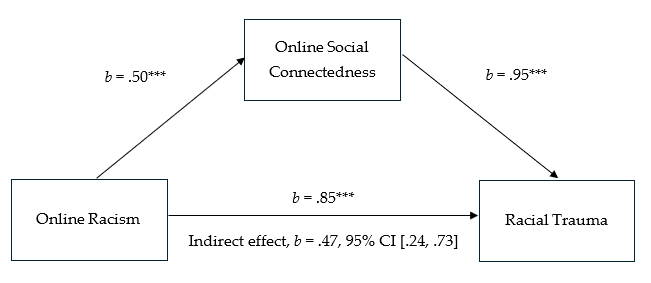
Note. Coefficients presented are unstandardized regression coefficients of direct effects. Confidence interval for the indirect effect is a bootstrapped confidence interval using 10,000 samples.
***p < .001.
Discussion
Prior and emerging literature has documented the significant impact of online racism on mental health and wellness, such as anxiety, depression, stress- and trauma-related symptoms, and psychological distress among children and adolescents (Del Toro & Wang, 2023; Thomas et al., 2023; Tynes et al., 2012) as well as emerging findings of psychological distress, substance use, suicidal ideation, anxiety, and depression among adults (Cano et al., 2021; Cavalhieri et al., 2024; Keum, 2022; Keum & Ahn, 2021; Keum & Cano, 2021; Keum et al., 2023; Keum & Hearns, 2021; Layug et al., 2022). This study sought to build upon these findings to determine if online racism exists as a racially traumatic stressor that may lead to the development of symptoms of racial trauma. Confirming our first hypothesis, the results of our study demonstrated that exposure to online racism was associated with increased racial trauma symptoms among participants. Thus, our findings indicate that such exposure contributes to emotional and psychological injury upon individuals’ racial identity. Our study aligns with emerging research on adults that has demonstrated exposure to racism via online communication and media as a traumatic stressor (Evans et al., 2024; Green et al., 2024; Maxie-Moreman & Tynes, 2022).
Our study builds upon existing research by highlighting that exposure to online racism may be experienced as racially traumatizing by PGM as well as by White individuals. Although not part of our primary research question and analysis, our regression analysis found no statistically significant difference in racial trauma between White and PGM participants. This finding should be interpreted with nuance given that White individuals do not experience racism as a function of white supremacy. Echoing findings from Carter, Roberson, and Johnson (2020) and Carter and Kirkinis (2021), White individuals’ quantitative endorsement of racial trauma from vicarious exposure to racism may be qualitatively different from experiences of PGM. Specifically, racial identity attitudes may play a role in how White individuals perceive racism and experience subsequent distress (Carter, Roberson, & Johnson, 2020). Prior research highlights that White individuals with greater racial awareness endorse fewer racial trauma symptoms despite reporting vicarious exposure to racism (Carter, Roberson, & Johnson, 2020). Moreover, White individuals with color-evasive racial attitudes may view White individuals as targets of online racism (Green et al., 2023). Thus, this finding may be best understood as being connected to racial attitudes that impact measurement of racial trauma symptoms rather than equating White and PGM participant experiences.
Our study also sought to examine the relationship and mediating role of social connectedness with online racism and racial trauma. Confirming our second hypothesis, we found that online social connectedness both significantly predicted racial trauma in our regression model and significantly mediated the relationship between online racism and racial trauma. These findings suggest that feeling disconnected in online contexts following exposure to online racism may relate to increased symptoms of racial trauma. Additionally, individuals who experience challenges in finding and maintaining connectedness and supportive communities with others may be at greater risk of developing racial trauma symptoms. This aligns with findings of suppression and social withdrawal following experiences of racialized cybervictimization (Evans et al., 2024). Conversely, our findings highlight that stronger social connectedness after exposure to online racism may relate to decreased racial trauma symptoms. These findings emphasize the value of resources like online counterspaces that may foster racial identity affirmation, sense of community, social support, and resistance to online racism (Case & Hunter, 2012; Gomez & Cabrera, 2025; Lopez-Leon & Casanova, 2023). In summary, this study highlights the important roles of online interactions, relationships, and communities as they relate to the racial trauma experienced following exposure to online racism.
Clinical Implications and Future Research
As discussed above, our study contributes to existing literature on online racism and symptoms of mental health and wellness. Findings from our study indicate that online racism may be experienced as a racially traumatic stressor. This is noted in participant scores for racial trauma (M = 78.40; SD = 20.63) being above the established clinical cut-off score of 48 (Williams et al., 2022). Thus, counselors should integrate experiences of online racism into assessment and interventions with adult clients, particularly at times when online racist content may be prevalent. This assessment and acknowledgement can incentivize counselors to focus on processing these traumatic experiences. For example, a counselor naming a client’s response as part of racial trauma can support validating their experiences following exposure. Moreover, this may also support client healing by attributing their intrapsychic racial trauma symptoms as responses to external racism while reducing the odds of internalizing racism (Adames et al., 2023). Likewise, counselors can focus on enhancing client social connectedness as a potential protective factor that may support reducing client experiences of self-blame and social withdrawal (Adames et al., 2023; Evans et al., 2024). Counselors may also consider supporting clients in developing digital hygiene to optimize self-care in their therapeutic work.
Considering the significance of social connectedness as a protective factor, counselors can advocate for clients experiencing racial trauma from online racism to actively participate in digital counterspaces that foster social connectedness (Gomez & Cabrera, 2025; Mosley et al., 2021). This may occur through traditional modalities of counseling such as group counseling via telehealth or other community-developed groups across social media platforms. Counselors may encourage client participation in such digital counterspaces during treatment to empower them to engage in community care as a compliment to self-care behaviors. Additionally, these client recommendations may aid in developing critical consciousness, a sense of belonging with others, and in developing resistance strategies despite experiences of online racism (Case & Hunter, 2012; Gomez & Cabrera, 2025; Lopez-Leon & Casanova, 2023). Beyond individual counseling, it is imperative that counselors engage in community-level advocacy in addressing online racism. For example, facilitating workshops, public education, and creating safe spaces in school or university settings may support vulnerable populations in building awareness around online racism and its impact. Such spaces can offer safety and validation of racial trauma experiences (Wright et al., 2023). Moreover, these spaces and events can provide critical insight toward preventing engagement in online racism and healing from its traumatic impact (Wright et al., 2023).
Lastly, counselors might consider ways to support the wellness of White clients who experience distress related to online racism. Counselors should emphasize development in White racial identity and coping practices to navigate vicarious exposure to racism online. This might include supporting White clients in reshaping their cognition of their adverse reactions toward a more critical understanding of white supremacy (Carter, Roberson, & Johnson, 2020). Counselors are encouraged to address color-evasive racial attitudes expressed by White clients during sessions to enhance critical consciousness in alignment with theory on radical healing (Adames et al., 2023; French et al., 2020; Green et al., 2023). Counselors should also encourage White clients who are struggling with their adverse reactions to online racism to build relationships with other White individuals to enhance social connectedness as it pertains to critical consciousness raising. Supporting White clients in appropriately attributing their adverse experiences may also aid in reducing online racism toward PGM. For example, a White client who experiences online backlash from engaging in online racism may attribute their adverse experience to reverse racism, resulting in further engagement in online racism (Green et al., 2023).
Future research may build upon our study by more specifically investigating the role of counterspaces as they relate to mental health, wellness, and exposure to online racism and other forms of online hate. Such research should consider the significance of qualitative methodologies to better understand the lived experiences of coping and resisting through social resources that may reduce the impact of online racism. Further quantitative research on the racial trauma of online racism might compare differences in coping between White and PGM populations to better understand ways for counselors to enhance support for those impacted by online racism. Additionally, it is important to examine online racism experienced by online racial justice activists who may be prone to such exposure. Such research might compare racial trauma symptoms experienced because of online and offline exposure to racism to identify ways in which counselors can support the wellness of those who engage in racial justice efforts via social media and other forms of digital technology. Lastly, future research might examine the impact of long-term exposure to racially traumatizing online content on mental health and wellness in order to better understand the transgenerational impact of online racism alongside advancements in digital technology. Such research might specifically study social, cognitive, and behavioral changes across the lifespan, particularly for parents of PGM children, adolescents, and emerging adults.
Limitations
One limitation of this study lies in its cross-sectional nature. Although the use of mediation analysis was used to better understand how exposure to online racism may result in decreased social connectedness that in turn increases racial trauma symptoms, the cross-sectional design does not allow for causal conclusions. As a result, it is unknown if lower or greater social connectedness reported by participants was preexisting or the result of exposure to online racism. Another limitation of the study lies in the sampling method. First, the use of MTurk as a platform to recruit participants likely introduced bias, particularly given the financial incentive for participants to complete the study. We attempted to mitigate some bias through use of two validity check items in the online survey; however, this may not have counteracted the potential for bias to influence participant data. In addition to the use of convenience sampling with monetary incentive, the use of a quota system introduced a bias in the results for White participants who completed the survey early on while PGM participants did not experience restrictions or any subsequent bias in participation. Although the quota was intended to limit the overrepresentation of White participants that may have occurred through sampling via MTurk, it also introduced uncontrolled bias into the results. Moreover, we did not include exposure to online racism or experiences of racial trauma as criteria in the recruitment process. Using a narrower sample would have been more consistent with the underlying theory of racial trauma and could produce different results. As a result, caution should be taken in generalizing this study’s findings. Future research might mitigate such bias by sampling from multiple sources, such as directly recruiting from social media platform users and groups, to better prevent issues of oversampling as it relates to racial identity.
Conclusion
Our study sought to expand emerging research on exposure to online racism by examining how it relates to racial trauma among adults. Moreover, our study contributed to this emerging research by highlighting the significance of online social connectedness as a mediating variable in the relationship between online racism and racial trauma. Our study indicates that online racism may exist as a racially traumatic stressor that is essential for counselors to attend to in clinical practice for clients who may be vulnerable to such exposure. Lastly, our findings suggest that enhancing sense of connectedness may be an avenue for supporting client wellness among those who experience racial trauma from online racism exposure.
Conflict of Interest and Funding Disclosure
The authors reported no conflict of interest
or funding contributions for the development
of this manuscript.
References
Adames, H. Y., Chavez-Dueñas, N. Y., Lewis, J. A., Neville, H. A., French, B. H., Chen, G. A., & Mosley, D. V. (2023). Radical healing in psychotherapy: Addressing the wounds of racism-related stress and trauma. Psychotherapy, 60(1), 39–50. https://doi.org/10.1037/pst0000435
American Psychiatric Association. (2022). Diagnostic and statistical manual of mental disorders (5th ed., text rev.).
Bliuc, A-M., Faulkner, N., Jakubowicz, A., & McGarty, C. (2018). Online networks of racial hate: A systematic review of 10 years of research on cyber-racism. Computers in Human Behavior, 87, 75–86.
https://doi.org/10.1016/j.chb.2018.05.026
Cano, M. Á., Schwartz, S. J., MacKinnon, D. P., Keum, B. T., Prado, G., Marsiglia, F. F., Salas-Wright, C. P., Cobb, C. L., Garcini, L. M., De La Rosa, M., Sánchez, M., Rahman, A., Acosta, L. M., Roncancio, A. M., & de Dios, M. A. (2021). Exposure to ethnic discrimination in social media and symptoms of anxiety and depression among Hispanic emerging adults: Examining the moderating role of gender. Journal of Clinical Psychology, 77(3), 571–586. https://doi.org/10.1002/jclp.23050
Carter, R. T. (2007). Racism and psychological and emotional injury: Recognizing and assessing race-based traumatic stress. The Counseling Psychologist, 35(1), 13–105. https://doi.org/10.1177/0011000006292033
Carter, R. T., & Kirkinis, K. (2021). Differences in emotional responses to race-based trauma among Black and White Americans. Journal of Aggression, Maltreatment, & Trauma, 30(7), 889–906.
https://doi.org/10.1080/10926771.2020.1759745
Carter, R. T., Kirkinis, K., & Johnson, V. E. (2020). Relationships between trauma symptoms and race-based traumatic stress. Traumatology, 26(1), 11–18. https://doi.org/10.1037/trm0000217
Carter, R. T., Mazzula, S., Victoria, R., Vazquez, R., Hall, S., Smith, S., Sant-Barket, S., Forsyth, J., Bazelais, K., & Williams, B. (2013). Initial development of the Race-Based Traumatic Stress Symptom Scale: Assessing the emotional impact of racism. Psychological Trauma: Theory, Research, Practice, and Policy, 5(1), 1–9. https://doi.org/10.1037/a0025911
Carter, R. T., Roberson, K., & Johnson, V. E. (2020). Race-based stress in White adults: Exploring the role of White racial identity status attitudes and type of racial events. Journal of Multicultural Counseling & Development, 48(2), 95–107. https://doi.org/10.1002/jmcd.12168
Case, A. D., & Hunter, C. D. (2012). Counterspaces: A unit of analysis for understanding the role of settings in marginalized individuals’ adaptive responses to oppression. American Journal of Community Psychology, 50(1–2), 257–270. https://doi.org/10.1007/s10464-012-9497-7
Cavalhieri, K. E., Greer, T. M., Hawkins, D., Choi, H., Hardy, C., & Heavner, E. (2024). The effects of online and institutional racism on the mental health of African Americans. Cultural Diversity & Ethnic Minority Psychology, 30(3), 476–486. https://doi.org/10.1037/cdp0000585
Cohen, J., Cohen, P., West, S. G., & Aiken, L. S. (2003). Applied multiple regression/correlation analysis for the behavioral sciences (3rd ed). Lawrence Erlbaum.
Comas-Díaz, L., Hall, G. N., & Neville, H. A. (2019). Racial trauma: Theory, research, and healing: Introduction to the special issue. American Psychologist, 74(1), 1–5. https://doi.org/10.1037/amp0000442
Del Toro, J., & Wang, M.-T. (2023). Online racism and mental health among Black American adolescents in 2020. Journal of the American Academy of Child & Adolescent Psychiatry, 62(1), 25–36. https://doi.org/10.1016/j.jaac.2022.07.004
Evans, A. M., Chalk, S., Green, D., Hornsby, T., Ramsay-Seaner, K., & Haskins, R. (2024). Cyberbullying as a method of discrimination among people of color: An interpretative phenomenological analysis. Wisconsin Counseling Journal, 37, 26–46.
French, B. H., Lewis, J. A., Mosley, D. V., Adames, H. Y., Chavez-Dueñas, N. Y., Chen, G. A., & Neville, H. A. (2020). Toward a psychological framework of radical healing in communities of color. The Counseling Psychologist, 48(1), 14–46. https://doi.org/10.1177/0011000019843506
Fulmer, R. (2024). A primer on how AI algorithms control you. Journal of Technology in Counselor Education and Supervision, 5(2), Article 1. https://doi.org/10.61888/2692-4129.1098
Gelles-Watnick, R. (2024). Americans’ use of mobile technology and home broadband. Pew Research Center. www.pewresearch.org/internet/2024/01/31/americans-use-of-mobile-technology-and-home-broadband
Gomez, V., & Cabrera, J. (2025). Theorizing virtual counterspaces: How Latina graduate students build community online. Race Ethnicity and Education, 28(7), 1105–1121. https://doi.org/10.1080/13613324.2023.2292509
Gottfried, J. (2024). Americans’ social media use. Pew Research Center. https://www.pewresearch.org/internet/2024/01/31/americans-social-media-use
Green, D. A., Dockery, G. N., & Williams, B. A. (2023). Cyber racism in counseling cyberspaces. Journal of Multicultural Counseling and Development, 51(3), 195–207. https://doi.org/10.1002/jmcd.12276
Green, D. A., Evans, A. M., Litam, S. D. A., Hornsby, T., Boulden, R., Shannon, J., Ford, D. J., & Landrum, D. (2024). Racial identity attitudes and vicarious traumatization from undue police violence on anticipatory traumatic reaction among Black Americans. Journal of Interpersonal Violence, 39(3–4), 848–868. https://doi.org/10.1177/08862605231198484
Hayes, A. F. (2018). Introduction to mediation, moderation, and conditional process analysis: A regression-based approach (2nd ed.). Guilford.
Hemmings, C., & Evans, A. M. (2018). Identifying and treating race-based trauma in counseling. Journal of Multicultural Counseling and Development, 46(1), 20–39. https://doi.org/10.1002/jmcd.12090
Hill, M. L. (2018). “Thank you, Black Twitter”: State violence, digital counterpublics, and pedagogies of resistance. Urban Education, 53(2), 286–302. https://doi.org/10.1177/0042085917747124
Holmes, S. C., Zare, M., Haeny, A. M., & Williams, M. T. (2024). Racial stress, racial trauma, and evidence-based strategies for coping and empowerment. Annual Review of Clinical Psychology, 20, 77–95.
https://doi.org/10.1146/annurev-clinpsy-081122-020235
Jones, N., Marks, R., Ramirez, R., & Ríos-Vargas, M. (2021, August 12). 2020 census illuminates racial and ethnic composition of the country. United States Census Bureau. https://www.census.gov/library/stories/2021/08/improved-race-ethnicity-measures-reveal-united-states-population-much-more-multiracial.html
Keum, B. T. (2017). Qualitative examination on the influences of the internet on racism and its online manifestation. International Journal of Cyber Behavior, Psychology and Learning, 7(3), 13–22.
https://doi.org/10.4018/IJCBPL.2017070102
Keum, B. T. (2021). Development and validation of the Perceived Online Racism Scale short form (15 items) and very brief (six items). Computers in Human Behavior Reports, 3, 100082. https://doi.org/10.1016/j.chbr.2021.100082
Keum, B. T. (2022). Impact of online racism on suicide ideation through interpersonal factors among racial minority emerging adults: The role of perceived burdensomeness and thwarted belongingness. Journal of Interpersonal Violence, 38(5–6), 4537–4561. https://doi.org/10.1177/08862605221117247
Keum, B. T., & Ahn, L. H. (2021). Impact of online racism on psychological distress and alcohol use severity: Testing ethnic-racial socialization and silence about race as moderators. Computers in Human Behaviors, 120, 106773. https://doi.org/10.1016/j.chb.2021.106773
Keum, B. T., & Cano, M. Á. (2021). Online racism, psychological distress, and alcohol use among racial minority women and men: A multi-group mediation analysis. American Journal of Orthopsychiatry, 91(4), 524–530. https://doi.org/10.1037/ort0000553
Keum, B. T., Cano, M. Á., Valdovinos, I. C., & Boland, D.-z. (2023). Impact of online and offline racism on cigarette smoking, marijuana use, and vaping via depressive/anxiety symptoms among racially minoritized emerging adults. American Journal of Orthopsychiatry, 93(5), 450–459. https://doi.org/10.1037/ort0000691
Keum, B. T., & Hearns, M. (2021). Online gaming and racism: Impact on psychological distress among Black, Asian, and Latinx emerging adults. Games and Culture, 17(3), 445–460. https://doi.org/10.1177/15554120211039082
Keum, B. T., & Miller, M. J. (2017). Racism in digital era: Development and initial validation of the Perceived Online Racism Scale (PORS v1.0). Journal of Counseling Psychology, 64(3), 310–324. http://doi.org/10.1037/cou0000205
Layug, A., Krishnamurthy, S., McKenzie, R., & Feng, B. (2022). The impacts of social media use and online racial discrimination on Asian American mental health: Cross-sectional survey in the United States during COVID-19. JMIR Formative Research, 6(9), e38589. https://doi.org/10.2196/38589
Lee, R. M., & Robbins, S. B. (1995). Measuring belongingness: The Social Connectedness and the Social Assurance scales. Journal of Counseling Psychology, 42(2), 232–241. https://doi.org/10.1037/0022-0167.42.2.232
Lopez-Leon, G., & Casanova, S. (2023). “Those are the spaces where I feel seen and fully understood”: Digital counterspaces fostering community, resistance, and intersectional identities among Latinx LGBTQ+ emerging adults. Journal of Adolescent Research, 40(2), 331–360. https://doi.org/10.1177/07435584231165993
Maxie-Moreman, A. D., & Tynes, B. M. (2022). Exposure to online racial discrimination and traumatic events online in Black adolescents and emerging adults. Journal of Research on Adolescence, 32(1), 254–269. https://doi.org/10.1111/jora.12732
Mosley, D. V., Hargons, C. N., Meiller, C., Angyal, B., Wheeler, P., Davis, C., & Stevens-Watkins, D. (2021). Critical consciousness of anti-Black racism: A practical model to prevent and resist racial trauma. Journal of Counseling Psychology, 68(1), 1–16. https://doi.org/10.1037/cou0000430
Mosley, D. V., Neville, H. A., Chavez-Dueñas, N. Y., Adames, H. Y., Lewis, J. A., & French, B. H. (2020). Radical hope in revolting times: Proposing a culturally relevant psychological framework. Social and Personality Psychology Compass, 14(1), Article e12512. https://doi.org/10.1111/spc3.12512
Nasereddin, S. (2023). Impact of social media platforms on international public opinion during the Israel war on Gaza. Global Change, Peace & Security, 35(1), 5–31. https://doi.org/10.1080/14781158.2024.2415908
Ong, M., Smith, J. M., & Ko, L. T. (2018). Counterspaces for women of color in STEM higher education: Marginal and central spaces for persistence and success. Journal of Research in Science Teaching, 55(2), 206–245. https://doi.org/10.1002/tea.21417
Pew Research Center. (2024). Mobile fact sheet. https://www.pewresearch.org/internet/fact-sheet/mobile
Rudnicki, K., Vandebosch, H., Voué, P., & Poels, K. (2023). Systematic review of determinants and consequences of bystander interventions in online hate and cyberbullying among adults. Behaviour & Information Technology, 42(5), 527–544. https://doi.org/10.1080/0144929X.2022.2027013
Sheikh, I. S., Alsubaie, M. K., Dolezal, M. L., Walker, R. S., Rosencrans, P. L., Peconga, E., Holloway, A., Bentley, J. A., & Zoellner, L. A. (2022). The role of social connectedness in buffering the effects of discrimination on post-trauma cognitions in forcibly displaced Muslims. Psychological Trauma: Theory, Research, Practice, & Policy, 14(1), 47–54. https://doi.org/10.1037/tra0001070
Tabachnick, B. G., & Fidell, L. S. (2019). Using multivariate statistics (7th ed). Pearson.
Thomas, A., Gale, A., & Golden, A. R. (2023). Online racial discrimination, critical consciousness, and psychosocial distress among Black and Latino adolescents: A moderated mediation model. Journal of Youth & Adolescence, 52(5), 967–979. https://doi.org/10.1007/s10964-022-01732-z
Tynes, B. M., Umaña-Taylor, A. J., Rose, C. A., Lin, J., & Anderson, C. J. (2012). Online racial discrimination and the protective function of ethnic identity and self-esteem for African American adolescents. Developmental Psychology, 48(2), 343–355. https://doi.org/10.1037/a0027032
Tynes, B. M., Willis, H. A., Stewart, A. M., & Hamilton, M. W. (2019). Race-related traumatic events online and mental health among adolescents of color. Journal of Adolescent Health, 65(3), 371–377.
https://doi.org/10.1016/j.jadohealth.2019.03.006
Volpe, V. V., Hoggard, L. S., Willis, H. A., & Tynes, B. M. (2021). Anti-Black structural racism goes online: A conceptual model for racial health disparities research. Ethnicity & Disease, 31(Suppl 1), 311–318.
https://ethndis.org/supplementarchive/files/ethndis-31-311.pdf
Williams, M. T., Metzger, I. W., Leins, C., & DeLapp, C. (2018). Assessing racial trauma within a DSM–5 framework: The UConn Racial/Ethnic Stress & Trauma Survey. Practice Innovations, 3(4), 242–260. https://doi.org/10.1037/pri0000076
Williams, M. T., Osman, M., Gallo, J., Pereira, D. P., Gran-Ruaz, S., Strauss, D., Lester, L., George, J. R., Edelman, J., & Litman, L. (2022). A clinical scale for the assessment of racial trauma. Practice Innovations, 7(3), 223–240. https://doi.org/10.1037/pri0000178
Wong, B. (2023). Top social media statistics and trends. Forbes Advisor. https://www.forbes.com/advisor/business/social-media-statistics
Wright, W., Hatchett Stover, J., & Brown-Rice, K. (2023). Understanding racial trauma: Implications for professional counselors. The Professional Counselor, 13(1), 17–26. https://doi.org/10.15241/ww.13.1.17
Darius A. Green, PhD, NCC, LPCC, is an assistant professor at Bowie State University. Kade Stanzilis, MA, LPCC, is a graduate researcher at the University of Colorado Colorado Springs. Sierra Roach-Coye, MSW, LSW, is a doctoral candidate at Denver University. Connor Sullivan, MA, LPCC, is a graduate researcher at the University of Colorado Colorado Springs. Correspondence may be addressed to Darius A. Green, Department of Counseling and Psychological Studies, Bowie State University, 14000 Jericho Park Road, Bowie, MD, 20715, dgreen2@bowiestate.edu.