Dec 16, 2020 | Volume 10 - Issue 4
William H. Snow, Thomas A. Field
This lead article introduces a special issue of The Professional Counselor designed to inform and support faculty, staff, and administrative efforts in starting or revitalizing doctoral degree programs in counselor education and supervision. We review the 14 studies that make up this issue and summarize their key findings. Seven key themes emerged for faculty and staff to consider during program development: (a) the current state of research, (b) doctoral program demographics and distribution, (c) defining quality, (d) mentoring and gatekeeping, (e) increasing diversity, (f) supporting dissertation success, and (g) gaining university administrator support. We recognize the vital contribution of these articles to doctoral counselor education and supervision program development while also highlighting future directions for research emerging from this collection.
Keywords: doctoral, counselor education and supervision, research, quality, diversity
This special issue of The Professional Counselor features 14 articles on doctoral counselor education and supervision (CES) to inform and support faculty, staff, and administrative efforts in starting or revitalizing doctoral degree programs in CES. In this introductory paper, we begin by providing context for the special issue’s focus on doctoral CES programs. We then reflect on the series of articles in this special issue that collectively address a myriad of topics pertinent to high-quality doctoral programs in CES. We further suggest critical themes and principles for faculty and administrators to follow when starting and operating doctoral counselor education programs and for students to reflect on when selecting a doctoral counselor education program. In our conclusion, we offer future directions for research emerging from the contributions to this special issue.
Doctoral CES Programming in Context
The CES doctorate is an increasingly sought-after degree. From 2012 to 2018, the number of CES doctoral programs accredited by the Council for Accreditation of Counseling and Related Educational Programs (CACREP) increased by 50%, with a 43.8% increase in student enrollment (CACREP, 2013, 2019). At the time of writing, there are now 84 CACREP-accredited doctoral programs (CACREP, n.d.). These CACREP-accredited doctoral programs have nearly 3,000 enrolled students and produce almost 500 doctoral graduates each year (CACREP, 2019). Doctoral study within counselor education prepares leaders for the profession (Adkinson-Bradley, 2013; West et al., 1995).
For over 70 years, the allied mental health professions, including counseling, were heavily influenced by psychology’s scientist–practitioner (aka Boulder) model of the 1940s (Baker & Benjamin, 2000), the scholar–practitioner model of the 1970s (Kaslow & Johnson, 2014), and the lesser-known clinical–scientist model of the 1990s (Stricker & Trierweiler, 2006).
In contrast to psychology, the purpose of doctoral counselor education was never to train entry-level clinicians. Instead, it has historically been to prepare counseling professionals to become counselor educators and advanced supervisors to train entry-level clinicians at the master’s level (West et al., 1995; Zimpfer et al., 1997). Counseling has needed to develop its own model(s) for effective doctoral education. Yet, relatively little literature exists to inform the development and implementation of doctoral programs within counselor education.
This special issue represents a concerted effort to address that knowledge gap. Research teams consisting of 46 counselor educators and student researchers from across the country answered the call with findings from 14 studies that we have organized under seven themes and related critical questions. The collective research provides invaluable information for anyone desiring to initiate, develop, and sustain a high-quality CES doctoral program on their campus. The following is a summary of the key themes, organizing questions, and findings.
Key Themes, Questions, and Findings
In preparation for this special issue, The Professional Counselor put out a call for papers with no restrictions on covered topics. The request simply asked authors to submit their scholarly contributions to a special issue on doctoral counselor education. Those accepted for the special issue fell naturally into one of the following seven themes: (a) the current state of research, (b) doctoral program demographics and distribution, (c) defining quality, (d) mentoring and gatekeeping, (e) increasing diversity, (f) supporting dissertation success, and (g) gaining university administrator support.
The Current State of Research
Research on the preparation of doctoral-level counselor educators shaped the first theme. Litherland and Schulthes (2020) conducted a thorough literature review in their paper, “Research Focused on Doctoral-Level Counselor Education: A Scoping Review.” They examined peer-reviewed articles published on the topic from 2005 to 2019 found in the PubMed, ERIC, GaleOneFile, and PsycINFO databases. After initially retrieving nearly 10,000 citations, they found only 39 studies met their inclusion criteria, an average of less than three published studies per year. Their work suggests the need for a long-term research strategy and plans to advance CES program development. The studies comprising this special issue begin to address some of that void by adding 14 peer-reviewed articles to the 39 Litherland and Schulthes already found, a significant increase in just a single publication in one year.
Doctoral Program Demographics and Distribution
The current number and location of CACREP-accredited doctoral programs relative to present and future demands for graduates to serve our master’s programs or the CES doctoral pipeline is the essence of the second theme. Field et al. (2020), in “The Pipeline Problem in Doctoral Counselor Education and Supervision,” analyzed regional distributions of existing doctoral programs. Despite recent growth in the number of doctoral programs, they found a significant difference in the number of CACREP-accredited doctoral programs by region. For example, the Western United States has the largest ratio of counseling master’s degree programs to doctoral programs (18:1), with only two doctoral and 35 master’s programs with CACREP accreditation in a region with nearly 64 million inhabitants. The data demonstrate a greater need for more CES doctoral programs in certain geographical regions. Without developing new CES programs accessible in regions with few doctoral degree options, a pipeline problem may persist whereby demand surpasses supply. This pipeline problem may result in some master’s programs struggling to hire faculty in regions with fewer doctoral programs, as prior studies have found that geographic location is a key reason why candidates accept faculty positions (Magnuson et al., 2001).
Defining Quality
The third theme centers on how to define high quality in CES doctoral education. Four studies in this special issue were aimed at exploring questions of quality doctoral counselor education in depth. Areas of investigation included program components, preparation for teaching and research, and promoting a research identity among students.
High-Quality Doctoral Programs
Preston et al. (2020) examined this theme in “Components of a High-Quality Doctoral Program in Counselor Education and Supervision.” Their qualitative study of 15 CES faculty revealed five critical indicators of program quality: (a) supportive faculty–student and student–student relationships; (b) a clearly defined mission that is supported by the counseling faculty and in alignment with the broader university mission; (c) development of a counselor educator identity with formal curricular experiences in teaching, research, and service; (d) a diversity orientation in all areas, including the cultural diversity of faculty and students, as well as a variety of experiences; and (e) reflection of the Carnegie classification of its institution, as aligned with its mission and level of support.
These findings on the components of a high-quality CES doctoral program are useful to multiple audiences. Faculty engaged in doctoral program development can use this as a partial checklist to ensure they are building quality components into what they are proposing. Faculty of existing programs can use these findings as a self-check for reviewing and improving their quality. Finally, potential doctoral students can use these five critical indicators of quality to inform their program search.
Quality Teaching Preparation
Teaching is a significant activity of faculty. Despite its importance, at least one recent study (Waalkes et al., 2018) found a lack of emphasis and rigor in graduate student training. Baltrinic and Suddeath (2020) conducted a study on the components of quality teacher preparation to inform preparation efforts. Their article, “A Q Methodology Study of a Doctoral Counselor Education Teaching Instruction Course,” found three broad critical factors of teacher preparation: course design, preparation for future faculty roles, and a focus on instructor qualities and intentionality in their communications. Most interesting are the practices they found were of less value yet commonly utilized in programs across the country. A detailed read of their study will likely challenge some of the activities currently deemed to be best practices.
Quality Research and Scholarship
The ability of doctoral graduates to demonstrate research and scholarship prowess is critical in their competitiveness in securing top faculty positions. In a prior study on faculty hiring by Bodenhorn and colleagues (2014), over half of faculty position announcements asked for demonstrated research potential. How we prepare students for their role in generating knowledge for the profession was an area of preparation addressed by Limberg et al. (2020). They suggest in their article, “Research Identity Development of Counselor Education Doctoral Students: A Grounded Theory,” that programs need to have strong faculty research mentors. Faculty who can involve students experientially in their research are more apt to instill a robust research identity and sense of self-efficacy in their doctoral students. Limberg et al. also offer other practical steps programs can take to increase research-oriented outcomes in their graduates.
In their article titled “Preparing Counselor Education and Supervision Doctoral Students Through an HLT Lens: The Importance of Research and Scholarship,” Brown et al. (2020) examined CES faculty publication trends from 2008 to 2018 from 396 programs. They found that although programs from Carnegie-classified R1 and R2 universities accounted for nearly 70% of the research, 30% was produced by faculty from doctoral/professional universities (D/PU) and master’s programs (M1). There is clear evidence that research is essential for all counselor education faculty, no matter the Carnegie level at which their university is classified.
Mentoring and Gatekeeping
The fourth theme pertains to how CES doctoral faculty can best serve as mentors and gatekeepers, as well as educate and train doctoral students to help in that same role when they graduate and become faculty in other institutions. Given the importance of the professional relationship in counseling (Kaplan et al., 2014), relationship building would seem to be a natural part of the mentoring and advising experience. Dipre and Luke (2020) advocate for such an advising model in their article, “Relational Cultural Theory–Informed Advising in Counselor Education.” Kent et al. (2020) provide further guidelines for a more specialized student population in their article, “Mentoring Doctoral Student Mothers in Counselor Education: A Phenomenological Study.”
Mentoring and advising are generally rewarding experiences as we prepare the next generation of leaders in the profession, but at times the conversations we need to have are challenging and tough. DeCino et al. (2020) provide an important view to an often-stressful component of advising with their article, “‘They Stay With You’: Counselor Educators’ Emotionally Intense Gatekeeping Experiences.” Their work uncovered five powerful sets of issues for faculty advisors to consider, including the early warning signs to look for, elevated student misconduct, the trauma of student dismissal, the stress of involvement in legal interactions, and the changes that occur from such experiences. Their article is a must-read for any new faculty mentor or advisor.
Many of the students we mentor and advise will assume similar roles as faculty members and confront the issues above. Freeman et al. (2020) provide a model and exploratory data in “Teaching Gatekeeping to Doctoral Students: A Qualitative Study of a Developmental Experiential Approach.” Intentional integration of gatekeeping training is essential to preparing future faculty for their duties as faculty advisors and mentors.
Increasing Diversity
The fifth theme encompasses research on what changes to the structure of programs are needed to establish more diverse CES doctoral learning communities. There is a need for more doctoral graduates in CES, but more importantly, we need more graduates and faculty from culturally diverse backgrounds. The 2016 CACREP Standards (2015) emphasized this in requiring accredited programs to engage in a “continuous and systematic effort to attract, enroll, and retain a diverse group of students and to create and support an inclusive learning community” (Standard 1.K.). CACREP sets the standard to be met, but programs are often at a loss as to what is most effective.
Ju et al. (2020) generated findings to help guide faculty in the most effective strategies in “Recruiting, Retaining, and Supporting Students From Underrepresented Racial Minority Backgrounds in Doctoral Counselor Education.” They suggest that faculty must prioritize getting involved with students from the onset of recruiting and staying engaged through the student’s program completion. The involvement needs to be personalized, which requires a robust faculty–student connection. Another principle they espouse is that faculty need to value the cultural identity of diverse students and help to connect them to that identity. Faculty can better foster this connection when they share their own cultural identity, encourage students to express their uniqueness, and share research interests connected to their cultural identity. Ju et al. also remind us that diverse students are more than members of a cultural group—they desire individual mentorship and support tailored to their specific needs. Finally, faculty are encouraged to work with diverse students to address multicultural and social justice issues at the institution and in the profession. If the principles derived from this article are sincerely applied, they will likely go a long way to promoting a more culturally sensitive academic culture.
Many doctoral programs are under-resourced, and funding to increase diversity is often hard to come by. Branco and Davis (2020) provide insight on a significant financial and mentoring support program for diverse students funded by the Substance Abuse and Mental Health Services Administration and administered by the National Board for Certified Counselors in their article, “The Minority Fellowship Program: Promoting Representation Within Counselor Education and Supervision.” Their study found that although the scholarship funds were helpful, students also appreciated the program’s networking, cohort model, and mentorship. This program has successfully aided in the graduation of 158 doctoral students to date who will go on to serve their diverse communities.
Supporting Dissertation Success
The sixth theme is grounded in helping students complete their dissertation and avoid becoming an “all but dissertation” (ABD) statistic. This concern is critical, as the doctoral completion rate across all disciplines is only 57% (Neale-McFall & Ward, 2015). It is unclear if CES doctoral programs do any better or worse than other disciplines, and up until now, there has been a dearth of research on how to improve the odds of a student finishing their doctoral program (Purgason et al., 2016).
Ghoston et al. (2020) provide informed guidance in their article “Faculty Perspectives on Strategies for Successful Navigation of the Dissertation Process in Counselor Education.” Five principles for how to support dissertation completion effectively emerged from their research: (a) program mechanics with structured curriculum and processes with a dissertation focus from the outset; (b) a supportive environment with solid mentoring and feedback tailored to the style and needs of the individual student; (c) selecting and working with cooperative, helpful, and productive dissertation committee members; (d) intentionality in developing a scholar identity to include a research and methodological focus; and (e) regular accountability and contact in supporting a student’s steady progress toward the final dissertation writing and defense. Programs attentive to all five factors cannot guarantee dissertation completion on time, but they can certainly increase the probability of student success.
Gaining University Administrator Support
It is critical to have the support of university administrators who set priorities, allocate resources, and ultimately determine if a new degree program proposal lives or dies. Administrators who give their stamp of approval and invest resources will want to see evidence of success to commit to ongoing support. The seventh and final theme entails how to collaborate with administrators in supporting our doctoral programs. Scherer et al. (2020) provide keen analysis and insights into this issue in “Gaining Administrative Support for Doctoral Programs in Counselor Education.” They caution faculty that before embarking down the path of program development, there are many issues involved that faculty generally are not accustomed to considering.
First, higher education administration has a certain amount of politics involved, and faculty need to remain aware of the political minefields they may be entering. Understanding and navigating university organizational dynamics and cultivating buy-in from the broader university constituency is a critical skill. Second, the payoff for such an endeavor may not be self-evident, so faculty must demonstrate how a new doctoral program fits the university’s mission, helps local communities and the profession, and ultimately raises the university’s prestige and reputation. Third, program leadership must establish credibility and gain the administration’s confidence that counseling faculty have the intellectual capital and expertise to educate, train, and graduate high-quality doctoral graduates. This article is an essential read for anyone planning to start or revitalize a program.
Future Directions
The 14 studies contained in this special issue represent a vital contribution to doctoral counselor education, yet important questions remain. We highlight four important directions to help guide future research.
First, there is a need to promote a more focused, systematic, ongoing agenda for the scholarship of doctoral counselor education. This special issue is an important first step, but leadership is needed to continue the effort. It is unclear how stakeholders such as CACREP, professional associations, doctoral program faculty, and editorial boards of peer-reviewed journals may build on and initiate efforts to promote scholarship in this area. It may be that a unified and intentional approach is key to ensuring that research proceeds in a strategic and methodical fashion and moves the profession steadily forward.
Second, we need to better understand how the advent of online programs is shaping the landscape of doctoral education. Based upon the findings in this special issue, we know residential doctoral programs are not distributed evenly across the country, but does it really matter if there is now an online option for all students? It is important to understand how potential employers now perceive online graduates and how potential doctoral students perceive online programs as acceptable alternatives to a brick-and-mortar campus experience.
Third, the important work of this journal’s special issue in promoting high-quality outcomes in doctoral education should continue. Current descriptions of quality rely heavily on expert faculty opinions and judgments. We need to evaluate how these suggested best practices actually translate into more empirical outcomes, such as student satisfaction and retention, dissertation pass rates, job-seeking success, and post-degree productivity. Future studies can also benefit from larger sample sizes and broader representation from more programs to increase the generalizability of findings.
Finally, the work of better understanding and improving the student experience—especially that of students from culturally diverse backgrounds and identities—is critical. This special issue strikes a good balance with six student-oriented articles and two focused on helping programs recruit, retain, and support students from underrepresented minority backgrounds, but we have more yet to do. The work must continue until the words “underrepresented minority” are a thing of the past and we have doctoral student cohorts that truly reflect the diversity of our world.
Conclusion
As we conclude our introduction to this special issue on doctoral education, we are grateful for the contribution of the 14 studies and their authors. We now know more about the state of research in the profession, potential geographic gaps in program coverage, how to define and improve program quality, strategies to gain administrative support, and most importantly how to best increase diversity and promote student success. We hope that the combined insights in the assembled studies will help inform CES doctoral programming and contribute to a focused research agenda for years to come. We look forward to revisiting this first CES special issue in the future to observe its influence and the positive outcomes we trust will follow.
Conflict of Interest and Funding Disclosure
The authors reported no conflict of interest
or funding contributions for the development
of this manuscript.
References
Adkinson-Bradley, C. (2013). Counselor education and supervision: The development of the CACREP doctoral standards. Journal of Counseling & Development, 91(1), 44–49. https://doi.org/10.1002/j.1556-6676.2013.00069.x
Baker, D. B., & Benjamin, L. T., Jr. (2000). The affirmation of the scientist-practitioner: A look back at Boulder. American Psychologist, 55(2), 241–247. https://doi.org/10.1037/0003-066X.55.2.241
Baltrinic, E. R., & Suddeath, E. G. (2020). A Q methodology study of a doctoral counselor education teaching instruction course. The Professional Counselor, 10(4), 472–487. https://doi.org/10.15241/erb.10.4.472
Bodenhorn, N., Hartig, N., Ghoston, M. R., Graham, J., Lile, J. J., Sackett, C., & Farmer, L. B. (2014). Counselor education faculty positions: Requirements and preferences in CESNET announcements 2005-2009. The Journal of Counselor Preparation and Supervision, 6(1). https://repository.wcsu.edu/jcps/vol6/iss1/2
Branco, S. F., & Davis, M. (2020). The Minority Fellowship Program: Promoting representation within counselor education and supervision. The Professional Counselor, 10(4), 603–614. https://doi.org/10.15241/sfb.10.4.603.
Brown, C. L., Vajda, A. J., & Christian, D. D. (2020). Preparing counselor education and supervision doctoral students through an HLT lens: The importance of research and scholarship. The Professional Counselor, 10(4), 501–516. https://doi.org/10.15241/clb.10.4.501.
Council for Accreditation of Counseling and Related Educational Programs. (n.d.). Find a program. Retrieved November 23, 2019, from https://www.cacrep.org/directory
Council for Accreditation of Counseling and Related Educational Programs. (2013). 2012 annual report. http://www.cacrep.org/wp-content/uploads/2019/05/CACREP-2012-Annual-Report.pdf
Council for Accreditation of Counseling and Related Educational Programs. (2015). 2016 CACREP standards. https://www.cacrep.org/for-programs/2016-cacrep-standards
Council for Accreditation of Counseling and Related Educational Programs. (2019). Annual report 2018. http://www.cacrep.org/wp-content/uploads/2019/05/CACREP-2018-Annual-Report.pdf
DeCino, D. A., Waalkes, P. L., & Dalbey, A. (2020). “They stay with you”: Counselor educators’ emotionally intense gatekeeping experiences. The Professional Counselor, 10(4), 548–561. https://doi.org/10.15241/dad.10.4.548.
Dipre, K. A., & Luke, M. (2020). Relational cultural theory–informed advising in counselor education. The Professional Counselor, 10(4), 517–531. https://doi.org/10.15241/kad.10.4.517.
Field, T. A., Snow, W. H., & Hinkle, J. S. (2020). The pipeline problem in doctoral counselor education and supervision. The Professional Counselor, 10(4), 434–452. https://doi.org/10.15241/taf.10.4.434
Freeman, B., Woodliff, T., & Martinez, M. (2020). Teaching gatekeeping to doctoral students: A qualitative study of a developmental experiential approach. The Professional Counselor, 10(4), 562–580.
https://doi.org/10.15241/bf.10.4.562.
Ghoston, M., Grimes, T., Grimes, J., Graham, J., & Field, T. A. (2020). Faculty perspectives on strategies for successful navigation of the dissertation process in counselor education. The Professional Counselor, 10(4), 615–631. https://doi.org/10.15241/mg.10.4.615.
Ju, J., Merrell-James, R., Coker, J. K., Ghoston, M., Casado Pérez, J. F., & Field, T. A. (2020). Recruiting, retaining, and supporting students from underrepresented racial minority backgrounds in doctoral counselor education. The Professional Counselor, 10(4), 581–602. https://doi.org/10.15241/jj.10.4.581.
Kaplan, D. M., Tarvydas, V. M., & Gladding, S. T. (2014). 20/20: A vision for the future of counseling: The new consensus definition of counseling. Journal of Counseling & Development, 92(3), 366–372.
https://doi.org/10.1002/j.1556-6676.2014.00164.x
Kaslow, N. J., & Johnson, W. B. (Eds.). (2014). The Oxford handbook of education and training in professional psychology. Oxford University Press. https://doi.org/10.1093/oxfordhb/9780199874019.001.0001
Kent, V., Runyan, H., Savinsky, D., & Knight, J. (2020). Mentoring doctoral student mothers in counselor education: A phenomenological study. The Professional Counselor, 10(4), 532–547. https://doi.org/10.15241/vk.10.4.532.
Limberg, D., Newton, T., Nelson, K., Barrio Minton, C. A., Super, J. T., & Ohrt, J. (2020). Research identity development of counselor education doctoral students: A grounded theory. The Professional Counselor, 10(4), 488–500. https://doi.org/10.15241/dl.10.4.488.
Litherland, G., & Schulthes, G. (2020). Research focused on doctoral-level counselor education: A scoping review. The Professional Counselor, 10(4), 414–433. https://doi.org/10.15241/gl.10.4.414
Magnuson, S., Norem, K., & Haberstroh, S. (2001). New assistant professors of counselor education: Their preparation and their induction. Counselor Education and Supervision, 40(3), 220–229.
https://doi.org/10.1002/j.1556-6978.2001.tb01254.x
Neale-McFall, C., & Ward, C. A. (2015). Factors contributing to counselor education doctoral students’ satisfaction with their dissertation chairperson. The Professional Counselor, 5(1), 185–194. https://doi.org/10.15241/cnm.5.1.185
Preston, J., Trepal, H., Morgan, A., Jacques, J., Smith, J. D., & Field, T. A. (2020). Components of a high-quality doctoral program in counselor education and supervision. The Professional Counselor, 10(4), 453–471. https://doi.org/10.15241/jp.10.4.453
Purgason, L. L., Avent, J. R., Cashwell, C. S., Jordan, M. E., & Reese, R. F. (2016). Culturally relevant advising: Applying relational-cultural theory in counselor education. Journal of Counseling & Development, 94(4), 429–436. https://doi.org/10.1002/jcad.12101
Scherer, R., Moro, R., Jungersen, T., Contos, L., & Field, T. A. (2020). Gaining administrative support for doctoral programs in counselor education. The Professional Counselor, 10(4), 632–647.
https://doi.org/10.15241/rf.10.4.632.
Stricker, G., & Trierweiler, S. J. (2006). The local clinical scientist: A bridge between science and practice. Training and Education in Professional Psychology, S(1), 37–46. https://doi.org/10.1037/1931-3918.S.1.37
Waalkes, P. L., Benshoff, J. M., Stickl, J., Swindle, P. J., & Umstead, L. K. (2018). Structure, impact, and deficiencies of beginning counselor educators’ doctoral teaching preparation. Counselor Education and Supervision, 57(1), 66–80. https://doi.org/10.1002/ceas.12094
West, J. D., Bubenzer, D. L., Brooks, D. K., Jr., & Hackney, H. (1995). The doctoral degree in counselor education and supervision. Journal of Counseling & Development, 74(2), 174–176.
https://doi.org/10.1002/j.1556-6676.1995.tb01846.x
Zimpfer, D. G., Cox, J. A., West, J. D., Bubenzer, D. L., & Brooks, D. K., Jr. (1997). An examination of counselor
preparation doctoral program goals. Counselor Education and Supervision, 36(4), 318–331.
https://doi.org/10.1002/j.1556-6978.1997.tb00398.x
William H. Snow, PhD, is a professor at Palo Alto University. Thomas A. Field, PhD, NCC, CCMHC, ACS, LPC, LMHC, is an assistant professor at the Boston University School of Medicine. Correspondence may be addressed to William Snow, 1791 Arastradero Road, Palo Alto, CA 94304, wsnow@paloaltou.edu.
Dec 16, 2020 | Volume 10 - Issue 4
Gideon Litherland, Gretchen Schulthes
The aim of this study was to develop an understanding of the research scholarship focused on doctoral-level counselor education. Using the 2016 Council for Accreditation of Counseling and Related Educational Programs (CACREP) doctoral standards as a frame to understand coverage of the research, we employed a scoping review methodology across four databases: ERIC, GaleOneFile, PsycINFO, and PubMed. Research between 2005 and 2019 was examined which resulted in identification of 39 articles covering at least one of the 2016 CACREP doctoral core areas. Implications for counseling researchers and counselor educators are discussed. This scoping research demonstrates the limited corpus of research on doctoral-level counselor education and highlights the need for future, organized scholarship.
Keywords: scoping review, doctoral-level counselor education, 2016 CACREP doctoral standards, counseling researchers, counselor educators
Counselor educators are positioned to be at the vanguard of research, teaching, and practice within the counseling profession (Okech & Rubel, 2018; Sears & Davis, 2003). The training of counselor educators is concentrated in the pursuit of doctoral degrees (e.g., PhD, EdD) in counselor education and supervision. Doctoral-level education of counselor educators is thus critical to the development of future leaders for the counseling profession (Goodrich et al., 2011). Counselor education doctoral students (CEDS) enrolled within programs accredited by the Council for Accreditation of Counseling and Related Educational Programs (CACREP) engage in advanced training in leadership, supervision, research, counseling, and teaching (CACREP, 2009, 2015; Del Rio & Mieling, 2012). CEDS complete academic coursework, participate in practicum and internship fieldwork, and deepen their professional counselor identity (Calley & Hawley, 2008; Limberg et al., 2013). Upon graduation, it is expected that CEDS are prepared to competently assume the responsibilities of a counselor educator. Counselor educators go on to work in any myriad of roles—professional and business leadership positions, academia, clinical and community settings, and consultation practices across the country (Bernard, 2006; Curtis & Sherlock, 2006; Gibson et al., 2015). It is imperative, then, for doctoral-level education to prepare and deliberately challenge these future counselor educators (Protivnak & Foss, 2009).
Historically, there have been concerns regarding the level of sustainability within the profession and the need for more qualified counselor educators (Isaacs & Sabella, 2013; Maples, 1989; Maples et al., 1993; Woo, Lu, Henfield, & Bang, 2017). Holding the terminal degree for the profession (Adkison-Bradley, 2013; CACREP, 2009; Goodrich et al., 2011), graduating CEDS meet the increasing demands across the country for trainers of a qualified workforce of school, college, rehabilitation, clinical mental health, addictions, and family counselors who can meet the psychosocial well-being needs of a diverse global population. There is an increasing need for counselors in all specialty areas, given recent projections of the next decade from the U.S. Bureau of Labor Statistics (2019). The needs of communities (e.g., criminalization of mental illness; Bernstein & Seltzer, 2003; Dvoskin et al., 2020), training programs (e.g., multicultural counseling preparedness; Celinska & Swazo, 2016; Zalaquett et al., 2008), and public mental health issues (e.g., suicide; Gordon et al., 2020) reflect the urgency for a qualified workforce that can serve clients, students, and a global economy (Lloyd et al., 2010; U.S. Bureau of Labor Statistics, n.d.-a, n.d.-b). Because of the demand for such a workforce, the counseling profession and its institutions must be prepared to educate counselor educators who, in turn, lead, teach, supervise, and mentor future generations of helping professionals. Given these market demands, it is important to consider: To what degree are CEDS being prepared to meet these demands in their post-graduation roles? How are CEDS being prepared to meet such demands? What evidence exists to guide the training and development of CEDS?
Based on available data from official CACREP annual reports, from 2012 to 2018, the number of CACREP-accredited counselor education doctoral programs increased from 60 to 85 (CACREP, 2013, 2019). In the same time period, the number of enrolled CEDS grew from 2,028 to 2,917. The number of doctoral program graduates similarly increased from 323 to 479. This interest and investment in accredited doctoral programs at universities across the country warrants greater research attention to better understand, focus on, and shape the doctoral-level education of future counselor educators. A great deal rests on preparation of future counselor educators as they maintain the primary responsibility for leading the profession as standard-bearers and gatekeepers.
Research on counselor education doctoral study is essential for improving and maintaining the efficacy of doctoral training because CEDS are the future leaders, faculty members, supervisors, and advocates of the profession. A critical step toward facilitating research on counselor education doctoral study is a scoping review (Tricco et al., 2018). Scoping review methodology has previously been used within counseling and mental health research (e.g., Harms et al., 2020; Meekums et al., 2016). Such a review can assist in constructing a snapshot of the breadth and focus of the extant research.
CACREP Core Areas as a Useful Framework for Analysis
The 2016 CACREP Standards (CACREP, 2015) delineate core areas of doctoral education and provide a meaningful and accessible framework appropriate to assess the state of doctoral-level education and training of CEDS. CACREP develops accreditation standards through an iterative research process that capitalizes on counseling program survey feedback, professional conference feedback sessions, and research within the counseling profession (Bobby, 2013; Bobby & Urofsky, 2008; Leahy et al., 2019; Williams et al., 2012). CACREP publishes updated accreditation standards that are publicly available online, on average, every 7 years (Perkins, 2017). The 2016 CACREP Standards (2015) articulate core areas of doctoral-level education and training in counselor education that align with professional expectations of performance upon graduation. These areas include leadership/advocacy, counseling, professional identity, teaching, supervision, and research. These core areas aim to guide faculty in fostering the development of counselor educator identity and professional competence.
The 2016 CACREP (2015) doctoral-level core areas serve as a professionally relevant framework to examine the extant research addressing doctoral-level education and training of CEDS. Previous research has utilized CACREP master’s-level core areas for content analysis (Diambra et al., 2011). Although much research within the field of counseling and other helping professions addresses the experiences and training needs of master’s-level practitioners, there is seemingly scant published research addressing the education and training of CEDS. To arrive at a clearer understanding of this gap, a framework of analysis (e.g., the 2016 CACREP doctoral-level core domains) is necessary in order to furnish a status report of the current research addressing doctoral-level education and training of CEDS.
Employing the 2016 CACREP (2015) doctoral standards core areas as a frame through which to view the research emphasizes the importance of accreditation and professional counselor identity. Doctoral core areas directly relate to the domain-driven framework employed in this study. In order to achieve a focused understanding of coverage of the CACREP core areas, the framework employed within this study conceptualizes each core area as a domain with two distinct differences: (a) distinguishing between leadership and advocacy in separate domains and (b) inclusion of professional identity as its own domain. The domains of our framework included Professional Identity, Supervision, Counseling, Teaching, Research, Leadership, and Advocacy. By systematically mapping the research conducted in each area of counselor education, we aimed to identify existing gaps in knowledge as a means to focus future research efforts. In this scoping review, the primary research question was “What is the coverage of the 2016 CACREP doctoral standards within the research over the past 15 years?” Research subquestions included (a) How many studies “fit” into each of the doctoral standard domains? (b) What frequency trends were present within the data related to type of research (qualitative, quantitative, mixed-methods)? (c) What publication trends were present within the data related to (i) year of publication, (ii) profession-based affiliation of the publishing journal, and (iii) the publishing journal? and (d) What other foci emerged that were not addressed by the CACREP 2016 doctoral program standards?
Methods
In order to address the primary research question and related subquestions in a systematic way, the Preferred Reporting Items for Systematic Review and Meta-Analysis Protocol (PRISMA-P; Moher et al., 2015) was considered. The PRISMA-P articulates critical components of a systematic review and aims to “reduce arbitrariness in decision-making” (Moher et al., 2015, p. 1) by facilitating a priori guidelines—with a goal of replicability. However, given the general-focus nature of the research question, the Preferred Reporting Items for Systematic Reviews and Meta-Analyses Extension for Scoping Reviews (PRISMA-ScR; Tricco et al., 2018) was more appropriate.
The PRISMA-ScR is an extension of the PRISMA-P with a broader focus on mapping “evidence on a topic and identify[ing] main concepts, theories, sources, and knowledge gaps” (Tricco et al., 2018, p. 467). The following steps, or items, of the PRISMA-ScR are described further in subsequent sections, including: primary and sub-research questions (Item 4), eligibility criteria (Item 5), exclusion criteria (Item 6), database sources (Item 7), search strategy (Item 8), data charting process (Item 10), data items (Item 11), and synthesis of results (Item 14). Items of the protocol not specifically listed here are satisfied by structural elements of this article (e.g., title [Item 1] and rationale [Item 3]).
Eligibility Criteria
For the present study, articles were only considered eligible for inclusion if they had been published in a peer-reviewed journal between 2005–2019. To be included in the study, articles were required to be research-based with an identified methodology (i.e., quantitative, qualitative, mixed-methods), primarily focused on some aspect of counselor education doctoral study (e.g., program, student, faculty, outcomes, process), and published in the English language. Articles were considered primarily focused on counselor education doctoral study if their research questions, study design, and implications directly bore relevance to the scholarship of doctoral counselor education. Excluded from the study were published dissertation work, magazines, conference proceedings, and other non–peer-reviewed publications. Position, policy, or practice pieces; case studies; conceptual articles; and theoretical articles also were excluded. The primary focus of the study could not be outside of counselor education doctoral study.
Information Sources
To identify articles for inclusion, the following databases were searched: PubMed, ERIC, GaleOneFile, and PsycINFO. We also utilized reference review (backward snowballing) as an additional information source (Jalali & Wohlin, 2012; Skoglund & Runeson, 2009).
Search
Each database was searched with a specific keyword, “counselor education doc*,” followed by a topical search term. The asterisk (*) was deliberate in the search term to inclusively capture all permutations of “doc,” such as doctoral or doctorate. Search terms were derived from the rationale for the present study and CACREP doctoral core areas. The search terms were: “research,” “empirical,” “counseling,” “doctoral program standards,” “peer-reviewed research,” “CACREP,” “doctorate,” “quantitative,” “program,” “student,” “faculty,” “outcomes,” “process,” “professional identity,” “counseling,” “supervision,” “teaching,” “leadership,” and “advocacy.” Researchers divided the search terms, while maintaining the keyword “counselor education doc*,” and independently ran systematic searches using any eligibility criteria (e.g., inclusive years) that the database could sort. Inclusion criteria, including search terms and keyword, were entered into the search query tool and the results exported. Results from each database search were delineated on a yield list for later screening.
In order to increase methodological consistency among researchers, each utilized a search yield matrix (Goldman & Schmalz, 2004). Results from each researcher’s yield list were organized within the search yield matrix using three fields: article title, authors, and year of publication. This allowed for cleaner comparison of articles and continued identification of duplicates throughout the screening processes. Duplicate entries were collapsed to one citation so that only one entry per article remained, regardless of database origin. Each researcher conducted a preliminary screening of article titles with the inclusion criteria.
Selection of Sources of Evidence
In order to systematically screen articles and produce a final list for data collection, three levels of screening were conducted for the entire yield. Level 1, 2, and 3 screenings are described in detail below.
Level 1 Screening
Each researcher scanned their own yield list (duplicates removed). Every citation’s title was examined for preliminary eligibility. Researchers agreed to engage in an inclusive scan of titles and pass articles on to Level 2 screening if they seemed at all relevant to doctoral counselor education. Researchers indicated an article’s fitness for inclusion by a simple “yes” or “no” note on the Level 1 screening instrument. The yield from Level 1 screening was considered adequate for further review and moved on to Level 2 screening.
Level 2 Screening
Using the results from the Level 1 screening, each researcher scanned the other’s “for inclusion” list. Each citation’s abstract was examined for eligibility. Researchers indicated an article’s fitness for inclusion by a simple “yes” or “no” note on the Level 2 screening instrument. The yield from Level 2 screening was considered adequate for further review and moved on to Level 3 screening.
Level 3 Screening
Using the results from the Level 2 screening, researchers combined their lists and consolidated duplicates. Each article’s full text was examined for eligibility by each researcher. Researchers indicated an article’s fitness for inclusion by a simple “yes” or “no” note on the Level 3 screening instrument. In order to avoid bias or influence, each researcher conducted their screening work on a separate document. In reviewing eligibility indicators, researchers sought resolution through discussion, review of eligibility criteria, and assessment of an article’s scholarly focus. This process of Level 1, 2, and 3 screening resulted in a unified list.
Reference Review
In order to identify potential articles for inclusion that were missed or unintentionally excluded from the search process, researchers conducted a reference review strategy (Jalali & Wohlin, 2012; Skoglund & Runeson, 2009) on the unified list. The reference review consisted of examining the reference section of every article that was selected for inclusion in the unified list. Researchers examined the reference section for relevant titles (Level 1 screening) and endorsed each article according to “yes” or “no” for inclusion. If an article was determined possibly eligible for inclusion, a full-text examination (Level 3 screening) was conducted to determine further eligibility. Any articles determined to be eligible for inclusion were then added to the unified list.
Data Charting Process and Data Items
In the data charting process, we employed a matrix strategy (Goldman & Schmalz, 2004). Data was collected and organized within a data collection matrix instrument. We created the data collection matrix instrument to organize and focus data collection.
Data items included: year of publication, publishing journal, professional affiliation of publishing journal, type of methodology (e.g., qualitative, quantitative), and domain fitness (i.e., Counseling, Supervision, Teaching, Professional Identity, Research, Leadership, or Advocacy). If other themes were identified that did not fit within the domains, those were noted for later review.
To collect data, we divided the unified list into two halves and then independently charted the data for each citation in the data collection matrix instrument. To determine the professional affiliation of the publishing journal, we reviewed the public-facing website of each journal and reviewed the information available. To determine domain coverage, we reviewed the aim, research question(s), and discussion section of each article and compared the focus of the article to the 2016 CACREP doctoral core area descriptions. For example, if a study focused on the experience of CEDS becoming supervisors, this was coded as “Supervision.” If, however, a study’s aim and research question focused on an area of counselor education doctoral study that was not covered by a domain, then it was coded as “Other Focus.” Researchers discussed articles coded as “Other Focus” and worked to collapse similar foci under broad categories for ease of reporting.
Of note, researchers did not consider articles that utilized CEDS within a sample or participant pool as automatically eligible for inclusion. Studies were only included if doctoral-level counselor education was a key component or focal point of the research inquiry. Every effort was made to ensure study appropriateness for review based on these criteria.
Synthesis of Results
We analyzed the results after data collection through descriptive statistics and basic data visualization of trends (e.g., frequency, type). We discussed each research subquestion, considered what data best addressed the question, and reviewed data for any trends. Having described the process of the scoping review, the results of the study are presented next according to the preferred reporting items for scoping reviews (Tricco et al., 2018).
Results
Selection of Sources
A total of 9,798 citations were initially retrieved from the ERIC (n = 1,012), GaleOneFile (n = 327), PsycINFO (n = 1,298) and PubMed (n = 7,161) databases. After an initial review of citation type (e.g., book, white paper) and removal of duplicates, 3,076 articles remained. The Level 1 screening captured 2,599 ineligible articles not meeting the inclusion criteria. Therefore, at the end of the Level 1 screening, 477 citations remained. The Level 2 screening captured 292 ineligible articles that did not meet inclusion criteria, resulting in 185 articles. As researchers combined lists for Level 3 screening and identified duplicates, 185 articles reduced to 123. The Level 3 screening captured 52 ineligible articles that did not meet inclusion criteria, resulting in 71 articles for the unified list. Articles from the reference review yield (n = 9) were screened and added to the unified list. The unified list initially consisted of 80 citations. However, three articles were removed as a result of data cleaning (e.g., text-based differences not previously captured by sorting tool) and/or not meeting inclusion criteria (e.g., inaccuracies in published article’s references). Therefore, 77 articles were selected for inclusion within the present scoping review.
Coverage of CACREP Doctoral Domains
The results suggested that some trends exist within the literature focused on doctoral study within counselor education. Although there was coverage of each of the 2016 CACREP doctoral standards core areas within the last 15 years, it was quite minimal (see Table 1). Of our 77 identified studies, 39 studies (50.65%) mapped onto the seven-domain framework. This left 38 studies (49.35%) focusing on some other aspect of counselor education doctoral study, discussed further below.
Table 1
Domain Coverage as Addressed by Year
| Identified Domain |
Advocacy |
Counseling |
Leadership |
Professional Identity |
Research |
Supervision |
Teaching |
Total |
|
n |
n |
n |
n |
n |
n |
n |
n |
| Year |
|
|
|
|
|
|
|
|
| 2006 |
0 |
0 |
0 |
0 |
1 |
1 |
0 |
2 |
| 2008 |
0 |
1 |
0 |
0 |
0 |
0 |
0 |
1 |
| 2009 |
0 |
1 |
0 |
0 |
0 |
0 |
0 |
1 |
| 2011 |
0 |
0 |
0 |
0 |
2 |
2 |
1 |
5 |
| 2012 |
0 |
2 |
0 |
0 |
0 |
0 |
0 |
2 |
| 2013 |
0 |
0 |
0 |
3 |
1 |
0 |
1 |
5 |
| 2014 |
0 |
0 |
1 |
0 |
1 |
2 |
0 |
4 |
| 2015 |
0 |
0 |
0 |
0 |
0 |
1 |
0 |
1 |
| 2016 |
0 |
1 |
0 |
1 |
0 |
2 |
1 |
5 |
| 2017 |
1 |
3 |
1 |
3 |
4 |
3 |
2 |
17 |
| 2018 |
0 |
1 |
0 |
2 |
1 |
0 |
1 |
5 |
| 2019 |
0 |
0 |
0 |
1 |
0 |
0 |
2 |
3 |
| Total |
1 |
9 |
2 |
10 |
10 |
11 |
8 |
51 |
Note. N = 51. Some articles met the criteria for more than one domain; therefore, the stated N is higher than the total number of articles identified. The years 2005, 2007, and 2010 are not included in the above table, as no articles that met the inclusion criteria and the established domains were published during those years.
Across the 15 years of literature examined in the current study, 39 studies covered the CACREP domains within our framework, but not necessarily with equal attention by scholars. To respond to the question “How many studies ‘fit’ into each of the doctoral standard domains?” we looked at the frequency of occurrence, per domain, across the 39 studies. Data indicated that Supervision was most frequently covered (n = 11), followed by Professional Identity (n = 10) and Research (n = 10). Domains with less than 10 studies over the 15-year time period included Counseling (n = 9), Teaching (n = 8), Leadership (n = 2), and Advocacy (n = 1). Of note, some articles mapped onto multiple domains during the coding process (see Appendix).
Methodological Trends
In determining frequency trends related to methodology, researchers analyzed each article’s research questions, method, and results section. Within the 39 domain-covering articles, there was a nearly equal emphasis between quantitative and qualitative research on doctoral counselor education. Of the domain-covering articles, 21 identified a clear quantitative methodology and 17 identified a clear qualitative methodology. Only one study identified a mixed-methods methodology and mapped onto the Professional Identity domain.
Publication Trends
The results did not indicate any identified trend within the year of publication. With regard to the professional affiliation of the publishing journal, 31 (79.49%) were published within counseling journals, and 8 (20.51%) were in interdisciplinary journals that were either topical (e.g., multicultural education) or methodologically (e.g., qualitative) focused.
Nearly half of the articles (n = 15) were published in Counselor Education and Supervision. The Professional Counselor was the second most frequent journal of publication (n = 5), followed by The Clinical Supervisor, Counseling Outcome Research and Evaluation, and the International Journal for the Advancement of Counselling, which each published two articles over the 15-year period (see Table 2).
The remaining journals—American Journal of Evaluation; Australian Journal of Rehabilitation Counselling; British Journal of Guidance & Counselling; Counseling and Values; Journal of Asia Pacific Counseling; Journal of College Counseling; Journal of Counseling & Development; Journal of Multicultural Counseling and Development; Journal of Rehabilitation, Mindfulness, Multicultural Learning and Teaching; The Practitioner Scholar: Journal of Counseling and Professional Psychology (now: The Practitioner Scholar: Journal of the International Trauma Training Institute); and The Qualitative Report—each only had one published article that covered a domain within the 15-year period.
Other Emergent Themes
Several themes emerged across the 38 remaining articles that did not address a domain within our framework (see Table 3). These articles focused on some aspect of doctoral counselor education but considered some near-experience or program factor that did not directly link to CEDS’ learning, training, or skill acquisition. The most frequently occurring topics addressed by the scholarly literature were dissertations (n = 6), general student experience (n = 4), and persons of color (n = 4). Other identified themes include: admissions (n = 3), program culture (n = 3), attrition/persistence (n = 2), career planning (n = 2), comprehensive exams – student experience (n = 2), general wellness (n = 2), motherhood (n = 2), problematic behavior (n = 2), international students (n = 1), international students – student experience (n = 1), school counselor educators (n = 1), spirituality (n = 1), wellness in motherhood (n = 1), and workforce issues (n = 1).
Table 2
Number of Articles Addressing Domains by Journal
| Journal Name |
n |
| Counselor Education and Supervision |
15 |
| The Professional Counselor |
5 |
| The Clinical Supervisor |
2 |
| Counseling Outcome Research and Evaluation |
2 |
| International Journal for the Advancement of Counselling |
2 |
| American Journal of Evaluation |
1 |
| Australian Journal of Rehabilitation Counselling |
1 |
| British Journal of Guidance & Counselling |
1 |
| Counseling and Values |
1 |
| Journal of Asia Pacific Counseling |
1 |
| Journal of College Counseling |
1 |
| Journal of Counseling & Development |
1 |
| Journal of Multicultural Counseling and Development |
1 |
| Journal of Rehabilitation |
1 |
| Mindfulness |
1 |
| Multicultural Learning and Teaching |
1 |
| The Practitioner Scholar: Journal of Counseling and Professional Psychology (now: The Practitioner Scholar: Journal of the International Trauma Training Institute) |
1 |
| The Qualitative Report |
1 |
| Total |
39 |
Note. N = 39. Only articles that met the inclusion criteria and covered at least one doctoral
domain are included.
Discussion
Given the importance of training doctoral-level counselor educators for the profession’s long-term growth and development, the results suggest minimal coverage of the CACREP doctoral standards core areas within the extant research. With little expectation of what we would find, this work is intentionally diagnostic of the current research scholarship focusing on doctoral counselor education. To date, no other scoping review research has focused on doctoral-level counselor education.
Given that only 39 articles satisfied our criteria, it is important to note that the scope of this review was limited to only research-based published literature. There may be valuable grey literature and scholarship focused on doctoral-level counselor education, but it was not captured within our narrow, predetermined scope. Another possible reason for our results may simply be a function of the profession’s emphasis on master’s-level training within the broader counseling literature. As the entry-level degree for the counseling profession, it comports with expectations that master’s-level training would, therefore, be more represented within the literature. Further, it may be the early developmental stage of the counseling profession that, in part, explains the lack of attention to doctoral-level counselor education. Additionally, the research-to-practice gap within the counseling profession may also explain the minimum coverage of the CACREP core areas within our results. For a detailed discussion of the research-to-practice gap in the counseling profession, see Lee et al. (2014).
Table 3
Number of Articles Addressing Other Foci Beyond Domains
| Other Focus |
n |
| Dissertations |
6 |
| Persons of Color |
4 |
| Admissions |
3 |
| Program Culture |
3 |
| Attrition/Persistence |
2 |
| Career Planning |
2 |
| Motherhood |
2 |
| Problematic Behavior |
2 |
| International Students |
1 |
| School Counselor Educators |
1 |
| Spirituality |
1 |
| Student Experience |
|
| General |
4 |
| Comprehensive Exams |
2 |
| International Students |
1 |
| Wellness |
|
| General |
2 |
| Wellness in Motherhood |
1 |
| Workforce Issues |
1 |
| Total |
38 |
Note. N = 38. Each article identified as having another focus
was only placed into one category.
Domain-Specific Discussion
Across the domains, there was notably uneven coverage. With the highest occurrence (n = 11), Supervision may be more extensively covered because it is a skillset that is well-emphasized within counselor education and supervision doctoral programs. Supervision, as a professional skillset, also has significant interprofessional interest, relevance, and marketability. Professional Identity (n = 10) as a focus of doctoral-level research makes sense given the past two decades’ emphasis on unifying the profession and the resultant professional discourse around professional identity (Kaplan & Gladding, 2011). As CEDS experience a transition in their identity from practitioner to educator/researcher, professional identity is a natural topic of inquiry (Dollarhide et al., 2013). Similarly, as research skill and identity development have been an important part of the counselor education discourse (Lamar et al., 2019; Okech et al., 2006), it follows that Research (n = 10) would be tied for second in coverage of the CACREP core areas. Counseling (n = 9) was covered within the literature, somewhat surprisingly, more frequently than other domains that are considered foundational to the role of a counselor educator (Okech & Rubel, 2018), such as Teaching and Leadership.
The research covering Teaching (n = 8) and doctoral-level counselor education has received scant attention across the 15-year period. There are likely a few historical factors that have influenced this result. Most notably, doctoral training, specifically of PhDs, has not emphasized teaching, but rather the development of the subject expert (Kot & Hendel, 2012). And although counselor educators consider the training, teaching, and supervision of counselors-in-training to be a critical part of their work, the effectiveness of their teaching preparation remains a critical research topic (Association of Counselor Education and Supervision [ACES] Teaching Initiative Taskforce, 2016; Barrio Minton et al., 2018; Suddeath et al., 2020; Waalkes et al., 2018). Teaching also may not be as robustly covered of a domain in the research because of the historical reliance on other disciplines’ theories, andragogies, and practices or the absence of a collective, focused research agenda (ACES Teaching Initiative Taskforce, 2016).
Finally, although Leadership (n = 2) and Advocacy (n = 1) were covered within the research, the strikingly low occurrences of coverage stand in stark contrast to the profession’s stated values. Leadership is a robust area of scholarship outside of the profession of counseling and it is considered a critical part of doctoral counselor education (Chang et al., 2012). It may be that a significant amount of leadership-focused literature is primarily conceptual or theoretical in nature and thus did not meet the inclusion criteria. The absence in our results of research-driven discourse around doctoral-level leadership is noteworthy for those training the future leaders of the profession. Similarly, though advocacy has been discussed as a critical part of counselor practice (Toporek et al., 2010), it has also received little attention within the doctoral-level counselor education research. One possible reason for the minimal attention could be the seeming devaluation of advocacy within traditional conceptualizations of faculty scholarship (e.g., research, teaching; Ramsey et al., 2002). Perhaps, then, there is a “fitness” issue between professional advocacy skills and job responsibilities.
Other Foci
These articles (n = 38) focused on some aspect of doctoral counselor education but also considered some element that did not directly link to CEDS’ learning, training, or skill acquisition. This may suggest a general interest in the experience and context of CEDS within the literature that simply did not map onto our scoping frame. The rationale for such non-domain, other-focused research likely lies in the counseling profession’s tacit understanding that education is a holistic endeavor and not solely driven by accreditation (Dickens et al., 2016).
There is value in this research that focuses on other aspects of the doctoral counselor education experience. If the profession is to value the role of accreditation in fostering quality education across the country, then it remains vital to build out a research base that bears relevance to both program accreditation and other variables related to the doctoral experience.
Limitations
In selecting the methodology for this study, researchers aimed to reduce limitations and increase rigor through the adoption of a protocol. Despite using the scoping review protocol, limitations of this study are evident and worth considering for future replications, particularly related to the search strategy, inclusion criteria, and the stringent focus on counselor education.
In designing the search strategy, researchers limited search terms to the most proximal to the CACREP doctoral core areas. Because of the limited set of search terms used, the search strategy may not have captured an exhaustive list of all eligible citations for inclusion. A possible solution to address this in future studies is the addition of broader spectrum search terms and automated search engines, such as Publish or Perish (Harzing, 2010).
Citations were only included if they were peer-reviewed, research-based articles; no grey literature was included. However, future scoping reviews may consider including grey literature (research-based or not research-based) in order to get a broader understanding of the existing scholarship focusing on doctoral counselor education.
By design, this study focused solely on “counselor education,” to the deliberate exclusion of “counseling psychology,” the profession’s historical cousin within the field of psychology. Counselor education is, however, also a terminology used primarily within the United States, and many countries do not differentiate these fields as distinctly as the United States (Bedi, 2016). As such, the possibility exists that some international articles that may contribute to the conversation on doctoral counselor education have not been captured within this review. Including counseling psychology in future studies may result in a more comprehensive yield, but the education and accreditation differences between the two professions is worthy to note.
Implications for Research
In the absence of clear parameters to assess our results, we may consider this study as an initial diagnostic baseline in a larger effort to identify knowledge gaps and set shared research agendas (Tricco et al., 2016). Notable in the results is the lack of a sustained scholarship addressing doctoral-level counselor education. As research excellence remains a priority for the counseling profession (Kaplan & Gladding, 2011; Kline, 2003; Wester & Borders, 2014), counseling scholars require strategies to construct a long-term research agenda exploring doctoral-level counselor education and directly informing training. Such strategies may include regular assessments of the scope of the research (such as this study), a community of collaborative researchers, and professional association support and showcasing. In developing a clear understanding of doctoral-level counselor education, researchers may then work toward defining effectiveness, evaluation, and excellence in doctoral preparation. Further, for researchers interested in publishing in this area of scholarship, it may be useful to consider the publishing journal results in order to compare editorial fitness for manuscript publication. All domains considered warrant further attention and scholarly investigation.
Implications for Counselor Educators
In light of the 39 research-driven articles focusing on doctoral counselor education published from 2005–2019, it is critical to wonder if this is a robust enough evidence base to inform program-wide decision-making for doctoral training programs. For example, in a cursory review of the counseling literature, few published textbooks exist that specifically address doctoral-level counselor education domains, such as teaching (McAuliffe & Eriksen, 2011; West et al., 2013) or research (Balkin & Kleist, 2016) and at-large issues (Flamez et al., 2017; Homrich & Henderson, 2018; Okech & Rubel, 2018). To move beyond adapting master’s-level curriculum for more advanced practice, as may be appropriate for experienced professional counselors, counselor educators require a specific body of literature, tools, and strategies for developing doctoral counselor education programs that meet or exceed CACREP standards.
As doctoral-level preparation has previously been identified as vital for the long-term growth of the profession (Sears & Davis, 2003), doctoral program directors, faculty, and staff would benefit from the development of, for example, a specialized andragogy, professional identity, and best practices for implementation. Such a corpus of research evidence and praxis knowledge of doctoral-level counselor education could inform professional development workshops and resources focused on fostering doctoral student development. The results of the current study suggest an urgent need to address such gaps in our empirical body of evidence for application to counselor education doctoral programs.
Implications for the Counseling Profession
CACREP, as the accrediting body for counseling programs across the country, assumes the responsibility for setting the standard of professional preparation for doctoral learners. By articulating clear and robust standards for doctoral programs, CACREP advances a framework that aims to produce competent counselor educators. It is essential to consider the extant conceptual, empirical, and experience base. Within this scoping review, findings indicate a seemingly impoverished empirical base covering the domains for doctoral-level counselor education. Other authors have called for further empirical inquiry of the CACREP standards, with particular respect to the evidence base for teaching preparation. In the ACES Teaching Initiative Taskforce (2016) Final Report, the authors wondered, “To what degree do current [2016] CACREP standards capture knowledge, skills, and dispositions needed for effective teaching practice in counselor education?” (p. 36). To extend this question, it may also be asked, “To what degree do the current CACREP standards capture the knowledge, skills, and dispositions necessary to be an effective counselor educator post-graduation?” Additionally, “What empirical base can we draw from to inform our training of future counselor educators?”
CACREP is actively engaged in promoting research on the impact of accreditation and is thus uniquely positioned to encourage focused scholarship to develop a research base for future iterations of the doctoral standards. In order to meaningfully shape and encourage scholarly research, counseling organizations should embrace opportunities for collaboration. Extending cooperative partnerships with professional associations, such as ACES, may prove especially fruitful for CACREP, and the larger counseling profession, in constructing a professional scholarly discourse around research of doctoral-level preparation. Such strategies that could stimulate research focused on doctoral-level preparation in counselor education may include: facilitating research-incubation initiatives; increasing the availability and amount of funding for such research; and the regular publication of briefs, syntheses, or memoranda that promote research-based or empirically driven preparation practices.
Conclusion
If doctoral preparation of counselor educators is to advance in a research-informed way, then the scholarship of doctoral-level training is valuable. Calling for more research is not the final conclusion of this study. Rather, if doctoral-level counselor education is to remain important to the profession, then the profession would benefit from an organized, focused, and high-quality scholarship of doctoral-level training. Doctoral programs, counselor educators, and the profession would benefit from a robust corpus of scholarship that directly impacts decision-making, andragogy, and professional identity development. With minimal research covering the identified doctoral-level domains, an opportunity exists to engage in critical reflection on the existing scholarship and evidence that form the foundational architecture of doctoral-level education within the counseling profession. This research seeks to assist in identifying the gaps in the current body of published research literature on doctoral-level counselor education and inform future research activity.
Conflict of Interest and Funding Disclosure
The authors reported no conflict of interest
or funding contributions for the development
of this manuscript.
References
*References marked with an asterisk indicate literature included in the Appendix.
Adkison-Bradley, C. (2013). Counselor education and supervision: The development of the CACREP doctoral standards. Journal of Counseling & Development, 91(1), 44–49. https://doi.org/10.1002/j.1556-6676.2013.00069.x
Association of Counselor Education and Supervision Teaching Initiative Taskforce. (2016). ACES Teaching Initiative Taskforce: Best practices in teaching in counselor education report 2016. Association for Counselor Education and Supervision. https://acesonline.net/wp-content/uploads/2018/11/ACES-Teaching-Initiative-Taskforce-Final-Report-2016.pdf
Balkin, R. S., & Kleist, D. M. (2016). Counseling research: A practitioner-scholar approach. American Counseling Association.
*Baltrinic, E. R., Jencius, M., & McGlothlin, J. (2016). Coteaching in counselor education: Preparing doctoral students for future teaching. Counselor Education and Supervision, 55(1), 31–45. https://doi.org/10.1002/ceas.12031
Barrio Minton, C. A., Wachter Morris, C. A., & Bruner, S. L. (2018). Pedagogy in counselor education: 2011–2015 update. Counselor Education and Supervision, 57(3), 227–236. https://doi.org/10.1002/ceas.12112
Bedi, R. P. (2016). A descriptive examination of Canadian counselling psychology doctoral programs. Canadian Psychology/Psychologie canadienne, 57(2), 83–91. https://doi.org/10.1037/cap0000047
Bernard, J. M. (2006). Counselor education and counseling psychology: Where are the jobs? Counselor Education and Supervision, 46(1), 68–80. https://doi.org/10.1002/j.1556-6978.2006.tb00013.x
Bernstein, R., & Seltzer, T. (2003). Criminalization of people with mental illnesses: The role of mental health courts in system reform. University of the District of Columbia Law Review, 7(1), 143–162. https://digitalco
mmons.law.udc.edu/cgi/viewcontent.cgi?article=1174&context=udclr
*Bishop, M., Tiro, L., Fleming, A. R., & McDaniels, B. (2017). Critical readings for doctoral training in rehabilitation counseling: A consensus-building approach. Journal of Rehabilitation, 83(1), 3–10.
Bobby, C. L. (2013). The evolution of specialties in the CACREP standards: CACREP’s role in unifying the
profession. Journal of Counseling & Development, 91(1), 35–43. https://doi.org/10.1002/j.1556-6676.2013.00068.x
Bobby, C. L., & Urofsky, R. I. (2008). CACREP adopts new standards. Counseling Today, 51(2), 59–60. http://www.cacrep.org/wp-content/uploads/2012/07/CACREP-adopts-new-standards-August-2008.pdf
*Borders, L. D., Welfare, L. E., Sackett, C. R., & Cashwell, C. (2017). New supervisors’ struggles and successes with corrective feedback. Counselor Education and Supervision, 56(3), 208–224. https://doi.org/10.1002/ceas.12073
*Borders, L. D., Wester, K. L., Fickling, M. J., &Adamson, N. A. (2014). Research training in doctoral programs accredited by the Council for Accreditation of Counseling and Related Educational Programs. Counselor Education and Supervision, 53(2), 145–160. https://doi.org/10.1002/j.1556-6978.2014.00054.x
Calley, N. G., & Hawley, L. D. (2008). The professional identity of counselor educators. The Clinical Supervisor, 27(1), 3–16. https://doi.org/10.1080/07325220802221454
*Campbell, A., Vance, S. R., & Dong, S. (2018). Examining the relationship between mindfulness and multicultural counseling competencies in counselor trainees. Mindfulness, 9, 79–87.
https://doi.org/10.1007/S12671-017-0746-6
Celinska, D., & Swazo, R. (2016). Multicultural curriculum designs in counselor education programs: Enhancing counselors-in-training openness to diversity. The Journal of Counselor Preparation and Supervision, 8(3), 4. https://repository.wcsu.edu/cgi/viewcontent.cgi?article=1124&context=jcps
Chang, C. Y., Barrio Minton, C. A., Dixon, A. L., Myers, J. E., & Sweeney, T. J. (Eds.). (2012). Professional counseling excellence through leadership and advocacy. Taylor & Francis.
Council for Accreditation of Counseling and Related Educational Programs. (2009). CACREP standards. www.cacre
p.org/wp-content/uploads/2017/07/2009-Standards.pdf
Council for Accreditation of Counseling and Related Educational Programs. (2013). 2012 annual report. http://www.cacrep.org/wp-content/uploads/2019/05/CACREP-2012-Annual-Report.pdf
Council for Accreditation of Counseling and Related Educational Programs. (2015). 2016 CACREP standards. www.cacrep.org/for-programs/2016-cacrep-standards
Council for Accreditation of Counseling and Related Educational Programs. (2019). Annual report 2018. http://www.cacrep.org/wp-content/uploads/2019/05/CACREP-2018-Annual-Report.pdf
Curtis, R., & Sherlock, J. J. (2006). Wearing two hats: Counselors working as managerial leaders in agencies and schools. Journal of Counseling & Development, 84(1), 120–126.
https://doi.org/10.1002/j.1556-6678.2006.tb00386.x
Del Rio, C. M., & Mieling, G. G. (2012). What you need to know: PhDs in counselor education and supervision. The Family Journal, 20(1), 18–28. https://doi.org/10.1177/1066480711429265
Diambra, J. F., Gibbons, M. M., Cochran, J. L., Spurgeon, S., Jarnagin, W. L., & Wynn, P. (2011). The symbiotic relationships of the counseling profession’s accrediting body, American Counseling Association, flagship journal and national certification agency. The Professional Counselor, 1(1), 82–91. https://doi.org/10.15241/jfd.1.1.82
Dickens, K. N., Ebrahim, C. H., & Herlihy, B. (2016). Counselor education doctoral students’ experiences with multiple roles and relationships. Counselor Education and Supervision, 55(4), 234–249.
https://doi.org/10.1002/ceas.12051
*Dollarhide, C. T., Gibson, D. M., & Moss, J. M. (2013). Professional identity development of counselor education doctoral students. Counselor Education and Supervision, 52(2), 137–150.
https://doi.org/10.1002/j.1556-6978.2013.00034.x
Dvoskin, J. A., Knoll, J. L., & Silva, M. (2020). A brief history of the criminalization of mental illness. CNS Spectrums, 1–13. https://doi.org/10.1017/S1092852920000103
*Elliott, A., Salazar, B. M., Dennis, B. L., Bohecker, L., Nielson, T., LaMantia, K., & Kleist, D. M. (2019). Pedagogical perspectives on counselor education: An autoethnographic experience of doctoral student development. The Qualitative Report, 24(4), 648–666.
*Farmer, L. B., Sackett, C. R., Lile, J. J., Bodenhorn, N., Hartig, N., Graham, J., & Ghoston, M. (2017). An exploration of the perceived impact of post-master’s experience on doctoral study in counselor education and supervision. The Professional Counselor, 7(1), 15–32. https://doi.org/10.15241/lbf.7.1.15
Flamez, B., Lenz, A. S., Balkin, R. S., & Smith, R. L. (2017). A counselor’s guide to the dissertation process: Where to start and how to finish. American Counseling Association.
*Frick, M. H., & Glosoff, H. L. (2014). Becoming a supervisor: Qualitative findings on self-efficacy beliefs of doctoral student supervisors-in-training. The Professional Counselor, 4(1), 35–48. https://doi.org/10.15241/mhr.4.1.35
Gibson, D. M., Dollarhide, C. T., Leach, D., & Moss, J. M. (2015). Professional identity development of tenured and tenure-track counselor educators. Journal of Counselor Leadership and Advocacy, 2(2), 113–130.
https://doi.org/10.1080/2326716X.2015.1042095
Goldman, K. D., & Schmalz, K. J. (2004). The matrix method of literature reviews. Health Promotion Practice, 5(1), 5–7. https://doi.org/10.1177/1524839903258885
Goodrich, K. M., Shin, R. Q., & Smith, L. C. (2011). The doctorate in counselor education. International Journal for the Advancement of Counselling, 33(3), 184–195. https://doi.org/10.1007/s10447-011-9123-7
Gordon, J. A., Avenevoli, S., & Pearson, J. L. (2020). Suicide prevention research priorities in health care. JAMA Psychiatry, 77(9), 885–886. https://doi.org/10.1001/jamapsychiatry.2020.1042
*Graham, S. R., Carney, J. S., & Kluck, A. S. (2012). Perceived competency in working with LGB clients: Where are we now? Counselor Education and Supervision, 51(1), 2–16. https://doi.org/10.1002/j.1556-6978.2012.00001.x
*Greason, P. B., & Cashwell, C. S. (2009). Mindfulness and counseling self-efficacy: The mediating role of
attention and empathy. Counselor Education and Supervision, 49(1), 2–19.
https://doi.org/10.1002/j.1556-6978.2009.tb00083.x
Harms, L., Boddy, J., Hickey, L., Hay, K., Alexander, M., Briggs, L., Cooper, L., Alston, M., Fronek, P., Howard, A., Adamson, C., & Hazeleger, T. (2020). Post-disaster social work research: A scoping review of the evidence for practice. International Social Work. https://doi.org/10.1177/0020872820904135
Harzing, A.-W. (2010). The publish or perish book. Tarma Software Research Pty Limited.
*Hein, S. F., Lawson, G., & Rodriguez, C. P. (2011). Supervisee incompatibility and its influence on triadic supervision: An examination of doctoral student supervisors’ perspectives. Counselor Education and Supervision, 50(6), 422–436. https://doi.org/10.1002/j.1556-6978.2011.tb01925.x
*Hinojosa, T. J., & Carney, J. V. (2016). Mexican American women pursuing counselor education doctorates: A narrative inquiry. Counselor Education and Supervision, 55(3), 198–215. https://doi.org/10.1002/ceas.12045
Homrich, A. M., & Henderson, K. L. (2018). Gatekeeping in the mental health professions. American Counseling Association.
*Hunt, B., & Gilmore, G. W. (2011). Learning to teach: Teaching internships in counselor education and supervision. The Professional Counselor, 1(2), 143–151. https://doi.org/10.15241/bhh.1.2.143
*Interiano, C. G., & Lim, J. H. (2018). A “chameleonic” identity: Foreign-born doctoral students in U.S. counselor education. International Journal for the Advancement of Counselling, 40(3), 310–325.
https://doi.org/10.1007/s10447-018-9328-0
Isaacs, M. L., & Sabella, R. A. (2013). Counselor educator compensation, work patterns, and career outlook. Journal for International Counselor Education, 5(1), 32–49. https://digitalscholarship.unlv.edu/cgi/viewco
ntent.cgi?article=1035&context=jice
Jalali, S., & Wohlin, C. (2012, September). Systematic literature studies: Database searches vs. backward snowballing. In Proceedings of the 2012 ACM-IEEE international symposium on empirical software engineering and measurement (pp. 29–38). IEEE.
*Jang, Y. J., Woo, H., & Henfield, M. S. (2014). A qualitative study of challenges faced by international doctoral students in counselor education supervision courses. Asia Pacific Education Review, 15(4), 561–572. https://doi.org/10.1007/s12564-014-9342-9
Kaplan, D. M., & Gladding, S. T. (2011). A vision for the future of counseling: The 20/20 Principles for Unifying and Strengthening the Profession. Journal of Counseling & Development, 89(3), 367–372.
https://doi.org/10.1002/j.1556-6678.2011.tb00101.x
Kline, W. B. (2003). The evolving research tradition in Counselor Education and Supervision. Counselor Education and Supervision, 43(2), 82–85. https://doi.org/10.1002/j.1556-6978.2003.tb01832.x
Kot, F. C., & Hendel, D. D. (2012). Emergence and growth of professional doctorates in the United States, United Kingdom, Canada and Australia: A comparative analysis. Studies in Higher Education, 37(3), 345–364. https://doi.org/10.1080/03075079.2010.516356
*Kuo, P. B., Woo, H., & Bang, N. M. (2017). Advisory relationship as a moderator between research self-efficacy, motivation, and productivity among counselor education doctoral students. Counselor Education and Supervision, 56(2), 130–144. https://doi.org/10.1002/ceas.12067
Lamar, M. R., Clemens, E., & Dunbar, A. S. (2019). Promoting doctoral student researcher development through positive research training environments using self-concept theory. The Professional Counselor, 9(4), 298–309. https://doi.org/10.15241/mrl.9.4.298
*Lamar, M. R., & Helm, H. M. (2017). Understanding the researcher identity development of counselor education and supervision doctoral students. Counselor Education and Supervision, 56(1), 2–18. https://doi.org/10.1002/ceas.12056
*Lambie, G. W., & Vaccaro, N. (2011). Doctoral counselor education students’ levels of research self-efficacy, perceptions of the research training environment, and interest in research. Counselor Education and Supervision, 50(4), 243–258. https://doi.org/10.1002/j.1556-6978.2011.tb00122.x
Leahy, M. J., Chan, F., Iwanaga, K., Umucu, E., Sung, C., Bishop, M., & Strauser, D. (2019). Empirically derived test specifications for the Certified Rehabilitation Counselor examination: Revisiting the essential competencies of rehabilitation counselors. Rehabilitation Counseling Bulletin, 63(1), 35–49.
https://doi.org/10.1177/0034355218800842
Lee, K. A., Dewell, J. A., & Holmes, C. M. (2014). Animating research with counseling values: A training model to address the research-to-practice gap. The Professional Counselor, 4(4), 303–315. https://doi.org/10.15241/kal.4.4.303
*Lenz, A. S., Perepiczka, M., & Balkin, R. S. (2013). Evidence for the mitigating effects of a support group for attitudes toward statistics. Counseling Outcome Research and Evaluation, 4(1), 26–40.
https://doi.org/10.1177/2150137812474000
*Limberg, D., Bell, H., Super, J. T., Jacobson, L., Fox, J., DePue, M. K., Christmas, C., Young, M. E., & Lambie, G. W. (2013). Professional identity development of counselor education doctoral students: A qualitative investigation. The Professional Counselor, 3(1), 40–53. https://doi.org/10.15241/dll.3.1.40
Lloyd, A. P., Feit, S. S., & Nelson, J. (2010). The evolution of the counselor educator. Counseling Today, 53(5), 58–59. http://www.cacrep.org/wp-content/uploads/2012/07/The-evolution-of-the-counselor-educator-November-2
010.pdf
*Lockard, F. W., III, Laux, J. M., Ritchie, M., Piazza, N., & Haefner, J. (2014). Perceived leadership preparation in counselor education doctoral students who are members of the American Counseling Association in CACREP-accredited programs. The Clinical Supervisor, 33(2), 228–242. chttps://doi.org/10.1080/07325223.2014.992270
*Lu, H-T., Zhou, Y., & Pillay, Y. (2017). Counselor education students’ exposure to trauma cases. International Journal for the Advancement of Counselling, 39(4), 322–332. https://doi.org/10.1007/s10447-017-9300-4
*Maldonado, J. M. (2008). Multicultural implications of the influence of ethnicity and self-efficacy for students and counselor educators. Multicultural Learning and Teaching, 3(1), 65–77. https://doi.org/10.2202/2161-2412.1030
Maples, M. F. (1989). The counselor educator crunch: Anatomy of a faculty search. Counselor Education and Supervision, 29(2), 94–101. https://doi.org/10.1002/j.1556-6978.1989.tb01141.x
Maples, M. F., Altekruse, M. K., & Testa, A. M. (1993). Counselor education 2000: Extinction or distinction? Counselor Education and Supervision, 33(1), 47–52. https://doi.org/10.1002/j.1556-6978.1993.tb00267.x
*Martin, J. L., Hess, T. R., Ain, S. C., Nelson, D. L., & Locke, B. D. (2012). Collecting multidimensional client data using repeated measures: Experiences of clients and counselors using the CCAPS-34. Journal of College Counseling, 15(3), 247–261. https://doi.org/10.1002/j.2161-1882.2012.00019.x
McAuliffe, G., & Eriksen, K. (Eds.). (2011). Handbook of counselor preparation: Constructivist, developmental, and experiential approaches. SAGE.
*McCaughan, A. M., Binkley, E. E., Wilde, B. J., Parmanand, S. P., & Allen, V. B. (2013). Observing the development of constructivist pedagogy in one counselor education doctoral cohort: A single case design. The Practitioner Scholar: Journal of Counseling and Professional Psychology, 2(1), 95–107.
Meekums, B., Macaskie, J., & Kapur, T. (2016). Developing skills in counselling and psychotherapy: A scoping review of interpersonal process recall and reflecting team methods in initial therapist training. British Journal of Guidance & Counselling, 44(5), 504–515. https://doi.org/10.1080/03069885.2016.1143550
Moher, D., Shamseer, L., Clarke, M., Ghersi, D., Liberati, A., Petticrew, M., Shekelle, P., & Stewart, L. A. (2015). Preferred reporting items for systematic review and meta-analysis protocols (PRISMA-P) 2015 statement. Systematic Reviews, 4(1), 1. https://doi.org/10.1186/2046-4053-4-1
*Murdock, J. L., Stipanovic, N., & Lucas, K. (2013). Fostering connections between graduate students and strengthening professional identity through co-mentoring. British Journal of Guidance & Counselling, 41(5), 487–503. https://doi.org/10.1080/03069885.2012.756972
*Nelson, K. W., Oliver, M., & Capps, F. (2006). Becoming a supervisor: Doctoral student perceptions of the training experience. Counselor Education and Supervision, 46(1), 17–31.
https://doi.org/10.1002/j.1556-6978.2006.tb00009.x
*Neuer Colburn, A. A., Grothaus, T., Hays, D. G., & Milliken, T. (2016). A Delphi study and initial validation of counselor supervision competencies. Counselor Education and Supervision, 55(1), 2–15.
https://doi.org/10.1002/ceas.12029
*Okech, J. E. A., Astramovich, R. L., Johnson, M. M., Hoskins, W. J., & Rubel, D. J. (2006). Doctoral research training of counselor education faculty. Counselor Education and Supervision, 46(2), 131–145.
https://doi.org/10.1002/j.1556-6978.2006.tb00018.x
Okech, J. E. A., & Rubel, D. J. (Eds.). (2018). Counselor education in the 21st century: Issues and experiences. American Counseling Association.
*Pebdani, R. N., Ferguson-Lucas, T. K., Dong, S., & Oire, S. N. (2016). Examining the status of supervision education in rehabilitation counsellor training. Australian Journal of Rehabilitation Counseling, 1(1), 1–6. https://doi.org/10.1017/jrc.2016.2
Perkins, S. N. (2017). Competency-based standards for marriage, couple and family counseling. In J. Carlson & S. B. Dermer (Eds.), The SAGE encyclopedia of marriage, family, and couples counseling (pp. 312–315). SAGE.
Protivnak, J. J., & Foss, L. L. (2009). An exploration of themes that influence the counselor education doctoral student experience. Counselor Education and Supervision, 48(4), 239–256.
https://doi.org/10.1002/j.1556-6978.2009.tb00078.x
Ramsey, M., Cavallaro, M., Kiselica, M., & Zila, L. (2002). Scholarly productivity redefined in counselor education. Counselor Education and Supervision, 42(1), 40–57. https://doi.org/10.1002/j.1556-6978.2002.tb01302.x
*Rapisarda, C. A., Desmond, K. J., & Nelson, J. R. (2011). Student reflections on the journey to being a supervisor. The Clinical Supervisor, 30(1), 109–123. https://doi.org/10.1080/07325223.2011.564958
*Scott, S. K., Sheperis, D. S., Simmons, R. T., Rush-Wilson, T., & Milo, L. A. (2016). Faith as a cultural variable: Implications for counselor training. Counseling and Values, 61(2), 192–205. https://doi.org/10.1002/cvj.12037
Sears, S. J., & Davis, T. E. (2003). The doctorate in counselor education: Implications for leadership. In J. D. West, C. J. Osborn, & D. L. Bubenzer (Eds.), Leaders and legacies: Contributions to the profession of counseling (pp. 95–108). Brunner-Routledge.
*Sink, C. A., & Lemich, G. (2018). Program evaluation in doctoral-level counselor education preparation: Concerns and recommendations. American Journal of Evaluation, 39(4), 496–510. https://doi.org/10.1177/1098214018765693
Skoglund, M., & Runeson, P. (2009, April). Reference-based search strategies in systematic reviews. In 13th International Conference on Evaluation and Assessment in Software Engineering (EASE) 13 (pp. 1–10).
Suddeath, E., Baltrinic, E., & Dugger, S. (2020). The impact of teaching preparation practices on self-efficacy toward teaching. Counselor Education and Supervision, 59(1), 59–73. https://doi.org/10.1002/ceas.12166
*Swank, J. M., & Houseknecht, A. (2019). Teaching competencies in counselor education: A Delphi study. Counselor Education and Supervision, 58(3), 162–176. https://doi.org/10.1002/ceas.12148
Toporek, R. L., Lewis, J. A., & Ratts, M. J. (2010). The ACA Advocacy Competencies: An overview. In M. J. Ratts, R. L. Toporek, & J. A. Lewis (Eds.), ACA advocacy competencies: A social justice framework for counselors (p. 11–20). American Counseling Association.
Tricco, A. C., Lillie, E., Zarin, W., O’Brien, K., Colquhoun, H., Kastner, M., Levac, D., Ng, C., Sharpe, J. P., Wilson, K., Kenny, M., Warren, R., Wilson, C., Stelfox, H. T., & Straus, S. E. (2016). A scoping review on the conduct and reporting of scoping reviews. BMC Medical Research Methodology, 16(1), 15.
https://doi.org/10.1186/s12874-016-0116-4
Tricco, A. C., Lillie, E., Zarin, W., O’Brien, K. K., Colquhoun, H., Levac, D., Moher, D., Peters, M. D. J., Horsley, T., Weeks, L., Hempel, S., Akl, E. A., Chang, C., McGowan, J., Stewart, L., Hartling, L., Aldcroft, A., Wilson, M. G., Garritty, C. . . . Straus, S. (2018). PRISMA extension for scoping reviews (PRISMA-ScR): Checklist and explanation. Annals of Internal Medicine, 169(7), 467–473. https://doi.org/10.7326/M18-0850
U.S. Bureau of Labor Statistics. (n.d.-a). Occupational outlook handbook, school and career counselors. U.S. Department of Labor. Retrieved October 25, 2020, from https://www.bls.gov/ooh/community-and-social-service/school-and-career-counselors.htm
U.S. Bureau of Labor Statistics. (n.d.-b). Occupational outlook handbook, substance abuse, behavioral disorder, and mental health counselors. U.S. Department of Labor. Retrieved October 25, 2020, from https://www.bls.gov/ooh/community-and-social-service/substance-abuse-behavioral-disorder-and-mental-health-counselors.htm
U.S. Bureau of Labor Statistics. (2019). Occupational outlook handbook, 21-1019, counselors, all other. U.S. Department of Labor. https://www.bls.gov/oes/2018/may/oes211019.htm
*Waalkes, P. L., Benshoff, J. M., Stickl, J., Swindle, P. J., & Umstead, L. K. (2018). Structure, impact, and deficiencies of beginning counselor educators’ doctoral teaching preparation. Counselor Education and Supervision, 57(1), 66–80. https://doi.org/10.1002/ceas.12094
*Welfare, L. E., & Sackett, C. R. (2011). The authorship determination process in student–faculty collaboration research. Journal of Counseling & Development, 89(4), 479–487. https://doi.org/10.1002/j.1556-6676.2011.tb02845.x
West, J. D., Bubenzer, D. L., Cox, J. A., & McGlothlin, J. M. (Eds.). (2013). Teaching in counselor education:
Engaging students in learning. Association for Counselor Education and Supervision.
Wester, K. L., & Borders, L. D. (2014). Research competencies in counseling: A Delphi study. Journal of Counseling & Development, 92(4), 447–458. https://doi.org/10.1002/j.1556-6676.2014.00171.x
Williams, D. J., Milsom, A., Nassar-McMillan, S., & Pope, V. T. (2012). 2016 CACREP standards revision committee at turn one. Counseling Today, 55(5), 56.
*Woo, H., Lu, J., Harris, C., & Cauley, B. (2017). Professional identity development in counseling professionals. Counseling Outcome Research and Evaluation, 8(1), 15–30. https://doi.org/10.1080/03054985.2017.1297184
Woo, H., Lu, J., Henfield, M. S., & Bang, N. (2017). An exploratory study of career intentions in academia: Doctoral students in counselor education programs in the US. Journal of Asia Pacific Counseling, 7(1), 79–92. https://doi.org/10.18401/2017.7.1.7
*Woo, H., Jang, Y. J., & Henfield, M. S. (2015). International doctoral students in counselor education: Coping strategies in supervision training. Journal of Multicultural Counseling and Development, 43(4), 288–304. https://doi.org/10.1002/jmcd.12022
Zalaquett, C. P., Foley, P. F., Tillotson, K., Dinsmore, J. A., & Hof, D. (2008). Multicultural and social justice training for counselor education programs and colleges of education: Rewards and challenges. Journal of Counseling & Development, 86(3), 323–329. https://doi.org/10.1002/j.1556-6678.2008.tb00516.x
Appendix
Articles and Associated Domain Coverage
| Title |
Author |
Year |
Domains |
| An Exploration of the Perceived Impact of Post-Master’s Experience on Doctoral Study in Counselor Education and Supervision |
Farmer et al. |
2017 |
Advocacy, Counseling, Leadership, Professional Identity, Research, Supervision, Teaching |
| Mindfulness and Counseling Self-Efficacy: The Mediating Role of Attention and Empathy |
Greason, P. B., & Cashwell, C. S. |
2009 |
Counseling |
| Perceived Competency in Working with LGB Clients: Where Are We Now? |
Graham et al. |
2012 |
Counseling |
| Faith as A Cultural Variable: Implications for Counselor Training |
Scott et al. |
2016 |
Counseling |
| Collecting Multidimensional Client Data Using Repeated Measures: Experiences of Clients and Counselors Using The CCAPS-34 |
Martin et al. |
2012 |
Counseling |
| Counselor Education Students’ Exposure to Trauma Cases |
Lu et al. |
2017 |
Counseling |
| Multicultural Implications of the Influence of Ethnicity and Self-Efficacy for Students and Counselor Educators |
Maldonado, J. M. |
2008 |
Counseling |
| Examining the Relationship Between Mindfulness and Multicultural Counseling Competencies in Counselor Trainees |
Campbell et al. |
2018 |
Counseling, Professional Identity |
| Critical Readings for Doctoral Training in Rehabilitation Counseling: A Consensus-Building Approach |
Bishop et al. |
2017 |
Counseling, Professional Identity, Research, Supervision, Teaching |
| Perceived Leadership Preparation in Counselor Education Doctoral Students Who Are Members of the American Counseling Association in CACREP-Accredited Programs |
Lockard et al. |
2014 |
Leadership |
| Mexican American Women Pursuing Counselor Education Doctorates: A Narrative Inquiry |
Hinojosa, T. J., & Carney, J. V. |
2016 |
Professional Identity |
| A “Chameleonic” Identity: Foreign-Born Doctoral Students in U.S. Counselor Education |
Interiano, C. G., & Lim, J. H. |
2018 |
Professional Identity |
| Professional Identity Development in Counseling Professionals |
Woo, H., Lu, J.,
Harris, C., & Cauley, B. |
2017 |
Professional Identity |
| Professional Identity Development of Counselor Education Doctoral Students: A Qualitative Investigation |
Limberg et al. |
2013 |
Professional Identity |
| Professional Identity Development of Counselor Education Doctoral Students |
Dollarhide et al. |
2013 |
Professional Identity |
| Title |
Author |
Year |
Domains |
| Fostering Connections Between Graduate Students and Strengthening Professional Identity Through Co-Mentoring |
Murdock et al. |
2013 |
Professional Identity |
| Pedagogical Perspectives on Counselor Education: An Autoethnographic Experience of Doctoral Student Development |
Elliott et al. |
2019 |
Professional Identity, Teaching |
| Evidence for the Mitigating Effects of a Support Group for Attitudes Toward Statistics |
Lenz et al. |
2013 |
Research |
| The Authorship Determination Process in Student–Faculty Collaboration Research |
Welfare, L. E., & Sackett, C. R. |
2011 |
Research |
| Understanding the Researcher Identity Development of Counselor Education and Supervision Doctoral Students |
Lamar, M. R., & Helm, H. M. |
2017 |
Research |
| Doctoral Counselor Education Students’ Levels of Research Self-Efficacy, Perceptions of the Research Training Environment, and Interest in Research |
Lambie, G. W., & Vaccaro, N. |
2011 |
Research |
| Doctoral Research Training of Counselor Education Faculty |
Okech et al. |
2006 |
Research |
| Advisory Relationship as a Moderator Between Research Self-Efficacy, Motivation, and Productivity Among Counselor Education Doctoral Students |
Kuo et al. |
2017 |
Research |
| Research Training in Doctoral Programs Accredited by the Council for Accreditation of Counseling and Related Educational Programs |
Borders et al. |
2014 |
Research |
| Program Evaluation in Doctoral-Level Counselor Education Preparation: Concerns and Recommendations |
Sink, C. A., & Lemich, G. |
2018 |
Research |
| International Doctoral Students in Counselor Education: Coping Strategies in Supervision Training |
Woo et al. |
2015 |
Supervision |
| A Qualitative Study of Challenges Faced by International Doctoral Students in Counselor Education Supervision Courses |
Jang et al. |
2014 |
Supervision |
| Becoming a Supervisor: Qualitative Findings on Self-Efficacy Beliefs of Doctoral Student Supervisors-in-Training |
Frick, M. H., & Glosoff, H. L. |
2014 |
Supervision |
| Becoming a Supervisor: Doctoral Student Perceptions of the Training Experience |
Nelson et al. |
2006 |
Supervision |
| New Supervisors’ Struggles and Successes With Corrective Feedback |
Borders et al. |
2017 |
Supervision |
| A Delphi Study and Initial Validation of Counselor Supervision Competencies |
Neuer Colburn et al. |
2016 |
Supervision |
| Supervisee Incompatibility and Its Influence on Triadic Supervision: An Examination of Doctoral Student Supervisor’s Perspectives |
Hein et al. |
2011 |
Supervision |
| Examining the Status of Supervision Education in Rehabilitation Counsellor Training |
Pebdani et al. |
2016 |
Supervision |
| Student Reflections on the Journey to Being a Supervisor |
Rapisarda et al. |
2011 |
Supervision |
| Learning to Teach: Teaching Internships in Counselor Education and Supervision |
Hunt, B., & Gilmore, G. W. |
2011 |
Teaching |
| Teaching Competencies in Counselor Education: A Delphi Study |
Swank, J. M. |
2019 |
Teaching |
| Structure, Impact, and Deficiencies of Beginning Counselor Educators’ Doctoral Teaching Preparation |
Waalkes et al. |
2018 |
Teaching |
| Coteaching in Counselor Education: Preparing Doctoral Students for Future Teaching |
Baltrinic et al. |
2016 |
Teaching |
| Observing the Development of Constructivist Pedagogy in One Counselor Education Doctoral Cohort: A Single Case Design |
McCaughan et al. |
2013 |
Teaching |
Note. N = 39. Only articles that met the inclusion criteria and covered at least one doctoral domain are included.
Inspiration for this research stemmed from the completion of a doctoral-level course assignment developed by Dr. Deborah Rubel, an associate professor at Oregon State University. Gideon Litherland, PhD, NCC, CCMHC, ACS, BC-TMH, LCPC, is a core faculty member in the Counseling@Northwestern site of the Counseling Program at the Family Institute at Northwestern University. Gretchen Schulthes, PhD, NCC, LAC, is the Associate Director of Advisement and Transfer at Hudson County Community College. Correspondence may be addressed to Gideon Litherland, 618 Library Place, Evanston, IL 60201, gideon.litherland@northwestern.edu.
Dec 16, 2020 | Volume 10 - Issue 4
Thomas A. Field, William H. Snow, J. Scott Hinkle
The hiring of new faculty members in counselor education programs can be complicated by the available pool of qualified graduates with doctoral degrees in counselor education and supervision, as required by the Council for Accreditation of Counseling and Related Educational Programs (CACREP) for core faculty status. A pipeline problem for faculty hiring may exist in regions with fewer doctoral programs. In this study, the researchers examined whether the number of doctoral programs accredited by CACREP is regionally imbalanced. The researchers used an ex post facto study to analyze differences in the number of doctoral programs among the five regions commonly defined by national counselor education associations and organizations. A large and significant difference was found in the number of CACREP-accredited doctoral programs by region, even when population size was statistically controlled. The Western region had by far the fewest number of doctoral programs. The number of CACREP-accredited master’s programs in a state was a large and significant predictor for the number of CACREP-accredited doctoral programs in a state. State population size, state population density, the number of universities per state, and the number of American Psychological Association–accredited counseling psychology programs were not predictors. Demand may surpass supply of doctoral counselor educators in certain regions, resulting in difficulties with hiring new faculty for some CACREP-accredited programs. An analysis of programs currently in the process of applying for CACREP accreditation suggests that this pipeline problem looks likely to continue or even worsen in the near future. Implications for counselor education and supervision are discussed.
Keywords: doctoral programs, master’s programs, counselor education and supervision, CACREP, pipeline problem
Counselor education has experienced substantial growth over the past decade. The number of students enrolled in master’s and doctoral programs accredited by the Council for Accreditation of Counseling and Related Educational Programs (CACREP) has increased exponentially. In 2012, there were 36,977 master’s-level students and 2,028 doctoral students in CACREP-accredited programs (CACREP, 2013). By 2018, that number had risen to 52,861 master’s students (43% increase) and 2,917 doctoral students (44% increase; CACREP, 2019b). Counselor education programs have also expanded across the United States, following the merger between CACREP and the Council for Rehabilitation Education (CORE) in 2017 (CACREP, 2017). All 50 states and the District of Columbia now contain counselor education programs accredited by CACREP (CACREP, n.d.), though the number of programs can vary substantially across states (see Appendix).
This enrollment growth in CACREP-accredited master’s programs may be influenced by events that generated a greater need for graduates of master’s CACREP-accredited counselor education programs. In 2010, the U.S. Department of Veterans Affairs (VA) published standards that permitted licensed counselors to work independently within its system (T. A. Field, 2017). Subsequently in 2013, TRICARE, the military insurance for active military and retirees, created a new rule that would permit licensed counselors to join TRICARE panels and independently bill for services (U.S. Department of Defense, 2014). Both rules required candidates to graduate from a CACREP-accredited program as a basis for eligibility. The VA and TRICARE’s requirement for licensed counselors to graduate from CACREP-accredited programs to qualify for independent practice status was in response to a 2010 report issued by the Institute of Medicine, now known as the National Academy of Sciences, Engineering, and Medicine’s Health and Medicine Division. The report recommended that professional counselors have “a master’s or higher-level degree in counseling from a program in mental health counseling or clinical mental health counseling that is accredited by CACREP” (p. 10). The additional legitimization of CACREP by the VA and TRICARE increased interest among counselor education programs to seek and maintain CACREP accreditation, especially for the master’s specialty of clinical mental health counseling (T. A. Field, 2017). In addition, graduation from a CACREP-accredited program has become a requirement for licensure in certain states (e.g., Ohio) within the past few years, following advocacy efforts by counselor leaders (Lawson et al., 2017). Lawson et al. (2017) and Mascari and Webber (2013) have proposed that establishing CACREP as the educational standard for licensure would strengthen the professional identity and place counseling on par with other master’s-level mental health professions that require graduation from an accredited program for licensure. Graduation from a CACREP-accredited program will also become a requirement for certification by the National Board for Certified Counselors (NBCC) as of 2024 (NBCC, 2018). These changes will likely bolster the valuing of CACREP accreditation by prospective students and also result in ever-increasing numbers of counseling programs that seek and maintain CACREP accreditation.
The growth in doctoral student enrollment (44%; CACREP, 2019b) may in part reflect the need for individuals with doctoral degrees to serve as counselor educators for these growing master’s programs. It is also likely due to a major change in faculty qualifications. To advance the professionalization of counseling (Lawson, 2016), the 2009 CACREP standards (2008) required all core faculty hired after 2013 to possess doctoral degrees in counselor education and supervision (CES), preferably from CACREP-accredited programs. From 2013 onward, newly appointed core faculty with doctorates in counseling psychology or other non-counseling disciplines could no longer qualify for faculty positions in CACREP-accredited doctoral CES programs. Lawson (2016) articulated that prior to this standard, an inequity existed whereby psychologists could be recruited for counselor education faculty positions, though counselor educators could not be hired for full-time psychology faculty positions. As a result, the psychology doctorate had a distinct advantage over the CES doctorate in the hiring of new faculty in counseling and psychology faculty positions (Lawson, 2016).
In light of these requirements for new faculty members in counselor education programs to possess doctorates in CES to qualify as core faculty, the hiring of new faculty members may be complicated by the available pool of qualified graduates. While counselor education programs routinely hire faculty from outside of their region, it seems possible that programs in regions with fewer counselor education doctoral programs may have greater difficulty in hiring counselor educators compared with programs in regions with numerous doctoral programs in CES. The extent of regional differences in the number of CES doctoral programs has not previously been quantitatively explored in the extant literature.
Regional Representation of Counselor Education Programs
Despite the national representation of CACREP-accredited programs and enrollment growth for both master’s and doctoral programs, the number of CACREP-accredited master’s and doctoral programs is not equally distributed and varies substantially by state and by region. Table 1 depicts that the national ratio of CACREP-accredited master’s-to-doctoral counselor education programs is roughly 9:1 (CACREP, n.d.). As seen in Table 1, these ratios vary by region as defined by national counselor education associations and organizations (i.e., North Atlantic, North Central, Rocky Mountain, Southern, Western regions). The North Central, Rocky Mountain, and Southern regions currently have a ratio of master’s-to-doctoral programs that ranges from 3:1 to 5:1. In comparison, the North Atlantic and Western regions have a 9:1 and 18:1 ratio of CACREP-accredited master’s-to-doctoral programs, respectively.
Table 1
Regional Representation of CACREP-Accredited Programs (December 2018)
| Region |
Population |
CACREP Doctoral Programs |
CACREP Master’s Programs |
Ratio of Master’s to Doctoral |
% States with Doctoral Programs |
Ratio of Population to Master’s Programs |
Ratio of Population to Doctoral Programs |
| North Atlantic |
57,780,705 |
8 |
75 |
9:1 |
36.4 |
770,409:1 |
7,222,588:1 |
| North Central |
72,251,823 |
23 |
104 |
5:1 |
69.2 |
694,729:1 |
3,141,384:1 |
| Rocky Mountain |
14,346,347 |
8 |
24 |
3:1 |
83.3 |
597,764:1 |
1,793,293:1 |
| Southern |
119,141,243 |
44 |
162 |
4:1 |
93.3 |
735,440:1 |
2,647,583:1 |
| Western |
63,647,316 |
2 |
35 |
18:1 |
28.6 |
1,818,495:1 |
31,823,658:1 |
| Total |
327,167,434 |
85 |
783 |
9:1 |
|
417,838:1 |
3,804,272:1 |
Note. Ratios rounded to closest whole number. Source of CACREP data: https://www.cacrep.org/directory/. Source of U.S. Census data: https://www.census.gov/data/tables/time-series/demo/popest/2010s-national-total.html#par_textimage_2011805803
This overall ratio of master’s-to-doctoral programs is likely to increase in the coming years, as a total of 63 master’s programs are in the process of applying for CACREP accreditation compared to only five doctoral programs, as depicted in the Appendix (i.e., 13:1 ratio). This 13:1 ratio exceeds the current 9:1 ratio. As seen in the Appendix, the regions with the highest ratios currently (North Atlantic and Western regions) have at least the same if not greater ratio of master’s-to-doctoral programs currently in the CACREP accreditation process (10:1 and 8:0 respectively), meaning that these unequal ratios will likely remain stable for some time to come. Although population size in states and regions may play some role in this unequal distribution, other factors likely contribute to this phenomenon. No previous literature has examined factors contributing to regional differences in the number of CACREP-accredited doctoral programs.
The confluence of (a) greater numbers of CACREP-accredited master’s programs, (b) greater student enrollment numbers in CACREP-accredited master’s programs, (c) CACREP requirements for hiring faculty to meet faculty–student ratios, and (d) the 2013 CACREP requirement for core faculty to possess doctorates in CES may together result in increased demand for hiring doctoral CES graduates to maintain CACREP accreditation. A pipeline problem may result from demand surpassing supply, with programs struggling to hire qualified doctoral graduates. This imbalance of supply and demand appears most exaggerated for faculty with expertise in school counseling (Bernard, 2006; Bodenhorn et al., 2014). Bodenhorn et al. (2014) expressed concern that the 2013 CACREP requirement for core faculty could limit enrollment in master’s programs. Although enrollment continues to climb in CACREP-accredited programs nationally, it is possible that regions with fewer doctoral programs may limit master’s enrollment because of difficulties with hiring additional core faculty. Programs in regions with fewer doctoral programs may struggle to convince candidates from other regions to relocate to their locale.
In the higher education literature, multiple studies have noted that location and proximity to home appears to be a fairly consistent reason for why prospective doctoral students, and later assistant professors, choose their doctoral programs and faculty positions, making recruitment from outside of a region difficult. Geographic location and proximity to home has been identified as the number one ranked reason for program selection in counselor education programs by master’s and doctoral students (Honderich & Lloyd-Hazlett, 2015) and in higher education doctoral programs (Poock & Love, 2001), and the second-ranked reason in marriage and family therapy doctoral programs (Hertlein & Lambert-Shute, 2007). Prospective students from underrepresented minority backgrounds appear to also consider the importance of community and geographic factors in doctoral program selection (Bersola et al., 2014). In a qualitative study by Linder and Winston Simmons (2015), proximity to family was an important factor in students choosing doctoral programs in student affairs. A qualitative study by Ramirez (2013) also found that proximity to home was a strong predictor of Latinx student choice of doctoral programs.
Very few studies exist into candidate selection of faculty positions at the completion of a doctoral CES program. The published studies that do exist have similarly found that location is again a primary consideration for new assistant professors when selecting their first faculty position. Magnuson et al. (2001) surveyed new assistant professors in counselor education and found that location was a primary factor for more than half of participants. New assistant professors considered proximity to family, geographical features, and opportunities for spouse when selecting their first faculty position (Magnuson et al., 2001). In more recent studies in other academic disciplines, geographic location remained a strong factor (though not the most important factor) for why academic job seekers chose faculty positions in hospitality (Millar et al., 2009) and accounting (Hunt & Jones, 2015). In academic medicine, geographic location was again a key reason for why candidates from underrepresented minority backgrounds selected faculty positions (Peek et al., 2013). It is worth noting that in the Millar et al. (2009) study, international students ranked geographic location as less important than their U.S. counterparts, though they ranked family ties to region as more important. It is possible that the rise of online positions may make location less of a factor in candidate job selection today compared to years past. Follow-up studies are needed to examine the role of geographic location in candidate selection of in-person and online faculty positions.
Although relatively few studies into the selection of faculty roles exist, location appears to be a consistent reason for why prospective doctoral students and later assistant professors choose their doctoral programs and faculty positions. Programs in regions with few doctoral programs may experience multiple layered challenges when hiring faculty. The master’s students in those regions have fewer options for doctoral study closer to home and therefore may need to consider leaving home and family to attend a doctoral program in a different region or attending a program with online or hybrid delivery options. Although online options are becoming more numerous, studies are needed to evaluate the frequency by which online doctoral graduates secure faculty positions versus in-person graduates, as this is currently unknown. It is possible that students may elect not to pursue doctoral study if they are unwilling to relocate, which potentially limits the pipeline of future faculty members who are originally from regions with fewer doctoral programs. Furthermore, doctoral graduates from other regions may have originally chosen their doctoral program in part because of geographical location, which may limit their openness to taking a faculty position in a region that has few doctoral programs. Thus, although counselor education programs in regions with fewer doctoral programs may need to hire candidates outside of the region, candidates from outside of the region may be less willing to move to a region with fewer doctoral programs. This may create difficulties for counselor education programs in regions with fewer doctoral programs that are seeking to fill open core faculty positions.
Purpose of the Study
The purpose of this study was to begin to address the gap in what is known regarding the extent of regional differences for the number of CACREP-accredited doctoral programs in CES. To date, regional differences in the number of CACREP-accredited doctoral programs have not been studied. The researchers believed that gaining information about regional differences in the number of doctoral programs would be helpful in understanding the nature and extent of the pipeline problem in CES.
Methodology
The guiding research question was as follows: To what extent do regional differences exist in the number of CACREP-accredited doctoral programs in CES? The researchers identified two hypotheses: 1) There are differences in the number of doctoral programs by region even when controlling for population size, and 2) The number of CACREP-accredited master’s programs is a strong predictor of doctoral CACREP-accredited programs by state. Because counselor education programs must already have achieved master’s CACREP accreditation for a full 8 years in order to apply for doctoral CACREP accreditation (CACREP, 2019a), the researchers hypothesized that the number of doctoral programs by region would be directly related to the number of CACREP-accredited master’s programs in the region.
For the purposes of this study, the word program refers to a counseling academic unit housed within an academic institution offering one or more CACREP-accredited master’s counseling specialties that include addiction counseling; career counseling; clinical mental health counseling; clinical rehabilitation counseling; college counseling and student affairs; marriage, couple, and family counseling; rehabilitation counseling; or school counseling. These programs also may offer a doctorate in CES. In this study, master’s programs were tallied by program unit rather than specialization tracks within programs to avoid counting multiples for the same master’s program.
The researchers selected an ex post facto quantitative design to compare doctoral programs by region and state. Data were gathered through four sources: (a) CACREP-accredited master’s and doctoral counselor education programs on the CACREP (n.d.) website; (b) listing of population demographics and population density on the U.S. Census Bureau (2020) website; (c) listing of public and private colleges by state from the National Center for Education Statistics (n.d.) website; and (d) listing of counseling psychology doctoral programs accredited by the American Psychological Association (APA; 2019). Data for variables (b) through (d) were collected to ascertain whether the prediction of the number of CACREP-accredited master’s programs within states was complicated by extraneous variables such as state population size, state population density, number of colleges and universities in the state, and number of APA-accredited counseling psychology programs within states. Counseling psychology doctoral programs were identified as a potential predictor variable because doctoral programs in counseling psychology and CES are often considered competitor programs for resources such as faculty lines, as core faculty cannot be shared between APA- and CACREP-accredited programs (CACREP, 2015). Thus, a preponderance of counseling psychology doctoral programs within a state could potentially limit the number of CES doctoral programs within the same state.
The researchers limited the search to CACREP-accredited programs only because of the 2013 requirement for CACREP-accredited programs to specifically hire doctoral CES graduates. Programs that are not accredited by CACREP may subvert a regional pipeline problem by hiring faculty from related disciplines, such as psychology. For this reason, non–CACREP-accredited programs were excluded from the study. A 2018 CACREP report indicated that 405 programs in the United States were CACREP accredited (CACREP, 2019b). The percentage of counselor education programs in the United States that are CACREP accredited is unknown and most likely differs among states and regions. For example, 98% of master’s counselor education programs were CACREP accredited (52 of 53 programs) in Ohio, with the only non–CACREP-accredited program in the process of working toward accreditation. In comparison, only 24% of master’s counselor education programs in California (23 of 96 programs) were CACREP accredited. The large difference in CACREP representation between California and Ohio can partially be attributed to state regulatory issues. In Ohio, candidates for counseling licensure are required to graduate from CACREP-accredited programs. In contrast, California does not require CACREP accreditation and became the last state to license counselors in 2010 (T. A. Field, 2017). Specialized accreditation appears less common across professions in California. Despite having the most licensed marriage and family therapists (LMFTs) of any state, only 10% (8 of 82) of LMFT preparation programs in California are accredited by the Commission on the Accreditation for Marriage and Family Therapy Education (COAMFTE; n.d.). California is an outlier in the Western region, as 95% (38 of 40) of programs within the other states in that region (Alaska, Arizona, Hawai’i, Nevada, Oregon, Washington) were CACREP accredited.
Data Analysis
Data were entered into a Microsoft Excel worksheet and organized by the following columns: states, number of CACREP-accredited doctoral programs per state, number of CACREP-accredited master’s programs per state, state population size, state population density, number of colleges and universities per state, and the number of APA-accredited counseling psychology doctoral programs per state, and region. States were organized by regions defined by national counselor education associations and organizations (e.g., North Atlantic region, North Central region). Data from all 50 U.S. states and the District of Columbia were entered into the database.
To test the first and second hypotheses, data were analyzed using SPSS (Meyers et al., 2013). For the first hypothesis, a one-way analysis of co-variance (ANCOVA) for independent samples was selected to compare the number of doctoral programs by region, controlling for population size. The required significance level for the one-way ANCOVA was set to .05. The researchers determined the required sample size for .80 power, per Cohen’s (1992) guidelines. Per G*Power 3 (Faul et al., 2007), a one-way independent-samples ANCOVA requires a sample size of 42 states for .80 power at the .05 alpha level.
To test the second hypothesis, a linear multiple regression analysis (random model) was computed to identify predictor variables for the number of CACREP-accredited doctoral programs by state. Five predictor (i.e., independent) variables were entered into the regression equation. These predictor variables were as follows: (a) the number of CACREP-accredited master’s programs per state, (b) state population size, (c) state population density, (d) number of colleges and universities by state, and (e) number of APA-accredited counseling psychology programs per state. As described above, the presence of an APA-accredited counseling psychology program could potentially reduce the likelihood of a university also offering a CACREP-accredited counselor education program at the same institution. Per G*Power 3 (Faul et al., 2007), a linear multiple regression analysis (random model) requires a sample size of 39 states for .80 power at the .05 alpha level.
To further understand trends in the data regarding the regional representations of CACREP-accredited doctoral programs and CACREP-accredited master’s programs, data were also organized graphically via a data visualization platform (Tableau). These data for the number of programs by state are presented in Figures 1 and 2.
Figure 1
Geographical Representation of CACREP-Accredited Doctoral Programs in the United States
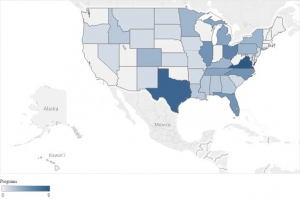
Note: To fit in image, Alaska was scaled down and the geographical locations of Alaska and Hawai’i were moved.
Figure 2
Geographical Representation of CACREP-Accredited Master’s Programs in the United States
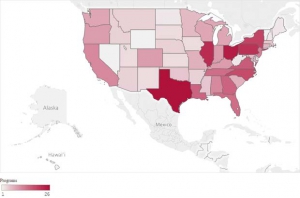
Note: Data reflect number of total programs rather than number of specialized tracks per state. To fit in image, Alaska was scaled down and the geographical locations of Alaska and Hawai’i were moved.
Results
Table 1 and the Appendix display the number of CACREP-accredited doctoral and master’s programs by both region and state. The researchers used these data to test the hypotheses using inferential statistics.
Differences in CACREP-Accredited Doctoral Programs by Region
The researchers tested the hypothesis that significant differences existed for the number of CACREP-accredited doctoral programs among the five regions, even when the confounding variable of population size was controlled. The sample size of 51 exceeded the requirement for 80% power at the .05 alpha level (i.e., n = 42). Levene’s test for equality of error variances was not significant, indicating that parametric statistics could be performed without adjustments (A. Field, 2013). A one-way independent-samples ANCOVA for differences in number of programs by region was significant—F(4, 45) = 4.64, p < .05, η2 = .38—and represented a large effect size (Cohen, 1988).
The Southern region had the largest number of CACREP-accredited doctoral programs (n = 45). This was nearly twice the number of CACREP-accredited doctoral programs of the second-ranked region (North Central, n = 23), and more CACREP-accredited doctoral programs than the other four regions combined (n = 41). Compared to the Southern and North Central regions, the other three regions—namely the North Atlantic, Rocky Mountain, and Western regions—had substantially fewer CACREP-accredited doctoral programs. The North Atlantic and Rocky Mountain regions had eight CACREP-accredited doctoral programs each, and the Western region had two. The Southern region had the highest percentage of states with CACREP-accredited doctoral programs at 93% (14 of 15 states).
The number of CACREP-accredited doctoral programs per state was not equally distributed by region. Figure 1 and the Appendix show that in the Southern region, 14 of 15 states had CACREP-accredited doctoral programs, with two states having an especially high number of doctoral programs (i.e., Virginia = 9, Texas = 8). Other Southern region states (i.e., Maryland and South Carolina) only had a single doctoral program. In the North Atlantic region, counselor education programs were concentrated within specific geographic locations. The eight doctoral programs in the region were located within three states (i.e., New Jersey, New York, Pennsylvania) and the District of Columbia. The remaining seven states, including the entirety of New England (i.e., Connecticut, Maine, Massachusetts, New Hampshire, Rhode Island, Vermont) have zero CACREP-accredited doctoral programs.
To better understand the relationship between doctoral programs and population size, ratios were computed comparing the population to doctoral and master’s programs by region. Table 1 depicts the ratio for population to doctoral programs by region. Upon further inspection of the data, it appears that population size could explain the number of doctoral programs in a region. For example, the Southern region had by far the greatest number of CACREP-accredited doctoral programs at 45, yet the proportion of programs was roughly equivalent for four of the five regions when considering the population size of those regions. As seen in Table 1, the population of the Southern region was 119 million people, which was 1.65 times the size of the next largest region, the North Central region (72 million). Accordingly, the number of doctoral programs in the Southern region was nearly double the number of programs in the North Central region (45 vs. 23). When examining the ratio of population to CACREP-accredited doctoral programs, the Southern region appears to have a roughly equivalent representation (2.6 million per doctoral program) to two other regions, the Rocky Mountain (1.8 million) and North Central (3.1 million) regions.
The Western region had the largest ratio of population to doctoral programs, at 31.8 million people per doctoral program. This ratio was more than four times greater than the next largest ratio (North Atlantic, 7.2 million per doctoral program) and 10 times the ratio of the other three regions (North Central, 3.1 million; Southern, 2.6 million; Rocky Mountain, 1.8 million). It was therefore evident that the Western region was most underrepresented in the number of CES doctoral programs per region inhabitant.
The Relationship Between CACREP-Accredited Doctoral and Master’s Programs
A linear multiple regression (random model) was computed to better understand the relationship between the number of CACREP-accredited master’s and doctoral programs per state. Other predictor variables included state population size, state population density, number of colleges and universities per state, and number of APA-accredited counseling psychology programs per state. The sample size of 51 exceeded the requirement for 80% power at the .05 alpha level (i.e., n = 39). Data conformed to homoscedasticity and did not show multicollinearity (A. Field, 2013). Residuals (errors) were equally distributed, and no significant outliers were found (A. Field, 2013). Because these assumptions were met, parametric statistics could be performed without adjustments (A. Field, 2013). The linear multiple regression (random model) variables significantly predicted the number of CACREP doctoral programs: F(5, 44) = 18.55, p < .05, R2 = .68. This represented a large effect size. Notably, only CACREP-accredited master’s programs were a significant predictor variable, with a standardized β coefficient of .85 (p < .05). The other predictor variables were not significant predictors and did not contribute to the multiple regression model. Thus, the presence of CACREP-accredited master’s programs accounted for 68% of the variance in doctoral programs by state.
Data in Table 1 help to elucidate the relationship between CACREP-accredited doctoral and master’s programs. The Southern region by far had the largest number of CACREP-accredited master’s programs (n = 162) and doctoral programs (n = 45). The second largest number of master’s programs was in the region with the second largest number of doctoral programs (North Central; 104 and 23, respectively). Some differences between doctoral and master’s program representation were found; the Rocky Mountain region had the smallest number of master’s programs at 24, which was three times less than the North Atlantic region, despite having the same number of doctoral programs (n = 8).
Figures 1 and 2 further clarify that although a relationship exists between the number of CACREP-accredited doctoral and master’s programs, there are important regional differences. In the West, several states had a relatively high number of master’s programs (e.g., California, Oregon, Washington) despite having one or even zero doctoral programs per state. In the North Atlantic region, New York and Pennsylvania had among the highest number of master’s programs by state, though these two states had relatively fewer doctoral programs. There were no CACREP-accredited doctoral programs and relatively few CACREP-accredited master’s programs in the entirety of New England (i.e., Connecticut, Maine, Massachusetts, New Hampshire, Rhode Island, Vermont), which is noteworthy because the area is known for the high number of colleges and universities, as well as high population density.
When reviewing ratios of master’s programs to population in Table 1, the Western region showed a far smaller representation of master’s programs compared to other regions. There were 1.8 million inhabitants per master’s program in the Western region. The Western region had more than double the ratio of the other four regions, who themselves have a fairly equivalent ratio of inhabitants per master’s program, ranging from 597,000 to 770,000.
Discussion
The results indicate a large and significant difference (p < .05, η2 = .38) in the number of CACREP-accredited doctoral programs by region when controlling for the confounding variable of population size. The number of CACREP-accredited master’s programs per state is also a large and significant predictor (standardized β = .85, p < .05) for the number of CACREP-accredited doctoral programs in a state. Other variables, such as state population size, state population density, number of colleges and universities per state, and number of APA-accredited counseling psychology programs, did not predict the number of CACREP-accredited doctoral programs in a state.
The Western region had by far the fewest number of CACREP-accredited doctoral programs, the smallest percentage of states with CACREP-accredited doctoral programs, the largest ratio of CACREP-accredited master’s-to-doctoral programs, and the largest ratio of population size to both master’s and doctoral CACREP-accredited programs. With only two CACREP-accredited doctoral programs in seven states, the Western region may experience a significant pipeline problem. It is worth noting that the number of CACREP-accredited master’s programs has doubled in the Western region since 2009, from 16 to 35 programs (CACREP, n.d.). During the same time period, the Western region has not gained any new CACREP-accredited doctoral programs. From an analysis of in-process programs, it seems that the Western region stands to gain further CACREP-accredited master’s programs but no CACREP-accredited doctoral programs in the near future, exacerbating any existing pipeline problem. In addition, the North Atlantic region has a relative lack of doctoral programs as compared to master’s programs. In the ensuing section, potential reasons for the lack of CACREP-accredited doctoral programs in the Western and North Atlantic regions, along with the potential impact of this problem, are discussed.
CES Doctoral Programs in the Western Region
The Western state of California was initially an early developer and adopter of counselor education accreditation standards, yet today it has relatively few CACREP-accredited master’s programs relative to population size and has never had a CACREP-accredited doctoral program. The California story is worth exploring in greater depth because it illustrates a further barrier to establishing doctoral CACREP programs in the Western region.
California is a major outlier in this study in that only 24% (n = 23) of 96 master’s degree programs in counseling (i.e., clinical mental health counseling; marriage, couple, and family counseling; school counseling) were CACREP accredited. One explanation for this low number is that it was not until 2010 that California granted licenses to professional counselors (T. A. Field, 2017). As mentioned earlier, licensure requirements (especially those that require CACREP accreditation) can increase the number of CACREP-accredited programs in a state, with Ohio being a notable example. It is also interesting to note that despite California’s long history of granting licenses to marriage and family therapists, COAMFTE (n.d.) was not a strong accreditation competitor to CACREP. As of 2019, only 10% (8) of 82 MFT licensable programs were COAMFTE accredited.
CES Doctoral Programs in the North Atlantic Region
The North Atlantic region had only eight CACREP-accredited doctoral programs, which were concentrated in three states (i.e., New Jersey, New York, District of Columbia). No CACREP-accredited doctoral programs were in the New England region (i.e., Connecticut, Maine, Massachusetts, New Hampshire, Rhode Island, Vermont). The North Atlantic region has several densely populated states, with New York and Pennsylvania being the fourth and fifth most populated states in the United States. The North Atlantic region also had a fairly large number of master’s CACREP-accredited programs (n = 75). As seen in Table 1, the North Atlantic region had roughly the same ratio of CACREP-accredited master’s programs to population size as the Southern region and yet had a ratio of CACREP-accredited doctoral programs to population size that was three times greater than the Southern region’s ratio. The North Atlantic region also had more than double the number of master’s programs than the Western region, despite having a smaller population overall. Considering this larger presence of CACREP-accredited master’s programs, the North Atlantic’s lack of doctoral programs is somewhat surprising.
The reason for the low number of CACREP-accredited doctoral programs in the North Atlantic region can be understood when considering the historical presence of APA-accredited counseling psychology doctoral programs in the region. Although not a predictor for the number of CES doctoral programs nationally, APA-accredited counseling psychology programs appear to be a potential barrier to CES doctoral program establishment in New England especially. Massachusetts had the second largest number of APA-accredited counseling psychology doctoral programs (n = 6), behind only Texas (n = 7; APA, 2019). As stated previously, university administrators may perceive doctoral programs in counseling psychology and CES as competitor programs for faculty lines, as core faculty cannot be shared between APA and CACREP-accredited programs (CACREP, 2015). The large number of counseling psychology doctoral programs in Massachusetts may help explain why there are no CES doctoral programs in New England.
CES Doctoral Programs Across Regions
Although the Western and North Atlantic regions had the greatest degree of pipeline problem, it is possible that all five regions will be impacted by the pipeline problem in the near future. An analysis of programs currently in the process of applying for CACREP accreditation (designated “in process”) is presented in the Appendix. Across regions, a total of 63 master’s programs were in process, compared to only five doctoral programs. This 12.6:1 ratio is far above the current ratios of the Southern, North Central, and Rocky Mountain regions and is similar to the current ratio for the North Atlantic region. All regions except the Rocky Mountain region appear to be impacted. The Southern region had 31 in-process master’s programs and three in-process doctoral programs (10:1 ratio). The North Central region had 13 in-process master’s programs and one in-process doctoral program (13:1). The North Atlantic region had 10 in-process master’s programs and one in-process doctoral program (10:1). The Western region had eight in-process master’s programs and zero in-process doctoral programs (8:0). The Rocky Mountain region seemed least impacted, with only one in-process master’s program and zero in-process doctoral programs (1:0). Any existing pipeline problem for doctoral-level counselor education faculty therefore seems likely to continue if not worsen in the coming years.
State Laws and Rules Prohibiting Doctoral Programs
In this study, the number of CACREP-accredited master’s programs is a strong predictor of the number of CACREP-accredited doctoral programs within a state. The relationship between the number of master’s and doctoral CACREP-accredited programs is far weaker in the Western region because of state laws and rules that restrict doctoral study at public universities. The California and Washington state university systems limit doctoral programs to their research-intensive universities. The California Master Plan (California State Department of Education, 1960; Douglass, 2000) restricts doctoral programs to the University of California university system and specifically does not permit Doctor of Philosophy degrees to be offered at the California State University system campuses. This is important because in California all of the counselor education programs at state universities are operated within the California State University system, with no programs offered within the research-intensive University of California system.
A similar dynamic exists within the Washington state educational system, whereby only the research-intensive universities (i.e., University of Washington, Washington State University) may offer doctoral degrees. As in California, master’s counselor education programs within Washington state universities are only operated within the teaching institutions (e.g., Central Washington University, Eastern Washington University, Western Washington University) and no programs are offered at the research-intensive state universities. Unfortunately, one of the first-ever CACREP-accredited doctoral programs was at the University of Washington, which closed its program and lost its CACREP accreditation status in 1988 (CACREP, n.d.).
State political dynamics are a significant barrier to starting new doctoral programs within the Western state public university systems. Because of state laws and regulations, the real need generated by the significant number of master’s counseling programs at teaching-focused and less research-intensive state universities in California and Washington has no real influence on doctoral program development. No new state university doctoral programs are on the horizon or even under consideration. Instead, new doctoral programs in Western states will likely only start at private universities. Unfortunately, these institutions tend to have higher tuition without the advantage of the graduate student funding that their state counterparts generally offer.
Pace (2016) found that institution type (i.e., public vs. private) and enrollment numbers for the institution were predictors of whether the institution had a CACREP-accredited doctoral program. As of 2018, the majority of doctoral programs were housed in public institutions (n = 64), with 19 programs at private institutions (CACREP, n.d.). Of these 19 programs at private institutions, 12 (63%) were at professional or master’s-level universities according to Carnegie classification (The Carnegie Classification of Institutions of Higher Education, 2019). Programs within private colleges and universities represented more than half of all programs (12 of 21 programs; 57%) at non–research-intensive universities (i.e., professional or master’s-level classifications). Private universities with professional and master’s-level classifications who develop doctoral CES programs seem less likely to have the financial support to offer scholarships and tuition waivers to students when compared to research institutions.
Student funding has historically been valued as a core principle of doctoral education. It often provides doctoral students with full-time opportunities to shadow faculty members and develop research self-efficacy (Lambie & Vaccaro, 2011), which is considered the primary focus of doctoral-level counselor education (Adkison-Bradley, 2013). Program faculty in these new private doctoral programs may face heavier workloads given the lack of student funding (e.g., increased teaching and advising loads) and support for faculty research and scholarship. This could potentially limit the research training available to doctoral students at these new institutions, which may hinder the ability for these doctoral students at emerging programs to be adequately prepared for the scholarly work required as a future faculty member. If unaddressed, these programs would not contribute to meeting the growing need for qualified doctoral counselor educators in the Western region, and the pipeline problem would continue.
For example, in Washington, several private universities with CACREP-accredited master’s programs (i.e., Antioch University-Seattle, City University of Seattle, Seattle Pacific University) have recently established doctoral programs in CES. In the three institutions, all new faculty hired after 2013 have completed doctoral degrees in CES from institutions outside of the Western region, with the majority of those doctorates being completed in the Southern region. Although not CACREP accredited at the time of writing, these new doctoral programs appear to be a potential solution to the pipeline problem in the Western region. However, it is worth noting that these three private universities are teaching institutions rather than research institutions, and such programs may need guidance regarding how to include sufficient research training in the doctoral curriculum if the program cannot offer funding to doctoral students and the faculty are not given support to generate faculty-led research and scholarship.
Impact of Doctoral Programs on Regional Professional Identity
Authors such as Lawson (2016) and Mascari and Webber (2013) have argued that CACREP accreditation strengthens the professional identity of the program and of students within the program. It is unknown whether the number of CACREP-accredited master’s and doctoral programs within a region also strengthens and contributes to professional identity within a region. There are no existing published studies that have comprehensively examined the regional impact of the number of CACREP-accredited master’s and doctoral programs on professional identity. Anecdotally, there appear to be several potential effects from having a lack of CACREP-accredited doctoral programs within a region. CACREP-accredited master’s counseling programs must recruit new faculty hires from outside of the region if there is an insufficient number of candidates available from established doctoral programs within the region. Because the Western region and New England states have a dearth of CACREP-accredited doctoral programs, counselor education programs in those states may need to recruit from outside of their region to find suitable candidates. As mentioned previously, this pipeline problem can make recruiting difficult, as candidates strongly weigh location and closeness to home when selecting doctoral programs (Hertlein & Lambert-Shute, 2007; Honderich & Lloyd-Hazlett, 2015; Poock & Love, 2001) and faculty positions (Hunt & Jones, 2015; Magnuson et al., 2001; Millar et al., 2009). Location appears to be a particularly important consideration for candidates from underrepresented minority backgrounds (Bersola et al., 2014; Linder & Winston Simmons, 2015; Peek et al., 2013; Ramirez, 2013). As a result, prospective doctoral students and faculty members may be unwilling to study or work at a program outside of their home region.
Online CACREP-accredited doctoral programs may create pathways for more students in a region with a lack of doctoral programs to pursue and attain a doctorate in counselor education, which may reduce any existing pipeline problem. Studies are needed to examine comparative hiring rates of online versus in-person programs to ascertain whether graduates of online programs are filling needed faculty positions. Hiring school counselor educators is particularly challenging (Bernard, 2006), and studies are needed that examine the proportion of school counselor educators that graduate from online counseling programs.
Counselor education programs are continually seeking to increase the diversity of their faculty (Cartwright et al., 2018; Holcomb-McCoy & Bradley, 2003; Shin et al., 2001; Stadler et al., 2006). Because prospective doctoral students from minority backgrounds may be more inclined to restrict their applications to doctoral programs within close proximity to their current location (Bersola et al., 2014; Linder & Winston Simmons, 2015; Ramirez, 2013), online doctoral programs appear to be a viable option for students from culturally diverse backgrounds who live in regions with few in-person doctoral programs. Data are needed to support whether online graduates are (a) filling open faculty vacancies in the Western region and New England states, (b) filling school counselor educator positions, and (c) contributing to faculty diversity.
This study represents the first-ever analysis of regional differences in the number of CACREP-accredited doctoral CES programs. Because this was an ex post facto study, the results are non-experimental and thus have the potential for error because of the lack of experimental control and randomization. To mitigate the potential for error, the confounding variable of population size was included in our inferential statistical analyses. Examination of variables such as the demand for counselor education program entry are also important to examine in the future to ascertain whether programs are turning away students because of capacity issues related to faculty hiring. Such studies could appraise application numbers, enrollment numbers, and the program’s ideal yield should capacity not be an issue. Furthermore, a more detailed analysis into the relationship between a state’s educational requirements for licensure (i.e., whether graduates must complete a CACREP-accredited program) and the demand for doctoral counselor educators within a state is important. Lawson et al. (2017) have proposed that advocating for CACREP accreditation as the educational requirement for counselor licensure is important to the advancement of professionalization and professional identity. It is possible that the lack of CACREP-accredited doctoral programs in a state may be a barrier to establishing CACREP as the educational standard for licensure.
Conclusion
A large and statistically significant difference exists in the number of CACREP-accredited doctoral programs by region, even when controlling for population size. The Western region has by far the fewest doctoral programs and thus the greatest need for new doctoral programs. The lack of doctoral programs in the Western region and New England states may present a pipeline problem. The number of CACREP-accredited master’s programs has doubled in the Western region since 2009 while the number of doctoral programs has remained the same. As a result, CACREP-accredited master’s programs in the Western region and New England states may struggle to recruit qualified core faculty from in-region doctoral programs. The ratio of in-process master’s versus doctoral programs suggests that any existing pipeline issue will continue if not worsen in the coming years.
Even though the number of CACREP-accredited master’s programs within a state appears to be a strong independent predictor of CACREP-accredited doctoral programs, new doctoral programs may be difficult to establish because of state regulatory issues, the existence of competing doctoral programs (e.g., counseling psychology), or the lack of research support infrastructure (e.g., smaller teaching loads, funding for doctoral students).
In addition to small, private, teaching-focused institutions that seem to be developing doctoral programs in regions with few CACREP-accredited doctoral programs (e.g., Antioch University-Seattle, City University of Seattle, and Seattle Pacific University in the Western region), online CACREP-accredited doctoral CES programs are a potential solution to training prospective doctoral students in regions with few in-person doctoral programs. Online programs may also help to address any existing specific pipeline issues regarding faculty with school counseling specialties and faculty from culturally diverse backgrounds. Future studies are needed to support whether online CACREP-accredited doctoral programs are helping master’s programs to address these recruitment needs. Additional follow-up studies are also needed to examine the role of geographic location in candidate selection of in-person and online faculty positions, as it is possible that geographic location has less prominence in candidate selection of faculty roles today compared to several decades ago when prior studies in counselor education were conducted (e.g., Magnuson et al., 2001).
Conflict of Interest and Funding Disclosure
The authors reported no conflict of interest
or funding contributions for the development
of this manuscript.
References
Adkison-Bradley, C. (2013). Counselor education and supervision: The development of the CACREP doctoral standards. Journal of Counseling and Development, 91(1), 44–49. https://doi.org/10.1002/j.1556-6676.2013.00069.x
Altekruse, M. K., & Wittmer, J. (1991). Accreditation in counselor education. In F. O. Bradley (Ed.), Credentialing in counseling (pp. 53–67). Association for Counselor Education and Supervision.
American Psychological Association. (2019). APA-accredited programs. https://www.apa.org/ed/accreditation/programs
/using-database
Bernard, J. M. (2006). Counselor education and counseling psychology: Where are the jobs? Counselor Education and Supervision, 46(1), 68–80. https://doi.org/10.1002/j.1556-6978.2006.tb00013.x
Bersola, S. H., Stolzenberg, E. B., Love, J., & Fosnacht, K. (2014). Understanding admitted doctoral students’ institutional choices: Student experiences versus faculty and staff perceptions. American Journal of Education, 120(4), 515–543. https://doi.org/10.1086/676923
Bodenhorn, N., Hartig, N., Ghoston, M. R., Graham, J., Lile, J. J., Sackett, C., & Farmer, L. B. (2014). Counselor education faculty positions: Requirements and preferences in CESNET announcements 2005-2009. Journal of Counselor Preparation and Supervision, 6(1), 1–16.
California State Department of Education (1960). A master plan for higher education in California: 1960-1975. https://www.ucop.edu/acadinit/mastplan/MasterPlan1960.pdf
The Carnegie Classification of Institutions of Higher Education. (2019). Basic classification description. http://carnegieclassifications.iu.edu/classification_descriptions/basic.php
Cartwright, A. D., Avent Harris, J. R., Munsey, R. B., & Lloyd-Hazlett, J. (2018). Interview experiences and diversity concerns of counselor education faculty from underrepresented groups. Counselor Education and Supervision, 57(2), 132–146. https://doi.org/10.1002/ceas.12098
Cohen, J. (1988). Statistical power analysis for the behavioral sciences (2nd ed.). Erlbaum.
Cohen, J. (1992). A power primer. Psychological Bulletin, 112(1), 155–159. https://doi.org/10.1037/0033-2909.112.1.155
Commission on Accreditation for Marriage and Family Therapy Education. (n.d.). Directory of COAMFTE accredited programs. Retrieved January 20, 2020, from https://coamfte.org/COAMFTE/Directory_of_Accredited_Programs/
MFT_Training_Programs.aspx
Council for Accreditation of Counseling and Related Educational Programs. (n.d.). Find a program. Retrieved January 20, 2020, from https://www.cacrep.org/directory
Council for Accreditation of Counseling and Related Educational Programs. (2008). CACREP 2009 standards. http://www.cacrep.org/wp-content/uploads/2017/07/2009-Standards.pdf
Council for Accreditation of Counseling and Related Educational Programs. (2013). 2012 annual report. http://www.cacrep.org/wp-content/uploads/2019/05/CACREP-2012-Annual-Report.pdf
Council for Accreditation of Counseling and Related Educational Programs. (2015). CACREP 2016 standards. http://www.cacrep.org/wp-content/uploads/2017/08/2016-Standards-with-citations.pdf
Council for Accreditation of Counseling and Related Educational Programs. (2017). CACREP/CORE merger information. https://www.cacrep.org/home/cacrepcore-updates
Council for Accreditation of Counseling and Related Educational Programs. (2019a). CACREP policy document. http://www.cacrep.org/wp-content/uploads/2019/05/2016-Policy-Document-January-2019-revision.pdf
Council for Accreditation of Counseling and Related Educational Programs. (2019b). Annual report 2018. http://www.cacrep.org/wp-content/uploads/2019/05/CACREP-2018-Annual-Report.pdf
Douglass, J. A. (2000). The California idea and American higher education: 1850 to the 1960 master plan. Stanford University Press.
Faul, F., Erdfelder, E., Lang, A.-G., & Buchner, A. (2007). G*Power 3: A flexible statistical power analysis program for the social, behavioral, and biomedical sciences. Behavior Research Methods, 39, 175–191. https://doi.org/10.3758/BF03193146
Field, A. (2013). Discovering statistics (4th ed.). SAGE.
Field, T. A. (2017). Clinical mental health counseling: A 40-year retrospective. Journal of Mental Health Counseling, 39(1), 1–11. https://doi.org/10.17744/mehc.39.1.01
Hertlein, K. M., & Lambert-Shute, J. (2007). Factors influencing student selection of marriage and family therapy graduate programs. Journal of Marital and Family Therapy, 33(1), 18–34.
https://doi.org/10.1111/j.1752-0606.2007.00002.x
Holcomb-McCoy, C., & Bradley, C. (2003). Recruitment and retention of ethnic minority counselor educators: An exploratory study of CACREP-accredited counseling programs. Counselor Education and Supervision, 42(3), 231–243. https://doi.org/10.1002/j.1556-6978.2003.tb01814.x
Honderich, E. M., & Lloyd-Hazlett, J. (2015). Factors influencing counseling students’ enrollment decisions: A focus on CACREP. The Professional Counselor, 5(1), 124–136. https://doi.org/10.15241/emh.5.1.124
Hunt, S. C., & Jones, K. T. (2015). Recruitment and selection of accounting faculty in a difficult market. Global Perspectives on Accounting Education, 12, 23–51.
Institute of Medicine. (2010). Provision of mental health counseling services under TRICARE. The National Academies Press. https://doi.org/10.17226/12813
Lambie, G. W., & Vaccaro, N. (2011). Doctoral counselor education students’ levels of research self-efficacy, perceptions of the research training environment, and interest in research. Counselor Education and Supervision, 50(4), 243–258. https://doi.org/10.1002/j.1556-6978.2011.tb00122.x
Lawson, G. (2016). On being a profession: A historical perspective on counselor licensure and accreditation. Journal of Counselor Leadership and Advocacy, 3(2), 71–84. https://doi.org/10.1080/2326716X.2016.1169955
Lawson, G., Trepal, H. C., Lee, R. W., & Kress, V. (2017). Advocating for educational standards in counselor licensure laws. Counselor Education and Supervision, 56(3), 162–176. https://doi.org/10.1002/ceas.12070
Linder, C., & Winston Simmons, C. (2015). Career and program choice of students of color in student affairs programs. Journal of Student Affairs Research and Practice, 52(4), 414–426.
https://doi.org/10.1080/19496591.2015.1081601
Magnuson, S., Norem, K., & Haberstroh, S. (2001). New assistant professors of counselor education: Their preparation and their induction. Counselor Education and Supervision, 40(3), 220–229.
https://doi.org/10.1002/j.1556-6978.2001.tb01254.x
Mascari, J. B., & Webber, J. (2013). CACREP accreditation: A solution to license portability and counselor identity problems. Journal of Counseling & Development, 91(1), 15–25.
https://doi.org/10.1002/j.1556-6676.2013.00066.x
Meyers, L. S., Gamst, G. C., & Guarino, A. J. (2013). Performing data analysis using IBM SPSS. Wiley.
Millar, M., Kincaid, C., & Baloglu, S. (2009). Hospitality doctoral students’ job selection criteria for choosing a career in academia. Hospitality Management, 7. https://repository.usfca.edu/hosp/7
National Board for Certified Counselors. (2018, August). NBCC delays start of new standard to obtain certification. NBCC Visions. https://nbcc.informz.net/NBCC/pages/August2018CACREPdelay?_zs=z9bqb&_zmi=?
National Center for Education Statistics. (n.d.). College navigator. Retrieved January 20, 2020, from https://nces.ed.gov/collegenavigator
Pace, R. L., Jr. (2016). Relationship of institutional characteristics to CACREP accreditation of doctoral counselor education programs [Doctoral dissertation, Walden University]. ScholarWorks. https://scholarworks.waldenu.edu/dissertations/2097
Peek, M. E., Kim, K. E., Johnson, J. K., & Vela, M. B. (2013). “URM candidates are encouraged to apply”: A national study to identify effective strategies to enhance racial and ethnic faculty diversity in academic departments of medicine. Academic Medicine, 88(3), 405–412. https://doi.org/10.1097/ACM.0b013e318280d9f9
Poock, M. C., & Love, P. G. (2001). Factors influencing the program choice of doctoral students in higher education administration. NASPA Journal, 38(2), 203–223. https://doi.org/10.2202/1949-6605.1136
Ramirez, E. (2013). Examining Latinos/as’ graduate school choice process: An intersectionality perspective. Journal of Hispanic Higher Education, 12(1), 23–36. https://doi.org/10.1177/1538192712452147
Shin, R. Q., Smith, L. C., Goodrich, K. M., & LaRosa, N. D. (2011). Attending to diversity representation among Council for Accreditation of Counseling and Related Educational Programs (CACREP) master’s programs: A pilot study. International Journal for the Advancement of Counselling, 33(2), 113–126.
https://doi.org/10.1007/s10447-011-9116-6
Stadler, H. A., Suh, S., Cobia, D. C., Middleton, R. A., & Carney, J. S. (2006). Reimagining counselor education with diversity as a core value. Counselor Education and Supervision, 45(3), 193–206.
https://doi.org/10.1002/j.1556-6978.2006.tb00142.x
U.S. Census Bureau. (2020). National population totals and components of change. https://www.census.gov/data/tab
les/time-series/demo/popest/2010s-national-total.html#par_textimage_2011805803
U.S. Department of Defense. (2014, July 17). TRICARE certified mental health counselors. 32 CFR Part 199. https://www.federalregister.gov/documents/2014/07/17/2014-16702/tricare-certified-mental-health-counselors
Wittmer, J. (2010). Evolution of the CACREP standards. In A. K. Mobley and J. E. Myers (Eds.), Developing and maintaining counselor education laboratories (2nd ed.). Association of Counselor Education and Supervision. https://acesonline.net/wp-content/uploads/2018/11/Developing-and-Maintaining-Counselor-Education-Laboratories-Full-Text.pdf
Appendix
CACREP-Accredited and In-Process Programs by State and Region (December 2018)
| State |
Region |
Population |
CACREP Doctoral Programs |
CACREP Master’s Programs |
Doctoral Programs “In Process” of CACREP Accreditation |
Master’s Programs “In Process” of CACREP Accreditation |
| Connecticut |
North Atlantic |
3,572,665 |
|
6 |
|
1 |
| Delaware |
North Atlantic |
967,171 |
|
1 |
|
|
| District of Columbia |
North Atlantic |
702,455 |
1 |
4 |
|
3 |
| Maine |
North Atlantic |
1,338,404 |
|
2 |
|
|
| Massachusetts |
North Atlantic |
6,902,149 |
|
5 |
|
1 |
| New Hampshire |
North Atlantic |
1,356,458 |
|
2 |
|
1 |
| New Jersey |
North Atlantic |
8,908,520 |
1 |
12 |
|
|
| New York |
North Atlantic |
19,542,209 |
3 |
19 |
|
4 |
| Pennsylvania |
North Atlantic |
12,807,060 |
3 |
21 |
1 |
|
| Rhode Island |
North Atlantic |
1,057,315 |
|
2 |
|
|
| Vermont |
North Atlantic |
626,299 |
|
1 |
|
|
| |
North Atlantic |
57,780,705 |
8 |
75 |
1 |
10 |
| Illinois |
North Central |
12,741,080 |
5 |
22 |
|
3 |
| Indiana |
North Central |
6,691,878 |
|
9 |
|
2 |
| Iowa |
North Central |
3,156,145 |
1 |
3 |
|
|
| Kansas |
North Central |
2,911,505 |
1 |
3 |
|
|
| Michigan |
North Central |
9,995,915 |
4 |
8 |
|
1 |
| Minnesota |
North Central |
5,611,179 |
3 |
6 |
|
1 |
| Missouri |
North Central |
6,126,452 |
1 |
7 |
|
3 |
| Nebraska |
North Central |
1,929,268 |
|
4 |
|
|
| North Dakota |
North Central |
760,077 |
1 |
2 |
|
|
| Ohio |
North Central |
11,689,442 |
6 |
24 |
|
2 |
| Oklahoma |
North Central |
3,943,079 |
|
5 |
|
|
| South Dakota |
North Central |
882,235 |
1 |
3 |
|
|
| Wisconsin |
North Central |
5,813,568 |
|
8 |
1 |
1 |
| |
North Central |
72,251,823 |
23 |
104 |
1 |
13 |
| Colorado |
Rocky Mountain |
5,695,564 |
3 |
9 |
|
|
| Idaho |
Rocky Mountain |
1,754,208 |
2 |
4 |
|
|
| Montana |
Rocky Mountain |
1,062,305 |
1 |
4 |
|
|
| New Mexico |
Rocky Mountain |
2,095,428 |
1 |
3 |
|
1 |
| Utah |
Rocky Mountain |
3,161,105 |
|
3 |
|
|
| Wyoming |
Rocky Mountain |
577,737 |
1 |
1 |
|
|
| |
Rocky Mountain |
14,346,347 |
8 |
24 |
0 |
1 |
| Alabama |
Southern |
4,887,871 |
2 |
11 |
|
1 |
| Arkansas |
Southern |
3,013,825 |
1 |
4 |
|
1 |
| Florida |
Southern |
21,299,325 |
5 |
14 |
|
3 |
| Georgia |
Southern |
10,519,475 |
2 |
15 |
2 |
3 |
| Kentucky |
Southern |
4,468,402 |
3 |
9 |
1 |
|
| Louisiana |
Southern |
4,659,978 |
2 |
15 |
|
1 |
| Maryland |
Southern |
6,042,718 |
1 |
6 |
|
2 |
| Mississippi |
Southern |
2,986,530 |
2 |
5 |
|
|
| North Carolina |
Southern |
10,383,620 |
5 |
18 |
|
1 |
| South Carolina |
Southern |
5,084,127 |
1 |
7 |
|
|
| Tennessee |
Southern |
6,770,010 |
4 |
14 |
|
7 |
| Texas |
Southern |
28,701,845 |
8 |
26 |
|
8 |
| Virginia |
Southern |
8,517,685 |
9 |
16 |
|
4 |
| West Virginia |
Southern |
1,805,832 |
|
2 |
|
|
| |
Southern |
119,141,243 |
45 |
162 |
3 |
31 |
| Alaska |
Western |
737,438 |
|
1 |
|
|
| Arizona |
Western |
7,171,646 |
|
4 |
|
|
| California |
Western |
39,557,045 |
|
11 |
|
6 |
| Hawaii |
Western |
1,420,491 |
|
1 |
|
|
| Nevada |
Western |
3,034,392 |
1 |
1 |
|
2 |
| Oregon |
Western |
4,190,713 |
1 |
9 |
|
|
| Washington |
Western |
7,535,591 |
|
8 |
|
|
| |
Western |
63,647,316 |
2 |
35 |
0 |
8 |
| |
Grand Total |
327,167,434 |
86 |
400 |
5 |
63 |
|
|
|
|
|
|
|
*Ratios rounded to closest whole number. Source of CACREP data: https://www.cacrep.org/directory/. Source of U.S. Census data: https://www.census.gov/data/tables/time-series/demo/popest/2010s-national-total.html#par_textimage_2011805
Thomas A. Field, PhD, NCC, CCMHC, ACS, LPC, LMHC, is an assistant professor at the Boston University School of Medicine. William H. Snow, PhD, is a professor at Palo Alto University. J. Scott Hinkle, PhD, ACS, BCC, HS-BCP, is a core faculty member at Palo Alto University. Correspondence may be addressed to Thomas Field, 72 E Concord St., Suite B-210, Boston, MA 02118, tfield@bu.edu.
Dec 16, 2020 | Volume 10 - Issue 4
Jennifer Preston, Heather Trepal, Ashley Morgan, Justin Jacques, Joshua D. Smith, Thomas A. Field
The doctoral degree in counselor education and supervision is increasingly sought after by students, with the Council for Accreditation of Counseling and Related Educational Programs (CACREP) reporting a 27% enrollment increase in just a 4-year span. As new programs are started and existing programs sustained, administrators and faculty may be seeking guidance in how to build a high-quality program. Yet no literature currently exists for how doctoral counseling faculty define a high-quality program. This study used a basic qualitative research design to examine faculty perceptions of high-quality doctoral programs (N = 15). The authors analyzed data from in-depth interviews with core faculty members at CACREP-accredited doctoral programs. Five themes emerged from the data: relationships, mission alignment, development of a counselor educator identity, inclusiveness of diversity, and Carnegie classification. The findings of this study can be important for faculty and administrators to consider when establishing and maintaining a counselor education and supervision doctoral program.
Keywords: doctoral programs, counselor education and supervision, CACREP, faculty perceptions, high-quality
Doctoral education in counselor education and supervision (CES) is surging, with both the number of programs and enrollment head count increasing over the past few years. According to the most recent annual report from the Council for Accreditation of Counseling and Related Educational Programs (CACREP), there are currently 85 CACREP-accredited CES doctoral programs (CACREP, 2019b) compared to 63 in 2014 (CACREP, 2017). This constitutes a 35% increase over a 4-year span. In addition, enrollment in CACREP-accredited doctoral programs has increased from 2,291 in 2014 to 2,917 in 2018, a 27% increase (CACREP, 2017, 2019a). The number of doctoral graduates in CES also increased by 35% between 2017 and 2019, from 355 to 479 (CACREP, 2017, 2019a). A registry does not exist for non–CACREP-accredited programs, and thus the exact number of doctoral programs in CES (i.e, CACREP- and non–CACREP-accredited programs) is unknown.
According to Hinkle et al. (2014), students’ motivations to pursue a doctorate in CES include
(a) to become a professor, (b) to be a respected professional with job security, (c) to become a clinical leader, and (d) to succeed for family and community amid obstacles. Student motivations appear tempered by CES departmental culture, mentoring, academics, support systems, and personal and related issues that impact their doctoral experience (Protivnak & Foss, 2009).
While students enter CES programs with one set of motivations, the programs themselves have their own goals for whom they admit, how they train, and what they perceive as a desired outcome to doctoral training. Doctoral programs in CES are considered training grounds for shaping students’ professional (Dollarhide et al., 2013; Limberg et al., 2013) and research identities (Perera-Diltz & Sauerheber, 2017). In addition, mentoring and advising relationships are viewed as important to supporting research motivation and productivity (Kuo et al., 2017).
Given students’ motivations and expectations for career preparation and advancement, it would make sense that they would want to choose a doctoral program that fits their needs. In addition to matching academic needs, it can also be assumed that as consumers of doctoral education, students would want to choose a high-quality doctoral program in CES. Bersola et al. (2014) conducted a study into factors that influenced admitted doctoral students’ (N = 540) choice of program. The students in the study were all from programs and departments located within one university. Both underrepresented minority and majority students cited program reputation, institutional reputation, faculty quality, research quality, and faculty access/availability as primary reasons for their choice of doctoral program. Participants reported these factors as more important to their choice of doctoral program than non–quality-related factors such as cost of living, housing, location, and urbanity (Bersola et al., 2014).
There are many program options for CES doctoral study, but little is known about what constitutes a high-quality program in counselor education apart from CACREP accreditation. Although the perceptions of CES doctoral graduates remain unknown, researchers have utilized data from doctoral graduates across disciplines regarding their satisfaction with their programs (Barnes & Randall, 2012; Morrison et al., 2011). Graduates identified aspects such as academic rigor, funding opportunities, mentoring in meeting program requirements, research skill training, and developing a sense of community as contributing to their satisfaction and perceptions of the doctoral programs (Barnes & Randall, 2012; Morrison et al., 2011).
Despite considerable knowledge of doctoral graduates’ perceptions, little is known about faculty perspectives on these issues (Kim et al., 2015). There is evidence that faculty perceptions of doctoral program quality can differ from alumni perceptions. Morrison et al. (2011) examined program faculty and alumni perceptions of quality doctoral education in the social sciences. Both faculty and alumni considered training in research skills and diversity characteristics of the program as important to quality. However, alumni also tended to place greater emphasis on the importance of faculty support in meeting program requirements and fostering belonging, whereas program faculty placed greater emphasis on the scholarly reputation of faculty when defining doctoral program quality.
Purpose of the Present Study
Very few studies have explored program faculty perceptions of high-quality doctoral education, and no studies exist in CES specifically. As educators and mentors, faculty who teach in CES programs should be both interested and invested in enhancing educational environments that meet students’ career aspirations as well as advancing the profession. Although industry standards for quality exist (e.g., CACREP standards), there is a need to better understand which components CES faculty believe comprise a high-quality doctoral program in CES. The purpose of this study was to address this gap in knowledge.
Methodology
This particular study was conducted as part of a larger comprehensive qualitative study of CES doctoral programs organized by the last author that followed the basic qualitative research design described by Merriam and Tisdell (2016). In the basic qualitative research paradigm, the research team collects, codes, and categorizes qualitative data using the constant comparative method from grounded theory methodology (Corbin & Strauss, 2015; Merriam & Tisdell, 2016). The researchers first use open coding, followed by categorization using axial coding to identify themes in the data (Merriam & Tisdell, 2016). Data collection continues until data reach saturation and redundancy. Unlike other qualitative traditions, this qualitative design is not employed to develop theory (i.e., grounded theory), capture the essence of a lived experience (i.e., phenomenology), nor describe cultural and environmental observations (i.e., ethnography; Merriam & Tisdell, 2016). Instead, researchers using basic qualitative designs seek to collect and analyze qualitative data for the purpose of answering research questions outside other specialized qualitative focus areas. A qualitative design was selected because the authors shared an underlying philosophical belief in the constructivist position that participants’ reality was socially co-constructed and that all responses should be given importance regardless of frequency (Lincoln & Guba, 2013).
The basic qualitative design was selected because it best fit the purpose of this larger qualitative project. The purpose of the larger qualitative study was to identify current perceptions of doctoral-level counselor educators regarding four major issues pertinent to doctoral counselor education: (a) components of high-quality programs, (b) strategies to recruit and retain underrepresented students, (c) strategies for working with administrators, and (d) strategies for successful dissertation advising. Our study collected and analyzed in-depth interviews with doctoral-level counselor educators to answer a series of research questions that addressed the issues above pertaining to doctoral-level counselor education.
Interview questions were designed to directly answer each research question. The research questions explored in the larger project were as follows: 1) What are the components of high-quality doctoral programs in CES, and what are the most and least important components? 2) Which strategies are doctoral programs using to recruit, support, and retain underrepresented doctoral students from diverse backgrounds, and how successful are those? 3) Which strategies are helpful in gaining initial and ongoing support from administrators when seeking to start a new doctoral program in CES, and how successful are those? and 4) Which strategies help students navigate the dissertation process, and how successful are those?
This manuscript represents the first of four articles from the larger qualitative project that each addressed one of the research questions listed above. This study therefore examined the first research question and sought to identify the components of high-quality doctoral programs in CES. The interview questions directly addressed this research question and were as follows: 1) How might you define a high-quality doctoral program in CES? and 2) What do you believe to be the most and least important components?
Participants
Purposeful sampling was used for an initial identification of eligible volunteers (Merriam & Tisdell, 2016) from the limited number of doctoral CES programs in the United States that are CACREP accredited. At the time of writing, 85 CACREP-accredited doctoral CES programs existed (CACREP, 2019b). Information-rich cases were sought to promote visibility to the perception of CES faculty. The sampling method was thus designed to identify and recruit participants who had experiences working in doctoral-level counselor education. Inclusion criteria for the study design were as follows: Participants had to 1) be current full-time core faculty members in CES, 2) who were currently working in a doctoral-level counselor education program with CACREP accreditation. The last author created a database of CES doctoral faculty from the 85 CACREP-accredited programs and recruited faculty interest in the study through email. Faculty initially provided demographic information during a pre-registration phase. The last author reviewed this information to select participants from the pool of eligible volunteers for entry into the study utilizing maximum variation sampling. This sampling technique was employed to gather the perspectives of counselor educators from diverse backgrounds with regard to demographic characteristics and program characteristics. Maximum variation sampling also assisted with avoiding premature saturation (Merriam & Tisdell, 2016). The research team believed that counselor educator perspectives may differ by background. Thus the following criteria were used for selecting participants from among the eligible volunteers: (a) racial and ethnic self-identification, (b) gender self-identification, (c) length of time working in doctoral-level counselor education programs, (d) Carnegie classification of university where the participant was currently working (The Carnegie Classification of Institutions of Higher Education, 2019), (e) region of the counselor education program where the participant was currently working, and (f) delivery mode of the counselor education program where the participant was currently working (e.g., in-person, online).
These six characteristics were selected because of indications in the extant literature of the influence of the above factors on CES faculty experiences and/or trends in doctoral program delivery, which may impact perceptions of what constitutes a high-quality doctoral program. Prior studies have identified the influence of racial and ethnic identity (Cartwright et al., 2018), gender identity (Hill et al., 2005), years of experience in doctoral counselor education (Lambie et al., 2014; Magnuson et al., 2009), Carnegie classification (Lambie et al., 2014), and delivery mode (Smith et al., 2015) on faculty perceptions and experiences.
Once participants responded regarding their interest in the study, the last author purposively selected participants one at a time to ensure adequate variation by these characteristics. Participant selection was predicated on meeting variability requirements between participants regarding the six criteria identified above. For example, the first and second participants were selected because of their differences in gender, years of experience, and Carnegie classification. Subsequent participant selection decisions were made on the basis of variant ethnicity and region. Overall participant characteristics interviews were conducted until data seemed to reach saturation and redundancy. Data reached saturation after 15 interviews. Faculty members who provided demographic information during pre-registration were informed that they had not been invited to participate in the interview portion of the study and were thanked for their participation during pre-registration.
A total of 15 participants were interviewed for the study. All 15 participants were from separate and unique doctoral-level CES programs, with no program represented by more than one participant. With regard to self-identified gender, the sample consisted of seven female participants (46.7%) and eight male participants (53.3%). No participants identified as non-binary or transgender. The majority of participants identified as heterosexual (n = 14, 93.3%), with one participant identifying as bisexual (6.7%). Eleven participants (73.3%) self-identified as Caucasian, with multiracial/multiethnic (n = 1, 6.7%), African American (n = 1, 6.7%), Asian (n = 1, 6.7%), and Latinx (n = 1, 6.7%) ethnic backgrounds also represented.
The sample was experienced, working as full-time faculty members for an average of 19.7 years (SD = 9.0 years) and a median of 17 years, ranging from 4 to 34 years. Participants spent most of those years working in doctoral-level CES programs (M = 17.3 years, SD = 9.2 years, Mdn = 16 years), ranging from 3 to 33 years. More than half of participants (n = 9, 60%) spent their entire careers working in doctoral-level CES programs. Eight of the participants (53.3%) currently worked at programs in the Southern region, with two participants (13.3%) each from the North Atlantic, North Central, and Western regions. One participant (6.7%) currently worked in the Rocky Mountain region. Five participants (33.3%) had worked in multiple doctoral programs in two or more regions. Twelve participants (80%) currently worked in face-to-face or brick-and-mortar programs, and three participants (20%) currently worked in online or hybrid programs. Regarding Carnegie classification, nine participants (60%) currently worked at Doctoral Universities – Very High Research Activity (i.e., R1) institutions, two participants (13.3%) currently worked at Doctoral Universities – High Research Activity (i.e., R2) institutions, and four participants (26.7%) currently worked at universities with the Master’s Colleges and Universities: Larger Programs designation (The Carnegie Classification of Institutions of Higher Education, 2019).
Positioning
The last author conducted all interviews with the selected participants. The author had etic status, in that they had not worked in a doctoral-level CES program previously. Because the author was a member of the counselor education community, etic status around the topic of doctoral-level CES was important to bracketing biases during the interview process. The interviewer followed the interview protocol included in the Appendix for all interviews to ensure that data were gathered for each research question to the highest extent possible.
Procedure
After receiving approval from their IRB, the last author created a database of doctoral-level counselor educator contacts who worked at the CES programs accredited by CACREP. The last author used the CACREP (2019b) website directory for recruitment purposes. Recruitment emails were sent to one faculty member at each of the 85 accredited programs. A total of 34 faculty responded with an interest in being interviewed (40% response rate). Of those 34 faculty, 15 were selected for interviews on the basis of maximal variation.
Interview Protocol
At the beginning of each interview, participants were asked a series of demographic questions that addressed the characteristics mentioned above (i.e., self-identified race and ethnicity, gender, sexual/affective orientation, years as a faculty member, years working in doctoral-level counselor education programs, number of doctoral programs the participant had worked in, and regions of the programs in which the counselor educator had worked). Participants were asked to self-identify their demographic information at the beginning of the interview to clarify demographic information that had been previously collected during pre-registration, and to ensure that participants were able to adequately self-identify.
Following the demographic section, the interview protocol featured a series of eight in-depth interview questions that addressed the research questions of the larger qualitative study. Interview questions were developed in accordance with Patton’s (2015) recommendations. Per Patton (2015), the interview questions were open-ended, as neutral as possible, avoided “why” questions, and were asked one at a time. The interview protocol was piloted with a faculty member in a doctoral-level CES program prior to the study commencing. Several double-barreled questions were split into two separate questions to ensure that only one question was asked at a time. The interview protocol followed conventions of semi-structured interviewing, with sparse follow-up questions permitted to the main interview questions to ensure understanding of participant responses (Patton, 2015).
Prior to each interview, participants reviewed and signed the informed consent agreement approved by the last author’s IRB. Participants were sent the interview questions ahead of time. Each interview lasted for approximately 60 minutes. All but one interview (i.e., 14 interviews) were recorded using the Zoom online platform built-in recording feature. One interview was recorded via a Sony audio digital recorder instead of the Zoom platform, as the interview occurred in person during a professional conference. All demographic information and recordings were assigned an alphabetical identifier (e.g., A, B, C). The last author was the sole individual who knew the identity of participants attributed to alphabetical identifiers. Participant identity was thus blinded to subsequent transcribers and coders.
Transcription
All interviews were transcribed verbatim by graduate students at the last author’s university, who had no familiarity with participants. Transcribers received transcription training prior to the study and received further training and direction by the last author prior to and during the transcription process. Once each transcript had been completed in full, the last author reviewed transcripts to ensure accuracy and sent the transcripts to the interviewees to conduct a member check. After member checks had been conducted, sections of transcripts were cut and pasted into separate documents for each of four research teams to code and analyze. The research teams were organized by research question (i.e., components of high quality; recruitment, support, and retention of underrepresented students; working with administrators; successful dissertation advising). Transcribed interviews for each research team were uploaded to separate secure folders in a secure encrypted online data management software system.
Data Analysis
The last author met with members of all four research teams collectively to ensure consistency in the coding approach. The last author developed several guidance documents for the research teams to use and created instructions for coding the data, which included guidance such as each research team meeting to bracket biases and identify any a priori codes prior to initial coding of the data, following Merriam and Tisdell’s (2016) guidelines. Research teams were instructed to identify emergent in vivo codes using verbatim line-by-line open coding when possible to avoid interpreting data too early during the coding process (Merriam & Tisdell, 2016). The focus of coding was to identify themes within and between participants. The four research teams were instructed to meet weekly over a period of several months to code and analyze data specific to their research question. Research teams coded each of the first three transcripts together as a team during weekly live coding sessions using the Zoom online platform, prior to individual team members coding the remaining transcripts separately. Codes were noted on the transcripts themselves, and then the lead team member compiled the codes into the code book. From there, the categories were developed and reviewed by all team members. Discrepancies in coding were resolved using coding consensus, with the research team documenting how they resolved any discrepancies in coding. Weekly meetings were required even when individual team members were coding separately to facilitate sharing their coding experience, clarifying questions about codes, establishing consensus on any parts of the transcript with complicated coding, and following the coding approach with consistency across coders. The last author created a coding database template that each research team was required to use, to ensure consistency in how coding was documented and categorized. These approaches were designed to improve consistency in coding within and between the four research teams. Each of the four research teams only coded and analyzed data pertinent to their assigned research question.
A coding team chair was identified for each of the four research teams to ensure that the coding and analysis approach was followed consistently and to organize the work of the team. Each research team organized codes into categories and eventually collapsed codes into themes using axial coding after all 15 transcripts had been coded. Themes also were analyzed by demographic and program characteristics of interviewees to assess the potential influence of background characteristics on responses. Each research team recorded memos during collective team meetings and during individual coding of transcripts. The last author also created memos during collective meetings with all four research teams. The last author created memos immediately following interviews, though they refrained from sharing the memos with the research teams to avoid biasing the coding and analysis process. Several research teams used software platforms to analyze the data, and were permitted to select their own software platforms for data analysis.
Researcher Positioning for the Current Study
For this study, the first five authors comprised the coding team that examined the research question pertinent to the components of high-quality programs. The sixth and last author conducted the interviews and did not code data for the reasons cited above. Among the five coding team members, both etic and emic perspectives were represented. Two of the authors had an emic perspective, as they had previously worked at a doctoral CES program during their faculty career. Three of the authors held an etic perspective as doctoral students who had not yet worked as full-time faculty members. Coding team members were from different counselor education programs to reduce bias.
With regard to other demographic characteristics, four members of the coding team identified as Caucasian, and one member identified as African American. Three team members identified as female, and two identified as male. The team members were from a wide range of programs. One doctoral student was from a very high research-intensive university; one faculty member and two doctoral students were from a research-intensive university; and one faculty member was from a private, nonprofit online university.
Trustworthiness
Trustworthiness was enhanced through procedures identified in the literature (e.g., Merriam & Tisdell, 2016). Credibility was addressed through considering the positioning of the interviewer and research team members. Emic and etic perspectives were sought for each research team to reduce the potential for bias. The interviewer and research team each bracketed their biases prior to their involvement in the study and continued the process of bracketing throughout the study to reduce bias. One bias the researchers bracketed, for example, was their involvement and experiences as faculty and students in a CES program. All interviewees worked at separate CES programs to avoid overrepresentation of data. Research team members were also from different CES programs to reduce bias in coding and analysis. Emergent, in vivo, verbatim line-by-line open coding was used by each research team to avoid interpreting data too early during the coding process and thus to reduce interpretation bias. The interviewer did not participate in coding the data to minimize bias through being too close to the data. The last author also clearly identified and trained the research teams, with the goal of enhancing consistency. Member checks were used to enhance credibility, and the last author also kept an audit trail of the process. Purposive sampling and thick description was used to ensure adequate representation of perspectives and thus establish adequate transferability and dependability (Merriam & Tisdell, 2016).
Results
Through data analysis, five categories emerged to capture the components that the participants described as critical to ensuring a high-quality doctoral program: relationships, mission alignment, development of a counselor educator identity, inclusiveness of diversity, and Carnegie classification. Each theme is described below, with support provided for each theme via participants’ quotes.
Relationships
The first major theme we identified from the data was the importance of relationships. This theme appears to be a critical component to having a high-quality program. Participants reported that supportive faculty–student and student–student relationships are important to high quality.
Faculty–Student Relationships
Participants emphasized the importance of close mentoring relationships between doctoral faculty and doctoral students. Several participants cited the quality of mentoring between faculty and students as the “most important factor” in a high-quality doctoral program. We identified several subthemes that appeared to influence the quality of faculty–student relationships. Smaller cohort sizes, close mentoring, faculty workload, and the match between the student and their dissertation chair all seemed to be important factors in faculty–student relationships. In order to support the faculty and student relationship, attention to cohort sizes and the overall size of the program is considered critical. One participant stated, “If you view your doctoral program as a cash cow, and you’re bringing in a lot of students, I think you’ve lost something.” They further clarified that advising and chairing dissertations for more than two doctoral students per year would lessen the quality of the mentoring experience. Some participants reported that consideration should be given for admitting students who value the close mentoring experience.
Faculty time and resources seem foundational to the establishment of high-quality faculty–student relationships. Faculty reported that they need time to focus on mentoring students. One participant stated that “the amount of time spent between faculty member and doctoral student” strongly influence the quality of the mentoring relationship. Consideration for faculty teaching loads and service expectations is therefore important within the context of having adequate time to devote to mentoring.
Participants also noted the importance of fit between the faculty mentor and their student mentee. High-quality mentoring relationships are predicated on the match between student goals, research interests, and experience levels with their assigned dissertation chair and/or advisor’s own goals, interests, and experiences. One participant reported that “there’s a lot to mentorship,” elaborating that faculty members must mentor students in “how to get involved in a profession; how to develop their voice as a counselor, as a teacher, as a clinical supervisor, as a researcher; and how to manage themselves professionally.”
Student–Student Relationships
In addition to cohort size, the cohort model was identified as important to facilitating supportive student-to-student relationships during the program. Participants reported that the cohort model facilitated deep, lasting, and “familial” relationships. Strong relationships with other doctoral students in the cohort were crucial during stressful periods. As one participant noted, “In addition to school, life is out there and stuff happens and people go through difficult times, with divorce and deaths and job losses and things like that. And having that support system built in is incredibly important.”
Mission Alignment
The next theme encompassed the importance of doctoral programs developing and following a mission statement with clearly defined doctoral student outcomes. As one participant stated, “A high-quality doctoral program in counselor ed and supervision has a clarity of purpose and focus. The program knows what its mission is, in terms of the product they want to produce with the doctoral students.” Another participant reported that “a high-quality doctoral program has a really clear mission, so the program knows who they’re trying to prepare and what they do well. And then the program works the mission.” This participant elaborated that although the mission of a doctoral program could vary, high-quality programs ensure execution of the mission regardless of mission type: “So if they’re preparing researchers, they work that mission. If they’re really focusing on preparing people just for teaching institutions, they work the mission.” This theme had several subthemes, including faculty buy-in, the importance of aligning the program’s mission with the university’s mission, and institutional support.
Faculty Buy-In
Several participants noted that faculty buy-in is essential to executing the mission of the program. This concept was expressed as more than general faculty alignment with the program mission. Faculty buy-in was defined as input, ownership, and commitment to the mission of the program. As one participant reported, high-quality programs have developed a culture whereby “everybody feels like they have some ownership in the doc program, and that everybody has a voice.” A team approach to carrying out the program’s mission and purpose requires doctoral faculty members to “realize that ‘winning’ as a team is providing the best training experience for students” rather than “maximizing their vita for their own promotability or transferability to another institution.” Thus, high-quality programs require faculty members to align their personal goals in order to fulfill the program’s mission.
Without this input, ownership, and commitment, the program is likely to “struggle” because of problematic faculty dynamics such as faculty working in isolation and program leaders (e.g., the program director) “doing all of the work.” Program faculty being aligned with the mission seemed to result in a faculty team that worked together well, could grow together, and supported students in a united way. In the participants’ experience, when faculty had strong relationships and worked together, the quality of student preparation and the overall program quality increased.
Some participants noted that faculty buy-in to a program mission that emphasizes the role of the doctoral program in leading the profession is important. Faculty involvement in professional leadership is thus a key component of the program’s leadership mission. One participant remarked, “[We] held a sense of pride in challenging ourselves to be leaders in the counseling profession,” and noted that “if we’re going to have a strong program, we need to be engaged and involved as faculty.”
Alignment With the University’s Mission
Participants reported that the counseling department’s or program’s mission statement should be in alignment with the broader university. Participants described how critical it is for the department to feel a connection to the mission of the university and for the students to share that connection. Mission alignment impacts both faculty and student feelings of connectedness to the program and broader university, along with university support and the resulting resources available to students.
Institutional Support
Participants reported that the program’s alignment with the university’s mission is crucial to securing institutional support for the program. Funding faculty lines, reduced faculty course loads, student graduate assistantships, conference attendance, specialized accreditation, and other aspects of the program are more likely to occur when the university feels the program reflects its own mission and purpose. One participant stated that “you need to garner respect from your program administration.” They elaborated that in order to “resource” the program adequately, the program needs to justify its existence through alignment with the university’s mission and purpose so that the university sees value in the program even when the program is unlikely to be a “money maker.” This financial support is considered crucial to operating a high-quality program. Administration buy-in helps to ensure that faculty members have the necessary resources, which in turn ensures a quality experience. As another participant stated, “I think that capacity and resources are key.”
Development of a Counselor Educator Identity
The next theme to emerge was the importance of doctoral students developing a strong identity as counselor educators. As one participant said, the mission of a high-quality program is to prepare students “to step into a role as an educator.” Some participants therefore equated high-quality programs with those that intentionally prepared counselor educators. Participants described a variety of curricular and extracurricular experiences within the program that assisted doctoral students to develop a strong professional identity as counselor educators.
Curricular Experiences
Several participants emphasized the importance of having formal curricular experiences in all three areas of teaching, research, and service as part of the doctoral degree program. As one participant stated, “I think you define your program by how well prepared your students are as evidenced by their success in these areas . . . of faculty activities, which [are] teaching, scholarship, and service.” A sole focus on one of these areas was considered inadequate by several participants. For example, even participants working at research-intensive institutions suggested that a sole focus and overemphasis on research at the expense of teaching and service (i.e., leadership and advocacy) may not assist students to develop broad knowledge and skills as counselor educators. In addition to training students broadly, some participants thought that curricular experiences needed to be rigorous. As one participant stated, “I assume that any high-quality doctoral program is rigorous—that you’re not letting students just do personal growth.”
Some participants also associated the program’s accreditation status (i.e., CACREP accreditation) with assisting students to develop their professional identity. One participant listed CACREP’s five core doctoral standards (i.e., counseling, leadership and advocacy, research, supervision, and teaching) as each being an essential part of the formal doctoral curriculum in counselor education: “I really believe in those five doctoral standards. I believe that those are the areas in which I expect to see scholar leaders at very high levels of competence.”
Extracurricular Experiences
Participants reported providing a range of extracurricular experiences to engage students in professional identity development. Participants reported assisting students in attending conferences, sharing in publications, co-teaching classes, and providing opportunities for service. One participant stated that “doctoral study also involves writing with faculty. It involves presenting and publishing your own work. It involves being involved in program governance.” Graduate assistantships are also important when they help students to “gain practical experience and meaningful experience.”
These experiences were often part of the “informal curriculum” of the program and were conceptualized by participants as exceeding minimum standards and requirements. Within this theme, it was also recognized that CACREP accreditation standards should be considered the minimum standards and that students need to have experiences beyond the minimum requirements. One participant said that high-quality programs provide experiences beyond “the cookie-cutter bare minimum that CACREP requires” and gave students training that created “pathways towards something that makes you unique in this field, so that you can contribute above and beyond when you get in the classroom.” Another participant said that “it’s going beyond just the course work, it’s going beyond the CACREP standards, that makes a difference.” Participants reported that these extracurricular experiences are components of high-quality programs because they assist students with developing a counselor educator identity.
Graduate Outcomes
Some participants also placed emphasis on the importance of graduate outcomes in determining a high-quality program. Consistent with the earlier subtheme of curricular experiences, participants felt that high-quality programs ensured that students were skilled in the three areas of research, service, and teaching: “I think if you take a look at your graduates and if, overall, they show strong evidence of success in all three of those areas, I think you have a high-quality doctoral program.” Participants believed that students would lack a “rounded doctoral experience” without these experiences and would not be adequately prepared for future employment as a core faculty member.
Some participants believed that high-quality programs had graduates who were securing faculty positions after graduation. One participant explained that a high-quality doctoral program has positive outcomes related to faculty employment and tenure: “Your students excel, by evidence of being employed in high-quality programs, by getting tenure, and by evidence of quality teaching.”
Inclusiveness of Diversity
The next theme encompassed the importance of diversity in doctoral counselor education. Participants reported that high-quality programs create a diverse learning community, both in terms of cultural diversity of faculty and students, as well as in diversity of experiences. They have a broad range of faculty teaching courses and allow for a spectrum of viewpoints and perspectives. Participants proposed that students’ engagement with diverse faculty and students is critical to ensuring high quality.
Faculty Diversity
Several participants reported that high-quality programs have a diverse faculty. This was perceived as central to the student experience. Within this theme, diversity was inclusive of cultural identity, as well as diversity of experiences. Participants indicated that doctoral students need to learn from faculty from diverse cultural backgrounds and diverse professional experiences. According to one participant, “I do think high-quality counselor education programs in particular should not only possess the demographic qualities, but the ideologic qualities of diversity and even professional pursuit of diversity.” This exposure to diversity in faculty backgrounds and experiences is vital to the growth of students, as it exposes them to different perspectives. One participant proposed that high-quality programs intentionally attend to diversity within the faculty and attempt to recruit lecturers and guest speakers from diverse backgrounds and perspectives to address any gaps in faculty diversity: “If you don’t have diversity in faculty, then you make sure to bring in diversity so that it’s not just a bunch of White faculty preparing students in Eurocentric viewpoints.”
Student Diversity
Participants also indicated that diversity in the student body is critically important to high quality. Program faculty seemed especially responsible for successfully recruiting students from diverse backgrounds and experiences. As one participant indicated, “They should bring diversity of thought, and diversity of experience, and diversity of region. People who bring something to the table beyond your master’s program are critical.” Faculty need to ensure, through admissions, that there is ample representation of diverse backgrounds and experiences within a cohort group. Faculty therefore also need to avoid screening out qualified applicants from diverse backgrounds during admissions.
Carnegie Classification
The final theme represented participant viewpoints regarding the role of Carnegie classification (i.e., The Carnegie Classification of Institutions of Higher Education) in doctoral program delivery. Participants held a range of views related to Carnegie classification, often stemming from their own institutional work. Participants believed that high-quality programs reflected the classification of their institution, as aligning with the institutional mission was associated with institutional support (similar to the mission alignment theme). There were two dimensions within this category: institutional type and Carnegie classification, and focus areas impacted by Carnegie classification.
Institution Type and Carnegie Classification
Participants acknowledged that a variety of doctoral program types exist in CES. As one participant stated, “When you talk about a doctoral program in counseling, you can have a doctoral program in a heavy research university with a Research 1 Carnegie classification. You can also have a more practice-oriented PhD.” Participants perceived that doctoral program types often reflect the type of institution where the doctoral program resides. Doctoral programs that emphasize research primarily exist at research universities, whereas doctoral programs that emphasize teaching primarily exist within teaching institutions.
Carnegie classification seemed important in determining the type of doctoral program that was offered at the institution. Participants at high and very high research-intensive universities (i.e., R2 and R1 Carnegie classifications) typically reported that their institution offered research-oriented doctoral programs, whereas participants working at doctoral/professional universities and master’s-level universities reported that their institution typically offered teaching-oriented doctoral programs. Carnegie classification thus was a strong influence on the type of CES doctoral program offered at the institution. As one participant said, “I think the Carnegie classification is actually pretty critical. Because the Carnegie classification, alongside state politics, determine where the ship of the institution is heading. And the counseling program needs to mirror the ship.”
Participants reported that the university’s expectations for faculty promotion and tenure were influenced by institutional type and Carnegie classification. These expectations shaped faculty activities. One participant explained that “at a Research 1 university, there’s a huge expectation for securing grants and publishing and refereed journal articles. At a lower level there’s less pressure to do that. And then at a teaching university, there’s hardly any pressure.” University expectations for tenure and promotion thus shaped faculty activities, which in turn affected the program faculty’s approach to training doctoral students. For example, faculty members who were more involved in research seemed more likely to value research training in the doctoral program in which they worked: “So what we are good at is preparing students to be researchers. There’s a sense of trying to focus hard on helping students develop research competencies, because that is what the program faculty is focused on.”
This mirroring between the institution’s classification and the doctoral program type is important to securing institutional financial support in the form of faculty lines, student assistantships, and so forth. Without this mirroring, the program is at risk of lacking institutional support, which would have an impact on its quality. Thus, the quality of the program is predicated on the program’s alignment with the institutional mission (as mentioned in the earlier theme of mission alignment), and the institutional mission is itself associated with the institution’s Carnegie classification.
Focus Areas Impacted by Carnegie Classification
As mentioned above, the degree to which doctoral programs focus on research during the program seems to vary by university classification. Participants from research-intensive universities (i.e., R1 or R2 designation) valued research training above other elements of the curriculum. In contrast, participants from teaching institutions (i.e., Master’s Colleges and Universities: Larger Programs designation) valued training in teaching and supervision and did not believe that research training should dwarf other aspects of training. Some participants proposed that research and publication should have a reduced emphasis in order for teaching and leadership to have a central focus in program delivery. Even though the emphasis on research varied by institution type, participants seemed to value the production of quality research regardless of institutional classification. Several participants reported that a high-quality doctoral program goes “above and beyond” CACREP minimum requirements in a manner that “expands counseling knowledge” and “allows for rigorous, quality research and really contributes uniquely to the profession.” Several participants at different types of institutions spoke to the importance of doctoral students publishing during their time in the program and early in their careers.
Leadership training was also cited as an important component of high-quality programs across participants regardless of their institution and thus seemed to be a common theme for both research- and teaching-oriented institutions. Participants who valued leadership training during doctoral study worked in both research-intensive and teaching-focused institutions. As one participant from an R1 institution stated, “Our graduates need to be able to build programs, to run them successfully, to teach and train students in a way that they also produce the best clinicians that can go into the field.” This participant added that high-quality programs therefore train students “beyond the publish-or-perish paradigm.”
Discussion
This study was part of a larger qualitative project that explored the perceptions of CACREP-accredited program faculty (N = 15) regarding topics pertinent to doctoral education. In this study, a research team composed of the first five authors analyzed faculty descriptions of perceived components of a high-quality doctoral program. The research team identified five categories that emerged from the data: relationships, mission alignment, development of a counselor educator identity, inclusiveness of diversity, and Carnegie classification. With regard to participant characteristics, differences in responses were related to the Carnegie classification of the participant’s current institution of employment. Contrary to previous research, no differences in participant perceptions were found by gender identity, racial/ethnic identity, length of time working at a doctoral program, region, or delivery mode.
Consistency and Divergence in Themes by Institutional Type and Classification
Across these themes, consistencies and divergences were found regarding how participants perceived high quality. Divergences appeared to be influenced by institutional type and Carnegie classification.
Consistency in Themes by Institutional Type and Classification
Regardless of institutional type and classification, participants broadly supported the importance of faculty–student mentoring relationships, student–student supportive relationships, having a clear mission statement that includes faculty buy-in and commitment, program and institutional mission alignment, securing university financial support for faculty lines and student assistantships among other costs, establishing a learning community with faculty and students who possess diversity in cultural background and ideological thought, helping students to develop a counselor educator identity, and producing high-quality research.
These findings are consistent with the extant literature. Studies into doctoral student experiences both in CES and across higher education have previously reported that faculty–student mentoring, student–student support systems, departmental culture, and curricula impact the quality of the student experience (Protivnak & Foss, 2009). Kuo et al. (2017) found that mentoring and advising relationships were pivotal for research motivation and producing quality research during doctoral study. Similarly, Perera-Diltz and Sauerheber (2017) suggested that developing research competencies was an important component of doctoral study in counselor education. Professional identity development is another important component of doctoral training (Dollarhide et al., 2013; Limberg et al., 2013). The inclusiveness of varying aspects of diversity within the students, faculty, and curriculum is an important finding and one that is echoed within the counseling profession’s code of ethics and professional standards (e.g., American Counseling Association, 2014; CACREP, 2015).
There is scant literature in CES that focuses specifically on the clarity of the mission, mission alignment with the university, and faculty buy-in to the mission. Adkison-Bradley (2013) broached the idea of faculty buy-in through the concept of visionary thinking, proposing that faculty members possessing this type of thinking are more likely to advocate or “buy in” to the program’s mission and work to sustain a resource-rich and quality program.
Divergence in Themes by Institutional Type and Classification
The main divergence involved the importance of research in relation to training in teaching. Participants from research-intensive programs placed more emphasis on research training at the expense of other focus areas. When considering the importance of mission alignment with the institution’s classification and mission, it seems possible that high quality can be defined somewhat differently, based on institution type. For example, a research-intensive university should have a greater emphasis on research training, as it needs to reflect the overall mission of the university (i.e., research focused). If a doctoral program at a research-intensive university does not have a strong research emphasis, it may not be of high quality because of the potential impacts to university financial support. In contrast, a teaching university (e.g., Master’s Colleges and Universities: Larger Programs designation) can focus more on teaching than research training and still be of high quality because the institution does not have a research emphasis and therefore the program’s mission of emphasizing teacher training is in alignment with the university’s mission. From this study, it seems important that faculty members therefore consider institutional mission and the degree of institutional emphasis on research training when seeking to start or sustain a doctoral program in counselor education.
Implications for Administrators and Program Faculty
The resulting themes from this study move us closer to identifying the components that contribute to high-quality doctoral programs in CES. It appears that when programs can (a) facilitate supportive faculty–student and student–student relationships, (b) create a clear mission that faculty are committed to and that aligns with and supports the broader institution, (c) establish a diverse learning community, (d) assist students to develop a professional identity as counselor educators, (e) ensure the production of quality research, and (f) provide leadership training during doctoral study, they will be of high quality.
Results from this study highlight several key components of high-quality doctoral programs. Our
findings mirror some of the essential elements of the CACREP standards. Thus, supporting and sustaining these quality elements through regular re-accreditation cycles is paramount. However, these findings could also support other areas of focus in program evalutaion. For example, administrators and faculty members should be intentional when designing a mission statement that aligns with the broader institutional mission and has a clear plan for recruiting and retaining a diverse learning community, developing professional identity, and providing leadership opportunities. Recent research has identified program evaluation training lacking in counselor education programs for doctoral students (Sink & Lemich, 2018), suggesting a need for increased attention in this area.
Implications for Prospective Doctoral Students
For students seeking programs, they are advised to appraise whether programs provide supportive mentorship and formal and informal learning opportunities, have a curricula focus that best fits their goals especially with regard to research preparation, and prioritize both faculty and student diversity. Burkholder (2012) suggested that student persistence and retention was bolstered by faculty communicating a genuine personal interest in students. Students who perceive a humanistic atmosphere from counselor education faculty are more likely to persist in counseling programs (Burkholder, 2012). Students should therefore consider their own academic and personal interests and needs and whether the program meets these. Hoskins and Goldberg (2005) also reported previously that the match between student interests and program offerings was an important predictor of doctoral student persistence.
Consideration for institution type and classification also appears important to prospective doctoral student decision making. For example, a student who wishes to develop a research identity may be best suited for a doctoral program at a research-intensive university that prioritizes research, whereas a doctoral program at a teaching institution may be a better fit for a student who has less proclivity toward research and who is seeking to develop specialized teaching competencies. Hinkle et al. (2014) previously reported that students typically sought doctoral study to become a professor or clinical leader, which seems consistent with how participants in this study identified focus areas of high-quality doctoral programs.
Lastly, faculty members should be sensitive to the needs of doctoral students as they engage in multiple roles and relationships such as co-teaching, supervising master’s students, and the dissertation process (Baltrinic et al., 2016; Dickens et al., 2016; Dollarhide et al., 2013). This is especially important for students from diverse backgrounds (e.g., minority race/ethnicity and sexual/affective orientation), who are often engaged in their communities and have more roles to balance (Cartwright et al., 2018).
Limitations and Implications for Future Studies
There were several limitations to this study despite the research team’s intention to perform a rigorous inquiry. The researchers’ bias and reactivity, which are common threats to validity in qualitative research (Bickman & Rog, 2008), were potential influencers at several study stages. Therefore, the research team, which consisted of two counselor educators and three doctoral students with doctoral program experience, attempted to establish trustworthiness and eliminate threats to validity by bracketing biases, taking methodological notes, and using consensus coding.
Limitations may have also impacted the transferability of study findings. As with most qualitative studies, the sample was small (N = 15) and could even be considered small for the chosen method of inquiry according to some sources (Creswell & Poth, 2017; Morse, 1994). Therefore, the findings may not be fully transferable (i.e., generalizable) to other CES doctoral faculty. When using maximal variation sampling, a research team intentionally seeks to identify extreme differences in participant characteristics to avoid early redundancy (Suri, 2011). This can result in over- or underrepresentation of overall sample demographic characteristics compared to the population.
Intriguingly, the sample in this study was adequately representative of faculty and program characteristics. For example, the sample was overrepresented by faculty who self-identified as White (73.3%), which closely mirrored CACREP (2019a) data regarding faculty racial/ethnic composition across CACREP-accredited programs (73.6% White faculty). Regarding Carnegie classification, 73.3% of participants worked at research-intensive (i.e., R1 or R2) institutions. This was consistent with institutional classification of CACREP-accredited doctoral programs. As of 2019, 71.8% of CACREP-accredited doctoral programs were at R1 and R2 institutions. Another potential area of overrepresentation was participant experience as a faculty member. Participant experience ranged from 4 to 34 years, with an average of 19.7 years (SD = 9.0). This average seemed fairly high. Unfortunately, the exact number of years of experience of core faculty in CACREP-accredited programs is unknown, which limits analyses regarding the sample representation of years of experience relative to the overall population of doctoral-level counselor educators.
The current study examined faculty perceptions of components of high-quality doctoral programs in CES. It would be important for future studies to survey current students or recent graduates of these doctoral programs to ascertain their perspectives on these components. As consumers of this advanced degree, students may have important perspectives on this issue. In addition, the current study only interviewed faculty who worked in CACREP-accredited CES programs. As accreditation standards define curriculum, these faculty may have been largely influenced by program components that are required by the current iteration of the CACREP standards. Faculty who work in non–CACREP-accredited programs may have different perceptions about what constitutes a high-quality doctoral program in CES.
Conclusion
The number of CACREP-accredited CES doctoral programs, enrolled doctoral students, and doctoral graduates have increased substantially within a fairly short (i.e., 4-year) period (CACREP, 2017, 2019a). As doctoral programs are increasingly developed and maintained, administrators and faculty may benefit from insights about how to build a program that is of high quality. By attending to high quality, a counselor education doctoral program is likely to provide a more optimal experience for the students who choose to enter the program. The findings from this study therefore may be important for administrators and faculty to consider when creating or attempting to sustain a doctoral program in CES.
Conflict of Interest and Funding Disclosure
The authors reported no conflict of interest
or funding contributions for the development
of this manuscript.
References
Adkison-Bradley, C. (2013). Counselor education and supervision: The development of the CACREP doctoral standards. Journal of Counseling & Development, 91(1), 44–49. https://doi.org/10.1002/j.1556-6676.2013.00069.x
American Counseling Association. (2014). ACA code of ethics. https://www.counseling.org/Resources/aca-code-of-ethics.pdf
Baltrinic, E. R., Jencius, M., & McGlothlin, J. (2016). Coteaching in counselor education: Preparing doctoral students for future teaching. Counselor Education and Supervision, 55(1), 31–45. https://doi.org/10.1002/ceas.12031
Barnes, B. J., & Randall, J. (2012). Doctoral student satisfaction: An examination of disciplinary, enrollment, and institutional differences. Research in Higher Education, 53(1), 47–75. https://doi.org/10.1007/s11162-011-9225-4
Bersola, S. H., Stolzenberg, E. B., Love, J., & Fosnacht, K. (2014). Understanding admitted doctoral students’ institutional choices: Student experiences versus faculty and staff perceptions. American Journal of Education, 120(4), 515–543. https://doi.org/10.1086/676923
Bickman, L., & Rog, D. J. (Eds.). (2008). The SAGE handbook of applied social research methods (2nd ed.). SAGE.
Burkholder, D. (2012). Returning counselor education doctoral students: Issues of retention, attrition, and perceived experiences. The Journal of Counselor Preparation and Supervision, 4(2), 6–23.
The Carnegie Classification of Institutions of Higher Education. (2019). Basic classification description. http://carnegieclassifications.iu.edu/classification_descriptions/basic.php
Cartwright, A. D., Avent-Harris, J. R., Munsey, R. B., & Lloyd-Hazlett, J. (2018). Interview experiences and diversity concerns of counselor education faculty from underrepresented groups. Counselor Education and Supervision, 57(2), 132–146. https://doi.org/10.1002/ceas.12098
Corbin, J., & Strauss, A. (2015). Basics of qualitative research: Techniques and procedures for developing grounded theory (4th ed.). SAGE.
Council for Accreditation of Counseling and Related Educational Programs. (2015). 2016 CACREP standards. http://www.cacrep.org/wp-content/uploads/2017/08/2016-Standards-with-citations.pdf
Council for Accreditation of Counseling and Related Educational Programs. (2017). Annual report 2016. http://www.cacrep.org/wp-content/uploads/2019/05/CACREP-2016-Annual-Report.pdf
Council for Accreditation of Counseling and Related Educational Programs. (2019a). Annual report 2018. http://www.cacrep.org/wp-content/uploads/2019/05/CACREP-2018-Annual-Report.pdf
Council for Accreditation of Counseling and Related Educational Programs. (2019b). Find a program. https://www.cacrep.org/directory
Creswell, J. W. & Poth, C. N. (2017). Qualitative inquiry and research design: Choosing among five traditions (4th ed). SAGE.
Dickens, K. N., Ebrahim, C. H., & Herlihy, B. (2016). Counselor education doctoral students’ experiences with multiple roles and relationships. Counselor Education and Supervision, 55(4), 234–249.
https://doi.org/10.1002/ceas.12051
Dollarhide, C. T., Gibson, D. M., & Moss, J. M. (2013). Professional identity development of counselor education doctoral students. Counselor Education and Supervision, 52(2), 137–150. https://doi.org/10.1002/j.1556-6978.2013.00034.x
Hill, N. R., Leinbaugh, T., Bradley, C., & Hazler, R. (2005). Female counselor educators: Encouraging and discouraging factors in academia. Journal of Counseling & Development, 83(3), 374–380.
https://doi.org/10.1002/j.1556-6678.2005.tb00358.x
Hinkle, M., Iarussi, M. M., Schermer, T. W., & Yensel, J. F. (2014). Motivations to pursue the doctoral degree in counselor education and supervision. The Journal of Counselor Preparation and Supervision, 6(1), 1–19. https://doi.org/10.7729/61.1069
Hoskins, C. M., & Goldberg, A. D. (2005). Doctoral student persistence in counselor education programs: Student–program match. Counselor Education and Supervision, 44(3), 175–188.
https://doi.org/10.1002/j.1556-6978.2005.tb01745.x
Kim, B., Stallings, R. P., Merlo, A. V., & Lin, A. W.-C. (2015). Mentoring in criminology and criminal justice doctoral education: Doctoral program coordinators’ perspectives. Journal of Criminal Justice Education, 26(4), 390–407. https://doi.org/10.1080/10511253.2015.1049630
Kuo, P. B., Woo, H., & Bang, N. M. (2017). Advisory relationship as a moderator between research self-efficacy, motivation, and productivity among counselor education doctoral students. Counselor Education and Supervision, 56(2), 130–144. https://doi.org/10.1002/ceas.12067
Lambie, G. W., Ascher, D. L., Sivo, S. A., & Hayes, B. G. (2014). Counselor education doctoral program faculty members’ refereed article publications. Journal of Counseling & Development, 92(3), 338–346.
https://doi.org/10.1002/j.1556-6676.2014.00161.x
Limberg, D., Bell, H., Super, J. T., Jacobson, L., Fox, J., DePue, M. K., Christmas, C., Young, M. E., & Lambie,
G. W. (2013). Professional identity development of counselor education doctoral students: A qualitative investigation. The Professional Counselor, 3(1), 40–53. https://doi.org/10.15241/dll.3.1.40
Lincoln, Y. S., & Guba, E. G. (2013). The constructivist credo. Left Coast Press, Inc.
Magnuson, S., Norem, K., & Lonneman-Doroff, T. (2009). The 2000 cohort of new assistant professors of counselor education: Reflecting at the culmination of six years. Counselor Education and Supervision, 49(1), 54–71. https://doi.org/10.1002/j.1556-6978.2009.tb00086.x
Merriam, S. B., & Tisdell, E. J. (2016). Qualitative research: A guide to design and implementation (4th ed.). Wiley.
Morrison, E., Rudd, E., Zumeta, W., & Nerad, M. (2011). What matters for excellence in PhD programs? Latent constructs of doctoral program quality used by early career social scientists. The Journal of Higher Education, 82(5), 535–563. https://doi.org/10.1353/jhe.2011.0029
Morse, J. M. (1994). Designing funded qualitative research. In N. K. Denzin & Y. S. Lincoln (Eds.), Handbook of qualitative research (2nd ed., pp. 220–235). SAGE.
Patton, M. Q. (2015). Qualitative research and evaluation methods: Integrating theory and practice (4th ed.). SAGE.
Perera-Diltz, D., & Sauerheber, J. D. (2017). Mentoring and other valued components of counselor educator doctoral training: A Delphi study. International Journal of Mentoring and Coaching in Education, 6(2), 116–127. https://doi.org/10.1108/IJMCE-09-2016-0064
Protivnak, J. J., & Foss, L. L. (2009). An exploration of themes that influence the counselor education doctoral student experience. Counselor Education and Supervision, 48(4), 239–256.
https://doi.org/10.1002/j.1556-6978.2009.tb00078.x
Sink, C. A., & Lemich, G. (2018). Program evaluation in doctoral-level counselor education preparation: Concerns and recommendations. American Journal of Evaluation, 39(4), 496–510. https://doi.org/10.1177/1098214018765693
Smith, R. L., Flamez, B., Vela, J. C., Schomaker, S. A., Fernandez, M. A., & Armstrong, S. N. (2015). An exploratory investigation of levels of learning and learning efficiency between online and face-to-face instruction. Counseling Outcome Research and Evaluation, 6(1), 47–57. https://doi.org/10.1177/2150137815572148
Suri, H. (2011). Purposeful sampling in qualitative research synthesis. Qualitative Research Journal, 11(2), 63–75. https://doi.org/10.3316/QRJ1102063
Appendix
Interview Protocol
- For context, please briefly describe how you self-identify and your background. This information will be aggregated; individual participant responses will not be associated with any quotes in subsequent manuscripts.
Gender:
Sexual/Affective Orientation:
Race and Ethnicity:
Years as a Faculty Member in a Counselor Education Program:
Years as a Faculty Member in a Doctoral Counselor Education Program:
Number of Doctoral Counselor Education Programs You Have Worked In:
Regions of Doctoral Counselor Education Programs You’ve Worked In:
- How might you define a “high-quality” doctoral program?
- What do you believe to be the most important components? The least important?
- How have you helped students to successfully navigate the dissertation process?
- Which strategies has your program used to recruit underrepresented students from diverse backgrounds? How successful were those?
- Which strategies has your program used to support and retain underrepresented students from diverse backgrounds? How successful were those?
- What guidance might you provide to faculty who want to start a new doctoral program in counseling with regards to working with administrators and gaining buy-in?
- What guidance might you provide to faculty who want to sustain an existing doctoral program in counseling with regards to working with administrators and gaining ongoing support?
- Last question. What other pieces of information would you like to share about running a successful, high-quality doctoral program?
Jennifer Preston, PhD, NCC, LPC, is a program director and department chair at Saybrook University. Heather Trepal, PhD, LPC-S, is a professor at the University of Texas at San Antonio. Ashley Morgan is a doctoral candidate at the University of Texas at San Antonio. Justin Jacques, ACS, LPC, CAC II, is a counselor at Johns Hopkins University. Joshua D. Smith, PhD, LCMHCA, LCASA, is a counselor at the Center for Emotional Health in Concord, North Carolina. Thomas A. Field, PhD, NCC, CCMHC, ACS, LPC, LMHC, is an assistant professor at the Boston University School of Medicine. Correspondence may be addressed to Jennifer Preston, Saybrook University, 55 Eureka Street, Pasadena, CA 91103, jpreston@saybrook.edu.
Dec 16, 2020 | Volume 10 - Issue 4
Eric R. Baltrinic, Eric G. Suddeath
Many counselor education and supervision (CES) doctoral programs offer doctoral-level teaching instruction courses as part of their curriculum to help prepare students for future teaching roles, yet little is known about the essential design, delivery, and evaluation components of these courses. Accordingly, the authors investigated instructor and student views on the essential design, delivery, and evaluation components of a doctoral counselor education teaching instruction (CETI) course using Q methodology. Eight first-year CES doctoral students and the course instructor from a large Midwestern university completed Q-sorts, which were factor analyzed. Three factors were revealed, which were named The Course Designer, The Future Educator, and The Empathic Instructor. The authors gathered post–Q-sort qualitative data from participants using a semi-structured questionnaire, and the results from the questionnaires were incorporated into the factor interpretations. Implications for incorporating the findings into CES pedagogy and for designing, delivering, and evaluating CETI courses are presented. Limitations and future research suggestions for CETI course design and delivery are discussed.
Keywords: teaching instruction course, Q methodology, pedagogy, counselor education, doctoral students
Counselor education doctoral students (CEDS) need teaching preparation as part of their doctoral training (Hall & Hulse, 2010; Orr et al., 2008), including the completion of formal courses in pedagogy, adult learning, or teaching (Barrio Minton & Price, 2015; Hunt & Weber Gilmore, 2011; Suddeath et al., 2020). Teaching instruction courses may occur within or outside of the counselor education curriculum. Within counselor education, counselor education teaching instruction (CETI) courses are those doctoral-level seminar or semester-long curricular experiences designed to provide CEDS with the basic foundational knowledge for effective teaching (Association for Counselor Education and Supervision [ACES], 2016). CETI courses are cited as an important foundational training component for preparing CEDS for success in fulfilling future teaching roles (ACES, 2016). Additionally, simply possessing expert knowledge in one’s field (e.g., counseling) is not sufficient to support student learning in the classroom (ACES, 2016; Waalkes et al., 2018), a reality recognized in counselor education some time ago by Lanning (1990).
To increase the attention to and strengthen the rigor of teaching preparation, the Council for Accreditation of Counseling and Related Educational Programs (CACREP) developed standards for fostering students’ knowledge and skills in teaching through curricular and/or experiential training (CACREP, 2015). Specifically, within the CACREP (2015) teaching standards, CEDS need to learn “instructional and curriculum design, delivery, and evaluation methods relevant to counselor education” (Section 6, Standard B.3.d.). Although programs may use teaching internships (Hunt & Weber Gilmore, 2011), structured teaching teams (Orr et al., 2008), coteaching (Baltrinic et al., 2016), and teaching mentorships (Baltrinic et al., 2018) to address standards and train CEDS for their future roles as educators, teaching coursework is cited as the most common preparation practice (Barrio Minton & Price, 2015; Suddeath et al., 2020; Waalkes et al., 2018). Despite our knowledge that teaching coursework is commonly used for teaching preparation (Barrio Minton & Price, 2015; Suddeath et al., 2020), little is known about how counselor educators design and deliver these courses within counselor education. Although a few studies in counselor education and supervision address teaching coursework (e.g., Suddeath et al., 2020; Waalkes et al., 2018), it is in a cursory way or as one part of a broader inquiry into teacher preparation processes.
Perceived Effectiveness of CETI Courses
Ideally, teaching coursework, whether offered within counselor education specifically or not, should provide doctoral students with a basic framework for effective teaching. Unfortunately, as previously mentioned, little is known about what constitutes a CETI course. Moreover, the few studies that address this training component suggest inconsistency in its perceived value and effectiveness. For example, early research by Tollerud (1990) and Olguin (2004) found no difference in terms of teaching self-efficacy between those with and without coursework, regardless of the number of courses taken. Similarly, in Hall and Hulse’s (2010) study examining counselor educators’ doctoral teaching preparation and perceived preparedness to teach, participants found their teaching coursework least helpful for preparing them to teach. To improve the effectiveness of their coursework, participants in Hall and Hulse’s study indicated a desire for multiple courses with a greater focus on the practical aspects of teaching, approaches for teaching adult learners, and more opportunities to engage in actual teaching during the course.
In a recent study by Waalkes et al. (2018), participants expressed similar sentiments reporting a general lack of emphasis and rigor in teacher preparation as compared to other core areas of development and especially for teaching coursework. Specific deficiencies included a lack of emphasis on pedagogy and teaching strategies and a discrepancy between their teaching coursework and their actual teaching responsibilities as current counselor educators (Waalkes et al., 2018). Given their experience, participants indicated a desire for greater integration of doctoral-level teaching coursework throughout their programs as well as “philosophy and theory, pedagogy/teaching strategies, understanding developmental levels of students, course design, assessment, and setting classroom expectations” (Waalkes et al., 2018, p. 73).
Unlike Tollerud (1990) and Olguin (2004), Suddeath et al. (2020) found that formal teaching coursework significantly predicted increased self-efficacy toward teaching. Furthermore, participants indicated that formal coursework strengthened their self-efficacy toward teaching slightly more than their fieldwork in teaching experiences. However, it is unclear from this study what aspects of the CEDS’ coursework contributed to increased self-efficacy. In a study by Hunt and Weber Gilmore (2011), CEDS identified elements such as the creation of syllabi, exams, rubrics, and a philosophy of teaching and receiving support and feedback from instructors and peers as most helpful in their coursework experiences. Those who did not find the course helpful expressed a desire for more opportunities to engage in actual teaching. Overall, the literature addressing the relative effectiveness of teaching coursework suggests the need to (a) improve teaching courses, (b) connect teaching courses to additional teaching experiences, and (c) make it a meaningful and impactful experience for CEDS.
Instructor Qualities and Course Delivery
Counselor education research also suggests that instructor qualities and course delivery influence the learning experiences of counseling students (Malott et al., 2014; Moate, Cox, et al., 2017; Moate, Holm, & West, 2017). Regarding instructor qualities, two recent studies examining novice counselors’ instructor preferences within their didactic (Moate, Cox, et al., 2017) and clinical courses (Moate, Holm, & West, 2017) found that, overall, participants preferred instructors who were kind, supportive, empathic, genuine, and passionate about the course. Likewise, Malott et al. (2014) reported that instructors who were caring, which included characteristics such as respect, interest, warmth, and availability, were “essential in motivating learning” (p. 295). Moate and Cox (2015) also emphasized the importance of cultivating a supportive and safe learning environment for increasing students’ active participation and engagement in their learning.
Regarding course delivery, overall participants in didactic and clinical courses preferred instructors who were pragmatic and connected course material to their actual work as counselors (Moate, Cox, et al., 2017; Moate, Holm, & West, 2017). Within didactic courses specifically—which included career counseling, theories, ethics, and diagnosis—Moate, Cox, et al. (2017) emphasized students’ lack of preference for instructors who primarily utilized lecture or PowerPoint for instruction. This relates to the topic of teacher-centered versus learner-centered approaches. Those who use teacher-centered approaches utilize lecture as the primary mode of delivery and focus on the transmission of content through lecture from the experienced expert to the inexperienced novice, which may foster passive learning (Moate & Cox, 2015). In contrast, those who use learner-centered approaches emphasize shared responsibility for learning, which encourages active learning and application of course content through collaborative learning activities to tap into the collective knowledge of the group as well as supporting students’ active engagement and application of course content (Malott et al., 2014; Moate & Cox, 2015).
Although Moate, Cox, et al. (2017) and Moate, Holm, and West (2017) focused on master’s-level versus doctoral-level students, their findings suggested the importance of instructor qualities and approaches as well as student perspectives within course design and delivery. Moate, Cox, et al. (2017) and Moate, Holm, and West (2017) did not link instructor qualities to the training they received within doctoral CETI coursework, but having an understanding of these connections may aid doctoral instructors’ design and delivery of CETI courses to better meet student needs.
Regarding instructor qualities and approaches to course delivery within doctoral CETI courses specifically, our literature search identified two studies that minimally addressed these components. Participants in the studies of both Waalkes et al. (2018) and Hunt and Weber Gilmore (2011) emphasized the importance of feedback from professors and classmates within CETI courses for strengthening their preparedness to teach. Neither study described exactly how this feedback supported their preparedness to teach, the type of feedback received, or the instructor’s approach to delivering feedback.
The Current Study
Teaching preparation is an essential component of CEDS’ training (ACES, 2016), as teaching and related responsibilities (a) consume a greater proportion of time than any other responsibility of a counselor educator (Davis et al., 2006) and (b) impact CEDS’ confidence and feelings of preparedness to teach (Hall & Hulse, 2010; Suddeath et al., 2020). Still, some findings suggest a lack of rigor concerning teaching preparation compared to other core doctoral training areas (e.g., research and supervision; Waalkes et al., 2018). Although teaching preparation research in general is gaining momentum, there are no findings clarifying what components of formal coursework most support students’ development as teachers. In fact, findings are mixed regarding its effectiveness (e.g., Suddeath et al., 2020; Waalkes et al., 2018). Furthermore, no in-depth research exists on how counselor educators implement formal teaching courses within counselor education or how those teaching courses are designed and delivered by counselor educators and experienced by CEDS. Yet, our experience tells us and research confirms (e.g., Waalkes et al., 2018) that counselor education programs increasingly require CEDS to engage in CETI courses as one way to develop teaching competencies, with some citing it as the most widely utilized way in which programs train CEDS to teach (ACES, 2016; Barrio Minton & Price, 2015; Suddeath et al., 2020).
As variability exists in how respective programs deliver CETI courses (Hunt & Weber Gilmore, 2011), we studied a single CETI course as a way to illustrate an example of common issues and potential discrepancies faced by students and instructors engaged in a doctoral CETI course. We examined this course, taking into account both experienced instructor and novice student views, to (a) reveal common views on ideal course design, delivery, and evaluation components among participants navigating a common curriculum; (b) identify any similar or divergent views between the instructor and students; and (c) determine how to design course content and instruction to meet the future needs of students. The study was guided by the research question: What are instructor and student views on the essential design, delivery, and evaluation elements needed for a CETI course?
Method
Q methodology is a unique research method containing the depth of qualitative data reduction and the objective rigor of by-person factor analysis (Brown, 1993). Researchers have effectively utilized this method in the classroom setting to facilitate personal discovery and to increase subject matter understanding (Watts & Stenner, 2012). Specifically, students’ self-perspectives are investigated and then related to other students’ views, which are then related to nuances within their own views (Good, 2003). Q methodology has also been effectively used as a pedagogical exercise to examine subjectivity in intensive samples of participants (McKeown & Thomas, 2013). Focusing on intensive samples, and even single cases, allows researchers to retain participants’ frames of reference while concurrently revealing nuances within their views, which may be lost within larger samples (Brown, 2019). Yet, the rigor of findings from intensive samples derived from Q factor analysis remains.
We selected Q methodology for the current study versus a qualitative or case study approach (Stake, 1995) to reveal common and divergent viewpoints in relation to common stimulus items (i.e., a Q sample composed of ideal design, delivery, and evaluation of CETI course components from the literature). We also wanted both the instructor and students participating in the sampled doctoral CETI course to provide their subjective views on the optimal design, delivery, and evaluation components of a doctoral CETI course, while incorporating the rigorous features of quantitative analysis (Brown, 1980).
Concourse and Q Sample
Specific steps were taken to develop the Q sample, which is the set of statements used to assist participants with expressing their views during the Q-sorting process. The first step is selecting a concourse, which is a collection of opinion statements about any topic (Stephenson, 2014). Many routes of communication contribute to the form and content of a concourse (Brown, 1980). The concourse for this study was composed of statements taken by the authors from select teaching literature and documents (e.g., ACES, 2016; McAuliffe & Erickson, 2011; West et al., 2013). After carefully searching within these sources, researchers selected statements specifically containing teaching experts’ views on essential components for teaching preparation, in general, and CETI courses in particular. The concourse selection process resulted in over 240 concourse statements, which was too many for the final Q sample (Brown, 1970, 1980).
Second, the concourse of statements was reduced by the first author using a structured deductive Q sample design shown in Table 1 (Brown, 1970). Data reduction using a structured design results in a reduction of concourse statements into a manageable Q sample (McKeown & Thomas, 2013). Accordingly, data reduction proceeded with the removal of unclear, fragmented, duplicate, or unrelated statements until there were eight items for each of the types, resulting in the structured 48-item sample shown in the Appendix.
Table 1
Structured Q Sample
| Dimensions |
Types |
N |
| 1. Design |
a. Materials
(Items 4, 5, 10, 13, 14, 23, 28, 39) |
b. Experiences
(Items 3, 22, 24, 25, 36, 37, 43, 45) |
2 |
| 2. Delivery
|
c. Content
(Items 2, 15, 17, 18, 26, 27, 35, 38) |
d. Process
(Items 6, 8, 12, 30, 32, 41, 44, 46) |
2 |
| 3. Evaluation |
e. Formative
(Items 7, 20, 21, 29, 33, 40, 42, 47) |
f. Summative
(Items 1, 9, 11, 16, 19, 31, 34, 48) |
2 |
*Q-set = D (Criteria) (Replications); D ([1₂] [2₂] [3₂]) (n); D (2) (2) (2); D = 8 combinations;
D (2) (2) (2) (6 replications); D = 48 statements for the Q sample.
Third, the 48-item Q sample was then evaluated by three expert reviewers using a content validity index (Paige & Morin, 2016). Expert reviewers who had a minimum of 10 years of experience as counselor educators, had designed and delivered doctoral CETI courses, had published frequently on teaching and learning, and were familiar with Q methodology were solicited by the first author. Accordingly, expert reviewers rated each of the 48 items on a 4-point scale using three criterion questions: 1) Is the statement clear and unambiguous as read by a counselor educator? 2) Is the statement clear and unambiguous as read by CEDS? and 3) Is the statement distinct from the other statements listed here? Items receiving a score of 3 (“Mostly”) or 4 (“Completely”) were included; items receiving a score of 2 (“Somewhat”) were reviewed and modified by the authors for appropriateness; items receiving a score of 1 (“Not at all”) were discarded from the sample. After the three expert evaluators completed the content validity index, the authors refined the Q sample by rewriting two items to improve clarity, eliminating one duplicate item, and adding an item the reviewers thought important. For the final step, two of the experts completed Q-sorts to assure the final Q sample facilitated the expression of views on supervisee roles. The results of these two pilot Q-sorts were not included in the data analysis.
Participant Sample
Researchers followed McKeown and Thomas’ (2013) recommendations for selecting an intensive participant sample (i.e., fewer than 20 participants), which included a combination of purposeful and convenience sampling strategies (Patton, 2015) to obtain participants for the study. We purposefully selected the doctoral CETI course and the instructor because it was offered within a reputable, CACREP-accredited doctoral program; developed by a counselor educator known for teaching excellence and professional contributions; and taught and refined in an on-campus, in-person program by that same instructor for over 16 years. Additionally, the participants engaged in the course at the time of investigation constituted a convenience sample of eight first-year CEDS. Participants collectively represented a group of individuals holding similar theoretical interests and the ability to provide insight into the topic of investigation (Brown, 1993).
All nine participants were from a large, top-ranked counselor education program located in the Midwest. Seven of the students identified as White cisgender females, and one as a cisgender Asian male. Four student participants were in the 25 to 30-year-old range, and four were in the 31 to 35-year-old range. The instructor was in the 50 to 55-year-old range, who identified as a White cisgender male. None of the student participants reported having previous teaching experience.
Data Collection
After obtaining IRB permission, the first author collected the initial consent, demographic, Q-sort, and post–Q-sort written data from the students and instructor using a semi-structured questionnaire. The nine participants (n = 8 students; n = 1 instructor) were each asked to rank-order the 48 items in the Q sample along a forced choice grid from most agree (+4) to most disagree (-4). The conditions of instruction used for the students’ and instructor’s Q-sorts stemmed directly from the research question. After completing this Q-sort, participants were asked by the first author to provide written responses, using a semi-structured questionnaire, for the top three items with which they most (+4) and least (-4) agreed and were asked to comment on any other items of significance.
The first author asked the course instructor to respond in writing to three questions, in addition to those prompts contained in the semi-structured questionnaire. This was done to add nuance and context to the results. The additional questions and highlights from the instructor’s responses are shown in Table 2.
Data Analysis
Nine Q-sorts completed by participants were each entered into the PQMethod software program V. 2.35 (Schmolck, 2014). A correlation matrix was then generated reflecting the “nature and extent of relationships” among all the participants’ Q-sorts in the data set (Watts & Stenner, 2012, p. 111). The correlation matrix served as the basis for factor analysis, which was completed using the centroid method (Brown, 1980). Essentially, factor analysis allows researchers to examine the correlation matrix for patterns of similarity among the participants’ Q-sorts. In the current study, we were interested in similar and divergent patterns among the instructor’s and students’ Q-sorts on essential doctoral CETI course components. In other words, data analysis in Q studies is possible because all participants rank-order a Q sample of similar items, which allows researchers to inter-correlate those Q-sorts for subsequent factor analysis.
Given the low number of participants, we initially extracted five factors from the correlation matrix, which yielded fewer significant factor loadings (i.e., a correlation coefficient reflecting the degree to which a participant’s Q-sort correlates with the factor). Therefore, we extracted three factors, which yielded a higher number of factor loadings. The three factors were rotated using the varimax method, which we selected because (a) we had no preconceived theoretical notions regarding the findings, (b) we were blind to participant identifying information in the data, and (c) we intended to obtain dominant views among participants within the same course (Watts & Stenner, 2012). The varimax factor rotation method helps researchers to identify individual factor loadings “whose positions closely approximate those of the factor” (Watts & Stenner, 2012, p. 142). In Q methodology, a factor is a composite or ideal Q-sort to which individual participants correlate (Watts & Stenner, 2012). Overall, data analysis steps yielded a 3-factor solution containing at least two significant factor loadings on each factor, which is the minimum suggested number of factor loadings for a factor to hold significance (Brown, 1980). Notably, the final 3-factor solution contained significant factor loadings for all nine of the study participants, which suggests the rigor of the collective viewpoints (i.e., factors) discussed in the results.
Table 2
Summary of Instructor Responses
| Interview Question |
Interview Responses (Factor A Exemplar) |
| 1. What is important for planning, delivering, and evaluating doctoral-level counselor education teaching instruction courses? |
I think of the different elements that go into teaching and I think these are the things that students need to be exposed to, such as: developing a teaching philosophy, creating a syllabus, evaluating other instructors’ syllabi, making selections on textbooks, looking at equity in the classroom, backwards design of curriculum, having a small group teaching experience, having a large group teaching experience, using experiences in the classroom for developing reflective practice, and reviewing essential readings in the teaching field. I also think it is essential that we teach students how to use online platforms, so they have exposure and, to what degree we can, competency, to online platforms. |
| 2. What are some significant lessons learned over the past 16 years as an instructor of a counselor education teaching instruction course? |
This course is a change in pace for most students in my program. For that reason, students generally seem excited about this course. Having them excited about taking the course makes teaching the course a pure joy. Along with the excitement, students bring a level of naïveté to the topic. They have been students, but they do not have a lot of exposure to being a teacher. In my field of counseling, students at the doctoral level have exposure to counseling, so they come in with a level of exposure and expertise in that area, but in teaching it seems all new to them. And that makes a course fun for me.
I believe the hardest thing for students to learn is to set aside their own passions and misconceptions about what their students need to know in service of what they must know to be an effective counselor. What their passions are and what students need to know are not always the same thing. I notice students are generally apprehensive about their performance when it comes to teaching. I have to constantly remind myself that it doesn’t come automatically to them as it does to me, having taught many years. So I have to reintroduce myself to the idea of performance anxiety in the classroom. That’s where I think the in-class reflective practice piece fits in nicely for them. They get a chance to think and talk through their anxiety about teaching. |
| 3. What role does a counselor education teaching instruction course serve for preparing doctoral students to teach? |
I can’t imagine a program that does not have a teaching instruction course, preferably taught within the program, that would be able to adequately prepare students for future faculty roles. Most of my career has been to emphasize the need for good faculty instruction on teaching in the counseling field. |
Results
The data analysis revealed three significantly different viewpoints (i.e., Factors A, B, and C) on the essential design, delivery, and evaluation elements needed for a doctoral CETI course. All participants in the study were significantly associated with one of the three factors. Specifically, one student participant and the course instructor were significantly associated with Factor A (i.e., had factor loadings of .37 or higher; .50 and .84, respectively). Five of the eight student participants were significantly associated with Factor B (.72, .70, .66, .78, and .60, respectively). Two of the eight student participants were significantly associated with Factor C (.75 and .87, respectively). Select participant quotes from participants’ post-sort questionnaires were incorporated into the factor interpretations below to provide contextual details for each factor.
Factor A: The Course Designer
Factor A is most distinguished by the view that CETI courses should result in students having the ability to design their own counseling courses, which differs from Factors B and C (Item 37; +4, 0, 0, respectively). This pervasive opinion is contained in the instructor’s semi-structured questionnaire response to Item 37:
I cannot imagine the purpose of having a course for teaching in counselor education without the purposeful outcome being to create a course. The ability to do course development, to me, is the skillset that doctoral graduates should have from a teaching course.
The student associated with this factor added, “I want this course to help me be successful, which means I have to practice . . . making a syllabus, working with students . . . the basis of the entire course is to learn to teach!” Learning how to design evaluations of the teaching and learning process (Item 48, +2) is also considered an essential CETI course component for Factor A. For Factor A, CETI courses need to include discussions about selecting textbooks (Item 14, +2) and opportunities to learn about classroom management (Item 18, +2). There was even stronger agreement that CETI courses need to include information about designing a syllabus (Item 39, +3) and constructing related course objectives (Item 33, +3), which would culminate in a plan for actual teaching experiences (Item 35, +3). Given the preference for technical and design elements in CETI courses, the authors have named Factor A The Course Designer.
Factor A placed less emphasis on the developmental level (Item 25, -3) and cultural differences (Item 38, -1) of students as essential components of a CETI course. But that does not suggest these elements are unimportant, as one participant illustrated: “All instructors need to be mindful of students’ cultural differences. Learning can only be effective in an environment conducive of understanding students’ differences.” Importantly, the Factor A view was not limited to just design and technical components. In fact, Factor A, like B and C, viewed having some type of teaching experience as an essential element of a CETI course (Item 46; +4, +4, +1, respectively).
Factor B: The Future Educator
The Factor B viewpoint, which the authors named The Future Educator, placed importance on the use of interactive (Item 6, +4) and experiential (Item 45, +3) activities, more so than course design, as essential elements of a CETI course. In contrast to Factors A (-4) and C (-4), Factor B participants believed in the helpfulness of teaching to their peers (Item 44, +2). However, Factor B was most distinguished from Factors A (+1) and C (-1) in its belief that CETI courses should prepare students for future faculty roles (Item 43, +4). Collectively, individuals on this factor all agreed that the role of a CETI course was to help them be successful as future faculty members, and as one student stated, “Students need to be prepared for future faculty roles including teaching, so students need to be prepared to teach.”
Factor B differed from Factors A and C on the importance of evaluation of students’ learning (Item 20, -1) and textbook selection (Item 14, -2), but agreed that videotaping students’ experiences is not an essential component of CETI courses (Item 11, -4). Regarding Item 11, participants noted, “Video recordings may not demonstrate the entire experience, including feelings and opinions of students and teachers.” Additionally, CEDS noted that being video-recorded could potentially “make students in the class act differently,” and, “if there is live evaluation” contained in a CETI course, “including guided reflection and time to process feedback, then video isn’t necessary.” This is an interesting finding given that many of the participants were trained in counseling programs that used video work samples as the basis for supervision feedback related to counseling skills development.
Factor C: The Empathic Instructor
Factor C represented a preference for instructor qualities and intentional communication (i.e., delivery) more so than design issues (Factor A) or future faculty preparation (Factor B). For instance, Factor C participants believed that instructors of CETI courses should be passionate about teaching (Item 30, +4), compared to -1 and 2 for Factors A and B, respectively. As one student put it, “I feel as though passion fuels everything else in the course: effort, preparation, and availability of the instructor. Passion is everything.” According to Factor C, CETI instructors should be approachable (Item 32, +4), model and demonstrate how to provide feedback for future student encounters (Item 26, +3), and check in often with students to determine their level of understanding (Item 21, +3). However, when designing, delivering, and evaluating CETI courses, Factor C participants highlighted the developmental level (Item 25, +2) and cultural differences (Item 38, +4) of students, which contrasts with Factors A and B. Factor C simply placed higher importance on these items compared to the other factors.
Factor C was also distinguished by what is not essential for a CETI course, such as planning for a teaching experience (Item 35, -1), processing fellow classmates’ teaching experiences (Item 29, -3), and being able to design evaluations of teaching and learning (Item 48, -4), which, as one participant stated, are “usually dictated by the institution where you are employed.” Factor C placed less emphasis on specific feedback (i.e., content-oriented) instructors provide to students on their teaching (Item 42, -1) in favor of the instructor’s approachability. As one participant described, “There is not growth without feedback . . . if the instructor is approachable then the student will feel as if they can approach the instructor with any concerns, including any items on this Q sample.” Given the preference for instructor qualities and communication, the authors have named Factor C The Empathic Instructor.
Consensus
Despite the distinguishing perspectives contained in each individual factor, significant areas of consensus existed among factors with respect to particular Q sample items. For example, Factors A, B, and C believed that designing a syllabus is an important aspect of a CETI course (Item 39; +3, +3, and +2, respectively). All three factors commonly acknowledged that CETI course instructors ought to consider the pedagogy used for course delivery (Item 10; 0, +1, and +1, respectively), and that CETI courses should prepare doctoral students for teaching internships (Item 22; 0, +1, 0). CETI courses should address classroom management issues as well (Item 18; +2, +1, and 0, respectively). Finally, CETI courses should contain intentional student engagement efforts (Item 3; +2, +1, and +2) with regular and relevant discussions (Item 8; +1, +3, and +2, respectively).
Consensus among factors also existed around the non-essential elements of a CETI course. Specifically, all three factors expressed that midterm (Item 16; -3, -3, and -2, respectively) and final course exams (Item 19; -3, -4, and -3, respectively) were not essential components of a CETI course. One male participant summarized this point: “I think students’ progress can be evaluated by exploring what students think they learn, how much insight they gain, and how they plan to apply what they learn in the class, rather than using exams or pre/post-tests.” Similarly, another female participant cited, “Exams will not show progress in teaching skills. You need real life experiences and discussion.” Overall, participants across factors believed that exams promote memorization of content more so than the fair and commensurate evaluation of teaching knowledge and skills. In other words, they believed that CETI courses should be more experiential in nature.
Discussion
The purpose of this study was to gain insight into the essential design, delivery, and evaluation elements needed for a CETI course. The results produced three unique views on this topic. In addition, although participants’ views varied, with Factor A emphasizing the technical components of creating a course, Factor B emphasizing experiential components and future faculty roles, and Factor C emphasizing the character and qualities of the instructor, there were several areas of consensus. Specifically, participants across all three factors agreed on the importance of CETI courses for (a) preparing CEDS for teaching internships (Hunt & Weber Gilmore, 2011; Orr et al., 2008; Waalkes et al., 2018); (b) using pedagogy to guide CETI course delivery (ACES, 2016; Waalkes et al., 2018); (c) designing syllabi (Hall & Hulse, 2010; Hunt & Weber Gilmore, 2011); and (d) developing teaching skills such as classroom management, engaging students, and facilitating class discussions (Hall & Hulse, 2010; Hunt & Weber Gilmore, 2011; Waalkes et al., 2018). As indicated above, these points of consensus align with previous counselor education literature, including participants’ desire for CETI courses to prepare them for teaching as counselor educators (Baltrinic et al., 2016).
An expected finding within Factor C is the influence of the instructor’s qualities (e.g., approachability and passion) and delivery (e.g., seminar format) on participants’ views of the CETI course (Moate, Cox, et al., 2017). The instructor delivered the course in a seminar format emphasizing student leadership for content sharing and de-emphasizing the use of lecture, which relates to consensus factor scores on Item 40, “In a teaching course, I should be evaluated on my ability to do a lecture.” However, it is unclear from the data how participants understood the purpose or role of lectures for engaging students in the classroom. It is notable to mention, however, that participants delivered counseling content to master’s-level students as part of their teaching experiences for the course and would thus benefit from feedback on their performance.
Many have suggested that utilizing lecture as the principal mode of delivery fosters passive learning and does not necessarily support students’ engagement in course content or development of decision-making, problem-solving, or critical-thinking skills (e.g., Malott et al., 2014; Moate & Cox, 2015). Participants in Waalkes et al.’s (2018) study indicated that their training primarily equipped them to lecture, which they reported did not fully prepare them for their roles as educators. Although Moate and Cox (2015) do not recommend utilizing lecture as the only method for helping students engage with course content, both they and Brookfield (2015) emphasized the false dichotomy that exists between teacher-centered approaches, which are typically characterized by lecturing, and learner-centered approaches, which often rely on using discussions as a primary mode of teaching.
Rather than dismissing lectures entirely, instructors can utilize lectures to provide a broad overview of the course content, to explain difficult or complex concepts with frequent examples, to generate students’ engagement and interest in a topic, and/or to model the types of skills and dispositions instructors would like to foster in students (Brookfield, 2015; Malott et al., 2014; Moate & Cox, 2015). Thus, lectures can serve as a starting point to model and frame course content for further discussion and application using other teaching methods (Moate & Cox, 2015). Overall, we believe that it is important for students to possess a variety of teaching methods for engaging students with course content and understand when and how to apply various methods effectively, which requires CETI instructor feedback and support.
Surprising results included participants’ low rankings of Item 12 regarding the importance of role-playing, of Item 7 regarding the importance of peer feedback, and of Item 11 regarding the use of video recordings of teaching—this latter finding contrasts with participant responses in Hunt and Weber Gilmore’s (2011) study, who found “sharing and critiquing a video of us teaching” an especially valuable component of their coursework (p. 147). Current counselor education research consistently affirms the importance and reported desire for formal coursework to incorporate practical teaching components related to the actual work of a counselor educator (Hall & Hulse, 2010; Hunt & Weber Gilmore, 2011). Instructors who employ learner-centered approaches often emphasize the role of peers and the use of peer feedback to enhance student learning (Moate & Cox, 2015). It could be that participants assumed that role-plays pertain to practicing counseling-related interventions. As such, it may prove helpful if counselor educators consider situational uses for role-plays, such as a way of managing difficult situations in the classroom (e.g., classroom management), or for addressing sensitive topics related to multicultural concerns, among others (Hunt & Weber Gilmore, 2011). Instructors can model how to facilitate these skills, which can be followed up with dyadic or triadic student role-plays.
Additionally, participants did not place importance on peer feedback over the instructor’s feedback or learning how to provide feedback to their future students in the instructor role. Instead, participants favored feedback from the instructor on their own teaching skills, the proposition here being that instructors can provide feedback from a position of experience, more so than peers who do not have teaching experience. It is plausible that CEDS attending CETI courses need feedback about how to provide feedback and perceive this as an important teaching skill (Hunt & Weber Gilmore, 2011). This is important because students in CETI courses are likely (a) learning the course-related content and (b) learning the pedagogy for delivering counseling-related content in their future classrooms (ACES, 2016).
Implications
Findings support two important implications for counselor educators, the first of which is illustrated by the instructor from this study: “What students’ passions are and what students need to know are not always the same thing.” One can reasonably expect discrepancies between the perceptions of the instructor and those of students as evidenced by some participants’ dissatisfaction with the content and delivery of their CETI courses (e.g., Hall & Hulse, 2010; Waalkes et al., 2018). However, we encourage counselor educators as they teach to consider students’ views (i.e., factors) even if they feel their own views and curriculum support best practice. We also acknowledge that some instructors may have limited autonomy in the construction of CETI course syllabi and assignments because of accreditation requirements.
In thinking about the implications for counselor educators, to the extent possible, tailoring a CETI course to the reported preferences/needs of the students seems essential for preparing them for future teaching (Waalkes et al., 2018) as well as for increasing student engagement (e.g., Moate & Cox, 2015). For example, counselor educators can incorporate technology, curricular, and course design elements into CETI courses (Factor A). Counselor educators can link teaching experiences to future faculty roles by exploring them in the context of accreditation requirements, their impact on tenure and promotion practices (Davis et al., 2006), and managing teaching loads in the context of other duties and institutional demands (Silverman, 2003; Factor B). Finally, counselor educators can incorporate Factor C views into their CETI courses by attending to the instructor qualities, modeling passion, demonstrating approachability, and frequently checking in on students’ progress (Malott et al., 2014). Additionally, the authors suggest that counselor educators incorporate aspects of all three factors into their own teaching practice and link the CETI course to future supervised teaching experiences such as teaching practicum or internships as suggested by Waalkes et al. (2018).
Second, counselor educators should obtain and incorporate CEDS’ perspectives early when designing, delivering, and evaluating CETI courses, which can be helpful for investigating (formally or informally) the impact of those instructional strategies and curriculum on CEDS’ teaching skill development and is recommended as a best practice by Malott et al. (2014). It is common practice to collect student opinions of instruction at the end of the semester, and many instructors collect ongoing data on how students are progressing in the semester. Q methodology could be used in ways similar to this study to help instructors positively influence CEDS’ learning. Additionally, counselor educators could utilize Q methodology to identify factors and use those factors to improve their own performance, to design other teaching-related courses, and to affect CEDS’ classroom experiences and learning outcomes. Counselor educators could also compare their CETI courses with other instructors’ courses to see trends or use Q methodology to identify factors within or between CETI courses over time.
Limitations and Future Research
Q methodology studies gather and rigorously analyze data to reveal common viewpoints among participants. Factors do not generalize in Q studies the same way as findings from traditional factor analysis (i.e., R methodology; Brown, 1980). Rather, factors are simply collections of opinion, the structure of which may or may not exist in other counselor education settings. However, CETI instructors can test this proposition by having students in other CETI courses complete Q-sorts with the current Q sample or by developing and testing relevant Q samples of their own design. In fact, because the Q sample was used in one class, researchers are encouraged to test propositions with larger samples across programs to see if the factors exist in multiple settings. Finally, because the participants in the current study were a convenience sample from a brick-and-mortar program composed mostly of White females within a single course, participant diversity was lacking. Future studies could examine the views of students of color and international students in larger samples across multiple courses and multiple formats (e.g., online and hybrid programs).
Additional conditions of instruction could be added to expand teaching instruction viewpoints using a single-case design approach (Baltrinic et al., 2018). Supporting Q findings with qualitative information from in-depth interviews from student and instructor factor exemplars would add more nuance to the existing factors as well. Finally, following in our footsteps, researchers could develop and administer their own teaching instruction Q-sorts before beginning a CETI course to tailor the development and delivery of the course to the needs of their students. This would allow CETI instructors to develop studies, which may reveal idiosyncratic and shared experiences (Stephenson, 2014) related to programs’ CETI course design, delivery, and evaluation.
Conclusion
We proposed in this article that doctoral CETI courses offer a starting point for CEDS’ teaching preparation. We elaborated further that despite accreditation guidelines and the anecdotal experiences of counselor educators in various programs, little is known about what specifically to include in a CETI doctoral course. Counselor educators and CEDS alike can honor course variability, anecdotal experiences, and academic freedoms, while providing some structure to their CETI courses. This goal can be achieved by acknowledging that CETI course design, delivery, and evaluation include professional-level, student, and instructor perspectives. The Q factors in the current study revealed one way to include multiple perspectives and to identify preferred and recognizable CETI course components.
Conflict of Interest and Funding Disclosure
The authors reported no conflict of interest
or funding contributions for the development
of this manuscript.
References
Association for Counselor Education and Supervision. (2016). ACES Teaching Initiative Taskforce best practices in teaching in counselor education report 2016. https://acesonline.net/wp-content/uploads/2018/11/ACES-Teaching-Initiative-Taskforce-Final-Report-2016.pdf
Baltrinic, E. R., Jencius, M., & McGlothlin, J. (2016). Coteaching in counselor education: Preparing doctoral students for future teaching. Counselor Education and Supervision, 55(1), 31–45. https://doi.org/10.1002/ceas.12031
Baltrinic, E. R., Moate, R. M., Hinkle, M. G., Jencius, M., & Taylor, J. Z. (2018). Counselor educators’ teaching mentorship styles: A Q methodology study. The Professional Counselor, 8(1), 46–59.
https://doi.org/10.15241/erb.8.1.46
Barrio Minton, C. A., & Price, E. (2015, October). Teaching the teacher: An analysis of teaching preparation in counselor education doctoral programs. Presentation session presented at the meeting of the Association for Counselor Education and Supervision Biannual Conference, Philadelphia, PA.
Brookfield, S. D. (2015). The skillful teacher: On technique, trust, and responsiveness in the classroom (3rd ed.). Jossey-Bass.
Brown, S. R. (1970). On the use of variance designs in Q methodology. The Psychological Record, 20, 179–189. https://doi.org/10.1007/BF03393928
Brown, S. R. (1980). Political subjectivity: Applications of Q methodology in political science. Yale University Press.
Brown, S. R. (1993). A primer on Q methodology. Operant Subjectivity, 16(3/4), 91–138.
https://doi.org/10.15133/j.os.1993.002
Brown, S. R. (2019). Subjectivity in the human sciences. The Psychological Record, 69, 565–579.
https://doi.org/10.1007/s40732-019-00354-5
Council for Accreditation of Counseling and Related Educational Programs. (2015). 2016 CACREP standards. http://www.cacrep.org/wp-content/uploads/2017/08/2016-Standards-with-citations.pdf
Davis, T. E., Levitt, D. H., McGlothlin, J. M., & Hill, N. R. (2006). Perceived expectations related to promotion and tenure: A national survey of CACREP program liaisons. Counselor Education and Supervision, 46(2), 146–156. https://doi.org/10.1002/j.1556-6978.2006.tb00019.x
Good, J. M. M. (2003). William Stephenson, quantum theory, and Q methodology. Operant Subjectivity, 26(4), 142–156. https://doi.org/10.15133/j.os.2003.009
Hall, S. F., & Hulse, D. (2010). Perceptions of doctoral level teaching preparation in counselor education. The Journal of Counselor Preparation and Supervision, 1(2), 2–15. https://doi.org/10.7729/12.0108
Hunt, B., & Weber Gilmore, G. (2011). Learning to teach: Teaching internships in counselor education and supervision. The Professional Counselor, 1(2), 143–151. https://doi.org/10.15241/bhh.1.2.143
Lanning, W. (1990). An educator/practitioner model for counselor education doctoral programs. Counselor Education and Supervision, 30(2), 163–169. https://doi.org/10.1002/j.1556-6978.1990.tb01193.x
Malott, K. M., Hall, K. H., Sheely-Moore, A., Krell, M. M., Cardaciotto, L. (2014). Evidence-based teaching in higher education: Application to counselor education. Counselor Education and Supervision, 53(4), 294–305. https://doi.org/10.1002/j.1556-6978.2014.00064.x
McAuliffe, G. J., & Erickson, K. (Eds.). (2011). Handbook of counselor preparation: Constructivist, developmental, and experiential approaches. SAGE.
McKeown, B., & Thomas, D. B. (2013). Q methodology (2nd ed.). SAGE.
Moate, R. M., & Cox, J. A. (2015). Learner-centered pedagogy: Considerations for application in a didactic course. The Professional Counselor, 5(3), 379–389. http://doi.org/10.15241/rmm.5.3.379
Moate, R. M., Cox, J. A., Brown, S. R., & West, E. M. (2017). Perceptions of helpfulness of teachers in didactic courses. Counselor Education and Supervision, 56(4), 242–258. https://doi.org/10.1002/ceas.12083
Moate, R. M., Holm, J. M., & West, E. M. (2017). Perceived helpfulness of teachers in clinical courses. The Professional Counselor, 7(2), 155–168. https://doi.org/10.15241/rmm.7.2.155
Olguin, D. L. C. (2004). Determinants of preparation through perceptions of counseling and teaching self-efficacy among prospective counselor educators (Order No. 3127784). Available from ProQuest Dissertations & Theses Global.
Orr, J. J., Hall, S. F., & Hulse-Killacky, D. (2008). A model for collaborative teaching teams in counselor education. Counselor Education and Supervision, 47(3), 146–163. https://doi.org/10.1002/j.1556-6978.2008.tb00046.x
Paige, J. B., & Morin, K. H. (2016). Q-sample construction: A critical step for a Q-methodological study. Western Journal of Nursing Research, 38(1), 96–110. https://doi.org/10.1177/0193945914545177
Patton, M. Q. (2015). Qualitative research and evaluation methods (4th ed.). SAGE.
Schmolck, P. (2014). PQMethod (Version 2.35). [Computer Software]. http://schmolck.userweb.mwn.de/qmethod
Silverman, S. (2003). The role of teaching in the preparation of future faculty. Quest, 55(1), 72–81.
https://doi.org/10.1080/00336297.2003.10491790
Stake, R. E. (1995). The art of case study research. SAGE.
Stephenson, W. (2014). General theory of communication. Operant Subjectivity: The International Journal of Q Methodology , 37(3), 38–56. https:// doi.org/10.15133/j.os.2014.011
Suddeath, E., Baltrinic, E., & Dugger, S. (2020). The impact of teaching preparation practices on self-efficacy toward teaching. Counselor Education and Supervision, 59(1), 59–73. https://doi.org/10.1002/ceas.12166
Tollerud, T. R. (1990). The perceived self-efficacy of teaching skills of advanced doctoral students and graduates from counselor education programs (Order No. 9112495). Available from ProQuest Dissertations & Theses Global.
Waalkes, P. L., Benshoff, J. M., Stickl, J., Swindle, P. J., & Umstead, L. K. (2018). Structure, impact, and deficiencies of beginning counselor educators’ doctoral teaching preparation. Counselor Education and Supervision, 57(1), 66–80. https://doi.org/10.1002/ceas.12094
Watts, S., & Stenner, P. (2012). Doing Q methodological research: Theory, method and interpretation. SAGE.
West, J. D., Bubenzer, D. L., Cox, J. A., & McGlothlin, J. M. (Eds.). (2013). Teaching in counselor education: Engaging students in learning. Association for Counselor Education and Supervision.
Appendix
College Teaching Q Sample Statements and Factor Array
| # |
Q Sample Statement |
A |
B |
C |
| 1 |
Peers should be able to review the courses I develop as part of a teacher training course. |
-1 |
-2 |
-2 |
| 2 |
Teacher training courses should have case examples. |
-2 |
0 |
1 |
| 3 |
Designing student engagement is important for a course on teaching. |
2 |
1 |
2 |
| 4 |
Courses in teacher training should have relevant technology resources. |
1 |
-2 |
-2 |
| 5 |
Learning how to assess students’ learning is important in a teaching course. |
3 |
0 |
2 |
| 6 |
Courses in teacher training should have interactive activities. |
0 |
4 |
1 |
| 7 |
I should have student feedback for the classes I teach while a student in a teacher
training course. |
-2 |
0 |
2 |
| 8 |
Teacher training courses should have relevant discussion. |
1 |
3 |
2 |
| 9 |
Teacher training courses should have student feedback mechanisms for the instructor. |
0 |
0 |
0 |
| 10 |
A teaching course should consider the pedagogy used for course delivery. |
0 |
1 |
1 |
| 11 |
I believe that my teaching should be videoed in my teacher training course. |
-1 |
-4 |
-1 |
| 12 |
Having role-plays on teaching is important for a teaching course. |
-4 |
-3 |
0 |
| 13 |
Teaching instruction courses should incorporate adult learning theories. |
0 |
-1 |
0 |
| 14 |
Selecting a textbook is an important part of learning in a teaching course. |
2 |
-2 |
1 |
| 15 |
Content in teacher training courses should be up to date. |
-1 |
1 |
-1 |
| 16 |
Teacher training courses should have midterm evaluations of my work in the course. |
-3 |
-3 |
-2 |
| 17 |
Teacher training courses should have breakout groups. |
-3 |
-3 |
-3 |
| 18 |
Teacher training courses should address classroom management. |
2 |
1 |
0 |
| 19 |
Teacher training courses should have course exams. |
-3 |
-4 |
-3 |
| 20 |
A method to evaluate students’ learning is important to course design. |
2 |
-1 |
1 |
| 21 |
Instructors of teacher training courses should check in often with students to determine their level of understanding. |
-1 |
0 |
3 |
| 22 |
Teaching instruction courses should prepare students for teaching internships. |
0 |
1 |
0 |
| 23 |
Teacher training courses should have assigned readings on varied aspects of teaching
and learning. |
1 |
-2 |
-1 |
| 24 |
Considering students’ personal and cultural characteristics is important in designing a teaching course. |
0 |
2 |
1 |
| 25 |
Considering students’ developmental level is important in designing a teaching course. |
-3 |
-1 |
2 |
| 26 |
Learning how to provide feedback to future students is important for a teaching course. |
1 |
0 |
3 |
| 27 |
In a teacher training course, I should be expected to create a teaching philosophy. |
4 |
1 |
3 |
| 28 |
Teacher training classes should have supplemental learning materials. |
-1 |
-2 |
-2 |
| 29 |
I should process fellow classmates’ teaching experiences as a part of a teacher
training course. |
1 |
-1 |
-3 |
| 30 |
The instructor in a teacher training course should be passionate about teaching. |
-1 |
2 |
4 |
| 31 |
In a teacher training course, I should be able to design a teaching instruction course. |
-4 |
-1 |
-4 |
| 32 |
Instructors of teacher training courses should be approachable. |
0 |
2 |
4 |
| 33 |
Creating course objectives are important to a teaching course. |
3 |
0 |
3 |
| 34 |
Teacher training courses should have pre/posttest of students’ learning. |
-2 |
-4 |
-3 |
| 35 |
Planning for a teaching experience is an important part of the course. |
3 |
2 |
-1 |
| 36 |
Portions of teacher training courses should include lectures. |
-2 |
-1 |
-2 |
| 37 |
In a teacher training course, I should be able to design a counseling course. |
4 |
0 |
0 |
| 38 |
Instructors of teacher training courses should anticipate students’ cultural differences. |
-1 |
2 |
4 |
| 39 |
Designing a syllabus is an important aspect of a teaching course. |
3 |
3 |
2 |
| 40 |
In a teaching course I should be evaluated on my ability to do a lecture. |
-2 |
1 |
0 |
| 41 |
Decisions on how you will use media are important in designing a teacher training course. |
0 |
-2 |
-2 |
| 42 |
Instructors of teacher training courses should provide appropriate feedback to students
on teaching. |
2 |
3 |
-1 |
| 43 |
Teaching instruction courses should prepare students for future faculty roles. |
1 |
4 |
-1 |
| 44 |
In a teaching training course, I should have the opportunity to teach to my peers. |
-4 |
2 |
-4 |
| 45 |
Experiential activities are important in a teaching instruction course. |
1 |
3 |
0 |
| 46 |
Having a teaching experience is important for a course on teaching. |
4 |
4 |
1 |
| 47 |
In a teacher training course, I should be able to use technology to collect evaluation data. |
-2 |
-3 |
-2 |
| 48 |
In a teacher training course, I should be able to design evaluations of teaching and learning. |
2 |
-1 |
-4 |
Eric R. Baltrinic, PhD, LPCC-S, is an assistant professor at the University of Alabama. Eric G. Suddeath, PhD, LPC, is an assistant professor at Mississippi State University – Meridian. Correspondence can be addressed to Eric Baltrinic, Graves Hall, Box 870231, Tuscaloosa, AL 35487, erbaltrinic@ua.edu.