Dec 22, 2025 | Volume 15 - Issue 4
Afroze N. Shaikh, Man Chen, Jyotsna Dhar, Jackie Yang, Katherine Sadek, Mia Kim Chang, Li-Cih Hsu, Rithika Shilam, Abigail S. Varghese, Catherine Y. Chang
Suicide rates have risen among emerging adults of Asian descent, yet limited research has explored risk and protective factors within this population. Grounded in the Interpersonal Theory of Suicide, this study examined the associations between coping orientations (i.e., problem-focused, emotion-focused, and avoidant) and strategies (i.e., gratitude, self-compassion, and search for meaning in life) and suicide risk (i.e., perceived burdensomeness and thwarted belongingness) among emerging adults of Asian descent (N = 429). Multiple linear regression models were used to assess these associations while controlling for relevant demographic variables. Problem-focused coping and gratitude were negatively associated with perceived burdensomeness and thwarted belongingness, whereas emotion-focused and avoidant coping were positively associated with perceived burdensomeness. Avoidant coping was also positively associated with thwarted belongingness, whereas self-compassion was negatively associated with thwarted belongingness. These findings underscore the importance of culturally responsive interventions that promote active coping and emotional resilience in addressing perceived burdensomeness and thwarted belongingness and addressing suicide risk factors.
Keywords: suicide risk, emerging adults, Asian, coping orientations, Interpersonal Theory of Suicide
Suicide is the second leading cause of death among emerging adults in the United States (ages 18–29) and emerging adults of Asian descent (Centers for Disease Control and Prevention, 2023). According to the Interpersonal Theory of Suicide (Van Orden et al., 2012), thwarted belongingness and perceived burdensomeness are two proximal predictors of desire for suicide. Thwarted belongingness refers to feelings of loneliness and a lack of reciprocally caring relationships, whereas perceived burdensomeness refers to the perception that one is a liability or a burden to others. Among emerging adults of Asian descent, recent anti-Asian rhetoric as a result of the COVID-19 pandemic underscores the message that individuals of Asian descent do not belong in the United States and are a burden on society (Keum & Wong, 2023; Litam et al., 2021). Given the heightened vulnerability of emerging adults of Asian descent and compounding stressors because of various life transitions at this developmental stage (Matud et al., 2020), this study explores the associations between coping orientations (e.g., problem-focused, emotion-focused, and avoidant coping), strategies (e.g., practicing gratitude, self-compassion, and the search for meaning in life), perceived burdensomeness, and thwarted belongingness.
Coping Orientations
Coping, the use of resources to manage stressors, is often studied as a response to one’s environment (Carver, 2019). Scholars identify three overarching coping orientations: problem-focused coping, emotion-focused coping, and avoidant coping (Carver, 1997). Problem-focused coping refers to active efforts to deal with a stressor by attempting to change or eliminate it (Lazarus & Folkman, 1984), such as addressing a conflict or asking for support. Problem-focused coping has been negatively linked to depression (O. D. Chang et al., 2024; C. E. Li et al., 2006), hopelessness (Elliott & Frude, 2001), and suicidal ideation (Clausen et al., 2025). Emerging adults of Asian descent may be more likely to use problem-focused coping strategies in response to external stressors, such as discrimination (Hwang et al., 2023; W. H. Kuo, 1995), because of cultural norms favoring direct advice and solution-seeking
(Wu & Chang, 2019; Yang & Clum, 1994).
Emotion-focused coping strategies, such as journaling or meditation (Baker & Berenbaum, 2007), often focus on managing or processing the emotions that may arise from a situation, as opposed to taking direct action to change the situation (Lazarus & Folkman, 1984). Emotion-focused coping can be both adaptive and maladaptive. For example, emotion-focused coping strategies (e.g., acceptance, social engagement) have been associated with positive mental health outcomes, especially in the face of discrimination (Martinez et al., 2025); however, strategies that involve self-distraction may be less beneficial long term (Perera & Chang, 2015). In addition, collectivism and the concept of the self as part of a larger network provide support for some emotion-focused strategies, such as engagement with community (B. C. H. Kuo, 2013; Yeh et al., 2006).
Lastly, avoidant coping, which involves minimizing, denying, or avoiding dealing with stressors (Roth & Cohen, 1986), is often linked to maladaptive behaviors, such as isolation or substance use (Penley et al., 2002). Among East Asian and South Asian individuals, avoidant coping in response to academic or interpersonal stressors was associated with higher levels of depression (Perera & Chang, 2015). E. C. Chang (2001) found that Asian students were more likely to use avoidant coping and withdraw socially as compared to European American students. Limited research has explored coping orientation and suicide risk among individuals of Asian descent (Y. Li et al., 2024; Zhang et al., 2012). Given the high rates of suicide among this community, more research is needed to understand effective coping strategies as a means of intervention (Fastenau et al., 2024).
Coping Strategies
Coping is a dynamic process influenced by cultural nuances (E. C. Chang et al., 2006). Each coping orientation, defined as a broad framework through which individuals respond to stress, encompasses a range of specific coping strategies. These strategies are specific behaviors or techniques within coping orientations that are used to manage distress and can be adaptive or maladaptive. Coping strategies serve as cognitive or action-based approaches to temper the effects of an unpleasant situation (American Psychological Association, 2018). Gratitude, self-compassion, and the search for meaning in life are well-documented coping strategies that decrease distress and serve as protective factors against suicide risk (Y. Li et al., 2024; Neff, 2023).
Gratitude
Gratitude is defined as thankfulness for positive parts of life (Kaniuka et al., 2021) and has been shown to decrease distress from anxiety, depression, and post-traumatic stress disorder (PTSD) symptoms while enhancing positive cognition, prosocial behaviors, and self-concept (Srirangarajan et al., 2020). Among college students in the Southern United States, gratitude decreased suicide risk by fostering positive cognitions, decreasing depression symptomology, increasing perceived social supports, and decreasing maladaptive coping strategies (e.g., substance misuse; Kaniuka et al., 2021). Gratitude has also been linked to increased feelings of belonging in sexual and gender minority adults (Fountain et al., 2021) and decreased suicidal ideation in a multiracial college student sample (Kleiman et al., 2013). However, stress due to holding multiple minoritized identities has been associated with greater feelings of burdensomeness in a sample of American LGBTQ+ adults with a history of suicide attempts (Williams, 2022). Despite these findings, research specifically on emerging adults of Asian descent is limited.
Cross-cultural research indicates that although expressions of gratitude differ between Asian and Western communities, gratitude remains culturally valid and socially normative across diverse populations of Asian descent (Chen et al., 2008; Srirangarajan et al., 2020). In many Japanese and Southeast Asian communities, collectivist orientations, the emphasis on interpersonal harmony, and familial interdependence shape the perception and expression of gratitude differently from other cultural groups (Balthip et al., 2022; Srirangarajan et al., 2020). Yet, differences in outcomes related to gratitude-based coping mechanisms have been documented. Two separate gratitude interventions showcased fewer well-being–related outcomes, including expressions of gratitude toward family and life satisfaction, in participants of Asian descent as compared to their White American counterparts (Srirangarajan et al., 2020). Given these mixed findings and noted cultural and contextual differences, we sought to examine the relationship between gratitude, perceived burdensomeness, and thwarted belongingness among individuals of Asian descent.
Self-Compassion
Self-compassion, defined as the ability to provide internal support during times of pain and suffering (Neff, 2023), has its origins in Buddhist tradition. Despite variations in its operationalization across cultures, self-compassion consistently contributes to psychological well-being across cultural contexts (Neff et al., 2008). In a multicultural, multigenerational U.S. sample, self-compassion was negatively correlated with suicidal thoughts, behaviors, and nonsuicidal self-injury (Suh & Jeong, 2021). Furthermore, among college students, self-compassion has been negatively associated with suicidal behavior (Kelliher Rabon et al., 2018), thwarted belongingness, and perceived burdensomeness (Umphrey et al., 2021).
The relationship between self-compassion and suicide has also shown promising results for emerging adults of Asian descent. Among Indonesian university students, self-compassion was found to buffer the effects of perceived burdensomeness and reduce the impact of thwarted belongingness on suicidal ideation (Djajadisastra et al., 2025). Umphrey et al. (2021) found that thwarted belongingness and perceived burdensomeness partially mediated the relationship between self-compassion and suicidal ideation among college students. In a Canadian young adult sample with nearly 40% Asian descent participants, results of a brief, online self-compassion intervention showed a decrease in thwarted belongingness (Bianchini & Bodell, 2024). Yet, a follow-up study did not show significant changes in thwarted belongingness or perceived burdensomeness. This study aims to further explore the relationships among self-compassion, thwarted belongingness, and perceived burdensomeness among emerging adults of Asian descent in the United States.
Meaning in Life
Frankl (1992) argued that finding meaning is central to human existence, achievable through work, love, or care for another being and cultivating courageousness in times of strife (Viktor Frankl Institute for Logotherapy, n.d.). Y. Li et al. (2024) found that for young people ages 10–24, meaning in life was a significant protective factor against suicidal ideation, especially in high-income, individualistic cultures. Kleiman et al. (2013) found that, particularly in the presence of gratitude and grit, meaning in life can serve as a protective factor against suicidal behavior.
The protective role of meaning in life against suicide has also been evident in some Asian contexts. Lew and colleagues (2020) cited meaning in life as a mediating construct between depression, self-derogation, and suicidal ideation in Chinese student samples. For some low-income Filipino youth, meaning in life was a positive coping strategy against structural challenges (Bernardo et al., 2022). Qualitative analyses in a college-aged Asian American sample also found that both having purpose and finding meaning in life served as protective factors against suicidal thoughts (Tran et al., 2015). Still, there remains a dearth of research regarding the search for meaning in life as a coping strategy for Asians in the United States. Thus, we sought to explore this further in the context of perceived burdensomeness and thwarted belongingness.
Purpose of the Study
Given the heightened vulnerability of emerging adults of Asian descent, we examined how coping orientations (i.e., problem-focused coping, emotion-focused coping, and avoidant coping) and strategies (i.e., gratitude, self-compassion, search for meaning in life) relate to suicide risk (i.e., perceived burdensomeness and thwarted belongingness). Based on previous literature, we hypothesized that problem-focused coping and emotion-focused coping would be negatively associated with perceived burdensomeness and thwarted belongingness, whereas avoidant coping would have a positive association with proximal suicide risk factors. Given the mixed findings related to the relationship between emotion-focused coping and adverse mental health outcomes, we hope to add to the literature by examining this relationship among our population of interest. Regarding coping strategies, we hypothesized that gratitude, self-compassion, and searching for meaning in life would be negatively associated with perceived burdensomeness and thwarted belongingness. The following research questions guided this study: 1) How are coping orientations and strategies associated with perceived burdensomeness among emerging adults of Asian descent? and 2) How are coping orientations and strategies associated with thwarted belongingness among emerging adults of Asian descent?
Methods
Procedures
Data for this study were obtained from a larger research project assessing suicide risk among adults of Asian descent (N = 578; Hsu et al., 2025; Shaikh et al., 2025). Inclusion criteria included self-identifying as 1) 18 years or older, 2) Asian or Asian American, and 3) currently residing in the United States. Recruitment occurred online via university listservs, social media, and an institutional research management system within a Southeastern urban public university in the United States. Participants were provided with basic information about the project, risks and benefits associated with participation, and a list of national crisis resources. Participants provided electronic consent and confirmation of eligibility via Qualtrics, a web-based survey tool. All study procedures were approved by an academic IRB.
Participants
From the larger research project, 429 participants met eligibility criteria for this study as emerging adults. Participant ages ranged from 18 to 29 (M = 21.53, SD = 2.05). Participants identified as 52.4% (n = 225) men and 47.6% (n = 204) women. Participants largely identified as heterosexual (n = 392, 91.4%), followed by bisexual (n = 26, 6%). In addition, the majority of participants identified as nonreligious (n = 126, 30.0%), followed by Protestant Christian (n = 91, 21.7%), Muslim (n = 85, 20.2%), and Hindu (n = 48, 11.4%). Participants had low (n = 142, 33.3%), middle (n = 204, 47.9%), and high incomes (n = 80, 18.8%). Participants identified as second generation (i.e., born in the United States of immigrant parents; n = 205, 47.8%), followed by 1.5 generation (i.e., born outside of the U.S. and immigrated as a child or adolescent; n = 95, 22.1%), and first generation (i.e., born outside the United States and immigrated as an adult; n = 52, 12.1%). Participants provided their ethnic identities via an open-ended response, with Indian (n = 75, 17.5%), Chinese (n = 47, 11.0%), Vietnamese (n = 46, 10.7%), and Korean (n = 40, 9.3%) as the most commonly reported ethnic groups. Overall, most participants reported never having attended counseling for more than 30 minutes (n = 311, 73.2%).
Measures
Coping Orientation
The 28-item Brief-Coping Orientation to Problems Experienced Inventory (Brief-COPE; Carver, 1997) was used to measure participants’ coping orientations across three subscales: Problem-Focused Coping (8 items), Emotion-Focused Coping (12 items), and Avoidant Coping (8 items). Items are scored on a 4-point Likert-type scale ranging from 1 (I haven’t been doing this at all) to 4 (I’ve been doing this a lot). Scores are calculated by averaging the sum of items across each subscale, with greater scores indicating greater engagement in the coping style. Sample items include “I’ve been taking action to try to make the situation better” (Problem-Focused), “I’ve been getting emotional support from others” (Emotion-Focused), and “I’ve been giving up trying to deal with it” (Avoidant). The subscales have yielded Cronbach’s alphas of .79, .74, and .74 (O. D. Chang et al., 2024) for Problem-Focused, Emotion-Focused, and Avoidant Coping, respectively, among U.S. adults. In this study, the subscales had Cronbach’s alphas of .87, .83, and .83 for the Problem-Focused, the Emotion-Focused, and Avoidant Coping subscales, respectively.
Gratitude
The Gratitude Questionnaire (GQ-6; McCullough et al., 2002) was used to assess gratitude across three dimensions: tendency to recognize gratitude, tendency to respond to gratitude, and tendency to experience gratitude. The questionnaire includes 6 items that are scored on a 7-point Likert-type scale ranging from 1 (strongly disagree) to 7 (strongly agree). The scale is scored by reverse-scoring appropriate items and calculating a mean score, with higher scores indicating a stronger sense of gratitude. Sample items include “I have so much in life to be thankful for” and “I am grateful to a wide variety of people.” The scale has yielded a Cronbach’s alpha of .78 among Chinese emerging adults (Lam & Chen, 2021) and Indian young adults (Singh et al., 2014). In this study, the GQ-6 had a Cronbach’s alpha of .79.
Self-Compassion
The Self-Compassion Scale Short Form (SCS-SF; Raes et al., 2011) was used to measure total self-compassion scores. The scale includes 12 items that are scored on a 5-point Likert-type scale ranging from 1 (almost never) to 5 (almost always). Scores are calculated by reverse-scoring appropriate items, calculating a mean across each subscale, and computing a total mean score. Higher scores indicate a greater level of self-compassion. Sample items include, “I try to see my failings as part of the human condition” and “When something upsets me I try to keep my emotions in balance.” The scale has yielded a Cronbach’s alpha of .84 among Asian American adults (Mateer et al., 2024). In the current study, the SCS-SF had a Cronbach’s alpha of .71.
Meaning in Life
The Meaning in Life Questionnaire (MLQ; Steger et al., 2006) was used to assess how participants seek to find meaning and understanding in their lives. The Search for Meaning subscale includes 5 items and is scored on a 7-point Likert-type scale ranging from 1 (absolutely untrue) to 7 (absolutely true). Scores are calculated by creating a summed score across the items, with higher scores indicating a greater pursuit for meaning in life. Sample items include “I am always looking to find my life’s purpose” and “I am searching for meaning in my life.” The subscale has previously yielded a Cronbach’s alpha of .85 among Chinese university students (Lew et al., 2020). In the current study, the subscale had a Cronbach’s alpha of .84.
Perceived Burdensomeness and Thwarted Belongingness
The Interpersonal Needs Questionnaire (INQ-15; Van Orden et al., 2012) was used to measure perceived burdensomeness (six items) and thwarted belongingness (nine items). The subscales are scored on a 7-point Likert-type scale ranging from 1 (not true at all for me) to 7 (very true for me). Scores are calculated by reverse-scoring appropriate items and summing subscale items, with higher scores indicating greater levels of perceived burdensomeness and thwarted belongingness. Sample items include “These days, the people in my life would be happier without me” (perceived burdensomeness) and “These days, I feel disconnected from other people” (thwarted belongingness). The subscales have yielded Cronbach’s alphas of .95 for perceived burdensomeness and .72 for thwarted belongingness among Asian American emerging adults (Keum & Wong, 2023). In the current study, the subscales had a Cronbach’s alpha of .97 and .85 for perceived burdensomeness and thwarted belongingness, respectively.
Statistical Analysis
Statistical analyses were conducted in R statistical software (R Core Team, 2024). We ran separate multiple linear regression models to examine the associations between coping orientations and strategies and perceived burdensomeness and thwarted belongingness, controlling for demographic variables including age, gender, religion, income, and psychotherapy. The first model investigated the relationship between coping orientations, perceived burdensomeness, and thwarted belongingness after controlling for demographic covariates. In the second model, we added coping strategies and compared the two models.
We investigated the missing data pattern using the mice R package (van Buuren & Groothuis-Oudshoorn, 2011). The proportion of missingness ranged from 0 to 7%, so we implemented multiple imputation by chained equations (mice) in the regression models. Specifically, five imputed datasets were generated, and pooled estimates were calculated using Rubin’s rules. We used the pool.compare function in the mice package for comparing Model 1 and Model 2 for each dependent variable. We checked the regression assumptions with visual inspection and computed heteroscedasticity robust standard errors and confidence intervals using the lmtest R package (Zeileis & Hothorn, 2002) to handle potential violations of homoscedasticity and normality assumptions.
Results
Factors Associated with Perceived Burdensomeness
Descriptive statistics are provided in Table 1.
Table 1
Descriptive Statistics for Study Variables
| Variable |
M |
SD |
Min |
Max |
Skewness |
Kurtosis |
| Perceived burdensomeness |
14.54 |
9.63 |
6.0 |
42.0 |
0.841 |
−0.437 |
| Thwarted belongingness |
28.86 |
10.45 |
9.0 |
55.0 |
−0.060 |
−0.746 |
| Problem-focused coping |
19.86 |
5.49 |
8.0 |
32.0 |
−0.127 |
−0.393 |
| Emotion-focused coping |
27.66 |
7.11 |
12.0 |
48.0 |
−0.167 |
−0.264 |
| Avoidant coping |
15.73 |
4.99 |
8.0 |
32.0 |
0.568 |
−0.166 |
| Gratitude |
5.26 |
1.13 |
1.5 |
7.0 |
−0.199 |
−0.571 |
| Self-compassion |
4.07 |
0.53 |
2.5 |
6.0 |
0.376 |
1.139 |
| Search for meaning in life |
24.93 |
6.28 |
5.0 |
35.0 |
−0.747 |
−0.911 |
In Model 1 (Table 2), after controlling for demographic covariates, a statistically significant negative association was identified between problem-focused coping and perceived burdensomeness (b = −0.627, p < .001, 95% CI [−0.849, −0.405]), while significant positive relationships were found between emotion-focused coping and perceived burdensomeness (b = 0.235, p < .05, 95% CI [0.027, 0.443]) and avoidant coping and perceived burdensomeness (b = 0.984, p < .001, 95% CI [0.763, 1.206]). About 34% of the variance in perceived burdensomeness was explained by the coping orientations and demographic covariates. In Model 2, problem-focused (b = −0.267, p < .05, 95% CI [−0.482, −0.052]), emotion-focused (b = 0.210, p < .05, 95% CI [0.011, 0.408]), and avoidant coping (b = 0.637, p < .001, 95% CI [0.409, 0.866]) remained significant predictors of perceived burdensomeness. In addition, gratitude was significantly negatively related to perceived burdensomeness (b = −3.013, p < .05, 95% CI [−3.748, −2.278]), while self-compassion (p = .115) and the search for meaning in life (p = .149) were not statistically significant predictors of perceived burdensomeness. About 45% of the variance in perceived burdensomeness was predicted by the coping strategies, coping orientations, and demographic covariates. A model comparison between Model 1 and Model 2 showed that the addition of coping strategies significantly improved the model fit, F(3, 3652.099) = 20.914, p < .001.
Table 2
Factors Associated With Perceived Burdensomeness
|
Model 1 |
Model 2 |
|
95% CI |
|
95% CI |
| Variable |
Estimate |
SE |
Lower |
Upper |
Estimate |
SE |
Lower |
Upper |
| Intercept |
10.658* |
4.717 |
1.356 |
19.959 |
32.043*** |
5.541 |
21.131 |
42.955 |
| Age |
−0.206 |
0.190 |
−0.579 |
0.166 |
−0.217 |
0.165 |
−0.541 |
0.106 |
| Woman |
−0.399 |
0.810 |
−1.994 |
1.196 |
−0.323 |
0.753 |
−1.804 |
1.159 |
| Catholic |
1.968 |
1.787 |
−1.545 |
5.482 |
2.737 |
1.688 |
−0.582 |
6.056 |
| Hindu |
−0.676 |
1.728 |
−4.074 |
2.723 |
0.068 |
1.641 |
−3.162 |
3.299 |
| Muslim |
0.676 |
1.628 |
−2.527 |
3.879 |
2.007 |
1.461 |
−0.868 |
4.882 |
| Nonreligious |
0.210 |
1.458 |
−2.657 |
3.077 |
0.067 |
1.352 |
−2.592 |
2.725 |
| Protestant Christian |
−1.920 |
1.564 |
−4.999 |
1.158 |
−0.707 |
1.438 |
−3.537 |
2.123 |
| Low income |
1.242 |
1.207 |
−1.130 |
3.615 |
1.179 |
1.125 |
−1.035 |
3.394 |
| Middle income |
−0.199 |
1.127 |
−2.415 |
2.016 |
−0.213 |
1.055 |
−2.288 |
1.863 |
| Never attended counseling |
−1.722 |
0.919 |
−3.529 |
0.085 |
−1.311 |
0.842 |
−2.969 |
0.347 |
| Problem-focused coping |
−0.627*** |
0.113 |
−0.849 |
−0.405 |
−0.267* |
0.109 |
−0.482 |
−0.052 |
| Emotion-focused coping |
0.235* |
0.106 |
0.027 |
0.443 |
0.210* |
0.101 |
0.011 |
0.408 |
| Avoidant coping |
0.984*** |
0.113 |
0.763 |
1.206 |
0.637*** |
0.116 |
0.409 |
0.866 |
| Gratitude |
|
|
|
|
−3.013* |
0.374 |
−3.748 |
−2.278 |
| Self-compassion |
|
|
|
|
−1.225 |
0.774 |
−2.748 |
0.298 |
| Search for meaning in life |
|
|
|
|
−0.091 |
0.063 |
−0.214 |
0.033 |
Note. SE = Standard Error. CI = Confidence Interval. *p < .05; **p < .01; ***p < .001
Factors Associated With Thwarted Belongingness
In Model 1 (Table 3), after controlling for demographic covariates, a statistically significant negative association was identified between problem-focused coping and thwarted belongingness (b = −0.855, p < .001, 95% CI [−1.109, −0.601]). In contrast, a significant positive relationship was found between avoidant coping and thwarted belongingness (b = 0.917, p < .001, 95% CI [0.681, 1.152]). About 28% of the variance in thwarted belongingness was explained by the coping orientations and demographic covariates. In Model 2, problem-focused coping (b = −0.319, p < .05, 95% CI [−0.582, −0.056]) and avoidant coping (b = 0.387, p < .01, 95% CI [0.152, 0.621]) remained significant predictors. Moreover, both gratitude (b = −4.235, p < .001, 95% CI [−5.070, −3.399]) and self-compassion (b = −3.690, p < .001, 95% CI [−5.258, −2.121]) were significantly negatively associated with thwarted belongingness. About 48% of the variance in thwarted belongingness was predicted by the coping strategies, coping orientations, and demographic covariates. A model comparison between Model 1 and Model 2 showed that the addition of coping strategies significantly improved the model fit, F(3, 5028.87) = 43.010, p < .001.
Table 3
Factors Associated with Thwarted Belongingness
|
Model 1 |
Model 2 |
|
|
95% CI |
|
|
95% CI |
| Variable |
Estimate |
SE |
Lower |
Upper |
Estimate |
SE |
Lower |
Upper |
| Intercept |
34.389*** |
5.577 |
23.419 |
45.359 |
67.698*** |
5.402 |
57.068 |
78.328 |
| Age |
−0.064 |
0.228 |
−0.513 |
0.385 |
−0.108 |
0.180 |
−0.464 |
0.248 |
| Woman |
−0.864 |
0.912 |
−2.657 |
0.929 |
−1.102 |
0.757 |
−2.589 |
0.386 |
| Catholic |
−2.608 |
2.323 |
−7.180 |
1.964 |
−1.138 |
1.946 |
−4.968 |
2.692 |
| Hindu |
−0.565 |
2.295 |
−5.077 |
3.947 |
0.608 |
1.968 |
−3.265 |
4.481 |
| Muslim |
−2.242 |
2.114 |
−6.399 |
1.914 |
0.201 |
1.725 |
−3.191 |
3.593 |
| Nonreligious |
0.490 |
2.100 |
−3.640 |
4.620 |
0.927 |
1.717 |
−2.450 |
4.304 |
| Protestant Christian |
0.178 |
2.215 |
−4.180 |
4.536 |
1.947 |
1.882 |
−1.760 |
5.653 |
| Low income |
0.780 |
1.251 |
−1.681 |
3.240 |
0.425 |
1.047 |
−1.633 |
2.484 |
| Middle income |
0.566 |
1.199 |
−1.794 |
2.926 |
0.461 |
1.032 |
−1.568 |
2.490 |
| Never attended counseling |
−1.961 |
1.068 |
−4.061 |
0.139 |
−0.839 |
0.914 |
−2.637 |
0.958 |
| Problem-focused coping |
−0.855*** |
0.129 |
−1.109 |
−0.601 |
−0.319* |
0.133 |
−0.582 |
−0.056 |
| Emotion-focused coping |
0.016 |
0.121 |
−0.222 |
0.254 |
−0.075 |
0.108 |
−0.288 |
0.138 |
| Avoidant coping |
0.917*** |
0.119 |
0.681 |
1.152 |
0.387** |
0.119 |
0.152 |
0.621 |
| Gratitude |
|
|
|
|
−4.235*** |
0.425 |
−5.070 |
−3.399 |
| Self-compassion |
|
|
|
|
−3.69*** |
0.798 |
−5.258 |
−2.121 |
| Search for meaning in life |
|
|
|
|
0.132 |
0.067 |
0.000 |
0.264 |
Note. SE = Standard Error. CI = Confidence Interval. *p < .05; **p < .01; ***p < .001
Discussion
The purpose of this study was to examine associations between coping orientations and strategies and proximal suicide risk factors, specifically perceived burdensomeness and thwarted belongingness, among emerging adults of Asian descent. Problem-focused coping was negatively associated with both perceived burdensomeness and thwarted belongingness. Specifically, active efforts to seek solutions and address stressors may reduce feelings of burdensomeness and social disconnection. This finding aligns with prior research suggesting that active problem-solving reduces stressors, fosters a sense of control, and enhances interpersonal connections (Y. Li et al., 2024). These results highlight the importance of culturally responsive interventions that strengthen active coping strategies. Problem-focused coping has been identified as a preferred coping strategy for emerging adults of Asian descent (Hwang et al., 2023), and encouraging these active coping strategies serves as a protective factor by mitigating the proximal suicide risk factors such as perceived burdensomeness and thwarted belongingness, ultimately supporting psychological resilience among this population.
Conversely, emotion-focused and avoidant coping were positively associated with perceived burdensomeness. As individuals increased efforts to mitigate the emotional consequences of a stressor, they may have also increasingly perceived themselves as burdensome to others. Congruent with the cultural norms and values of collectivist cultures, this behavior emphasizes the internalization and regulation of personal emotions to foster social and interpersonal harmony. Within such cultural contexts, traditions and values may normalize the suppression of processing emotions in order to maintain a sense of harmony (Litam et al., 2021; Sue et al., 2019), which may result in increased feelings of self-blame and liability to others. Similarly, avoidant coping was positively associated with thwarted belongingness, underscoring the maladaptive role of this coping orientation. These findings are consistent with prior research among college students that highlighted how dependence on maladaptive coping behaviors elevated the intensity of association between various types of stress and suicidal ideation (Hussain & Hill, 2023).
Practicing gratitude was negatively associated with both perceived burdensomeness and thwarted belongingness, underscoring the importance of fostering gratitude among individuals of Asian descent. Gratitude may promote a positive reframing of life circumstances and strengthen social bonds, thereby reducing feelings of burden and enhancing belongingness. A meta-analysis of studies assessing the impacts of mindfulness interventions on well-being (e.g., Kirca et al., 2023) highlighted the positive impact of gratitude interventions on well-being. Despite gratitude’s negative association with perceived burdensomeness, it is essential to note that expressions and experiences of gratitude may differ by individual and cultural group. Corona et al. (2020) examined gratitude and its link to well-being across Latinos and East Asians and found that the two collectivist cultures varied in their expressions and experiences of the construct.
Self-compassion was negatively associated with thwarted belongingness but not perceived burdensomeness. These findings suggest that self-compassion may reduce loneliness and enhance a sense of belonging yet may not directly impact feelings of burdensomeness among emerging adults of Asian descent. This underscores the need to support individuals in engaging in self-compassion exercises to strengthen one’s sense of connection and well-being (Liu et al., 2020). This pattern is consistent with prior studies showing that self-compassion fosters social connectedness and compassion for others (Neff & Germer, 2013).
Contrary to previous reports (e.g., Y. Li et al., 2024), the search for meaning in life did not significantly predict perceived burdensomeness or thwarted belongingness in our sample. These findings may highlight the complexity of emerging adulthood, which includes challenges such as identity exploration and changes to one’s education, career, and relationships (Arnett, 2011). Among emerging adults of Asian descent, these challenges may be further complicated in the process of navigating bicultural expectations, including familial obligations (Cheung & Swank, 2019). Furthermore, the search for meaning in life may constitute a more individualistic exploration that conflicts with collectivistic values emphasizing relational harmony and interdependence (Steger et al., 2008), thus limiting its relationship with proximal suicide risk factors at this stage of life.
Implications for Professional Counselors
The findings of this study have significant implications for professional counselors, particularly in the design and implementation of culturally sensitive interventions to address suicide risk among emerging adults of Asian descent. The positive association between problem-solving coping and lower levels of perceived burdensomeness and thwarted belongingness highlights the importance of encouraging active, action-oriented coping strategies in counseling. Problem-solving approaches, such as structured planning and solution-seeking behaviors, can empower clients of Asian descent to address stressors effectively and in a culturally congruent manner. Within the counseling session, this may manifest as working with a client to develop a plan to address feelings of thwarted belongingness, such as identifying targeted ways to seek social support. In addition, counselors may consider implementing interventions to support client self-efficacy and use of problem-focused coping. For example, scholars have suggested the use of mindfulness training as a resource to increase problem-focused coping among students (Halland et al., 2015). When supporting clients navigating experiences of racial trauma and oppression, counselors may particularly benefit from situating problem-focused coping strategies within the radical healing framework and engaging in strategies that promote critical consciousness development, resistance, and the cultivation of radical hope (French et al., 2020).
Furthermore, emotion-focused and avoidant coping may exacerbate suicide risk factors for this population. Professional counselors will want to carefully assess clients’ reliance on emotion-focused or avoidant coping orientations and provide psychoeducation on the potential risks associated with maladaptive approaches in relation to suicide risk factors. Counseling interventions should allow for clients to identify adaptive coping orientations that align with their cultural values while promoting emotional processing and interpersonal connections. Among clients of Asian descent, this process may include discussing indirect forms of coping, such as saving face, or protecting one’s image and honor in interpersonal contexts. Concern for losing face has been linked to experiences of depressive symptoms (Kong et al., 2020) and diminished help-seeking attitudes (Leong et al., 2011), which may further exacerbate levels of suffering, isolation, and feelings of perceived burdensomeness and thwarted belongingness.
As gratitude was negatively associated with both thwarted belongingness and perceived burdensomeness, professional counselors can encourage clients of Asian descent to engage in gratitude exercises, such as meditation, prayer, and journaling. Practicing such exercises during counseling sessions, as well as encouraging these exercises outside of sessions, can support clients in feeling less like a burden and more connected to others (Diniz et al., 2023; Komase et al., 2021). When encouraging gratitude exercises, it is important to consider that emotion-focused coping was positively associated with perceived burdensomeness. Therefore, gratitude practices should be designed to emphasize interpersonal connection and belonging while intentionally de-emphasizing themes that could inadvertently reinforce feelings of being a burden. Tailoring these exercises to focus on relational appreciation and mutual support may be especially beneficial for emerging adults of Asian descent navigating collectivistic values.
Self-compassion was also negatively associated with thwarted belongingness, further emphasizing the importance of interventions that promote self-kindness and shared humanity during challenging times. Self-compassion exercises encourage individuals to view their struggles as a part of a common human experience rather than isolating events, thereby enhancing feelings of connection and reducing loneliness (Neff, 2011). Professional counselors can consider supporting clients of Asian descent to normalize imperfections and magnifying efforts they are taking to navigate adversities rather than providing praise (e.g., “You are doing great!”; “Excellent job of pushing through!”). Unlike praise, which uses evaluative language, encouragement focuses on the individual’s efforts and encourages steps they are taking (e.g., “You are working really hard.” and “That is challenging, and you are trying.”). Such approaches are more likely to support clients’ development of a growth mindset, empowering their ability to embrace mistakes as part of learning (Dweck, 2007). Moreover, professional counselors can engage in interventions to promote increased perspective-taking andcompassion toward oneself. Potential interventions include role play exercises, asking them what they might tell a friend going through their situation, maintaining a self-compassion journal, and taking time to process engaging in such exercises (Neff, n.d.). It is important to note that, given the diversity among individuals of Asian origin, the efficacy of self-compassion interventions may vary across Asian cultures. Supporting this notion, Neff and colleagues (2008) conducted a cross-cultural study of college students from three countries and found that Thai students reported the highest levels of self-compassion, Taiwanese students reported the lowest, and American students reported intermediate levels. These findings highlight the need to consider within-group cultural differences when developing and implementing self-compassion interventions.
Interestingly, given that the search for meaning in life was not significantly associated with suicide risk in this population, interventions focusing solely on meaning in life may not be sufficient for emerging adults of Asian descent. Professional counselors should consider integrating meaning in life–related strategies into broader frameworks that address other factors, such as gratitude and self-compassion. For example, professional counselors may incorporate meaning-making activities that align with cultural values, such as the use of personal storytelling (Wang et al., 2015), while also pairing this coping strategy with a problem-focused coping orientation or gratitude exercises.
Beyond the therapeutic space, professional counselors and counselor educators may benefit from leveraging these findings to recognize the unique needs of students of Asian descent in the classroom and within academic spaces. For example, this process may involve the integration of anti-oppressive problem-focused coping strategies in advising and mentoring relationships, reminders to engage in self-compassion within the training sequence, and inclusive encouragement. In turn, these strategies may help to decrease thwarted belongingness and perceived burdensomeness in counseling trainees and students of Asian descent, an already marginalized group within counselor education (Shaikh et al., 2024).
Limitations and Future Directions
Although convenience sampling facilitated the recruitment of our target population, it may introduce bias. Specifically, online recruitment and data collection required internet and technological access, potentially limiting the sample’s representation. Additionally, individuals of Asian descent are not a homogenous group, and although our study included an intentionally diverse sample, the sample size was insufficient for subgroup comparisons. Future studies may consider exploring specific sociocultural differences (e.g., ethnicity, race, religious orientation, immigration status, social class) to understand within-group differences. Furthermore, given that our study utilized self-reported measures, future research may include other-report or behavioral measures to help triangulate our findings, such as recruiting participants’ family members. Finally, our study was a cross-sectional study, which does not allow us to make causal or directional claims. Future studies may consider using longitudinal or experimental designs to further explore particular mechanisms of suicidality and protective factors in the Asian diaspora.
Conclusion
Asians are the fastest-growing ethnoracial group in America (Vaishnav & Labh, 2023). Although suicide rates for emerging adults of Asian descent have increased (Bui & Lau, 2024), research on culturally specific risk factors and supports protecting against suicide risk is limited. Guided by the Interpersonal Theory of Suicide, we examined the associations between coping orientations and strategies and perceived burdensomeness and thwarted belongingness. Problem-focused coping and gratitude were negatively associated with perceived burdensomeness, whereas avoidant and emotion-focused coping orientations demonstrated positive associations with perceived burdensomeness. Similarly, problem-focused coping, gratitude, and self-compassion were negatively associated with thwarted belongingness, whereas avoidant coping was positively associated with thwarted belongingness. These findings highlight the need for counseling interventions that integrate these coping orientations and strategies in order to address proximal suicide risk factors among emerging adults of Asian descent.
Conflict of Interest and Funding Disclosure
The authors reported no conflict of interest
or funding contributions for the development
of this manuscript.
References
American Psychological Association. (2018, April 19). Coping strategy. In APA dictionary of psychology. https://dictionary.apa.org/coping-strategy
Arnett, J. J. (2011). Emerging adulthood(s): The cultural psychology of a new life stage. In L. A. Jensen (Ed.), Bridging cultural and developmental approaches to psychology: New syntheses in theory, research, and policy (pp. 255–275). Oxford University Press.
Baker, J. P., & Berenbaum, H. (2007). Emotional approach and problem-focused coping: A comparison of potentially adaptive strategies. Cognition and Emotion, 21(1), 95–118. https://doi.org/10.1080/02699930600562276
Balthip, K., Suwanphahu, B., & McSherry, W. (2022). Achieving fulfilment in life: Cultivating the mindset of gratitude among Thai adolescents. SAGE Open, 12(1). https://doi.org/10.1177/21582440211070791
Bernardo, A. B. I., Mateo, N. J., & Dela Cruz, I. C. (2022). The psychology of well-being in the margins: Voices from and prospects for South Asia and Southeast Asia. Psychological Studies, 67(3), 273–280. https://doi.org/10.1007/s12646-022-00676-5
Bianchini, G., & Bodell, L. P. (2024). An open trial of a brief, self-compassion intervention targeting thwarted belongingness and perceived burdensomeness. Archives of Suicide Research, 28(4), 1390–1402. https://doi.org/10.1080/13811118.2024.2307894
Bui, A. L., & Lau, A. S. (2024). Suicide rates among Asian American and Pacific Islander youths—A cause for alarm. JAMA Network Open, 7(7), e2422694. https://doi.org/10.1001/jamanetworkopen.2024.22694
Carver, C. S. (1997). You want to measure coping but your protocol is too long: Consider the Brief COPE. International Journal of Behavioral Medicine, 4(1), 92–100. https://doi.org/10.1207/s15327558ijbm0401_6
Carver, C. S. (2019). Coping. In C. D. Llewellyn, S. Ayers, C. McManus, S. Newman, K. J. Petrie, T. A. Revenson, & J. Weinman (Eds.), The Cambridge handbook of psychology, health and medicine (3rd ed., pp. 114–118). Cambridge University Press.
Centers for Disease Control and Prevention. (2023). WISQARS: Web-based Injury Statistics Query and Reporting System. U.S. Department of Health & Human Services. https://wisqars.cdc.gov/
Chang, E. C. (2001). A look at the coping strategies and styles of Asian Americans: Similar and different? In C. R. Snyder (Ed.), Coping with stress: Effective people and processes (pp. 222–239). Oxford University Press. https://doi.org/10.1093/med:psych/9780195130447.003.0011
Chang, E. C., Tugade, M. M., & Asakawa, K. (2006). Stress and coping among Asian Americans: Lazarus and Folkman’s model and beyond. In P. T. P. Wong & L. C. J. Wong (Eds.), Handbook of multicultural perspectives on stress and coping (pp. 439–455). Springer.
Chang, O. D., Ward, K. P., & Lee, S. J. (2024). Examining coping strategies and mental health during the COVID-19 pandemic: Evidence for the protective role of problem-focused coping. Health & Social Work, 49(3), 175–184. https://doi.org/10.1093/hsw/hlae018
Chen, L. H., Chen, M. Y., Kee, Y. H., & Tsai, Y. M. (2008). Validation of the Gratitude Questionnaire (GQ) in Taiwanese undergraduate students. Journal of Happiness Studies, 10, 655–664. https://doi.org/10.1007/s10902-008-9112-7
Cheung, C. W., & Swank, J. M. (2019). Asian American identity development: A bicultural model for youth. Journal of Child and Adolescent Counseling, 5(1), 89–101. https://doi.org/10.1080/23727810.2018.1556985
Clausen, B. K., Porro, D., Zvolensky, M. J., Capron, D. W., Buitron, V., & Albanese, B. J. (2025). Unique relations of avoidant, emotion, and problem focused coping and suicidality in a sample of sexual and gender minorities. Journal of Affective Disorders, 379, 473–480. https://doi.org/10.1016/j.jad.2025.03.077
Corona, K., Senft, N., Campos, B., Chen, C., Shiota, M., & Chentsova-Dutton, Y. E. (2020). Ethnic variation in gratitude and well-being. Emotion, 20(3), 518–524. https://doi.org/10.1037/emo0000582
Djajadisastra, F. W., Ma, J. S., Musabiq, S., & Geshica, L. (2025). Relationship between self-compassion, thwarted interpersonal needs, and suicidal thoughts among Indonesian young adults. Mindfulness, 16, 1002–1014. https://doi.org/10.1007/s12671-025-02540-9
Diniz, G., Korkes, L., Tristão, L. S., Pelegrini, R., Bellodi, P. L., Bernardo, W. M. (2023). The effects of gratitude interventions: A systematic review and meta-analysis. Einstein (São Paulo), 21, eRW0371. https://doi.org/10.31744/einstein_journal/2023RW0371
Dweck, C. S. (2007). Mindset: The new psychology of success. Random House.
Elliott, J. L., & Frude, N. (2001). Stress, coping styles, and hopelessness in self-poisoners. Crisis: The Journal of Crisis Intervention and Suicide Prevention, 22(1), 20–26. https://doi.org/10.1027//0227-5910.22.1.20
Fastenau, A., Willis, M., Penna, S., Yaddanapudi, L., Balaji, M., Shidhaye, R., & Pilot, E. (2024). Risk factors for attempted suicide and suicide death among South-East Asian women: A scoping review. International Journal of Environmental Research and Public Health, 21(12), 1658. https://doi.org/10.3390/ijerph21121658
Fountain, C., Johnson, S., & Edward, D. (2021). Gratitude as a conditional buffer for relationship between low belongingness and suicidal behavior in a GSM sample. [Poster abstract]. American Psychological Association Convention. Virtual.
Frankl, V. E. (1992). Man’s search for meaning: An introduction to logotherapy (I. Lasch, Trans.; 4th ed.). Beacon Press. (Original work published 1946)
French, B. H., Lewis, J. A., Mosley, D. V., Adames, H. Y., Chavez-Dueñas, N. Y., Chen, G. A., & Neville, H. A. (2020). Toward a psychological framework of radical healing in communities of color. The Counseling Psychologist, 48(1), 14–46. https://doi.org/10.1177/0011000019843506
Halland, E., de Vibe, M., Solhaug, I., Friborg, O., Rosenvinge, J. H., Tyssen, R., Sørlie, T., & Bjørndal, A. (2015). Mindfulness training improves problem-focused coping in psychology and medical students: Results from a randomized controlled trial. College Student Journal, 49(3), 387–398.
Hsu, L.-C., Shaikh, A. N., Chang, C. Y., Wang, K., Rice, K. G., & Suh, H. N. (2025). Culturally relevant risk and well-being factors of suicide and perceived burdensomeness in an Asian young adult sample. Asian American Journal of Psychology, 16(3), 231–240. https://doi.org/10.1037/aap0000377
Hussain, Z., & Hill, R. M. (2023). The association between coping behaviors and the interpersonal theory of suicide in college students. Journal of Behavioral and Cognitive Therapy, 33(2), 118–126. https://doi.org/10.1016/j.jbct.2023.05.005
Hwang, J., Ding, Y., Chen, E., Wang, C., & Wu, Y. (2023). Asian American university students’ adjustment, coping, and stress during the COVID-19 pandemic. International Journal of Environmental Research and Public Health, 20(5), 4162. https://doi.org/10.3390/ijerph20054162
Kaniuka, A. R., Kelliher Rabon, J., Brooks, B. D., Sirois, F., Kleiman, E., & Hirsch, J. K. (2021). Gratitude and suicide risk among college students: Substantiating the protective benefits of being thankful. Journal of American College Health, 69(6), 660–667. https://doi.org/10.1080/07448481.2019.1705838
Kelliher Rabon, J., Sirois, F. M., & Hirsch, J. K. (2018). Self-compassion and suicidal behavior in college students: Serial indirect effects via depression and wellness behaviors. Journal of American College Health, 66(2), 114–122. https://doi.org/10.1080/07448481.2017.1382498
Keum, B. T., & Wong, M. J. (2023). COVID-19 anti-Asian racism, perceived burdensomeness, thwarted belongingness, and suicidal ideation among Asian American emerging adults. International Review of Psychiatry, 35(3–4), 302–309. https://doi.org/10.1080/09540261.2023.2182186
Kirca, A., Malouff, J. M., & Meynadier, J. (2023). The effect of expressed gratitude interventions on psychological wellbeing: A meta-analysis of randomised controlled studies. International Journal of Applied Positive Psychology, 8, 63–86. https://doi.org/10.1007/s41042-023-00086-6
Kleiman, E. M., Adams, L. M., Kashdan, T. B., & Riskind, J. H. (2013). Gratitude and grit indirectly reduce risk of suicidal ideations by enhancing meaning in life: Evidence for a mediated moderation model. Journal of Research in Personality, 47(5), 539–546. https://doi.org/10.1016/j.jrp.2013.04.007
Komase, Y., Watanabe, K., Hori, D., Nozawa, K., Hidaka, Y., Iida, M., Imamura, K., & Kawakami, N. (2021). Effects of gratitude intervention on mental health and well-being among workers: A systematic review. Journal of Occupational Health, 63(1), e12290. https://doi.org/10.1002/1348-9585.12290
Kong, D., Wong, Y.-L. I., & Dong, X. (2020). Face-saving and depressive symptoms among U.S. Chinese older adults. Journal of Immigrant and Minority Health, 22(5), 888–894. https://doi.org/10.1007/s10903-020-01033-2
Kuo, B. C. H. (2013). Collectivism and coping: Current theories, evidence, and measurements of collective coping. International Journal of Psychology, 48(3), 374–388. https://doi.org/10.1080/00207594.2011.640681
Kuo, W. H. (1995). Coping with racial discrimination: The case of Asian Americans. Ethnic and Racial Studies, 18(1), 109–127. https://doi.org/10.1080/01419870.1995.9993856
Lam, K. K. L., & Chen, W.-W. (2021). Family interaction and depressive symptoms in Chinese emerging adults: A mediation model of gratitude. Psychological Reports, 125(3), 1305–1325. https://doi.org/10.1177/00332941211000662
Lazarus, R. S., & Folkman, S. (1984). Stress, appraisal, and coping. Springer.
Leong, F. T. L., Kim, H. H. W., & Gupta, A. (2011). Attitudes toward professional counseling among Asian-American college students: Acculturation, conceptions of mental illness, and loss of face. Asian American Journal of Psychology, 2(2), 140–153. https://doi.org/10.1037/a0024172
Lew, B., Chistopolskaya, K., Osman, A., Huen, J. M. Y., Abu Talib, M., & Lueng, A. N. M. (2020). Meaning in life as a protective factor against suicidal tendencies in Chinese University students. BMC Psychiatry, 20, 73(2020). https://doi.org/10.1186/s12888-020-02485-4
Li, C. E., DiGiuseppe, R., & Froh, J. (2006). The roles of sex, gender, and coping in adolescent depression. Adolescence, 41(163), 409–415.
Li, Y., Kim, M., Dong, F., & Zhang, X. (2024). Racial discrimination, coping, and suicidal ideation in Chinese immigrants. Cultural Diversity & Ethnic Minority Psychology, 30(3), 467–475. https://doi.org/10.1037/cdp0000588
Litam, S. D. A., Oh, S., & Chang, C. (2021). Resilience and coping as moderators of stress-related growth in Asians and AAPIs during COVID-19. The Professional Counselor, 11(2), 248–266. https://doi.org/10.15241/sdal.11.2.248
Liu, S., Li, C.-I., Wang, C., Wei, M., & Ko, S. (2020). Self-compassion and social connectedness buffering racial discrimination on depression among Asian Americans. Mindfulness, 11, 672–682. https://doi.org/10.1007/s12671-019-01275-8
Martinez, J. H., Tahirkheli, N. N., Roemer, L., Ying, A., & Abdullah, T. (2025). Coping with racial discrimination: A preliminary examination of coping strategies in college students at a university in Northeastern U.S. Journal of American College Health, 73(5), 2306–2313. https://doi.org/10.1080/07448481.2023.2283737
Mateer, E. M., Jin, J., Taone, T., Duffield, C., & Foster, M. (2024). Does self-compassion buffer against stigma among Asian Americans? Stigma and Health, 9(4), 553–562. https://doi.org/10.1037/sah0000455
Matud, M. P., Díaz, A., Bethencourt, J. M., & Ibáñez, I. (2020). Stress and psychological distress in emerging adulthood: A gender analysis. Journal of Clinical Medicine, 9(9), 2859. https://doi.org/10.3390/jcm9092859
McCullough, M. E., Emmons, R. A., & Tsang, J.-A. (2002). The grateful disposition: A conceptual and empirical topography. Journal of Personality and Social Psychology, 82(1), 112–127. https://doi.org/10.1037/0022-3514.82.1.112
Neff, K. D. (n.d.). Self-compassion practices. https://self-compassion.org/self-compassion-practices/#self-compassion-exercises
Neff, K. D. (2011). Self-compassion, self-esteem, and well-being. Social and Personality Psychology Compass, 5(1), 1–12. https://doi.org/10.1111/j.1751-9004.2010.00330.x
Neff, K. D. (2023). Self-compassion: Theory, method, research, and intervention. Annual Review of Psychology, 74, 193–218. https://doi.org/10.1146/annurev-psych-032420-031047
Neff, K. D., & Germer, C. K. (2013). A pilot study and randomized controlled trial of the Mindful Self-Compassion Program. Journal of Clinical Psychology, 69(1), 28–44. https://doi.org/10.1002/jclp.21923
Neff, K. D., Pisitsungkagarn, K., & Hsieh, Y.-P. (2008). Self-compassion and self-construal in the United States, Thailand, and Taiwan. Journal of Cross-Cultural Psychology, 39(3), 267–285. https://doi.org/10.1177/0022022108314544
Penley, J. A., Tomaka, J., & Wiebe, J. S. (2002). The association of coping to physical and psychological health outcomes: A meta-analytic review. Journal of Behavioral Medicine, 25, 551–603. https://doi.org/10.1023/A:1020641400589
Perera, M. J., & Chang, E. C. (2015). Depressive symptoms in South Asian, East Asian, and European Americans: Evidence for ethnic differences in coping with academic versus interpersonal stress? Asian American Journal of Psychology, 6(4), 350–358. https://doi.org/10.1037/aap0000030
R Core Team. (2024). The R Project for statistical computing. R Foundation. https://www.R-project.org/
Raes, F., Pommier, E., Neff, K. D., & Van Gucht, D. (2011). Construction and factorial validation of a short form of the Self-Compassion Scale. Clinical Psychology & Psychotherapy, 18(3), 250–255. https://doi.org/10.1002/cpp.702
Roth, S., & Cohen, L. J. (1986). Approach, avoidance, and coping with stress. American Psychologist, 41(7), 813–819. https://doi.org/10.1037/0003-066X.41.7.813
Shaikh, A. N., Dhar, J., Hsu, L.-C., Kim Chang, M., Yang, J., Sadek, K., & Chang, C. Y. (2025). Culturally-relevant predictors of thwarted belongingness among college students of Asian descent. Journal of College Student Mental Health, 1–21. https://doi.org/10.1080/28367138.2025.2459097
Singh, M., Khan, W., & Osmany, M. (2014). Gratitude and health among young adults. Indian Journal of Positive Psychology, 5(4), 465–468. https://doi.org/10.15614/IJPP/2014/V5I4/88528
Srirangarajan, T., Oshio, A., Yamaguchi, A., & Akutsu, S. (2020). Cross-cultural nomological network of gratitude: Findings from Midlife in the United States (MIDUS) and Japan (MIDJA). Frontiers in Psychology, 11, Article 571. https://doi.org/10.3389/fpsyg.2020.00571
Steger, M. F., Frazier, P., Oishi, S., & Kaler, M. (2006). The Meaning in Life Questionnaire: Assessing the presence of and search for meaning in life. Journal of Counseling Psychology, 53(1), 80–93. https://doi.org/10.1037/0022-0167.53.1.80
Steger, M. F., Kawabata, Y., Shimai, S., & Otake, K. (2008). The meaningful life in Japan and the United States: Levels and correlates of meaning in life. Journal of Research in Personality, 42(3), 660–678. https://doi.org/10.1016/j.jrp.2007.09.003
Sue, D. W., Sue, D., Neville, H. A., & Smith, L. (2019). Counseling the culturally diverse: Theory and practice (8th ed.). Wiley.
Suh, H., & Jeong, J. (2021). Association of self-compassion with suicidal thoughts and behaviors and non-suicidal self injury: A meta-analysis. Frontiers in Psychology, 12, 633482. https://doi.org/10.3389/fpsyg.2021.633482
Tran, K. K., Wong, Y. J., Cokley, K. O., Brownson, C., Drum, D., Awad, G., & Wang, M.-C. (2015). Suicidal Asian American college students’ perceptions of protective factors: A qualitative study. Death Studies, 39(8), 500–507. https://doi.org/10.1080/07481187.2014.970299
Umphrey, L. R., Sherblom, J. C., & Swiatkowski, P. (2021). Relationship of self-compassion, hope, and emotional control to perceived burdensomeness, thwarted belongingness, and suicidal ideation. Crisis, 42(2), 121–127. https://doi.org/10.1027/0227-5910/a000697
Vaishnav, M., & Labh, N. (2023). Asian Americans in California: Results from a 2022 survey. Carnegie Endowment for International Peace. https://carnegie-production-assets.s3.amazonaws.com/static/files/Vaishnav_Labh_California-2023.pdf
van Buuren, S., & Groothuis-Oudshoorn, K. (2011). mice: Multivariate imputation by chained equations in R. Journal of Statistical Software, 45(3), 1–67. https://doi.org/10.18637/jss.v045.i03
Van Orden, K. A., Cukrowicz, K. C., Witte, T. K., & Joiner, T. E., Jr. (2012). Thwarted belongingness and perceived burdensomeness: Construct validity and psychometric properties of the Interpersonal Needs Questionnaire. Psychological Assessment, 24(1), 197–215. https://doi.org/10.1037/a0025358
Viktor Frankl Institute for Logotherapy. (n.d.). The basic principles of logotherapy. https://www.viktorfranklinstitute.org/about-logotherapy/
Wang, Q., Koh, J. B. K., & Song, Q. (2015). Meaning making through personal storytelling: Narrative research in the Asian American context. Asian American Journal of Psychology, 6(1), 88–96. https://doi.org/10.1037/a0037317
Williams, S. (2022). Stigma described by attempt survivors with diverse gender and sexual identities in their suicide stories: A hermeneutic phenomenological dissertation [Doctoral dissertation, University of Louisville.]. ThinkIR: The University of Louisville’s Institutional Repository. https://doi.org/10.18297/etd/4030
Wu, K., & Chang, E. C. (2019). Feeling good—and feeling bad—affect social problem solving: A test of the broaden-and-build model in Asian Americans. Asian American Journal of Psychology, 10(2), 113–121. https://doi.org/10.1037/aap0000129
Yang, B., & Clum, G. A. (1994). Life stress, social support, and problem‐solving skills predictive of depressive symptoms, hopelessness, and suicide ideation in an Asian student population: A test of a model. Suicide and Life‐Threatening Behavior, 24(2), 127–139. https://doi.org/10.1111/j.1943-278X.1994.tb00797.x
Yeh, C. J., Inman, A. G., Kim, A. B., & Okubo, Y. (2006). Asian American families’ collectivistic coping strategies in response to 9/11. Cultural Diversity & Ethnic Minority Psychology, 12(1), 134–148. https://doi.org/10.1037/1099-9809.12.1.134
Zeileis, A., & Hothorn, T. (2002). Diagnostic checking in regression relationships. R News, 2(3), 7–10. https://cran.r-project.org/doc/Rnews/Rnews_2002-3.pdf
Zhang, X., Wang, H., Xia, Y., Liu, X., & Jung, E. (2012). Stress, coping and suicide ideation in Chinese college students. Journal of Adolescence, 35(3), 683–690. https://doi.org/10.1016/j.adolescence.2011.10.003
Afroze N. Shaikh, PhD, NCC, BC-TMH, LPC, is an assistant professor at the University of Texas at Austin and was a 2022 Mental Health Counseling Doctoral Fellow with the NBCCF Minority Fellowship Program. Man Chen, PhD, is an assistant professor at the University of Texas at Austin. Jyotsna Dhar, MA, LPC, is a doctoral student at the University of Wisconsin-Madison and was a 2022 Mental Health Counseling Master’s Fellow with the NBCCF Minority Fellowship Program. Jackie Yang, MA, is a doctoral candidate at the University of Texas at Austin. Katherine Sadek, MEd, is a graduate student at the University of Texas at Austin. Mia Kim Chang, PhD, EdM, NCC, is a part-time instructor at Georgia State University. Li-Cih Hsu, MS, is a doctoral intern at Vanderbilt University. Rithika Shilam is an independent researcher. Abigail S. Varghese, BS, is a doctoral student at the University of Texas at Austin. Catherine Y. Chang, PhD, NCC, LPC, CPCS, is a professor at Georgia State University. Correspondence may be addressed to Afroze Shaikh, 1912 Speedway, Stop D5000, Austin, TX 78712-1139, afroze.shaikh@austin.utexas.edu.
Apr 1, 2021 | Volume 11 - Issue 2
Stacey Diane Arañez Litam, Seungbin Oh, Catherine Chang
This exploratory study examined the extent to which coping, resilience, experiences of subtle and blatant racism, and ethnic identity predicted stress-related growth in a national convenience sample of Asians and Asian Americans and Pacific Islanders (AAPIs; N = 326) who experienced COVID-19–related racial discrimination. Our analysis indicated participants with higher levels of coping, resilience, experiences of subtle and blatant racism, and ethnic identity were significantly more likely to cultivate higher levels of stress-related growth. Coping strategies such as self-blame, religion, humor, venting, substance use, denial, and behavioral disengagement significantly moderated the relationship between experiences of racism and stress-related growth. Notably, participants in the study who used mental health services following COVID-19 reported significantly higher levels of racial discrimination, resilience, coping, and stress-related growth compared to Asians and AAPIs who did not use professional mental health services. Mental health professionals are called to utilize culturally sensitive treatment modalities and challenge traditional Western notions that frame coping responses from an individualistic worldview.
Keywords: Asian, Asian American, COVID-19, racial discrimination, stress-related growth
Asians and Asian Americans and Pacific Islanders (AAPIs) represent vulnerable ethnic groups that may present with higher rates of mental health distress during COVID-19. Following the global outbreak, rates of discrimination, harassment, and violence toward Asians and AAPIs have substantially increased (Congressional Asian Pacific American Caucus, 2020; Jeung & Nham, 2020). The rise of COVID-19–fueled racism directed toward Asians and AAPI groups, especially individuals who phenotypically appear East Asian, has deleterious effects on their mental health and wellness (Litam, 2020; Litam & Oh, in press, 2020; Wen et al., 2020).
Although Asians who reside in the United States and AAPI groups are both affected by COVID-19–related racial discrimination, mental health professionals must recognize the important distinctions and challenges that exist between Asian internationals and Asian Americans (Anandavalli et al., 2020; Sue et al., 2019). Professional counselors must also consider the vast heterogeneity that characterizes Asian and AAPI ethnic subgroups (Budiman & Ruiz, 2021; Chan & Litam, 2021). Although an extensive overview of the differences between Asians and AAPI ethnic subgroups was beyond the purview of this study, mental health professionals are called to examine how the intersection of client identities (e.g., international status, nationality, ethnic identity, acculturative status, colonization history) may influence the ways in which COVID-19 racial discrimination affects Asian and AAPI clients (Chan & Litam, 2021; Litam, 2020). For the purpose of contributing to the scant literature on the effects of COVID-19 on Asian and AAPI communities, the current study assesses a national convenience sample of Asians and AAPI groups who reported discrimination experiences following the pandemic. Aggregating these distinct populations was not intended to overlook the vast heterogeneity that exists across ethnic subgroups nor to invalidate the unique challenges faced by Asian and AAPI individuals who reside in the United States. Rather, the present study combined Asian and AAPI populations to ascertain a more collective understanding of the ways in which the greater community may be affected by COVID-19–related racial discrimination.
Effects of Racial Discrimination on Asian and AAPI Mental Health
Extant research illuminated how perceived racial discrimination among Asian and AAPI communities has adverse effects on overall mental health, coping responses, and wellness. Asians and AAPIs who faced race-based discrimination reported higher levels of psychological distress, substance use, anxiety, depression, and suicidal ideation (Choi et al., 2020; Gee et al., 2007; Hwang & Goto, 2008; Le & Ahn, 2011; Leong et al., 2013). Experiences of race-related stress in Asians and AAPIs were also associated with negative outcomes related to well-being (Iwamoto & Liu, 2010; Mossakowski, 2003), self-esteem (Liang & Fassinger, 2008), and social connectedness (Wei et al., 2012). Although the importance of understanding the effects of COVID-19–related racial discrimination on the mental health of Asians and AAPIs has been established (Asmundson & Taylor, 2020; Chan & Litam, 2021; Litam, 2020), a paucity of empirical investigations examines the mental health effects of pandemic-related discrimination among Asians and AAPIs across the life span (Litam & Oh, in press).
Ethnic Identity
Ethnic identity is the quality of an individual’s affiliation with their ethnic group and includes a sense of belongingness, self-identification, and attitudes toward one’s group (Phinney, 1990). Phinney (1992) outlined four developmental stages based on high and low levels of exploration and commitment. Whereas exploration includes activities and behaviors undertaken to understand the role of one’s ethnicity or race in one’s identity, commitment refers to the affirmation, sense of connection, and clarity about how one’s ethnic or racial identity fits into one’s life and self-concept (Phinney, 1992). Taken together, the two dimensions of exploration and commitment form four statuses of ethnic and/or racial identity development: diffused (low exploration, low commitment), foreclosed (low exploration, high commitment), moratorium (high exploration, low commitment), and achieved (high exploration, high commitment; Erikson, 1968).
The mixed effect of ethnic identity in the relationship between racial discrimination experiences and well-being has been noted across earlier studies. On one hand, existing research has noted that Asians and AAPIs who cultivated strong ethnic identities were more likely to maintain a positive sense of psychological well-being, reported a greater sense of belongingness to their ethnic communities, and responded with greater resilience when racial discrimination occurred (Lee, 2003; Lee & Davis, 2000; Lee & Yoo, 2004; Litam & Oh, in press; Phinney, 2003; Yip & Fuligni, 2002). In the United States, AAPIs with a strong sense of ethnic identity reported a better quality of life and greater levels of spousal support and harmony (Lieber et al., 2001). In one study with 187 Chinese and Chinese Americans, strong ethnic identity moderated the relationship between experiences of COVID-19 discrimination and levels of depression (Litam & Oh, 2020). Levels of exploration and commitment may additionally influence whether ethnic identity buffers or exacerbates well-being among Asians and AAPIs who experience racial discrimination. According to a meta-analysis of 51 studies, Yip and colleagues (2019) asserted that individuals high in exploration reported more negative mental health and riskier health behavior outcomes following experiences of racial discrimination. Conversely, ethnic identity was a protective factor for individuals with high levels of commitment following racial discrimination (Yip et al., 2019).
The moderating effects of ethnic identity on Asian and AAPI mental health may be framed within the context of social identity theory (Tajfel & Turner, 1979) and self-categorization theory (Turner et al., 1987). According to social identity theory (Tajfel & Turner, 1979), individuals are members of many social groups with whom they may identify (e.g., religion, race, ethnicity, gender). Once individuals have determined their social identities, they become invested in maintaining and enhancing their self-concept (Tajfel & Turner, 1979). Social identity theory therefore predicts that individuals who center their identities are better equipped to cope with identity threats to protect their overall self-concept (Tajfel & Turner, 1979). Through the lens of this theory, individuals who strongly identify with their Asian or AAPI identities may be better positioned to engage in coping strategies that buffer the harmful impact of ethnic or racial discrimination.
Self-categorization theory builds on social identity theory by recognizing that individuals can identify with several social groups simultaneously and that some social identities become more psychologically salient than others (Turner et al., 1987). When ethnic identity becomes salient and represents an important component of one’s identity, self-categorization theory predicts that ethnic and racial discrimination will have a stronger negative impact on mental health and wellness outcomes (Turner et al., 1987). Taken together, social categorization theory predicts that positive feelings toward one’s ethnic group may heighten awareness to ethnic discrimination, which may exacerbate the harmful effects of ethnic or racial discrimination (Lee, 2005), whereas social identity theory posits that high regard for one’s ethnic identity may result in a buffering effect to the deleterious effects of racial discrimination (Yip et al., 2019).
Resilience
Resilience refers to the “personal qualities that enable one to thrive in the face of adversity” (Connor & Davidson, 2003, p. 76). Although responding with resilience in times of stress has been reported across diverse AAPI subgroups, various ethnic groups may conceptualize resilience in unique ways. As a coping strategy, resilience is not limited to how one responds to challenges but also encompasses strategies for goal achievement. For example, Hmong women demonstrated resilience in career development by adopting positive perspectives, focusing on goal achievement, and reflecting on ways to continue improving (Yang, 2014). In another study, Chinese immigrants demonstrated fortitude through the immigration process and continued to thrive in the United States despite living in poverty in a California Chinatown community (Cheng, 2013). Resilience, therefore, consists of a stress response and an enduring phenomenon. Resilience may be fostered through the presence of social support, especially among family members (Lim & Ashing-Giwa, 2013), through the promotion of cultural understanding (i.e., cultivating ethnic identity), engaging in meaningful activities, and developing mental toughness (i.e., resilience; Kim & Kim, 2013).
Coping and Stress Responses
Individuals evaluate racial discrimination experiences and cope with stressors differently based on their cultural values and beliefs (Lazarus & Folkman, 1984; Tweed & Conway, 2006). Asians and AAPIs who endorse higher levels of ethnic identity may be more likely to employ coping strategies that align with culturally embedded values (Miller & Kaiser, 2001; Miller & Major, 2000). These cultural values may assert the importance of adjusting one’s feelings to fit their environment, accepting rather than confronting problems, preserving social harmony, avoiding problem disclosure (Inman & Yeh, 2007; Tweed & Conway, 2006; Yeh et al., 2006), and evading conflict to preserve interpersonal relationships (Noh & Kaspar, 2003). These passive forms of coping may be problematic, as avoidant and emotion-focused responses may contribute to poorer mental health outcomes in AAPIs.
Other culturally congruent coping responses such as social isolation, which protects the user by avoiding the stressor (Edwards & Romero, 2008); self-blame or criticizing oneself, which maintains interpersonal harmony (Wei et al., 2010); and substance use (Pokhrel & Herzog, 2014), which momentarily helps one evade problems or adjust one’s feelings to the environment, may also be preferred by Asians and AAPIs. Following stressful events, social isolation has been strongly linked to increased symptoms of depression and anxiety, decreased feelings of self-worth, and lower levels of life satisfaction (Cacioppo & Hawkley, 2003; Cacioppo et al., 2002).
Stress-Related Growth
Individuals may respond to stressful life events, transitions, and traumatic experiences with positive psychological changes (Park et al., 1996; Tedeschi & Calhoun, 2004). Researchers posit that coping strategies (Helgeson et al., 2006; Janoff-Bulman, 2004; Tedeschi & Calhoun, 2004), higher levels of self-esteem, positive spiritual changes, and increased social support (Linley & Joseph, 2004; Tedeschi & Calhoun, 1995, 2004) may arise following experiences of stress. According to Tedeschi and Calhoun (1996, 2004), examples of stress-related growth may include pursuing new possibilities, having a greater appreciation for life, cultivating meaningful relationships, enhancing spiritual growth, and developing personal strengths. A meta-analysis of 103 studies identified the presence of coping strategies, cognitive reappraisal, religion, optimism, and social support as significant predictors for stress-related growth (Prati & Pietrantoni, 2009). A qualitative study with Korean immigrants indicated the use of coping strategies was a predictor for stress-related growth (Kim & Kim, 2013).
Tedeschi and Calhoun (1996, 2004) conceptualized stress-related growth as both a long-term outcome and a process. For instance, stress-related growth has been conceptualized as a coping strategy following traumatic events (Nolen-Hoeksema & Davis, 2004) and may occur as the result of ongoing medical conditions such as cancer (Cordova et al., 2017) and chronic pain (Rzeszutek & Gruszczyńska, 2018), wherein traumatic experiences are not time-limited. Thus, stress-related growth may result from the ongoing process of awareness, adaptation, and concern related to medical, psychological, and social consequences associated with the conditions of living (Edmondson et al., 2011). Given the precedence of emerging research that measures stress-related growth during COVID-19 (Vasquez et al., 2021), stress-related growth was included as an outcome variable in our study. This variable was of particular interest because research remains forthcoming on the contributing factors to stress-related growth among Asians and AAPIs following experiences of stress related to COVID-19.
The call to identify moderators of mental health in Asian and AAPI communities following racial discrimination has been established (Litam, 2020; Litam & Oh, in press; Nadal et al., 2015; Wong et al., 2014). It is of paramount importance to identify race-related response strategies to develop culturally sensitive and effective counseling interventions (Chan & Litam, 2021; Frazier et al., 2004; Litam & Hipolito-Delgado, 2021). The relationship between COVID-19–fueled racial discrimination, ethnic identity, resilience, and coping responses in Asian and AAPI populations remains to be seen and necessitates special consideration for mental health professionals. Understanding this relationship is crucial when considering how Asians and AAPIs tend to avoid health care services (DeVitre & Pan, 2020; Sue et al., 2019). To address this paucity of literature, this study was undertaken to examine the following research questions:
- To what extent do coping, resilience, experience of racism, and ethnic identity predict stress-related growth following COVID-19?
- To what extent does coping moderate experiences of COVID-19–related racism and stress-related growth?
- To what extent does resilience moderate experiences of COVID-19–related racism and stress-related growth?
Method
Participants
Data was collected from June to July 2020. A total of 409 Asian and AAPI individuals were recruited through AAPI listservs and community organizations (n = 10) and Amazon MTurk (n = 399). Sixty-eight respondents from Amazon MTurk completed less than 50% of the survey items, so their associated surveys were removed from the data. An additional 11 respondents from Amazon MTurk endorsed all survey items with the same response or incorrectly answered validity items, and their surveys were also eliminated from the data. Lastly, four multivariate outliers were removed (i.e., Mahalanobis distance value > 20.515 at a = .001), resulting in a final sample of 326 cases (79.7% useable response rate). The final sample (N = 326) met sufficient sample size for hierarchical multiple regression (N > 94) and a path analysis (N > 134; O’Rourke & Hatcher, 2013) at a = .01 to identify medium effect size.
Table 1
Descriptive Characteristics and Correlations
| Characteristic |
Frequency |
% |
| Gender |
|
|
| Male |
225 |
69.0% |
| Female |
101 |
31.0% |
| Education Level |
|
|
| High School Diploma or the equivalent |
6 |
1.8% |
| Associate Degree |
6 |
1.8% |
| Bachelor’s Degree |
205 |
62.9% |
| Master’s Degree |
95 |
29.1% |
| Doctorate Degree |
14 |
4.3% |
| Sexual Identity |
|
|
| Heterosexual |
220 |
67.5% |
| Gay or Lesbian |
9 |
2.8% |
| Bisexual, Pansexual, or Non-Monosexual |
91 |
27.9% |
| Other |
6 |
1.8% |
| Seeking Mental Health Service Since COVID-19 |
|
|
| Yes |
153 |
46.9% |
| No |
149 |
45.7% |
| No, but I have considered it |
24 |
7.4% |
|
|
|
|
|
|
|
|
|
| Variable |
a |
M |
SD |
1 |
2 |
3 |
4 |
5 |
| SBRS |
.91 |
27.48 |
7.28 |
– |
|
|
|
|
| SRGS |
.95 |
77.05 |
15.09 |
.510** |
– |
|
|
|
| MEIM |
.61 |
22.56 |
3.20 |
.437** |
.429** |
– |
|
|
| Resilience |
.95 |
134.92 |
20.97 |
.301** |
.703** |
.436** |
– |
|
| Coping |
.92 |
79.05 |
13.10 |
.662** |
.699** |
.521** |
.518** |
– |
|
|
|
|
|
|
|
|
|
|
|
Note. SBRS = Subtle and Blatant Racism Scale; SRG = Stress-Related Growth Scale; MEIM = Multigroup
Ethnic Identity Measure.
**p < .01
Table 1 presents details regarding descriptive characteristics of participants in this study. The average age of Asian and AAPI participants was 33.79 years (SD = 9.19), ranging from 18 to 72 years. The majority of participants identified as male (69.0%, n = 225), and a smaller group identified as female (31%; n = 101). Most participants reported having an international status (72.7%, n = 237), whereas 27.3% of participants (n = 89) identified as an American citizen or permanent U.S. resident. For one item, “Have you sought professional mental health counseling services since COVID-19?” approximately half of the participants (46.9%, n = 153) selected “Yes,” a total of 150 participants (45.7%) selected “No,” and a total of 24 participants (7.4%) indicated “No, but I’ve considered it.”
Procedures
IRB approval from relevant universities was obtained prior to data collection. Potential participants were recruited using non-probability convenience sampling with inclusion criteria. Participants who (a) self-identified as Asian or Asian American, (b) resided in the United States, and (c) had either directly or indirectly experienced COVID-19–related racism were able to participate in the study. Participants from the MTurk obtained $0.50 as an incentive for their completion of the survey. To ensure the quality of data, the survey included two validity items that asked participants to choose specific response options. Participants who chose incorrect responses were automatically excluded from participation in the survey.
Measures
Demographics and Background Form
A demographics/background information form was created to gather information regarding participants’ age, gender, highest level of education, race/ethnicity, sexual identity, income level, occupation, international status, religion, and generational status. Additional survey items assessed English proficiency and how rates of discrimination evidenced through verbal, covert, online, and physical harassment may have changed following COVID-19. Participants were provided with the option to input text describing additional forms of racial discrimination experienced since COVID-19.
Multigroup Ethnic Identity Measure – Revised (MEIM-R)
The Multigroup Ethnic Identity Measure (MEIM; Phinney, 1992) is a 14-item scale that assesses three aspects of ethnic identity: positive ethnic attitudes and a sense of belonging (five items), ethnic identity achievement (seven items), and ethnic behaviors or practices (two items). The measure is scored by reversing negatively worded items, summing the scores across each item, and obtaining the mean. Scores range from 4 (high ethnic identity) to 1 (low ethnic identity). Overall reliability was .90 in a college sample, and the results of a principal axis factor analysis using squared multiple correlations supported the presence of two factors, ethnic identity and other-group group orientation, accounting for 30.8% and 11.4% in college samples, respectively (Phinney, 1992). The MEIM was shortened into a six-item scale that measures two subscales, Identity Exploration and Identity Commitment (MEIM-R; Brown et al., 2014). Example items include “I have spent time trying to find out more about my own ethnic group, such as its history, traditions, and customs” and “I think a lot about how my life will be affected by my ethnic group membership.” The MEIM-R demonstrated adequate internal consistency for the overall scale and two subscales with all Cronbach alpha values near or above .70 (Brown et al., 2014). Based on the results of multiple-groups confirmatory factor analyses, the MEIM-R demonstrated evidence of measurement invariance, had good psychometric properties, and is an appropriate measure of ethnic identity across diverse Asian subgroups (Brown et al., 2014).
Resilience Scale (RS)
The Resilience Scale (RS; Wagnild & Young, 1993) is a 25-item measure that uses a 7-point Likert-type scale from 1 (strongly disagree) to 7 (strongly agree). Example items include “I usually manage one way or another” and “I feel that I can handle many things at a time.” The RS demonstrated a coefficient alpha of .91 with item-to-total correlations ranging from .37 to .75. The concurrent validity of the RS was also robust and was strongly associated with measures of life satisfaction, morale, and depression. The results of a factor analysis indicated the RS is a reliable measure that demonstrated good internal consistency reliability, concurrent validity, and preliminary construct validity (Wagnild & Young, 1993).
Subtle and Blatant Racism Scale for Asian Americans Revised (SABRA-A2)
The Subtle and Blatant Racism Scale for Asian Americans Revised (SABRA-A2; Yoo et al., 2010) is an 8-item measure that uses a 5-point Likert-type scale from 1 (almost never) to 5 (almost always) to assess the presence of subtle and blatant forms of racial discrimination. The total score is obtained by summing the responses across each of the items, with higher scores indicating greater perceived racism. Example items include “In America, I am faced with barriers in society because I’m Asian” and “In America, I have been physically assaulted because I’m Asian.” Support for the two-subscale structure was confirmed through an exploratory and confirmatory factor analysis with evidence of good internal reliability and stability over 2 weeks (Yoo et al., 2010). The SABRA-A2 also demonstrated good discriminant validity as evidenced by no correlations with color-blind racial attitudes (Yoo et al., 2010).
Brief COPE
The Brief COPE (Carver, 1997) is a 28-item measure and uses a 4-item Likert-type scale to measure the extent to which participants report using various coping strategies. The measurement has 14 subscales that include two items each. Available responses are 1 (I haven’t been doing this at all), 2 (I’ve been doing this a little bit), 3 (I’ve been doing this a medium amount), and 4 (I’ve been doing this a lot). Example items include “I’ve been concentrating my efforts on doing something about the situation I’m in” and “I’ve been criticizing myself.” The Brief COPE has demonstrated acceptable psychometric properties and has been used with Asian populations (Sue et al., 2019). Cronbach’s alpha for the entire scale is .92 in the current study. Cronbach’s alpha for each of the 14 subscales ranged from .34 to .65. Given the poor reliability for the subscales, the present study utilized the total score for the entire scale.
Stress-Related Growth Scale Revised (SRGS-R)
The Stress-Related Growth Scale Revised (SRGS-R; Boals & Schuler, 2018), is a 15-item measure that assesses the extent to which participants experience change following a negative event. The scale uses a bipolar 7-point Likert-type scale from −3 (a very negative change) to +3 (a very positive change), and example items include “I experienced a change in the extent to which I listen when others talk to me” and “I experienced a change in my belief that I have something of value to teach others about life.” The SRGS-R demonstrated acceptable measures of convergent validity and stronger associations with outcome measures of mental health, including depression, anxiety, global distress, and post-traumatic symptoms (Boals & Schuler, 2018). Compared to other measures, the SRGS-R may be a more accurate measure for human resiliency as evidenced by the neutral wording of each item and the inclusion of items that avoid measuring illusory growth (Boals & Schuler, 2018).
Data Diagnostics
Examining the proportion of missing data indicated that 88% of participants reported no missing values, and 83% of the items were not missing data for any case. The proportion of missing data for the rest of the 17% of the items ranged from 2.7% to 16.8%. The degree and pattern of missing data were examined to determine whether data were missing at random. A matrix of the estimated means with each pattern yielded no particular patterns nor severe degree of missing data, which supported evidence for proceeding with missing data replacement techniques. Missing data points were populated using multiple imputation (MI), a method to allocate missing data without causing inflated bias even when there is a large portion of missingness in the data (Osborn, 2013).
Next, the assumptions of normality, linearity, homoscedasticity, and multicollinearity were tested. The residuals were linear and did not deviate from normality as evidenced by the residuals lying reasonably in a straight, diagonal line. The assumption of homoscedasticity was also supported, as most of the residuals were concentrated along the zero point. All variance inflation factor (VIF) values were less than 10 and tolerance values were greater than .1, indicating absence of multicollinearity (Tabachnick & Fidell, 2019). Therefore, the data were deemed appropriate for hierarchical regression and path analysis (Tabachnick & Fidell, 2019).
Analytic Strategy
Hierarchical regression models of stress-related growth were employed using SPSS version 27. First, gender, age, education status, sexual identity, and help-seeking experience were entered in Model 1 as the control variables. In Model 2, the first independent variable of subtle and blatant racism was added. In Model 3, the second independent variable of ethnic identity was entered. Finally, the remaining two independent variables of resilience and coping strategy were added as key predictors that may function as potential moderators in Model 4.
To examine potential moderating roles of resilience and coping strategy in the relationship between racism and stress-related growth, Hayes’ (2018) PROCESS macro version 3.5 was conducted. Specifically, 10,000 bootstrapping resampling was conducted to produce 95% percentile confidence intervals (CIs) for the moderating effect. If the CIs excluded zero, moderating effect was considered to be significant. Furthermore, the moderating effects were examined utilizing three conditional values of moderators (Hayes, 2018; Preacher et al., 2017), which included low (the mean score of the moderator −1 SD), moderate (the mean score), and high values (the mean score of the moderator +1 SD). Bodner’s (2017) formula was used to calculate effect size across moderator values. All predictors and moderators were mean-centered for more meaningful interpretation of moderating effect (Hayes, 2018).
Results
Preliminary Analyses
Descriptive characteristics are found in Table 1. Male and female participants reported similar mean scores on all measurements, except the SABRA-A2. Female participants reported experiencing significantly higher levels of racism (M = 29.10, SD = 6.25) than their male counterparts (M = 26.75, SD = 7.59), with a small effect size (d = 0.34; Cohen, 1998). Participants who had sought mental health services since COVID-19 reported significantly higher resilience scores (M = 138.78, SD = 20.59), experiences of subtle and blatant racism (M = 29.99, SD = 6.38), coping strategy (M = 84.34, SD = 12.61), and stress-related growth (M = 81.13, SD = 14.25) than participants who either did not seek professional mental health services or who considered seeking services, but had not used them.
Correlations
Correlational analyses among all study variables were conducted. Table 1 presents the correlations among the predictive and outcome variables assessed in the study as well as the mean and standard deviations for each variable and internal reliability for each measurement. As expected, ethnic identity, resilience, coping strategy, and stress-related growth were positively and moderately correlated with each other. Interestingly, subtle and blatant racism were also positively related to ethic identity, resilience, coping, and stress-related growth.
Hierarchical Regression Analyses
Results from the hierarchical regression analyses are provided in Table 2. The control variables of gender, age, education status, sexual identity, and help-seeking experience were examined in Model 1. Among the control variables, education status, sexual identity, and help-seeking experiences were significantly associated with stress-related growth for Asians and AAPIs. Specifically, participants who had earned a master’s degree or higher and identified as heterosexual had significantly lower scores of stress-related growth compared to those who did not identify as heterosexual. Moreover, participants who sought mental health services following the COVID-19 outbreak reported significantly higher scores of overall stress-related growth compared to those who did not use professional mental health services. Model 1 accounted for 11.6% of the variance in stress-related growth.
The direct effects of subtle and blatant racism on stress-related growth were examined in Model 2. Subtle and blatant racism had a significantly positive relationship with stress-related growth among Asians and AAPIs (β = .456, p < .001) after controlling for gender, age, education, sexual identity, and help-seeking experience. Thus, higher levels of subtle and blatant racism were correlated with higher levels of stress-related growth. Among the control variables, only education status was found to be significantly associated with stress-related growth. Model 2 explained 28.8% of the variance in stress-related growth. The addition of subtle and blatant racism accounted for a 17.2% increase in the explained variance in stress-related growth, which was deemed a medium effect size (Cohen, 1998).
Ethnic identity was added in Model 3. Results indicated that ethnic identity was significantly positively associated with stress-related growth for Asians and AAPIs (β = .244, p < .001) after controlling for gender, age, education, sexual identity, and help-seeking experience. Based on these results, participants in the study who endorsed stronger levels of ethnic identity were more likely to cultivate higher levels of stress-related growth. Model 3 accounted for 33.5% of the variance in stress-related growth. The addition of ethnic identity explained 4.7% of increase in the variance of stress-related growth.
Resilience and coping strategy were added and analyzed in Model 4. Both resilience and coping strategy had significantly positive associations with stress-related growth for Asians and AAPIs after controlling for gender, age, education, sexual identity, and help-seeking experience. Specifically, Asians and AAPIs who had higher levels of resilience and higher levels of coping strategy were more likely to develop higher levels of stress-related growth. Model 4 explained 66.2% of the variance in stress-related growth. The addition of resilience and coping strategy accounted for a 32.7% increase in the explained variance in stress-related growth, which represented a large effect size (Cohen, 1998).
Moderating Effect of Resilience and Coping Strategy
To examine the moderating effect of resilience and coping strategy, Hayes’ (2018) PROCESS macro (Model 1) was employed using 10,000 bootstrapping resamples. As shown in Table 3, coping strategy was significantly positively related to the slope of subtle and blatant racism on stress-related growth
(β = .017, p < .001). Based on these results, coping strategy significantly moderated (i.e., strengthened) the positive link between racism and stress-related growth. As the moderator, coping strategy explained 1.4% of the total variance (51.2%) in stress-related growth, yielding a small effect size (Cohen, 1998). The nature of the moderating effect is presented in the simple slope analyses (Figure 1). Subtle and blatant racism had a significant effect on the development of stress-related growth for Asians and AAPIs with higher levels of coping strategy (+1 SD; b = .468, 95% CI [.169, .767]), but the significant effect did not hold for those with lower levels of coping strategy (−1 SD; b = .017, 95% CI [−.224, .257]). A +2 SD increase in resilience yielded less than .001 change in the conditional effect on stress-related growth, which was small in magnitude (Bodner, 2017). Thus, resilience did not significantly moderate the link between racism and stress-related growth.
Table 2
Results From Hierarchical Multiple Regression and Moderated Path Analysis
|
Model 1 |
Model 2 |
Model 3 |
Model 4 |
| Variables |
Β (S.E.) |
β |
Β (S.E.) |
β |
Β (S.E.) |
β |
Β (S.E.) |
β |
| Gender
Female (ref) |
|
|
|
|
|
|
|
|
| Male |
−1.668
(1.718) |
−.051 |
.187
(1.559) |
.006 |
−.036
(1.510) |
−.001 |
−1.831
(1.085) |
−.056 |
| Age
> 34 (ref) |
|
|
|
|
|
|
|
|
| ≤ 34 |
−1.205
(1.623) |
−.039 |
−2.059
(1.462) |
−.067 |
−2.287
(1.417) |
−.074 |
.397
(1.027) |
.013 |
| Education
≤ Bachelor (ref) |
|
|
|
|
|
|
|
|
| ≥ Master |
−5.017
(1.698) |
−.157** |
−3.470
(1.537) |
−.109* |
−2.249
(1.510) |
−.070 |
.320
(1.090) |
.010 |
| Sexual Identity
Non-hetero (ref) |
|
|
|
|
|
|
|
|
| Heterosexuality |
−4.479
(1.697) |
−.139** |
−1.721
(1.557) |
−.109 |
−1.621
(1.508) |
−.050 |
−1.512
(1.090) |
−.047 |
| Help-Seeking
No (ref) |
|
|
|
|
|
|
|
|
| Yes |
6.796
(1.605) |
.225*** |
2.691
(1.517) |
.089 |
2.880
(1.469) |
.095 |
.452
(1.065) |
.015 |
| SBRS |
|
|
.947
(.108) |
.456*** |
.734
(.114) |
.354*** |
.220
(.095) |
.106* |
| MEIM |
|
|
|
|
1.152
(.243) |
.244*** |
−.172
(.190) |
−.037 |
| Resilience |
|
|
|
|
|
|
.357
(.029) |
.496*** |
| Coping |
|
|
|
|
|
|
.433
(.059) |
.375*** |
| R2 |
.116 |
.288 |
.335 |
.662 |
| ∆ R2 |
|
.172 |
.047 |
.327 |
|
|
|
|
|
|
|
|
|
|
Note. Β = unstandardized regression coefficients; S.E. = standard errors; β = standardized coefficients; SBRS = Subtle and Blatant Racism Scale; MEIM = Multigroup Ethnic Identity Measure; ref = reference group.
*p < .05. **p < .01. ***p < .001
Table 3
Results From Moderation Path Analysis
| Variable |
β |
SE |
LLCI |
ULCI |
| SBRS |
0.242* |
0.115 |
0.015 |
0.469 |
| Coping |
0.718*** |
0.062 |
0.596 |
0.841 |
| SBRS × Coping |
0.017** |
0.006 |
0.006 |
0.029 |
| Controlled Variables |
|
|
|
|
| Age |
−1.420 |
1.215 |
−3.811 |
0.971 |
| Gender |
−0.681 |
1.297 |
−3.232 |
1.871 |
| Education |
−1.409 |
1.287 |
−3.942 |
1.124 |
| Sexual Identity |
0.185 |
1.304 |
−2.380 |
2.750 |
| Help-Seeking |
0.070 |
1.282 |
−2.452 |
2.592 |
| SBRS |
0.577*** |
0.089 |
0.403 |
0.751 |
| Resilience |
0.443*** |
0.029 |
0.387 |
0.499 |
| SBRS × Resilience |
0.001 |
0.004 |
−0.006 |
0.009 |
| Controlled Variables |
|
|
|
|
| Age |
0.472 |
1.109 |
−1.709 |
2.654 |
| Gender |
−1.704 |
1.175 |
−4.015 |
0.607 |
| Education |
-0.084 |
1.174 |
−2.227 |
2.395 |
| Sexual Identity |
−2.569* |
1.184 |
−4.899 |
−0.239 |
| Help-Seeking |
1.542 |
1.138 |
−0.696 |
3.781 |
Note. SBRS = Subtle and Blatant Racism Scale; LLCI = lower limit of confidence interval; ULCI = upper limit
of confidence interval.
*p < .05. **p < .01. ***p < .001.
Supplementary Analyses
Because the 14 coping subscales demonstrated poor reliability, we examined which types of coping strategies moderated the link between racism and stress-related growth. Among the different types of coping responses, self-blame, religion, humor, venting, substance use, denial, and behavioral disengagement had significant moderation effects on the relation between racism and stress-related growth. On the contrary, self-distraction, active coping, use of emotional support, use of instrumental support, positive reframing, planning, and acceptance did not significantly moderate the relationship between racism and stress-related growth.
Figure 1
Coping Strategy Moderates the Effect of Subtle and Blatant Racism on Stress-Related Growth
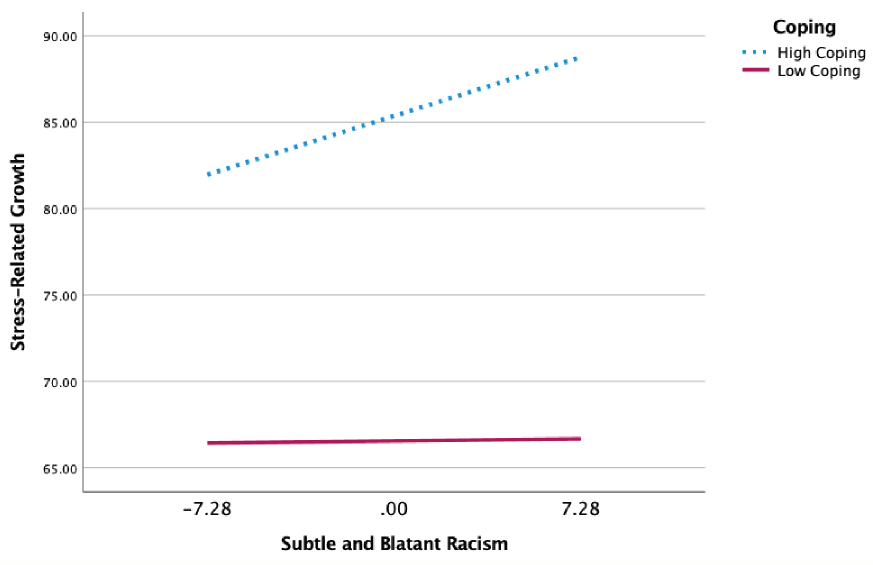
Discussion
The present study examined the extent to which coping, resilience, experiences of racism, and ethnic identity predicted stress-related growth in a national convenience sample of Asian and AAPI individuals. The results of our exploratory study provide empirical evidence for the moderating effects of coping on the relationship between racial discrimination and stress-related growth in Asians and AAPIs following the COVID-19 pandemic. In our study, ethnic identity was positively associated with stress-related growth, which further supports the current body of research linking ethnic identity to well-being (Iwamoto & Liu, 2010; Mossakowski, 2003; Yip et al., 2019). Our findings may be additionally explained through the lens of social identity theory (Tajfel & Turner, 1979), which posits that individuals who strongly identify with their social identities (i.e., ethnic and/or racial identities) are better equipped to leverage effective coping strategies that protect their overall self-concept and buffer the harmful impact of discrimination.
Participants in the study who used mental health services following COVID-19 also reported significantly higher levels of racial discrimination, resilience, coping, and stress-related growth compared to Asians and AAPIs who did not use professional mental health services. The results from our study are consistent with existing research that asserted how individuals may cultivate coping responses following traumatic experiences (Helgeson et al., 2006; Janoff-Bulman, 2004; Tedeschi & Calhoun, 2004) in ways that can strengthen the relationship between stressful experiences (i.e., racism) and stress-related growth (Park et al., 1996; Tedeschi & Calhoun, 2004). The results of our study therefore contribute to a larger body of research that establishes the relationship between stress-related growth and psychological health, optimism, positive affect, and psychological well-being (Bostock et al., 2009; Bower et al., 2009; Durkin & Joseph, 2009) while contributing nascent findings to the relationship between COVID-19 racial discrimination and stress-related growth in Asian and AAPI communities.
The results from Model 1 indicated education status, sexual identity, and help-seeking experiences were significantly associated with stress-related growth for Asians and AAPIs in the study. Specifically, participants who reported higher levels of education and identified as heterosexual or straight had lower scores of stress-related growth compared to those who did not identify as heterosexual. These findings are notable as individuals with lesbian, gay, bisexual, and other marginalized identities experience more stress and mental health issues compared to their heterosexual counterparts (Mongelli et al., 2019), resulting in greater opportunities to cultivate coping responses, build resilience, and establish meaningful social supports (Helgeson et al., 2006; Janoff-Bulman, 2004; Tedeschi & Calhoun, 2004). Participants in our study who used mental health services following the COVID-19 outbreak reported significantly higher levels of stress-related growth compared to Asians and AAPIs who did not use professional mental health services. One possible explanation for this finding may be that participants who sought mental health services already demonstrated higher levels of psychological mindedness, which may have influenced higher levels of stress-related growth following COVID-19–related racial discrimination.
In our study, the combined effects of resilience and coping explained 66.2% of the variance in Model 4, with coping strategies moderating the relationship between experiences of racism and stress-related growth. Participants in our study may have learned cognitive coping responses in the therapeutic setting that mitigated the effects of racism and cultivated stress-related growth. Our findings are consistent with the results of a meta-analysis (n = 103) that identified coping responses such as reappraisal, acceptance, and support seeking as significant predictors of stress-related growth (Prati & Pietrantoni, 2009). The specific coping responses that moderated the link between racism and stress-related growth in this study were self-blame, religion, humor, venting, substance use, denial, and disengagement. Leveraging these coping strategies in response to stressful experiences may be consistent with culturally congruent coping responses that protect Asians and AAPIs by avoiding the stressor (Edwards & Romero, 2008; Litam, 2020). Consistent with extant research on culturally congruent coping, engaging in self-blame responses may maintain interpersonal harmony (Wei et al., 2010), and humor, venting, denial, disengagement, and substance use may help one evade problems or adjust one’s feelings to the environment (Pokhrel & Herzog, 2014). The results of our study are thus consistent with research that emphasizes the influence of cultural notions on coping responses (Lazarus & Folkman, 1984; Tweed & Conway, 2006) while contributing new findings about which coping responses may contribute to stress-related growth in Asian and AAPI communities following COVID-19.
Implications for Counselors
This study highlights how experiences of racism, ethnic identity, resilience, and coping strategies may cultivate stress-related growth among Asian and AAPI individuals who experience COVID-19–related racial discrimination. Each of these variables were found to predict stress-related growth in our study. Mental health professionals working with Asian and AAPI clients who have experienced COVID-19 racism are encouraged to consider how their clients’ ethnic identity, resilience, and coping strategies may be leveraged to promote their well-being. In this exploratory study, participants with higher levels of ethnic identity experienced greater levels of stress-related growth, so it may behoove mental health professionals to embolden Asian and AAPI clients to fortify the quality of their ethnic group affiliation by pursuing cultural practices that promote a sense of group belongingness (Phinney, 1990). For example, ethnic identity can be cultivated by fostering community connection through local Asian and AAPI organizations, embracing cultural notions, and learning more about one’s culture, background, and family history (Chan & Litam, 2021; Litam, 2020). Clients who embody strong ethnic identities may be more likely to employ coping strategies that align with culturally embedded values; therefore, it is essential that mental health counselors recognize their own cultural values while remaining respectful of their client’s cultural values (Chang & O’Hara, 2013; see MSJCC, Ratts et al., 2016).
Given the importance of coping strategies and resilience on stress-related growth, mental health professionals are encouraged to identify and amplify clients’ existing coping strategies while fostering responses that cultivate resilience. Though limited, a supplementary analysis indicated that different forms of coping, such as self-blame, religion, humor, venting, substance use, denial, and disengagement, may moderate the relationship between racism and stress-related growth among Asian and AAPI communities facing racial discrimination following COVID-19. Thus, mental health professionals working with Asian and AAPI clients must assess the intention and outcome of client coping responses and challenge individualistic assumptions that minimize the value of culturally congruent coping strategies. The importance of using culturally sensitive therapeutic interventions when supporting Asian and AAPI clients during COVID-19 has been established (Litam, 2020). For example, mental health professionals must challenge assumptions that disengagement coping strategies are inherently problematic for their Asian and AAPI clients (Wong et al., 2010). Instead, mental health professionals are encouraged to focus on the usefulness of their Asian and AAPI clients’ coping strategies without imposing their own preconceived notion of what healthy and unhealthy coping entails. Of note, substance use was identified as a coping strategy used by participants in this study. Counselors are therefore called to examine the purpose and outcomes associated with client substance use with nuance to determine the extent to which ongoing substance use may contribute to mental health sequelae.
Limitations and Future Areas of Study
The results of the study must be interpreted within the context of methodological limitations. First, although all participants resided in the United States, the majority of participants held international statuses compared to U.S. citizens or permanent residents. Readers must be cautioned before generalizing these findings to AAPIs, who may endorse generational differences. Next, it is possible that participants recruited from MTurk may not be representative of the general Asian and AAPI population in the United States (Burnham et al., 2018). Future areas of research may consider incorporating various strategies to recruit more representative samples. Additional areas of investigation may also examine how generational identity may affect the extent to which coping, resilience, racism, and ethnic identity predict stress-related growth. Next, although a significant positive association was found between using professional mental health services and levels of resilience, racism, coping, and stress-related growth, it is unknown whether participants in the study already embodied higher levels of stress-related growth, coping, and resilience before seeking services. Future areas of study may examine whether these variables may actually predict help-seeking behaviors in Asians and AAPIs. For example, seeking professional mental health services is consistent with predictors of stress-related growth, including leveraging community support, engaging in cognitive responses, appraisal, and facilitating meaning making (Park & Fenster, 2004; Prati & Pietrantoni, 2009). Moreover, the validity of the findings from the supplementary analysis could be limited because of the low reliability of 14 subscales. Finally, Asians and AAPIs were aggregated in the study, which results in the loss of important within-group distinctions. Future studies are warranted that investigate the extent to which coping, resilience, racism, and ethnic identity predict stress-related growth in specific Asian and AAPI subgroups.
Conclusion
Asians and AAPIs who employ culturally congruent coping responses may experience greater levels of stress-related growth following experiences of COVID-19–related racial discrimination. In this study, higher levels of ethnic identity, resilience, and coping responses predicted stress-related growth in a national convenience sample of Asians and AAPIs residing in the United States. Asians and AAPIs in this study who sought professional mental health services reported higher levels of racism and endorsed higher scores of resilience, coping, and stress-related growth compared to those who did not seek professional mental health services. Mental health professionals are encouraged to support Asian and AAPI clients in strengthening their ethnic identity, building resilience, and using culturally congruent coping responses to mitigate the effects of COVID-19–related racism and promote the development of stress-related growth.
Conflict of Interest and Funding Disclosure
The authors reported no conflict of interest
or funding contributions for the development
of this manuscript.
References
Anandavalli, S., Harrichand, J. J. S., & Litam, S. D. A. (2020). Counseling international students in times of uncertainty: A critical feminist and bioecological approach. The Professional Counselor, 10(3), 365–375. https://doi.org/10.15241/sa.10.3.365
Asmundson, G. J. G., & Taylor, S. (2020). Coronaphobia: Fear and the 2019-nCoV outbreak. Journal of Anxiety Disorders, 70. https://doi.org/10.1016/j.janxdis.2020.102196
Boals, A., & Schuler, K. L. (2018). Reducing reports of illusory posttraumatic growth: A revised version of the Stress-Related Growth Scale (SRGS-R). Psychological Trauma: Theory, Research, Practice, and Policy, 10(2), 190–198. https://doi.org/10.1037/tra0000267
Bodner, T. E. (2017). Standardized effect sizes for moderated conditional fixed effects with continuous moderator variables. Frontiers in Psychology, 8, 562. https://doi.org/10.3389/fpsyg.2017.00562
Bostock, L., Sheikh, A. I., & Barton, S. (2009). Posttraumatic growth and optimism in health-related trauma: A systematic review. Journal of Clinical Psychology in Medical Settings, 16(4), 281–296. https://doi.org/10.1007/s10880-009-9175-6
Bower, J. E., Moskowitz, J. T., & Epel, E. (2009). Is benefit finding good for your health? Pathways linking positive life changes after stress and physical health outcomes. Current Directions in Psychological Science, 18(6), 337–341. https://doi.org/10.1111/j.1467-8721.2009.01663.x
Brown, S. D., Unger Hu, K. A., Mevi, A. A., Hedderson, M. M., Shan, J., Quesenberry, C. P., & Ferrara, A. (2014). The Multigroup Ethnic Identity Measure–Revised: Measurement invariance across racial and ethnic groups. Journal of Counseling Psychology, 61(1), 154–161. https://doi.org/10.1037/a0034749
Budiman, A., & Ruiz, N. G. (2021). Key facts about Asian Americans, a diverse and growing population. Pew Research Center. https://www.pewresearch.org/fact-tank/2017/09/08/key-facts-about-asian-americans
Burnham, M. J., Le, Y. K., & Piedmont, R. L. (2018). Who is MTurk? Personal characteristics and sample consistency of these online workers. Mental Health, Religion & Culture, 21(9–10), 934–944. https://doi.org/10.1080/13674676.2018.1486394
Cacioppo, J. T., & Hawkley, L. C. (2003). Social isolation and health, with an emphasis on underlying mechanisms. Perspectives in Biology and Medicine, 46(3), S39–S52. https://doi.org/10.1353/pbm.2003.0063
Cacioppo, J. T., Hawkley, L. C., Crawford, L. E., Ernst, J. M., Burleson, M. H., Kowalewski, R. B., Malarkey, W. B., Van Cauter, E., & Berntson, G. G. (2002). Loneliness and health: Potential mechanisms. Psychosomatic Medicine, 64(3), 407–417. https://doi.org/10.1097/00006842-200205000-00005
Carver, C. S. (1997). You want to measure coping but your protocol’s too long: Consider the Brief COPE. International Journal of Behavioral Medicine, 4(1), 92–100. https://doi.org/10.1207/s15327558ijbm0401_6
Chan, C. D., & Litam, S. D. A. (2021). Mental health equity of Filipino communities in COVID-19: A framework for practice and advocacy. The Professional Counselor, 11(1), 73–85. https://doi.org/10.15241/cdc.11.1.73
Chang, C. Y., & O’Hara, C. (2013). The initial interview with Asian American clients. Journal of Contemporary Psychotherapy, 43(1), 33–42. https://doi.org/10.1007/s10879-012-9221-9
Cheng, H.-I. (2013). “A wobbly bed still stands on three legs”: On Chinese immigrant women’s experiences with ethnic community. Women & Language, 36, 7–25.
Choi, Y., Park, M., Noh, S., Lee, J. P., & Takeuchi, D. (2020). Asian American mental health: Longitudinal trend and explanatory factors among young Filipino- and Korean Americans. SSM – Population Health, 10. https://doi.org/10.1016/j.ssmph.2020.100542
Cohen, J. (1998). Statistical power analysis for the behavioral sciences (2nd ed.). Lawrence Erlbaum.
Congressional Asian Pacific American Caucus. (2020, February 26). As coronavirus fears incite violence, CAPAC members urge colleagues to not stoke xenophobia. https://capac-chu.house.gov/press-release/coronavirus-fears-incite-violence-capac-members-urge-colleagues-not-stoke-xenophobia
Connor, K. M., & Davidson, J. R. T. (2003). Development of a new resilience scale: The Connor-Davidson Resilience Scale (CD-RISC). Depression and Anxiety, 18(2), 76–82. https://doi.org/10.1002/da.10113
Cordova, M. J., Riba, M. B., & Spiegel, D. (2017). Post-traumatic stress disorder and cancer. The Lancet Psychiatry, 4(4), 330–338. https://doi.org/10.1016/S2215-0366(17)30014-7
DeVitre, Z., & Pan, D. (2020). Asian American values and attitudes towards seeking mental health services. Journal of Asia Pacific Counseling, 10(1), 15–26. https://doi.org/10.18401/2020.10.1.2
Durkin, J., & Joseph, S. (2009). Growth following adversity and its relation with subjective well-being and psychological well-being. Journal of Loss and Trauma, 14(3), 228–234.
https://doi.org/10.1080/15325020802540561
Edmondson, D., Chaudoir, S. R., Mills, M. A., Park, C. L., Holub, J., & Bartkowiak, J. M. (2011). From shattered assumptions to weakened worldviews: Trauma symptoms signal anxiety buffer disruption. Journal of Loss and Trauma, 16(4), 358–385. https://doi.org/10.1080/15325024.2011.572030
Edwards, L. M., & Romero, A. J. (2008). Coping with discrimination among Mexican descent adolescents. Hispanic Journal of Behavioral Sciences, 30(1), 24–39. https://doi.org/10.1177/0739986307311431
Erikson, E. H. (1968). Identity: Youth and crisis. W. W. Norton.
Frazier, P. A., Tix, A. P., & Barron, K. E. (2004). Testing moderator and mediator effects in counseling psychology research. Journal of Counseling Psychology, 51(1), 115–134. https://doi.org/10.1037/0022-0167.51.1.115
Gee, G. C., Spencer, M., Chen, J., Yip, T., & Takeuchi, D. T. (2007). The association between self-reported racial discrimination and 12-month DSM-IV mental disorders among Asian Americans nationwide. Social Science & Medicine, 64(10), 1984–1996. https://doi.org/10.1016/j.socscimed.2007.02.013
Hayes, A. F. (2018). Introduction to mediation, moderation, and conditional process analysis: A regression-based approach (2nd ed.). Guilford.
Helgeson, V. S., Reynolds, K. A., & Tomich, P. L. (2006). A meta-analytic review of benefit finding and growth. Journal of Consulting and Clinical Psychology, 74(5), 797–816. https://doi.org/10.1037/0022-006X.74.5.797
Hwang, W.-C., & Goto, S. (2008). The impact of perceived racial discrimination on the mental health of Asian American and Latino college students. Cultural Diversity and Ethnic Minority Psychology, 14(4), 326–335. https://doi.org/10.1037/1099-9809.14.4.326
Inman, A. G., & Yeh, C. J. (2007). Asian American stress and coping. In F. T. L. Leong, A. G. Inman, A. Ebreo, L. H. Yang, L. Kinoshita, & M. Fu (Eds.), Handbook of Asian American psychology (2nd ed., pp. 323–340). SAGE.
Iwamoto, D. K., & Liu, W. M. (2010). The impact of racial identity, ethnic identity, Asian values, and race-related stress on Asian Americans and Asian international college students’ psychological well-being. Journal of Counseling Psychology, 57(1), 79–91. https://doi.org/10.1037/a0017393
Janoff-Bulman, R. (2004). Posttraumatic growth: Three explanatory models. Psychological Inquiry, 15(1), 30–34.
Jeung, R., & Nham, K. (2020). Incidents of coronavirus-related discrimination. Asian Pacific Policy & Planning Council. http://www.asianpacificpolicyandplanningcouncil.org/wp-content/uploads/STOP_AAPI_HATE_MONTHLY_REPORT_4_23_20.pdf
Kim, J., & Kim, H. (2013). The experience of acculturative stress-related growth from immigrants’ perspectives. International Journal of Qualitative Studies on Health and Well-Being, 8(1).
https://doi.org/10.3402/qhw.v8i0.21355
Lazarus, R. S., & Folkman, S. (1984). Stress, appraisal, and coping. Springer.
Le, D. L., & Ahn, S. (2011). Racial discrimination and Asian mental health: A meta-analysis. The Counseling Psychologist, 39(3), 463–489. https://doi.org/10.1177/0011000010381791
Lee, R. M. (2003). Do ethnic identity and other-group orientation protect against discrimination for Asian Americans? Journal of Counseling Psychology, 50(2), 133–141. https://doi.org/10.1037/0022-0167.50.2.133
Lee, R. M. (2005). Resilience against discrimination: Ethnic identity and other-group orientation as protective factors for Korean Americans. Journal of Counseling Psychology, 52(1), 36–44.
https://doi.org/10.1037/0022-0167-52.1.36
Lee, R. M., & Davis, C., III. (2000). Cultural orientation, past multicultural experience, and a sense of belonging on campus for Asian American college students. Journal of College Student Development, 41(1), 110–115.
Lee, R. M., & Yoo, H. C. (2004). Structure and measurement of ethnic identity for Asian American college students. Journal of Counseling Psychology, 51(2), 263–269. https://doi.org/10.1037/0022-0167.51.2.263
Leong, F., Park, Y. S., & Kalibatseva, Z. (2013). Disentangling immigrant status in mental health: Psychological protective and risk factors among Latino and Asian American immigrants. American Journal of Orthopsychiatry, 83(2–3), 361–371. http://doi.org/10.1111/ajop.12020
Liang, C. T. H., & Fassinger, R. E. (2008). The role of collective self-esteem for Asian Americans experiencing racism-related stress: A test of moderator and mediator hypotheses. Cultural Diversity and Ethnic Minority Psychology, 14(1), 19–28. https://doi.org/10.1037/1099-9809.14.1.19
Lieber, E., Chin, D., Nihira, K., & Mink, I. T. (2001). Holding on and letting go: Identity and acculturation among Chinese immigrants. Cultural Diversity and Ethnic Minority Psychology, 7(3), 247–261. https://doi.org/10.1037/1099-9809.7.3.247
Lim, J., & Ashing-Giwa, K. T. (2013). Is family functioning and communication associated with health-related quality of life for Chinese- and Korean-American breast cancer survivors? Quality of Life Research, 22, 1319–1329. https://doi.org/10.1007/s11136-012-0247-y
Linley, P. A., & Joseph, S. (2004). Positive change following trauma and adversity: A review. Journal of Traumatic Stress, 17(1), 11–21. https://doi.org/10.1023/B:JOTS.0000014671.27856.7e
Litam, S. D. A. (2020). “Take your Kung Flu back to Wuhan”: Counseling Asians, Asian Americans, and Pacific Islanders with race-based trauma related to COVID-19. The Professional Counselor, 10(2), 144–156. https://doi.org/10.15241/sdal.10.2.144
Litam, S. D. A., & Hipolito-Delgado, C. P. (2021). When being “essential” illuminates disparities: Counseling clients affected by COVID-19. Journal of Counseling & Development, 99(1), 3–10.
https://doi.org/10.1002/jcad.12349
Litam, S. D. A., & Oh, S. (in press). Effects of COVID-19 racial discrimination on depression and life satisfaction among young, middle, and older Chinese Americans. Adultspan Journal.
Litam, S. D. A., & Oh, S. (2020). Ethnic identity and coping strategies as moderators of COVID-19 racial discrimination experiences among Chinese Americans. Counseling Outcome Research and Evaluation. https://doi.org/10.1080/21501378.2020.1814138
Miller, C. T., & Kaiser, C. R. (2001). A theoretical perspective on coping with stigma. Journal of Social Issues, 57(1), 73–92. https://doi.org/10.1111/0022-4537.00202
Miller, C. T., & Major, B. (2000). Coping with stigma and prejudice. In T. F. Heatherton, R. E. Kleck, M. R. Hebl, & J. G. Hull (Eds.), The social psychology of stigma (pp. 243–272). Guilford.
Mongelli, F., Perrone, D., Balducci, J., Sacchetti, A., Ferrari, S., Mattei, G., & Galeazzi, G. M. (2019). Minority stress and mental health among LGBT populations: An update on the evidence. Minerva Psychiatrica, 60(1), 27–50. https://doi.org/10.23736/S0391-1772.18.01995-7
Mossakowski, K. N. (2003). Coping with perceived discrimination: Does ethnic identity protect mental health? Journal of Health and Social Behavior, 44(3), 318–331. https://doi.org/10.2307/1519782
Nadal, K. L., Wong, Y., Sriken, J., Griffin, K., & Fujii-Doe, W. (2015). Racial microaggressions and Asian Americans: An exploratory study on within-group differences and mental health. Asian American Journal of Psychology, 6(2), 136–144. https://doi.org/10.1037/a0038058
Noh, S., & Kaspar, V. (2003). Perceived discrimination and depression: Moderating effects of coping, acculturation, and ethnic support. American Journal of Public Health, 93(2), 232–238. https://doi.org/10.2105/ajph.93.2.232
Nolen-Hoeksema, S., & Davis, C. G. (2004). Theoretical and methodological issues in the assessment and interpretation of posttraumatic growth. Psychological Inquiry, 15, 60–64.
O’Rourke, N., & Hatcher, L. (2013). A step-by-step approach to using SAS for factor analysis and structural equation modeling (2nd ed.). SAS Press.
Osborn, J. W. (2013). Best practices in data cleaning: A complete guide to everything you need to do before and after collecting your data. SAGE.
Park, C. L., Cohen, L. H., & Murch, R. L. (1996). Assessment and prediction of stress-related growth. Journal of Personality, 64(1), 71–105. https://doi.org/10.1111/j.1467-6494.1996.tb00815.x
Park, C. L., & Fenster, J. R. (2004). Stress-related growth: Predictors of occurrence and correlates with psychological adjustment. Journal of Social and Clinical Psychology, 23(2), 195–215. https://doi.org/10.1521/jscp.23.2.195.31019
Phinney, J. S. (1990). Ethnic identity in adolescents and adults: Review of research. Psychological Bulletin, 108(3), 499–514. https://doi.org/10.1037/0033-2909.108.3.499
Phinney, J. S. (1992). The Multigroup Ethnic Identity Measure: A new scale for use with diverse groups. Journal of Adolescent Research, 7(2), 156–176. https://doi.org/10.1177/074355489272003
Phinney, J. S. (2003). Ethnic identity and acculturation. In K. M. Chun, P. B. Organista, & G. Marin (Eds.), Acculturation: Advances in theory, measurement, and applied research (pp. 63–82). American Psychological Association.
Pokhrel, P., & Herzog, T. A. (2014). Historical trauma and substance use among Native Hawaiian college students. American Journal of Health Behavior, 38(3), 420–429. https://doi.org/10.5993/AJHB.38.3.11
Prati, G., & Pietrantoni, L. (2009). Optimism, social support, and coping strategies as factors contributing to posttraumatic growth: A meta-analysis. Journal of Loss and Trauma, 14(5), 364–388.
https://doi.org/10.1080/15325020902724271
Preacher, K. J., Rucker, D. D., & Hayes, A. F. (2007). Addressing moderated mediation hypothesis: Theory, methods, and prescriptions. Multivariate Behavioral Research, 42(1), 185–227.
https://doi.org/10.1080/002731707001341316
Ratts, M. J., Singh, A. A., Nassar-McMillan, S., Butler, S. K., & McCullough, J. R. (2016). Multicultural and Social Justice Counseling Competencies: Guidelines for the counseling profession. Journal of Multicultural Counseling and Development, 44(1), 28–48. https://doi.org/10.1002/jmcd.12035
Rzeszutek, M., & Gruszczyńska, E. (2018). Paradoxical effect of social support among people living with HIV: A diary study investigating the buffering hypothesis. Journal of Psychosomatic Research, 109, 25–31. https://doi.org/10.1016/j.jpsychores.2018.03.006
Sue, D. W., Sue, D., Neville, H. A., & Smith, L. (2019). Counseling the culturally diverse: Theory and practice (8th ed.). Wiley.
Tabachnick, B. G., & Fidell, L. S. (2019). Using multivariate statistics (7th ed.). Pearson.
Tajfel, H., & Turner, J. C. (1979). An integrative theory of intergroup conflict. In W. G. Austin & S. Worchel (Eds.), The social psychology of intergroup relations. Brooks Cole.
Tedeschi, R. G., & Calhoun, L. G. (1995). Trauma and transformation: Growing in the aftermath of suffering. SAGE.
Tedeschi, R. G., & Calhoun, L. G. (1996). The posttraumatic growth inventory: Measuring the positive legacy of trauma. Journal of Traumatic Stress, 9(3), 455–471. https://doi.org/10.1007/BF02103658
Tedeschi, R. G., & Calhoun, L. G. (2004). Posttraumatic growth: Conceptual foundation and empirical evidence. Psychological Inquiry, 15(1), 1–18. https://doi.org/10.1207/s15327965pli1501_01
Turner, J. C., Hogg, M. A., Oakes, P. J., Reicher, S. D., & Wetherell, M. S. (1987). Rediscovering the social group: A self-categorization theory. Basil Blackwell.
Tweed, R. G., & Conway, L. G., III. (2006). Coping strategies and culturally influenced beliefs about the world. In P. T. P. Wong & L. C. J. Wong (Eds.), Handbook of multicultural perspectives on stress and coping (pp. 133–153). Springer.
Vasquez, C., Valiente, C., García, F. E., Contreras, A., Peinado, V., Trucharte, A., & Bentall, R. P. (2021). Post-traumatic growth and stress-related responses during the COVID-19 pandemic in a national representative simple: The role of positive core beliefs about the world and others. Journal of Happiness Studies. https://doi.org/10.1007/s10902-020-00352-3
Wagnild, G. M., & Young, H. M. (1993). Development and psychometric evaluation of the Resilience Scale. Journal of Nursing Measurement, 1(2), 165–178.
Wei, M., Heppner, P. P., Ku, T.-Y., & Liao, K. Y.-H. (2010). Racial discrimination stress, coping, and depressive symptoms among Asian Americans: A moderation analysis. Asian American Journal of Psychology, 1(2), 136–150. https://doi.org/10.1037/a0020157
Wei, M., Wang, K. T., Heppner, P. P., & Du, Y. (2012). Ethnic and mainstream social connectedness, perceived racial discrimination, and posttraumatic stress symptoms. Journal of Counseling Psychology, 59(3), 486–493. https://doi.org/10.1037/a0028000
Wen, J., Aston, J., Liu, X., & Ying, T. (2020). Effects of misleading media coverage on public health crisis: A case of the 2019 novel coronavirus outbreak in China. An International Journal of Tourism and Hospitality Research, 31(2), 331–336. https://doi.org/10.1080/13032917.2020.1730621
Wong, G., Derthick, A. O., David, E. J. R., Saw, A., & Okazaki, S. (2014). The what, the why, and the how: A review of racial microaggressions research in psychology. Race and Social Problems, 6, 181–200. https://doi.org/10.1007/s12552-013-9107-9
Wong, Y. J., Kim, S.-H., & Tran, K. K. (2010). Asian Americans’ adherence to Asian values, attributions about depression, and coping strategies. Cultural Diversity and Ethnic Minority Psychology, 16(1), 1–8. https://doi.org/10.1037/a0015045
Yang, A. (2014). Themes in the career development of 1.5-generation Hmong American women. Journal of Career Development, 41(5), 402–425. https://doi.org/10.1177/0894845313507775
Yeh, C. J., Arora, A. K., & Wu, K. A. (2006). A new theoretical model of collectivistic coping. In P. T. P. Wong & L. C. J. Wong (Eds.), Handbook of multicultural perspectives on stress and coping: International and cultural psychology series (pp. 55–72). Springer.
Yip, T., & Fuligni, A. J. (2002). Daily variation in ethnic identity, ethnic behaviors, and psychological well-being among American adolescents of Chinese descent. Child Development, 73(5), 1557–1572. https://doi.org/10.1111/1467-8624.00490
Yip, T., Wang, Y., Mootoo, C., & Mirpuri, S. (2019). Moderating the association between discrimination and adjustment: A meta-analysis of ethnic/racial identity. Developmental Psychology, 55(6), 1274–1298. https://doi.org/10.1037/dev0000708
Yoo, H. C., Steger, M. F., & Lee, R. M. (2010). Validation of the Subtle and Blatant Racism Scale for Asian American College Students (SABRA-A2). Cultural Diversity and Ethnic Minority Psychology, 16(3), 323–334. https://doi.org/10.1037/a0018674
Stacey Diane Arañez Litam, PhD, NCC, CCMHC, LPCC-S, is an assistant professor at Cleveland State University. Seungbin Oh, PhD, NCC, LPC, is an assistant professor at Merrimack College. Catherine Chang, PhD, NCC, LPC, CPCS, is a professor at Georgia State University. Correspondence may be addressed to Stacey Litam, 2121 Euclid Ave., Cleveland, OH 44115, s.litam@csuohio.edu.