Sep 2, 2014 | Article, Volume 1 - Issue 3
Sachin Jain, Santiago Silva
One of the major flaws in current psychological tests is the belief that a prediction/diagnosis can be made that would tell an individual whether he is heterosexual, homosexual or bisexual. What is needed within the profession, however, is an assessment that has the sensitivity to help clients explore their sexual orientation. A pilot 100-item Sexual Orientation Scale was developed after interviewing 30 self-identified gay men who considered themselves happy/satisfied. The items summarized the thoughts and feelings of these 30 men during the discovery process and ultimate acceptance of their sexual orientation. The scale was then completed by 208 male participants. The Cronbach’s Alpha Coefficient was calculated for the initial 100-item version of the Sexual Orientation Scale along with item analysis and factor analysis. These statistical manipulations were computed to help eliminate items that did not discriminate well. The final version of the Sexual Orientation contains 43 items. Implications for the use of this scale and future directions in research are further explored.
Keywords: sexual orientation, scale development, males, assessment, exploration
As children grow up in our society, they are introduced to a wide range of knowledge about sexual behavior by their parents, siblings, and peers. Part of their education addresses the ideas of sexual orientation and/or preference. The inherent messages in this education are that a person is either heterosexual (sexually attracted to members of the opposite sex), homosexual (sexually attracted to members of the same sex), or bisexual (sexually attracted to members of both sexes).
Historical Overview of Sexual Orientation
A number of theories on the origin of homosexuality have attempted to define homosexuality. A number of these theories (c.f. Drescher, 2008; Ellis, 1936; Freud, 1922/2010; Krafft-Ebing, 1887/1965; Nuttbrock et al., 2009) place sexual orientation within the context of an individual’s overall sex role identity. These individuals link sexual attraction for men toward women with a masculine sex role orientation and sexual orientation toward men with a feminine sex role orientation (Axam & Zalesne, 1999; Mata, Ghavami & Wittig, 2010; Storms, 1980). Sexual orientation refers to a particular lifestyle (behavior) that an individual displays. Storms (1980) and Moradi, Mohr, Worthington, & Fassinger (2009) found most theories about the nature of sexual orientation emphasize either the person’s sex role orientation or erotic orientation. Although these assumptions have had a major impact on the development of theories, research, clinical practice, and even popular stereotypes, neither assumption has been adequately tested in past research. A homosexual person is one defined as having preferential erotic attraction to members of the same sex and usually (but not necessarily) engaging in overt sexual relations with them (Crooks & Baur, 2008; Marmor, 1980).
Cass (1984) and Harper & Harris (2010) identified four steps in the discovery process that people experience as they begin to identify their sexual orientation:
1. Individuals come to perceive themselves as a homosexual by adopting a self-image of what it means to be homosexual.
2. Individuals take this self-image a step further and allow it, through interaction with others, to become a homosexual identity.
3. Individuals assume the necessary affective, cognitive, and behavioral strategies in order to effectively manage this identity in everyday life.
4. Individuals find a way with which to incorporate the new identity into an overall sense of self.
Assessment of Sexual Orientation
Fergusson & Horwood (2005) wrote a review of the multitude of methods that have been used to assess sexual orientation. Conceptualization of sexual orientation as dichotomous (i.e., heterosexual and homosexual) was overturned over 60 years ago by Kinsey, Pomeroy, and Martin (1948) and by Kinsey, Pomeroy, Martin, and Gebhard (1953). These studies resulted in the development of a 7-point scale in which 0 represented exclusive heterosexuality and 6 represented exclusive homosexuality. Three on the scale indicated equal homosexual and heterosexual responsiveness. Individuals were rated on this continuum based upon their sexual behavior and physical reactions (i.e., physical attraction to desired partners) (Coleman, 1987; Fergusson & Horwood, 2005).
Although this notion that people fall in a continuum better represented the realities of the world (Bagley & Tremblay, 1997; Silenzio, Pena, Duberstein, Cerel, & Knox, 2007), the Kinsey Scale has many limitations for accurately describing an individual’s sexual orientation. The scale assumes that sexual behavior and erotic responsiveness are the same within individuals. In response to this criticism, Bell and Weinberg (1978) used two scales in their extensive study of homosexuality. They examined two scales: one for sexual behavior, and one for erotic fantasies. Bell & Weinberg (1978) found discrepancies between the two ratings. Paul (1984) and Garnets & Kimmel (2003) also reported discrepancies in approximately one-third of their homosexual samples. It was reported that most men saw their behavior as more exclusively homosexual than their erotic feelings (Coleman, 1987; Fergusson & Horwood, 2005; Schwartz, Kim, Kolundzija, Rieger & Sanders, 2008).
Coleman (1987) and Fergusson & Horwood (2005) suggested that while this dichotomous and continuous view of sexual orientation represented an improvement in assessment of sexual orientation, several clinicians and researchers have recommended additional dimensions (Fox, 2003). These dimensions are those based upon both the biological sex of the partner and the biological dichotomous sex of the individual.
As the literature on psychological testing and homosexuality unfolded, it became clear that tests were not very effective in creating special scales, signs or scoring patterns that could differentiate homosexuals from heterosexuals (Garnets & Kimmel, 2003; Paul, Weinrich, Gonsiorek, & Hotvedt, 1982). Homosexuality was no longer being studied as an illness. Contrastingly, literature has brought forth strong data that dismiss the notion that homosexuality is a disorder (Cass, 1984; Coleman, 1982; Harper & Harris, 2010; Henchen & O’Dowd, 1977; Morin & Miller, 1974; Tripp, 1975; Troiden, 1977; Weinberg, 1978).
One of the major flaws in current psychological tests is that there is a belief that a prediction/diagnosis can be made that would tell an individual whether he is heterosexual, homosexual, or bisexual. It is the authors’ belief that it is inappropriate to predict what kind of lifestyle an individual will/should follow. What is more feasible is to assist an individual as he or she explores the experience of uncertainty. Therefore, an instrument is needed that has the sensitivity to help clients explore their sexual orientation, not one that identifies levels of disturbance.
Purpose of the Study
The purpose of the study was to construct an instrument that would help counselors in assisting clients who wish to explore sexual orientation. The instrument was to:
• Identify issues that need to be addressed by the client during the discovery of sexual orientation.
• Focus on issues such as self-definition, self-acceptance, fears, sexual fantasies, and understanding of lifestyle.
• Provide an information base for counselors as they help their clients unfold significant characteristics of their personality.
• Provide counselors a tool for helping clients meet the challenges they face now and will face in the future.
Method
Participants
The volunteer population of this study consisted of males who were either a) receiving personal counseling at a university counseling service, community mental health agency, and/or private practice; b) enrolled in introductory psychology classes at universities or community colleges; or c) participating in local men’s groups (i.e., Jaycees, Lions Clubs, support groups, etc.).
Two universities in California, eight universities in Texas, and one university in Wisconsin assisted in the collection of data. Three mental health agencies and four private counseling centers also were recruited for assistance in data collection. The private counseling centers served primarily gay and lesbian clients from the Dallas/Ft. Worth area.
Directors and/or counselors at the mental health sites mentioned above were visited. The purpose of the study was explained and they were asked if they would approach their clients (straight and gay) to determine their willingness to participate in the study. If the counselors were willing to speak to their clients, they were given instructions to share with clients who agreed to participate. They were instructed to give the client the research packet and return the completed information in the enclosed addressed/stamped envelope. Seventy-five agreed and completed packets from this group of mental health agencies were obtained.
Permission from psychology professors at the universities and/or colleges to address their introductory psychology classes was obtained for recruiting more subjects. The purpose of the study was shared with the class, willing participants were moved to another classroom, and they completed the research packet. One hundred and six packets were completed through this procedure.
Men’s groups were approached to obtain additional participants. Groups such as Jaycees, Lions Clubs, and Gay Men’s Support Groups were contacted and visited. A presentation was made that addressed the purpose of the study. Willing participants were provided with information packets, which they returned in enclosed envelopes. Thirty-three completed packets from representatives of the men’s groups were received. Twenty-eight of the 33 came from gay men’s support groups.
Demographic information from the personal data form was summarized and examined across the variable of sexual orientation on the following factors: educational level, socio-economic status, age, ethnicity, self-rating on the Kinsey Sexuality Scale and whether or not the participant was currently in counseling or psychotherapy. The males in the sample identified themselves as being either homosexual (gay) or heterosexual (straight). The males self-identified as gay or straight by rating themselves on the seven-point Kinsey Sexuality Scale (0=exclusively heterosexual to 6=exclusively homosexual). Straight responses were identified as those of which the men rated themselves as zero (0) or one (1) and gay responses were identified as those in which the men rated themselves as five (5) or six (6) on the Kinsey scale. Only six subjects rated themselves as 2, 3 and 4. The scales completed by these 6 subjects were not used in this study.
The sample consisted of a total of 208 men from cities in Texas, Wisconsin, and California: 132 were between the ages of 18–25 (63.5%); 52 were between the ages of 26–33 (25.0%); and 24 were between the ages of 34–40 (11.5%). According to the Kinsey Scale Rating, 104 were straight (50%) and 104 were gay (50%). Of the men who participated in the sample, 85 (40.9%) had received counseling and 123 (59.1%) had not.
Procedure
The first procedure consisted of the development of the items for the Sexual Orientation Scale. In order to achieve this task, thirty gay men who described themselves as being happy/satisfied with the gay lifestyle were interviewed. The men were identified via personal contacts and gay organizations. Their input was used to develop items for the Sexual Orientation Scale.
Three small group meetings of approximately two hours each with about ten men were scheduled. Each meeting began with a statement of the purpose of the groups and the study. It was explained that data was being collected to formulate a scale that would help people clarify questions about their sexual orientation. It was explained that the scale was not designed to label whether someone was gay or straight, but simply to identify issues surrounding sexual orientation. Time was allotted for questions and answers.
Participants were asked for permission to record the group session. When permission was obtained, participants were asked about their experience of the discovery process of their sexual orientation (e.g., “What struggles did you experience?” “What questions did you ask yourself during this discovery process?” “What were you feeling?” “Did you get in touch with any fears?” “What kind of sexual fantasies did you experience?”). These questions were asked in order to help the participant recall their discovery process. Participants were allowed to ask each other questions and/or identify with what was being shared in a casual and informal atmosphere. Recordings of the three small group meetings provided the source for the 100 items that represented thoughts and feelings the men experienced during their discovery process. These 100 items consisted of Phase 1 of the Sexual Orientation Scale development.
After the pilot scale was developed, packets were sent out to university counseling services, psychotherapists in private practice, and community mental health agencies. The packet consisted of: (a) a personal data form, (b) the 100-item Sexual Orientation Scale, (c) an informed consent form, and (d) an addressed and stamped envelope. Data on the 100-item Sexual Orientation Scale also was collected from different men’s groups and from the introductory psychology classes both at universities and community colleges.
Two hundred and eight packets were completed. Coincidently, 104 responses were from gay individuals, and 104 were straight responses. The responses were then transferred onto Scantrons and submitted for analysis.
Instrument Development
Item construction. Tests are composed of a number of items that are used to measure a particular subject. According to Wesman (1971), an item may be defined as a scoring unit. Creating an item should be taken seriously because each item in a test produces a unit of information regarding the person who takes the test.
Writing a test item is an involved process. Test items need to be subjected to constant evaluation in order to ensure, as much as possible, that they are measuring what they are intended to measure. The items developed for the Sexual Orientation Scale represent two variables: self-image and eroticism. These variables have been continuously identified in sexual-orientation literature (Cass, 1984; Coleman, 1982; Eliason & Schope, 2007; Grace, 1979) as variables that must be examined when attempting to answer questions regarding sexual orientation. Self-image is defined as involving self-definition, self-acceptance, fears and an understanding of lifestyle. Eroticism is defined as sexual fantasies.
Item analysis. According to Anastasi (1988), items on an instrument may be analyzed quantitatively, in regards to their statistical properties. When examining items qualitatively, content validity is considered as well as the evaluation of items in terms of effective item-writing procedures. Quantitative analysis primarily includes the measure of item difficulty and item discrimination (Anastasi, 1988).
Item difficulty answers the question: How hard or easy was a particular item for the group of participants? Item discrimination refers to the degree to which an item differentiates correctly among test takers in that behavior that the test is designed to measure (Anastasi, 1988, p. 210). Item discrimination was calculated as a correlation coefficient between the item score and the total score. Correlation coefficient indicates the strength and direction of a linear relationship between two random variables.
Results and Discussion
Item Design for the Sexual Orientation Scale
In designing the Sexual Orientation Scale, two areas of interests were salient. They were self-images and eroticism. The literature on sexual identity formation strongly supported the examination of these two interest areas during the discovery process of one’s sexual orientation. The importance of examining self-images and eroticism was further supported in the early stages of this study that resulted in the identification of the initial 100 items of the Sexual Orientation Scale.
Thirty self-identified gay men were interviewed regarding their discovery process. While reviewing interviews, items were generated that represented their thoughts and feelings. Examination of items clearly indicated that issues such as self-acceptance, understanding fears, and eroticism were being confronted during the discovery process.
Next, these 100 items were then subjected to an item analysis that resulted in identifying 45 items with item discrimination indices of 0.50 or higher. These 45 items were then further subjected to a factor analysis and an alpha coefficient.
An arbitrary decision was then made to use a 0.5 or higher factor loading in examining items. A strict convention of 0.5 or higher was used in order to identify the most discriminating items. The factor analysis identified the same items the item analysis identified. The alpha coefficients were as follows: overall= 0.924; straights= 0.723, gays= 0.653.
The factor analysis also identified four factors that were consistent with issues identified by both the literature and the initial 100 items. After reviewing the items in these factors, they were labeled as:
attraction to same sex
attraction to opposite sex
self-acceptance of gay behavior/attitudes
fears
Item Analysis
Anastasi (1988) pointed out that items on an instrument may be analyzed qualitatively, in terms of their content and form, and quantitatively, in terms of their statistical properties. The item analysis performed on the initial 100 items of the Sexual Orientation Scale focused on a quantitative analysis and more specifically on the measures of item difficulty and item discrimination.
Item difficulty refers to the percentage of subjects that endorse certain items on the scale. The closer the difficulty level approaches 0.50, the more differentiations the items can make (Anastasi, 1988).
Item discrimination refers to how effective the item discriminates between the two groups. Therefore, the higher the item discrimination score, the more effectively the item will differentiate between the two groups (gays/straights). Table 1 shows how the sample was grouped in order to establish an item-to-total score correlation, which is identified as a useful exercise to select items.
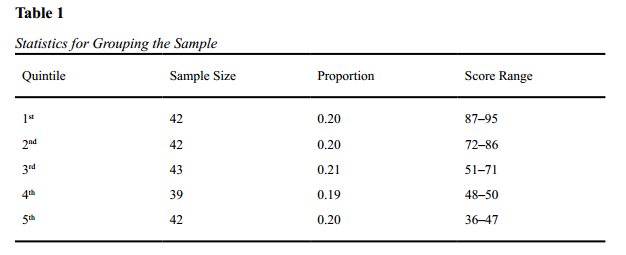
Based on the total score, the respondents were divided into quintiles (groups of approximately 40 subjects). A total score was established by assigning a value of 1 to true responses and a value of 2 to false responses. A true response indicated the way a gay man would respond. An item difficulty, identified in the item analysis as proportion of subjects that responded correctly to the item (PROP) and item discrimination, identified in the item analysis as a point biserial correlation coefficient (RPBI), were calculated for each item.
Table 2 outlines the item difficulty and item discrimination score and the scoring key of the initial 100 items. The asterisks identify the scores for the 43 items on the final version of the Sexual Orientation Scale. Of the final 43 items, approximately 76.7% of the items have a difficulty score that range from 0.40 to 0.60. Since Anastasi (1988) stated that the closer the difficulty level approaches 0.50, the more differentiations the item can make, it is safe to infer that the majority of the items on the Sexual Orientation Scale possessed good potential for differentiating between responses of the two groups. The remaining 23.3% of the items were not far behind. None of the item difficulty scores were less than 0.32 or higher than 0.76. This shows that the result of these items do not differentiate as well, but well enough to contribute to the overall reliability and validity of the Sexual Orientation Scale.
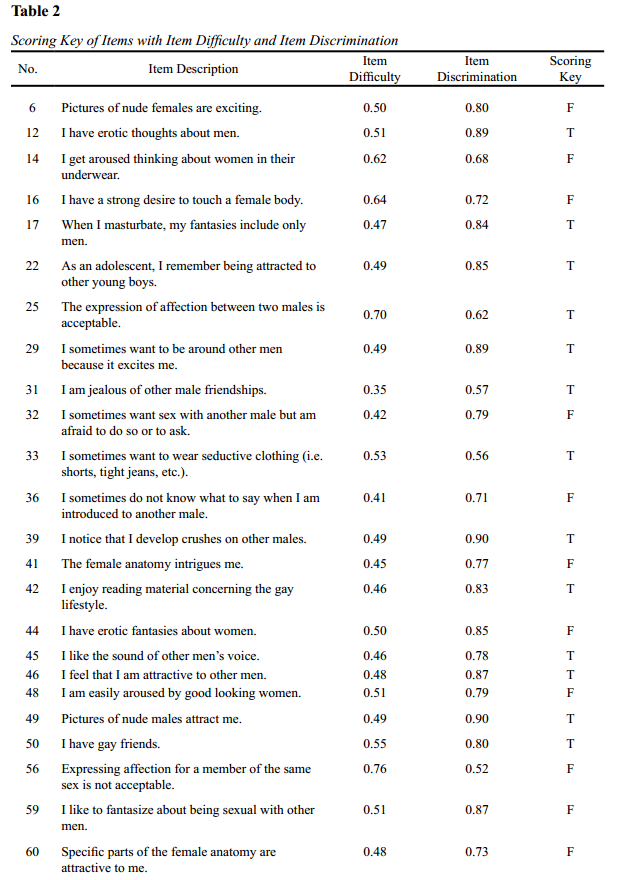
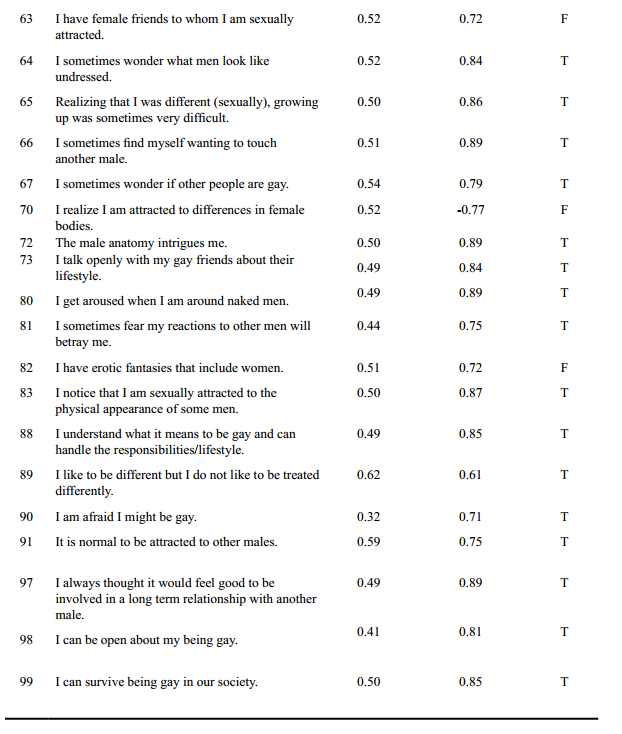
According to Anastasi (1988), the items that have low correlations with total score should be deleted and the items with the highest average inter-correlations will be retained. These items were retained because they are the ones that discriminate well and increase the validity of the test.
Analysis showed that 43 items on the initial 100-item Sexual Orientation Scale scored 0.50 or higher on the item discrimination index. Since the item discrimination refers to the degree to which an item differentiates correctly among test takers in the behavior that the test is designed to measure, one could assume the majority of the items on the Sexual Orientation Scale effectively differentiates between the two groups (gay/straight) that were tested.
Results of Item Analysis
The 45-item version of the Sexual Orientation Scale was a result of an item analysis done on the initial 100-item scale. The original data analysis identified 17 factors. An item discrimination index of 0.50 or higher was used to identify the items for the final version of the scale. Items that exhibited a higher level of commonality were selected. The 55 items that were deleted did not discriminate as well.
The 45 items were then submitted to the following statistical procedures: (a) Cronbach’s alpha coefficients were calculated for the overall sample, for the straight sample, and for the gay sample; and (b) a factor analysis was conducted via the running of five, four, three and two factor solutions on the overall sample (N=208). The factor analysis was done for the purpose of further validating the Sexual Orientation Scale.
Naming of the Factors
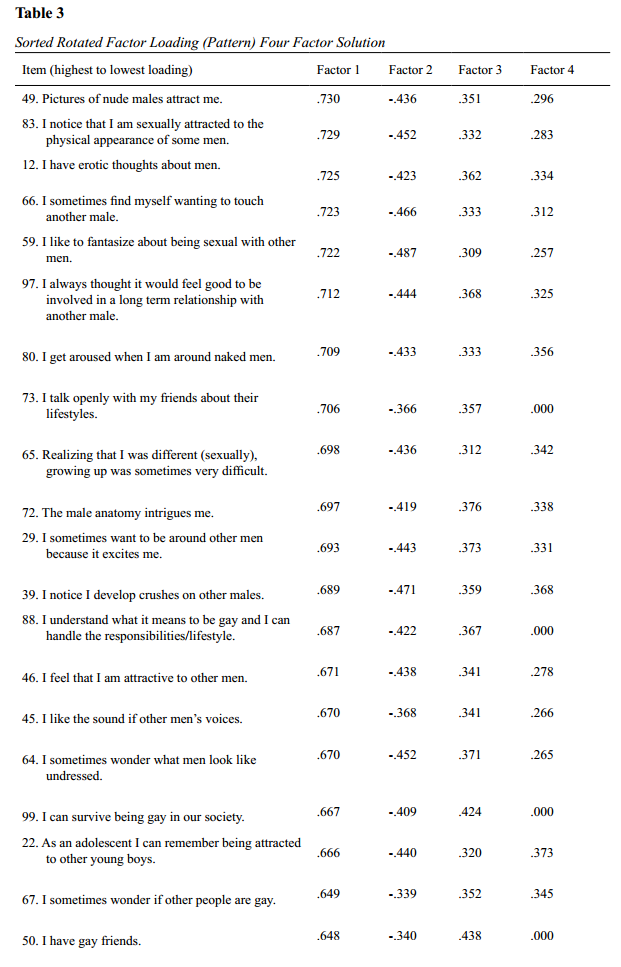
After creating and reviewing a SCREE Plot with the Eigen values of the 45 items, the researchers identified a bend that began to occur around the three, four and five factors. All factor solutions were investigated, and a decision was made to use the four-factors solution because (a) the items fit the four factors very well, and (b) the addition of a fifth factor accounted for negligent increase in the total variance. Every item in each factor carried a common theme.
The items in the four-factor solution were reviewed. Finally, two of the 45 items did not have a factor loading of 0.5 or higher. In keeping with the arbitrary decision of only using those items with a 0.5 factor loading or higher (for the purpose of implementing a stricter convention), items 36 and 15 were deleted. The final version of Sexual Orientation Scale resulted in having 43 items.
Table 3 summarizes the four factors solution by identifying the sorted rotated factor loadings of each item in each factor. Items 12, 22, 29, 39, 42, 45, 46, 49, 50, 59, 64, 65, 66, 67, 68, 72, 73, 80, 83, 88, 97, 98, and 99 loaded on Factor One with factor loadings ranging from 0.58 to 0.73. The common theme was sexual attraction to members of the same sex. The items in Factor One identified issues such as being attracted to nude males, erotic thoughts about men, masturbatory fantasies involving men only, relationships with males, etc. Therefore, Factor One was named “Attraction to Same Sex.”
Items 6, 14, 17, 41, 44, 48, 60, 63, 70, and 82 of Factor Two in Table 3 also had sexuality as their common theme. However, the sexual attraction addressed in the above items was towards members of the opposite sex. Their factor loadings ranged from 0.55 to 0.78. The items in Factor Two brought to surface issues dealing with erotic fantasies about women only, thoughts about women that led to sexual arousal, etc. Due to a common theme in these items, Factor Two was named “Attraction to Opposite Sex.”
Factor Three in Table 3 was comprised of items 16, 25, 33, 56, 89, and 91. These items had factor loadings ranging from 0.53 to 0.78. In examining these items, it was evident that the common theme surrounding the items was that of self-image and self-concept. The items in Factor Three addressed issues such as self-expression, expression of affection to another male, the acknowledgement of individual differences and the normalcy of being attracted to other men. Factor Three was named “Self-Acceptance of Gay Behaviors/Attitudes.”
Items 31, 32, 81, and 90 in Table 3 loaded onto Factor Four with loadings that ranged from 0.52 to 0.60. The common theme among these items was fear, which pertained to issues faced more often than not by gay men. The items addressed concerns in areas such as wanting to be sexually active with other men, jealousy, noticeable reactions to other men and fear of being gay. Because of the obvious common theme, Factor Four was named “Fears.”
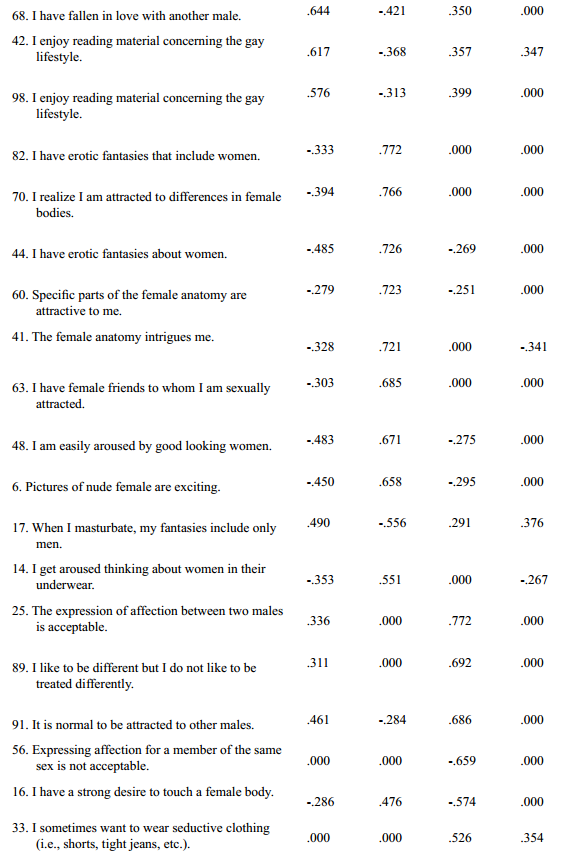
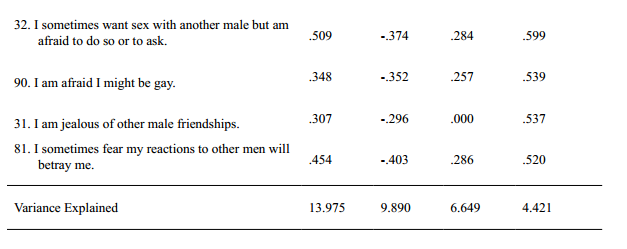
It is vital to note that the four factors identified via the factor analysis represented those themes continually found in sexual orientation literature. Cass (1979 & 1984), Grace (1979) and Coleman (1982) consistently addressed the importance of examining the variables of self-images and eroticism during the discovery process of one’s sexual orientation. All these factors are clearly identified in the 43 items in the four-factor solution done on the final version of the Sexual Orientation Scale.
Reliability
A Cronbach’s alpha coefficient was performed in order to establish the reliability of the final 43-item version of the Sexual Orientation Scale. An alpha coefficient was done on the overall sample (N=205), the straight sample (N=103), and the gay sample (N=102). The overall sample has an N of 208. Three completed scales (1 straight respondent and 2 gay respondents) were eliminated because they did not complete the initial 100 items. The alphas for the 43-item version were 0.93 for the overall sample, 0.72 for the straight sample and 0.65 for the gay sample.
Construct-Related Validity
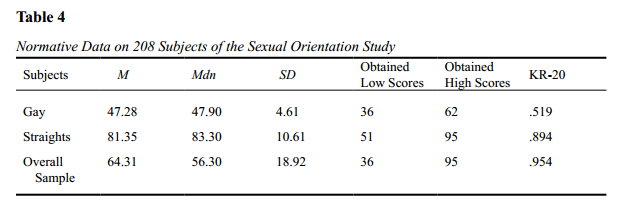
Internal consistency is a procedure used to establish construct validity. A statistical procedure used in this study to establish internal consistency was Cronbach’s Alpha Coefficient; this statistic also was used to establish instrument reliability (Miller, 1987). Table 4 shows the alphas which clearly exhibit the homogeneity for the items on the Sexual Orientation Scale.
A factor analysis was performed on the 45 items to identify the prevalent factors. After the factor analysis was done, four factors were identified as the most important factors that need to be examined when struggling with the uncovering discovery process of an individual’s sexual orientation. They are Attraction to Same Sex, Attraction to Opposite Sex, Self-Acceptance of Gay Behavior/Attitudes, and Fears. The items and other data on each factor are summarized in the following table. Normative data also was generated on the overall sample, the gay sample, and the straight sample. This was done for interpretation purposes. Table 4 summarizes the established normative data.
Limitations
This study contained methodological features which resulted in limitations. The major areas of limitations were (a) the sampling procedures and (b) generalizability.
Sampling Procedures
The initial 100-item Sexual Orientation Scale resulted from interviews with self-identified gay men who stated they were happy/satisfied as gay men. Only 30 men were interviewed. Although this number was an acceptable number, a larger number of men interviewed may have provided additional insights.
Of this group of 30 men (participating in the development of the items for the Sexual Orientation Scale) from cities in the Rio Grande Valley (RGV) in South Texas, 90% were Hispanic college graduates. Being a Hispanic gay man in the RGV in South Texas is difficult. The machismo attitude is somewhat prevalent in this area. This, coupled with a strong Catholic belief about homosexuality makes life as a gay man very secretive in this area. Thus, it is important to note that the initial 30 subjects were men who are openly gay, educated, motivated, and obvious risk takers. The sample group, therefore, may not have represented the “typical” gay man in the United States. Moreover, a different or more thorough perspective about what is involved in the discovery process with respect to sexual orientation might have risen if there had been a more diverse group of gay men in terms of ethnicity and geographical area.
The sample size (N = 208) utilized for the statistical item analysis was small. Although acceptable for this study, a much larger sample would likely improve the scale’s reliability and validity. The sample in this study did not include women. Women were excluded because it was suspected that gay men and lesbian women experience a different discovery process and that a parallel, yet different study is necessary for females.
Lastly, the two samples (gay/straight) are not actually directly comparable because, in essence, they were not selected in the same way. For example, a large percentage (65.4%) of the gay sample compared to 16.3% of the straight sample was enrolled in counseling. One can ascertain that most of the gay samples were selected from university counseling centers, mental health agencies, and the private sector. Contrastingly, the straight sample was selected from introductory psychology classes and from the membership of men’s groups (civic and/or support).
Generalizability
The generalizability of the results of this study is limited to men who are between the ages of 18 and 40 and who are either receiving counseling services from university counseling centers, mental health agencies, or the private sector, or who are in introductory psychology classes or members of men’s groups. The generalizability of this study is further limited to Hispanic and Caucasian men who met the research criteria.
Recommendations
The following are recommendations to either improve the present study’s design or identify areas for future research:
• Obtain a more culturally diverse sample by including representatives of other ethnic groups along with representatives from the Hispanic and Caucasian groups. This would increase the potential of gathering different perspectives and insights as well as increase the generalizability of the results.
• Utilize a larger more diverse sample in order to compare the reliability and validity data obtained in this study with other studies. A test re-test might be considered so as to verify the reliability of the Sexual Orientation Scale.
• In order to minimize a client’s tendency to answer the way they think their therapist or counselor wants them to, a lie/consistency scale may need to be established for the Sexual Orientation Scale. This may be done by including items that emphasize the same information, but written in a different manner.
Once the Sexual Orientation Scale has undergone further empirical investigation and eventual modifications, the use of the scale in counselor training programs should be considered. This would be done in hopes of (a) educating future counselors in how to assist clients who are confused about their sexual orientation, (b) increasing one’s sensitivity to and knowledge about gay/lesbian issues, and (c) requiring to some extent that future counselors accept and understand their own biases in regards to individual differences and more specifically to gays and lesbian.
References
Anastasi, A. (1988). Psychological testing. New York, NY: Macmillan.
Axam, H. S., & Zalesne, D (1999). Simulated sodomy and other forms of heterosexual horseplay: Same sex sexual harassment, workplace gender hierarchies, and the myth of the gender monolith before and after oncale. Yale Journal of Law and Feminism, 11, 155–253.
Bagley, C., & Tremblay, P. (1997). Suicidal behaviors in homosexual and bisexual males. Crisis, 18(1), 24–34.
Bell A. P., & Weinberg, M. S. (1978). Homosexualities: A study of diversity among men & women. New York, NY: Simon and Schuster.
Cass, V. C. (1979). Homosexuality identity formation: A theoretical model. Journal of Homosexuality, 4, 219–234.
Cass, V. C. (1984). Homosexuality identity formation: Testing a theoretical model. The Journal of Sex Research, 20, 143–167.
Coleman, E. (1982). Homosexuality & psychotherapy: Developmental stages of the coming-out crocess. Journal of Homosexuality, 7, 36–48.
Coleman, E. (1987). Assessment of sexual orientation. Boca Raton, FL: Haworth.
Crooks, R., & Baur, K. (2008). Our sexuality. Belmont, CA: Wadsworth.
Drescher, J. (2008). A history of homosexuality and organized psychoanalysis. Journal of the American Academy of Psychoanalysis and Dynamic Psychiatry, 36(3), 443–460.
Ellis, H. (1936). Studies in the psychology of sex. New York, NY: Random House.
Eliason, M. J., & Schope, R. (2007). The health of sexual minorities: Shifting sands or solid foundation? Lesbian, gay, bisexual, and transgender identity formation. New York, NY: Springer.
Fergusson, D. M., & Horwood, L. J. (2005). Sexual orientation and mental health in a birth cohort of young adults. Psychological Medicine, 35(7), 971–981.
Fox, R. C. (2003). Bisexual Identities. In L. Garnets & D. Kimmel (Eds.), Psychological perspectives on lesbian, gay, and bisexual experiences (pp. 86–129). New York, NY: Columbia University Press.
Freud, S. (1922/2010). Group psychology and the analysis of the ego. (J. Strachey, trans.). Charleston, S.C: Nabu Press.
Garnets, L., & Kimmel, D. C. (2003). Psychological perspectives on lesbian, gay, and bisexual experiences. New York, NY: Columbia University Press.
Grace, J. (1979, November). Coming out alive. Paper presented at the Sixth Biennial Professional Symposium of the National Association of Social Workers. San Antonio, Tx.
Harper, S. R, & Harris, F. (2010). College men and masculinities: Theory, research, and implications for practice. Hoboken, NJ: John Wiley.
Henchen, J. D., & O’Dowd, W. T. (1977). Coming out as an aspect of identity formation. Gay Academic Union Journal: Gai Saber, 1, 18–22.
Kinsey, A. C., Pomeroy, W. B., & Martin, C. E. (1948). Sexual behavior in the human male. Philadelphia, PA: W. B. Saunders.
Kinsey, A. C., Pomeroy, W. B., Martin, C. E., & Gebhard, P. H. (1953). Sexual behavior in the human female. Philadelphia, PA: W. B. Saunders.
Krafft-Ebing, R. V. (1887/1965). Psychopathia sexualis. (H. E. Wedick, Trans.). New York, NY: Putnam.
Marmor, J. (1980). Homosexual behavior. New York, NY: Basic.
Mata, J., Ghavami, N., & Wittig, M. A. (2010). Understanding gender differences in early adolescents’ sexual prejudice. The Journal of Early Adolescence 30(1), 50–75.
Miller, D. (1987). Strategy making and structure: Analysis and implications for performance. Academy of Management Journal, 30, 7–32.
Moradi, B., Mohr, J. J., Worthington, R. L., & Fassinger, R. E. (2009). Counseling psychology research on sexual (orientation) minority issues:Conceptual and methodological challenges and opportunities. Journal of Counseling Psychology, 56(1), 5–22.
Morin, S. F., & Miller, J. S. (1974, March). On fostering positive identity in gay men: Some developmental issues. Paper presented at the meeting of the American Orthropsychiatric Association, San Francisco, CA.
Nichols, P., & Fulkerson, D. (2010). Informing design patterns using research on item writing expertise. Menlo Park, CA: SRI International.
Nuttbrock, L., Bockting, W., Mason, M., Hwahng, S., Rosenblum, A., Macri, M., & Becker, J. (2009). A further assessment of Blanchard’s typology of homosexual versus non-homosexual or autogynephilic gender dysphoria. Archives of Sexual Behavior,40(2), 247–257.
Paul, W., Weinrich, J. D., Gonsiorek, J. C., & Hotvedt, M. E. (1982). Homosexuality: Social, psychological and biological issues. Beverly Hills, CA: Sage.
Paul, J. P. (1984). The bisexual identity: An idea without social recognition. Journal of Homosexuality, 9(2/3), 65–77.
Silenzio, V. M., Pena, J. B., Duberstein, P. R., Cerel, J., & Knox, K. L. (2007). Sexual orientation and risk factors for suicidal ideation and suicide attempts among adolescents and young adults.American Journal of Public Health 97(11), 2017–2019.
Storms, M. D. (1980). Theories of sexual orientation. Journal of Personality and Social Psychology, 38, 783–792.
Tripp, C. A. (1975). Homosexual matrix. New York: McGraw-Hill.
Troiden, R. R. (1977). Becoming a homosexual: Research on acquiring a homosexual identity. Unpublished manuscript, State University of New York at Stony Brook, Stony Brook, New York.
Weinberg, T. (1978). On “doing” and “being” gay: Sexual behavior and homosexual male self-identity. Journal of Homosexuality, 4, 143–156.
Wesman, A. G. (1971). Writing the test item. In R.L. Thorndike (Ed.), Educational measurement. Washington, DC: American Council on Education.
Sachin Jain, NCC, is an Assistant Professor, Department of Counseling, Oakland University, Rochester, MI. Santiago Silva, is a Clinical Professor & Director of the Counseling Assessment Preparation Clinic (CAP) at the University of Texas-Pan American. Correspondence can be addressed to Sachin Jain, Oakland University, Department of Counseling, 2200 N Squirrel Road, Rochester, MI, 48309, sacedu@yahoo.com.
Sep 2, 2014 | Article, Volume 2 - Issue 1
Robert C. Reardon, Stephen J. Leierer, Donghyuck Lee
A six-year retrospective study of a university career course evaluated the effect of four different class schedule formats on students’ earned grades, expected grades and evaluations of teaching. Some formats exhibited significant differences in earned and expected grades, but significant differences were not observed in student evaluations of instruction. Career services providers, including curriculum designers, administrators and instructors, will find the results of this study helpful in the delivery of services, especially with high-risk freshman students.
Keywords: career, teaching, course, instruction, evaluation, grades
While individual counseling has been shown to be effective in helping students develop career decision-making skills (Brown & Ryan Krane, 2000; Reese & Miller, 2006; Whiston & Oliver, 2005; Whiston, Sexton, & Lasoff, 1998), undergraduate career courses also can be effective interventions (Folsom & Reardon, 2003; Reardon, Folsom, Lee, & Clark, 2011; Whiston et al., 1998).
Although college career courses have been shown to offer substantial benefits (Brown & Ryan Krane, 2000; Osborn, Howard, & Leierer, 2007; Reed, Reardon, Lenz, & Leierer, 2001; Reese & Miller, 2006; Whiston & Oliver, 2005; Whiston et al., 1998), the content and format of such courses vary greatly (Folsom & Reardon, 2003). The present study sought to focus on one aspect of such career course variability: alternative class schedule formats.
Effective career classes can be characterized by these features: (a) structured course approaches appear to be more effective than unstructured approaches (Smith, 1981); (b) individual career exploration should be a cornerstone of the course (Blustein, 1989); and (c) five components (written exercises, individualized interpretations and feedback, in-session occupational exploration, modeling, and building support for choices within one’s social network) (Brown & Ryan Krane, 2000; Brown et al., 2003).
What is the effect that class schedule might have on course effectiveness? Only one study (Vernick, Reardon, & Sampson, 2004) has examined this issue, and the results showed that such courses should be designed to meet more than once a week and avoid over-exposure to materials and activities so as not to overwhelm the student. Extending this concept, we hypothesized that certain course schedule formats (weekly meeting frequency and term length) could make a difference in student learning and evaluation of teaching.
Alternative Career Class Schedules
This study focused on a course based on cognitive information processing theory incorporated into the course textbook, Career Planning and Development: A Comprehensive Approach (Reardon, Lenz, Sampson, & Peterson, 2000). All sections of the course followed a prescribed curriculum comprising a mixture of lectures, panel presentations, small and large group instructional activities, personal research, and field work; however, the classes differed in terms of the class meeting schedule (class duration, number of weekly meetings, and number of weeks a class met during an academic term).
We examined 57 course sections that met over a six-year period and were team-taught by lead instructors and co-instructors with an instructor/student ratio of about 1:8. Lead instructors included both professional staff and faculty who supervised the co-instructors. During the time of this study, four class schedule formats were used. In the case of a 16-week semester, the class met once per week for 3 hours; twice per week for 1.5 hours; or three times weekly for 1 hour. A fourth schedule option was for a 6-week term with the class meeting four times weekly for about 8 hours per week. In the 16-week semester, the class met once per week for 3 hours on Wednesdays (W); twice per week for 1.5 hours on either Monday/Wednesday or Tuesday/Thursday (MW/TuTh); or three times weekly for 1 hour on Monday, Wednesday, and Friday (MWF). A fourth schedule option was for a 6-week term where the class met four times weekly for about 8 hours per week on Monday, Tuesday, Wednesday, and Thursday (MTuWTh). In summary, we sought to evaluate the influence of these four class schedule formats upon the educational experience of the students as measured by expected grades, earned grades, and student evaluations of teaching.
Course Measures
The following section gives details about the three measures of student learning and perceptions of teaching used in this study.
Earned Grade (EG)
Although a student’s grade point average has limitations as a measure of academic achievement, class grades are nevertheless a widely accepted method of quantifying students’ level of educational achievement and future success in graduate school or employment (Plant, Ericsson, Hill, & Asberg, 2005). Specific to career development, Reardon, Leierer, and Lee (2007) showed that grades might be useful measures of career course interventions, “especially if the treatment variables are carefully described and the grading procedures are fully explained and replicable by other researchers” (p. 495). For this study, we assumed that a student’s final EG would accurately reflect learning in the course.
Expected Grade (XG)
Grade expectations are a complex phenomenon that combines realistic data-driven grade expectations with unjustified optimism or wishful thinking (Svanum & Bigatti, 2006). The XG reflects the student’s assessment of course demands and optimism about successfully meeting those demands. This grade prediction may be informed or uninformed; however, after completing multiple assignments over the course of the semester, Svanum and Bigatti (2006) noted that students lower the value of their XG such that it will be only moderately inflated and will reliably predict their final EG. Because students in our course had the course grading scale in the syllabus, a signed performance contract, and predicted their grades during the last week of the semester when 85% of their grade had already been accounted for, we hypothesized that in aggregate their predictions would be only moderately inflated and thus a reliable predictor of their earned grades and success in the course. We felt this grade variable was important as a measure of students’ confidence in their mastery of the career development subject matter and the problem-solving skills taught in the course, and therefore a valid measure of the relative effectiveness of different class schedule formats.
In addition, comparing EG and XG informs us about students’ self-evaluation of learning and their actual performance in the course. When there is not a significant difference between the two scores, we might suppose that students have a fairly accurate understanding of their performance on completed assignments and those still to be graded. By contrast, a significant difference between XG and EG indicates a discrepancy between students’ self-evaluations of graded and as-yet-ungraded assignments and the official final grades. If XG is significantly higher than EG in a section, one may conclude that the academic work has been undervalued by the instructor or overvalued by the students. Conversely, if XG is significantly lower than EG, one might conclude that students’ estimates were conservative or instructors recognized a level of performance not seen by the students.
Student Evaluation of Teaching (SET)
Student evaluation of classes and teaching effectiveness is standard practice at most postsecondary institutions. There is substantial anecdotal and experimental evidence supporting the usefulness of SETs (Centra, 1993; Marsh & Dunkin, 1992; Marsh & Roche, 1997). Certain student ratings forms provide important feedback that can be used to improve teaching performance (Greenwald & Gillmore, 1997; Marsh & Roche, 1997; McKeachie, 1997), and when asked most faculty members support the use of SETs as a tool for teaching improvement (Baxter, 1991; Griffin, 1999; Schmelkin, Spencer, & Gellman, 1997). Although SET is not without its critics, it appears to be a pragmatic way to access and compare student perceptions of teachers’ effectiveness and therefore a potential measure of the relative efficacy of different class schedules.
In an effort to better evaluate students’ course experiences, the influence of EG (Goldman, 1985) and XG (Greenwald & Gillmore, 1997) on SET is receiving considerable attention in the literature. The present study provided an opportunity to examine the relationship of SET to both EG and XG relative to four different class schedule formats.
Research Questions
In seeking to discover if particular class schedules were more effective in a team-taught career course, we evaluated grades and participant feedback from undergraduate students. The goal was to determine if any of the four differing class schedules produced significant differences in the course evaluation measures EG, XG, and SET. Although we were examining these measures from the students’ perspective and such measures are typically scored at the individual student level, we chose to examine class section level scores because XG and SET data were only available to us in this way.
The first group of research questions examined differences between mean evaluative measures, aggregated by class format and averaged for classes that met one (W), two (MW/TuTh), or three times per week (MWF) for 16 weeks, or four times per week (MTuWTh) for 6 weeks.
Research Question 1: Were there any significant differences in the career course evaluation measures among the four class formats?
RQ 1.1: Are there differences in mean EG between formats?
RQ 1.2: Are there differences in mean XG between formats?
RQ 1.3: Are there differences in mean SET between formats?
The second group of research questions explored the differences between the evaluation measures (EG, XG, and SET) within the sections.
Research Question 2: Within any given format, are there significant differences between the mean of the aggregated class evaluation measures?
RQ 2.1: Is the mean XG significantly different than the mean EG?
RQ 2.2: Is the mean XG significantly different than the mean SET?
RQ 2.3: Is the mean EG significantly different than the mean SET?
Method
Participants
Over a 6-year period, 1,479 students were enrolled in 57 sections of a career course to fulfill elective requirements for the baccalaureate degree. The class met in a standard classroom in academic buildings on the campus. Although the class was offered for variable credit, over 95% of the students took it for 3 credit hours. The number of students per section ranged from 19–34 with a mean of 26.5.
Ethnic diversity was generally proportional to the general student population of the university: Caucasian, 74%; African American, 12%; Hispanic American, 7%; Other, 4%; Asian, 3%; and American Indian, .4%. The course typically enrolled about 60% females and 40% males, including freshmen (15%), sophomores (45%), juniors (20%), and seniors (20%). Depending on the semester, between 15% and 25% of the course was composed of students with officially undeclared majors, and the large percentage of sophomores was the result of academic advisors referring these undeclared students to the class. While almost 40% of the members in a typical class reported satisfaction with their present career situation, about 60% were unsure, dissatisfied, or undecided.
Course Grading Procedures
Student grades were computed using scores earned on assignments contained in the performance contract. This contract was comprised of 28 different graded activities spread across the three units of the course. Given the use of the performance contract, students in this course should have had a very good idea of what their final grade would be when they filled out the SET and estimated their grade, because only two of the 28 activities accounting for 125 of 653 total points were still ungraded at that point.
Student Evaluation of Teaching Ratings
We used a standardized instrument for SETs, the Student Instructional Rating System (SIRS; Arreola, 1973), a student course on form developed at Michigan State University (Davis, 1969) and adapted for use at our university. SIRS provided an opportunity for instructors to obtain reactions to their instructional effectiveness and course organization and to compare these results to those of similar courses offered within the university.
The SIRS consisted of 32 items and 25 of these items enabled students to express their degree of satisfaction with the quality of instruction provided in the course by using a 5-point Likert scale. For example, the course was well organized could be marked strongly agree, agree, neutral, disagree, or strongly disagree. One item on the SIRS was of special interest in this study: What grade do you expect to receive in this course? A, B, C, D, or F.
We also employed a second instructional rating instrument, the State University System Student Assessment of Instruction (SUSSAI) which had been used at the university for five years prior to this study. This instrument consisted of eight items focused on class and instructor evaluation. One item was of special interest in this study: Overall assessment of instructor: Excellent=4, Very Good=3, Good=2, Fair=1, Poor=0.
Data Collection
After obtaining permission from the university institutional review board, we received the archived career course grade data for a six-year period. We aggregated the grades of these 1,479 students by class schedule and averaged the results to achieve a mean EG for each class schedule format.
The data relating to students’ perceptions of what they had achieved and the quality of instruction they had received was collected as follows: On the last week of class, while filling out their teacher evaluations, all students in a section were asked to indicate the grade they expected to receive and the results were tallied and averaged to determine a class mean XG. These class averages of 57 sections were forwarded to the researchers, and the results were tallied and averaged to find the mean XG for each class schedule format. In addition, we retrieved overall class ratings of instructors for an ad hoc sample of career classes over the 6-year period. These data enabled us to examine the relationships between mean EG and XG, EG and SET, and XG and SET.
Procedures
In this team-taught course where all instructors were involved in making large- and small-group presentations, each co-instructor had primary responsibility for evaluating the progress of students in his or her small group and assigning a grade, while the lead instructor of the team had overall responsibility for course presentations and management. In completing the SIRS and SUSSAI items for the SET, students were asked to provide a composite rating of the instructional team for their section. SETs were completed anonymously during the final two class meetings while instructors were out of the room and then returned by a student proctor to the university’s office of evaluation services.
Data Analysis
We examined how different class formats influenced mean EG, XG, and SET. The independent variable of class schedule format had four levels. The first three levels met over the course of a 16-week fall or spring semester for either 3 hours once a week (W), 1.5 hours twice a week (MW/TuTh), or 1 hour three times a week (MWF). The final level met for 2 hours four times a week over the course of a 6-week semester (MTuWTh). Because the assumptions related to independence for the three evaluative measures could not be met (i.e., the evaluations for each class section were correlated), we analyzed the data using a split-plot design.
Results
As is the case for other ANOVA and MANOVA tests, the dependent variables were assumed to be normally distributed. We tested the dependent variables to determine if they were normally distributed by computing skewness and kurtosis of each of the dependent variables to see if they fell between −1.0 and +1.0. Both the SET and EG scores did not violate the assumptions of normality as measured by skewness and kurtosis. However, while the skewness of XG did fall within the appropriate range, the kurtosis score was 1.04. Although this score is above 1.00, we believe this minor violation does not seriously affect the results and their interpretation.
Research Question 1
Using the split-plot MANOVA, we found a significant interaction of the three evaluative measures across the four class formats F (6, 106) = 4.47, p < .0005, η2 = .20. Specifically, there was a significant difference in EG between the four course formats, F (3, 53) = 19.15, p < .0005, partial η2 = .52. The EG for schedule MTuWTh (M = 3.50) was significantly higher (p < .005) than that of formats W, MW/TuTh, and MWF (M = 3.25, 3.32, and 3.31, respectively). Next, there was a significant difference in XG between the four course formats, F (3, 53) = 3.62, p = .019, η2 = .02. The means for XG for the W, MW/TuTh, MWF, and MTuWTh were 3.71, 3.57, 3.34, and 3.64, respectively. There was not a significant difference for XG between formats W, MW/TuTh, and MTuWTh. However, there was a significant difference between format MWF and format MTuWTh (p = .036), and format MWF was trending lower when compared with format W (p = .097) and format MW/TuTh (p = .051). Finally, there was not a significant difference on SET scores across the four formats, F(3, 53) = 1.36, p = ns. The mean SET scores for formats W, MW/TuTh, MWF, and MTuWTh were 2.88, 3.15, 3.31, and 3.11, respectively.
Research Question 2
When we compared evaluation measures within each format, we found significant differences with each one, F (2, 52) = 23.61, p < .0005, η2 = .47. We found XG significantly greater than EG within schedule format W (.46, p = .002) and format MW/TuTh (.35, p < .0005). By contrast, the difference between XG and EG was smaller and not statistically significant within format MWF (.13, p = ns) and format MTuWTh (.13, p = ns). This lack of a significant difference between EG and XG indicates that these students earned grades very similar to the grades they expected to receive. It is apparent that the students and instructors used similar evaluation and grading methods. Stated another way, this finding suggests that students in classes meeting more frequently per week have a slightly more accurate perception of how they are doing in the class.
We also found that mean XG was significantly greater than mean SET for format W (.83, p =.003), format MW/TuTh (.42, p < .0005), and format MTuWTh (.53, p < .0005). However, there was not a significant difference between XG and SET for format MWF (.13, p = ns). Finally, in comparing the difference between mean EG and mean SET within each of the four formats, we found a significantly higher EG only for format MTuWTh (.40, p < .0005). No significant differences were observed for formats W, MW/TuTh, and MWF, which had differences of .37, .07, and .13, respectively.
In summary, we found significant differences in the evaluation measures of XG, EG, and SET across the four different career course formats. Class sections which met four times a week for 6 weeks had a significantly higher EG than classes meeting one, two, or three times a week for a 16-week semester. Interestingly, formats W, MW/TuTh, and MTuWTh all had mean XG scores over 3.55, while format MWF’s XG was not only lower than the other formats, but significantly lower than that of format MTuWTh. Finally, mean SET scores were not significantly different from one another. Notably, they were all well above the rating of “good” (good = 2.0), with a mean of 3.15 on a 4-point scale. Means for the sections ranged between 2.88 and 3.31; thus we concluded that students found the instruction to be very good or excellent.
Discussion
Career course interventions have been developed to help students improve their academic and career decision-making skills. Comprehensive career courses offered for academic credit represent a cost-effective intervention that could be described as a “mega-dose” of career services (Reardon et al., 2011). While the benefits of college career courses are clear, it is unclear what contributions specific class formats (differing by length of class period, number of classes per week, length of course in weeks) might make to their effectiveness. Thus, the purpose of our study was to analyze the influence of different schedule formats on earned and expected grades and students’ evaluation of their instructors.
Previous studies on career development classes have described various limitations (see Gold, Kivlighan, Kerr, & Kramer, 1993; Reese & Miller, 2010), and we attempted to address these in the following ways. First, although we did not directly address random selection and random assignment issues, we aggregated class section scores instead of individual student scores, thus reducing the effect of individual outliers. By using the aggregate mean for each career planning section, individual students’ evaluation of the teacher remained anonymous yet the evaluation of the course section remained intact. The second limitation described by other researchers is the small number of participants in the career class analyzed. Over a six-year period we were able to collect data from almost 1,500 students from 57 sections of the course. The third limitation we attempted to address was the lack of equal representation of different ethnic groups. While we did not have equal percentages of students from different ethnicities, the demographic composition of our sample closely matched the composition of our university.
Perhaps the greatest strength of this study’s design was the replication of the intervention. That is, because the course structure and specific assignments were very similar for all sections, in effect the replication of the career course occurred across all 57 of the course sections analyzed. In each section, the course content and procedures were clearly specified and grades were based on the successful execution of a performance contract by the student.
Earned and Expected Grades
We examined how schedule influenced mean earned grade (EG) and expected grade (XG) scores. Like Vernick et al. (2004), we found that sections meeting only once per week over 16 weeks (format W) had the lowest EG, though not significantly lower than formats MW/TuTh and MWF. By contrast, schedule MTuWTh had a significantly higher EG than all the other formats, suggesting that a 6-week semester of 2-hour class meetings four times a week was more conducive to learning than a 16-week semester of classes meeting one, two, or three times per week for 3 hours, 1.5 hours, or 1 hour, respectively; that is, the “mega-dose” of career development interventions given in the course were intensified with MTuWTh.
Further analysis of the difference between mean section EG and XG scores enables us to compare the students’ view of their performance in the course with their actual performance. Ideally, we would prefer that there not be a significant difference between XG and EG in order to increase students’ confidence about the fairness of the grading and their sense of having mastered the material in the course. Expanding on these points, when the section mean XG was significantly higher than the mean EG, students could have left the course with a sense of failure and disappointment. Interestingly, in this study schedules W and MW/TuTh had significantly higher mean XG than mean EG, indicating an incongruity between the expected and earned grades. By contrast, for both schedules MWF and MTWF, the difference between mean XG and mean EG was not significant. One might conclude that fewer course meetings per week increased the difference between XG and EG scores.
Student Evaluation of Teaching
With regard to SET, there were no significant differences between the four class schedule formats, although we had suspected this might be the case. Perhaps a significant difference between section means for SET and XG would describe an incongruity between the students’ estimate of instruction quality and their evaluation of their own performance in the course. If XG were significantly higher than SET, this finding might indicate that students in these sections believed their performance was more related to their abilities and efforts rather than course instruction. By contrast, sections with significantly lower XG than SET scores may have rated instructors’ presentation of material higher than their own performance in the course. Interestingly, for schedules W, MW/TuTh, and MTuWTh, XG was significantly higher than SET, suggesting that students evaluated themselves more favorably than they did their instructors. We found it curious that for schedule MWF alone, XG was not significantly higher than SET.
Finally, EG is assigned to the student by the instructor, while SET is assigned to the instructor by the student. By comparing mean EG with SET, we can examine the relationship between an instructor’s evaluation of his or her students with students’ evaluation of the instructor. When EG is greater than SET, this means that instructors evaluated their students more favorably than they themselves were evaluated; conversely, when SET is greater than EG, students evaluated instructors more favorably than they themselves were evaluated. For schedules W, MW/TuTh, and MWF, there were no significant differences between mean EG and SET scores. However, for MTuWTh, in which students achieved a significantly higher mean EG than the other formats, the EG also was significantly higher than the SET, suggesting that this high-performing group had higher expectations for their instructors than they felt the instructors met.
Limitations
Because this study is field research, there are a few limitations to discuss. First, participants were undergraduates taking a career planning course from one university. The advantage to using this approach was consistency of teaching content, training and quality control of teaching personnel, administration of tests, and assignments, thus reducing the possibility that course differences were responsible for random error variance. But, because these results come from only one university’s career course, caution should be exercised when generalizing them to other courses.
Second, participants were not randomly selected. In fact, random assignment was impossible given the students’ autonomy in selecting this course. Random selection is seldom an option in field research at an educational institution, but this fact does restrict the robustness and generalizability of results to other populations (Babbie, 2001).
Third, participants in the study may have been experiencing more career-related difficulties than other students who did not elect to take the course. It is to be expected that participants perceived a career course as more important to their progress than nonparticipants, which limits generalizability of these findings (Smith & Glass, 1987).
Fourth, because the data were collected over a six-year period, it is difficult to determine the effect of historical events on the behavior and attitudes of participants (Smith & Glass, 1987; Van Dalen, 1979). For example, students from the initial semester of the study took the class at the height of the tech bubble, while others took the class in the shadows of the 9-11 tragedy. Although we were not able to control for these events, we acknowledge that researchers and practitioners must be aware of the influence of external events upon any college course.
Implications
There are several implications regarding the findings of this study. The significant differences found between schedule formats in the outcomes of EG and XG serve to remind instructors, those who supervise them, and those managing career courses about the potential impact of this variable. For example, these findings indicate that classes meeting one time per week for three hours are not characterized by higher earned grades, and by implication this means student learning. Additional studies should isolate and evaluate format variables such as length of the entire course, number of classes per week, and length of individual classes so that those evaluating teachers might consider this in their evaluations. At the same time, the absence of any differences in student evaluations of teaching across the four schedule formats is reassuring for those teaching and supervising instructors, at least in a course that was as highly structured and standardized as the one in this study.
Career services providers, curriculum designers, administrators, and instructors may wish to consider these findings when making decisions about the design and delivery of career courses, especially for high-risk freshmen (Osborn et al., 2007). Students meeting for four classes a week over a 6-week semester earned and expected significantly higher grades overall than students meeting over a 16-week semester. Taking the 6-week intensive course during the summer term before beginning the freshman year could both increase students’ chances of academic success and their confidence in navigating the college experience.
References
Arreola, R. A. (1973). A cross-institutional factor structure replication of the Michigan State University SIRS faculty evaluation model. College Student Journal, 7, 38–42.
Babbie, E. (2001). The practice of social research. Belmont, CA: Wadsworth/Thomson Learning.
Baxter, E. P. (1991). The TEVAL experience, 1983–88: The impact of a student evaluation of teaching scheme on university teachers. Studies in Higher Education, 16, 151–179.
Blustein, D. L. (1989). The role of career exploration in the career decision making of college students. Journal of College Student Development, 30, 111–117.
Brown, S. D., & Ryan Krane, N. E. (2000). Four (or five) sessions and a cloud of dust: Old assumptions and new observations about career counseling. In S. D. Brown & R. W. Lent (Eds.), Handbook of counseling psychology (3rd ed., pp. 740–766). New York, NY: John Wiley & Sons.
Brown, S. D., Ryan Krane, N. E., Brecheisen, J., Castelino, P., Budisin, I., Miller, M., & Edens, L. (2003). Critical ingredients of career choice interventions: More analyses and new hypotheses. Journal of Vocational Behavior, 62, 411–428.
Centra, J. A. (1993). Reflective faculty evaluation: Enhancing teaching and determining faculty effectiveness. San Francisco, CA: Jossey-Bass.
Davis, R. H. (1969). Student Instructional Rating System (SIRS) Technical Bulletin. East Lansing, MI: Michigan State University, Office of Evaluation Services.
Folsom, B., & Reardon, R. (2003). College career courses: Design and accountability. Journal of Career Assessment, 11, 421–450.
Gold, P. B., Kivlighan, D. M. Jr., Kerr, A. E., & Kramer, L. A. (1993).The structure of students’ perceptions of impactful, helpful events in career exploration classes. Journal of Career Assessment, 1, 145–161.
Goldman, L. (1985). The betrayal of gatekeepers: Grade inflation. Journal of General Education, 37, 97–121.
Greenwald, A. G., & Gillmore, G. M. (1997). Grading leniency is a removable contaminant of student ratings. American Psychologist, 52, 1209–1217.
Griffin, B. W. (1999). Results of the faculty survey on student ratings of instruction: Preliminary report. Statesboro, GA: Georgia Southern University, Student Ratings Committee.
Marsh, H. W., & Dunkin, M. (1992). Students’ evaluations of university teaching: A multidimensional perspective. In J. C. Smart (Ed.), Higher education: Handbook on theory and research (Vol. 8, pp. 143–234). New York, NY: Agathon Press.
Marsh, H. W., & Roche, L. A. (1997). Making students’ evaluations of teaching effectiveness effective: The critical issues of validity, bias, and utility. American Psychologist, 52, 1187–1197.
McKeachie, W. J. (1997). Student ratings: The validity of use. American Psychologist, 52, 1218–1225.
Osborn, D. S., Howard, D. K., & Leierer, S. J. (2007).The effect of a career development course on the dysfunctional career thoughts of racially and ethnically diverse college freshmen. Career Development Quarterly, 55, 365–377.
Plant, E. A., Ericsson, K. A., Hill, L., & Asberg, K. (2005). Why study time does not predict grade point average across college students: Implications of deliberate practice for academic performance. Contemporary Educational Psychology 30, 96–116. doi:10.1016/j.cedpsych.2004.06.001
Reardon, R. C., Folsom, B., Lee, D., & Clark, J. (2011). The effects of college career courses on learner outputs & outcomes: Technical report No. 531. Tallahassee, FL: Center for the Study of Technology in Counseling and Career Development, Florida State University. Retrieved from http://career.fsu.edu/techcenter/whatsnew/TechRept53.pdf.
Reardon, R. C., Leierer, S. J., & Lee, D. (2007). Charting grades over 26 years to evaluate a career course. Journal of Career Assessment, 15, 483–498. doi:10.1177/1069072707305767.
Reardon, R. C., Lenz, J. G., Sampson, J. P., Jr., & Peterson, G. W. (2000). Career development and planning: A comprehensive approach. Pacific Grove, CA: Wadsworth-Brooks/Cole.
Reed, C., Reardon, R., Lenz, J., & Leierer, S. (2001). Reducing negative career thoughts with a career course. Career Development Quarterly, 50, 158–167.
Reese, R. J., & Miller, C. D. (2006). Effects of a university career development course on career decision-making self-efficacy. Journal of Career Assessment, 14, 252–26.
Reese, R. J., & Miller, C. D. (2010). Using outcome to improve a career development course: Closing the scientist-practitioner gap. Journal of Career Assessment, 18, 207–219.
Schmelkin, L. P., Spencer, K. J., & Gellman, E. S. (1997). Faculty perspectives on course and teacher evaluations. Research in Higher Education, 38, 575–592.
Smith, G. E. (1981). The effectiveness of a career guidance class: An organizational comparison. Journal of College Student Personnel, 22, 120–124.
Smith, M. L., & Glass, G. (1987). Research and evaluation in education and the social sciences. Englewood Cliffs, NJ: Prentice-Hall.
Svanum, S., & Bigatti, S. (2006). Grade expectations: Informed or uninformed optimism, or both? Teaching of Psychology, 33, 14–18.
Van Dalen, D. (1979). Understanding educational research: An introduction. New York, NY: McGraw-Hill.
Vernick, S. H., Reardon, R. C., & Sampson, J. P. Jr. (2004). Process evaluation of a career course: A replication and extension. Journal of Career Development, 30, 201–213.
Whiston, S. C., Sexton, T. L., & Lasoff, D. L. (1998). Career-intervention outcome: A replication and extension of Oliver and Spokane. Journal of Counseling Psychology, 45, 150–165.
Whiston, S. C., & Oliver, L. W. (2005). Career counseling process and outcome. In W. B. Walsh & M. Savickas (Eds.), Handbook of vocational psychology (3rd ed., pp. 155–194). Hillsdale, NJ: Erlbaum.
Robert C. Reardon, NCC, NCCC, is Professor Emeritus at the Career Center at Florida State University. Stephen J. Leierer is an Associate Professor at East Carolina University. Donghyuck Lee is an Assistant Professor at Konkuk University in Seoul, Korea. Correspondence can be addressed to Robert C. Reardon, Career Center, Florida State University, 100 S. Woodward St., Tallahassee, FL 32306-4162, rreardon@admin.fsu.edu.
Sep 2, 2014 | Article, Volume 1 - Issue 2
John McCarthy, Michelle Bruno, Teresa E. Fernandes
The prevalence of depression increases markedly during adolescence, yet many youth are not receiving the support that they need. One factor that has been speculated as contributing to low rates of care is a lack of mental health literacy about depression and viable sources of support. This pilot study focused on mental health literacy as it relates to adolescent depression and suicidality and represented a pseudo-replication of Burns and Rapee (2006). Overall, participants (N=36) in this study were able to differentiate depressed vignettes from non-depressed vignettes and identify common symptoms of depression in their assessments. Also, sources of optimal help identified by participants varied upon the perceived degree of seriousness of the difficulties. Such results offer implications regarding the potential benefit of including adolescents in a more direct way when providing outreach or offering services.
Keywords: adolescents, mental health literacy, depression, suicidality, support
Depression in adolescence is of particular relevance, as it can continue into adulthood yet often goes undiagnosed and untreated (Wagner, Emslie, Kowatch, & Weller, 2008). According to the Diagnostic and Statistical Manual of Mental Disorders-Text Revision (DSM-IV-TR) (APA, 2000), the diagnostic criteria and duration mirror adult depression in many respects. As in adult depression, adolescent depression can include a variety of symptoms, at least one of which must be either depressed mood or loss of pleasure/interest. Furthermore, the DSM-IV-TR stipulates that, if depressed mood is chosen, it may be substituted by irritable mood in adolescents.
The rate of depression increases six-fold between the ages of 15–18 (Hankin, 2006). Approximately eight percent of teenagers—an estimated two million youth from 12–17 years of age—suffered at least one major depressive episode in 2007. Only 39% received some form of treatment for depression in the preceding 12 months. The rate of receiving professional help was much lower among those youth without health insurance (17%). Among all teenagers who obtained treatment, over half (59%) saw a counselor for assistance with their depression. Nearly 37% and 27% of youths saw a psychologist or general practitioner/family doctor, respectively (Substance Abuse and Mental Health Services Administration, 2009).
Given the prevalence of mental illness and its impact on society, it is no surprise that there is a growing interest in mental health literacy, a term first used by Jorm et al. (1997). Defined as the “knowledge and beliefs about mental disorders which aid their recognition, management or prevention” (p. 182), mental health literacy also includes knowledge about treatment and from whom to seek help. It has been found, for instance, that family and friends can be vital in the recognition of depressive symptoms (Langlands, Jorm, Kelly, & Kitchener, 2008a). However, Highet, Thompson, and McNair (2005) saw that family members usually recognized symptoms of the individual in hindsight. The general public often does not possess the knowledge base to help someone who is developing a psychotic illness (Langlands, Jorm, Kelly, & Kitchener, 2008b). Kitchener and Jorm (2002) found that individuals who took part in their Mental Health First Aid course showed improvement in recognizing disorders, and their views about treatment of disorders became more in line with those of professionals in the mental health field. In addition, the course reduced their stigma attached to mental disorders, increased their feelings of confidence in providing help, and increased the help provided to others.
Few studies have been conducted on younger populations and mental health literacy. Burns and Rapee (2006) noted, “While there is growing literature on the mental health literacy of adults, to date there has not been a parallel interest in the mental health literacy of young people” (p. 227). Wright et al. (2005) looked at young adults’ (ages 12 to 25) ability to pinpoint depression and psychosis and their recommendations for help to be sought. Nearly half of the participants were able to label the depressed vignette as depressed, but only a quarter of participants were able to label psychosis. People who were given the depressed vignette were less likely to choose a correct form of treatment than those given the psychosis vignette. Psychologists and psychiatrists were recommended more frequently for the psychosis vignette than for the depressed vignette, and a family doctor or general practitioner was chosen more often for the depressed vignette than for the psychosis vignette.
Adolescents have been found more likely to consider themselves “very confident” (Jorm, Wright, & Morgan, 2007a, p. 67) to help a peer in need with girls rating themselves as more confident than boys. In addition, across vignettes, confidence in providing help to a peer with a problem was higher for depression (without alcohol misuse) and social phobia than for psychosis and depression with alcohol misuse (Jorm et al, 2007a).
Jorm, Wright, & Morgan (2007b) found differences among Australian youth in the type of help sought for mental disorders. Participants were read vignettes describing youth of similar ages who were experiencing various disorders, then were asked a series of questions that included where they would turn with similar problems. For the vignette describing a teen suffering from depression, adolescents aged 12–17 chose family (54%) most often as a source of help and opted for mental health professional or service most infrequently (2%). Nearly one-third of young adults ages 18–25 selected family (31%) or a general practitioner/medical doctor (31%) on a similar vignette regarding depression. Overall the perceived barriers to help-seeking were personal in nature and did not relate to systemic characteristics, as they noted, “For young people, it is embarrassment or concern about what others think…” (p. 559).
Burns and Rapee (2006) used a vignette-based approach to measure mental health literacy among high school students in Australia. In their study, they utilized the Friend In Need questionnaire, created by the authors for that specific study. This instrument offers five short vignettes of teenage students, two of whom (“Tony” and “Emily”) represented youth meant to be clinically depressed. One of the two vignettes (“Emily”) offered a reference to suicidal ideation. The remaining three vignettes were of students facing difficulties, though were not intended to reflect depression.
They found that over two-thirds of participants (68%) accurately labeled “Emily” as depressed, while about one-third (34%) recognized “Tony” as depressed. Female participants were more likely to make a depressed diagnosis in both the “Tony” and “Emily” vignettes than the male participants. Female participants also showed more worry for the depressed vignettes than male participants. Among help-seeking sources, counselors were chosen most often for the helpers of the depressed teens, and this category was followed by friends and family/relatives.
To our knowledge, no study has been conducted on the mental health literacy of U.S. teens as it pertains to adolescent depression. With this point in mind, the current study represents a replication of Burns and Rapee (2006) and offers an initial sample involving older adolescents’ perspectives in the assessment, recovery time, and help-seeking recommendations regarding depression. Our central study questions were consistent with Burns and Rapee and the questions posed by the Friend in Need Questionnaire.
Procedures
Both prior to and after receiving approval by the university’s institutional review board, two of the authors met with the principal of the school where the data was collected. It was determined that eight sections of the school’s psychology and anthropology classes would be appropriate to the topic of study and ages of interest, and the primary author contacted the teachers and shared the following information with them: the parental/guardian consent form, the student consent form, details concerning the data collection process, and pertinent dates of the consent form deadlines and actual administration of the instrument used in this study. Teachers distributed the consent forms to students, who, if interested in possibly participating in the study, took them to their parents/guardians. Signed parental/guardian consent must have been completed and returned to the teachers in a four-day time period, which occurred prior to the date of the administration of the instrument. In both the parental/guardian and participant consent forms, it was made clear that the questionnaire was not a formal test and would take an estimated 25–40 minutes to complete.
On the day of the data collection, one of the two primary authors (JM and MB) went to the classroom, collected the completed parental/guardian consent form, read an abbreviated student consent form to the potential participants after giving a hard copy to them, and asked for questions at the conclusion. Students with unsigned parental/guardian consent forms were given an alternate class assignment, while those students who consented to be in the study completed the Friend in Need Questionnaire. No extra credit was granted for participation in the study. Participants completed the questionnaire in their classrooms. In a few instances, participants and the author/administrator were asked to move to a nearby vacant room for the data collection.
Approximately five classes were visited for data collection, and a total of 36 students, 21 of whom were young men, participated in the study. Most participants completed the questionnaire in approximately 20 minutes. The questionnaires were completed in an anonymous manner. In the coding process, a number was given to each questionnaire for tracking purposes only. Finally, the two authors also offered to return to the class after the data administration to further discuss the study; however, no teachers chose this option.
Instrument
Adolescents’ mental health literacy was assessed using the Friend in Need Questionnaire (Burns & Rapee, 2006). As previously described, the questionnaire presents five vignettes of young people experiencing various difficulties and solicits both close-ended and open-ended responses from participants. Specifically, participants are instructed to read each vignette and respond to the following general questions: (a) How worried would you be about the person’s overall emotional well-being? (b) What do you think is the problem of the person? (c) What aspects of the vignette provided the strongest hints that the person was having difficulties? (d) How long will it take this adolescent to feel better? and (e) Does this person need help from others to cope with his/her problems? The final question also has a supplemental, open-ended question regarding who the helper would be. The respondents are posed with all of these questions for each of the five vignettes. The complete Friend in Need Questionnaire can be found in Burns and Rapee (2006).
A coding system was devised for the open-ended responses, specifically on the responses asking about the youth’s problem, aspects of the vignette that provided hints, and the appropriate helper. For the question concerning the youth’s problem, the responses were filtered into two categories: “depressed” or “not depressed.” To qualify as “depressed,” the respondents needed to write the words “depressed/depression” or “suicide/suicidal.” Any other problems listed were considered to be “not depressed.” On the question regarding hints of the problem in the vignette, the coder was looking for responses that fit into diagnostic criteria for depression. The two depressed vignettes each had five diagnostic criteria imbedded in them, and this question tried to tease out whether respondents could identify these key criteria. Hence, the responses were categorized into the five diagnostic criteria of each vignette, with other responses not qualifying. The question that asked about the appropriate helper was split into nine possible categories of helpers. A few respondents, whose answers occurred rarely, were not included in the analyses.
Results
The findings are described in order of the items presented in the Friend in Need Questionnaire. The first question assessed whether adolescents could label a cluster of depressive symptoms in a case vignette as depressed. Respondents were asked, “What do you think is the matter with [name]?” This open-ended question elicited a variety of responses from respondents. Only responses that included “depressed,” “depression,” “suicide,” or “suicidal” were coded as a label of depression. In reviewing the responses to the two vignettes concerning students (Tony and Emily) depicted as depressed, it was evident that the majority of participants accurately labeled the vignettes, as 75% accurately identified Emily as depressed and 58% accurately labeled Tony as depressed.
The majority of respondents also accurately identified the non-depressed vignettes as such. Specifically, over 94% of respondents accurately identified Mandy as not being depressed. All participants (100%) accurately identified Jade as non-depressed, and over 97% accurately identified Nick as not being depressed. Frequencies of depressive codes for all vignettes are included in Table 1. Separate chi-square analyses were conducted to examine any differences in ratings of each vignette between male and female participants. Results indicated that no such differences exist on any of the five vignettes.
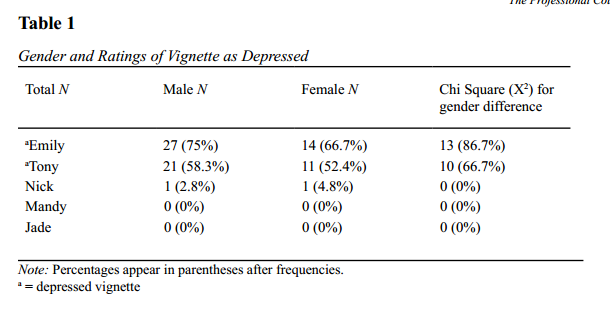
Second, in regard to respondents expressing greater worry for youth in the depressed vignettes versus the non-depressed vignettes, the Friend in Need Questionnaire instructed participants to rate their concern on a five-point scale with higher scores indicating more worry. The scores for the depressed vignettes (Emily and Tony) and non-depressed vignettes (Mandy, Jade, and Nick) were collapsed to produce mean scores of level of worry. A general linear model was used to compare sex differences (participant) in the intensity of worry scores for depressed and non-depressed vignettes. Results indicate that no significant differences existed between male (M = 3.40, SD = .38) and female participants (M = 3.45, SD = .33) regarding ratings of worry for the depressed (p < .58). No significant differences were found regarding male (M = 1.80, SD = .41) and female participants’ (M = 1.81, SD = .39) ratings of worry of the non-depressed vignettes either (p < .82).
The third question pertained to the length of recovery in the depressed and non-depressed vignettes. The respondents rated each vignette on the perceived length of time it would take the character to feel better on a four-point Likert scale from 1 (one or two days) to 4 (longer than a few months). Higher scores indicate a perception that more time is needed to feel better. Despite the use of a Likert scale, some respondents chose two answers or marked in between two options. When this occurred, the score was adjusted to reflect an average. For example, if someone circled, both “3” and “4,” a score of “3.5” was entered. This decision was made to maintain as many respondents as possible, given the small number of the sample. Overall, the respondents rated the depressed vignettes with a mean score of 3.67 (SD = .37), which indicates a recovery period of between “one or two months” and “longer than a few months.” This finding compared to a lower mean score of 1.97 (one or two days, SD = .45) for the non-depressed vignettes. Scores on the two depressed vignettes and scores on the three non-depressed vignettes were collapsed to create a composite mean score of recovery time for depressed (dependent variable) versus non-depressed vignettes (dependent variable).
A two-way MANOVA was conducted to determine if sex differences (of respondents) made a difference in the length of the recovery for both scenarios (depressed versus non-depressed). The overall model was statistically significant for the recovery time between the depressed and non-depressed vignettes F (1, 34) = 651.31; p = .01. The MANOVA did not reveal a significant interaction between participant gender and recovery time of vignettes (p < .27). Female respondents rated both the depressed vignettes (M = 3.82, SD = 24) and non-depressed vignettes (M = 2.03, SD = .43) higher than male respondents who rated the vignettes as 3.57 (SD = .53) and 1.93 (SD = .47) respectively, but this difference was not statistically significant.
Fourth, participants were asked to identify the elements of the vignette that demonstrated whether the fictitious teens were having emotional troubles. The two depressed vignettes (Emily and Tony) contained criteria of a Major Depressive Episode as described in the DSM-IV-TR (APA, 2000). In the case of Emily, respondents readily identified indicators of suicide (91%) and self-worth (72%). Respondents were less likely to identify symptoms of loss of interest (19%), fatigue (22%), and mood (19%) in this case. (See Table 2 for more complete results.) In the case of Tony, a majority of respondents identified loss of interest (75%) and weight loss (58%). Respondents were less likely to identify Tony’s fatigue (44%), insomnia (39%), and diminished ability to think or concentrate (39%).
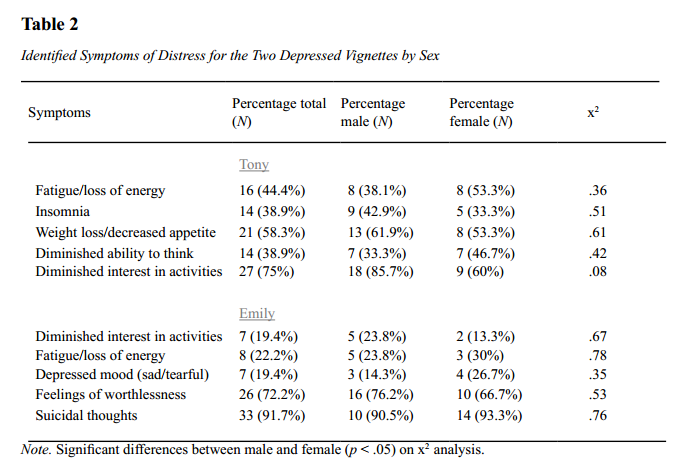
Finally, after noting which symptoms were strong indicators of problems, respondents answered an open-ended question about sources of help to aid the person in the vignette. For all five vignettes, participants answered whether they thought the person in the vignette needed help from another person. The options included “no,” “yes,” or “don’t know.” If the respondents endorsed that the person did need help, they were asked to answer a follow-up question indicating who they think should help the person. For the depressed vignettes, 58% of respondents indicated that Tony needed help, and 75% indicated the same for Emily.
In regard to the type of helpers, participants’ responses were broken down into nine categories of helpers, including counselor; friends; family; professional; psychologist; psychiatrist; doctor; teacher; and someone who has had the same difficulty. Some coding decisions included how to categorize responses not explicitly in the list. Some of these included counseling, school counselor, and guidance counselor, which were included in the category of counselor. For the friend category, other responses included “peers” and “someone who knows him/her well.” For family, “parents,” “relatives,” “siblings/brother/sister” also were included. Non-specific terms were included in the professional category, including specialist, shrink, therapist, psychotherapist, and family therapist. Other responses included in the psychiatrist category were “doctor for depression/depressed kids” and “doctor who prescribes antidepressants.” Some responses that were not coded included third party, new people, anyone, role model, someone he/she doesn’t know, and everyone.
Nearly half of the participants (47%) identified the family as the suggested primary helper for Tony, while over one-third (36%) of participants suggested a counselor. The same percentage (36%) identified the family and a psychiatrist, respectively, for Emily, as the best sources of help (see Tables 3-4 for more complete results).
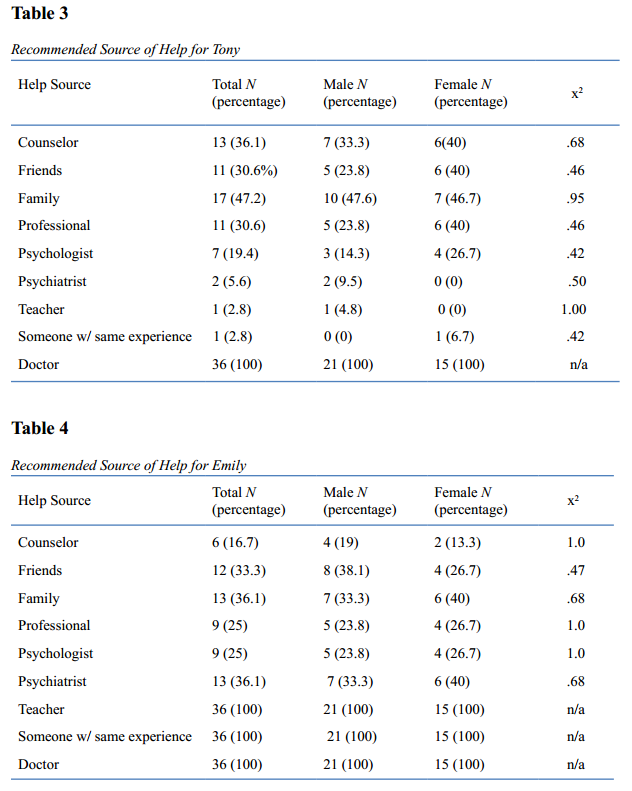
Discussion
The primary purpose of this study was to examine the level of teenagers’ mental health literacy specific to adolescent depression. Because it was a pilot study that involved a relatively small sample size, the findings are admittedly limited in generalizability. However, even with the small sample size, the results offer initial points of comparison to Burns and Rapee’s (2006) larger scale study. First and perhaps foremost, the level of detection of adolescent depression was relatively high in the present study, yet no significant differences were found as they related to gender. Over half of the participants correctly labeled both depressed-based vignettes (Emily and Tony) as being depressed, and three in four participants indicated that Emily was depressed. To their credit, participants rated both depressed vignettes as highest in terms of depression.
This finding is noteworthy. In Burns and Rapee (2006), the corresponding findings of correctly identifying depression in Emily and Tony were 68% and 34%, respectively. The higher rating of Emily as depressed was similar in both settings, yet the rating of Tony as depressed was sizably different with American participants being more inclined to have viewed the fictitious student as depressed.
A closer investigation of this finding points to critical symptoms chosen in the participants’ assessment. The vignette of Emily featured pointed comments of suicidality, and, to no surprise, it was this characteristic that was almost uniformly (92%) expressed by participants when asked about the “strongest hints that something was wrong.” The element of suicidality also was foremost in Burns and Rapee (2006) in reference to Emily, but its expression was lower (77%) among the Australian sample. At least two possibilities are present. First, it is conceivable that the Australian teenagers were not as concerned about the suicidal ideation as the U.S. participants in the present study. A second possibility is that the awareness of suicidality among adolescents has increased in more recent years in the U.S., prompting a higher rate among the U.S. teenagers.
Suicidality was absent in the vignette of Tony. However, other signs of depression were present, and these symptoms included anhedonia, fatigue, weight loss, insomnia, and diminished ability to think/concentrate. Both U.S. participants in the present study and Australian participants in Burns and Rapee (2006) placed “diminished loss of interest” as the primary symptom of an emotional difficulty at nearly identical rates (73% and 75%, respectively). The same held true for the second-rated symptom (weight loss) in both samples, again expressed by nearly the same percentage (58% in the present study and 61% in Burns and Rapee). The consistency in the ranking and percentages of both samples reflects the teenagers’ recognition of lowered interest levels and appetite difficulties leading to weight loss when an adolescent is experiencing depression. In actuality, both behaviors do indeed tend to be two of the six most frequent symptoms among teenagers who are depressed (Roberts, Lewinsohn, & Seeley, 1995).
To their credit, participants in the present study also were able to differentiate the depressed vignettes from the non-depressed vignettes. Mandy was feeling upset over a relationship termination initiated by her former boyfriend that occurred three days prior. Jade expressed family disruption and had become intoxicated at a recent party. Meanwhile, Nick was coping with the loss of a grandparent. None of these vignettes offered significant amounts in the way of genuine depression, and by and large, the majority of participants detected that their respective problems were not severe. A mere 6% of participants indicated that Mandy was depressed. Similarly, none of the participants indicated that Jade was depressed, and only 3% of them assessed Nick to be depressed. This finding offers support for the overall level of mental health literacy of the sample as it pertains to adolescent depression. Moreover, in comparison to the Australian participants in Burns and Rapee (2006), the American sample fared somewhat better: They found that, though none of their participants found Jade to be depressed, 11% and 9% of teenagers in their study did relate Nick and Mandy, respectively, to be depressed.
The participants in the present study demonstrated significantly more concern and anticipated a longer recovery period for the students in the depressive vignettes than in the non-depressed vignettes. In our study, a significant difference was accurately found in estimated recovery time.
The average duration of an initial depressive episode is eight months when no treatment is received (Brent & Birmaher, 2002). These findings add support to the conclusion that the sample possessed a considerable level of literacy. Given the fact that, to our knowledge, this pilot study is the first to assess mental health literacy for adolescent depression among American teenagers, no point of comparison exists. With this point in mind, the finding was relatively surprising. The adolescents in the present study were astute in their detection, concern, and estimated time of recovery, which could be related to a knowledge set based on their classroom education or acquired in other ways (i.e., having a friend who was depressed). Regardless of the mode of acquisition, the adolescents in this study offered greater concern for the fictitious students in the midst of a depressive episode and estimated their recovery more accurately than those students in the non-depressed vignettes.
It was mildly surprising that, unlike Burns and Rapee (2006) and Gifford-May (2002), no significant difference was found in regard to gender and mental health literacy. Burns and Rapee found that girls “clearly demonstrated” higher literacy in their abilities to not only correctly label the depressed vignettes, but also in their expression of greater concern over the students in those same vignettes (p. 232). One point of speculation on their part dealt with the higher levels of depression experienced by young women in later adolescence (Lewinsohn, Rohde, & Seeley, 1998). However, given the absence of significant differences in gender within the sample in the present study, it raises the possibility that young men in the U.S. are more insightful regarding adolescent depression than anticipated.
Burns and Rapee (2006) indicated that the primary reason for raising the mental health literacy of adolescents “is to increase the likelihood that young people can access the most appropriate help when needed” (p. 233). Taken from combined data from 2005 and 2006, an estimated 12% of American youth aged 12–17 obtained professional help for emotional or behavioral problems, and females were more likely than males to receive professional help (Office of Applied Statistics, 2008). However, the literature points to the fact that many other teenagers in need of mental health assistance for various disorders do not receive it. In fact, a mere 39% of those adolescents suffering a depressive episode receive treatment (Office of Applied Statistics, 2009).
The recommended sources for help in our sample were family and counselor, respectively, for Tony, and family and psychiatrist, both at equal percentages, for Emily. For the vignette of Emily, counselor ranked sixth of the nine helping sources. This finding is in contrast to the real-world conditions where nearly 60% of those teenagers with depression in 2007 saw or talked to a counselor in their treatment (Office of Applied Statistics, 2009).
Though the reasoning behind the choices of the helping sources was not sought, the selections lead to intriguing possibilities. First, in the case of Tony, the primary helping source was family, despite information in the vignette that the family system was deteriorating over a parental separation. Even if that played no role in the participants’ responses, the choice of family in soliciting help is striking in that parent-adolescent conflicts increase during early adolescent years (Laursen, Coy, & Collins, 1998). Suicidal adolescents reported difficulty in communicating with parents, tremendous stress in their home life, and a distressed relationship with one or both parents (Bostik & Everall, 2006). However, this finding is consistent with a qualitative study (McCarthy, Downes, & Sherman, 2008) pointing to beneficial parental partnerships that developed during depressive episodes and were instrumental in the teenager getting professional help. Counselor, the second recommended helper choice in the vignette of Tony, may not be as surprising. The school from which the data were collected does have a staff of professional school counselors, and this finding may speak to the participants’ level of comfort with counselors.
The topic of recommended helper was much different in the vignette of Emily, as the choices were much more equal in terms of the percentages. The selection of psychiatrist as the second recommended helper may point to the participants’ perception of the potential for harm and their connotation that a physician with mental health expertise and prescription privileges was needed. In a similar vein, the designations of psychologist and professional were closely behind psychiatrist in recommended helpers, again suggesting the participants’ notion that highly trained professionals who likely have a doctoral degree were needed to aid Emily. This finding mirrors recent research, as 27% of those adolescents having a depressive episode saw their family physician or a general practitioner. Roughly the same number sought help from a psychiatrist or psychologist (Office of Applied Statistics, 2009).
Surprisingly, friends were the third most common choice of helper in a case of a student marked by suicidal ideation. With the potential for harm in this student, friends may not be the best source for initial help. However, participants in the present study may have thought that friends would be supportive during an emotionally difficult period. Finally, the lower ranking of the counselor designation may be connected with a perception that a counselor is sought for less complex difficulties.
Burns and Rapee (2006) found that counselor and friend were the two primary overall recommended sources of help. In regard to counselors, they noted that this finding may be reflective of the “access and familiarity” that adolescents in many Australian schools possess with this type of professional (p. 233). Overall, however, the participants in their study offered far lower rankings of a psychologist, professional, or psychiatrist as a source of help in the depressed vignettes. This finding could point to a familiarity by American teenagers with medical professionals, particularly with the prevalence rate of medication prescribed to this population in the U.S. compared to European countries (Levin, 2008).
Limitations
Limitations are clearly evident in this study. As previously noted, the small sample size that is consistent with pilot studies restricts generalizability. The sample size also may have been composed of more sophisticated students in mental health, as many students in the sample were enrolled in a psychology class. Burns and Rapee (2006) pointed out that the vignette-based instrument of the Friend in Need Questionnaire is consistent with the manner in which other mental health literacy studies have been conducted. However, they added, “The extent to which such data can be translated into what actually is likely to happen in the real world is unclear” (p. 234). They also noted that a subsequent challenge for research in this area includes the development of research modalities that examine literacy in a naturalistic setting, such as interviews with adolescents. This suggestion connects to Dundon’s (2006) call to bring forth the “voice of the adolescent” that has been lacking in the research on adolescent depression (p. 384).
Implications
This pilot study represents a point of entry in studying American teenagers’ mental health literacy in regard to teen depression. Participants in this study showed the ability to correctly differentiate depressed vignettes from non-depressed vignettes and, in their assessment, indicated relevant symptoms of depressive symptoms faced by adolescents. Overall they also expressed sources of help that varied upon the perceived degree of seriousness of the difficulties. The outcomes offer implications regarding the potential benefit of including adolescents in a more direct way when providing outreach or offering services. They demonstrated an accurate understanding of when more intense levels of care could be beneficial.
The study produced results that also warrant further exploration of the relationships between youth and parents during adolescence. Although this developmental period can be marked by tumultuous relationships between them, there may be wisdom in providing communication skills to strengthen such relationships. Such efforts could result in more disclosure of depressive symptoms to parents, which may expedite the process of getting help as opposed to sharing such struggles only with peers. In addition to implications for teens and parents, this research can help shape additional studies in expanding the understanding of literacy.
Future research calls for additional mental health literacy investigations marked not only by larger sample sizes, but also by an in-depth investigation of adolescents of various racial/ethnic differences within the sample. Higher rates of adolescent depression have been found in youth of Latino descent (Guiao & Thompson, 2004; Twenge & Nolen-Hoeksema, 2002), for instance, and it would be important to evaluate the mental health literacy levels among respective backgrounds. With teenage depression being a pressing matter in adolescent mental health, the domain of mental health literacy in regard to this disorder is a vital one that merits additional research.
References
American Psychiatric Association. (2000). Diagnostic and statistical manual of mental disorders (4th ed., text rev.). Washington, DC: Author.
Bostik, K. E., & Everall, R. D. (2006). In my mind I was alone: Suicidal adolescents’ perceptions of attachment relationships. International Journal for the Advancement of Counselling, 28(3), 269–287. doi: 10.1007/s10447-006-9013-6
Brent, A., & Birmaher, B. (2002). Adolescent depression. The New England Journal of Medicine, 347(9), 667–671. doi:10.1056/NEJMcp012249
Burns, J. R., & Rapee, R. M. (2006). Adolescent mental health literacy: Young people’s knowledge of depression and help seeking. Journal of Adolescence, 29, 225–239. doi:10.1016/j.adolescence.2005.05.004
Dundon, E. E. (2006). Adolescent depression: A metasynthesis. Journal of Pediatric Health Care, 20, 384–392. doi: 10.1016/j.pedhc.2006.02.010
Gifford-May, D. (2002). Adolescents’ knowledge and beliefs about depression, coping strategies and barriers to help-seeking: Gender and ethnic difference (Unpublished master’s thesis). Macquarie University, Australia.
Guiao, I., & Thompson, E. A. (2004). Ethnicity and problem behaviors among adolescent females in the United States. Health Care for Women International, 25(4), 296–310. doi:10.1080/07399330490278330
Hankin, B. L. (2006). Adolescent depression: Description, causes, and interventions. Epilepsy & Behavior, 8, 102–114. doi:10.1016/j.yebeh.2005.10.012
Highet, N., Thompson, M., & McNair, B. (2005). Identifying depression in a family member: The carers’ experience. Journal of Affective Disorders, 87, 25–33. doi:10.1016/j.jad.2005.02.- 016
Jorm, A. F., Korten, A. E., Jacomb, P. A., Christensen, H., Rodgers, B., & Pollitt, P. (1997). “Mental health literacy”: A survey of the public’s ability to recognise mental disorders and their beliefs about the effectiveness of treatment. Medical Journal of Australia, 166, 182–186.
Jorm, A. F., Wright, A., & Morgan, A. J. (2007a). Beliefs about appropriate first aid for young people with mental disorders: Findings from an Australian national survey of youth and parents. Early Intervention in Psychiatry, 1, 61–70. doi:10.1111/j.1751-7893.2007.00012.x
Jorm, A. F., Wright, A., & Morgan, A. J. (2007b). Where to seek help for a mental disorder? National survey of the beliefs of Australian youth and their parents. The Medical Journal of Australia, 187, 556–560.
Kitchener, B. A., & Jorm, A. F. (2002). Mental health first aid training for the public: Evaluation of effects on knowledge, attitudes and helping behaviour. BioMed Central Psychiatry, 2, 10. doi:10.1186/1471-244X-2-10
Langlands, R. L., Jorm, A. F., Kelly, C. M., & Kitchener, B. A. (2008a). First aid for depression: A Delphi consensus study with consumers, carers and clinicians. Journal of Affective Disorders, 105, 157–165. doi:10.1016/j.jad.2007.05.004
Langlands, R. L., Jorm, A. F., Kelly, C. M., & Kitchener, B. A. (2008b). First aid recommendations for psychosis: Using the Delphi method to gain consensus between mental health consumers, carers, and clinicians. Schizophrenia Bulletin, 34(3), 435–443. doi:10.1093/schbul/sbm099.
Laursen, B., Coy, K. C., & Collins, W. A. (1998). Reconsidering changes in parent-child conflict across adolescence: A meta-analysis. Child Development, 69, 817–832. doi:10.1111/j.14678624.1998.00817.x
Levin, A. (2008, November 21). U.S. youth more apt than Europeans to be prescribed psychotropics. Psychiatric News, p. 18.
Lewinsohn, P. M., Rohde, P., & Seely, J. R. (1998). Major depressive disorder in older adolescents: Prevalence, risk factors, and clinical implications. Clinical Psychology Review, 18(7), 765–794. doi:10.1016/S0272-7358(98)00010-5
McCarthy, J., Downes, E. J., & Sherman, C. A. (2008). Looking back at adolescent depression: A qualitative study. Journal of Mental Health Counseling, 30(1), 49–68.
Office of Applied Statistics. (2009, May 11). Major depressive episode and treatment among adolescents. The NSDUH Report, pp. 1–4.
Roberts, R. E., Lewinsohn, P. M., & Seeley, J. R. (1995). Symptoms of DSM-III-R major depression in adolescence: Evidence from an epidemiological survey. Journal of the American Academy of Child and Adolescent Psychiatry, 34, 1608–1617. doi:10.1097/00004583-199512000-00011
Substance Abuse and Mental Health Services Administration, Office of Applied Studies. (May 11, 2009). The NSDUH Report: Major Depressive Episode and Treatment among Adolescents. Rockville, MD.
Substance Abuse and Mental Health Services Administration, Office of Applied Studies. (September 28, 2008). Mental health service use among youths aged 12 to 17: 2005 and 2006. Rockville, MD.
Twenge, J. M., & Nolen-Hoeksema, S. (2002). Age, gender, race, socioeconomic status, and birth cohort differences on the Children’s Depression Inventory: A meta-analysis. Journal of Abnormal Psychology, 111, 578–588. doi:10.1037/0021-843X.111.4.578
Wagner, K. D., Emslie, G. J., Kowatch, R. A., & Weller, E. B. (2008). An update on depression in children and adolescents. Journal of Clinical Psychiatry, 69(11), 1818–1828. doi:10.4088/JCP.v69n1118
Wright, A., Harris, M. G., Wiggers, J. H., Jorm, A. F., Cotton, S. M., Harrigan, S. M., & McGorry, P. D. (2005). Recognition of depression and psychosis by young Australians and their beliefs about treatment. The Medical Journal of Australia, 183, 18–23.
John McCarthy, NCC, is a Professor in the Department of Counseling at the Indiana University of Pennsylvania (IUP). Michelle Bruno is an Assistant Professor in the same department at IUP. Teresa E. Fernandes, NCC, is a counselor at the Meadows Psychiatric Center, Centre Hall, PA. Correspondence can be addressed to John McCarthy, Indiana University of Pennsylvania, Department of Counseling, 206 Stouffer Hall, Indiana, PA, 15705, john.mccarthy@iup.edu.
Sep 2, 2014 | Article, Volume 1 - Issue 1
Richard A. Wantz, Michael Firmin
Numerous sources of information influence how individuals perceive professional counselors. The stressors associated with entering college, developmental differences, and factors associated with service fees may further impact how college students view mental health professionals and may ultimately influence when, for what issues, and with whom they seek support. Individual perceptions of professional counselors furthermore impress upon the overall identity of the counseling profession. Two hundred and sixty-one undergraduate students were surveyed regarding their perceptions of professional counselors’ effectiveness and sources of information from which information was learned about counselors. Overall, counselors were viewed positively on the dimensions measured. The sources that most influenced perceptions were word of mouth, common knowledge, movies, school and education, friends, books, and television.
Keywords: professional counselors, perceptions, counselor effectiveness, professional identity, undergraduates
Perception is not reality, but perception is nonetheless a very cogent relative to how humans come to understand reality. Moreover, perception tends to drive behavior and decisions made by consumers. In the present context, we are interested in how college students come to perceive human service providers across a number of variables. The constructs explored are not novel, as this genre of research has been assessed in decades past (e.g., Murray, 1962; Strong, Hendel, & Bratton, 1971; Tallent & Reiss, 1959; West & Walsh, 1975). However, we believe the topic warrants refreshed attention, particularly with the professional licensure acquired among all human service professions: psychiatrists, psychologists, counselors, marriage and family therapists, social workers, and psychiatric nurses.
The media tends to exert a cogent effect on students’ perceptions across multiple life domains, including human service professionals (Von Sydow, Weber, & Christian, 1998). Students also are affected by other information sources such as previous experiences with their high school (guidance) counselors, personal therapy, clergy, family doctors, parental influence, and input from peers (Tinsley, de St. Aubin, & Brown, 1982). Students’ perceptions of human service providers also may be affected by various campaigns, typically receiving information-influence from multiple sources that actively attempt to shape their perceptions of mental health services’ value and efficacy (Hanson, 1998).
Some human service professions have been more aggressive in how they advocate their service value to the public. Fall, Levitov, Jennings, and Eberts (2000) note that psychiatrists and psychologists generally have dwarfed counselors’ efforts at advocacy. Counselors, as a profession, have struggled significantly with their own identity (Garrett & Eriksen, 1999; Eriksen & McAulife, 1999), which likely affects this phenomenon. That is, if one’s identity is unclear to the respective professionals, then probably it will negatively affect its status among the laity (Gale & Austin, 2003). Psychology generally has lagged behind psychiatry in terms of the public’s professional perceptions (Webb & Speer, 1985), although Zytowski et al. (1988) reported that people frequently confused the terms psychiatrist and psychologist relative to function. Counseling psychologists also often seem to be confused with professional counselors in the public’s understanding (Hanna & Bemak, 1997; Lent, 1990).
Social work has existed as a vocation for over a hundred years. Kaufman & Raymond (1995) reported that the public’s awareness of the profession’s perception was somewhat negative in their survey sample. LeCroy and Stinson (2004) and Winston and Stinson (2004) likewise found individuals in their particular sample to be relatively knowledgeable regarding social workers’ responsibilities, although reported attitudes were more positive than those reported by Kaufman and Raymond. This partly may be due to the fact that respondents reported more favorable perceptions of social workers as helping those needing avocation than they did for social workers as therapists. Sharpley, Rogers, and Evans (1984) suggest that marriage and family therapy, as a profession, is relatively cryptic to the general public. That is, people generally deduce what such human service personnel do, as indicated by the title, but do not have as much first-hand knowledge or experience with such professionals as they do with counselors, social workers, psychologists, and other professionals.
Ingham (1985) notes that a helping profession’s overall image affects clinicians in that profession relative to their abilities in helping clients to utilize their services. This conclusion makes logical sense in that consumers’ confidence in the care provided is subjective and highly influenced by psychological variables, such as idiographic perceptions. Attempts at educating the public regarding an apt understanding of what a human service profession has to offer has shown various levels of effectiveness (Pistole & Roberts, 2002). Nonetheless, Pistole (2001) also notes that the general public finds the distinctions among the various human service providers to be bewildering. In short, without periodic reminders, the public’s image of various human service personnel may reconverge in a fog of misperception.
Since many individuals have never experienced the services of mental health clinicians, often their perceptions are based on reports or intuitively acquired opinions. For example, Trautt and Bloom (1982) report that fee structures affect perceptions of status and effectiveness provided by clinicians. The basic understanding, of course, is that the more expensive the treatment, the higher its perceived value and professional status. That, of course, can result in self-fulfilling prophesies—with people paying more money expecting more from therapy—and experiencing better success rates. We are unaware of any studies where clients were randomly assigned to professional therapists and (systematically) charged varying pay rates. Such a study, controlling for fee structures, might yield some valuable data to the present discussion regarding how the public perceives the value of respective human service professionals.
Beyond the public’s general perceptions on this topic, however, we are particularly focused on students’ perceptions. Hundreds of thousands of students annually utilize the services of university counseling centers, as well as private practice therapists and other human service agencies. With the added stress of academics, social pressures, being away from home for the first time, transitioning from teenage to adult responsibilities, dating, drinking alcohol, and other similar stressors, having apt utilization of psychotherapeutic services is paramount for college students. Turner and Quinn (1999) suggest that college students’ perceptions differ from the population-in-general, and research data from one group may not accurately generalize to the other.
Notwithstanding obvious developmental differences between college students and more mature adults from the general population, counseling students may not pay (directly, out of pocket) for the services available to them. Campus counseling centers, for example, typically receive funding from tuition or generic student fees, rather than students paying direct dollars for the services. Additionally, most full-time students remain on their parents’ medical insurance which also offsets financial costs involved in private practice expenses. In short, cost of services seems to be a significant variable for the general population (Farberman, 1997) that may not load with the same degree of importance vis-a-vis college students. Additionally, titles (such as “doctor”) may not have as much bearing with the general public (Myers & Sweeney, 2004) as they do with college students who routinely use such nomenclature with professors and others on a daily basis. In short, while we accommodate research findings that compare the various mental health professionals as perceived by the general public (e.g., Murstein & Fontaine, 1993), we also treat the results with some degree of prudence and believe college students represent a distinct population worthy of particular focus and exploration.
Gelso, Brooks, and Karl (1975) conducted a study that was similar in some respects to our present one. They surveyed 187 students from a large eastern university with a sample of 103 females and 84 males. Subjects were asked to rate perceived characteristics of various human service professionals, including high school counselors, college counselors, advisers, counseling psychologists, clinical psychologists, and psychiatrists. They found that overall college students did not report significant differences relative to professionals’ personal characteristics. However, they did report differences among the human service providers relative to their perceived competencies in treating various hypothetical presenting problems.
In the 30 years subsequent to this study, we are interested in how student perceptions have changed over time. Additionally, the Gelso, Brooks, and Karl (1975) study did not account for students’ perceptions of social workers, marriage and family therapists, or psychiatric nurses. Given the present milieu, we are more interested in these professionals than the categories of school counselors or advisors. Additionally, we also chose to combine the categories of counseling and clinical psychologists into the generic grouping, “psychologist.” The specific questions asked of students also differed in our present study. However, the general tenor of the two studies is similar—and we believe the updating of knowledge in this area has significant importance for those working with college students in various capacities and milieus.
Warner and Bradley (1991) also conducted a study similar to the present one. Their participants included 60 men and 60 women who were undergraduate college students enrolled in a University of Montana introductory psychology course. They assessed student perceptions of master’s-level counselors, clinical psychologists, and psychiatrists on multiple variables. Findings included students reporting their perceptions of counselors as possessing more caring-type qualities. Psychiatrists were seen as most able to address severe psychopathology and psychologists were viewed as more academics and researchers than as therapists.
Method
Participants
We surveyed 261 students from three sections of a general psychology course for this study. The course was selected, in part, because it is included in the university’s general studies core curriculum. Consequently, it represented a relatively wide range of majors from the student body and included students from freshman through senior status. The sample was taken at a selective, private, comprehensive university located in the Midwest with a study body of approximately 3,000 students. It included 167 women and 92 men with ages ranging from 17 to 55. The students were mostly Caucasian with 9% identifying themselves as ethnic minorities representing 34 states.
Procedure
The instrument was first pilot tested (Goodwin, 2005) to a group of undergraduate students at a regional state university prior to utilizing it in the present research project. Modifications were made in clarifying ambiguous terminology, instructions, and time to complete. Due to practical considerations, the instrument was designed to be completed in about one-half of a normal class period. The survey was administered during a normal class period with students having the option to participate at will without reward or penalty for doing so. Two students chose not to complete the surveys for undisclosed reasons.
The survey queried students regarding their perceptions of human service professionals (HSP), taking about 20–25 minutes to complete. Anonymity was provided to all students regarding answers to all items. Questions were asked about the overall perceived effectiveness of various HSPs, for which types of problems they might recommend various HSPs, and overall perceptions about the various HSPs. Although obviously many types of HSPs exist, this particular survey focused on psychiatrists, psychologists, professional counselors, marriage & family therapists, social workers and psychiatric nurses. In order to control for order effects as potential threats to internal validity (Sarafino, 2005), the various HSPs were presented in random order each time they appeared throughout the survey. The amount of data collected from the survey was relatively substantial. However, given the practical number of journal pages that can be reasonably devoted to presenting the information, along with our desire to comprehensively address perceptions of counselors, the present article addresses only this particular segment of the data collection.
Results
We organized the survey’s results in terms of the counseling services utilized, how effective students perceived counseling to be, for what types of problems or issues counselors are thought to be apt, how students came to view their perceptions of professional counselors, and qualities thought to characterize professional counselors. All percentages are rounded for clarity of reading and presentation, except where percentages fall below 1%.
Types of Services Utilized
At the end of the questionnaire, students were asked to confidentially self-disclose whether or not they had received services from a HSP. The question was placed at the end in order to have students already somewhat acclimated to HSPs and to have them somewhat more comfortable with the world of different types of HSPs. Of those answering the question, 28% of the participants indicated having received assistance from a HSP prior to completing the survey. The specific question asked whether or not students received prior professional assistance regarding personal, social, occupational or mental health concerns. About 3% of all the participants chose not to answer this particular question. However, of the 28% only 1% indicated that they did not know the profession of their HSP, indicating that most of the respondents who previously had utilized HSP services were aware whether the professional they saw was a counselor, psychologist, social worker, etc. Relatively few (
States possess a variety of titles by which professional counselors can or should be called (Freeman 2006). Consequently, rather than asking students simply to identify whether or not they had previously utilized the services of a “counselor,” we specified some types of counselors they may have seen. These included professional counselor, pastoral counselor, addictions or chemical dependency counselor, rehabilitation counselor, clinical mental health counselor, professional clinical counselor, and school guidance counselor.
Of the 28% of students who indicated they had previously utilized HSP services, three particular types of counselors were more prominent than the others. Namely, 16% indicated having seen a school counselor, 11% saw a professional counselor, and 9% saw a pastoral counselor. Relatively few students indicated having seen a rehabilitation counselor (0.4%), an addictions counselor (0.8%), or a mental health/clinical counselor (3%).
Perceived Overall Effectiveness
Students were asked to indicate how effective they believed professional counselors are overall. The particular question was worded as follows: In general, what is your opinion about how overall effective professional counselors would be with helping a mental health consumer? The options provided, with descriptors in parenthesis, were 1 (Positive), 2 (Neutral), 3 (Negative), and 4 (Unsure or don’t know). The intent of the question was to capture the gestalt of students’ thinking regarding professional counselors, prior to probing more deeply vis-a-vis types of counselors and for which kinds of issues they might find effective interventions.
Only 3% of the participants indicated having no opinion regarding this question. Another 3% indicated viewing professional counselors negatively. A total of 28% of the participants indicated having neutral views regarding counselors’ overall effectiveness. Sixty-six percent of the participants indicated having a positive view of professional counselors.
Types of Issues for Which Counselors Are Adept
Students were asked to identify for what types of issues they believed professional counselors would be particularly adept. They were provided with 12 different issues and asked to rate them as Yes (I would recommend a professional counselor for this situation), No (I would not recommend a professional counselor for this situation), or NS (Not sure, not familiar). Relatively few students skipped these questions or chose not to respond (range=0.8% to 3.4%). In other words, response rates were consistently high for these questions, obviously adding to the interpretation process. The same is true with students indicating that they were unsure or unfamiliar. Namely, on average 4% or so of students indicated being unsure for the situations presented (range=1.9 to 6.9). Results showed three clusters of participants’ responses.
The first cluster had four prominent responses, exhibited by 80% or more of the respondents—they involved college issues, academic problems, depression, and career counseling. A total of 91% of the participants indicated believing a professional counselor would be effective for helping college students who report homesickness, roommate problems, and falling behind with class assignments. A similar number (88%) believed that a professional counselor would be effective with a depressed individual who reports feeling sad and empty most days, finds little pleasure in daily activities, has insomnia, and is unable to concentrate. Comparable responses (83%) were seen for professional counselors addressing a young person with adequate intellectual capacity, but a pattern of academic problems (e.g., failing grades and significant underachievement). Finally, 80% of participants indicated that a professional counselor would be effective for a person reporting job dissatisfaction and uncertainty about career choices.
The next cluster of responses involved issues of family dysfunction, substance abuse, and attention-deficit hyperactivity disorder (ADHD). Seventy-six percent of participants indicated feeling that professional counselors were effective for a family unit reporting communication problems, negative interactions, criticism, and withdrawal among family members. For cases when a person self-administers and abuses drugs that results in impairment of daily academic, occupational and social functioning, 73% of the respondents in our survey believed a professional counselor would be effective. Sixty-seven percent of participants indicated that a professional counselor would be effective when a person with persistent patterns of inattention and hyperactivity-impulsivity that interferes with academic, occupational, and social function.
The final cluster of participants’ responses involved issues of personality assessment, intelligence testing, psychotic symptoms, physical disabilities, and mental health evaluations. Just over half (53%) of the participants indicated that professional counselors were apt for working with a person who needs personality assessment. Forty-four percent said that a professional counselor would be effective for a person with psychiatric symptoms who experiences delusions, hallucinations, disorganized speech, and is frequently incapable of meeting ordinary demands of life. When asked if an unemployed individual with a physical disability seeking employment would be a target source for a professional counselor, 43% answered affirmatively. Only 40% of participants indicated that a professional counselor would be effective in helping a client who needs a comprehensive mental health evaluation. Fewer (37%) indicated that intelligence testing was germane for a professional counselor.
Table 1
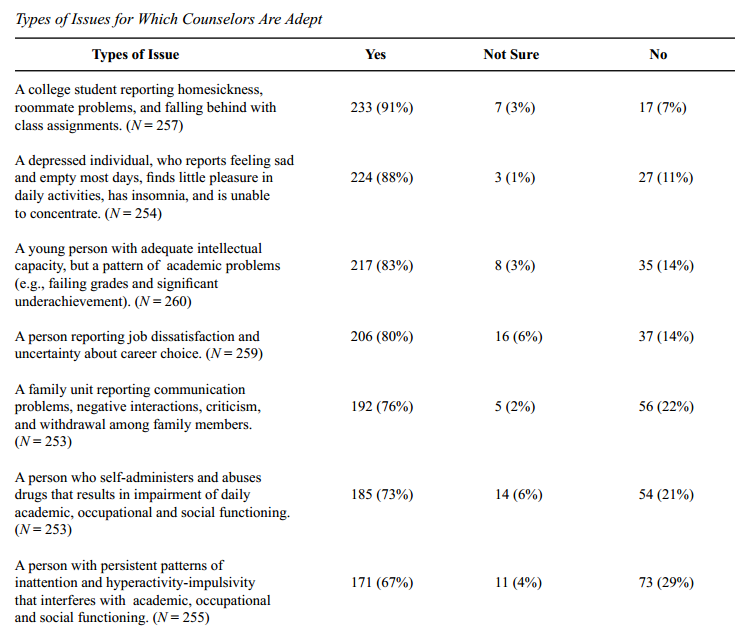
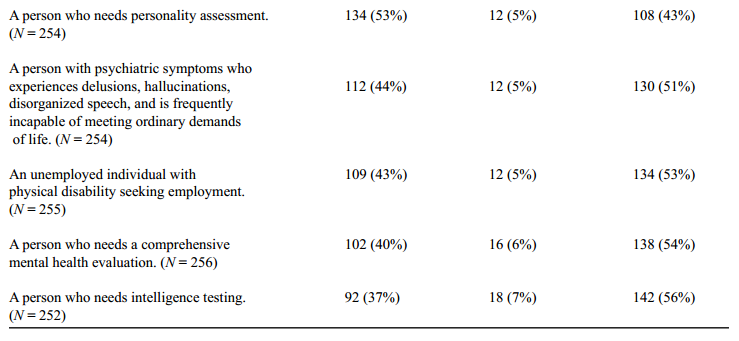
Sources of Perceptions about Counselors
Another line of inquiry addressed the identified sources by which students indicated they developed their perceptions about counselors. In other words, they told us about the factors that influenced them the most regarding how they came to think about professional counselors. The options from which to choose included books, common knowledge, friends or associates, HSPs, insurance company or carrier, Internet, magazines, physician or nurse, movies, newspapers, personal experience, school and education, and television. Only 2% of the participants declined to participate in this section of the survey or marked “none.”
Instructions asked students to complete this section in two steps. First, they were to indicate (by checking a corresponding box) whether or not they learned about a professional counselor from the identified source. Students were told they could select multiple sources. In the second step, they were asked to rate whether the information about the HSP was 1 (positive), 2 (neutral) or 3 (negative). Only 2% of the students marked a box described as “other,” indicating that the categories provided were relatively comprehensive. Results from this portion of the survey showed the data falling into three clusters. The two clusters representing extreme scores were of relatively equal size, while the third or middle was small (only two sources in the category).
The first cluster showed the following items as being relatively influential in how students came to understand the roles of professional counselors: common knowledge (84%), movies (63%), school and education (60%), friends (55%), books (49%) and television (44%). The middle cluster included personal experience (27%) and Internet (24%). The finding that 27% indicated personal experience to be influential is consistent with the demographic portion of the questionnaire where 28% of students said they had personal contact with a HSP prior to completing the survey. The third cluster comprised those sources that participants said were relatively non-influential in generating their perceptions of professional counselors. They included magazines (20%), physician or nurse (18%), newspaper (13%), HSPs (10%) and insurance companies (5%).
Results from the second step in the survey are more difficult to summarize. The data was more dispersed than the first step, although three clusters inductively emerged. Some items received few responses, as they were not selected very frequently in step one. The percentages listed do not add up to 100% for each item because the remaining percentage for each item is accounted by students who did not provide answers for that item. For example, if an item had 1% positive, 1% neutral, and 1% negative, then 97% of the participants simply left the question blank.
The first were items where students indicated that professional counselors were as viewed mostly positive. These included school and education (43% positive, 13% neutral and 3% negative), friends (38% positive, 10% neutral and 6% negative), books (30% positive, 17% neutral and 2% negative), personal experience (17% positive, 7% neutral and 3% negative), physicians (10% positive, 6% neutral and 2% negative), and HSPs (8% positive, 0.8% neutral and 0.8% negative).The second cluster comprised items that were rated as being mostly neutral and with relatively few positive indicators. These included: movies (14% positive, 28% neutral and 19% negative) and television (13% positive, 25% neutral and 6% negative). The third cluster showed a relative spread of responses, although there were few negatives in each category. They included: common knowledge (38% positive, 42% neutral and 3% negative), magazines (10% positive, 8% neutral 3% negative), Internet (10% positive, 12% neutral and 1% negative), newspapers (5% positive, 6% neutral and 3% negative), and insurance companies (0.8% positive, 2% neutral and 2% negative).
Perceived Counselor Qualities
The final portion of the questionnaire addressed how participants viewed various professional counselors’ characteristics. Students were asked to identify statements that they believed to be true about professional counselors, based on their overall knowledge of them. Options included competent, can be in independent private practice, diagnose and treat mental and emotional disorders, doctoral degree required to practice, intelligent/smart, overpaid, prescribe medication and trustworthy. Consistently, only 1% of the participants chose not to respond to this portion of the survey, making interpretation for this section relatively straightforward. The findings fell neatly into two categories: characteristics counselors presumably possess and those they do not.
Characteristics that students believed professional counselors possess include being competent (81%), independent private practice (81%), trustworthy, (79%), and intelligent/smart (77%). Contrariwise, participants identified the following as not characterizing professional counselors, as indicated by the relatively low percentages of marked responses: doctorate required (30%), diagnose and treat mental disorders (22%), overpaid (16%) and prescribe medications (5%).
Discussion
Given the formation and advancement of the American Mental Health Counseling Association (AMCHA), the introduction of state licensure laws that specifically use mental health counselors as formal nomenclature (Freeman, 2006), and particular certifications that have been offered in clinical mental health counseling, we were somewhat surprised that only 3% of the students who had previously used HSP services identified doing so with clinical mental health counselors. Of course, they may have been confused with names, but to the degree that accurate reporting occurred, the numbers were relatively low compared to other types of counselors.
Obviously, school counselors are very important relative to how students perceive professional counselors. They accounted for the largest portion of users (16%). First impressions are not always necessarily lasting impressions. However, they are cogent and school counselors may set the tone for how these students, for the rest of their lives, perceive others using the word “counselor” in their professional titles. This sentiment was illustrated in qualitative research findings by Wantz, Firmin, Johnson, and Firmin (2006).
Three times as many students indicated having seen a pastoral counselor than a mental health counselor (9% and 3%, respectively). Obviously, we do not know if some students actually meant that they saw an ordained clergy person for personal issues, considering this person to be a pastoral counselor, since they received counseling from him/her and the person was clergy. However, assuming accurate reporting, it suggests that graduate training programs should consider giving additional attention to this domain of counseling. Although courses in pastoral counseling sometimes are seen in religiously-oriented universities (e.g., seminaries, Catholic or Christian colleges), the apparent popularity of their use by students, suggested by the present research, provides evidence that more widespread attention to pastoral counseling is warranted.
Students’ overall perception of professional counselors as being effective is heartening. Particularly welcoming is that only 3% viewed counselors negatively. Social psychology research (Myers, 1994) has shown that a few negative, public incidences can have overshadowing effects on a group’s overall positive characteristics. Fortunately for professional counselors, whatever data might feed negative overall impressions seems to be relatively dormant for students in the present sample.
A general continuum emerged vis-a-vis students’ perceptions of what types of issues are most germane for professional counselors to address. Namely, high responses were provided for general, developmental life issues such as academic problems, depression and career counseling. Moderate responses were provided for problems where direct brain-behavior connections are involved such as ADHD or drug counseling. The lowest responses were provided for types of situations where assessment is warranted, such as personality or intellectual assessment and mental health evaluations. These findings are consistent with overall perceptions that students do not think of counselors in terms of being clinical mental health professionals, but rather as more generic, trained counselors. If the field wishes to advance itself toward the direction of diagnosis, assessment, and treating psychopathology, then data from the present survey would suggest that efforts should be redoubled.
Not all media sources appear to be equal in influencing students’ perceptions of professional counselors. For example, newspapers (13%), magazines (20%), and the Internet (24%) were relatively inconsequential when compared to movies (63%), books (49%) and television (44%). Unfortunately for professional counseling organizations, the most potentially influential sources also happen to be the most expensive ones to target. Nonetheless, if organizations such as the American Counseling Association (ACA), American Mental Health Counselors Association (AMCHA), and the National Board for Certified Counselors (NBCC) are going to impact students’ thinking, then they should target the most efficacious sources. It could be, of course, that the reason newspapers, magazines and the Internet were so relatively non-influential is that few inroads have been attempted in these domains. Advertising in university newspapers, posting and promoting user-friendly web sites, and generating informative articles in popular magazines simply may be an important need for professional counseling advocacy at this time.
In a separate study under development, using qualitative methodology, we are attempting to better flesh-out some of the details relating to these sources of impact on students’ perceptions of professional counselors, particularly the concept of “common knowledge.” Although not surveyed in this study, an influential source proved to be word-of-mouth in perception formations regarding counseling. That is, influences of school, friends, personal experience, physicians, and HSPs most likely have some type of personal connections tied to the medium. Evidently, there is some truth to the adage that word-of-mouth is the best means of advertising—assuming, of course, that the messages being relayed are positive.
In the perceived counselor qualities portion of the survey, it was somewhat disheartening that comparatively few (22%) students indicated they saw professional counselors as competent to diagnose and treat mental disorders. This finding was consistent with other data throughout the survey. Namely, students generally view counselors as professionals who address relatively normal, human development issues rather than psychopathology or more severe disorders requiring assessment, diagnosis and treatment. Again, if the counseling profession wishes to move in the latter direction, then findings from the present research suggest that there is some distance to go. Early acquired school counselor perceptions tended to initiate students’ mindsets regarding what counselors do and they seem not to have moved far from those early perceptions.
In summary, we believe that the present study is a strong first step in a line of needed research regarding just how people come to understand counselors. The findings here do not dictate any action on behalf of professional counseling organizations. However, we believe that the findings indicate in which directions the winds of student perceptions are blowing—and that is data which should be considered when making policy decisions. If counselors are going to move to new, future levels of excellence in terms of public perception, then paying attention to this type of data and giving it due consideration is an important initial component.
Limitations and Future Research
All good research studies report limitations (Murnan & Price, 2004) and we indicate four of them here. First, while our sample had several strengths, including adequate size (Patten, 1998), high response rate (Stoop, 2004), and lack of incentives/bribes for participation (Storms & Loosveldt, 2004), it was taken from a single locale. Some compensation exists, such as students coming from 34 states and the relatively broad cross-section of college majors represented. However, future research in this domain should assess students from a wider variety of institutions such as research universities, state universities, and liberal arts colleges—as well as from diverse locales in the country in order to enhance the study’s external validity (Cohen & Wenner, 2006).
Second, our study had relatively low representation from minority students. This simply was an artifact of the university where the data was collected. Specifically, minorities comprised only 6% of the student body population. Further research should contain samples with larger representations of minority individuals. Additionally, replicating this present study with all minority students would provide an interesting comparison among many points of investigation.
Third, some of the items queried were selected a priori. While we believe them to be of interest and germane to our purposes, future research should broaden questionnaires to include questions that are derived empirically from the research literature. Also, organizations such as the Council for Accreditation of Counseling and Related Educational Programs should provide input vis-a-vis questions that directly would enhance their efforts in counselor education preparation. The same is true with potential input from NBCC and ACA as they market professional counselors to the general population as well as college students.
Fourth, in retrospect there are two particular changes we would have made to the survey instrument. One is that we would have added a Likert-scale to the first question, querying the perceived overall effectiveness of counselors. While we believe that rating professional counselors with three choices was useful—and we would keep the question—we also would recommend future researchers add a Likert-scale question that is anchored with descriptions, but to which numeric interval-scale values could be assessed. Second, looking back on our questionnaire, we would have asked how many students saw more than one HSP. That is, did they use more than one type of human service professional’s services (e.g., they saw both a rehabilitation counselor and a school counselor). Accounting for multiple uses within the same clientele could provide potentially useful data.
Future research should take the present study and apply it to the population in general. That is, we produced what we believe to be fairly apt representations of perceptions among students—but they do not represent the population at large. Obviously, college students have unique features of adult development that are not necessarily shared by older adults (Foos & Clark, 2003). The very low reported influence that health insurance companies have on college students’ perceptions is one of many examples of where student ideations and those of more middle-aged adults might differ.
And finally, qualitative research is needed in this area. A prime value of questionnaires, such as the present one, is that more voluminous amounts of data can be collected—providing breadth of understanding (Gall & Borg, 2003). Such research also tends to answer “how many” or “what” types of questions (Hittleman & Simon, 2003). Thicker descriptions are needed to help flesh-out some of the details on which survey research was only able to skim. Answers to some of the “why” and “how” questions that the present findings raise can best be answered with follow-up qualitative research methodology (Flick, 2002).
References
Cohen, J., & Wenner, C. J. (2006, May). Convenience at a cost: College student samples. Poster presented at the annual convention of the Association for Psychological Science, New York, NY.
Eriksen, K. P., & McAuliffe, G. J. (1999). Toward a constructivist and developmental identity of the counseling profession: The context-phase-state-style model. Journal of Counseling & Development, 77, 267–280.
Fall, K. A., Levitov, J. E., & Eberts, S. (2000). The public perception of mental health professions: An empirical examination. Journal of Mental Health Counseling. 22, 122–134.
Farberman, R. K. (1997). Public attitudes about psychologists and mental health care: Research to guide the American Psychological Association public education campaign. Professional Psychology: Research and Practice, 28, 128–136.
Foos, P. W., & Clark, M. C. (2003). Human aging. Boston, MA: Allyn & Bacon.
Flick, U. (2002). An introduction to qualitative research (2nd ed.). Thousand Oaks, CA: Sage.
Freeman, L. (2006). Licensure requirements for professional counselors. Alexandria, VA: American Counseling Association.
Gale, A. U., & Austin, B. D. (2003). Professionalism’s challenges to professional counselors’ collective identity. Journal of Counseling & Development, 81, 3–10.
Gall, M. D., & Borg, W. R. (2003). Educational research (7th ed.). Boston: Allyn & Bacon.
Garrett, J. M., & Eriksen, K.P. (1999). Toward a constructivist and developmental identity for the counseling profession: The context-phase-stage-style model. Journal of Counseling & Development, 77, 267–280.
Gelso, C. J., Brooks, L., & Karl, N. J. (1975). Perceptions of “counselors” and other help givers: A consumer analysis. Journal of College Student Personnel, 16, 287–292.
Goodwin, C. J. 92005). Research in psychology: Methods and design (4th ed.). Hoboken, NJ: Wiley.
Hann, F. J., & Bemak, F. (1997). The quest for identity in the counseling profession. Counselor Education and Supervision, 36, 194–206.
Hanson, K. W. (1998). Public opinion and the mental health parity debate: Lessons from the survey literature. Psychiatric Services, 49, 1059–1066.
Hittleman, D., & Simon, A. (2006). Interpreting educational research (4th ed.). Upper Saddle River, NJ: Prentice Hall.
Ingham, J. (1985). The public image of psychiatry. Social Psychiatry, 20, 107–108.
Murstein, B. I., & Fonatine, P.A. (1993). The public’s knowledge about psychologists and other mental health professionals. Psychology in Action, 48, 839–845.
Kaufman, A. V., & Raymond, G. T. (1995). Public perception of social workers: A survey of knowledge and attitudes. Arete, 20, 24–35.
Lecroy, C. W., & Stinson, E. L. (2004). The public’s perception of social work: Is it what we think it is? Social Work, 49, 164–175.
Lent, R. W. (1990). Further reflections on the public image of counseling psychology. Counseling Psychologist, 18, 324–332.
Murnan, J., & Price, J. H. (2004). Research limitations and the necessity of reporting them. American Journal of Health Education, 35, 66–67.
Murray, C. M. (1962). College students’ concepts of psychologists and psychiatrists: A problem of differentiation. The Journal of Social Psychology, 57, 161–168.
Myers, D. G. (1994). Exploring social psychology. New York, NY: McGraw-Hill.
Myers, J. E., & Sweeney, T. J. (2004). Advocacy for the counseling profession: Results of a national survey. Journal of Counseling & Development, 82, 466–471.
Patten, M. L. (1998). Questionnaire research. Los Angeles: Pyrczak.
Pistole, M. C. (2001). Mental health counseling: Identity and distinctiveness. ERIC reproduction services. EDO-CG-01-09. 1–4.
Pistole, M. C., & Roberts, A. (2002). Mental health counseling: Toward resolving identity confusions. Journal of Mental Health Counseling, 24, 1–19.
Sarafino, W. P. (2005). Research methods. Upper Saddle River, NJ: Prentice Hall.
Sharpley, C. F., Rogers, H. J., & Evans, N. (1984). ‘Me! Go to a marriage counselor! You’re joking!’: A survey of public attitudes to and knowledge of marriage counseling. Australian Journal of Sex, Marriage, and Family, 5, 129–137.
Stoop, I. (2004). Surveying nonrespondents. Field Methods, 16, 23–54.
Strong, S. R., Hendel, D. D., & Bratton, J. C. (1971). College students’ views of campus help-givers: Counselors, advisers, and psychiatrists. Journal of Counseling Psychology, 18, 234–238.
Storms, V., & Loosveldt (2004). Who responds to incentives? Field Methods, 16, 414–421.
Tallent, N., & Reiss, W. J. (1959). The public’s concepts of psychologists and psychiatrists: A problem of differentiation. The Journal of General Psychology, 61, 281–285.
Tinsley, H. E., de St. Aubin, T. M., & Brown, M. T. (1982). College students’ help-seeking preferences. Journal of Counseling Psychology, 5, 523–533.
Trautt, G. M., & Bloom, L. J. (1982). Therapeugenic factors in psychotherapy: The effects of fee and title on credibility and attraction. Journal of Clinical Psychology, 38, 274–279.
Turner, A. L., & Quinn, K. F. (1999). College students’ perceptions of the value of psychological services: A comparison with APA’s public education research. Professional Psychology: Research and Practice, 30, 368–371.
Von Sydow, K., Weber, A., & Reimer, C. (1998). Psychotherapists, psychologists, and psychiatrists in the media: A content analysis of cover pictures in eight German magazines, published 1947–1995. Psychotherapeut, 43, 80–92.
Wantz, R., Firmin, M., Johnson, C., & Firmin, R. (2006, June). University student perceptions of high school counselors. Poster presented at the 18th Annual Enthnographic and Qualitative Research in Education conference, Cedarville, OH.
Warner, D. L., & Bradley, J. R. (1991). Undergraduate psychology students’ views of counselors, psychiatrists, and psychologists: A challenge to academic psychologists. Professional Psychology: Research and Practice, 2, 138–140.
Webb, A. R., & Speer, J. R. (1985). The public image of psychologists. American Psychologist, 40, 1064–1065.
West, N. D., & Walsh, M. A. (1975). Psychiatry’s image today: Results of an attitudinal survey. American Journal of Psychiatry, 132, 1318–1319.
Winston, L., & Stinson, E. L. (2004). The public’s perception of social work: Is it what we think it is? National Association of Social Workers, 49, 164–174.
Zytowski, D. G., Casas, J. M., Gilbert, L. A., Lent, R. W., & Simon, N. P. (1988). Counseling psychology’s public image. Counseling Psychologist, 16, 332–346.
Richard A. Wantz, NCC, is a Professor at Wright State University, and Michael Firmin, NCC, teaches at Cedarville University, both in Ohio. Correspondence can be addressed to Richard A. Wantz, Wright State University, Department of Human Services, 3640 Colonel Glenn Highway, Dayton, OH, 45435, richard.wantz@wright.edu.
Sep 1, 2014 | Article, Volume 2 - Issue 1
Jonathan H. Ohrt, Laura K. Cunningham
Burnout and impairment among professional counselors are serious concerns. Additionally, counselors’ work environments may influence their levels of wellness, impairment and burnout. This phenomenological study included the perspectives of 10 professional counselors who responded to questions about how their work environments influence their sense of wellness. Five themes emerged: (a) agency resources, (b) time management, (c) occupational hazards, (d) agency culture, and (e) individual differences. Implications for professional counselors and future research are discussed.
Keywords: professional counselors, agencies, wellness, burnout, impairment
Wellness promotion focuses on individual strengths and emphasizes holistic growth and development. For example, Myers, Sweeney and Witmer (2000) defined wellness as:
A way of life oriented towards optimal health and well-being in which body, mind, and spirit are integrated by the individual to live life more fully within the human and natural community. Ideally, it is the optimum state of health and well-being that each individual is capable of achieving. (p. 252)
The authors’ definition of wellness alludes to one’s overall well-being. Counselors often advocate holism, exploration of self and self-actualization for their clients (Cain, 2001). Such aspirations may be achieved through a holistic wellness approach (i.e., attending to intellectual, emotional, physical, occupational and spiritual well-being; Witmer & Young, 1996). Therefore, counselors view wellness as an important aspect of overall human functioning. Although this fundamental view has historically been applied to clients, professional counselors themselves now recognize that they also may benefit from a wellness focus (Maslach, 2003).
Professional counseling organizations (e.g., American Counseling Association [ACA]; American Mental Health Counselors Association [AMHCA]; National Board for Certified Counselors [NBCC]) specifically emphasize the importance of counselor wellness and impairment prevention. For example, counselors are ethically required to recognize when they are impaired. The ACA (2005) ethical standards state that “Counselors are alert to the signs of impairment from their own physical, mental, or emotional problems and refrain from offering or providing professional services when such impairment is likely to harm a client or others” (Standard C.2.g). The AMHCA (2010) ethical standards further state that counselors:
recognize that their effectiveness is dependent on their own mental and physical health. Should their involvement in any activity, or any mental, emotional, or physical health problem, compromise sound professional judgment and competency, they seek capable professional assistance to determine whether to limit, suspend, or terminate services to their clients. (Standard C.1.h)
Furthermore, the NBCC (2005) ethical standards indicate that certified counselors discontinue providing services “if the mental or physical condition of the certified counselor renders it unlikely that a professional relationship will be maintained” (Standard A.15).
The Governing Council of the ACA states that “Therapeutic impairment occurs when there is a significant negative impact on a counselor’s professional functioning which compromises client care or poses the potential for harm to the client” (Lawson & Venart, 2005, p. 3). In 2003, this council became proactive in addressing the issue of counselor wellness by creating a task force on counselor wellness and impairment. The task force seeks to educate counselors about impairment prevention, promote resources for prevention and treatment of impaired counselors and to advocate within ACA and its division to address the broader issue of counselor impairment. As a result, they have distributed information on risk factors, assessment, resources and wellness strategies. Thus, a wellness focus is essential for professional counselors to prevent impairment and provide effective counseling services to clients (Witmer & Young, 1996).
Unfortunately, professional counselors encounter multiple factors that threaten their wellness (Lawson, 2007). For instance, counselors are at a particularly high risk for burnout due to the intense and psychologically close work they do with clients (Skovholt, 2001). Although there are many definitions of burnout, Pines and Maslach (1978) described it as “a condition of physical and emotional exhaustion, involving the development of a negative self-concept, negative job attitude, and loss of concern and feelings for clients” (p. 233). Additional consequences of burnout may include low energy and fatigue, cynicism towards clients, feelings of hopelessness and being late or absent from work (Lambie, 2006). When counselors fail to address burnout it can lead to impairment. Counselors also may experience occupational hazards such as compassion or empathy fatigue and vicarious traumatization (Figley, 2002; Lawson, 2007; Stebniki, 2007). Stebniki (2007) defined empathy fatigue as a state wherein counselors are exhausted by their duties because of their constant exposure to the suffering of others, which induces feelings of hopelessness and despair. Similarly, vicarious traumatization occurs when a counselor becomes emotionally impaired due to being exposed to an accumulation of traumatic stories from multiple therapy sessions (McCann & Perlman, 1990). Therefore, the actual nature of counselors’ work is a potential threat to their ability to be well.
In addition, environmental factors in counselors’ work settings also may be detrimental to their wellness (Ducharme, Knudsen, & Roman, 2008; Knudsen, Ducharme, & Roman, 2006; Vredenburgh, Carlozzi, & Stein, 1999). In a survey that included 501 professional counselors, Lawson (2007) found that those working in community agencies experienced higher levels of burnout and compassion fatigue and vicarious traumatization than those working in private practice. Agency variables that are associated with burnout include: work overload, low remuneration, lack of control over services, unsupportive or unhealthy work peers and ineffective or punitive supervisors (Lloyd, King, & Chenoweth, 2002). For example, low remuneration is a specific concern in many Southeastern states. Lambie and Young (2007) offered the following example of a work environment in a specific agency: “an employee assistance program in this area requires its counselors to conduct sessions for 35 clients a week…the counselor in such an organization faces stresses and work hours similar to a first year lawyer in a large firm, without the mitigating effects of financial compensation” (p.101). Additional stressors stem from nonprofit agencies’ dependence on government and state funding sources to operate. Agency compliance with government and state policies to maintain funding often require administrations to focus on the “bottom line,” sometimes to the detriment of client services and employee wellness (Rupert & Morgan, 2005). Counselors who experience such stressors are at serious risk for burnout. Nevertheless, counselors are ethically expected to avoid burnout because it ultimately reduces the quality of services provided to clients, compromises client care and creates potential for harm to the clients (Lawson & Venart, 2005).
Leaders in the counseling profession strongly encourage counselors to be proactive in maintaining their own wellness and self-care. Counselors need to “fill the well” of their own sense of well-being continually, so they can “pour it out” for their clients (Shapiro, Brown, & Biegel, 2007). For example, Lawson (2007) reported that counselors who endorsed 15 highly valued career sustaining behaviors scored higher on compassion satisfaction and lower on burnout. However, despite individuals’ efforts to maintain a wellness lifestyle, the work environment may have a significant role in impeding or supporting wellness efforts. If the work environment does not allow for rejuvenation, or if wellness is not valued, employees (counselors) may become distressed and impaired (Maslach, Leiter, & Schaufeli, 2008). Witmer and Young (1996) suggested that counselor education programs promote and model wellness for their students so they can prepare themselves to make lasting changes in their life to reduce the risk of impairment. Further, if counselors create an individual sense of wellness, they can advocate for their personal well-being in the agency and redirect energies towards organization wellness (Lambie & Young, 2007).
Previous authors suggested that the agencies in which counselors work can help to create wellness environments that contribute to counselors’ overall functioning. For example, Witmer and Young (1996) posited that counselor education programs, employing organizations and regulatory boards should develop systemic preventative wellness protocols to prevent counselor impairment. Their recommendations to agencies included equally distributing the most difficult cases, providing employee assistance programs that include family counseling, adequate peer support, and supervision and team building exercises. Stokes, Henley, and Herget (2006) offered some concrete suggestions to increase wellness including healthy food options, on-site exercise facilities, smoke-free environments, break stations away from the work areas, wellness challenges, support groups, social activities, health risk assessments, self-care information, employee counseling, financial incentives for long term employees and conflict resolution training for supervisors. Further, Lambie and Young (2007) recommended that mental health agencies reduce stress and promote wellness among their employees (counselors) by reducing paperwork and cutting “red tape,” adopting a collaborative management style, improving interpersonal relationships and teamwork, developing ways to reduce role stress, helping counselors grow on the job (e.g., professional development) and improving environmental conditions.
Although the potential hazards related to counselor’s work have received some attention (Gaal, 2009), there is limited research about how counselors conceptualize their wellness in relation to the influence of their work environment. Thus, the purpose of this exploratory study was to gain a greater understanding of how counselors experience wellness and how their work environment influences their sense of wellness. A qualitative phenomenological approach was the most appropriate method to implement because we were seeking to understand the participants’ lived experience of the phenomena (Creswell, 2007). Following the phenomenological tradition, we sought to uncover the central underlying meaning of their experience by reducing data, analyzing specific statements, searching for all possible meanings and creating meaning units (Creswell, 2009). Thus, we developed two research questions. The first question was, “How do you relate to the concept of wellness as a professional counselor?” and the second question was, “How do you perceive your agency influences your sense of wellness?” The first open-ended question was designed to gain information on each of the counselors’ thoughts about wellness and how they interpret the concept. The second question was designed to obtain information about how they believe their work environment affects their sense of wellness.
Method
Research Team
The research team consisted of two counselor educators who at the time of the study were doctoral students at a university in the southeastern U.S. The first author is a Caucasian male and the second author is a Caucasian female. The first author has previous work experience in a residential treatment setting and in a secondary school setting where he experienced a high level of turnover and burnout among the staff. The second author has previous work experience in a variety of agency settings and experienced different levels of emphasis on wellness in each agency. She became interested in researching in this area to assist counselors in the field. Both authors believe a wellness focus is important for professionals in the helping professions. Furthermore, the authors believe that one’s work environment affects each counselor’s ability to be well.
Procedure
Prior to facilitating the interviews and focus groups, we obtained approval from the Institutional Review Board (IRB) to conduct the study. Next, we recruited the 10 participants through a mixture of criterion-based and snowball-sampling strategies (Teddlie & Yu, 2007). The criterion included contacting counselors or agency directors who were currently or very recently employed at mental health agencies in a southeastern state. The snowball strategy included contacting individuals from the first and second authors’ previous employers, e-mailing invites on group servers for counselors who are alumni from a university that educates counselors and through following up recommendations from other counselors. After we secured participants for the study, we obtained informed consent and confirmed dates for the interviews and focus group.
Participants
The sample included seven female and three male professional counselors whose ages ranged from 25 to 53. Seven of the counselors were Caucasian, one counselor was of Indian descent, one was Latino, and one was of Middle Eastern descent. Two participants were employed by an agency that provides palliative care by way of in-home visits. One participant was a clinical director of an adolescent residential unit. One was previously a clinical director of a domestic violence shelter and a community counseling clinic. One participant worked in a behavioral hospital while another participant worked in an inpatient facility and previously in a residential setting. Three of the participants worked in a university-based clinic. Three counselors were present in the focus group interview and seven counselors were interviewed individually on separate occasions. See Appendix for pseudonyms and demographics.
Data Collection
Demographic questionnaire. Participants completed a demographic questionnaire consisting of questions about their age, race/ethnicity, socioeconomic status, gender, years in the field and work setting prior to participating in the interviews.
Individual interviews. The second author facilitated individual, semi-structured interviews with seven of the participants. Each interview lasted between 60 and 90 minutes. The interview started with the interviewer explaining the purpose of the study and then posing the first question: “How do you relate to the concept of wellness as a professional counselor?” Once this area was completely explored between the researcher and the interviewee, the researcher posed the second question: “How do you perceive your agency impacts your sense of wellness?” The researchers used follow-up, open-ended questions to elicit significant depth for each of the questions.
Focus group. The focus group included three counselors at a university-based counseling clinic and was facilitated by the second author. Prior to the group, the researcher reminded the interviewees about confidentiality and its limitations. The group lasted approximately 90 minutes and followed the same protocol as the individual interviews.
Data Analysis
After completing the interviews, we transcribed the audio-recorded sessions. All identifying information of the participants and location of employment were altered to maintain confidentiality. Next, the first and second authors read through transcripts to find initial categories. We employed inductive coding to devise categories that represented the overall essential message that was being conveyed in each interview and the focus group. The coding categories that emerged were recorded as well as thoughts about possible relationships between the categories (Glesne, 2006). Next, using the qualitative research software ATLAS.ti (Muhr, 2004), we loaded the documents and reduced the data using a chunking method, which requires the researcher to highlight sections of the transcription and assign codes or categories. Finally, we numbered the code list and noted connections among the interviewees’ coded chunks. This procedure consists of the researcher reviewing the codes to determine if a pattern, theme or relationship occurs (Glesne, 2006).
Verification Procedures
We implemented multiple verification procedures in order to ensure the trustworthiness of the study (Creswell, 2008). First, we performed member checks with participants to verify that the themes developed captured the essence of their experience. We addressed the threat of subjectivity through revealing our positionality and attempting to view information as objectively as possible. Additionally, we employed a peer-debriefer who continuously asked the primary author questions about the study, reviewed the relationship between the data and the research questions and reviewed the accuracy of the data analysis in comparison to the transcriptions.
Findings
In this study, we conducted seven individual interviews and a focus group to explore wellness for professional counselors in various mental health agencies. From the two research questions, “How do you relate to the concept of wellness as a professional counselor?” and, “How do you perceive your agency influences your sense of wellness?” five themes emerged: (a) resources, (b) time management, (c) occupational hazards, (d) agency culture, and (e) individual differences. We discuss each theme with thick, rich descriptions.
Agency Resources
Resources within the agency appeared to be a common theme that influenced participants’ sense of wellness. Participants consistently discussed areas such as salary, staff coverage and workloads as barriers to wellness. For example, participants discussed how financial compensation affected their feelings of being valued as well as their means to do things to maintain wellness. One participant, Anne, explained, “I am a 37-year-old woman who has to live with a roommate… I’m paid half of what nurses [at the same facility] are paid for the same amount of time.” When asked how she handled being paid less than other helping professionals, Anne responded, “I commiserate with other people in the field about being underpaid and undervalued. I can’t beat my head against a wall.” Another participant, Brian, discussed how his salary often impeded his ability to engage in wellness activities:
One of the struggles I had at the beginning was pay. Because it didn’t afford me, literally, the chance to do things to take care of myself, that I wanted to do to take care of myself. So if I had a weekend I couldn’t take a trip to the beach for the weekend. It had to be a quick jaunt and back because I couldn’t afford a hotel.
Resources also included counselor workloads, specifically in terms of how many clients each counselor had to see a day to maintain reimbursement policies. Brian discussed the lack of funding and explained that agencies must work “bare bones…skeleton crew basically.” One participant, Helen, commented on her caseload:
Money can drive a lot of things. Like the choices that you could make [before reimbursement] were more about the clients and what was needed, or what you wanted to try, and then you know Medicaid or other external forces enter, and then decisions have to be made on a different basis. The number of people you would even take would change. [before Medicaid]… There was a lot of flexibility, there was no external pressure to take a certain amount of clients and then there were great conversations and the ability to envision what you should do, and there was the time do it, and there was opportunity to review what you have done, and build the relationships and get feedback on your work, and whereas now, you have put in the time and you have to make the numbers and you lose the time to create relationships or talk about what you are doing.
Similarly, Brian discussed how large caseloads and working with clients back-to-back affected his performance when stating:
Basically, it took away from the services I was able to offer. But most of all it took away from me. You know my energy level, and just across the board I wasn’t able to do all of the things you would like to do as a quality counselor like planning…often it was sort of on the cusp.
Participants described the various resources within their agencies that influenced their sense of wellness. They identified the lack of resources as a barrier to their wellness, which also affected the quality of client care and enthusiasm for their work.
Time Management
Participants discussed time constraints as barriers to their wellness and their ability to maintain optimal performance with clients. They mentioned heavy caseloads as well as administrative duties and paperwork requirements as obstacles to their wellness that also reduced the quality of client services. Additionally, they believed that there was not adequate time for other important aspects of their development, such as supervision. One participant, David, discussed his frustration with not being able to sufficiently prepare for sessions, stating, “there was kind of this disconnect with how long it took to prepare for a session to do it right, or how long it would take to do a group, and to do it right.” He further proposed that the problem may be lessened even without reducing the caseload; “maybe it’s not about the number of clients as much as, maybe it’s just about a scheduling thing too, if you could just spread these clients out, thin enough.”
Participants also discussed administrative duties such as paperwork as wellness barriers that take away from the true meaning of their work. For instance, David stated that, “what was most stressful wasn’t working one-on-one with clients, it was just the amount of paperwork and catch up. You literally feel like you’re running a marathon when you walk in the room.” Brian described the draining effects of paperwork by stating, “I found myself very disenchanted because the work that I wanted to do was with people and often I found I was just doing documentation.”
Finally, participants discussed the importance of making time for appropriate supervision and consultation in maintaining their wellness. For example, when comparing an agency where she felt greater wellness to her previous agency, Fatin stated that the difference is:
The support and the peer consultation, and the time to do that. The level of respect is much higher. There is respect for the administrator; you can approach her with feedback. [There are] high ethical standards and consulting, and the open-door policy. Just makes it so you never feel worried that you will make a mistake, because a lot of people are holding you up.
When talking about the need to differentiate client staffing from clinical supervision, Brian explained that supervisors often, “don’t do supervision with their employees…or supervision is staffing. It’s the same.” He further explained, “Ideally, you have a sit-down with a person and do supervision. So they have a chance to talk about how they’re feeling, the problems they are having, in a safe place to do that.” He conceded that time constraints often hinder this process because, “there’s a lot of crisis and things come up at any given moment. So, you have a schedule, but something trumps it very quickly.” David discussed the benefits of having a positive supervisor who made time for clinical supervision with him, stating:
It was a really important part of me so when I was getting close to burnout or when I was stressed out or in a funk or whatever, I could talk to him and that kind of supervision process which was more than just once a week for an hour. It was more of an as needed kind of a thing and was very, very helpful. It was more than just clients, so it was very helpful for personal growth and so I was totally happy to have that.
Participants described time constraints as significant barriers to their wellness and consequently their ability to provide the best care to clients. However, they also discussed how access to human resources (e.g., supervisors) can positively influence their sense of wellness and development.
Occupational Hazards
A second theme that emerged was occupational hazards. This theme involved the psychologically intense characteristics of the work itself that threaten wellness and included concepts such as empathy fatigue, vicarious traumatization, depersonalization, lack of meaning and wounded healing. Participants discussed the challenges of helping difficult clients while attempting to maintain their own wellness.
One participant, Peter, discussed his struggle to not personally take on too much of the clients’ concerns. He stated that:
I think the biggest challenge that I’ve faced, and I can’t say this challenge is gone to this day, is that I took on a lot of my clients’ stuff. You know, you hear as a counselor you develop empathy for your clients with their challenges and their stories and experiences can be very traumatic and you know can be very impactful. So I think the biggest thing that I had that was impactful is I feel I would take on a lot and I would feel a lot more of what others struggled to face, as opposed to be there in the moment and then walk away from it… That was something, if you think about wellness as this bubble around me and that bubble keeps me from taking on too much of people’s stuff and keeps me mentally and personally safe, then my wellness was gone, the bubble was gone.
Another participant, Anne, discussed the burden that builds when occupational hazards are ignored by the agency and/or supervisors:
A lot of vicarious trauma, grief trauma left unprocessed. When a patient dies it is like—okay next. My administrator actually said that we assume you are coming in with the clinical skills and you will take care of yourself with that. There is no facilitative process or it is not acknowledged in our agency—that it could be happening to us as counselors. We are not given a moment to have that time. [The administrators say] be sure your taking care of yourselves out there—it is sort of you take care of yourself out there.
Yet another participant, David, discussed how the quick client turnaround in the inpatient facility led him to question the value and meaning in his work when he stated:
It was a lot of treat and street, so in other words they come in, you’re basically working on discharge paperwork from the first day you meet them, so you are already thinking about where they need to go…I mean they had lost everyone else in their lives and they felt isolated and alone, so the relationship was incredibly crucial and I think most people would agree that the relationship is the most important part of the counseling process, and you can’t build a relationship if basically when they are coming in you are looking at the chart trying to get the form filled out and trying to get them out the door because either insurance won’t pay or it’s a bed that needs to be emptied out so it can be filled with someone who can maybe last longer.
David went on to discuss his resulting emotions:
There is almost like this shame/guilt you are kind of feeling or struggling with where you feel like you can’t seem to get anywhere, or I am not doing anything, or what am I doing…Am I helping?…Does this matter? And I think that once you have lost that meaning in your work, that passion for what you are doing then it just kind of all, it’s a sinking ship at that point and wellness is just kind of out the window, you just get frustrated.
Participants also discussed the potential setbacks that can occur when professional counselors over-identify with their clients (e.g., wounded healer). Helen comments on how unfinished business unfolds in an agency:
It isn’t quite a straight line. In other words, it is whatever the underlying energy of the agency that draws people in. If people come and then they go, they may not relate to it, but those people who stay for a while, for [more than] three years, that is an issue. You have to constantly reflect back ‘why am I here?’ What is it about this job that has pulled me here and what is it that I need to learn. I think you could stay in the field and never reflect or heal from anything.
One participant, Romie, who also does clinical supervision, discussed the importance of processing empathy fatigue and often spends her time processing the “heaviness of the work.” She responded that “managing the occupational hazards is a matter of keeping the counselors happy…if they are happy and they feel good, and if they feel rewarded in their work they are going to produce and stay.”
Participants discussed that intense and emotionally close work they do with clients is a potential barrier to their wellness. They alluded to the need to set personal boundaries while still finding meaning in their work. Additionally, participants discussed needing time to process the emotions that may arise.
Agency Culture
The next theme that emerged was agency culture. The participants expressed that the messages the administration convey as well as the morale of the agency often influence their sense of wellness. Participants discussed wanting to feel valued and respected by their agency. Sarita stated that she felt valued by her agency. When she was asked how that message was conveyed to her, she replied:
I have been made to feel okay about my developmental level, just…you know…. normalizing my learning level. Everyone can speak up about what their opinion is, even if they are new, you feel part of the team. You know you have been selected for a reason to work here. They have confidence in you and they remind you of that.
Romie paralleled Sarita’s statement:
I happen to believe that wellness comes from the agency itself through feeling valued as an employee, [when] someone hears you in the company and that you have a voice. Having a sense that you say things and that they are respected. Feeling like that if there is anything that the company could do to help, they would. People feel happier, more rewarded and better. What that is in an agency I think is different for each one. It is more of a relationship and personal style.
Brian discussed the value when agencies respect the employees’ need to take care of their family:
Most of the programs that I’ve been in—they are more than willing to let you take care of your family as long as you are doing your job. That’s been the biggest piece I think from a wellness standpoint is the understanding of that from the top.
Participants also discussed how the overall morale of the agency and coworker relationships influence their sense of wellness. For example, Helen commented on how one of her previous places of employment communicated messages of wellness through promoting coworker relationships:
A lot that has to do with the attitude with the people running the place, what they valued, that fact they were invested in relationships. They realized we have to have connection with each other in order to give support to do the work here.
Similarly, Peter discussed how he believed staff cohesion plays a role in wellness:
My experience is that when there is a sense of cohesion, a sense of togetherness and teamwork, I think that people get along better and there’s a natural well, not well, but a natural happiness that goes along with it. My experience, where I’ve had the most stable or happy wellness have been places that encourage staff meals or having staff getaways, or doing events that brought the staff together to enjoy one another…not to work, but just to be around one another and enjoy one another and support one another.
Participants also discussed how agency directors and supervisors directly advocate for self-care. Catherine commented about self-care and wellness:
There is an encouragement for self-care. It is double-binded, you have to get your stuff done, but you know it is like it is Friday, let’s go home. They encourage each other to work less and have fun. Other places (agencies) had more pressure to get it done. There is a consciousness of balance.
Peter also discussed positive feelings when his supervisor supported his self-care efforts, “There was one day there was an accumulation of things, a combination of feeling sick, but also in the middle of a stressful time…he said go home, have a great day. So he was in support of wellness.” Peter continued, “he understood the job is not always easy and can bring on a lot of stress and he was willing to let us take care of ourselves if we needed to.”
Overall, when the agency promoted the respect and value of professional counselors and encouraged counselors to have a voice and affect change, it promoted the counselors’ own sense of wellness. Furthermore, sensing an investment in work relationships and promoting a work-life balance influenced the wellness of these counselors.
Individual Differences
The final theme that emerged involved the different perspectives of the participants and how that influenced their feelings of wellness. Two participants from the same agency held very different feelings about how their agencies influenced their sense of wellness. Jill felt very positive about her agency and spoke of the many financial incentives and freedoms allotted and that the agency’s independent scheduling fit her. Anne also mentioned the same financial incentives, but believed that she received negative mixed messages and that her wellness was being negatively affected by the same agency. Conversely, Jill, who felt positive towards her agency, noted, “No one had to tell me to take care of myself.” David also expressed that wellness is often left up to the individual; when speaking about one of his agencies he stated, “it wasn’t really like it was a place of wellness. Wellness is something that happened, or self-care happened long after you left.” Romie responded about her intentionality with wellness:
Personally, what I do is many things. I exercise; I make sure I get plenty of sleep. I take time for myself when I need to. I will do yoga and meditate and do a lot of reading and I am highly spiritual. I have a wonderful home-life, a very supportive love-mate in my life. I am really in a good place.
Throughout the interviews, the participants discussed very different values in terms of their wellness. Some of the participants mentioned spiritual practice and journaling as being important in maintaining wellness. Others expressed time with family as being most important, whereas others discussed setting clear boundaries or finding meaning in their work.
Other participants discussed how wellness initiatives within their agencies often seemed inconvenient to them. When talking about a discounted gym membership that was offered, Brian viewed the offer as superficial, saying “in my experience, most of what they offer in terms of wellness is, in my experience, is somewhat superficial.” He further stated, “Very few people are able to utilize the gym membership because of the hours they work and where it’s located and the cost is still too high for the employees.” Peter discussed the positives and negatives of a wellness initiative:
The book was a 40 week-by-week event where you learned about wellness…physical, mental, spiritual; all these different components. The problem was they had these events that took place scattered all over the district and so for anyone to attend them, they would have to drive half an hour to 45 minutes to attend them and which if you’re trying to have a good basis for wellness, then having people drive 45 minutes after a long day of work is not a good place to start for that.
However, Peter acknowledged that this may be only his view, stating:
The planning of the events I felt could have been better. And of course, not to say other people didn’t go to them and find them successful, but it was just my experience of do I go home or drive 45 minutes then attend a 2-hour meeting on nutrition. I felt like going home was more beneficial for me at that time.
These statements reveal that professional counselors may value different things related to wellness. Other counselors in Brian or Peter’s agency may have appreciated the wellness initiatives.
The participants responded differently in terms of wellness values. One cannot overlook how different individuals will react to the stress of being a counselor. Knowing what type of atmosphere is the best fit for the counselor’s personality and interests can factor in overall well-being. Romie commented, “It is good to know what kind of atmosphere is the best fit for you, if you love it, then that is your wellness, if you don’t, then nothing you do will ever click.”
Discussion
The findings in this study suggest that the environment in which the participants work may play an important role in their overall wellness. This finding is consistent with previous research that suggested agencies directly affect well-being and satisfaction of counselors (Knudsen, Ducharme, & Roman, 2006; Lloyd, King, & Chenowith, 2002; Maslach, 1982, 1986). Participants in this study discussed lack of resources as potential barriers to wellness including unsatisfactory salaries, large caseloads, heavy paperwork and lack of supervision. This finding is consistent with previous research that maintaining caseloads above 15 per week increases chances of occupational hazards (Trippany, Kress, & Wilcoxon, 2004). Additionally, counselors have reported increased salaries as directly relating to their wellness (Bell et al., 2003), and comprised a major setback for counselors in this study. Further, our findings support previous research that poor supervision, little to no peer-to-peer conversations, low salaries, heavy paperwork, lack of control over services and managed care influences are all correlated with decreased wellness and increased likelihood of burnout (Ackerly, Burnell, Holder, & Kurdek, 1998; Gaal, 2009). Clients deserve to receive the best care possible in agencies; therefore, funding sources should be aware of what counselors specifically need to function at their best. However, it is the responsibility of all counseling professionals to organize and advocate for gains such as salary increases, caseload limits, qualified supervisors, and funding for wellness activities. Advocating through joining local, state and national organizations is one way to work toward these goals, as organizations stay abreast of current legislative changes and locate opportunities to improve the counseling profession.
The finding in this study that occupational hazards influenced counselors’ wellness is consistent with previous literature (Skovholt, 2001; Stebnicki, 2007). Additionally, participants in this study discussed the importance of supervision and processing time in order to work through such hazards. This finding reinforces the importance of supportive environments where counselors can obtain peer support and adequate supervision. Consequently, counselors’ wellness may be increased when agencies have consistent treatment-team meetings and supervision sessions, where counselors have an opportunity to process their work with others and obtain consultation. Additionally, supervisors should have appropriate training in supervision to ensure that a quality supervision experience occurs.
Participants in this study expressed that the culture of the agency influenced their sense of wellness. Factors that positively influenced them included feeling valued by administrators, feeling that they had a voice, being respected and feeling cohesion with coworkers. Agencies may assist in counselor wellness by developing employee committees that provide a forum for counselors to express concerns and provide recommendations to the agency. This may help to foster a sense of value among the counselors when their perspectives are heard. Additionally, employee committees may serve to organize wellness activities and professional development opportunities for the staff, encourage peer support and cohesion, and organize advocacy efforts.
Implications for Professional Counselors
The findings in this study suggest that one’s wellness is very personal and is heavily influenced by personally salient values. In this study, the participants mentioned different wellness values. Individually, counselors can develop holistic wellness plans and gain self-knowledge concerning what aids them in performing at their best, while considering the realities of their work environment and resources that are available to them. Counselor educators can model wellness activities and highlight the resilience that stems from a comprehensive wellness plan so new professionals are prepared to attend to wellness when they enter the field. Counselor educators also should educate counselor trainees as to the realities of agency work (e.g., caseloads, paperwork, difficult clients) so they can prepare themselves mentally to enter the system. Counselors and clinical directors can vocalize ways to enhance the well-being of the atmosphere in the agencies by advocating for reasonable caseloads and encouraging wellness days for the staff (e.g., days where the entire staff rejuvenates together through team building or other enjoyable workshops or activities). Given that funding is often mentioned as a factor that influences wellness, agencies and individual counselors may benefit from learning how to secure various types of grants to assist with resources (e.g., additional staff, technology, wellness initiatives). Additionally, agencies may benefit from developing ad-hoc committees that will evaluate processes and procedures (e.g., paperwork, documentation) to potentially reduce workloads and ensure that counselors’ time is used efficiently. Finally, counselors should be proactive in seeking out further training in wellness, self-care and burnout prevention through conferences (e.g., ACA, AMHCA) or other professional development opportunities, and should advocate that their agencies provide these types of trainings.
Limitations and Future Research
Despite the depth and richness of information obtained in this exploratory study, there are multiple limitations. First, we did not spend prolonged time in the field in order to gather further data about wellness practices through observation or document analysis. Future researchers may benefit from direct observations of wellness practices in the natural setting. Additionally, we only utilized one source of data for interpretation (i.e., interview/focus group) which may have affected the depth of information obtained. Finally, although generalizability is not a major goal of qualitative research, readers should be mindful that the findings may not be representative of other counselors in different settings.
Future researchers could explore wellness experiences of more diverse racial/ethnic groups and those at various income levels. Additional studies may include more prolonged engagement in the field by the researcher in order to make observations about wellness practices as well as multiple data sources (e.g., observations, questionnaires, reflective journals). Other studies may include agencies that are currently implementing specific wellness practices in order to evaluate their effect on counselor wellness. Finally, future researchers may benefit from identifying particular agencies that maintain effective wellness practices and exploring them through in-depth analysis.
Conclusion
Counselor wellness is an important aspect of ensuring effective and ethical services to clients (ACA, 2010; NBCC, 2005). The findings in this study provide some initial information about the various aspects of wellness that may be influenced by professional counselors’ work environment. Although agencies may not be able to immediately change all aspects of the work environment (e.g., salary, caseloads, work hours), other aspects such as agency culture and adequate supervision are easier to address. Counselors and clinical directors may benefit from evaluating their current wellness practices through staff questionnaires, focus groups, or needs’ assessments. Attending to professional counselors’ wellness needs may help to improve the morale in the agency, help counselors avoid burnout, and ensure more quality care for clients.
References
Ackerly, G. D., Burnell, J., Holder, D. C., & Kurdek, L.A. (1988). Burnout among licensed psychologists. Professional Psychology: Research and Practice, 19, 624–631.
American Counseling Association. (2005). ACA code of ethics. Alexandria, VA: Author. American Mental Health Counselors Association. (2010). AMHCA code of ethics. Author.
Bell, H., Kulkarni, S., & Dalton, L. (2003). Organizational prevention of vicarious trauma. Families in Society: The Journal of Contemporary Services, 84, 463–470.
Cain, D. J. (2001). Defining characteristics, history, and evolution of humanistic psychotherapies. In D. J. Cain & J. Seeman (Eds.), Humanistic psychotherapies: Handbook of research and practice (pp. 3–54). Washington, DC: American Psychological Association.
Creswell, J. W. (2007). Qualitative inquiry and research design: Choosing among five traditions (2nd ed.). Thousand Oaks, CA: Sage.
Creswell, J. W. (2009). Research design: Qualitative, quantitative, and mixed methods approaches (3rd ed.). Thousand Oaks, CA: Sage.
Ducharme, L. J., Knudsen, H. K., & Roman, P. M. (2008). Emotional exhaustion and turnover intention in human
service occupations: The protective role of coworker support. Sociological Spectrum, 28, 81–104. doi:10.1016/j.jsat.2006.04.003
Figley, C. R. (2002). Treating compassion fatigue. New York, NY: Routledge.
Gaal, N. (2009). Comparing burnout levels experienced by therapists working in a mental health organization versus therapists working in private practice. (Doctoral dissertation). Retrieved from ProQuest. (3360424)
Glesne, C. (2006). Becoming qualitative researchers (3rd ed.). Boston, MA: Pearson Education.
Knudsen, H. K., Ducharme, L. J., & Roman, P. M. (2006). Counselor emotional exhaustion and turnover intention in therapeutic communities. Journal of Substance Abuse Treatment, 31(2), 173–180. doi:10.1016/j.jsat.2006.04.003
Lambie, G., & Young, M. E. (2007). Wellness in school and mental health systems: Organizational influences. Journal of Humanistic Counseling, Education and Development, 46, 98–113.
Lawson, G. (2007). Counselor wellness and impairment: A national survey. Journal of Humanistic Counseling, Education and Development, 46, 21–34.
Lawson, G., & Venart, B. (2005). Preventing counselor impairment: Vulnerability, wellness, and resilience. In G. R. Walz & R. K. Yep (Eds.), VISTAS: Compelling perspectives on counseling 2005 (pp. 243–246). Alexandria, VA: American Counseling Association.
Lloyd, C., King, R., & Chenoweth, L. (2002). Social work, stress and burnout: A review. Journal of Mental Health, 11, 255–265. doi; 10.1080/09638230020023642
Maslach, C. (1982/2003). Burnout: The cost of caring. Cambridge, MA: Malor Books.
Maslach, C. (1986). Burnout research in the social services: A critique. Journal of Social Service Research, 10, 95–105.
Maslach, C., Leiter, M.P., & Schaufeli, W.B. (2008). Measuring burnout. In Cooper, C.L., Cartwright, S. (Eds), The Oxford handbook of organizational wellbeing (pp. 86–108). Oxford: Oxford University Press.
McCann, I. L., & Pearlman, L. A. (1990). Vicarious traumatization: A framework for understanding the psychological effects of working with victims. Journal of Traumatic Stress, 3, 131–149. doi: 10.1007/BF00975140
Muhr, T. (2004). ATLAS.ti 5.0 (Version 5:). Berlin, Germany: ATLAS.ti Scientific Software Development GmbH. Available from http://www. Atlasti.com/
Myers, J. E., Sweeney, T. J., & Witmer, J. M. (2000). The wheel of wellness counseling for wellness: A holistic model for treatment planning. Journal of Counseling & Development, 78, 251–266. Retrieved from http://aca.metapress.com/link.asp?id=pxpkullf5qnetnax.
National Board for Certified Counselors (2005). NBCC code of ethics. Greensboro, NC: Author.
Pines, A., & Maslach, P. (1978) Characteristics of staff burnout in mental health settings. Hospital and Community Psychiatry, 29, 233–237.
Rupert, P., & Morgan, D. (2005). Work setting and burnout among professional psychologists. Professional Psychology: Research and Practice, 36, 544–550. doi: 10.1037/0735-7028.36.5.544
Shapiro, S., Brown, K., & Biegel, G. (2007). Teaching self-care to caregivers: Effects of mindfulness-based stress reduction on the mental health of therapists in training, Training and Education in Professional Psychology, 1, 105–115. doi: 10.1037/1931-3918.1.2.105
Skovholt, T. M. (2001). The resilient practitioner: Burnout prevention and self-care strategies for counselors, therapists, teachers, and health professionals. Boston, MA: Allyn & Bacon.
Stebnicki, M. (2007). Empathy fatigue: Healing the mind, body, and spirit of professional counselors. American Journal of Psychiatric Rehabilitation, 10, 317–338. doi:10.1080/15487760701680570
Stokes, G., Henley, N. & Herget, C. (2006), Creating a culture of wellness in workplaces. North Carolina Medical Journal, 67, 446–448.
Teddlie, C., & Fen, Yu (2007). Mixed methods sampling: A typology of examples. Journal of Mixed Methods Research, 1, 77–100. doi: 10.1177/2345678906292430
Trippany, R. Kress, V., & Wilcoxon, S. (2004). Preventing vicarious trauma: What counselors should know when working with trauma survivors. Journal of Counseling & Development, 82, 31–37.
Vredenburgh, L., Dale , C., Alfred, F., & Stein, L. B.(1999). Burnout in counseling psychologists: Type of practice setting and pertinent demographics. Counselling Psychology Quarterly, 12, 293–302. doi: 10.1080/09515079908254099
Witmer, M., & Young, M. E. (1996). Preventing counselor impairment: A wellness approach. Journal of Humanistic Counseling, Education, & Development, 34, 141–156.
Jonathan H. Ohrt is an Assistant Professor at the University of North Texas. Laura K. Cunningham, NCC, is an Assistant
Professor at Argosy University. Correspondence can be addressed to Jonathan H. Ohrt, University of North Texas, 1155 Union Circle #310829, Denton, TX 76203, jonathan.ohrt@unt.edu.
Appendix
Participant Demographics
Name (pseudonyms were assigned) Type of Facility Gender Age Race Experience in Field Interview Method
Anne
Palliative Care Facility
Female
37
Caucasian
11 Years
Individual
Jill
Palliative Care Facility Female 40 Caucasian 2 Years Individual
Helen
Clinical Director for Domestic Violence Shelter and Community Counseling Center Female 45 Caucasian 13 Years Individual
Romie
Clinical Director of an Adolescent Residential unit
Female 53 Caucasian 20 Years Individual
Fatin
University Counselor
Female 27 Caucasian/Middle Eastern 1 Year Focus Group
Catherine
University Counselor
Female 28 Caucasian 9 Months Focus Group
Sarita
University Counselor
Female 33 East Indian 1 Year Focus Group
David Behavioral Hospital Male 29 Latino 3 Years Individual
Peter Inpatient & Residential Male 28 Caucasian 3 Years Individual
Brian Adolescent Residential Male 38 Caucasian 13 Years Individual