Apr 3, 2014 | Article, Volume 4 - Issue 2
Seth Hayden, Kathy Ledwith, Shengli Dong, Mary Buzzetta
Student veterans often encounter unique challenges related to career development. The significant number of student veterans entering postsecondary environments requires career-development professionals addressing the needs of this population to decide upon appropriate career intervention topics. This study utilized a career-needs assessment survey to determine the appropriate needs of student veterans in a university setting. Student veterans indicated a desire to focus on the following topics within career intervention: transitioning military experience to civilian work, developing skills in résumé-building and networking, and negotiating job offers. Results of the needs survey can be used in the development of a career-related assessment.
Keywords: student veterans, career development, needs assessment, military, career-related assessment
In 2013, there were 21.4 million male and female veterans aged 18 and older in the civilian noninstitutional population (U.S. Bureau of Labor Statistics, 2014a). The post-9/11 GI Bill, authorized by Congress in 2008, has contributed to a large number of veterans seeking postsecondary degrees (Sander, 2012). Since 2008, more than 817,000 military veterans have used the bill to attend U.S. colleges (Sander, 2013). Student veterans face many challenges on college campuses, including transition issues, relational challenges, feelings of isolation, and lingering effects of combat-related injuries (Green & Hayden, 2013).
One of the most significant concerns is that veterans typically experience unemployment at a higher rate than their civilian counterparts (U.S. Bureau of Labor Statistics, 2014b). In 2013, the unemployment rate for Gulf War II-era veterans was 10.1 %; Gulf War I-era veterans 5.5%; and World War II, Korean War, and Vietnam War veterans 5.5% (U.S. Bureau of Labor Statistics, 2014b). Younger veterans in particular struggled with unemployment. As of 2013, about 2.8 million of the nation’s veterans had served during the Gulf War II era (September 2001–present; U.S. Bureau of Labor Statistics, 2014a). The unemployment rate for the Gulf War II-era veterans (10.1%) is significantly higher than their civilian counterparts (6.8%; U.S. Bureau of Labor Statistics, 2014b). As young military personnel continue to return to college campuses, it is important to address the career-readiness needs of this population utilizing evidence-based practices.
Cognitive Information Processing
The Cognitive Information Processing (CIP) approach to career decision making (Sampson, Reardon, Peterson, & Lenz, 2004) has been suggested as a way to aid veterans as they transition into the civilian workforce (Bullock, Braud, Andrews, & Phillips, 2009; Buzzetta & Rowe, 2012; Clemens & Milsom, 2008; Hayden, Green, & Dorsett, in press; Phillips, Braud, Andrews, & Bullock, 2007; Stein-McCormick, Osborn, Hayden, & Van Hoose, 2013). The CIP approach is designed to assist individuals in making both current and future career choices (Sampson et al., 2004; Buzzetta & Rowe, 2012). This theoretical approach states that career problem solving and decision making are skills that can be learned and practiced (Sampson et al., 2004). Once clients have improved their problem-solving and decision-making skills, then they can apply these same skills to choices they make in the future. According to the CIP approach, the key aspects of career problem solving and decision making are self-knowledge, occupational knowledge, decision-making skills, and metacognitions (Sampson et al., 2004). Engels and Harris (2002) suggest that military individuals would benefit from understanding their self-knowledge, occupational information and decision-making skills.
Pyramid of Information Processing
The CIP approach consists of two key components: the pyramid of information processing, or the knowing, and the CASVE cycle, or the doing. The interactive elements are analogous to a recipe used in cooking. The pyramid is like the ingredients for the dish, while the CASVE cycle reflects the necessary steps to make the dish. Both are critical for effective career decision making and problem solving (Sampson et al., 2004). The pyramid of information processing includes three domains involved in career decision making: knowledge, decision-making skills, and executive processing (Sampson et al., 2004). Sampson et al. (2004) theorized that all components of the pyramid are affected by dysfunctional thinking and negative self-talk. The knowledge domain consists of two main areas: self-knowledge and occupational knowledge. Self-knowledge is the cornerstone of a client’s career-planning process, and is comprised of an individual’s knowledge of his or her values, interests, skills, and employment preferences (Reardon, Lenz, Peterson, & Sampson, 2012; Sampson et al., 2004). Occupational knowledge is the second cornerstone of a client’s career-planning process; it encompasses knowledge of options, including educational, leisure, and occupational alternatives, as well as how occupations can be organized.
The decision-making skills domain consists of a systematic process to help clients improve their problem-solving and decision-making skills, and includes the CASVE cycle, which is a multi-phase decision-making process, intended to increase client awareness and improve a client’s decision-making skills. The executive processing domain includes metacognitions, which include an individual’s thoughts about the decision-making process. There are three cognitive strategies included in the executive processing domain: self-talk, self-awareness, and monitoring and controlling an individual’s progress in the problem-solving process. Metacognitions can include dysfunctional career thinking, which can present problems in career decision making, influence other domains in the pyramid, and impact individuals’ perceptions of their capabilities to perform well (Sampson et al., 2004).
CASVE Cycle
The CASVE cycle is used as a means of approaching a career problem or decision, and consists of five sequential stages (communication, analysis, synthesis, valuing, and execution), with repeated circuits when the problem still exists or new problems arise (Sampson et al., 2004). An individual enters the CASVE cycle after receiving either internal or external cues that he or she must make a career decision. In the communication stage, individuals are required to examine these prompts, and identify a gap that exists between where they are currently and where they would like to be. In the analysis phase, individuals clarify their existing self-knowledge by determining their occupational preferences, abilities, interests and values. The process of clarifying existing knowledge and gaining new information about potential options also is included. In the synthesis phase, individuals narrow down and further develop the options they are considering.
In the valuing phase, individuals assess the costs and benefits of each remaining alternative. This task involves prioritizing the alternatives, as well as selecting a tentative primary and secondary choice. In the execution phase, individuals create and commit to a plan of action for accomplishing their first choice. Upon completion of the execution phase, individuals return to the communication phase to determine whether the gap has been filled. The CASVE cycle is recursive in nature. Therefore, if the gap has not been removed and problems still exist, an individual will progress through the CASVE cycle again (Sampson et al., 2004).
Negative Thinking
Several studies have found that negative thoughts are related to career decision-making difficulties (Kleiman et al., 2004; Sampson, Peterson, Lenz, Reardon, & Saunders, 1996; Sampson et al., 2004). Kleiman et al. (2004) examined the relationship between dysfunctional thoughts and an individual’s degree of career decidedness in a sample of 192 college students enrolled in an undergraduate career-planning course. The researchers found that dysfunctional thinking during the decision-making process can negatively influence rational decisions. Assessing for dysfunctional career thoughts and working with individuals to reduce negative career thinking can have a positive impact on the knowledge and decision-making skills domains of the pyramid of information processing. More importantly, utilizing a theoretical approach can provide a structure in which to address the needs of student veterans.
Needs Assessment Survey
In order to address the needs of student veterans, counselors must first assess what these needs are. Student veterans offer a unique subset of our veteran population in that they operate within an educational environment while possessing diverse life experiences, and are therefore often unique in relation to their peers (Cook & Kim, 2009). Given the aforementioned employment difficulties for younger veterans (U.S. Bureau of Labor Statistics, 2014b), a need for career-focused interventions designed to assist this population is apparent.
While various supportive services for veterans are available, determining an appropriate allocation of resources and time to address the needs of this population can enhance the quality of services. To match intervention with need, the authors created a needs survey designed to inform the development of a theoretically based career intervention, the purpose of which is assisting student veterans in developing skills in career decision making and problem solving.
Sample
The sample for this needs assessment was collected from a sample of student veterans attending a large southeastern university (n = 92). Currently, this university has approximately 317 student veterans enrolled and receiving educational benefits through either the Montgomery GI Bill or post-9/11 GI Bill. This means of identifying veterans is imperfect, as there may be student veterans attending the university who do not utilize educational benefits. However, this is a common method of identifying veterans within university settings (University of Arizona, 2007). The participants were asked to complete the needs survey by both the university veterans association and the veterans benefit officer. Both social media and e-mail were used to elicit participation.
All 317 identified members of the population receiving education benefits were provided the opportunity to respond to the survey, via both an e-mail request with the electronic survey attached and a post on the student veteran organization’s social media Web page. A total of 92 (29%) completed surveys were collected. Of the 92 respondents, a majority identified as graduate students (47; 51%). The remaining respondents indicated their classifications as undergraduate students with the classifications of junior (25; 23%), senior (18; 20%), and sophomore (2; 2%). No students classified as freshmen responded to the survey.
Instrument
The research team constructed the Veterans Needs Survey after examining the common career-development needs of both veterans and nonveterans encountered in the university’s career center. The instrument was created via a Qualtrics survey management system and attached to an electronic communication addressed to the potential respondents, as well as embedded in a social media thread of the university’s student veteran organization. The measure inquired about whether respondents had heard of the university career center; whether they had previously visited the university career center; what they would like to learn more about related to the career-development process; what modalities of treatment they were most interested in attending (e.g., group counseling, workshop series); how likely they were to attend the option indicated; education status; major/field of study; additional comments related to their career development; and an opportunity to participate in an intervention (an e-mail address was requested). The authors did not collect significant demographic information, instead focusing on variables like utilization of services (e.g., contact with the career center) and students’ academic classification, as these factors appear directly connected with career-development concerns.
Results
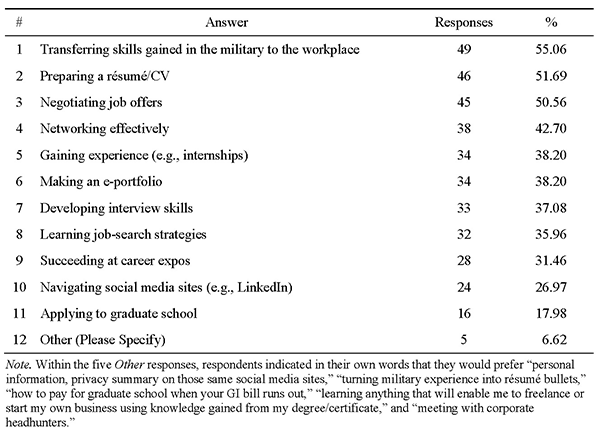
The survey examined utilization and perceptions of career-development needs. The majority of respondents (80; 87%) indicated that they had heard of the career center, but a smaller number indicated actually visiting the career center (66; 73%). The question pertaining to perceived career-development needs provided a multiple-option response set in which one could indicate several options. The most frequently indicated response was transferring skills gained in the military to the workplace (49; 55.06%). The second most frequently indicated response was preparing a résumé/CV (46; 51.69%), followed by negotiating a job offer (45; 50.56%). Table 1 provides a detailed description of additional responses regarding the career-development process.
A significant majority (54; 61%) indicated that they would be most interested in attending a group format, and fewer respondents selected the workshop series as their first choice (24; 27%). Respondents indicating the other category specified that they would attend career fairs, take advantage of individual counseling, and utilize online workshops. Following up on the previous question, one item inquired how likely a respondent would be to attend the option indicated. The most frequently indicated response was somewhat likely (42; 47%) followed by very likely (34; 38%) with unlikely (14; 16%) being the least frequently indicated response. The majors/fields of study with a significant number of responses were law (9), business-related (undergraduate and graduate; 9), social work (7), and criminology (8).
Participants provided diverse general comments related to their career development. One student veteran stated, “I have an associates [sic] degree in Laboratory Technology from the military and would also like assistance building a résumé trying to find employment now.” Another shared, “As a distance learner, it is possible to feel out of reach when it comes to on-campus resources. But, I know we can overcome that. I may be a combat disabled veteran. But, I won’t let disabilities stop my self-actualization quest.”
The information obtained from the needs survey can be utilized to inform an intervention designed to assist student veterans in their career development, which will provide a grounded approach in addressing these issues. The following section offers a proposal for meeting student veteran needs with a career-development intervention.
Table 1
Perceived Career-Development Needs
A Proposed Theoretically Based Career Intervention
Based upon the CIP theoretical framework (Sampson et al., 2004) and the feedback received from the needs assessment, psychoeducational groups will be conducted in order to achieve the following goals: expanding student veteran self-knowledge and career options through the CIP approach, exploring transferable skills gained through military experiences, gaining knowledge of resources that can assist student veterans in the job search and application processes, and identifying and decreasing negative metacognitions and dysfunctional career thoughts.
The psychoeducational group will meet once a week for 4 weeks. The group is open to all student veteran members attending the university through a campus-wide recruitment effort. Considering the tight connections between each CIP component, the group will be conducted in a closed-group format. The group facilitators will be graduate students pursuing doctoral degrees in counseling psychology or school psychology, and/or master’s students studying career counseling.
The group activities will center on the student veterans’ needs obtained through the needs assessment survey and the CIP components that have been proposed to serve the needs of veterans (Bullock et al., 2009; Clemens & Milsom, 2008). The structure of the psychoeducational group is based on the CIP model and five stages of the CASVE cycle diagram: communication, analysis, synthesis, valuing, and execution.
During the first session (communication), the group leader(s) will help to identify gaps between where group members are currently and where they aspire to be. Group members’ baseline information will be obtained by completing the Career Thoughts Inventory (CTI; Sampson, Peterson, Lenz, Reardon, & Saunders, 1996/1998) and My Vocational Situation (MVS; Holland, Daiger, & Power, 1991). The group leader(s) will explain the CIP Pyramid, CASVE Cycle Diagram, Self-Directed Search (SDS; Holland 1985) and assessment procedures. Group members will have an opportunity to interact with each other and complete one section of the Guide to Good Decision Making (Sampson, Peterson, Lenz, & Reardon, 1992). As a part of the homework assignment listed on the Individual Learning Plan (ILP), a document designed to identify career-related goals and associated action steps, group members will complete the SDS, and bring a copy of their current résumé to the next session.
During the second session (analysis/synthesis), the group leader(s) will help the student veterans examine and identify their interests, values, and skills (including transferable skills). The group leader(s) will assist group members in interpreting their SDS results, and examine any potential dysfunctional career thoughts that may be impacting group members’ career choices and decision-making abilities. To expand their career options, group members will be exposed to career-related resources such as the Occupational Outlook Handbook (U.S. Bureau of Labor Statistics, 2014c) and the Military Crosswalk Search via O*Net Online (National Center for O*NET Development, n.d.). In addition to gaining self-knowledge and occupational information in the analysis process, group members will have opportunities to practice synthesis skills. Group members will improve their résumé-writing skills through practice and feedback from peers and the group leader(s). Exploring and highlighting transferable skills is another important component. As part of their assignment listed on the ILP, group members will enhance their career networking skills by accessing supportive professionals via an alumni network and the Student Veterans Association, among other resources. Group members will also conduct an informational interview to gain firsthand experiences for their chosen career options. They will bring updated versions of their résumés and cover letters for the next session to obtain feedback from the group.
During the third session (valuing and execution), group members will present reflections on their informational interviews and provide feedback on their peers’ résumés and cover letters. In addition, group members will be exposed to various career resources such as VetJobs (VetJobs, Inc., 2014), Feds Hire Vets (U.S. Office of Personnel Management, n.d.), Job-hunt.org (NETability, Inc., 2014), the Riley Guide (Riley Guide, 2014), and the National Resource Directory (U.S. Departments of Defense, Labor and Veterans Affairs, n.d.). The group leader(s) will explain the “elevator speech” exercise and ask group members to practice this exercise in order to maximize their interview skill development. The group will also enhance members’ ability to use social networking to optimize their job search and applications. All activities aim to help members weigh their career options and execute their career decision making through careful planning. The group leader(s) will encourage members to initiate career networking and start exploring job and career opportunities.
During the last session (communication), group members will share what they originally included in their ILPs and what they have achieved, and offer suggestions and feedback to one another. They will retake the CTI and MVS and compare their new and initial results. Group leaders will help group members examine whether the gaps identified at the communication stage have successfully been closed, and suggest further measures to close gaps if necessary.
Discussion
The information gathered from the needs survey provides a thorough description of student veterans’ career-development needs. Interventions designed to support this population by determining appropriate interventions are often constructed using anecdotal information rather than objective needs. Student veteran responses to the survey indicate that veterans are concerned about transitioning their military experiences to civilian employment opportunities. In addition, student veterans appear to desire assistance with practical elements of the career-development process such as creating a résumé, negotiating a job offer, and networking. The purpose of this study is to develop a theoretically based intervention, and the study offers a framework in which to create effective career-development interventions for student veteran population.
Student veterans appear to engage in a wide array of academic programs, with a significant portion of veterans selecting majors within the realm of business, law, sociology, social work and criminology. These survey results provide a snapshot of the majors/fields of study that student veterans seem to gravitate toward. These preferences could be attributed to the hierarchical and meritocratic nature of some of these fields, which are somewhat analogous to the culture of the military.
Responses to the survey also provided a glimpse into the preferred modality of receiving career-related assistance. Oftentimes, military transition programs are designed to serve a large number of people, using seminar or workshop modalities in which to provide information. Student veterans indicated a strong preference for a smaller group counseling format that would provide more individual career-development support.
An additional important consideration for future interventions is the high number of respondents who identified themselves as distance learners in the needs assessment (some of them may have been on active service, whereas others were simply enrolled in the university from a remote location). Given the technological capabilities that allow online learning environments, it is reasonable that student veterans could utilize e-learning opportunities. Designing online interventions could be helpful in determining appropriate modalities by which to deliver services.
The student veterans’ comments and responses regarding their desired areas of focus for career development indicate a preference for a balanced approach of skill development. Ensuring that interventions focus on practical elements such as résumés and networking skill development, while also addressing broader topics such as transitioning from the military to the civilian workforce, appears to be a desired method for addressing the career-development needs of student veterans.
Limitations
The needs survey is limited in generalizability, as the results were collected from one educational institution, confining interpretations to the student veterans in this institution. Despite this limitation, the career-development concerns of student veterans provide a snapshot of the needs of this unique subset of the veteran population. Given the paucity of research in this area, it seemed necessary to facilitate an in-depth examination of this population’s career-development concerns, allowing the development of an informed intervention and establishing replicable protocol for future needs surveys.
The low response rate to the online survey also limits the application of findings. Though the response rate of 29% may be considered reasonable for an online assessment, having a large portion of the sample disregard the assessment presents a gap in fully substantiated information on this topic. Developing methods for collecting more information would enhance the validity of the data.
Finally, the high rate of graduate students who responded to the survey presents a challenge in applying the results to a primarily undergraduate institution. While there may be analogous experiences between graduate and undergraduate students, specific aspects of undergraduate student veterans’ career development may need additional evaluation.
Implications for Practice and Research
In this needs assessment, collaborative efforts between career services professionals at the institution and the university veterans’ center resulted in informative data on the career concerns of student veterans. Co-sponsored initiatives targeting these expressed needs could increase the number of student veterans impacted by career services. Survey respondents, along with group or workshop participants, could be recruited to provide feedback as part of a career-development focus group, further informing research and application for student veterans’ career concerns. Survey results could also be useful for marketing career services to student veterans. In addition, career centers or university libraries could acquire career resources such as books and print materials on topics that survey respondents considered desirable, especially those specifically tailored for veterans.
At the larger university level, major data on their students’ career-development concerns would be valuable information for college and department academic advisors and other university stakeholders. Career center staff members focus on various academic units as part of their career outreach, but further research regarding the unique career concerns of student veterans in specific majors could allow career center liaisons to impact veterans more effectively in their designated areas. As previously stated, since the survey was conducted at one higher education institution, duplicating the needs survey across a larger sample of colleges and universities would provide additional data sets for analysis, as well as broader application possibilities. Survey data could also be applied outside the institution to identify the most optimal partnerships in order to meet the comprehensive needs of student veterans. For example, career counselors might collaborate with mental health professionals, school counselors, and rehabilitation professionals to identify challenges and provide resources in order to maximize development for student veterans.
The results of this survey also support future research on the efficacy and suitability of online career-development options. There are many online programs designed to provide veterans the opportunity to pursue their education while in active duty. While the convenience of remote educational options for a mobile population is understood, ensuring that universities also provide career-development resources to distance learners is an important consideration in addressing the needs of veterans. Career-development opportunities such as webinars and online workshops offer the flexibility of distance learning. For example, online formats could provide veterans an opportunity to participate in such workshops collaboratively. Possible areas of research would include effective use of distance learning for veterans and comparative benefits and costs of in-person versus distance formats.
Based on the information collected, in future needs surveys, adjusting the survey items to detail reasons for certain item selections could allow greater understanding of both the responses and student veterans’ career thinking in general. Resulting career interventions would provide additional opportunities for further research to investigate aspects of career decision making and CIP theory, including relationships between student veterans’ self-knowledge, options knowledge, decision-making skills and metacognitions.
Conclusion
While veterans’ needs receive significant attention, programs are often created based on anecdotal and intuitive information. Developing needs assessments to solicit veterans’ perceptions of career development can inform interventions. Specifically regarding career development, utilizing a theoretically based, researched approach offers a framework to guide practice and research. Ongoing assessment of needs and services that utilizes established approaches will ensure quality services for those who have sacrificed greatly in service of their country.
References
Bullock, E. E., Braud, J., Andrews, L., & Phillips, J. (2009). Career concerns of unemployed U.S. war veterans: Suggestions from a Cognitive Information Processing approach. Journal of Employment Counseling, 46, 171–181. doi:10.1002/j.2161-1920.2009.tb00080.x
Buzzetta, M., & Rowe, S. (2012, November 1). Today’s veterans: Using Cognitive Information Processing (CIP) approach to build upon their career dreams. Career Convergence Magazine. Retrieved from http://www.ncda.org/aws/NCDA/pt/sd/news_article/66290/_self/layout_details/false
Clemens, E. V., & Milsom, A. S. (2008). Enlisted service members’ transition into the civilian world of work: A cognitive information processing approach. The Career Development Quarterly, 56, 246–256. doi:10.1002/j.2161-0045.2008.tb00039.x
Cook, B. J., & Kim, Y. (2009). From soldier to student: Easing the transition of service members on campus. Retrieved from http://www.acenet.edu/news-room/Documents/From-Soldier-to-Student-Easing-the-Transition-of-Service-Members-on-Campus.pdf
Engels, D. W., & Harris, H. L. (2002). Career counseling with military personnel and their dependents. In S. G. Niles (Ed.), Adult career development: Concepts, issues, and practices (3rd ed., pp. 253–266). Tulsa, OK: National Career Development Association.
Green, L., & Hayden, S. (2013). Supporting student veterans: Current landscape and future directions. Journal of Military and Government Counseling, 1, 89–100.
Hayden, S., Green, L., & Dorsett, K. (in press). Perseverance and progress: Career counseling for military personnel with traumatic brain injury. VISTAS. Retrieved from http://www.counselingoutfitters.com/vistas/vistas_2013_TOC-QR3-section_01.htm
Holland, J. L. (1985). Making Vocational Choices: A theory of vocational personalities and work environments. Englewood Cliffs, NJ: Prentice Hall.
Holland, J. L., Daiger, D. C., & Power, P. G. (1991). My Vocational Situation. Mountain View, CA: Consulting Psychologists Press.
Kleiman, T., Gati, I., Peterson, G., Sampson, J., Reardon, R., & Lenz, J. (2004). Dysfunctional
thinking and difficulties in career decision making. Journal of Career Assessment, 12,
312–331. doi:10.1177/1069072704266673
National Center for O*NET Development. (n.d.). Military crosswalk search [Database]. O*NET Online. Retrieved from http://www.onetonline.org/crosswalk/MOC/
NETability, Inc. (2014). How to succeed in your job search today. Job-hunt.org. Retrieved from http://www.job-hunt.org
Phillips, J., Braud, J., Andrews, L., & Bullock, E. E. (2007, November 1). Bridging the gap from job to career for U.S. veterans. Career Convergence Magazine. Retrieved from
http://associationdatabase.com/aws/NCDA/pt/sd/news_article/5412/_PARENT/layout_details_cc/false
Reardon, R. C., Lenz, J. G., Peterson, G. W., & Sampson, J. P., Jr. (2012). Career development and planning: A comprehensive approach (4th ed.). Dubuque, IA: Kendall Hunt Publishing.
Riley Guide. (2014). The Riley Guide. Retrieved from http://www.rileyguide.com/
Sampson, J. P., Jr., Peterson, G. W., Lenz, J. G., & Reardon, R. C. (1992). A cognitive approach
to career services: Translating concepts into practice. The Career Development Quarterly, 41, 67–74.
Sampson, J. P., Jr., Peterson, G. W., Lenz, J. G., Reardon, R. C., & Saunders, D. E. (1996). Career Thoughts Inventory: Professional manual. Odessa, FL: Psychological Assessment Resources.
Sampson, J. P., Jr., Peterson, G. W., Lenz, J. G., Reardon, R. C., & Saunders, D. E. (1998). The design and use of a measure of dysfunctional career thoughts among adults, college students, and high school, students: The Career Thoughts Inventory. Journal of Career Assessment, 6, 115–134. doi:10.1177/106907279800600201
Sampson, J. P., Jr., Reardon, R. C., Peterson, G. W., & Lenz, J. G. (2004). Career counseling & services: A cognitive information processing approach. Belmont, CA: Brooks/Cole.
Sander, L. (2012, July). Colleges expand services for veterans, but lag in educating faculty on veterans’ needs. The Chronicle of Higher Education. Retrieved from https://chronicle.com/
Sander, L. (2013, January). Veterans tell elite colleges: ‘We Belong’. The Chronicle of Higher Education. Retrieved from https://chronicle.com/
Stein-McCormick, C., Osborn, D. S., Hayden, S. C. W., & Van Hoose, D. (2013). Career development for transitioning veterans. Broken Arrow, OK: National Career Development Association.
U.S. Bureau of Labor Statistics. (2014a). Employment situation of veterans – 2012 [News release]. Retrieved from http://www.bls.gov/news.release/pdf/vet.pdf
U.S. Bureau of Labor Statistics. (2014b). Table A-5. Employment status of the civilian population 18 years and over by veteran status, period of service, and sex, not seasonally adjusted [Economic news release]. Retrieved from http://data.bls.gov/cgi-bin/print.pl/news.release/empsit.t05.htm
U.S. Bureau of Labor Statistics. (2014c). 2014–2015 Occupational outlook handbook. Retrieved from http://www.bls.gov/ooh/
U.S. Departments of Defense, Labor and Veterans Affairs. (n.d.). National resource directory. Retrieved from https://www.nrd.gov/
U.S. Office of Personnel Management. (n.d.). Feds hire vets. Retrieved from http://www.fedshirevets.gov/Index.aspx
University of Arizona. (2007). Student veteran needs assessment survey. Retrieved from https://studentaffairs.arizona.edu/assessment/documents/VETS_Needs7-2012FINAL.pdf
VetJobs, Inc. (2014). VetJobs: Veterans make the best employees. Retrieved from https://www.vetjobs.com/
Seth Hayden, NCC, is the Program Director of Career Advising, Counseling and Programming at Florida State University. Kathy Ledwith, NCC, is the Assistant Director for Career Counseling, Advising and Programming at Florida State University. Shengli Dong is an Assistant Professor at Florida State University. Mary Buzzetta, NCC, is a doctoral student at Florida State University. Correspondence can be addressed to Seth Hayden, 100 S. Woodward Avenue, Tallahassee, FL 32308, scwhayden@fsu.edu.
Apr 3, 2014 | Article, Volume 4 - Issue 1
Angel Riddick Dowden, Jessica Decuir Gunby, Jeffrey M. Warren, Quintin Boston
This article reports the results of a phenomenological study of racial identity development that asked the following questions: How do African-American males cope with invisibility experiences? What role do counselors play in assisting African-American males cope with invisibility experiences? The study involved the use of semi-structured interviews to explore invisibility experiences among seven African-American males. Results identified four thematic codes: self-affirmation, self-awareness, coping strategies in overcoming invisibility, and providing effective counseling to African-American males.
Keywords: racial identity development, African-American males, counselors, self-affirmation, self-awareness
The classic novel Invisible Man by Ralph Ellison (1952) explores the philosophical and psychological world of the main character, whose name is left unsaid in the novel to further perpetuate his invisibility. The metaphorical novel demonstrates how racism and racial epithets can harm the mind of the African-American man. Additionally, the novel reveals how the identity of the African-American man is often defined by social prejudice versus the individual self.
Consistent with the lives of many African-American men (Franklin, 1999), the nameless main character in Ellison’s novel spends his life searching for justice in the face of injustice. Ellison (1952) makes use of ambiguous struggles to represent the moral, mental and emotional frustration that results from the main character’s search for identity in a world that treats him as if he is invisible. The nameless main character represents the lives of many African-American men in American society whose daily struggles with invisibility contribute to feelings of anger, frustration, inferiority and alienation.
With the novel in mind, the authors of this article explore the concept of invisibility among African-American males in today’s society and demonstrate the impact that invisibility experiences have on racial identity. An initial discussion of the concept of invisibility is provided. Next, nigrescence theory is used as the theoretical underpinning of racial identity development.
Understanding Invisibility
Invisibility is defined as “an inner struggle with the feeling that one’s talents, abilities, personality, and worth are not valued or even recognized because of prejudice and racism” (Franklin, 1999, p. 761). This concept is often demonstrated through devaluing, demeaning, disadvantaging and the unfair regard that African-American males are subjected to on a daily basis (Franklin, 1999).
According to Franklin (1999), for some African-Americans, “being able to discern when behavior is racist, and then acting consistent with one’s sense of self, is the personal struggle for visibility” (p. 764). Racial experiences influence African-American males’ sense of self. Therefore, the negotiation of visibility that some African-American men encounter becomes a process of seeking validation, respect and dignity with or without compromising their identity. On the other hand, limited identity development or a lack of self-concept can result in identity erosion (e.g., alienation, invisibility, identity confusion; Cross & Vandiver, 2003). Moreover, racial identity development can act as a defense against the invisibility syndrome (Parham, 1999).
To that end, Parham (1999) warns that African-American people must be cautious where they seek validation, stating that it is damaging to seek validation from the oppressor, especially when that validation is “disaffirming and dehumanizing” (Parham, 1999, p. 800). In The Souls of Black Folk, Du Bois (1903) expounds on this phenomenon by stating the following:
It is a peculiar sensation, this double-consciousness, this sense of always looking at one’s self through the eyes of others, of measuring one’s soul by the tape of a world that looks on in amused contempt and pity. One ever feels his two-ness,—an American, a Negro; two souls, two thoughts, two unreconciled strivings; two warring ideals in one dark body, whose dogged strength alone keeps it from being torn asunder (pp. 8–9).
Parham (1999) states that when personal affirmations and basic needs are not met as a result of racism, African-Americans may be prone to exhibit high-risk behaviors.
Nigrescence Theory: Correlations Between Racial Identity and Invisibility
Nigrescence theory has been revisited and revised over the course of 40 years to its current expanded version (Cross, 1991; Cross & Vandiver, 2003). Nigrescence theory expanded (the theory’s most current name and version) is utilized for the purpose of this study to provide a foundation for racial identity development and to validate the correlation between racial identity development and invisibility. While other theoretical underpinning could be employed as the foundation for racial identity development (e.g., critical race theory), expanded nigrescence theory was chosen because of its emphasis on psychological themes in the social history of Black/African-American people (Cross & Vandiver, 2003). As such, the first author provides a brief exploration of the experiences of Black people in the context of nigrescence theory in order to provide foundational information to support the correlation between invisibility and racial identity development, and this research.
The extant literature and empirical research relative to Cross’s nigrescence theory is immense (Cross, 1991; Cross & Vandiver, 2003). Inasmuch, this discussion moves beyond providing a review of the expanded theory itself. Instead emphasis is placed on central elements of nigrescence theory expanded that align with the goals of the present study.
The term nigrescence means “the process of becoming Black” (Cross, 1991). The theory’s theme revolves around the processes involved in developing Black racial and cultural identity (Cross, 2003). Core precepts of nigrescence theory expanded include the following: (a) Blackness is viewed as a social identity and not a personality variable; (b) various types of Black identity have resulted in the delineation of a range of identity exemplars; and (c) the best way to conceptualize Black identity variability is through the explications of ideological types (profiles); with the different types or interpretations of what it means to be Black at the heart of the theory (Cross & Vandiver, 2003).
Being Black/African-American is not just about skin color or the origin of descendants; it is equally related to how Black people define themselves in a society that perpetuates prejudice, racism, microaggression, separation and exclusion (Gibson & Obgu, 1991). According to Cross & Vandiver (2003), the core of nigrescence theory expanded focuses on various ways Black people make sense of themselves as social beings rather than a collection of personality traits.
Both past and present racism may impede African-American males’ ability to form an identity that includes “independence, success and achievement” (Oyserman, Gant, & Ager, 1995, p. 1219). However, identity development is essential in the promotion of well-being over the lifespan (Oyserman et al., 1995). Additionally, a well-established sense of self improves the ability to organize and interpret social experiences, regulate affect, control behavior, and develop healthy cognition (Cross & Vandiver, 2003; Oyserman et al., 1995). Without it, African-American males experience misinterpreted social experiences, self-blame, and guilt, which over time can limit education attainment, occupation attainment, and personal fulfillment (Gibson & Ogbu, 1991). It is the correlation between racial identity and invisibility, and the resulting issues, that are at the root of this study.
Research Rationale
The purpose of this phenomenological study is to answer the following research questions: How do African-American men cope with invisibility experiences? What role might counselors play in assisting African-American males cope with invisibility experiences? To answer these questions, the authors explored the lived invisibility experiences of seven African-American males.
Philosophical and Theoretical Underpinning
At the core of the study’s purpose is a humanistic and multicultural perspective. Tenets consistent with both humanistic (Scholl, 2008) and multicultural (Sue, Ivey, & Pedersen, 1996) theories are interwoven throughout the study. Specifically, emphasis is placed on empathy, self-awareness, and understanding and valuing all human beings.
With humanism and multiculturalism in mind, a phenomenological approach was utilized in the study to gather the firsthand accounts of the invisibility experiences of African-American males when encountering macro and micro forms of racism. Additionally, a constructivist approach was activated with the purpose of understanding the human experience through narrative conceptions of the phenomena (Hays & Wood, 2011). By utilizing a constructivist perspective, additional attention was placed on putting forth the participants’ perspective and ensuring contextual relevance (Hays & Wood, 2011).
Phenomenological research captures the lived experiences of people (Levers et al., 2008). Phenomenological researchers study the essence of a phenomenon and explore how individuals situate themselves in the world based on how they make meaning of their experiences (Levers et al., 2008). Utilizing a phenomenological approach in this study helps professional counselors better understand African-American male invisibility experiences. The data gathered during the study were thematically categorized and used to provide specific recommendations for counselors working with African-American males of all ages in diverse clinical settings.
Primary Researcher Bias and Influence on the Study
As an African-American female who has heard a lifetime of stories about invisibility incidents from African-American males, read about invisibility syndrome (Ellison, 1952; Franklin, 1999), as well as experienced personal feelings of invisibility, the first author decided to make a conscious effort to suspend self-knowledge about invisibility in order to entirely engage in the experiences of the participants. While bracketing personal experiences was challenging, it was an important step in ensuring that as the researcher, the author (a) treated the participants with empathy, (b) put forward the lived experience of the participants and not personal experience, and (c) maintained the trustworthiness needed to support the essence of the study, while also reporting the findings.
To avoid inferring assumptions or biases related to the topic, the first author used reflexive journaling throughout the data collection, data analysis and reporting of findings. Journaling allowed the author to maintain the trustworthiness, or the ability to ensure that the voices of the participants, and not the author’s own, were present in the study (Hunt, 2011). During reflexive journaling, the author wrote about experiences as the primary researcher, including experiences during the interviews, about feelings, thoughts, and reactions to newly discovered information, as well as emerging awareness of the phenomenon. The author often referred back to personal writing with the goal of separating perceptions from the actual information relayed by participants. Reflexive journaling increased the level of self-awareness and allowed the author to maintain trustworthiness throughout the study.
Method
Participants
Purposeful sampling was used in qualitative research to select participants who could provide a description of the phenomenon being studied (Creswell, 2007). A snowball sampling process was used to select participants for the study. That is, initial participants were identified, interviewed, and then asked to provide the names of other individuals who might be interested in participating in the study. Individuals selected as participants had to be willing to recall and describe their experiences related to the phenomenon.
Seven African-American males, ages 34–47, participated in the study. All participants identified as middle class, and five had an educational level beyond high school graduation (four master’s level and one doctorate level). Five of the participants were born in the southeast US and two were born in the northeast US. The participants also reported their familial status: one participant was single, five were married with children, and one participant was in a committed live-in relationship.
Data Collection Procedures
The participants’ subjective, personal perspective and interpretation of the phenomenon was explored. The participants engaged in semi-structured interviews by responding to interview questions and engaging in discussion related to the phenomenon. The semi-structured interview questions used in this study derived from reviewed literature on invisibility and racial identity development (Cross, 1991; Cross & Vandiver, 2003; Dubois, 1903; Parham, 1999). Interview questions focused on the derivation of the participants’ identity development, invisibility experiences (i.e., have you ever felt invisible?), ability to cope with invisibility, overall behaviors resulting from invisibility syndrome, and potential counseling to improve and/or nurture identity development.
Participants signed Institutional Review Board-approved documents prior to participating in interviews for the study. Participants agreed to allow direct information from the interviews to be utilized within the study. Data was collected in April and May 2011. Interviews were held either face-to-face or through telephone conference. Face-to-face interviews took place at various locations (e.g., library, office). Interviews and discussion lasted approximately 1–1.5 hours. All interviews were audio recorded and transcribed.
Data Analysis
A phenomenological model outlined by Wertz (2005) that synthesizes Giorgi’s (1985) description-reduction-interpretation model was used for the data analysis of this study. From this well-established philosophy for analyzing phenomenological data, three essential steps became capstones for the data analysis of this study. Those steps were as follows: (a) providing an exhaustive description of the phenomenon, (b) reducing and categorizing the data, and (c) interpretation.
Step 1 was important in that a clear understanding of the phenomenon was presented from the participants’ perspective. For example, participants were asked if they had ever felt invisible. This question became the catalyst of the analysis and shaped the foundation of the exploration of the phenomenon. The exhaustive description provides readers an understanding of the essence of the lived experiences and represents a unifying structure of the phenomenon (Wang, 2008).
In step 2, information was categorized and coded, themes were developed and defined, and rich descriptions of the themes based on information gathered from parts of the interviews were constructed. Themes were developed and defined by transcribing the audiotapes, and then participating in rote review and reading of the material. This process led to the delineation of significant information within the interviews, the cross-verification of information gathered among interviews, and the charting of information. From this process, information was reviewed as parts of a whole in order to develop main themes.
For example, during the transcription and review of the data, it became evident that participants relied on self-affirmation to maintain or improve racial identity development. Participants continuously spoke about affirming who they are or having to strongly defend or uphold who they are in public. It was evident that this affirmation was essential to the participants. During cross-verification, it became clear that all participants utilized self-affirmation and believed it to be essential to racial identity development. As a result, self-affirmation became an essential theme when coping with invisibility experiences.
In step 3, data was interpreted in the context of invisibility and racial identity development. During this process themes were consistently revisited with the goal of determining how they related to invisibility and racial identity development. Participants were able to review the codes and themes for clarity after data was analyzed. The interpretation of data provided probable meanings and was utilized in the development of the implications section. Reflexive journaling was an especially important aspect of step 3 as it assisted in the maintenance of trustworthiness.
Results
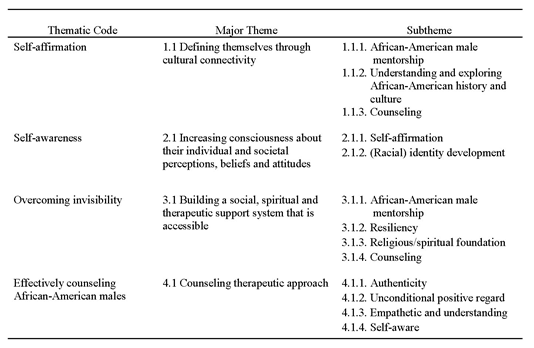
The data analysis resulted in an exhaustive description of the phenomenon and the emergence of four interconnected themes: self-affirmations, self-awareness, coping with invisibility, and providing effective counseling to African-American males. A personal account of invisibility is provided through the lens of each participant. This is followed by coded descriptions of each thematic code, major and subtheme. The thematic codes, majors and subthemes have been coded and identified below and summarized in Table 1. The findings highlight this thematic information.
Invisibility Experiences
Participant #1. I’ve felt invisible in the sense that if you don’t engage yourself in their [White people’s] beliefs, have things in common or join the social crowd you are treated invisible. For me my cultural differences have caused me to be treated invisible. For example, I’ve been in situations where I felt like White people did not really want to interact with me if they didn’t have to. I can tell this because of there is a level of avoidance even when they are, to some degree, forced into communicating. There’s a barrier there. Oftentimes there’s a lack of eye contact. Their avoidance makes me feel invisible because at the same time you see how they interact with their own [other White people]. When you do talk with them, they are very diplomatic, very politically correct, very careful. At times, I think this is how they communicate with anyone they don’t know, but for me I know it’s associated with race. I mean this is something that as an African-American male you deal with pretty regularly.
Table 1
Thematic Overview of Phenomenological Analysis of Invisibility
Participant #2. I probably feel invisible the majority of the time. I’ve learned to cope with it. It’s just a part of my reality, but at times it’s stressful. Sometimes it’s hard for me to assess some of this stuff because it’s so normal for me. I’m a faculty member at this university and certain people know me in classes and in my college, but as soon as I walk out of the building I don’t perceive that people see me as a professor. Not that people have to recognize that I’m a professor, but I don’t think that I’m viewed with the respect that any professional should have in any public space. Going into department stores I feel special when a sales person acknowledges me…I’m grateful and I want to do business with them because they’ve demonstrated to me that they are culturally competent, kind, a decent person because most times I’m looked over. I prepare myself for what I have to deal with. I’m very capable and competent…negotiating these things [race, invisibility] because I’ve had to do it. I’ve even watched my mother do it when I was a child.
Participant #3. I’ve been ignored at times; times when I felt like my opinion didn’t matter. When I was in undergrad at [name of university removed] I was meeting with my advisor. I was sharing with him my concern about pursuing my bachelor’s degree in physics and when I was telling him about my experience and how I felt about it, he expressed to me that I may have some type of learning disability. At that point, I felt like okay, in other words he was ignoring the fact that maybe I learned differently or ignoring the fact that there may be other factors and just saying that your main problem is that you have a learning disability. That experience made me think of who I was as a person.
Participant #4. I worked at several predominately White schools and had the certification and licensure to do the job. At the same time, I had White colleagues who hadn’t gotten certified at the time. But I felt like a lot of times, I was there and had the credentials to prove my worth, but sometimes I felt like I had to always go that extra mile to prove my skill set. I had to go that extra mile and pander from time to time to prove that I was worth enough or acceptable to be in the circle. For example, one time I was in a situation at a middle school. I had proven that I had done my job to the best of my ability. I had shown more than enough evidence to prove that I could do the job. But after dialoging and debating over and over again, I felt like the person in charge never heard my case, never understood my experience and because of that it made me feel invisible and powerless. Those with privilege a lot time can state a case and they will get exonerated, whereas in my case I felt invisible and powerless because in my case regardless of whatever I did I always felt like I was public enemy number one.
Participant #5. One situation happened when I got busted for drugs. When I got busted I felt like the gentlemen that arrested me made fun of me and they were Caucasian males. They said, “We gotcha now, you will never see the streets again;” they said, “that’s what happens to all of y’all; y’all put yourself into a bunch!” They laughed and in so many words told me my life was over.
Participant #6. One time me and my mom went to shop on 34th Street in Manhattan. My mother was hungry so we went inside to eat. So we went inside and set at the counter. The White lady looked at us and she kept on doing what she was doing; she never one time acknowledged us. Eventually, my mom got up. I could see tears in her eyes and we just walked out.
Participant #7. My first experiences with invisibility occurred when I was a small kid, say age 7. I use to go to North Carolina. During that time I would see how proud and bold my grandfather was when he spoke with Black people, but when he spoke with White men he would “cow down” [assume on a more inferiority/invisible position] as I call it. You know he would speak soft, bow his head, not make eye contact. He was expected by them to be this way—invisible. Another example when I was in middle school I remember White boys would look at me and call me and other Black kids names. I mean, we were all different complexions, different heights, 4-inch differences, extreme differences. They would call me Kenny when I was [name removed]. I soon realized that they didn’t see me. We [all the Black boys] were the same. They looked through us and simply saw our skin color. It was amazing to me because when I saw them, I could clearly see that they were different: different hair styles, different complexions, different hair colors…. But for them they didn’t see any of that. So they really didn’t see the person that they were talking to that they respected, they just looked over us and assumed that because we were Black we must all be like the same person. It was an incredible experience.
Thematic Code 1: Self-Affirmation
All seven study participants discussed the process of routinely affirming themselves as African-American males. For them, this process is important in understanding and staying true to who they are as African-American men in a society that often perceives them as less. Self-affirmation theory refers to the process of responding to threats to an individual’s self-worth or self-image with affirming strategies to maintain positive self-image (Lannin, Guyll, Vogel, & Madon, 2013).
Cultural connectivity (1.1). For the participants, three key objectives are essential in affirming who they are as African-American males. Those objectives include (a) contact and communication with other African-American males (1.1.1), (b) understanding and exploring the historical context from which they came (1.1.2), and participating in counseling (1.1.3).
Having contact and communication with other African-American males was clearly articulated by all participants as key in self-affirmation (1.1.1). Being able to communicate and come in contact with other African-American males further affirmed their Blackness and brought about a sense of kindred spirit in a struggle for equity and equality. For the participants, this relationship was often with friends, their father, father figures, and mentors (people they respected, trusted, and often aspired to be). These relationships assisted in preventing societal standards, perceptions and beliefs that are based on White culture to cause identity confusion. Participant #1 stated, “I use other African-American male friends as sounding boards for invisibility experiences. They usually have had the same experience or something similar. They validate my experience and we are able to discuss how we handled it, how/what to think about it—how to handle it in the future.”
All seven participants referenced understanding and exploring the historical context from which they came as an important aspect in identity development and self-affirmation (1.1.2). Participant #4 stated, “I am very aware of my Blackness. I affirm it every day…by constantly reflecting on the greatness of my ancestors, on the path that we’ve trotted and reflecting on the fact that we have an African-American president.” All spoke about engaging in culturally relevant events and reading relevant books. All spoke about prominent historical and cultural African-American figures that assisted them in affirming who they are as African-American males. A few reoccurring names include Malcolm X, Martin Luther King, Jr., Marcus Garvey and President Barack Obama. Participants 4 and 5 expressed feelings that they were “standing on the shoulders of African-American men who came before them.”
Participants 1–3 referenced counseling as beneficial in affirming who they are as African-American males, while participants 4 and 6 alluded to this (1.1.3). Participant 3 stated, “…I went through his (African-American counselor at the university counseling center) [counseling] program…it led to my metamorphosis. All three participants who articulated counseling as beneficial in the self-affirmation process discussed their strong desire to see an African-American male counselor—if not male, then an African-American female counselor.
Thematic Code 2: Self-Awareness
The self-awareness theme is evident throughout all aspects of the interviews. All seven participants discussed the ongoing process of becoming self-aware as essential in self-affirming and developing a strong identity. Self-awareness occurs when an individual acknowledges biases and understands the impact that they may have on perceptions, beliefs and attitudes (Suthakaran, 2011). Participants discussed how the process of becoming more self-aware assists them in moving from being very defensive when they feel they are being treated as invisible, to becoming more conscious of invisibility treatment in order to appropriately prepare for and deal with it.
Increase consciousness about individual and societal perceptions, beliefs and attitudes (2.1). For participants, self-affirmation (2.1.1) and identity development (2.1.2) are essential to the self-awareness process. All seven participants discussed reading and understanding African-American culture, history and experiences as important to the self-affirmation (2.1.1) and self-awareness process. Participant 6 stated that “learning the truth about Black history, it just builds a confidence in you; knowing the truth helps put things in perspective.” All seven participants discussed thinking differently about and reflecting on past experiences in order to learn, grow, and negotiate invisibility experiences. Additionally, all participants discussed how that process has assisted them in changing who they are emotionally, mentally and spiritually.
Participants acknowledged the process that identity development (2.1.2) plays in achieving self-awareness. According to Franklin (1999), “identity is achieved by successfully resolving the crises inherent in life choices and making purposeful decisions and stable commitments” (p. 772). Participants described racial identity development as the impact the negotiation of racial experiences has on the individual. Participants 4 and 5 stated, “as an African-American male you have to work twice as hard [to be acknowledged and respected],” while participant 7 stated, “you always have to be better than the best [to be acknowledged and respected].” Understanding their role in society and making decision and life choices as a result informs the identity development process.
Thematic Code 3: Coping with Invisibility
According to Franklin (1999), coping with invisibility involves “being able to discern when behavior is racist, and then acting consistent with one’s sense of self” (p. 764). This personal struggle for visibility can be challenging and often overwhelming.
Building a social, spiritual and therapeutic support system that is accessible (3.1). For participants, coping with invisibility included (a) African-American male mentorship (3.1.1), (b) resiliency (3.1.2.), (c) establishing and maintaining a strong religious and spiritual foundation (3.1.3), and (d) counseling (3.1.4.).
All seven participants discussed the need to communicate overwhelming feelings of anger and frustration that result from feelings of invisibility to other Black men that they trust and value their opinions of (3.1.1). Communicating with another African-American male is central to coping with feeling of invisibility. Being understood in a world where you are often misunderstood and being able to relate to one another was powerful to all participants and assisted in coping with invisibility.
None of the participants perceived racism and invisibility as something that would soon dissipate. As a result, participants felt that being resilient was essential in coping with invisibility (3.1.2.). One participant discussed how he remained resilient by constantly reminding himself of how his ancestors overcame far worse, while also reflecting on how far this country (the United States) has come since slavery and remaining hopeful that the United States will continue to grow in the years to come. Participant 2 remained resilient by constantly reminding himself that we have a Black president, understanding his struggle as president, and using him as a model for the opportunities that lie before other Black men if they continue to work hard. Participant 2 stated, “when I am feeling low about the state of society I hold on to the fact that President Obama was able to be elected. That’s like the miracle that I hold on to.” Participant 2 stated, “Being invisible is normal for me. I expect it. I know where I’m going to be visible and where I’m not going to be visible.”
Five participants discussed having strong spiritual or religious beliefs (3.1.3). Participant 4 stated “at times I need to pray and ask God for insight on racism and how incidents I experience affect me.” Others were hopeful that the future would be brighter than the past for African-American males. Participant 4 alluded to this when he stated, “I know that things will be different when I join God in Heaven.” Participant 3 discussed abandoning Christianity for African Islamic religious beliefs. Participant 3 explained that this process has assisted him in connecting with his African culture, and participant 6 discussed his transition from Islamic faith to Catholicism to Protestantism in search of his spiritual calling.
Lastly, all participants acknowledged the process of thinking differently as fundamental in coping with invisibility. All participants acknowledged that by thinking differently African-American males can overcome pitfalls such as socially unacceptable emotions and behaviors, as well as responding defensively to feelings of invisibility. Furthermore, participants acknowledged how counseling (3.1.4) could assist in this area.
Thematic Code 4: Effectively Counseling African-American Males
The counseling theme is evident throughout all aspects of the interviews. All participants discussed counseling approaches that would be effective in working with African-American males who experience invisibility. The approaches outlined by the participants were humanistic in nature and included (a) authenticity (4.1.1), (b) unconditional positive regard (4.1.2), (c) empathetic understanding (4.1.3), and (d) self-awareness (4.1.4).
All seven participants discussed the need for counselors to be authentic (4.1.1). For participant 4, being authentic meant “avoiding politically correct statements and hiding behind real feeling and thoughts.” They discussed the need to feel like the counselor demonstrated unconditional positive regard (4.1.2). The inherent need for acceptance is ignored when African-American males are invisible. When counselors are able to demonstrate unconditional positive regard, it fosters acceptance. Participant 2 stated, “Counselors should support my experience in spite of myself…”
All seven participants discussed the need to feel visible to the counselor. Participants discussed achieving visibility by acknowledging race, culture, ethnicity and other individual and collective attributes, while also validating the experiences of the client. Participants indicated that validation is achieved by being empathetic and understanding toward the client’s experience (4.1.3). All participants discussed the need for the counselor to demonstrate empathy. Participant 7 stated, “Listening and being open to the experiences of African-American males and moving beyond book information about African-American males, but instead seeking contact with the group, is important in broadening counselor empathy and understanding.” None of the participants sought sympathy, as they all demonstrated strong feelings of pride in themselves and their culture. Instead, the need for empathy and subjective understanding of their experience was essential.
Lastly, four participants discussed the need for both the counselor and client to be self-aware (4.1.4). For these participants, the counselors’ self-awareness meant being open about their bia; exploring ways to be change agents (advocates), whether individually or collectively; and being able to openly express emotions in a way that encouraged growth. Participant 4 spoke to all the competencies presented in thematic code four by stating the following:
Therapists that [have] an Afrocentric worldview or actually went through the struggle themselves [are needed]. You can have what I call an external concept of racism, but until you actually experience it or live it there is no dialogue. So, I would need a therapist, preferably a Black male or Black female, but more or less a male, who has gone through the same struggles…of being a Black male in America. Then I think we can have an open dialogue and try to reach some resolve… [If the counselor were White] it is somewhat possible [for them to provide the same support as a Black counselor] if they have a sense of empathy, a sense of positive regard, they are very objective…they can live through my experience vicariously [congruently] so that they can be understanding…and have an Afrocentric perspective.
Implications
Clinical Practice and Client Retention
This phenomenological study explored the lived invisibility experiences of seven African-American males. The four thematic codes that were extracted from the rich data gathered during the study were used to provide potential implications for clinical practice.
Findings showed that these African-American males encounter varying experiences and levels of invisibility on a daily basis. African-American males’ strong sense of self and ability to affirm who they are as individuals and as African-Americans were core conditions of living in a world where they often feel invisible. Additional findings showed that for these participants, coping with invisibility included having a relationship with something or someone higher than themselves (religious or spiritual connection), embracing African-American history and culture, being resilient, connecting with the African-American community, and communicating with and observing other African-American men. Based on the findings, specific counseling theories and techniques as well as additional approaches were outlined as strategies for working with African-American males in clinical practice, and for retaining this population after initial visits.
Conclusions from the findings purported that counselors working with African-American males experiencing invisibility could encompass two fundamental approaches to counseling at the core of their clinical practice: multicultural and person-centered approaches. Encompassing these approaches provides the stability needed to encourage African-American males to participate in counseling, while also encouraging these clients to return to counseling. Building on these approaches, counselors should utilize additional humanistic-existential therapies, such as Adlerian and existentialism.
Specifically, the use of encouragement—fundamental in Adlerian counseling—and the promotion of social connections to foster a sense of belonging produces a stronger sense of self. Existentialism can assist in the quest for meaning and life purpose (Corey, 2001). Findings indicate that African-American males’ social connection with other African-American males is pertinent in developing self-awareness, while also learning how to strive in society. Exploring self-awareness, goals, and the process it takes to reach goals during counseling sessions with African-American males can dually assist the client and counselor to better understand the clients’ perspectives and life purpose. Additionally, assisting African-American male clients by encouraging relationships with other African-American males can assist with their quest for meaning and value.
Based on the findings, it appears that African-American males would benefit from social learning theoretical perspectives during counseling. Considering Bandura’s social learning theory (1997), specific theoretical approaches include observational learning, nurturing intrinsic and extrinsic reinforcers (e.g. pride, the environment), and motivated modeling. Again, this could be encouraged through mentoring, social connections within the African-American community (e.g. volunteerism), and exposure and knowledge about the African-American experience.
Admittedly, many of these theories fall short when considered from a multicultural perspective. However, the additional use of specific techniques, applied appropriately, can become building blocks in working with African-American males. Moreover, counselors should promote resiliency as a means of coping with invisibility. To do this, counselors should consider connecting clients with or encouraging clients to garner an African-American male mentor. African-American males’ connection with positive African-American male mentors is highly regarded by all participants in the study and key in coping with invisibility experiences. Additionally, the use of both psychoeducation and bibliotherapy groups geared toward African-American males encourages kinship, skill development, as well as cultural and historical understanding.
Furthermore, when considering the theoretical underpinnings of the study (Nigrescence, humanism and multiculturalism), three premises are put forward for counselors working with this populations: (a) collaborate with the individual as he works to make sense of himself as a social being (Cross, 1991; Cross & Vandiver, 2003); (b) understand and value the individual’s subjective experience (e.g., feelings, opinions, values; Scholl, 2008), and (c) work to become more aware of both one’s own culture (as the counselor) and the culture of the client in order to remove barriers, build rapport and overcome social stereotypes and bias.
Research
Based on the findings, future research might consider the impact that mentoring, religion and spirituality, cultural belonging, and resiliency have on African-American male racial identity development and African-American males’ ability to cope with racial experiences. Potential research questions could include the following: How effective is mentoring in helping African-American males to cope with issues related to racial identity development? How do religion and spirituality assist African-American males in coping with issues related to racial identity development? Is resiliency a learned behavior for African-American males? Investigations in these areas have the potential to yield useful findings.
Limitations of the Study
Caution should be exercised when generalizing the study’s findings to all African-American males. First, the study included only seven African-American males. While these seven participants garnered a rich amount of data to support the study, the qualitative nature of the study made generalizing this information across an entire group of people difficult. Quantitatively exploring the same research questions could provide more generalizable data. Second, the majority of the participants were educated, middle-class African-American males. A diverse group of African-American males was not considered in this study; a more diverse participant sample could enhance future research on this topic.
Conclusion
Throughout the study, participants clearly articulated that they did not think the process of feeling invisible would soon dissipate. Therefore, all participants encouraged learning how to cope with invisibility. Counselors can encourage African-American males to cope with invisibility by advocating resiliency, promoting self-awareness and identity development, affirming African-American identity both individually and collectively, fostering African-American male mentorships, teaching African-American males how to negotiate race, and encouraging historical and cultural knowledge and understanding. At the same time, African-American males cannot be taught to cope or change their cognition, behavior, or emotions without counselors advocating and working to change individual, systemic and institutional barriers that lead to feelings of invisibility.
References
Bandura, A. (1997). Self-efficacy: The exercise of control. New York, NY: W. H. Freeman.
Corey, G. (2001). Theory and practice of counseling and psychotherapy (6th ed.). Belmont, CA: Brooks/Cole.
Creswell, J. W. (2007). Qualitative inquiry and research design: Choosing among five approaches (2nd ed.). Thousand Oaks, CA: Sage.
Cross, W. E., Jr. (1991). Shades of black: Diversity in African-American identity. Philadelphia, PA: Temple University Press.
Cross, W. E., Jr. (2003). Encountering nigrescence. In J. G. Ponterotto, J. M. Casas, L. A. Suzuki, & C. M. Alexander (Eds.), Handbook of multicultural counseling (2nd ed., pp. 30–44). Thousand Oaks, CA: Sage.
Cross, W. E., & Vandiver, B. J. (2003). Nigrescence theory and measurement: Introducing the Cross Racial Identity Scale (CRIS). In J. G. Ponterotto, J. M. Casas, L. A. Suzuki, & C. M. Alexander (Eds.), Handbook of multicultural counseling (2nd ed., pp. 371–393). Thousand Oaks, CA: Sage.
Du Bois, W. E. B. (1903). The souls of Black folk. New York, NY: Library of America.
Ellison, R. (1952). Invisible man. New York, NY: Random House.
Franklin, A. J. (1999). Invisibility syndrome and racial identity development in psychotherapy and counseling African American men. The Counseling Psychologist, 27, 761–793. doi:10.1177/0011000099276002
Gibson, M. A., & Ogbu, J. U. (1991). Minority status and schooling: A comparative study of immigrant and involuntary minorities. New York, NY: Garland.
Giorgi, A. (1985). Sketch of a psychological phenomenological method. In A. Giorgi (Ed.), Phenomenology and psychological research (pp. 8–22). Pittsburgh, PA: Duquesne University Press.
Hays, D. G., & Wood, C. (2011). Infusing qualitative traditions in counseling research designs. Journal of Counseling & Development, 89(3), 288–295. doi:10.1002/j.1556-6678.2011.tb00091.x
Hunt, B. (2011). Publishing qualitative research in counseling journals. Journal of Counseling & Development, 89(3), 296–300. doi:10.1002/j.1556-6678.2011.tb00092.x
Lannin, D. G., Guyll, M., Vogel, D. L., & Madon, S. (2013). Reducing the stigma associated with seeking psychotherapy through self-affirmation. Journal of Counseling Psychology, 60, 508–519. doi:10.1037/a0033789
Levers, L. L., Anderson, R. I., Boone, A. M., Cebula, J. V., Edger, K., Kuhn, L., . . . Sindlinger, J. (2008, March). Qualitative research in counseling. Applying robust methods and illuminating human context. Program presented at the annual conference of the American Counseling Association, Honolulu, HI. Retrieved from http://counselingoutfitters.com/vistas/vistas08/Levers.htm
Oyserman, D., Gant, L., & Ager, J. (1995). A socially contextualized model of African American identity: Possible selves and school persistence. Journal of Personality and Social Psychology, 69(6), 1216–1232. doi:10.1037/0022-3514.69.6.1216
Parham, T. A. (1999). Invisibility syndrome in African descent people: Understanding the cultural manifestations of the struggle for self-affirmation. The Counseling Psychologist, 27, 794–801. doi:10.1177/0011000099276003
Scholl, M. B. (2008). Preparing manuscripts with central and salient humanistic content. Journal of Humanistic Counseling, Education and Development, 47, 3–8. doi:10.1002/j.2161-1939.2008.tb00043.x
Sue, D. W., Ivey, A. E., & Pedersen, P. B. (1996). A theory of multicultural counseling & therapy. Pacific Grove, CA: Brooks/Cole.
Suthakaran, V. (2011). Using analogies to enhance self-awareness and cultural empathy: Implications for supervision. Journal of Multicultural Counseling and Development, 39, 206–217.
Wang, Y.-W. (2008). Qualitative research. In P. P. Heppner, D. M. Kivlighan, & B. E. Wampold. (Eds.), Research design in counseling (3rd ed., pp. 256–295). Belmont, CA: Brooks/Cole.
Wertz, F. J. (2005). Phenomenological research methods for counseling psychology. Journal of Counseling Psychology, 52(2), 167–177. doi:10.1037/0022-0167.52.2.167
Angel Riddick Dowden, NCC, is an Assistant Professor at North Carolina A&T State University. Jessica Decuir Gunby is an Associate Professor at North Carolina State University. Jeffrey M. Warren, NCC, is an Assistant Professor at University of North Carolina at Pembroke. Quintin Boston is an Assistant Professor at North Carolina A&T State University. Correspondence can be addressed to Angel Riddick Dowden, North Carolina A&T State University, 1601 E. Market Street, Proctor Hall-325, Greensboro, NC 27411, adowden@hotmail.com.
Apr 2, 2014 | Article, Volume 4 - Issue 2
Heather C. Robertson, Pamelia E. Brott
Many military veterans face the challenging transition to civilian employment. Military veteran members of a national program, Troops to Teachers, were surveyed regarding life satisfaction and related internal/external career transition variables. Participants included military veterans who were currently or had previously transitioned to K–12 teaching positions. Two variables, confidence and control, demonstrated a slight yet statistically significant positive correlation with life satisfaction. Recommendations for practice and future research are included in this second report on the findings of a dissertation.
Keywords: career transition, employment, life satisfaction, military veterans, teaching
Military members typically experience transitions at some point during their military career, whether to a new duty station, a change of command or a deployment overseas. Another significant transition that military members often face is their return to civilian employment. While formal military programs are established to provide assistance with planning and overall logistics of such transitions (Wolpert, 2000), research suggests that veterans feel emotionally underprepared to manage the transition to civilian employment (Baruch & Quick, 2009; Business and Professional Women’s [BPW] Foundation, 2007). Researchers have examined retirement satisfaction and adjustment (Spiegel & Shultz, 2003), career adaptability and adjustment (Ebberwin, Krieshok, Ulven, & Prosser, 2004), as well as adjustment after transition (DiRamio, Ackerman, & Mitchell, 2008); however, few studies have examined the overall life satisfaction of veterans experiencing career transitions, specifically examining these experiences. This study examined career transition variables of military members, as well as the relationship of these variables to the military member’s overall life satisfaction.
Schlossberg’s model of “Human Adaptation to Transition” (Goodman, Schlossberg, & Anderson, 2006, p. 33) has made significant contributions to the current understanding of the transition process (Robertson, 2010). While transition is different for each individual, four main areas comprise the model, specifically (1) transition as a process that occurs over a span of time, (2) environmental and individual characteristics that may impact the transition, (3) one’s resources and deficits that impact the transition, and (4) a successful adaptation that is the goal of transition (Robertson, 2010; Schlossberg, 1981). The goal of the transition process is the ability to adapt to the new experience. Individuals manage a multitude of internal influences (e.g., confidence, control, coping skills, motivation) and external influences (e.g., job market, support from family, timing of transition) during the transition process. These influences may be considered resources or deficiencies (Schlossberg, 1981). One of the most important considerations of the model is that transition occurs over time. Schlossberg (2011) states that leaving one role and establishing another takes time, and that the process of doing so is easier for some than for others, even after several years.
Extensive research exists regarding civilians experiencing or considering career transition (e.g., Chae, 2002; Jepsen & Choudhuri, 2001; Perrone & Civiletto, 2004). One impetus for making a career change relates to increasing life satisfaction, which can be defined as contentment or happiness in life (Perrone & Civiletto, 2004). Career counseling models support clients’ movement toward fulfillment, such as the values-based counseling (e.g., Brown, 1995) and constructivist models (e.g., Savickas, 1997), which emphasize value formation, prioritization, role relationships and career adaptability. Given the volatility of the job market, unemployment, underemployment and the uncertainty of the future, one’s control during career transition has become a focus of concern. The support experienced during transition can further impact one’s ability to grow psychologically from the experience (Jepsen & Choudhuri, 2001). The perceived risk of career change also may impact one’s perceptions of control, manifesting as stress, or physical and mental health problems (Strazdins, D’Souza, Lim, Broom, & Rodgers, 2004).
Research does exist on the military career transition experience. Several researchers have examined the importance of pre-retirement/pre-separation planning and its value for post-military employment outcomes (Baruch & Quick, 2007; Baruch & Quick, 2009; Spiegel & Shultz, 2003). Other researchers have examined the relationship between mental health and employment of veterans, specifically regarding issues of trauma, depression and mental health treatment (Burnett-Zeigler et al., 2011; Zivin et al., 2011; Zivin et al., 2012).
Despite previous studies on career transition experiences of civilians and military, there is a dearth of studies that examine the overall experience and life satisfaction of those who transition from the military to a second career. Military members who pursue the teaching profession provide an opportunity to examine life satisfaction and career transition. Their (first) military career indicates a commitment to the military for a period of time. For individuals choosing to teach as a second career path, there also is a commitment toward additional education or certification, since there is no military occupational code (MOC) for educating children in an elementary through high school classroom (Robertson, 2010). While training and leading adults may be required in specific positions, teaching children in a traditional classroom setting is not offered as a military career (Messer, Green, & Holland, 2013). This means that those who pursue teaching would likely have to receive additional education and training in order to teach in a classroom post-military separation. Their commitment to the military and their commitment to teaching indicate that both professions were intentional career opportunities, as opposed to employment obtained via happenstance (Robertson, 2010).
This study explored the transition of 136 military members to the field of teaching. Measurements were sought that would adequately capture the framework of internal and external resources, as well as adaptation and life satisfaction. Given the foci of life satisfaction among military members who are transitioning or have transitioned to teaching, the present study examined the following research question: “To what extent is the life satisfaction of military members who are transitioning or have transitioned to teaching explained by the five career transition factors of readiness, confidence, control, perceived support, and decision independence?”
The career transition variables (readiness, confidence, control, perceived support and decision independence) were hypothesized to increase or decrease in proportion to one’s life satisfaction (Robertson, 2010). This hypothesis was based on earlier research studies examining internal and external variables of career transition, including confidence and self-esteem (Heppner, Fuller, & Multon, 1998; Robbins, 1987), control (Strazdins et al., 2004), readiness and goal setting (Oyserman, Bybee, Terry, & Hart-Johnson, 2004) and family support (Eby & Buch, 1995; Latack & Dozier, 1986). However, while these studies examined career transition, none addressed the transition experiences of military members or their overall life satisfaction.
Methods
Members of a national program, Troops to Teachers (TTT), were surveyed. Ninety (90) mentors (i.e., former military, current teachers who volunteer to assist others with the teaching certification process) and 46 members (i.e., military members who may be seeking or have already secured careers in K–12 teaching) responded to the survey. At the time of the survey, there were 178 mentors on the TTT mentor list, indicating a mentor response rate of approximately 50%. It was not possible to estimate the number of members represented in the database in order to determine a member response rate because the percentages of active and inactive members in the TTT database is unknown. Membership in TTT is not a requirement for pursing a teaching career, and not everyone in the database has continued to pursue teaching since originally joining. Accessing members of TTT was feasible due to contact information made available through the TTT Web site. State TTT directors were contacted and asked to include the survey in their member materials (e.g. Web site, newsletters, e-mails); mentor data was available publically on the TTT Web site. According to Feistritzer (2005) and Robertson (2010), over 8,000 teachers have entered the profession via Troops to Teachers.
Participants
Data from 136 respondents (90 members, 46 mentors) were used for analysis. Specifically, 86% of the respondents were male, 10% female, and approximately 4% identified as transgender or left the item blank. Of the respondents, 87% identified as non-Hispanic; 79% identified as white, and the mean age was 51 (range 21–69 years). Respondents were either married (86%), divorced (4.4%), single (3.7%), or identified as “other” (5.8%). The average household income was $102,224 per year (range $0–$250,000). Distribution of respondents was divided among all branches of service: Air Force (32%), Navy (28%), Army (21%), Marine Corps (13%) and Coast Guard (1%), or the item was left blank (5%). Officers and enlisted personnel were nearly equal, with approximately 48% being officers and 45% enlisted (7% left item blank). Average years served in the military was 20.5 years. Responses indicated that respondents experienced an average of 29.4 months between leaving the military and beginning their teaching career. A large number of respondents (80%) were in the post-transition stage, indicating that they were currently in a teaching or other employment position (Robertson, 2010; Robertson, 2013). Demographic data from the sample was primarily white, male and non-Hispanic, which is similar to that of a larger study of TTT participants (n = 1,461) conducted by Feistritzer (2005).
Instruments
Each participant took the Career Transitions Inventory (CTI) and the Satisfaction with Life Scale (SWLS), as well as answered 15 demographic questions. The CTI (Heppner, 1991) contains 40 items and assesses strengths and barriers that adults experience during career transition. These items measure one’s belief about readiness (preparedness), confidence (belief in one’s ability manage the process), control (individual input and influence over the process), perceived support (whether important people in one’s life are supportive) and decision independence (impact of decisions on others). Higher scores in one factor indicate that the area is a source of strength for the client. Lower scores may be viewed as barriers or obstacles for clients, excluding the independence factor. The independence factor is not viewed as a strength or barrier; however, independence measures one’s relationship and responsibility to others (Heppner & Hendricks, 1995). Of the 40 items, each variable is assigned a selected number of items as well as an average score from high to low, specifically as follows: control (6 items; high score = 5.0, medium score = 3.5, low score = 2.0), readiness (13 items; high score = 5.5, medium score = 4.7, low score = 2.7), perceived support (5 items; high score = 5.6, medium score = 4.7, low score = 2.6), confidence (11 items; high score = 4.7, medium score = 3.9, low score = 2.2) and decision independence (5 items; high score = 5.0, medium score = 3.5, low score = 2.0). The CTI subscale scores’ reliability ranges from .66–.87 (median .69); the test-retest reliability (three-week interval) for each section is as follows: control .55, readiness .74, perceived support .77, confidence .79, and decision independence .83. The overall CTI test-retest reliability was reported as .84 (Heppner, Multon, & Johnston, 1994). Construct validity has been reported for various populations, as well as convergent validity with external instruments, which was utilized during the development of a French version of the CTI (Fernandez, Fouquereau, & Heppner, 2008).
The SWLS (Diener, Emmons, Larsen, & Griffin, 1985) is a five-item instrument assessing life satisfaction, allowing respondents to examine overall satisfaction based on the their own personal values. The instrument contains five statements and responses are indicated on a Likert scale (1 = strongly disagree, 7 = strongly agree). These statements include the following: “(a) In most ways my life is close to my ideal; (b) The conditions of my life are excellent; (c) I am satisfied with my life; (d) So far, I have gotten the important things I want in life; and (e) If I could live my life over, I would change almost nothing” (Diener et al., 2009. Results are tallied as an overall score, which corresponds to a level of satisfaction, specifically highly satisfied, satisfied, average, below average, dissatisfied and extremely dissatisfied. The reported reliability includes Cronbach’s alphas of .87 for the scale and .82 for test-retest (two-month interval). Validity evidence appears as moderately strong convergence, with outcomes ranging from .50–.75 with 12 other instruments (Diener et al., 1985). More recent reports indicate a number of cross-cultural studies that have utilized the SWLS, including studies with the U.S. Marine Corps (Pavot & Diener, 2008).
Results
Descriptive statistics were used to examine the overall population. Based on the large number of mentors in the group, t-tests were conducted to compare the mentor group to the member group. Correlation was used to examine the primary hypothesis stating that all transition variables would be positively correlated with life satisfaction. Finally, multiple regression analyses examined how the transition variables might explain variability in the military members’ life satisfaction.
Comparing Mentor and Member Groups
Initially there was concern about the large number of mentors among respondents. Because mentors are TTT volunteers who assist members with the teacher certification process, there was concern that mentor experiences would be positively skewed as a result of mentors having positive experiences (e.g. desired employment) with their transitions. Thus t-tests on demographic, career transition and life satisfaction variables were conducted. The demographics of both groups (member and mentor) were analyzed using cross-tabs and graphs as a means of comparing the two samples. The member and mentor samples were comparable. Both groups were comprised of primarily married men (% of men = mentor 87%, member 85%; % married = mentor 86%, member 87%). Their racial and ethnic backgrounds were primarily white and non-Hispanic (% white = mentor 80%, member 76%; % non-Hispanic = mentor 90%, member 80%). The groups were similar in terms of average years served in the military (mentor 21, member 20). There was a slight difference in their ages (mentor 53, member 57), combined income (mentor $98,100, member $114,200) and the length of transition between military and civilian employment (mentor 26 months, member 40 months). Despite the differences in their transition periods, a t-test did not demonstrate a statistically significant difference between the time in transition for members and mentors, t (28) = –.965, p = .343; r = –.12 (mentors: M = 26.22, SD = 33.3; members: M = 39.60, SD = 66.8).
Due to the similarity of the two groups, as well as the small number of respondents in the member group, a decision was made to report the findings as one group (combined member and mentor). T-tests which compared the means of the mentor and member groups with life satisfaction, as well as with the variables of readiness, confidence, control, support and decision independence, found no statistically significant differences among the variables. Specifically, t-tests revealed the following: readiness: t (134) = –.485, p = .626, r = .05 (mentors: M = 2.89, SD = .57; members: M = 2.93, SD = .62); confidence: t = (134) = –806, p = .422, r = –.07 (mentors: M = 4.09, SD = .57; members: M = 4.17, SD = .58); control: t (134) = –.022, p = .983, r = .05 (mentors: M = 4.3, SD = .87; members: M = 4.3, SD = .91); support: t (134) = –1.681, p = .095, r = –.14 (mentors: M = 3.67, SD = .51; members: M = 3.83, SD = .57); decision independence: t (134) = –.540, p = .590, r = .04 (mentors: M = 3.71, SD = .90; members: M = 3.79, SD = .75); and life satisfaction: t (134) = –.221, p = .826, r = –.20 (mentors: M = 5.57, SD = .12; members: M = 5.62, SD = .12) . Therefore, a decision was made not to disaggregate the data into member and mentor groups, since there was no statistically significant difference between the two groups, and smaller group samples would reduce the validity of the findings.
Life Satisfaction and Career Transition
Reliability was reported for each career transition variable using Cronbach’s alpha (life satisfaction = .87, readiness = .87, confidence = .83, control = .69, support = .66, decision independence = .67). All transition variables had positive, statistically significant correlations with one another (ranging from .25 to .56). Results from the SWLS indicated satisfied to average level of satisfaction (M = 5.59; SD = 1.21) for participants.
To address the hypothesis that all transition variables correlated with life satisfaction, bivariate correlation analysis using Pearson’s r was utilized. Using the SWLS and the CTI means for each variable (readiness, confidence, control, support and decision independence), a correlation matrix was developed (Table 1). Two transition variables, confidence (r = .23) and control (r = .31), demonstrated little statistically significant positive correlations to life satisfaction. Thus, the overall hypothesis stating that all variables would be correlated with life satisfaction was not supported.
Table 1
Means, Standard Deviations and Correlations for Life Satisfaction and Career Transition

Results from multiple regression analyses were used to address the main research question: To what extent is the life satisfaction of military members who are transitioning or have transitioned to teaching explained by the five career transition factors (readiness, confidence, control, perceived support, and decision independence)? Of the five predictor variables, control was the only transition variable found to explain life satisfaction (Table 2). Control was responsible for 10% of the variance in life satisfaction (F (1, 134) = 14.60, R = .10, beta = .31, p < .001); whereas readiness was responsible for adding approximately 6% (F (3, 133) = 8.87, R = .16, beta = –.28, p < .01). Combined, control and readiness accounted for approximately 16% of the variance in life satisfaction, indicating a small to medium effect size. None of the other variables (confidence, support, decision independence) explained any statistically significant portion of life satisfaction.
Table 2
Multiple Regression with Life Satisfaction and Career Transition Variables

Discussion
Control was the primary variable connected to life satisfaction among transitioning military members, with a small but significant correlation with life satisfaction. Control has been present in several studies which indicate its positive influence on the transition process (Heppner, Cook, Strozier, & Heppner, 1991; Latack & Dozier, 1986; Lerner, Levine, Malspeis, & D’Agostino, 1994; Perosa & Perosa, 1983). While the correlation between control and life satisfaction was significant, one should also note that it was small. As such, control of one’s career transition may not be an essential component of life satisfaction post-transition (Robertson, 2010).
Confidence had a small correlation to life satisfaction, despite the fact that earlier studies cite confidence as an essential element for career transition success (Heppner et al., 1991; Latack & Dozier, 1986). While respondents indicated moderate to high confidence on the CTI, it should be noted that many of those who responded to the survey indicated that they were in the post-transition phase, having already began their teaching career. These respondents would exhibit and respond with great confidence in the success of their transition, with the knowledge that they had already navigated the experience with success (Robertson, 2010).
Readiness contributed slightly to the findings and also is present in earlier research as a as a means of coping with transitions (Ebberwein, Krieshok, Ulven, & Prosser, 2004; Oyserman et al., 2004). The terms ready and motivated are often used to describe U.S. military service members. While readiness and motivation did not present substantial outcomes in this study, it is important to explore the feelings of readiness and motivation in military members making a career transition, particularly those who have less control over their military separation and may not feel ready for the transition.
Implications for Counseling Practice
Counselors should recognize that confidence, control and readiness may play a role in the life satisfaction of current or former military members’ career transition. Counselors may wish to help military clients in transition examine their perceptions of control. A difficult economy and rising joblessness rates may cause clients to feel a lack of control. For military members transitioning to the civilian sector, controlling their own career decisions can be a new and challenging concept. However, counselors can assist clients in examining transition from angles that they can control, including attitude or effort toward the transition or their job search. Counselors may wish to help clients identify areas of control that are present before, during and after the transition. Military members who had no control over their military separation (e.g., being passed over for promotions, injury, medical discharge, other than honorable discharge) can explore with counselors how the circumstances of their separation from the military do not determine their life satisfaction post-transition.
Counselors working with current and former military members should explore the clients’ confidence both toward completing the transition process and their life post-transition. Military communities have a unique military culture, and separation from one’s military culture may impose a lifestyle loss (Simmelink, 2004), which may be more difficult than moving from civilian job to civilian job. Regardless of how or where a military member spent their career (e.g. abroad, state-side, combat, or non-combat), they may go through a period of culture shock in their post-military career (Wolpert, 2000; Robertson, 2010). The military member’s confidence may contribute to their ability to manage that change and loss. Counselors also may wish to address confidence of the military member before, during and after the transition process. Specifically, counseling activities that both assess and enhance confidence may help clients obtain greater life satisfaction in their post-military career. Confidence may be viewed as emotional readiness to navigate the career transition process.
Counselors can help clients assess their readiness for the military-to-civilian career transition, including both emotional and practical preparation. Emotional preparation may include preparing for lifestyle loss (Simmelink, 2004), specifically the transition from close-knit military communities, structured employment environments and regular promotions/pay increases to the ambiguous and uncertain realm of civilian employment. Earlier studies on career transition for civilians (Latack & Dozier, 1986) emphasize the presence of grief and loss in career changers. These feelings of loss and longing were also present with this population (Robertson & Brott, 2013), in that service members often feel that their civilian careers are less meaningful, less significant, or less important than their military careers (Spiegel & Shultz, 2003). Counselors must help prepare military members for these emotional aspects of the military-to-civilian transition, as well as the logistical aspects, such as preretirement planning, job searching, benefits, and relocation.
Limitations
The primary limitation of this research was the large number of individuals in the post-transition stage, which impacts the ability to generalize results to all military personnel. Generalizations should not be made to populations with low representation in this sample, which includes females, minorities and the unmarried. Generalizations also should not be made to different occupations (e.g. individuals moving from non-military careers and to non-teaching careers). Respondents for this research were volunteer participants, as opposed to randomly selected. Outcomes were self-reported, which includes the risk that responses may be impacted by other, unintended factors. This is particularly relevant since some respondents were asked to reflect on their past transition experience as opposed to those who were currently undergoing transition (Robertson, 2010).
Challenges with Post-Transition Respondents
The research design was intended to capture respondents in the pre-, mid- and post-transition phases. However, since the CTI is designed for veterans who are currently experiencing transition, instructions were adjusted to ask post-transition respondents to reflect on their transition process and respond as they remembered their transition experience. While these changes raise questions as to the validity of including the post-transition participant responses, three factors support reporting the findings.
First, transition is viewed as a process that occurs over time, not as an event that ends when one becomes employed. Schlossberg (2011) considers it important to identify where one is in the transition process including before, during and after the transition. While individuals may have already secured a teaching job, it does not necessarily imply that they have successfully adapted to the transition. Secondly, when validating the French version of the CTI, Fernandez et al. (2008) utilized a sample of over 1,000 participants who were experiencing varying types of career transition. Heppner herself (1998) identified three types of career transition: task change, position change and occupational change. Task changes and position changes usually occur within the same workplace settings, while occupational changes involve an entirely new occupation. These variations on transition were incorporated in the results of the CTI. Heppner’s (1998) own validation of the CTI included stages of transition. This factor emphasizes the variability in which transition occurs as reported by participants, and this variability has been incorporated into the development of the CTI.
Finally, the findings of this research, originally from a dissertation, support and supplement earlier studies regarding midlife career transition, life satisfaction and transition variables. For example, Baruch and Quick’s (2009) study of senior admirals who had left the Navy addressed the difficulty of the transition and adaptability. They specifically addressed the admirals’ ability to move away from past roles and toward future roles, reinforcing the concept of transition over time. Spiegel and Shultz (2003) also examined a variety of transition variables in their study of retired naval officers. A pilot project by the BPW Foundation (2007) examined female veterans transitioning to civilian employment and emphasized the importance of both practical and psychological supports during and after the transition. These studies demonstrate that the variables examined by the CTI are being examined in other military transition research.
It was predicted that distribution among respondents’ participant groups (pre-, mid-, and post-transition) would be somewhat balanced; however, the results were not as anticipated. Yet the findings yield valuable results in understanding veterans and the career transition process. T-tests also yielded no significant differences between mentors (primarily post-transition) and members (pre-, mid- and post-transition).
Future Research Opportunities
Future research opportunities exist to replicate the present research with populations that exhibit greater diversity, including veterans in various stages of transition and veterans from various demographic backgrounds. A random sample survey would provide results that are less likely to be influenced by personal factors. Longitudinal studies, following service members from their time in the military, through their transition, to their post-service employment, perhaps via interviewing and qualitative research, would provide personal experiences and insights on service members’ transitions. Opportunities exist to diversify the careers being studied (Robertson, 2010). For example, many universities offer “career changer” programs for individuals transitioning to teaching, who are not necessarily military members. Another option would be to utilize post-service military organizations (e.g., U.S. Department of Veterans Affairs, Veterans of Foreign Wars, or Iraq and Afghanistan Veterans of America) to examine the transition experience of military members to other careers besides teaching. University career centers may have access to data examining student veteran career transition information. Further, life satisfaction scores could be compared to other populations beyond those studied here, thus illuminating whether these results were a condition of military experience, teaching careers, or other factors pertaining to the career transition experience.
Summary
This research provides insight into life satisfaction and career transition, specifically for military members pursing teaching careers. Military members indicated that their control and confidence throughout the transition process was slightly correlated with life satisfaction. Results indicated that their control and readiness during the transition process may explain a small portion of their life satisfaction. However, previous literature indicates that relationships exist (Robertson, 2010), which were not found in the present study. For example, previous researchers have indicated that family support impacts the career transition process (Perone & Civiletto, 2004; Eby & Buch, 1995); however, family support was not one of the variables considered in this study. One reason for these differences may be the limited sample size and distribution; yet it is also possible that military experiences are not well examined through traditional assessments. The main limitation of the study was an uneven distribution of the data, including a large number from those post-transition, males, whites and those who were married. Generalizing results to other areas and populations should be discouraged (Robertson, 2010). Counselors who have the opportunity to work with military members transitioning to the civilian workforce, or those who have already transitioned, may wish to address how confidence, control and readiness contribute to the life satisfaction of the transitioning military member.
References
Baruch, Y., & Quick, J. C. (2007). Understanding second careers: Lessons from a study of U.S. Navy admirals. Human Resource Management, 46, 471–491. doi:10.1002/hrm.20178
Baruch, Y., & Quick, J. C. (2009). Setting sail in a new direction: Career transitions of US Navy admirals to the civilian sector. Personnel Review, 38, 270–285. doi:10.1108/00483480910943331
Brown, D. (1995). A values-based approach to facilitating career transitions. The Career Development Quarterly, 44, 4–11.
Burnett-Zeigler, I., Valenstein, M., Ilgen, M., Blow, A. J., Gorman, L. A., & Zivin, K. (2011). Civilian employment among recently returning Afghanistan and Iraq National Guard veterans. Military Medicine, 176, 639–646.
Business and Professional Women’s Foundation. (2007). Women veterans in transition: A research project of the Business and Professional Women’s Foundation. Retrieved from http://bpwfoundation.org/resources/women_veterans_project/
Chae, M. H. (2002). Counseling reentry women: An overview. Journal of Employment Counseling, 39, 146–152. doi:10.1002/j.2161-1920.2002.tb00846.x
Diener, E., Emmons, R. A., Larsen, R. L., & Griffin, S. (1985). The Satisfaction with Life Scale. Journal of Personality Assessment, 49(1), 71–75. doi:10.1207/s15327752jpa4901_13
Diener, E., Emmons, R. A., Larsen, R. J., & Griffin, S. (2009). Satisfaction with Life Scale: SWLS translations. Retrieved from http://internal.psychology.illinois.edu/~ediener/SWLS.html
DiRamio, D., Ackerman, R., & Mitchell, R. L. (2008). From combat to campus: Voices of student-veterans. NASPA Journal, 45, 73–102.
Ebberwin, C. A., Krieshok, T. S., Ulven, J. C., & Prosser, E. C. (2004). Voices in transition: Lessons on career adaptability. The Career Development Quarterly, 52, 292–308. doi:10.1002/j.2161-0045.2004.tb00947.x
Eby, L. T., & Buch, K. (1995). Job loss as career growth: Responses to involuntary career transitions. The Career Development Quarterly, 44, 26–42.
Feistritzer, C. E. (2005). Profile of Troops to Teachers. Washington, D.C.: National Center for Education Information. Retrieved from http://ncei.com/NCEI_TT_v3.pdf
Fernandez, A., Fouquereau, E., & Heppner, M. J. (2008). The Career Transitions Inventory: A psychometric evaluation of a French version (CTI-F). Journal of Career Assessment, 16, 384–398. doi:10.1177/1069072708317384
Goodman, J., Schlossberg, N. K., & Anderson, M. L. (2006). Counseling adults in transition: Linking practice with theory (3rd ed.). New York, NY: Springer.
Heppner, M. J. (1991). The Career Transitions Inventory. Columbia, MO: University of Missouri.
Heppner, M. J. (1998). The career transition inventory: Measuring internal resources in adulthood. Journal of Career Assessment, 6, 135–145. doi:10.1177/106907279800600202
Heppner, M. J., Fuller, B. E., & Multon, K. D. (1998). Adults in involuntary career transition: An analysis of the relationship between the psychological and career domains. Journal of Career Assessment, 6, 329–346. doi:10.1177/106907279800600304
Heppner, M. J., & Hendricks, F. (1995). A process and outcome study examining career indecision and indecisiveness. Journal of Counseling and Development, 73, 426–437.
Heppner, M. J., Multon, K. D., & Johnston, J. A. (1994). Assessing psychological resources during career change: Development of the Career Transitions Inventory. Journal of Vocational Behavior, 44, 55–74. doi:10.1006/jvbe.1994.1004
Heppner, P. P., Cook, S. W., Strozier, A. L., & Heppner, M. J. (1991). An investigation of coping styles and gender differences with farmers in career transition. Journal of Counseling Psychology, 38, 167–174. doi:10.1037//0022-0167.38.2.167
Jepsen, D. A., & Choudhuri, E. (2001). Stability and change in 25-year occupational career patterns. The Career Development Quarterly, 50, 3–19. doi:10.1002/j.2161-0045.2001.tb00884.x
Latack, J. C., & Dozier, J. B. (1986). After the ax falls: Job loss as career transition. Academy of Management Review, 11, 375–392. doi:10.5465/AMR.1986.4283254
Lerner, D. J., Levine, S., Malspeis, S., & D’Agostino, R. B. (1994). Job strain and health-related quality of life in a national sample. American Journal of Public Health, 84, 1580–1585. doi:10.2105/AJPH.84.10.1580
Messer, M. A., Greene, J. A., & Holland, J. L. (2013). The Veterans and Military Occupations Finder: Online edition. Lutz, FL: PAR. Retrieved from http://www.self-directed-search.com/docs/default-source/default-document-library/sds_vmof_online_edition.pdf?sfvrsn=2
Oyserman, D., Bybee, D., Terry, K., & Hart-Johnson, T. (2004). Possible selves as roadmaps. Journal of Research in Personality, 38, 130–149. doi:10.1016/S0092-6566(03)00057-6
Pavot, W., & Diener, E. (2008). The Satisfaction with Life Scale and the emerging construct of life satisfaction. The Journal of Positive Psychology, 3, 137–152. doi:10.1080/17439760701756946
Perosa, S. L., & Perosa, L. M. (1983). The midcareer crisis: A description of the psychological dynamics of transition and adaptation. Vocational Guidance Quarterly, 32, 69–79.
Perrone, K. M., & Civiletto, C. L. (2004). The impact of life role salience on life satisfaction. Journal of Employment Counseling, 41, 105–116. doi:10.1002/j.2161-1920.2004.tb00884.x
Robertson, H. C. (2010). Life satisfaction among midlife career changers: A study of military members transitioning to
teaching (Doctoral dissertation). Retrieved from http://scholar.lib.vt.edu/theses/available/etd-05122010-100341/unrestricted/Robertson_HC_D_2010.pdf
Robertson, H. C. (2013). Income and support during transition from a military to civilian career. Journal of Employment Counseling, 50, 26–33. doi:10.1002/j.2161-1920.2013.00022.x
Robertson, H. C., & Brott, P. E. (2013). Male veterans’ perceptions of midlife career transition and life satisfaction: A study of military men transitioning to the teaching profession. Adultspan Journal, 12, 66–79. doi:10.1002/j.2161-0029.2013.00016.x
Robbins, S. B. (1987). Predicting change in career indecision from a self-psychology perspective. The Career Development Quarterly, 35, 288–296.
Savickas, M. L. (1997). Career adaptability: An integrative construct for life-span, life-space theory. The Career Development Quarterly, 45, 247–259. doi:10.1002/j.2161-0045.1997.tb00469.x
Schlossberg, N. K. (1981). A model for analyzing human adaptation to transition. The Counseling Psychologist, 9(2), 2–18. doi:10.1177/001100008100900202
Schlossberg, N. K. (2011). The challenge of change: The transition model and its applications. Journal of Employment Counseling, 48, 159–162. doi:10.1002/j.2161-1920.2011.tb01102.x
Simmelink, M. N. (2004, December 1). Lifestyle loss: An emerging career transition issue. Career Convergence Magazine.
Retrieved from http://ncda.org/aws/NCDA/pt/sd/news_article/4992/_PARENT/layout_details_cc/false
Spiegel, P. E., & Shultz, K. S. (2003). The influence of preretirement planning and transferability of skills on naval officers’ retirement satisfaction and adjustment. Military Psychology, 15, 285–307. doi:10.1207/S15327876MP1504_3
Strazdins, L., D’Souza, R. M., Lim, L. L.-Y., Broom, D. H., & Rodgers, B. (2004). Job strain, job insecurity, and health: Rethinking the relationship. Journal of Occupational Health Psychology, 9(4), 296–305. doi:10.1037/1076-8998.9.4.296
Wolpert, D. S. (2000). Military retirement and the transition to civilian life. In J. A. Martin, L. N. Rosen, & L. R. Sparacino (Eds.), The military family: A practice guide for human service providers (pp. 103–119). Westport, CT: Praeger.
Zivin, K., Bohnert, A. S. B., Mezuk, B., Ilgen, M. A., Welsh, D., Ratliff, S.,…Kilbourne, A. M. (2011). Employment status of patients in the VA health system: Implications for mental health services. Psychiatric Services, 62, 35–38. doi:10.1176/appi.ps.62.1.35
Zivin, K., Campbell, D. G., Lanto, A. B., Chaney, E. F., Bolkan, C., Bonner, L. M.,…Rubenstein, L. V. (2012). Relationships between mood and employment over time among depressed VA primary care patients. General Hospital Psychiatry, 34, 468–477. doi:10.1016/j.genhosppsych.2012.05.008
Heather C. Robertson, NCC, is an Assistant Professor at St. John’s University. Pamelia E. Brott, NCC, is an Associate Professor at Virginia Polytechnic Institute and State University. Correspondence can be addressed to Heather C. Robertson, 80-00 Utopia Parkway, Sullivan Hall, Jamaica, NY 11439, robertsh@stjohns.edu.
Apr 2, 2014 | Article, Volume 4 - Issue 1
Kristopher G. Hall, Sejal Barden, Abigail Conley
Increases in diverse clientele have caused counselor education to enhance its focus on multicultural pedagogy, using the Tripartite Model (TM) to impart multicultural learning. While knowledge and awareness are important, it also is important to enhance skill development in counselors-in-training. Counselor educators have a unique opportunity to blend knowledge and awareness with skills learned in counseling techniques courses by incorporating microskills training in the multicultural classroom. Additionally, other theories, such as Relational-Cultural Theory (RCT), can be used as a framework to merge the TM and microskills. This article includes an overview of RCT, a brief history on microskills training and a case study to integrate the two concepts for use in counselor training. The reader should begin to see how microskills, RCT and the TM can serve to enhance skill development in the multicultural classroom.
Keywords: microskills, multicultural, Relational-Cultural Theory, counselor education, pedagogy
Counseling as a profession espouses the need for counselors to be culturally competent, as evidenced by the inclusion of diversity training in preparation standards (Council for Accreditation of Counseling and Related Educational Programs [CACREP], 2009) and in ethical standards (American Counseling Association [ACA], 2005). According to the 2009 CACREP standards, an institution must provide instruction that includes “an understanding of the cultural context of relationships, issues, and trends in a multicultural society” (Section II, Code G.2, p. 10). Although the importance of multicultural competence is supported in preparatory and ethical standards, current pedagogical practices may be ineffective as graduates of counseling programs frequently report feeling unprepared to effectively work with culturally diverse clients (Bidell, 2005; Bidell, 2012; Rock, Carlson, & McGeorge, 2010). Therefore, counselor educators need to consider how to more effectively meet the challenge and responsibility of cultivating cultural competence for counselor trainees by focusing on increasing skill development (Cates, Schaefle, Smaby, Maddux, & LeBeauf, 2007; Dickson & Jepsen, 2007; Hays, 2008).
Priester et al. (2008) conducted a content analysis of 64 introductory master’s-level multicultural course syllabi to understand the content of contemporary multicultural courses. The authors collected the syllabi by examining counseling program Web sites and contacting the instructor of record. Results indicated high emphasis in multicultural knowledge across syllabi, with over 84% of the syllabi highly emphasizing knowledge and moderate emphasis on self-awareness, with 41% of syllabi emphasizing self-awareness and a significantly lower emphasis of skill acquisition, and with only 12% of syllabi emphasizing skill development. Findings highlight relatively high emphasis on knowledge when working with culturally diverse groups and markedly lower levels of skill acquisition, potentially perpetuating the issue of counselor graduates not feeling adequately prepared. Although knowledge and self-awareness are critical components in developing cultural sensitivity, it is imperative to teach counselor trainees skills that will aid them in therapeutically connecting with their clients (West, 2005).
Counselor preparation programs are responsible for training students how to work with clients from all backgrounds; however, multicultural pedagogy has been found to be lacking in key areas (Braden & Shah, 2005), including focusing primarily on obtaining multicultural knowledge and awareness related to working with diverse groups, while failing to reinforce training in discrete skills (Priester et al., 2008). Knowledge alone does not lead to behavior or attitude change among counselor trainees and may actually reinforce culturally insensitive practices (Alberta & Wood, 2009; Arredondo & Toporek, 2004), creating a significant gap in education; while counselors-in-training are taught effective practices for personal multicultural development, they may not be given the necessary skills to use their new knowledge with diverse clients. Therefore, it is imperative to introduce new theories and integrate current theories into counselor education curricula to ensure that students are receiving well-rounded instruction in relation to multicultural competence.
To this end, the purpose of this paper is to highlight the use of RCT (Miller, 1986) as a vehicle to develop skills and integrate existing emphasis of knowledge and awareness in multicultural courses. The authors will begin with a brief overview of multicultural pedagogy and current approaches to multicultural instruction, followed by an introduction to microskills and a brief overview of RCT. The manuscript will close with a case study which integrates the concepts of the TM, microskills, RCT, implications for the field of counseling and conclusions.
Multicultural Pedagogy
As counseling professionals have become more aware of the complexity and interactions of culture on counseling relationships (Daniel, Roysircar, Abeles, & Boyd, 2004), several models have been developed that make recommendations for what constitutes a culturally competent counselor (Buckley & Foldy, 2010; Collins & Arthur, 2010; Sue, 2001). Although these models were pioneered by recognized experts in the field of multiculturalism, many authors agree that the central model in the field remains the TM, developed by Sue, Arredondo and McDavis (1992) (Holcomb-McCoy & Myers, 1999; Mollen, Ridley, & Hill, 2003). The TM has influenced major counseling bodies such as ACA and CACREP, standardizing multicultural content in counselor training ethics and accreditation (Holcomb-McCoy, 2000). Additionally, the TM has largely influenced current literature on multicultural pedagogy, placing considerable emphasis on teaching multicultural knowledge, skills and awareness to counselors-in-training (Hipolito-Delgado, Cook, Avrus, & Bonham, 2011). Essentially, the TM asks that counselors (a) have the necessary cultural knowledge of the population they will be assisting; (b) be aware of any cultural biases that the counselor may have regarding the client’s culture and biases their client may have due to the counselor’s perceived culture; and (c) have the necessary skills to assist clients of that particular culture, including understanding when to refer to more knowledgeable colleagues.
The TM has been refined on three occasions (1992, 1996, 2001), but past refinements have failed to address some of the major limitations of the model (Arredondo et al., 1996; Sue, 2001; Sue et al. 1992). Criticisms of the model are based on the lack of supporting literature to ground the three-dimensional model, difficulty measuring the factor structure of the model, and lack of relevance for practical application (Constantine, Gloria, & Ladany, 2002). Furthermore, although the TM provides a helpful framework in conceptualizing multiculturalism, it fails to highlight the importance of the therapeutic alliance when working with clients from diverse backgrounds. Extensions and applications of the TM include the development of the multicultural competencies (Sue et al., 1992). While the multicultural competencies highlight the importance of considering culture when developing the relationships, they fail to offer requisite skills that are necessary when developing relationships with culturally diverse clients. For example, the authors espouse using the model to “promote culturally effective relationships, particularly in interpersonal counseling” (Arredondo et al., 1996, p. 55); however, the competencies emphasize only that diverse relationships should be considered, not how they are to be achieved. Given that the TM is the preeminent model in which most multicultural courses are grounded, emphasis on relationships between the client and counselor and relationships between minority clients and majority society is minimal, highlighting the need for alternate conceptualizations and models that emphasize the therapeutic alliance (West, 2005).
Researchers suggest that often counselors teach clients how to best operate within the majority culture, failing to address the significance of contextual factors (e.g., socioeconomic status, education, literacy) that may be related to client distress (e.g., Comstock et al., 2008). When contextual factors are overlooked, the counselor and client are at increased risk for perpetuating cultural misunderstandings and negative attitudes toward counseling (Hartling, Rosen, Walker, & Jordan, 2000). Specifically, failing to attend to contextual factors may lead to disconnection, feelings of being misunderstood, and potential for weakening the therapeutic alliance, which increases the likelihood for treatment withdrawal (Duffey & Somody, 2011). In sum, there is heightened importance for multicultural pedagogy to increase focus on the relational and contextual factors when working with clients from diverse backgrounds. Therefore, it is imperative to teach counselors-in-training specific skills regarding how to be attentive to contextual factors.
Researchers (Roysircar, Gard, Hubell, & Ortega, 2005; Sodowsky, Kuo-Jackson, Richardson, & Corey, 1998) have found that exposure to varied multicultural experiences—both inside and outside of the classroom—increase various aspects of multicultural competence. Sodowsky et al. (1998) assessed multicultural competence while controlling for social desirability, race and attitudes of social inadequacy and locus of control. The authors found that multicultural training variables including minority client load, number of research projects, and multicultural training courses significantly contributed to overall multicultural counseling competency. In another study, Roysircar et al. (2005) used a mentoring program in which counseling students in a multicultural course were exposed to middle school students in an English as a Second Language course to develop trainee multicultural awareness. Counseling students in the study reported increased multicultural awareness as a result of the exposure to different cultures (Roysircar et al., 2005). It can be inferred from these studies that the inclusion of multicultural experiences during counselor training can contribute to student development in regard to the TM.
In sum, counselor educators have adapted to CACREP requirements through the application of several teaching models for multicultural competency including didactic (Abreu, 2001; Kim & Lyons, 2003) and experiential (Platt, 2012; Tomlinson-Clarke & Clarke, 2010) models for teaching multicultural competence. However, the efficacy of many of the existing models is unknown. Therefore, it may be helpful to employ a common standard across counselor education curricula to ensure that counselors-in training are receiving similar emphasis on the development of multicultural knowledge, awareness and skills. This common standard already exists in the microskills training that are used in counseling techniques courses.
Microskills
Microskills training is the primary pedagogy used in counselor education training. Counselors-in-training are taught the building blocks of counseling through discrete skills used to simplify abstract concepts (Mollen, Ridley, & Hill, 2003). The training model was developed as a result of work began by Truax and Carkuff (1967), who noticed that beginning and highly experienced counselors were equally skilled in facilitating therapeutic change, an anomaly given an experienced counselor’s increased time in the field. The authors concluded that counseling students were being taught the importance of the relationship in counseling, but not how it is achieved; therefore experienced counselors had the knowledge base but lacked the ability to demonstrate respective skills. Ivey (1971) continued the work of Truax and Carkuff and coined the term microskills or “communication skill units of the [counseling] interview that will help [the student] interact more intentionally with a client” (Ivey & Ivey, 2003, p. 22). Microskills has been the preeminent method of counselor training for over 40 years, with over 450 studies completed on microskills training, highlighting the strong empirical base supporting its utility in counselor education (Ridley, Mollen, & Kelly, 2011). Although microskills are well researched and supported, the need to adapt these core counseling skills when working with diverse clients is not clear. Therefore, we, the authors, propose integrating RCT with microskills training to best meet the needs of diverse mental health clients.
Relational-Cultural Theory: A Fresh Perspective
Counselors are faced with an increased challenge to find ways to relate to diverse clients and build strong therapeutic alliances (Constantine, Hage, Kindaichi, & Bryant, 2007; Owen, Tao, Leach, & Rodolfa, 2011). While it is not feasible for counselors to understand the idiosyncrasies of every culture, it is possible to increase attention to cultural and contextual factors when building the therapeutic alliance (Vasquez, 2007). Furthermore, researchers have suggested that successful counseling must include empathic relationships that are culturally sensitive in nature and that employ techniques grounded in mutual empathy, defined as a mutual exchange of empathic experiences during the counseling session (Comstock, 2005; Duffey & Somody, 2011; Fuertes et al., 2006). Therefore, it is imperative for counselor educators to focus on emphasizing culture and empathy, and how to build therapeutic alliances when teaching counselor trainees to be culturally sensitive. An overview of RCT will be explored as a framework for incorporating the strategies of multicultural pedagogy, strong therapeutic alliance and mutual empathy into counseling with diverse clients.
Overview of RCT’s Basic Tenets
Similar to multicultural theories, RCT is grounded in feminist theory. The theory was developed at the Stone Center for Women in 1977 through weekly meetings with Jean Baker Miller, Irene Stiver, Judith Jordan, and Janet Surrey (Jordan, 2008; West, 2005). Miller’s (1986) book, Towards a New Psychology of Women, solidifies the ideas presented at these meetings and establishes a formal introduction of RCT. Theoretical underpinnings of RCT are grounded in the notion that primary counseling theoretical orientations placed unnecessary blame on the clients for their problems and did not account for the importance of relationships and contextual factors (West, 2005). Therefore, RCT was developed as a theory that emphasizes relationships and external factors, as opposed to focusing on internal pathology and mental illness. RCT states that individuals develop through mutually empowering relationships with others, asserting that the relationship, not autonomy, is the key to growth (Duffey & Somody, 2011). Furthermore, RCT highlights the importance of mutuality and authenticity between client and counselor, both gaining from shared experiences and leaving with a deeper understanding of themselves and the other person’s perspective (Duffey & Somody, 2011).This mutual growth experience begins with the formation of relational images (West, 2005).
Relational images, defined as internal relational schemas or beliefs about an individual’s relationships, are formed from experiences throughout the lifespan (Miller & Stiver, 1997). Positive or negative images form related connections or disconnections within the individual, resulting in the formation of relational images (Miller & Stiver, 1997; Napier, 2002). As individuals move throughout the lifespan, relational images are either confirmed or denied by various experiences. When an event is mutually empowering, it is referred to as a connection (Miller & Stiver, 1997). Conversely, when a person’s experiences are in conflict with their relational images or when they are not mutually beneficial and empowering, they experience disconnections (Napier, 2002). Continuous damage to relational images may lead to negative beliefs including self-blame, isolation and immobilization (Jordan, 2001). Counselors may be at risk of weakening the therapeutic alliance by reinforcing disconnections or by neglecting the cultural context of the client’s concerns (Duffey & Somody, 2011).
Disconnections are an expected occurrence and are necessary for growth (Jordan, 2008). However, constant disconnections can damage the client’s relational images, possibly leading to counseling as a result of feelings of shame, confusion and decreased self-worth (Napier, 2002). When clients successfully move through disconnections, they may experience relational growth or relational resilience. Relational resilience refers to the ability to alter relational images and rebound from disconnection. Clients who experience relational resilience are more able to reconnect to others by increasing mutuality in relationships such as mutual support and growth (Duffey & Somody, 2011). In summary, RCT suggests that all persons seek connections, but internalized feelings may cause them to continually disengage as a mode of self-protection, resulting in a relational paradox; therefore, counselors can use the therapeutic alliance to reframe disconnections and reconstruct relational images (Miller & Stiver, 1997).
Counselors are well-positioned to facilitate dialogues with clients regarding relational disconnections, by discussing reasons and causes for disconnections and enabling the client to avoid placing complete responsibility or blame on their internal self. RCT suggests that the best way to realign and strengthen new relational images is through the therapeutic alliance (Jordan, 2008). The therapeutic alliance gives the client the opportunity to establish positive connections and repair relational distortions (West, 2005). By establishing a strong therapeutic alliance, the counselor provides an environment in which the client is able to begin reconnecting with his/her true self and demonstrating this behavior outside of counseling (Banks, 2006). Freedburg (2007) suggested that clients benefit when they can see their counselor as a fully dimensional human being, encouraging the client to carry the skills learned in therapy back into the real world. Therefore, the client must see the counselor as a mutually engaging human being who sees the client in a way that others have not.
In addition to emphasizing the therapeutic alliance, the use of mutual empathy in RCT encourages counselors to allow themselves to be affected by their client and share their experiences with clients when appropriate (Duffey & Somody, 2011). Mutual empathy also can be taught and reinforced during clinical internship/practicum. RCT suggests that counselors express their connections with their clients and invite feedback about how this has impacted the client (Comstock et al., 2008). During training counselor educators can illuminate instances where mutual empathy could be implemented in the counseling session. Additionally, RCT can be taught in conjunction with the ideas regarding authenticity in counseling. One-way empathy is considered a barrier that blocks authenticity due to creating a more contrived relationship, whereas counselors should instead strive for a relationship based on mutual respect, maximizing possibilities for relational equality and desires for emotional connectedness (Freedburg, 2007). Abernethy & Cook (2011) state that authenticity in counseling with RCT opens up both the client and the counselor to connect in a safe environment. This safe environment is important for multicultural understanding, as researchers (e.g., Comstock et al. 2008) have indicated that minority clients tend to feel disconnected in therapy due to feelings of being misunderstood by majority culture.
The goal of RCT in therapy is to first change negative self-images through mutual empowerment and mutual empathy (West, 2005). The counselor seeks to understand the reasons for relational disconnections and assist the client in repairing their distorted views of the relational process (Miller & Stiver, 1997). For example, a client’s thoughts may change from “I could not make connections, so I am wrong” to “I could not make connections, so the connection is wrong.” Change is achieved through genuine and authentic connections between the client and the counselor, grounded in mutual empathy and mutual exchange of ideas on the direction of treatment and goal setting (Duffey & Somody, 2011; West, 2005).
RCT and Counselor Training
RCT is a practical model which counselor educators can use to integrate multicultural knowledge with skill development through the use of mutual empathy to enhance the therapeutic alliance. Given that relationships between the clients and counselors have been found to be one of the most important aspects of the therapeutic alliance and a consistent predictor of client outcomes, it is clear that there is primacy for the therapeutic alliance when teaching multicultural counseling (Baldwin, Wampold, & Imel, 2007; Castonguay, Constantino, & Holtforth, 2006). RCT emphasizes that individuals grow through their relationships with others and that the primary therapeutic goal is for the client to move out of perceived isolation (Duffey & Somody, 2011). By infusing RCT into multicultural courses, trainees may be better suited to form strong therapeutic alliances and demonstrate culturally appropriate forms of empathy when working with clients from diverse backgrounds. By encouraging counselor trainees to pay increased attention to contextual factors and relationships that may be impacting the client, trainees may have more insight and ability to empathize with their clients (Comstock, 2005; West, 2005). West (2005) suggests that by acknowledging external relationships and contextual factors, clients may feel more engaged in the counseling process, helping to reinforce the therapeutic alliance.
Integrating RCT, the TM, and Microskills Training
Microskills exist as the basis of counselor skill training and are widely used throughout the profession. These skills are carried through the counseling curricula into other courses, reinforcing and developing these basic skills to proficiency. Additionally, counselor educators have attempted to integrate the TM into multicultural training, following accreditation (CACREP, 2009) and ethical code (ACA, 2005) revisions. RCT can be used as a vehicle to blend both microskills and the TM to reinforce and simplify multicultural teaching strategies. Below is an overview of the ways that the TM, microskills and RCT can be combined for multicultural training.
Knowledge
The knowledge portion of the TM encourages multiculturally competent practitioners to gather information regarding the cultural and environmental histories of their clients (Arredondo et al., 1996). This information gathering allows practitioners to create a well-informed picture of client issues for accurate assessments and goal setting. RCT also espouses cultural knowledge through its belief in the client worldview. Client worldviews are important as they give detail to how clients interpret life events and how they form the basis of connections and disconnections (Jordan, 2001).
Understanding worldview can be achieved through targeted, open-ended questioning, which was first introduced during counseling skills courses. Rodriguez and Walls (2000) introduced the concept of culturally educated questioning, in which practitioners use knowledge-based questions to gather information relevant to treatment. Information from previous questions is used to build on more focused questions for a deeper understanding of the client. This concept can be tied into RCT by teaching counseling students to ask future clients questions specific to RCT concepts, including significant relationships and power structures.
Awareness
Multicultural awareness entails understanding how the counselors’ cultural history may impact their clients (Arredondo et al., 1996). It is important for practitioners to understand how their multicultural makeup (e.g., race, gender, age) may have a bearing on the counseling relationship due to the client’s experiences with these factors outside of counseling, as cultural mistrust has been identified as a barrier to treatment in minority clients (Duncan & Johnson, 2007; Whaley, 2001). RCT encourages practitioners to be aware of the power-over structures, which may exist within the relationships presented by the client (Jordan, 2008). Power-over structures include culturally relevant systemic issues that may affect client functioning, creating constant disconnection due to an effort to assimilate into majority culture (Jordan, 2008). It is important for counselors to be aware of how their role as the counselor and the hierarchical nature of the counselor-client relationship may affect the therapeutic alliance. Therefore, counselor educators can remind students of the importance of the relationship development from the onset of the counseling experience.
Skills
From a microskills perspective, counselor educators can remind students of the necessity of relationship building with clients as a foundation for therapeutic engagement. Rogers (1951) asserts that the counseling relationship is a key component for client growth and should be attained before interventions are begun. Young (2012) asserts that students should begin by establishing liking, respect and trust, which leads to client communication and openness. As reinforcement, RCT encourages practitioners to engage in authenticity with clients to create deeper engagement and to demonstrate positive connections that can be repeated outside of counseling (Jordan, 2008). Through the development of the relationship, clients and counselors work to decrease the hierarchical nature of the relationship. Counselor educators use microskills training to teach counselors-in-training to use empathy as a method for connecting to clients and to understand issues from the client’s frame of reference (Ivey & Ivey, 2003). RCT goes a step further with its emphasis on mutual empathy, a technique to allow the client to see, hear and feel that their story has affected the counselor (Jordan, 2001).
Mutual empathy has many similarities to the widely accepted definition of empathy; however, a few key differences exist. Mutual empathy requires that the counselor allow themselves to be affected by the client because detachment may interfere with therapeutic healing (Duffey & Somody, 2011). Mutual empathy is demonstrated by continually checking in with the client through empathic exchange, enabling the counselor to better understand the client’s worldviews and inviting the client to react to the mutual exchange. Allowing the client to react to the exchange constitutes the difference between mutual empathy and empathy, with the counselor inviting the client to engage in empathic exchange instead of the counselor simply making empathic statements. Counselor educators can reinforce this behavior in the classroom by teaching students to request client reactions to certain empathic statements. The act of mutual empathy can create a more meaningful relationship by encouraging both client and counselor to fully participate in the exchange and feel the impact that each participant has on the other (Freedburg, 2007). For example, after making an empathic statement, trainees can be requested to respond based on the empathic statement from the client in order to demonstrate mutual empathy.
In conclusion, infusing central tenets of RCT in multicultural pedagogy through the use of microskills may be an effective way to prepare counselor trainees to meet the demands of working with clients from all backgrounds. RCT’s synthesis of multicultural knowledge and focus on obtaining skills provides trainees with universal tools for developing strong multicultural competence at every stage of the counseling process. By focusing on the relational aspects of counseling through the use of microskills, trainees will be able to demonstrate culturally sensitive counseling. We provide a brief case illustration to highlight core tenets of RCT in practice.
Case Illustration
James (pseudonym) is a 22-year-old college student at a large university and has entered counseling with feelings of “constant anger” and “frustration” toward his family, friends and professors. James states that his actions are pushing others away, resulting in feelings of isolation. He describes spending much time in his bedroom in order to avoid conflict and reports feeling increasingly depressed. When he does engage with others, he finds that conflict often arises, causing him to either minimize the importance of the issue or withdraw from the offending individual in an effort to refrain from lashing out. James reports that while there are important things he would like to say during these moments, he relents because he does not want to heighten conflict.
Through the course of counseling, James describes varying degrees of emotional connection to his family and friends. He currently lives with his older sister and another roommate in a home owned by his parents. James is of Colombian descent and moved back and forth between his home country and Miami between the ages of 9 and 16. His parents are married, although his mother lives in Miami while his father lives in Colombia in order to maintain the family business. Both of his siblings are pursuing what he considers “successful” careers; his older brother is in law school and his older sister is in medical school. James has one year left to complete his undergraduate degree and is currently studying accounting. His relationships with his parents and siblings are important to him; however, he admits to hiding information, including his visits to therapy and feelings regarding friends and familial issues, as he fears reprisal or invalidation. He also consistently compares himself to his older siblings and feels that he does not live up to his potential within his family. Lastly, James has a fairly large social network, belonging to a coed fraternity for the past 2 years. Although he interacts with several members of the organization, he consistently feels misunderstood or ignored.
RCT Counselor Response
RCT is a broad and flexible framework, which can be employed in a multitude of ways. For the purposes of this article, the authors take a closer look at using worldview/cultural context, authenticity, disconnections, and mutual empathy in order to understand a different way to relate to James. The authors also demonstrate how each of these facets can be incorporated with microskills training.
Worldview/cultural context. In order to set the stage for client conceptualization, the initial focus of the relationship should be the client’s cultural context. Exploring the client’s worldview will give the practitioner an opportunity to understand the client’s cultural context and allow the client to feel heard, which is essential to RCT and the therapeutic alliance. After a few sessions, the counselor notes that James operates in many different areas, creating a rich worldview for the counselor to explore.
It is important at this stage to employ culturally educated questioning to enhance the counselor’s multicultural knowledge regarding the client. The counselor asks open-ended questions that are tailored to gather specific information about the client’s worldview as more information is shared between the client and counselor. Through exploration of his worldview, James indicates that his primary identification is a student, which colors all of his other worldviews and affects the primacy of other responsibilities contained within his other cultural contexts. James’s secondary identification is being a fraternity member. However, due to his studies, there are times when he is forced to forgo fraternity events so that he can be prepared for classes. The stress caused from his failing grades and inability to meet fraternal obligations adds to his anger issues. James also discusses his Colombian heritage and the importance of family, giving insight to his decision making. Exploring James’s daily activities, cultural groups and relationships helps build initial rapport and creates an early therapeutic alliance, while also giving insight into possible stressors for James. This alliance is carried through to other parts of the session, as the client feels comfortable giving detail, knowing that his particular worldview will be encouraged and respected.
Connections and disconnections. James feels unheard by his fraternity brothers and inferior to his family members. Deeper investigations into these relationships reveal that James’s peers and family members are not able to accept and understand his feelings, creating an empathic disconnect. The results of this disconnect cause James to become aggressive when he cannot get his point across. Using RCT, the counselor and James analyze the disconnection in each of his familial relationships and how they affect his current functioning and relationships with others. For example, James’s relationship with his brother is often very tense, causing him to retreat from conflict or release his anger in a nonproductive fashion. These behaviors are repeated when James comes into conflict with others, such as his fraternity brothers.
Next, the counselor helps James identify positive, mutually beneficial connections with others in his social circle. When asked what is different about these relationships, he shares that he feels open to discussing his emotions with these individuals and that his feelings are valued. To help build the therapeutic alliance, the counselor directly asks James what can be done to build a similar, mutually beneficial connection within their counseling sessions. James responds that he wants to feel safe and respected so that he can share his views without judgment. The counselor then seeks to create this type of environment using the tenets of mutual empathy and authenticity.
Counselors should be aware of power-over structures, which can alter how relationships are perceived. When counselor educators teach students to employ multicultural awareness, it is important to remind students of how existing societal structures may determine how students form relationships with members of society. RCT asks that counselors analyze client relationships and how they contribute to functioning with regard to positive and negative aspects of various relationships. Counselors can inquire about the important relationships in their clients’ lives and whether these relationships are mutually beneficial.
Mutual empathy and authenticity. While less emphasized in multicultural courses, counselor educators who teach counseling technique courses have the opportunity to reinforce multicultural skill development. Empathy development is taught as a foundational skill in counseling techniques courses, which begins during the initial phases of relationship development. Using RCT, counselor educators can teach the advanced skill of mutual empathy to help deepen the relationship between client and counselor.
In order to move from disconnection to connection, the counselor attempts to create a supportive environment using the RCT concepts of mutual empathy and authenticity by reaffirming the client’s story and attempting to accurately reflect the client’s emotion. When the client shares something that was particularly difficult, the counselor reflects feeling and shows appreciation for the client’s strength in addressing a difficult issue. In order to demonstrate mutual empathy, the counselor shares how he has been affected by James’s disclosure and asks how he feels about that action. James affirms being heard and respected, qualities that are necessary for mutually beneficial connection. For example, after James shares a particularly difficult story regarding feeling frustrated by others making decisions for him, the counselor re-affirms his story through empathic response, but then uses mutual empathy to ask how it feels to hear that his frustration is understood. Using RCT allows the client to feel that he is truly understood, and evidence of a more robust therapeutic alliance is seen through James’s increased willingness to share and explore themes.
Implications for Counselor Educators
Counselor educators have done much to incorporate multicultural development into counseling curricula. Through CACREP and ACA standards, counselor educators have received a blueprint for developing multiculturally competent practitioners. Counselor educators also have an established method of training through microskills, which are used to help students learn the building blocks of counseling. However, at this time very few counseling theories have sought to bridge both multicultural development and microskills training.
The purpose of this article is to provide a tool for counselor educators to help integrate the TM, (awareness, knowledge, skills) into classroom instruction using microskills training. The TM and RCT have concepts that mirror each other and that, when combined, can create a practical framework for students in progressing toward multicultural competence. When microskills training is used as a vehicle for instruction, students will have a tangible and discrete set of skills to use with diverse clients which may increase self-efficacy, improve the counseling relationship and improve treatment outcomes. Using RCT in multicultural coursework provides counselor educators with an educational tool to better apply the TM and meet the need to increase the emphasis of skills in multicultural courses.
Counseling using RCT principles includes bringing meaning to the client’s relationships and exploring his or her relational images (Jordan, 2001). Additionally, Jordan (2010) states that clients must be aware that they are having an impact on their counselors. Counselor educators have the ability to combine elements of RCT with microskills to enhance multicultural development in students. By linking knowledge, awareness and skills with the RCT elements of emphasis on worldview, power-over structures, and mutual empathy, counselor educators give students tangible skills that can be employed with multicultural clients. Funneling these two concepts through microskills gives counselor educators an available and proven framework to structure student learning.
Suggestions for Future Research
Like all theories, RCT is not without shortcomings. Because RCT is based on relational focus and views on openness between counselor and client, RCT may not be suitable for all counseling relationships. For example, Jordan (2010) states that RCT may not be effective with clients who have sociopathic personalities, due to such clients’ avoidance of authentic interactions. If a client is not willing to honestly engage the counselor, mutuality is lost. RCT also requires a level of authenticity that some counselors may not be comfortable with, specifically those with boundary issues. Counselors trained in other theories are taught to keep certain levels of relational distance between themselves and the client. However, Walker (2004) makes note that RCT practitioners strive for a level of relational clarity while avoiding language that implies separateness and objectification.
Currently, research is sparse in the area of using RCT as a method of instruction, most likely because RCT has not yet been operationalized, making it difficult to teach. Previously, the theory has been described as a way of being or an understanding, instead of a direct set of techniques that can be imparted to students. Oakley et al. (2013) have suggested using RCT in a brief model of treatment, stating their intention to develop a manual, which may help counselor educators in teaching the elements of RCT. Researchers should continue to focus on finding ways to clarify the process of RCT; its strong focus on relationships, worldviews and advanced techniques such as mutual empathy could create stronger counselors.
Conclusion
In summary, it is essential for counselors-in-training to be aware of how to put the TM into action. Current multicultural pedagogy primarily emphasizes learning in the knowledge and awareness domains, rarely making skill development a focus during counselor training. Given the changing demographics and increased growth of the minority population in the United States, training counselors to be effective with working with all clients is imperative. Counselor educators are in the unique position to prepare students for multicultural engagement before they begin practice. The infusion of RCT into counseling techniques courses gives counselors-in-training exposure to a different perspective, which incorporates the multicultural competencies with relationship building skills. RCT, with its emphasis on mutual empathy, relationships and contextual factors, enables counselors to gain a greater depth and breadth of minority client experiences, potentially strengthening the therapeutic alliance.
References
Abernethy, C., & Cook, K. (2011). Resistance or disconnection? A relational-cultural approach to supervisee anxiety and nondisclosure. Journal of Creativity in Mental Health, 6(1), 2–14. doi:10.1080/15401383.2011.560067
Abreu, J. M. (2001). Theory and research on stereotypes and perceptual bias: A didactic resource for multicultural counseling trainers. The Counseling Psychologist, 29(4), 487–512. doi:0.1177/0011000001294002
Alberta, A. J., & Wood, A. H. (2009). A practical skills model for effectively engaging clients in multicultural settings. The Counseling Psychologist, 37(4), 564–579. doi:10.1177/0011000008326231
American Counseling Association. (2005). ACA code of ethics. American Counseling Association. Alexandria, VA: Author.
Arredondo, P., & Toporek, R. (2004). Multicultural counseling competencies = ethical practice. Journal of Mental Health Counseling, 26(1), 44–55.
Arredondo, P., Toporek, R., Brown, S. P., Jones, J., Locke, D. C, Sanchez, J., & Stadler, H. (1996). Operationalization of the multicultural counseling competencies. Journal of Multicultural Counseling and Development, 24, 42–78. doi:10.1002/j.2161-1912.1996.tb00288.x
Baldwin, S. A., Wampold, B. E., & Imel, Z. E. (2007). Untangling the alliance-outcome correlation: Exploring the relative importance of therapist and patient variability in the alliance. Journal of Consulting and Clinical Psychology, 75, 842–852. doi:10.1037/0022-006X.75.6.842
Banks, A. L. (2006). Developing student affect in a university self-defense course. Physical Educator, 63, 8–17.
Bidell, M. P. (2005). The Sexual Orientation Counselor Competency Scale: Assessing attitudes, skills, and knowledge of counselors working with lesbian, gay, and bisexual clients. Counselor Education and Supervision, 44(4), 267–279. doi:10.1002/j.1556-6978.2005.tb01755.x
Bidell, M. P. (2012). Examining school counseling students’ multicultural and sexual orientation competencies through a cross-specialization comparison. Journal of Counseling & Development, 90(2), 200–207. doi:10.1111/j.1556-6676.2012.00025.x
Braden, J. P., & Shah, K. G. (2005). A critique of multicultural training in school psychology: Rationale, strategies, and tactics. In C. L. Frisby & C. R. Reynolds (Eds.), Comprehensive handbook of multicultural school psychology (pp. 1023–1047). New York, NY: Wiley.
Buckley, T. R., & Foldy, E. G. (2010). A pedagogical model for increasing race-related multicultural counseling competency. The Counseling Psychologist, 38, 691–713. doi:10.1177/0011000009360917
Castonguay, L. G., Constantino, M. J., & Holtforth, M. G. (2006). The working alliance: Where are we and where should we go? Psychotherapy: Theory, Research, Practice, Training, 43, 271–279. doi:10.1037/0033-3204.43.3.271
Cates, J. T., Schaefle, S. E., Smaby, M. H., Maddux, C. D., & LeBeauf, I. (2007). Comparing multicultural with general counseling knowledge and skill competency for students who completed counselor training. Journal of Multicultural Counseling and Development, 35(1), 26–39. doi:10.1002/j.2161-1912.2007.tb00047.x
Collins, S., & Arthur, N. (2010). Culture-infused counseling: A fresh look at a classic framework of multicultural counselling competencies. Counselling Psychology Quarterly, 23, 203–216. doi:10.1080/09515071003798204
Comstock, D. L. (Ed.). (2005). Diversity and development: Critical contexts that shape our lives and relationships. Belmont, CA: Thomson Brooks/Cole.
Comstock, D. L., Hammer, T. R., Strentzsch, J., Cannon, K., Parsons, J., & Salazar II, G. (2008). Relational-cultural theory: A framework for bridging relational, multicultural, and social justice competencies. Journal of Counseling & Development, 86, 279–287. doi:10.1002/j.1556-6678.2008.tb00510.x
Constantine, M. G., Gloria, A. M., & Ladany, N. (2002). The factor structure underlying three self-report multicultural counseling competence scales. Cultural Diversity & Ethnic Minority Psychology, 8, 334–345. doi:10.1037/1099-9809.8.4.335
Constantine, M. G., Hage, S. M., Kindaichi, M. M., & Bryant, R. M. (2007). Social justice and multicultural issues: Implications for the practice and training of counselors and counseling psychologists. Journal of Counseling & Development, 85, 24–29. doi:10.1002/j.1556-6678.2007.tb00440.x
Council for Accreditation of Counseling and Related Educational Programs. (2009). 2009 standards for accreditation. Alexandria, VA: Author.
Daniel, J. H., Roysircar, G., Abeles, N., & Boyd, C. (2004). Individual and cultural-diversity competency: Focus on the therapist. Journal of Clinical Psychology, 60, 755–770. doi:10.1002/jclp.20014
Dickson, G. L., & Jepsen, D. A. (2007). Multicultural training experiences as predictors of multicultural competencies: Students’ perspectives. Counselor Education and Supervision, 47(2), 76–95. doi:10.1002/j.1556-6978.2007.tb00040.x
Duffey, T., & Somody, C. (2011). The role of relational-cultural theory in mental health counseling. Journal of Mental Health Counseling, 33, 223–242.
Duncan, L. E., & Johnson, D. (2007). Black undergraduate students attitude toward counseling and counselor preference. College Student Journal, 41, 696–719.
Freedburg, S. (2007). Re-examining empathy: A relational-feminist point of view. Social Work, 52, 251–259. doi:10.1093/sw/52.3.251
Fuertes, J. N., Stracuzzi, T. I., Bennett, J., Scheinholtz, J., Mislowack, A., Hersh, M., & Cheng, B. (2006). Therapist multicultural competency: A study of therapy dyads. Psychotherapy: Theory, Research, Practice, Training, 43, 480–490. doi:10.1037/0033-3204.44.1.13
Hartling, L. M., Rosen, W. B., Walker, M., & Jordan, J. V. (2004). Shame and humiliation: From isolation to relational transformation. In J. V. Jordan, M. Walker, L. M. Hartling (Eds.), The complexity of connection: Writings from the Stone Center’s Jean Baker Miller Training Institute (pp. 103–128). New York, NY: Guilford.
Hays, P. A. (2008). Addressing cultural complexities in practice: Assessment, diagnosis, and therapy. Washington, DC: American Psychological Association.
Hipolito-Delgado, C. P., Cook, J. M., Avrus, E. M., & Bonham, E. J. (2011). Developing counseling students’ multicultural competence through the multicultural action project. Counselor Education and Supervision, 50, 402–421. doi:10.1002/j.1556-6978.2011.tb01924.x
Holcomb-McCoy, C. C. (2000). Multicultural counseling competencies: An exploratory factor analysis. Journal of Multicultural Counseling and Development, 28, 83–97. doi:10.1002/j.2161-1912.2000.tb00609.x
Holcomb-McCoy, C. C., & Myers, J. E. (1999). Multicultural competence and counselor training: A national survey. Journal of Counseling & Development, 77, 294–302. doi:10.1002/j.1556-6676.1999.tb02452.x
Ivey, A. E. (1971). Microcounseling: Innovations in interviewing training. Springfield, IL: Charles C. Thomas.
Ivey, A. E., & Ivey, M. B. (2003). Intentional interviewing and counseling: Facilitating client development in a multicultural society (5th ed.). Pacific Grove, CA: Brooks/Cole.
Jordan, J. V. (2001). A relational-cultural model: Healing through mutual empathy. Bulletin of the Menninger Clinic, 65, 92–103.
Jordan, J. V. (2008). Recent developments in relational-cultural theory. Women & Therapy, 31, 1–4. doi:10.1080/02703140802145540
Jordan, J. V. (2010). Relational-cultural therapy. Washington, DC: American Psychological Association.
Kim, B. S., & Lyons, H. Z. (2003). Experiential activities and multicultural counseling competence training. Journal of Counseling & Development, 81(4), 400–408. doi:10.1002/j.1556-6678.2003.tb00266.x
Miller, J. B. (1986). Toward a new psychology of women (2nd ed.). Boston, MA: Beacon Press.
Miller, J. B., & Stiver, I. P. (1997). The healing connection: How women form relationships in therapy and in life. Boston, MA: Beacon Press.
Mollen, D., Ridley, C. R., & Hill, C. (2003). Models of multicultural competence: A critical evaluation. In D. B. Pope-Davis, H. L. K. Coleman, W. M. Liu, & R. Toporek (Eds.), Handbook of multicultural competencies in counseling & psychology (pp. 21–36). Thousand Oaks, CA: Sage.
Napier, M. B. (2002). Staying connected: Incorporating a client centered nondirective attitude into the Stone Center’s model of relational-cultural therapy (Doctoral dissertation). Retrieved from PsycINFO database. (Accession No. 2002-95020-134)
Oakley, M. A., Addison, S. C., Piran, N., Johnston, G. J., Damianakis, M., Curry, J.,…Weigeldt, A. (2013). Outcome study of brief relational-cultural therapy in a women’s mental health center. Psychotherapy Research, 23(2), 137–151. doi:10.1080/10503307.2012.745956
Owen, J. J., Tao, K., Leach, M. M., & Rodolfa, E. (2011). Clients’ perceptions of their psychotherapists’ multicultural orientation. Psychotherapy, 48(3), 274–282. doi:10.1037/a0022065
Platt, J. J. (2012). A Mexico City-based immersion education program: Training mental health clinicians for practice with Latino communities. Journal of Marital and Family Therapy, 38(2), 352–364. doi:10.1111/j.1752-0606.2010.00208.x
Priester, P. E., Jones, J. E., Jackson-Bailey, C. M., Jana-Masri, A., Jordan, E. X., & Metz, A. J. (2008). An analysis of content and instructional strategies in multicultural counseling courses. Journal of Multicultural Counseling & Development, 36, 29–39. doi:10.1002/j.2161-1912.2008.tb00067.x
Ridley, C. R., Mollen, D., & Kelly, S. M. (2011). Beyond microskills: Toward a model of counseling competence. The Counseling Psychologist, 39, 825–864. doi:10.1177/0011000010378440
Rock, M., Carlson, T. S., & McGeorge, C. R. (2010). Does affirmative training matter? Assessing CFT students’ beliefs about sexual orientation and their level of affirmative training. Journal of marital and family therapy, 36(2), 171–184. doi:10.1111/j.1752-0606.2009.00172.x
Rodriguez, R. R., & Eugene Walls, N. (2000). Culturally educated questioning: Toward a skills-based approach in multicultural counselor training. Applied and Preventive Psychology, 9(2), 89–99.
Rogers, C. R. (1951). Client-centered therapy. Boston, MA: Houghton Mifflin.
Roysircar, G., Gard, G., Hubbell, R., & Ortega, M. (2005). Development of counseling trainees’ multicultural awareness through mentoring English as a second language students. Journal of Multicultural Counseling and Development, 33, 17–36. doi:10.1002/j.2161-1912.2005.tb00002.x
Sodowsky, G. R., Kuo-Jackson, P. Y., Richardson, M. F., & Corey, A. T. (1998). Correlates of self-reported multicultural competencies: Counselor multicultural social desirability, race, social inadequacy, locus of control racial ideology, and multicultural training. Journal of Counseling Psychology, 45, 256–264. doi:10.1037/0022-0167.45.3.256
Sue, D.W. (2001). Multidimensional facets of cultural competence. The Counseling Psychologist, 29, 790–821. doi:10.1177/0011000001296002
Sue, D. W., Arredondo, P., & McDavis, R. J. (1992). Multicultural counseling competencies and standards: A call to the profession. Journal of Counseling & Development, 70, 477–486. doi:10.1002/j.1556-6676.1992.tb01642.x
Tomlinson-Clarke, S. M., & Clarke, D. (2010). Culturally focused community-centered service learning: An international cultural immersion experience. Journal of Multicultural Counseling and Development, 38(3), 166–175. doi:10.1002/j.2161-1912.2010.tb00124.x
Truax, C. B., & Carkhuff, R. R. (1967). Toward effective counseling and psychotherapy:
Training and practice. Chicago, IL: Aldine.
Vasquez, M. J. T. (2007). Cultural difference and the therapeutic alliance: An evidence-based analysis. American Psychologist, 62, 878–885. doi:10.1037/0003-066X.62.8.878
Walker, M. (2004). How relationships heal. In M. Walker & W. B. Rosen (Eds.), How connections heal: Stories from relational-cultural therapy (pp. 3–21). New York, NY: Guilford.
West, C. K. (2005). The map of relational-cultural theory. Women & Therapy, 28(3–4), 93–110. doi:10.1300/J015v28n03_05
Whaley, A. L. (2001). Cultural mistrust: An important psychological construct for diagnosis and treatment of African Americans. Professional Psychology: Research and Practice, 32, 555–562. doi:10.1037/0735-7028.32.6.555
Young, M. E. (2012). Learning the art of helping: Building blocks and techniques (5th ed.). New York, NY: Pearson.
Kristopher G. Hall is a doctoral student at the University of Central Florida. Sejal Barden is an Assistant Professor at the University of Central Florida. Abigail Conley is an Assistant Professor at Virginia Commonwealth University. Correspondence can be addressed to Kristopher G. Hall, University of Central Florida, College of Education and Human Performance, 12494 University Boulevard, Orlando, FL 32816, kristopher.g.hall@knights.ucf.edu.
Apr 1, 2014 | Article, Volume 4 - Issue 2
Lauren K. Osborne
Unemployment continues to be a growing concern among both civilian and veteran populations. As 14% of the veteran population currently identify as disabled because of service, this population’s need for specialized vocational rehabilitation is increasing. Specifically in Veterans Affairs (VA) Blind Rehabilitation Centers (BRC) where holistic treatment is used in treatment and rehabilitation, career services may be useful in improving quality of life for visually impaired veterans. A group approach to career counseling with visually impaired veterans is discussed using the principles and theory of the cognitive information processing (CIP) approach. This approach emphasizes metacognitions, self-knowledge, occupations knowledge, and the use of a decision-making cycle to improve career decision states and decrease negative career thinking. A group outline is provided and discussion of special considerations and limitations are included.
Keywords: veterans, cognitive information processing, group, career counseling, visually impaired
As of August 2014, the Bureau of Labor and Statistics (BLS) reports the unemployment rate for all veterans as 6.0% (U.S. Bureau of Labor Statistics, 2014b). For men and women who once held steady employment as part of the armed services, this lack of security can prove stressful. All branches of the military are required to provide some sort of preseparation counseling to service members and offer workshops aimed at providing assistance for veteran transitions out of the military. There is limited data on the effectiveness of these programs (Clemens & Milsom, 2008), and it has been estimated that only one out of five veterans is aware of vocational services provided by the U.S. Department of Veterans Affairs (VA; Ottomanelli, Bradshaw, & Cipher, 2009). As troops continue to withdraw from current operations and unemployment remains high among all Americans, the outlook for postmilitary careers can seem bleak to transitioning veterans and veterans who have been out of service for longer periods of time.
While many transition variables may affect employment opportunities, veterans with disabilities are particularly vulnerable to unemployment and to the perception that employment is not possible (Mpofu & Harley, 2006). The BLS estimates that as of March 2014, approximately 15% of all veterans reported having service-related disabilities (U.S. Bureau of Labor Statistics, 2014a). Bullock, Braud, Andrews, and Phillips (2009) found that 15% of veterans reported that they viewed their physical disability as an obstacle to gaining employment. Of the many types of disabilities reported by veterans, it is estimated that more than one million of these are low vision, with likely over 45,000 veterans having been diagnosed as legally blind (Williams, 2007). In recent years, the VA has put forth a substantial amount of effort to establish a system of inpatient Blind Rehabilitation Centers (BRC) that are designed to improve overall quality of life to veterans with visual impairment (Williams, 2007). As part of this care, a team of rehabilitation and counseling specialists attend to patients and assist veterans in building strength, skills and confidence in the face of their disability (Williams, 2007). One inadequate aspect of the VA’s attempts to increase these individuals’ quality of life is providing quality interventions aimed at improving veterans’ views of employment opportunities as well as their ability to acquire employment.
Current Use of Evidence-Based Interventions
Approximately 67% of veterans attended at least one counseling session in 2006 and of these, 24.1% attended at least one group therapy session with the average number of group visits being approximately 15.9 (Hunt & Rosenheck, 2011). Veterans with service-connected disabilities are more likely than those without disabilities to engage in counseling, and typically the number of sessions veterans may make is unlimited (Hunt & Rosenheck, 2011). Most group intervention research regarding veterans incorporates a combination of cognitive behavioral therapy (CBT), trauma-focused therapy, interpersonal problem solving, and relapse prevention, and focuses on treatment of mental health diagnoses like post-traumatic stress disorder (PTSD) and depression (Ready et al., 2012). These approaches have been found effective in relieving symptoms of such diagnoses through implementation of theory- and evidence-based techniques (Ready et al., 2012).
Holistic approaches to treating the overall wellness of veterans is a growing trend in research. The use of a combination of interpersonal strategies and cognitive behavioral techniques such as behavioral activation also has been found to improve overall wellness in veterans, even as physical functioning is diminished because of chronic illness (Perlman et al., 2010). Across treatment approaches, a common finding is that veterans perceive the use of groups positively. In one study using interpersonal and cognitive-based approaches to aid transitioning veterans, the researchers found that the group-based format was the key factor in positive outcomes (Westwood, McLean, Cave, Borgen, & Slakov, 2010). Likewise, Ready et al. (2012) attributed low dropout rates to strong group cohesion and resulting positive peer pressure. Hunt and Rosenheck (2011) noted that veterans are likely to prefer group therapy because of reduced perceived stigma and increased cost effectiveness for all involved.
In the arena of vocational psychology, a substantial amount of research exists regarding career decision making, specifically using the cognitive information processing (CIP) approach developed by Sampson, Reardon, Peterson, and Lenz (2004) to conceptualize employment concerns. One of the largest components of the research here focuses on dysfunctional career thoughts and their ability to hinder effective career decision making. Bullock et al. (2009) specifically found that dysfunctional career thoughts can stunt readiness for career choices. Furthering this assertion, Bullock-Yowell, Peterson, Reardon, Leierer, and Reed (2011) found that negative career thoughts in fact mediate the relationship between life stress and career decision states. A CIP approach to career counseling with veterans has only been applied in individual cases in the research, and in such applications, significant progress toward making career decisions and improving satisfaction with current career situations has been reported (Clemens & Milsom, 2008).
Components of a CIP approach to career counseling such as homework assignments, providing resources, and empowering clients to complete research have been found to contribute to positive career outcomes (Ryder, 2003). Similarly, a de-emphasis on pathology and a shift in focus toward coping skills and concrete goals have been found to play a part in veterans’ commitment to group therapy (Perlman et al., 2010). Veterans with increased awareness of available vocational services and opportunities have been shown to be five times more likely to return to work after service-related injuries than those without knowledge of available resources (Ottomanelli et al., 2009). Evaluations of veterans’ interests, skills and abilities according to John Holland’s RIASEC (realistic, investigative, artistic, social, enterprising, conventional) theory have found that veterans endorse a wide range of Holland interest codes, which can characterize both people and career choices (Bullock et al., 2009). That is, when reporting aspects of career development according to the six areas delineated by Holland (listed above), veterans report a wide range of career-related interests, skills and abilities (Bullock et al., 2009). Through education regarding these factors and the variability among both employees and employers, further options for employment may be considered that were not considered before engaging in career counseling. Because Bullock et al. (2009) did not find significant differences between veterans and the general adult population regarding their skills, abilities and interests, this article asserts that counselors can readily apply the evidence-based CIP approach to veterans’ career issues without great concern that dramatic differences may hinder effectiveness of the approach.
Using CIP Groups as Career Interventions for Veterans
The CIP Model: Theoretical Framework
The CIP approach to counseling as developed by Sampson et al. (2004) is based on two core concepts: (1) the pyramid of information-processing domains, and (2) the CASVE cycle of decision making. This approach focuses on the holistic nature of careers, the process of choosing a career path and the generalizability of the decision-making process to areas beyond occupations (Bullock-Yowell et al., 2011). The CASVE cycle refers to a decision-making process that involves five steps to make up the acronym, which are communication, analysis, synthesis, valuing and execution. The first step is communication, which entails identifying what decision needs to be made or “identifying the gap” between where one is and where he or she wants to be following implementation of a decision (Sampson et al., 2004). The following step, analysis, involves one identifying his or her own value as an employee and what he or she wants to receive from a career or job (Sampson et al., 2004). Following this, during synthesis, one elaborates and crystallizes the occupational options available depending on the self-knowledge gained (Sampson et al., 2004). After identifying top choices, the next step is valuing, in which the individual engages a cost-and-benefit analysis of the options available, and using the self-knowledge gained during analysis, ranks the options that have been identified (Sampson et al., 2004). The final stage of the CASVE cycle is execution, in which the decider puts his or her action plan into place and carries out the choice or decision made through the process (Sampson et al., 2004).
The four assumptions underlying the process and theory of CIP are the following: (1) emotions and cognitions can influence career problem solving and decision making; (2) effective problem solving requires both gaining knowledge and thinking about the knowledge gained; (3) what is known about the self and the environment is constantly interacting and evolving, and organization of this information occurs in complex ways; and (4) career problem solving and career decision making are skills that can be improved through learning and practice (Sampson et al., 2004). CIP-focused career counseling uses cognitive behavioral-based techniques such as cognitive restructuring, behavioral activation, and homework to facilitate the basic aims of the counseling process (Bullock-Yowell et al., 2011).
Application of CIP Model to Veteran Interventions
As stated previously, approximately 15% of the veteran population report having service-related disabilities and of this group, more than one million suffer from service-related visual impairment (U.S. Bureau of Labor Statistics, 2014a; Williams, 2007). The purpose of a group-based approach to vocational intervention is to further the current goals set forth by existing VA BRC: of enhancing and improving quality of life for these disabled individuals (Williams, 2007). In addition to medical rehabilitation activities such as mobility training and orientation, veterans deemed likely to benefit from mental health treatment should also engage in individual and/or group counseling (Kuyk et al., 2004). The purpose of rehabilitation activities is to increase veterans’ independence through improving their self-efficacy toward tasks that become extremely difficult for visually impaired individuals (Kuyk et al., 2004). Offering vocational counseling in addition to these skill-building activities is meant to further enhance this purpose by providing insight and progress toward satisfying independence for these individuals in vocational domains. The group format would best be served in conjunction with current treatment offered to veterans in established VA BRC.
The CIP approach aims to assist people in making appropriate career choices through education and practice of problem-solving and decision-making skills (Sampson et al., 2004). As the world of work continues to evolve, even for civilians who have been a part of it for decades, teaching disabled veterans how to approach this new world is extremely relevant to helping them further adapt to this dynamic environment (Sampson et al., 2004). Career counseling in general has this goal of assisting clients in recognizing and resolving issues (McAuliffe et al., 2006), and the CIP approach provides a standardized outline to address this need. In the case of visually impaired veterans, as with most disabilities, the need for advocacy also plays a part in approaching career counseling (Bullock et al., 2009). It will be important for counselors to continue monitoring perceived barriers and assessing how veteran participants may be able to overcome these independently, while also recognizing when advocacy may be appropriate (Clemens & Milsom, 2008).
Group Goals Using the CIP Model
The group’s goals are in line with the majority of research regarding veteran transitions and career counseling for individuals with disabilities (Clemens & Milsom, 2008; Perlman et al., 2010; Westwood et al, 2010). However, the goals of the CIP approach to career counseling (Sampson et al., 2004) should be noted and incorporated according to established veteran goals regarding employment and careers. Goals include the following: (1) decreasing negative career thoughts and increasing confidence in one’s ability to make career decisions, (2) increasing knowledge of an effective career decision-making process and how to apply it to decisions outside occupational domains, (3) increasing self-knowledge regarding skills, abilities and interests in relation to decision making, (4) increasing independence through education and practice of completing work outside group sessions, and (5) creating a cohesive and safe environment for participants to feel comfortable to make both mistakes and progress.
Individual Factors to Consider
Suggested Inclusion and Exclusion Criteria
In attempt to achieve the aforementioned goals, prescreening for inclusion in the suggested group should occur in individual settings with the group leader. The group is formatted such that it is a closed group, but because of the nature of most treatment facilities, staggered start and end dates may allow for continuous enrollment in the protocol. Optimally, groups will be composed of five to eight patients and meet once a week for an hour over the course of 7 weeks. Suggested prescreening should include evaluation of eligibility as well as completion of assessments to aid in achieving group goals. Some assessments may be used as outcome measures to assess effectiveness, while some serve informative purposes for the group participants.
Inclusion criteria that should be considered are an individual diagnosis of visual impairment, current receipt of treatment at a VA BRC where groups may be conducted, and ability to articulate a career-related gap that can benefit from the CIP approach. Exclusion criteria to consider include current clinically significant substance abuse or dependence, unwillingness to engage in group work or work outside group, and extreme distress as assessed by the Depression Anxiety Stress Scale (DASS) or other assessments used by the rehabilitation center to assess psychopathology. Extreme distress may be characterized by “severe” classifications according to scores on any scales or “moderate” classification of scores on the depression scale of the DASS. Further, individuals who are only able to identify a single question that needs to be addressed or noncareer-related goals would likely not benefit from the group as outlined. Additionally, individuals with complete blindness may be excluded from the group-based CIP treatment, as they are likely to need more focused treatment. These individuals should be offered the option of engaging in the protocol on an individual basis, because of the need for additional augmentation and specialized attention with regard to completing and interpreting assessments, as well as adapting homework assignments.
Suggested Assessments to Include
The outlined assessments are suggested for use in evaluating eligibility of participants, measuring outcomes, and as informative tools for participants to use in sessions:
Career Thoughts Inventory (CTI). The CTI (Sampson, Peterson, Lenz, Reardon, & Saunders, 1996) is a measure of negative or dysfunctional career thoughts that interfere with career decision making. It is a 48-item self-report inventory that uses a 4-point Likert scale ranging from 0=strongly disagree to 3=strongly agree. This inventory includes items such as “I’m so confused, I’ll never be able to choose a field of study or occupation,” and “I’m afraid that if I try out my chosen occupation I won’t be successful.” The CTI has three subscales—decision-making confusion, commitment anxiety, and external conflict—which are used to measure negative career thoughts.
Career Planning Confidence Scale (CPCS). The CPCS (McAuliffe et al., 2006) is a 39-item measure of career planning confidence. It uses a 5-point Likert Scale ranging from 1=no confidence to 5=completely confident with items such as “ready to invest time and energy necessary to make a career decision” and confidence in “finding general career information.” The CPCS has six subscales: readiness to make a career decision, self-assessment confidence, generating options, information-seeking confidence, deciding confidence, and confidence in implementing one’s decision.
Depression Anxiety Stress Scale (DASS). The DASS (Lovibond & Lovibond, 1995) is a 42-item self-report measure of depression, anxiety and stress. It consists of three subscales using a 4-point Likert scale that ranges from 0=did not apply to me at all to 3=applied to me very much, or most of the time. Scales are measured using items such as “I couldn’t seem to experience any positive feeling at all” and “I felt sad and depressed,” and the three subscales are depression, anxiety and stress.
Self-Directed Search (SDS). The SDS (Holland, Fritzsche, & Powell, 1994) is an interest inventory based on Holland’s RIASEC theory, which yields a three-letter code to classify individual interests. The assessment requests that test takers rate their preferences or perceptions of tasks, capabilities, occupations and self-estimates. Items on the SDS require yes or no responses in each RIASEC area and scale. Users can enter codes yielded from this assessment on the O*NET website, which will generate occupational options in line with their codes and information regarding individual occupations. The recently developed fifth edition of this measure added to the resources available for veterans with the development of a Military Occupations Finder. This resource allows veterans and active-duty military to link military occupation titles with civilian titles that can aid in transferring skills and experiences to civilian employment.
All measures except for the SDS are recommended to be administered at completion of the group protocol to assess treatment outcomes. After initial screening and assessment, all participants will engage in a pregroup meeting as well as six sessions outlined according to recommendations by Sampson et al. (2004) regarding applications of CIP theory to career counseling (refer to Appendix for session outlines).
Special Considerations
There are several considerations to be made for use of a CIP group with the intended population. If used with groups of veterans as discussed, individuals will likely maintain interactions in other areas of their lives, which constitute increased contact outside group settings. Because of the nature of veteran groups and rehabilitation centers such as VA BRC, group members are also likely to engage in other treatment and social settings together, and thus, group leaders should carefully discuss confidentiality with all group members. Likewise, group treatment as part of a holistic approach by a treatment team is often the case at veteran treatment centers, so issues regarding expectations of confidentiality should be addressed. Because of the hierarchical nature of the group content, consistent attendance is necessary, and group facilitators should explain this to participants and have a discussion regarding consequences for missing sessions, as a part of the initial group rules.
Group facilitators should pay attention to the intended participant pool and the potential for complicated interactions between disability, racial and other identities and worldviews that may influence perceptions and engagement in the group process (Mpofu & Harley, 2006). As career intervention research provides no evidence for specifically engaging in career counseling among blind veterans, it is critical to continually consider the nature of this disability as well as individual differences. The disability status of the veterans is likely not the only influential factor on career decisions and possibly not the primary lens through which participants may perceive career options and identities (Mpofu & Harley, 2006). As such, it is crucial that providers not make assumptions regarding their perceptions, and that each individual receives the opportunity to respectfully voice opinions and points of view.
For these visually impaired individuals, there will still be many barriers regarding implementing homework, completing assessments and carrying out career goals. The counselor must expect that there will be a need for both advocacy and additional individual assistance to members for them to complete the career group. Throughout sessions, continual assessment of perceived barriers by participants may aid in improving the decision-making process for veterans, especially as related to gaining employment. Patients at VA BRC may have access to state-of-the-art equipment that allows them to conduct online research and carry out tasks on their own, so with this in mind, clinical judgment will be critical in deciding when to step in and when to promote autonomy. In particular, administration of assessments must be adapted to accommodate visual disabilities. In treatment settings where this level of technology is not available, counselors should make special considerations for completion of homework. Specifically, finding the resources for group members should be a priority to allow for optimal retention of concepts.
Limitations to Consider
One significant limitation in conducting this group among visually impaired veterans is the emphasis placed on participants completing work outside sessions, as the participant pool will likely vary in level of visual impairment. The use of handouts will be limited unless the group leader adapts their formatting according to individual participants’ visual needs. Another limitation is that the VA’s individual treatment facilities may have policies and procedures that require altering some aspects of this proposal. Without previous research backing the use of this or any other vocational protocol for blind veterans, this approach may provide a promising avenue for future interventions; but because of stringent policies, counselors may not be allowed to create this group. Another possible limitation of group work with veterans is the use of a leader without service history. On one hand, the group members might view a civilian leader with respect for his or her experience in the civilian workforce; on the other, the group members might distrust a leader who lacks affiliation with military service and experiences. If this question is deemed significant, the use of a co-leader with military background may be beneficial to the group’s success.
References
Bullock, E. E., Braud, J., Andrews, L., & Phillips, J. (2009). Career concerns of unemployed U.S. war veterans: Suggestions from a cognitive information processing approach. Journal of Employment Counseling, 46, 171–181. doi:10.1002/j.2161-1920.2009.tb00080.x
Bullock-Yowell, E., Peterson, G. W., Reardon, R. C., Leierer, S. J., & Reed, C. A. (2011). Relationships among career and life stress, negative career thoughts, and career decision state: A cognitive information processing perspective. The Career Development Quarterly, 59, 302–314. doi:10.1002/j.2161-0045.2011.tb00071.x
Clemens, E. V., & Milsom, A. S. (2008). Enlisted service members’ transition into the civilian world of work: A cognitive information processing approach. The Career Development Quarterly, 56, 246–256. doi:10.1002/j.2161-0045.2008.tb00039.x
Holland, J. L., Fritzsche, B. A., & Powell, A. B. (1994). The self-directed search technical manual. Odessa, FL: Psychological Assessment Resources.
Hunt, M. G., & Rosenheck, R. A. (2011). Psychotherapy in mental health clinics of the Department of Veterans Affairs. Journal of Clinical Psychology, 67, 561–573. doi:10.1002/jclp.20788
Kuyk, T., Elliot, J. L., Wesley, J., Scilley, K., McIntosh, E., Mitchell, S., & Owsley, C. (2004). Mobility function in older veterans improves after blind rehabilitation. Journal of Rehabilitation Research & Development, 41, 337–345.
Lovibond, S. H., & Lovibond, P. F. (1995). Manual for the depression anxiety stress scales (2nd ed.). Sydney, Australia: Psychology Foundation.
McAuliffe, G., Jurgens, J. C., Pickering, W., Calliotte, J., Macera, A., & Zerwas, S. (2006). Targeting low career confidence using the career planning confidence scale. Journal of Employment Counseling, 43, 117–129. doi:10.1002/j.2161-1920.2006.tb00011.x
Mpofu, E., & Harley, D. A. (2006). Racial and disability identity: Implications for the career counseling of African Americans with disabilities. Rehabilitation Counseling Bulletin, 50, 14–23. doi:10.1177/00343552060500010301
Ottomanelli, L., Bradshaw, L. D., & Cipher, D. J. (2009). Employment and vocational rehabilitation services use among veterans with spinal cord injury. Journal of Vocational Rehabilitation, 31, 39–43. doi:10.3233/JVR-2009-0470
Perlman, L. M., Cohen, J. L., Altiere, M. J., Brennan, J. A., Brown, S. R., Mainka, J. B. & Diroff, C. R. (2010). A multidimensional wellness group therapy program for veterans with comorbid psychiatric and medical conditions. Professional Psychology: Research and Practice, 41, 120–127. doi:10.1037/a0018800
Ready, D. J., Sylvers, P., Worley, V., Butt, J., Mascaro, N., & Bradley, B. (2012). The impact of group-based exposure therapy on the PTSD and depression of 30 combat veterans. Psychological Trauma: Theory, Research, Practice, and Policy, 4, 84–93. doi:10.1037/a0021997
Ryder, B. E. (2003). Counseling theory as a tool for vocational counselors: Implications for facilitating clients’ informed decision making. Journal of Visual Impairment & Blindness, 97, 149–156.
Sampson, J. P., Peterson, G. W., Lenz, J. G., Reardon, R. C., & Saunders, D. E. (1996). Career Thoughts Inventory: Professional manual. Odessa, FL: Psychological Assessment Resources.
Sampson, J. P., Jr., Reardon, R. C., Peterson, G. W., & Lenz, J. G. (2004). Career counseling & services: A cognitive information processing approach. Belmont, CA: Brooks/Cole.
U.S. Bureau of Labor Statistics. (2014a, April 4). Table A-5. Employment status of the civilian population 18 years and over by veteran status, period of service, and sex, not seasonally adjusted [Economic news release]. Retrieved from http://www.bls.gov/news.release/empsit.t05.htm
U.S. Bureau of Labor Statistics. (2014b). Economic news release: Employment situation of veterans summary. Retrieved from http://www.bls.gov/news.release/vet.nr0.htm
Westwood, M. J., McLean, H., Cave, D., Borgen, W., & Slakov, P. (2010). Coming home: A group-based approach for assisting military veterans in transition. The Journal for Specialists in Group Work, 35, 44–68. doi:10.1080/01933920903466059
Williams, M. D. (2007). Visual impairment and blindness: Addressing one of the growing concerns of today’s veterans. Exceptional Parent, 37, 78–80.
Appendix
Session Outlines
Pregroup Meeting
Discussion regarding the nature of the group.
- Note differences between this and other groups they may engage in as part of rehabilitation treatment.
- Discuss expectations of the group (for both members and leaders).
- Outline overall goals and structure of sessions and importance of attendance.
- Discuss confidentiality limits.
Session 1
- Review expectations regarding group and confidentiality.
- Set group rules through discussion and agreement of group members.
- Conduct group member introductions and begin discussion regarding expected gains from group.
- Introduce CIP Pyramid and discuss Metacognitions domain.
- Return CTI and CPCS results and provide broad interpretation of scores.
- Encourage discussion regarding reactions and thoughts about results.
- Introduce individual learning plan.
- Homework: outlining specific goals for group process.
- Discuss different types of goals: increasing confidence, outlining concrete career plans, find a new career path, and so on.
Session 2
- Review previous session: Metacognitions, assessment results, CIP Pyramid.
- Review homework. Allow for discussion regarding goals and process of writing them.
- Discuss possible activities to be filled in, and allow for group member interaction and feedback.
- Introduce Self-Knowledge: link to homework and interests.
- Introduce Holland’s RIASEC model and theory, and allow for discussion of members’ expected codes.
- Discuss SDS results: reactions and thoughts.
- Discuss how current knowledge, skills and abilities from military may fall in or out of this code.
- Introduce Military Occupations Finder.
- Homework: Look up occupations related to Holland code on O*NET and finalize activities for Individual Learning Plan.
Session 3
- Review metacognitions and self-knowledge pieces of CIP pyramid.
- Review Individual Learning Plans and discuss difficulties regarding outlining activities.
- Allow for discussion among group members regarding feedback or discussion about possible activities.
- Introduce options knowledge and review O*NET experience and feedback regarding information found or not found.
- Discuss perceived barriers to employment in occupations of interest.
- Introduce CASVE cycle.
- Allow for discussion of how decisions are currently carried out by participants.
- Explain CASVE cycle and provide example regarding decision of when to disclose disability and disability needs to future employers.
- Encourage participants to suggest new examples regarding their current state of decision making and where they may be in the cycle.
- Homework: Complete at least one activity on Individual Learning Plan and narrow down possible occupations to 3-5.
- Discuss possible barriers to completing activities.
Session 4
- Review last session: CASVE cycle, options knowledge and self-knowledge.
- Review homework: experiences of completing activities, discuss what helped or hindered the process.
- Members will further discuss current individual positions in CASVE cycle.
- Discuss process of synthesizing and valuing choices, and expand on purpose of homework to complete this process.
- Ask for examples from participants regarding weighing costs and benefits of options.
- Discuss perception of current confidence levels in making decisions.
- Homework: Complete two activities on Individual Learning Plan.
- Discuss perceived barriers to completing these.
Session 5
- Review last session: CASVE cycle, synthesis and valuing.
- Review homework: Outcomes of completing activities, what helped or hindered the process? What is the next activity that should be completed?
- Conduct pretermination discussion regarding current status of participants in the CASVE cycle.
- Where do you see yourself, and how much further do you need to go to execute your goals?
- What would help you to further close your identified gap? Discussion regarding previously anticipated barriers and current perceived barriers.
- Homework: Develop a plan for execution of action needed to close gap.
- Administer post-CTI and CPCS.
Session 6
- Review homework: What are plans for closing gaps?
- Discussion regarding returning to Communication phase of CASVE cycle.
- What will your life look like when gap is closed?
- What other steps will be taken to close this gap?
- How can you apply this decision-making process to other decisions outside careers?
- Discuss post-CTI and CPCS results and broad interpretation.
- Encourage participants to share their reactions to changes in scores.
- Discuss plans to continue to increase career planning confidence and decrease negative thoughts.
- Termination
- Discuss content: What has changed, what did you learn about decision making and career choices?
- Discuss process: What did you learn from engaging in this process? About yourself, from others?
- Provide further options for career counseling at the Rehabilitation Center, Veteran Centers and VA Hospitals. Administer post-DASS.
Lauren K. Osborne is a doctoral student in counseling psychology at the University of Southern Mississippi. Correspondence can be addressed to Lauren K. Osborne, 118 College Drive, #5025, Hattiesburg, MS 39402, lauren.osborne@eagles.usm.edu.