Nov 9, 2021 | Volume 11 - Issue 4
Stacey Diane Arañez Litam, Christian D. Chan
A grounded theory study was employed to identify the conditions contributing to the core phenomenon of Asian American activists (N = 25) mobilizing toward thick solidarity with the Black Lives Matter (BLM) movement in 2020. The findings indicate achieving a collective oppressed identity was necessary to mobilize in thick solidarity with the BLM movement and occurred because of causal conditions: (a) experiences of COVID-19–related anti-Asian discrimination, and (b) George Floyd’s murder. Non-action, performative or unhelpful action, and action toward thick solidarity were influenced by contextual factors: (a) alignment with personal and community values, (b) awareness and knowledge, and (c) perspectives of oppression. Mobilization was also influenced by intervening factors, which included affective responses, intergenerational conflict, conditioning of “privileges” afforded by White supremacy, and the presence of organized communities. Mental health professionals and social justice advocates can apply these findings to promote engagement in the community organizing efforts of Asian American and Pacific Islander communities with the BLM movement, denounce anti-Blackness, and uphold a culpability toward supporting the Black community.
Keywords: Asian American, solidarity, social justice, Black Lives Matter, grounded theory
Trayvon Martin’s death in 2012 reignited conversations about the underlying sentiments of White supremacy that remain deeply entrenched in American society (Khan-Cullors & Bandele, 2017; Taylor, 2016). Shortly thereafter, the #BlackLivesMatter (BLM) movement was launched to address acts of police brutality on Black and Brown people and challenge the systemic oppression within the justice system (Lebron, 2017). Following the murder of George Floyd in 2020, the role of silence in perpetuating complicity resurfaced, and the familiar narratives and gut-wrenching images of non-Black police officers harming Black bodies once again found a place in the limelight (Chang, 2020; Elias et al., 2021). However, this time there was something noticeably different; one of the non-Black officers was Asian American.
Tou Thao’s role in sanctioning George Floyd’s murder illuminated the complex history of anti-Blackness within Asian American and Pacific Islander (AAPI) communities; created momentum for conversations about race, discrimination, and oppression; and echoed earlier support for the BLM movement among AAPIs (J. Ho, 2021; Merseth, 2018; Tran et al., 2018). These discussions may have been traditionally avoided, given the narrative invoked by racial and colonial notions that diminishes critical consciousness about racial histories and relations in AAPI communities (Chang, 2020; David et al., 2019). Because of the structural conditions of White supremacy and colonialism, AAPI communities have been forced to adopt Whiteness as a pathway to success, minimize salient cultural values, and trivialize manifestations of anti-Blackness (J. Ho, 2021; Poon et al., 2016). Erasing critical consciousness among AAPI communities has served as an insidious attempt to maintain a racial hierarchy that neither supports AAPI visibility nor eradicates racial tensions (Chou & Feagin, 2016; David et al., 2019). The invisibility of AAPI history absolves the United States from long-standing histories of anti-Asian racial violence (Li & Nicholson, 2021) and endorses complacency of White supremacy (Museus, 2021; Poon et al., 2019). Although this contention exists, a greater number of AAPI voices have begun to mobilize in solidarity with the BLM movement and the Black community in recent years (Anand & Hsu, 2020; Lee et al., 2020; Merseth, 2018; Tran et al., 2018).
Despite a complex racialized history of White supremacists weaponizing communities of color against each other (Nicholson et al., 2020; Poon et al., 2016), AAPI individuals have a long-standing history of pursuing thick solidarity and activism with the Black community and supporting Black civil rights (J. Ho, 2021). These racial coalitions have been evidenced through the Third World Liberation Front Strikes and the tireless efforts of activists like Grace Lee Boggs, Yuri Kochiyama, and Richard Aoki (W. Liu, 2018; Sharma, 2018). Thick solidarity is achieved when racial differences are acknowledged while emphasizing the specificity, irreducibility, and incommensurability of racialized experiences (W. Liu, 2018). Although understanding the factors that influence AAPIs to mobilize with the Black community represents a critical step toward thick solidarity (Tran et al., 2018), previous studies investigating the phenomenon have been limited to quantitative methods (Merseth, 2018; Yoo et al., 2021) or focused solely on Southeast Asian American populations (Lee et al., 2020).
The following sections outline the histories of racialized oppression faced by Asian American and Black communities and provide a brief overview of the extant research linking Asian American solidarity with the BLM movement. A grounded theory that identifies the emergent process that contributed to Asian American activists mobilizing toward thick solidarity with the BLM movement in 2020 is additionally presented.
The Racialized Experiences of Asian Americans and Black Communities in America
Prior to engaging in a grounded theory, researchers must build upon preexisting processes, theories, and perspectives documented in extant research (Charmaz, 2017). Thus, one cannot explore the processes that contributed to Asian American activists mobilizing toward thick solidarity with the BLM movement in 2020 without first addressing the nuanced and racialized experiences of AAPI and Black communities in America. Tran et al. (2018) asserted that navigating an oppressive system embedded in White supremacy has forced communities of color to make historical adaptations that leave AAPI voices out of the BLM movement. The following section provides a brief description of the complexity in which AAPI and Black identities are juxtaposed and elaborates on the model minority myth, racial triangulation, and historical anti-Blackness in AAPI communities as processes that may complicate the process of achieving thick solidarity.
Racial Triangulation
According to Kim (1999), racial triangulation theory refers to a “field of racial positions” (p. 106) that was proposed to extend the conceptualization of racial discourse beyond the Black and White narrative. The field of racial positions is mapped onto two dimensions. The superior/inferior axis represents the process of relative valorization, whereby Whites valorize Asian Americans relative to Black Americans in ways that maintain White privilege and White supremacy (Kim, 1999). The second dimension, an insider/foreigner axis, refers to the process of civic ostracism, in which Whites position Asian Americans as foreign, unassimilable, and outsiders (Kim, 1999; Xu & Lee, 2013). Although Asian Americans may be afforded social and economic benefits due to their proximity to Whiteness, this social location functions as an incomplete portrayal that conceals inequities, treats Asian Americans as perpetual foreigners, and maintains the status of White supremacy over communities of color (Bonilla-Silva, 2004; Nicholson et al., 2020). As a result, members of Asian American communities may be racialized to be White-adjacent and create an illusion of success with a conditional set of privileges (Kim, 1999; Museus, 2021).
One example of racial triangulation is the model minority myth, which essentializes Asian Americans by portraying them as a monolithic group with universal educational and occupational success (Chou & Feagin, 2016; Yi et al., 2020). According to Poon et al. (2016), scholars must acknowledge the model minority myth’s history to challenge processes of racial triangulation and deficit thinking. The model minority myth creates barriers to social justice efforts and racial coalitions by pitting communities of color against one another (Chang, 2020), invalidating experiences of systemic oppression and discrimination (Nicholson et al., 2020; Pendakur & Pendakur, 2016), and maintaining “a global system of racial hierarchies and White supremacy” (Poon et al., 2016, p. 6). When contextualizing the model minority myth through the lens of critical race theory, Asian Americans may be conceptualized as a “middleman minority” (Poon et al., 2016, p. 5). Originally coined by Blalock (1967) and later expanded upon by Bonacich (1973), middleman minorities are foreigners who buffer the power struggles between two major groups in a host society. Similar to other historical middleman minority groups, the minority model myth exploits Asian Americans by granting economic privileges while denying political or social power (Poon et al., 2016). As a more egregious consequence, the model minority myth can lead communities of color to harbor feelings of resentment toward Asian American communities, especially Asian immigrants who may feel pressured to prove their loyalty to American values (J. Ho, 2021) and embrace the submissive, hardworking qualities espoused by the model minority myth (Poon et al., 2019).
The complex relationship between AAPI and Black communities becomes even more complex as communities of color, including Black Americans, continue to define the boundaries of inclusion about “who belongs in communities of Color” (Tran et al., 2018, p. 78). As a result, Asian Americans are rarely included in race dialogues; may not be identified as “of color” by other groups; and are forced to navigate their weaponized, conditional identities as racialized in some spaces and White-adjacent in others (C. D. Chan & Litam, 2021; Litam & Chan, 2021; Museus, 2021; Poon et al., 2016).
Understanding Anti-Blackness in Asian American Communities
The denigration of Black identities and the desire to be viewed as distinct from Black Americans are evidenced across the histories of several Asian American ethnic subgroups. For example, in the mid-20th century, access to U.S. citizenship was limited to free White persons and persons of African descent (Pavlenko, 2002). At the time, the system was not set up to accommodate Asian Americans or other racialized groups, as evidenced by the landmark cases of Takao Ozawa and Bhagat Singh Thind (Chou & Feagin, 2016; Haney López, 2006). After living in the United States for over 20 years and articulating his relationship to White racial groups because of his light skin, Takao Ozawa, a Japanese man, was judged to be a race other than those able to obtain citizenship and deemed ineligible for naturalization (S. Chan, 1991; Yamashita & Park, 1985). Bhagat Singh Thind, an Asian Indian man, attempted to align specifically with the use of “Caucasian” and White racial ideologies, but was also denied citizenship by the U.S. Supreme Court (Haney López, 2006). Following the United States v. Bagat Singh Thind ruling, nearly 50% of Asian Indian Americans had their U.S. citizenship revoked (Haney López, 2006). Despite attempts to prove their loyalty to Whiteness, both cases reified how Asian Americans are placed in a vexing situation that provides an illusion of privileges but excludes them from fully participating as U.S. citizens (Haney López, 2006; Nicholson et al., 2020). Both cases also exemplified early instances of Asian American individuals who were pressured by prevailing racial ideologies to eschew Blackness and assimilate into dominant norms of White supremacy.
Examples of anti-Black sentiments are deeply rooted in people of Filipino descent who may endorse colonial mentality, an internalized form of oppression characterized by a preference for Western attitudes and the denigration of Filipino culture following years of colonization by the United States (David & Okazaki, 2006a, 2006b). For example, internalized anti-Black sentiments in Filipino culture are evidenced by the systematic discrimination against the dark-skinned Ati people, who are indigenous to the Aklan region (Petrola et al., 2020). As a result of the mining, logging, and tourism industries, the Ati have been forced to relocate onto smaller plots of land, face physical violence, and are denied various human rights (Petrola et al., 2020). Other insidious anti-Black attitudes that permeate the Filipino worldview include White-centered beauty notions that venerate straight hair and light skin over textured locks and dark skin (Nadal, 2021; Rafael, 2000). Despite their documented toxic and dangerous consequences, skin whitening products in the Philippines are a billion-dollar industry (Mendoza, 2014). These examples relay cultural and economic implications that are predicated on histories of global imperialism and colonialism, which root out indigeneity in favor of Eurocentric values and White norms (Fanon, 1952). Examples of anti-Black sentiments in Filipino communities are a sample of the ways in which colonialist movements mapped anti-Blackness onto Filipino communities and culture by occupation of the land, terrorism, and brutality (David, 2013; Nadal, 2021).
History of anti-Black attitudes may also exist in Korean Americans following the 1992 Los Angeles riots. After White officers were exonerated in the beating of Rodney King and a Korean store owner fatally shot 15-year-old Latasha Harlins, tension erupted between the Black and Korean American communities due to the lack of accountability for the killing of a Black person. Media reports of widespread rioting, theft, injuries, and damage to businesses were attributed to poor race relations between African American and Korean communities and larger issues of systemic racism were disregarded (Oh, 2010; Sharma, 2018). Despite calls to law enforcement for help, Korean voices were overlooked by the police (Yoon, 1997), which potentially illustrates how the law enforcement system reacts in favor of White interests. Once again, White media highlighted the undercurrent of racial tension between ethnic and racial groups as noteworthy and masked preexisting racial coalitions between Black and Asian American communities. These news stories deterred Asian American and Black communities from looking outward and acknowledging the larger issues of ongoing police brutality and inequitable justice systems (F. Ho & Mullen, 2008).
Chinese Americans may harbor anti-Black notions following the conviction of Peter Liang, who fatally shot Akai Gurley in New York City (W. Liu, 2018). Although he was the first officer indicted for killing an unarmed and innocent Black man, Liang’s conviction resulted in conflict between Chinese American and Black American communities (R. Liu & Shange, 2018; W. Liu, 2018). Many individuals within Asian American communities argued for the fair sentencing and punishment of Liang (Tran et al., 2018), but others protested the charge and believed the courts used him as a scapegoat to detract from BLM activists who called for police reform (R. Liu & Shange, 2018; W. Liu, 2018).
Challenging Historical Anti-Blackness in Asian American Communities
Challenging anti-Blackness in Asian American communities underscores a cultural paradox. On one hand, Asian American individuals, especially East Asian subgroups, benefit from social and economic privileges because of their proximity to Whiteness and identities as non-Black minorities (Bonilla-Silva, 2018; Poon et al., 2016). Thus, some Asian American individuals endorse aspects of the model minority myth because of the privilege it affords (Kim, 1999), even at the expense of maintaining a racially triangulated identity (Bonilla-Silva, 2004; Poon et al., 2019; Yi et al., 2020). Anti-Blackness therefore moves beyond prejudicial attitudes against Blacks and encompasses a performance of Whiteness (W. Liu, 2018).
Movements initiated by younger Asian American generations that challenge anti-Black sentiments (e.g., #Asians4BlackLives) are gaining traction (Anand & Hsu, 2020; Lee et al., 2020) and can help Asian immigrants move beyond their own unacknowledged pain and racial trauma to appreciate the challenges of other marginalized communities (David et al., 2019; Tran et al., 2018). For example, Letters for Black Lives is a crowdsourcing project that empowers communities of color to have conversations about anti-Blackness with older generations (R. Liu & Shange, 2018) who may endorse anti-Black attitudes following injustices against Asian people (e.g., Peter Liang) or anti-Asian historical events (e.g., the LA riots). These letters help younger Asian American communities describe ambiguous and complex issues related to social justice, racism, and systemic oppression with their families and have been helpful in promoting support for the BLM movement (Arora & Stout, 2019).
Extant Research on Racial Coalitions
Extant research posits how experiences of ingroup discrimination cultivate increased empathy, positive attitudes, and a collective sense of community (Craig & Richeson, 2012; Tajfel & Turner, 1979). As rates of anti-Asian discrimination have substantially increased following the COVID-19 pandemic and negatively affected the psychological well-being of Asian American communities (C. D. Chan & Litam, 2021; Jeung & Nham, 2020; Litam, 2020; Litam & Oh, 2020, 2021; Litam et al., 2021), the Common Ingroup Identity Model (CIIM; Gaertner & Dovidio, 2000) may help explain the increasing number of Asian American voices in support of BLM. According to the CIIM, experiences of racial discrimination toward one’s own racial group may lead to a shared disadvantaged racial minority identity that engenders positive attitudes and feelings of closeness toward other racial minorities. Compared to White, male, high-status groups, racialized minorities (e.g., Asian Americans) may be more likely to experience feelings of solidarity and affiliation with other communities of color believed to share experiences of racial discrimination (Brewer, 2000; Gaertner & Dovidio, 2000).
Preliminary support for the CIIM may be evidenced by a quantitative study conducted by Merseth (2018). Using a nationally representative sample of data, Merseth determined AAPIs who supported BLM were more likely to perceive anti-Black discrimination in the United States and identify race-based linked fates. A recent ethnography that examined AAPI support for the BLM movement identified the importance of community-based educational spaces as paramount to engaging in antiracist work and cultivating cross-racial coalitions among Southeast Asian Americans (Lee et al., 2020). Lee and colleagues’ (2020) results illuminated the importance of educational institutions that provide the foundation and language needed to challenge anti-Blackness among Southeast Asian communities. Combined with these studies, a more recent investigation by Yoo et al. (2021) involved a quantitative measurement of racial groups and their support for the BLM movement. Although this crucial study revealed the implications of solidarity among several racial groups with the BLM movement, the Yoo et al. study only involved a convenience sample of college students and did not necessarily account for the nuances within participants’ social identities, their motivations for support, or historical and political contexts. In the context of increased anti-Asian racial discrimination in the wake of COVID-19, shared experiences of anti-Asian discrimination may result in “a common ground of solidarity that Asian Americans and African Americans can forge against White supremacy” (Anand & Hsu, 2020, p. 194).
Purpose of the Present Study
The centralization of police brutality on Black and Brown people has reignited conversations about systemic oppression and has illuminated the need for civil rights, racial equity, and the dismantling of White supremacy (Elias et al., 2021; R. Liu & Shange, 2018; W. Liu, 2018; Tran et al., 2018). Although AAPIs may face discrimination in the wake of COVID-19 in ways that may result in solidarity with the BLM movement (Chang, 2020; J. Ho, 2021), a qualitative study that underscores this process with diverse Asian American voices can further contextualize meaningful opportunities for racial coalitions. Given the historical presence of anti-Blackness in Asian American communities (W. Liu, 2018; Tran et al., 2018), generating an emergent process that outlines the path of Asian American activists mobilizing toward thick solidarity with the BLM movement is of paramount importance to continue bolstering efforts toward racial coalitions (Lee et al., 2020; Merseth, 2018). To address the paucity of literature, a grounded theory was conducted to examine the following research question: What is the process that mobilizes Asian American activists to pursue thick solidarity with the BLM movement in 2020?
Method
Qualitative methods are appropriate when researchers seek to develop a complex or detailed understanding of an experience (Creswell & Poth, 2018). Specifically, grounded theory is a qualitative method used to generate a theory grounded in the data from participants who have experienced the process under inquiry and focuses on maximizing numerous perspectives constructed over phases of time (Charmaz, 2017). Given our desire to understand the process of action through which Asian American activists mobilize toward thick solidarity with the BLM movement, a grounded theory approach was deemed appropriate. To this end, the grounded theory focused on what participants experience and how the process of mobilizing in solidarity for BLM unfolds.
This study was implemented using a social constructionist paradigm to complement Charmaz’s (2014) constructivist grounded theory. Social constructionist researchers recognize the presence of multiple, processual, and constructed realities while acknowledging the role and importance of the researchers’ and participants’ positionality (Charmaz, 2014; Clarke, 2012). Social constructionism augments three overarching themes: (a) critiquing the neutrality of participants’ and researchers’ values by locating perspectives within social contexts (e.g., time, culture); (b) revealing language as a vehicle for shaping representation within particular communities; and (c) introducing different perspectives to unsettle social conditions and co-create new knowledge (K. J. Gergen, 2020; M. Gergen, 2020).
Procedure and Participants
Internal Review Board approval was obtained before beginning the study. Participants in this study were selected through the use of purposive and theoretical sampling (Timonen et al., 2018). The first and second authors, Stacey Diane Arañez Litam and Christian D. Chan, used purposive sampling to disseminate recruitment materials to key social media groups and community networks focused on AAPI community organizing. In the initial stages, Litam interviewed the first group of participants and ascertained their social identities. Next, theoretical sampling was employed. To introduce additional perspectives after the first group, Litam focused on soliciting more participants to expand the sample based on region, gender, and ethnic identities. Prospective participants could participate if they (a) self-identified as a member of the Asian American community and (b) identified as being engaged in ongoing support of the BLM movement. Prospective participants were recruited by posting on social media pages frequented by Asian American individuals actively involved in BLM activism. Prospective participants were asked to email Litam and were given more information describing the study’s purpose, design, and research questions. Eligible participants were informed that participation was voluntary, the research would not directly benefit them, and no compensation would be offered. A consent form was completed before participation occurred. Interviews were held on a HIPAA-compliant Zoom account.
This study consisted of interviews with 25 AAPI individuals who were actively engaged with the BLM movement. To protect confidentiality, participants were given pseudonyms. Participants reported a diversity of identities that increased the heterogeneity of the sample. Participants’ ages ranged from 25 to 73, and ethnic identities of participants included Filipino (n = 10), Korean (n = 5), Chinese (n = 2), Japanese (n = 1), Vietnamese (n = 1), Chamorro (n = 1), and multiracial (n = 5) descent. The gender identities of participants included women (n = 17), men (n = 5), and non-binary (n = 3). Most participants reported being a U.S. citizen and one participant identified as Canadian. Four participants identified as transracial adoptees.
Data Collection
Data collection occurred between June and July 2020. Semi-structured interviews lasted an average of 90 minutes. Participants responded to the following questions: (a) What are your experiences regarding how Asian Americans have historically supported, or are currently supporting, the Black Lives Matter movement? (b) Which contexts or situations have influenced your desire to support the Black Lives Matter movement? and (c) Which contributing factors influenced your development toward a social justice–oriented mindset? Follow-up questions developed organically. Participants provided consent for the interview to be recorded and were informed they could end the recording or the interview at any time. Only the audio file of the interview was saved, and the file was not uploaded to any cloud-based servers so as to promote participant confidentiality. Litam transcribed all interviews. Following the interview, participants completed two 15-minute member-check meetings—first to confirm the accuracy of researchers’ themes, and second to reflect on the final grounded theory.
Throughout the interview, Litam restated the major points after each response. Clarification was obtained through follow-up questions when participants described new concepts that had not been described by previous participants. Litam did not move onto the next question until each of the major points described by the participant were accurately identified and reflected. At the end of the interview, Litam summarized the conversation and restated the major points to confirm understanding of the participants’ statements. Follow-up questions, member checks, restatements, analytic memo writing, and constant comparative method were used to analyze the data.
Data Analysis
The data collection and analysis process reflected a concurrent process and a recursive process, which informed one another and led to the development of an emerging grounded theory (Charmaz, 2017). Throughout the data analysis process, concurrent analytic techniques of induction, deduction, and verification were used to develop an emergent theory (Charmaz, 2014). Litam immersed herself in the raw data by transcribing, reading, and listening to the audio transcripts. Transcription was completed within 24 hours of the interview, and member checks with participants to confirm themes were completed within 72 hours of the interview. New data were compared to existing data following the completion of each transcribed interview. Initial codes and analytic memos were used throughout the process to create an audit trail. Data were closely examined for disconfirming evidence, and two external auditors were used throughout the data analysis process to understand how our assumptions could influence the coding and findings.
Two external auditors were used between open and focused coding to confirm emergent findings, discuss the accuracy of emerging themes, and triangulate across perspectives (Saldaña, 2021). Both external auditors identified as members of the AAPI community and endorsed a strong commitment to AAPI concerns, research, and mental health. The second external auditor also carried in-depth training in qualitative methodologies. Data were coded with labels that categorized, summarized, or accounted for each piece of data (Charmaz, 2014; Saldaña, 2021) and analytic memos were used to help scrutinize the data (Miles et al., 2020). Each participant confirmed the accuracy of themes and reported feeling energized by the theory, a phenomenon known as catalytic validity (Guba & Lincoln, 1989).
We engaged in reflective commentary throughout the interview and data analysis process by using bracketing and ongoing evaluation. Peer scrutiny was employed by inviting three AAPI colleagues who were familiar with the phenomenon to offer feedback and fresh perspectives on the findings as they continued to emerge and become saturated. The first colleague identifies as a transnational Chinese woman and is an associate professor. The second colleague identifies as a Chinese woman who specializes in counseling AAPI communities. The third colleague identifies as a Filipino, Chinese, and Malaysian man and works as a counselor educator. Interviews were conducted until saturation occurred and fresh data no longer sparked new theoretical insights or properties of the generated grounded theory, its categories, or its concepts.
Researcher Reflexivity
A researcher’s social location, biases, theoretical lens, and epistemological beliefs must be established to increase the trustworthiness of results (Saldaña, 2021). Litam identifies as a foreign-born Filipina and Chinese American woman. She is a counselor educator, an assistant professor, and a licensed professional clinical counselor and a supervisor. She conducts research on topics related to human sexuality, human trafficking, trauma, race, diversity, and AAPI issues. Litam has overcome her own internalized colonial mentality as a Filipina American woman and endorses a strong commitment toward issues of social justice and racial equity. She is dedicated to engaging in work that dismantles the forces of White supremacy that oppress all racialized groups.
Chan is a queer person of color and a second-generation Asian American of Filipino, Chinese, and Malaysian heritage. As an assistant professor, he invests primarily in scholarship on intersectionality, social justice, activism, multiculturalism, career development, and communication of culture and socialization in couple, family, and group modalities. He actively works toward racial coalitions that interrogate structures of White supremacy and organizes intentional community initiatives for solidarity. Many of his perspectives, especially toward the inquiry at hand, attend to social structures and histories that underpin ideologies of White supremacy.
Trustworthiness
Grounded theory requires standards of quality and trustworthiness, including credibility, originality, resonance, and usefulness (Charmaz, 2014; Creswell & Poth, 2018). To promote trustworthiness, constant comparison was employed by using open codes, a codebook, and data to inform, analyze, and compare new data sources (Charmaz, 2014). Any new data were consistently checked and compared to the emerging theory. Member checks were completed twice by connecting with participants over Zoom for approximately 15 minutes each. We also used peer scrutiny with three AAPI colleagues and two AAPI external auditors to challenge assumptions and biases, triangulate findings, and engage in dialogue about clusters of meaning and themes as they emerged. These strategies were used to ensure the theory was data-driven rather than reflective of our own beliefs, values, and assumptions (Hays & Singh, 2012). Analytic memos were written after each round of coding, which elaborated emotions, thoughts, and personal reactions to the data. This information strengthened the tracking of the data and our influence as we shared the audit trail with both external auditors. Thus, multiple measures of trustworthiness were used to account for positionality that could influence the data and theory development.
Findings
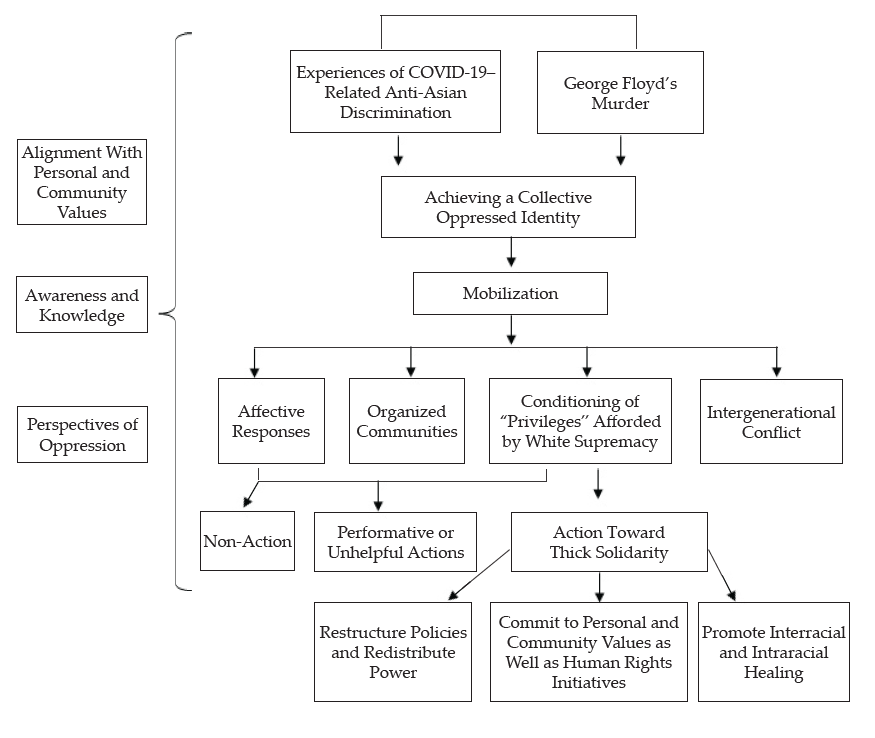
We sought to examine the following research question: What is the process that mobilizes Asian American activists to pursue thick solidarity with the BLM movement in 2020? The results of the grounded theory analysis describe the process through which causal conditions, contextual factors, and intervening conditions affect actions and foster pathways to consequences following the core category of the phenomena of interest (see Figure 1).
Figure 1
Grounded Theory Outlining AAPI Process of Mobilizing in Thick Solidarity With BLM in 2020
Causal Conditions
Based on perspectives from participants, two causal conditions led participants to mobilize toward solidarity for BLM in 2020.
George Floyd’s Murder
Exposure to George Floyd’s murder through social media and news outlets was the first causal condition. For each of the participants, this event represented the “breaking point,” “threshold,” “spark,” or “tipping point” that illuminated the need to “act,” “pursue justice,” “make change,” and “fight back.” As stated by Gemma, a Filipina woman in her mid-30s:
When George Floyd died . . . I just refused to be silent about what happened to him. I just kept thinking, well, what the hell have I been doing that it didn’t impact enough change [so] that this man could have lived? This man died because we have not done enough. He died calling out for his mom. What I could not handle was if I had been born with a particular fear, and I died that way. This man was born and lived knowing that he could be murdered by the police. And that’s how he died. I refuse that. And I am personally responsible that the narrative has not changed in this country. I am responsible and I hold my communities responsible. We have not done enough so that man could have lived.
Experiences of COVID-19–Related Anti-Asian Discrimination
The second causal condition was identified as experiences of COVID-19–related anti-Asian discrimination. This condition was characterized by witnessing or experiencing broad anti-Asian discrimination and exposure to “Trump’s Anti-Chinese,” “xenophobic,” and “racist messages.” Participants described how anti-Asian rhetoric touted by political leaders and experiences of anti-Asian discrimination served as “tinder” that “incited,” “enraged,” and “irritated” AAPIs in ways that “primed” them to act.
For each of the participants, witnessing and/or experiencing COVID-19–related racism was an event that led to action. Each of the 25 participants stated that exposure to anti-Asian discrimination cultivated empathy for Black Americans and illuminated how their shared experiences of racial discrimination “opened their eyes,” “woke them up,” or “pulled off the blindfold” of their racialized identity as Asian Americans. Yuri, a Chinese and Vietnamese woman in her early 30s, explained:
We have this fresh memory of discrimination in the back of our heads, and you know, it reaches a boiling point. You have the intersection of your own experiences and somebody else’s experiences and you start to connect the dots that we are not so different. And we are not so safe. We have more in common with Black lives than we do with White ones.
These sentiments were echoed by Hunter, a Korean man in his early 50s:
The pandemic created this anti-Asian reality. It really brought attention to the average Asian American [about] how much anti-Asian sentiment is still out there. You know, we all live in our little bubbles in life. And we don’t really see what’s going on. But I think, you know, seeing all these news stories about anti-Asian violence, whether we are members of the older generation reading our ethnic papers or just, you know, a member of the younger generation watching television, we see this stuff on the news and it has kind of served as the kindling to the fire to act and do more.
Evelyn, a Filipina woman in her early 40s, also described how exposure to anti-Asian rhetoric touted by political leaders primed her to act:
This particular president [Trump] is stoking the flames [and] it’s re-energizing a particular base of people who are emboldened to say and do things that are hate-centered, that are violent, that are wrong. And I think that it also touched on a particular powerlessness that Asian Americans have felt. And when you couple that within a global pandemic you are hyper aware of your mortality. You could die from this virus that’s going around, [and] we are all wearing masks. You couldn’t get more on edge, you know? We were primed to act. We were ready.
Josie, a multiracial woman in her mid-30s, explained:
Yes, we’re being harassed. We’re being called names. We’re experiencing another wave of xenophobia and racism, being told to go back to our countries, being told that we are not welcome here. I believe that Asians are saying, “Okay, yeah, we’re being threatened, but we’re not being held to the ground and choked out to the point that we’re being killed on TV.” I believe it’s awakened a lot of levels of pain and solidarity because you can’t imagine it. People can’t imagine that the world is this bad until someone’s last breaths are on TV. I think it mobilized people to become more involved because injustice does not have a place among any minority group. Injustice resonates with the Brown community, the Latinx community, the Asian community, and I believe it empowered us to move toward human empathy. Asians are realizing that if we don’t stand together, we stand alone, and nothing in this world will change.
Contextual Factors
Contextual factors were the individual traits and characteristics that affected the actions taken by participants to pursue mobilization in solidarity with BLM. Participants described three contextual factors: (a) alignment with personal and community values, (b) awareness and knowledge, and (c) perspectives of oppression.
Alignment With Personal and Community Values
The first contextual factor was defined as alignment with personal and community values. Notions of values alignment were identified in interviews when participants described how supporting the BLM movement was not a choice; rather, “protesting,” “supporting,” “fighting,” and “engaging in human rights activism” represented “values,” “moral imperatives,” and “needs.” Each of the participants described how mobilizing toward thick solidarity with the Black community reflected the direct consequence of one’s own set of values. Hunter shared the following: “Regardless of how it benefits the Asian American community, for me, it’s my sense of value. This is my own value system. I don’t feel comfortable having groups that are continuing to be oppressed.”
For some participants, notions of values alignment and the need to act had been socialized and were shared by their families of origin. José, a Filipino man in his early 30s, indicated:
I needed to act, there was no other choice. My parents taught me years ago how this whole [BLM] movement creates an obligation to speak up when injustice occurs. Our [Filipino] history has led us to learn that we always have been stronger when we all unite together because there is so much divisiveness in our society.
Evelyn described how values alignment represented a moral imperative:
For about 17 years, I have been an activist. I have always known at a very deep, personal, soul level, that issues of race are the knife on the throat of this country. This country has not resolved or has even come close to reconciling its history. And I don’t think that it [supporting BLM] was something that I decided. It wasn’t a neuron movement. It wasn’t a shift; it wasn’t something that physiologically or intellectually or cognitively shifted. It was like something else just shed, like a skin was pulled off me. It was just so plainly obvious that it was more than overdue for people to say something. We needed to act. There was no other option. It was just this plain, visceral refusal to be silent.
Participants described how alignment with personal and community values emerged because other Asian countries have been historically oppressed. Specifically, Hong Kong, Vietnam, and the Philippines were identified as countries that “silenced Asian voices” in ways that amplified participants’ desire to underscore their values in the United States. Byron, a Vietnamese and Chinese man in his late 30s, identified the following perspective on contextual factors:
I think it’s very important for us, as Asian Americans or even Asians across the world, to really be vocal on this [BLM movement]. Because, dude, America is a crazy place. It’s a beautiful country, but at the same time, the system is kind of jacked, right? And, you know, my parents being from Vietnam and really trying to get away from communists and stuff, I see what the Hong Kong people are going through right now. That to me is like a sign. Like, their battle is different from ours, but it’s still the same. We need to fight for what’s right.
Awareness and Knowledge
The second contextual factor was identified as awareness of one’s identity as a person of color and knowledge of how all communities of color are affected by systemic racism and White supremacy. Participants described how learning about Asian American history and the impact of racial triangulation, how AAPI liberation is directly tied to Black liberation, and the weaponization of the model minority myth were critical factors that contributed to their BLM activism. Rufio, a Filipino man in his late 20s, recalled the following memory:
Peter Liang, I think, was the first person that got convicted of anything. I clearly remember a street. On one side of it were Black protesters and on the other side were Asian American protesters. One side was saying, “Peter was innocent!” and the other side was like, “He deserves more of a sentence!” African American and Asian American protesters were pointing at each other when really they should have been looking outside [of] the situation and being like, the people in power set this game up so we didn’t look at them. They were making us look at each other, but we shouldn’t be looking at each other. We should be looking at them.
Participants identified the importance of achieving multiracial unity and described how the fates of communities of color are inextricably linked. Jay, a non-binary Filipinx person in their early 20s, asserted the following about multiracial unity:
When we center the most vulnerable or the most marginalized, then we are able to lift up everyone. And I think that’s why a lot of people are focusing on the term BIPOC and [are] like, trying to center Black people and Indigenous people, because Black people have been enslaved and Indigenous people [have] had so many atrocities committed to them on stolen land. Ultimately, we are all in this together and what we do for one affects us all.
Similarly, Dante, a transracially adopted Taiwanese man in his mid-20s, observed the political implications surrounding race relations in the United States:
Honestly, I think that four years of the Trump presidency is probably a big mobilizing factor. His policy towards China has been just straight-up racist on his best days and, you know, far worse on his bad days. And so one of the concerns that I had is like, he has no problem locking up kids and immigrants in detention centers. At what point is that going to start being directed at Asian people? If we don’t fight for other people of color, who’s going to fight for us when it is our turn?
Jubilee, a Chinese woman in her early 30s, described the recent AAPI support of BLM and emphasized the importance of cultivating awareness and knowledge with her community and family of origin:
I feel like this is the first time I’ve seen such solidarity from Asians to the Black community. It happened back in the 60s during the civil rights movement so like, we are not the first, but like, in my generation and in my lifetime, this is the first time I am seeing that from us as an Asian community. There are finally conversations coming up about anti-Blackness in Asian communities, you know? It has also allowed me and my brother to bring up these conversations and issues with our friends and parents. For the first time in our lives, we are having conversations about anti-Blackness and systemic racism, and they are not brushing it off. They [my friends and parents] actually take a pause and listen, and this was the first time seeing them do that. And that’s pretty cool. There’s still a long way to go, but there is definitely some change happening. I see it and I feel it around me.
Perspectives of Oppression
Participants conceptualized their experiences from two distinct perspectives of oppression that uniquely influenced the strategies used to mobilize in thick solidarity toward the BLM movement: (a) as a member of the AAPI community or (b) as a member of a greater community of minoritized groups. Participants who limited their perspective of oppression to the AAPI community tended to center Asian voices in support of the BLM movement (i.e., “Yellow Peril for BLM”). Participants in the first category tended to limit their focus to how supporting the BLM movement would benefit the Asian community. Byron explained how supporting the BLM movement better positions the greater Asian American community to engage in advocacy:
I think us mobilizing together and supporting the Black Lives movement would really help us out as a community. Not only as just Chinese, Vietnamese, and Filipino and all that, but literally, as one Asian community. I think we are learning from the Black Lives movement. Not only are we participating with them, but it’s almost like training wheels for our community to be like, we need to be louder about certain rights that we want or certain things that we want to talk about. The United States has created the perfect platform for us to express that, and we have not utilized that.
Conversely, participants who endorsed a wider perspective that recognized Asian Americans as members of one oppressed minoritized group centered the Black community and amplified Black voices. Participants in the second category were more likely to recognize how mobilizing in thick solidarity with the BLM movement would benefit the larger constellation of communities of color. June, a Korean, non-binary, transracially adopted person in their late 20s, highlighted this connection across social movements:
So many Asian people don’t want to post about anti-Asian oppression alongside Black Lives Matter. They are like, “Oh I don’t want to take away from the Black Lives Matter movement by posting about the racism that I experienced or by posting about immigration.” But I kind of see them as being connected because we all face the same oppressor. We are all dealing with White supremacy, so we need to realize all of our movements are interconnected. We need to be in solidarity with each other.
Mia, a Korean woman in her early 30s, similarly explained this relationship:
Just like how we wonder, How is discrimination affecting the greater Asian community?, I think you have to extend that exercise to, How is it affecting the Black community? Where is it [discrimination] starting from? Whose lives are affected? Instead of just being like, “These are the discrimination experiences I face in my life,” it becomes a bigger conversation about what our greater community of minorities faces.
Intervening Conditions
Intervening conditions represent the broad and general factors that influence strategies based upon action or inaction and may include time, space, culture, history, emotions, and institutions. In this study, Asian American participants described four intervening conditions that either facilitated or created barriers to mobilizing toward thick solidarity with the BLM movement. Intervening conditions were described as having a bidirectional nature with the contextual conditions and action strategies used by participants.
Affective Responses
Participants described how feelings of “fear,” “anger,” “helplessness,” “empathy,” and “compassion” intersected with George Floyd’s murder, experiences of COVID-19–related anti-Asian discrimination, alignment with personal and community values, awareness and knowledge, and perspectives of oppression. Nearly every participant identified how they had “struggled” with, “overcome,” or “witnessed” how Asian Americans become paralyzed by fears of “taking up space,” “being too privileged,” or “not sharing the same intensity of oppression as Black Americans.” June described how some AAPIs become too overwhelmed by their privilege to engage in activism:
I so often hear them [AAPIs] say, “I want to help, but I can’t do anything. I can’t, I can’t. I don’t feel it’s in my place because I’m not Black. I feel like my voice doesn’t matter in this situation because I don’t suffer in the way that they [Black Americans] do.” I’ve seen so many excuses about how their voices are too privileged to matter, and it’s not true.
Annie, a Vietnamese woman in her early 30s, explained how fear can limit action:
They [AAPIs] fear that if they stand with the Black community, they will be ousted, attacked, treated differently, and looked down upon. I’ve seen a lot of fears that family would disown them if they become more vocal about Black Lives Matter because the older generation is very stuck in their own mindset of teaching the younger generations, you know, “You keep your head down, you go to school, you make a life for yourself, you don’t make waves, because it will only ruin your life.” I’ve seen a lot of people say that they can’t be as vocal because they are only one person.
Intergenerational Conflict
Participants identified intergenerational conflict as the second intervening condition that influenced Asian American action or inaction. Each participant described how Asian Americans and Asian immigrants (especially older individuals) lacked social justice–oriented language and stressed the importance of assimilation, and how those influences affected the shifting realities between first-generation Asian Americans and subsequent generations in their support of the BLM movement. Conversely, Asian Americans who were willing to engage in discussions about racial discrimination and cultivate cross-racial relationships were more likely to mobilize toward thick solidarity with the BLM movement. Participants also described how older Asian Americans and Asian immigrants struggled to grasp the “cultural nuances” that contextualize the history of systemic oppression and police brutality on Black and Brown individuals in America. The cultural barriers for many older Asian immigrants were described by Lin, a transracially adopted Korean woman in her early 30s:
The social justice language that we use when it comes to Black Lives Matter is difficult enough for a White person who is unfamiliar with this terminology. [It’s hard] to try and communicate that across generational lines, especially because a lot of us don’t have the strength in language skills to be able to translate. From what I’ve observed in my parents, they’ve kind of just kept their head down. They stressed assimilation very strongly for their children. It’s that old-school, “don’t rock the boat” mentality. Don’t give them a reason to look at us. Don’t give them a reason to hate us, you know? Don’t do anything to jeopardize this freedom that they worked so hard to achieve [and] that we’re so lucky to have.
Participants also described how first-generation Asian American and Asian immigrants were more likely to be “encapsulated,” “avoid other racial groups,” and “keep to themselves” in ways that prevented the cultivation of meaningful cross-racial relationships and kept them from challenging historical anti-Black sentiments. The importance of connecting with other communities of color to foster empathy and challenge historical anti-Blackness among Asian Americans and Asian immigrants was described by Ira, a multiracial woman in her early 70s:
I think that when older Asians are exposed in even a small way to the African American community, they can understand. But many Asian people stay within people of their own color, and they stay within their own ethnicity and they stay within their own groups. If you stay in your own community and you never see an African American person except [for] what you see on TV, it’s hard to see the similarities and realize that we are not so different.
To complement this notion, Jenny, a multiracial woman in her early 40s, discussed this perspective:
I feel like it’s really common for Asian immigrants not to connect with these situations [of discrimination] that are happening to them, either in individual instances or in bigger systems. They’re not tying them back to racism. I think that for so long, you know, immigrants were just trying to survive. First-generation folks were just trying to keep their head down, stay out of trouble, and survive, and they couldn’t get distracted by thinking about what else was happening around them.
Conditioning of “Privileges” Afforded by White Supremacy
The third intervening condition was coded when participants described how being Asian American represented “conditional,” “unsafe,” and “hyphenated” identities and when proximity to Whiteness elicited confusion about their role in activism. For some participants, the conditioning of “privileges” afforded by White supremacy contributed to action. As described by Evelyn, Whiteness elucidated a system of different racialized experiences:
I begin to wonder how powerful is Whiteness, you know? If I’m not the one being killed in the street, but I’m also experiencing racism, where do I fit into all of this? You begin to question how Asian Americans have been inserted into this narrative. And for me, you begin to wonder like, am I a pawn in this? What is my level of responsibility here? Is there a shared oppression? Yes. Are we all tethered the same way? No.
Participants who struggled to overcome the conditioning of privileges afforded by White supremacy were more likely to vacillate between action and inaction. Monica, a transracially adopted Korean woman in her early 30s, stated the following:
I do feel like for Asians, you’re in this really interesting space. I do actually think I have a lot of privilege. And with that, potentially, some responsibility as a person that essentially has a long-standing visa or passport into Whiteness. I know the language. I know how White people think and act. I feel like I can talk to White people about racism in a way that other people don’t necessarily have access to. But also, I experience racism and I’m also really tired.
Organized Communities
The presence of social media groups; local, regional, national, and international groups; participants’ own Asian American communities; and other communities with shared group identities (e.g., the lesbian, gay, bisexual, and transgender [LGBT] community) were identified by participants as the fourth intervening condition. When organized communities were present, they either hindered or fostered mobilization. Participants who had communities that hindered mobilization described how their families and Asian American communities socialized them “not to rock the boat,” raised them to “keep their head down,” and discouraged “making waves.” Participants who lacked the presence of organized communities described feeling “burned out,” “alone,” and “unsupported.” As reported by Andi, a non-binary Korean person in their late 20s:
I have been fighting alone for years and it’s exhausting. I carry on because our activism is important, but it would be so nice to be able to meet up with other groups, share our experiences, and fill our validation cups, you know? It’s like, there is only so much I can do alone, and I don’t have the support I need to really keep going.
Participants described how communities fostered mobilization by providing the language, structure, resources, validation, and space necessary to begin talking about race and understanding the plight of other communities of color. Communities that fostered mobilization were most frequently described as college and university settings. Jackie, a Chinese and Japanese student in her mid-20s, described how her Asian American community on the university campus fosters action:
I just didn’t want to be by myself and protest alone. It feels good to learn more about why we are doing this and why it is important. Now, I felt like I have learned why it was so important that we as a group are able to rally behind the Black Lives Matter movement. I think community plays a huge part in supporting the BLM movement. It’s not just enough for us as individuals to be moving forward, it’s important that we have an Asian community presence in this battle.
The fostering role of communities in promoting thick solidarity was further described by Trichelle, a Chamorro woman in her late 50s:
I think the college and university experience has helped facilitate an understanding about race, generally, and experiences as Asian Americans or Pacific Islanders, secondarily. They facilitated an ability to see the connections, both the differences and the similarities of how racism has impacted AAPI communities but also how it is linked to the experiences of Black folks. The ability to have the language and to have some kind of infrastructure is critical to mobilize. Mobilization does not happen in the absence of some kind of organizational infrastructure.
Actions
To understand this larger process of action, participants in this study described non-action, performative action, or action toward thick solidarity. Participants additionally described how contextual factors, causal conditions, and intervening conditions interacted to influence the type of actions that occurred.
Non-Action
Non-action occurred when Asian American individuals were unable to challenge collectivistic notions of “not rocking the boat,” “not making waves,” and “not causing trouble.” Non-action was also more likely to occur when Asian Americans became overwhelmed by the economic and social privilege afforded to them because of their proximity to Whiteness. Upon considering the distinctness of Black oppression, participants described recognition of how Asian Americans may feel “unable,” “unsupported,” “guilty,” or “ineffective” to engage in action because of burnout; lack of community, validation, support, or resources; or feelings of “privilege guilt.” Participants also described how non-action may occur in older generations and Asian immigrants who may have internalized model minority traits, emphasized the importance of assimilation, remained encapsulated within the Asian American community, or lacked an understanding of systemic racism and social justice language.
Performative or Unhelpful Action
Performative or unhelpful action occurred when Asian American individuals either felt compelled to act to avoid being perceived as anti-Black or because supporting the BLM movement was “trending.” Unhelpful action occurred when Asian American individuals centered their issues in ways that disenfranchised Black issues or centered AAPI voices over Black voices (i.e., Asians4BlackLives). June described an example of how Asian American individuals may engage in performative action: “They’ll say one or two things online, and they’ll be like, ‛Oh, I did my part. I posted #BlackLivesMatter. Look at my profile picture. Look at my Instagram. Look, I posted a couple links for donations.’”
They also explained how centering AAPI voices constituted unhelpful action:
When someone posts “Yellow Peril Stands for Black Lives,” you’re actually overshadowing Black Lives Matter. Taking our title, our movement, and placing it in front of BLM says, “Hey, we’re here. We’re standing with you. Look at us.” That’s not acting in solidarity. It becomes one group saying, “I AM HERE. Here’s my voice for your voice.” We need to make our voices strong for theirs. We are the chorus and they are the lead singers.
Action Toward Thick Solidarity
Action toward thick solidarity occurred when Asian American individuals were able to support the BLM movement without centering AAPI issues or focusing on their own racial trauma histories. Demonstrating a willingness to learn how to be an ally and cultivating cultural humility were effective strategies in transcending action from performative or unhelpful to action toward thick solidarity. Sari, a Chinese and Lebanese woman in her early 30s, described the process of acting toward solidarity and the importance of communities that foster mobilization:
Solidarity to me is not a noun. It is a process that you continue to refine and reflect on and add or subtract things to, and it has a lot to do with your perspective and your approach. And I think a lot of solidarity with others comes from a genuine dedication to building your own community. I think a really important piece of solidarity is that introspection and community building with your own ingroup.
José explained how acting toward thick solidarity requires Asian Americans to follow the lead of Black activists. He tells the following story of how he explained allyship to a friend:
Remember two summers ago when you asked me to help you fix your deck, and I never knew how to work with power tools? The weekend before, I went on the internet and learned basic skills like how to hold a tool and how to be safe. And then when I went to your house, I wore a hard hat. I had everything ready, and I followed your lead and your leadership. That’s how you become an ally. You educate yourself. And when you go to situations you don’t center yourself. You follow the person who has the most experience.
Phenomenon, Consequences, and Core Category
Participants in the study described the process of feeling “primed” to act because of the combined causal conditions of George Floyd’s murder and experiences of COVID-19–related anti-Asian discrimination. Participants were able to mobilize because of the contextual factors of alignment with personal and community values, awareness and knowledge, and perspectives of oppression. The phenomenon of Asian American activists mobilizing in thick solidarity with the BLM movement were influenced by intervening conditions, which included affective responses, intergenerational conflict, conditioning of “privileges” afforded by White supremacy, and organized communities. Each of these conditions and factors interacted to influence non-action, performative or unhelpful action, and action toward thick solidarity.
Participants identified the consequences of pursuing thick solidarity with the Black community as resulting in pathways that facilitate three domains: (a) to promote intraracial and interracial healing, (b) to commit to personal and community values as well as human rights initiatives, and (c) to restructure policies and redistribute power. Within this study, “achieving a collective oppressed identity” occurred most frequently in participant narratives, experiences, and practices and was identified as absolutely critical for mobilization to occur. The core category of achieving a collective oppressed identity arose as a result of George Floyd’s murder, because of experiences of COVID-19–related anti-Asian discrimination, and in the light of awareness and knowledge.
Discussion
A grounded theory analysis with 25 diverse individuals outlined an emergent process describing how contributing factors mobilized Asian American activists toward thick solidarity with the BLM movement in June and July 2020. Understanding and abstracting this theoretical process is important to embolden other Asian American individuals to engage in collective social action. Components of the emergent process are consistent with the CIIM (Gaertner & Dovidio, 2000) and supplement additional studies that explored AAPI support for the BLM movement (Lee et al., 2020; Merseth, 2018; Yoo et al., 2021). Specifically, the theoretical process that emerged from this study illuminates new findings that indicate how achieving a collective oppressed identity and contextualizing the historical relationship between the Asian American and Black communities are critical to empowering AAPI communities to form racial coalitions (Chang, 2020; J. Ho, 2021). For many participants, understanding this history and becoming more racially conscious propelled their motivations for achieving solidarity and dismantling the forces of White supremacy that oppress all racialized groups. This finding reveals numerous perspectives that value historical context and knowledge as a central factor for AAPI activism, especially in tandem with other communities of color (Museus, 2021; Nicholson et al., 2020).
Participants in the study identified how George Floyd’s murder and their experiences of anti-Asian discrimination resulted in an achieved collective oppressed identity that contributed to their mobilization toward thick solidarity with the BLM movement. This finding is consistent with extant research that hypothesized how ingroup discrimination may cultivate increased empathy, positive attitudes, and a collective sense of greater community (Craig & Richeson, 2012; Tajfel & Turner, 1979). The ways that causal conditions identified in this study led to a collective oppressed identity may further be explained through the lens of the CIIM model (Gaertner & Dovidio, 2000), which posits that experiences of racial discrimination can engender positive attitudes and feelings of closeness to other racial minorities. The findings of the study additionally complement earlier studies on AAPI support for BLM that identified race-based linked fate beliefs among Asian Americans as a predictor of BLM support (Merseth, 2018), and an ethnography that identified the importance of organized educational communities for Southeast Asian Americans engaging in activism (Lee et al., 2020). Another possibility may be that participants in the study achieved a dual identity. As explained by Gaertner and colleagues (1994), dual identity occurs when individuals perceive themselves as members of different ethnic or racial groups “playing on the same team” (p. 227)—in this case, to dismantle the forces of White supremacy that continue to oppress all communities of color. The findings from the present study further elaborate on processes that may outline how anti-Asian discrimination can create the impetus for mobilizing in thick solidarity with the Black community (Anand & Hsu, 2020; Li & Nicholson, 2021; R. Liu & Shange, 2018; W. Liu, 2018).
Implications From the Study
The findings from this study can be used by mental health professionals and counselor educators to engage in meaningful racial dialogues and foster interracial coalitions. Specifically, professional counselors can employ this grounded theory to help Asian Americans heal from their own racial and intergenerational trauma by supporting other communities of color. The process of action outlined in our study illuminates the importance of promoting awareness and knowledge about the history of Black and AAPI oppression (Chang, 2020; J. Ho, 2021), connecting AAPI individuals to supportive communities (C. D. Chan & Litam, 2021; Yi et al., 2020), and providing helpful resources (e.g., Letters for Black Lives) and strategies (e.g., exposure and connection with other communities of color) to navigate cultural barriers (Arora & Stout, 2019).
Mental health professionals and social justice advocates can apply these findings to promote engagement in community organizing efforts of AAPI communities with the BLM movement, denounce anti-Blackness, and uphold culpability in supporting the Black community. Following the COVID-19 pandemic, AAPI individuals may experience greater rates of racial discrimination and anti-Asian rhetoric in ways that negatively impact their well-being (C. D. Chan & Litam, 2021; Jeung & Nham, 2020; Litam, 2020; Litam & Oh, 2020, 2021; Litam et al., 2021). Mental health professionals can validate these experiences of oppression and help clients redirect affective experiences in ways that promote awareness and knowledge (David et al., 2019; Museus, 2021), challenge proximity to Whiteness (Poon et al., 2016; Yi et al., 2020), and cultivate meaningful action in racial solidarity movements (Chang, 2020; Litam, 2021; Yoo et al., 2021). Helping Asian American individuals find communities that foster action toward thick solidarity with BLM and exploring how affective experiences influence accountability may be helpful in garnering support. For example, mental health professionals can explore whether limited perspectives of oppression and assimilation strategies may result in inaction or performative action, especially in directly challenging Whiteness (Chang, 2020; Yoon et al., 2016) or intentionally taking accountability for harboring anti-Black sentiments (Museus, 2021). This consideration is especially crucial as AAPIs build long-term solidarity as a proactive approach to Black solidarity rather than a temporary measure. Finally, mental health professionals may encourage AAPI individuals to expand their perspectives to include dual identities as AAPI people and as members of a greater group of oppressed minoritized individuals to foster racial coalitions.
Limitations
First, participants self-selected into the study with a strong working knowledge of their activist and AAPI identities. Readers must therefore be judicious about transferring these findings to AAPI individuals whose activist and/or racial identities may not be fully developed. Second, participants represented a small sample of a larger Asian American community that endorses varying views about activism, anti-Blackness, and other human rights issues. Notably, the sample only included one person with Pacific Islander heritage. Although the importance of thick solidarity continues to gain traction, readers must caution themselves against interpreting these perspectives as a monolithic viewpoint held by all AAPI individuals.
Recommendations for Future Research
The limitations of the study yield additional opportunities to build upon empirical research that illuminates racial coalitions, particularly among communities of color. With the findings of this study, it would be helpful to elucidate critical developmental points that shift AAPI communities into racial consciousness of White supremacy. This developmental point may be complex, given different histories of regions within the United States, migration histories, acculturation rates, and racial socialization within families. Similarly, White supremacy seeks to homogenize AAPI communities as a single racial group solely characterized by educational and economic success (Museus, 2021).
Built upon the premise of this study, it behooves researchers to address how anti-Blackness persists within AAPI communities (Yi et al., 2020; Yoo et al., 2021). Because only one participant had Pacific Islander heritage in the current study, researchers can further explore how Pacific Islanders may (a) endorse anti-Blackness, (b) experience the nexus of racism and colonialism, and (c) shape their commitments to solidarity with Black communities. Based on the themes underpinning the process toward thick solidarity in the study, it may be beneficial for researchers to consider the institutional conditions of their neighborhoods, communities, schools, and workplaces in promoting racial coalitions. Given that the study’s findings emphasized the importance of awareness and knowledge, it would be helpful to engage in qualitative research that further explores how educators in the P–16 system (i.e., preschool to college) map their curriculum of Asian history to include knowledge of racial coalitions, White supremacy, imperialism, and colonialism. Further research may also examine how counselor educators address the complex and racialized experiences of Asian American and Black communities within graduate coursework. Additionally, it is imperative to expand on research that illuminates Black organizers, activists, and communities in racial solidarity movements and Black-Asian racial coalitions.
Conclusion
The results of a grounded theory with diverse Asian American voices illuminated how causal conditions, contextual factors, intervening conditions, actions, and outcomes mobilized Asian Americans toward solidarity with the BLM movement in 2020. Understanding these conditions are of paramount importance to overcoming anti-Black notions embedded within AAPI ethnic subgroups and challenging systemic forms of racial oppression that impact all communities of color.
Conflict of Interest and Funding Disclosure
The authors reported no conflict of interest
or funding contributions for the development
of this manuscript.
References
Anand, D., & Hsu, L. (2020). COVID-19 and Black Lives Matter: Examining anti-Asian racism and anti-Blackness in US education. International Journal of Multidisciplinary Perspectives in Higher Education, 5(1), 190–199. https://doi.org/10.32674/jimphe.v5i1.2656
Arora, M., & Stout, C. T. (2019). Letters for Black Lives: Co-ethnic mobilization and support for the Black Lives Matter movement. Political Research Quarterly, 72(2), 389–402. https://doi.org/10.1177/1065912918793222
Blalock, H. M., Jr. (1967). Toward a theory of minority-group relations. Wiley.
Bonacich, E. (1973). A theory of middleman minorities. American Sociological Review, 38(5), 583–594. https://doi.org/10.2307/2094409
Bonilla-Silva, E. (2004). From bi-racial to tri-racial: Towards a new system of racial stratification in the USA. Ethnic and Racial Studies, 27(6), 931–950. https://doi.org/10.1080/0141987042000268530
Bonilla-Silva, E. (2018). Racism without racists: Color-blind racism and the persistence of racial inequality in America (5th ed.). Rowman & Littlefield.
Brewer, M. B. (2000). Reducing prejudice through cross-categorization: Effects of multiple social identities. In S. Oskamp (Ed.), Reducing prejudice and discrimination (pp. 165–183). Erlbaum.
Chan, C. D., & Litam, S. D. A. (2021). Mental health equity of Filipino communities in COVID-19: A framework for practice and advocacy. The Professional Counselor, 11(1), 73–85. https://doi.org/10.15241/cdc.11.1.73
Chan, S. (1991). Asian Americans: An interpretive history. Twayne.
Chang, B. (2020). From ‘illmatic’ to ‘kung flu’: Black and Asian solidarity, activism, and pedagogies in the COVID-19 era. Postdigital Science and Education, 2(3), 741–756. https://doi.org/10.1007/s42438-020-00183-8
Charmaz, K. (2014). Constructing grounded theory (2nd ed.). SAGE.
Charmaz, K. (2017). Special invited paper: Continuities, contradictions, and critical inquiry in grounded theory. International Journal of Qualitative Methods, 16(1), 1–8. https://doi.org/10.1177/1609406917719350
Chou, R. S., & Feagin, J. R. (2016). The myth of the model minority: Asian Americans facing racism. Routledge. https://doi.org/10.4324/9781315636313
Clarke, A. E. (2012). Feminism, grounded theory, and situational analysis revisited. In S. N. Hesse-Biber (Ed.), Handbook of feminist research: Theory and praxis (2nd ed., pp. 388–412). SAGE.
Craig, M. A., & Richeson, J. A. (2012). Coalition or derogation? How perceived discrimination influences intraminority intergroup relations. Journal of Personality and Social Psychology, 102(4), 759–777. https://doi.org/10.1037/a0026481
Creswell, J. W., & Poth, C. N. (2018). Qualitative inquiry & research design: Choosing among five approaches (4th ed.). SAGE.
David, E. J. R. (2013). Brown skin, White minds: Filipino-/American postcolonial psychology. Information Age Publishing.
David, E. J. R., & Okazaki, S. (2006a). Colonial mentality: A review and recommendation for Filipino American psychology. Cultural Diversity and Ethnic Minority Psychology, 12(1), 1–16.
https://doi.org/10.1037/1099-9809.12.1.1
David, E. J. R., & Okazaki, S. (2006b). The Colonial Mentality Scale (CMS) for Filipino Americans: Scale construction and psychological implications. Journal of Counseling Psychology, 53(2), 241–252. https://doi.org/10.1037/0022-0167.53.2.241
David, E. J. R., Schroeder, T. M., & Fernandez, J. (2019). Internalized racism: A systematic review of the psychological literature on racism’s most insidious consequence. Journal of Social Issues, 75(4), 1057–1086. https://doi.org/10.1111/josi.12350
Elias, A., Ben, J., Mansouri, F., & Paradies, Y. (2021). Racism and nationalism during and beyond the COVID-19 pandemic. Ethnic and Racial Studies, 44(5), 783–793. https://doi.org/10.1080/01419870.2020.1851382
Fanon, F. (1952). Black skin, White masks. Grove Press.
Gaertner, S. L., & Dovidio, J. F. (2000). Reducing intergroup bias: The common ingroup identity model. Psychology Press.
Gaertner, S. L., Rust, M. C., Dovidio, J. F., Bachman, B. A., & Anastasio, P. A. (1994). The contact hypothesis: The role of a common ingroup identity on reducing intergroup bias. Small Group Research, 25(2), 224–249. https://doi.org/10.1177/1046496494252005
Gergen, K. J. (2020). Constructionist theory and the blossoming of practice. In S. McNamee, M. M. Gergen, C. Camargo-Borges, & E. F. Rasera (Eds.), The SAGE handbook of social constructionist practice (pp. 3–14). SAGE. https://doi.org/10.4135/9781529714326.n1
Gergen, M. (2020). Practices of inquiry: Invitation to innovation. In S. McNamee, M. M. Gergen, C. Camargo-Borges, & E. F. Rasera (Eds.), The SAGE handbook of social constructionist practice (pp. 17–23). SAGE. https://doi.org/10.4135/9781529714326.n2
Guba, E. G., & Lincoln, Y. S. (1989). Fourth generation evaluation. SAGE.
Haney López, I. (2006). White by law: The legal construction of race (10th ed.). New York University Press.
Hays, D. G., & Singh, A. A. (2012). Qualitative inquiry in clinical and educational settings. Guilford.
Ho, F., & Mullen, B. V. (Eds.). (2008). Afro Asian: Revolutionary political and cultural connections between African Americans and Asian Americans. Duke University Press.
Ho, J. (2021). Anti-Asian racism, Black Lives Matter, and COVID-19. Japan Forum, 33(1), 148–159.
https://doi.org/10.1080/09555803.2020.1821749
Jeung, R., & Nham, K. (2020). Incidents of coronavirus-related discrimination. Asian Pacific Policy & Planning Council. https://bit.ly/3bITRDE
Khan-Cullors, P., & Bandele, A. (2017). When they call you a terrorist: A Black Lives Matter memoir. St. Martin’s Publishing Company.
Kim, C. J. (1999). The racial triangulation of Asian Americans. Politics Society, 27(1), 105–138.
https://doi.org/10.1177/0032329299027001005
Lebron, C. J. (2017). The making of Black Lives Matter: A brief history of an idea. Oxford University Press.
Lee, S. J., Xiong, C. P., Pheng, L. M., & Vang, M. N. (2020). “Asians for Black Lives, not Asians for Asians”: Building Southeast Asian American and Black solidarity. Anthropology & Education Quarterly, 51(4), 405–421. https://doi.org/10.1111/aeq.12354
Li, Y., & Nicholson, H. L., Jr. (2021). When “model minorities” become “yellow peril”—Othering and the racialization of Asian Americans in the COVID-19 pandemic. Sociology Compass, 15(2), 1–13. https://doi.org/10.1111/soc4.12849
Litam, S. D. A. (2020). “Take your Kung-Flu back to Wuhan”: Counseling Asians, Asian Americans, and Pacific Islanders with race-based trauma related to COVID-19. The Professional Counselor, 10(2), 144–156. https://doi.org/10.15241/sdal.10.2.144
Litam, S. D. A. (2021). Rocking the boat: A call for Asian American and Pacific Islander counselors to make waves. Journal of Mental Health Counseling, 43(3), 273–276. https://doi.org/10.17744/mehc.43.3.09
Litam, S. D. A., & Chan, C. D. (2021). Breaking the bamboo ceiling: Practical strategies for Asian American and Pacific Islander counselor educators. Counselor Education and Supervision, 60(3), 174–189. https://doi.org/10.1002/ceas.12210
Litam, S. D. A., & Oh, S. (2020). Ethnic identity and coping strategies as moderators of COVID-19 racial discrimination experiences among Chinese Americans. Counseling Outcome Research and Evaluation. https://doi.org/10.1080/21501378.2020.1814138
Litam, S. D. A., & Oh, S. (2021). Effects of COVID-19 racial discrimination on depression and life satisfaction among young, middle, and older Chinese Americans. Adultspan Journal, 20(2), 70–84. https://doi.org/10.1002/adsp.12111
Litam, S. D. A., Oh, S., & Chang, C. (2021). Resilience and coping as moderators of stress-related growth in Asians and AAPI during COVID-19. The Professional Counselor, 11(2), 248–266.
https://doi.org/10.15241/sdal.11.2.248
Liu, R., & Shange, S. (2018). Toward thick solidarity: Theorizing empathy in social justice movements. Radical History Review, 131, 189–198. https://doi.org/10.1215/01636545-4355341
Liu, W. (2018). Complicity and resistance: Asian American body politics in Black Lives Matter. Journal of Asian American Studies, 21(3), 421–451. https://doi.org/10.1353/jaas.2018.0026
Mendoza, R. L. (2014). The skin whitening industry in the Philippines. Journal of Public Health Policy, 35, 219–238. https://doi.org/10.1057/jphp.2013.50
Merseth, J. L. (2018). Race-ing solidarity: Asian Americans and support for Black Lives Matter. Politics, Groups, and Identities, 6(3), 337–356. https://doi.org/10.1080/21565503.2018.1494015
Miles, M. B., Huberman, A. M., & Saldaña, J. (2020). Qualitative data analysis: A methods sourcebook (4th ed.). SAGE.
Museus, S. D. (2021). The centrality of critical agency: How Asian American college students develop commitments to social justice. Teachers College Record, 123(1), 1–38.
Nadal, K. L. (2021). Filipino American psychology: A handbook of theory, research, and clinical practice (2nd ed.). Wiley. https://doi.org/10.1002/9781119677109
Nicholson, H. L., Jr., Carter, J. S., & Restar, A. (2020). Strength in numbers: Perceptions of political commonality with African Americans among Asians and Asian Americans in the United States. Sociology of Race and Ethnicity, 6(1), 107–122. https://doi.org/10.1177/2332649218785648
Oh, A. E. (2010). An issue of time and place: The truth behind Korean Americans’ connection to the 1992 Los Angeles riots. Asian American Policy Review, 19, 39–48.
Pavlenko, A. (2002). ‘We have room for but one language here’: Language and national identity in the US at the turn of the 20th century. Multilingua, 21(2–3), 163–196. https://doi.org/10.1515/mult.2002.008
Pendakur, S. L., & Pendakur, V. (2016). Beyond boba tea and samosas: A call for Asian American race consciousness. In S. D. Museus, A. Agbayani, & D. M. Ching (Eds.), Focusing on the underserved: Immigrant, refugee, and Indigenous Asian American and Pacific Islanders in higher education (pp. 55–72). Information Age Publishing.
Petrola, J. P., Ledesma, J., Venturillo, C. P., Del Rosario, K. E., & Isidro, R. (2020). The will to self-determination: Understanding the life of Ati people in Aklan, Philippines. Journal of Critical Reviews, 7(11), 218–222. https://doi.org/10.31838/jcr.07.11.35
Poon, O. A., Segoshi, M. S., Tang, L., Surla, K. L., Nguyen, C., & Squire, D. D. (2019). Asian Americans, affirmative action, and the political economy of racism: A multidimensional model of raceclass frames. Harvard Educational Review, 89(2), 201–226. https://doi.org/10.17763/1943-5045-89.2.201
Poon, O., Squire, D., Kodama, C., Byrd, A., Chan, J., Manzano, L., Furr, S., & Bishundat, D. (2016). A critical review of the model minority myth in selected literature on Asian Americans and Pacific Islanders in higher education. Review of Educational Research, 86(2), 469–502. https://doi.org/10.3102/0034654315612205
Rafael, V. L. (2000). White love and other events in Filipino history. Duke University Press.
Saldaña, J. (2021). The coding manual for qualitative researchers (4th ed.). SAGE.
Sharma, N. (2018). The racial studies project: Asian American studies and the Black Lives Matter campus. In C. J. Schlund-Vials (Ed.), Flashpoints for Asian American studies (pp. 48–65). Fordham University Press.
Tajfel, H., & Turner, J. C. (1979). An integrative theory of intergroup conflict. In W. G. Austin & S. Worchel (Eds.), The social psychology of intergroup relations (pp. 33–47). Brooks Cole.
Taylor, K.-Y. (2016). From #BlackLivesMatter to Black liberation. Haymarket Books.
Timonen, V., Foley, G., & Conlon, C. (2018). Challenges when using grounded theory: A pragmatic introduction to doing GT research. International Journal of Qualitative Methods, 17(1), 1–10. https://doi.org/10.1177/1609406918758086
Tran, N., Nakamura, N., Kim, G. S., Khera, G. S., & AhnAllen, J. M. (2018). #APIsforBlackLives: Unpacking the interracial discourse on the Asian American Pacific Islander and Black communities. Community Psychology in Global Perspective, 4(2), 73–84. https://doi.org/10.1285/i24212113v4i2p73
Xu, J., & Lee, J. C. (2013). The marginalized “model” minority: An empirical examination of the racial triangulation of Asian Americans. Social Forces, 91(4), 1363–1397. https://doi.org/10.1093/sf/sot049
Yamashita, R. C., & Park, P. (1985). The politics of race: The open door, Ozawa and the case of the Japanese in America. Review of Radical Political Economics, 17(3), 135–156.
Yi, V., Mac, J., Na, V. S., Venturanza, R. J., Museus, S. D., Buenavista, T. L., & Pendakur, S. L. (2020). Toward an anti-imperialistic critical race analysis of the model minority myth. Review of Educational Research, 90(4), 542–579. https://doi.org/10.3102/0034654320933532
Yoo, H. C., Atkin, A. L., Seaton, E. K., Gabriel, A. K., & Parks, S. J. (2021). Development of a support for Black Lives Matter measure among racially–ethnically diverse college students. American Journal of Community Psychology, 68(1–2), 100–113. https://doi.org/10.1002/ajcp.12498
Yoon, I.-J. (1997). On my own: Korean businesses and race relations in America. University of Chicago Press.
Stacey Diane Arañez Litam, PhD, NCC, CCMHC, LPCC-S, is an assistant professor at Cleveland State University. Christian D. Chan, PhD, NCC, is an assistant professor at the University of North Carolina at Greensboro. Correspondence may be addressed to Stacey Litam, 2121 Euclid Ave., Cleveland, OH 44115, s.litam@csuohio.edu.
Nov 9, 2021 | Volume 11 - Issue 4
J. Claire Gregory, Claudia G. Interiano-Shiverdecker
Using Moustakas’s modification of Van Kaam’s systematic procedures for conducting transcendental phenomenological research, we explored ballet culture and identity and their impact on ballet dancers’ mental health. Participants included four current professional ballet dancers and four previous professionals. Four main themes emerged: (a) ballet culture—“it’s not all tutus and tiaras”; (b) professional ballet dancers’ identity—“it is a part of me”; (c) mental health experiences—“you have to compartmentalize”; and (d) counseling and advocacy—“the dance population is unique.” Suggestions for counselors when working with professional ballet dancers and professional athletes, such as fostering awareness about ballet culture and its impact on ballet dancers’ identity and mental health, are provided. We also discuss recommendations to develop future research focusing on mental health treatment for this population.
Keywords: ballet dancers, culture, identity, phenomenological, mental health
“Dancers are the athletes of God.”—Albert Einstein
Professional ballet dancers’ mental health experiences are sparse within research literature (Clark et al., 2014; van Staden et al., 2009) and absent from the counseling literature. Most research including ballet dancers focuses primarily on eating disorders, performance enhancement (Clark et al., 2014), and injuries (Moola & Krahn, 2018). Although these topics are crucial to dancers’ wellness, explorations of ballet dancers’ mental health that do not primarily focus on eating disorders are also important. Increasing professional ballet dancer and athlete mental health research could provide counselors with deeper awareness of the populations’ needs. Further, counselors have access to the American Counseling Association’s (ACA; 2014) Code of Ethics, which is relevant for all clients, including athletic populations. However, the counseling profession lacks specific sports/athletic counseling ethical codes, competencies, and teaching guidelines (Hebard & Lamberson, 2017). The only mention of “athletic counseling guidelines” appears in a 1985 article from the Association for Counselor Education and Supervision (Hebard & Lamberson, 2017). In their initiative to increase counselor response to the need for athletic counseling, Hebard and Lamberson (2017) implored counselors to advocate for athletes’ mental health. Further, the researchers stated that it is common to view athletes as privileged and idolize them for their physical endurance; however, this perception may leave athletes vulnerable to mental health concerns. Recent examples of mental health difficulties experienced by formidable professional athletes include tennis player Naomi Osaka choosing to decline after-match news conferences to safeguard her mental health and gymnast Simone Biles removing herself from some events at the Tokyo 2020 Olympics in order to protect her mental health.
Moreover, scholars have been increasingly devoted to understanding the cultures within which performing artists are trained and developed and recognizing their role in supporting the health and well-being of the artist (Lewton-Brain, 2012; Wulff, 2008). For counselors, the ACA Code of Ethics (2014) promotes gaining knowledge, personal awareness, sensitivity, and skills pertinent to working with a diverse client population (C.2.a). However, this is difficult with limited current data or research seeking to advance knowledge of the culture of performing institutions and how they relate to artists’ mental health experiences. Therefore, an exploration of ballet culture and identity and their impact on ballet dancers’ mental health experiences could help inform counselors and counselor educators about the counseling needs of this population.
Mental Health Among Elite Athletes and Performing Artists
Because of the scant literature focusing directly on professional ballet dancers’ mental health, we included research findings from articles examining mental health among athletes and performing artists. Although differences exist between professional ballet dancers, elite athletes, and performing artists, a professional ballet dancer straddles multiple environments. For example, an elite athlete trains to win a national title or medal, possesses more than two years of experience, and trains daily to develop talent (Swann et al., 2015). Rouse and Rouse (2004) suggested that performing artists’ goals or outcomes are to create art and achieve a high performance level with audience satisfaction. Similar to these groups, a professional ballet dancer trains almost every day, which requires extreme dedication. They must comply with high physical and mental demands to develop their ballet technique for performing and entertaining audiences.
Scholars have discovered that elite athletes experience a high prevalence of anxiety, eating disorders, and depression compared to the general population (Åkesdotter et al., 2020; Gorczynski et al., 2017). At the same time, eating disorders are overrepresented in elite athlete studies because of the requirement that elite athletes maintain a specific stature for their profession (Åkesdotter et al., 2020). Interestingly, few elite athletes reported anxiety disorders even though they scored in the moderate range on the General Anxiety Disorder-7 (GAD-7; Åkesdotter et al., 2020). This could indicate that elite athletes normalize their anxiety and eating concerns, even at a clinical level. Likewise, performing artists display disproportionately high reporting rates for mental health disorders, such as depression, anxiety, and stress, when compared to the general population (Van den Eynde et al., 2016; van Rens & Heritage, 2021). Given professional ballet dancers’ emotionally demanding performance levels as performing artists and their physicality as athletes, they may share similar mental health experiences with elite athletes and performing artists, yet these experiences remain unknown.
Ballet Culture and Professional Dancers’ Mental Health
Literature exploring ballet dancers has focused on culture (Wulff, 2008), development (Pickard, 2012), emotional harm (Moola & Krahn, 2018), injury prevention (Biernacki et al., 2021), and disordered eating (Arcelus et al., 2014). Ballet, with origins in the Italian and French courts, is an age-old culture that fuses beauty and athleticism (Kirstein, 1970; Wulff, 2008). Influenced by social and cultural forces in the Western world (Kirstein, 1970), ballet culture is synonymous with tradition and hierarchy (Wulff, 2008). Ballet culture holds steadfast to idealistic tenets in which dispositions (e.g., tenacity), perceptions of an ideal body, and actions (e.g., constant rehearsals) provide dancers the ability to illustrate a story through movements (Wulff, 2008). Exquisite sets, costumes, and movements create a unique experience and can produce a visceral reaction in the audience (Moola & Krahn, 2018).
Yet a strong commitment to the art form requires ballet dancers to work with their bodies for hours, sustain injuries, and work through chronic pain (Pickard, 2012), often leading to emotional distress (Moola & Krahn, 2018). Physical requirements also make dancers three times more vulnerable, compared to non-dancers, to suffer from eating disorders, particularly anorexia nervosa and those labeled by the Diagnostic and Statistical Manual of Mental Disorders as eating disorders not otherwise specified (Arcelus et al., 2014). van Staden et al. (2009) focused directly on ballet dancers’ mental health, finding that professional ballet dancers also experience mental health concerns due to negative body image and stress. The vast majority of these studies originated from countries outside the United States, including South Africa (van Staden et al., 2009), the United Kingdom (Pickard, 2012), and Canada (Moola & Krahn, 2018). The scarcity of scholarly attention on professional ballet dancers’ mental health within the United States is concerning given the evidence of emotional distress in similar populations. Counselors may be less than effective without a clear understanding of this population’s mental health needs. Understanding the cultural context and its impact on ballet dancers’ mental health in the United States, therefore, requires further exploration.
Purpose of the Present Study
The purpose of this study was to explore ballet culture and identity and their impact on ballet dancers’ mental health experiences. The guiding research questions were (a) How do professional ballet dancers define ballet culture and identity? (b) What are the mental health experiences of professional ballet dancers? and (c) What are professional ballet dancers’ suggestions for counseling and advocating with this population?
Method
Given the purpose of this study, we chose a transcendental phenomenological approach as an appropriate method to discover and describe the essence of participants’ lived experiences. Both van Staden et al. (2009) and Moola and Krahn (2018) utilized phenomenological approaches to explore ballet dancers’ mental health and experiences of emotional harm. Originally introduced by Husserl (1970), this approach positions researchers to focus on the individual experience while also identifying commonalities across participants (Hays & Singh, 2012). Further, in transcendental phenomenology, researchers set aside preconceived ideas, seeking to add depth and breadth to people’s conscious experiences of their lives and the wider world. In Moustakas’s (1994) modification of Van Kaam’s method of transcendental phenomenology, researchers aim to collect the experiences of participants while consistently assessing and addressing their biases to produce a purer and transcended description of the researched phenomena. Because our lead author, J. Claire Gregory, possesses a background as a professional ballet dancer, the framework of transcendental phenomenology provided the needed structure for identification of biases and preconceived notions, allowing us to evaluate our positionality to the data.
Research Team Positionality
Our research team consisted of Gregory, a doctoral candidate and licensed professional counselor, and Claudia Interiano-Shiverdecker, an assistant professor in counselor education and supervision in a CACREP-accredited counselor education program. Gregory is a Caucasian female and was a professional ballet dancer for 7 years. Interiano-Shiverdecker is a Honduran female with extensive experience conducting qualitative research and clinical experience primarily focused on trauma, crisis, and grief. We have a combined 13 years in clinical practice. Moustakas implored researchers to uphold epoché, “a Greek word meaning to refrain from judgment, to abstain from or stay away from everyday, ordinary ways of perceiving things” (1994, p. 85), by bracketing their own opinions, theories, and expectations. Bracketing is a defining characteristic of transcendental phenomenology in which researchers set aside their own assumptions, to the extent possible, to allow individual experiences to emerge and inform a new perspective on the phenomenon (Moustakas, 1994). Given the composition of the research team and the methodology employed, it was vital to engage in ongoing conversations about our collaboration, data collection and analysis, participants, and the data. Therefore, we addressed specific biases by engaging in virtual weekly bracketing meetings for over a year. Before meetings, Gregory would log memos about thoughts during data collection and analysis. Interiano-Shiverdecker would serve as a consultant to address biases. The biases discussed included a desire to not focus on mental health disorders typically discussed in the literature (e.g., eating disorders) and a desire to highlight professional ballet dancers’ strengths to balance out negative stereotypes. Throughout data analysis, we noted that participants discussed other presenting mental health issues and the connection of ballet culture to the development of those issues, including eating disorders. We operated from a social constructivist research paradigm in which multiple realities of a phenomenon exist (ontology), researchers and participants co-construct knowledge (epistemology), and context is valuable (axiology; Hays & Singh, 2012). This approach primarily focused on reflecting the participants’ voices while recognizing our roles as researchers, so we intentionally did not incorporate a theoretical framework to analyze our data.
Sampling Procedures and Participants
The transcendental phenomenological research procedures we followed included (a) determining the phenomenon of interest, (b) bracketing researcher assumptions, and (c) collecting data from individuals who have directly experienced the phenomenon. Therefore, after receiving approval from our university’s IRB, we used purposive and snowball sampling to recruit professional ballet dancers in the spring and summer of 2020.
Purposive sampling allowed us to select participants for the amount of detail they could provide about the phenomenon (Hays & Singh, 2012). We intentionally recruited individuals who identified as a professional ballet dancer currently or in the past and were 18 years or older, aiming for a sample of at least five participants (Creswell, 2012). The parameters for “professional ballet dancer” were being a dancer with a professional ballet company and receiving financial payment. Gregory emailed potential participants, contacted professional ballet organizations to request distribution of the recruitment flyer among their members, and posted on Facebook groups used by professional ballet dancers. This email and post included an invitation to participate, a link to a demographic form, and an informed consent form. A total of seven eligible volunteers responded to recruitment emails and posts on Facebook groups. Through snowball sampling, we recruited one more participant. Seven of the dancers had worked with the same professional ballet company as Gregory, but only two had danced concurrently with her, which occurred 10 years prior to data collection.
All participants who contacted us about the study stayed enrolled and completed the interview session. Table 1 outlines the demographic information of each participant, with the use of pseudonyms. Five of the eight participants lived in a southern region of the United States, while three participants lived in northwest and eastern regions. All participants identified as Caucasian. Two participants currently worked as professional ballet dancers attached to a company; the other six were ballet teachers, office employees, freelance dancers, students, or nurses.
Data Collection Procedures
Moustakas (1994) recommended lengthy and in-depth interactions with participants in transcendental phenomenology in order to understand participants’ experiences of the phenomenon and the contexts that influence those experiences. Participation required professional ballet dancers to complete a demographic questionnaire, take a picture that represented their perspective on mental health while dancing professionally, and complete an individual semi-structured interview. We chose to include the picture to include creative expression, a vital element in ballet culture. The use of pictures during the interview process facilitated a representative and safe discussion around mental health. Although we did not directly analyze the pictures, they served as catalysts for interview questions. In qualitative research, photography can supplement primary data collection methods when participants struggle to utilize words alone to capture an experience (Hays & Singh, 2012).
Table 1
Participant Demographic Information
| Pseudonym |
Gender |
Age |
Race |
Professional Status |
| Abby |
F |
31 |
Caucasian |
Former Professional |
| Cleo |
F |
28 |
Caucasian |
Current Professional |
| Luna |
F |
35 |
Caucasian |
Former Professional |
| Mica |
F |
30 |
Caucasian |
Former Professional |
| Monica |
F |
37 |
Caucasian |
Former Professional |
| Paul |
M |
25 |
Caucasian |
Current Professional (Freelance) |
| Sophie |
F |
33 |
Caucasian |
Current Professional |
| Zelda |
F |
25 |
Caucasian |
Current Professional (Freelance) |
We developed a 9-item open-ended interview protocol (see Appendix) intended to explore participants’ experiences with mental health, counseling, and advocacy. Gregory conducted all interviews, which lasted from 30 to 60 minutes with an average of 40 minutes, and transcribed each interview verbatim afterward. Three interviews were in person, while six interviews occurred over the phone because of the COVID-19 pandemic. During development, we decided to begin with a simple question to help the dancer feel more at ease. In the next five questions, we utilized their picture to discuss mental health. Because the term “mental health” may or may not be known to the dancers, or it may hold stigma, we felt the picture could produce more insight and depth of the concept. Question 6 asked the dancers to consider their social context and its relation to their mental health. We also chose to include a question asking about ballet dancers’ strengths, as this seems to be rare within performing artist and athlete literature. Next, we directly asked the dancers how counselors could help and then asked a final question that created space for any other relevant thoughts. Through these interviews with eight (seven female, one male) professional ballet dancers, we reached data saturation, meaning that no new information emerged in the data creating redundancy.
Data Analysis
We followed Moustakas’s (1994) modification of Van Kaam’s steps for data analysis, which included (a) developing clusters of meaning, (b) using significant statements and themes to write a description of what participants experienced (textural description) and how they experienced it (structural description), and (c) describing the essence of participant experience from the textural and structural descriptions. First, Gregory engaged in member checking by emailing each participant their interview transcript to ensure accuracy and provide an opportunity to redact any statements. No participant changed their transcript.
Gregory then reviewed each transcript independently, highlighting significant statements or quotes that conveyed participants’ experience. This process is known as horizontalization (Moustakas, 1994). Then, we discussed each identified statement and assigned meaning to similar statements (i.e., clusters of meaning). We used NVivo software for data analysis to ensure consistency, transparency, and accuracy. NVivo, a qualitative data analysis software, aids researchers with consistency in assigning codes to similar topics and allows the research team to cross-check codes for accuracy.
We then determined the invariant constituents, or the final code list, from redundant and ancillary information through a process of reduction and elimination. For example, we eliminated codes that did not illustrate participants’ lived experiences in relation to the purpose of this study. Through the process of reduction, we merged codes if their meaning was similar. These processes allowed us to have a final list of codes that were not repetitive and aligned with the purpose of the study. Using the final codebook, we began the recursive coding process to recode every interview and reach final consensus. Recursive coding, a qualitative data analysis technique, is very useful when analyzing interview data, allowing researchers to compact the data into different categories and illuminating patterns within the data not otherwise apparent (Hays & Singh, 2012). For example, we noticed several codes that illustrated traditions or customs, both positive and negative, that ballet dancers embraced, so we decided to categorize codes about traditions and customs, in both negative and positive categories, to illustrate ballet culture.
Following this initial coding, we explored the latent meanings and clustered invariant constituents into themes, ensuring that all themes were representative of the participants’ experiences. We then synthesized themes into textural descriptions of participants’ experiences, including verbatim quotes and emotional, social, and cultural connections to create a textural-structural description of meanings and essences of experience (Moustakas, 1994). Using the individual textural-structural descriptions, we proceeded to create composite textural and structural descriptions of reoccurring and prominent themes. Finally, Gregory engaged in the member-checking process for a second time by sending the final themes to all participants via email. Four participants responded, all supporting the final themes.
Strategies for Trustworthiness
To ensure quality, we engaged in multiple strategies to meet trustworthiness criteria, such as transferability, confirmability, dependability, and credibility. Specific strategies included using researcher triangulation, member checking, in-depth description of the analyses, and thick description of the data (Hays & Singh, 2012). Weekly meetings for a year helped reduce researcher bias through openly challenging each other with any conclusions. We also engaged in two rounds of member checking for dependability and confirmability. In addition, we utilized an external auditor with previous experience in qualitative research who was unfamiliar with ballet traditions and culture to aid in establishing confirmability of the results and credibility of our data analysis process (Hays & Singh, 2012). The auditor reviewed our NVivo file for data analysis and notes, and the final presentation of the results in a Microsoft Word document. Although the external auditor provided us with APA suggestions, she had no critical feedback regarding our analysis. Instead, she supported our findings on ballet culture that provided a new insight for counselors. Finally, we used thick description when reporting the study findings to increase trustworthiness. Utilizing thick description allowed us to depict deeper meaning and context of the data instead of only reporting the basic facts (Hays & Singh, 2012).
Results
We identified four prevalent themes about professional ballet dancers’ mental health experiences: (a) ballet culture—“it’s not all tutus and tiaras”; (b) professional ballet dancers’ identity—“it is a part of me”; (c) mental health experiences—“you have to compartmentalize”; and (d) recommendations for counseling and advocacy—“the dance population is unique.”
Ballet Culture—“It’s Not All Tutus and Tiaras”
All eight participants described ballet as a unique culture with its own set of customs and ingrained traditions. One of the participants, Monica, further elucidated this point: “The traditions of ballet are very old-fashioned, but it’s beautiful when something endures and exists after hundreds of years.” Throughout their narratives, dancers mentioned patterns of “good” and “bad” sides to ballet culture. “It’s not all tutus and tiaras or the perfect life. There is so much beneath the surface,” explained Cleo. To clarify this theme, we divided it into two subthemes: negative aspects of ballet culture and positive aspects of ballet culture. Although we present this theme in two opposing subthemes for simplicity, dancers’ experiences existed along a continuum.
Negative Aspects of Ballet Culture
All of the participants shared that customs of ballet culture focused primarily on requirements indispensable to successfully performing a job that was emotionally and physically demanding. The dancers’ comments centered around physical body requirements and arduous training, highlighting the need for extreme physical athleticism to perform at a professional level. Monica explained, “They [ballet dancers] have obvious physical strength, stamina, endurance, and mind over matter for what they need to do.” “We’re a very underrated athlete,” echoed Abby. Zelda added, “I would compare us to what the world knows a little bit better as gymnastics for the Olympics.”
Although no interview questions specifically asked about the negative side to ballet, participants shared feeling constant stress, pushing their bodies and minds to their limits, worrying about body image and injuries, and feeling pressure to find and keep employment. It was commonplace for participants to experience a sense of pressure and stress from internal and external forces. For example, Paul stated, “I think about my ballet career, and I think how I was tired all the time, because I would wake up and do so much.” Echoing this feeling, Zelda shared, “I was half thriving, half dying inside.” Other participant statements emphasized feeling mentally broken with the lack of time for any outside hobby and having no power as a dancer. Abby stated, “In ballet, everything was just so competitive and mind twisting. I was raised with the idea that every day is an audition.” She added, “This could be your day, or if you don’t work hard today then 3 months from now it is going to creep up on you. So, it’s this weird, like, permanence that is doomed upon us.” According to Abby, there was a daily pressure to achieve greatness, which at times caused injury. For Cleo, a current professional ballet dancer, employment pressure and injury were prevalent: “I actually had an injury where I was not able to dance for a year. . . . I managed to sprain my ankle in three places. I had spent the entire summer rehabbing and keeping it in a boot.” Yet she explained that because she was “scared [of not being asked to return to the dance school], I danced on it for weeks after the initial injury.” Cleo also saw her peers struggling with the same issue:
My friend had food poisoning yesterday. She is still sick today and they told her she has to come in because they were setting the Adagio scene . . . she literally left class to throw up and then came back to class and the whole time was trying not to throw up.
Other professional dancers echoed these fears of financial stress and employment stability, which justified their reasons to push their minds and bodies to the limit, despite physical or mental injuries. Despite perceptions of glamour, Paul highlighted the financial strain that most ballet dancers experience by detailing how he made only “$100 a week and lived in a place that charged me $250 a month.” Even with their efforts, three participants had lost their dancing jobs. Luna believed it was her weight that got her fired, while Paul shared, “I would work super hard all day, back to the gym at night, eat super healthy, and I was still fired for not being good enough, according to my old boss.”
Positive Aspects of Ballet Culture
Despite these intense demands, all participants also discussed positive qualities of ballet culture. These included connection to others, learned adaptability, and creating a story for the audience. Paul highlighted, “Even with the bad parts, there’s a lot more good than there was bad. . . . It’s one of those things, you’re like, I love it so I’ll do it for whatever money.” Monica reflected on her career, saying, “I see fond memories and really good times.” Several participants shared how long training hours and a common goal created a unique connection to others that was difficult to experience elsewhere. Monica passionately stated that “dancers thrive in the sense of community. When you are in a company you are exactly that—part of the greater company and you work together.” Mica shared, “You aren’t really your own person when you are dancing in a professional setting.” “It helps create friends and that was the beauty behind it, you had a support system,” added Luna. Three of the dancers shared their enjoyment of creating an onstage story for the audience. Mica enjoyed how ballet “uses the body to give meaning to stories, more so than other forms of dance.” Luna shared, “We were giving back to the community and being a part of the arts. That was great. I loved that.”
Professional Ballet Dancers’ Identity—“It Is a Part of Me”
All dancers either directly or indirectly attested to a ballet identity and how it influenced their development. To display the range of experiences, we described this theme in two subthemes: ballet dancer traits and connections to their ballet dancer identities. The first subtheme illustrates aspects that ballet dancers might share, while the second theme discusses how participants connected these traits to their personal identity.
Ballet Dancer Traits
All participants shared traits they felt were central to life as a professional dancer, such as tenacity and grit, that influenced their identity during and after dancing. Luna, Mica, Sophie, and Zelda mentioned the discipline a dancer must possess for a successful ballet career. “The level of discipline, I think, is unmatched,” Mica fervently stated. Sophie, Mica, Zelda, and Paul mentioned that their determination for continuous improvement represented their role on stage and ability to maintain their jobs. Sophie expressed, “Your determination, your artistic expression, all of those things include the whole person.” The dancers expressed an ability to push through any odds knowing that, eventually, their hard work would pay off. Sophie shared:
Delayed gratification I feel is a big one [strength], especially in a society with everything now being instant and we are always on our phones, but to work on something slowly over time and be patient. Just trust that hard work pays off.
Dancers indicated a connection between their transformation as dancers and their development as adults. Cleo shared, “If you make it to a professional, you are one of the few that had a hard road, and it makes you have a very thick skin that can help in all matters of life.”
Connection to Their Ballet Dancer Identities
All dancers expressed both positive and negative emotions about their ballet identity, ranging from gratitude to contempt. Four participants expressed that dancing was not just something they did, it was who they were. For them, ballet, and the culture of ballet, were integral parts of their identity. During her interview, Zelda paused after a question about why she continues to dance and simply stated, “It is a part of me.” Sophie shared, “Over the years, I think I stuck with it because it became wrapped up in my identity a bit. This is who I am, this is what I do, this is what makes me special.” Additionally, Cleo and Sophie identified the power and connection they felt while dancing on stage. This connection gave meaning to their dance career. Sophie shared, “Somehow dance felt like it gave me the most ability to participate in music in a way I really wanted to and a kind of level of expression I never really had.”
Yet four participants also felt that their identity had evolved past ballet. “It’s a picture that represented me at a point in time, but I don’t feel it represents me anymore,” shared Mica. Paul, a freelance professional, shared, “I feel like it definitely was how I viewed myself. But I’m not 100% sure if I do or don’t feel that way now.” Monica, a former professional, explained:
Our identity is who we were and what we had, but that is not my core identity. I know who I am in my identity, and it is in Christ who made me, and also just me as a person is more than what I did and what I do on my days at a job.
Mental Health Experiences—“You Have to Compartmentalize”
Utilizing pictures to discuss mental health attended to participants’ preferred form of expression. As Zelda stated early in her interview, “I don’t know how to put it into words. It’s hard.” Despite their dedication and passion, all dancers spoke of the demanding nature of professional dancing and its impact on their mental health. Their conversation around mental health focused on two areas: perfectionism and the perfect body and compartmentalization.
Perfectionism and the Perfect Body
All dancers felt they needed an additional picture to represent the darker side of ballet or related this darker side to imperfections within the picture. Figure 1 displays Paul’s picture of artwork, which the dancer felt represented the outward appearance of perfection but included lumps of paint (i.e., imperfections), a representation of his mental health.
Figure 1
Paul’s Picture of His Mental Health Experience as a Professional Ballet Dancer

Despite there being no interview questions about their body image, seven of the eight dancers shared thoughts about body image concerns or pressure to develop a certain physique. Throughout their dancing career came numerous hours of practice in front of mirrors. Abby’s chosen picture displayed part of a bathroom mirror: “When I look into the mirror, a lot of judgments come back in, and ballet is all based off of opinions and judgments that really mess with your head.” She added, “Everything revolved around the mirror, and if the mirror said it was ok, then my brain said it was ok . . . with ballet and mental health, I feel like a lot of my mental health was based off the reflection.” Paul also shared, “I was going to the gym every single day and was in really good shape but was still told I was not in ballet shape.” Monica shared another company dancer’s experience: “Even though she was a gorgeous dancer and had the most incredible feet and legs, she was told she was overweight, and she did not know, in those days, how to deal with it.” Luna spoke openly about feelings of depression when she gained weight: “When I got fired, I would go into periods where I gained 20 pounds because of my depression. The whole reason I was fired was because I got too big.” She later added, “I started losing it when I got hired back but was not allowed to be in productions because I was too big. . . . The depression made me eat and go into a dark place.” However, Luna also spoke about current cultural changes regarding the “ideal” body shape for ballet dancers in the United States: “Nowadays I feel that they [ballet companies] have embraced differences in dancers.”
Although participants recognized the benefits of an unbreakable determination, discipline, and rigor toward their professional career, they also noted the emotional consequences of their dedicated work. Cleo best illustrated this point: “It just felt like it didn’t matter how hard I worked, it just took a toll. . . . I thought it [ballet] was beautiful, and 13 years ago I believed this, but then things started to turn darker mentally for me.” Mica shared, “I would say a lot of us, we have anxiety and depression, but we are also crazily mentally strong . . . like me, for example, I was told I was too fat from the age of 12.” With this constant stress, the dancers felt their mental health fluctuated with external forces (i.e., thoughts about not being good enough). Zelda stated, “I had constant anxiety of not being good enough.”
Compartmentalization
Another prominent subtheme for all of the dancers was compartmentalization. The dancers described compartmentalization of thoughts and feelings as a healthy coping mechanism for some and a hindrance for others. Abby and Sophie spoke about their need to separate from their feelings and thoughts to perform well. Abby told herself, “Do not think that way. You work really hard and you can put all those thoughts into a little box and hopefully, eventually, get rid of it.” She added that “when the thoughts creep up, I try to put them into my little mental box and try not to open it.” Sophie also spoke in depth about how she maintained her mental health and navigated her negative feelings:
I have to separate myself from my feelings sometimes. I have to remember that my feelings aren’t me. . . . You have to believe you can make it happen and it’s going to work out and be resilient enough to take rejection and injuries, and the uncertainty of finances. You have to hold on and believe it will happen for you. . . . Over time I have become more resilient or grounded. My mental health is very dependent on how I take care of the situations I am in.
However, several dancers also explained how this compartmentalization fostered a negative approach toward mental health, silenced their voice, and led them to bottle up their feelings. Abby described, “If you are sad and can’t handle it, then the director is going to see that, and consequences will happen . . . then it’s the worst . . . we are conditioned to accept whatever is given to us.” Cleo added, “You have to compartmentalize, to hold it in and aren’t allowed to talk about it . . . you’re not allowed to feel the validation of ‘I’m bothered by this.’ It’s almost wrong to feel bothered by this.” When analyzing the data, we noticed that the four participants who were former professional dancers noted an improvement in their mental health after their life in ballet. Sophie also illustrated changes in dancers’ mental health: “It is able to grow and change and be cultivated. So, I do not think mental health as a dancer is fixed.”
Recommendations for Counseling and Advocacy—“The Dance Population Is Unique”
As the conversation turned toward mental health experiences, all participants expressed recommendations in two areas: counseling and society’s view of ballet dancers and advocacy.
Counseling
All participants discussed recommendations for counseling when working with professional ballet dancers. Regarding counseling, Mica shared, “The dance population is unique in itself. A counselor being able to counsel to this is very important.” She further explained, “It’s not the same as advising someone who’s on a basketball team, nor is it the same as advising someone who’s on a theatre crew. It’s just different. It’s an athlete and it’s an artist.”
Abby also urged counselors to recognize trauma among this population: “I think counselors should be aware of emotional abuse and treat dancers as such.” Monica described how ballet dancers joined voices with the MeToo movement: “It just seemed like the movement of women being able to finally express what had happened to them and the abuse they had been enduring was very empowering.” At the same time, she indicated that a lot of people responded with “well that’s just what ballet is.”
Participants highlighted dancers’ absence of mental health services in their work contracts. “Just having someone to talk to would be nice. I know it’s not covered on a lot of health insurances or dancers’ insurance,” said Cleo. “It would be really cool if it were in the context of the studio and dancers could have one session a month at least . . . individual session, group sessions . . . I think a lot of people would jump at the opportunity,” stated Abby. Monica further explained how a counselor could “do a lot to sustain dancers and maybe help their careers because they might be less prone to injury if they aren’t sad and depressed or feeling alone or pushing themselves beyond their breaking point.” She added how counselors may support company staff: “I think there is a lot on the shoulders of the artistic director or one of the ballet mistresses or ballet masters to be an emotional shoulder or a listening ear.”
Another prevalent tenet woven throughout the dancers’ interviews was counselors’ awareness of ballet culture. Three dancers specifically mentioned that if counselors increased their awareness of dance careers, it might help dancers open up to counselors. Paul stated, “I think about when I was dancing, if someone had just been like ‘oh well, you don’t have to be super skinny to dance.’ I’d be like, you don’t know anything, ya know?” Another dancer shared:
Counselors may not need dance experience, but it would be helpful for the dancers if counselors at least have an idea of what a rehearsal day is . . . how many hours we are dancing, how many dancers have second jobs, how often we perform, it adds context . . . having an understanding of the rigors and demands from within the profession.
Society’s View of Ballet Dancers and Advocacy
At some point in their interviews, all participants described ballet dancers’ mental health as hidden or unknown to society, and therefore believed that the first step for advocacy required awareness. Participants explained that when people go to the theatre to watch The Nutcracker around the holiday season or attend Romeo and Juliet, they see a story, a real-time depiction of magic and narrative. Yet participants felt that this led society to view dancers as having “glamourous lifestyles” or, because of Hollywood, believe that dancers “are frail individuals that do not have a real job, throw their friends down the stairs, and steal husbands.” Cleo openly spoke about the hidden side of the ballet world when sharing her picture:
The idea is that it’s so glamorous and they have this perfect life, it’s like the same way they [society] perceive celebrities and they have these glamourous lives and everything is perfect when you see the surface and the smile you are forced to put on, but they do not see everything that goes on underneath. That’s why I love this photo: you don’t know what the person is actually feeling. . . . On the outside I am a very bubbly person, and people don’t know anything going on behind, I guess behind the curtain.
Along these same lines, participants advocated for gender equality within the profession. Although no interview questions asked about gender differences, three dancers pointed out this discrepancy by sharing that women are under extreme pressure to maintain their dance careers. Cleo and Abby also identified how most directors were male. Abby expressed this always “trying to appease the person in charge, who is almost always a man.” For five of the participants, the company director played a vital role in how they viewed themselves. Although some dancers noted overall societal changes and awareness that dancers did not have to fit “this anorexic ballerina” stereotype, some felt that overcoming long-lasting traditions in ballet culture of “skinny equals better” required significant change.
Discussion
The purpose of this qualitative study was to provide a better understanding of ballet culture and its impact on dancers’ identity and mental health. More specifically, we sought to explore different facets of professional ballet dancers’ mental health, while also providing cultural context to professional ballet dancers’ lived experiences. Our attention to cultural context is parallel to trends over the past decade reflecting scholars’ increased focus on performing artists’ training environments to understand their experiences (Lewton-Brain, 2012). Using this perspective allowed us to offer recommendations for counseling and advocacy directly inspired by the ballet dancers’ viewpoints.
The findings from this study resemble descriptions of belief systems and practices entrenched in ballet culture previously discussed in the literature (Wulff, 1998, 2008). One overarching premise presented by the dancers was their need to acquire physical strength, stamina, and a “mind over matter” attitude to have successful ballet careers. The positive and negative qualities of ballet culture created a constant push and pull; however, the participants kept dancing. They recognized their hardships and yet believed enduring them was necessary to live their dreams. The ethos of ballet culture made going through hardships—restricting eating, dancing with injuries, and other stressors—worthwhile. Without providing a justification for these physical and emotional injuries, these new findings provide context to understand ballet dancers’ ideas on body, mind, and health. As some dancers shared, ballet was more than a career to them; it was a part of them, and life without it was hard to imagine.
Participant narratives revealed the ballet dancers’ numerous strengths, such as tenacity, grit, learned adaptability, and unbreakable discipline and rigor. At the same time, participants discussed several mental health hardships. To live up to their ballet dancing goals, dancers focused on their most highly used attribute—their bodies. Because of this, body concerns were prevalent in the findings. The dancers also relayed mental struggles and with them a will to succeed and compartmentalize, to carry on for the performance and the art despite physical and/or emotional pain and at times unsupportive or even abusive environments. Their experiences seemed to align with similar concerns shared by tennis player Naomi Osaka and gymnast Simone Biles. To illustrate, Biles withdrew from part of the 2021 Olympics because of a mind and body disconnect. Her decision earned criticism from the public. She later shared her struggles with mental health concerns (i.e., depression) and how stepping down from competition allowed her to prioritize her mental health and protect her body from potential serious injury.
Our findings also aligned with similar results found with elite athletes and performing artists (Åkesdotter et al., 2020; Gorczynski et al., 2017) and ballet literature in other countries that underscore concerns with disordered eating and body image issues that run deep within ballet culture (Clark et al., 2014; van Staden et al., 2009). Participants discussed anxiety, depression, trauma, abuse, and perfectionism. Their discussions indicated a connection, with anxiety and depression feeding into restrictive eating or other types of eating disorders, and an emotional turmoil following when they were unable to have control. Comorbidity between these mental health disorders and eating disorders is prevalent in the literature, and the present findings elucidate a similar connection among professional ballet dancers.
The findings from this study add to our understanding of professional ballet dancers’ mental health across the world by presenting, to the best of our knowledge, the only study within the United States to fully focus on a qualitative exploration of professional ballet dancer mental health experiences. Our findings expand on and reinforce Hebard and Lamberson (2017), whose work implored counselors to advocate for athletes’ mental health awareness. They stressed that athletes are idolized for their physical endurance, and this perception may leave them specifically vulnerable to mental health issues. Our participants expressed a similar concern and desired counseling services integrated into their schedule and provided by a counselor possessing an understanding of the ballet culture and its specific stressors. They believed that mental health services could not only address their mental health struggles and provide trained support, but also reduce physical injuries often caused by repressed feelings of sadness, loneliness, or insecurity. Participants expressed that advocating for this population should focus on increased access to mental health service providers with an awareness of ballet culture.
Lastly, these findings elucidate a need to evaluate aspects of ballet culture ingrained in tradition that can lead to physical and emotional injuries. Conversations about ballet culture and the emphasis on “petite ballerina dancers” are slowly becoming a part of current efforts to dismantle established perceptions of beauty, athleticism, and inclusion. As Pickard (2012) stated about herself as a dancer, “My body is ballet” (p. 25), and participants expressed that for counselors to advocate for and counsel this population, building awareness about this ongoing conversation while acknowledging the impact of ballet culture on professional ballet dancers’ mindset should be a requirement.
Implications for Counseling
Because of ballet culture and traditions, ballet dancers experience intense physical and mental demands. Counselors must attempt to understand ballet culture as well as its impact on dancer identity and mental health. Counselors need to remain aware of ballet culture when broaching the topic of weight and body identity influences, requirements for a successful ballet dancer, and the relationship between ballet standards and mental health disorders. From the dancers’ perspective, their physical form is directly related to their mental state or how they view themselves. Dancers’ identities intertwine with their bodies from a young age. Although this creates many positive experiences for the dancers, they also expressed how this can lead to depression, anxiety, and other mental health disorders. Considering these experiences, we encourage counselors to support dancers with a client-centered approach and to create an atmosphere of understanding about the dancers’ physical form as integral to their identity and their profession. Utilizing a client-centered approach would allow counselors to inquire about the dancers’ professional experience and help them build an understanding of the professional demands of ballet. Additionally, we encourage counselors to help professional ballet dancers explore their internal self-talk around comparing themselves to others and their relationship with their body.
Although not as prevalent in the data, the dancer statements about abuse are just as vital for counselor awareness. As Monica stated, ballet is a culture with centuries-old traditions and, according to five of the dancers, artist leadership tends to be authoritative in nature. Ballet requires certain physical attributes and training to achieve professional status, which can manifest as abusive relationships and power struggles. We suggest that counselors help professional dancers learn when certain demands may be perceived as abuse by the world outside of the studio. Providing psychoeducation of abuse (e.g., different forms of abuse, power and control wheel) can help ballet dancers differentiate these behaviors and seek help, when needed.
Although many dancers in this study expressed wanting counseling, it seems as though they feared counselors would not understand them or why they committed to such an intense lifestyle. The central need, according to the dancers, is for counselors to be aware of the unique ballet culture. For many dancers, ballet was a part of them, their identity, and something they felt drawn to always be improving. It is not a sport or a hobby, though there seem to be some commonalities between professional ballet dancers and elite athletes. According to the literature (Åkesdotter et al., 2020; Gorczynski et al., 2017), elite athletes experience intense physical demands and elevated anxiety. Our current findings from the dancers are comparable to these features. Therefore, counselors working with dancers may find some similarities with sports counseling. However, counselors should remain aware that sports are for competition and winning, whereas ballet is an art that seeks to provide the audience enjoyment and entertainment.
Limitations and Suggestions for Future Research
As with all research, limitations exist because of many factors. For example, this study engaged a small, homogenous sample of ballet dancers with limited opportunity to dive deeply into within-group differences. All participants identified as Caucasian and many of the dancers had resided in the same geographical location at one point. We recognize that racial and geographical differences, among others, can significantly impact participants’ mental health experiences.
In addition, seven of the eight participants had experienced a prior dance connection with Gregory. Although this may have contributed to trust and more candid interviews, it is also possible that this resulted in biases despite our measures to ensure trustworthiness (e.g., weekly research meetings in order to bracket).
Another limitation is the ballet dancers’ subjective representation of their own mental health. Their illustrations of their experiences provide an inner look at their mental health yet do not guarantee an accurate or clinical representation of their experiences.
Because of the limited research examining professional ballet dancer mental health experiences, many opportunities remain open for future research. One recommendation is for future researchers to consider within-group differences (e.g., race, gender) through recruitment of a heterogenous sample. Also, considering the study’s participants all identified as Caucasian, we recommend future researchers explore the mental health experiences of minority ballet dancers, as they tend to be underrepresented in professional ballet companies in the United States. Additionally, this study included both former and current professional ballet dancers. Researchers may discover insightful data using a longitudinal study, as this could display information about the career transition period from professional dancer to former professional dancer. Other recommendations for future research include quantitative studies focusing on counseling interventions or prevention. Finally, some participants discussed instances of trauma, depression, and anxiety. Future researchers could examine specific mental health disorders and their comorbidity among ballet dancers by using the GAD-7 (Spitzer et al., 2006) for assessing anxiety and the BDI-II (Beck et al., 1996) for depression.
Conclusion
This qualitative study explored ballet culture and identity and their impact on professional ballet dancers’ mental health experiences, which resulted in the four themes of (a) ballet culture—“it’s not all tutus and tiaras”; (b) professional ballet dancers’ identity—“it is a part of me”; (c) mental health experiences—“you have to compartmentalize”; and (d) counseling and advocacy—“the dance population is unique.” A distinct culture exists for professional ballet dancers that includes traditions passed down since the 14th century. Hence, tradition, dedication, and commitment to their profession shape professional ballet dancers’ identities. Further, their identities straddle the environments of performing artists and elite athletes, creating contextually distinctive experiences. For counselors to adequately support professional ballet dancers, they must first build their awareness of ballet culture and the unique mental health needs and resiliencies of dancers.
Conflict of Interest and Funding Disclosure
The authors reported no conflict of interest
or funding contributions for the development
of this manuscript.
References
Åkesdotter, C., Kenttä, G., Eloranta, S., & Franck, J. (2020). The prevalence of mental health problems in elite athletes. Journal of Science and Medicine in Sport, 23(4), 329–335. https://doi.org/10.1016/j.jsams.2019.10.022
American Counseling Association. (2014). ACA code of ethics. https://www.counseling.org/resources/aca-code-of-ethics.pdf
Arcelus, J., Witcomb, G. L., & Mitchell, A. (2014). Prevalence of eating disorders amongst dancers: A systemic review and meta-analysis. European Eating Disorders Review, 22(2), 92–101. https://doi.org/10.1002/erv.2271
Beck, A. T., Steer, R. A., & Brown, G. (1996). Beck Depression Inventory–II [Database record]. APA PsycTests. https://doi.org/10.1037/t00742-000
Biernacki, J. L., Stracciolini, A. S., Fraser, J., Micheli, L. J., & Sugimoto, D. (2021). Risk factors for lower-extremity injuries in female ballet dancers: A systematic review. Clinical Journal of Sports Medicine, 31(2), e64–e79.
Clark, T., Gupta, A., & Ho, C. H. (2014). Developing a dancer wellness program employing developmental evaluation. Frontiers in Psychology, 5(731), 1–9.
https://doi.org/10.3389/fpsyg.2014.00731
Creswell, J. (2012). Qualitative inquiry and research design: Choosing among five approaches (3rd ed.). SAGE.
Gorczynski, P. F., Coyle, M., & Gibson, K. (2017). Depressive symptoms in high-performance athletes and non-athletes: A comparative meta-analysis. British Journal of Sports Medicine, 51(18), 1348–1354. https://doi.org/10.1136/bjsports-2016-096455
Hays, D. G., & Singh, A. A. (2012). Qualitative inquiry in clinical and educational settings. Guilford.
Hebard, S. P., & Lamberson, K. A. (2017). Enhancing the sport counseling specialty: A call for a unified identity. The Professional Counselor, 7(4), 375–384. https://doi.org/10.15241/sph.7.4.375
Husserl, E. (1970). The crisis of European sciences and transcendental phenomenology: An introduction to phenomenological philosophy. Northwestern University Press.
Kirstein, L. (1970). Dance: A short history of classic theatrical dancing. Praeger.
Lewton-Brain, P. (2012). Conversation with a clinician: William G. Hamilton, MD – Is more always more for young dancers? International Association of Dance Medicine and Science Newsletter, 19(4).
Moola, F., & Krahn, A. (2018). A dance with many secrets: The experience of emotional harm from the perspective of past professional female ballet dancers in Canada. Journal of Aggression, Maltreatment & Trauma, 27(3), 256–274. https://doi.org/10.1080/10926771.2017.1410747
Moustakas, C. (1994). Phenomenological research methods. SAGE.
Nejedlo, R. J., Arredondo, P., & Benjamin, L. (1985). Imagine: A visionary model for counselors of tomorrow. George’s Printing.
Pickard, A. (2012). Schooling the dancer: The evolution of an identity as a ballet dancer. Research in Dance Education, 13(1), 25–46. https://doi.org/10.1080/14647893.2011.651119
Rouse, W. B., & Rouse, R. K. (2004). Teamwork in the performing arts. Proceedings of the IEEE, 92(4), 606–615. https://doi.org/10.1109/JPROC.2004.825880
Spitzer, R. L., Kroenke, K., Williams, J. B. W., & Löwe, B. (2006). A brief measure for assessing generalized anxiety disorder: The GAD-7. Archives of Internal Medicine, 166(10), 1092–1097. https://doi.org/10.1001/archinte.166.10.1092
Swann, C., Moran, A., & Piggott, D. (2015). Defining elite athletes: Issues in the study of expert performance in sport psychology. Psychology of Sport and Exercise, 16(1), 3–14.
https://doi.org/10.1016/j.psychsport.2014.07.004
Van den Eynde, J., Fisher, A., & Sonn, C. (2016). Working in the Australian entertainment industry: Final report. Entertainment Assist, 1–181. https://crewcare.org.au/images/downloads/WorkingintheAustralianEntertainmentIndustry_FinalReport_Oct16.pdf
van Rens, F. E. C. A., & Heritage, B. (2021). Mental health of circus artists: Psychological resilience, circus factors, and demographics predict depression, anxiety, stress, and flourishing. Psychology of Sport and Exercise, 53, 101850. https://doi.org/10.1016/j.psychsport.2020.101850
van Staden, A., Myburgh, C. P. H., & Poggenpoel, M. (2009). A psycho-educational model to enhance the self-development and mental health of classical dancers. Journal of Dance Medicine & Science, 13(1), 20–28.
Wulff, H. (1998). Ballet across borders: Career and culture in the world of dancers. Berg Publishers.
Wulff, H. (2008). Ethereal expression: Paradoxes of ballet as a global physical culture. Ethnography, 9(4), 518–535. https://journals.sagepub.com/doi/10.1177/1466138108096990
J. Claire Gregory, MA, NCC, LPC, LCDC, is a doctoral candidate at the University of Texas at San Antonio. Claudia G. Interiano-Shiverdecker, PhD, is an assistant professor at the University of Texas at San Antonio. Correspondence may be addressed to J. Claire Gregory, Department of Counseling, 501 W. César E. Chávez Boulevard, San Antonio, TX 78207-4415, jessica.gregory@utsa.edu.
Appendix
Interview Protocol
- Tell me a little bit about yourself.
- Tell me about the picture you took and how this represents your understanding of mental health as a professional ballet dancer.
- Is this picture representative of your mental health? If so, how?
- What do you see here when you look at your picture?
- What are you trying to convey to someone who is looking at your picture?
- Describe how this image relates to society and what prevailing ideas about your mental health are present in this picture.
- What are some strengths about being a professional ballet dancer?
- What can we as counselors do about ballet dancers’ mental health?
- Is there anything else you would like to add?
Nov 9, 2021 | Volume 11 - Issue 4
Charles F. Shepard, Darius A. Green, Karli M. Fleitas, Debbie C. Sturm
This qualitative grounded theory study is the first of its kind aimed at understanding the decision-making process of parents and guardians of transgender and gender-diverse (TGD) youth providing informed consent for their children to undergo gender-confirming endocrinological interventions (GCEI), such as hormone replacement therapy and puberty blockers. Using primarily intensive interviews supported by observational field notes and document review, this study examined the decision-making processes of a national sample of participants who identified as a parent or legal guardian of at least one TGD youth and who have given informed consent for the youth in their care to undergo GCEI. A variety of inhibiting and contributing factors were illuminated as well as a “dissonance-to-consonance” model that participants used to combine contributing factors to overcome inhibitors and grant informed consent. Implications for professional counseling practitioners are discussed, including guidance for direct services, gatekeeping, case management, and advocacy functions.
Keywords: transgender, gender-diverse, youth, decision-making, intervention
One of the more controversial topics currently addressed in professional counseling involves gender identity and access for gender-confirming interventions for transgender or otherwise gender-diverse (TGD) youth. Since academic journals began publishing studies of the experiences of people expressing what today could be considered gender expansiveness in the late 19th century (Drescher, 2010), there has been considerable struggle in Western culture to understand the constructs of gender identity and expression and the implications that these aspects of human development present for mental and physical health. In the United States, controversy around pathologizing TGD identity or normalizing and affirming it has influenced popular and professional opinions since the early 20th century (Drescher, 2010; Stryker, 2008). Within the past decade, TGD identity has been associated with pervasive patterns of mistreatment and discrimination across social, educational, occupational, legal, and health care experiences in the United States (James et al., 2016).
Transgender Health Care in the United States
TGD people have been shown to be overrepresented in populations associated with negative mental, physical, and social health outcomes, such as those suffering from suicidality and homelessness (James et al., 2016). Among transgender older adolescents and young adults, 25% to 32% have reported attempting suicide (Grossman & D’Augelli, 2007), while the national rate for attempted suicide is 4.6% (James et al., 2016). According to the Lesbian, Gay, Bisexual, and Transgender (LGBT) Homeless Youth Survey (Durso & Gates, 2012), LGBT youth comprised 40% of the populations served by 354 agencies serving homeless youth. Of the 381 youth that responded to the survey, 46% reported that they ran away from home because of family rejection of their affectional orientation or gender identity, and 43% reported that they were forced out by their parents because of their affectional orientation or gender identity.
According to the 2015 U.S. Transgender Survey, TGD people have also had their access to health care limited by stigma and discrimination by health care providers (James et al., 2016). One-third (33%) of respondents reported experiencing at least one negative experience with a health care provider in relation to their gender identity, and nearly a quarter (23%) did not seek services for fear of being mistreated. One-third (33%) did not seek health care because of an inability to afford the cost of TGD-specific or other services. These disparities are among the many motivators of the current movement to make health care, and professional counseling in particular, more affirming of TGD people (Rose et al., 2019; Vincent, 2019).
Factors Influencing Rejection and Affirmation of TGD Identity
Factors that support the pathologization of TGD identity and behavior find their roots across a variety of intersecting segments of American society. One of the more prominent influencers of these practices in the United States has been religion (Drescher, 2010; Stryker, 2008; Vines, 2014). More than 70% of the U.S. population identifies as Christian, with more than half the population practicing Christianity as members of evangelical denominations, which have been associated with traditionally rejecting attitudes toward lesbian, gay, bisexual, transgender, queer, questioning, intersex, asexual, and pansexual (LGBTQ+) people and behavior (Pew Research Center, 2014; Vines, 2014). Chronic suicidal thinking among LGBT people ages 18 to 24 has been associated with parents’ rejecting religious beliefs, and fears about being forced to leave one’s religion have been associated with a suicide attempt within a 12-month period for the same population (Gibbs & Goldbach, 2015).
Religion has been closely associated with recent changes in state legislation and federal policy that suggest that disparities in the treatment of TGD people are socially and professionally acceptable. At least four states (Arkansas, Montana, Ohio, and South Dakota) have passed legislation that has included what is known as a conscience clause that could impede access to health care for LGBTQ+ people (Dailey, 2017; Goodkind, 2021; Rose et al., 2019). These health care–related laws have allowed legal protection for health care providers, sometimes specifically addressing professional counselors, who refuse services to clients who request help in ways that conflict with the provider’s particular religious beliefs (Dailey, 2017; Rose et al., 2019). In 2018, conscience clause–type considerations were expanded to the federal level when the U.S. Department of Health and Human Services (DHHS) created the Conscience and Religious Freedom Division (CRFD) in the DHHS Office for Civil Rights (DHHS, 2018a). At the time, CRFD policy explicitly cited protections for health care practitioners who declined to provide services related to abortion and assisted suicide (DHHS, 2018b); however, some noted that the division’s loose language could have left room for health care providers to deliver sub-standard care for LGBTQ+ clients as well (Gonzalez, 2018; Rose et al., 2019). In fact, a DHHS spokesperson stated at the time that the department would not interpret prohibitions on sex discrimination in health care to cover gender identity (Gonzalez, 2018). It should be noted that federal protections of TGD individuals in health care were restored in 2021 (Shabad, 2021).
Awareness of Gender Diversity
The general beginnings of the social consciousness of gender diversity in the United States can be traced to the attention that Christine Jorgensen commanded during her transition in the 1950s (Drescher, 2010; Stryker, 2008). Jorgensen was a U.S. Army veteran who served during World War II and travelled to Europe to undergo orchiectomy and penectomy procedures. Upon her return to the United States, she underwent vaginoplasty and became a preeminent advocate for LGBTQ+ rights (Drescher, 2010; Jorgensen, 1967; Stryker, 2008). About a decade later, physician Harry Benjamin pioneered gender-confirming endocrinological interventions (GCEI) aimed at medically supporting TGD patients who wished to feminize or masculinize their bodies to be more congruent with their gender identity without surgery (Drescher, 2010; Stryker, 2008). The most popular forms of GCEI—cross-sex hormone replacement therapy and gonadotropin-releasing hormone analogues or “puberty blockers”—have been associated with positive physical and mental health outcomes (Bränström & Pachankis, 2020; Couric, 2017; Drescher, 2010; Murad et al., 2010) and have been made available to people from pre-puberty through late adulthood (E. Coleman et al., 2012; Hembree et al., 2017).
Nearly all the research regarding GCEI has been conducted on adults (Couric, 2017), and the experiences of parents of TGD youth are not well represented in the literature (Hill & Menvielle, 2009), despite the growing popularity of GCEI among TGD minors (Couric, 2017; Drescher, 2010; Pew Research Center, 2013; Rosin, 2008). In the United States, minors are almost always dependent on their parents or legal guardians to provide informed consent for GCEI (Burt, 2016; D. L. Coleman, 2019; D. L. Coleman & Rosoff, 2013) even though they are likely to be considered by the medical profession to be cognitively capable of making an informed choice to undergo hormone-related treatments (E. Coleman et al., 2012; Hembree et al., 2017). At least one study that intends to contribute to the literature on the long-term risks and benefits of GCEI on minors is ongoing but not complete as of this publication (Bunim, 2015; S. Rosenthal, personal communication, November 7, 2019). This leaves both TGD youth and their parents—who are unlikely to share their child’s gender identity—in the precarious position of making meaningful decisions about the youth’s mental and physical health in a climate dominated by legal, political, religious, and social trends and without a body of rigorous research to instill confidence in giving or denying consent for GCEI.
Role of Professional Counselors
Partially for the reasons stated above, professional counselors who work with TGD youth and their families have unique opportunities to serve their clients at the micro-, meso-, and macrolevels. With professional emphases on human development, the helping relationship, and social justice (Lawson, 2016), counselors have an ethical obligation to develop competencies related to addressing issues concerned with gender identity, spirituality, and social systems to enable the empowerment of clients through individual, group, and family counseling in addition to interprofessional consultation and advocacy (American Counseling Association [ACA], 2014; Burnes et al., 2010; Cashwell & Watts, 2010; Ratts et al., 2015; Toporek & Daniels, 2018). ACA’s stance that TGD identity is a normal part of human development and should be affirmed (Burnes et al., 2010) aligns with the positions of every major health care professional organization globally (Drescher, 2010). Professional counselors are likely to be presented with opportunities to provide psychoeducation about gender identity development and best practices regarding the affirmative care of TGD clients as well as opportunities to advocate for their clients through the writing of referral letters for GCEI (E. Coleman et al., 2012). It is not uncommon, however, for professional counselors to challenge this obligation, especially when they feel compelled to prioritize religious teachings that pathologize LGBTQ+ identity (Kaplan, 2018; Rose et al., 2019).
The Purpose of the Present Study
The purpose of this research was to explore the process by which parents or legal guardians of TGD youth develop affirmative understandings and approaches to their children’s gender identity, affirm their related transition needs, and grant informed consent for the TGD youth in their care to undergo GCEI. With that in mind, the primary research question of this grounded theory study was, How did the parents of TGD youth who have undergone GCEI decide to give informed consent? Secondarily, are there specific themes that emerge for Christian, heterosexual, cisgender parents who go through this process? Finally, what part, if any, did a professional counselor play in the process?
Method
A qualitative grounded theory method was employed because this method is used to understand how participants go about resolving a particular concern or dilemma (Charmaz, 2014; Glaser & Strauss, 1967). Unlike other forms of qualitative research, grounded theory guides the researcher with a set of general principles, guidelines, strategies, and heuristic devices rather than formulaic prescriptions to help the researcher direct, manage, and streamline data collection so that analyses and emerging theory are well grounded in the collected data (Charmaz, 2014). For the purposes of this study, we followed prescribed grounded theory protocols for data collection, analysis, and trustworthiness (Charmaz, 2014; Corbin & Strauss, 2015; Creswell, 2013; Merriam & Tisdell, 2016).
Participants
Following IRB approval, a snowball sampling method (Creswell, 2013; Merriam & Tisdell, 2016) was employed to recruit a purposive sample of adult participants who (a) self-identified as a parent and/or legal guardian of a person who self-identifies as TGD and (b) have given informed consent for their TGD child to receive GCEI. Study information and a request for assistance with identifying participants was disseminated to national organizations that advocate for TGD rights such as the Society for Affectional, Intersex, and Gender Expansive Identities (SAIGE), Parents and Friends of Lesbians and Gays (PFLAG), and Transparent USA. Prospective participants were asked to contact the researcher and forward the information to others that they believed met the study criteria. Participant screening consisted of an online Qualtrics survey that included confidentiality and informed consent information, inclusion criteria, and demographic items. Once identified, participants were asked to participate in initial intensive interviews.
Theoretical sampling (Charmaz, 2014) is the preferred strategy for grounded theory because it allows emerging themes to direct simple decisions until saturation is met (i.e., no new information is being detected). In this study, saturation was met at the 16th interview and confirmed in the 17th. Table 1 details the sociodemographic characteristics of the participants, the majority of which identified as cisgender women (n = 13), White (n = 16), married (n = 14), college educated (n = 17), and employed full-time (n = 12). Participants’ ages ranged between 32 and 61 years with a mean age of 49 (see Table 2). The participants made up a national sample (see Table 3), both in regard to region of birth and region of residence. As Table 4 shows, a near majority identified as mainline Protestant Christian (n = 8). The majority had one TGD child (n = 13), and the children’s ages at which the participants gave consent for GCEI ranged from 10 to 18 years (M = 13.93; see Table 2).
Instrumentation and Data Collection
Because the main emphasis of this study was to understand parents’ decision-making processes, intensive interviews were the main instrument of data collection. Environmental observation and document reviews were conducted when they were accessible. To protect the participants’ confidentiality, each was randomly assigned a pseudonym. Additionally, interviews—which lasted between 30 and 75 minutes—were facilitated through telehealth video conferencing software that complied with the Health Information Portability and Accountability Act of 1996 (HIPAA). Electronic recordings of interviews were stored on a HIPAA-compliant version of an internet-based file hosting service, and transcription was provided by a company that provides confidential transcription services.
Table 1
Sociodemographic Characteristics of Participants
| Demographic characteristic* n % |
| Gender |
| Cisgender Women 13 76.5 |
| Cisgender Men 4 23.5 |
| Ethnicity
White 16 94.1
Mixed-race 1 0.1 |
| Marital Status |
| Married 14 82.4 |
| Divorced 2 11.8 |
| Separated 1 5.8 |
|
| Highest level of education |
| Some college 3 17.6 |
| Associates degree 2 11.8 |
| Bachelor’s degree 5 29.4 |
| Master’s degree 3 17.6 |
| Doctoral degree 4 23.5 |
|
| Employment status |
| Employed full-time 12 70.6 |
| Employed part-time 5 29.4 |
|
| Professional identity |
| Office/clerical 1 5.8 |
| Sales/marketing 2 11.8 |
| Professional 9 52.9 |
| Mid-level management 2 11.8 |
| Upper-level management/ 1 5.8 |
| business owner |
| Other 2 11.8
Household annual income
More than $90,000 9 52.9
$60,001 to $90,000 6 35.3
$35,000 to $60,000 2 11.8 |
Note. N = 17.
*Participants were asked to identify across a variety of different gender identities, relationship statuses, educational statuses, employment statuses, professional identities, and income statuses. Only the identities or statuses selected by participants are shown. |
Table 2
Relevant Ages
|
M |
Range |
| Current age of parents |
49 |
32–61 |
| Current age of TGD child |
15.78 |
10–26 |
| Age of TGD child at time of consent |
13.93 |
10–18 |
Table 3
Participant Regions of Birth/Residence
| Region |
Place of birth |
% |
Place of residence |
% |
| Northeast |
1 |
5.8 |
0 |
0 |
| Mid-Atlantic |
6 |
35.3 |
12 |
70.6 |
| Midwest |
3 |
17.6 |
2 |
11.8 |
| Southeast |
4 |
23.5 |
1 |
5.8 |
| Southwest |
1 |
5.8 |
1 |
5.8 |
| Mountain West |
0 |
0 |
1 |
5.8 |
| Outside U.S. |
2 |
11.8 |
0 |
0 |
Note. N = 17
Table 4
Participant Religious Affiliation
| Affiliation |
n |
% |
| Christian (mainline Protestant) |
8 |
47.1 |
| Christian (Catholic) |
0 |
0 |
| Christian (Evangelical Protestant) |
0 |
0 |
| Muslim |
0 |
0 |
| Jewish |
1 |
5.8 |
| Agnostic |
2 |
11.8 |
| Atheist |
2 |
11.8 |
| Other/unaffiliated |
4 |
23.5 |
Based on Charmaz’s (2014) recommendations, the researchers developed an interview protocol (see Appendix) that was examined and confirmed for (a) its sensitivity to the experience of participants and (b) its capability for addressing the research questions at hand with two individuals who meet criteria for participation. One of the individuals was the executive director of a small, rural LGBTQ+ advocacy organization. The second was a professional counselor who works with TGD clients. Both were parents of at least one TGD child.
Analysis
The researchers used line-by-line coding of interview data and continuously compared new codes with those of previous interviews. Microsoft Excel software (version 16.44) was used for keeping track of the coding matrix. The coding matrix was reworked until a core theoretical category emerged that explained the underlying concepts inherent in the process under examination.
Trustworthiness
In qualitative research, a study’s rigor is typically measured by trustworthiness, or the consistency of the results with the data collected (Merriam & Tisdell, 2016). To support this process, we used a variety of strategies, including triangulation, member checks, and reflexivity (Corbin & Strauss, 2015; Creswell, 2013; Merriam & Tisdell, 2016). Triangulation was accomplished by the recruitment of two study auditors who conducted blind coding of data samples and reviewed the study design, procedures, and process of theory integration for accuracy (Creswell, 2013). Reflexivity involves the “critical self-reflection of the researcher regarding assumptions, worldview, biases, theoretical orientation and relationship to the study that may affect the investigation” (Merriam & Tisdell, 2016, p. 256). The first author and lead researcher, Charles F. Shepard, identifies as a White, cisgender, straight, middle-aged man who has lived his entire life in the Southeastern United States. He has been married for more than 14 years, and he is the father of two young children who were assigned female at birth. Shepard’s interest in the present topic is rooted in personal, academic, and professional experiences with conscience conflicts during the past three decades. The second author, Darius A. Green, served as an auditor and identifies as a Black, cisgender, straight, young adult man who has lived predominantly in the Southeastern United States. Green is a doctoral-level counselor educator who has conducted research and provided counseling with underrepresented populations. The third author, Karli M. Fleitas, served as the second auditor and identifies as a Japanese American, cisgender, straight, young adult woman who has lived predominantly in the Southeastern United States. Fleitas is a doctoral student in a counselor education program accredited by the Council for Accreditation of Counseling and Related Educational Programs who has clinical experience working with LGBTQ+ clients as well as certification with respect to diversity, equity, and inclusion practices. The fourth author, Debbie C. Sturm, served as the chairperson of Shepard’s dissertation committee and provided guidance to the research and reporting processes. Sturm identifies as a White, cisgender, straight, middle-aged woman who has lived between the Northeastern and Southeastern regions of the United States. She has conducted and supervised previous research relevant to LGBTQ+ concerns. We considered our identities and backgrounds throughout for their potential effect on the data collection and analysis processes.
Results
The major findings of this study included inhibitors and contributors to consent as well as a central theme, specifically how participants combined contributing factors to overcome inhibiting factors of the consent-giving process.
Inhibitors to Consent
Participants identified five major inhibitors to giving consent: (a) lack of knowledge and awareness of issues and concerns related to TGD identity, (b) fear, (c) doubt, (d) grief over a lost parenting narrative, and (e) rejection from healthcare providers (or payors) and parenting partners. To a lesser degree, lack of access to affirming care due to residential location and the cost of treatments were cited as notable experiences of participants.
Lack of Knowledge and Awareness
Of the participants, all but one (n = 16) reported that they lacked knowledge or awareness of the issues that TGD youth face when their children either came out to them, asked to participate in GCEI, or both. When asked what she knew about gender identity and/or gender expression prior to her child coming out, Jaylene (51), a White, cisgender woman divorced from her parenting partner, but remarried and living in the Southeast, stated:
Really not a lot, because I think that transgender people in the past were really colored as men who were sick and dressed like women. . . . I was kind of ignorant to it all, but I didn’t know I was ignorant is the thing.
Participants often cited their lack of knowledge as a key component of their fear over giving informed consent for their TGD child’s GCEI.
Fear
Participants reported experiencing fear on multiple levels in response to their child’s request to begin GCEI, including fear of negative future social experiences for their child, fear of the side effects of the treatments, and political fears. Of the 17 participants, 13 reported fears over negative future experiences. Hilda (50), a White, cisgender woman married to her parenting partner and residing in the Mid-Atlantic region, said, “It’s scary as hell. It’s terrifying. . . . It’s not that I’m fearful of who she is, I’m fearful of what the world is going to do to her.”
Similar to fear of future experiences for their children, 12 participants cited fear of the side effects of their child’s requested GCEI. Camilla (46), a White, cisgender woman separated from her partner and living in the Mid-Atlantic region, had similar concerns, stating that she “didn’t have a whole lot of information on how testosterone, for instance, would affect [my child] . . . . It was a concern of, ‘How does that affect the long-term health of my child?’ That’s actually a question that I still have.”
Finally, at least six participants communicated that fear related to the political climate inhibited their decision-making process. Honour (43), a White, cisgender woman divorced from her parenting partner and residing in the Mid-Atlantic region, recounted that political fears affected her and her child’s decision to request a subcutaneous implant, saying:
The physician seemed surprised and said, “Tell me more about why that’s your first choice.” And (child) says, “We have a presidential election coming up, and I don’t want to be in a situation where I start monthly or quarterly shot treatments only to have that right taken away from me. If they put a 2-year implant in my arm, they’re not going to come rip it out.”
Doubt
Although fewer than half of participants (n = 6) expressed doubt in the genuineness of their youth’s TGD identity, doubt was still considered a main inhibitor because each participant who described their doubt gave vivid descriptions thereof. Berta (48), a White, cisgender woman married to her parenting partner and living in the Mid-Atlantic region, provided the following example that was indicative of the sample’s experiences:
It was scary at first because everybody goes to the same place, which is scared for your child. And then, you know, maybe this is a phase? Maybe he’s confused? Maybe—you know? And so, you go through all those things.
Grief Over a Lost Parenting Narrative
The most prominent inhibiting factor not directly related to lack of knowledge leading to fear or doubt was participants’ description of grief over their lost parenting narrative. A majority of participants (n = 9) reported that the change in their expected future with their child came as a result of learning that their child identified as TGD. Adele (32), a White, cisgender woman married to her child’s father and living in the Mountain West region, described an internal conflict consistent with her peers:
There’s this creeping in of grief. . . . Even if you should be able to adapt, it’s still there. When we make these choices for hormone therapy, it’s kind of a step further in the direction of whatever could have been will definitely never be.
Rejection
A substantial subset of participants (n = 8) reported experiencing what could be considered some form of rejection, either from a parenting partner or a health care provider or payor. Of the six participants who reported that their parenting partner demonstrated signs of rejection, all were cisgender women; however, only two reported that their parenting partner maintained their rejecting stance in a way that ultimately put informed consent at risk (for legal reasons). Mellony (49), a White, cisgender woman married to her child’s father and living in the Mid-Atlantic region, recounted an experience that was more typical in the sample:
My husband was a little slower, in the beginning, to get on board. I just think he had a harder time—you know, “Is this really real? Is this a phase? Did she learn it on the internet? What’s really going on?”
Three participants described what they considered to be rejecting messages and/or behavior from health care providers. In response to a question about how a mental health professional was involved in her decision-making process, Journey (51), a White, cisgender woman married to her parenting partner and living in the Mid-Atlantic region, said that meeting with a counselor was one of the worst parts of the process, and they walked out of the session early:
One of the things that was concerning me at the time was, “How do I tell my younger children.” And she said, “Oh, I wouldn’t do that. He’s probably going to change his mind.” And so we said, “Well, OK, there’s a lot we don’t know, but that’s not the right answer.”
Adele described denials of reimbursement from her child’s insurance company as well as unwelcoming responses from front-desk workers at the clinic at which they were seeking treatment: “They seemed incredibly—I don’t know how to word it—off-putting in that, we were like, ‘one of those.’”
Lack of Access
A subset of participants reported a lack of access to affirming treatment. Five participants reported a lack of access due to their residential location; three reported it was due to insurmountable financial cost. Some drove several hours away and across state lines so that their child could receive treatment. Sharyn (47), a White, cisgender woman divorced from her child’s father and living in the Mid-Atlantic region, recounted that her ex-partner’s reluctance to give consent affected the cost of treatment, stating, “All we could do was a prescription to stop periods, which [was] about three or four times more expensive than hormones.”
Contributors to Consent
Participants identified four factors that contributed to giving consent: (a) parental attunement to the experiences and emotions of the youth in their care, (b) parental autonomy from their family of origin and religious communities, (c) access to affirming education about TGD issues and GCEI, (d) the presence and/or development of affirming relationships and community, and (e) affirming religious beliefs and/or community.
Parental Attunement to Youth’s Experience
The construct of parental attunement has been defined as a relational dynamic between parent and child that surpasses what is typically included in the construct of empathy. Erskine (1998) posited that attunement is a two-part process that includes (a) the ability to sense and to identify with another person’s sensations, needs, and feelings: and (b) communicating that sensitivity to the other person. A parent’s ability to attune to their child’s experience and emotional world has been prominently associated with the fostering of secure attachment and personality development (Ainsworth & Bowlby, 1991; Bowlby, 1988; Siegel, 2013; Wallin, 2007). Participants in the present study conveyed their ability to demonstrate parental attunement by describing their wishes for their TGD youth’s social and emotional well-being as a primary motivator for granting informed consent for them to undergo GCEI. Furthermore, participants implied respect for their youth’s autonomy, their recognition of their youth’s gender non-conformity, and their recognition of their youth’s mental health symptoms. Participants also recognized their own position of privilege that facilitated granting consent and a sense of their own autonomy from their families of origin or religious backgrounds.
One of the more striking examples of parental attunement in this sample was provided by Tony (61), a White, cisgender man married to his child’s mother and living in the Mid-Atlantic region, who tearfully recounted a conversation with his then–16-year-old child following a support group meeting:
I said, “You know, what would really help me is, could you write down your goals, what you want, and be honest with everything. We want to support you.” So, after we got home, within about two hours, [child] brought me something that I still have. . . . It says “Trans with the Plans.” And that was when I knew that this kid I love so much knew what they wanted, and I had to support them.
A notable subset of participants (n = 16) reported that they recognized their child’s rejection of binary gender norms prior to their child coming out to them. This recognition often came during early childhood. Hilda remembered noticing her child’s “Sunday best”:
I had [child] in her little dress shirt and tie and dress pants, and I told her to go get her dress shoes, and her little face lit up. She ran down the hall and came back in those little Cinderella shoes—so, [child] was always [child]. It just took us awhile to catch on.
Every participant recounted a recognition of and concern for their child’s mental health. Prudence (46), a mixed-race, cisgender woman married to her child’s father and living in the Southwest region, said that her child “came to us in the middle of the night, and I said, ‘Are you feeling suicidal?’ He didn’t respond verbally, but he just started crying. So I just pulled him in bed with me and I snuggled him.”
Parental Autonomy From Their Family of Origin or Religious Communities
A less frequent, but nonetheless notable, sign of parental attunement to the experience and emotions of their child was participants’ descriptions of how they prioritized the wishes and needs of their child and demonstrated autonomy from their families of origin (n = 10) or religious backgrounds (n = 4). Berta recounted planning with her partner how to break the news of their consent to extended family members:
[When] we told extended family, I was making the phone calls, but [my partner] reminded me, he said, “Remember, this is not a terminal illness.” It could be, right, if you don’t do it right, but just say, “We’re not asking permission, and we are not apologizing.” So, he kind of like, you know, held me up when we made those calls.
Brenda (48), a White, cisgender woman married to her parenting partner and living in the Mid-Atlantic region, described her experience within a religious community that had members that were reluctant to openly lend support and others who wanted to offer support but lacked the necessary knowledge and skill to do so. In recounting what led her and her family to leave their congregation at the time, she stated:
I did chat about it to anyone who asked and had hoped to educate and affect some positive change from within, but lots of folks just weren’t ready or willing to have these conversations. Which was interesting because this was all during the time when the [denomination] was making high-level decisions about whether or not to affirm LGBTQ folks.
Access to Affirming Community, Education, Health Care, and Parenting Partnership
All participants made at least some reference to having access to affirming (a) community of parents, professionals, colleagues, and/or friends; (b) education; (c) health care; and (d) parenting partnership. A key element of access to an affirming community was participants’ acknowledgement of possibility models. This term, which participants credited to prominent transgender actor Laverne Cox, refers to a person who identifies as TGD and has successfully gone through a medical transition, or a parent who has successfully supported their child through a medical transition. Possibility models were referenced when participants spoke about their experiences with family friends, support group members, professionals, and members of the mass media.
Participants were all members of affirming communities, and they reported that they received affirming education from group members and health care providers, including professional counselors. Adele reported the following about the support her child received from an affirming professional counselor during the process toward GCEI:
This counselor met her where she was and was using interventions geared toward just expressing herself. And I think it helped her to externalize what was happening, and then also, she was able to talk about the things that she was going through . . . because it was a space where there was no pressure.
Several participants reported that the counselors or mental health providers who wrote referral letters for their youth to begin GCEI were often closely associated with support groups they attended, completed gatekeeping procedures efficiently and without unexpected fees, had TGD-affirming staff and office procedures in place, and did not necessarily focus exclusively on gender identity.
Affirming Religious Beliefs and/or Community
Nearly half the participants (n = 8) identified as mainline Protestant Christians (i.e., members of denominations that have historically rejected fundamentalist practices) and reported that affirming religious beliefs contributed to their decision-making process. Emma (56), a White, cisgender woman married to her child’s father and living in the Midwest region, provided a response typical of the sample regarding the role of religion in her decision-making process:
Jesus said we are children of God, and he did not define what a child of God looks like. God created this world to be diverse. Look outside, and you’re going to see it. We’re just living in that reality of being children of God.
Central Theme: From Dissonance to Consonance
Each participant described an initial expectation that their youth would identify, like them, as cisgender. When they recognized that their child’s gender expression did not align with those social expectations, each participant described experiencing some level of intra- and interpersonal tension. This phenomenon may also be understood by what is commonly known as cognitive dissonance (Festinger, 1957; Myers & DeWall, 2019). Like the construct of parental attunement described previously, the construct of cognitive dissonance borrows from the physics of music, in which the term dissonance is used to describe a lack of harmony. On the other hand, consonance is the term used to describe a combination of one or more tones of different frequencies that combine and result in a musically pleasing (i.e., harmonious) sound (Errede, 2017). Festinger’s cognitive dissonance theory (1957) suggests that when faced with this type of mental tension, humans often bring their attitudes and beliefs into alignment with their actions (Myers & DeWall, 2019). The responses of the participants of this study suggest that this is an apt metaphor for their decision-making process.
Each participant described 1) an experience of exposure to some form of human diversity prior to their youth confirming a TGD identity, 2) cognitive-emotional openness to new and TGD-affirming information, and 3) acceptance of the new and affirming information presented to them, followed by the participant 4) using the affirming information available to them to make an affirming cost-benefit analysis that led to the granting of informed consent and finally 5) feeling a sense of relief that they gave informed consent for their youth to undergo GCEI. Figure 1 shows a dissonance-to-consonance model of these mutually influencing central factors.
Exposure to Historically Minoritized Experiences
Each participant described previous exposure to some type of historically minoritized experience, whether it was as personal as identifying as a woman (as in Journey’s case), a professional experience, or knowing someone within their children’s social networks. Mellony reported personal and professional exposure, stating that a former colleague had come out as trans, “so I did know someone. I also knew another mom whose child had come out a couple years earlier, so it was not completely foreign to me.”
Openness
Each participant described generally open attitudes that led to parenting decisions ranging from the toys they gave to their child to seeking education. Adele recounted that her family “did a lot of research on our own. We had other parents and kiddos that [we] were able to talk to about what they were experiencing, and we heard from families about what the process looked like for them.”
Figure 1
A Dissonance-to-Consonance Model
Acceptance
Prudence provided an example of acceptance typical of the sample in that she not only accepted that the GCEI and other affirming practices would be beneficial, but she also arrived at a place where she wished she had started them earlier:
I often say [child’s given name at birth] was the vessel, [child’s name] is the soul. If I had known that, and understood it wasn’t a phase, I probably would have pushed to start so he didn’t go through puberty as a female.
Affirming Cost-Benefit Analysis
Berta provided a description typical of the sample regarding her and her partner’s affirming cost-benefit analysis that led to granting informed consent. She highlighted her access to a supportive community as well as her recognition of the mental health implications of a non-affirmed TGD identity for her child:
A parent who had come before me said there’s really nothing that you can’t reverse. You can wear a wig if your hair falls out. . . . If you start growing facial hair and then you decide you don’t want to, you can get electrolysis. . . . If you get your breasts removed, you can get implants. But what it really comes down to is do you want a dead kid, or do you want a kid that might be slightly altered? We looked at [our child] and thought, “You’re miserable, and if this will help you not be miserable, then we will go for it.”
Relief
Each participant expressed a sense of relief that they had granted informed consent, usually because they noticed improvements in their child’s moods and general sense of happiness. Lennon (55), a White, cisgender man married to his parenting partner and living in the Midwest region, provided a statement that was typical in the sample: “His mood changed. That was the key. I think the fact that we saw [child] become happier with it, that’s the key. That’s all that really mattered.”
Discussion
The purpose of this research was to explore the process by which 17 parents of TGD youth developed affirmative understandings and approaches to their children’s gender identity, affirmed their related transition needs, and granted informed consent for the TGD youth in their care to undergo GCEI. Based upon our review of the literature, there are no studies related to the process that the parents and guardians of TGD minors go through to give informed consent for GCEI. This research appears likely to inform best practice for professional counselors and other helping professionals serving TGD youth who wish to have an endocrinologically supported transition and those charged with giving informed consent for these interventions.
Implications for Professional Counselors
First, this research provides a plausible model for practitioners to follow when presented with the challenge of supporting parents of TGD youth as they work to develop affirming attitudes and support their respective children’s medical transition. Though the dissonance-to-consonance model as presented still needs to be tested by more objective means, the interplay of exposure, openness, and acceptance as contributing factors to parents’ TGD-affirming cost-benefit analyses toward the experience of relief for themselves and their children appears to be consistent with attachment and family counseling best practices (Ainsworth & Bowlby, 1991; Bowlby, 1988; Gladding, 2019; Minuchin, 1974; Siegel, 2013; Siegel & Bryson, 2011; Wallin, 2007). The combination of these factors, especially as they relate to parents’ fears about the side effects of GCEI and doubts about the genuineness of their child’s gender identity, appeared particularly relevant to this study given the previously cited paucity of research examining the long-term effects of GCEI on developing pre-adolescent and adolescent bodies and that the consistency between gender-expansive identity development and cisgender identity development has only been published recently (Drescher, 2010; Gülgöz et al., 2019). The challenges, however, for adolescents regarding decision-making, impulse control, and executive functioning are well-documented (Siegel, 2013).
Participants in this study praised the work of the professional counselors and other mental health professionals in their life when they (a) provided credible and affirming education about gender identity development; (b) worked in connection with support groups with which participants were involved; (c) recognized that the presenting concerns for the child and/or family may not necessarily be related to gender identity; and (d) completed gatekeeping responsibilities and tasks succinctly, efficiently, and without unexpected financial costs. These factors appear to be consistent with competencies for working with transgender clients developed by SAIGE (Burnes et al., 2010). Participants lamented their experiences with professional counselors and other health care professionals when (a) the above tasks were not completed within these guidelines, (b) the professionals were dismissive of the child’s gender identity or unwilling to provide care, and (c) clinic staff gave participants an unwelcoming or non-affirming impression.
The present study suggests that when presented with the opportunity to serve TGD adults, youth, and their families, professional counselors should familiarize themselves with and develop both the SAIGE competencies and the World Professional Association for Transgender Health (WPATH) Standards of Care (E. Coleman et al., 2012). Furthermore, professional counselors should follow established informed consent guidelines and be upfront and clear about fees for services when it comes to more specialized tasks like writing a GCEI referral letter. A growing body of resources also exists for developing TGD-affirming and inclusive cultures among non-clinical staff employed by counseling practices. For example, the guidelines developed by Morenz and colleagues (2020) for developing and implementing a transgender health program include suggestions for gaining buy-in from and training for reception and administrative staff.
Finally, it appears that collegial support of counselors knowledgeable about the roles of clinicians in working with TGD individuals and families to develop competence among a wider network of providers may be necessary. This support is warranted, given the lack of access to TGD-affirming health care due to residential location, including counseling, cited as an inhibiting factor by this sample. This may support the reduction of referrals of TGD clients between counselors, a practice allowed by the ACA’s (2014) Code of Ethics in matters of limited competency but, as Kaplan (2018) has stated, is also a practice the clients may interpret as rejecting.
Limitations and Future Directions
As with all qualitative research, the results of this grounded theory study, despite the efforts made to maximize trustworthiness, need further testing using quantitative methodology to strengthen their applicability across a broader range of samples (Merriam & Tisdell, 2016). By its design, this was a study about how participants resolved their dilemma in an affirming way and therefore may not be as valuable for responding to research questions regarding dilemmas resolved in pathologizing or rejecting ways. This study was also limited demographically, with a sample heavily weighted toward the experiences of White (n = 16), cisgender women (n = 13), and married participants (n = 14). The majority of participants reported household incomes of more than $90,000, doubtlessly improving the odds that they could overcome some inhibiting factors because of greater financial ability. Finally, this research may have been limited by a sample that was heavily weighted toward participants who reside in the Mid-Atlantic region (n = 12); a sample that was more balanced across the United States may have produced different findings.
These findings lend themselves to testing with quantitative methods such as pre-test/post-test program evaluation or randomized controlled trials (RCTs). Both methods have the potential to draw larger, more representative sample sizes, thus enhancing external validity to make greater contributions to the literature. The dissonance-to-consonance model presented here could be used as a program theory for evaluation. RCTs in the vein of what has been used to test the effectiveness of specific counseling modalities, using an approach influenced by the dissonance-to-consonance model compared to a control sample using “therapy as usual” (Ramsauer et al., 2014), may also be valuable for informing best practice while avoiding the ethical dilemma presented by denying treatment. Quantitative investigation may also benefit from further qualitative exploration of the present research questions in a way that addresses the demographic limitations of this study. For example, a grounded theory study of parents who identify as Black may produce different results (Armstrong et al., 2013; Gibbons, 2019; Zheng, 2015).
Conclusion
The present study examined, for the first time, the experiences of parents of TGD youth as they decided to give informed consent for their child to undergo GCEI. They named a variety of inhibitors and contributors to this process, and a “dissonance-to-consonance” model for using contributing factors to overcome inhibitors to the process was illuminated. We found the research process to be emotionally moving and rich with guidance for both parents of TGD youth who are making decisions of considerable consequence for their children and the professional counselors working with them in supportive roles. The model appears to provide fertile ground for further study to support services that affirm and support TGD youth and their families. We relish the opportunity to continue this work and look forward to the contributions of others who advance this topic in service of TGD well-being throughout the life span.
Conflict of Interest and Funding Disclosure
The authors reported no conflict of interest
or funding contributions for the development
of this manuscript.
References
Ainsworth, M. D. S., & Bowlby, J. (1991). An ethological approach to personality development. American Psychologist, 46(4), 333–341.
American Counseling Association. (2014). ACA code of ethics. https://bit.ly/ACAcodeofethics
Armstrong, K., Putt, M., Halbert, C. H., Grande, D., Schwartz, J. S., Liao, K., Marcus, N., Demeter, M. B., & Shea, J. A. (2013). Prior experiences of racial discrimination and racial differences in health care system distrust. Medical Care, 51(2), 144–150. https://doi.org/10.1097/MLR.0b013e31827310a1
Bowlby, J. (1988). A secure base: Parent-child attachment and healthy human development. Basic Books.
Bränström, R., & Pachankis, J. E. (2020). Reduction in mental health treatment utilization among transgender individuals after gender-affirming surgeries: A total population study. The American Journal of Psychiatry, 177(8), 727–734. https://doi.org/10.1176/appi.ajp.2019.19010080
Bunim, J. (2015, August 17). First U.S. study of transgender youth funded by NIH: Four sites with dedicated transgender youth clinics to examine long-term treatment effects. UCSF News & Media. https://bit.ly/UCSFstudy
Burnes, T. R., Singh, A. A., Harper, A. J., Harper, B., Maxon-Kann, W., Pickering, D. L., Moundas, S., Scofield, T. R., Roan, A., & Hosea, J. (2010). American Counseling Association competencies for counseling with transgender clients. Journal of LGBT Issues in Counseling, 4(3–4), 135–159.
https://doi.org/10.1080/15538605.2010.524839
Burt, N. (2016). When girls play with G.I. Joes and boys play with Barbies: The path to gender reassignment in minors. Florida Law Review, 68(6), 1883–1913. https://bit.ly/3GkpSPK
Cashwell, C. S., & Watts, R. E. (2010). The new ASERVIC competencies for addressing spiritual and religious issues in counseling. Counseling and Values, 55(1), 2–5.
https://doi.org/10.1002/j.2161-007X.2010.tb00018.x
Charmaz, K. (2014). Constructing grounded theory (2nd ed.). SAGE.
Coleman, D. L. (2019). Transgender children, puberty blockers, and the law: Solutions to the problem of dissenting parents. The American Journal of Bioethics, 19(2), 82–84. https://doi.org/10.1080/15265161.2018.1557297
Coleman, D. L., & Rosoff, P. M. (2013). The legal authority of mature minors to consent to general medical treatment. Pediatrics, 131(4), 786–793. https://doi.org/10.1542/peds.2012-2470
Coleman, E., Bockting, W., Botzer, M., Cohen-Kettenis, P., DeCuypere, G., Feldman, J., Fraser, L., Green, J., Knudson, G., Meyer, W. J., Monstrey, S., Adler, R. K., Brown, G. R., Devor, A. H., Ehrbar, R., Ettner, R., Eyler, E., Garofalo, R., Karasic, D. H. . . . Zucker, K. (2012). Standards of Care for the Health of Transsexual, Transgender, and Gender-Nonconforming People, Version 7. International Journal of Transgenderism, 13(4), 165–232. https://doi.org/10.1080/15532739.2011.700873
Corbin, J., & Strauss, A. (2015). Basics of qualitative research: Techniques and procedures for developing grounded theory (4th ed.). SAGE.
Couric, K. (Director, Producer). (2017). Gender revolution [Documentary]. National Geographic.
Creswell, J. W. (2013). Qualitative inquiry and research design: Choosing among five approaches (3rd ed.). SAGE.
Dailey, S. F. (2017, June). Ethical & legal considerations: Complicated issues in challenging times. Presentation given at the 2017 Illuminate Symposium, Washington, D.C.
Drescher, J. (2010). Queer diagnoses: Parallels and contrasts in the history of homosexuality, gender variance, and the Diagnostic and Statistical Manual. Archives of Sexual Behavior, 39, 427–460.
https://doi.org/10.1007/s10508-009-9531-5
Durso, L. E., & Gates, G. J. (2012). Serving our youth: Findings from a national survey of services providers working with lesbian, gay, bisexual and transgender youth who are homeless or at risk of becoming homeless. The Williams Institute with True Colors Fund and The Palette Fund.
Errede, S. (2017). [Lecture notes on acoustical physics of music]. Department of Physics, University of Illinois at Urbana-Champagne, IL. https://bit.ly/3p8gh7z
Erskine, R. G. (1998). Attunement and involvement: Therapeutic responses to relational needs. International Journal of Psychotherapy, 3(3), 235–244.
Festinger, L. (1957). A theory of cognitive dissonance. Stanford University Press.
Gibbons, J. (2019). The effect of segregated cities on ethnoracial minority healthcare system distrust. City & Community, 18(1), 321–343. https://doi.org/10.1111/cico.12370
Gibbs, J. J., & Goldbach, J. (2015). Religious conflict, sexual identity, and suicidal behaviors among LGBT young adults. Archives of Suicide Research, 19(4), 472–488. https://doi.org/10.1080/13811118.2015.1004476
Gladding, S. T. (2019). Family therapy: History, theory, and practice (7th ed.). Pearson.
Glaser, B. G., & Strauss, A. L. (1967). The discovery of grounded theory: Strategies for qualitative research. Aldine Publishing.
Gonzalez, R. (2018, January 23). How the ‘Religious Freedom Division’ threatens LGBT health—and science. Wired. https://www.wired.com/story/how-the-religious-freedom-division-threatens-lgbt-healthand-science
Goodkind, N. (2021, July 9). Ohio law allows doctors to deny health care and birth control to LGBTQ patients. Fortune. https://bit.ly/FortuneLGBTQ
Grossman, A. H., & D’Augelli, A. R. (2007). Transgender youth and life-threatening behaviors. Suicide and Life-Threatening Behavior, 37(5), 527–537. https://doi.org/10.1521/suli.2007.37.5.527
Gülgöz, S., Glazier, J. J., Enright, E. A., Alonso, D. J., Durwood, L. J., Fast, A. A., Lowe, R., Chonghui, J., Heer, J., Martin, C. L., & Olson, K. R. (2019). Similarity in transgender and cisgender children’s gender development. Proceedings of the National Academy of Sciences of the United States of America, 116(49), 24480–24485. https://doi.org/10.1073/pnas.1909367116
Hembree, W. C., Cohen-Kettinis, P. T., Gooren, L., Hannema, S. E., Meyer, W. J., Murad, M. H., Rosenthal, S. M., Safer, J. D., Tangpricha, V., & T’Sjoen, G. G. (2017). Endocrine treatment of gender-dysphoric/gender-incongruent persons: An Endocrine Society clinical practice guideline. The Journal of Clinical Endocrinology & Metabolism, 102(11), 3869–3903. https://doi.org/10.1210/jc.2017-01658
Hill, D. B., & Menvielle, E. (2009). “You have to give them a place where they feel protected and safe and loved”: The views of parents who have gender-variant children and adolescents. Journal of LGBT Youth, 6(2–3), 243–271. https://doi.org/10.1080/19361650903013527
James, S. E., Herman, J. L., Rankin, S., Keisling, M., Mottet, L., & Anafi, M. (2016). The Report of the 2015 U.S. Transgender Survey. National Center for Transgender Equality. https://transequality.org/sites/default/files/docs/usts/USTS-Full-Report-Dec17.pdf
Jorgensen, C. (1967). Christine Jorgensen: A personal autobiography. Bantam.
Kaplan, D. M. (2018, April). Train the trainer: Delivering presentations on the 2014 ACA Code of Ethics. Presentation at the ACA 2018 Conference & Expo Pre-conference Learning Institutes, Atlanta, GA.
Lawson, G. (2016). On being a profession: A historical perspective on counselor licensure and accreditation. Journal of Counselor Leadership and Advocacy, 3(2), 71–84. https://doi.org/10.1080/2326716X.2016.1169955
Merriam, S. B., & Tisdell, E. J. (2016). Qualitative research: A guide to design and implementation (4th ed.). Jossey-Bass.
Minuchin, S. (1974). Families & family therapy (1st ed.). Harvard University Press.
Morenz, A. M., Goldhammer, H., Lambert, C. A., Hopwood, R., & Keuroghlian, A. S. (2020). A blueprint for planning and implementing a transgender health program. Annals of Family Medicine, 18(1), 73–79. https://doi.org/10.1370/afm.2473
Murad, M. H., Elamin, M. B., Garcia, M. Z., Mullan, R. J., Murad, A., Erwin, P. J., & Montori, V. M. (2010). Hormonal therapy and sex reassignment: A systematic review and meta-analysis of quality of life and psychosocial outcomes. Clinical Endocrinology, 72(2), 214–231.
https://doi.org/10.1111/j.1365-2265.2009.03625.x
Myers, D. G., & DeWall, C. N. (2019). Exploring psychology in modules (11th ed.). Worth Publishers.
Pew Research Center. (2014). Religious landscape study. http://www.pewforum.org/religious-landscape-study
Ramsauer, B., Lotzin, A., Mühlhan, C., Romer, G., Nolte, T., Fonagy, P., & Powell, B. (2014). A randomized controlled trial comparing Circle of Security Intervention and treatment as usual as interventions to increase attachment security in infants of mentally ill mothers: Study protocol. BMC Psychiatry, 14(24). https://doi.org/10.1186/1471-244X-14-24
Ratts, M. J., Singh, A. A., Nassar-McMillan, S., Butler, S. K., & McCullough, J. R. (2015). Multicultural and social justice counseling competencies. American Counseling Association. https://www.counseling.org/docs/default-source/competencies/multicultural-and-social-justice-counseling-competencies.pdf?sfvrsn=20
Rose, J. S., Kocet, M. M., Thompson, I. A., Flores, M., McKinney, R., & Suprina, J. S. (2019). Association for Lesbian, Gay, Bisexual, and Transgender Issues in Counseling best practices in addressing conscience clause legislation in counselor education and supervision. Journal of LGBT Issues in Counseling, 13(1), 2–27. https://doi.org/10.1080/15538605.2019.1565800
Rosin, H. (2008, November). A boy’s life. The Atlantic. https://bit.ly/3lIxOCF
Shabad, R. (2021). Biden administration announces reversal of Trump-era limits on protections for transgender people in health care. NBC News. https://nbcnews.to/3drlWAr
Siegel, D. J. (2013). Brainstorm: The power and purpose of the teenage brain. Penguin.
Siegel, D. J., & Bryson, T. P. (2011). The whole-brain child: 12 revolutionary strategies to nurture your child’s developing mind. Delacorte Press.
Stryker, S. (2008). Transgender history. Seal Press.
Toporek, R. L., & Daniels, J. (2018). American Counseling Association advocacy competencies: Updated. American Counseling Association https://www.counseling.org/docs/default-source/competencies/aca-advocacy-competencies-updated-may-2020.pdf?sfvrsn=f410212c_4
U.S. Department of Health and Human Services. (2018a). HHS announces new Conscience and Religious Freedom Division. https://www.hhs.gov/about/news/2018/01/18/hhs-ocr-announces-new-conscience-and-religious-freedom-division.html
U.S. Department of Health and Human Services. (2018b). Conscience and religious freedom. https://bit.ly/3oz6p7G
Vincent, B. (2019). Breaking down barriers and binaries in trans healthcare: The validation of non-binary people. International Journal of Transgenderism, 20(2–3), 132–137. https://doi.org/10.1080/15532739.2018.1534075
Vines, M. (2014). God and the gay Christian: The biblical case in support of same-sex relationships. Convergent Books.
Wallin, D. J. (2007). Attachment in psychotherapy. Guilford.
Zheng, H. (2015). Losing confidence in medicine in an era of medical expansion? Social Science Research, 52, 701–715. https://doi.org/10.1016/j.ssresearch.2014.10.009
APPENDIX A
Interview Protocol
Beginning Questions:
- Tell me about how you came to grant informed consent for your child to receive puberty blockers or hormone replacement therapy?
- When did you first notice/realize that your child identified as transgender or gender-diverse (TGD)?
- What was that like?
Intermediate Questions:
- What, if anything, did you know about gender identity and gender expression prior to learning your child identified as TGD?
- What, if anything, did you know about gender-confirming endocrinological interventions (GCEI) prior to giving informed consent for your child to participate in them?
- How, if at all, have your thoughts and feelings changed about gender variance since learning that your child identified as TGD?
- How, if at all, have your thoughts and feelings changed about gender-confirming hormone treatments since your child indicated they wanted to receive them?
- What, if anything, inhibited your change process?
- Who, if anyone, helped you in this change process?
- How, if at all, was a professional counselor or other mental health professional involved?
- What would you say were the most helpful aspects that you experienced during your process toward giving informed consent for GCEI?
Closing Questions:
- Is there something that you might not have thought about before that occurred to you during this interview?
- Is there something else you think I should know to understand your process or experience better?
Charles F. Shepard, PhD, NCC, LPC, is a visiting faculty member at James Madison University. Darius A. Green, PhD, NCC, is the PASS Program Assistant Coordinator at James Madison University. Karli M. Fleitas, MA, is a doctoral student at James Madison University. Debbie C. Sturm, PhD, LPC, is a professor at James Madison University. Correspondence may be addressed to Charles F. Shepard, MSC 7704, James Madison University, 91 E. Grace Street, Harrisonburg, VA 22807, sheparcf@jmu.edu.
Nov 9, 2021 | Volume 11 - Issue 4
Jennifer Scaturo Watkinson, Gayle Cicero, Elizabeth Burton
It is widely documented that practicum students experience anxiety as a natural part of their counselor development. Within constructivist supervision, mindfulness exercises are used to help counselors-in-training (CITs) work with their anxiety by having them focus on their internal experiences. To inform and strengthen our practice, we engaged in a practitioner inquiry study to understand how practicum students experienced mindfulness as a central part of supervision. We analyzed 25 sandtray reflections and compared them to transcripts from two focus groups to uncover three major themes related to the student experience: (a) openness to the process, (b) reflection and self-care, and (c) attention to the doing. One key lesson learned was the importance of balancing mindfulness exercises to highlight the internal experiences related to anxiety while providing adequate opportunities for CITs to share stories and hear from peers during group supervision.
Keywords: supervision, mindfulness, counselors-in-training, anxiety, practitioner inquiry
It is widely documented that counselors-in-training (CITs) experience anxiety as part of the developmental process (Auxier et al., 2003; Kuo et al., 2016; Moss et al., 2014). Reasons for anxiety include CITs’ doubts about their ability to perform competently within their professional role (Moss et al., 2014) coupled with perfectionism (Kuo et al., 2016). Additionally, Auxier et al. (2003) noted that CITs’ anxiety also stems from the pressure associated with external evaluation provided by supervisors. Wagner and Hill (2015) added that CITs’ need for external validation from their supervisors, coupled with the belief that there is only one right way to counsel clients, also generates anxiety. This need for external validation creates an overreliance on a supervisor’s judgment that could render a CIT helpless (Wagner & Hill, 2015). Although a moderate amount of anxiety may increase a person’s focus and positively impact productivity, too much anxiety impedes learning and growth (Kuo et al., 2016). Hence, there is a need for supervisors to address anxiety early in a CIT’s development to foster self-reliance and professional growth (Ellis et al., 2015; Mehr et al., 2015).
The two lead authors of this article, Jennifer Scaturo Watkinson and Gayle Cicero, are counselor educators who supervised school counseling practicum students and ascribed to a constructivist approach to supervision. While discussing supervision pedagogy, we shared our observations on how anxious our practicum students were to be evaluated and our belief that their anxiety often limited their professional growth and development as counselors. Within constructivist supervision, mindfulness exercises are used to help CITs work with their anxiety by having them focus on their internal experiences of discomfort (Guiffrida, 2015). Thus, we utilized mindfulness as a central approach to helping our students work with their anxiety associated with the counselor developmental process.
To assist in our planning, we reviewed the supervision literature and found that discussions on mindfulness were largely conceptual (Guiffrida, 2015; Johnson et al., 2020; Schauss et al., 2017; Sturm et al., 2012) or outcome-based (Bohecker et al., 2016; Campbell & Christopher, 2012; Carson & Langer, 2006; Daniel et al., 2015; Dong et al., 2017), with limited focus on supervision pedagogy to guide supervisors on how to integrate mindfulness into their practicum seminars, particularly from the perspective of the practitioner. Further, Barrio Minton et al. (2014) and Brackette (2014) confirmed that there was a scarcity of counselor education literature that focused on teaching pedagogy and argued that more research in this area was needed to improve counselor preparation. To add to the current literature on supervision pedagogy and inform our practice, we engaged in a practitioner inquiry study (Cochran-Smith & Lytle, 2009) and formed a professional learning community to investigate how utilizing mindfulness within our supervision could help school counseling practicum students work with their anxiety.
Literature Review
Constructive Supervision
Supervisors who utilize constructivist principles help CITs make meaning of their experience by examining how their approach benefits their clients (Guiffrida, 2015). Constructivism is built upon the belief that knowledge is not derived from absolute realities but rather localized to specific contexts and personal experiences. McAuliffe (2011) argued that knowledge is “continually being created through conversations” and is not given to the learner through a one-sided expert account. Constructivists believe that learning is “reflexive and includes a tolerance for ambiguity” (McAuliffe, 2011, p. 4). Constructivist supervisors prioritize CITs’ experiences, encouraging them to examine the intent behind their approach and reach their own conclusions. Hence, constructive supervisors help supervisees deconstruct experiences that have multiple “right” approaches to client care while normalizing the anxiety associated with professional growth. Within a constructivist supervision framework, moderate amounts of anxiety are not viewed as problematic but rather are seen as a catalyst for change (Guiffrida, 2015) and part of the learning process (McAuliffe, 2011). Guiffrida (2015) asserted that the aim of supervision in the early stages of counselor development is not to remove feelings of anxiety but rather to help the CIT acknowledge and live with the anxiety. Utilizing mindfulness, supervisors acknowledge CITs’ internal experiences and guide them through intentional mindfulness practices to generate personal and professional reflection and meaning making.
Within constructivist supervision, mindfulness is a central approach to helping CITs work with their anxiety (Guiffrida, 2015). Kabat-Zinn (2016) defined mindfulness as “paying attention in a sustained and particular way: on purpose, in the present moment and nonjudgmentally” (p. 1). Constructive supervisors facilitate learning experiences that promote introspection and intentionally direct CITs to examine their internal experience, without judgment, during times of disequilibrium. Rather than helping a CIT rid themselves of anxiety, the constructivist supervisor acknowledges that anxiety is a normal response to the uncertainty of doing something for the first time (Guiffrida, 2015). Mindfulness provides a platform for a supervisor to normalize anxiety within the supervisory relationship (Sturm et al., 2012). Hence, supervisors can utilize mindfulness to prioritize the CITs’ internal experiences (e.g., doubt, uncertainty, fear) and foster self-reliance.
Mindfulness as an Approach
Mindfulness practices are linked to the personal and professional growth of CITs (Bohecker et al., 2016; Campbell & Christopher, 2012). Campbell and Christopher (2012) compared counseling students who participated in a mindfulness-based stress reduction (MBSR) program to a control group and found that those who participated in MBSR reported significant decreases in stress, negative affect, rumination, and state and trait anxiety while noting a significant increase in positive affect and self-compassion when compared to participants in the control group. Additionally, Christopher and Maris (2010) reported that supervisees who were exposed to mindfulness were “more open, aware, self-accepting, and less defensive in supervision” (p. 123). Similarly, Bohecker et al. (2016) discovered that CITs who participated in a mindfulness experiential small group saw the benefits of attending to their emotions (e.g., internal experiences) and acknowledged that mindfulness increased self-awareness and promoted objectivity when attending to their thoughts. Having objectivity allowed them to be in the present, which positively affected their behavioral responses (Bohecker et al., 2016).
CITs also experienced benefits to having mindfulness incorporated into their practicum and internship seminar classes. Dong et al. (2017) examined CITs’ response to mindfulness-based activities and discussions during internship seminar. Results suggested that CITs who engaged in mindfulness practices were more focused on the moment and responded to stressors with acceptance and nonjudgment. As a result, CITs were more likely to be “okay with not being okay” when faced with challenging situations (Dong et al., 2017, p. 311). Additionally, Dong and his colleagues noted that participants were able to validate themselves when they made mistakes and were more accepting of their rough edges. Carson and Langer (2006) agreed and added that CITs who received mindfulness as part of their supervision were better able to examine the thoughts that contributed to their anxiety and were more open to accepting their mistakes as learning opportunities. As a result, CITs minimized the focus they put on self-criticism and were less vulnerable when they made mistakes (Carson & Langer, 2006). These studies highlight how CITs benefited from integrating mindfulness into group supervision, yet there is limited research on how counselor educators might structure their practicum seminars to include mindfulness as an integrated approach to supervision.
Purpose of the Present Study
The purpose of this practitioner inquiry was to inform Watkinson and Cicero’s practice as supervisors of practicum school counseling students within a CACREP-accredited program. We utilized mindfulness as a central approach to group supervision during practicum seminar and wanted to understand how intentional mindfulness exercises that prioritized the CITs’ internal experiences (e.g., uncertainty, doubt, fear) were perceived by our students. By understanding the student experience, we could make informed decisions about how we might improve upon the way we integrate mindfulness into future seminar meetings. Specifically, we were guided by this research question: How are CITs experiencing mindfulness as part of group supervision provided during practicum seminar?
Method
We engaged in a practitioner inquiry study (Cochran-Smith & Lytle, 2009) to examine the application of mindfulness within the context of our practice. Cochran-Smith and Lytle (2009) argued that the examination of one’s practice privileges practitioner knowledge and adds to the overall discourse on teaching pedagogy, as “deep and significant changes in practice can only be brought about by those closest to the day-to-day work of teaching and learning” (p. 6). Although not intended to generalize knowledge, practitioner inquiry positions the researcher as a participant to uncover tensions and challenges that come from applying theory to practice while enhancing the knowledge of the practitioner doing the investigation (Cochran-Smith & Lytle, 2009). Thus, we intended to reflect upon how we integrated mindfulness into supervision by understanding the experiences of our practicum students.
Participants
We gained approval from our university’s IRB to conduct the study and invited all 33 CITs enrolled in our practicum sections to participate. Twenty-five (76%) CITs agreed to participate. Of the 25 participants, 24 identified as female (96%) and one identified as male (4%). Sixteen students (64%) self-identified as White/Caucasian, five (20%) as African American, three (12%) as Hispanic, and one (4%) as other. Eighty-four percent of participants were full-time students and 16% identified as part-time. Students were told they could withdraw their participation at any time. All practicum students completed their field experience in public schools.
To safeguard participants from believing they were required to join the study, Watkinson and Cicero were not aware of which students agreed to participate until the end of the semester, when grades were submitted. To protect participant identity until after the semester, we took the following steps: 1) the third author, Elizabeth Burton, was the only one who knew the identity of the participants; 2) Burton recruited participants, stored data (erasing identifying information), and communicated with the participants; 3) the data source labeled sandtray reflections included activities that all CITs completed as part of a required seminar experience; 4) a focus group was held after the semester concluded and grades were submitted; and 5) during data collection, Watkinson and Cicero never discussed the study with any of the CITs enrolled in practicum.
Seminar Context
The practicum course is the first field experience for CITs enrolled in the school counseling master’s program. As per the CACREP 2016 Standards, the practicum experience is a 100-hour experience in which 40% of those hours are in direct service. In addition to meeting those direct hours by working with several individual clients, practicum students are also required to design and run a small counseling group and deliver several classroom lessons within schools. Further, CACREP-accredited programs must provide practicum students with 1.5 hours on average of group supervision per week throughout the duration of the semester. Thus, our practicum seminars were designed to provide CITs with the required group supervision.
All practicum seminar sessions met in person except for one, which was held synchronously through Zoom, a web conferencing platform. There were three sections of practicum, two taught by Cicero and one taught by Watkinson. Watkinson and Cicero drew upon constructive supervision principles and mindfulness core concepts (e.g., self-compassion, present moment, and nonjudgment) to guide the planning of the practicum seminars. We maintained similar course structures, objectives, and learning outcomes utilizing similar room arrangements, mindfulness exercises, and structured learning experiences. Mindfulness exercises were central to the practicum seminar and were focused on the practicum students’ internal experiences. The 15 weekly practicum seminars were 90 minutes in length, and student-to-faculty ratios were 9:1 for two of the practicum sections and 6:1 for the third. The room arrangement consisted of a circle of chairs for students to use during the opening and closing of the seminar, along with a designated workspace for students to sit at tables to take notes or complete reflective class experiences. Soft meditation music played as students entered the room and was turned off to signal the beginning of class.
Watkinson and Cicero engaged in weekly collaborative planning meetings throughout the 15-week semester to plan their seminar meetings and share insights related to student learning. The instructional design was experiential and incorporated mindfulness exercises during the opening of the seminar to bring attention to the “here and now,” breath, nonjudgment, and self-compassion. Cicero was previously trained in mindfulness and exercises were selected based upon her training; Cicero taught Watkinson how to implement those mindfulness exercises during their weekly meetings. Many of the opening mindfulness exercises can be found through internet searches.
Structure of Seminar Meetings
The structure and room arrangement for each practicum seminar were consistent across the three sections. Fourteen of the 15 seminar meetings began with the CITs participating in a 5-minute mindfulness opening that transitioned into structured learning experiences and ended with a sharing circle. Seminar Meeting 11 was entirely dedicated to mindfulness, engaging practicum students in several mindfulness activities for the purpose of drawing their attention to breath and reflection.
Mindfulness Openings
The 5-minute mindfulness openings were scripted and consisted of either a guided meditation (e.g., Calm Still Lake, A River Runs Through It), intentional breathing exercises (e.g., Balloon Breath, Meditative Chimes) or chair yoga (e.g., Mountain Pose, Warrior 2). Each mindfulness opening concluded with reflective questions to increase awareness of the present moment (e.g., What was this experience like for you?). The meditation exercises were varied to introduce CITs to different approaches they might want to try outside of seminar for personal use or in their own practice with K–12 students.
Structured Learning Experiences
After the mindfulness opening, CITs participated in structured learning experiences that focused on either counselor development, case conceptualization, group counseling leadership, evidence-based planning, or classroom curriculum development and instruction. Guided by constructivist supervision principles, two of the structured learning experiences implemented were metaphorical case drawing (Guiffrida, 2015) and sandtray (Guiffrida, 2015; Saltis et al., 2019).
Metaphorical Case Drawing. Guiffrida’s (2015) metaphorical case drawing was used to assist CITs in the development of their case conceptualization skills. In Guiffrida’s work, a metaphorical case drawing has three steps. First, CITs reflect upon six items that highlight their internal experiences and perspectives specific to an individual counseling session with one of their clients: 1) identification of the client’s primary concern, 2) description of the client and CIT interaction, 3) CIT’s intention for the session, 4) CIT’s description of how they viewed their performance as a counselor during the session, 5) general assessment of how the session went, and 6) statement on what the CIT thought the client gained from the session. Second, CITs use images and/or metaphors to respond to three of the six items above to create a case drawing. Lastly, utilizing their case drawings, CITs share their cases with the supervisor and other supervisees. Through the presentation of their case, the CITs interpreted their work while the supervisor and other supervisees listened and asked questions to facilitate deeper insight by offering alternative perspectives.
Sandtray. Although sandtray is typically used in supervision to help CITs develop their case conceptualization skills (Anekstein et al., 2014; Guiffrida, 2015; Guiffrida et al., 2007), we modified our use of sandtray to focus the CITs on their developmental journey as counselors. Like the metaphorical case drawing, the sandtray facilitates an internal examination where CITs get to interpret their own experience (Guiffrida et al., 2007). The sandtray was used in Seminar Meetings 6 and 13 to document how CITs were encountering practicum at two different times in the semester. The written reflections that followed the sandtray were used as a data source for this study and are therefore described in further detail.
Prior to creating an image in the sandtray, CITs were asked to journal about their experience as a practicum student. The prompt was left open so that CITs would have the freedom to focus on the most salient part of their experience. Next, CITs were partnered to create a sandtray image and each pair were given a large box that contained sand and a small baggie filled with a variety of miniature objects. CITs had 5 minutes to create an image in response to this prompt: Create an image that represents your practicum experience thus far. At the conclusion of the 5 minutes, CITs shared their stories with their partners. After everyone created a sandtray image and shared, CITs wrote a reflection in response to this prompt: Drawing from the sandtray exercise and sharing, describe your experience in practicum thus far. Identify and describe the thoughts and feelings you have as you begin your work with students. These written reflections were submitted to the professor at the conclusion of the seminar meeting.
At Seminar Meeting 13, CITs created and shared their sandtray images. Following the same procedure as identified in Seminar Meeting 6, CITs engaged in the sandtray activity again to create a new image in response to a new prompt: Create an image that described your overall experience in practicum. After creating and sharing of their image with a partner, students reflected and responded in writing to a final prompt: Drawing from the sandtray exercise, describe your experience in practicum. Identify and describe your thoughts and feelings now that practicum has come to an end. What have you learned about yourself? Written reflections were completed during the seminar meeting and submitted to the professor when class ended.
Sharing Circle
After the structured learning experience, each seminar concluded with a 5–10 minute sharing circle where students summarized new insights and identified actions to implement at their practicum site. The sharing circle was guided by two questions: What are some key takeaways from today’s seminar? and How might we use what we have learned today within our own practice?
Structure of Mindfulness Seminar Meeting
Seminar Meeting 11 was fully dedicated to the practice of mindfulness and did not follow the above seminar format and structure. During this one 90-minute class, CITs identified an intention, created a mindfulness jar, journaled, and walked a labyrinth. Johnson et al. (2020) argued that CITs who receive mindfulness as part of their supervision should start or maintain a mindfulness practice of their own. Yet there is nothing in the research that identifies specific mindfulness exercises as being essential to that practice, only that CITs should be exposed to mindfulness as part of the classroom experience (Johnson et al., 2020). Thus, our intent for this seminar meeting was to engage CITs in mindfulness exercises that would encourage meditation and reflection. For this class we requested a large room to accommodate a small circle arrangement of 10 chairs and three stations: a labyrinth, creating a mindfulness jar, and journaling. During this seminar meeting, the CITs were instructed to visit the three stations at their own pace and to self-select the order in which they participated in those stations. Class opened with a mindfulness exercise that focused on breath and ended with a sharing circle to debrief. An example of a closing question posed by the professors during the sharing circle is: What insights would you like to share about your experience in seminar today?
Labyrinth. CITs were given a brief description of a labyrinth along with written instructions on how to set an intention and walk the labyrinth. We created a floor labyrinth for use during the seminar. CITs set their intention prior to walking the labyrinth. Some examples of intentions were to be open to the process or to demonstrate self-compassion. Once inside the labyrinth, CITs would follow the path and could walk the labyrinth as many times as they desired.
Creating Mindfulness Jars. CITs created a mindfulness jar from an empty 8-ounce bottle, fine glitter, clear hand soap, confetti, and water. Directions on how to create a mindfulness jar were provided at the station. CITs were encouraged to use the mindfulness jar during the 90-minute seminar as a focal point to guide their breath during reflection time.
Journaling. CITs were provided paper, pens, markers, and crayons for journaling at the beginning of the seminar. CITs were provided minimal directions on what they were to journal, outside of selecting a quiet place in the room to write and reflect upon their experience during the session. Journals were private and CITs were not asked to share what they wrote with the professors or other CITs.
Data Sources and Collection
We used three data sources to understand CITs’ experience with mindfulness as part of supervision: supervisor observations, sandtray reflections from weeks 6 and 13, and focus group transcripts. Watkinson and Cicero captured supervisor observations in their meeting minutes, which also included specific plans for each seminar session along with assumptions and observations about CIT learning. The written sandtray reflections captured CITs’ overall experience in practicum at two different points in the semester. Using a multi-step process, the sandtray served as a structured learning experience completed and collected during the seminar meetings. Data from sandtray reflections taken at the end of the semester (week 13) were analyzed to examine how CITs reflected on their overall practicum experience at the completion of the semester.
All 25 participating CITs were invited to participate in a focus group. Of the 25, nine (36%) attended and two different focus groups were held to accommodate their schedules. Each focus group was held virtually on Zoom, recorded, and transcribed, and took place at the end of the academic semester after grades were issued. Focus groups lasted 60 minutes, were co-led by Watkinson and Cicero, and served as a type of member checking. Guiding questions/prompts were: Describe your experience in practicum this semester, Describe your feelings throughout the semester, and What was it like for you to engage in mindfulness as part of your development as a counselor?
Trustworthiness
Watkinson and Cicero are both counselor educators at a university located within the Mid-Atlantic region of the United States. Watkinson is a Caucasian middle-aged female with 14 years of experience as a school counselor and over 10 years of experience as a counselor educator. Cicero is a Caucasian middle-aged female with 30 years of experience in a large public school district as a teacher, school counselor, and a district-level administrator of school counseling and student service programs, as well as 3 years of experience as a counselor educator. Watkinson and Cicero are licensed professional counselors, board approved certified supervisors, and certified school counselors. Burton was a first-semester school counseling student and served as Watkinson’s graduate assistant. She is a Caucasian female with no prior experience in schools or as a counselor. At the time of data analysis, she had finished her first year of coursework and offered an additional perspective on how the data could be interpreted.
Watkinson and Cicero held certain biases and assumptions about how mindfulness might be experienced by CITs in their practicum sections. We assumed that mindfulness was beneficial to CIT counselor development yet had no preconceived ideas as to the type of benefit it would have on their professional growth outside of our assumption that mindfulness could help CITs work with their anxiety. Additionally, we found that CITs, particularly at the practicum level, were anxious and worried about their performance and believed that supervision was needed to attend to that anxiety. Lastly, we shared a strong desire to better understand our own practice and were therefore open and expected feedback to strengthen that practice.
Trustworthiness was addressed in a variety of ways. In practitioner research, validation is obtained through a form of peer review, where practitioner researchers collaborate to discuss and reflect upon their experiences through peer feedback (Anderson & Herr, 1999; Cochran-Smith & Lytle, 2009). Thus, Watkinson and Cicero met weekly during the 15-week semester to share observations and obtain feedback related to their own practice. Further, during these meetings we engaged in critical dialogue to disrupt previously held assumptions and biases. For example, we challenged each other to share evidence to support the interpretations we made about how students were experiencing the course, asking the question, How do you know? Observations that included peer feedback were recorded in our meeting minutes.
Second, we engaged in prolonged observation of participants as we worked alongside CITs, acting in the role of both inside and outside observers during the 15-week semester. As Creswell (2013) asserted, validation of findings comes from prolonged engagement and persistent observation of participants. Third, we triangulated data, comparing Seminar Meeting 13 sandtray reflection data across the three practicum sections to the focus group transcripts (Merriam, 2009). Fourth, the focus groups served as a type of member checking (Merriam, 2009) to validate and refine our analysis of the final sandtray reflections to the perceptions that were shared by students in the focus groups.
Data Analysis
We formed a research team and regularly met to debate and discuss the data during the analysis process. Data from the sandtray reflections taken during Seminar Meeting 13 were organized into a table for analysis so that we could track individual responses and practicum sections. Drawing from Creswell’s (2013) process for analyzing data, we each familiarized ourselves with the data by independently engaging in multiple readings of the final sandtray reflections and focus group transcripts, including memoing to capture initial impressions and key concepts. After familiarizing ourselves with the data, we met as a research team to share initial insights and bracket assumptions. Next, we reviewed each line of the final sandtray reflection data independently to identify initial codes. As a research team, we shared our codes, discussed discrepancies, and reviewed units of data until consensus was reached and a codebook was created. Next, codes from the final sandtray reflections were compared to the focus group transcripts and refined. Lastly, we looked for patterns in the data and organized them into themes.
Findings
To examine our supervision practice, we sought to understand how CITs experienced mindfulness as a supervision approach. Prioritizing mindfulness within our practicum seminar meetings focused our students on the examination and understanding of their internal experiences and meeting uncertainty with nonjudgment and self-compassion. After analyzing the data, three major themes emerged: openness to the process of becoming, reflection and self-care, and attention to the doing.
Openness to the Process of Becoming
Although CITs acknowledged the challenges associated with their experience, they also expressed an openness to becoming a counselor who generated personal insight, self-compassion, and wisdom. As one participant stated, “It’s natural to feel uncertain when learning new concepts. However, uncertainty should not consume you and cause your thoughts to become negative. Give yourself permission to grow.” Another wrote, “The biggest growth I’ve seen in myself is self-awareness. Regardless of my weaknesses and shortcomings, I am good enough!! The greatest gift I can give to students is to be myself.”
CITs felt hopeful and purposeful in their development as counselors and expressed excitement about their professional growth. As one participant remarked, “In the beginning everything seemed new and scary, but when I look at the end, I see so much growth. I will continue to grow and expand. I look forward to my career.” Another wrote:
At the beginning of practicum, I felt awkward and unsure of myself. I felt self-conscious. At the end of practicum, I can feel the growth I’ve made. I no longer feel awkward or self-conscious. I know who I am and what kind of counselor I am.
Acknowledging the emotional challenges of their professional journey, CITs highlighted the emotional discomfort they felt at the start of practicum. One student stated: “Anxiety from the beginning—feeling of anxiety and not knowing what to expect.” Another mentioned in her reflection, “I definitely had feelings of inadequacy. I just didn’t think that I was doing what I needed to do.” Some students expressed this discomfort as cyclical:
Understanding everything that was going to be happening and everything that was expected and what it all entails, I definitely started to get more anxious and got comfortable and then getting [anxious] again. So, kind of like back and forth a lot.
Students compared this back and forth feeling to that of a rollercoaster: “I feel like some weeks I’d be on fire, like, yeah, I did really good . . . there would be other days where it’s like my timing is off and I’m uncomfortable in the classrooms . . . it was definitely a rollercoaster feeling.”
Another student agreed, sharing that they “would definitely second the rollercoaster. The beginning was very overwhelming for sure . . . that rollercoaster of like the expectation of learning . . . feeling like you’re doing really bad and then learning what is good.”
There was also a sense of wisdom in how the participants described what they gained from this experience of becoming. One participant mentioned “feeling depressed and anxious. . . . Fast forward 2 months and I had grown so much. I can’t believe in only 60 days my attitude toward practicum changed so dramatically. . . . change and growth take time, but it does happen.” Another CIT stated:
In my first reflection, there seemed to be a lot of low points, but I was hopeful things would get better. In my second reflection, I realized that the things I have done have made an impact and the highs and lows both got me to this point.
CITs expressed recognition of the highs and lows experienced and within that recognition focused on a greater purpose. As one wrote,
I started out being very unaware and doubtful of myself. I was overwhelmed and wasn’t seeing the beauty in the process of learning who I am as a counselor. I began to see the small and big impacts that I had with my students in 15 weeks. I saw the power that comes with being a counselor and am more mindful of the impact I have and will make.
Another reflected:
The biggest growth I’ve seen in myself is self-awareness. Awareness of my strengths and weaknesses so that I can be mindful of how to be the best I can be for all students. So that I can strive to have a positive impact on others.
Another mentioned:
At this point in the journey, I finally met my passion. I always wanted to have an impact not because I taught a great lesson, but because I helped a student and showed I cared. I grew by knowing how to use my tools to make a difference while finding my style of counseling in the process. The growth hasn’t stopped and needs refinement, but I want each day to be better for myself and the students.
Additionally, CITs perceived feedback to be essential to their growth process. One CIT reflected that they “learned to be open to change . . . accepting feedback and letting it help me make positive changes throughout this journey. There is always a need for continued growth and development.” Another remarked:
I’ve realized that in order for me to learn and grow I have to be more open [to feedback]. Being closed off means that I am only working with what I know, which is not helpful to me personally, but also what we tell students not to do. Being open has forced me to become a more active participant in my learning and take more risks . . . it will all be worth it in the end.
Another practicum student focused on gratitude:
Feedback and supervision helped to change my perspective and boost my confidence. Things about myself that I thought had nothing to do with being a counselor were highlighted and the areas for improvement were spoken of and tended to with genuine care. I’m grateful to have had the experience of becoming so reflective. I’m grateful for the lows and the moments where I felt as though I was at a standstill. I’m grateful for falling so hard that my only option was to reach out and ask for help. I’m grateful for the hurdles . . . and I’m grateful for the ever-flowing river. I’m grateful for the art and the science of counseling. I’m grateful for who I’m becoming in the process of becoming. I’m grateful for grace and for the realization of how necessary it is. I’m grateful for family and adopted big sisters in the program. I’m grateful to have had the chance to say “I don’t know” and keep learning.
The theme of openness to the journey was also highlighted in the acknowledgement of not being in control. There was an openness to embracing the unknown and the chaos associated with not having everything figured out, as one CIT concluded:
In the beginning, I was working really hard to try to figure everything out. I saw obstacles everywhere. As I moved on, I started to focus on counseling in a way that didn’t put pressure on me to do all of the right things. I started to grasp the essence of counseling and what makes the profession unique.
Another noted:
One major insight is that it was a chaotic journey. It’s not straightforward, and I don’t always know the path I’ll take, but I am continuously growing and learning about myself as a person and as a school counselor. . . . I am enjoying the unknown. I like what I am doing, and I like moving forward, even if I am unsure at times.
Reflection and Self-Care
CITs reported that the seminar was very reflective, which gave them a sense of calm and a new appreciation for self-care. As one student commented, “I did, like everyone else, find [the seminar class] to be calming, enjoyable, and reflective.” Reflection generated by the mindfulness exercises gave CITs an opportunity to get to know themselves:
It was definitely a positive experience for sure. I would agree it was very calming and super reflective. I felt like I understood myself as a counselor and also just like as a person on my own personal journey. Even aside from that I felt like I learned a lot.
Further, CITs expressed the importance of reflection and giving themselves the space to be in the present moment as a means of self-care:
I am so wrapped up in everything that is going on in my life and getting everything done. And school takes a lot of everything I’ve got . . . to be reminded and practice [mindfulness] on a regular basis . . . but doing it each week in class, helped me to do it at home. So that was giving me that practice and repetition and it really made a huge difference.
Another mentioned, “There’s just so many things going on in your life . . . to be reflective and just calm my inner self and learn how to breathe . . . this was a life skill class for me,” and a different student elaborated, “I was so grateful for it because I realized how much self-reflection I have to do . . . that I need to keep doing it and making it a priority.”
Attention to the Doing
Although students valued the priority that we placed upon mindfulness to better understand their internal experiences, some wished that we had provided more time for them to share stories about their practicum sites. As one CIT stated, “I would have liked to have had time each week for all of us to share what was going on and to learn from each other’s situations and to support each other in those situations.” Additionally, CITs desired to know more about what was happening at different practicum sites because of the belief that they were missing an experience. As one CIT explained, “I didn’t have a role model so it was nice to hear everyone else’s role models . . . so I could just learn from pieces I wasn’t getting [at my site].” Another CIT agreed: “I think it definitely would have helped to hear more about other people’s sites just because I wasn’t really getting a ton out of my site. Or I did get things, but differently.” Another mentioned, “I wanted to hear other people’s experiences because I felt like everyone was at such different schools and different levels . . . we’re all experiencing different things.”
Discussion
We sought to understand how practicum students experienced mindfulness exercises within supervision to improve our own practice. To help practicum students work with their anxiety, mindfulness exercises were heavily integrated into the course structure to engage all CITs in weekly reflective exercises that directed their attention toward their internal experiences. Practicum students were invited to acknowledge their anxiety and respond to it with nonjudgment and self-compassion. Mindfulness core concepts (e.g., being present, nonjudgment, self-compassion) served as a framework for how practicum students made meaning of their internal experiences. Although our focus was not to determine the impact mindfulness had on our practicum students, to inform our practice we did seek to gain a descriptive understanding of how our students experienced mindfulness as part of their group supervision.
Open to the Process of Becoming
Our CITs reported being open to the process of becoming a counselor that included acceptance of where they were in the developmental process. Through acceptance, CITs reported being aware of the uncertainty associated with learning a new skill and leaned into that anxiety with self-compassion and nonjudgment. Further, they were able to acknowledge the ambiguity (e.g., “rollercoaster”) associated with learning something new and the tension that comes with being uncomfortable. Bohecker et al. (2016) found similar results in their qualitative study, acknowledging that CITs who integrated mindfulness practices into their daily lives were better able to handle the ambiguity associated with counselor development. As part of her correlational study, Fulton (2016) found that self-compassion, a core principle of mindfulness, was predictive of a CIT’s tolerance to handle ambiguity. Thus, our findings support and add to the current literature by describing qualitatively how practicum students made meaning of that uncertainty to normalize the tension that was associated with it.
Self-Care
Participants saw reflection as a form of self-care, finding meditation to be relaxing, and they acknowledged that meditating each week during seminar allowed them to stay in the present moment. Similarly, Duffy and colleagues (2017) found that CITs in their qualitative study who participated in weekly mindfulness exercises as part of a core class described mindfulness as reflective, providing them with a sense of calm and ability to stay within the present. Banker and Goldenson (2021) noted that CITs within their qualitative study also reported personal benefits to utilizing mindfulness within their practicum seminar, including being able to better transition to the present moment. Thus, the experiences our practicum students had connecting reflection as a form of self-care are similar to the experiences of other CITs who practiced regular meditation.
Attention to the Doing
Although CITs saw value in participating in group supervision that integrated mindfulness as a central approach within their practicum seminars, some CITs wanted more focus on learning about the experiences other practicum students had at their school sites. Specifically, CITs desired to know more about school counselor practice by sharing stories of what their peers were doing, as well as the work being done by the practicing school counselor. Participants sought more understanding on school counselor practice either because of a lack of modeling at their own schools or professional curiosity. Similarly, Watkinson et al. (2018) noted that counselor educators reported discrepancies between how school counseling CITs were being prepared versus what they experienced in the field. For example, counselor educators shared that they often taught content (e.g., implementing a comprehensive school counseling program) that their school counseling CITs did not see modeled at their schools. Thus, it would seem logical that CITs at the practicum level would want to have more exposure to activities that school counselors were doing at other sites, especially if what they were observing was not aligned with their training.
Reflecting on Our Own Practice: Lessons Learned
Through this practitioner inquiry, we gained some valuable insight into how CITs experienced mindfulness that has informed our practice. First, by analyzing our CITs’ experiences in practicum, we believed that they benefited from the mindfulness exercises as a way to work with their anxiety. Specifically, we were encouraged that practicum students expressed an openness to the process of becoming a counselor, which included self-acceptance. CITs stated they were more open to feedback and less critical of themselves, recognizing they still had much to learn. Second, we learned that although the integration of mindfulness as a central approach to our supervision could be helpful to practicum students, CITs also expressed a desire to have more time dedicated to hearing about the work their peers and other practicing school counselors were doing within schools. This was particularly important if the CIT believed their site was lacking. Hence, as supervisors we needed to create a balance between engaging our CITs in mindfulness practices and the need that our CITs had to share work stories and gain some practical insight into the work of school counselors.
Cochran-Smith and Lytle (2009) highlighted that a benefit to practitioner inquiry was the uncovering of professional dilemmas that naturally occur when you apply a concept to practice. For us, seeking balance challenged us to consider what specific mindfulness exercises were critical to maintain. Watkinson et al. (2018) also found that counselor educators struggled with balancing the amount of content that needs to be covered in a course versus the depth of understanding that is needed for CITs to apply the content learned. Thus, we too needed to decide on depth versus breadth, which boiled down to identifying the frequency with which we had our practicum students participate in mindfulness exercises in each seminar meeting to gain benefit.
Because the recent literature suggested that exposure to weekly mindfulness exercises within core courses and clinical seminars benefited CITs (Campbell & Christopher, 2012; Dong et al., 2017; Fulton, 2016), we decided to keep the opening mindfulness meditative exercises and remove the one seminar session we had dedicated to mindfulness. Further, we increased the time CITs spent in sharing circles to include space for CITs to talk about the work being done by school counselors (or themselves) at practicum sites. Lastly, we looked for opportunities to highlight mindfulness principles in case conceptualization.
To integrate mindfulness principles into case conceptualization, Sturm and colleagues (2012) proposed using metaphors (i.e., Earth, Air, Water, Space and Fire) that represent ancient Buddhist principles when conceptualizing cases. For instance, the Earth metaphor symbolizes grounding, and when applied to case conceptualization enables CITs to consider what grounds them personally and theoretically when treating a client (Sturm et al., 2012). Another example of integrating core mindfulness principles into supervision is through free association (Schauss et al., 2017). Schauss et al. (2017) used free association to help CITs attend to the present by asking questions that focused CITs on the here and now (Schauss et al., 2017). Sample questions include: What are you feeling in this moment? When and in what ways has this feeling surfaced during your counseling experiences at your school site? How does your body respond to this type of feeling and what is the impact on your counseling experiences? By integrating mindfulness principles into skill development (e.g., case conceptualization), our practicum students would be further exposed to core mindfulness principles.
Limitations and Future Research
Our intention of sharing the findings from this study was to offer a practitioner’s perspective on how CITs experienced mindfulness within supervision to contribute to the broader discussions on counselor education pedagogy. Generalization was not the objective, and findings need to be interpreted within the context of practice. Further, this study did not examine the impact that mindfulness had on CIT anxiety, and we are not able to infer such causal relationships. To strengthen our understanding of counselor education pedagogy, future studies could build upon our findings to identify which mindfulness exercises had the greatest impact on helping CITs work with their anxiety. Understanding which mindfulness exercises impact anxiety, counselor educators could be more intentional with the exercises they include, thus making room for other supervision priorities (e.g., CITs hearing about the work of practicing school counselors).
Future research could also investigate how supervisors’ modeling of core mindfulness principles could impact counselor development and the supervisory alliance. Daniel et al. (2015) have called upon researchers to increase understanding of how supervisors’ mindfulness behaviors impact the supervisory relationship. Future research could attend to this deficiency within the literature by looking at the relationship between a supervisor’s mindfulness behaviors and the supervisory relationship through a practitioner lens.
Conclusion
By incorporating a mindfulness approach into supervision, we learned that CITs were open to working with the anxiety associated with becoming a counselor. This openness or self-acceptance gave them the perspective to appreciate the impact this experience had on them and others while also valuing the benefits of reflection through meditation. The intent of this study was not to generalize the experience of these CITs to others; rather, it was to generate conversation and an understanding of how CITs experienced mindfulness to better our practice as supervisors. Although CITs saw benefits of mindfulness within supervision, they also desired more conversations on counselor practice to better their understanding of the role school counselors have in schools. As supervisors, we understand mindfulness should be balanced with the need for CITs to learn about the work of the school counselor through the sharing of experiences at their practicum sites. Beginning each session with a mindfulness exercise and infusing mindfulness core principles into case conceptualization could be a means to achieve such balance.
Conflict of Interest and Funding Disclosure
The authors reported no conflict of interest
or funding contributions for the development
of this manuscript.
References
Anderson, G. L., & Herr, K. (1999). The new paradigm wars: Is there room for rigorous practitioner knowledge in schools and universities? Educational Researcher, 28(5), 12–21. https://www.jstor.org/stable/1176368
Anekstein, A. M., Hoskins, W. J., Astramovich, R. L., Garner, D., & Terry, J. (2014). Sandtray supervision: Integrating models and sandtray therapy. Journal of Creativity in Mental Health, 9(1), 122–134. https://doi.org/10.1080/15401383.2014.876885
Auxier, C. R., Hughes, F. R., & Kline, W. B. (2003). Identity development in counselors-in-training. Counselor Education and Supervision, 43(1), 25–38.
https://doi.org/10.1002/j.1556-6978.2003.tb01827.x
Banker, J. E., & Goldenson, D. (2021). Mindfulness practices in supervision: Training counselors’ experiences. The Family Journal, 29(1), 17–23. https://doi.org/10.1177/1066480720954204
Barrio Minton, C. A., Wachter Morris, C. A., & Yaites, L. D. (2014). Pedagogy in counselor education: A 10-year content analysis of journals. Counselor Education and Supervision, 53(3), 162–177.
https://doi.org/10.1002/j.1556-6978.2014.00055.x
Bohecker, L., Vereen, L. G., Wells, P. C., & Wathen, C. C. (2016). A mindfulness experiential small group to help students tolerate ambiguity. Counselor Education and Supervision, 55(1), 16–30.
https://doi.org/10.1002/ceas.12030
Brackette, C. M. (2014). The scholarship of teaching and learning in clinical mental health counseling. New Directions for Teaching and Learning, 2014(139), 37–48. https://doi.org/10.1002/tl.20103
Campbell, J., & Christopher, J. (2012). Teaching mindfulness to create effective counselors. Journal of Mental Health Counseling, 34(3), 213–226. ttps://doi.org/10.17744/mehc.34.3.j75658520157258l
Carson, S. H., & Langer, E. J. (2006). Mindfulness and self-acceptance. Journal of Rational-Emotive and Cognitive-Behavior Therapy, 24(1), 29–43. https://doi.org/10.1007/s10942-006-0022-5
Christopher, J. C., & Maris, J. A. (2010). Integrating mindfulness as self-care into counselling and psychotherapy training. Counselling and Psychotherapy Research, 10(2), 114–125. https://doi.org/10.1080/14733141003750285
Cochran-Smith, M., & Lytle, S. L. (2009). Inquiry as stance: Practitioner research for the next generation. Teachers College Press.
Creswell, J. W. (2013). Qualitative inquiry & research design: Choosing among five approaches. (3rd ed.). SAGE.
Daniel, L., Borders, L. D., & Willse, J. (2015). The role of supervisors’ and supervisees’ mindfulness in clinical supervision. Counselor Education and Supervision, 54(3), 221–232. https://doi.org/10.1002/ceas.12015
Dong, S., Campbell, A., & Vance, S. (2017). Examining the facilitating role of mindfulness on professional identity development among counselors-in-training: A qualitative approach. The Professional Counselor, 7(4), 305–317. https://doi.org/10.15241/sd.7.4.305
Duffy, J. T., Guiffrida, D. A, Araneda, M. E., Tetenov, S. M. R., & Fitzgibbons, S. C. (2017). A qualitative study of the experiences of counseling students who participate in mindfulness-based activities in a counseling theory and practice course. International Journal for the Advancement of Counselling, 39(1), 28–42. https://doi.org/10.1007/s10447-016-9280-9
Ellis, M. V., Hutman, H., & Chapin, J. (2015). Reducing supervisee anxiety: Effects of a role induction intervention for clinical supervision. Journal of Counseling Psychology, 62(4), 608–620.
https://doi.org/10.1037/cou0000099
Fulton, C. L. (2016). Mindfulness, self-compassion, and counselor characteristics and session variables. Journal of Mental Health Counseling, 38(4), 360–374. https://doi.org/10.17744/mehc.38.4.06
Guiffrida, D. A. (2015). Constructive clinical supervision in counseling and psychotherapy. Routledge.
Guiffrida, D. A., Jordan, R., Saiz, S., & Barnes, K. L. (2007). The use of metaphor in clinical supervision. Journal of Counseling & Development, 85(4), 393–400.
https://doi.org/10.1002/j.1556-6678.2007.tb00607.x
Johnson, D. A., Ivers, N. N., Avera, J. A., & Frazee, M. (2020). Supervision guidelines for fostering state-mindfulness among supervisees. The Clinical Supervisor, 39(1), 128–145.
https://doi.org/10.1080/07325223.2019.1674761
Kabat-Zinn, J. (2016). Mindfulness for beginners: Reclaiming the present moment—and your life. Sounds True, Inc.
Kuo, H.-J., Landon, T. J., Connor, A., & Chen, R. K. (2016). Managing anxiety in clinical supervision. Journal of Rehabilitation, 82(3), 18–27.
McAuliffe, G. (2011). Constructing counselor education. In G. McAuliffe & K. Eriksen (Eds.), Handbook of counselor preparation: Constructivist, developmental, and experiential approaches (pp. 3–12). SAGE.
Mehr, K. E., Ladany, N., & Caskie, G. I. L. (2015). Factors influencing trainee willingness to disclose in supervision. Training and Education in Professional Psychology, 9(1), 44–51.
https://doi.org/10.1037/tep0000028
Merriam, S. B. (2009). Qualitative research: A guide to design and implementation (3rd ed.). Jossey-Bass.
Moss, J. M., Gibson, D. M., & Dollarhide, C. T. (2014). Professional identity development: A grounded theory of transformational tasks of counselors. Journal of Counseling & Development, 92(1), 3–12. https://doi.org/10.1002/j.1556-6676.2014.00124.x
Saltis, M. N., Critchlow, C., & Smith, J. A. (2019). Teaching through sand: Creative applications of sandtray within constructivist pedagogy. Journal of Creativity in Mental Health, 14(3), 381–390.
https://doi.org/10.1080/15401383.2019.1624995
Schauss, E., Steinruck, R. E., & Brown, M. H. (2017). Mindfulness and free association for multicultural competence: A model for clinical group supervision. Journal of Counselor Practice, 8(2), 102–119. https://doi.org/10.22229/xpw610283
Sturm, D. C., Presbury, J., & Echterling, L. G. (2012). The elements: A model of mindful supervision. Journal of Creativity in Mental Health, 7(3), 222–232. https://doi.org/10.1080/15401383.2012.711718
Wagner, H. H., & Hill, N. R. (2015). Becoming counselors through growth and learning: The entry transition process. Counselor Education and Supervision, 54(3), 189–202. https://doi.org/10.1002/ceas.12013
Watkinson, J. S., Goodman-Scott, E. C., Martin, I., & Biles, K. (2018). Counselor educators’ experiences preparing preservice school counselors: A phenomenological study. Counselor Education and Supervision, 57(3), 178–193. https://doi.org/10.1002/ceas.12109
Jennifer Scaturo Watkinson, PhD, LCPC, is a certified school counselor and serves as an associate professor and the School Counseling Program Director at Loyola University Maryland. Gayle Cicero, EdD, LCPC, is a certified school counselor and serves as an assistant clinical professor at Loyola University Maryland. Elizabeth Burton is a certified professional school counselor for Baltimore County Public Schools. Correspondence may be addressed to Jennifer Watkinson, Timonium Graduate Center, 2034 Greenspring Dr., Lutherville-Timonium, MD 21093, jswatkinson@loyola.edu.
Nov 9, 2021 | Volume 11 - Issue 4
Bilal Urkmez, Chanda Pinkney, Daniel Bonnah Amparbeng, Nanang Gunawan, Jennifer Ojiambo Isiko, Brandon Tomlinson, Christine Suniti Bhat
The COVID-19 pandemic resulted in many universities moving abruptly from face-to-face to online instruction. One group of students involved in this transition was master’s-level counseling students. Their experiential group counseling training (EGCT) program started in a face-to-face format and abruptly transitioned to an online format because of COVID-19. In this phenomenological study, we examined these students’ experiences of participating and leading in six face-to-face and four online EGCT groups. Two focus groups were conducted, and three major themes emerged: positive participation attributes, participation-inhibiting attributes, and suggestions for group counseling training. The findings point to additional learning and skill development through the online group experience as well as its utility as a safe space to process the novel experience brought about by COVID-19.
Keywords: experiential group counseling training, phenomenological, COVID-19, face-to-face, online format
Most of what is known about group counseling and the training of group counselors has been learned from groups that occur in face-to-face group environments (Kozlowski & Holmes, 2014). This includes seminal works on group counseling’s therapeutic factors, such as universality, altruism, instillation of hope, cohesiveness, existential factors, interpersonal learning, self-understanding, and catharsis (Yalom & Leszcz, 2005). Researchers have found positive contributions of group therapeutic factors toward therapy outcomes (Behenck et al., 2017), and they have explored the experiences of group members in face-to-face group counseling settings, including the interpersonal and intrapersonal processes of members (Holmes & Kozlowski, 2015; Krug, 2009; Murdock et al., 2012). By contrast, there is considerably less research on online group counseling (Kozlowski & Holmes, 2014) or group counselors’ training in online modalities (Kit et al., 2014; Kozlowski & Holmes, 2017).
In this qualitative study, we utilized the phenomenological method to explore and compare master’s-level students’ experiences of participating in and leading during six face-to-face and four online experiential group counseling training (EGCT) groups as part of an introductory group counseling course. The master’s-level counseling students began their EGCT in face-to-face groups, and because of the COVID-19 pandemic, they continued to meet in four online groups after their university decided to suspend all face-to-face instruction.
Experiential Groups in Counselor Education
Group counseling training is one of the eight core areas of required training for counselors stipulated by the Council for the Accreditation of Counseling and Related Educational Programs (CACREP; 2015). In order to learn the complex group processes necessary for effective group counseling, master’s-level counseling students are required to participate in EGCT (Association for Specialists in Group Work [ASGW], 2007; CACREP, 2015). For CACREP-accredited master’s programs, at least 10 clock hours of group participation during one academic semester are required (CACREP, 2015). During this experiential training, students learn to be both group counseling participants and group counseling leaders (Ieva et al., 2009) and gain valuable experience in and insight into group dynamics, group processes, and catharsis (Ohrt et al., 2014).
Master’s-level counseling students “benefit a great deal when allowed to develop practical and relevant clinical skills” (Steen et al., 2014, p. 236). Experiential training in group counseling also promotes self-awareness, personal growth, and a greater understanding of vulnerability and self-disclosure in the learners (Yalom & Leszcz, 2005). The experiential component of group counseling training provides an environment for counseling students to experience vicarious modeling, self-disclosure, validation, and genuineness from their classmates (Kiweewa et al., 2013). Finally, these experiential opportunities promote students’ self-confidence (Ohrt et al., 2014; Shumaker et al., 2011; Steen et al., 2014).
Online Counseling
Barak and Grohol (2011) defined online counseling as “a mental health intervention between a patient (or a group of patients) and a therapist, using technology as the modality of communication” (p. 157). Counselors are increasingly using more digital modalities in their practice (Anthony, 2015; Richards & Viganó, 2013), and it is being seen as a viable alternative to support clients (Hearn et al., 2017). Since the start of the COVID-19 pandemic, counselors have begun to use more online modalities to provide counseling services (Peng et al., 2020). Online counseling began to emerge as a potential solution for mental health services when providers were forced to discontinue or scale down in-person services and adjust to virtual formats during the pandemic (Békés & Aafjes-van Doorn, 2020; Peng et al., 2020; Wind et al., 2020). Peng et al. (2020) noted the effects COVID-19 have had on the delivery of mental health services in China. They mentioned the governmental and authorities’ support for preparedness and response and the multidisciplinary enhancement of remote intervention quality for clients. They also suggested that governments should integrate the mental health interventions related to COVID-19 into existing public mental health emergency preparedness and response structures.
Because of the growing importance of online counseling, it is essential to train counseling students to conduct online counseling, including online group counseling, effectively. Understanding master’s students’ experiences in online EGCT can help identify potential challenges they may face during their training. It is also important to explore students’ experiences in face-to-face and online EGCT groups to better understand possible future training needs and help counselor educators create an educational curriculum that addresses group counseling knowledge and skills for online groups. There is currently a lack of information about how to train counseling students in the delivery of online counseling (Kozlowski & Holmes, 2014), and specifically group counseling (Kit et al., 2014).
Professional and Accreditation Bodies’ Guidance on Technology
The American Counseling Association (ACA) Code of Ethics states, “Counselors understand that the profession of counseling may no longer be limited to in-person, face-to-face interactions” (2014, p. 17). The ASGW Best Practices Guidelines require that “Group workers are aware of and responsive to technological changes as they affect society and the profession” (ASGW, 2007, p. 115, A.9). Similarly, CACREP (2015) indicates “students are to understand the impact of technology on the counseling profession” (2.F.1.j) as well as “the impact of technology on the counseling process” (2.F.5.e). CACREP also emphasized that students understand “ethical and culturally relevant strategies for establishing and maintaining in-person and technology-assisted relationships” (2.F.5.d). Additionally, the Association for Counselor Education and Supervision (ACES; 2018) provides guidelines for online instruction featuring descriptions regarding course quality, content, instructional support, faculty qualifications, course evaluation procedures and expected technology standards.
Online Group Counseling
Textbooks on group counseling have mainly approached EGCT in face-to-face formats (e.g., G. Corey, 2016; Yalom & Leszcz, 2005). Given the growing interest and demand for online counseling in recent years (Holmes & Kozlowski, 2015; Kozlowski & Holmes, 2017), COVID-19 has highlighted the need for greater awareness and understanding of online group counseling training. However, there is limited research on online group counseling and counseling students’ training in online group counseling.
Kozlowski and Holmes (2014) explored master’s-level counseling students’ experience in an online process group, reporting themes of participants’ experiences of a linear discussion, role confusion, and feelings of being disconnected, isolated, and unheard. In 2015, Holmes and Kozlowski expanded on their work with a study on master’s-level counseling students’ experiences in face-to-face and online group counseling training. They found that the online group participants felt significantly less comfortable than participants in the face-to-face group. Further, participants in the study evaluated face-to-face groups as preferable for participation, social cohesion, and security (Holmes & Kozlowski, 2015). Lopresti (2010) compared students’ group therapy experiences between face-to-face and online group counseling methods using synchronous text-based software. This research involved six master’s-level students engaging in an 8-week, 60-minute, weekly online group counseling session using the WebCT chat system. Results indicated that in the online format, some participants reported self-disclosure more easily, but they also shared that it was easy to hide behind the screen and to censor themselves.
Effectiveness of Online Group Counseling
Some researchers have observed the efficacy of online support groups (Darcy & Dooley, 2007; Freeman et al., 2008; Lieberman et al., 2010; Webb et al., 2008). Haberstroh and Moyer (2012) reported that professionally moderated online support groups could supplement face-to-face counseling, especially for clients who want regular daily support during the process of recovering from self-injury. They also found that online group interaction provided clients with opportunities to engage in healthy self-expression and reduce their sense of loneliness and isolation (Haberstroh & Moyer, 2012). King et al. (2009) examined the effectiveness of internet-based group counseling to treat clients with methadone substance abuse, reporting that internet-based group counseling could reduce resistance and non-adherence in clients. Clients expressed satisfaction with the process and reported convenience and higher levels of trust in confidentiality because they were able to participate from home.
Similarly, Gilkey et al. (2009) reported the advantages and disadvantages of synchronous videoconferencing (SVC) web-based interventions. This study involved families with children with traumatic brain injury. The results revealed that SVC had the potential for family-based therapy delivery. However, it required important factors such as client readiness to address their issues and patience with the technology’s imperfections. SVC could reduce barriers to treatment with motivated families from diverse backgrounds. Nevertheless, the online group experience is vulnerable to the impact of technology glitches, privacy issues, disruptions in connectivity, and personal detachment (Amulya, 2020). In online group therapy, Weinberg (2020) identified four obstacles: managing the frame of the treatment, the disembodied environment, the question of presence, and the transparent background.
Purpose of Study and Research Questions
In March 2020, as a result of the pandemic, our university moved most face-to-face classes to virtual environments following statewide restrictions for in-person gatherings. This sudden change led to a unique experience for first-year master’s-level counseling students enrolled in an introductory group counseling course at a CACREP-accredited program in the Midwest. It was planned that students would participate in 10 face-to-face EGCT groups of 90 minutes each to fulfill the CACREP (2015) group counseling experiential training requirements. Doctoral students facilitated the first five group counseling experiences for the counselors-in-training. The plan was for two master’s students to lead face-to-face groups under the supervision of doctoral students for the remaining five groups (6–10). However, the university closed for 2 weeks after Session 6 was completed. As a result, when classes resumed, they were online. EGCT Sessions 7 through 10 were conducted online using Microsoft Teams with master’s students leading and doctoral students supervising. Thus, in a single semester, the master’s students had the experience of participating in and leading both face-to-face and online groups. Our study was guided by the following research question: What were master students’ experiences of participating and leading in both face-to-face and online EGCT groups?
Methods
Research Design
Qualitative methodology was used to explore first-year master’s students’ experiences of participating and leading in both face-to-face and online formats of EGCT. Our aim was to build an understanding of their experience shifting to an online modality with a specific interest in their attitudes, learning, facilitating, and adaptation to these two environments. For this purpose, a phenomenological approach was appropriate for investigating students’ unique experiences in both versions of the EGCT groups. Moustakas (1994) defined phenomenology as an approach for “comprehending or having in-depth knowledge of a phenomenon or setting and . . . attained by first reflecting on one’s own experience” (p. 36). In a phenomenological study, the aim is to describe the essence of individuals’ experiences with a certain phenomenon (Creswell & Creswell, 2018).
Participants and Procedures
IRB approval was obtained, and purposive sampling was implemented with a recruitment email. All participants were recruited from a CACREP-accredited counseling program in the Midwest United States. Our inclusion criteria were that participants must be current master’s-level counseling students and must be enrolled in a group counseling course. In addition, each participant must have experienced both participating in and leading at least one EGCT session during the prior term.
The invitation to participate in a focus group was emailed to all students enrolled in the group counseling course in the prior term. It included information about the study, addressed voluntary participation, and explained the entirely separate nature of participation in the focus group from evaluation of performance in the group class that had concluded. This recruitment email was sent out a total of three times within a 3-week period before the study was conducted.
Nine students agreed to participate in the study, and written consent forms were sent to them via email to read and review. Of the nine participants, three self-identified as male and six self-identified as female. Seven participants identified as White and two identified as “other,” and the age range was 18–34 years old. Two participants were specializing in school counseling, three in clinical mental health counseling, three in clinical mental health/clinical rehabilitation counseling, and one in clinical mental health/school counseling.
Before the focus group, prospective participants were emailed a copy of the semi-structured interview questions to alleviate any anxiety or concerns about the questions that would be asked during the study. Prospective participants were also invited to ask any questions at the start of the focus group and were then invited to provide verbal consent. To secure confidentiality, participants were assigned a code consisting of letters and numbers to protect their identity. Participants’ identification codes, with corresponding names, were kept securely in the possession of the first author, Bilal Urkmez.
Focus Groups
Focus groups were used because they allow students to share their experiences with EGCT groups and compare points of view (Krueger & Casey, 2014). Two online focus groups were held—one with five participants (one male, four females) and one with four participants (two males, two females). Participants received invitation links from the focus group facilitator via Microsoft Teams. All participants were familiar with Microsoft Teams because they had used it for their experiential groups and classes after moving to online instruction. Urkmez contacted the university’s IT department regarding the protocol of recording and securing the video and audio of the focus groups on Microsoft Teams.
Our fifth and sixth authors, Jennifer Ojiambo Isiko and Brandon Tomlinson, who led and supervised the original EGCT groups, conducted the focus groups. Care was taken to ensure that master’s students were not placed in a focus group led by the same doctoral student who had previously led and supervised their 10-session EGCT groups.
We used Krueger and Casey’s (2014) guidelines to create a semi-structured focus group protocol. Open-ended questions were built in for the focus group leaders to use as prompts to facilitate discussion when necessary. The online focus groups lasted approximately 60 minutes. All the conversations were recorded and then transcribed verbatim by the designated focus group facilitator.
Authors’ Characteristics and Reflectivity
Our research team consisted of two counselor educators with experience teaching and facilitating group counseling courses and five counselor education doctoral students. All doctoral students were part of a single cohort, and all had prior experiences facilitating group counseling. The counselor educators were Urkmez, who self-identifies as a White male, and Christine Suniti Bhat, an Asian female. The doctoral students were Chanda Pinkney, an African American female; Daniel Bonnah Amparbeng, an African male; Nanang Gunawan, an Asian male; Isiko, an African female; and Tomlinson, a White male. Before data collection, we met to discuss focus group questions, explore biases and assumptions, and assign focus group leaders for the study.
Our team used multiple strategies to establish trustworthiness. As two of the researchers taught group counseling and five of the researchers had led and supervised the EGCT groups, it was necessary to discuss possible biases before and during the data analysis process to ensure that the resulting themes and subthemes emerged from participants’ responses (Bowen, 2008).
First, some of the researchers shared that they believe face-to-face group counseling is better than online group counseling because they do not personally like to take or teach online courses in their education. All research members taught, learned, and supervised EGCTs predominantly in face-to-face environments prior to the study and pandemic. Secondly, some of the researchers also mentioned their frustrations with learning and supervising online. These discussions were held to promote awareness of potential biases so as to avoid focusing on the negative experiences of the master’s students. Bracketing was implemented throughout the study to reduce researchers’ possible influence on participants of favoring face-to-face counseling environments (Chan et al., 2013). This measure helped ensure the validity of the study’s data collection and analysis by having the researchers put aside any negative experiences of online learning environments during the pandemic (Chan et al., 2013). Urkmez, Pinkney, Bonnah Amparbeng, Gunawan, Isiko, and Tomlinson analyzed the data first, fulfilling investigator triangulation (Patton, 2015). This same group then met several times to discuss their analyses of the transcripts and agree upon the significant statements and themes.
Experiential Group Counseling Training
Twenty-eight first-year master’s students were enrolled in an introductory group counseling course in the spring 2020 academic semester. The EGCT groups were a required adjunct to the didactic portion of the course. EGCT sessions for the master’s students met weekly for 90 minutes and were set up so that the master’s students were participants for Sessions 1 through 5 (led by doctoral students) and were leaders for Sessions 6 through 10 (supervised by doctoral students). All 10 sessions were planned to be face-to-face sessions. Doctoral students were enrolled in an advanced group counseling course, and their participation was a required component of the course.
During the first five sessions, doctoral students’ responsibilities as leaders included facilitating meaningful interaction among the participants, promoting member–member learning, and encouraging participants to translate insights generated during the interaction into practical actions outside the group (G. Corey, 2016). For Sessions 6–10, in the role of supervisors, doctoral students’ responsibilities were to mentor and monitor the master’s students’ group leadership skills and provide verbal feedback immediately after the session. Doctoral students also provided written feedback to both the master’s students and group counseling course instructors. Additionally, the doctoral students engaged in peer supervision with each other under the tutelage of the advanced group counseling course instructor, discussing how EGCT could be supervised more effectively.
As stated previously, two master’s students started to co-lead the EGCT groups during Session 6, which was conducted face-to-face. After Session 6, in-person classes were canceled by the university in response to COVID-19, so the remaining four sessions of EGCT were conducted online on Microsoft Teams. The online groups were conducted synchronously on the same day and time as the face-to-face groups had been conducted in the earlier part of the semester.
Session 7 was the first synchronous online session of the EGCT and deserves special mention. Prior to Session 7, the doctoral students received brief training on Microsoft Teams. The master’s students had no previous exposure to Microsoft Teams. Thus, during Session 7, the doctoral students provided support by demonstrating how Microsoft Teams worked and processing the master’s students’ thoughts, feelings, and levels of wellness in relation to the sudden pandemic. Students resumed leading the online synchronous groups for Sessions 8, 9, and 10 under doctoral students’ supervision.
Data Analysis
Isiko and Tomlinson led the two focus groups and transcribed the data collected from the participants who shared their experiences in the focus groups. We utilized the phenomenological data analysis method described by Moustakas (1994). Urkmez, Pinkney, Bonnah Amparbeng, Gunawan, Isiko, and Tomlinson conducted the data analysis while Bhat served as a peer debriefer because of her position of seniority in terms of expertise in not only qualitative methodology, but also group counseling research, as well as her experience of more than 15 years in teaching both master’s- and doctoral-level group counseling courses at the CACREP-accredited program. Her primary role was to read the transcripts, review the raw data and analysis, and scrutinize established themes to point out discrepancies (Creswell & Creswell, 2018).
Our research team (except for Bhat) met to discuss our potential biases and bracket our assumptions about the phenomenon under investigation. Then, each of us independently read all transcripts multiple times to become familiar with the data. Next, we reviewed the transcripts according to the horizontalization phase of analysis (Moustakas, 1994). Moustakas defined the horizontalization phase as the part of the analysis “in which specific statements are identified in the transcripts that provide information about the experiences of the participants” (Moustakas, 1994, p. 28). During this step, we independently reviewed each transcript and identified significant statements that reflected the participants’ interpretations of their experiences with the phenomenon. We identified these significant statements based on the number of times they were mentioned both within and across participants. From this point, we each independently created a list of significant statements.
Subsequently, we met to review our lists to establish coder consistency, create initial titles for the themes, and place data into thematic clusters (Moustakas, 1994). Each of our themes and related subthemes were similar in content and typically varied only in the titles used. Titles for themes and subthemes were discussed until consensus was obtained. We revisited the horizontalized statements and discussed our different perspectives. Next, we evaluated the most commonly occurring themes and created a composite summary of each theme from the participants’ experiences. After these steps, we arrived at a consensus about each theme’s essential meaning and decided on specific participant quotes that represented each theme.
Findings
We identified three main themes related to the participants’ experiences of taking part in and leading both face-to-face and online EGCT. The three main themes were positive participation attributes, participation-inhibiting attributes, and suggestions for group counseling training.
Positive Participation Attributes
The central theme of positive participation attributes focused on exploring master’s students’ perceptions about what helped them actively participate in both online and face-to-face EGCT groups as a group member. Five subthemes were identified in the main theme of positive participation attributes: (a) knowing other group members, (b) physical presence, (c) comfortability of online sessions, (d) cohesiveness, and (e) leadership interventions.
Knowing Other Group Members
The EGCT group involved graduate-level counseling students who knew each other for a semester before engaging in the EGCT. Study participants shared that seeing familiar faces provided a safe and supportive environment for them to participate in both face-to-face and online group sessions as a group member. One participant noted that “a part of it helped because it was many people I had already known,” and another participant stated that “it was easier to have face-to-face after we had already kind of met everybody in the semester and so I wasn’t worried about confidentiality. I wasn’t in this group with a whole bunch of strangers.” Participants noted that knowing other group members helped them to participate actively in EGCT. They reported that having familiar faces in the group made them feel comfortable and connected, and that it helped them engage more fully during the ECGT groups.
Physical Presence
Study participants shared that group members’ physical presence during the face-to-face sessions enhanced their willingness to participate. The physical presence provided access and a better ability to understand group members’ content and emotion through their body language, eye contact, vocal tone, and other nonverbal cues during sessions. As one participant shared, “I feel so much more in touch and present with people when I can see them, but just kind of feel their physical presence rather than just watching the faces online.” Furthermore, the study participants shared that being physically present during the face-to-face sessions allowed for the incorporation of more icebreaker activities by both doctoral and master’s student group leaders, enhancing their participation in groups. One participant noted that “the small icebreakers, I just remember doing those at the beginning during our face-to-face sessions; those were a lot of fun.”
Comfortability of Online Sessions
Participants reported that they felt comfortable engaging in online EGCT from their familiar surroundings at home. They appreciated the convenience of participating in ECGT groups from wherever they were. One participant reported that “people could be outside or eating or drinking or whatever, which I think is cool.” Another participant shared that before the state-issued quarantine, they already used online technology to communicate with friends, so it was easy to use Microsoft Teams for online experiential training groups. Another participant noted:
We were doing them (EGCT) from the comfort of our own home; it just increased how comfortable you were in general. We were all at home, rocking in sweatpants and not having to worry about stuff. I feel we were in our own comfortable, safe space, and that made the online easier for me.
Cohesiveness
Participants reported they felt “anxious,” “lonely,” and “isolated” and experienced other difficulties during the COVID-19 pandemic. They noted that they actively engaged in online EGCT sessions because it provided them with the opportunity to connect, share, and process their thoughts and emotions. A group participant reported, “We all had to isolate. [It] made it exciting to be able to connect with everyone again, to talk about how it (COVID-19) was affecting us, to vent out our emotions and check in with others.” Additionally, another participant reported:
When we started these sessions [online], it was at the beginning of these COVID-19 issues, and I was feeling more stressful, and there was nothing to do. It was so difficult to adjust to this environment, even staying at home. This was like an opportunity for me to connect with classmates in the group and [it] helped me to reflect on my anxiety and how other people were thinking around these COVID-19 issues.
As a result of the online EGCT groups, participants gained a means of personal interaction during isolation. The subthemes presented above capture the positive participation factors that helped participants to engage actively in both online and face-to-face sessions.
Leadership Interventions
Participants shared leadership interventions that helped them to participate during face-to-face and online sessions. The sudden transition to online groups due to COVID-19 was characterized by trial and error and uncertainty for everyone. Participants noted that while working with the new online EGCT group and different processes than what they experienced before COVID-19, doctoral students and master’s student leaders demonstrated a sense of flexibility and adaptability to the prevailing situation and could steer the groups in the changing environment. Both the doctoral and master’s student leaders were aware of the effect of COVID-19 on the participants, and they allowed the participants to get support from each other before they could get into the session plan for the group. One participant mentioned that “we kind of partly used that [the group] as a social support group . . . and reflect on how we’re feeling during social isolation.” Another participant shared that “the facilitators were flexible. So, even if they had a topic or something like that, they would allow for flexibility, to check in [with participants], and be able to kind of shift focus to what we all needed.”
Participants explicitly mentioned that the doctoral and master’s students’ leadership interventions, such as encouraging, checking in, and being present, helped them engage in the EGCT groups. Participants highlighted the strength of the group leaders’ encouragement of reflection (“I appreciated that the leader really put emphasis on encouraging us to answer questions”) and overall presence and attention (“[The leader] was attending our behavior and was really good with reflecting”). The participants also found the aspect of “checking in” by the leaders as something that enhanced their participation: “The leaders were always pretty quick to check in on someone if something seemed off.”
Group leaders’ ability to coordinate and successfully facilitate group sessions can significantly influence group outcomes (G. Corey, 2016; Gladding, 2012). Study participants shared that group facilitators demonstrated leadership skills and techniques to facilitate meaningful discussions and participation among members in both face-to-face and online sessions: “Like she [group leader] was always there to answer questions if there is silence; like she didn’t want us to rely on her to do the entire conversation, so her encouragement was beneficial for me.”
Participation-Inhibiting Attributes
For this main theme, we examined attributes that negatively influenced participation and leading in the online and face-to-face formats of the EGCT groups. Three subthemes were identified: (a) group dynamics, (b) challenges with online EGCT, and (c) technological obstacles for online EGCT. The most prominent subtheme that arose and spread across both group formats was that of the group dynamic. Friction within the group dynamic was one of the primary issues reported by participants. The remaining subthemes were related to challenges with online EGCT groups. These challenges include the importance of “being with” or physically present with the rest of the group, problems with missing nonverbal communication in the online meetings, difficulties navigating awkward silences and pauses in the group, and technical obstacles.
Group Dynamics
Study participants shared that the group dynamics dictated how much of a connection developed among group members and significantly influenced the progression to the working phase in the groups. In the words of one participant, “I feel like that was definitely something with our group dynamic. . . . There was definitely still good conversations, but I think that impacted it.”
Some participants reported their initial concerns about fostering rapport with group mates chosen randomly for them. Participants expressed thoughts that personalities did not mesh well in their group and that there were issues of building good rapport. Some participants indicated that having a reserved personality made it hard to participate: “For me, it was more about a personal thing because I am an introverted personality, so I find it difficult to talk in groups anyway, so that’s what hindered my participation sometimes.” Another participant stated: “I felt like the others protect themselves by not talking, so why should I open myself and put myself into risk? I thought about that.”
Challenges With Online EGCT
Participants in this study emphasized that one of the main difficulties of the online EGCT experience that affected their participation and leadership negatively was missing body language and physical cues. Participants shared that they could use nonverbal cues and body language to know when it was a good time to speak without interrupting other group members during the face-to-face ECGT. Because these were missing in online EGCT, the students did not have immediate awareness to participate in group conversation without interrupting other group members. For example, one participant noted the difficulties of “just not being able to read body language as well and not being able to see everyone at once.” As a result of these online environment limitations, study participants indicated they had a sense of “stepping on toes” while trying to participate in online EGCT: “I think that one of the biggest challenges with doing it [EGCT] online is that you want to be respectful and make sure that you are not gonna talk over somebody else.”
Kozlowski and Holmes (2014) previously noted that the unfamiliar environment of online counseling, the time delay because of technology, and the inability to utilize group members’ body language can all create a one-dimensional or “linear” experience in online group counseling environments. These factors appeared to hinder the natural growth and development of the EGCT groups in our study as well. In an effort to reduce the perception of being rude, there were times of awkward silence as participants avoided constant interruptions during the sessions; this difficulty gave the feeling of a linear environment.
One other factor the participants noted in the online format more so than the in-person group was what students described as an awkward silence. This occurrence serves as a subtheme of missed physical cues because the participants noted that the lack of said cues complicated determining when to speak and when to wait: “Online, the silence almost felt like it was much longer than what it really would have been if it was face-to-face.” Another participant stated that they “feel pretty comfortable with silences, but it’s a lot harder to gauge that when it’s online.” This issue presented itself in several circumstances, though one group did attempt to figure out a solution, per the report of one participant: “For our group . . . to help with people talking over each other, we had people type in a smiley face in the chat when they wanted to share.”
Notably, participants in this study also mentioned that there was some physical presence that they could not describe but found to be relevant to them in their connection with the group. Although students were unable to identify it precisely, several study participants agreed on its importance. One participant said that they “enjoy the voice and the video, but I feel like when we are talking, especially in a group dynamic and group processes, especially to grasp something important, I really need to be with this person in a physical space.”
The participants emphasized the importance of physical presence, from the ability to see and greet one another to having space to do activities that got them up and moving. Many participants mentioned some intangible quality they could not name but that was missing when the groups convened electronically instead of in person. A participant shared that “you can observe the body language—what is happening in the group actually, but in online sessions, it’s like you don’t know, you are just talking.”
As noted in other sections, the group members appreciated the space for doing activities together when they were in person. Master’s student group leaders reported that they felt anxious when facilitating icebreaker activities in their online EGCT sessions because of the missing physical presence and noted the loss of face-to-face icebreakers. Study participants lamented that the online format did not allow for these bonding and icebreaking exercises, which when utilized in the usual face-to face format tended to put them in a position to feel better equipped to share with their group members, almost like a metaphorical entryway to the group process: “Some of the exercises are not possible to execute [online] because we were doing some physical things in our group, like throwing balls to each other and stuff.” Without these social warm-ups, the group flow and process suffered; according to those in the focus group, leaders needed more assistance to run activities in online EGCT sessions. One participant added a similar sentiment: “How do we lead a group online with proximity activities or icebreakers we would use? We can’t really do [that] because of the virtual interaction, [it] can’t work.”
Overall, the online EGCT environment limited the interpersonal relationships of the EGCT members and group leaders. Group members could not use their nonverbal communication skills or participate in physical group activities. Lastly, online EGCT appears to provide added pressure on group leaders to keep members engaged during the session. Master’s students had to choose topics where all members felt comfortable enough to participate with minimal encouragement, which was a challenge.
Technological Obstacles for Online EGCT
Participants reported some technological difficulties that inhibited their ability to participate and lead the online EGCT sessions. Some participants noted that when participants turned off their cameras, it exacerbated disengagement levels within the group and hampered group dynamics. Some speculated that technical difficulties might be an excuse to disengage from the group: “Like in online, I can be mute, I can turn off my camera, I can not talk, and I can accuse the technology for that.” This capacity to disengage negatively impacted the group for several of the focus group participants, who noted that they felt this closed off the group and circumvented the ability to engage with all members of the group.
The limitations of the university-sanctioned online platform used for the EGCT groups, Microsoft Teams, adversely affected engagement during the online sessions as it only allowed four members (at the time of the online EGCT sessions) to be seen on the screen at a time. As one participant stated, “I cannot see all the group members . . . my attention is not with all members. This was difficult. It was difficult to lead the group.” Several group members were vociferous in their dislike for this limitation of the platform. Further, internet connectivity issues were problematic: “Sometimes like a group member would disconnect [because of technology problems], and there would be several minutes before they could come back.” These types of interruptions were frustrating to all group members and group leaders. Master’s student group leaders had a difficult time leading with interruptions.
One focus group participant noted, and others agreed, that it was challenging to learn how to lead a group online because they were missing so many elements of the in-person process of leading a group, and they did not have previous group leadership experience in an online environment. A participant shared that “it’s hard [leading group online]. It’s maybe harder for leaders because they cannot observe what’s going on . . . like body language.”
Suggestions for Group Counseling Training
Participants were invited to share their concerns and ways to develop and improve face-to-face and online EGCT group experiences. Three subthemes were identified: (a) software issues and training, (b) identified group topics, and (c) preferred EGCT environment.
Software Issues and Training
Participants shared common concerns about the software for their online experiential training groups. Specifically, they found Microsoft Teams’ display of only four people at one time prevented them from seeing all group members on the screen. Members who were not speaking were displayed at the bottom of the computer screen with their profile picture or initials, which was not conducive to interaction. One participant suggested that they should “probably just use Zoom instead . . . I like Zoom better, seriously, because I can see absolutely everyone.” Another participant agreed, “But for the reason, at least, in Zoom, I can see everyone’s faces, not, um, not just four.”
Another participant similarly emphasized the importance of seeing everyone on one screen during their meeting: “If you don’t see the faces [at one time], you’re just clueless. I mean, have to, like, awkwardly check in with this person all the time.” Participants also brought another suggestion about training on leading online experiential training groups. Participants shared their anxiety about leading groups using online software because it is a new and unique experience. Because of the sudden onset of COVID-19, the students did not have a chance to get training on how to lead online experiential training groups. A participant mentioned that having training where students could learn how to facilitate online groups before leading weekly sessions would help alleviate anxiety and build competence: “Perhaps allowing a small period where everyone kind of gets adjusted to it and becomes more familiar with it might help facilitate [online] group sessions better.”
Identified Group Topics
Another suggestion by participants regarding their EGCT experience was using one selected topic for each group. For example, a participant shared: “I think part of what was hard about this that might be something to change is, like having the group just be all over the place in terms of topics from week to week.” Another participant added: “If the group was more, like, a little bit more specific and clearer about like, the goal, or something like that, that might be—might help it flow a little bit better.” Some participants also suggested allowing students to select which group they wanted to attend, instead of having groups pre-assigned to them. In other words, participants preferred to join a specific group based on their interests. A participant mentioned: “I think that would be like a really good option to give like a list of ten types of groups or topics in the groups.” Another participant similarly suggested “giving an opportunity to all students to choose one group. For example, like the one group would work specifically on self-esteem problems or the other one would work on grief problems.”
Some participants noted that they felt there was a lack of purpose for the group, indicating that they were not sure of the group’s goals or objectives and that this hindered their ability to participate fully. Some also shared having confusion about their role and the boundaries of the group and what they could or could not share. One participant noted: “In the first session when we were trying to set up our goals, it was difficult for us to find what the goals will be as a group leader candidate, or as a person.” The focus group participants suggested giving more concrete topics overall for the EGCT group to understand better how to participate. This notion spanned across the online and face-to-face format as a more general recommendation.
Preferred Training Environment
Lastly, participants were asked about their preference for participation in a face-to-face or online EGCT experience, if given a choice. Even though participants reported a reasonably good experience with online EGCT groups, such as comfortability and cohesiveness, most of the participants voiced a preference for face-to-face sessions if they had to do the group counseling training over again. One participant stated: “Ultimately, face-to-face will probably still be better.” Another participant added: “Face-to-face for sure. I just think as like a profession, we all enjoy working with people. We would prefer to work with someone in person.” Similarly, another participant mentioned: “I would definitely choose face-to-face, but I was thankful that we had the opportunity to do it online.”
Asking the participants about their preferred experiential training group environment garnered the most reaction during the interviews. Most of the participants shared that they preferred face-to-face groups. Even though participants had personal connections in an online setting, they wanted to have face-to-face meetings to interact better. One participant mentioned that “we are doing online sessions right now. I wish that I [could] continue to do the group lab and connect with the group members, but if I have the opportunity to take face-to-face, absolutely, I would do that.” Lastly, another participant added: “Absolutely, it’s face-to-face, but if we are in a situation like this, COVID-19 issues, sometimes the online sessions can be helpful.”
Participants offered their perspectives on learning group counseling skills during the global COVID-19 pandemic. Despite the unprecedented circumstances, the students persevered and completed the course. Group leaders and professors encouraged the group members to participate to the best of their abilities. The concerns and suggestions shared in these focus groups could help counselor educators plan and develop for EGCT in both online and face-to-face formats.
Discussion
This study investigated the experiences of master’s students in an online and face-to-face EGCT group. EGCT is an essential aspect of novice counselors’ preparation and is required by CACREP (2015) standards. In this study, participants identified positive factors related to their EGCT group participation, such as knowing other group members, group leadership skills, physical presence, and connection with other group members. They also reported participation-inhibiting factors such as the complexities of group dynamics, missing physical cues, and technological challenges. Our research findings are similar to Kozlowski and Holmes’s (2014) study on online group counseling training. Their participants reported problems with the group feeling artificial, lacking attending skills, and difficulties with achieving cohesion and connectedness.
In the current study, course instructors and student leaders did not have control over the choice of an online platform. The limitations of Microsoft Teams, which at the time of the online EGCT sessions only allowed four participants to be visible on the screen at one time, added to difficulties with engaging and feeling connected. For participants to remain engaged, leaders and instructors should have access to online platforms that allow students to see all group members simultaneously on the screen. Setting ground rules requiring that cameras remain on during sessions and utilizing the chat feature or the hand-raising feature to facilitate discussions would also help create and maintain a sense of connection. Outlining contingency plans such as the alternatives for not being able to join the group with the camera on are important for successful group outcomes.
Participants in this study appreciated the convenience of participating in online ECGT groups. This is similar to the findings of King et al. (2009) about the convenience of access to online group counseling. In the same study by King et al. (2009), the participants shared that online counseling sessions allowed them to participate from the comfort of their homes, thus improving both convenience and privacy. One of the difficulties participants reported was that of awkward silence. This experience, coupled with interruptions (“stepping on toes”), resulted in students finding that the experience online was more linear and less organic compared to face-to-face interactions. These findings are similar to those of Kozlowski and Holmes (2014). Yalom and Leszcz (2005) noted that the group leader’s role is to design the group’s path, get it going, and keep it functional to achieve effectiveness. Presence, self-confidence, the courage to take risks, belief in the group process, inventiveness, and creativity are essential leadership traits in leading groups (G. Corey, 2016). However, these traits are for in-person groups. It is possible that effectively leading online groups requires other skills that have not yet been identified. The sudden change to online training in this instance did not allow for a planful design. It is necessary for group leaders to possess specific group leadership skills and appropriately perform them to help group members participate in groups (M. S. Corey et al., 2018). However, participants appreciated that the doctoral and master’s student leaders demonstrated flexibility, allowing for additional time to check in with group members and process their experiences and emotions related to the pandemic.
One interesting finding related to how COVID-19 impacted participants’ experiences in the ECGT groups was that group participants actively engaged in the online sessions when they were allowed to process their anxiety and stress due to COVID-19, as it served as a support group. This result is dissimilar to findings of previous studies in which participants felt unsafe during online group sessions and being on online platforms impeded participants’ emotional connection and trust levels (Fletcher-Tomenius & Vossler, 2009; Haberstroh et al., 2007; Kozlowski & Holmes, 2014).
Bellafiore et al. (2003) emphasized online group leaders’ roles as “shaping the group” and “setting the tone.” They also expressed that “establishing and maintaining a leadership style is important in keeping the group going” (p. 211). In the current study, first-year master’s students, many of whom were participating in or leading groups for the first time, had the unexpected and sudden additional layer of learning how to lead online. Further, the abrupt transition from face-to-face to online groups because of COVID-19 did not allow for extensive instructor planning and preparation. Leading groups online was challenging and anxiety-provoking for members, as they lacked experience and were unsure how to proceed. Master’s students need additional training on facilitating online groups, establishing a leadership style, and managing silence. This information corresponds with Cárdenas et al.’s (2008) findings that master’s-level counseling students felt more confident to provide online counseling services after training.
Implications
Although the findings from this study are not generalizable, there may be implications for designing and leading EGCT groups that merit consideration based on the experience of the counselor trainees described in this study. Part of the group design entailed assigning different topics to focus on for each session. The rationale for having different topics for each session should be clearly explained to the participants. Any questions regarding the identified topics should be addressed early to enhance the group facilitation process for both leaders and participants. Additionally, group leaders or course instructors need to explain roles clearly, and group members should understand the group’s boundaries and how they fit with their didactic course.
With online EGCT groups, it is essential to consider how participation is influenced by a lack of natural communication signals, such as body language and physical presence. Counselor educators and EGCT student leaders need to establish ground rules about online group interactions such as having all cameras remain on during sessions, having a private and quiet space from which to participate, and minimizing distractions from pets or relatives, all of which are necessary for successful groups. Further, utilizing technology that allows all members to be seen on the screen may help build connection and cohesiveness. Utilizing methods such as using the chat to insert a symbol or using the hand-raising icon can also help facilitate participation.
Overall, students reported feeling unprepared to lead online counseling groups. However, as counselor educators, we are responsible for preparing our students to engage in online counseling successfully, especially as the COVID-19 pandemic continues into its second year and will continue to affect how much virtual counseling will take place in the future. The recent normalization of online counseling (individual and group) may persuade educators and counselors to “increase their skills in terms of development, comfortability, and flexibility in the online environment” (International OCD Foundation, 2020, p. 1). Therefore, counselor educators should cover online-specific facilitation skills in their training programs.
Limitations and Future Research Directions
This study was the first step in attempting to understand and describe master’s-level students’ experiences of participating and leading in both face-to-face and online formats of EGCT. As with all research, limitations should be considered in interpreting the findings. Further, some of the limitations point to potential research directions.
COVID-19 created a situation where the transition from face-to-face to online formats was compulsory. It is therefore not clear what the experience would have been like if the transition was planned and did not have a situation like COVID-19 in the background pushing the transition, or if the group had been entirely online. Because of unplanned adjustment, course instructors and student leaders did not have control over the choice of an online platform. Outlining contingency plans, such as alternatives when a group member cannot join the group with their camera on, are essential for successful group outcomes, and a lack of familiarity with online platforms may have prevented instructors and student leaders from providing these contingencies and therefore impacted the experience for students.
Further, the EGCT groups were conducted with master’s-level students, and participants already had preexisting relationships with each other. This may have contributed to their strong support of face-to-face groups over online groups. In future research, studies with participants who do not already know each other may help us assess the appeal of online groups to participants. Further, researchers in the future may wish to examine the efficacy of online group counseling training for counseling students compared to in-person group training by comparing two equivalent experiential groups.
The current study recruited master’s-level counseling students from a CACREP-accredited counseling program in the Midwest United States; thus, results cannot be generalized to other institutions. The sample size was small in the current study. Therefore, we caution against generalizing our findings. During the focus groups, participants shared some apprehension about how much information to disclose in group counseling, and they verbalized some confusion on group purpose, direction, or goals. For many, these EGCT groups were the students’ first experience in group counseling training, and this could contribute to them questioning if their feelings and experiences were appropriate (Ohrt et al., 2014).
There are methodological considerations to improve future studies. Focus groups were conducted to collect the data from the participants. In-depth individual interviews would enhance a deeper conversation in understating and reflecting on the challenges and needs of master’s-level students. Participants may have censored some of their true feelings, as they were aware that their group leaders were also part of the research team, even though they did not run the focus groups. We acknowledge that the students knowing each other from previous classes may have influenced how much they shared in groups. Participants in this study expressed comfort with knowing each other from a previous semester. However, it is also possible that students may have disclosed minimal personal information so as not to effect public perception of themselves or effect future professional relationships.
Another area to expand on would be investigating counselors’ self-efficacy while facilitating online counseling groups. For example, exploring positive participation attributes that increase online groups’ participation from the leader’s perspective could be useful. This may allow researchers and practitioners to identify how group counseling can best be leveraged in an online environment.
Conclusion
The purpose of this study was to explore and compare first-year master’s-level counseling students’ experiences of participating and leading in both face-to-face and online formats of EGCT. In summary, students considered that the online format was challenging because it added a layer of learning to their fledgling group work skills beyond the face-to-face setting. Technological barriers that were outside the control of participants inhibited their participation, but on the other hand, the online groups served as a safe and supportive space for students to alleviate their stress and loneliness due to COVID-19. Regardless of the teaching environment, thoughtful and well-planned EGCT groups are essential for student development in this area, and skilled group leaders can manage group dynamics and model group counseling skills. COVID-19 has necessitated a focus on teletherapy and online counseling. The group counseling profession should be proactive in addressing this training need, as conducting online group counseling sessions is likely to continue to be a much-needed skill in a post-pandemic world.
Conflict of Interest and Funding Disclosure
The authors reported no conflict of interest
or funding contributions for the development
of this manuscript.
References
American Counseling Association. (2014). ACA code of ethics. https://www.counseling.org/docs/default-source/default-document-library/2014-code-of-ethics-finaladdress.pdf?sfvrsn=96b532c_2
Amulya, D. S. L. (2020). An experiment with online group counseling during COVID 19. In L. S. S. Manickam (Ed.), COVID-19 pandemic: Challenges and responses of psychologists from India (pp. 182–197).
Anthony, K. (2015). Training therapists to work effectively online and offline within digital culture. British Journal of Guidance & Counselling, 43(1), 36–42. https://doi.org/10.1080/03069885.2014.924617
Association for Counselor Education and Supervision. (2018). ACES guidelines for online learning – 2017. https://acesonline.net/knowledge-base/aces-guidelines-for-online-learning-2017-2
Association for Specialists in Group Work. (2007). Association for Specialists in Group Work: Best practice guidelines. https://www.researchgate.net/publication/247784312_Association_for_Specialists_in_Group_Work_Best_Practice_Guidelines_2007_Revisions
Barak, A., & Grohol, J. M. (2011). Current and future trends in internet-supported mental health interventions. Journal of Technology in Human Services, 29(3),155–196. https://doi.org/10.1080/15228835.2011.616939
Behenck, A., Wesner, A. C., Finkler, D., & Heldt, E. (2017). Contribution of group therapeutic factors to the outcome of cognitive–behavioral therapy for patients with panic disorder. Archives of Psychiatric Nursing, 31(2), 142–146. https://doi.org/10.1016/j.apnu.2016.09.001
Békés, V., & Aafjes-van Doorn, K. (2020). Psychotherapists’ attitudes toward online therapy during the COVID-19 pandemic. Journal of Psychotherapy Integration, 30(2), 238–247. https://doi.org/10.1037/int0000214
Bellafiore, D. R., Colon, Y., & Rosenberg, P. (2003). Online counseling groups. In R. Kraus, J. Zack, & G. Stricker (Eds.), Online counseling: A handbook for mental health professionals (pp. 197–216). Academic Press.
Bowen, G. A. (2008). Naturalistic inquiry and the saturation concept: A research note. Qualitative Research, 8(1), 137–152. https://doi.org/10.1177/1468794107085301
Burlingame, G. M., McClendon, D. T., & Yang, C. (2019). Cohesion in group therapy. In J. C. Norcross & M. J. Lambert (Eds.), Psychotherapy relationships that work: Evidence-based therapist contributions (pp. 205–244). Oxford University Press.
Cárdenas, G., Serrano, B., Flores, L. A., & De la Rosa, A. (2008). Etherapy: A training program for development of clinical skills in distance psychotherapy. Journal of Technology in Human Services, 26(2–4), 470–483. https://doi.org/10.1080/15228830802102180
Chan, Z. C., Fung, Y., & Chien, W. T. (2013). Bracketing in phenomenology: Only undertaken in the data collection and analysis process. The Qualitative Report, 18(30), 1–9.
https://doi.org/10.46743/2160-3715/2013.1486
Corey, G. (2016). Theory and practice of group counseling (9th ed.). Cengage.
Corey, M. S., Corey, G., & Corey, C. (2018). Groups: Process and practice (10th ed.). Cengage.
Council for the Accreditation of Counseling and Related Educational Programs. (2015). CACREP 2016 standards. http://www.cacrep.org/wp-content/uploads/2017/08/2016-Standards-with-citations.pdf
Creswell, J. W., & Creswell, J. D. (2018). Research design: Qualitative, quantitative, and mixed methods approaches (5th ed.). SAGE.
Darcy, A. M., & Dooley, B. (2007). A clinical profile of participants in an online support group. European Eating Disorders Review, 15(3), 185–195. https://doi.org/10.1002/erv.775
Fletcher-Tomenius, L., & Vossler, A. (2009). Trust in online therapeutic relationships: The therapist’s experience. Counselling Psychology Review, 24(2), 24–33.
Freeman, E., Barker, C., & Pistrang, N. (2008). Outcome of an online mutual support group for college students with psychological problems. Cyberpsychology & Behavior, 11(5), 591–593.
https://doi.org/10.1089/cpb.2007.0133
Gilkey, S. L., Carey, J., & Wade, S. L. (2009). Families in crisis: Considerations for the use of web-based treatment models in family therapy. Families in Society, 90(1), 37–45. https://doi.org/10.1606/1044-3894.3843
Gladding, S. T. (2012). Groups: A counseling specialty (6th ed.). Pearson.
Haberstroh, S., Duffey, T., Evans, M. P., Gee, R., & Trepal, H. (2007). The experience of online counseling. Journal of Mental Health Counseling, 29(3), 269–282. https://doi.org/10.17744/mehc.29.3.j344651261w357v2
Haberstroh, S., & Moyer, M. (2012). Exploring an online self-injury support group: Perspectives from group members. The Journal for Specialists in Group Work, 37(2), 113–132.
https://doi.org/10.1080/01933922.2011.646088
Hearn, C. S., Donovan, C. L., Spence, S. H., & March, S. (2017). A worrying trend in social anxiety: To what degree are worry and its cognitive factors associated with youth social anxiety disorder? Journal of Affective Disorders, 208, 33–40. https://doi.org/10.1016/j.jad.2016.09.052
Holmes, C. M., & Kozlowski, K. A. (2015). A preliminary comparison of online and face-to-face process groups. Journal of Technology in Human Services, 33(3), 241–262. https://doi.org/10.1080/15228835.2015.1038376
Ieva, K. P., Ohrt, J. H., Swank, J. M., & Young, T. (2009). The impact of experiential groups on master students’ counselor and personal development: A qualitative investigation. The Journal for Specialists in Group Work, 3(4), 351–368. https://doi.org/10.1080/01933920903219078
International OCD Foundation. (2020, July 15). Teletherapy in the time of COVID-19. https://iocdf.org/covid19/teletherapy-in-the-time-of-covid-19
King, V. L., Stoller, K. B., Kidorf, M., Kindbom, K., Hursh, S., Brady, T., & Brooner, R. K. (2009). Assessing the effectiveness of an Internet-based videoconferencing platform for delivering intensified substance abuse counseling. Journal of Substance Abuse Treatment, 36(3), 331–338.
https://doi.org/10.1016/j.jsat.2008.06.011
Kit, P. L., Wong, S. S., D’Rozario, V., & Teo, C. T. (2014). Exploratory findings on novice group counselors’ initial co-facilitating experiences in in-class support groups with adjunct online support groups. The Journal for Specialists in Group Work, 39(4), 316–344. https://doi.org/10.1080/01933922.2014.954737
Kiweewa, J., Gilbride, D., Luke, M., & Seward, D. (2013). Endorsement of growth factors in experiential training groups. The Journal for Specialists in Group Work, 38(1), 68–93.
https://doi.org/10.1080/01933922.2012.745914
Kozlowski, K. A., & Holmes, C. M. (2014). Experiences in online process groups: A qualitative study. The Journal for Specialists in Group Work, 39(4), 276–300. https://doi.org/10.1080/01933922.2014.948235
Kozlowski, K. A., & Holmes, C. M. (2017). Teaching online group counseling skills in an on-campus group counseling course. Journal of Counselor Preparation and Supervision, 9(1).
Krueger, R. A., & Casey, M. (2014). Focus groups: A practical guide for applied research (5th ed.). SAGE.
Krug, O. T. (2009). James Bugental and Irvin Yalom: Two masters of existential therapy cultivate presence in the therapeutic encounter. Journal of Humanistic Psychology, 49(3), 329–354.
https://doi.org/10.1177/0022167809334001
Lieberman, M., Winzelberg, A., Golant, M., Wakahiro, M., DiMinno, M., Aminoff, M., & Christine, C. (2010). Online support groups for Parkinson’s patients: A pilot study of effectiveness. Social Work Health Care, 42(2), 23–38. https://doi.org/10.1300/J010v42n02_02
Lopresti, J. M. (2010). The process and experience of online group counseling for masters-level counseling students (Order No. 3451084). Available from ProQuest Dissertations & Theses A&I. (862058819).
Moustakas, C. (1994). Phenomenological research methods. SAGE.
Murdock, J., Williams, A., Becker, K., Bruce, M. A., & Young, S. (2012). Online versus on-campus: A comparison study of counseling skills courses. The Journal of Human Resource and Adult Learning, 8(1), 105–118.
Ohrt, J. H., Prochenko, Y., Stulmaker, H., Huffman, D., Fernando, D., & Swan, K. (2014). An exploration of group and member development in experiential groups. The Journal for Specialists in Group Work, 39(3), 212–235. https://doi.org/10.1080/01933922.2014.919047
Patton, M. Q. (2015). Qualitative research & evaluation methods: Integrating theory and practice (4th ed.). SAGE.
Peng, D., Wang, Z., & Xu, Y. (2020). Challenges and opportunities in mental health services during the COVID-19 pandemic. General Psychiatry, 33(5). https://doi.org/10.1136/gpsych-2020-100275
Richards, D., & Viganó, N. (2013). Online counseling: A narrative and critical review of the literature. Journal of Clinical Psychology, 69(9), 994–1011. https://doi.org/10.1002/jclp.21974
Shumaker, D., Ortiz, C., & Brenninkmeyer, L. (2011). Revisiting experiential group training in counselor education: A survey of master’s-level programs. The Journal for Specialists in Group Work, 36(2), 111–128. https://doi.org/10.1080/01933922.2011.562742
Steen, S., Vasserman-Stokes, E., & Vannatta, R. (2014). Group cohesion in experiential growth groups. The Journal for Specialists in Group Work, 39(3), 236–256. https://doi.org/10.1080/01933922.2014.924343
Webb, M., Burns, J., & Collin, P. (2008). Providing online support for young people with mental health difficulties: Challenges and opportunities explored. Early Intervention in Psychiatry, 2(2), 108–113. https://doi.org/10.1111/j.1751-7893.2008.00066.x
Weinberg, H. (2020). Online group psychotherapy: Challenges and possibilities during COVID-19—A practice review. Group Dynamics: Theory, Research, and Practice, 24(3), 201–211.
https://doi.org/10.1037/gdn0000140
Wind, T. R., Rijkeboer, M., Andersson, G., & Riper, H. (2020). The COVID-19 pandemic: The ‘black swan’ for mental health care and a turning point for e-health. Internet Interventions, 20.
https://doi.org/10.1016/j.invent.2020.100317
Yalom, I. D., & Leszcz, M. (2005). The theory and practice of group psychotherapy (5th ed.). Basic
Books.
Bilal Urkmez, PhD, LPC, CRC, is an assistant professor at Ohio University. Chanda Pinkney, MA, CT, is a doctoral student at Ohio University. Daniel Bonnah Amparbeng, MEd, NCC, LPC, is a doctoral student at Ohio University. Nanang Gunawan, MA, is a doctoral student at Ohio University. Jennifer Ojiambo Isiko, MA, is a doctoral student at Ohio University. Brandon Tomlinson, MA, NCC, LPC, is a doctoral student at Ohio University. Christine Suniti Bhat, PhD, LPC, LSC, is a professor at Ohio University. Correspondence may be addressed to Bilal Urkmez, Patton Hall 432P, Athens, OH 45701, urkmezbi@ohio.edu.