Jun 18, 2015 | TPC Outstanding Scholar
 TPC received entries for the second annual Dissertation Excellence Award from across the United States. After great deliberation, the TPC editorial board committee selected Lindsey M. Mitchell to receive the 2015 Dissertation Excellence Award for her dissertation, titled Bereavement Experience of Female Military Spousal Suicide Survivors: Utilizing Lazarus’ Cognitive Stress Theory.
Dr. Mitchell completed her doctoral studies at the George Washington University, in Washington, D.C., under the supervision of Kenneth C. Hergenrather. According to Dr. Hergenrather, “Dr. Mitchell’s dissertation is exemplary of student commitment to research, demonstrated through prior dissertation involvement with the research topic and population addressed, to further empower people and enhance the life quality of the persons served.”
Dr. Mitchell is a National Certified Counselor and a licensed counselor in both Texas and Washington, D.C. She is currently seeking a faculty position at a university.
TPC looks forward to recognizing outstanding dissertations like Dr. Mitchell’s for many years to come.
Read more about the TPC scholarship awards here.
Jun 18, 2015 | TPC Outstanding Scholar
Kristi A. Lee, John A. Dewell, and Courtney M. Holmes

Kristi A. Lee, John A. Dewell, and Courtney M. Holmes received the 2014 Outstanding Scholar Award for Concept/Theory for their article “Animating Research with Counseling Values: A Training Model to Address the Research-to-Practice Gap.”
Dr. Lee is an assistant professor of community counseling at Seattle University. Her research focuses on the use of service learning in counselor education, as well as on how to best prepare counselors as social justice advocates.
Dr. Dewell is an assistant professor in the Department of Counseling at Loyola University New Orleans. His research interests include counselor trainee education and development and adolescent aggression.
Dr. Holmes is an assistant professor in the Department of Rehabilitation Counseling at Virginia Commonwealth University, in Richmond. Her research interests include a wide variety of issues related to counselor training, supervision, and the integration of technology into both clinical practice and teaching.
All three authors are National Certified Counselors (NCCs).
Read more about the TPC scholarship awards here.
Jun 18, 2015 | TPC Outstanding Scholar
Lisa D. Hawley, Todd W. Leibert, and Joel A. Lane

Lisa D. Hawley, Todd W. Leibert, and Joel A. Lane received the 2014 Outstanding Scholar Award for Quantitative or Qualitative Research for their article “The Relationship Between Socioeconomic Status and Counseling Outcomes.”
Dr. Hawley is an associate professor and department chair at Oakland University, in Rochester, Michigan. Her research includes socioeconomic status and counseling implications, clinical training, and professional identity issues. In addition, she advocates for counselors on equity issues.
Dr. Leibert is an associate professor and coordinator of the doctoral program at Oakland University, in Rochester, Michigan. His research and scholarly passion center on factors that facilitate or impede change in counseling among adult clients.
Dr. Lane is an assistant professor at Portland State University, in Portland, Oregon, where he also serves as coordinator of the clinical mental health counseling program. His research and scholarly agenda focus on emerging adult life transitions and their impact on mental health and well-being.
All three authors are National Certified Counselors (NCCs).
Read more about the TPC scholarship awards here.
Jun 17, 2015 | Book Reviews
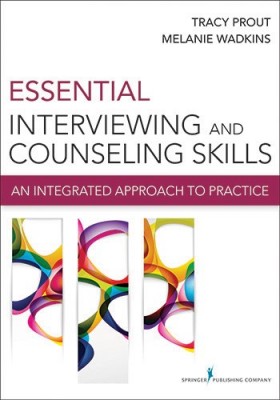 Essential Interviewing and Counseling Skills is a helpful resource for facilitating an understanding of integrative counseling methods. Moving beyond theory, this book not only explains the relevance of integrative methods, but also fosters the application of an integrative approach. The book is divided into four sections which incrementally guide the learner in developing essential knowledge and skills. Titled “Building the Foundation,” the aptly named first section provides important aspects of interviewing, ethics, case conceptualization, selecting interventions and diversity issues. After acquiring foundational skills, the reader is prepared to transition to learning the importance of developing a counseling relationship. In this segment, the reader learns core counseling concepts such as reflecting, conveying empathy and strengthening the therapeutic alliance. The third section assists the learner in connecting with the client and promoting change. Within the areas of assessment, diagnosis and treatment planning, the authors provide the reader with expansive insight into goal setting, wellness, emotionality, the nature of the therapeutic relationship and helpful techniques. The final section concludes with termination considerations for a variety of counseling modalities such as group, school, career, family and forensic counseling. Additionally, the authors highlight methods of crisis intervention and suicide prevention.
In accordance with integrative practice, the writers provide a distinctive section that assists the learner in developing a unique counseling style. The format of the book emphasizes the essentiality of continued education and notes the importance of professional development via conferences, workshops, seminars, certifications, networking, supervision and self-care. The seamless progression of this book from chapter to chapter is helpful in utilizing a developmental teaching perspective in counselor education. The authors provide case examples and multicultural perspectives throughout the text to assist in the learning process. In addition, skill boxes with learning exercises, resources and reflections are sprinkled throughout the book, which aid in threading the learned material into practice. Furthermore, several of these skill boxes include web applications through which the reader can venture beyond the text.
The authors certainly achieve their intention of providing knowledge in a manner that is easily accessible to a beginning audience. The range of information from acquiring basic skills to integrating methods makes this book suitable for the counseling trainee, novice counselor or clinician seeking guidance in expanding and integrating practice. The skills-focused, reflective style of this text may also be helpful to the experienced counselor looking for fresh approaches to counseling. Chapters are equipped with reviews, personal reflections, keywords and suggestions for further reading that may assist the counselor educator in developing or facilitating training courses. On the other hand, due to the skills-focused approach, this text may be insufficient for training courses that aim to encompass the depth of counseling theories. Overall, the authors provide a wealth of information to assist in counseling training. Students in counseling training programs will find Essential Interviewing and Counseling Skills a helpful guide in expanding their clinical toolbox.
Prout, T., & Wadkins, M. (2014). Essential interviewing and counseling skills: An integrated approach to practice. New York, NY: Springer.
Reviewed by: Shainna Ali, doctoral student in counselor education, University of Central Florida, Orlando, FL.
The Professional Counselor
https://tpcwordpress.azurewebsites.net
May 6, 2015 | Video Reviews
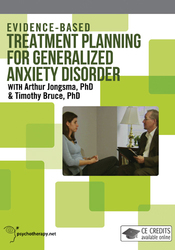
In their comprehensive and user-friendly video, Evidence-Based Treatment Planning for Generalized Anxiety Disorder, Drs. Arthur Jongsma and Timothy Bruce provide a core foundation for understanding as well as treating generalized anxiety disorder—all within 70 minutes. Additionally, the authors adequately demonstrate how research can be translated into practice by using an evidence-based framework to treat symptoms consistent with generalized anxiety disorder. Other benefits include the transcript provided with the video because it enables viewers to follow along with ease, as well as provides the variety of learning methods included in the video, such as the dialogue throughout the interview, PowerPoint slides, and case vignettes that include exchanges between a practitioner and client.
In order to provide their audience with an organized, step-by-step guide for counseling an individual presenting with generalized anxiety disorder, Bruce and Jongsma (2012) incorporate six modules and four clinical vignettes to best illustrate their treatment practices. Specifically, the authors address DSM criteria and related clinical features, provide a historical framework that highlights the movement towards empirically supported treatments, emphasize key elements for treatment planning, target relapse prevention, and utilize a six-step treatment planning process grounded in evidence-based practices. Throughout the video, terms are clearly and explicitly defined.
In addition to highly educational information, Bruce and Jongsma (2012) include a multitude of clinical references, online resources, and concise yet extremely applicable case vignettes. In this video, the four various vignettes provide specific examples for how behavioral definitions, long-term goals and short-term objectives are used when working with clients, all while meeting the standards for empirically supported treatments. For example, in the first vignette, relaxation is demonstrated by using a guided imagery procedure that also incorporates body scanning and cue words to help the active and tense mind experience relief. In the second and third vignettes, stimulus control and worry time are targeted, with examples that can be applied to daily life. Similarly, the authors clearly show how evaluating the evidence, predicting the likelihood, and exploring best- and worst-case scenarios can help reduce generalized anxiety. In the final vignette, a role play is used while working through a sample treatment plan. Relapse prevention is also included.
The strengths of this video are clearly evident, yet it is also important to note several limitations and growth opportunities for future videos and related resources. First, it would be helpful to include a vignette before the 30-minute mark, as a vignette truly captures the attention of the audience and also makes it easier to translate theory into practice. Second, while discussing short- and long-term goals, it would be helpful to describe measurement and strategies for evaluation. Third, the client in the vignette seemed highly receptive, willing and ready to change. For at least one vignette, the therapist(s) may consider working with a client who feels stuck or who exhibits some resistance or hesitation in using imagery or postponing worry.
In summary, Evidence-Based Treatment Planning for Generalized Anxiety Disorder is an excellent resource for practitioners counseling clients presenting with anxiety. It is a hands-on resource and provides a comprehensive guide to treating generalized anxiety disorder while also using empirically supported treatments. Both beginning and veteran clinicians are sure to benefit from this video.
Reviewed by: Mary-Catherine McClain, The University of Georgia Counseling and Psychiatric Services Center.
John Wiley & Sons (Producer). (2012). Evidence-Based treatment planning for generalized anxiety disorder with Arthur Jongsma, PhD & Timothy Bruce, PhD [Streaming video]. Retrieved from www.psychotherapy.net
Available in streaming format and as part of video subscription at www.psychotherapy.net/subscriptions.
The Professional Counselor
https://tpcwordpress.azurewebsites.net