Dec 2, 2014 | Book Reviews
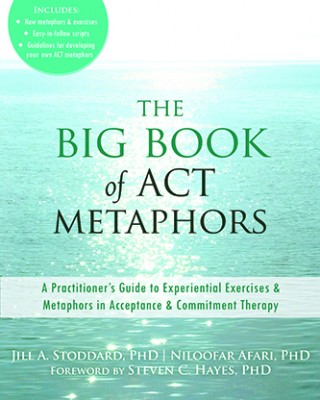 Acceptance and commitment therapy (ACT) has received significant research attention over the past decade and also been used frequently to treat individuals presenting with a variety of clinical concerns ranging from chronic pain and diabetes management to severe depression and substance abuse. In The Big Book of ACT Metaphors: A Practitioner’s Guide to Experiential Exercises and Metaphors in Acceptance and Commitment Therapy, Jill A. Stoddard and Niloofar Afari provide a comprehensive A–Z resource guide for practitioners, trainees and others in the counseling profession to use when working with clients. Additionally, novel metaphors, new experiential exercises and detailed scripts were collected from the entire ACT community to make this a collaborative endeavor and to provide a “one-stop” shop for all.
The book includes nine chapters and 202 pages of material, as well as 10 appendices, additional resources and a complete list of references. The first two chapters provide a brief introduction to Relational Frame Theory (RFT) and specifically explain how ACT is rooted and theoretically grounded in this model. The reader learns about the six core therapeutic processes and the ACT hexaflex. The authors also adequately discuss the function of metaphors, how to create therapeutic metaphors and how to effectively deliver tailored metaphors in treatment. Chapters 3 through 8 provide a more in-depth description of each of the six core ACT processes. Chapter 3 covers acceptance and willingness while chapter 8 focuses on committed action. The other core processes include cognitive defusion, present-moment awareness, self-as-context and values. In each of these chapters, the authors summarize the core process and provide brilliant exercises, metaphors and scripts for the reader, specifically showing how this theory and approach can be translated into practice. The final chapter ties it all together by summarizing and reviewing material from the first eight chapters and also by using a sailing boat metaphor to demonstrate how multiple core processes can occur in counseling. The authors address general guidelines for tailoring metaphors and common stumbling blocks.
While numerous ACT textbooks and workbooks are available, this book is essential for any current or future ACT practitioner. In addition to including over 100 metaphors and exercises, Stoddard and Afari have beautifully organized the content in this book and matched each exercise or metaphor with its respective core process (e.g., values, committed action). The authors go above and beyond to cite the source from which the material was collected and even provide specific page numbers in order to assist the reader in obtaining previously published material. The inclusion of material that can be used for both group counseling and individual sessions represents a strength of the book. Each chapter is concise, easy to read and detailed enough for even the most novice counselor to replicate in session. In addition to the book’s numerous strengths, the authors may consider adding a chapter in future editions on the role of culture and incorporating additional multicultural metaphors and exercises to utilize in practice, ultimately fostering more cultural dialogue and a stronger therapeutic alliance with clients engaging in treatment.
In summary, this practical, useful and relevant book provides an excellent foundation and guide for new clinicians and also a one-stop shop for well-seasoned ACT counselors. Whether as a trainee, clinician, researcher, supervisor or professor, there is something in this book that you can benefit from and can add to your current toolbox.
Reviewed by: Mary-Catherine McClain, The University of Georgia, Athens, GA.
Stoddard, J., & Afari, N. (2014). The big book of ACT metaphors: A practitioner’s guide to experiential exercises & metaphors in acceptance & commitment therapy. Oakland, CA: New Harbinger.
The Professional Counselor
https://tpcwordpress.azurewebsites.net
Dec 2, 2014 | Video Reviews
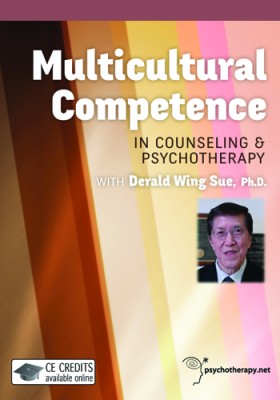 Multicultural Competence in Counseling & Psychotherapy delves into key aspects of multicultural counseling via an interview with Derald Wing Sue conducted by Victor Yalom. In just under an hour and a half, they explore the following topics: color-blindness, micro-aggressions, developing cultural competence, the race lab, the invisible white man, and the caterpillar and the ant. Each discussion offers viewers a candid analysis of these phenomena and their relevance to competent counseling practice.
Throughout the existentially grounded interview, Sue validates personal and developmental challenges as part of the process of building cultural awareness, knowledge and skill. Sue consistently invites viewers to confront roadblocks to culturally competent practice such as taking a colorblind approach for fear of appearing racist, rigidly apply theories and techniques, experiencing implicit bias, or failing to anticipate our social impact on clients. He also offers practical suggestions for counselor educators, supervisors and trainees such as the use of recording, integration of experiential reality in training and supervision, creating validating and inviting office spaces, and striving for authenticity and reflexivity in practice.
In particular, Sue addresses concepts that inform counselor education and supervision practice through identification and discussion of both challenges and strategies in fostering cultural competence among counselor trainees. Thus, this video is ideally suited for doctoral students and could be used as part of the didactic curricula in courses focused on pedagogy, supervision, leadership and advocacy, or during doctoral fieldwork as students intern as instructors and supervisors. Likewise, the compelling combination of instructional content blended with Sue’s perspective and insights lends itself well to master’s-level counseling courses focused on multicultural counseling and advocacy or fieldwork. Sue’s expertise and personal disclosures have the potential to crystalize concepts for counselor trainees, normalize the challenges of developing cultural competence and inspire students to commit to a continual journey toward cultural competence.
Multicultural Competence in Counseling & Psychotherapy is well suited for classroom use or as an accompaniment to lessons or assigned readings for students engaged in distance learning. It should be noted that while the video can be viewed in one or two sittings, the concepts addressed are complex and may be more than students can digest in one or two sittings. It also should be noted that while the organization of chapter segments may be useful in selecting sections to include in class sessions or to accompany readings, some of the chapter divisions split related content. For example, Sue begins discussing the four major goals of training in the chapter on developing cultural competence and continues in the chapter on the race lab.
Yalom’s interview of Sue provides a platform to evoke Sue’s personal and professional experience as a pioneer in our field. Thus, as Sue addresses each phenomenon, he contextualizes it in a manner that supports a full understanding of its integral relevance to multicultural counseling and therapy. For example, Sue reflects on coming to a Eurocentric field with culturally bound theories and values that not only failed to account for cultural diversity, but also contributed to pathologizing it. The inclusion of his experience exemplifies the problem for viewers, sheds light on the courageous and vital work he and others have done, and underscores the charge to each of us to practice cultural competence and advocacy as counselors, educators and supervisors.
Reviewed by: Amie Manis, NCC, Capella University.
Psychotherapy.net (Producer), & Yalom, V. (Director). (2014). Multicultural Competence in Counseling & Psychotherapy with Derald Wing Sue [DVD]. (Available in DVD and video streaming from http://www.psychotherapy.net/video/multicultural-competence-psychotherapy-sue)
Available in DVD and streaming format as part of video subscription at Psychotherapy.net/subscriptions.
The Professional Counselor
https://tpcwordpress.azurewebsites.net
Dec 2, 2014 | Book Reviews
 When most experts in a field state that they “wrote the book” on a topic, it is merely a complimentary figure of speech; however, Dr. Virginia B. Allen has literally written the book on professional counselors working within the legal system. Drawing on more than 20 years of experience as a professional counselor working within the family court system, Dr. Allen has developed a comprehensive review of the field of forensic counseling titled Counseling in the Family Law System: A Professional Counselor’s Guide. At first glance, I thought this book would detail how counselors could collaborate with other professionals working within the legal system to advocate for clients, but that impression was only partially correct. I did not realize that professional counselors could play an integral role within the family court system as advocates for children and evaluators in custody suits, work as mediators between aggrieved parties, and operate as case managers within the judicial system.
In the first part of the guide, Dr. Allen explores the foundations of forensic counseling and the family law system, defining forensic counseling and providing a greater understanding of legal terminology and the various functions that professional counselors can perform in this venue. She works to dispel many myths associated with working in the family law courts, and also highlights the realities of these positions. As with any area of specialization in the counseling field, it is important to understand the scope of practice for such work, and Dr. Allen clearly outlines the types of training needed to prepare for this area of counseling. Likewise, she discusses ethical considerations for the positions of case managers, mediators and custody evaluators. Additionally, she explores the standards of practice outlined by the Association of Family and Conciliation Courts.
The second part of the book focuses on the basics of counseling practice within the field of family law. This section is extremely useful to beginning counselors in this field or to those who might be contemplating a transition to this area of practice, as it provides practical examples of interviewing basics and the forms of report writing required. Continuing to draw on her own expertise, Dr. Allen guides the reader through the process of working a case, as well as understanding and conducting special circumstances cases. She describes how to provide testimony, prepare for a case, professionally present oneself in court, and build professional relationships with lawyers and judges within the system.
The only limitation of this book, if it could be called that, is the fact that there is little published material to which one can compare it. Counseling in the Family Law System is the first book of its kind to guide professional counselors through the family court system and to provide an understanding of how to prepare for and practice within this specialized field. Overall, I came away with a new perspective on the possibilities for practice as a professional counselor. I admit that I was not aware of this specialty area and the degree to which counselors are already prepared to enter this field, possessing the ability to communicate effectively with others from varying age groups and culturally diverse populations, the skill to advocate on behalf of clients of all ages, and the experience to evaluate clients and to appropriately mediate disparate views or competing interests. Based upon her training and extensive experience in the profession, Dr. Allen opens the field of forensic counseling to new practitioners and to established professionals alike, and to the possibilities for expanded practice in the field of professional counseling.
Allen, V. B. (2014). Counseling in the family law system. New York, NY: Springer.
Reviewed by: Michael A. Keim, NCC, University of West Georgia, Carrollton, GA.
The Professional Counselor
https://tpcwordpress.azurewebsites.net
Dec 2, 2014 | Book Reviews
 Multiculturalism and Diversity in Clinical Supervision: A Competency-Based Approach, the potential for mixing two very complex domains into one complex book is certainly present.
Fortunately, there are portions of this book that break down both multiculturalism and supervision into realistic ideas that can be infused into anyone’s personal counseling or supervision style. Whereas some supervision texts are hyperfocused on steps and actions that must be taken to become a competent supervisor, Multiculturalism and Diversity in Clinical Supervision: A Competency-Based Approach takes a step back, instead invoking a more wide-angle view of the supervision process and how multiculturalism is central throughout it. This comprehensive approach is most readily apparent in Chapter 2, where the authors illustrate supervision and culture as interwoven circles in which the client’s, the counselor’s and the supervisor’s personal and cultural values collide within every interaction. Furthermore, the author breaks down each of these levels using vignettes and examples to show the reader how these different areas connect and collide with one another. While this information does not give a map or guideline of how to conduct supervision, it does invoke further contemplation about how one’s own personal tendencies and others’ backgrounds can affect the supervision process, a topic that is often skimmed over in traditional supervision literature.
While the focus of this book is unique and much needed in the supervision literature base, there are some limitations to how the authors structured the text, the most notable of which is that this book is clearly geared toward psychologists and not counselors. For a new or novice supervisor, this omission may prove problematic, as the basic building blocks of supervision for counselors are absent.
The second critique of this book is the creation of its chapters. Instead of following a traditional outline in which each chapter builds toward the next, further elaborating and clarifying ideas from the previous chapter, this text reads more as a series of disconnected articles that have been compiled into one volume. Therefore, each chapter is self-contained, with its own beginning, middle and end, as well as its own particular writing style. The lack of continuity makes this text a somewhat arduous read at times.
But overall, the macro-level focus of Multiculturalism and Diversity in Clinical Supervision: A Competency-Based Approach is a refreshing outlook on how the personal and cultural qualities of counselor and supervisor intertwine within the supervision process. On one hand, the manner in which this book is written may make it a difficult selection for counselors and counselors-in-training who do not yet have a solid foundation in counseling supervision. On the other hand, counselors and supervisors who are up to date on the current counseling supervision literature may find that the ideas within this book can spark self-reflection on how their own personal qualities and cultural orientation arise in the supervision process.
Reviewed by: Mark P. Eades, NCC, University of North Carolina at Greensboro, Greensboro, NC.
Falender, C. A., Shafranske, E. P., & Falicov, C. J. (Eds.). (2014). Multiculturalism and diversity in clinical supervision: A competency-based approach. Washington, DC: American Psychological Association.
Dec 2, 2014 | Book Reviews
 Philip Brownell starts Spiritual Competency in Psychotherapy with a quote from the Bible, which may put off some non-Christian counselors. However, he issues a disclaimer early in the text that although he brings in excerpts from other religious leanings, he generally discusses what he knows best—Christianity. The book, divided into three parts, has eighteen chapters that describe spirituality and religion according to both older and more recent religious beliefs.
The first part of the book includes the first through the fifth chapters. Brownell delves into spirituality through the lenses of three faiths—Judaism, Christianity and Islam. He journeys with the reader through Eastern philosophies to the New Age movement. Brownell then discusses the similarities and differences between spirituality and religion, and makes it clear that though many apply the two terms interchangeably, clear differences exist. He touches on spirituality and religion from the psychological, philosophical, theoretical and coherentist points of view. He ends the first part of the book by discussing the process of personal spirituality and ethical issues for the various helping professions. Brownell uses the diagram of a strand of DNA to explain spirituality and religion as both a process and a relationship. Using personal anecdotes, he takes the reader through the process of spirituality and religion, and growth in spiritual maturity. Though Brownell does not advocate counselors necessarily sharing their clients’ spiritual and religious practices, he implores counselors to understand how these play a part in clients’ make-up.
In part two of the book, Brownell writes about how spirituality looks in therapy, providing a face for therapy in practice, especially from the Christian perspective. He admonishes counselors to “treat religious experiences as legitimate” (p. 50), but encourages them to question these experiences respectfully enough to know which aspect can be used to help clients. He avers that spirituality is more personal and individual, whereas religion is a communal experience. He provides examples from various religious beliefs to explain these differences to the counselor inclined towards spiritual competency. Much as researchers in multicultural competency in therapy advocate areas for counselor concentration, so Brownell urges counselors to be aware of their own assumptions, biases, behaviors and values, as they recognize how similar and/or different they may be from their clients.
Part three of the book deals with common spiritual issues encountered in therapy. Brownell approaches this part from an existential perspective and establishes that every counselor can grow in spiritual competency to help clients achieve the help they need. The section would have been complete with case studies of counselors applying spiritual competencies with clients from various religious orientations, but Brownell provides additional information. He urges counselors to work especially in the here-and-now with clients and reaffirms what most research on client outcomes indicates as helpful—making connections with clients. Brownell demonstrates how spiritual competency endows counselors with skills necessary to help clients take bold steps and explore uncertain areas in their lives. Finally, Brownell addresses a sensitive topic in religious circles—the abuse of clients by religious leaders. He emphasizes the burden upon counselors in upholding the trust of clients, and also encourages counselors to work with religious leaders to benefit clients. Brownell points out that counselors deal with clients as well as their faith community and what that faith teaches. Counselors are not to act as theologians or evangelists but are encouraged to discover how clients interpret their faith and how this interpretation manifests in therapy. He ends the book with a look at death—that of both clients and their loved ones—and counselors’ role in providing support for clients’ meaning making.
In summary, Brownell’s book advocates for the need to combine ethical codes in any helping professional field with good judgment and knowledge of various religious beliefs. Though many examples are Christian-based, the book is still relevant for both the beginner and expert counselor. It is fashioned in a way that allows the reader to move to any chapter that addresses his or her particular needs. Although Brownell discloses his Christian background early on, he does not approach the subject of spirituality with the emphasis one might have expected from a minister.
Reviewed by: Hannah E. Acquaye, doctoral student in counselor education, University of Central Florida, Orlando, Florida.
Brownell, P. (2015). Spiritual competency in psychotherapy. New York, NY: Springer.
The Professional Counselor
https://tpcwordpress.azurewebsites.net