Oct 15, 2014 | Article, Volume 3 - Issue 1
Ryan F. Reese, J. Scott Young, Gerald A. Hutchinson
To date, few scholars in counselor education have attended to the processes and impacts of introducing business-related concepts within counseling curricula. The authors describe the development, implementation and evaluation of a graduate-level course titled Entrepreneurship in Clinical Settings wherein students were tasked with producing a business plan for their ideal clinical practice. Implications and recommendations are explored.
Keywords: entrepreneurship, private practice, problem-based learning, clinical settings, counselor education
Recent attention in mainstream professional counseling has brought to light the complexities of establishing and maintaining a successful clinical practice (Shallcross, 2011). Developing and sustaining a caseload through a referral base, deciding whether to buy or rent office space, and identifying a marketable niche are just a few of the many challenges practitioners face in establishing a counseling practice. Despite the complex nature of counseling practice that requires a competent understanding of foundational business concepts, limited literature exists within counselor education to address the importance of preparing counselors to succeed in private practice (Reynolds, 2010). A search for business failure rates for 2012 revealed that only 47.6% of services business, of which a counseling practice is one type, survive for five years (Shane, 2012), meaning that less that one of two counselors who begins a clinical practice will be in business five years hence. Relatedly, researchers within the field have noted that mental health practitioners have been economically naive and must expand conceptualizations of potential applications of psychological treatment, stressing the need for counselors to become more entrepreneurial (Cummings, Cummings, & O’Donohue, 2009). The development of scholarly writing around business-related concepts in counselor education might help counselor educators better prepare counselors to develop competencies related to successfully developing and running a clinical practice. Although there is a dearth of such writing at present in counselor education literature, scholars within related professions (e.g., social work; Green, Baskind, Mustian, Reed, & Taylor, 2007) have highlighted the lack of preparation that students in their fields receive in developing and managing a clinical practice and are taking steps to increase training in business-related practices. In a survey study (N=261) conducted by Green and colleagues with social work graduate stakeholders (e.g., graduate students, graduate-level deans, private and agency-level social workers), nearly 66% of graduate students intended to enter private practice, yet none of the graduate schools surveyed taught content associated with the establishment and management of a clinical practice. A similar lack of literature regarding entrepreneurship in counselor education settings would suggest that a quandary exists in programs preparing counselors for professional private practice enterprises.
Current educational standards within programs accredited by the Council for Accreditation of Counseling and Related Educational Programs (CACREP) do not require that students complete coursework in the business-related aspects of professional counseling. However, counselor educators who would like to provide students with practice management training cite the CACREP (2009) standards to support the infusion of business-related concepts into current courses or even in the development of a new graduate course. For example, the standards state that upon graduation from a CACREP-accredited program, a student pursuing a clinical mental health counseling track “understands the roles and functions of clinical mental health counselors in various practice settings” (CACREP, 2009, Code A.3; p. 30). That is, students will understand how to function in clinical settings, which includes private practice. In addition, the standards state that a student “understands the management of mental health services and programs, including areas such as administration, finance, and accountability” for their roles in counseling settings (CACREP, 2009, Code A.8; p. 30). Thus, the standards encourage students to gain an understanding of the technical aspects of professional counseling that can include an understanding of developing and maintaining a successful counseling practice. Offering students opportunities to gain practice management skills and competencies within counselor education programs might better prepare them to one day develop their own counseling practices.
Without an exhaustive survey, it is not known how many counselor education programs cover any of the business-related skills of clinical practice. What is certain is that in the United States nearly 20% of all small businesses do not survive past their first year and only 44% of small businesses survive to see their four-year anniversary (Knaup & Piazza, 2007). As of August 1, 2011, of the 42,926 American Counseling Association (ACA) members reporting their work settings, 10.45% described their full-time work setting as private practice and 4.1% described their part-time work setting as private practice. In sum, 14.5% of current ACA members who reported their work setting described themselves as working in private practice (C. Neiman, personal communication, August 15, 2011). Given the high failure rates for small businesses in the service sector and the fact that nearly one in seven counselors describe themselves as conducting private practice, counselor education programs should consider placing a higher emphasis on facilitating the development of knowledge and skills associated with the successful creation and management of a clinical practice.
To address this lack of training, the authors developed and implemented a graduate-level elective course titled Entrepreneurship in Clinical Settings open to both masters and doctoral-level students enrolled in graduate-level helping profession programs (e.g., counselor education, clinical psychology, social work, nursing, kinesiology, etc.) at a university located in the southeast United States. Those actually enrolled in the course included masters and doctoral-level students from counselor education. The course was advertised as an opportunity to obtain the knowledge needed to develop and run a successful private practice. The purpose of developing the course was to advance students’ knowledge and related skills in formulating an individualized business plan for establishing a clinical practice and thereby preparing them to successfully manage a small business.
The purpose of this article is to provide counselor educators and other interested readers with the information needed to adapt or develop a similar course or workshop that fits the needs of their counselor preparation programs. Subsequently, the development, implementation, evaluation and implications of a clinical entrepreneurship course specifically designed to assist students in the acquisition of the knowledge and skills necessary to develop a counseling practice in their desired setting are described.
Entrepreneurial Pedagogy
The semester-long course was co-taught by a counselor educator (second author) and a leadership consultant working in private practice (third author). The course was developed from a pedagogical structure grounded in problem-based learning (PBL) (Albanese & Mitchell, 1993). PBL typically involves the presentation of a set of carefully constructed problems to a small group of students consisting of observable phenomena or events that need explanation. The task of students is to discuss these problems and produce explanations for the phenomena (Norman & Schmidt, 1992). PBL has been implemented in a variety of educational contexts including medical training (Albanese & Mitchell, 1993), teacher preparation (Brocato, 2009) and counselor education (Stewart, 1998). With PBL, the instructor places the ownership of learning directly into the hands of students by posing a problem they must solve prior to the learning of concepts that will assist them in solving the problem (Bouhuijs & Gijselaers, 1993). Subsequently, PBL relies not on didactic instruction but on the provision of resources to aid students in developing practical knowledge needed to solve the problem at hand (Savery, 2006). Within a PBL teaching framework, the instructor is viewed as an expert resource that facilitates critical thinking by asking guided questions and providing feedback as students attempt to solve the problem at hand rather than lecturing about predetermined material (Stewart, 1998). For this course, the instructor (second author) who was a counselor educator also had over 15 years of experience as a part-time private practitioner providing counseling to children, adolescents and adults as well as couple and family counseling. He had successfully established counseling practices in two states treating a wide array of clinical issues, was knowledgeable about billing, insurance panels, marketing, accounting and related issues, had completed training in PBL pedagogy, and had extensive training in business (e.g., a B.A. in business administration). The co-instructor (third author) had obtained a Ph.D. in counselor education and supervision and spent over 15 years as a leadership development consultant to persons in positions of leadership in private industry. He had owned his own successful consulting firm for 12 years, possessing extensive training in executive coaching, consulting and leadership enhancement.
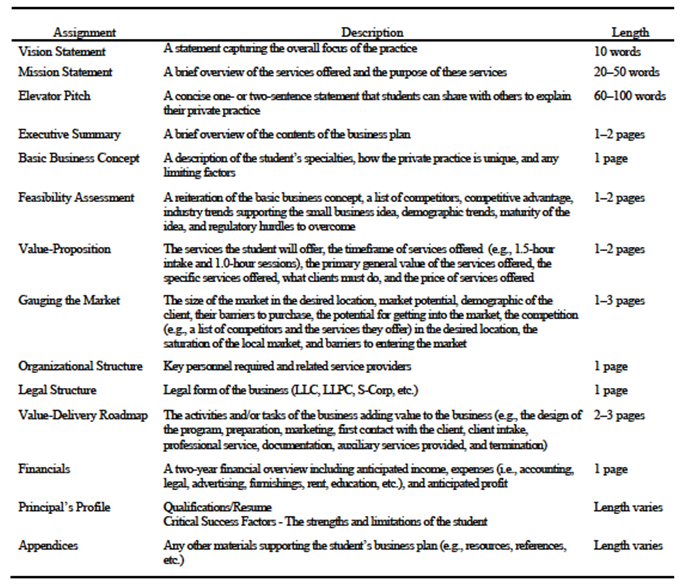
For the Entrepreneurship in Clinical Settings course, students were charged with formulating the specific components of a business plan (see Table 1), which required them to creatively align their own interests with the plan elements while accounting for practical factors that would facilitate or hinder the success of their plan. To meet this goal, each student developed a series of proposals to address the assigned problem, and then worked in small groups to challenge one another through a cyclical feedback process enhanced through the progressive acquisition of relevant knowledge. The PBL cyclical feedback process is hallmarked by the development of multiple iterations of proposals in response to the problem presented by the course instructor (Brocato, 2009). The proposals are presented for peer, self and instructor feedback in a repeating cycle until an end or desired product is developed.
Table 1
Business Plan Outline
The PBL approach was utilized for this particular course because the goal of the course was for students to develop, maintain and enhance a sense of ownership over their visions for a counseling practice they hoped to pursue. Students were challenged to develop their business plan through multiple iterations of their proposal informed by course readings, in-class discussion, guest lectures, and peer and instructor feedback. The course and its structure are described below.
Learning Goals and Objectives
The primary learning goal of the course was to support students as they labored through the PBL approach to develop a detailed business plan relevant to their identified area of focus for a counseling practice (e.g., men in transition, couples and family, children, women’s issues). This goal was addressed by meeting the following objectives taken from the course syllabus, all of which provided students with practical knowledge about the development of a counseling practice:
1. Students will articulate the benefits and problems associated with starting a counseling practice and/or provide self-employed private services as an adjunct to other employment.
2. Students will think critically about entrepreneurship and the role of business in society.
3. Students will establish a coherent counseling practice value-proposition and a profitable value-delivery model.
4. Students will analyze the options for financing a counseling practice (e.g., grants, public monies, private funds).
5. Students will analyze the importance of marketing and its role in a successful business.
6. Students will understand the basics of business budgeting, bookkeeping and third-party payments.
Course Structure
The course utilized two textbooks that served as foundation for class discussion and weekly reading assignments. Grodzki’s (2000) Building Your Ideal Private Practice is a self-help book directed toward practitioners in the helping professions who wish to improve upon or develop their own counseling practices. Readings also were assigned from the textbook Entrepreneurial Small Business (Katz & Green II, 2011), which was written for students taking a course in entrepreneurship. These texts served as key resources to students in developing their business plans.
The instructors approached class time from the PBL framework, affording students the opportunity to critically think alone and within group settings about the feasibility of their individual counseling business-related ideas. Prior to each class students worked on one aspect of their business plan (e.g., vision statements, feasibility assessment, value proposition); these assignments served as the focus of class activities. Class time was structured to include substantial peer and instructor feedback, occasional guest speakers, mini-lectures by instructors on topics related to an aspect of the business plan, and student presentations. The instructors approached the class from a Socratic rather than a didactic style in order to provide students with the opportunity to take full ownership over their business ideas and plans. Because the course content could be covered efficiently and because the PBL design allowed for students to work independently, the class met two to three times each month for two hours each session; there were a total of ten sessions across the semester for the two–semester hour course.
Elements of class included brief, interactive PowerPoint presentations with handouts as a way for the instructors to bridge the gap between students’ lack of knowledge of business-related concepts and their developing business plans. In order to add an out-of-class component to student interaction, students used a classroom online forum (Blackboard Learning Technologies) where they posted 500- to 800-word reflections about assigned readings. In addition, students were required to provide feedback regarding the postings of two peers in order to provoke additional intellectual challenge to the reading-learning assignments. Beginning in the second class session, students provided one another in-class feedback about each assignment leading up to the final business plan; this feedback was transmitted in the form of peer reviews in pairs or in triads. Near the end of the course, students provided written feedback to a peer on a draft of their partner’s business plan, which was composed of all of the assignments up to that point. In the final class meeting each student presented his or her completed business plan and responded to comments and questions by fellow course participants from the perspective of “would you invest start-up money in this practice/ business concept?” The idea was that a well-developed and clearly articulated business plan could be used to seek startup investment if needed (Grodzki, 2000). Such an environment was facilitated to help students present clear and concise descriptions of their hypothetical counseling practices. Finally, guest speakers joined class discussions on two different occasions. One speaker was a counselor who had founded and ran a successful counseling practice that provided an array of clinical services including individual, group, and family counseling; in-home counseling; trauma-focused CBT; child-parent psychotherapy; grant-funded parent skills and development; mental health consultation to Head Start; safe touch programs; school-based counseling; as well as traditional insurance-based fee-for-service outpatient counseling. This practice employed multiple counselors, and the speaker provided students a rich sense of entrepreneurial possibilities that exist with a clinical practice. The other speaker ran a successful coaching and business development practice designed to assist mental health practitioners in developing or expanding their own clinical practice.
Class Assignments
Students developed their full business plans by completing a series of related subcomponent assignments outside of class that were discussed and critiqued in class. A brief overview of assignments regarding the development of the business plan is described in Table 1. The first two weeks of the course were dedicated to students thinking about and sharing their broad counseling practice ideas and narrowing these ideas into vision and mission statements that required the development of clarity as to the nature and scope of their proposed practice, including constituents served and market niche. Students were encouraged to contact and interview clinicians in private practice in their community of interest to provide greater clarity into their potential market niche and ask different questions related to the practitioners’ business structures. Students completed several iterations of their vision and mission statements and shared these in pairs and with the class. Students were then assigned a task from the Grodzki text to develop an “elevator pitch” for the practice, which was a brief, one- to two-sentence statement regarding the nature of the practice that an uninformed person could understand. The intention of developing such a statement was, according to Grodzki, to help students describe their practices in plain, nontechnical language that the potential consumer could easily grasp (i.e., “I work with couples and families who are tired of being tired and looking for a new way of doing their relationships”). Students shared, critiqued and modified these statements several times following the PBL model. Another assignment asked students to identify their perceived level of business-related competencies through completion of a business and technical skills self-assessment (e.g., sales, accounting, industry expertise, market knowledge) (Katz & Green, 2011, p. 61). This self-assessment served as an important foundation for a discussion that allowed students to share and normalize comforts and discomforts associated with their own self-efficacy in regard to business- and counseling-related competencies.
The feasibility assessment assignment challenged students to think critically about the viability of their proposed vision and mission statements by identifying their market niche, conducting an industry profile (i.e., identifying competitors), forecasting their one- and two-year expected revenues and examining market conditions in the location of their intended practice. Students found this assignment challenging because it forced them to achieve specific clarity about their mission and vision statements. The instructors responded to student needs in the development of the fundamental vision for their business by allowing students to progress on their assignments at a somewhat different pacing. Given the high-stakes nature of business feasibility, it was important not to arbitrarily rush this step to completion.
After students had developed clear mission statements and conducted feasibility assessments, the assignments flowed more cohesively. The subsequent assignment directed students to ascertain risk management strategies by identifying appropriate professional credentials, professional liability insurance, legal structure for their practice and a financial strategy for the business (e.g., self-pay, private insurance, grants, Medicaid). Students then were challenged to articulate a value proposition for their business by indicating how aspects of their practice would add value for their clients (i.e., what a client could expect to receive for the time and resources invested). Next, students developed marketing strategies, modeled how they would deliver value, and identified the time, logistical, regulatory, economic and expertise constraints that their practices would operate under. They also specified particular support that would be necessary to make their businesses thrive, including accounting, legal and any other relevant services to position their practice for success.
In week eight students developed a budget and financial plan to determine how much capital they would need to sustain the business to profitability over a two-year span. During the final two weeks of the course, students completed their business plans and provided one another detailed feedback about those plans. In the final iteration of their business plan, students identified critical success factors, including their strengths and areas for growth to help them succeed in implementing their plans.
Use of Class Time
Typically, the first 10–15 minutes of class were utilized to discuss students’ questions about business plan components that were the topic during that class. All students presented to the class a progress update on their business plans. This allowed students to provide one another with rich feedback and suggestions in tackling components of the plan. The instructors often placed students into dyads or triads for 20–30 minutes and asked students to provide thoughtful, yet honest feedback on their partners’ work. As this occurred, the instructors would listen in and provide strategic feedback in attempts to promote group interaction and group problem-solving. The class would reconvene and present overlying concerns that ran across business plans and consider how these concerns might be addressed in the next iteration of the plan. In the latter weeks of the course, the instructors invited several guest speakers to talk about their experiences in private practice. Class generally ended with a discussion of the upcoming aspect of the business plan, how students might approach this exercise, and brainstorming of resources that might assist students in answering questions.
Course Effectiveness: A Qualitative Exploration
Because the material in the course as well as the PBL pedagogy is likely unfamiliar to many counselor educators, below we provide readers what we consider to be key learnings for instructors as well as important feedback from students. Following the conclusion of the course, 12 qualitative interview questions were developed to collect feedback associated with the beneficial and/or challenging aspects of the course, fulfillment of course purposes, the utility of course activities, the evaluation of readings, the impact of the course on students ability to develop a business plan, and recommendations for improvements. A counselor educator with experience in developing qualitative interview questions provided feedback on the questions prior to data collection. The primary author completed semi-structured interviews with all students lasting from 15–30 minutes. Interviews were audio-recorded and later reviewed to capture general themes.
Collectively, students articulated that they benefited from the conversational and practical tone of the class, profited from developing a business plan in their interest area regardless of whether the student was a second-year master’s student or a seasoned counselor and desired a more robust bridge to connect business-related information to their plans. If one is considering teaching such a course, the points below may provide clarity and guidance for making decisions as to the structure of the course and how to facilitate student learning in this rather nontraditional approach to education.
It’s simple, but it isn’t easy. The challenge in teaching this course was not assisting students in gaining mastery over the content; rather, the difficulty lies in helping students apply the content to their unique situation. Much like providing clinical supervision or leading groups, this graduate course was as much about the process as about skill mastery. Although students expressed anxiety about the business-related terminology and concepts, terms introduced in the course were kept basic and easy to understand. However, students did struggle with gaining personal clarity about the type of clinical practice they hoped to create and then matching that clarity to a method of providing services. Overall, students felt confident in their abilities to implement their business plans by the end of the course. One student stated, “I have developed a clearer understanding on what my practice will look like and confidence in what it will look like to get there.”
Students further commented on how learning and applying business concepts were less familiar to them compared to counseling concepts. Students found the Grodzki (2000) text to be written in accessible language and characterized as inspirational in the way business concepts were clearly translated. Students further described Grodzki’s writing as inspiring, provoking them to “dream big,” and a text that one “would have picked up in the bookstore.” Conversely, students (and instructors) described the Katz and Green II (2011) reading as more challenging as it was written as a textbook for business school majors. One student indicated her preference for an “entrepreneurship for dummies kind of book” that would allow her to access and understand business concepts more readily. Such feedback suggested to the instructors that in future offerings of the course reader-friendly texts that are related to counseling and fostering students’ confidence are important. Less technical information may be a better fit for counseling students who are often at an early stage of business knowledge. For example, a very accessible text targeted toward an owner-operated entrepreneurial startup such as The Big Book of Small Business (Gegax, 2007) appears ideal.
Group counseling skills are useful. The class began with many of the issues that are present in a newly formed counseling group, including heightened anxiety and uncertainty about performance and expectations. For counseling students, thinking about the business aspects of their career was like learning a foreign language and subsequently there was self-doubt about articulating their fledgling ideas to their peers and the instructors for scrutiny.
Nevertheless, students reported that verbalizing their thoughts and anxieties assisted them in clarifying their future business intentions. By sharing their ideas, they gained clarity and could evaluate the feasibility of their business plan. Students suggested that although they initially felt uncomfortable sharing their ideas to the group because they took the feedback personally, it was an important aspect of developing a well-crafted plan.
Over the course of the semester, students reported feeling more comfortable in sharing their work. Initially, one student recalled that she felt like she and her peers were “just being kind of nice to each other.” By the class’s final session, however, students reported feeling relaxed while delivering their business plan and receiving feedback. In fact, several students reported the final presentation as the highlight of the class experience. As one student stated, “people were comfortable enough to throw out honest feedback.” As a result of sharing their business plans throughout the semester in an informal atmosphere, students reported gaining more perspective and clearer visions in developing a high quality business proposal.
Expect anxiety. As is often reported in the PBL literature, students reported that they wanted more concrete answers and structure than could be provided with a PBL approach and this ambiguity caused anxiety. They often wanted to know whether something was “right” or “wrong.” Feelings of frustration and uncertainty escalated as they confronted roadblocks in their planning, but these would subside as clarity was achieved. It became clear to students that the task of the instructors was to provide appropriate support as anxiety was encountered, with the full awareness that fears could not be completely alleviated; that was the students’ work. Providing the opportunity to struggle with the implications of their business plans allowed students to overcome self-doubts as they owned their decisions; this appeared to increase self-efficacy and optimism in the development of the business plan. Students overcame challenges they previously thought were implausible. As one student recalled, “I didn’t think I would have a final business plan at the end of the class, and I did.”
You can’t teach someone to have a good idea. Students had to labor with their ideas to reach their own conviction about the feasibility of the clinical practice they hoped to create. Therefore, the instructors’ evaluation of student ideas as solid or weak proved less important than the students’ exertion through the steps of developing the business plan. Students had to reach clarity for themselves and this did not appear to come from the instructors. One student said:
When a person is developing a plan, it’s their baby and they get really invested in it and you better not criticize the baby…but you need that [criticism], you need a fresh set of eyes to look at it and say, “Did you think about that? You know, that won’t work.” And they might be wrong. It’s okay. If they’re bringing it to your attention, then that’s really good.
Students in a course such as this will be excited about and protective of their ideas, yet need assistance in challenging their ideas so that more mature thinking can emerge.
It is best to hear about “the real world” from an expert. It was important to bring in outsiders (e.g., counselors in private practice, a business coach) to discuss the process of developing a counseling practice. Even though the instructors had similar insights to share, the reality of starting and managing a clinical practice gained credibility when students heard it from “the horse’s mouth.” The instructors invited guests who ran successful clinical practices who spoke with students about their experiences in establishing and managing their business. Hearing from someone actively engaged in the day-to-day struggles of running a clinical practice was extremely valuable both in terms of offering encouragement and in modeling success.
As mentioned earlier, one speaker ran a coaching and business development practice designed to assist mental health practitioners in establishing and/or maximizing the effectiveness of their clinical practice. This speaker has worked with hundreds of counselors and therapists across the U.S. and was able to address many of the anxieties (e.g., Will I make enough money? How long will it take to get established? What sort of overhead might I expect?) Students found this practical yet highly motivating speaker to be particularly beneficial.
Course Improvements
The more experts the better. The instructors invited several guest speakers who were successful helping professionals and students consistently found these talks to be helpful. The opportunity to hear from a person who had expertise in running a clinical practice gave the students confidence that they too could learn the skills needed to run their own practice. Experts from areas outside of the helping professions were not included (e.g., business management, accounting, law) although several students commented that the opportunity to hear from experts in such specialties may have been helpful in shaping their business plans. Such experts may have made some assignments “less nebulous” as one student put it. Having guests that represent support services such as attorneys or insurance agents might have helped students better understand how to address such issues in business plans. For example, “Do I need to call law firms or call insurance companies or do I just need to be thinking what are my expenses going to be? More clarity would have been helpful,” stated one student. From the post-course perspective, the instructors concluded that the more multidisciplinary the experts the better in order to add specialist insights to the course.
Struggle is the way forward. Unlike a course in which students are asked to read, digest, and repeat material on papers or tests, this material was much more personally connected to their deeper hopes and dreams; while the building of an actual plan to manifest those dreams was the principal outcome. Subsequently, the material held significant salience for the students; thus, being patient with their struggle was crucial. Instructor gentleness was particularly salient as students were forced to struggle to match their vision with the practical reality of developing and running a small business. In the words of one student:
In other [counseling] courses we start out with a broad topic and then you narrow it down and we didn’t have that natural progression (in this class). Instead, we immediately began talking about our ideas, our vision for our careers and the uncertainty as to whether this was something we could make a reality. So from the very beginning this material was more challenging because it was personal.
Indeed, it was clear that the personal nature of the material added to the challenge of course assignments, yet it was equally apparent that the material facilitated student creativity, drive and determination to develop a plan that captured their truest vision for their clinical practice.
Sometimes the instructor needs to get out of the way of the students. The challenge for the instructors was to provide feedback that helped students move deeper into the practical reality of their ideas without discouraging vision and aspirations or taking the idea in a direction that lacked interest. For example, questions like, “Have you considered who else in the area is providing services similar to the ones you hope to offer?” is much more facilitative than, “I doubt there is a market for that.” All students commented on the importance of both instructor and student feedback. For example, one student stated, “I didn’t always feel comfortable with the feedback, but it was necessary to help with the planning process.” Another student commented on how she would have preferred more peer feedback as opposed to relying on the instructors for the expansion of her ideas. She stated:
Sometimes when we presented ideas the instructors would run with ideas of their own. This helped to create a lot of energy, which was nice, but a balance between staying true to the person’s vision versus expanding it would have been helpful.
This comment demonstrates the student’s ownership of their ideas. The instructors found it an imperative challenge to remain true to the core of students’ ideas and ask critical guiding questions while minimizing the instructor’s own contributions. The instructors had to constantly remind themselves; while they may have many years of experience, it does not always translate into expert knowledge in the areas of students’ passions.
The answer isn’t in the book. Students struggled to accept that ultimately their practice vision was not found in any of the materials they read; they had to find it in themselves. Needless to say, this was harder for some students than for others. Like many courses within counselor preparation programs, this course required students to engage in an internal process of self-examination and introspection. Students were given the additional challenge of educating themselves about business aspects of clinical practice through reading, interviews with private practitioners in their communities of interest, market research and seeking feedback. The level of self-examination required was more difficult for some as the business plans were a documentation of crystallized ideas about their hopes for entering the field. Confronting the reality of an actual plan for their future livelihood, as opposed to simply hoping to help others was not always easy. Well-considered plans to make a counseling practice successful are often difficult to come by.
Regardless of their prior counseling or business experience, all students indicated that they benefited from the course and envisioned themselves implementing their business plans. A concern the instructors initially had in developing the course was whether entry-level graduate students or those several years away from developing a counseling practice could fully benefit from such a course. Some students shared these same concerns in their interviews. One master’s student had her doubts initially, but ended up feeling accomplished at the end of the course. Another entry-level graduate student nearing the end of her program of study shared confidently that she had gained tremendously from taking the course and that it had helped her clarify the populations she would like to serve. She stated that, “Other [counseling] classes prepare you to be a generalist…this class really helped me to get the specificity and the passion that I needed behind what I wanted.” Students emphasized that the course helped them clarify their goals not just for establishing a clinical practice, but also in regards to who they wanted to be as practitioners. One student said, “Once you are clear, then you know what to ask for and when you can ask for it; then you are open to getting that.” In a similar way, another student noted, “Because of the course I was able to strip away all the extraneous things and focus on kind of the core of what I want my business to be.” This course impacted students’ level of confidence and clarity in not only the kinds of practices they wanted to develop, but also what they wanted their identities to be as professional counselors. Students at all levels of counseling and business-related experience reported gaining professionally from taking the course. Students indicated that they appreciated and were challenged by the seminar style that provided a process for facilitated student and instructor feedback. Even though at times they wanted more guidance on assignments, students gained clarity about the types of clients they intended to work with, the practices they hoped to develop and the professionals they aspired to be.
Discussion
Both student and instructor reflections identified the strengths as well as the challenges of implementing the course, Entrepreneurship in Clinical Settings. Students reported benefiting from their experience as the development of the business plan forced them to narrow their focus and develop a feasible strategy for implementing their small business ideas. Students went from having broad and poorly formed ideas to a tangible focus for their practice that allowed them to explore the feasibility of their business model. Although some students were several years away from developing a clinical practice, at the conclusion of the course all reported clarity about their proposed business ideas and a sense of confidence in both themselves and the plans they believed would help shape a more specific counselor identity.
The idea of teaching business concepts may be intimidating to some counselor educators, especially those lacking experience running a counseling practice. While counselor educators with experience running a clinical practice are likely more prepared to instruct this course, this may not always be a possibility. Subsequently, for counselor educators who lack experience with a private clinical practice, consider recruiting a co-instructor with practice experience to assist with discussions of business-related concepts and the structuring of a practice. Another option is to consult closely with local counselors who run clinical practices and who can serve as guest speakers to provide students with the foundation needed to integrate business concepts into their practice plans.
One approach that could prove fruitful to teach foundational business concepts is to analyze an existing clinical practice as a case study to examine how networking, marketing, budgeting, operations, risk management, accounting and training are implemented. Analyzing a counseling practice with objectivity early in the course might enhance student relationship building and allow time to transition into a more highly interactive approach in the course’s remaining activities. The instructors learned from conversations with students that including a practice case study in the first portion of the course could be beneficial. Future iterations of the course will include a case study assignment to help students’ transition into developing their own business plans in the latter part of the course.
The class assignments and activities described help students think through and solve the problem of developing their own business plan. However, delaying the start of the PBL approach until after the initial concept-building stage may be a wise consideration. With the increased comfort caused by greater familiarity and higher competence in speaking the language of business with the knowledge accrued in the first segment of the course, students could better engage in lively and productive discussions as “roundtable advisors” about others’ clinical practice ideas and businesses. Students will have a greater ownership of the outcome of the course, if they see a strong link between course-content and outcomes that benefit them directly.
Overall, students enjoyed the seminar structure of the course and PBL pedagogy. They found the classroom environment to be a comfortable, conversational process as opposed to a top-down lecture-based method. Through this structure and the PBL pedagogy, equal responsibility was placed on all classroom participants to facilitate the learning process rather than relying on the instructors to provide information. Despite this freedom and overall satisfaction, students wanted to know in greater detail what the instructors expected from each assignment. When PowerPoint mini-lectures were included, students reported feeling better able to predict the knowledge and skills the instructors expected them to obtain.
Following the completion of the course an unsolicited email was received that described the impact of the course for a particular student. Although the statement’s generalizability is limited, it captures the instructors’ intention of teaching the course:
I cannot express to you how valuable and impactful your course has already been on me in my professional journey as a counselor, but I want to try. Throughout the course of graduate school, I was on the very necessary track of opening my understanding and competence in new areas. Every time I took a class, I could envision myself doing that kind of work: children, families, assessments, adults, adolescents, career, substance abuse, you get the idea. What that gave me in the end was the feeling that I could do anything – I could accept any entry-level counseling job and be successful. What I was lacking, however, was direction. What was my passion in all of this – beyond my desire to be a helper, to be a counselor? Through the progression of Entrepreneurship in Clinical Settings, I was forced to think about not just what I could do, but what I wanted to do and that idea kept refining itself until I became very clear about the fact that I want to work with pregnant women and women parenting young children. Getting clear about this gave me energy and purpose in my job search. Instead of looking on job boards for what was being advertised, I was able to look for agencies that offered the services I wanted to provide. I was able to put out the message into the universe that this was the type of job I wanted. Three days after graduation I was offered a job as an in-home therapist. I am working with pregnant women and women who are parenting children under the age of five who are working with a caseworker on child development issues, but have also requested a therapist to work on their own mental health issues. Not only do I have a job, I can honestly say I have my dream job, and I credit your class. I still plan to start a counseling practice after licensure, but until then I am getting invaluable experience and training working with my ‘ideal clients.’
References
Albanese, M. A., & Mitchell, S. (1993). Problem-based learning: A review of literature on its outcomes and implementation issues. Academic Medicine, 68, 52–81. Retrieved from http://journals.lww.com/academicmedicine/pages/default.aspx.
Bouhuijs, P. A. J., & Gijselaers, W. H. (1993). Course construction in problem-based learning. In P. A. J. Bouhuijs, H. G. Schmidt & H. J. M. van Berkel (Eds.), Problem-based learning as an educational strategy (pp. 79–90). Maastricht: Network Publications.
Brocato, K. (2009). Studio based learning: Proposing, critiquing, iterating our way to person-centeredness for better classroom management. Theory Into Practice, 48, 138–146. doi:10.1080/00405840902776459
Council for Accreditation of Counseling and Related Educational Programs. (2009). 2009 CACREP Standards. Retrieved from http://www. cacrep.org.
Cummings, N. A., Cummings, J. L., & O’Donohue, W. (2009). We are not a healthcare business: Our inadvertent vow of poverty. Journal of Contemporary Psychotherapy 39, 7–15.
Gegax, T. (2007). The big book of small business: You don’t have to run your business by the seat of your pants. New York, NY: Harper Collins.
Green, R. G., Baskind, F. R., Mustian, B. E., Reed, L. N., & Taylor, H. R. (2007). Professional education and private practice: Is there a disconnect? Social Work, 52, 151–159.
Grodzki, L. (2000). Building your ideal private practice. New York, NY: W. W. Norton.
Katz, J. A., & Green II, R. P. (2011). Entrepreneurial small business (3rd ed.). New York, NY: McGraw-Hill/Irwin.
Knaup, A., & Piazza, M. (2007). Business employment dynamics data: Survival and longevity, II. Monthly Labor Review, 130, 3–10. Retrieved from http://stats.bls.gov/opub/mlr/mlrhome.htm.
Norman, N. R., & Schmidt, H. G., (1992). The psychological basis of problem-based learning: A review of the evidence. Academic Medicine, 67, 557–565. Retrieved from http://journals.lww.com/academicmedicine/pages/default.aspx.
Reynolds, G. P. (2010). Private practice: Business considerations. Retrieved from http://counselingoutfitters.com/vistas/vistas10 Article_36.pdf.
Savery, J. R. (2006). Overview of problem-based learning: Definitions and distinctions. Interdisciplinary Journal of Problem-based Learning, 1, 9–20. Retrieved from http://www.mendeley.com/research/overview-problembased-learning-definitions-distinctions/.
Shallcross, L. (2011, March). Breaking away from the pack. Counseling Today. Retrieved from http://www.counseling.org/Publications/CounselingTodayArticles.aspx?AGuid=0dc6886d-24d8-48b7-bb69-74712df6ea71.
Shane, S. (2012). Failure rates by sector: The real numbers. Small Business Trends. Retrieved from http://smallbiztrends.com/2012/09/failure-rates-by-sector-the-real-numbers.html.
Stewart, J. B. (1998). Problem-based learning in counsellor education. Canadian Journal of Counselling, 32, 37–49.
Ryan F. Reese, NCC, is an Instructor at Oregon State University-Cascades. J. Scott Young, NCC, is Professor and Department Chair of Counseling and Educational Development at the University of North Carolina at Greensboro. Gerald A. Hutchinson is President of AnovaLogic Management and Leadership, LLC in Greensboro, NC. Correspondence can be addressed to Ryan F. Reese, 2600 NW College Way, Bend, OR 97701, rfr1202@gmail.com.
Oct 15, 2014 | Article, Volume 3 - Issue 1
Neal D. Gray, Paul Erickson
The present paper advocates for standardized regulations and laws for supervision of pre-licensed counselors in the United States, particularly for direct observation of clinical skills. A review of regulations by the American Counseling Association (ACA) Office of Professional Affairs (2012) reveals that only two states (Arizona and North Carolina) specify requiring supervision interventions that include the use of reviewing audio or videotapes, or live supervision modalities, to help evaluate pre-licensed counselors’ competence. Literature on the current state of regulations, extant research on supervision practices, and effects on satisfaction with supervision and self-efficacy are presented and framed in terms of standardized policy.
Keywords: pre-licensed counselors, regulations, laws, satisfaction with supervision, self-efficacy, direct observation
A review of regulations by the American Counseling Association (ACA) Office of Professional Affairs (2012) reveals that all 50 states require the practice of counseling under supervision for two or more years after the completion of the master’s degree prior to licensure. However, there are no unified national standards that govern post-master’s degree supervision (e.g., ACA, 2012; Borders & Cashwell, 1992). Supervised counseling experience range from 1000 to 4500 hours (ACA, 2012), with the amount of face-to-face clinical supervision occurring either in an individual or group setting varying greatly (ACA, 2007). Furthermore, only two states (Arizona and North Carolina) specify requiring supervision interventions that include the use of reviewing audio or videotapes, or live supervision modalities, to help evaluate pre-licensed counselor competence (ACA, 2012). Some studies have investigated supervision in this counselor pre-licensure stage, including factors related to counselor effectiveness such as self-efficacy and satisfaction (e.g., Bernard & Goodyear, 2004; Fall & Sutton, 2004; Magnuson, Norem, & Wilcoxon, 2002). The use of direct observation of skills in supervision is noted to lead to more positive effects in terms of counseling performance and outcomes. Standardization of required direct observation of clinical skills is especially necessary. The literature indicates that observation of skills is crucial to counselor professional development and practice (Herbert & Trusty, 2006). Moreover, standardization of required direct observation of clinical skills is a key factor in licensure policy. The following review calls for such standardization, with a summary of current regulations, extant research in counseling outcomes and supervision practice, and recommendations and advocacy for regulation.
Supervision Background and Standards
ACA, the Association for Counselor Education and Supervision (ACES), and the American Association of State Counseling Licensure Boards (AASCB) have all attempted to define best practices in counselor supervision. The ACA Code of Ethics standard F.1.a discusses a primary obligation of supervisors in the role of monitoring services of counselors-in-training. This consists of monitoring case notes, samples of clinical work or live observation of the trainee (Herlihy & Corey, 2006). In 1990, model legislation for licensed professional counselors was developed by the American Counseling Association to promote acceptable professional standards within the realm of counseling. This proposed licensure bill recommended state licensure boards consider “what is the nature of the supervision co-therapy, direct observation, audio and/or videotaping” (Bloom et al., p. 520). ACES also addressed this issue in two different documents. First, the Ethical Guidelines for Counseling Supervisors states that supervisors are responsible for “actual work samples via audio or videotape or live observation . . .” which “should be reviewed by the supervisor as a regular part of the ongoing supervisory process” (ACES, 1995, p. 272). Secondly, the document titled Standards for Counseling Supervisors outlines eleven core competencies necessary for successful supervision. This document recommends that effective supervisors are skilled in using appropriate methods and techniques to promote counselor development; included are the review of video and audio tapes and live supervision (ACA, 1990). Lastly, the AASCB’s Approved Supervision Model (2007) recommends “some type of actual counseling session reviewed on a regular basis (i.e., videotaped session at least once a month)” (p. 2).
Methods of Supervision
Utilizing direct observation of counseling skills in supervision is recommended by various counseling associations. Numerous studies have shown the most common method of supervision during graduate-level training and the pre-licensure stage is self-report (e.g., Amerikaner & Rose, 2012; Bernard & Goodyear, 2014; Borders, Cashwell, & Rotter, 1995; Borders & Cashwell, 1992; Borders & Usher, 1992; Coll, 1995; Culbreth, Woodford, Levitt, & May 2004; Fall & Sutton, 2004; Herbert & Trusty, 2006). The information about the content of counseling sessions is based exclusively on the pre-licensed counselor’s subjective beliefs (Noelle, 2003). A limitation of this method may involve a supervisor’s lack of observable information about the pre-licensed counselor’s session, preventing accurate evaluation of the counselor’s effectiveness (Bernard & Goodyear, 2004). Rogers and McDonald (1995) found that when social work instructors in the field practicum experience used student self-evaluation as the primary content focus of supervision, they more often rated students as prepared for professional practice. However, when instructors employed direct observation of skills as the primary focus of their teaching and discussion surrounding the supervision session, they were less likely to assess the students as being prepared for clinical work. Similarly, Amerikaner and Rose (2012) state that direct knowledge of pre-licensed individuals’ work allows more precise evaluation of clinical skill demonstration. Furthermore, Herbert and Trusty (2006) state that without direct observation “the supervisor can neither affirm nor refute counselor impressions concerning the client-counselor relationship” (p. 76).
Extant literature also suggests supervision beyond self-report may enhance the supervision experience. Anderson, Schlossberg, and Rigazio-DiGilio (2000), in a study of family therapy trainees’ experiences in supervision, found that live supervision and videotape review were related to an enhanced supervision experience. Ellis (2010) states that thorough feedback helps supervisees develop new skills and hone existing skills needed to be successful. Although highly recommended, possible reasons the direct observation of clinical skills in supervision is not more commonly utilized could be due to a lack of time clinical supervisors have to provide adequate supervision due to other job-related duties (e.g., administrative), limited contact between the supervisor and the pre-licensed counselor (Borders & Usher, 1992; Magnuson, Norem, & Wilcoxen, 2000; Rogers & McDonald, 1995), difficulty in obtaining informed consent permission to tape or view counseling sessions (Herbert & Trusty, 2006), or the unavailability of apparatus necessary to directly observe skills such as video-recording technology and one-way mirrors (Amerikaner & Rose, 2012).
Counselor effectiveness also has been linked to self-efficacy and satisfaction, which are important components of therapeutic skill. Some work has investigated these variables in the context of the pre-licensed counselors’ supervisory experience, particularly related to the method of supervision (Gray, Erickson, & Kahsheena, 2009).
Satisfaction with Supervision
Ramos-Sanchez et al. (2002) found that the supervisory relationship was a critical factor in supervisee development. Patton and Kivlighan (1997) found that the bond between supervisee and supervisor affected the quality of the rapport in the supervisees’ relationship with clients. Larson (1998) stated that supervisor support and encouragement (in addition to structured learning situations such as direct observation of skills) would affect supervisee self-efficacy. Learning occurs through both skill practice and within a supportive, satisfactory relationship (Frymier & Houser, 2000). Thus, if the supervisee and supervisor have a satisfactory supervisory relationship, the supervisee is more likely to gain competency in clinical skills, and further, the production of self-efficacy through direct observation of skills within that relationship is likely to lead to a greater satisfaction with supervision.
Self-Efficacy
Assisting the pre-licensed counselor in producing efficacious actions with clients is a primary goal of the supervisor (Larson & Daniels, 1998). Cormier and Bernard (1982) state that the most important goal of supervision is the protection of clients’ welfare and that directly observing the pre-licensed counselor’s skills is useful in meeting this goal. Abbott and Lyter (1999) posit that supervisor observation of the supervisee during field supervision, whether by direct observation or via audio or videotaped recordings, is an essential for professional growth. Lent et al. (2006) state that one function of effective supervisors is that of building efficacy, through support, encouragement and observation of skills. Direct observation of skills is related to confidence in skills, or self-efficacy.
Self-efficacy is a component of social cognitive theory, which partially is a theory of learning through observation. In terms of counseling, the theory posits that to successfully conduct therapy, counselors must believe they are capable of providing successful treatment and be able to master techniques and interventions (Bandura, 1986; Larson, 1998). Mastery is one of four factors that contribute to the development of self-efficacy (Carruth & Woodside, 2010). If pre-licensed counselors have experienced previous success with an intervention, they are more likely to engage in that behavior again. It appears as if direct observation of skills better determines the effectiveness of interventions than case conceptualization does (Bandura, 1986; Bandura, 1997; Larson, 1998).
Direct observation of skills helps more with gaining self-efficacy than more widely-used methods of training in medical settings, such as through paper and pencil testing (du Pre, 2010). For instance, in a study of supervisory observation of medical trainees’ clinical skills by Kogan, Holmboe, and Hauer (2009), the authors found that direct observation of skills is related to quicker attainment of clinical skills and more effective client care. Most importantly, confidence and the ability to apply clinical skills in practice directly influences quality of services provided (Bradley & Fiorini, 1999). Gray et al. (2009) found that pre-licensed counselors’ self-efficacy is affected by more frequent direct observation of clinical skills. Self-efficacy is thus an important component of clinical skill-building in counseling. Given the evidence for this and other elements of supervisory practice and positive outcomes in supervisees, standards for effectiveness in practice are warranted.
Discussion
Currently there are no unified national standards that govern the post-master’s degree supervision experience (e.g., ACA Office of Professional Affairs, 2012; Borders & Cashwell, 1992). Additionally, only a small minority of states require direct observation of pre-licensed counselors’ skills during the supervisory process (ACA Office of Professional Affairs, 2012). Direct observation and practice of skills are linked to self-efficacy (Bandura, 1986). Gray, et al. (2009) found higher levels of counselor self-efficacy in those receiving greater amounts of direct supervision. Thus, it is likely that increased levels of direct observation during supervision are related to both counselors’ self-efficacy and satisfaction with the supervisory experience.
Counselor performance also has been found to be related to self-efficacy and the supervisory environment (Larson & Daniels 1998); counselors who feel confident in their skills and have had adequate supervision have been shown to perform better clinically. Further, Kanno, and Koeske (2010) found social work interns who rated the supervisory experience as positive (i.e., helpful, receiving positive feedback) felt more empowered and reported higher levels of self-efficacy, linking positive supervisory experiences to self-efficacy and confidence. This work should directly translate to changes in supervision standards. Standards requiring practices that lead to such outcomes across states are necessary to provide a vehicle for optimal performance in counselor practice (Herbert & Trusty, 2006). Supervisees and educators should consider direct obervation of counseling practices to optimize the experience of supervision and counselor performance.
Implications for Supervisors
Observation of skills is clearly relevant to many aspects of supervisor-supervisee interaction. While numerous studies indicate that the most common form of conducting supervision is by self-report (e.g., Amerikaner & Rose, 2012; Bernard & Goodyear, 2014; Borders et al., 1995; Borders & Cashwell, 1992; Borders & Usher, 1992; Coll, 1995; Culbreth et al., 2004; Fall & Sutton, 2004; Herbert & Trusty; 2006), research indicates that observing counselors through the use of audio or video tapes or live supervision is beneficial to supervisee growth. Research further suggests that even minimal amounts of observation of skills has a significantly greater effect on the pre-licensed counselor’s skill development than no observation at all, and that observing the pre-licensed counselor’s skills at least half of the time in supervision is related to greater supervisee self-efficacy than less amounts of clinical skill observation (Gray et al., 2009). Self-efficacy is associated with counselor effectiveness and thus, if direct observation of skills contributes to greater self-efficacy, such observation may be linked to more effective counselor performance. Supervisee observation of supervisors performing counseling, or co-counseling between supervisor and supervisee, is another possible pathway to skill building and self-efficacy (Baird, 2011). It is recommended that supervisees take the initiative in requesting to directly observe supervisors counsel, as it has been found there can be resistance of supervisors to tape sessions for teaching purposes (Levenson & Evans, 2000).
It is paramount during discussions of expectations, roles and responsibilities in the supervisory relationship that supervisors emphasize to counselors that their skills will be observed during the pre-licensure stage (Remley & Herlihy, 2010). If not mandated by supervisors, it is doubtful that pre-licensed counselor’s will solicit direct observation of their skills. Borders and Usher (1992), in a study conducted to determine preferred supervision modalities of pre-licensed counselors, found that they preferred self-report over observation of skills. The authors state “respondents may have considered other methods (e.g., live observation, videotaping) to be too inconvenient, intrusive or threatening” (Borders & Usher, 1992, p. 598). Furthermore, at the conclusion of the pre-licensure experience, supervisors will be required to formally report to state licensure boards a judgment of the supervisees’ competence to practice independently as a counselor (Cobia & Boes, 2000). Observing skills on a regular basis throughout the relationship can aid in this decision. Lastly, it is recommended that if supervisors are not trained in using these methods of direct observation, they should consider completing continuing education training, workshops or graduate courses (Borders et al., 1995; Culbreth et al., 2004).
Implications for Counselor Educators
The Council for Accreditation of Counseling and Related Educational Programs (CACREP) requires supervisors in master’s and doctoral practicum experiences to include during the experience “the development of program-appropriate audio/video recordings for use in supervision or live supervision of the student’s interactions with clients” (CACREP, 2009, p. 17). It also is common that evaluation for course success utilizes audio/videotapes or live observation of clinical sessions in practicum and internship. However, at the post-master’s degree level this is usually not a requirement, but a recommendation. As previously noted, research studies point out that the observation of clinical work is a rarity and that self-report of clinical sessions is the norm (Amerikaner & Rose, 2012; Bernard & Goodyear, 2014; Borders et al., 1995; Borders & Cashwell, 1992; Borders & Usher, 1992; Coll, 1995; Culbreth et al., 2004; Fall & Sutton, 2004; Herbert & Trusty, 2006). Extant work has found that during the pre-licensure phase of supervision, counseling skills are usually never or rarely observed, but that viewing supervisees’ skills significantly affects their beliefs positively concerning their levels of self-efficacy (Gray et al. 2009).
It is recommended that counselor educators in master’s and doctoral degree programs discuss the post-master’s degree process with students during their graduate school experience, specifically recommending that when selecting a supervisor, pre-licensed counselors broach the issue of how their counseling skills will be evaluated. It also is necessary that counselor educators encourage future counselors to choose supervisors committed to using direct observation as a method to enhance counselee growth, following CACREP requirements that mandate direct observation of skills in graduate practicum and internship experiences. Research such as that cited here can demonstrate to future pre-licensure counselors that despite the possible feelings of anxiety associated with having their clinical skills examined, requesting this observation will benefit their growth as counselors greatly (Borders & Usher, 1992; Overholser, 2004).
Since counselor educators have experience and skill in using these methods of direct observation, it also is recommended that they provide supervision trainings or continuing education opportunities for supervisors in their communities to enhance their competence in supervision (Coll, 1995). Furthermore, as more states call for supervisors to become board certified, counselor educators should advocate for state licensure boards to require supervisory training in methods of clinical skill observation. In addition, it is also recommended that counselor educators support licensure boards mandating a certain percentage of time that counselors’ skills are directly observed. Herbert and Trusty (2006) state that “given the clearly expressed preference for counselors to provide verbal reports of counseling sessions, it is unlikely that other, more direct methods, such as those available through audiotape, videotape, one-way mirror, will evolve without policy changes” (p. 76).
Conclusion
The post-master’s degree supervision experience is critically important in the development of competent counselors, and some research has been conducted to determine which factors in supervision produce more satisfied or capable counselors. However, individual state licensure boards in the United States lack specific requirements concerning methods of supervision (e.g., verbal exchange, direct observation). While the case consultation method is the most directly utilized method of supervision, it should not be the only approach utilized in the supervisory environment. Direct observation of skills by supervisors is a necessary component in the pre-licensed counselors’ professional development. Furthermore, direct observation of skill development will enhance counselor performance, possibly leading to more successful clinical outcomes (Herbert & Trusty, 2006). Given extant work in supervision outcomes, observational learning, and instructive relationships, standard policy regarding supervision of direct skills must be mandated across state licensure boards.
References
Abbott, A. A., & Lyter, S. C. (1999). The use of constructive criticism in field supervision. The Clinical Supervisor, 17(2), 43–57 doi:10.1300/J001v17n02 02
American Association of State Counseling Boards (2007). Approved supervisor model. Alexandria VA: Author.
American Counseling Association Office of Public Policy Legislation (2007). Mental health professional supervised experience requirements for state licensure. Alexandria, VA: Author.
American Counseling Association Office of Professional Affairs. (2012). Licensure requirements for professional counselors: A state-by-state report. Alexandria, VA: Author.
American Counseling Association (1990). Standards for counseling supervisors. Journal of Counseling and Development, 69, 30–32.
Amerikaner, M., & Rose, T. (2012). Direct observation of psychology supervisees’ clinical work: A snapshot of current practice. The Clinical Supervisor, 31(1), 61–80.
Anderson, S. A., Schlossberg, M., & Rigazio-DiGilio, S. (2000). Family therapy trainees’ evaluations of their best and worst supervision experiences. Journal of Marital and Family Therapy, 26, 79–91.
Association for Counselor Education and Supervision. (1995). Ethical guidelines for counseling supervisors. Counselor Education and Supervision, 34, 270–276
Baird, B. N. (2011). The internship, practicum, and field placement handbook (6th ed.). Boston, MA: Allyn & Bacon.
Bandura, A. (1997). Self-efficacy: The exercise of control. New York, NY: W.H. Freeman.
Bandura, A. (1986). Social foundations of thought and action. Englewood Cliffs, NJ: Prentice Hall.
Bernard, J. M., & Goodyear, R. K. (2004). Fundamentals of clinical supervision (3rd ed.). Boston, MA: Allyn and Bacon.
Bernard, J. M., & Goodyear, R. K. (2014). Fundamentals of clinical supervision (5th ed.). Columbus, OH: Pearson.
Bloom, J., Gerstein, L., Tarvydas, V., Conaster, J., Davis, E., Kater, D., Sherrard, P., & Esposito, R. (1990). Model legislation for licensed professional counselors. Journal of Counseling and Development, 68, 511–523.
Borders, L. D., & Cashwell, C., S. (1992). Supervision regulations in counselor licensure legislation.Counselor Education and Supervision, 31, 209–218.
Borders, L. D., Cashwell, C., S., & Rotter, J. C. (1995). Supervision of counselor licensure applicants: A comparative study. Counselor Education and Supervision, 35, 54–69.
Borders, L. D., & Usher, C. H. (1992). Post degree supervision: Existing and preferred practices. Journal of Counseling and Development, 70, 594–599.
Bradley, C., & Fiorini, J. (1999). Evaluation of counseling practicum: National study of programs accredited by CACREP. Counselor Education and Supervision, 39, 110–119.
Carruth, E. K., & Woodside, M. (2010). The development of counseling self-efficacy: A case study. North Carolina Perspectives, 3, 4–17.
Cobia, D. C., & Boes, S. R. (2000). Professional disclosure statements and formal plans for supervision: Two strategies for minimizing the risk of ethical conflicts in post-master’s supervision. Journal of Counseling and Development, 78, 293–296.
Coll, K. M. (1995). Clinical supervision of community college counselors: Current and preferred practices. Counselor Education and Supervision, 35, 111–117.
Cormier, L. S., & Bernard, J. M. (1982). Ethical and legal responsibilities of clinical supervisors. The Personnel and Guidance Journal, 60, 486–491.
Council for Accreditation of Counseling and Related Educational Programs. (2009). 2009 CACREP accreditation manual Alexandria, VA: Author.
Culbreth, J. R., Woodford, M. S., Levitt, D. H., & May, K. M. (2004). Current and preferred clinical supervision experiences of home based treatment providers. The Clinical Supervisor, 23(1), 83–99. doi:10.1300/J001v23n0106
du Pré, A. (2010). Communicating about health: Current issues and perspectives (3rd ed.). New York, NY: Oxford.
Ellis, M. V. (2010). Bridging the science and practice of clinical supervision: Some discoveries, some misconceptions. The Clinical Supervisor, 29(1), 95–116.
Fall, M., & Sutton, J. M. (2004). Supervision of entry level licensed counselors. The Clinical Supervisor, 22(2), 139–151. doi: 10.1300/J001v22n02_09
Frymier, A. B., & Houser, M. L. (2000). The teacher-student relationship as an interpersonal relationship. Communication Education, 49, 207–219. doi: 10.1080/03634520009379209
Gray, N. D., Erickson, P., & Kahsheena, Z. (2009, March). The optimal supervision experience: A post-masters’ supervisee perspective. Presentation conducted at the Annual Convention and Exposition of the American Counseling Association, Charlotte, NC.
Herbert, J.T., & Trusty, J. (2006). Clinical supervision practices and satisfaction within the public vocational rehabilitation program. Rehabilitation Counseling Bulletin, 49(2), 66–80.
Herlihy, B., & Corey, G. (2006). ACA ethical standards casebook (6th ed.). Alexandria, VA: Author.
Kanno, H., & Koeske, G. F. (2010). MSW students’ satisfaction with their field placements: The role of preparedness and supervision quality. Journal of Social Work Education, 46, 23–38.
Kogan, J. R., Holmboe, E. S., & Hauer, K. E. (2009). Tools for direct observation and assessment of clinical skills of medical trainees: A systematic review. Journal of the American Medical Association, 302(12), 1316–1326. doi: 10.1001/jama.2009.1365
Larson, L. M. (1998). The social cognitive model of counselor training. The Counseling Psychologist, 26, 219–273.
Larson, L. M., & Daniels, J. A. (1998). Review of the counseling self-efficacy literature. The Counseling Psychologist 26(2), 179–218.
Lent, R. W., Hoffman, M. A., Hill, C. E., Treistman, D., Mount, M., & Singley, D. (2006). Client-specific counselor self-efficacy in novice counselors: Relation to perceptions of session quality. Journal of Counseling Psychology 53, 453–463.
Levenson, H., & Evans, S. (2000). The current state of brief therapy training in American Psychological
Association-accredited graduate and internship programs. Professional Psychology: Research and Practice, 31, 446–452.
Magnuson, S., Norem, K., & Wilcoxon, S. A. (2000). Clinical supervision of prelicensed counselors: Recommendations for consideration and practice. Journal of Mental Health Counseling, 22, 176–190.
Magnuson, S., Norem, K., & Wilcoxon, S. A. (2002). Clinical supervision for licensure: A consumer’s guide. Journal of Humanistic Counseling, Education and Development, 41, 52–60.
Noelle, M. (2003). Self-report in supervision. The Clinical Supervisor, 21(1), 125–134. doi: 10.1300/J001v21n01_10
Overholser, J. C. (2004). The four pillars of psychotherapy supervision. The Clinical Supervisor, 23(1), 1–13. doi: 10.1300/J001v23n01 01
Patton, M. J., & Kivlighan, D. M. (1997). Relevance of the supervisory alliance to the counseling alliance and to treatment adherence in counselor training. Journal of Counseling Psychology, 44, 108–115.
Ramos-Sanchez, L., Esnil, E., Goodwin, A., Riggs, S., Touster, L. O., Wright, L. K., Ratanasiripong, P., & Rodolfa, E. (2002). Negative supervisory events: Effects on supervision satisfaction and supervisory alliance. Professional Psychology, Research and Practice, 33, 197–203.
Remley, T. P., & Herlihy, B. (2010). Ethical, legal, and professional issues in counseling (3rd ed).Upper Saddle River, NJ: Merrill.
Rogers, G., & McDonald, P. L. (1995). Expedience over education: Teaching methods used by field instructors. The Clinical Supervisor, 13(2), 41–61. doi: 10.1300/J001v13n02_04
Neal D. Gray is the Chairperson of the Counselor Education program at Lenoir-Rhyne University. Paul Erickson is an Associate Professor and Director of Educational Research Assessment and Technology at Eastern Kentucky University. Correspondence can be addressed to Neal D. Gray, 625 7th Avenue NE, Hickory, NC 28601, neal.gray@lr.edu.
Oct 15, 2014 | Article, Volume 3 - Issue 1
Dodie Limberg, Hope Bell, John T. Super, Lamerial Jacobson, Jesse Fox, M. Kristina DePue, Chris Christmas, Mark E. Young, Glenn W. Lambie
The professional identity of a counselor educator develops primarily during the individual’s doctoral preparation program. This study employed consensual qualitative research methodology to examine the phenomenon of professional identity development in counselor education doctoral students (CEDS) in a cohort model. Cross-sectional focus groups were conducted with three cohorts of doctoral students in counselor education (N = 18) to identify the experiences that contributed to their professional identity development. The findings identified that (a) programmatic goals to develop professional identity align with the experiences most influential to CEDS, (b) experiential learning opportunities enhanced CEDS professional identity development, (c) the relationships with mentors and faculty contribute to their identity as counselor educators, and (d) being perceived as a counselor educator by faculty influences professional identity development. Implications for counselor education and the counseling profession are discussed.
Keywords: consensual qualitative research, counseling, counselor education and supervision, doctoral student development, professional identity development
Professional identity development is central to counseling professionals’ ethical practice (Corey, Corey, & Callanan, 2010; Granello & Young, 2012). The process of professional identity development is defined as the “successful integration of personal attributes and professional training in the context of a professional community” (Gibson, Dollarhide, & Moss, 2010, pp. 23–24). Counselor education doctoral students (CEDS) develop their identity as counselor educators primarily during their doctoral preparation program (Calley & Hawley, 2008; Carlson, Portman, & Bartlett, 2006; Zimpfer, Cox, West, Bubenzer, & Brooks, 1997). Specifically, intentional experiences designed by faculty and/or initiated by CEDS during their doctoral preparation program promote their professional identity development as counselor educators, supporting an effective transition into academia (Carlson et al., 2006). Counselor education doctoral programs employ diverse pedagogical strategies to promote their students’ identity development (e.g., Zimpfer et al., 1997). However, the impact that the experiences and strategies developed within programs has on students and their professional identity has not been examined in previous research. Therefore, an increased understanding of CEDS’ professional identity development might offer insight into pedagogical experiences that enhance doctoral students’ transition from counseling practitioners to faculty members in higher education (Calley & Hawley, 2008; Magnuson et al., 2003).
Professional identity development within counselor education can be described as both an intrapersonal and interpersonal process (Gibson et al., 2010). The intrapersonal process is an internalization of knowledge shared by faculty members and supervisors (e.g., recognizing personal strengths; areas of growth in academic roles). The interpersonal process develops during immersion into the norms of the professional community (e.g., submitting manuscripts for publication, presenting papers at conferences, teaching courses). These two developmental processes co-occur while counselor education trainees are conceptualizing their specific roles and tasks within academia.
Within counselor educators’ professional identity development, three primary roles emerge: (a) teaching and supervision, (b) research and scholarship, and (c) service (Calley & Hawley, 2008). An exploration of the tasks and/or experiences that facilitate doctoral students’ understanding of their future roles as counselor educators is needed (Calley & Hawley, 2008; Gibson et al., 2010). Carlson and colleagues (2006) developed a conceptual model of professional identity development in counselor education consisting of eight roles or tasks: (a) program expectations, (b) teaching and supervision, (c) research, (d) publications, (e) grants and funding, (f) service and conferences, (g) networking, and (h) professional development. Doctoral preparation programs are tasked with guiding future counselor educators’ understanding of these eight roles. Within doctoral preparation programs, three programmatic structure models are employed: (a) independent, (b) part-time, or (c) cohort (Walker, Golde, Jones, Bueschel, & Hutchings, 2008). For the purposes of this manuscript, we focus on the doctoral preparation cohort model. A doctoral preparation cohort model is defined as a group of students entering their preparation program together (same semester), taking the majority of coursework together, and moving through the program concurrently (Paisley, Bailey, Hayes, McMahon, & Grimmett, 2010).
In doctoral counselor education and supervision preparation programs, professional identity development is crucial as students move from their roles as counseling practitioners to counselor educators: making the paradigm shift from thinking like a counselor to thinking like an educator, supervisor, researcher, and leader (e.g., Carlson et al., 2006; Hall & Burns, 2009). In addition, the Council for Accreditation of Counseling and Related Education Programs (CACREP, 2009) Standards state that doctoral preparation program facilitate experiences for doctoral students to collaborate “with program faculty in teaching, supervision, research, professional writing, and service to the profession and the public” (p. 54). Furthermore, the American Counseling Association (ACA) and the Association for Counselor Education and Supervision (ACES) provide professional development opportunities (e.g., conferences, publications) for CEDS to develop their professional identity as future counselor educators. Nevertheless, limited research has investigated professional identity development of CEDS during their cohort model doctoral preparation program.
The shift of identity for CEDS may be from a counselor identity, a student identity, or other professional identity, depending on vocation before entering a counselor education doctoral program. Development of identity as a counselor educator requires a sometimes-difficult shift from previous occupational foci to that of counselor education. Regardless of previous identity, the counselor educator identity is unique in its focus on scholarship, service, and teaching. Without investing oneself in these qualities of counselor education, CEDS risk making a full transition from their previous identity to that of the counselor educator, thus shorting themselves and future students and employers the benefits of an invested counselor educator, such as being student-centered, contributing to the field through research, and giving back to the counseling community. Given the importance of professional identity development in CEDS, the purpose of the present study was to (a) gain a better understanding of the professional identity development process of CEDS during their cohort model doctoral preparation program and (b) identify the specific experiences of CEDS that influenced their professional identity development. The research question guiding the investigation was: How do CEDS develop their professional identities as counselor educators during their cohort model doctoral preparation program?
Method
We utilized consensual qualitative research (CQR; Hill, Thompson, & Williams, 1997; Hill, Knox, Thompson, Williams, & Hess, 2005) for this study. By definition, CQR combines elements of phenomenological, comprehensive analysis, and grounded theory approach to focus on the subjective experiences of humans in their sociological context (Heppner, Wampold, & Kivlighan, 2008). CQR was selected for this study due to (a) the intention of analyzing the comprehensive, subjective experiences of professional identity development among CEDS; (b) its collaborative nature; and (c) data consistency through consensus (Hays & Wood, 2011). Hill and colleagues (2005) identified four main aspects of CQR: (a) the use of open-ended questions, (b) consensual judgment of meaning in the data, (c) the use of an auditor throughout data analysis, and (d) identifying domains and core ideas through cross-analysis. All four of these research aspects were utilized in our investigation. In addition, our study was initiated as an assignment for a first semester doctoral counselor education class and evolved into a genuine interest in understanding professional identity development processes. As a result, we adhered to all protocol for a research study (e.g., approval of university’s institutional review board).
Research Team
We (the research team and authors) consisted of: seven first-year CEDS within a counselor education and supervision doctorate of philosophy (Ph.D.) program at a large southeastern university, a professor within the counselor education and supervision program who assumed the role of the internal auditor and facilitated the focus group for the first-year cohort (i.e., the research team), and an associate professor, in counselor education and supervision, who fulfilled the role of the external auditor and was not involved in data collection and analysis. We ranged in age from mid 20s to late 50s and consisted of four female students, three male students and two male faculty members, and we are all Caucasian. Five members of the research team conducted focus groups, while all members contributed to analyzing the data with the exception of the external auditor. A master’s-level student, not associated with the data collection or analysis, transcribed the focus group data from an audio format.
Positionality and Trustworthiness
We attempted to separate or bracket our biases and judgments regarding the phenomenon under investigation to understand CEDS professional identity development processes with as much objectivity as possible (Creswell, 2007; Hays & Wood, 2011). Therefore, we recorded our biases and expectations in a meeting prior to data collection (Hill et al., 1997). Additionally, we discussed researcher biases and expectations throughout the duration of the study in order to promote awareness of the influence we, as researchers, may have on data analysis (Creswell, 2007). Our biases included the belief that professional identity development is an important aspect of our doctoral program design and that results from this investigation would exemplify specific experiences, in our program, that highlight the areas of teaching, supervision, research, and service in counselor education. The personal knowledge of the participants may have created bias and higher value in particular participant voices in the data analysis; however, this knowledge also added richness to the data collected through prolonged engagement (Creswell, 2007). Additionally, the power dynamic between a professor leading a focus group or a first-year cohort member leading a focus group may create bias in participant responses. Our expectations were that data would vary by cohort years based on the participants’ time in the program and their level of experience, and experiences in (a) teaching and supervision, (b) participating and publishing research, and (c) presenting at conferences would be more powerful than other experiences due to their emphasis in our doctoral program.
To reduce the effects of bias when coding data and to support trustworthiness for our investigation, we used investigator triangulation and an internal and external auditor to evaluate each step of data analysis (Glesne, 2011; Hays & Wood, 2011; Hill et al., 1997). Both auditors were part of the counselor education program in which the study was conducted; therefore, this internal knowledge of the program may have influenced their review of the data analysis. In addition, we used member checking to support trustworthiness, asking participants to review transcripts, preliminary findings and near-finished writings. Furthermore, we sought to be transparent in revealing unforeseen barriers that presented in the research process, supporting the credibility of the research findings. These barriers included various levels of participation in cohorts, the challenge of coding and analyzing data that the research team itself produced through the first-year cohort focus group, and the ability to identify certain participants through personal knowledge of doctoral students in the program. We sent the raw data and the analysis to external and internal auditors to review the consistency and integrity of the data. The external auditor, whose perspective was not influenced by the research team, may have been influenced from being in the same program. This auditor supported the identified themes and findings. The internal auditor confirmed that the raw data were accurately represented under the domains, core ideas and categories.
Participants
The participants were first-, second- and third-year CEDS enrolled in a counselor education and supervision Ph.D. program at a large research university in the southeastern United States. They were recruited and selected to participate based on purposive criteria (i.e., enrolled as a doctoral student in the counselor education program) through campus email. The doctoral program in counselor education and supervision from which the participants were recruited is a fulltime, three-year program that employs a cohort model and awards Ph.D. degrees (Paisley et al., 2010). Criterion-based selection was utilized to ensure participants had similar experiences and commonalities within their doctoral program and to capture the variety of research interests, skill levels and clinical experience among the three years (Creswell, 2007). Although CQR is a qualitative analysis focused on producing results that illustrate the participants’ life experience related to the phenomenon investigated, CQR methodology does suggest a sample size of at least three cases in order to perform the cross-analysis during the data analysis process. A total of 18 CEDS agreed to participate with fellow cohort members in a focus group designated by year, which was an appropriate sample size for CQR (Hays & Wood, 2011). The first-year cohort included seven focus group participants (100% of the first-year CEDS population at this university) consisting of four Caucasian females and three Caucasian males. The second-year cohort included eight focus group participants (78% of the second-year population) with two Caucasian females, one African-American female, one Asian male, and four Caucasian males. Finally, the third-year CEDS cohort included four focus group participants (67% of the third-year population) comprised of two African-American females, one Asian female, and one Caucasian male.
In this study, we acted as both participants and researchers (i.e., the first-year cohort). In qualitative research, the observers can range from complete observers to complete participants (Creswell, 2013), and while traditional research design encourages impartiality, qualitative research varies. Researchers participating in a study offers greater depth of what the participants are experiencing, helps establish greater rapport with the participants and provides an understanding of the context better than would be understood by nonparticipant observers (Creswell, 2013; Heppner et al., 2008). There were several drawbacks that emerged from engaging in the dual roles of researcher and participant. The primary challenge occurred in analyzing the data for the first-year cohort (our cohort). In the dual roles, a level of familiarity was added, as we knew the underlying meanings of statements that might have appeared unclear to outside researchers. While this dual role also was a strength in that the true meaning of the data was able to be analyzed, the same level and depth of understanding could not be given to coding the second-year and third-year cohort data, as they were not part of the research team.
Data Collection
Data collection consisted of facilitators(s), who were members of the research team, conducting focus groups for each CEDS cohort. The focus groups were semi-structured with five open-ended questions asked in sequential order to promote consistency across groups and allow for rich data collection and in-depth responses (Bell et al., 2012; Heppner et al., 2008). Focus groups were conducted, as opposed to individual interviews, to maximize group dynamics that contribute to richer data collection, with the responses of each cohort being observed and recorded. The questions used to facilitate the focus group were created by the research team based on the literature of doctoral student identity.
The open-ended questions were: (a) Describe your experience of transitioning from counselor to counselor-educator-in-training? (b) I am going to name several different experiences you have had so far during your doctoral program (i.e., clinical work with clients, conducting research, teaching, supervising students, service to the profession, attending or presenting at conferences, interviews with faculty members in your initial doctoral class, cohort membership). Please identify or talk about things that happened in any of these arenas that helped you think of yourself as a counselor educator. (c) What other experiences have you had that resonated with you that affected your development as a counselor educator? (d) What pivotal moments (or critical incidents such as important conversations or successes) have you experienced that have helped to form your identity as a counselor educator? and, (e) Can you talk about any experiences that have created doubts about adopting the identity of a counselor educator?
Focus groups lasted one to two hours, varying by the discussion duration. All participants were assured that answers would be kept confidential to protect relationships within the program and promote honest answers. Although confidentiality was explained as part of the consent process, participants were also reminded that researchers could not guarantee confidentiality of other participants within the focus group. While the focus group design offered an environment rich for discussion, it is possible that participants may have held back on full disclosure due to the close nature of the program and personal knowledge of other participants. A faculty member of the research team facilitated the first-year CEDS focus group in order to preserve group facilitator impartiality and allow the first-year cohort, serving dual roles of research members and participants, to fully participate in the focus group process. The second-year and third-year CEDS focus groups were facilitated by first-year CEDS from the research team. Following each focus group, facilitators were asked to debrief by reflecting on three structured open-ended questions: (1) What experiences did participants mention most frequently and with the most emotional intensity? (2) Were there questions that seemed to elicit more or less response? and (3) Anything else that was relevant or noticeable (to you) during this focus group? The purpose of the debriefing was to acknowledge bias from the focus group leaders and to ensure that each leader could express the experience and understanding of the focus group. All the focus groups and debriefing sessions were audiotaped and subsequently transcribed.
Data Analysis
When using CQR, data analysis is a three-step process of (a) clustering data and identifying domains, (b) summarizing core ideas from the domains with shorter descriptions, and (c) developing categories that classify the common themes in the core ideas that exist across cases (Hill et al., 2005). Figure 1 visually explains the data analysis process. We analyzed the data by focus group, and each focus group participant’s contribution was analyzed independently. The data were analyzed to identify domains that were common themes from members of the cohorts. From the domains we recognized core ideas developing within the domain and from the core ideas we recognized categories that developed that crossed the focus groups. Of the eight final domains identified, five domains have more than one category. The process for coding used several methods, using names from the social sciences and in vivo coding where exact words or phrases were used to identify the code.
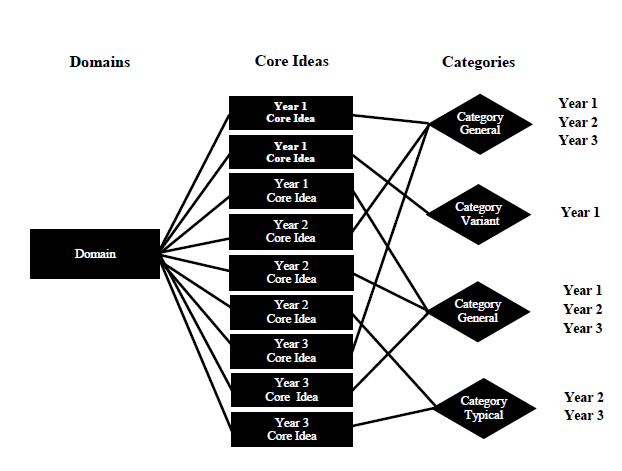
Figure 1. Data analysis flow chart of the process of analyzing each domain.
Domains. Before collecting and analyzing the data, we collectively created a 12-item start list of domains to guide our data investigation, which is a suggested step of CQR (Hill et al., 2005; Miles & Huberman, 1994). Table 1 presents the start list of domains (bolded), in addition to domains that emerged during data analysis. The start list domains were based on our expectations, as well as the three areas of (a) teaching and supervision, (b) research, and (c) service within counselor education (CACREP, 2009; Calley & Hawley, 2008). A domain start list created by the research team through consensus and in accordance with previous literature related to the phenomenon studied serves several purposes. The start list familiarized the research team with previous findings and allowed for comparison of new emergent themes, and themes found in previous research that was not identified in the current study. Additionally, the start list acquainted the research team with the process of reaching consensus in data analysis. While domain start lists may serve to skew data analysis if not properly and carefully analyzed, all domains required support from the data to be kept or added. Thus, in viewing Table 1, one can see that the original start list did have domains that were dropped due to lack of support from within the data. In accordance with CQR, we analyzed the first-year CEDS data independently, then met as a consortium and evaluated the same data together until consensus was met and domains adjusted. The second-year and third-year CEDS focus groups’ data were then analyzed through us breaking into dyads and triads. Domains were added to the master list as they appeared in the data and were agreed upon by the entire research team. In addition, we collapsed or deleted any domains that were found to be redundant, insignificant, or not present.
Table 1
Domain List Used to Analyze Data
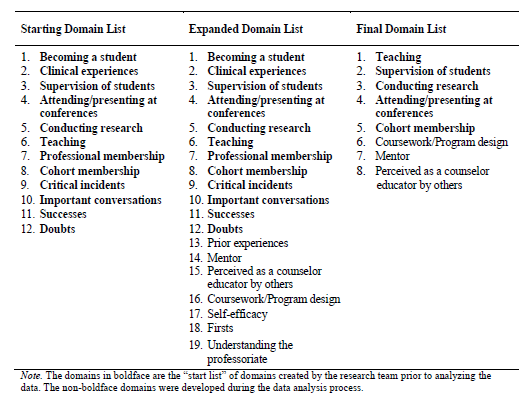
When analyzing the second-year and third-year focus group data, if a difference of opinion arose concerning the meaning of a response, we added subjective insight from the perspective of the group facilitator and how they interpreted the participants’ response in the greater context of the focus group. Additionally, if consensus was not met, we reviewed the original transcript to clarify and meet consensus of the meaning of the data (Hill et al., 2005).
Core ideas and categories. After categorizing the data by cohort year under domains, we continued to work in dyads and triads to formulate core ideas from the raw data (grouped by domain and not by cohort year). We then determined categories that each core idea fell under. Each core idea was assigned a category, and similar core ideas were collapsed under a category to best represent the data. The categories served an overall purpose to classify and determine frequency in the responses from participants within each domain. Categories were clarified through a cross-analysis (Hill et al., 2005) of the participants’ year in the program, and if more than one member of the cohorts identified a domain as an important task or experience. Figure 1 shows the process of categorizing the data from domains to core ideas and then to categories. In CQR, the number of cases in each category determines the frequency label (Hill et al., 2005). General frequency constitutes all, or almost all, cases; typical constitutes more than half of the cases; and variant for less than half of the cases. For this investigation, each focus group represented one case, so frequency labels were defined as general if the category was present in all three cohort groups, typical if the category was present in two groups and variant if the category only emerged in one cohort’s focus group. We reevaluated the domains based on the frequency of the categories within the domain and the relevance to the research question, resulting in the final domain list (see Table 1) that was agreed on through consensus with the entire research team. Finally, we asked the participants to review the preliminary findings (member check), supporting trustworthiness. Participants supported the findings and did not dispute them.
Results
The findings of the investigation are described using domains (i.e., topics used to group data; Hill et al., 2005) and categories used to conduct a cross-analysis to support the findings and connect the findings to the research question. Originally, we developed a start list (Miles & Huberman, 1994) of 12 domains based on previous literature and personal experiences (bolded in Table 1). The start list was expanded to 19 domains through the data analysis (not bolded in column 2 of Table 1). Through further examination, a cross-analysis of the core ideas and categories within each domain was conducted (as presented in Figure 1). After the cross-analysis, the auditors reviewed the data and provided feedback. We revisited the 19 domains, identifying eight domains as strong due to their relevance to the research question and the domain being supported through the clarification of categories (as described in the methods section). The eight domains identified as strong were: (a) teaching, (b) supervision of students, (c) conducting research, (d) attending or presenting at a conference, (e) cohort membership, (f) program design, (g) mentoring, and (h) perceived as a counselor educator by faculty (Column 3 of Table 1; Bell et al., 2012). The eight domains and cross-analysis results are presented in Table 2, which exemplifies the frequency of categories created to increase the level of abstraction in the data analysis (Hill et al., 2005). Not all domains had categories (e.g., cohort membership, program design, and being perceived as a counselor educator by others) because the data within these domains was not diverse enough to create separate categories.
Domain I: Teaching
The teaching domain generated a significant amount of data from the CEDS groups in creating and strengthening their identities as counselor educators. Additionally, the teaching domain produced three contributing categories. Teaching is a core component of a doctoral counselor education program (CACREP, 2009). For this particular university’s program, teaching begins in the first year and peaks in the second year. Teaching was defined as didactic instruction of master’s-level students by doctoral students and occurred in the form of teaching classes, facilitating psycho-educational groups and clinical instruction. The teaching domain was present throughout the first-year, second-year and third-year focus groups with varying emphasis in the categories of (a) teaching experience, (b) contributing factors, and (c) critical interactions with students (see Table 2 for the breakdown and frequencies of the categories within the teaching domain). Therefore, teaching experience during the doctoral program assisted the CEDS in developing their professional identity, specifically their role as counselor educators.
Table 2
Cross-Analysis Findings: Final Domain and Category List
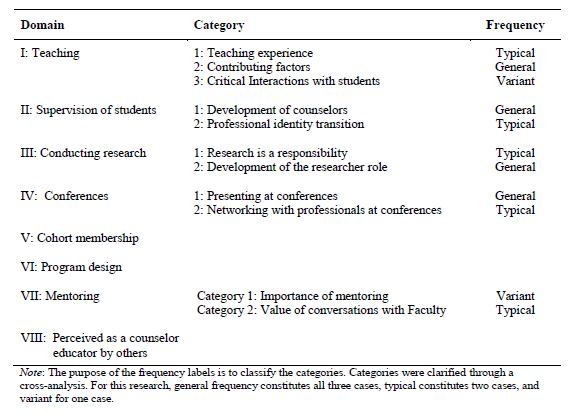
Category 1: Teaching experience. Data generated on the teaching experience category originated from the second-year and third-year CEDS cohorts, designating it as a typical category. Some participants discussed previous teaching experience as vital, while others identified the learning of teaching theories as important. The data revealed the second year as the period in which teaching becomes relevant in this particular counselor education doctoral program. Additionally, first-hand teaching experiences were identified by the third-year cohort as important in counselor educator identity formation. The teaching experience provided doctoral students a way to practice and apply their teaching and learning theory, and an opportunity to build their confidence as teachers. One third-year CEDS stated, “I recognized myself as a counselor educator when I had to assign grades, especially those below a B.”
Category 2: Contributing factors. The category of contributing factors was a general category, present in all three CEDS cohorts. The first-year CEDS felt mandatory programmatic activities such as facilitating psycho-educational groups contributed to their counselor educator identity development in teaching. The second-year students noted the interrelation of teaching and supervision, in that using these skills in a classroom improved their efficacy and contributed to adopting a counselor educator persona. The interrelation is indicated in one student stating, “The second year allows you the opportunity to do everything, including teaching, that you will be doing as a counselor educator.” In addition, evaluating students’ knowledge and skills acquisition helped in developing teaching as a core component of the counselor educator identity. A second-year CEDS supported the importance of student evaluation by stating that teaching and grading were not skills used as a counselor, but differentiated the CEDS as a counselor educator.
Category 3: Critical interactions with students. Though a variant category, third-year cohort members found interactions with students to be influential in adopting the identity of a counselor educator. The third-year group discussed important moments with students that created an impact on them such as: (a) receiving teacher evaluations, (b) grading students, (c) managing student concerns, and (d) feeling pride at student accomplishments. One student stated:
In terms specifically of my teaching I remember grading and being, okay this is where I have to be a big boy, this is where I have to be the counselor educator. It falls to me to decide to pass evaluation and not just a verbal feedback, but a grade… it was a moment, a specific moment where I was like okay now I’m a counselor educator.
Domain II: Supervision of Students
Supervision was the second largest domain present in the CEDS focus groups that was relevant in the participants’ development of a counselor educator identity, which was not surprising due to the emphasis on supervision within counselor education. Data within the supervision domain yielded two categories: (a) supervision teaches future counselor educators about the development of counselors and (b) supervision profoundly affects CEDS’ professional identity transition from counselor to counselor educator (see Table 2 for frequency breakdown). One participant stated, “Supervision brings teaching and counseling skills together to see what students are grasping.”
Category 1: Development of counselors. Supervision as a critical part of counselor development was a general category within the supervision domain and included theoretical aspects of supervision (e.g., applying theories of supervision and adjusting those theories to the development of students), as well as the practical aspects within supervision (e.g., focusing on what students need to know in order to proceed in the field of counseling and in their own growth and development). One CEDS summarized the importance of observing and enhancing development of counselors-in-training as follows:
I would say…supervising students for me has been counselor education in its purest form. Because when you’re in front of a class you’re teaching counselor concepts to people you are wondering are they grasping it, how are they understanding it and when you’re sitting down one-on-one and really supervising a student while they’re counseling someone else over a year or a semester, it gives us an opportunity to be intimately aware of what they’re learning and for me it’s been one of the most energizing and rewarding elements of a counselor educator.
Category 2: Professional identity transition. The doctoral students represented in these focus groups begin their education and practice of supervision during the second year of their doctoral program. Aligning with program sequencing, the majority of responses in the professional identity transition category came from the second-year cohort with support from the third-year CEDS, designating it as a typical category. Second-year students noted that the introduction of supervising students during the second year of the program facilitated their role transition from counselor to counselor educator. A second-year CEDS stated, “I think really what solidified it for me was the supervision class… having two of those before teaching even. That’s when I remember making that shift into thinking as an educator and supervisor rather than a counselor.” Another second-year CEDS stated, “Supervising students has been helpful to be me, sitting on the other side of the table instead of me counseling the client; I’m supervising the counselor (who is) counseling the client.” The third-year CEDS also identified supervision as one of the most significant experiences in solidifying their counselor educator identity.
Domain III: Conducting Research
The domain of conducting research as an important identity-forming experience was present across all the CEDS cohorts. Although the importance of conducting research was present in first through third years, it appears to peak in the second year of the program where research is emphasized through coursework. CEDS in the second-year cohort reported an increased interest in research and awareness of the relevance of research in counselor education and identifying as a counselor educator. A second-year CEDS stated:
One thing that really clicked for me this year was speaking in terms of research and that was a new way of thinking for me. It was a struggle between wearing my counselor hat versus my counselor educator hat and was sort of manifested in my research ideas. I was doing a lot of counselor practitioner kind of thinking in terms of research and I switched that into thinking of counselor educator research and that helped my identity transition.
Two categories were identified within the conducting research domain: (a) research is a responsibility and (b) development of the researcher role (see Table 2 for category and frequency breakdown).
Category 1: Research is a responsibility. The theme that research inquiry is not just a duty of a counselor educator, but also a responsibility to the profession presented as a typical category. The third-year cohort focused on the feeling of responsibility toward conducting research. The second-year CEDS contributed the majority of data in the research is a responsibility category and focused on the responsibility of research, writing and contributing to the professional knowledge base. During the second-year CEDS focus group, a conversation thread emerged focused on intentionality of contributing to the field of literature with quality research. All second-year cohort members agreed that the responsibility of conducting research was an area that substantially helped in their transition from thinking like a counseling practitioner to thinking like a counselor educator.
Category 2: Development of the researcher role. Data assigned to the research category was fairly distributed between all three cohorts, designating it as a general category. The first-year CEDS focused on their initial experiences, including the process of writing the first manuscript and the first Institutional Review Board (IRB) submission and approval. A major theme of second-year CEDS was identifying and developing research interests. Third-year CEDS focused more on the products of conducting research, such as presenting research results at conferences and conducting follow-up research. These research themes appeared to be developmentally appropriate as they matched the educational structure of this particular doctoral counselor education program.
Domain IV: Conferences
Although the domain of conferences produced broad responses from participants, it was clear that conference attendance contributed to identity development. Data centered around two categories contributing to CEDS’ identity development as counselor educators: (a) attending and presenting papers at conferences and (b) networking with other professionals in counselor education.
Category 1: Presenting papers at conferences. Conference presentation was a general category, present across all three years of CEDS. First-year students discussed the importance of presenting papers in developing professional identity. One reason identified for the importance of presenting papers was that other professionals at conferences expressed interest in their work and this professional attention was affirming. Second-year CEDS felt conference presentations solidified their role as a counselor educator, making it “more real.” Third-year CEDS stated that presenting papers at conferences gave a feeling of “professional weightiness,” in that they felt respected when other professionals valued their contributions and recruited them for potential faculty positions.
Category 2: Networking with professionals at conferences. The category of networking with professionals at conferences was a typical category, present in the first and second-year cohort responses. First-year students felt conversations with counselor educators outside of their program that occurred during conferences were helpful in the formation of their counselor educator identity. A second-year CEDS emphasized:
Attending the conferences is really good… I’m able to see other professionals that have been successful going through what I’m in now. And to get advice from them, to hear some tips that they have about research or teaching…umm and just getting inspired and motivated and saying that “you know I can see myself in their positioning in another year and a half or so.”
Domain V: Cohort Membership
The university at which our research was conducted employs a cohort model for the doctoral program in counselor education. As noted, a cohort model is defined by a group of students entering the program together, taking the majority of coursework together and moving through the program concurrently (Paisley et al., 2010). In participants’ responses, we found cohort membership was valuable in both first-year and second-year students. First-year CEDS expressed that being a part of the cohort helped create a vision of the future as a counselor educator. The students also recognized cohort members as future colleagues. Second-year CEDS focused on learning from cohort members, such as relying on cohort members’ expertise in understanding new situations and how sharing experiences with cohort members helps support them through the doctoral preparation process. It was not surprising that cohort membership did not emerge in the third-year students, as course work ends in the second year so third-year students can focus on dissertations. The lack of coursework contributes to less time the CEDS are together, and thus less of an emphasis on cohort membership and dynamics.
Domain VI: Program Design
The program design domain appeared often, but only in the second-year cohort data. The data reflected the second-year CEDS’ beliefs that the program was intentionally designed to develop skills and knowledge incrementally bringing all the roles of a counselor educator together in the second year of the doctoral program. For example, evaluation by faculty and classroom assignments helped students understand their roles as counselor educators. A second-year student stated, “In the second year, the program is set up to do everything we will be doing in the profession.” While program design domain does not contain categories, it was one of three domains added to the final list that was not associated with the original start list of domains (see Table 1). As the focus groups were conducted in the beginning of the academic year, first-year students may not have recognized the program design as an asset in their identity development as counselor educators due to their newness to the program. We were somewhat surprised that the program design domain did not come up in the third-year focus group; however, as previously mentioned, the third year is centered on dissertation. Therefore, program design may seem less clear during the third year in the program, as the CEDS are working independently.
Domain VII: Mentoring
The data in the mentoring domain crossed all three CEDS cohorts emphasizing the importance of mentoring across the doctoral program. From the mentoring domain, two categories emerged: (a) the importance of mentoring on the student’s professional identity development and (b) the value of conversations with faculty members on their development. A mentoring relationship was beneficial in the CEDS’ professional identify development, which was identified in the data, but was not part of the original start list of domains (see Table 1).
Category 1: Importance of mentoring. The importance of mentoring was present in both first-year and second-year cohort CEDS focus groups, designating it a typical category. First-year CEDS recognized the mentor relationship as an integral part of doctoral education. Second-year CEDS focused on the modeling of teaching by faculty members and faculty assisting in the development of research interests and writing. One student stated, “just being taken under some faculty member’s wing and having them take an invested interest in me and having me connect what my interests are in the community…has been mentally helpful for me.”
Category 2: Value of conversations with faculty. The value of conversations with faculty was a general category. First-year CEDS discussed conversations such as professors checking in on their progress and expressing pride in their work. One student stated, “Talking with a professor who has been successful and is similar to me has validated me in many ways.” Second-year and third-year CEDS focused on encouragement from faculty in terms of honing research interests and consulting with faculty about students, as exhibited in this statement:
A professor told me that my paper could be a manuscript and I didn’t view it like that. I didn’t understand what that meant (to write a manuscript) until the professor said that and I’m like, really? And I didn’t really have the self-efficacy to believe that until he started working with me and I realized the accuracy of his statement. Because I didn’t believe that of all the people out there making contributions (to the scholarly body of research) that I could actually be one of those people making contributions. It is due to the mentorship and support and somebody highlighting the opportunity.
Domain VIII: Perceived as Counselor Educator by Faculty
The domain of being perceived as counselor educator by faculty crossed all three CEDS cohorts and reflected the professors’ belief and vision of students as future counselor educators. The perceived belief of the faculty members was then reflected in the self-confidence of the CEDS. Students across cohorts gave examples of professors believing in their research, asking for recommendations, and being addressed by professors as counselor educators. One student said, “The professors seeing me as an educator helps me see myself that way.” In addition, one CEDS identified a defining moment while networking at a conference when a professor from an outside university asked for an opinion regarding which textbook to use. The professor’s request validated the student’s identity as a counselor educator and gave the perception of being accepted in the field. Being perceived as a counselor educator by faculty emerged as a domin through data analysis and was not part of the original domain start list (see Table 1).
Discussion
Previous research supports three primary counselor educator roles (teaching and supervision, research, and service; Calley & Hawley, 2008; Carlson et al., 2006). The teaching domain (subcategories: teaching experience, contributing factors, and critical interactions with students) and the supervision domain (subcategories: development of counselors and how it impacted counselor identity) generated the most data from our CEDS participants. Thus, teaching and supervision may serve as distinguishing factors of the transition from counseling practitioner to counselor educator. The perspective that the counselor educators’ researcher role develops during the beginning of this preparation program, and conducting and developing research interests are established through participation on research teams and presenting research results was consistent with previous findings (e.g., Calley & Hawley, 2008; Carlson et al., 2006). However, the responsibility and application of conducting research is important to emphasize throughout a doctoral program to enhance professional identity development. The role of service in counselor education (e.g., Calley & Hawley, 2008) was not supported in our data. The CEDS in our investigation may not have been aware of the opportunities to provide service to the counseling profession, or they may not view service as a priority. Therefore, the counselor educator role of service may be an area of growth for some doctoral programs to expand opportunities for CEDS to provide service in the field.
In addition, our findings support the premise that the development of CEDS professional identity as counselor educators is intimately linked to the students’ doctoral preparation program which was consistent with previous findings (e.g., Carlson, et al.,1997). Built within the participants’ program were opportunities for CEDS to take on the roles of counselor educator, including teaching, research, supervision, and participation in the greater community of counselor educators through conference participation. What is noticeably absent from our results is the lack of influence that the curriculum (e.g., attending class meetings, reading, writing papers, listening to lectures) played in the professional identity development of the CEDS. Although each participant was enrolled as a fulltime CEDS through the duration of their education, the influence of “learning by doing” seemed to develop the identity of each participant more than traditional didactic learning methods. Thus, it is important for counselor education doctoral programs to consider practical experiences for their students (e.g., opportunities’ for teaching, research and supervision).
The influence of faculty and networking (e.g., mentoring, being perceived by faculty as counselor educators, and attending and presenting at conferences) is crucial to CEDS’ professional identity development, and was a unique finding. However, it was noted that counselor education faculty members influenced their students primarily outside of the classroom setting. Faculty (including those outside of one’s program) helped their students grow into the identity of counselor educator through (a) consultation, (b) developing research interests, (c) believing in and treating the students as counselor educators, (d) encouraging students to present at conferences, and (e) mentorship. Our findings affirm the importance of counselor education faculty members’ influence on the development of future counselor educators and professional counselors.
Lessons Learned
As this investigation was our first time conducting qualitative research, specifically CQR, we reflected on lessons learned through this process. Three overarching lessons emerged: (a) coding qualitative data using CQR methodology is a lengthy process that requires significant and honest discussion, (b) the consensual aspect of CQR seemed to balance personal bias, and (c) applying a new research methodology while concurrently learning the process of the methodology presents many challenges. While the focus groups were an expedient method of collecting the data, we found coding the data required a significant amount of time to ensure the data were represented in the codes. Correct categorization of the data was somewhat remedied by dividing up the second-year and third-year CEDS data; however, each smaller team continued spending significant time with their respective data. Additionally, balancing the thoughts and opinions of seven of us was challenging; however, the guidelines for CQR methodology delineated that consensus must be reached in coding the data (Hill et al., 2005). Although a lengthy process, it appeared to balance bias allowing the data to speak for itself in producing new domains. Finally, we served as both researchers and participants, which we recognize as a limitation. However, the active learning process of conceptualizing and applying CQR simultaneously while serving as participants provided us an opportunity to develop our own professional identity as counselor educators, specifically in the area of research.
Limitations and Implications for Future Research
As in all research, limitations were apparent in our investigation. At the time the focus groups were facilitated, we were in the first year of the program, and all of us were from the same university. Our study involved only students in a single doctoral program, which is a cohort design; therefore, the results emphasize the specific goals and curriculum design of one cohort model in counselor education. In addition, we served as participants in representing the first-year doctoral student perspective. Though facilitated by a faculty member, we did have previous knowledge of the research questions and analyzed the data resulting from the focus group.
Although CQR is an emerging methodology that has not been used extensively in counselor education, we followed Hill et al.’s (1997; 2005) CQR guidelines and other scholarly writing guidelines (e.g., Hays & Wood, 2011; Lambie, Sias, Davis, Lawson, & Akos, 2008). After reviewing several CQR methodologies in various studies, Hill et al. (2005) found many advantages and disadvantages to the consensual process of qualitative data collection; one of the advantages may be the rigorous cross-analysis embedded within the CQR method. Our qualitative investigation used a meticulous cross-sectional approach to identify key components of professional identity development among CEDS. A limitation to CQR is researcher bias, which should be safeguarded by considering and reporting all biases (Hill et al., 2005). We spent a significant amount of time considering and discussing potential biases. Finally, we listed all potential biases and through consensus identified actual biases as reported earlier.
A recommendation for future research, based on our investigation, is to expand the sample to include other doctoral counselor education programs, specifically different models (e.g., part-time, independent), allowing domain consistency to be explored, as well as identifying similarities and differences across counselor education doctoral programs. In addition, future research may benefit from the exploration of pre-tenured faculty members’ experiences of professional identify development in comparison to CEDS. Furthermore, a quantitative design may be employed to examine significant relationships of specific domains and productivity of doctoral counselor education students.
In summary, our study examined CEDS’ experiences that helped build their professional identity as counselor educators. The data were collected from three cohorts representing different stages in their doctoral preparation program and analyzed using CQR methodology. The findings suggested that: (a) programmatic goals align with the experiences critical to CEDS professional identity development, (b) experiential learning opportunities (e.g., teaching courses under supervision, participating on a research team, and supervising students) appeared more influential than traditional content learning, and (c) the relationships with mentors and faculty members contribute to both the CEDS efficacy and development of their identity as counselor educators. Therefore, counselor education doctoral programs may want to evaluate current curricula to ensure their students have experiential learning opportunities, if they wish to promote the professional identity of counselor educators.
References
Bell, H., Limberg, D., Young, M. E., Robinson, E.H., Robinson, S., Hayes, G., . . . Christmas, C. (2012). Professional identity development of counselor education doctoral students. Paper presented at the British Association for Counselling & Psychotherapy, Scotland.
Calley, N. G., & Hawley, L. D. (2008). The professional identity of counselor educators. The Clinical Supervisor, 27, 3–16.
Carlson, L. A., Portman, T. A., & Bartlett, J. R. (2006). Self-management of career development: Intentionally for counselor educators in training. Journal of Humanistic Counseling, Education and Development, 45, 126–137.
Corey, G., Corey, M. S., & Callanan, P. (2010). Issues and ethics in the helping professions (8th ed.). Pacific Grove, CA: Brooks/Cole.
Council for Accreditation of Counseling and Related Educational Programs. (2009). CACREP accreditation manual. Alexandria, VA: Author.
Creswell, J. W. (2007). Qualitative inquiry & research design: Choosing among five approaches (2nd ed.).Thousand Oaks, CA: Sage.
Creswell, J. W. (2013). Qualitative inquiry & research design: Choosing among five approaches (3rd ed.). Los Angeles, CA: Sage.
Gibson, D. M., Dollarhide, C. T., & Moss, J. M. (2010). Professional identity development: A grounded theory of transformational tasks of new counselors. Counselor Education and Supervision, 50, 21–38.
Glesne, C. (2011). Becoming qualitative researchers: An introduction (4th ed.). Boston, MA: Pearson.
Granello, D. H., & Young, M. E (2012). Counseling today: Foundations of professional identity. Upper Saddle River, NJ: Prentice Hall.
Hall, L. A., & Burns, L. D. (2009). Identity development and mentoring in doctoral education. Harvard Educational Review, 79, 49–70.
Hays, D. G., & Wood, C. (2011). Infusing qualitative traditions in counseling research designs. Journal of Counseling & Development, 89, 288–295.
Heppner, P. P., Wampold, B. E., & Kivlighan, D. M. (2008). Research design in counseling. (3rd ed.). Belmont, CA: Thomson.
Hill, C. E., Knox, S., Thompson, B. J., Williams, E., Hess, S. A., & Ladany, N. (2005).Consensual qualitative research: An update. Journal of Counseling Psychology, 52, 196–205.
Hill, C. E., Thompson, B. J., & Nutt Williams, E. (1997). A guide to conducting consensual qualitative research. The Counseling Psychologist, 25, 517–572.
Knox, S., Burkard, A. W., Janecek, J., Pruitt, N. T., Fuller, S. L., & Hill, C. E. (2012). Positive and problematic dissertation experiences: The faculty perspective. Counseling Psychology Quarterly, 24, 55–69.
Lambie, G. W., Sias, S. M., Davis, K. M., Lawson, G., & Akos, P. (2008). A scholarly writing resource for counselor educators and their students. Journal of Counseling & Development, 86, 18–25.
Magnuson, S., Davis, K. M., Christensen, T. M., Duys, D. Y., Glass, J. S., Portman, T., . . . Veach, L.J. (2003). How entry-level assistant professors master the art and science of successful scholarship. Journal of Humanistic Counseling, Education and Development, 42, 209–222.
Miles, M. B., & Huberman, A. M. (1994). Qualitative data analysis: An expanded sourcebook (2nd ed.). Thousand Oaks, CA: Sage.
Paisley, P. O., Bailey, D. F., Hayes, R. L., McMahon, H., & Grimmett, M. A. (2010). Using a cohort model for school counselor preparation to enhance commitment to social justice. Journal for Specialists in Group Work, 35, 262–270.
Walker, G. E., Golde, C. M., Jones, L., Bueschel, A. C., & Hutchings, P. (2008). The formation of scholars: Rethinking doctoral education for the twenty-first century. San Francisco, CA: Jossey-Bass.
Zimpfer, D. G., Cox, J. A., West, J. D., Bubenzer, D. L., & Brooks, D. K. (1997). An examination of counselor preparation doctoral program goals. Counselor Education and Supervision, 36, 318–331.
Dodie Limberg is an Assistant Professor at Texas A&M-Commerce. Hope Bell is a doctoral candidate at the University of Central Florida. John T. Super, NCC, and Lamerial Jacobson are doctoral graduates of the University of Central Florida. Jesse Fox, NCC, is a doctoral candidate at the University of Central Florida. M. Kristina DePue, NCC, is an Assistant Professor at the University of Florida. Chris Christmas is a doctoral candidate at the University of Central Florida. Mark E. Young is a Professor and Glenn W. Lambie, NCC, is an Associate Professor at the University of Central Florida. Correspondence regarding this article can be addressed to Dodie Limberg, University of Central Florida, College of Education, Department of Education and Human Services, P. O. Box 161250, Orlando, FL 32816-1250, dlimberg@knights.ucf.edu.
Oct 15, 2014 | Article, Volume 3 - Issue 2
Stephen V. Flynn, Linda L. Black
The quality of the therapeutic relationship and the personal characteristics of professional counselors are key determinants of positive counseling outcomes and decision making, and they are believed to be influenced by conscious and unconscious processes. Beliefs about the unconscious nature of altruism and self-interest among 25 mental health professionals were examined through a paradigmatic narrative analysis. Data from 19 semi-structured individual interviews, one focus group, 19 artifacts and participant member checks were subjected to a secondary qualitative analysis. The results of the analysis generated three salient archetypes representative of the altruism–self-interest dynamic: exocentric altruist, endocentric altruist, and psychological egoist.
Keywords: professional counselors, altruism, self-interest, archetype, qualitative, paradigmatic narrative analysis
The constructs altruism and self-interest have long been described in dichotomous terms and as the sole motivators of human behavior (Holmes, Miller, & Lerner, 2002; Simpson, Irwin, & Lawrence, 2006). In 1851, Comte defined the term altruism as “self-sacrifice for the benefit of others” (1875/2001, p. 565). More than a century later, Sober (1993) defined self-interest as “the sole fixation on gaining pleasure and avoiding pain.” Because these two constructs typically have been associated with individuals’ actions and viewed through a polarized lens, there is a dearth of research examining the unified and unconscious nature of both altruism and self-interest (Bishop, 2000). The heretofore dichotomous and superficial understanding of these constructs has enabled individuals to maintain an inaccurate view of altruistic and self-interest oriented behaviors (Flynn & Black, 2011; Holmes, Miller, & Lerner, 2002), resulting in a value-based perspective that perpetuates under-informed over-generalizations of the phenomenon (e.g., people who give to others are “good” and those who take for themselves are “bad”).
Professional literature presents mixed messages regarding altruism and self-interest. To date, the concept of self-interest has seldom been explicitly examined within the counseling profession. Current literature largely describes professional counselors’ self-interest in terms of personal wellness, self-advocacy, positive beliefs, self-care and the development of self-regulatory systems (Hendricks, 2008; Hermon & Hazler, 1999; Myers & Sweeney, 2008; Myers, Sweeney, & White, 2002; Osborn, 2004). A smaller body of literature encourages professional counselors to maintain effective professional boundaries and to seek compensation commensurate with their level of training (Bernard, 2006; Myers et al., 2002). The literature on wellness, boundaries and monetary compensation sometimes conflicts with professional counseling’s altruistic foundation and has garnered less attention than professional literature that focuses almost exclusively on meeting the needs of clients. Although recent efforts have been made to address counselor impairment and burnout (e.g., Ohrt & Cunningham, 2012; Parker & Henfield, 2012), very little attention has centered on understanding counselor self-interest. For example, professional counselors are called to advocate for the underserved, to provide a percentage of their services pro bono, and to secure referrals for clients unable to pay the professional counselor’s rate (American Counseling Association, 2005; Osborn, West, Bubenzer, Duba, & Olson, 2003). Professional counseling is a service-oriented profession, yet the almost exclusive focus on altruistic acts (e.g., giving of oneself) without a concomitant discussion of professional counselor self-interest potentially creates a culture of professional self-sacrifice and martyrdom that places counselors at risk for burnout and clients at risk for negative outcomes.
Although the negative consequences of an exclusive focus on altruism in professional counseling are evident, there has been limited scholarly dialogue on the unconscious nature of altruism and self-interest. Classic literature postulates that acts of altruism are disguised expressions of greed, with self-interest seen as a form of greed that may be exhibited as acts of displacement or sublimation (Freud, 1974). Contemporary literature encourages professional counselors to recognize how their own unconscious material may be projected onto their clientele and thereby affect the therapeutic relationship (Hackney & Cormier, 2009). We, the authors, assert that professional counselors and their clients may benefit from a more transparent discussion and consideration of counselors’ altruism and self-interest. The purpose of the present study was to investigate the unconscious nature of the construct altruism–self-interest through a secondary supplemental analysis (Heaton, 2008), following the tenets of paradigmatic narrative analysis. Flynn’s (2009) existing data set was utilized to explore the emergence of unconscious phenomena within the various participants’ narratives. This analysis revealed three archetypal representations of the altruism–self-interest phenomenon expressed within the lived experiences of professional counselors. A brief review of archetypes is provided to set the context for the reader.
Archetypes
Carl Gustav Jung’s (1875–1961) heuristic insights into the collective unconscious and primordial archetypal images have implications for altruism–self-interest and the present research. According to Jung (1969), the collective unconscious could encompass certain inherited aspects of mental life. Jung viewed two aspects of the collective unconscious as essential: the non-dichotomous interconnectedness of mind and body and the principle of natural selection through which various patterns evolved over time (i.e., archetypes).
Jung (1969) defined archetype as “an unconscious representation from the collective unconscious.” Archetypes can be recognized only through situations in which they occur, thus making their existence ambiguous and non-dichotomous. Jung also recognized the confounding nature of this construct, as evidenced in this quotation from 1953: “I admit at once that [the concept of archetypes] is a controversial idea and more than a little perplexing” (p. 15). He asserted that the process of exploring archetypes was parallel to the examination of humankind’s inherited motifs regarding thoughts, feelings, dreams and religion. In other words, an archetype was and is a human universal that continues to emerge throughout history.
Jung (1969) described countless archetypes that he believed humans were compelled to act upon throughout their lives. In addition, he relied on interpreting symbols and dreams to access a client’s archetypes. Some of the most commonly referenced archetypes include the trickster, the lover, the divine child, the shadow, the magical animal, the nurturing mother, the witch, the law-giving father, the devil, mandalas, trinities, judgment, heaven, hell and atonement. Mother and father serve as basic archetypes that have governed humankind from the beginning of time and history (Jung, 1986). The mother archetype (also referred to as goddess and great mother) symbolically represents ruler of Earth, bearer of fertility, giver of life, exhibitor of tolerance and acceptance of strangers, nurturer of family, and dispenser of compassion or mercy in human relations. The father archetype (also referred to as son of the great mother and wise old man) symbolizes the bringer of discipline and order, and represents honor, glory, fame, social hierarchy, secret knowledge, and wisdom.
Jung never specifically addressed altruism and self-interest in relation to archetypes, yet the descriptive elements of the mother and father archetypes seem to be reflected in the altruism–self-interest concept described by Flynn and Black (2011). We, the authors, acknowledge the risk of reinforcing gender-role stereotypes (i.e., mothers as self-sacrificing nurturers [altruism] and males as self-focused loners [self-interest]), yet we believe these images persist because archetypes represent collectively inherited unconscious ideas, patterns of thought, and images universally present in individual psyches.
Recent research has provided an initial exploration of the depth and breadth of the constructs of altruism and self-interest in the daily lives of professional counselors (Flynn & Black, 2011). The results of Flynn & Black’s qualitative study provided initial evidence that altruism and self-interest could more accurately be viewed as a unified, self-sustaining construct entitled altruism–self-interest. Additionally, Flynn and Black found initial evidence consistent with unconscious aspects of the initiation, process, and sustainability of altruism–self-interest. They postulated that the altruism–self-interest construct promoted an unconscious view of oneself (archetype) as helpful to others (altruism) while simultaneously experiencing or seeking positive or beneficial feelings for oneself (self-interest). The existence and relevance of these archetypes, although noted in the original study, were not subjected to analysis, as they were beyond the scope of the original guiding research questions.
Method
The authors hypothesized that the altruism–self-interest phenomenon described in Flynn’s (2009) original study potentially represented archetypal images for the participants. A secondary analysis of the original data was conducted through a paradigmatic narrative lens. In the paragraphs that follow, the authors briefly describe secondary supplemental analysis and paradigmatic narrative inquiry. For a more detailed depiction of each aspect, please see Heaton (2004) and Bruner (1985), respectively.
Secondary Supplemental Analysis
Beginning in the mid-1980s, secondary analysis of qualitative data has been conducted in the social sciences. Numerous authors (Corti, Witzel, & Bishop, 2005; Gladstone & Volpe, 2008; Hakim, 1982; Hays & Singh, 2012; Heaton, 2004; 2008) have documented sound rationale, procedures and protocols for the use of secondary analysis. For the purposes of the present study, the authors carefully considered the questions posed by Van den Berg (2005) and assessed and confirmed (a) our ethical responsibilities to the original participants, (b) our access to rich and abundant amounts of contextualized data (e.g., complete interview transcripts, focus group transcripts, artifacts, field notes, journals, and audit trails), and (c) the relevance, utility, and feasibility of the study. The authors opted to engage in a supplementary secondary analysis, as defined by Heaton (2008), in which we sought “a more in-depth analysis of an emergent issue or aspect of the data that was not addressed or was only partially addressed in the primary study” (p. 39).
Paradigmatic narrative analysis is a qualitative method that identifies instances of information and groups them into general concepts that share a common attribute (e.g., archetype) (Polkinghorne, 1995). Paradigmatic reasoning, which is similar to inductive reasoning, constitutes people’s experiences as consistent and ordered, producing cognitive networks of concepts that permit people to create experiences by putting emphasis on the repeating elements (Bruner, 1985; Lai, 2010). Our rationale for conducting this investigation centered on four points: (a) participants’ narratives collected in the original study were so dense and rich that they could not adequately be represented in one published work, so it was imperative that the participants’ voices be heard and honored with respect to this personal and value-ridden topic; (b) because participants provided recursive messages throughout the original interviews, the use of a paradigmatic structure allowed us to construct participants’ experiences in an organized manner; (c) the use of narrative inquiry allowed for the unconscious nature of altruism–self-interest to be reported in a comprehensible literary structure; and (d) the present study could potentially yield insights into latent categorical concepts.
Original Research Study
Flynn’s (2009) study provided a grounded theory that described the promotion, initiation, and maintenance of altruism–self-interest for professional counselors. The term professional counselor, as it is used here, describes individuals who engage in an active clinical practice and possess (or are seeking) at least a master’s degree in counseling or psychology. Participants in Flynn’s (2009) study were asked how they defined and experienced altruism; how they defined and experienced self-interest; and what, if any, synergy, tension, or conflict they experienced relative to these two constructs in their practice and the profession. Six data sources were utilized to address these questions: a measure of altruism, individual interviews, a focus group, participant artifacts, member-checking, and a topical analysis of subject matter published during the last decade in several major professional counseling journals.
Participants. Participants held or were seeking a graduate degree (master’s or doctorate) in counseling, psychology, or counselor education, and they were providing counseling services or were a recognized but retired scholar in counselor education. A total of 25 individuals participated without compensation.
The sample comprised 10 women (40%) and 15 men (60%) who ranged in age from 25 to 79 years (M = 49.76). The self-reported ethnicities of participants were Caucasian (80%), Hispanic (4%), Asian (4%), Native American (4%), Arabian (4%), and Jewish (4%). The professional identity of the sample of 25 participants included (a) seven professional counselors (28%), (b) 14 counselor educators (84%), (c) three marriage and family therapists (12%), (d) and one psychologist (4%) (Flynn & Black, 2011).
Narrative Analysis of Original Data
According to Weglowska-Rzepa, Kowal, Park, and Lee (2008), archetypes can be discovered when an individual processes certain information and stimuli. The authors utilized a combination of qualitative data sources to further distill participants’ experiences. By employing multiple qualitative data sources, the authors triangulated data to create a confluence of evidence that was designed to increase credibility (Denzin, 1970; Eisner, 1991) and to explore the latent experiences of the participants. Through paradigmatic narrative inquiry, the participants’ experiences were analyzed to uncover the unconscious nature of altruism–self-interest. Initially, a paradigmatic cross-analysis of the participants’ narratives and artifacts was conducted. The authors examined 19 individual interviews and the conversation of seven focus group members (25 total participants; one member participated in an interview and the focus group), which resulted in an initial group of emergent narratives/statements that were later grouped into 23 categories. A second level of analysis examined all non-dichotomous narratives and resulted in 12 categories. Next, an independent examination of the 37 artifacts was conducted to examine their relevance in light of the emerging narrative. This combined cross-analysis revealed three emergent archetypes involving altruism–self-interest: the exocentric altruist, the endocentric altruist, and the psychological egoist. The credibility and confirmation of the secondary supplemental analysis were explored through a participant member check. Specifically, the first author submitted the original transcript, descriptions of the three emergent archetypes, and samples of relevant quotations to each of the 19 individual interview participants for member-checking. Fourteen of the 19 individual interview participants confirmed the accuracy and relevance of archetypes, specific quotations, and the associated archetype.
To control for bias and group think, the results of the secondary and paradigmatic analyses were submitted to two independent auditors, unrelated to either original or secondary analysis. Each auditor, experienced in qualitative methodology, reviewed the interview transcript, initial codes, codes related to the emergent categories, and description of the archetypes with related quotations. The auditors confirmed the initial findings and sought clarification related to the description of three emergent archetypes. Subsequent to the completion of external auditing, the literature related to the intersections of altruism and self-interest was examined to determine whether the emergent categories had previously been described. The general descriptions did in fact exist (Bond, 1996; Karylowski, 1982); however, there was a dearth of research relating these categories to the unconscious.
The authors returned to Carl Jung’s (1969) theory that unconscious structures underlie human behavior and experiences, and can be represented by various archetypes. Jung described these archetypes as universal psychic structures and postulated that they were the representations of innate unconscious experience. Salient to Jung’s theory of archetypes are their fluidness throughout an individual’s life. For example, a person may demonstrate the shadow archetype one moment, and later the same person may demonstrate the trickster archetype. The authors noticed a similar fluidness in the participants’ demonstration and reporting of the three archetypes. Specifically, during a particular dialogue or interview, participants would demonstrate a particular archetype and then demonstrate another archetype within the same dialogue or interview.
Results
Three categories of unconscious archetypes emerged from the paradigmatic analysis: exocentric altruist, endocentric altruist, and psychological egoist. The archetypes describe the unconscious nature of the emergent theory of altruism–self-interest. These categories were revised until they provided the best possible fit with a categorical scheme for the data set seeking to locate common categorization among the stories participants presented (Polkinghorne, 1995; Sexton, 2007). The process of data analysis yielded descriptions of each archetype.
According to Jung (1968), “A word or an image is symbolic when it implies something more than its obvious and immediate meaning. It has a wider ‘unconscious’ aspect…” (p. 4). The data demonstrate the introspection and dynamic conversation participants shared in relation to the constructs of altruism and self-interest. To preserve confidentiality, all participants’ quotations used in support of each archetype are represented by an unassociated letter. Additionally, quotations were organized around the various data collection methods to aid in a structured presentation.
Exocentric Altruist Archetype
The exocentric altruist archetype describes an individual who receives internal gratification from the act of giving, yet does not deliberately take part in charitable acts with the intention of receiving internal gratification. Participants who demonstrated the exocentric altruist archetype reported the desire to assist others personally or financially because of a personal belief in giving, with no preconceived expectation for self, for recognition or for personal gain.
Individual interviews. Fifteen of 19 participants related stories of professionally oriented tasks that were completed for the good of humanity. Participant J reported on her personal and professional ethics regarding clients who could not continue paying for professional services:
I’ve had clients who have had insurance and then their benefits run out, so I’ve kept them as clients until we can figure out another…financial arrangement or I can make referrals to them to community resources.
Within this quotation, participant J demonstrated the exocentric altruist archetype by continuing to provide services for clients who could not pay. Exocentric altruists put the needs of others before self to achieve a higher moral principle consistent with their values. The content of this quotation represents the participant’s motivation to care for clients despite the client’s inability to immediately reciprocate in an equitable fashion (pay for services rendered); thus, this participant is willing to delay or even forgo equity in the professional relationship.
Ten of the 19 participants provided narratives involving natural disasters in which they volunteered to help those who had suffered. Participant B explained his process in responding to Hurricane Katrina:
And I think that was the case with Katrina. I think there it was just, you know, just ’cause you saw the sheer devastation. I don’t think it was a matter of self-interest, but to help keep you engaged. I think it was the altruism and knowing that…it was just…where I should be at the moment.
The content of this quotation demonstrates that participant B may have engaged in exocentric altruism because of a personal calling to aid victims of indescribable suffering and devastation associated with a natural disaster. The exocentric altruist describes feeling internally compelled to assist others while simultaneously limiting his or her focus on self.
Focus group. All members of the focus group described incidents when they chose to give altruistically to the profession at a cost to their personal or professional life. Within the focus group setting, participants demonstrated a profound openness when discussing their altruistic acts and achievements. A counselor educator described exocentric altruism in his daily interactions with students. Participant B stated:
I’m thinking as a professor working with students. I do it because I care about them and I want to do it and if somebody’s overwhelmed and has some personal stuff going on and they’re taking three classes, and it’s just too much for them and they talk to me after class I could just say, ‘well you know I gotta get going. Shoot me an email.’ But I almost always say, ‘well let’s go up to my office and talk a little bit’ and then they vent, and we talk. Then I call my wife and say I’m late. Because, I had a student who had some difficulties and we tried to iron it out…
Exocentric altruists aid others because it appears to be something they must do. There does not seem to be any evaluation of mutuality or equity on the part of the participants.
Endocentric Altruist Archetype
The essence of the endocentric altruist archetype is centered on helping a person in need while concurrently feeling good about the self. Participants who demonstrated the endocentric altruist archetype reported a desire to assist others, with a preconceived or reported concern for self and some expectation of mutual benefit from the behavior.
Individual interviews. Seventeen of the 19 participants noted the mutual reinforcement that both the giver and receiver of an altruistic act received. Participant K extended the mutual benefit of an altruistic act a step further when he acknowledged the benefit a witness received from an altruistic act:
People who perform an altruistic act[s] get…big benefits, persons receiving get a benefit …with a little less, and people watching the altruistic act benefit, so I think it’s good for us…and it’s very good for others.
Within this quotation, participant K described the endocentric altruist perceptions of the benefits of giving. Whether a person is attempting to give or is on the receiving end of an altruistic act, that person is attending to self-interest. The participant closes his statement by acknowledging that the benefits extend beyond the one-to-one interaction to encompass observers.
Eight participants focused on how the monetary compensation for services rendered encouraged excellence in client care. Participant L described how being paid well helps support the counselor’s personal happiness and promotes excellence in client care:
I think to value ourselves…treat ourselves well is also to treat it [counseling] as a business. I mean if you look at my three, the three core [business collaborators]…; we really treat it as a business…; we really make a good living and we really help a lot of people. And we really do a lot of good in the world. And I like that model.
Participant J demonstrated the endocentric altruist archetype by acknowledging the reciprocity of treating oneself well while effectively treating one’s clientele. In the words commonly attributed to Benjamin Franklin, Participant J was “doing well by doing good.”
Focus group. Six focus group participants described incidents representing the interplay of altruism and self-interest within human behavior. During the focus group in the original study, participants were asked to consider altruism and self-interest in the accomplishments of Mother Teresa. Participants identified Mother Teresa’s behavior as a blend of altruism and self-interest. The following discussion exemplifies participants’ perceptions of endocentric altruism in the spiritual leadership of Mother Teresa:
Participant C: When you said that [altruism does not exist], Mother Teresa popped into my mind. I mean did she give, get, give, get, give, get? [indicating a transactional approach]
Participant E (in response): I think she got tons. That may not have been her explicit reason for her, but I don’t think she would have continued if she wasn’t getting something…
Participant G: For me that question was a really good one. ’Cause when you think of the opposite to not do something, the contrast if you can’t live with that code right, then it just seems like it would be a natural part of your value system. Mother Teresa’s value system was…How could she not do what she did? Or accomplish all the things she chose and hoped to accomplish.
As evident within the above discussion, the endocentric altruist aids others and understands mutual interests of the giver (Mother Teresa) and receiver (those she touched).
Psychological Egoist Archetype
The psychological egoist archetype describes individuals who give solely to fulfill their own self-interest. Participants who demonstrated the psychological egoist archetype reported giving with the aim of meeting personal needs, wants or desires.
Individual interviews. Ten of the 19 participants portrayed all human behavior as rooted in self-interest. Descriptions of this core self-interest perception included the words self-interest, greed, capitalist, and opportunist. Participant K noted humanity’s core self-interest value:
…you have needs and wants, and there are rewards and punishments. Let’s not fool ourselves. Human beings at our basis are…opportunists. We’re going to look for the best opportunity to fulfill what we think is fulfilling…and even when we have an ideal, our self-interest will kick in all the time, whether we think it’s there or not.
Within this quotation, participant K demonstrates the psychological egoist archetype by describing self-interest as the sole motivation of all human behavior. Participant K described altruism as an ideal and self-interest as inextricably intertwined with altruistic behavior.
Six of the 19 participants provided detailed information on their experiences of witnessing fellow professional counselors who exhibited psychological egoism in negative and inappropriate ways. Participant I provided the following narrative:
Oh…and, who’s that guy? [mental health professional who wrote a ‘pop’ psychology book for couples] Uh…they are just to me like used car salesmen. They just found a niche to describe themselves, you know, they’re just good at publishing and…I went to his workshop in Oregon as a therapy counselor when I was on internship and, um, he was introduced as the Moses of family therapy (laughter).
Within this quotation, participant I demonstrated the psychological egoist archetype through her belief in the overriding self-interest of a counselor who authored “pop” psychology books. Participant I went so far as to describe this author as “grandiose in his self-promotion.”
Focus group. Four of the seven focus group participants described incidents in which the sole motivation of human behavior was self-interest. The following excerpt is a dialogue among several members of the focus group. The focus group members dismiss the existence of altruism and cite self-interest as the sole motivation of human behavior. This discussion exemplifies participants’ perceptions of psychological egoism as the motivation to help clients within the counseling relationship:
Participant A: I’ve been thinking this from the very beginning…is there such a thing as charity? I’ve been thinking about it for the past hour. For me, that’s what this one comes down to because are we not taking care of ourselves through taking care of others. Because we would feel like shit about ourselves if we didn’t and I hate to be cynical, because there is something to be said for [the fact that] I do feel good if I do help this person…
Participant F: So, does true altruism actually exist?
Participant C: I actually don’t think it does.
The psychological egoist gives to others mainly for self-benefit. Participants did not report much, if any, recognition of mutuality, but they did describe humanitarian actions motivated by self-interest.
Artifact Analysis
All 19 individual interview participants were asked to provide two artifacts: one that represented their professional (versus personal) altruism, and a second that represented their professional self-interest. Eighteen of the 19 participants provided photographs of artifacts that represented their altruism and self-interest (Flynn & Black, 2011).
The aforementioned artifacts were reanalyzed and reconsidered in conjunction with the participant descriptions and the emerging descriptions of the three archetypes. Every participant’s altruistic artifact description demonstrated both endocentric and exocentric altruist archetypes; however, none of the descriptions included overt aspects of the psychological egoist archetype. For example, participant K elaborated on a heart-shaped business card holder:
…it’s a business card holder, but it’s really cool. It’s a set of hands, and then, so the hands look like they’re looking out and then there’s kind of like a heart shape in the middle…To me it was, I feel like the symbolism of hands, and reaching out, being able to hold someone up, being needed to give,…I will hold you, I will support you.
Participant K revealed the endocentric archetype with her comment, “being needed to give.” There is a mutual benefit to being needed and giving. The exocentric archetype came with the comment, “I will hold you, I will support you.”
Every participant’s description of his or her self-interest artifact included aspects of the endocentric altruist archetype, and five included the psychological egoist archetype. Interestingly, none of the participants’ descriptions of self-interest artifacts included aspects of exocentric altruism. For example, participant J described his wizard figurine artifact:
My self-interest artifact is, weirdly enough, this little wizard. I got it…it’s a wizard…on one level, I want to know everything. I want power! And not power that hurts others because a wizard…this is a quote from Lord of the Rings… ‘A wizard always shows up when you need him and never when you don’t.’ The wizard is all-seeing, but doesn’t take credit for what happens, and catalyzes major transformative events. And so, the wizard is also status, because a wizard is very renowned and nobody messes with the wizard.
Participant J revealed the endocentric altruist archetype with his comment, “A wizard always shows up when you need him.” The mutual benefit is exposed with the self-interest of being needed and the altruism of showing up. The psychological egoist archetype is made obvious with the comment “I want power.”
Discussion
Three distinct archetypes emerged from the secondary data analysis. Given that the three archetypes emerged in interviews throughout the focus group, were verified by 14 participants’ member checks, and were confirmed by two outside auditors, professional counselors are urged to begin a more in-depth dialogue as well as theoretical and empirical investigations around the dynamic and systemic nature of altruism–self-interest among professional counselors and those in training. These archetypes relate back to the established theory of altruism–self-interest (Flynn & Black, 2011) and create five discussion points.
First, professional counselors need to consider adopting a less dichotomous assessment of human behavior (e.g., “He is wrong because he charged a high fee for his service.”). Although certain acts and behaviors by professional counselors require clear and unambiguous consequences (e.g., egregious boundary violations with clientele, etc.), other behaviors are quite likely the function of something much more in-depth and commonplace than commonly considered. In other words, professional counselors who embody psychological egoism are not at fault or less “normal” than those who exude exocentric altruism because both are normal aspects of human development. Indeed, classic psychological research has depicted individuals as motivated by healthy selfish desires (Maslow, 1950). Maslow described selfishness, within his participants, as a behavior within individuals who have reached levels of self-actualization and have fully satisfied their lower needs, thus self-actualization can be viewed as an antecedent for selfishness. Further, society creates both overt and covert norms, rules, laws, and mores around human behavior. Professional counselors and educators of counselors would benefit from a more critical view of this value-based depiction of human behavior instead of simply accepting it without question. The potential benefits resulting from a systemic change in society’s perception of human behavior could include increased humanism, optimal wellness, less social stigma attached to mental health services, improvement in clinical boundaries, increased levels of intentionality in one’s life, and a system-wide decrease in both burnout and impairment.
A second point of discussion centers on the potential consequences associated with over- or under-activation of a particular archetype. The present research demonstrated the fluid nature of the emergent archetypes in a professional counselor’s everyday life; however, none of the participants described a personal over- or under-adherence to a particular archetype. This finding mirrors Osborn’s (2004) warning that professional counselors should monitor any use of absolutism and Jung’s (1981) perspective that the conscious and unconscious contain temporally connected experiences that are related, as each carries the germ of the other. Many of the participants (n = 17) described colleagues who did, in fact, display over- or under-activation of one of the emergent archetypes. Professional counselors could experience burnout and impairment as a result of an over- or under-reliance on one of the emergent archetypes. For example, professional counselors who display an over-reliance on the psychological egoist archetype could be at higher risk for violating others (e.g., sexual relationship with clientele, overcharging clients). Similarly, those who demonstrate an over-reliance on the exocentric altruist archetype may display unnecessary sacrifice for the sake of others that is unrewarded and unacknowledged (e.g., all pro bono client caseload, overly forthright communication with untrustworthy colleagues).
Third, the authors were intrigued by the content and processes by which professional counselors met their personal needs through the therapeutic relationship. Participant S described this experience:
I think they [counselors] are…people motivated more to help others because it makes us feel good and powerful and so then we start to muddy up the definition of altruism…we all know we can try to look really altruistic and inside we’re gloating away…
Ethically, professional counselors are mandated to model and mentor the highest possible level of ethical and moral behavior (American Counseling Association (ACA), 2005; Stevens, 2000). In addition, Rogers (1959) described authenticity as central to self-growth. Given the mandate of moral behavior and benefits of authenticity, professional counselors should explore their personal needs and understand how the counseling of other human beings meets those needs. This exploration could generate optimal levels of acceptance, empathy, and congruence within a professional counselor’s self and compassion for the suffering of others.
A fourth implication centers on counselor educators and supervisors developing curriculum, internship, and coursework that would enhance students’ understanding of how to achieve appropriate self-interest (e.g., fee structure, implications for consulting, and marketing). Most of the participants admitted that they received very little information within their training that would help them understand a basic business structure, counseling’s place in the economy, and how to market and advertise a service (Flynn & Black, 2011). Counselors working in the field who do not pay attention to their own self-interest (i.e., exclusive focus on altruism) are in jeopardy of burnout and impairment. The consequences of a lack of attention to appropriate self-interest (e.g., wellness) are: ignoring one’s own stress level, low salaries, frustration, job dissatisfaction, stress-related health problems, lowered work productivity, inability to cope with occupational stress, interpersonal conflict, apathy, and poor boundaries (Baker & Baker, 1999; Ben-Dror, 1994; Flynn & Black, 2011; Osborn, 2004). Counselor education curriculum should resemble the multi-role conception of the field that counselor educators advocate for in many of their scholarly pursuits, including preparation to effectively fulfill multiple roles (e.g., advanced clinician; organizational leader; supervisor; program manager; private practitioner; director; researcher; teacher; and consultant; Sears & Davis, 2003). This could be completed through the creation of a student-friendly internship manual offering experiences in traditional settings (e.g., hospitals, agencies, and school) and settings that offer alternative options (e.g., private practice, adventure-based counseling, and organizational consultation).
Lastly, due to the difficulty of quantitatively exploring unconscious structures (e.g., archetypes), researchers should consider alternative methods that are congruent in exploring unconscious states, traits, and types that are part of the human experience (e.g., in-depth semi-structured interview techniques). Developing a unique research identity among professional counselors appears to be essential for designing research that expands the profession’s understanding of covert phenomena that does not lend itself easily to examination by empirical methods (e.g., quantitative methodology, surveys). For example, if a participant endorses a Likert scale point indicating “I somewhat agree” to a statement about altruism, the underlying meaning of that answer could be very different from another participant’s “I somewhat agree” response to the very same question. A strength of qualitative research is that it allows participants to describe just what they mean and for their voice to be present in the reporting of results.
Limitations
Two potential limitations should be considered when examining the findings of this research. First, examining participants’ reported experiences of particular behaviors (e.g., self-interest) was a subjective experience. Although the author’s subjective interpretations were validated through participant member checks, audits, and triangulation, archetypes are subjective in nature and are not meant to be generalized to particular populations. Instead, readers might reflect on their own experience in regard to the emergent archetypes and associated quotations.
The second limitation of this research is the potential for participants to present socially desirable profiles due to the controversial nature of archetypes around the constructs of altruism and self-interest. Jung (1953) was overt about the contentious implications of creating unconscious collectives that describe a common human experience. Describing human universals around the construct of altruism–self-interest had the potential for creating an atmosphere in which participants might present their motivations in a socially desirable manner.
Areas for Future Research
This investigation into the unconscious archetypes that underlie the construct altruism–self-interest begins to provide some understanding for a new query into the unconscious motivating factors of all human behavior. Although qualitatively these constructs appear to be stable, future research should quantify their occurrence in the human experience. This analysis could be conducted through an experiment, survey or creation of an instrument.
A second area that warrants further empirical support is the impact of a person’s multicultural background on the emergence of particular archetypes. An investigation of this nature could increase understanding of multicultural issues related to the clients that counselors serve. In addition, this research would help professional counselors examine their own personal experience with the presented archetypes. This personal awareness could create a greater capacity for acceptance of the archetypes in a client’s life.
A final area for future research includes a closer examination of the norms and mores governing the occurrence of the emergent archetypes. Participants described the influence of societal values on the occurrence of particular behaviors. These societal values were often described as originating within institutions (e.g., postsecondary institutions), religion, social media, and clinical diagnosis. Understanding the manner in which individuals are influenced to think and act in a certain way could increase awareness of behavior and cognition.
In conclusion, this research represents an attempt to develop an initial understanding of unconscious archetypes that underlie the phenomenon of altruism–self-interest (Flynn & Black, 2011). The results of all four data collection points revealed three emergent archetypes that symbolize common human collectives. The three collectives are the endocentric altruist, the exocentric altruist, and the psychological egoist. These archetypes are unconscious structures that symbolize the underlying behavior related to the phenomenon of altruism–self-interest. Our hope was to encourage professional counselors to understand that all humans possess unconscious collectives that encourage a range of behavior within a particular context. This understanding holds promise for inspiring greater ranges of acceptance, genuineness and congruence.
References
American Counseling Association (ACA). (2005). ACA Code of ethics. Alexandria, VA: Author.
Baker, J. G., & Baker, D. F. (1999). Perceived ideological, job satisfaction and organizational commitment among psychiatrists in a community mental health center. Community Mental Health Journal, 35, 85–95.
Bernard, J. M. (2006). Counselor education and counseling psychology: Where are the jobs? Counselor Education & Supervision, 46, 68–80.
Ben-Dror, R. (1994). Employee turnover in community mental health organization: A developmental stages study. Community Mental Health Journal, 30, 243–257.
Bishop, L. (2000). In defense of altruism: Inadequacies of Ayn Rand’s ethics and psychological egoism. New Orleans, LA: University Press of the South.
Bond, E. J. (1996). Ethics and human well-being. Oxford, England: Blackwell.
Bruner, J. (1985). Narrative and paradigmatic modes of thought. In E. Eisner (Ed.), Learning and teaching the ways of knowing (pp. 97–115). Chicago, IL: NSSE.
Comte, A. (2001). System of positive polity. In J. H. Bridges (Ed. & Trans.), System of positive polity (pp. 1–100). Bristol, England: Thoemmes. (Original work published 1875)
Corti, L., Witzel, A, & Bishop, L. (Eds.), (2005). Secondary analysis of qualitative data. Forum Qualitative Sozialforschung/Forum: Qualitative Social Research, 6. Retrieved from http://qualitative-research.net/index.php/fqs/issue/view/13
Denzin, N. K. (1970). The research act: A theoretical introduction to sociological methods. New York, NY: Aldine.
Eisner, E. W. (1991). The enlightened eye: Qualitative inquiry and the enhancement of educational practice. Toronto: Collier Macmillan Canada.
Flynn, S. V. (2009). A grounded theory of the altruism and self-interest phenomenon within the counseling profession (Doctoral dissertation). Retrieved from ProQuest Dissertations and Theses Database. (AAT 3378221)
Flynn, S. V., & Black, L. L. (2011). An emergent theory of altruism and self-interest. Journal of Counseling & Development, 89, 459–470.
Freud, S. (1974). New introductory lectures on psychoanalysis. J. Strachey (Ed.). London, England: Hogarth Press.
Gladstone, B. M., & Volpe, T. (2008, April). Qualitative secondary analysis: Asking “new” questions of “old” data. Paper presented at the Qualitative Research Interest Group, Athens, GA.
Hackney, H., & Cormier, S. (2009). The professional counselor: A process guide to helping (6th ed.). Upper Saddle River, NJ: Pearson.
Hakim, C. (1982). Secondary analysis in social research: A guide to data sources and methods with examples. London, England: George Allen & Unwin.
Hays, G. D., & Singh, A. A. (2012). Qualitative inquiry in clinical and educational settings. New York, NY: Guilford.
Heaton, J. (2004). Reworking qualitative data. London, England: Sage.
Heaton, J. (2008). Secondary analysis of qualitative data: An overview. Historical Social Research, 33, 33–45.
Hendricks, B. C. (2008). Introduction: Who are we? The role of ethics in shaping counselor identity. The Family Journal, 16, 258–260. doi:10.1177/1066480708317725
Hermon, D. A., & Hazler, R. J. (1999). Adherence to wellness model and perceptions of psychological well-being. Journal of Counseling and Development, 77, 339–343.
Holmes, J. G., Miller, D. T., & Lerner, M. J. (2002). Committing altruism under the cloak of self-interest: The exchange fiction. Journal of Experimental Social Psychology, 38, 144–151.
Jung, C. G. (1953). Two essays on analytical psychology: Collected works (Vol. 7). R. F. C. Hull, trans. Bollingen Series XX. Princeton, NJ: Princeton University Press.
Jung, C. G. (1968). Man and his symbols. New York: Laurel.
Jung, C. G. (1969). The archetypes and the collective unconscious (2nd ed.). Princeton, NJ: Princeton University Press.
Jung, C. G. (1981). The structure and dynamics of the psyche. Princeton, NJ: Princeton University Press.
Jung, C. G. (1986). Four archetypes: Mother, rebirth, spirit, trickster. New York, NY: Ark.
Karylowski, J. (1982): Two types of altruistic behavior: Doing good to feel good or to make the other feel good. In V. J. Derlega & J. Grzelak, (Eds.). Cooperation and helping behavior: Theories and research (pp. 398–419). New York, NY: Academic Press.
Lai, C.K.Y. (2010). Narrative and narrative enquiry in health and social sciences, Nurse Researcher, 17, 3, 72–84.
Maslow, A. H. (1950). Self-actualizing people: A study of psychological health. In W. Wolff (Ed.), Personality symposia: Symposium #1 on values (pp. 11–34). New York, NY: Grune & Stratton.
Myers, J. E., & Sweeney, T. J. (2008). Wellness counseling: The evidence base for practice. Journal of Counseling and Development, 86, 482–493.
Myers, J. E., Sweeney, T. J., & White, V. E. (2002), Advocacy for counseling and counselors: A professional imperative. Journal of Counseling and Development, 80, 394–401.
Ohrt, J. H., & Cunningham, L. C. (2012). Wellness in mental health agencies. The Professional Counselor: Research and Practice, 2, 90–101.
Osborn, C. J. (2004). Seven salutary suggestions for counselor stamina. Journal of Counseling and Development, 82, 319–328.
Osborn, C. J., West, J. D., Bubenzer, D. L., Duba, J. D., & Olson, S. (2003). Dimensions and areas for leadership. In J. D. West, C. J. Osborn, & D. L. Bubenzer (Eds.), Leaders and legacies: Contributions to the profession of counseling (pp. 293–308). New York, NY: Taylor & Francis/Brunner-Routledge.
- Parker, M., & Henfield, M. S. (2012). Exploring school counselors’ perceptions of vicarious trauma: A qualitative study. The Professional Counselor: Research and Practice, 2, 134–142.
Polkinghorne, D. E. (1995). Narrative configuration in qualitative analysis. In J. A. Hatch and R. Wisniewski (Eds.), Life history and narrative (pp. 5–23). London, England: Falmer.
Rogers, C. R. (1959). A theory of therapy, personality and interpersonal relationships as developed in the client-centered framework. In S. Koch (Ed.), Psychology: A study of a science. Vol. 3: Formulations of the person and the social context. New York, NY: McGraw-Hill.
Sears, J. S., & Davis, T. E. (2003). The doctorate in counselor education: Implications for leadership. In J. D. West, C. J. Osborn, & D. J. Bubenzer (Eds.), Leaders & legacies: Contributions to the profession of counseling (pp. 95-108). New York, NY: Brunner-Routledge.
Sexton, S. (2007). Voices echoing the past: I decided to do teaching because of the teacher that I had. Thirteen female secondary entry-level teachers candidates teaching not only what but also how they were taught. Australian Journal of Teacher Education, 32, 1–13.
Simpson, B., Irwin, K., & Lawrence, P. (2006). Does a “norm of self-interest” discourage prosocial behavior? Rationality and quid pro quo in charitable giving. Social Psychology Quarterly, 69, 296–306.
Sober, E. (1993). Evolutionary altruism, psychological egoism, and morality: Disentangling the phenotypes. In M. H. Nitecki & D. V. Nitecki (Eds.), Evolutionary ethics (pp. 199–216). Albany, NY: State University of New York Press.
Stevens, P. (2000). The ethics of being ethical. The Family Journal, 8, 177–178. doi:10.1177/1066480700082011
Van den Berg, H. (2005) Reanalyzing qualitative interviews from different angles: The risk of decontextualization and other problems of sharing qualitative data. Forum Qualitative Sozialforschung/Forum: Qualitative Social Research, 6(1). Retrieved from http://www.qualitativeresearch.net/index.php/fqs/article/view/499/1074
Weglowska-Rzepa, K., Kowal, J., Park, L. H., & Lee, H. K. (2008). The presence of spiritual archetypes among representatives of eastern and western cultures. Jung Journal, 2, 58–72.
Stephen V. Flynn, NCC, is an Assistant Professor of Counselor Education in the Department of Counselor Education and School Psychology at Plymouth State University. Linda L. Black, NCC, is a Professor of Counselor Education and Supervision and Acting Dean of the Graduate School and International Admittance at the University of Northern Colorado in Greeley, Colorado. Correspondence can be addressed to Stephen V. Flynn, Plymouth State University, Department Counselor Education and School Psychology, 17 High Street MSC 11, Plymouth, NH 03264, svflynn@plymouth.edu.
Oct 15, 2014 | Article, Volume 3 - Issue 2
V. Casey Dozier, James P. Sampson, Robert C. Reardon
John Holland’s Self-Directed Search (SDS) is a career assessment that consists of several booklets designed to be self-scored and self-administered. It simulates what a practitioner and an individual might do together in a career counseling session (e.g., review preferred activities and occupations; review competencies, abilities and possible career course; and consider RIASEC theory). This study examined how individuals used two different interpretive materials with the SDS assessment: (1) two paper booklets and (2) the computer-generated SDS Interpretive Report (SDS:IR). Participants receiving the SDS:IR were more likely to recall their SDS summary codes and expand their options than those receiving the two paper booklets.
Keywords: Self-Directed Search, SDS Interpretive Report, RIASEC theory, career course, John Holland, career assessment
The Self-Directed Search (SDS; Holland, 1994a) is a career intervention based on John Holland’s (1997) RIASEC theory (Realistic, Investigative, Artistic, Social, Enterprising, Conventional). The basic form of the SDS consists of several booklets designed to be self-scored and self-administered. It simulates what a practitioner and an individual might do together in a counseling session (e.g., review preferred activities and occupations, and review competencies and abilities). In this study, all students in two sections of a college career course completed the paper version of the SDS Form R Assessment booklet (Holland, 1994a) using the paper Occupations Finder (OF; Holland, 2000). Students in one section of the course received the SDS:IR generated by the SDS software system (IR; Reardon & PAR, 2001). Those in the other section received two paper booklets, You and Your Career (YYC; Holland, 1994b) and the Educational Opportunities Finder (EOF; Rosen, Holmberg, & Holland, 1997). These interpretive materials were both designed to answer common questions about the SDS assessment results and about how the findings might be used to improve college students’ career decision-making.
The YYC reusable booklet gives the practitioner a tool for interpreting the results of the SDS assessment activity, and for providing a more complete career intervention (Reardon & Lenz, 1998). Although the YYC booklet was designed to make the SDS a more self-directed activity and support the practitioner’s work, little research has investigated the usefulness of this booklet (Holland, Fritzsche, & Powell, 1994). The EOF is a listing of more than 700 educational programs at three degree levels according to three-letter Holland summary codes. The computer-generated interpretive report uses the SDS assessment results and includes content materials from the OF, YYC, and EOF booklets to produce a customized report based on an individual’s scores from the assessment booklet.
Holland’s work has been referenced in more than 1,600 citations, and the SDS is reported in hundreds of studies (Ruff, Reardon, & Bertoch, 2008). For example, Holland (1997) reported more than two dozen SDS studies with high school students, college students, and adults that demonstrated the psychometric properties of the inventory, examined the efficacy of the RIASEC typology, and investigated the relationship between the Big Five personality factors and RIASEC theory. Despite the popularity of the SDS, we were unable to locate any studies investigating the efficacy of the interpretive materials that support the SDS or the varied ways it might be used (e.g., in-person, booklet alone, personalized computer-generated report).
Whiston and James (2013) concluded that although Brown and Ryan Krane (2000) found that individualized interpretations and feedback were one of five key ingredients in successful career interventions, “there is little outcome research related to precisely how practitioners should interpret the results of career assessments” (p. 571). Moreover, they noted that in analyzing studies published between 1983 and 1995, no treatment/control comparison studies addressed individual test interpretation (Whiston, Sexton, & Lasoff, 1998). We sought to address this gap in the literature with this study.
The authors wanted to learn more about the impact of these two different interpretive materials on SDS users. Did users remember their SDS results or codes? How much time did they spend with each of the materials? Did the materials help users expand their career options? Did users prefer one method over the other?
Method
Participants
The sample consisted of 51 undergraduate students enrolled in two sections of a college career course. Common reasons for enrolling in the course were to explore career options and learn more about career decision-making. Participant ages ranged from 18 to 26 years (M = 21.14, SD = 1.16). The demographic breakdown of the sample was 52.9% Caucasian, 31.4% African-American, 9.8% Hispanic/Latino, 3.9% other, and 2% Asian. Academic class was 62.7% seniors, 19.6% juniors, 15.7% sophomores, and 2% freshmen.
Procedures
After the university institutional review board (IRB) approved this study, each student in the course was given a folder during the first week of class containing an informed consent document, a demographic form, the paper-and-pencil version of the SDS Form R Assessment booklet, and the OF. Completion of the SDS was a basic course assignment, whereas participation in the study was optional. Those completing the forms were given five points of extra credit toward their grade for participating, which was 1% of the total points available in the course.
After the first week of classes, students in each section of the course were randomly assigned to receive either the client interpretive report (Group 1) generated by the SDS software portfolio computer system or the YYC and EOF booklets (Group 2). The Interpretive Reports were given after the SDS summary scores from each completed paper SDS assessment booklet were manually entered into the computer. Five days after students received the SDS results and interpretive materials, the SDS Feedback Form was administered to gather information about students’ satisfaction with the materials and their effectiveness.
Instruments
The Self-Directed Search Form R. The original paper form of the SDS was first published in 1970 and revised in 1977, 1985, and 1994 (Reardon & Lenz, 1998). The assessment is based on Holland’s RIASEC theory, is self-administered, and takes 35–45 minutes to complete. The cost per administration (Assessment booklet, OF, YYC booklet) is about $4.04 (PAR, 2009). The SDS Assessment booklet includes a measure of expressed interests or vocational aspirations (the Daydreams Section) and a measure of assessed interests. The latter is obtained when users respond to SDS items in four sections: Activities (66 items endorsed like or dislike); Competencies (66 items endorsed yes or no to assess skills assess); Occupations (84 occupations that are endorsed yes or no to assess those of interest); and Self-Estimates (12 scale ratings [1 is low and 7 is high] to indicate self-estimates of skills and abilities as compared to those of a similar age across each RIASEC type). A three-letter summary code is derived by totaling the number of “yes” or “like” responses from the three sections (Activities, Competencies, Occupations) and two Self-Estimates ratings in the Assessment booklet.
Intercorrelations among the SDS: Form R and measures of vocational aspiration and college major indicate concurrent validity for male and female college students ranging from .32 to .39 (Holland et al., 1994). Substantial reliability for the summary scales on the SDS are indicated by the internal consistency coefficients (KR-20) ranging from .90 to .94, and test-retest reliability coefficients ranged from .76 to .89 (Holland et al., 1994). Overall, support exists for both the reliability and validity of the SDS.
You and Your Career. YYC is a seven-page booklet developed for use in conjunction with the SDS Form R Assessment booklet. YYC includes descriptions of the Holland codes and personality types, suggestions for engaging in career planning, and information on how to use Holland codes. This reusable booklet gives the practitioner a tool for interpreting the results of the SDS assessment activity, and for providing a more complete career intervention (Reardon & Lenz, 1998). Although the YYC booklet was designed to make the SDS a more self-directed activity and support the practitioner’s work, little research has investigated the usefulness of this booklet (Holland et al., 1994). The YYC costs about $1.28 per copy (PAR, 2009).
Educational Opportunities Finder. The EOF was first published in 1987 as the College Majors Finder and lists more than 750 technical and college-level fields of study, alphabetically and by three-letter Holland code and degree level (2 year, 4 year, and postgraduate). It is designed to help individuals connect Holland codes to varied educational and training options. It costs about $2.16 and may be reused (PAR, 2009).
SDS Interpretive Report. The SDS: IR produces a 10- to 12-page single-spaced Interpretive Report based on an individual’s SDS summary scores and provides a personalized list of occupations using five SDS Summary codes. Each occupation listed includes the DOT number, estimated education needed, and on-the-job training required. The IR also includes major fields of study and leisure options. The Interpretive Report is produced by the software portfolio system that costs $525 for unlimited use (PAR, 2009).
SDS Feedback Form. The items on the SDS Feedback Form were adapted from the Computer-Assisted Career Guidance (CACG) Evaluation Form (Peterson, Ryan-Jones, Sampson, & Reardon, 1988) used in studies of computer-based guidance systems (e.g., Discover, SIGI). The original CACG Evaluation Form had alpha reliabilities ranging from .77 to .87. The SDS Feedback Form included open-ended questions assessing how much time participants spent reading their materials, whether they accurately recalled their three-letter summary code, and the information learned by reading the materials. Four specific items from the Feedback Form were used to assess participants’ ability to expand or narrow their options.
Occupational Alternatives Question. The Occupational Alternatives Question (OAQ; Zener & Schnuelle, 1972, 1976; modified by Slaney, 1980) is a measure of occupational decidedness that asks respondents to list the number of occupations they are considering and the level of decidedness pertaining to these occupations. The OAQ includes two parts: (a) “List all of the occupations you are considering right now” and (b) “Which occupation is your first choice? If undecided, write undecided.” The OAQ is scored on a scale from one to four and is rated as follows: 1 = a first choice is given with no alternatives; 2 = a first choice is given with alternatives listed as well; 3 = no first choice is given, only alternatives; and, 4 = no choices or alternatives are given. The higher the OAQ score, the less decided the individual. The OAQ has been found to have convergent validity with other measures of career indecision, including the Satisfaction with Career Scale, the Vocational Decision Making Difficulties Scale, and the Career Decision Scale (Slaney, Stafford, & Russell, 1981; Walker & Peterson, 2012).
Satisfaction with Choice Question. The Satisfaction with Choice Question (SCQ; Zener & Schnuelle, 1972, 1976; modified by Holland, Gottfredson, & Nafziger, 1975) asks a single question, “How well satisfied are you with your first choice?” and is used to assess one’s level of satisfaction with career choice. This item is rated on a scale from one to six, and is scored as follows: 1 = well satisfied with choice; 2 = satisfied, but have a few doubts; 3 = not sure; 4 = dissatisfied and intend to remain; 5 = very dissatisfied and intend to change; and, 6 = undecided about my future career. Higher scores on the SCQ indicate greater dissatisfaction with career choice. Slaney et al. (1981) reported average correlations of .43, .53 and .44 between the SCQ and other measures of career decidedness, including the OAQ, Vocational Decision Making Difficulty Scale, and the Career Decision Scale.
Student Data Sheet. A demographic form was used to collect basic information on each participant, including gender, age, ethnicity, major, grade level, and career decision state. The latter was measured with the OAQ and SCQ as measures of participants’ career decision state according to the level of career decidedness and satisfaction assessment. Preliminary t-tests indicated that the groups did not vary across age or gender, but Group 2, which received the YYC and EOF booklets, included more seniors and ethnic diversity.
Results
Several analyses were conducted to investigate participants’ ability to recall their SDS summary codes. For example, both 4 x 2 chi-square analyses and several 2 x 2 chi-square analyses were used to compare participants’ actual summary code and their recall of their summary code. Participants in Group 1 who received the computer-generated, individualized interpretive report were significantly more likely to accurately recall their overall summary code (84%), as compared with participants in Group 2 (YYC/EOF booklets) (61.5%, p < .05). Participants in Group 1 were significantly more likely to recall the first and third letters of their summary codes (84% and 88%), compared with participants in Group 2 (61.5% and 50%, p < .017), but there were no significant differences between the groups on the ability to recall the second letter of the summary code.
Using items from the SDS Feedback Form, a series of 3 x 2 chi-square analyses were conducted to determine participants’ ability to expand, elaborate, narrow or confirm their occupational alternatives. Participants in Group 1 (interpretive report) were significantly more likely to expand their career options than those in Group 2 (72% vs. 57.6%, p < .05). However, participants in the two groups showed no significant differences in their ability to elaborate, confirm or narrow their options.
A one-way multivariate analysis of variance (MANOVA) was performed to investigate group differences between two aspects of career decision state. The independent variable was treatment (Groups 1 and 2), and the dependent variable was career decision state, as measured by the OAQ level of decidedness and the response to the SCQ. There were no statistically significant differences noted between treatment groups with respect to career decision state (decidedness and satisfaction) following use of the SDS.
Finally, two independent-sampled t-test analyses were conducted to compare the impact of receiving different SDS:IR materials on the amount of time (calculated in minutes) participants spent with the interpretive materials and the number of times participants picked up the materials to review them. There were no significant differences between groups regarding either the amount of time or number of times spent reading the SDS interpretive materials. Although there were no differences between the two groups on the amount of time spent reading the interpretive materials, participants in both groups spent about 30 minutes reviewing the materials, with a range of 5 to 90 minutes and a standard deviation of nearly 20 minutes. The variability in the amount of time that participants spent examining the SDS interpretive materials is noteworthy and merits further research.
Discussion
The findings in this study indicate that individuals receiving the SDS:IR generated by the SDS software portfolio computer system were more likely to recall their SDS overall three-letter summary code, as well as the first and third letters of their code, than those receiving the YYC and the EOF booklets. Because the SDS software portfolio generates a more customized and individualized interpretive report, the findings of this study are consistent with Brown and Ryan Krane’s (2000) recommendations for providing individualized interpretations and feedback regarding career development interventions. These results are also consistent with previous research, which demonstrated that the SDS increases self-understanding (Zener & Schuelle, 1976). In addition, Tinsley and Chu (1999) indicated that the recall of test results is one method of assessing the effects of a test interpretation.
Findings reveal that the interpretive materials used in this study enabled students to expand their options, but no significant relationships (p < .05) were found regarding their ability to narrow or confirm their options. The SDS results examine matches between the users’ three-letter code and the codes of more than 1,300 occupations in the OF, so it is reasonable that the SDS helped individuals expand their options (Holland, 1997).
Several limitations in this study may affect the generalizability of these findings. First, the sample was small (n = 51) and limited to two sections of an undergraduate career class in one university. The sample was dominated by Social and Enterprising types (64%). Another study with a sample composed of more varied RIASEC types might produce different results. Finally, t-tests were conducted to investigate the homogeneity of groups, and differences were found between class level and ethnicity, with Group 2 (OF/EOF printed booklets) having more seniors and more ethnic diversity. Given that members of this group were less likely to recall their code, it is possible that some seniors were not as focused on exploring their occupational interests and may have been primarily focused on resume writing and job searching.
These limitations notwithstanding, this study adds to the very limited research literature reported by Whiston and James (2013) regarding how practitioners might best interpret the results of career assessments. This study used two different interpretation materials for the SDS, two printed booklets and a computer-based individualized report. The computer-based interpretive report enabled users to recall their results more accurately in a follow-up survey after completing the SDS, and it led users to consider a more expanded list of career options for further consideration. Future studies might examine the efficacy of new interpretive materials now being developed for the SDS, as well as interpretive materials in varied media formats for other career assessments. Such studies would alleviate the paucity of research in this area noted by Whiston and James (2013).
References
Brown, S. D., & Ryan Krane, N. E. (2000). Four (or five) sessions and a cloud of dust: Old assumptions and new observations about career counseling. In S. D. Brown, & R. W. Lent (Eds.), Handbook of counseling psychology (3rd ed., pp. 740–766). New York, NY: Wiley.
Holland, J. L. (1994a). Self-Directed Search. Odessa, FL: Psychological Assessment Resources.
Holland, J. L. (1994b). You and your career. Odessa, FL: Psychological Assessment Resources.
Holland, J. L. (1997). Making vocational choices: A theory of vocational personalities and work environments (3rd ed.). Odessa, FL: Psychological Assessment Resources.
Holland, J. L. (2000). The occupations finder. Odessa, FL: Psychological Assessment Resources.
Holland, J. L., Fritzsche, B., & Powell, A. (1994). The self-directed search: Technical manual. Odessa, FL: Psychological Assessment Resources.
Holland, J., Gottfredson, G., & Nafziger, D. (1975). Testing the validity of some theoretical signs of vocational decision-making ability. Journal of Counseling Psychology, 22, 411–422.
Peterson, G. W., Ryan-Jones, R. E., Sampson, J. P., & Reardon, R. C. (1988). Computer-assisted career guidance evaluation form. Tallahassee, FL: Florida State University.
Psychological Assessment Resources. (PAR; July 2009). Creating connections, changing lives. PAR catalog of professional testing resources, 32(3).
Reardon, R. (1987). Development of the computer-version of the Self-Directed Search. Measurement and Evaluation in Counseling and Development, 20, 62–67.
Reardon, R. C., & Lenz, J. G. (1998). The Self-Directed Search and related Holland career materials: A practitioner’s guide. Odessa, FL: Psychological Assessment Resources.
Reardon, R., & Psychological Assessment Resources Staff (2001). Self-Directed Search Software Portfolio (SDS-SP) for Windows[Computer program]. Odessa, FL: Psychological Assessment Resources.
Rosen, D., Holmberg, K., & Holland, J. (1997). Educational opportunities finder. Odessa, FL: Psychological Assessment Resources.
Ruff, E. A., Reardon, R. C., & Bertoch, S. C. (2008, June). Holland’s RIASEC theory and applications: Exploring a comprehensive bibliography. Career Convergence. Retrieved September 25, 2011 from http://ncda.org/aws/NCDA/pt/sd/news_article/5483/_self/layout_ccmsearch/false
Slaney, R. (1980). Expressed vocational choice and vocational indecision. Journal of Counseling Psychology, 27, 122–129.
Slaney, R., Stafford, M., & Russell, J. (1981). Career indecision in adult women: A comparative and descriptive study. Journal of Vocational Behavior, 19, 335–345.
Tinsley, H. E. A., & Chu, S. (1999). Research on test and interest inventory interpretation outcomes. In M. L. Savickas & A. R. Spokane (Eds.), Vocational interests: Meaning, measurement, and counseling use (pp. 257–276). Palo Alto, California: Davies-Black.
Walker, J. V., & Peterson, G.W. (2012). Career thoughts, indecision, and depression: Implications for mental health assessment in career counseling. Journal of Career Assessment, 20(4), 497–506.
Whiston, S. C., & James, B. N. (2013). Promotion of career choices. In S. D. Brown & R. W. Lent (Eds.), Career development and counseling: Putting theory and research to work (2nd ed., pp. 565–594). Hoboken, NJ: Wiley.
Whiston, S. C., Sexton, T. L., & Lasoff, D. L. (1998). Career intervention and outcome: A replication and extension of Oliver and Spokane (1988). Journal of Counseling Psychology, 45, 150–165. doi:10-1037/0022-0167.45.2.150
Zener, T., & Schnuelle, L. (1972). An evaluation of the Self-Directed Search. (Research Rep. 124). Baltimore, MD: Johns Hopkins University, Center for Social Organization of Schools.
Zener, T., & Schnuelle, L. (1976). Effects of the Self-Directed Search on high school students. Journal of Counseling Psychology, 23, 353–359.
V. Casey Dozier, NCC, is a post-doctoral fellow at the About Family and Youth Institute in Thomasville, Georgia. James P. Sampson, NCC, NCCC, is the Mode L. Stone Distinguished Professor of Counseling and Career Development, Associate Dean for Faculty Development and Administration, and Co-Director, Center for the Study of Technology in Counseling and Career Development, College of Education, Florida State University. Robert C. Reardon, NCC, is Professor Emeritus at Florida State University. Correspondence can be addressed to Robert C. Reardon, FSU Career Center, P.O. Box 3064162, 100 South Woodward Avenue, Tallahassee, FL 32306-4162,
rreardon@fsu.edu.
Author Note: Robert C. Reardon is an author of the SDS software report used in this research.