Oct 1, 2026 | TPC Global, Volume 16 - Issue 3
J. Richelle Joe
Editor, The Professional Counselor
The World Health Organization (WHO; 2022) estimates that globally 1 in 8 people is living with a mental health condition, with anxiety and depressive disorders among the most common conditions. Multiple contextual factors affect mental health, including natural disasters, pandemics, armed conflicts, genocide, political unrest, gender-based violence, and legislation targeting vulnerable populations. Counselors and counseling researchers require research and scholarship that extend beyond the United States in order to strengthen the evidence base for the work that they do and to improve mental health globally.
As the official journal of the National Board for Certified Counselors, Inc. and Affiliates (NBCC), The Professional Counselor (TPC) exists for just this reason. The journal aims to inform the counseling profession and enhance mental health worldwide through rigorous scholarship published in an open-access format. Although the accessibility of the journal allows its contents to travel across borders, the prevalence of global scholarship published in the journal has been low historically. In a meta-study of the publication trends of TPC, Williams et al. (2021) reported that only 3.4% of lead authors published in the first 9 years of the journal lived outside of the United States. This finding presented an opportunity for TPC to intentionally engage international scholars and support global scholarship in accordance with NBCC’s priority of global capacity building. Through NBCC’s global virtual conference, the editorial team of TPC has shared its expertise with an international counseling audience, presenting about quantitative and qualitative methodology, scholarly writing and publishing, and ethical considerations for research outside of the United States. In this issue of TPC, I am proud to introduce a new initiative that will extend the journal’s engagement and support of global mental health research and scholarship: TPC Global.
TPC Global is a special section of the journal where we will elevate international counseling scholarship to expand the knowledge base on mental health, wellness, and culturally grounded approaches to care. Rather than a single special issue focused on international scholarship as suggested by Williams et al. (2021), TPC Global will be a recurring designated section of the journal. This will establish global scholarship as a priority of the journal and ensure the longevity of our commitment to publishing such scholarship.
The first article to be featured in TPC Global explores experiences of people living with HIV in rural Uganda. The HIV/AIDS pandemic has claimed over 44 million lives since the virus was first identified in the 1980s (WHO, 2026). Currently 41 million people are living with HIV worldwide (WHO, 2026), including more than 1 million people in Uganda (UNICEF, n.d.). In the article titled “Exploring the Lived Experiences of Rural Ugandans With HIV/AIDS: Existential Threats and Community and Social Resources,” Godfrey Ddungu, Corinne W. Bridges, and Cynthia A. Briggs (2026) contextualize HIV/AIDS in Uganda and provide insights for mental health professionals supporting individuals and communities affected by the illness. This article exists as a valuable resource for counseling professionals in Uganda who are currently serving this population and seeking practical and structural support for the services they provide. Additionally, the relevance to readers in the United States is twofold. First, the prevalence of HIV in Uganda is comparable to that of the United States, where roughly 1.2 million people are living with HIV and facing similar mental health challenges as those discussed by Ddungu et al. By engaging with this article, counselors in the United States can deepen their understanding of the psychosocial effects of HIV on individuals, families, and communities. With that deeper understanding, they may be motivated to explore ways that they can support Ugandan counseling professionals serving people living with HIV in rural areas. Alternatively, they might apply the implications of this study to their own work by incorporating spirituality, community, and family into their counseling services for people living with HIV. Second, Ddungu et al.’s article serves as a reminder to readers in the United States that recent cuts to federal funding for HIV/AIDS programs and research can have global consequences for vulnerable individuals in under-resourced areas, such as rural Uganda (amfAR, 2026a, 2026b). Ddungu et al.’s scholarship underscores the human experience of HIV/AIDS and other conditions that are subject to policy shifts.
Articles like this one and others we hope to publish in TPC Global can move the counseling profession toward global connectivity (Williams et al., 2021) and strengthen counselors’ understanding of and response to the social and political determinants of health within the various contexts that they work. We look forward to publishing more scholarship like this, including empirical and conceptual pieces that address country- or region-specific mental health needs, apply indigenous and decolonial healing frameworks to counseling practice outside of the United States, and critique the application of traditional theoretical frameworks in global contexts. Collectively this scholarship can better equip the counseling workforce to advance mental health globally.
References
amfAR. (2026a). Ending AIDS is at risk. https://www.amfar.org/news/ending-aids-is-at-risk
amfAR. (2026b). Taking the pulse of PEPFAR. https://www.amfar.org/news/taking-the-pulse-of-pepfar
Ddungu, G., Bridges, C. W., & Briggs, C. A. (2026). Exploring the lived experiences of rural Ugandans with HIV/AIDS: Existential threats and community and social resources. The Professional Counselor, 16(3), 153–170. https://doi.org/10.15241/gd.16.3.153
UNICEF. (n.d.). HIV and AIDS: Improving HIV prevention and care for children and women. https://www.unicef.org/uganda/what-we-do/hiv-aids
Williams, D., Melanson, M., & Erford, B. T. (2021). The Professional Counselor: Author and article characteristics from 2011 to 2019. The Professional Counselor, 11(1), 61–72. https://doi.org/10.15241/dw.11.1.61
World Health Organization. (2022). World mental health report: Transforming mental health for all. https://iris.who.int/server/api/core/bitstreams/40e5a13a-fe50-4efa-b56d-6e8cf00d5bfa/content
World Health Organization. (2026). Information sheet: HIV statistics, globally and by WHO region, July 2026. https://cdn.who.int/media/docs/default-source/hq-hiv-hepatitis-and-stis-library/hiv_information_sheet_july2026.pdf
Oct 1, 2026 | TPC Global, Volume 16 - Issue 3
Godfrey Ddungu, Corinne W. Bridges, Cynthia A. Briggs
HIV/AIDS is the most stigmatized health condition globally, yet few studies have explored the needs of rural Ugandans diagnosed with HIV/AIDS. Uganda is one of the countries most affected by the AIDS pandemic and has an adult HIV prevalence of over 6.2% (UNAIDS, 2021). This transcendental phenomenological study revealed the lived experiences of women and men diagnosed with HIV in rural Uganda, and examined mental health counseling concerns. In-depth semi-structured interviews provided the data for this study. Three major themes emerged: (a) existential threat post–HIV/AIDS diagnosis, (b) resources relative to HIV/AIDS diagnosis, and (c) support from families and friends post–HIV diagnosis. The results of this study confirm a need for greater attention to and increased mental health support for people living with HIV/AIDS in rural Uganda, which may inform training strategies and support services in counselor education programs.
Keywords: HIV/AIDS, rural Uganda, existential threat, resources, counselor education
Although HIV/AIDS is a manageable chronic condition, people diagnosed with HIV/AIDS in Uganda continue to face reduced life expectancy, higher risk for comorbidities, and declines in quality of life (Li et al., 2018; Nasi et al., 2017). The fact that people living with HIV/AIDS (PLWHA) experience higher levels of comorbidity with mental health diagnoses, including depression, anxiety, and suicidal thoughts, is particularly relevant to counselors, as isolation, stigma, and difficulty accessing mental health services can exacerbate these concerns (National Institutes of Health, 2024). Disproportionate rates of HIV/AIDS diagnoses in some African countries, such as Uganda, make mental health concerns even more prevalent.
HIV statistics from the Uganda AIDS Commission (2020, 2022) showed that approximately 1.4 million people were living with HIV in Uganda, with women disproportionately affected. There, women are twice as likely to acquire HIV/AIDS than men are. National HIV surveillance data indicate that in 2021, about 54,000 new diagnoses were recorded, with the highest among young people aged 15–24 years (Obeagu & Obeagu, 2024; Uganda Ministry of Health, 2022). By comparison, the United States reports over 1 million people living with HIV (Centers for Disease Control and Prevention [CDC], 2021), while the burden of HIV in Uganda is much higher relative to population size and disproportionately affects rural communities.
HIV/AIDS in Uganda mirrors global and regional disparities. The Joint United Nations Programme on HIV/AIDS (UNAIDS, 2020) reported that of the 38 million people living with HIV worldwide, Eastern and Southern Africa accounted for 20.7 million, with Uganda being one of the most heavily affected countries. Within Uganda, HIV prevalence varies by demographic group, gender, sexual orientation, and geography, with rural populations experiencing challenges in testing, treatment access, and stigma (Akatukwasa et al., 2021). These rural disparities are echoed in parts of the United States where geographic isolation, poverty, and stigma similarly restrict access to care (De Jesus & Williams, 2018).
Uganda has made important progress in addressing HIV/AIDS through prevention, treatment, and care programs. The scale-up of antiretroviral therapy (ART) has been central to that progress; by 2020, approximately 84% of Ugandans living with HIV were on ART, and 75% had achieved viral suppression (UNAIDS, 2021). Akatukwasa et al. (2021) asserted that widespread HIV counseling and testing campaigns, prevention of mother-to-child transmission initiatives, and community-based outreach programs have significantly reduced AIDS-related deaths. Yet, challenges remain, including particularly low rates of testing among men and adolescents, delays in care engagement, and pervasive HIV-related stigma (Akatukwasa et al., 2021).
Stigma continues to pose barriers to care in Uganda. Kitara and Aloyo (2012) reported that many people living with HIV avoid seeking services because of conservative attitudes and discriminatory legislation. Hladik et al. (2017) studied HIV and psychosocial risk among men who have sex with men in Kampala, Uganda, and found that 40% of participants reported experiencing homophobic abuse and 44.5% reported lifetime suicidal ideation. Such stigma contributes to social isolation, mental health strain, and decreased adherence to ART (Kalichman et al., 2017). Despite their recognition as major problems in eradicating the HIV epidemic, few countries have prioritized reducing or eliminating stigma and discrimination in their national programs (Kumar et al., 2017). Counselors working in rural Uganda must therefore understand the complex intersections of stigma, mental health, and medical adherence in order to provide effective support. In sum, despite Uganda’s progress in expanding access to ART and reducing AIDS-related deaths, HIV/AIDS remains a major public health, mental health, and counseling concern. The persistence of new diagnoses, the disproportionate impact on young people and women, and ongoing stigma highlight the need for integrated biomedical, psychosocial, and community-based interventions.
Mental Health and HIV/AIDS
Rates of mental health issues among vulnerable populations whose members acquire HIV/AIDS are high when compared to the general population (Remien et al., 2019). An estimated 63% of people living with HIV have a mental health disorder, compared to 31% for people without HIV/AIDS (Byrd et al., 2020). People who have HIV/AIDS experience higher rates of mental health issues and mental health impairment, and those experiencing mental health issues have an increased risk of acquiring HIV/AIDS (Remien et al., 2019).
PLWHA experience higher rates of external and internal stigma in rural areas than they do in urban areas, which can affect all areas of individuals’ lives (Akatukwasa et al., 2021; Breslow & Brewster, 2020; Li et al., 2018). For instance, PLWHA in Uganda and Kenya deferred marriage and childbearing, distanced themselves from friends and family members, and avoided seeking treatment because of internalized stigma (Akatukwasa et al., 2021; Breslow & Brewster, 2020). Additionally, stigmatization and disease progression of HIV/AIDS have contributed to psycho-emotional disturbances, job losses, poverty, dependence, moving in with relatives, and concerns about strain on or disruption of relationships and families (Setlhare et al., 2014).
Mental Health Treatment Challenges in Rural Uganda
Rural African communities of Uganda face unique considerations related to the retention of patients for continuation of care and ongoing treatment of PLWHA. In much of rural Uganda, communities are dispersed across villages, with limited access to healthcare facilities and reliable transportation. Daily life is heavily influenced by subsistence farming, extended family networks, and communal living, which shape how health services are perceived and accessed. Mental health services are not widely integrated into community health systems, and discussions of mental illness often carry cultural stigma (Akatukwasa et al., 2021).
Although mental health counseling services are an important tool in HIV/AIDS treatment across Africa, fewer than 50% of PLWHA utilize HIV testing and mental health counseling services. Many avoid them because of fears of confidentiality breaches, social stigma, and discrimination associated with being HIV positive (Ijeoma et al., 2018; Kiene et al., 2015). In rural Uganda, people often rely on traditional healers or faith-based approaches before seeking biomedical or psychological care, which further complicates the uptake of evidence-based interventions. The limited availability of culturally appropriate evidence-based mental health interventions may undermine efforts to address the interconnected mental health and HIV treatment needs of PLWHA (Nakimuli-Mpungu et al., 2021). Consequently, counselors working in these areas often have few established models to draw upon that account for the cultural and social dynamics of rural Ugandan life.
The social realities of rural Uganda such as poverty, gender inequality, limited education, and fear of social rejection exacerbate the HIV epidemic and make eradication difficult. Yet, research shows that PLWHA who receive treatment services, including mental health care, are significantly more likely to live longer than 10 years compared to those who do not receive treatment services (Poorolajal et al., 2016). Reduced adherence to medication is strongly associated with stigma, discrimination, and worsening health outcomes (Costelloe et al., 2015; Kalichman et al., 2017). HIV/AIDS-related stigma operates at multiple levels of society—individual, family, community, and institutional—and is rooted in fear of death, rejection, and denial (Kumar et al., 2017).
Although existing research indicates that PLWHA in rural Uganda experience significant mental health challenges, including depression, stigma, and limited access to care, and that mental health services are often under-resourced, the literature has primarily focused on structural barriers and policy-level integration rather than individual experiences. What remains insufficiently understood is how PLWHA themselves perceive and make meaning of their lives and mental health counseling. This lack of insight into PLWHA’s lived experiences represents a critical gap in the literature. Therefore, our study employs a phenomenological design to explore the lived experiences of PLWHA in rural Uganda, with the aim of generating contextually grounded knowledge to inform more culturally appropriate and effective mental health counseling practices.
Purpose of the Study
The purpose of our qualitative transcendental phenomenological study was to describe the lived experiences of PLWHA in rural Uganda. According to Husserl (1931), transcendental researchers must strictly suspend attitudes, beliefs, and suppositions to capture the pure experiences of participants. Understanding the pure essence of the lived experiences of PLWHA in rural Uganda can provide deep insights into the intricacies of the HIV problem and the mental health counseling concerns for PLWHA. Our study was guided by the research question: What are the lived experiences of rural Ugandans diagnosed with HIV/AIDS? And the sub-question: How do rural Ugandans experience stigma in relation to their HIV/AIDS diagnosis?
Method
Transcendental phenomenology involves viewing knowledge as coming from outside participants’ immediate awareness (Giorgi, 2012a) and encourages researchers to suspend preconceived judgments of the phenomenon and adopt epoché or bracketing (Moustakas, 1994). Bracketing allows researchers to view the data with a fresh perspective without bias and to gain a broader understanding of the experiences of the population (Shelton & Bridges, 2022). In this qualitative approach, there is an alignment between the what, or noema, of the experience and how something is experienced, or the noesis (Sloan & Bowe, 2014). Grounded in phenomenology, the guiding framework for our study, this approach explores a shared phenomenon by examining how participants perceive, interpret, and make meaning of their experiences (Peoples, 2021).
Positionality
First Author
Our article stems from the dissertation research of Godfrey Ddungu. I (Ddungu) am originally from rural Uganda. My positionality is inseparable from the knowledge produced in this study. Coming from rural Uganda and having counseled PLWHA, I carry an insider’s understanding of how stigma, poverty, and gendered expectations shape health-seeking practices. Yet, these same experiences intersect with forms of privilege, education, institutional affiliation, and mobility that position me differently from the participants. This dual position as both insider and outsider creates possibilities for empathy but also introduces interpretive blind spots that need to be acknowledged.
Critical reflexivity requires that I remained attentive to how gendered and cultural norms not only shaped participants’ narratives but also structured my questions and interpretations (Mi Choi & Hyun, 2023). Although my background may predispose me to highlight women’s struggles for autonomy in healthcare access, it risks obscuring the less visible pressures on men to suppress vulnerability. To navigate these dynamics, I approached the research with humility, conscious of power asymmetries (Koskinen, 2025), and sought to create dialogical spaces that validated participants’ agency. Situating myself explicitly within the research process reflected a methodological and ethical stance: recognizing that all knowledge is co-constructed through relations of power, culture, and positionality.
Corinne W. Bridges and Cynthia A. Briggs served on my dissertation committee as research and content experts. Additionally, we are all licensed counselors with doctoral degrees in counselor education and supervision and have expertise in qualitative methods.
Procedure
The Walden University Institutional Review Board approved this study following a comprehensive ethical review of the research questions, data collection instruments, and data analysis procedures. I provided detailed descriptions of participant recruitment and data collection processes to ensure that potential risks to privacy and participant safety were minimized and appropriately managed. Because the study was conducted outside the United States, I assumed responsibility for understanding and complying with applicable human subjects protection laws in Uganda. I completed the Collaborative Institutional Training Initiative certification in order to ensure adherence to international research standards and listed Walden University as the affiliated institution.
Following IRB approval, purposive criterion sampling was used to recruit participants. Informed consent was obtained both verbally and in writing, with participants fully apprised of the study’s purpose, procedures, potential benefits and risks, and their rights to confidentiality and voluntary participation. Maintaining confidentiality was an ongoing process throughout the study. The research team retained exclusive access to all study files, with each participant assigned a pseudonym linked to their consent forms, audio recordings, transcripts, and related data. All electronic files were securely stored and password-protected in Dropbox. As a gesture of appreciation, participants received a USD $10 food voucher for their participation. Additionally, participants provided self-reported demographic information at the beginning of each interview (see Table 1).
Table 1
Participant Demographic Information
|
Participant
|
Age |
Marriage status |
Number of children |
Employment status |
Number of years with diagnosis |
Education level |
Sex |
|
Angella
|
32 |
Married |
8 |
Unemployed |
13 |
Grade 4 |
Female
|
|
Emma
|
35 |
Married |
2 |
Unemployed |
7 |
Grade 5 |
Male |
|
Eva
|
45 |
Unmarried |
3 |
Unemployed |
16 |
Grade 4 |
Female
|
|
Immaculate
|
44 |
Unmarried |
7 |
Unemployed |
16 |
Grade 3 |
Female
|
|
Joseph
|
45 |
Divorced |
4 |
Employed |
5 |
Grade 5 |
Male
|
|
Lucy
|
39 |
Unmarried |
5 |
Unemployed |
11 |
Grade 5 |
Female
|
|
Maria
|
45 |
Unmarried |
6 |
Unemployed |
16 |
Grade 4 |
Female
|
|
Teo
|
35 |
Unmarried |
7 |
Employed |
1 |
Grade 5 |
Female
|
Participants
All participants met the following inclusion criteria: adult participants between the ages of 18 and 45 who had been diagnosed with HIV and had contacted the AIDS clinic center in a rural village of the Luweero district, Uganda. Six of the eight participants were female and two were male. In accordance with Moustakas (1994), an electronic flyer and request for participants was sent to the director of the health center that outlined the purpose, criteria, time commitment, confidentiality, and incentives. Although there is no set sample size for a qualitative study, the sample size should be able to provide data saturation. Saturation is a core methodological principle in qualitative research, referring to the point at which no new data, themes, or codes emerge and recurring patterns are observed (Creswell & Creswell, 2018; Peoples, 2021; Shelton & Bridges, 2022). It is not defined by sample size alone but represents an analytic judgment shaped by the study’s aims, sample characteristics, and depth of inquiry (Fusch & Ness, 2015; Lim, 2026). Saturation is achieved when data are sufficient to support replication and additional collection yields no new insights, meaning that even small, homogeneous samples may reach saturation when thematic redundancy occurs (Creswell & Creswell, 2018; Fusch & Ness, 2015; Lim, 2026). To ensure saturation, we used a sample range of six to 10; saturation was achieved at eight participants.
Data Collection Measures
The data for this study were collected through semi-structured, face-to-face individual interviews with PLWHA who shared their lived experiences. Ddungu served as the primary instrument (Giorgi, 1997). Ddungu scheduled a 30-minute session with each participant to review the informed consent, discuss details such as confidentiality, permission to record the interview, and the participants’ right to voluntarily withdraw from the study.
All participants agreed to one 90-minute face-to-face semi-structured interview at a healthcare center, which provided safety and security for participants. A semi-structured interview protocol allowed for open-ended questions with follow-up questions to collect the most accurate textual and rich data of what participants experienced and their structured descriptions of how they experienced the phenomenon (Giorgi, 2009; Moustakas, 1994). All eight interviews were audio recorded and conducted in Luganda. Ddungu, who is bilingual in English and Luganda, ensured the completeness of meaning rather than word-for-word translation. After completing the Luganda transcripts, the texts were translated from Luganda into English. To ensure the accuracy of translation and avoid bias, the English and Luganda transcripts were examined by a secondary bilingual reviewer. To ensure the accuracy of the analysis and reduce researcher bias, we used memos to record immediate impressions and performed reflexive journaling (Chan et al., 2013).
Trustworthiness
Qualitative researchers promote trustworthiness in their work by safeguarding the credibility and confirmability of their methods and findings (Cope, 2014). Trustworthiness was ensured through strategies addressing credibility, confirmability, dependability, and transferability (Cope, 2014). Credibility was upheld through prolonged engagement with the data, including repeated readings of interview transcripts and systematic coding, as well as the use of verbatim participant quotations to maintain a clear connection between participants’ perspectives and the findings. Confirmability was achieved by maintaining a detailed audit trail documenting our methodology, and through reflexive journaling to bracket researcher assumptions and reduce bias. Dependability was supported by providing a transparent and thorough description of the research design, data collection procedures, and allowing other researchers to follow and evaluate the consistency of the process over time (Korstjens & Moser, 2018). Transferability was addressed through rich descriptions of the research context, setting, and participant characteristics, enabling readers to determine the applicability of the findings to other contexts (Peoples, 2021). We adhered to Giorgi’s descriptive phenomenological method (Giorgi et al., 2017) to ensure methodological rigor and consistency, and, in line with this approach, we did not conduct member checking because it could undermine the goals of the study and is not considered a universal test of accuracy (Giorgi et al., 2017; Shelton & Bridges, 2022).
Data Analysis
Phenomenological interviewing emphasizes the description of lived experiences; it is crucial to gather data through the perspective filter that provides a concrete understanding of the phenomenon (Peoples, 2021). Our goal for data analysis was to interpret the data with faithfulness and describe the meaning of an experience through emergent themes (Giorgi, 2009; Shelton & Bridges, 2022). We adopted the concept of bracketing throughout the data collection and analysis. To analyze the transcripts, we employed Giorgi’s descriptive phenomenological psychological method, which involves five steps (Giorgi et al., 2017). I adopted the concept of bracketing as I developed the interview questions, explored my personal experiences as someone who grew up in Uganda, and transcribed and analyzed the data that I collected (Chan et al., 2013).
I analyzed the data following the approach outlined by Giorgi et al. (2017). This process began with a thorough reading of each transcript to gain an overall understanding of the whole experience. I then adopted a phenomenological psychological reduction to bracket the natural attitude and focus on the phenomena as they were experienced. Next, the transcripts were broken down into smaller meaning units to facilitate analysis. These meaning units were subsequently transformed into phenomenologically and psychologically informed descriptions, with some units requiring multiple levels of transformation while others required only one. Finally, I organized these transformed meanings into a coherent general structure that captured the essence of the experience.
Results
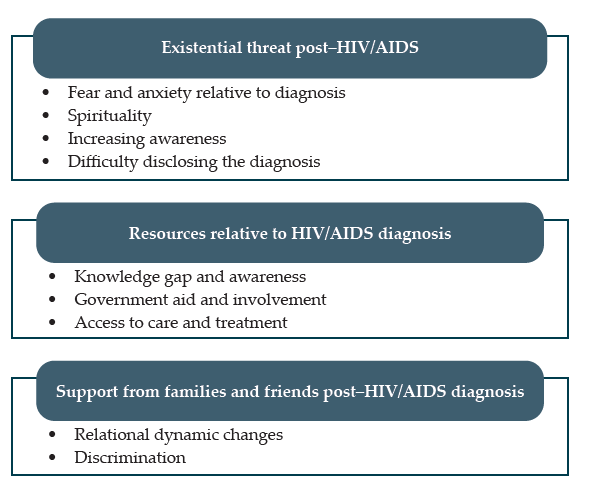
The meaning units discovered illuminated the following emergent themes: existential threat post HIV/AIDS, resources relative to HIV/AIDS diagnosis, and support from families and friends post–HIV diagnosis. Within each of the themes, subthemes emerged (see Figure 1).
Figure 1
Themes Derived From the Data
Existential Threat Post–HIV/AIDS Diagnosis
All participants shared heightened awareness of death and a sense of meaninglessness of life after receiving their HIV/AIDS diagnosis. They expressed their need to see beyond the diagnosis and hold onto something bigger and still contribute to the family, society, and self. Subthemes including fear and anxiety, spirituality, increasing awareness, and difficulty disclosing diagnosis emerged.
Fear and Anxiety Relative to Diagnosis
The lack of support through government resources in rural areas of Uganda added to the participants’ fear of disclosing their HIV status, as such disclosure could lead to discrimination, a disruption of their relationships, or even abandonment. All participants experienced a state of deep anxiety and worry post-diagnosis. For example, Teo reported that at 7 months pregnant, she went in for “a routine blood check for my pregnancy. It was found that I had the virus. I was scared and feared for my life and the life of the baby.”
Fear and anxiety were exacerbated by lack of knowledge and misconceptions about HIV transmission. Some of the participants worried, for example, that HIV could be transmitted through sharing eating utensils or drinking out of the same cup. Three out of eight participants shared their feelings of fear of transmitting the disease to their relatives, which led to them taking hygiene measures to ensure family safety. Maria stated, “I told my family not to use the utensils I was using to eat or mix them when washing out of fear of infecting the family members with the virus. I wanted to isolate myself to protect my family.”
Others shared their anxiety and fear because they transmitted HIV to their children during birth. Eva expressed her worry, stating, “I do not know if my son will ever love me.” Participants’ accounts revealed that awareness of their HIV-positive status, combined with internalized community stigma, deeply intensified their emotional burden. As a result, many struggled significantly with disclosing their HIV status.
Spirituality
The need to connect with God was expressed by most of the participants. Spirituality was described as playing an important role in helping them cope with feelings of fear and suffering following their HIV diagnosis (Sulung & Asyura, 2019). Six out of eight participants expressed a strong belief in God, which was considered a constant source of coping, strength, and hope that helped them come to terms with the virus. For example, Teo explained the presence of God in her life:
God has been good to me, and I’ve not been sick lately. I take my medication daily and I make sure I eat after taking medication. I wake up, go to the gardens morning and evenings to support my children and myself.
Lucy also shared how she experienced daily psychological distress and symptoms of depression because of her HIV-positive diagnosis. She explained that her faith in God enables her to remain strong for her family. She stated, “I tell my children every day that God knows our lives. God has helped me, and I have not gotten sick or had symptoms of the disease. Having these symptoms would scare my children. I am grateful to God.”
Teo’s and Lucy’s stories show how their connection to spirituality provided them with strength and hope in coping with their diagnosis. This indicates the importance of spirituality as a resilience resource that the participants used to overcome the challenges of living with HIV/AIDS. The ability to see beyond the diagnosis, hold onto something bigger, and contribute to family and society were important to them.
Increasing Awareness
The participants in our study expressed a strong desire to share their experiences with healthcare providers, the government, and the wider community, including mental health challenges, the need to refrain from sexual activity, the importance of taking medication as directed, and how the support of government resources can help people living with HIV/AIDS. Some participants explained how living with HIV/AIDS caused feelings of depression. Joseph said:
The government celebrating the AIDS Day should also involve the people living with HIV/AIDS in rural areas. We are not called to participate in this event, and yet this could be an opportunity for us to share our stories and have our ideas and experiences be heard. If the government gets involved and supports people with HIV/AIDS in rural areas to access mental health counseling services, this could improve our health and stop being depressed and stressed out all the time in our villages.
For Joseph, it was important for PLWHA to take an active role in their own care and for mental health professionals and the government to understand mental health concerns relative to the diagnosis. Joseph’s words were intended to increase awareness and support for PLWHA.
Difficulty Disclosing Diagnosis
All participants shared both positive and negative experiences regarding their disclosure of their diagnosis. Regardless of the support they had received from family, friends, partners, or the community, they expressed a preference for isolation. However, they also reported that social isolation resulted in depressed feelings and an increase in irrational thinking. Lucy did not want to disclose her HIV diagnosis because she feared being rejected and accused of giving the virus to her partner. She stated, “I never told the man about my HIV-positive status, and he never saw me taking medication the time we were together. I kept the results of my status secret and to my heart.” Because of the internalized feelings of HIV stigma, many participants decided to conceal their HIV status from family members and friends out of fear of being abandoned, compromising their relationships, or experiencing a violent response. Similarly, Teo did not share her status with her partner: “I have not told him and it’s hard. . . . I want this person to find out by himself. I do not want to put myself out there and end up being accused as one who brought the virus.” Participants feared disclosure because they suspected that their significant other’s response might include anger, violence, and possibly rejection.
Another concern that participants shared with respect to the idea of disclosing the diagnosis within an existing or new relationship was the advice they received from friends after disclosing their HIV status. One participant received misleading feedback from a friend that could have led to her premature death. Lucy stated:
After I was told that I was HIV positive, I did not take the medication. My friend told me that cooking and drinking local herbs like marijuana and other local herbs could kill or weaken the AIDS virus. I decided to follow her advice. I had three children at the time and when I was pregnant with the fourth child, I started to get sick and that is when I got on medication.
This demonstrates a widespread lack of knowledge about the virus, as people misunderstand how HIV is treated, resulting in the spread of misinformation.
Resources Relative to the HIV/AIDS Diagnosis
All eight participants discussed that without focused resources and concerted efforts from the government in addressing mental health services and social and economic needs as barriers, PLWHA will continue to experience negative health outcomes at each step of the HIV care continuum. All participants expressed a lack of knowledge of the government’s support regarding resources needed to manage issues like mental health problems, problems accessing care, and barriers to financial support and transportation.
Knowledge Gap and Awareness
All participants discussed gaps in their knowledge and awareness of the resources available to support them through the crisis. Maria stated:
Here in the villages, we do not have mental health counselors and yet this would have been very helpful for us. We have so many thoughts on our minds and some of these thoughts can lead one to committing suicide. I have heard people with HIV/AIDS in Kampala city have mental health services. I live very far from the town in the village and I would want to know if we have mental health counselors in our village. The only counselors I know of are the ones here at the center who took my blood.
Participants also lacked knowledge about engaging in sexual activities post-diagnosis. For example, following Joseph’s diagnosis, he engaged in sexual relationships with multiple women. Disclosure of the virus reportedly occurred; however, the women did not believe him because he had no visible signs associated with AIDS. Sexual relationships continued despite this disbelief, with the understanding that if the women later discovered that they had the virus, Joseph would take them to the clinic for treatment. This lack of awareness and understanding of available resources contributed to significant challenges in accessing necessary support, highlighting the broader issue of knowledge gaps that hinder effective HIV/AIDS management and prevention.
Government Aid and Involvement
Participants expressed a lack of resources to access treatment and the government’s inability to act on their behalf to navigate their HIV/AIDS issues. They felt that government aid and involvement would support their financial independence and their children’s ability to continue in school. For instance, Immaculate said:
Having government aid would make my life much better and easier. For instance, if the government can give us pigs, this can be very helpful because pigs can be a source of income when we sell them . . . one piglet can cost an equivalent of $26. Having such small businesses can help us become financially independent and be able to support our children to go to school and not drop out.
Similarly, Angella reported that the government had claimed they would support people with HIV/AIDS by supporting small scale farming; those with a plot of land would be given livestock. However, this governmental assistance never came to fruition.
All participants discussed increased psychological distress and symptoms of depression as a result of experiencing HIV-related stigma and a lack of mental health services. Participants reported that because of a lack of government involvement in aiding PLWHA, diagnoses were on the rise, while testing and treatment were in decline. Supporting rural areas to have mental health providers would lead to improvements in the overall well-being of PLWHA in rural Uganda. According to Joseph:
Receiving mental health services can increase my longevity. . . . a mental health counselor coming to my house or in our villages, makes me feel that I am valuable . . . that my country values my life, which in turn encourages me to live happily.
All participants expressed a lack of governmental support for PLWHA in rural Uganda and failure of the government to fulfil the promises it has made in past to PLWHA. For instance, Eva reported:
The government has not supported us. One time we had people from the government coming to our homes and [they] took our pictures, promising that they were going to build houses for us. But the only people who got housing support were the elderly and not people living with HIV/AIDS. Additionally, the government has supported elderly through goat farming but not the people living with HIV/AIDS.
This lack of mental health support, combined with minimal government intervention, not only worsened psychological distress but also contributed to broader systemic barriers, including difficulties in accessing care because of transportation challenges.
Access to Care
All eight participants discussed barriers to care, including transportation and traveling long distances to access HIV treatment, coupled with the high cost of public transportation in rural areas. Eva reported:
I am living with my mother. The distance from the healthcare center to my village is about 12 miles. I find it hard to walk this long distance on days when I do not have money for public transportation. Today, if I was not told that I was not going to be given money for transportation, I would not have come for my treatment. It is a very long distance to walk, especially when you are not feeling well.
Other participants highlighted financial problems as a barrier to accessing treatment. Participants reported difficulty paying healthcare center fees, and six out of eight participants were unemployed. For instance, Lucy said:
It is very expensive to get to the healthcare center, and yet we still are required to pay a fee of about 12.5 dollars, which is approximately 45,800 UG shillings, to get medication every month. Also, I did not have money this term to take my daughter back to school because I have to first pay for the last term. She was allowed to sit for her exams last term but does not get the school report card until I pay the school fees.
Another significant barrier that participants experienced was a lack of support from healthcare providers, including negative attitudes and delays in service. Participants reported that, at times, patients with extra money, often in the form of bribes, were served first, regardless of their arrival time at the healthcare center. Immaculate reported:
One time I got here very early at 6 am before the doors were opened at 7 am. I waited for my medication past 2 pm at the health center. I reported to the doctor that I had not received my medication and yet some people who came after me had received their medication. The doctor responded to me with a negative attitude and anger and asked me what I wanted him to do. He told me that he did not have many hands to look for my file and that I have to wait.
Despite these logistical and financial challenges, participants found solace in the support of some of their friends, highlighting the crucial role of social connections in navigating the difficulties of living with HIV.
Support From Families and Friends Post–HIV Diagnosis
Most of the participants experienced some form of support from their friends. After disclosing their HIV status, participants reported major shifts in family and social relationships, which could be either supportive or not supportive. In Uganda’s rural communities where close relationships are essential for survival, these changes were highly significant. For participants, disclosure marked a turning point, deeply reshaping their lived experiences and social support systems.
Relational Dynamic Changes
All participants stated that their relationships were affected after they shared their HIV status with their family members and friends. Two out of eight participants reported having the support of friends who played an active role in their well-being by interacting with them and providing resources they needed. Eva described friends who kept her accountable for taking her medication when she was unmotivated to do so and just wanted to die: “I have a few friends who have been supportive to me. They have encouraged me that some people live for over 40 years or more if you take your medication and do not stress yourself.” Similarly, Joseph shared positive relationship dynamics after the diagnosis:
Even though my girlfriend had not told me that she had the virus, she is the one who advised me to go for a blood test. After finding out that I was HIV positive, we stayed together because I loved her and we supported each other.
During other interviews, participants shared negative dynamics in spousal relationships. For instance, Immaculate reported:
After I became aware of my HIV-positive diagnosis via blood test, I told my husband that I had been healthy, and I believe he had infected me with the virus. He refuted my allegation and accused me, saying that I was the one with the virus and probably I had infected him. I accepted my situation and decided to separate from my husband.
Although some participants found support from friends who actively contributed to their well-being, the experience of stigma and discrimination created barriers to treatment and acceptance of their diagnosis.
Discrimination
Participants highlighted the issue of discrimination, and whether they had directly or indirectly experienced discrimination, as a barrier when accessing treatment, accepting the diagnosis, or addressing prejudice. For instance, Joseph reported:
I was isolated and discriminated [against] by my family members and close friends, who started to look at me like I was already dead—something that is not of any value waiting to be put in the dust bin. At first, it was hard for me to come and get treatment because people in the villages talk.
Participants also discussed experiencing discrimination from family members and physically being excluded from participating in family events because of their positive HIV status. For instance, Eva reported:
My family discriminated against me by not even wanting to touch me and be close to me. I was locked in a room and was given food by sliding a plate of food in my room. I could not use the same cup and utensils.
Participants also reported that the majority of people in the villages who are HIV positive are not seeking treatment because of fear of stigma and discrimination post-diagnosis. Despite the Ugandan government launching campaigns to encourage community outreach with the help of local leaders, participants in our study reported that many people in villages who have an HIV-positive diagnosis do not seek out early treatment because of the stigma and being discriminated against. For instance, Lucy said:
The majority of people who have HIV/AIDS do not come here to get treatment. Many people fear coming to the clinic because they do not want to be seen and judged. Some decided to go to another clinic, but many do not go for any treatment. They do not want people to know their status because people will go around talking about them and that they are on medication.
In another interview, Joseph reported discrimination related to employment:
One main challenge I have encountered is employment discrimination. This is so because the people who hire me, once they know that I have the virus, they start discriminating [against] me. Many times, I get hired, do the work, but I do not get paid. They keep promising me to be paid every other day, but they never pay me. My boss knows that I have the virus and I need money to get my treatment, but he refuses or delays my payment because he cares more about making his money and not my treatment.
Despite growing awareness of stigma and discrimination as major barriers to eradicating HIV, addressing these issues has not been prioritized in national programs. Participants highlighted discrimination as a significant obstacle to accessing treatment, accepting their diagnosis, and maintaining employment. Many faced exclusions from family and community events, while others avoided seeking treatment altogether because of fear of judgment. Even government-led outreach efforts have struggled to overcome the deep-seated stigma that prevents people from accessing essential care.
Discussion
The aim of this research was to understand the experiences of PLWHA in rural Uganda, rather than to generalize them with others outside of this context; the lived experiences of PLWHA are contingent upon the proximal and distal environment (Breslow & Brewster, 2020). Bearing in mind the transferability of the study findings, we provided robust information about adults living with HIV/AIDS in rural Uganda that can help to examine comparative experiences with those living in urban areas and to create a framework for similar comparisons in other parts of the world. This research study mirrored trends occurring across Uganda. Furthermore, the study participants represented a range of ages, genders, and years living with their diagnosis. Therefore, the findings of this study provide supportive information for similar research on PLWHA globally.
Implications for Clinical Practice
Our findings highlight critical implications for clinical practice by underscoring the need for contextually responsive, holistic mental health care for PLWHA in Uganda. In rural communities where relationships are vital for survival, relational changes caused by an HIV/AIDS diagnosis can profoundly affect psychological well-being, making it essential for clinicians to integrate psychosocial support with medical treatment. Addressing stigma, strengthening community ties, and tailoring interventions to differences in age, sex, and duration of illness can enhance the effectiveness of care and promote resilience. For U.S.-based practitioners, these insights underscore the importance of cultural humility and the recognition that environmental and relational contexts significantly influence the lived experiences of PLWHA. Applying these lessons can inform more individualized and culturally competent care for African diaspora populations and other marginalized groups, advancing patient-centered and equitable models of practice.
Implications for Social Change
The Bethany Land Institute (BLI), a nonprofit organization, provides a useful, real-world model for addressing not only the physical but also the psychosocial dimensions of HIV/AIDS in rural Uganda (BLI, 2025). Its approach aligns closely with key themes such as spirituality, knowledge gaps and awareness, discrimination, and fear and anxiety by embedding mental health support within community development and ecological programs. For instance, BLI integrates spirituality as a core component of healing and resilience, which is especially important in rural Ugandan contexts in which faith-based worldviews are central to daily life. Founded on Christian principles, BLI incorporates spiritual reflection, prayer, and values such as stewardship, hope, and dignity into its training programs. For PLWHA, spirituality helps reframe illness as part of a broader life journey rather than a moral failure, reducing internalized stigma while fostering a sense of belonging through shared community values. Also, BLI addresses knowledge gaps and limited awareness, which are major barriers in rural Uganda. By embedding health education into its livelihood and sustainability programs, participants engage in agricultural and ecological training to receive information about nutrition. This practical learning model uses hands-on demonstrations, such as nutrition-sensitive farming, to show how proper diet supports immune health for PLWHA. Once participants are trained, they are empowered with actionable knowledge to return to their villages and improve community health outcomes.
Professional counselors increasingly recognize the impact of social factors on individual well-being. Integrating mental and physical healthcare improves outcomes for PLWHA. In rural Africa, particularly Uganda, limited access to quality medical and counseling services is compounded by unemployment, poverty, and low socioeconomic status. Addressing these challenges requires meaningful conversations within the counseling profession in order to develop effective responses to HIV/AIDS in resource-limited settings.
This research confirms that health and social factors significantly impact PLWHA. Although professional counselors may not fully understand the lived experiences of individuals with HIV/AIDS in rural Uganda, fostering connections among service providers can improve treatment outcomes. Strengthening these networks helps identify available resources, address service gaps, and guide further research. The counseling profession has opportunities to engage with rural African communities through partnerships with organizations such as BLI. BLI supports individuals in rural Uganda affected by HIV/AIDS and other illnesses, many of whom have lost family members to this pandemic. By providing sustainable agriculture programs, BLI helps participants build stable livelihoods. Collaborating with such initiatives allows U.S.–based counselors and counseling programs to contribute to global mental health efforts, support sustainable development, and enhance culturally responsive care. This is one example of unique opportunities for the counseling profession in the United States to get more involved by connecting and partnering with these types of programs in Uganda and Africa.
Limitations
This study met the established criteria for qualitative research, and data saturation was achieved. In line with methodological guidance, we aimed for a sample of six to 10 participants and conducted 90-minute in-depth interviews, which supported saturation and enhanced trustworthiness (Shelton & Bridges, 2022). A potential limitation, however, was the influence of prior assumptions about the phenomenon. Despite the use of bracketing to set aside personal biases, achieving complete neutrality is challenging (Jackson et al., 2018). To further strengthen trustworthiness, we approached data collection with intentionality, focusing on describing participants’ lived experiences without judgment. Husserl introduced the concept of intentionality, a cornerstone of phenomenological research, to capture “life-world experiences or lived experiences” (Giorgi, 2012b, p. 132; Giorgi et al., 2017).
Recommendation for Further Research
Our study highlights several priorities for future research. Findings reveal unique considerations related to support, barriers, and existential crises affecting the quality of life of PLWHA in rural Uganda. Participants emphasized the lack of government support despite Uganda’s historical leadership in the HIV/AIDS response since the 1980s. This raises important questions about potential governmental disconnection or complacency, warranting further research on the evolving role of government support and public perceptions. Additionally, the study highlights the importance of relational support in rural Uganda, where family, social, and community connections are crucial for maintaining well-being and survival. Wissing et al. (2020) noted that relationships in the African context are rooted in interconnectedness, interdependence, solidarity, and belonging. A quantitative study could expand these findings to a broader sample, increasing generalizability.
Conclusion
The purpose of this qualitative transcendental phenomenological study was to describe the lived experiences of people living with HIV/AIDS in rural Uganda. Addressing the challenges facing PLWHA in rural Uganda requires urgent intervention from the Ugandan government, counselors, and educators. Although the United States has long engaged with Africa in healthcare, recent policy changes may threaten this collaboration (Schreiber, 2025). Strengthening global mental health initiatives is crucial, necessitating cultural competence in order to effectively support affected communities (American Counseling Association, 2014). This qualitative study provides essential insights into the complexities of HIV/AIDS and mental health counseling in rural Uganda, emphasizing the need for culturally informed global interventions.
Conflict of Interest and Funding Disclosure
The authors reported no conflict of interest
or funding contributions for the development
of this manuscript.
References
Akatukwasa, C., Getahun, M., El Ayadi, A. M., Namanya, J., Maeri, I., Itiakorit, H., Owino, L., Sanyu, N., Kabami, J., Ssemmondo, E., Sang, N., Kwarisiima, D., Petersen, M. L., Charlebois, E. D., Chamie, G., Clark, T. D., Cohen, C. R., Kamya, M. R., Bukusi, E. A., . . . Camlin, C. S. (2021). Dimensions of HIV-related stigma in rural communities in Kenya and Uganda at the start of a large HIV “test and treat” trial. PLoS ONE, 16(5), 1–17. https://doi.org/10.1371/journal.pone.0249462
American Counseling Association. (2014). ACA code of ethics. https://bit.ly/ACACodeofEthics
Bethany Land Institute. (2025, May 7). Who are we? https://www.bethanylandinstitute.org
Breslow, A. S., & Brewster, M. E. (2020). HIV is not a crime: Exploring dual roles of criminalization and discrimination in HIV/AIDS minority stress. Stigma and Health, 5(1), 83–93. https://doi.org/10.1037/sah0000177
Byrd, K. K., Hardnett, F., Hou, J. G., Clay, P. G., Suzuki, S., Camp, N. M., Shankle, M. D., Weidle, P. J., & Taitel, M. S. (2020). Improvements in retention in care and HIV viral suppression among persons with HIV and comorbid mental health conditions: Patient-centered HIV care model. AIDS and Behavior, 24(12), 3522–3532. https://doi.org/10.1007/s10461-020-02913-2
Centers for Disease Control and Prevention. (2021). About HIV. https://www.cdc.gov/hiv/about/?CDC_AAref_Val=https://www.cdc.gov/hiv/basics/whatishiv.html
Chan, Z. C. Y., Fung, Y., & Chien, W. (2013). Bracketing in phenomenology: Only undertaken in the data collection and analysis process. The Qualitative Report, 18(30), 1–9. https://doi.org/10.46743/2160-3715/2013.1486
Cope, D. G. (2014). Methods and meanings: Credibility and trustworthiness of qualitative research. Oncology Nursing Forum, 41(1), 89–91. https://doi.org/10.1188/14.ONF.89-91
Costelloe, S., Kemppainen, J., Brion, J., MacKain, S., Reid, P., Frampton, A., & Rigsbee, E. (2015). Impact of anxiety and depressive symptoms on perceptions of stigma in persons living with HIV disease in rural versus urban North Carolina. AIDS Care, 27(12), 1425–1428. https://doi.org/10.1080/09540121.2015.1114993
Creswell, J. W., & Creswell, J. D. (2018). Research design: Qualitative, quantitative, and mixed methods (5th ed.). SAGE.
De Jesus, M., & Williams, D. R. (2018). The care and prevention in the United States Demonstration Project: A call for more focus on the social determinants of HIV/AIDS. Public Health Reports, 133, S28–S33. https://doi.org/10.1177/0033354918801353
Fusch, P. I., & Ness, L. R. (2015). Are we there yet? Data saturation in qualitative research. The Qualitative Report, 20(9), 1408–1416. https://nsuworks.nova.edu/tqr/vol20/iss9/3
Giorgi, A. (1997). The theory, practice, and evaluation of the phenomenological method as a qualitative research procedure. Journal of Phenomenological Psychology, 28(2), 235–260. https://doi.org/10.1163/156916297×00103
Giorgi, A. (2009). The descriptive phenomenological research method in psychology: A modified Husserlian approach. Duquesne University Press.
Giorgi, A. (2012a). The descriptive phenomenological psychological method. Journal of Phenomenological Psychology, 43(1), 3–12. https://doi.org/10.1163/156916212X632934
Giorgi, A. (2012b). Review of “Subjectivity and lifeworld in transcendental phenomenology.” Journal of Phenomenological Psychology, 43(1), 131–135. https://doi.org/10.1163/156916212X632970
Giorgi, A., Giorgi, B., & Morley, J. (2017). The descriptive phenomenological psychological method. In C. Willig & W. S. Rogers (Eds.), The SAGE handbook of qualitative research in psychology (pp. 176–192). SAGE. https://doi.org/10.4135/9781526405555.n11
Hladik, W., Sande, E., Berry, M., Ganafa, S., Kiyingi, H., Kusiima, J., & Hakim, A. (2017). Men who have sex with men in Kampala, Uganda: Results from a bio-behavioral respondent driven sampling survey. AIDS and Behavior, 21(5), 1478–1490. https://doi.org/10.1007/s10461-016-1535-2
Husserl, E. (1931). Ideas: General introduction to pure phenomenology. [Trans. by W. R. B. Gibson]. Routledge.
Ijeoma, A., Ejikeme, A., Theodora, O., & Chika, O. (2018). Knowledge, attitude, willingness of HIV counseling and testing and factors associated with it, among long distant drivers in Enugu, Nigeria: An opportunity in reduction of HIV prevalence. African Health Sciences, 18(4), 1088–1097. https://doi.org/10.4314/ahs.v18i4.30
Jackson, C., Vaughan, D., R., & Brown, L. (2018). Discovering lived experiences through descriptive phenomenology. International Journal of Contemporary Hospitality Management, 30(11), 3309–3325. https://doi.org/10.1108/IJCHM-10-2017-0707
Kalichman, S., Katner, H., Banas, E., & Kalichman, M. (2017). Population density and AIDS-related stigma in large-urban, small-urban, and rural communities of the southeastern USA. Prevention Science, 18, 517–525.
https://doi.org/10.1007/s11121-017-0761-9
Kiene, S. M., Sileo, K., Wanyenze, R. K., Lule, H., Bateganya, M. H., Jasperse, J., Nantaba, H., & Jayaratne, K. (2015). Barriers to and acceptability of provider-initiated HIV testing and counselling and adopting HIV-prevention behaviors in rural Uganda: A qualitative study. Journal of Health Psychology, 20(2), 173–187. https://doi.org/10.1177/1359105313500685
Kitara, D. L., & Aloyo, J. (2012). HIV/AIDS stigmatization, the reason for poor access to HIV counseling and testing (HCT) among the youths in Gulu (Uganda). African Journal of Infectious Diseases, 6(1), 12–20. https://doi.org/10.4314/ajid.v6i1.77737
Korstjens, I., & Moser, A. (2018). Series: Practical guidance to qualitative research. Part 4: Trustworthiness and publishing. European Journal of General Practice, 24(1), 120–124. https://doi.org/10.1080/13814788.2017.1375092
Koskinen, C. (2025). Researcher vulnerability in qualitative research—A conceptual framework. Scandinavian Journal of Caring Sciences, 39(1), e70012. https://doi.org/10.1111/scs.70012
Kumar, N., Unnikrishnan, B., Thapar, R., Mithra, P., Kulkarni, V., Holla, R., Bhagawan, D., & Kumar, A. (2017). Stigmatization and discrimination toward people living with HIV/AIDS in a coastal city of south India. Journal of the International Association of Providers of AIDS Care, 16(3), 226–232. https://doi.org/10.1177/2325957415569309
Lim, W. M. (2026). Sample size in qualitative research: Moving from data saturation to theoretical saturation. Journal of Global Marketing, 39(2), 224–234. https://doi.org/10.1080/08911762.2025.2590757
Mi Choi, K., & Hyun, J. H. (2023). Perceptions and experiences of school counselor trainees on self-care grounded in mindfulness and social–emotional learning. The Professional Counselor, 13(2), 113–128. https://doi.org/10.15241/kmc.13.2.113
Moustakas, C. (1994). Phenomenological research methods. SAGE.
Nakimuli-Mpungu, E., Musisi, S., Smith, C. M., Von Isenburg, M., Akimana, B., Shakarishvili, A., Nachega, J. B., Mills, E. J., Chibanda, D., Ribeiro, M., Williams, A. V., & Joska, J. A. (2021). Mental health interventions for persons living with HIV in low- and middle-income countries: A systematic review. Journal of the International AIDS Society, 24(S2), 100–114. https://doi.org/10.1002/jia2.25722
Nasi, M., De Biasi, S., Gibellini, L., Bianchini, E., Pecorini, S., Bacca, V., Guaraldi, G., Mussini, C., Pinti, M., & Cossarizza, A. (2017). Ageing and inflammation in patients with HIV infection. Clinical and Experimental Immunology, 187(1), 44–52. https://doi.org/10.1111/cei.12814
National Institutes of Health. (2024, November 13). Living with HIV. HIVinfo. https://hivinfo.nih.gov/understanding-hiv/fact-sheets/hiv-and-mental-health
Obeagu, E. I., & Obeagu, G. U. (2024). Preventive measures against HIV among Uganda’s youth: Strategies, implementation, and effectiveness. Medicine, 103(44), e40317. https://doi.org/10.1097/MD.0000000000040317
Peoples, K. (2021). How to write a phenomenological dissertation: A step-by-step guide. SAGE.
Poorolajal, J., Hooshmand, E., Mahjub, H., Esmailnasab, N., & Jenabi, E. (2016). Survival rate of AIDS disease and mortality in HIV-infected patients: A meta-analysis. Public Health, 139, 3–12. https://doi.org/10.1016/j.puhe.2016.05.004
Remien, R. H., Stirratt, M. J., Nguyen, N., Robbins, R. N., Pala, A. N., & Mellins, C. A. (2019). Mental health and HIV/AIDS: The need for an integrated response. AIDS, 33(9), 1411–1420. https://doi.org/10.1097/QAD.0000000000002227
Schreiber, M. (2025, January 25). Trump’s “stop-work” order for PEPFAR cuts off anti-HIV drugs for patients. National Public Radio. https://www.npr.org/sections/goats-and-soda/2025/01/28/g-s1-45030/pepfar-trump-drugs-stop-work
Setlhare, V., Wright, A., & Couper, I. (2014). The experiences of people living with HIV/AIDS in Gaborone, Botswana: Stigma, its consequences and coping mechanisms. South African Family Practice, 56(6), 309–313. https://doi.org/10.1080/20786190.2014.975484
Shelton, D., & Bridges, C. W. (2022). A phenomenological exploration of adoptive parent experiences of support during the adoption process. Adoption Quarterly, 25(3), 212–243. https://doi.org/10.1080/10926755.2021.1976336
Sulung, N., & Asyura, R. (2019). The analysis of spirituality of patients with HIV/AIDS in taking lessons and self-acceptance. Indian Journal of Palliative Care, 25(2), 232–235. https://doi.org/10.4103/IJPC.IJPC_203_18
Uganda AIDS Commission. (2020). The monitoring and evaluation plan for the national HIV and AIDS strategic plan 2020/21-2024/25. https://www.prepwatch.org/wp-content/uploads/2022/07/Uganda-ME-Plan-2020-25.pdf
Uganda AIDS Commission. (2022). 2022 fact sheet: Facts on HIV and AIDS in Uganda 2022. https://uac.go.ug/images/2024/facttsheets/hiv-aids-factsheet-2022.pdf
Uganda Ministry of Health. (2022). Health alerts and services. https://uac.go.ug/images/2024/jar-2024/jar-report-_-final_2021_nov-12.pdf
UNAIDS. (2020). Fact sheet – World AIDS Day 2020. https://uac.go.ug/media/attachments/2021/09/13/unaids_factsheet_en.pdf
UNAIDS. (2021). UNAIDS data 2021. https://www.unaids.org/sites/default/files/media_asset/JC3032_AIDS_Data_book_2021_En.pdf
Wissing, M. P., Wilson Fadiji, A., Schutte, L., Chigeza, S., Schutte, W. D., & Temane, Q. M. (2020). Motivations for relationships as sources of meaning: Ghanaian and South African experiences. Frontiers in Psychology, 11. https://doi.org/10.3389/fpsyg.2020.02019
Godfrey Ddungu, PhD, NCC, ACS, LCPC, ASDCS, is an assistant professor at California State University Fresno. Corinne W. Bridges, EdD, NCC, BC-TMH, LPCC, is an associate professor at Walden University. Cynthia A. Briggs, PhD, NCC, LCMHC(NC), is an associate professor at Walden University. Correspondence may be addressed to Godfrey Ddungu, Department of Counselor Education and Rehabilitation, Kremen School of Education and Human Development, California State University Fresno, 5005 N Maple Ave MS ED1, 455, Fresno, CA 93740, goddungu@mail.fresnostate.edu.
Oct 1, 2026 | Volume 16 - Issue 3
Marcus Adams, Joshua D. Smith, Neal D. Gray
Each year TPC presents an interview with an influential figure in counseling as part of its Lifetime Achievement in Counseling series. This year, Dr. Christian J. Dean discussed important considerations for military-connected individuals and families. With a military career spanning nearly three decades and a counseling career almost as long, Dr. Dean holds valuable insights into military culture, mental health needs of military-connected individuals, and challenges faced by counselors seeking to serve this population. In this interview he clearly identifies gaps in services and potential solutions that are informed by his lived experience and professional expertise. We are grateful for Dr. Dean’s commitment to veterans, active-duty military personnel, and their families and share his hope for expanded military mental health services.
—J. Richelle Joe, Editor
Disclaimer: The following does not represent the views or opinions of the Department of Defense, the Department of Veterans Affairs, the United States Army, the United States Army Reserve, or any other branch or component of the U.S. Armed Forces.
 Christian J. Dean, PhD, NCC, LPC-S, LMFT-S, is a professor in the Clinical Mental Health Counseling program at Divine Mercy University. He was previously a professor at the University of the Cumberlands. He is licensed as a professional counselor/board-approved supervisor (LPC-S) and a marriage and family therapist/board-approved supervisor (LMFT-S) in Louisiana, where he practices at Counseling for Growth, LLC. Dr. Dean is a 28+-year member of the military (Army National Guard and Army Reserve), currently holds the rank of colonel, and is a veteran of Operation Iraqi Freedom. He is a National Certified Counselor (NCC) and participated as a collaborative investigator for the DSM-5 Field Trials in Routine Clinical Practice Settings. He works with Spanish-speaking clients, service members, veterans, and a wide variety of other client populations. Dr. Dean is an EMDR-trained therapist and integrates cognitive behavioral therapy in his clinical work. Dr. Dean has presented and published on the use of metaphors in counseling and counselor education, counseling couples, understanding military systems and dynamics, differential diagnosing and processes, and ethical considerations in counseling and marriage and family therapy. He is the author of Ladders and Shovels: How to Climb Out of Emotional Holes and Stop Digging Them and the coeditor of Metaphors in Counselor Education and Supervision as well as Metaphors and Therapy: Enhancing Clinical Supervision and Education.
- What originally inspired you to become a counselor, and how did your time in the military shape your desire to serve veterans, active-duty members, and their families?
I’m a rescuer by nature, which can be a good and, at times, challenging trait. Whenever my friends had something on their mind, I would want to be available to them to discuss what was bothering them. Back in high school, what normally came up as upsetting events was usually relationship troubles, and I found that I wanted to be there for my friends to hear them out, be a listening and compassionate ear, and to figure out how I could be helpful. My passion for helping others led me to major in psychology at the University of New Orleans.
When I enlisted in the Louisiana Army National Guard, I was already familiar with many military terms and some cultural factors, as I was in the Navy Junior Reserve Officers Training Corps (NJROTC) in high school. I completed Basic Training and my Advanced Individual Training (AIT), where I was military occupational specialty (MOS) qualified as a 13F, fire support specialist. I began working on my graduate degree in counseling at the University of New Orleans and enrolled in Officer Candidate School, where I commissioned as a second lieutenant. I graduated with my master’s in counseling, completed Field Artillery Officer Basic Course (FAOBC), and continued to serve in the Louisiana Army National Guard while I enrolled in my doctoral program in counselor education and supervision at the University of New Orleans. While completing my dissertation, I was alerted that my unit was being mobilized to deploy to Iraq as part of Operation Iraqi Freedom III. I was allowed to stay behind a couple of days so that I could walk for graduation and then immediately reported to Fort Hood, Texas, to join my unit.
At that time, I had already received my license as a marriage and family therapist (LMFT) and was what was then called a counselor intern, also completing my hours toward my license as a professional counselor (LPC); however, I had not had much work in providing counseling with service members or veterans. Upon our deployment, I realized that the medical unit in my brigade did not have any mental health assets, so I connected with the brigade surgeon and advocated for the importance of mental health services to our soldiers. Since I had my doctorate and an independent license, I was allowed to provide counseling services to our soldiers for one day a week at the Troop Medical Clinic (TMC) with oversight from the brigade surgeon. I had a 12-hour day, and all 12 hours were filled before I even started. Additionally, the next week’s clinical day was also full before I even finished my first day. This prompted unit leadership to allocate two days a week, which were also quickly filled. Before I knew it, I was assigned to provide counseling services 6 days a week at 12-hour days, which were all filled almost every week while I served in that capacity.
My time working at the TMC was very rewarding for me, as I could help soldiers in need during their time in a combat deployment. I was able to hear many stories and see the need for mental health resources for service members. I also provided training to unit leadership and medics, and even units outside of our brigade requested training. However, all of that came to an end when a new division assumed operational control over our brigade during a transfer of authority. The incoming unit had a division psychologist, who said that I could not provide counseling, as I was not a psychologist or social worker, the two professions that the U.S. Army allowed to provide counseling services. My brigade now had to find other ways to get mental health services to our soldiers. From then on, I made it part of my mission to continue to provide counseling services and help others be more informed when helping service members, veterans, and their families.
- Who mentored you along the way, and how does this impact how you mentor others today?
Mentorship is something I’ve always valued and continue to value. In terms of mentorship in counseling, I would have to say it goes all the way back to my graduate counseling program. Dr. Ted Remley, Dr. Diana Hulse, Dr. Terry Christensen, and Dr. Barbara Herlihy, to name a few, were some mentors who poured into me and informed who I am as a counselor. On a clinical level, I had the opportunity to work with several clinicians in many capacities who have helped mentor and develop my clinical skills. On the military side, I’ve had many officers and many noncommissioned officers (NCOs) throughout my career who provided some form of mentorship.
Today, I am working on being available to counselors and service members for mentorship. Sometimes mentorship occurs in structured settings, while other times it develops more naturally through conversations and day-to-day interactions. These mentoring moments often happen during phone calls with other soldiers or impromptu meetings during Battle Assembly (BA)/drill. During BA, I’ll have soldiers come up and ask if they could meet with me. Often, there are questions related to career progression, options within the U.S. Army Reserve, and whether to continue to serve. More structured mentorship may include formal developmental counseling within the military leadership context, where assigned tasks, expectations, performance, and professional development goals are discussed with soldiers. Regular touchpoints may also be used to explore goals, thoughts, and concerns. In the counseling world, mentorship may involve touching base with counselors who email or call regarding private practice, joining the U.S. Armed Forces, research questions, etc. I also have monthly meetings with counselors who request more ongoing mentorship and guidance.
- From your perspective, what are some of the biggest mental health challenges that service members, veterans, and military spouses are facing today?
The culture of the military is one of the biggest challenges. Although mental health services and the overall mental health care of service members, veterans, and their families have gained more attention over the past decade, there is still a lot of work to do. Different branches of the military have their own challenges with their view and approach to mental health, where some may be more understanding and supportive, while there is still a significant stigma with others. Many [individuals] are concerned about how they will be treated or seen by their fellow service members if they admit to or get help for mental health–related concerns. Again, there has been some improvement, but we can still grow a lot in this area.
Some solutions with mental health services include adjusting the types of free services provided through Military OneSource. For example, anyone diagnosed or who meets criteria for a diagnosis of most psychiatric disorders is not allowed to use such services, as Military OneSource only provides “nonmedical” counseling. Therefore, having such services available to service members and their families regardless of clinical conditions would prove to be helpful and expand the free services to those who need them the most. Additional support services such as Military and Family Life Counselors (MFLC) and Military OneSource can be helpful resources; however, limitations related to clinical conditions and affordability can still create barriers to care for many service members and their families. Access to care also continues to be a challenge, particularly for service members and families attempting to navigate systems such as TRICARE, Military OneSource, and VA-related services. Increasing the number of counselors who are educated about and willing to work within these systems could greatly improve access to mental health support for military populations.
The [Department of] Veterans Affairs (VA) and related VA clinics and Vet Centers do provide mental health services to veterans who are registered with the VA. These services are more available to veterans throughout the country. The VA also does provide some community-based care options where they contract with local providers to help meet the needs of veterans. However, getting enrolled in and navigating through the VA system can be challenging. Counselors can learn about ways to assist veterans in enrolling with the VA and to provide additional support when needed.
If a service member records a mental health diagnosis during a Periodic Health Assessment (PHA), then the service member’s records may be reviewed for Fit-for-Duty evaluations, which may impact their ability to serve in certain specialties and/or their duty status. Even on the application for security clearances, there are questions about treatment; however, marriage and couples counseling are excluded from the areas that may need to be reported. Still, military leadership encourages service members to be honest about their experiences so that adequate services may be provided through referrals and organic assets.
- What do you believe are some of the most common misconceptions civilian counselors have about working with service members, veterans, and military families, and how can the profession better prepare clinicians to serve this community effectively?
Whether it be a misconception or lack of awareness, the first thing that comes to mind is the importance many service members and veterans place on military service and culture. A counselor knowing their own family’s military history can help demonstrate that they honor and respect service members and veterans. Understanding the culture, values, structure, and terminology of at least one military branch can be helpful, and broader knowledge across branches can be even more beneficial.
Another misconception is that all service members and veterans are closed off and not open to counseling. There are many within the military community who embrace counseling. Part of the challenge is helping military populations find mental health professionals who are knowledgeable, engaged, and genuinely invested in understanding military culture. Understanding the structure, ranks, and terminology can help facilitate this process for counselors. I encourage professionals interested in working with service members, veterans, and their families to consider engaging in experiential learning and immersive experiences. Some examples include engaging in trainings through the Department of Veterans Affairs, the Consortium for Deployment Psychology, and Military OneSource, and participating in volunteer opportunities through the United Service Organizations (USO). Counselors may also want to shadow or connect with Military and Family Life Counselors (MFLC) to better understand the experiences and challenges of service members, veterans, and their families.
From a clinical perspective, a common misconception is that combat trauma and post-traumatic stress disorder (PTSD) stemming from combat are the main challenges experienced by service members and veterans. Many service members never see combat or necessarily directly engage in combat operations. Unfortunately, PTSD may present due to other traumatic experiences like military sexual trauma (MST) or interpersonal trauma related to experiences of being neglected, abused, or mistreated by leaders, other service members, and/or the system in general. Counselors can better serve service members and veterans from this perspective.
One common theme is the focus on the service member and their experiences while inadvertently ignoring the impact on the entire family system. The spouse and children of service members may have their heart skip a beat if they see individuals in uniform pulling up to their house due to potential bad news about the service member that is deployed. For some, it could be the phone ringing when they haven’t heard from their deployed service member for several days. The trauma of their deployed service member being in a dangerous environment in and of itself can take a toll on the entire family system. Although children are often thought of as resilient, these experiences can really impact military families, resulting in challenging emotional equilibrium. Counselors can benefit from considering the impact of military service on the entire family system while exploring such potential experiences and related impact.
This also ties into how counselors are trained and how we support this population overall. Counselors can seek out training on military culture, rank structure, etc. Some training programs are available for free, which is great. Attending specialization certification programs on working with service members, veterans, and their families can also be helpful. I do, however, caution the counseling profession in the potential impact of “doing more” than other mental health professions to get equal footing when it comes to recognition as uniformed service providers.
My concern with the counseling profession having to “prove” that they are competent/capable to serve in certain situations will result in additional trainings beyond what other mental health professions may have to complete. For example, to be credentialed and seeking Substance Abuse Professional status with the U.S. Department of Transportation (DOT), a counselor must have the Master Addictions Counselor (MAC) certification through NBCC; however, licensed physicians, psychologists, social workers, and marriage and family therapists don’t require an additional certification. I find it concerning that counselors are singled out and required to do more than other mental health professionals to be considered “good enough.” I support additional training on knowledge and competencies related to working with service members, veterans, and their families; however, I don’t support such training being a requirement to put counselors on equal footing with other mental health professions.
Mental health professionals can work on advocacy strategies to encourage the Department of Defense to adjust the free care (i.e., Military OneSource, MFLC) being provided to allow more clinically focused conditions to be treated. This may include contacting federal congressional and Senate representatives to inform them of these opportunities and to influence change, potentially through legislation. Mental health professionals can also volunteer with programs like the Give an Hour program to provide pro bono services or independently offer pro bono services to service members, veterans, and their families. Mental health professionals can also connect with Star Behavioral Health Providers (SBHP) to access free training on military culture, values, etc. Enrolling as a TRICARE provider can also improve access to mental health services. At least in my community, I’ve found that more private practice providers are going to cash pay–only. I invite all mental health professionals to consider becoming a TRICARE provider to assist service members and their families with needed clinical services. Lastly, [I recommend] working with the VA to become a Community Care Network (CCN) provider as well as establishing a Veterans Care Agreement (VCA) with the VA to provide services not available at VA clinics and healthcare facilities within the community.
- When working with military clients, what approaches or techniques have you found to be most effective?
I find that working on rapport is essential. Asking the client about their military service, to include branch, component (i.e., active duty, National Guard, or reserve), rank, deployment, MOS, duty stations, etc. is important. If a counselor has served or has family members who have served, only share that information if they can answer similar questions about their family’s service history. For example, if a counselor shared that their mother was in the U.S. Army, they should then be ready to answer what component, rank, MOS, duty stations, etc. By knowing that information, it sends a message that you value military service, are invested in learning about it, and can speak to your family’s military service.
Many service members and veterans find meaning and purpose in their military service. Exploring those experiences has been helpful in my work with both populations. Their experience can include having a 20-year-old overseeing several other service members and equipment potentially worth hundreds of thousands of dollars. Once they leave military service, finding a job with similar responsibilities, meaning, and purpose may be difficult. Helping veterans find other ways to find purpose and meaning can be greatly beneficial.
Due to the physical and often interpersonal trauma experienced by service members, being trained in Eye Movement Desensitization and Reprocessing (EMDR) and Internal Family Systems (IFS) can also be very helpful, as such approaches can help service members and veterans work through those traumatic events. Integrating cognitive-based approaches can also be helpful; however, I have received feedback from several service members and veterans that exposure therapy does not accommodate their needs, which necessitates alternate methods of therapy and/or treatment.
- Looking back on your career, what do you see as your most meaningful contribution to the counseling profession, particularly in supporting the military community?
As part of my mission, I started submitting proposals for presentations at conferences to help train counselors and marriage and family therapists on military culture, as well as ways to connect with service members, veterans, and their families. I also provided training at Yellow Ribbon Events, where service members and their families received education about reintegration following deployments. Earlier in my career, I had the opportunity to provide training to medics within the Belize Defense Force through the State Partnership Program between the Louisiana Army National Guard and Belize.
In addition to training and education efforts, I have also focused heavily on advocacy work related to the inclusion of counselors and marriage and family therapists within military and veteran systems of care. I’ve advocated for the inclusion of counselors and marriage and family therapists as uniformed behavioral science officers in the U.S. Army, U.S. Army Reserve, and U.S. Army National Guard, as well as for the need for the Department of Veterans Affairs to hire more counselors and marriage and family therapists.
The VA currently approves internships exclusively within profession-specific programs. While the Council for Accreditation of Counseling and Related Educational Programs (CACREP) permits any independently licensed mental health professionals, such as licensed professional counselors, licensed marriage and family therapists, licensed clinical social workers, or licensed psychologists to serve as site supervisors, the VA’s current policy requires that only licensed counselors supervise counseling interns. Expanding supervisory eligibility to include all independently licensed mental health professionals recognized by CACREP could help increase internship opportunities and strengthen the development of future counseling professionals within VA systems.
I have written a white paper on how the U.S. Army could save money while also providing qualified behavioral science officers faster if they would create new areas of concentration (AOC) for both counselors and marriage and family therapists. The U.S. Army started a Master of Social Work (MSW) program where soldiers would receive a commission, be put on active duty, and complete a 14-month MSW program. I highlighted how even after the 14-month program, those MSWs would need to complete roughly 3 years of post-degree supervised experience before they are fully licensed. I point out how the U.S. Army could save hundreds of thousands of dollars, per officer, between the base pay, benefits, etc., over the 4+ years if they would create a new AOC for counselors and for marriage and family therapists. I will be sending this document up through military channels to explore potential inclusion.
In the past, I have corresponded with ACA, AMHCA, NBCC, and AAMFT regarding advocacy efforts to have counselors’ and marriage and family therapists’ inclusion with military service. I’ve also served as a pro bono counselor with the Give an Hour program. I completed a study exploring the uniformed service experience of counselors and marriage and family therapists and will have the results submitted to a journal in the next couple of months. The hope is that the results of the study can help the ACA, AMHCA, NBCC, and AAMFT with advocacy efforts to include counselors and marriage and family therapists as uniformed behavioral science officers within the branches of the military.
There is some good news regarding inclusion. Recent updates from the Commissioned Corps of the U.S. Public Health Services (USPHS) announced the inclusion of licensed professional counselors (LPCs) to become mental health providers to address provider shortages (Schobitz, 2025). The changes made by the USPHS will make it the “first uniformed service with mental health counselors serving as commissioned officers” (Schobitz, 2025, p. 14). Now, advocacy and inclusion efforts will hopefully be easier with other uniformed services (e.g., Army, Air Force, and Navy).
- Finally, if you could leave readers with one message about what it means to serve both in uniform and as a professional counselor, what would that message be?
As a service member, veteran, and professional counselor, I find deep meaning and purpose in my roles as a leader, officer, and counselor. I am proud to serve alongside many dedicated individuals who work tirelessly to support our service members and veterans. While challenges exist—such as navigating disability compensation for service-connected injuries and exposures, and ensuring every individual feels fully valued within support systems—I believe these are opportunities for growth and improvement. These situations often stem from complex processes and communication challenges, not from a lack of care or commitment by leaders, units, or organizations. With continued collaboration and innovation, we can strengthen these systems to better serve those who have served us. In my current leadership role, I work hard to try to make systemic changes that are beneficial to service members, particularly those in my unit. My role as a counselor, service member, and leader has given me the opportunity to be of service to veterans and service members. Advocating for them, exploring solutions and options, and providing direct support has meant the world to me. I hope that other counselors will join the call to support service members, veterans, and their families, as the need is clearly present.
After 25+ years of clinical practice and 28+ years of military service, it is hard to separate the “counselor” in me from the “soldier.” I do integrate counseling skills in my interactions with soldiers in my unit and highly encourage counseling for all service members who are in need. I’m not their counselor and I don’t provide counseling services, but I do use active listening, empathy, and unconditional positive regard in many of my interactions. I’m extremely proud of my 28+ years of military service, and I hope to continue until my retirement. I sometimes think about what it will be like when I must hang up the uniform and how a big part of me will be gone, given that I’ve spent more than half of my life wearing it and serving my country. I know I will grieve that part of me; however, I know that I can look back with pride hoping I’ve inspired others and supported everyone I’ve served with.
This concludes the 11th interview for the annual Lifetime Achievement in Counseling Series. TPC is grateful to Marcus Adams, Joshua D. Smith, and Neal D. Gray for providing this interview. Marcus Adams is a graduate student at Lenoir-Rhyne University. Joshua D. Smith, PhD, NCC, LCMHC, is an associate professor at the University of Mount Olive. Neal D. Gray, PhD, LCMHC-S, is a professor at Lenoir-Rhyne University. Correspondence can be emailed to Marcus Adams at marcus.adams@my.lr.edu.
References
Schobitz, R. (2025, January). Uniformed services opens door to counselors in 2025. Counseling Today, 14.
Oct 1, 2026 | Volume 16 - Issue 3
Aydanur Aydin, Arpita Ghosh
Career exploration is an important developmental task to accomplish while enrolled in postsecondary education for many reasons. These reasons include establishing future career plans and being prepared for career transitions. However, little is known about the factors that inform undergraduate students’ engagement in career exploration practices. Therefore, the purpose of this exploratory study is to examine whether social–emotional skills, specifically emotion regulation, self-awareness, and assertiveness, predicted career exploration among undergraduate students (N = 241). Findings from correlation analyses suggest that career exploration is significantly and positively related to emotion regulation and self-awareness. Multiple linear regression analyses suggest that although self-awareness and emotion regulation significantly predicted career exploration, assertiveness did not contribute significantly to the regression model. Our findings highlight the importance of integrating emotion regulation and self-awareness interventions within professional career counseling services to support undergraduate students’ career exploration. Recommendations for research, implications for counseling practice, and study limitations are discussed.
Keywords: social–emotional skills, emotion regulation, self-awareness, assertiveness, career exploration
Career exploration is an important construct in counseling, particularly for professional counselors, career counselors, and psychologists working in university counseling centers and career services settings. Recent scholarship conceptualizes career exploration as a process that involves self-exploration and environmental exploration (Jiang et al., 2019; Kleine et al., 2021; Lent et al., 2016). Through this process, individuals gather information about the world of work (Kleine et al., 2021); reflect on their interests, values, abilities, and goals; and evaluate potential career opportunities (Jiang et al., 2019; Lent et al., 2016). Career exploration has become increasingly important as college students navigate rapidly changing social and occupational environments that require them to develop professional knowledge while simultaneously managing uncertainty about their future careers (Su et al., 2024). Because some students may find engaging in career exploration challenging, it is important to understand which skills may help facilitate college students’ career decision-making and career exploration processes.
The purpose of this exploratory study was to examine whether the social–emotional skills, specifically emotion regulation, assertiveness, and self-awareness, predicted career exploration among undergraduate students. We utilized the Social and Emotional Learning (SEL) framework developed by the Collaborative for Academic, Social, and Emotional Learning (CASEL; 2012). Understanding how these skills relate to career exploration can help counselors and psychologists develop and implement interventions for college students that strengthen their ability to manage emotions, communicate, and address their needs. This, in turn, may help increase clients’ engagement in career exploration and support their adaptive career decision-making and career readiness.
College Students’ Career Exploration
College is an important developmental period during which career exploration takes place, as students are required to select academic majors and to make initial career decisions (Chen & Kizilcec, 2024; Kleine et al., 2021). The career decision-making process involves students engaging in information seeking, self-reflection, evaluating career alternatives, and planning for future occupational pathways (Jiang et al., 2019; Lent et al., 2016). These activities can help students clarify their career identities and make more informed career decisions (Jiang et al., 2019). University counseling centers often provide career counseling interventions aimed at supporting students’ career adaptability, employability, and transition to the professional world (Carvalho et al., 2023). Despite some of these interventions, students may still experience difficulties with career exploration tasks (Bullock-Yowell et al., 2014; Leung et al., 2011).
Although career exploration interventions have demonstrated benefits, there has been limited attention to the personal characteristics and psychological skills that may facilitate students’ engagement in career exploration. For example, Cheung and Jin (2016) found that participation in a career exploration course increased students’ career exploration behaviors and occupational information seeking, suggesting that structured opportunities can promote exploration. More recently, Soares et al. (2022) conducted a systematic review of career interventions among university students. They found that career interventions were being conducted across a variety of formats, including college courses, individual career counseling, and group career counseling. Studies included in their review also highlighted variation in interventions’ content, including job search training, skills awareness, and career decision-making training. They also found that interventions focusing primarily on providing career information may overlook the role of social–emotional skills that support students’ ability to reflect, regulate emotions, and communicate effectively during the exploration process.
Research about college students’ career exploration has mostly focused on its relationship to other career-related variables. For instance, career exploration has been associated with greater career decision-making self-efficacy (Cheung & Arnold, 2014; Cheung & Jin, 2016), clearer vocational identity (Morgan & Osborn, 2025; Praskova et al., 2015), and reduced career decision-making difficulties (Storme & Celik, 2018). Some research on career exploration has focused on its relationship with college students’ personalities. For example, some studies have shown that personality factors such as agreeableness, conscientiousness, and openness to experience are positively correlated with higher levels of career exploration (e.g., Li et al., 2015). Similarly, individuals who are more open to experiences tend to engage more actively in exploration behaviors by seeking feedback, building social connections, and experimenting with different career options (Yang et al., 2024). Research also suggests that conscientious individuals are more likely to engage in structured, goal-directed career exploration activities because these behaviors support planning and decision-making in complex career environments (Lee et al., 2023). In addition, proactive personality and self-esteem have been found to predict greater engagement in career exploration among university students (Cai et al., 2015).
Previous research has mostly examined environmental and personality factors as they relate to college students’ career exploration. However, researchers have not examined the role of specific social–emotional skills, including emotion regulation, assertiveness, and self-awareness, in career exploration. Examining how these specific variables predict career exploration may benefit career counselors by informing counseling interventions, assessment, and case conceptualization related to career exploration.
Theoretical Framework
Our study was conceptualized within the Social and Emotional Learning (SEL) framework, which emphasizes the development of social and emotional competencies that support individuals’ academic, career, and life outcomes (CASEL, 2020). Specifically, we focused on three SEL-related competencies: self-awareness, emotion regulation, and assertiveness. Self-awareness may support career exploration by helping students identify their interests, strengths, and values when making career decisions (Osher et al., 2016). Emotion regulation may facilitate career exploration by helping students manage the uncertainty, stress, and anxiety often associated with career decision-making (Arbona et al., 2021). Additionally, assertiveness may support career exploration by enabling students to seek guidance, communicate career goals, and build professional networks (Nota & Soresi, 2003). By integrating SEL principles, career counselors can design targeted counseling interventions that enhance clients’ social–emotional competencies and support adaptive career decision-making (Durlak et al., 2011).
Self-Awareness and Career Exploration
Self-awareness is an important construct in career development and is increasingly understood as a key element of effective career exploration, particularly through its role in self-reflection and self-assessment processes. Recent research conceptualizes career exploration as a process that integrates both self-exploration and environmental exploration, through which individuals actively reflect on their interests, values, abilities, and goals while also gathering information about potential career options (Jiang et al., 2019). In this process, self-reflection plays a central role in supporting decision-making and identity development. Through exploration activities, individuals gain a clearer understanding of their interests, values, skills, and career goals, which helps them identify their strengths and areas for development (Kleine et al., 2021; Ran et al., 2023).
Taken together, these findings suggest that self-awareness is closely embedded within the career exploration process itself as individuals continuously reflect on and evaluate their personal characteristics while engaging with career-related information. Therefore, students with stronger self-awareness may be more likely to engage in career exploration because they possess greater understanding of their personal characteristics and how these characteristics align with possible career paths.
Emotion Regulation and Career Exploration
Emotions are important determinants of the career decision-making process (Di Fabio et al., 2012) and are inevitably part of the workplace experience (Grandey, 2000). Emotion regulation is the process by which individuals manage their emotions, including the emotions they experience, why they have them, and how they express them (Gross, 1998).
Career exploration often involves uncertainty, ambiguity, and evaluating possible future outcomes, which may require individuals to regulate emotions associated with career-related stress and decision-making challenges. Research suggests that being hopeful about the future and having positive emotions about oneself can lead to higher levels of career exploration (Hirschi et al., 2015). Similarly, individuals who experience greater confidence and emotional control may be better equipped to engage in proactive career behaviors, including gathering information and evaluating career opportunities. Despite the theoretical connection between emotion regulation and career exploration, relatively limited empirical research has directly examined this relationship. Recent findings suggest that emotion regulation is significantly associated with career exploration, indicating that students who can effectively manage emotional experiences may be more likely to engage in career-related exploration behaviors (Ali et al., 2023). Given the limited research on emotion regulation within career counseling contexts, further investigation is warranted.
Assertiveness and Career Exploration
Career exploration is a socially embedded process through which students actively seek career-related information, engage with social networks, and access environmental resources that shape their career development (Lent et al., 2016; Patton & McMahon, 2015). Career exploration behaviors, such as conducting informational interviews, seeking guidance from advisors, and discussing career options with others, require students to communicate their needs, express their interests, and initiate interpersonal interactions (Jiang et al., 2019; Zhang & Huang, 2018). Therefore, individual differences in interpersonal skills, such as assertiveness, may influence the extent to which students engage in career exploration activities.
Assertiveness refers to the ability to express thoughts, needs, and preferences while maintaining effective interpersonal communication (Nota & Soresi, 2003). Within the career development context, assertiveness may support exploration by enabling students to actively seek career information, request assistance, and develop relationships that provide access to career-related opportunities. Supporting this perspective, Nota and Soresi (2003) developed an assertiveness training program for students who are experiencing career indecision and difficulties gathering occupational information. The intervention emphasized skills related to analyzing challenging situations, obtaining relevant information, and communicating effectively with significant others. Findings indicated that developing assertiveness skills enhanced students’ ability to engage with the career exploration process.
More recent research similarly emphasizes the importance of interpersonal resources in facilitating career exploration. For example, Zhang and Huang (2018) found that career-related peer support, including informational support, emotional encouragement, and peer role modeling, was positively associated with college students’ career exploration. These findings suggest that students’ engagement in career exploration may be influenced not only by their internal motivation, but also by their ability to actively participate in interpersonal exchanges and to seek support from their social environments. Therefore, in our study, we examined assertiveness as a potential predictor of undergraduate students’ career exploration. We hypothesized that higher levels of assertiveness would be associated with greater engagement in career exploration behaviors.
Purpose of the Study
The purpose of our exploratory study was to examine whether social–emotional skills, specifically self-awareness, emotion regulation, and assertiveness, predict undergraduate students’ career exploration. We aimed to expand the existing career exploration literature by identifying specific social–emotional factors that may contribute to students’ engagement in career exploration behaviors. Our findings may inform career counseling assessment and intervention approaches by highlighting skills that counselors can address to support students’ career development. Our study was guided by the SEL framework. Although assertiveness is not identified as a standalone CASEL competency, it represents an interpersonal skill aligned with SEL-related competencies, particularly social awareness and relationship skills. Our study addresses the following research question: Do self-awareness, emotion regulation, and assertiveness significantly predict undergraduate students’ career exploration?
Based on the previous research, we hypothesized that self-awareness, emotion regulation, and assertiveness would significantly predict career exploration, with assertiveness and self-awareness expected to be stronger predictors.
Method
Procedure
Our study was reviewed and received an exemption determination from the Institutional Review Board. Potential participants were recruited via snowball sampling during the 2023–2024 academic year. Aydanur Aydin sent a recruitment message via email to 10 academic departments and instructors at a large Midwestern university. The departments and instructors were selected because of the large number of undergraduate students in those departments. The recruitment messages were distributed to initial contacts during a 6-month period. We sent reminders approximately once a month. The recruitment message included an explanation of the study and contained a Qualtrics survey link. Because different departments and instructors passed along the recruitment message, the exact number of departments, instructors, and students who received the invitation is unknown.
Participants
There were 327 undergraduate students who initially began the survey. Of the 327, 47 participants had incomplete data. Thirty-nine participants did not meet the consent requirements because of procedural irregularities and were excluded. This resulted in a sample of 241 undergraduate students. Student age ranged from 18 to 30 (M = 19.24, SD = 1.81). Of the 241 participants, 150 identified as women (62.2%), 87 as men (36.1%), and four as other (1.6%). Most participants identified as White/Caucasian (n = 170, 70.5%). The remaining participants identified as Hispanic (n = 22, 9.1%), Asian (n = 13, 5.4%), biracial (n = 10, 4.1%), Black/African American (n = 8, 3.3%), Asian American (n = 5, 2.1%), multiracial (n = 4, 1.7%), European (n = 4, 1.7%), Middle Eastern (n = 3, 1.2%), and Native American (n = 2, 0.8%). Participants included those with declared majors (n = 225, 93.4%) and undecided students (n =16, 6.6%). The majority of the participants were freshmen (n = 169, 70.1%), followed by 36 (14.9%) sophomores, 21 (8.7%) seniors, and 15 (6.2%) juniors. The number of participants who reported having a job was 103 (42.7%) while 133 (55.2%) participants did not. The majority of the participants (n = 185, 76.8%) reported not being a first-generation college student while 56 (23.2%) identified as first-generation college students.
Measures
Demographic Questionnaire
We developed a demographic questionnaire in order to obtain participants’ self-reported information on demographic variables such as age, ethnicity, employment history, major, grade point average, level of education, and year in school.
Career Exploration Survey
The Career Exploration Survey (CES; Stumpf et al., 1983) was administered to measure career exploration. Career exploration refers to individuals’ behaviors, attitudes, and responses related to gathering information and learning about potential career options (Stumpf et al., 1983). The CES is a self-reported measure consisting of 62 items. Participants responded to items on a 5-point Likert-type scale ranging from 1 (little) to 5 (a great deal). The measure assesses multiple aspects of the career exploration process, including individuals’ beliefs about exploration, the behaviors and strategies they use while exploring career options, and their reactions to the exploration experience. A sample item is “Initiated conversations with knowledgeable individuals in my career area” (Stumpf et al., 1983).
Our study assessed career exploration using the Environment Exploration, Self-Exploration, Internal Search Instrumentality, and Intended-Systematic Exploration subscales because these subscales capture participants’ engagement in career exploration activities and behaviors. This measure has been used with college students (e.g., Cheung & Arnold, 2014; Guan et al., 2015; Sawitri & Dewi, 2015). Previous research has provided evidence supporting the internal structure of the CES through the identification of multiple dimensions related to career exploration behaviors, beliefs, and reactions (Stumpf et al., 1983).
Convergent validity for the measure is supported by correlations among the CES’s core domains with one another. For example, the domains of Exploration Behaviors, Reactions to Exploration, and Exploration-Related Beliefs were correlated in ways that were expected. Furthermore, self-esteem was significantly correlated with dimensions of Focus and Certainty of Career Exploration Outcome (Stumpf et al., 1983). Each CES dimension demonstrated weak and nonsignificant correlations with social desirability, age, gender, and years of work experience, which provides evidence for discriminant validity (Stumpf et al., 1983). Reliability estimates (Cronbach’s α) ranged from .79 to .92 for the undergraduate sample in the original study (Stumpf et al., 1983). In our study, the CES demonstrated excellent internal reliability in the current sample, as indicated by Cronbach’s alpha
(α = .94; Cronbach, 1951) and McDonald’s omega (ω = .94; McDonald, 1999).
Emotion Regulation Questionnaire
The Emotion Regulation Questionnaire (ERQ) was administered to assess emotion regulation, which is defined as individuals’ processes for managing emotional experiences and expressions (Gross & John, 2003). The ERQ consists of 10 items with two subscales: Reappraisal and Suppression (Gross & John, 2003). This scale was developed as a 7-point Likert-type scale ranging from 1 (strongly disagree) to 7 (strongly agree). One sample item from ERQ is “When I want to feel less negative emotion, I change the way I’m thinking about the situation” (Gross & John, 2003).
Previous research has supported the two-factor structure of the ERQ through factor analytic studies demonstrating the distinction between cognitive reappraisal and expressive suppression (Gross & John, 2003). Gross and John (2003) found that reappraisal correlated positively with positive affect, well-being, and improved interpersonal functioning, demonstrating convergent validity. Suppression, on the other hand, was correlated with more negative affect and poorer social functioning (Gross & John, 2003). Spaapen et al. (2014) validated a nine-item version of the ERQ (ERQ-9) in two community samples, as did Andrea et al. (2024) with a large clinical sample. Both studies found that reappraisal and suppression showed similar patterns to Gross and John’s original findings. Internal consistency alpha coefficients ranged from .73 to .79. Test-retest reliability was .69 across three months (Gross & John, 2003). The ERQ has been used in a variety of studies with different contexts among college students (Park et al., 2020; Schroder et al., 2015). The ERQ demonstrated acceptable internal reliability in the current sample (α = .76, ω = .77).
The Rathus Assertiveness Schedule
The Rathus Assertiveness Schedule (RAS) was administered to measure students’ assertiveness, defined as individuals’ ability to express themselves, communicate effectively, and advocate for their needs in interpersonal situations (Rathus, 1973). The measure is comprised of 30 items, and items are scored on a Likert-type scale. Each response ranges from 3 (very much like me) to −3 (very much unlike me). A sample item is “I enjoy starting conversations with new acquaintances and strangers” (Rathus, 1973). Items 1–2, 4–5, 9, 11–17, 19, 23–24, 26, and 30 are reverse scored. A total score is obtained by adding numerical responses to each item after changing signs of reversed items, ranging from 90 to −90 (Rathus, 1973).
The RAS has shown convergent and discriminant validity with college student samples. The original development of the RAS included validation verification by incorporating items derived from the diaries of college juniors and seniors. Additionally, Harris and Brown (1979) found that RAS scores in a sample of college students were significantly correlated with six Class I scales of the California Psychological Inventory, which measures poise, ascendancy, and self-assurance. Rathus (1973) found that the measure’s test-retest reliability over 2 months was .78, internal reliability coefficient was .82, and split-half reliability was .77. This measure has been effectively administered to college students in previous studies with different contexts and cultures (Parray & Kumar, 2016; Toktas et al., 2022). In our study, the RAS demonstrated good internal reliability in the current sample (α = .82, ω = .81).
Self-Awareness Outcomes Questionnaire
The Self-Awareness Outcomes Questionnaire (SAOQ) is a 38-item measure that assesses self-awareness, which is defined as individuals’ ability to recognize and understand their own thoughts, emotions, behaviors, and personal characteristics (Sutton, 2016). The scale has four factors assessing self-awareness: Reflective Self-Development, Acceptance of Self and Others, Proactivity at Work, and Emotional Costs (Sutton, 2016). Items are rated on a 5-point Likert-type scale from 1 (never) to 5 (almost always). A sample item from the scale is “I’m aware of my abilities and limitations” (Sutton, 2016).
Previous research has supported the four-factor structure of the SAOQ through examination of its dimensions (Sutton, 2016). Internal consistency coefficients were .87 for Reflective Self-Development, .83 for Acceptance of Self and Others, .81 for Proactivity at Work, and .77 for Emotional Costs. All of the subscales demonstrated adequate reliability estimates (a > .70; Sutton, 2016). Validation evidence for the SAOQ focuses on general adult samples and not college student–specific populations (Sutton, 2016). In this study, we used this measure because the items focused on the outcomes of self-awareness. Internal consistency reliability for self-awareness scores was ω = .91. The SAOQ demonstrated excellent internal reliability in our sample (α = .91, ω = .92).
Data Analyses
Means, standard deviations, and correlations were calculated for each measure. Total scale scores were utilized for all measures in the analyses. Internal consistency reliability was evaluated using both Cronbach’s alpha and McDonald’s omega. Following the guidelines proposed by Nunnally and Bernstein (1994), reliability coefficients of .70, .80, and .90 were interpreted as indicating acceptable, good, and excellent internal consistency, respectively. Regression analyses were utilized to answer our research question.
Results
Preliminary Analyses
Means, standard deviations, and correlation coefficients for independent and dependent variables are presented in Table 1.
Table 1
Descriptive Statistics (N = 241)
|
Assertiveness |
Career exploration |
Emotion regulation |
Self-awareness |
M |
SD |
| Assertiveness |
1 |
|
|
|
−5.29 |
22.16 |
| Career exploration |
0.095 |
1 |
|
|
64.96 |
17.49 |
| Emotion regulation |
−.110 |
.228** |
1 |
|
45.58 |
8.10 |
| Self-awareness |
.009 |
.375** |
.305** |
1 |
139.35 |
16.60 |
Note. Means and standard deviations are of total scores.
**Correlation is significant at the 0.01 level (2-tailed).
Variables were correlated in expected ways. There were statistically significant low correlations between emotion regulation and career exploration (r = .228, p < .01), and self-awareness and emotion regulation (r = .305, p <.01). There was a moderately significant relationship between self-awareness and career exploration (r = .375, p < .01).
Regression Analyses
Prior to conducting the regression analyses, assumptions of linear regression were examined. Linearity and homoscedasticity were assessed through examination of scatterplots of standardized residuals and predicted values. Normality of residuals was examined through inspection of histograms and normal probability plots. Multicollinearity was assessed using tolerance and variance inflation factor (VIF) values. The Durbin–Watson statistic was examined to assess independence of errors. Results indicated that assumptions of linear regression were adequately met.
To answer the research question, we conducted a multiple linear regression analysis examining whether emotion regulation, self-awareness, and assertiveness predicted career exploration. Career exploration was entered as the criterion variable. Emotion regulation, self-awareness, and assertiveness were the predictor variables. See Table 2 for a summary of the regression findings.
A multiple linear regression analysis was conducted to examine whether emotion regulation, self-awareness, and assertiveness predicted career exploration. The overall regression model was significant, R = .41, R² = .17, adjusted R² = .16, F(3, 237) = 15.74, p < .001, accounting for 16.6% of the variance in career exploration. Results indicated that self-awareness (β = 0.33, p < .001) and emotion regulation (β = 0.14, p = .03) were significant positive predictors of career exploration. However, assertiveness was not a statistically significant predictor of career exploration (β = 0.11, p = .08).
Table 2
Summary of the Multiple Linear Regression Analysis
| R |
R² |
adj. R² |
Predictor |
B |
SE B |
β |
t |
p |
| 0.41 |
0.17 |
0.16 |
— |
— |
— |
— |
— |
— |
|
|
|
Constant |
3.08 |
9.38 |
— |
0.33 |
.74 |
|
|
|
Emotion Regulation |
0.30 |
0.14 |
0.14 |
2.21 |
.03 |
|
|
|
Self-awareness |
0.35 |
0.07 |
0.33 |
5.31 |
< .001 |
|
|
|
Assertiveness |
0.08 |
0.05 |
0.11 |
1.79 |
.08 |
|
|
|
|
|
|
|
|
|
|
|
Note. Career Exploration is the criterion variable.
Discussion
The purpose of our exploratory study was to examine whether self-awareness, emotion regulation, and assertiveness predicted career exploration among undergraduate students. Initially, findings from our study suggested significant positive relationships between emotion regulation, self-awareness, and assertiveness with career exploration. There has been limited investigation on the relationship among all of these variables in one study. However, when examined separately, the correlations among each of these variables with career exploration are consistent with previous research. Some of these relationships are supported within the SEL framework (CASEL, 2012; 2020) and align with counseling literature that emphasizes emotional and self-reflective processes in career counseling.
Additionally, findings from the multiple linear regression analyses suggested that emotion regulation and self-awareness significantly predicted career exploration of undergraduate students while assertiveness did not. The finding of self-awareness being a significant predictor of career exploration is consistent with previous research. For instance, findings from Abdullah’s (2018) study with university students identified career exploration difficulties, including limited self-awareness, as barriers to effective career decision-making. Students do not have to know their interests to be able to decide benefits and limitations of a career path. Similarly, recent research suggests that individuals’ career decision-making involves drawing on interests, intuition, experiences, emotions, and skills as part of self-awareness and intuitive processing in their decision-making (Gati et al., 2025; Özek & Ferraris, 2018).
Assertiveness was not a significant predictor of career exploration in this study, which is partially inconsistent with previous findings in the literature. In our study, assertiveness was hypothesized to be a significant predictor, considering how undergraduate students might need this social skill to engage in career exploration, such as seeking guidance, networking, initiating professional conversations, and expressing career-related needs. However, findings indicated assertiveness was not a significant predictor of career exploration. This finding is partially inconsistent with existing literature. For instance, Solberg et al. (1995) stated that there was no direct relationship between assertiveness and the number of career search activities performed. Conversely, Reed et al. (2004) suggested that individuals who were assertive and extroverted were more engaged in information-seeking behaviors as part of their career exploration process.
Lastly, the finding of emotion regulation being a significant predictor of career exploration fills a research gap in the literature. The career exploration process often presents emotional challenges that career counselors directly address. For instance, students may experience emotional challenges during career exploration and job searching, such as uncertainty about the job market, coping with rejection and negative feedback, elevated anxiety about their future, and social anxiety when networking. They may cope with these challenges more effectively if they are able to regulate their emotions.
Previous research suggests that social–emotional skills are important in career exploration activities (Nota & Soresi, 2003). Considering the importance of networking and the influence of social relationships on work, especially regarding finding new job opportunities and learning about specific fields, it is expected that people with more social–emotional skills may be more likely to engage in career exploration activities.
Recommendations for Future Research
Findings of our study support the need for further investigation. Future studies should emphasize developing specific interventions that focus on undergraduate students’ social–emotional skills, specifically emotion regulation and self-awareness. These interventions may involve career counseling, career coaching, or academic advising in order to expand undergraduate students’ career exploration. Future studies should also investigate what other social skills (e.g., communication, adaptability) may be beneficial in the career exploration process among undergraduate students.
In addition to the development of these interventions, studies should empirically investigate their efficacy to determine if they are promoting students’ career exploration behaviors. Future studies could also investigate the development of these specific social skills over time. Researchers are encouraged to longitudinally examine career exploration, emotion regulation, and self-awareness each year an undergraduate student is enrolled to discover changes.
Implications for Practice
Our study has several implications for professional counseling practice, particularly career counseling. Career counselors may integrate self-awareness and emotion regulation interventions into individual and group career counseling to support clients’ engagement in career exploration. Counselors should recognize that these competencies may include both dispositional characteristics and skills that can develop over time. Therefore, the goal of career counseling interventions may not be to completely change these characteristics, but rather to increase students’ awareness of their internal experiences and strengthen their ability to apply adaptive strategies during career decision-making.
Specifically, counselors may consider assessing clients’ levels of self-awareness and emotion regulation early in the career counseling process to identify potential barriers to career exploration. Students with limited self-awareness may benefit from interventions focused on values clarification, strengths identification, interest exploration, and reflective activities to develop a clearer understanding of their career goals. Similarly, students who experience anxiety, uncertainty, or emotional distress related to career decision-making may benefit from emotion regulation strategies, such as identifying emotional responses, cognitive reframing, and developing coping strategies for career-related stress. Research suggests that these skills can be strengthened through targeted interventions (Bagheri et al., 2016; Jia-Yuan et al., 2022); even brief counseling encounters may focus on teaching practical strategies for recognizing, understanding, and managing emotions that arise during career exploration.
Our findings also suggest that career counselors should conceptualize career exploration difficulties beyond a lack of information or motivation and consider the role of social–emotional competencies in the exploration process. When students avoid career exploration behaviors, counselors may explore whether emotional barriers (e.g., fear of failure, uncertainty about the future, difficulty managing negative emotions) or limited self-understanding contribute to avoidance. Addressing these factors may allow counselors to develop more individualized and effective career interventions.
Group career counseling and psychoeducational interventions may also incorporate SEL-informed activities to address emotional barriers to career exploration. For example, career counseling groups may include structured activities that promote self-reflection, emotional awareness, and coping with career-related uncertainty. Counselors may incorporate experiential activities, such as guided reflection and discussion about previous career-related experiences, to enhance students’ self-awareness during the exploration process. Given the time-limited nature of many college counseling services, these interventions may be most appropriate when framed as opportunities to increase awareness and provide students with practical tools that they can continue developing beyond counseling.
Counselor educators and supervisors may also consider integrating SEL-informed career interventions into training curricula that prepare counselors to address emotional and self-reflective aspects of career development. Training programs may emphasize the connection between social–emotional skills and career development by preparing future counselors to assess these competencies and apply interventions that support students’ career exploration. Additionally, supervisors may encourage counselors-in-training to consider how emotional experiences and self-perceptions influence clients’ engagement in their career decision-making.
Finally, although assertiveness was not a significant predictor of career exploration in our study, counselors should continue to consider interpersonal skills when supporting career development. Career exploration often involves networking, seeking mentorship, and communicating career goals; therefore, counselors should assess whether clients need support developing communication and advocacy skills even when these skills do not directly predict exploration behaviors.
Limitations
There are several limitations to our study that should be considered when interpreting findings. First, the cross-sectional design of the study limits any ability to draw causal inferences. Although regression analyses identified self-awareness and emotion regulation as significant predictors of career exploration, the directionality of these relationships cannot be established. It is plausible that students who are more engaged in career exploration subsequently develop greater self-awareness and improved emotion regulation, or that these variables mutually influence one another over time. Additionally, the sample was drawn from a single large Midwestern university, which limits the generalizability of the findings to other undergraduate populations. Students at different types of institutions (e.g., community colleges, private universities, non-U.S. institutions) may differ in their levels of career exploration and social–emotional competencies because of contextual, cultural, or institutional factors.
Although this study focused on three social skills—self-awareness, emotion regulation, and assertiveness—career exploration is a multifaceted construct influenced by a broader set of individual and contextual variables. Factors such as personality traits, career decision-making self-efficacy, socioeconomic status, cultural background, labor market perceptions, and access to career resources were not included in our model and may explain additional variance in career exploration.
Lastly, the measurement approach may also represent a limitation. Although well-established instruments were used, each construct was operationalized through a specific self-report scale, which may not fully capture the complexity of the constructs assessed. In particular, the assertiveness measure may not have captured domain-specific or career-relevant assertiveness behaviors, which could have influenced its nonsignificant contribution in the regression model.
Conclusion
In summary, this study identified an important gap in the literature by examining social–emotional skills and career exploration within a social–emotional learning framework. Emotion regulation, self-awareness, and assertiveness have typically been investigated independently; this study proposed examining these skills together. Our findings suggested significant relationships among career exploration, emotion regulation, and self-awareness. Emotion regulation and self-awareness predicted career exploration significantly while assertiveness did not. These findings highlight the importance of considering social–emotional competencies as an integrated set of skills in understanding college students’ engagement in career exploration. We hope that these findings assist career counselors and counseling psychologists in developing assessment-informed and SEL-integrated career counseling interventions.
Conflict of Interest and Funding Disclosure
The authors reported no conflict of interest
or funding contributions for the development
of this manuscript.
References
Abdullah, S. M. (2018). Career decision making in college students. Guidena: Jurnal Ilmu Pendidikan, Psikologi, Bimbingan dan Konseling, 8(1), 30–39. https://doi.org/10.24127/gdn.v8i1.1192
Ali, Y., Amin, F., Ali, H., & Draz, U. (2023). Dark triad of personality, difficulties in emotional regulation and career exploration behavior in students. Journal of Psychological Science and Research, 3(1), 1–7. https://doi.org/10.53902/JPSSR.2023.03.000540
Andrea, A. M., Galiano, C. S., Rosellini, A. J., & Brown, T. A. (2024). Psychometric evaluation of the Emotion Regulation Questionnaire in a clinical sample. Journal of Psychopathology and Behavioral Assessment, 46(2), 495–503. https://doi.org/10.1007/s10862-023-10108-x
Arbona, C., Fan, W., Phang, A., Olvera, N., & Dios, M. (2021). Intolerance of uncertainty, anxiety, and career indecision: A mediation model. Journal of Career Assessment, 29(4), 699–716. https://doi.org/10.1177/10690727211002564
Bagheri, Z., Kosnin, A. M., & Besharat, M. A. (2016). Improving emotion regulation skills through an emotional intelligence training course. Khazar Journal of Humanities and Social Sciences, 19(4), 36–48. https://doi.org/10.5782/2223-2621.2016.19.4.36
Bullock-Yowell, E., McConnell, A. E., & Schedin, E. A. (2014). Decided and undecided students: Career self-efficacy, negative thinking, and decision-making difficulties. NACADA Journal, 34(1), 22–34. https://doi.org/10.12930/NACADA-13-016
Cai, Z., Guan, Y., Li, H., Shi, W., Guo, K., Liu, Y., Li, Q., Han, X., Jiang, P., Fang, Z., & Hua, H. (2015). Self-esteem and proactive personality as predictors of future work self and career adaptability: An examination of mediating and moderating processes. Journal of Vocational Behavior, 86, 86–94. https://doi.org/10.1016/j.jvb.2014.10.004
Carvalho, L., Mourão, L., & Freitas, C. (2023). Career counseling for college students: Assessment of an online and group intervention. Journal of Vocational Behavior, 140, 1–14. https://doi.org/10.1016/j.jvb.2022.103820
Chen, Y., & Kizilcec, R. F. (2024). Showing authentic examples of academic and career trajectories to influence college students’ career exploration. Journal of Vocational Behavior, 153, 104026. https://doi.org/10.1016/j.jvb.2024.104026
Cheung, R., & Arnold, J. (2014). The impact of career exploration on career development among Hong Kong Chinese university students. Journal of College Student Development, 55(7), 732–748. https://doi.org/10.1353/csd.2014.0067
Cheung, R., & Jin, Q. (2016). Impact of a career exploration course on career decision making, adaptability, and relational support in Hong Kong. Journal of Career Assessment, 24(3), 481–496. https://doi.org/10.1177/1069072715599390
Collaborative for Academic, Social, and Emotional Learning. (2012). Effective social and emotional learning programs. Preschool and elementary school edition. https://files.eric.ed.gov/fulltext/ED581699.pdf
Collaborative for Academic, Social, and Emotional Learning. (2020). What is SEL? https://casel.org/what-is-sel
Cronbach, L. J. (1951). Coefficient alpha and the internal structure of tests. Psychometrika, 16(3), 297–334. https://doi.org/10.1007/BF02310555
Di Fabio, A., Palazzeschi, L., & Bar-On, R. (2012). The role of personality traits, core self-evaluation, and emotional intelligence in career decision-making difficulties. Journal of Employment Counseling, 49(3), 118–129.
https://doi.org/10.1002/j.2161-1920.2012.00012.x
Durlak, J. A., Weissberg, R. P., Dymnicki, A. B., Taylor, R. D., & Schellinger, K. B. (2011). The impact of enhancing students’ social and emotional learning: A meta-analysis of school-based universal interventions. Child Development, 82(1), 405–432. https://doi.org/10.1111/j.1467-8624.2010.01564.x
Gati, I., Izrailevitch, V., & Tatar, M. (2025). Clients’ intuitions in career decision making: Should career counselors trust them? Journal of Career Assessment, 33(3), 549–568.
https://doi.org/10.1177/10690727241287532
Grandey, A. A. (2000). Emotional regulation in the workplace: A new way to conceptualize emotional labor. Journal of Occupational Health Psychology, 5(1), 95–110. https://doi.org/10.1037/1076-8998.5.1.95
Gross, J. J. (1998). The emerging field of emotion regulation: An integrative review. Review of General Psychology, 2(3), 271–299. https://emotion.wisc.edu/wp-content/uploads/sites/1353/2021/11/Gross-1998-The-Emerging-Field-of-Emotion-Regulation-An-Integrative-Review.pdf
Gross, J. J., & John, O. P. (2003). Individual differences in two emotion regulation processes: Implications for affect, relationships, and well-being. Journal of Personality and Social Psychology, 85(2), 348–362. https://doi.org/10.1037/0022-3514.85.2.348
Guan, Y., Wang, F., Liu, H., Ji, Y., Jia, X., Fang, Z., Li, Y., Hua, H., & Li, C. (2015). Career-specific parental behaviors, career exploration and career adaptability: A three-wave investigation among Chinese undergraduates. Journal of Vocational Behavior, 86, 95–103. https://doi.org/10.1016/j.jvb.2014.10.007
Harris, T. L., & Brown, N. W. (1979). Congruent validity of the Rathus Assertiveness Schedule. Educational and Psychological Measurement, 39(1), 181–186. https://doi.org/10.1177/001316447903900125
Hirschi, A., Abessolo, M., & Froidevaux, A. (2015). Hope as a resource for career exploration: Examining incremental and cross-lagged effects. Journal of Vocational Behavior, 86, 38–47. https://doi.org/10.1016/j.jvb.2014.10.006
Jiang, Z., Newman, A., Le, H., Presbitero, A., & Zheng, C. (2019). Career exploration: A review and future research agenda. Journal of Vocational Behavior, 110, 338–356. https://doi.org/10.1016/j.jvb.2018.08.008
Jia-Yuan, Z., Xiang-Zi, J., Yi-Nan, F., & Yu-Xia, C. (2022). Emotion management for college students: Effectiveness of a mindfulness-based emotion management intervention on emotional regulation and resilience of college students. The Journal of Nervous and Mental Disease, 210(9), 716–722. https://doi.org/10.1097/NMD.0000000000001484
Kleine, A.-K., Schmitt, A., & Wisse, B. (2021). Students’ career exploration: A meta-analysis. Journal of Vocational Behavior, 131, Article 103645. https://doi.org/10.1016/j.jvb.2021.103645
Lee, S. D., Aquino, A., Kuncel, N. R., & Hansen, J.-I. C. (2023). Personality predictors of career exploration: A meta-analysis. The Career Development Quarterly, 71(1), 41–55. https://doi.org/10.1002/cdq.12315
Lent, R. W., Ezeofor, I., Morrison, M. A., Penn, L. T., & Ireland, G. W. (2016). Applying the social cognitive model of career self-management to career exploration and decision-making. Journal of Vocational Behavior, 93, 47–57. https://doi.org/10.1016/j.jvb.2015.12.007
Leung, S. A., Hou, Z.-J., Gati, I., & Li, X. (2011). Effects of parental expectations and cultural-values orientation on career decision-making difficulties of Chinese university students. Journal of Vocational Behavior, 78(1), 11–20. https://doi.org/10.1016/j.jvb.2010.08.004
Li, Y., Guan, Y., Wang, F., Zhou, X., Guo, K., Jiang, P., Mo, Z., Li, Y., & Fang, Z. (2015). Big-five personality and BIS/BAS traits as predictors of career exploration: The mediation role of career adaptability. Journal of Vocational Behavior, 89, 39–45. https://doi.org/10.1016/j.jvb.2015.04.006
McDonald, R. P. (1999). Test theory: A unified treatment. Lawrence Erlbaum.
Morgan, M. J., & Osborn, D. S. (2025). College career courses and growth toward vocational identity achievement status. Journal of Career Assessment, 33(1), 73–91. https://doi.org/10.1177/10690727241250352
Nota, L., & Soresi, S. (2003). An assertiveness training program for indecisive students attending an Italian university. The Career Development Quarterly, 51(4), 322–334.
https://doi.org/10.1002/j.2161-0045.2003.tb00613.x
Nunnally, J. C., & Bernstein, I. H. (1994). Psychometric theory (3rd ed.). McGraw-Hill.
Osher, D., Kidron, Y., Brackett, M., Dymnicki, A., Jones, S., & Weissberg, R. P. (2016). Advancing the science and practice of social and emotional learning: Looking back and moving forward. Review of Research in Education, 40(1), 644–681. https://doi.org/10.3102/0091732X16673595
Özek, H., & Ferraris, A. (2018). The role of self-awareness and self-efficacy on career decision-making: An innovative perspective. In D. Vrontis, Y. Weber, A. Thrassou, S. M. Riad Shams, & E. Tsoukatos (Eds.), Innovation and capacity building: Cross-disciplinary management theories for practical applications (pp. 207–229). Palgrave Macmillan. https://doi.org/10.1007/978-3-319-90945-5_11
Park, C. L., Williams, M. K., Hernandez, P. R., Agocha, V. B., Lee, S. Y., Carney, L. M., & Loomis, D. (2020). Development of emotion regulation across the first two years of college. Journal of Adolescence, 84(1), 230–242. https://doi.org/10.1016/j.adolescence.2020.09.009
Parray, W. M., & Kumar, S. (2016). Assertiveness among undergraduate students of the university. The International Journal of Indian Psychology, 4(1), 283–291. https://www.researchgate.net/publication/316663003_Assertiveness_among_Undergraduate_Students_of_the_University
Patton, W., & McMahon, M. (2015). Career development and systems theory: Connecting theory and practice (3rd ed.). Sense Publishers.
Praskova, A., Creed, P. A., & Hood, M. (2015). Career identity and the complex mediating relationships between career preparatory actions and career progress markers. Journal of Vocational Behavior, 87, 145–153. https://doi.org/10.1016/j.jvb.2015.01.001
Ran, J., Liu, H., Yuan, Y., Yu, X., & Dong, T. (2023). Linking career exploration, self-reflection, career calling, career adaptability and subjective well-being: A self-regulation theory perspective. Psychology Research and Behavior Management, 16, 2805–2817. https://doi.org/10.2147/PRBM.S420666
Rathus, S. A. (1973). A 30-item schedule for assessing assertive behavior. Behavior Therapy, 4(3), 398–406. https://doi.org/10.1016/S0005-7894(73)80120-0
Reed, M. B., Bruch, M. A., & Haase, R. F. (2004). Five-factor model of personality and career exploration. Journal of Career Assessment, 12(3), 223–238. https://doi.org/10.1177/1069072703261524
Sawitri, D. R., & Dewi, K. S. (2015). Academic fit, adolescent-parent career congruence, and career exploration in university students. Procedia Environmental Sciences, 23, 105–109. https://doi.org/10.1016/j.proenv.2015.01.016
Schroder, H. S., Dawood, S., Yalch, M. M., Donnellan, M. B., & Moser, J. S. (2015). The role of implicit theories in mental health symptoms, emotion regulation, and hypothetical treatment choices in college students. Cognitive Therapy and Research, 39(2), 120–139. https://doi.org/10.1007/s10608-014-9652-6
Soares, J., Carvalho, C., & Silva, A. D. (2022). A systematic review on career interventions for university students: Framework, effectiveness, and outcomes. Australian Journal of Career Development, 31(2), 81–92. https://doi.org/10.1177/10384162221100460
Solberg, V. S., Good, G. E., Fischer, A. R., Brown, S. D., & Nord, D. (1995). Career decision-making and career search activities: Relative effects of career search self-efficacy and human agency. Journal of Counseling Psychology, 42(4), 448–455. https://doi.org/10.1037/0022-0167.42.4.448
Spaapen, D. L., Waters, F., Brummer, L., Stopa, L., & Bucks, R. S. (2014). The Emotion Regulation Questionnaire: Validation of the ERQ-9 in two community samples. Psychological Assessment, 26(1), 46–54. https://doi.org/10.1037/a0034474
Storme, M., & Celik, P. (2018). Career exploration and career decision-making difficulties: The moderating role of creative self-efficacy. Journal of Career Assessment, 26(3), 445–456. https://doi.org/10.1177/1069072717714540
Stumpf, S. A., Colarelli, S. M., & Hartman, K. (1983). Development of the Career Exploration Survey (CES). Journal of Vocational Behavior, 22(2), 191–226.
https://doi.org/10.1016/0001-8791(83)90028-3
Su, X., Ahmad, A., & Alias, J. (2024). Examining career calling through career exploration: The influence of decision self-efficacy and openness. Social Sciences, 13(12), 685. https://doi.org/10.3390/socsci13120685
Sutton, A. (2016). Measuring the effects of self-awareness: Construction of the Self-Awareness Outcomes Questionnaire. Europe’s Journal of Psychology, 12(4), 645–658. https://doi.org/10.5964/ejop.v12i4.1178
Toktas, S., Demir, A., & Barut, A. İ. (2022). Examining of university students’ assertiveness levels and attitudes towards physical education course. African Educational Research Journal, 10(4), 388–393. https://doi.org/10.30918/AERJ.104.21.150
Yang, W., Wang, Y., Choi, M., & Li, Y. (2024). Influence of mentoring on the proactive behavior of new employees: Moderated mediation effect of agreeableness. Frontiers in Psychology, 15, 1370815. https://doi.org/10.3389/fpsyg.2024.1370815
Zhang, H., & Huang, H. (2018). Decision-making self-efficacy mediates the peer support–career exploration relationship. Social Behavior and Personality: An International Journal, 46(3), 485–498. https://doi.org/10.2224/sbp.6410
Aydanur Aydin, MSc, is a doctoral student in Counseling Psychology at the University of Kansas. Arpita Ghosh, PhD, is an associate professor in the Department of Educational Psychology in the Counseling Psychology program at the University of Kansas. Correspondence may be addressed to Aydanur Aydin, Joseph R. Pearson Hall, Rm 221, 1122 West Campus Rd., Lawrence, KS 66045-3101, ayda@ku.edu.
Oct 1, 2026 | Volume 16 - Issue 3
Tamara Makki, Nadiya Boyce, Sejal M. Barden
Intimate partner violence (IPV) remains a critical public health concern, with Muslim women in the United States encountering distinct cultural and structural barriers when navigating support systems. Though survivors frequently utilize informal networks like family and community peers, these resources often yield inconsistent and unreliable outcomes. Concurrently, formal systems such as emergency shelters, legal services, and law enforcement frequently present barriers marked by cultural insensitivity and limited accessibility. To address these systemic gaps, this conceptual article proposes a culturally grounded framework designed to strengthen informal pathways of care through empowering peer-based networks. Utilizing an illustrative case study application, our article demonstrates how integrated advocacy can foster survivor empowerment, cultivate coping skills, and build long-term resilience. The implications extend to community programming, policy, and future research. We offer a practice-oriented model to reduce stigma and establish consistent, trustworthy interventions for Muslim women experiencing IPV.
Keywords: intimate partner violence, Muslim women, case study application, peer-based networks, interventions
Intimate partner violence (IPV) represents a global public health crisis that affects approximately 1 in 3 women worldwide (World Health Organization, 2021). Within the United States, IPV impacts an estimated 10 million individuals each year (Huecker et al., 2023). The Centers for Disease Control and Prevention (CDC) conceptualizes IPV as a pattern of behaviors encompassing physical violence, sexual violence, stalking, and psychological aggression employed by current or former partners to maintain power and control over a victim (Huecker et al., 2023).
Although this remains an emerging area of research, recent national data highlights a persistent prevalence of IPV among American Muslims, a large community of 3.45 million people of diverse racial and ethnic backgrounds (Pew Research Center, 2017). For instance, a national survey of 366 American Muslims, conducted in collaboration with the Peaceful Families Project, indicated that 40% of Muslim women and 10% of Muslim men reported experiencing IPV (American Muslim Intimate Partner Violence Study [AMIPV]; Oyewuwo et al., 2024). This prevalence remains consistent across racial, socioeconomic, and immigration lines, illustrating that IPV cuts across demographic boundaries and operates as a deeply rooted, multifaceted issue within this community (Oyewuwo et al., 2024). Rather than being isolated incidents, these patterns are sustained by intersecting cultural misconceptions, structural systemic barriers, and a lack of specialized community training, which together reinforce cycles of abuse and deter victims from seeking safety.
Furthermore, Muslim women experience diverse configurations of abuse, including physical, sexual, financial, social, and psychological coercion (Sharifnia et al., 2025). Among these, psychological and emotional violence are most frequently documented; these forms significantly undermine a survivor’s self-worth and well-being, often preceding the escalation to physical abuse (Sharifnia et al., 2025). Consequently, Muslim women navigate distinct cultural, religious, and systemic barriers that uniquely complicate their lived experiences and restrict their overall access to traditional support systems (Afrouz et al., 2018; Sharifnia et al., 2025).
This article examines IPV in Muslim communities in the United States, highlighting the potential of peer support psychoeducation to enhance knowledge, reduce stigma, and increase willingness to intervene. The discussion emphasizes the need for culturally and religiously responsive interventions that move beyond traditional, one-size-fits-all IPV models in order to address the unique needs of this population.
Religion and IPV in Muslim Communities
At its core, Islam emphasizes central values like justice, compassion, equality, and accountability (Hamid, 2015). These principles dictate that human interactions must be built on mutual respect, which strictly forbids oppression or the causing of harm to others. Within family life, The Qur’an explicitly mandates that the marital relationship be anchored in tranquility and mercy, framing the home as a sanctuary of safety. Grounded in these values, Islam explicitly grants women spiritual, social, and legal rights, including the ability to own property, earn income, seek education, and choose to marry or to leave a marriage (Hamid, 2015). The Qur’an emphasizes the moral and spiritual equality of women and men and holds both accountable for their actions. Though cultural practices have historically distorted these values, Islamic teachings, at their core, promote dignity, equity, and compassion for women (Hamid, 2015).
The Intersection of Patriarchy, Culture, and Religious Practice
Across faith traditions, religious values and practices shape community responses to IPV, and Muslim communities are no exception (Alkhateeb & Abugideiri, 2007; Ghafournia, 2017). Islamophobic narratives that conflate Islam with IPV both stigmatize Muslim communities and obscure the faith’s foundational emphasis on gender equity and nonviolence (Hamid, 2015). These external narratives amplify IPV risks by increasing a survivor’s fear of reporting abuse, as victims often choose to hide their experiences in order to avoid validating mainstream anti-Muslim stereotypes or exposing their community to external surveillance (Hassouneh & Kulwicki, 2007; Hulley et al., 2022). Within Muslim contexts, religion and culture are often intertwined. Sometimes they function as protective resources and at other times as tools that reinforce harm. Oversimplifying this dynamic as exclusively positive or negative risks erasing the complexity of survivors’ lived experiences (Hamid, 2015).
In Muslim communities, cultural norms and Islamic values are often closely intertwined, influencing how religious teachings are interpreted and applied within families and communities (Ghafournia, 2017). Across the literature, a consistent distinction emerges between Islam’s core principles, which emphasize compassion, justice, mutual respect, and the prohibition of harm, and the patriarchal cultural interpretations that have been used to legitimize male authority and women’s subordination (Alkhateeb & Abugideiri, 2007; Jayasundara et al., 2014). Systematic reviews and qualitative studies identify cultural expectations surrounding female submissiveness, preservation of family honor, shame associated with marital dissolution, and prioritization of family unity as factors that contribute to the justification, normalization, and continuation of IPV (Alghamdi et al., 2021; Gennari et al., 2017; Jayasundara et al., 2014). These findings suggest that barriers to help-seeking often arise not from Islamic teachings themselves, but from the conflation of patriarchal cultural traditions with religious practice (Ghafournia, 2017).
This distinction is reflected in survivors’ lived experiences. Drawing on in-depth qualitative interviews with 14 Muslim immigrant women who experienced IPV, survivors consistently described spirituality as an important source of comfort, resilience, and hope, with prayer and Qur’an recitation serving as meaningful coping strategies throughout the abuse (Ghafournia, 2017). However, many participants also described receiving messages from family members and religious leaders that emphasized patience, forgiveness, and preserving the marriage, even when abuse persisted, which created spiritual and emotional barriers to seeking safety (Ghafournia, 2017; Pinter et al., 2016). Similarly, focus groups with 42 first-generation Muslim immigrants from Morocco, Egypt, and Pakistan demonstrated that although attitudes toward IPV varied across cultural groups, patriarchal gender norms consistently prioritized male authority, family reputation, and marital preservation over women’s individual safety (Gennari et al., 2017). It is important to note that survivors frequently distinguished these experiences from Islam itself, emphasizing that their faith protects women’s dignity and rights, but that these principles are often overshadowed by male-dominated interpretations of scripture and culturally reinforced gender roles (Gennari et al., 2017; Ghafournia, 2017).
Perspectives from frontline service providers further reinforce these findings. A qualitative phenomenological study involving providers with extensive experience serving Muslim survivors identified immigration-related stress, collectivist family structures, patriarchal gender norms, honor and shame, and the misuse of religious teachings as intersecting factors that shape survivors’ experiences and contribute to barriers to help-seeking (Milani et al., 2018). Providers described instances in which women had internalized beliefs portraying men as religious authorities and women as inherently subordinate, illustrating how patriarchal interpretations of faith can become deeply embedded within survivors’ self-perceptions and decision-making (Milani et al., 2018). Collectively, these findings demonstrate that the authority of family members, community leaders, and religious leaders may either facilitate help-seeking by affirming women’s rights or reinforce abuse when family preservation is prioritized over survivor safety (Alkhateeb & Abugideiri, 2007; Milani et al., 2018; Pinter et al., 2016).
These findings have important implications for intervention. Helping survivors distinguish Islamic principles from patriarchal cultural interpretations may reduce self-blame, strengthen self-worth, and increase confidence in making safety-focused decisions (Finigan, 2010; Ghafournia, 2017). Culturally responsive advocacy that promotes empowerment, assertiveness, healthy boundaries, and faith-consistent understandings of dignity and justice may help survivors challenge harmful beliefs while preserving the protective role that spirituality often plays in coping and recovery (Finigan, 2010; Ghafournia, 2017). Together, these findings suggest that the consequences of IPV extend beyond the relationship itself. The interaction of patriarchal cultural norms, restrictive interpretations of faith, and barriers to help-seeking can profoundly affect survivors’ psychological, emotional, relational, and spiritual well-being, highlighting the importance of understanding the broader impact of abuse on Muslim women.
Impact of IPV on Muslim Survivors
A deeper conceptual understanding of how abuse affects the psychological well-being of Muslim survivors was established through a meta-ethnography synthesizing 33 qualitative studies involving 764 Muslim women across 21 countries, drawing on interviews and focus groups (Sharifnia et al., 2025). By systematically comparing findings across these diverse investigations, the synthesis reveals the profound internal toll of ongoing abuse. Survivors frequently describe enduring pervasive feelings of worthlessness, hopelessness, helplessness, emotional numbness, physical and mental exhaustion, and a sense of total entrapment in their marriages (Hassouneh & Kulwicki, 2007; Sharifnia et al., 2025). Experiencing this form of recurrent trauma impacts survivors by fracturing their core sense of identity, causing chronic psychological hypervigilance, and creating a profound internal alienation (Hassouneh & Kulwicki, 2007; Sharifnia et al., 2025). Furthermore, some women express humiliation and an underlying desire for retribution, while others carry persistent regret and guilt that is actively reinforced by their spouses’ psychological manipulation and compounding pressures from extended in-laws (Ghafournia, 2017; Sharifnia et al., 2025). These chronic emotional injuries can develop into severe crises, sometimes escalating to suicidal thoughts. Within these contexts, external accusations of infidelity frequently drive women to consider or attempt suicide as a means to escape social stigma and communal dishonor (Alghamdi et al., 2021; Hassouneh & Kulwicki, 2007; Sharifnia et al., 2025). Additionally, pervasive communal shame and feelings of spiritual abandonment heavily discourage survivors from disclosing their abuse to their external networks (Alghamdi et al., 2021; Ghafournia, 2017; Sharifnia et al., 2025). These findings highlight how the cumulative psychological toll of IPV not only undermines immediate mental health but also fundamentally dictates the restrictive patterns of formal and informal help-seeking that we will examine in the following section (Sharifnia et al., 2025).
Help-Seeking Practices Among Muslim Victims of IPV
Help-seeking in the context of IPV is not monolithic but occurs across multiple networks of support. The literature commonly distinguishes between formal networks, which encompass services provided by law enforcement, healthcare providers, emergency shelters, and formal advocacy organizations, and informal networks, which include family, friends, and other community members operating outside of public care systems (Fleming & Resick, 2016). Research demonstrates that survivors turn first to informal supports, which they are drawn to because of their immediate accessibility and perceived safety when compared to formal systems. Survivors often avoid formal help-seeking because they fear social stigma, breaches of confidentiality, retaliation, or harmful encounters with institutional systems (Fleming & Resick, 2016; Oyewuwo-Gassikia, 2016). Because survivors gauge the risks and benefits of seeking outside intervention, informal disclosure may also serve as a critical precursor to formal help-seeking. This distinction is particularly important for understanding Muslim survivors’ pathways to support, in which both cultural and religious dynamics shape disclosure decisions across formal and informal spaces (Hansia & Merolla, 2021).
Formal Help-Seeking
Formal help-seeking among Muslim women is shaped by a complex interplay of cultural, religious, and systemic barriers. Experiences of Islamophobia, inadequate cultural responsiveness, language barriers, and limited accommodation of religious practices frequently complicate survivors’ efforts to access shelters, healthcare systems, counseling services, legal resources, and law enforcement (Oyewuwo-Gassikia, 2016; Rabaan & Dombrowski, 2023; Sharifnia et al., 2025). These challenges often coexist with concerns about family privacy, community stigma, immigration-related vulnerabilities, and religious interpretations emphasizing endurance and marital preservation, which create additional obstacles to seeking support (Oyewuwo-Gassikia, 2016; Sharifnia et al., 2025). Many women delay seeking formal assistance until abuse becomes severe or intolerable (Sharifnia et al., 2025). Feelings of shame, fear of community judgment, limited awareness of available services, and concerns about confidentiality contribute to their reluctance to disclose abuse and engage with formal systems (Oyewuwo-Gassikia, 2016; Sharifnia et al., 2025). These barriers often leave survivors weighing the risks of disclosure against the potential benefits of receiving support.
Experiences within formal service systems vary considerably. Some survivors report receiving validation, advocacy, and meaningful support from shelters, healthcare providers, legal professionals, and counselors (Rabaan & Dombrowski, 2023; Sharifnia et al., 2025). Others describe encounters that were dismissive, culturally insensitive, or ineffective, particularly when providers failed to recognize the significance of religious identity, cultural context, or nonphysical forms of abuse (Rabaan & Dombrowski, 2023). Such experiences can reinforce mistrust of institutions and contribute to continued reliance on informal sources of support despite their limitations (Rabaan & Dombrowski, 2023; Sharifnia et al., 2025).
Collectively, these findings highlight the fact that barriers to formal help-seeking extend beyond individual decisions to disclose abuse and reflect broader shortcomings within service delivery systems. Limited cultural responsiveness, insufficient coordination among providers, and inadequate attention to the religious and social realities shaping Muslim women’s experiences may undermine access to care and contribute to revictimization (Oyewuwo-Gassikia, 2016; Rabaan & Dombrowski, 2023; Sharifnia et al., 2025). Addressing these barriers requires culturally responsive and survivor-centered approaches that integrate religious literacy, cultural humility, and collaboration with Muslim communities.
Informal Help-Seeking
For many Muslim women, informal support networks represent the first and most accessible avenue for seeking help. They often reach out to family members, friends, and religious leaders before approaching formal service providers because they perceive those people as trusted, familiar, and culturally meaningful sources of support (Afrouz et al., 2018; Khan et al., 2022). Informal networks may provide emotional validation, practical assistance, and encouragement to seek safety; however, the quality of support varies considerably. Family and community responses are often shaped by concerns about family honor, privacy, and marital preservation (Afrouz et al., 2018; Khan et al., 2022). Though some relatives and friends encourage disclosure and support survivors’ decisions to leave abusive relationships, others respond with victim blaming, pressure to remain silent, or encouragement to endure abuse for the sake of family cohesion (Khan et al., 2022). Fear of stigma and community judgment further influence whether women disclose abuse and to whom they turn for assistance (Afrouz et al., 2018).
Religious leaders occupy a particularly complex role within survivors’ help-seeking experiences. Many women view imams and other faith leaders as trusted sources of guidance because they possess cultural and religious knowledge that may be absent within mainstream service systems (Khan et al., 2022; Rabaan & Dombrowski, 2023). Some religious leaders provide emotional support, validate survivors’ experiences, and facilitate access to resources, whereas others prioritize marital reconciliation or lack adequate training to respond effectively to IPV (Afrouz et al., 2018; Khan et al., 2022). As a result, faith-based support can function as either a protective factor or an additional barrier to safety.
Disclosure patterns are also influenced by social identity and community belonging. Muslim individuals report greater willingness to seek support from Muslim family members and friends when the perpetrator is Muslim, whereas disclosure to non-Muslim networks increases when the perpetrator is perceived as outside the Muslim community (Hansia & Merolla, 2021). Higher levels of religiosity are associated with stronger preferences for Muslim support networks, while perceived marginalization is associated with lower rates of disclosure across multiple sources of support (Hansia & Merolla, 2021).
These findings suggest that informal support networks serve as both a critical resource and a potential source of harm for Muslim women experiencing IPV. Family members, friends, and religious leaders often provide the first opportunity for disclosure and intervention, yet their responses are frequently constrained by stigma, family honor concerns, patriarchal norms, and varying levels of knowledge about IPV (Afrouz et al., 2018; Khan et al., 2022). Strengthening informal help-seeking pathways requires community-based efforts that reduce stigma, increase IPV awareness, improve bystander intervention, and equip community and faith leaders with evidence-based knowledge and referral skills.
Proposed Conceptual Framework of Knowledge and Stigma in Help-Seeking
The findings synthesized across the literature suggest that help-seeking among Muslim women experiencing IPV is influenced by multiple interacting factors rather than a single barrier or facilitator. Based on the themes identified in our review, this section proposes a conceptual framework that highlights two interrelated constructs—knowledge and stigma—as key influences on survivors’ disclosure decisions, help-seeking behaviors, and the responses they receive from informal support networks. Although these constructs are presented separately for clarity, they operate in a dynamic manner that shapes both individual decision-making and community responses to IPV. The proposed framework provides a foundation for understanding these relationships and offers direction for counseling practice and community interventions.
Knowledge
When informal support networks respond inconsistently to IPV disclosures, gaps in knowledge often emerge as a contributing factor. Knowledge influences whether survivors recognize abuse, understand available options for support, and identify pathways to safety. Across the literature, limited awareness of IPV dynamics, legal protections, counseling services, shelters, and advocacy resources repeatedly emerged as barriers to help-seeking among Muslim women (Afrouz et al., 2018; Kulwicki et al., 2010; Oyewuwo-Gassikia, 2016). Many survivors reported uncertainty regarding the role of formal systems such as law enforcement and the courts, while others remained unaware of available services until violence had significantly escalated (Kulwicki et al., 2010; Oyewuwo-Gassikia, 2016).
Knowledge deficits often extend beyond survivors themselves and affect the broader support systems on which women rely. Family members, community leaders, and faith leaders may lack the information necessary to recognize abuse, respond appropriately to disclosures, or connect survivors with culturally relevant resources (Afrouz et al., 2018; Oyewuwo-Gassikia, 2016; Rabaan & Dombrowski, 2023). Survivors also reported difficulty locating trustworthy information and culturally responsive guidance regarding available services and legal protections, limiting opportunities for timely intervention and support (Rabaan & Dombrowski, 2023). These findings suggest that knowledge functions as both an individual and community-level factor influencing how IPV is understood and addressed. Limited knowledge may delay recognition of abuse, contribute to misconceptions regarding available resources, and increase reliance on informal advice that does not always promote safety (Kulwicki et al., 2010; Oyewuwo-Gassikia, 2016). Conversely, greater awareness of IPV warning signs, coercive control, legal rights, and available services may facilitate earlier help-seeking and strengthen the capacity of informal support networks to respond effectively when abuse is disclosed (Afrouz et al., 2018; Kulwicki et al., 2010).
The literature further suggests that the increasing of knowledge requires intervention at both the individual and community levels. Educational initiatives delivered through mosques, community organizations, social media platforms, and faith leader training programs may improve awareness of IPV and available resources while increasing confidence in those responding to disclosures (Kulwicki et al., 2010; Oyewuwo-Gassikia, 2016; Rabaan & Dombrowski, 2023). Through psychoeducation, counselors can make contributions regarding healthy relationships, coercive control, safety planning, and community resources, which will help survivors and their support systems make informed decisions regarding safety and intervention.
Within the proposed conceptual framework, knowledge alone may be insufficient to promote help-seeking when stigma surrounding abuse remains pervasive. Even when survivors recognize abuse and understand available options, concerns about shame, judgment, and family reputation may continue to discourage disclosure and support-seeking (Khan et al., 2022; Oyewuwo-Gassikia, 2016; Sharifnia et al., 2025). This highlights the importance of stigma as a second construct influencing whether knowledge ultimately translates into action.
Stigma
Stigma consistently emerges as one of the most significant barriers to disclosure and support-seeking among Muslim women experiencing IPV. Across studies, survivors described fears of shame, judgment, social exclusion, and damage to family reputation as powerful deterrents to seeking help (Alghamdi et al., 2021; Khan et al., 2022; Kulwicki et al., 2010; Sharifnia et al., 2025). Disclosure was often viewed as threatening to family honor or exposing private family matters to public scrutiny, creating pressure to remain silent even when abuse was severe (Sharifnia et al., 2025). These experiences were reinforced by cultural norms that emphasized privacy, endurance, and family preservation, contributing to the normalization or minimization of abuse within some community contexts (Khan et al., 2022; Rabaan & Dombrowski, 2023).
Stigma also shapes how survivors are treated when they disclose abuse. Women frequently reported encountering victim-blaming attitudes, pressure to preserve marriages, and responses that prioritized family reputation over personal safety (Khan et al., 2022; Sharifnia et al., 2025). Such responses may contribute to self-blame, secrecy, and reluctance to access both formal and informal support systems, which leaves survivors increasingly isolated from potential sources of help (Rabaan & Dombrowski, 2023). Consequently, stigma functions not only as a barrier to disclosure, but also as a mechanism that perpetuates silence, denial, and limited community accountability regarding IPV (Alghamdi et al., 2021; Rabaan & Dombrowski, 2023).
The relationship between knowledge and stigma is particularly important. Increasing awareness of IPV and available resources may have limited impact if survivors continue to fear judgment or social consequences associated with disclosure. Likewise, reducing stigma without improving knowledge may leave survivors and community members uncertain about how to respond when they recognize abuse. These findings suggest that knowledge and stigma operate as interconnected constructs that influence help-seeking, disclosure decisions, and community responses to IPV (Afrouz et al., 2018; Alghamdi et al., 2021; Khan et al., 2022; Sharifnia et al., 2025).
Addressing stigma therefore requires interventions that target both individual beliefs and broader community norms. Counselors can help survivors challenge internalized shame, reduce self-blame, and develop alternative narratives that emphasize resilience, dignity, and empowerment rather than secrecy and personal responsibility for abuse (Bridge & Duman, 2019; Jordan, 2017). Self-compassion interventions, narrative approaches, and strengths-based practices may be particularly useful in supporting this process (Jordan, 2017). Community-level interventions are equally important. Educational initiatives, survivor-informed awareness campaigns, and faith-based discussions that openly address IPV may help challenge harmful beliefs and reduce barriers to disclosure (Khan et al., 2022; Sharifnia et al., 2025). Religious leaders are particularly well-positioned to influence these efforts by promoting survivor-centered interpretations of faith, emphasizing safety and justice, and encouraging supportive responses to survivors who seek help (Khan et al., 2022; Rabaan & Dombrowski, 2023). Through these combined efforts, reducing stigma may create conditions in which increased knowledge can more effectively translate into disclosure, support-seeking, and access to safety.
Peer Support
Informal peer support has emerged as an important source of assistance for survivors of IPV, particularly when formal services are perceived as inaccessible, culturally incongruent, or unable to address the relational and emotional needs of survivors (Hulley et al., 2022; Osborn et al., 2024). Unlike traditional service models that position survivors as recipients of professional expertise, peer-based approaches draw upon shared lived experiences in order to foster trust, connection, and mutual understanding. Survivors frequently describe peer relationships as more accessible and relatable than formal services because they provide support from individuals who have navigated similar challenges and can offer guidance grounded in personal experience (Gilbert, 2026; Osborn et al., 2024).
Across the literature, peer support appears to promote validation by reducing survivors’ sense of isolation and affirming that their experiences are real, understandable, and deserving of support (Gilbert, 2026; Osborn et al., 2024). Many survivors of IPV report questioning their perceptions of abuse or internalizing blame because of repeated experiences of minimization, victim-blaming, or stigma (Khan et al., 2022; Sharifnia et al., 2025). Peer supporters who have experienced similar circumstances can challenge these narratives by normalizing survivors’ reactions, validating emotional experiences, and providing reassurance that help-seeking is both appropriate and justified (Gilbert, 2026; Osborn et al., 2024). This process may strengthen survivors’ confidence in their own experiences while reducing shame and self-blame. Peer support also enhances understanding by translating lived experience into practical knowledge and guidance. Survivors often report uncertainty regarding available resources, safety planning, legal options, and the help-seeking process (Afrouz et al., 2018; Oyewuwo-Gassikia, 2016). Individuals with lived experience may be uniquely positioned to share information in ways that feel credible, accessible, and culturally relevant, which helps survivors navigate challenges that formal systems sometimes fail to address (Gilbert, 2026; Osborn et al., 2024). In this way, peer support may bridge the gap between knowledge and action by helping survivors understand their options and the practical realities of seeking support.
The literature further suggests that peer relationships contribute to resilience by fostering hope, empowerment, and a renewed sense of agency (Gilbert, 2026; Osborn et al., 2024). Witnessing another survivor’s ability to heal, access support, and rebuild their life may provide tangible evidence that recovery is possible. At the same time, peer mentors often describe deriving meaning and purpose from supporting others, creating reciprocal benefits that strengthen both individual and collective resilience (Gilbert, 2026). Rather than focusing solely on crisis management, peer interventions may help survivors reconnect with personal strengths, develop supportive relationships, and cultivate a sense of belonging within a broader community of survivors. For Muslim women experiencing IPV, peer-based interventions may be particularly valuable because they offer support that is culturally resonant and grounded in shared community experiences. Survivors often report concerns about stigma, privacy, and being misunderstood when seeking help through formal systems or traditional community structures (Rabaan & Dombrowski, 2023; Sharifnia et al., 2025). Peer support delivered by other Muslim women may help address these concerns by providing culturally relevant validation, reducing isolation, and fostering trust within a supportive relational context.
Case Study: Layla and Noor
Layla is a 32-year-old Muslim woman who has been married for 8 years and lives in a close-knit Muslim community in the United States. During the past 3 years, her husband’s behavior has become increasingly controlling and emotionally abusive. He routinely criticizes her appearance, restricts her contact with family and friends, monitors her communication, and undermines her confidence as a mother. More recently, his behavior has escalated to include threats of physical violence. Although Layla recognizes that her marriage has become increasingly distressing, she questions whether her experiences are “serious enough” to justify seeking help and wonders whether she should simply be more patient or forgiving. Over time, she has begun to internalize responsibility for the abuse, which has made it increasingly difficult for her to recognize her own need for support.
Layla has considered reaching out for help, but she remains uncertain about where she could safely turn. She worries that disclosing the abuse to members of her community could lead to gossip, judgment, or damage to her family’s reputation. She also fears that approaching her local imam may result in encouragement to preserve the marriage rather than prioritize her safety. Although professional counseling is another option, Layla is unfamiliar with available IPV services and is uncertain whether she could find a provider who understands her religious beliefs, cultural values, and family context. Because she has never spoken with another Muslim woman who has experienced IPV, Layla feels isolated and believes that she must navigate her situation alone.
Noor, one of Layla’s closest friends, has noticed significant changes in Layla’s behavior over the past several months. Layla has become increasingly withdrawn, frequently cancels plans, appears anxious whenever her husband contacts her, and rarely participates in community gatherings. Noor suspects that something is wrong, but she is uncertain whether what she is observing constitutes abuse and whether it is appropriate for her to intervene. She worries that raising the topic might embarrass Layla, damage their friendship, or unintentionally place her at greater risk if her husband were to discover the conversation. Noor also feels unprepared to navigate the cultural and religious complexities surrounding IPV and is unsure where she could direct Layla to for culturally appropriate support if abuse were disclosed.
Concerned about Layla’s increasing isolation, Noor gently expresses her concern and reassures Layla that she is available to listen without judgment. Feeling supported rather than criticized, Layla discloses the abuse and agrees to seek counseling with a licensed professional counselor who has experience working with survivors of IPV and demonstrates cultural responsiveness to Muslim clients. During the initial counseling sessions, Layla describes years of emotional abuse, increasing isolation, uncertainty regarding whether her experiences constitute abuse, and fears of being judged by her community if she seeks help. The counselor recognizes that Layla’s reluctance to seek support has been influenced not only by the abuse itself, but also by limited knowledge of IPV dynamics, concerns regarding community stigma, and uncertainty about culturally responsive services. Layla’s experiences, together with Noor’s uncertainty about how to respond, illustrate how limited knowledge, stigma surrounding IPV, and hesitation within informal support networks can prevent both survivors and supportive community members from accessing or facilitating help.
Applying the Proposed Conceptual Framework to the Case Study
Layla’s presentation in counseling illustrates the central premise of the proposed conceptual framework, which suggests that knowledge and stigma interact to influence survivors’ disclosure decisions, help-seeking behaviors, and responses from informal support networks. Rather than conceptualizing Layla’s reluctance to seek help as an individual deficit, the counselor understands her experiences within the broader context of limited knowledge, community stigma, and uncertainty regarding culturally responsive resources. Guided by this framework, the counselor develops a treatment plan that addresses both Layla’s individual needs and the broader social and cultural factors influencing her help-seeking while also strengthening supportive relationships within her informal support network.
The first component of Layla’s counseling focuses on increasing knowledge of IPV-related dynamics. The counselor provides Layla with psychoeducation regarding the dynamics of IPV, including coercive control, emotional abuse, trauma responses, and the cycle of abuse. Together, they explore culturally responsive community resources, legal protections, safety planning, shelters, advocacy organizations, and other community services available to Muslim women experiencing IPV. The counselor also helps Layla explore differences between cultural expectations and Islamic teachings that emphasize justice, dignity, and protection from harm rather than endurance of abuse. As Layla develops a greater understanding of IPV and available resources, she becomes better equipped to recognize the abuse, evaluate her options, and make informed decisions regarding her safety. With Layla’s consent, the counselor also encourages Noor to participate in community-based or faith-informed educational opportunities that increase awareness of IPV and strengthen her ability to provide informed, supportive responses. A second component of Layla’s counseling addresses the effects of stigma on Layla’s help-seeking and recovery. Through cognitive restructuring, self-compassion, and strengths-based interventions, Layla begins to replace self-critical beliefs with more adaptive perspectives that emphasize her dignity, resilience, and right to safety. The counselor also facilitates discussions that distinguish harmful cultural expectations from religious principles that support protection from abuse and personal well-being. By addressing internalized stigma while affirming Layla’s faith and cultural identity, counseling reduces psychological barriers that have contributed to her reluctance to seek support.
The proposed framework also highlights the importance of strengthening informal support networks as part of the counseling process. Rather than viewing Noor solely as a concerned friend, the counselor recognizes her potential role as a supportive member of Layla’s recovery. With Layla’s permission, the counselor discusses strategies for reconnecting with trusted individuals who can provide validation, encouragement, and practical assistance while respecting Layla’s autonomy. The counselor also recommends participation in a culturally responsive peer support group facilitated by Muslim women with lived experience or specialized IPV training. These relationships provide opportunities for Layla to reduce isolation, challenge self-blame, receive practical guidance regarding safety planning and available resources, and develop hope through connection with others who understand the intersection of faith, culture, and abuse. Simultaneously, Noor’s increased knowledge and confidence enhance her ability to respond with empathy, validation, and appropriate referrals rather than uncertainty or silence.
Implications for Counseling Practice
The literature synthesized in our article and the accompanying case illustration suggest that counselors can play an important role in addressing barriers to help-seeking among Muslim women experiencing IPV by integrating culturally responsive counseling with efforts to strengthen informal support networks. Survivors’ help-seeking pathways are shaped by the complex interplay of cultural expectations, religious beliefs, stigma surrounding disclosure, limited knowledge of available resources, and the responsiveness of both formal and informal support systems. Because many Muslim women first disclose abuse to trusted friends, family members, or other informal supports before engaging formal services, counselors should recognize the influential role these relationships play in facilitating or hindering access to safety and care. Drawing on the literature reviewed and the conceptual framework proposed in this article, the following recommendations provide evidence-informed strategies for strengthening culturally responsive counseling, promoting survivor empowerment, and enhancing collaboration with the informal support networks that often serve as survivors’ first point of support.
First, counselors should develop an understanding of the cultural values and religious beliefs that influence Muslim women’s experiences of IPV and help-seeking behaviors. Cultural competence enables counselors to recognize abuse within its cultural context while avoiding stereotypes or assumptions regarding Muslim families (Abdulraof & Guro, 2025; Bridge & Duman, 2019). Beyond direct clinical work, this knowledge prepares counselors to collaborate with Muslim community organizations, consult with faith leaders, and develop culturally responsive psychoeducational initiatives that strengthen informal support systems and increase community awareness of IPV.
Second, family members, friends, and faith communities frequently influence survivors’ decisions regarding disclosure, safety planning, and help-seeking. Counselors should assess the role of these relationships while helping survivors identify individuals who promote safety, validation, and empowerment (Bridge & Duman, 2019; Jordan, 2017). Clinical tools such as genograms and social network mapping may assist counselors in identifying supportive relationships and recognizing barriers within clients’ social environments. When appropriate, counselors can also collaborate with trusted community members to strengthen informal support networks and facilitate culturally responsive referral pathways.
Third, limited knowledge of IPV, available resources, legal protections, and healthy relationship dynamics continues to delay help-seeking among many Muslim women (Abdulraof & Guro, 2025; Oyewuwo-Gassikia, 2016). Counselors can address these barriers by providing culturally responsive psychoeducation that increases awareness of safety planning, community resources, and available services. Extending psychoeducation beyond individual counseling through workshops, consultation with community organizations, and educational programming for peer supporters and faith leaders may further strengthen the knowledge and confidence of those most likely to receive survivors’ initial disclosures.
Fourth, fear of community judgment, shame, and concerns about family reputation often discourage Muslim women from disclosing abuse or seeking support outside their immediate social networks (Bridge & Duman, 2019; Tanhan & Young, 2022). Counselors can reduce these barriers by fostering therapeutic relationships characterized by cultural humility, validation, confidentiality, and trust. At the community level, counselors may collaborate with faith leaders and community organizations to facilitate psychoeducational workshops and stigma-reduction initiatives that encourage supportive responses to disclosure and challenge beliefs that normalize abuse or discourage help-seeking.
Fifth, prolonged exposure to IPV frequently undermines survivors’ confidence, autonomy, and sense of self-worth (Sharifnia et al., 2025). Counselors can foster empowerment by incorporating assertiveness training, boundary-setting exercises, communication skills training, and collaborative problem-solving into treatment. Cognitive restructuring may help survivors challenge internalized self-blame and maladaptive beliefs, while self-compassion interventions, narrative therapy, and strengths-based approaches may promote self-worth, resilience, and post-traumatic growth. Throughout treatment, counselors should reinforce survivors’ capacity for self-determination, encouraging them to make informed decisions that align with their values, priorities, and readiness for change (Jordan, 2017).
Collectively, these recommendations extend the counselor’s role beyond individual therapy to include collaboration with peer supporters, faith leaders, and community organizations. By strengthening the knowledge and responsiveness of informal support networks while simultaneously empowering survivors through culturally responsive and faith-informed counseling, counselors can help create coordinated systems of care that promote earlier intervention, reduce stigma, and improve access to culturally congruent support for Muslim women experiencing IPV. Counselors may also engage in action research to evaluate the implementation and effectiveness of culturally responsive, community-based interventions within their own practice settings. Examining outcomes such as changes in survivors’ help-seeking behaviors, perceptions of social support, and collaboration with informal support networks can inform ongoing program development and contribute to the growing evidence base for counseling interventions with Muslim women experiencing IPV.
Conclusion
Muslim women experiencing IPV frequently encounter inconsistent and, at times, inadequate responses from both formal and informal support systems. Although barriers such as stigma, limited knowledge, and concerns regarding cultural responsiveness continue to delay help-seeking, the literature highlights opportunities for counselors to strengthen the community relationships that often serve as survivors’ first source of support by recognizing family members, friends, and faith communities as protective resources and providing culturally responsive psychoeducation, addressing stigma, and promoting the knowledge and skills needed to effectively respond to disclosures of IPV.
The conceptual framework proposed in our article emphasizes increasing knowledge, addressing stigma, and strengthening informal support networks as interconnected strategies for improving help-seeking and complementing formal counseling services. Through psychoeducation, stigma reduction, survivor empowerment, collaboration with faith leaders and community organizations, and counselor-led community engagement, this framework offers a practical approach to promoting earlier help-seeking, increasing access to culturally congruent care, and enhancing opportunities for safety and healing among Muslim women experiencing IPV. By integrating culturally responsive counseling with strengthened peer support and community collaboration that extends beyond the counseling office into the communities where survivors live, worship, and seek support, counselors can help foster environments in which survivors encounter validation, empowerment, and meaningful pathways toward recovery.
Conflict of Interest and Funding Disclosure
The authors reported no conflict of interest
or funding contributions for the development
of this manuscript.
References
Abdulraof, A. G., & Guro, N. G. (2025). Integrating Islamic spirituality into mental health counseling: A culturally responsive strategies for Muslim clients. Cognizance Journal of Multidisciplinary Studies, 5(3), 507–517. https://doi.org/10.47760/cognizance.2025.v05i03.036
Afrouz, R., Crisp, B. R., & Taket, A. (2018). Seeking help in domestic violence among Muslim women in Muslim-majority and non-Muslim-majority countries: A literature review. Trauma, Violence, & Abuse, 21(3), 551–566. https://doi.org/10.1177/1524838018781102
Alghamdi, M. S., Lee, B. K., & Nagy, G. A. (2021). Intimate partner violence among Canadian Muslim women. Journal of Interpersonal Violence, 37(17–18), NP15153–NP15175. https://doi.org/10.1177/08862605211021516
Alkhateeb, M. B., & Abugideiri, S. E. (2007). Introduction. In M. B. Alkhateeb & S. E. Abugideiri (Eds.), Change from within: Diverse perspectives on domestic violence in Muslim communities (pp. 1–12). Peaceful Families Project.
Bridge, E. N., & Duman, N. (2019). Partner violence in Muslim marriages: Tips for therapists in the US. Spiritual Psychology and Counseling, 4(1), 57–66. https://doi.org/10.37898/spc.2019.4.1.0055
Finigan, M. K. (2010). Intimate violence, foreign solutions: Domestic violence policy and Muslim-American women. Duke Forum for Law & Social Change, 2(1), 141–154. https://scholarship.law.duke.edu/dflsc/vol2/iss1/7
Fleming, C. J. E., & Resick, P. A. (2016). Professional versus personal resource utilization in survivors of intimate partner violence. Psychological Trauma: Theory, Research, Practice, and Policy, 8(3), 319–324. https://doi.org/10.1037/tra0000074
Gennari, M., Giuliani, C., & Accordini, M. (2017). Muslim immigrant men’s and women’s attitudes towards intimate partner violence. Europe’s Journal of Psychology, 13(4), 688–707. https://doi.org/10.5964/ejop.v13i4.1411
Ghafournia, N. (2017). Muslim women and domestic violence: Developing a framework for social work practice. Journal of Religion & Spirituality in Social Work: Social Thought, 36(1–2), 146–163. https://doi.org/10.1080/15426432.2017.1313150
Gilbert, B. (2026). Examining peer mentoring with women who experience multiple and complex disadvantage: A feminist ethical model of practice. Journal of Gender Studies, 35(1), 78–91. https://doi.org/10.1080/09589236.2025.2450649
Hamid, R. M. (2015). Domestic violence in Muslim communities. In A. J. Johnson (Ed.), Religion and men’s violence against women (pp. 319–342). Springer Science + Business Media.
Hansia, A., & Merolla, A. J. (2021). Intimate partner violence disclosure among Muslim-Americans: A survey study of disclosure likelihood to varying networks and the roles of relational context, religiosity, and marginalization. Journal of Applied Communication Research, 49(6), 609–631. https://doi.org/10.1080/00909882.2021.1970793
Hassouneh, D. M., & Kulwicki, A. (2007). Mental health, discrimination, and trauma in Arab Muslim women living in the US: A pilot study. Mental Health, Religion & Culture, 10(3), 257–262. https://doi.org/10.1080/13694670600630556
Huecker, M., King, K., Jordan, G., & Smock, W. (2023). Domestic violence. National Library of Medicine; StatPearls Publishing. https://www.ncbi.nlm.nih.gov/books/NBK499891/
Hulley, J., Bailey, L., Kirkman, G., Gibbs, G. R., Gomersall, T., Latif, A., & Jones, A. (2022). Intimate partner violence and barriers to help-seeking among Black, Asian, minority ethnic and immigrant women: A qualitative metasynthesis of global research. Trauma, Violence, & Abuse, 24(2), 1001–1015. https://doi.org/10.1177/15248380211050590
Jayasundara, D., Nedegaard, R., Sharma, B., & Flanagan, K. (2014). Intimate partner violence in Muslim communities. Arts and Social Sciences Journal, S1, 1–12. https://www.researchgate.net/publication/277945117_Intimate_Partner_Violence_in_Muslim_Communities
Jordan, J. V. (2017). Relational–cultural theory: The power of connection to transform our lives. The Journal of Humanistic Counseling, 56(3), 228–243. https://doi.org/10.1002/johc.12055
Khan, A. G., Eid, N., Baddah, L., Elabed, L., Makki, M., Tariq, M., King, E. J., & Kusunoki, Y. (2022). A qualitative study of Arab-American perspectives on intimate partner violence in Dearborn, Michigan. Violence against Women, 28(10), 2286–2311. https://doi.org/10.1177/10778012211032696
Kulwicki, A., Aswad, B., Carmona, T., & Ballout, S. (2010). Barriers in the utilization of domestic violence services among Arab immigrant women: Perceptions of professionals, service providers & community leaders. Journal of Family Violence, 25(8), 727–735. https://doi.org/10.1007/s10896-010-9330-8
Milani, A., Leschied, A., & Rodger, S. (2018). “Beyond cultural sensitivity”: Service providers’ perspectives on Muslim women experiences of intimate partner violence. Journal of Muslim Mental Health, 12(1). https://doi.org/10.3998/jmmh.10381607.0012.103
Osborn, M., Ball, T., & Rajah, V. (2024). Peer support work in the context of intimate partner violence: A scoping review. Trauma, Violence, & Abuse, 25(5). https://doi.org/10.1177/15248380241271350
Oyewuwo, O. B., Chaudhry, T., Mokhtar, H., Hashem, H., Friend, K., Mercado, E., Tabahi, S., Berte, D., McGee, B., & Barqadle, K. (2024). American Muslim intimate partner violence study (AMIPV) data brief. Peaceful Families Project. https://www.flipsnack.com/peacefulfamilies/amipv-data-brief-2024-h5qzas5unf
Oyewuwo-Gassikia, O. B. (2016). American Muslim women and domestic violence service seeking: A literature review. Affilia, 31(4), 450–462. https://doi.org/10.1177/0886109916654731
Pew Research Center. (2017, July 26). Demographic portrait of Muslim Americans. https://www.pewresearch.org/religion/2017/07/26/demographic-portrait-of-muslim-americans/
Pinter, B., Hakim, M., Seidman, D. S., Kubba, A., Kishen, M., & Di Carlo, C. (2016). Religion and family planning. The European Journal of Contraception & Reproductive Health Care, 21(6), 486–495.
https://doi.org/10.1080/13625187.2016.1237631
Rabaan, H., & Dombrowski, L. (2023). Survivor-centered transformative justice: An approach to designing alongside domestic violence stakeholders in US Muslim communities. Proceedings of the 2023 CHI Conference on Human Factors in Computing Systems, 1–19. https://doi.org/10.1145/3544548.3580648
Sharifnia, A. M., Bulut, H., Ali, P., & Rogers, M. (2025). Muslim women’s experiences of domestic violence and abuse: A meta-ethnography of global evidence. Trauma, Violence, & Abuse, 26(4), 694–711.
https://doi.org/10.1177/15248380241286836
Tanhan, A., & Young, J. S. (2022). Muslims and mental health services: A concept map and a theoretical framework. Journal of Religion and Health, 61(1), 23–63. https://doi.org/10.1007/s10943-021-01324-4
World Health Organization. (2021). Devastatingly pervasive: 1 in 3 women globally experience violence. https://www.who.int/news/item/09-03-2021-devastatingly-pervasive-1-in-3-women-globally-experience-violence
Tamara Makki, PhD, NCC, LMHC, is a visiting assistant professor at the University of Alabama at Birmingham. Nadiya Boyce, PhD, NCC, LPC, PMH-C, is an assistant professor at the University of Central Florida. Sejal M. Barden, PhD, LCMHC, is a professor, Chair of Counselor Education and School Psychology, and Executive Director of the Marriage and Family Research Institute at the University of Central Florida. Correspondence may be addressed to Tamara Makki, University of Alabama at Birmingham, EEC 115B, 1150 10th Ave S., Birmingham, AL 35233, tmakki@uab.edu.
Oct 1, 2026 | Volume 16 - Issue 3
Rommel Johnson, Gabriela Rangel
This article illustrates how tailored cinematic interventions can support healing, cultural identity, and resilience among Hispanic/Latine clients. Drawing on established psychological theories—such as Jung’s archetypes, Bandura’s social learning, and narrative and cognitive-behavioral frameworks—the article highlights how films can facilitate emotional insight, narrative re-authoring, and resilience. The article provides a structured, step-by-step guide for counselors to implement cinematherapy effectively, emphasizing assessment, preparation, active engagement, and processing within culturally attuned practices. Through a case study and the film Encanto, the article demonstrates how tailored cinematic interventions can promote healing, strengthen cultural identity, and foster resilience among Hispanic/Latine clients. Cinematherapy offers a dynamic, accessible, and culturally resonant approach to addressing complex trauma rooted in cultural and intergenerational contexts.
Keywords: cinematherapy, Hispanic/Latine, Encanto, intergenerational, cultural identity
The Hispanic/Latine population in the United States comprises approximately 19.1% of the U.S. population, or 63.7 million individuals (U.S. Census Bureau, 2023). Amid the growing need for mental health services within this population (Caballero et al., 2017; Office of Minority Health, 2026), culturally responsive approaches to care remain especially important. Hispanic/Latine clients may face barriers to mental health treatment, including stigma, language differences, cultural misunderstandings, and limited access to culturally responsive services (Falgas et al., 2017; National Alliance on Mental Illness, 2024; Sanchez et al., 2021).
Cultural values and beliefs can further shape perceptions of mental health, help-seeking, and trust in providers (Caplan, 2019; Moyce et al., 2022). Concerns about shame or stigma may deter some individuals from seeking support (Crowe et al., 2022; Forcén et al., 2023; Moyce et al., 2022), and historical and systemic inequities may foster mistrust of healthcare systems perceived as culturally insensitive (Shukla et al., 2025). Together, these factors underscore the importance of interventions that are both clinically meaningful and culturally congruent.
One approach that may support culturally responsive engagement is cinematherapy, the intentional integration of film into the therapeutic process (Berg-Cross et al., 1990; Sharp et al., 2002). Film offers an accessible narrative medium through which clients can reflect on characters, relationships, and experiences that may parallel aspects of their own lives, thereby fostering reflection, meaning-making, and dialogue (Bruner, 1990; McAdams, 1993; White & Epston, 1990). This narrative quality may be particularly relevant when working with Hispanic/Latine clients, as storytelling has long transmitted cultural knowledge, values, identity, and family experience across generations (Anzaldúa, 1987; Monte, 2018). Cinematherapy may therefore provide a culturally resonant way to approach emotionally difficult material while creating some distance from direct disclosure.
This article examines cinematherapy as a culturally responsive adjunctive intervention for Hispanic/Latine clients experiencing distress stemming from intergenerational trauma. It considers the cultural and intergenerational context in which this distress may arise, reviews theoretical lenses that can guide the clinical use of film, outlines practical considerations for implementing cinematherapy, and presents a case illustration using Encanto (Howard et al., 2021). In doing so, the article demonstrates how intentional film selection and culturally attuned processing may support reflection, emotional expression, narrative reconstruction, and therapeutic engagement.
Literature Review
Cultural Context and Intergenerational Trauma
Understanding behavioral health within the Hispanic/Latine community requires appreciating the historical, cultural, and social factors that influence identity, wellness, and resilience. Members of this community share intersecting experiences shaped by colonization, migration, systemic discrimination, and intergenerational trauma (Cerdeña et al., 2021; Dreyer, 2019). These collective experiences have contributed to psychological wounds that persist across generations, often manifesting as anxiety, depression, and identity distress (Cardwell et al., 2023; Torres et al., 2022). The transmission of such trauma occurs not only through biological and psychological mechanisms but also through cultural channels—most notably, storytelling and shared family narratives.
Intergenerational trauma has become an important framework for understanding how psychological and emotional distress propagate across generations within marginalized groups (Cacace & Summers, 2025; Eads et al., 2025). It highlights the lasting impact of historical oppression, violence, and displacement on behavioral health long after the initial traumatic events. Also called multigenerational, transgenerational, or collective trauma, the concept emphasizes how trauma extends beyond individual experiences to influence community identity and collective functioning (Hirschberger, 2018; Kostova & Matanova, 2024; Yehuda & Lehrner, 2018).
Intergenerational trauma functions through various pathways, including biological inheritance, relational dynamics, and cultural narratives that pass down distress and coping mechanisms within families and communities (Danieli, 1988; López et al., 2017). O’Neill et al. (2018) described intergenerational trauma as the lasting legacy of trauma that continues to influence descendants’ lives, even among those who did not directly experience the events. Although intergenerational trauma can impact any population, it is especially evident among groups that have experienced systemic inequities and collective violence (El-Khalil et al., 2025; Ullah et al., 2023). For instance, in Native American and African American communities, the intergenerational impacts of colonization, slavery, and racial oppression contribute to higher rates of depression, substance use, and post-traumatic stress (Brave Heart, 1998; Hankerson et al., 2022; Joo-Castro & Emerson, 2021).
These traumas are reinforced through learned behaviors, parenting styles, and collective memory (Cruz et al., 2022; Yoder et al., 2019). Similarly, research on Holocaust survivors and their descendants offers biological and psychological evidence of trauma transmission. Epigenetic research uncovers trauma-related changes in gene expression linked to increased vulnerability to stress-related disorders, while descendants often report inherited grief, loss, and identity struggles (Nie et al., 2022; Treuer, 2019; Yehuda & Lehrner, 2018). Understanding these broader mechanisms provides a foundation for developing culturally responsive therapeutic approaches to intergenerational trauma, particularly among populations whose historical and sociopolitical experiences continue to influence mental health outcomes (El-Khalil et al., 2025; Hankerson et al., 2022; Joo-Castro & Emerson, 2021).
Storytelling Within Hispanic/Latine Communities
Storytelling plays a central role in Hispanic/Latine cultural traditions, serving both to preserve collective identity and to pass down emotional and historical memory (Monte, 2018; Library of Congress, 2026). Family stories—whether focused on migration, displacement, or survival—often help strengthen intergenerational bonds and preserve cultural continuity. However, when these stories remain unresolved or are filled with pain, they can pass down intergenerational trauma, carrying feelings of grief, loss, and shame (Cerdeña et al., 2021; Sangalang & Vang, 2017). On the other hand, storytelling can also serve as a powerful tool for healing. Through conversaciones (conversations), testimonios (testimonials), and cuentos (stories), people can turn stories of suffering into tales of endurance and resilience (Pereñíguez et al., 2025). Trauma-informed storytelling approaches that prioritize validation and self-definition give individuals the power to reframe their experiences and take back control over their personal and cultural stories (Ranjbar et al., 2020).
Bridging Cultural Context and Therapeutic Practice
Given the importance of narrative expression in Hispanic/Latine culture, therapeutic approaches that incorporate storytelling as a key element of healing are especially effective (Pereñíguez et al., 2025). One promising intervention closely aligned with these cultural strengths is cinematherapy: the structured use of film viewing and discussion within therapy (Berg-Cross et al., 1990). This method leverages film’s universal accessibility and emotional impact to encourage reflection, self-awareness, and emotional expression. By watching characters who reflect their own struggles, clients can externalize their pain, gain perspective, and find pathways to healing.
Cinematherapy provides unique benefits for Hispanic/Latine clients, especially those impacted by intergenerational trauma (Ainousah, 2023; Rajaei & McKenna-Quayle, 2026). It creates a psychologically safe environment where individuals can process complex emotions indirectly, helping to reduce shame and discomfort often linked to discussing mental health openly (Hamilton, 2024). Films addressing themes like migration, family sacrifice, colonization, or resilience can provoke strong emotional reactions and encourage dialogue about shared experiences (Ainousah, 2023; Figueiredo et al., 2018). Through guided reflection, clients can examine how these stories relate to their own lives, helping them reframe trauma and reshape meaning (Pannu & Goyal, 2025).
This narrative alignment is especially important because many Hispanic/Latine individuals depend on collective identity and relational meaning-making as key coping strategies (Bedard-Gilligan et al., 2022). Cinematherapy leverages this cultural tendency by promoting group-based reflection and discussion, thus combining personal healing with community support (Ainousah, 2023; Rajaei & McKenna-Quayle, 2026). Additionally, because films are easily accessible, linguistically flexible, and simple to incorporate into various therapeutic environments, this approach provides both practicality and cultural relevance (Eppler & Hutchings, 2020; García-Martínez & Moreno-Mora, 2011).
Theoretical Lenses for the Clinical Use of Cinematherapy
The purpose of this section is not to provide an exhaustive account of the theoretical foundations of cinematherapy, nor to suggest that a single theory explains its clinical utility. Rather, this section highlights several theoretical lenses that may help mental health counselors understand how and why films can be used intentionally in counseling. Cinematherapy can be integrated across a range of theoretical orientations because films provide clients with symbolic, observational, narrative, cognitive, and emotional material to explore within the therapeutic relationship. For counselors working from psychodynamic, social learning, narrative, or cognitive-behavioral perspectives, films may serve as accessible tools for facilitating insight, emotional expression, perspective-taking, and behavioral change.
Psychodynamic Theory
From a psychodynamic perspective, films can provide symbolic material through which clients may explore unconscious conflicts, emotions, and relational patterns. Jungian theory is particularly useful for understanding how films evoke universal symbols and archetypal themes that may resonate with clients across cultural contexts. Jung’s work on archetypes and the collective unconscious suggests that recurring images and character patterns, such as the hero, the shadow, the caregiver, or the wise guide, may hold psychological meaning for individuals and communities (Jung, 1980). When clients identify with characters, conflicts, or symbolic themes in films, they may gain access to emotions and aspects of the self that are difficult to express directly. In this way, films can create a safe symbolic distance that allows clients to discuss painful or complex experiences indirectly before connecting them to their own lives.
Psychodynamic theories also highlight the role of projection, identification, and transference, all of which may be clinically useful in cinematherapy. Clients may project their fears, hopes, unresolved conflicts, or relational expectations onto characters and storylines. Rather than viewing projection as a barrier, counselors can use it as a therapeutic entry point by inviting clients to reflect on why a particular character, scene, or conflict felt meaningful. For example, a client who strongly reacts to a character’s rejection, silence, or anger may be revealing important emotional material related to attachment wounds, grief, shame, or family dynamics. Similarly, identification with a character may allow clients to explore parts of themselves that they admire, reject, fear, or wish to develop. These processes can support insight, emotional processing, and self-understanding within a contained and symbolically rich therapeutic environment (Gramaglia et al., 2011, 2013; Guggenbühl-Craig, 1971).
Social Learning Theory
Bandura’s social learning theory provides another important lens for understanding cinematherapy. According to Bandura (1977), individuals learn not only through direct experience but also through observation, modeling, and the perceived consequences of others’ behavior. Films are especially suited to this process because they portray characters making choices, facing challenges, experiencing consequences, and developing new ways of coping. Through attention, retention, reproduction, and motivation, viewers may internalize modeled behaviors and consider applying them in their own lives (Bandura, 1977; Bandura & Walters, 1963).
Within counseling, a film scene can therefore become more than entertainment; it can function as a model for resilience, communication, boundary-setting, emotional regulation, or help-seeking. This lens is especially useful when counselors help clients identify adaptive coping strategies or rehearse new behavioral possibilities. For example, observing a character seeking support, challenging a harmful belief, repairing a relationship, or persisting through adversity may strengthen a client’s sense of agency and hope. The counselor can then guide the client in linking the scene to real-life choices by asking how the character responded, what alternatives were available, what consequences followed, and what the client might do in a similar situation. In this way, films may support vicarious learning and help clients imagine new responses to familiar problems (Ainousah, 2023; Figueiredo et al., 2018; Sacilotto et al., 2022).
Narrative Theory
Cinematherapy aligns closely with narrative therapy because both approaches emphasize meaning-making, identity, and the stories people use to understand their lives. Narrative therapy proposes that individuals often organize their experiences through dominant stories that can either constrain or expand their sense of agency (Morgan, 2000; White & Epston, 1990). Films frequently depict characters who struggle with identity, family expectations, trauma, loss, belonging, and transformation. These cinematic narratives can help clients externalize their problems and examine them from a safer distance. For example, rather than saying, “I am broken,” a client may begin by discussing a character who feels broken, silenced, rejected, or trapped. This externalization can reduce shame and open space for reflection.
Through a narrative lens, cinematherapy allows clients to examine the stories they have inherited, internalized, resisted, or rewritten. This may be particularly relevant for clients experiencing intergenerational trauma, as family and cultural narratives often shape how individuals understand suffering, survival, responsibility, and healing. Film can provide metaphors through which clients explore alternative storylines, identify strengths, and re-author parts of their own narratives. For example, a counselor might ask, “What story did this character believe about themselves at the beginning of the film?” or “Who or what helped them challenge that story?” or “What would it look like for you to write a different ending to your own story?” These questions position film as a narrative bridge between the client’s lived experience and the possibility of new meaning.
Cognitive-Behavioral Theory
Cognitive-behavioral theory (CBT) offers an additional lens for using films to support therapeutic change. CBT emphasizes the interplay among thoughts, emotions, behaviors, and physiological responses, as well as the role of cognitive distortions and maladaptive beliefs in maintaining distress (A. T. Beck, 1976; J. S. Beck, 2011). Films often depict characters who interpret events, react emotionally, make behavioral choices, and either reinforce or challenge their beliefs. These portrayals can help clients observe cognitive-behavioral processes in action before applying them to their own experiences.
For CBT-oriented counselors, film scenes may be used to help clients identify automatic thoughts, cognitive distortions, emotional triggers, avoidance patterns, and coping responses. A counselor might pause after a key scene and ask, “What did the character believe in that moment?” or “How did that belief affect their emotions and behavior?” or “What alternative thought might have led to a different response?” This process can make abstract CBT concepts more concrete and relatable. Films may also provide examples of cognitive restructuring, exposure, problem-solving, emotional regulation, mindfulness, acceptance, and interpersonal effectiveness. When used intentionally, these examples can reinforce therapeutic skills and help clients visualize how change may occur in real-life situations (Eppler & Hutchings, 2020; Gramaglia et al., 2013).
Taken together, these theoretical lenses show that cinematherapy is not confined to a single counseling orientation. Instead, it can be adapted to the clinician’s theoretical framework and to the client’s cultural context, presenting concerns, and treatment goals. Psychodynamic counselors may use film to explore symbolism, projection, and identification; social learning–oriented counselors may focus on modeling and vicarious learning; narrative counselors may use film to support externalization and re-authoring; and CBT-oriented counselors may use film to illustrate the relationship among thoughts, emotions, and behaviors. This flexibility is especially important when working with Hispanic/Latine clients, for whom storytelling, family narratives, cultural identity, and intergenerational experience may be central to the therapeutic process. By clarifying these theoretical lenses, counselors can use cinematherapy not as a passive activity but as an intentional, culturally responsive intervention that supports insight, emotional processing, and behavioral change.
Clinical Considerations for Using Cinematherapy
Implementing cinematherapy requires intentional film selection, structured processing, and attention to client readiness and safety. Existing recommendations emphasize assessment, therapeutic homework, film selection, and post-viewing processing (Dermer & Hutchings, 2000; Owolabi et al., 2022; Powell, 2008). When working with Hispanic/Latine clients, counselors should also consider culturally relevant factors such as familismo, respeto, personalismo, spirituality, immigration and acculturation stress, language preferences, and mental health stigma.
Assessment and Cultural Formulation
Before integrating film into therapy, counselors should assess whether cinematherapy is appropriate for the client by considering presenting concerns, emotional regulation capacity, risk factors, trauma triggers, dissociation, depression severity, and the client’s ability to identify and communicate emotional and somatic experiences (Dermer & Hutchings, 2000). Assessment should also explore cultural context, including family roles and expectations, intergenerational narratives, cultural values, gender-role expectations, faith and spirituality, language preferences, migration and acculturation experiences, and mental health stigma.
Counselors should identify protective factors and strengths, including family and community support, cultural pride, traditions, storytelling, faith practices, and existing coping strategies (Owolabi et al., 2022). Treatment goals should then be defined collaboratively so the selected film connects to specific therapeutic targets, such as reducing guilt, strengthening emotion regulation, improving communication, increasing self-worth, or developing culturally respectful boundaries (Dermer & Hutchings, 2000).
Preparation and Film Selection With Cultural Attunement
Counselors should preview films for potentially triggering content, including trauma, grief, family conflict, abandonment, shame, or intense interpersonal pressure (Dermer & Hutchings, 2000; Powell, 2008). Film selection should align with the client’s clinical needs and cultural context without assuming that shared ethnicity or cultural themes automatically ensure a good fit. When appropriate, accessibility can be supported through Spanish- or English-language audio and subtitles, and by allowing clients to reflect or journal in their preferred language.
Counselors should also provide psychoeducation on the purpose of cinematherapy and may frame film as a “safe mirror” for indirectly exploring difficult emotions and experiences (Owolabi et al., 2022). Informed consent should include the rationale for the selected film; possible emotional reactions; strategies for managing distress; and the client’s right to pause, skip scenes, or discontinue viewing (Dermer & Hutchings, 2000).
Implementation of Viewing
Structure viewing around the client’s treatment goals. Counselors may provide prompts or worksheets; establish appropriate viewing periods; and develop an activation plan for managing distress, such as pausing the film, using grounding or breathing strategies, writing a brief reflection, or returning to the material later (Powell, 2008). When clients view films outside of session, encourage them to choose a private, comfortable environment and avoid viewing while emotionally overwhelmed. Film-based interventions should also be used selectively rather than routinely (Owolabi et al., 2022). Each viewing assignment should serve a clear therapeutic purpose and connect to reflection, skill development, or subsequent clinical processing.
Post-Viewing Processing
Post-viewing processing should begin with the client’s emotional and somatic responses before moving into interpretation or cognitive analysis (Dermer & Hutchings, 2000). Counselors may use an indirect-to-direct sequence: first exploring characters, relationships, and events in the film before inviting the client to consider connections to their own experiences. This approach can create emotional distance while reducing defensiveness around sensitive family or cultural material. For Hispanic/Latine clients, processing should honor familismo and relational commitments while supporting healthy differentiation and boundaries (Bedard-Gilligan et al., 2022). Counselors can help clients examine how guilt, shame, loyalty, belonging, and family expectations influence their responses and can connect insights from the film to practical skills such as emotion labeling, self-compassion, coping strategies, and assertive communication (Dermer & Hutchings, 2000).
Follow-Up and Strengthening
Counselors should monitor whether cinematherapy supports the client’s treatment goals by tracking changes in emotional awareness, self-talk, triggers, coping strategies, and family interactions over time (Owolabi et al., 2022). Between sessions, clients may complete brief behavioral tasks that translate insight into action, such as practicing a boundary, initiating a conversation, or using a coping or self-affirmation strategy. When clinically appropriate and safe, counselors may also consider limited family involvement (Pineros-Leano et al., 2023). Film scenes or themes can serve as a shared starting point for discussion; however, counselors should avoid using films to identify or blame individual family members. The emphasis should remain on reflection, communication, relational growth, and collective healing (Owolabi et al., 2022).
Case Study: Using Encanto With a Client to Address Intergenerational Trauma
The following case illustrates how the preceding cinematherapy framework may be applied to a Hispanic/Latine client experiencing distress related to intergenerational trauma. The case is based on a previous client of Rommel Johnson and has been modified to protect the client’s confidentiality.
Maria is a 23-year-old Mexican American woman and college student who presents with symptoms of depression, including persistent sadness, fatigue, feelings of hopelessness, and difficulty concentrating. She reports feeling overwhelmed by her emotional state and struggling with motivation and interest in activities she once enjoyed. Maria describes her relationship with her mother as very close and identifies her mother as a significant influence in her life. Maria’s mother immigrated to the United States without documentation at age 14. She crossed the border with her younger brother and experienced significant trauma during migration, including sexual assault. Maria was conceived as a result of this assault. Maria’s stepfather, who has raised her since she was 3 years old, witnessed his father’s murder when he was 8 years old and has struggled intermittently with alcohol use. He and Maria’s mother have separated multiple times, often reuniting when he relapses.
Despite these hardships, Maria describes her mother as having provided a nurturing environment during her early childhood, emphasizing family loyalty and resilience. More recently, however, Maria has become concerned that her mother may be experiencing symptoms consistent with bipolar disorder, including intense mood swings, impulsivity, and depressive lows. These observations have heightened Maria’s worry about her mother’s well-being and intensified family tension. Maria also recalls overhearing her mother tell a neighbor that she witnessed her own mother’s murder, which was one of the reasons she fled to the United States.
Maria reports feeling uncertain about her significance and purpose in life. She often questions her worth and wonders whether she will be able to overcome her emotional struggles. She also experiences guilt and a sense of responsibility related to her mother’s suffering and behavioral health. Her depressive symptoms have begun to interfere with her work, social life, and personal goals, leading her to seek therapy. Throughout therapy, Maria reveals that her mother’s traumatic experiences and behavioral health challenges have deeply shaped Maria’s understanding of herself and her role within the family. She describes feeling caught between honoring her mother’s resilience and feeling burdened by her perceived responsibility to protect, support, and emotionally care for her mother.
Film Selection and Clinical Rationale
After assessing Maria’s presenting concerns, family history, cultural context, emotional readiness, and treatment goals, the counselor selected Encanto (Howard et al., 2021). Encanto (Howard et al., 2021) centers on the Madrigal family, a Colombian family whose members receive magical gifts that become closely tied to their family roles and perceived value. Mirabel, who receives no gift, struggles with belonging and self-worth as she discovers how Abuela’s unresolved trauma has shaped rigid expectations across generations. Other characters similarly embody pressures to remain strong, perfect, useful, or silent. These dynamics make the film particularly relevant for exploring family loyalty, identity, sacrifice, emotional burden, and intergenerational healing.
The film’s themes of family sacrifice, intergenerational trauma, silence, belonging, and inherited responsibility parallel Maria’s experiences of guilt, uncertainty about her worth, and perceived responsibility for her mother’s suffering. Mirabel’s sense of being unseen and Abuela’s history of displacement, loss, and survival provide symbolic distance, allowing Maria to explore painful family dynamics without requiring immediate disclosure.
Although Encanto offers relevant themes, we do not intend for it to represent all Hispanic/Latine experiences. Rather, it illustrates how counselors can select films that align with a client’s presenting concerns, cultural context, emotional readiness, treatment goals, and potential trauma triggers while providing sufficient distance for safe reflection.
Assessment and Cultural Formulation Applied to Maria
Before using Encanto, the counselor assesses Maria’s clinical readiness. Maria presents with sadness, fatigue, hopelessness, concentration difficulties, low motivation, guilt, and a sense of responsibility for her mother’s trauma and mood instability. Because film content may evoke strong emotions, the counselor assesses Maria’s ability to regulate distress, including whether she tends to shut down, ruminate, panic, dissociate, or become overwhelmed. This assessment helps determine whether cinematherapy can begin immediately or after development of stabilization and coping skills (Dermer & Hutchings, 2000).
Given Maria’s family trauma history, including sexual assault during migration, homicide exposure, relapse cycles, and possible bipolar symptoms, the counselor also screens for trauma triggers, dissociation, depression severity, suicidal ideation, sleep disruption, and functional impairment. If Maria can manage activation and return to baseline with coping strategies, cinematherapy may be appropriate; otherwise, stabilization takes priority. This approach reflects recommendations to use cinematherapy with careful attention to presenting concerns, readiness, and safety (Dermer & Hutchings, 2000; Owolabi et al., 2022; Powell, 2008).
Cultural assessment occurs alongside clinical assessment. The counselor explores how familismo, respeto, family hierarchy, and unspoken family pain may influence Maria’s caretaker role, emotional expression, and ability to set boundaries. The counselor also considers cultural messages that may reinforce shame or emotional suppression and explores whether Maria expresses emotions more comfortably in Spanish, English, or both. Finally, the counselor identifies Maria’s strengths and supports, including help-seeking, insight, cultural pride, resilience, friends, campus resources, faith or community supports, and mentors. Together, Maria and the counselor establish goals such as reducing guilt and over-responsibility, strengthening emotion regulation and communication, developing familismo-consistent boundaries, and building self-worth beyond her family role.
Preparation and Film Selection Applied to Maria
In preparing Maria for cinematherapy, the counselor selects Encanto because its themes of intergenerational trauma, family roles, silence, loyalty, and emotional burden parallel important aspects of Maria’s experience. The film can provide symbolic distance that allows difficult family experiences to be explored less directly (Berg-Cross et al., 1990; Dermer & Hutchings, 2000; Sharp et al., 2002). The counselor also acknowledges that Encanto reflects a Colombian context, whereas Maria is Mexican American. Rather than assuming cultural equivalence, Maria is invited to identify what feels familiar, what does not fit, and how her own family experience differs. This approach supports cultural humility and avoids treating the film as representative of all Hispanic/Latine experiences.
Before assigning the film, the counselor previews it for potentially activating themes, including loss, survival trauma, family rupture, shame, inadequacy, and family responsibility. The counselor and Maria develop strategies for managing distress, such as viewing the film in segments, using planned pauses, and practicing grounding skills. The counselor also explains that cinematherapy is a way to use film as a “safe mirror” for exploring difficult emotions indirectly. After discussing the purpose of the intervention and possible emotional reactions, the counselor obtains informed consent and emphasizes Maria’s autonomy to pause, skip scenes, or discontinue viewing. Spanish or English audio and subtitles are available, and Maria can journal in whichever language best captures her emotional experience.
Implementation of Viewing Applied to Maria
Maria is encouraged to watch Encanto (Howard et al., 2021) in a private, comfortable setting while she is not emotionally overwhelmed. To reduce distress, she may view the film in 30–40-minute segments and pause as needed. Counselors can use general viewing prompts that are adaptable to different films, clients, and treatment goals, such as:
- Which character, relationship, or scene stood out most to you, and why?
- What emotions arose, and where did you notice them in your body?
- What family, cultural, or relational expectations did you notice?
- Where did you see pain, coping, or responsibility passed across generations?
- What felt familiar to your experience, and what did not?
- What insight from the film connects with one of your therapy goals?
For Maria, these prompts can be tailored to Encanto: “Who do you relate to most—Mirabel, Luisa, Isabela, Abuela, or Bruno—and why?” and “Where do you see pressure to be useful in order to belong?” and “What does the Madrigal family avoid talking about?” and “What moment in the film gave you hope or courage?” These questions connect the film to Maria’s experience without requiring premature disclosure of painful family material. Before viewing, Maria and the counselor also develop an activation plan. If distressed, Maria can pause the film; complete 60 seconds of grounding; name her emotion; and decide whether to resume, skip the scene, or stop. A brief prompt such as “Right now I feel ___ because ___” may help her organize her reaction. If needed, she can contact a pre-identified support person or bring the reaction to the next session. This structure keeps viewing intentional and therapeutically focused.
Post-Viewing Processing Applied to Maria
The debriefing session begins with Maria’s emotional and somatic responses. The counselor might ask, “What did you feel in your body during the movie—tightness, tears, heaviness, numbness, or something else?” Beginning with bodily and emotional reactions can help Maria notice her experience before moving into interpretation. The counselor could then move from indirect to direct questions, beginning with the characters: “What do you think Mirabel needed but did not receive?” or “What did Luisa’s role cost her?” or “How did Abuela’s trauma shape her approach to survival and family responsibility?” Once Maria identifies these themes, the counselor could connect them to her experience by asking “Where do you feel like Mirabel—questioning your worth?” or “Where do you feel like Luisa—carrying responsibility so others do not fall apart?” or “What is the ‘we don’t talk about’ topic in your family?”
This process reflects narrative therapy by helping Maria externalize problems, examine dominant family narratives, and consider alternative meanings (Morgan, 2000; White & Epston, 1990). It also reflects cognitive-behavioral principles by helping her identify connections among beliefs, emotions, and behaviors related to guilt, responsibility, and self-worth (J. S. Beck, 2011). Throughout processing, the counselor honors familismo while helping Maria develop healthier boundaries. The counselor can validate her love and loyalty toward her mother while distinguishing care from over-responsibility. For example, the counselor might ask, “How can you care for your mother without carrying what happened to her or becoming responsible for her mood stability?” Maria could also explore whether guilt reflects values such as loyalty, belonging, or being “a good daughter,” and consider how these values can coexist with appropriate limits and self-care.
Finally, insights from Encanto can become anchors for skill practice. Maria might label an emotion by saying, “This is guilt and fear,” rather than “I am bad,” or practice the self-compassion statement “I did not cause my mother’s trauma. I can love her and still live my life.” She could also rehearse a familismo-consistent boundary, such as “Mami, I love you and want to be here for you. I can talk for 20 minutes, and then I need to rest and study. Let’s check in tomorrow.” The session could conclude with a brief coping plan combining grounding with one behavioral activation step after difficult family interactions.
Follow-Up and Consolidation Applied to Maria
Over time, the counselor monitors Maria’s depressive symptoms, energy, sleep, motivation, concentration, guilt, rumination, self-compassion, and family interactions. Progress also includes becoming less enmeshed and increasingly able to support family members by choice rather than obligation. Between sessions, Maria could complete one or two manageable “micro-actions,” such as practicing a loving boundary; limiting the length of an emotionally intense call; using the phrase “I cannot solve this tonight”; completing a self-affirmation; or engaging in a behavioral activation activity such as walking, attending class, or meeting a friend. If clinically appropriate and safe, limited family involvement may also be considered, such as inviting Maria’s mother to a session focused on support planning rather than blame. Discussion should center on family roles, silence, pressure, and communication rather than labeling individual family members. If family involvement is not appropriate, treatment should remain individual and continue to strengthen Maria’s coping skills, differentiation, and external supports.
Discussion
Maria’s case illustrates how cinematherapy can be used as a culturally responsive adjunctive intervention when film selection is guided by assessment, cultural attunement, clinical goals, and client readiness. Counselors should avoid using films as generic assignments. Instead, they should preview the film, assess for fit and risk, collaborate with the client, provide structured prompts, process emotional and somatic responses, and connect insights to concrete therapeutic goals. Counselors should also tailor prompts to the client rather than relying exclusively on film-specific questions. General prompts can help clinicians apply cinematherapy flexibly across films, whereas tailored prompts help connect a particular film to the client’s lived experience.
This case also demonstrates how cinematherapy can align with multiple theoretical orientations. From a psychodynamic perspective, Encanto provides symbolic material through which Maria can explore projection, identification, family roles, and unspoken emotional wounds. From a social learning perspective, the film offers models of communication, courage, repair, and boundary-setting (Bandura, 1977). From a narrative perspective, the film helps Maria externalize family expectations and consider alternative stories about worth, loyalty, and responsibility (Morgan, 2000; White & Epston, 1990). From a cognitive-behavioral perspective, the film can help Maria identify links among thoughts, emotions, behaviors, and beliefs related to guilt and self-worth (J. S. Beck, 2011).
Future research is needed to examine whether culturally attuned cinematherapy improves engagement, emotional expression, therapeutic alliance, symptom reduction, and treatment retention among Hispanic/Latine clients experiencing intergenerational trauma. Studies may also explore how clients respond to films that match or differ from their specific ethnic, national, linguistic, or generational backgrounds. Additional research could examine whether structured cinematherapy protocols are more effective than informal film discussion and whether outcomes vary by presenting concern, level of trauma exposure, acculturation stress, family functioning, or language preference. Such research could help clarify the conditions under which cinematherapy is most useful, for whom it is most effective, and how counselors can implement it ethically and responsively.
Limitations of Cinematherapy in Maria’s Case
Although Encanto may provide a useful therapeutic entry point for Maria, several limitations must be considered. First, the film may evoke painful emotional material related to migration trauma, sexual assault, family secrecy, parental instability, and perceived responsibility. Therefore, cinematherapy should not be used without careful assessment, informed consent, stabilization planning, and follow-up processing. Second, cultural resonance should not be assumed. Encanto portrays a Colombian family and, although it includes broader Latin American themes, Maria’s Mexican American identity, family history, immigration context, and personal values may differ from those represented in the film. The counselor must therefore invite Maria to critique, accept, reject, or reinterpret the film rather than imposing meaning onto her experience.
Third, cinematherapy should not replace evidence-based treatment for depression, trauma symptoms, or family-related distress. Instead, it should be used as an adjunctive intervention within a broader treatment plan. Maria may also need additional interventions, such as trauma-informed counseling, cognitive-behavioral strategies, behavioral activation, emotion regulation skills, psychiatric referral, or family systems work. Finally, some clients may not respond positively to film-based interventions because of limited interest in movies, difficulty concentrating, sensory sensitivity, cultural mismatch, or emotional overwhelm. In such cases, counselors may consider alternative expressive or narrative methods, such as music, poetry, testimonio, journaling, bibliotherapy, or visual art.
Conclusion
When thoughtfully integrated into counseling, cinematherapy may offer a culturally responsive and accessible adjunctive approach for Hispanic/Latine clients navigating intergenerational trauma; family stressors; and concerns about identity, guilt, and belonging. Rather than serving as a stand-alone treatment, film can be used intentionally within the therapeutic relationship to support emotional insight, symbolic reflection, behavioral modeling, and the reconstruction of personal and family narratives. Its clinical application can be informed by psychodynamic concepts such as symbolism, projection, and identification; social learning principles that emphasize modeling and vicarious learning; narrative therapy approaches that support externalization and re-authoring; and cognitive-behavioral attention to the relationships among thoughts, emotions, beliefs, and behaviors.
For Hispanic/Latine clients experiencing intergenerational trauma, cinematherapy may offer sufficient emotional distance to explore family roles, inherited pain, cultural values, and unspoken expectations without requiring immediate, direct disclosure. As Maria’s case illustrates, culturally attuned film selection and guided processing can help clients examine family responsibility, silence, resilience, and belonging while linking insight to therapeutic skills. However, counselors should approach film selection with cultural humility, recognizing that no single film captures the diversity of Hispanic/Latine experiences. When grounded in careful assessment, client readiness, collaborative treatment goals, and culturally responsive processing, cinematherapy may serve as a meaningful adjunct to support emotional processing, narrative reconstruction, and relational well-being.
Conflict of Interest and Funding Disclosure
The authors reported no conflict of interest
or funding contributions for the development
of this manuscript.
References
Ainousah, R. (2023). Cultural identity and racism. The International Journal for Scientific Research, 2(11), 11–33. https://doi.org/10.59992/ijsr.2023.v2n11p1
Anzaldúa, G. (1987). Borderlands/La Frontera: The new mestiza. Aunt Lute Books.
Bandura, A. (1977). Social learning theory. General Learning Press.
Bandura, A., & Walters, R. H. (1963). Social learning and personality development. Holt, Rinehart & Winston.
Beck, A. T. (1976). Cognitive therapy and the emotional disorders. International Universities Press.
Beck, J. S. (2011). Cognitive behavior therapy: Basics and beyond (2nd ed.). Guilford.
Bedard-Gilligan, M., Kaysen, D., Cordero, R. M., Huh, D., Walker, D., Kaiser-Schauer, E., Robjant, K., Saluskin, K., & Pearson, C. (2022). Adapting narrative exposure therapy with a tribal community: A community-based approach. Journal of Clinical Psychology, 78(11), 2087–2108. https://doi.org/10.1002/jclp.23395
Berg-Cross, L., Jennings, P., & Baruch, R. (1990). Cinematherapy: Theory and application. Psychotherapy in Private Practice, 8(1), 135–156. https://doi.org/10.1300/J294v08n01_15
Brave Heart, M. Y. H. (1998). The return to the sacred path: Healing the historical trauma and historical unresolved grief response among the Lakota through a psychoeducational group intervention. Smith College Studies in Social Work, 68(3), 287–305. https://doi.org/10.1080/00377319809517532
Bruner, J. (1990). Acts of meaning. Harvard University Press.
Caballero, T. M., DeCamp, L. R., Platt, R. E., Shah, H., Johnson, S. B., Sibinga, E. M. S., & Polk, S. (2017). Addressing the mental health needs of Latino children in immigrant families. Clinical Pediatrics, 56(7), 648–658. https://doi.org/10.1177/0009922816679509
Cacace, A., & Summers, S. J. (2025). Intergenerational trauma in phenomenological research—A systematic review. Journal of Loss and Trauma, 30(8), 1134–1169. https://doi.org/10.1080/15325024.2025.2490917
Caplan, S. (2019). Intersection of cultural and religious beliefs about mental health: Latinos in the faith-based setting. Hispanic Health Care International, 17(1), 4–10. https://doi.org/10.1177/1540415319828265
Cardwell, M., Soliz, J., & Kellas, J. K. (2023). Intergenerational transmission of trauma: Understanding family histories and narratives. In R. C. Diggs & T. J. Socha (Eds.), Family communication and cultural transformation: (Re)awakening legacies of equality, social justice, freedom, and hope (1st ed.; pp. 110–124). Routledge.
Cerdeña, J. P., Rivera, L. M., & Spak, J. M. (2021). Intergenerational trauma in Latinxs: A scoping review. Social Science & Medicine, 270, Article 113662. https://doi.org/10.1016/j.socscimed.2020.113662
Crowe, A., Averett, P., Harris, J. R. A., Crumb, L., & Dietz, S. S. (2022). “The problem will pass:” Attitudes of Latinx adults toward mental illness and help seeking. International Journal for the Advancement of Counselling, 44(3), 453–468. https://doi.org/10.1007/s10447-021-09425-1
Cruz, D., Lichten, M., Berg, K., & George, P. (2022). Developmental trauma: Conceptual framework, associated risks and comorbidities, and evaluation and treatment. Frontiers in Psychiatry, 13(1), 1–14. https://doi.org/10.3389/fpsyt.2022.800687
Danieli, Y. (1988). Confronting the unimaginable: Psychotherapists’ reactions to victims of the Nazi Holocaust. In J. P. Wilson, Z. Harel, & B. Kahana (Eds.), Human adaptation to extreme stress: From the Holocaust to Vietnam (pp. 219–238). Springer.
Dermer, S. B., & Hutchings, J. B. (2000). Utilizing movies in family therapy: Applications for individuals, couples, and families. The American Journal of Family Therapy, 28(2), 163–180. https://doi.org/10.1080/019261800261734
Dreyer, B. P. (2019). Sustained animus toward Latino immigrants—Deadly consequences for children and families. New England Journal of Medicine, 381(13), 1196–1198. https://doi.org/10.1056/NEJMp1908995
Eads, R., Young, S., Yoon, S., Quinn, C. R., & Lee, M. Y. (2025). Protective factors in intergenerational trauma: A mixed methods investigation of the role of holistic well-being and parental empowerment by parents’ gender. Children and Youth Services Review, 172, Article 108247. https://doi.org/10.1016/j.childyouth.2025.108247
El-Khalil, C., Tudor, D. C., & Catalin, N. (2025). Impact of intergenerational trauma on second-generation descendants: A systematic review. BMC Psychology, 13, 668. https://doi.org/10.1186/s40359-025-03012-4
Eppler, C., & Hutchings, J. (2020). The use of cinematherapy to illustrate systemic resilience. Journal of Clinical Psychology, 76(8), 1463–1471. https://doi.org/10.1002/jclp.22998
Falgas, I., Ramos, Z., Herrera, L., Qureshi, A., Chavez, L., Bonal, C., McPeck, S., Wang, Y., Cook, B., & Alegría, M. (2017). Barriers to and correlates of retention in behavioral health treatment among Latinos in 2 different host countries. Journal of Public Health Management and Practice, 23(1), e20–e27.
https://doi.org/10.1097/phh.0000000000000391
Figueiredo, A., Oldenhove, G., & Licata, L. (2018). Collective memories of colonialism and acculturation dynamics among Congolese immigrants living in Belgium. International Journal of Intercultural Relations, 62, 80–92. https://doi.org/10.1016/j.ijintrel.2017.03.004
Forcén, F. E., Flórez, M. C. V., Medina, R. B., Zambrano, J., Pérez, J. H., Rodríguez, A. M., & Santos, L. H. (2023). Deconstructing cultural aspects of mental health care in Hispanic/Latinx people. Psychiatric Annals, 53(3), 127–132. https://doi.org/10.3928/00485713-20230215-02
García-Martínez, J., & Moreno-Mora, D. (2011). El trabajo con películas en psicoterapia [Working with films in psychotherapy]. Revista de Psicoterapia, 22(86/87), 5–20. https://doi.org/10.33898/rdp.v22i86/87.622
Gramaglia, C., Abbate-Daga, G., Amianto, F., Brustolin, A., Campisi, S., De-Bacco, C., & Fassino, S. (2011). Cinematherapy in the day hospital treatment of patients with eating disorders: Case study and clinical considerations. The Arts in Psychotherapy, 38(4), 261–266. https://doi.org/10.1016/j.aip.2011.08.004
Gramaglia, C., Jona, A., Imperatori, F., Torre, E., & Zeppegno, P. (2013). Cinema in the training of psychiatry residents: Focus on helping relationships. BMC Medical Education, 13, Article 90. https://doi.org/10.1186/1472-6920-13-90
Guggenbühl-Craig, A. (1971). Power in the helping professions. Spring Publications.
Hamilton, J. (2024). Movies on the couch: The MOVIE model of film therapy. Counselling and Psychotherapy Research, 24(2), 385–389. https://doi.org/10.1002/capr.12658
Hankerson, S. H., Moise, N., Wilson, D., Waller, B. Y., Arnold, K. T., Duarte, C., Lugo-Candelas, C., Weissman, M. M., Wainberg, M., Yehuda, R., & Shim, R. (2022). The intergenerational impact of structural racism and cumulative trauma on depression. American Journal of Psychiatry, 179(6), 434–440.
https://doi.org/10.1176/appi.ajp.21101000
Hirschberger, G. (2018). Collective trauma and the social construction of meaning. Frontiers in Psychology, 9, 1441. https://doi.org/10.3389/fpsyg.2018.01441
Howard, B., Bush, J., & Castro Smith, C. (Directors). (2021). Encanto [Film]. Walt Disney Animation Studios.
Joo-Castro, L., & Emerson, A. (2021). Understanding historical trauma for the holistic care of Indigenous populations: A scoping review. Journal of Holistic Nursing, 39(3), 285–305.
https://doi.org/10.1177/0898010120979135
Jung, C. G. (1980). The archetypes and the collective unconscious (R. F. C. Hull, Trans.; 2nd ed.). Princeton University Press.
Kostova, Z., & Matanova, V. L. (2024). Transgenerational trauma and attachment. Frontiers in Psychology, 15, Article 1362561. https://doi.org/10.3389/fpsyg.2024.1362561
Library of Congress. (2026, March 27). Latinx storytelling in the US. Research Guides at Library of Congress. https://guides.loc.gov/folktales-oral-storytelling/Latinx-storytelling-US
López, C. M., Andrews, A. R., III, Chisolm, A. M., de Arellano, M. A., Saunders, B., & Kilpatrick, D. G. (2017). Racial/ethnic differences in trauma exposure and mental health disorders in adolescents. Cultural Diversity and Ethnic Minority Psychology, 23(3), 382–387. https://doi.org/10.1037/cdp0000126
McAdams, D. P. (1993). The stories we live by: Personal myths and the making of the self. Guilford.
Monte, K. D. (2018, July 11). The oral traditions of Hispanics. The Latino Family Literacy Project. https://www.latinoliteracy.com/the-oral-traditions-of-hispanics/
Morgan, A. (2000). What is narrative therapy? An easy-to-read introduction. Dulwich Centre Publications.
Moyce, S., Thompson, S., Metcalf, M., Velazquez, M., Aghbashian, E., Sisson, N., & Claudio, D. (2022). Rural Hispanic perceptions of mental health: A qualitative study. Journal of Transcultural Nursing, 33(3), 346–354. https://doi.org/10.1177/10436596211070592
National Alliance on Mental Illness. (2024). Hispanic/Latinx. https://www.nami.org/Your-Journey/Identity-and-Cultural-Dimensions/Hispanic-Latinx/
Nie, Y., Wen, L., Song, J., Wang, N., Huang, L., Gao, L., & Qu, M. (2022). Emerging trends in epigenetic and childhood trauma: Bibliometrics and visual analysis. Frontiers in Psychiatry, 13, 925273. https://doi.org/10.3389/fpsyt.2022.925273
Office of Minority Health. (2026, August). Mental health and Hispanics/Latinos. U.S. Department of Health and Human Services. https://minorityhealth.hhs.gov/mental-health-and-hispanicslatinos
O’Neill, L., Fraser, T., Kitchenham, A., & McDonald, V. (2018). Hidden burdens: A review of intergenerational, historical and complex trauma, implications for Indigenous families. Journal of Child & Adolescent Trauma, 11(2), 173–186. https://doi.org/10.1007/s40653-016-0117-9
Owolabi, S., Idiegbeyan-Ose, J., Iyare, C. A., & Suliman, A. M. (2022). Cinematherapy: Going beyond books, engaging video contents as intervention on moral decadence and development of emotional intelligence among Generation Z. Owena Journal of Library and Information Science, 9(1).
https://www.nigerianjournalsonline.com/index.php/OJOLIS/article/view/2699
Pannu, A., & Goyal, R. K. (2025). Cinematherapy for depression: Exploring the therapeutic potential of films in mental health treatment. The Journal of Psychology, 159(5), 329–357.
https://doi.org/10.1080/00223980.2024.2409227
Pereñíguez, M. D., Palacios, J., Echevarría, P., Morales-Moreno, I., & Muñoz, A. (2025). The use of narratives as a therapeutic tool among Latin American immigrant women: Processes of reconstruction and empowerment in contexts of vulnerability. Healthcare, 13(4), 362.
https://doi.org/10.3390/healthcare13040362
Pineros-Leano, M., Parchment, T. M., & Calvo, R. (2023). Family interventions to improve mental, emotional, and behavioral health outcomes among Latinx youth: A systematic review. Children and Youth Services Review, 145, 106756. https://doi.org/10.1016/j.childyouth.2022.106756
Powell, M. L. (2008). Cinematherapy as a clinical intervention: Theoretical rationale and empirical credibility [Doctoral dissertation, University of Arkansas]. ProQuest Dissertations Publishing.
Rajaei, A., & McKenna-Quayle, K. (2026). A multiverse of perspectives: Cinema therapy, cultural identity, and family healing with Everything Everywhere All at Once. The Family Journal, 34(1), 75–82. https://doi.org/10.1177/10664807251384187
Ranjbar, N., Erb, M., Mohammad, O., & Moreno, F. A. (2020). Trauma-informed care and cultural humility in the mental health care of people from minoritized communities. FOCUS, 18(1), 8–15. https://doi.org/10.1176/appi.focus.20190027
Sacilotto, E., Salvato, G., Villa, F., Salvi, F., & Bottini, G. (2022). Through the looking glass: A scoping review of cinema and video therapy. Frontiers in Psychology, 12, 732246. https://doi.org/10.3389/fpsyg.2021.732246
Sanchez, K., Eghaneyan, B. H., Killian, M. O., Cabassa, L. J., & Trivedi, M. H. (2021). Depression education fotonovela for engagement of Hispanic patients in treatment: A randomized clinical trial. BMC Psychiatry, 21(1), Article 635. https://doi.org/10.1186/s12888-021-03641-0
Sangalang, C. C., & Vang, C. (2017). Intergenerational trauma in refugee families: A systematic review. Journal of Immigrant and Minority Health, 19(3), 745–754. https://doi.org/10.1007/s10903-016-0499-7
Sharp, C., Smith, J. V., & Cole, A. (2002). Cinematherapy: Metaphorically promoting therapeutic change. Counselling Psychology Quarterly, 15(3), 269–276. https://doi.org/10.1080/09515070210140221
Shukla, M., Schilt-Solberg, M., & Gibson-Scipio, W. (2025). Medical mistrust: A concept analysis. Nursing Reports, 15(3), 103. https://doi.org/10.3390/nursrep15030103
Torres, A. U., Morales, F., Palomin, A., Dawkins, M., & Mercado, A. (2022). Predictors of traumatic experiences and mental wellbeing among recent immigrant mothers and children. Journal of Family Strengths, 22(1), Article 2. https://doi.org/10.58464/2168-670X.1460
Treuer, D. (2019). The heartbeat of Wounded Knee: Native America from 1890 to the present. Penguin.
Ullah, H., Ahmad, H., Tharwani, Z. H., Shaeen, S. K., Rahmat, Z. S., & Essar, M. Y. (2023). Intergenerational trauma: A silent contributor to mental health deterioration in Afghanistan. Brain and Behavior, 13(4), e2905. https://doi.org/10.1002/brb3.2905
U.S. Census Bureau. (2023, September 28). Hispanic Heritage Month 2023. U.S. Department of Commerce. https://www.census.gov/newsroom/facts-for-features/2023/hispanic-heritage-month.html
White, M., & Epston, D. (1990). Narrative means to therapeutic ends. W. W. Norton.
Yehuda, R., & Lehrner, A. (2018). Intergenerational transmission of trauma effects: Putative role of epigenetic mechanisms. World Psychiatry, 17(3), 243–257. https://doi.org/10.1002/wps.20568
Yoder, J. R., Hodge, A. I., Ruch, D., & Dillard, R. (2019). Effects of childhood polyvictimization on victimization in juvenile correctional facilities: The mediating role of trauma symptomatology. Youth Violence and Juvenile Justice, 17(2), 129–153. https://doi.org/10.1177/1541204018757038
Rommel Johnson, PhD, NCC, LPC, CRC, CAADC, is an assistant professor at the University of Texas Rio Grande Valley. Gabriela Rangel, PhD, NCC, LPC, LCDC-I, is a lecturer professor at the University of Texas Rio Grande Valley. Correspondence may be addressed to Rommel Johnson, School of Rehabilitation Services and Counseling, 1201 W. University Dr., Edinburg, TX 78539, rommel.johnson@utrgv.edu.