Jun 5, 2019 | Volume 9 - Issue 2
Leigh Falls Holman, Judith Nelson, Richard Watts
This study utilizes a correlation matrix to examine relationships between variables identified in literature (role ambiguity, role conflict, assignment of non-counseling duties, coworker and supervisor support, and level of control over time and task) as measured by the Demand Control Support Questionnaire (DCSQ), and elements of school counselor burnout (SCBO) as measured by the Counselor Burnout Inventory (CBI) subscales (Exhaustion, Incompetence, Negative Work Environment, Devaluing Clients, and Deterioration in Personal Life). Findings indicate experiencing high external demands, such as assignment of non-counseling duties; experiencing the school as a negative place to work; and experiencing low levels of support from colleagues and supervisors result in high levels of exhaustion and contribute to burnout. These variables need further exploration using a hierarchical multiple regression to analyze the amount of variance they contribute to SCBO. The article includes a discussion of ethical concerns, future research, and practice implications for school counselor educators, supervisors, educational administrators, and school counselors.
Keywords: school counselor burnout, non-counseling duties, role conflict, organizational variables, leadership
School counselors are a valuable resource in supporting a school’s mission to help children and adolescents develop into healthy, well-functioning, contributing members of society. However, when school counselors experience high levels of chronic job stress and burnout, those experiences may result in negative effects on the students and schools they serve (Falls & Nichter, 2007; Holman & Grubbs, 2018). Therefore, identifying those variables most likely to contribute to school counselor burnout (SCBO) is crucial for counselor educators’ and supervisors’ development of prevention, monitoring, and early intervention protocols. With this end in mind, this study is the next in a series of research projects we are pursuing to systematically evaluate variables potentially related to SCBO in order to develop a model of SCBO in the future.
Background of School Counselor Burnout
Research suggests demographic variables potentially contribute to the development of SCBO, including high caseloads (Bardhoshi, Schweinle, & Duncan, 2014; Falls & Nichter, 2007; Gunduz, 2012), location of the school (Butler & Constantine, 2005), grade level served (DeMato & Curcio, 2004; Rayle, 2006), and gender and ethnicity of the counselor (Butler & Constantine, 2005; Falls & Nichter, 2007). However, our recent study utilizing a series of factorial ANOVAs systematically analyzed levels of job stress and burnout in relationship to these variables. The findings indicated, contrary to suggestions in the literature, that none of these variables is significantly related with both job stress and burnout (Holman, Watts, Robles-Pina, & Grubbs, 2018). These findings led us to seek additional potential SCBO contributing variables for exploration. Below we discuss additional variables we identified and how we operationalized them for the current study.
External Demands
There are several features of external demands highlighted by the literature, which we describe below. Ultimately, we included role ambiguity, assignment of non-counseling duties, and role conflict in the current study.
Role ambiguity. The literature indicates that role ambiguity may contribute to SCBO (Culbreth, Scarborough, Banks-Johnson, & Solomon, 2005; Falls & Nichter, 2007; Holman & Grubbs, 2018). School counselors frequently experience situations where various stakeholders, including administrators, teachers, parents, and students, have conflicting ideas about the school counseling role. Differences in understanding the appropriate role of the school counselor is defined as role ambiguity.
In addition to these stakeholders, school counselors have their own understanding of their roles. School counselors’ conceptualization of their roles is based on their graduate school training (Culbreth et al., 2005; Gibson, Dollarhide, & Moss, 2010; Goodman-Scott, 2015; Watkinson, Goodman-Scott, Martin, & Biles, 2017). However, role ambiguity among school counselors might result from lack of clarity from graduate school programs about the unique manifestation of counseling in a school environment, particularly if school counseling classes are add-on classes to clinical mental health coursework (Falls & Nichter, 2007). Additionally, educational administrators often have little if any instruction in their graduate programs regarding how to best utilize a school counselor in helping reach the school’s overall mission (Amatea & Clark, 2005; Dodson, 2009; Lieberman, 2004; Shoffner & Williamson, 2000). As such, this could be an area of professional advocacy school counselors need to pursue in order to reduce role ambiguity.
Further, the duties assigned by administrators due to role ambiguity are often inconsistent with the American School Counselor Association’s National Model (ASCA; 2012). ASCA’s model indicates school counselors should design and deliver comprehensive school counseling programs that promote student achievement. According to ASCA (2012), “school counseling programs are comprehensive in scope, preventative in design and developmental in nature” (p. 1). Appropriate duties include individual student academic program planning; interpreting testing; responsive counseling services related to school participation and achievement; collaboration with teachers, administrators, and parents; identifying and developing programming for student and school needs; advocating for students; and analyzing disaggregated data (ASCA, 2012).
Assignment of non-counseling duties. The assignment of non-counseling duties, those inconsistent with ASCA’s National Model (ASCA, 2012), is a significant subset of external demands that negatively impact school counselors (Falls & Nichter, 2007; Holman, Grubbs, Robles-Pina, Nelson, & Watts, 2019). In fact, several studies have indicated that the assignment of inappropriate non-counseling duties (e.g., master scheduling, substitute teaching, conducting state mandated testing, lunch duty, clerical duties) is a potential variable contributing to SCBO (Baggerly & Osborn, 2006; Bardhoshi et al., 2014; DeMato & Curcio, 2004; Falls & Nichter, 2007; Holman & Grubbs, 2018; Moyer, 2011).
However, one concern with these studies is the use of the School Counselor Activity Rating Scale’s Other Counseling Duties subscale (SCARS; Scarborough, 2005) to operationalize the assignment of non-counseling duties. The SCARS Other Counseling Duties subscale asks counselors to rate how often they participate on committees within the school; coordinate standardized testing programs; organize outreach to low income families; respond to health issues (e.g., check for lice, eye screening, 504 coordination); perform hall, bus, and cafeteria duty; schedule students for class; maintain educational records; handle discipline; and substitute teach.
According to the developer of the instrument, despite the overall strength of the other SCARS subscales, this subscale demonstrates low reliability (Scarborough 2005). It also does not measure the complex and varied external demands that school counselors experience from multiple stakeholders (Adelman & Taylor, 2002; Baker & Gerler, 2004; Culbreth et al., 2005; Falls & Nichter, 2007; Herlihy, Gray, & McCollum, 2002; Holman & Grubbs, 2018; House & Hayes, 2002). Therefore, in order to measure this construct for the current study, we sought to find another instrument that might measure these non-counseling duties commonly assigned to school counselors. After we discuss the other variables identified as potentially contributing to SCBO, we will discuss a different instrument for operationalizing non-counseling duties.
Role conflict. Role conflict occurs when school counselors experience multiple external demands from a variety of stakeholders (i.e., administrators, parents, teachers, and students). They report feeling so overwhelmed with attempting to meet all of these externally imposed expectations that they have trouble actually following the ASCA model (Falls & Nichter, 2007; Holman & Grubbs, 2018). As a result, school counselors experience job stress from competing externally imposed demands, each exerting pressure on school counselors’ limited time and resources.
Control Over School Counselor Tasks and Time
Conflicting external demands can become even more challenging when school counselors believe they do not have the ability to choose which tasks to prioritize or how much time to spend on different tasks. This can occur because building administrators insist the school counselor rigidly adhere to only those tasks the administrator believes are important, many of which may be contrary to the ASCA National Model (Falls & Nichter, 2007). Alternatively, school counselors may experience pressure from a building administrator who prioritizes some activities and a director of guidance who prioritizes completely different activities. School counselors may believe they cannot address student needs or conduct needs-based programming because there simply is not enough time to do so. School counselor job stress research indicated that the level of control counselors experience over how they spend their time might affect their level of job stress (Lee, Cho, Kissinger, & Ogle, 2010). Therefore, this is another potential variable we need to explore in relationship to SCBO.
Coworker Support and Supervision for School Counselors
The SCBO literature identifies two additional related variables, coworker support (Bardhoshi et al., 2014; Gunduz, 2012; Holman & Grubbs, 2018; Lambie, 2007; Thomas, 2011) and supervisory support (Bardhoshi et al. 2014; Holman & Grubbs, 2018; Moyer, 2011; Thomas, 2011), as potentially affecting the development of SCBO. Coworker support refers to the quality of relationships school counselors have with their fellow counselors, teachers, and administrators. Supervisory support refers to either the school counselor’s administrative supervisor or a clinical supervisor, which varies from school to school and district to district. Some school counselors have only a building administrator with little other supervisory support, while others have fellow counselors, perhaps even senior school counselors, whom they rely on for clinical supervision. Some districts have directors of guidance who act as school counselor supervisors. Regardless of how support structures are manifest in schools, the support variable, including both perceived support from colleagues and supervisory support, needs to be explored in relationship to SCBO.
Methods
We first obtained Institutional Review Board approval. Our research question was: What is the relationship of external demands on time, perceived control over work duties, and colleague and supervisor support with school counselor burnout symptomology? This current study builds on our previous research examining potential demographic variables identified in the literature as potential predictor variables for SCBO. In this study, we explored the significance, strength, and direction of the correlations between role ambiguity, role conflict, and assignment of non-counseling duties, measured by the Demand Control Support Questionnaire (DCSQ) Demand subscale; perceived control school counselors have over how their time is spent on the job, measured by the DCSQ Control subscale; school counselors’ perceptions regarding the level of support they experience from supervisors and colleagues, measured by the DCSQ Supervisor and Colleague Support subscale; and levels of SCBO measured by the Counselor Burnout Inventory (CBI) subscales. We intend to utilize the findings of this and our previous research to develop a model of SCBO in the future.
Participants
A priori, we conducted a power analysis determining that we needed 174 participants for sufficient power (a < .05, ß = .8), with a medium effect size (GPower, 2008). We solicited participants by sending emails with a link to our consent and survey to all school counselors in the state of Texas from a list provided by the Texas Education Agency. Employing a criterion sampling strategy, we only included those who met the following criteria: (a) certified school counselor in Texas, and (b) working in a public elementary, middle, or high school (Gay, Mills, & Airasian, 2011). Our non-random sample of 449 school counselors is representative of the population of Texas certified school counselors with most being White (81%), followed by smaller groups of Black (10%) and Hispanic (9%) counselors. Most (93%) reported having master’s degrees with the remainder holding educational specialist or doctoral degrees.
The sample represents elementary school (43%), middle school (22%), and high school (35%) counselors. Most of the counselors worked in suburban locations (47%), with rural (28%) and urban (26%) almost evenly split to make up the remainder of the sample. They reported working in schools ranging in size from 100 to 3,400 students. Over half the counselors responding reported caseloads of over 400 (53%), with those reporting 251–400 students (35%) as the next largest group, and those with less than 250 (11%) being the least represented group. The mean age of the participants was 44 years, with an average of 13 years’ experience in educational settings. Almost half (43%) were school counselors for 5 years or less. A quarter (25%) reported being counselors between 6 and 10 years, and 32% reported having at least 11 years’ experience as a school counselor.
Instruments
The current study gathered demographic data in addition to utilizing two instruments. The first is the DCSQ (Karasek & Theorell, 1990) and the second is the CBI (Lee et al., 2007).
DCSQ. The DCSQ (Karasek & Theorell, 1990) is a 30-item scale measuring “psychological work demands, job control and workplace social support” (Williams, Sundelin, & Schmuck, 2001, p. 71). It is the most recent iteration of a scale measuring job demands and psychological workload, decision latitude or control over tasks, and coworker and supervisory support on the job. The goal of the instrument, according to the developers, is “gathering objective data about work environments relevant for prevention-oriented goals of improving social and psychological working conditions” (Karasek et al., 1998; p. 328). It is self-administered and takes approximately 15 minutes to complete (Karasek, 1979; Karasek et al., 1998; Karasek & Theorell, 1990). Participants rate each statement on a 4-point Likert scale: 1 = strongly disagree, 2 = disagree, 3 = agree, and 4 = strongly agree. The subscales used in our study measure external demands (9 questions), perceived control (9 questions), and supervisor and coworker support (11 questions).
Multiple studies conducting exploratory factor analyses on the questionnaire support the dimensional structure (Cheng, Luh, & Guo, 2003; Choobineh, Ghaem, & Ahmedinejad, 2011; de Araújo & Karasek, 2008; Edimansyah, Rusli, Naing, & Mazalisah, 2006; Eum et al., 2007; Gimeno, Benavides, Amick, Benach, & Martínez, 2004; Gomez-Ortiz & Moreno, 2009; Kawakami, Kobayashi, Araki, Haratani, & Furui, 1995; Li, Yang, Liu, Xu, & Choi, 2004; Mase et al., 2012; Nehzat, Huda, & Tajuddin, 2014). In a recent study, both exploratory and confirmatory factor analysis examined goodness of fit using the Root Mean Square Error of Approximation, finding the values indicate good (.08) to excellent (.05) fit (Santos, Carvalho, & de Araújo, 2016). Additionally, research analyzing the data using a Comparative Fit Index and Tucker-Lewis Index compared the hypothetic model with independent variables finding both indices vary from 0 to 1 and values were above .90, indicating adequate fit (Santos, et al., 2016). They also established composite reliability for each factor loading and respective measurement error at or above .70, indicating satisfactory internal consistency (Santos et al., 2016). Finally, research has demonstrated adequate performance in discriminant validity (Santos et al., 2016).
According to Karasek and colleagues (1998), the coefficients on each subscale indicate strong internal consistency: Demand (.71–.79), Control (.80–.84), and Supervisor and Coworker Support
(.72–.85). Additionally, the “internal consistency of the scales tend to be similar across populations and between men and women” (Karasek et al., 1998, p. 336). The Cronbach’s alphas coefficient for women is .73 and for men is .74, both within acceptable ranges (Karasek et al., 1998). Additionally, several studies support the reliability of the scale format we used in our study (Kawakami & Fujigaki, 1996; Kawakami et al., 1995).
CBI. The CBI (Lee et al., 2007) is a 20-item self-report instrument measuring counselor burnout. Respondents rate each item on a 5-point Likert scale ranging from 1 (never true) to 5 (always true). A distinguishing feature of the CBI is that it includes both personal and organizational factors in determining level of burnout, whereas the Maslach Burnout Inventory (MBI) uses a model of burnout exclusive of organizational factors (Maslach, 1982; Maslach, Jackson, & Leiter, 1996, 1997). This is significant given that the literature indicates organizational factors, such as external demand on school counselor’s time spent on non-counseling duties (e.g., car duty, scheduling, test administration), as contributing to school counselor burnout (Baggerly & Osborn, 2006; Butler & Constantine, 2005; Culbreth et al., 2005; DeMato & Curcio, 2004; Falls & Nichter, 2007; Lambie, 2007; Mullen & Gutierrez, 2016; Rayle, 2006; Thompson & Powers, 1983; Wilkerson & Bellini, 2006).
The CBI developers established initial psychometrics using an exploratory factor analysis to evaluate construct validity and confirmed their findings with a second exploratory factor analysis. They identified five factors accounting for 66.9% of the total variance in school counselor burnout. Factor 1 is Negative Work Environment (NWE). This subscale includes items such as, “I feel frustrated with the system in my workplace,” thus measuring stress attributed to the work environment other than personal and interpersonal problems. Factor 2 is Devaluing Clients, which includes items such as, “I am no longer concerned about the welfare of my clients,” thus measuring a counselor’s challenges with connecting empathically with student clients. Factor 3 is Deterioration in Personal Life. This subscale includes items such as, “I feel I do not have enough time to spend with my friends,” thus measuring counselor’s perceptions of job-related stress on their personal life. Factor 4 is Exhaustion, including items such as, “Due to my job as a counselor I feel tired most of the time,” thus measuring physical and emotional exhaustion attributed to the job. Finally, Factor 5 is Incompetence. This subscale includes items such as, “I feel I am an incompetent counselor,” thus measuring the counselor’s self-perception of effectiveness on the job. Internal consistency of subscales is acceptable, ranging between .73 and .85 (Lee et al., 2007).
Initially, the instrument developers analyzed the psychometric properties of the CBI with two samples. Although not designed specifically to measure burnout among school counselors, the first sample of 258 counselors included 32.6% professional school counselors, and the second sample of 132 contained 43.2% professional school counselors (Lee et al., 2007, p. 144). Further, researchers validated the instrument with several counseling subspecialties, including school counselors (Lee et al., 2010; O’Sullivan & Bates, 2014). One study of the CBI with 272 school counselors using confirmatory factor analysis found the factor structure valid for use specifically with school counselors (Gnilka, Karpinski, & Smith, 2015). Additionally, test-retest reliability using a 6-week interval demonstrates strong reliability with subscale Cronbach alphas ranging from .72 to .85 (Lee et al., 2007). Finally, both concurrent validity (Lee et al., 2007; Wallace, Lee, & Lee, 2010) and discriminant validity (Lee et al., 2007; O’Sullivan & Bates, 2014; Puig et al., 2012) are well established.
Data Collection
Consistent with our approved protocol, we sent a survey link through Survey Monkey to all school counselor emails provided by the Texas Education Agency. We believe that school counselors suffering burnout are less likely to self-select without an additional incentive to participate because of the negative effects of burnout; therefore, they are more likely to be professionally disengaged. As such, we offered an incentive $50 gift certificate drawing for those choosing to participate and who provided their contact information at the end of the survey. According to Dillman (2014), the offer of an incentive is likely to improve the response rate and inclusion of participants that would not otherwise self-select to take the survey. After reading and agreeing to the consent document, participants completed an online survey comprised of the demographic questionnaire, the DCSQ, and the CBI.
Data Analysis
We downloaded the data from Survey Monkey to Excel and transferred it to SPSS. Once transferred, we eliminated any participants with missing data, leading to our final sample described above. We then conducted descriptive statistics including measures of central tendency, variability and dispersion, distributional shape, and histograms to evaluate normality, in order to ensure that the data collected is appropriate for the analysis conducted. After establishing that the data met the assumptions of normality, linearity, and homoscedasticity, we calculated the reliability coefficients for each of the instruments, namely the DCSQ and CBI, to evaluate their reliability. Once satisfied that each instrument demonstrated adequate reliability coefficients (.70 or higher), we conducted a Pearson’s product moment correlation to explore the relationships between the subscales for each instrument (Field, 2005). We examined the correlation matrix to evaluate evidence of multicollinearity, looking for correlations between two scales of .80 or higher. There were no subscales in the correlation matrix indicating multicollinearity.
Results
The reliability of the DCSQ and CBI subscales is documented in Table 1, and the relationships between the subscales is documented in Table 2. The DCSQ Demand subscale indicated a significant relationship to each CBI subscale; however, only four of them are large enough to interpret. These included a significant positive relationship between the Demand subscale and the CBI Exhaustion subscale (r = .608, p < .01), the CBI Incompetence subscale (r = .297, p < .01), the CBI NWE subscale (r = .517, p < .01), and the CBI Deterioration in Personal Life subscale (r = .518, p < .01). Although low, the Demand subscale also demonstrated significant negative relationships to the DCSQ Coworker and Supervisor Support subscale (r = -.272, p < .01). Therefore, increases in external demands placed on school counselors will likely result in higher levels of exhaustion, feelings of incompetence, experience of their work environment as negative, and deterioration in their personal lives. However, with increasing levels of coworker and supervisory support, external demands may have less impact on school counselors.
Table 1
DCSQ Subscale Reliability
| Subscale |
Cronbach’s Alpha |
Cronbach’s Alpha based on standardized items |
Number of Items |
| DCSQ Control |
.171 |
.145 |
9 |
| DCSQ Demand |
.807 |
.813 |
9 |
| DCSQ Coworker Support |
.828 |
.843 |
6 |
| DCSQ Supervisor Support |
.891 |
.890 |
5 |
| DCSQ Support |
.907 |
.909 |
11 |
| CBI Exhaustion |
.895 |
.900 |
4 |
| CBI Incompetence |
.730 |
.733 |
4 |
| CBI Negative Work Environment |
.828 |
.827 |
4 |
| CBI Devaluing Clients |
.743 |
.759 |
4 |
| CBI Deterioration in Personal Life |
.837 |
.836 |
4 |
Table 2
Correlation Matrix (DCSQ and CBI Subscales)
| Subscale |
1 |
2 |
3 |
4 |
5 |
6 |
7 |
8 |
| 1. Control |
1 |
-.246** |
.294** |
-.153** |
-.106* |
-.330** |
-.038 |
-.181** |
| 2. Demand |
-.246** |
1 |
-.272** |
.608** |
.297** |
.517** |
.142** |
.518** |
| 3. Support |
.294** |
-.272** |
1 |
-.224** |
-.166** |
-.646** |
-.221** |
-.252** |
| 4. Exhaustion |
-.153** |
.608** |
-.224** |
1 |
.430** |
.539** |
.161** |
.717** |
| 5. Incompetence |
-.106* |
.297** |
-.166** |
.430** |
1 |
.464** |
.409** |
.435** |
| 6. new |
-.330** |
.517** |
-.646** |
.539** |
.464** |
1 |
.314** |
.552** |
| 7. Devaluing Clients |
-.038 |
.142** |
-.221** |
.161** |
.409** |
.314** |
1 |
.277** |
| 8. Deter in Pers Life |
-.181** |
.518** |
-.252** |
.717** |
.435** |
.552** |
.277** |
1 |
Note. *p < .05 ** p < .01
The Control subscale demonstrated significant negative correlations with the Demand (r = -.246,
p < .01), Exhaustion (r = -.153, p = < .01), Incompetence (r = -.106, p < .05), and Deterioration in Personal Life (r = -1.81, p < .01) subscales, and demonstrated a significant positive relationship with Coworker and Supervisor Support (r = .294, p < .01). However, only the NWE subscale (r = -.330, p < .01) correlation is large enough to interpret, increased control being significantly negatively correlated with NWE. Although the other correlations are low, there may be interaction effects that warrant future exploration. Therefore, the data suggested that with increased control over how school counselors spend their time, they are impacted less by external demands. They also experienced lower levels of exhaustion, feelings of incompetence, and deterioration in their personal lives. Working in an NWE results in school counselors feeling they have significantly less control over their day-to-day work.
The DCSQ Coworker and Supervisor Support subscale was significantly negatively related to the Demand (r = -.272 p < .01), Exhaustion (r = -.224, p < .01), Incompetence (r = -.166, p < .01), Devaluing Clients (r = -.221, p < .01), and Deterioration in Personal Life (r = -.252, p < .01) subscales. However, only the NWE subscale correlation was large enough to interpret (r = -.646, p < .01). The Coworker and Supervisor Support subscale is significantly positively related to Control (r = .294, p < .01). These data indicate that increased perceptions of support from coworkers and supervisors decrease school counselors’ negative experience of external demands on their day-to-day work. They also feel lower levels of exhaustion, incompetence, experiences of devaluing their students, and deterioration in their personal lives. Similar to the Control variable discussed above, experiences of coworker and supervisory support are perceived to be lower when school counselors experience their work environments as negative.
Discussion and Implications
Although this study was formulated to expand research regarding demographic variables related to school counselor burnout, they were not found to be significant (Holman et al., 2018). Therefore, the current study focused on exploring organizational variables that may contribute to SCBO. After evaluating the literature, we identified the variables of role ambiguity, role conflict, and assignment of non-counseling duties, which we operationalized using the DCSQ Demand subscale; coworker and supervisory support, which we operationalized using the DCSQ Support subscale; and the level of control school counselors perceive they have over their time and tasks, which we operationalized using the DCSQ Control subscale.
We utilized a correlation matrix to explore relationships between these variables and the subscales of the CBI, which is a valid and reliable measure of SCBO. Our findings indicated organizational variables including high external demands, such as assignment of non-counseling duties; experiencing the school as a negative place to work; and experiencing low levels of support from colleagues and supervisors resulted in high levels of exhaustion and contributed to burnout. These variables need further exploration in future research using a hierarchical multiple regression to analyze the amount of variance they contribute to SCBO. This can provide school counselor educators, supervisors, school administrators, and school counselors with valuable information on the best areas of focus for prevention and intervention activities.
External Demands
The Demand subscale consistently demonstrates the strongest correlations across the matrix. This subscale measures psychological work overload and job conflict that result from role ambiguity such as the assignment of non-counseling duties. Items included whether the job requires employees to “work fast” or “work hard,” perception of “no excessive work,” having “enough time” to complete tasks, experiencing “conflicting demands” or frequent “task interruption,” experiencing the job as “hectic,” or that they have to “wait on others” to complete their job (Karasek et al., 1998).
Research on school counselor role ambiguity supports work overload and job conflict as both antecedents and consequences of role ambiguity in cyclical fashion (Paisley & McMahon, 2001). Additionally, our previous research supports the likelihood of interactions between these constructs, indicating that the DCSQ Demand subscale measures the assignment of non-counseling duties due to role ambiguity, thus resulting in role conflict and work overload (Holman et al., 2019). Role ambiguity, role conflict, and work overload interact to contribute to SCBO (Falls & Nichter, 2007; Holman & Grubbs, 2018; Maslach, 1982; Selye, 1976).
Given these data, we recommend school counselor educators and supervisors consider integrating ways to manage psychological workload in their pedagogical development of emerging school counselors. In addition, we recommend school counseling professionals self-monitor levels of psychological workload in order to identify job stress early and intervene through being proactive in planning self-care activities and continually monitoring levels of job stress so that early intervention and remediation is possible. School counselor educators, supervisors, and school counselors also should consider methods for systematically educating stakeholders on the appropriate role of a school counselor and advocate for that role. One way to do so is to utilize data-driven methods such as needs assessments and both formative and summative program evaluation measures.
By engaging in data-driven practice, school counselors have the necessary tools to communicate their roles and their worth to important stakeholders. School counselors should be proactive in reporting results from formative and summative program evaluation to stakeholders. This is consistent with the ASCA National Model (ASCA, 2012); however, school counselors likely increase their burnout risk when they continue to wait for administrators to direct them in which activities they will perform. We recommend that school counselors take command of their role by approaching the job from a professional school counselor mindset that demonstrates their role through action, rather than waiting to respond to others’ perceptions of their role.
Coworker and Supervisory Support
Perceiving higher levels of coworker and supervisory support has a significant inverse relationship with the level of external demands the school counselor experiences on the job. This likely makes sense when we consider that the demands most often prioritized by school counselors are those that come from supervisors. This is consistent with previous literature that found coworker and supervisory support mediates SCBO (Falls & Nichter, 2007). Although significant, the level is just under .3. Given that support is significantly related to a decrease in SCBO, it is important to include the variable in a future regression analysis; however, based on the small correlation, this variable is likely to account for less variance in SCBO than some may hypothesize. The largest relationship involving level of support is the fact that when school counselors perceive they have low levels of support, they experience their work settings in a negative light. It is difficult with this limited data to understand whether the low support results in feeling negative about the work environment or vice versa. This is an area for exploration in the future, as it could provide important information about potential prevention.
Potential Effects of SCBO
Our research suggests that having a negative experience of one’s school environment is very important because it negatively impacts school counselors’ levels of student engagement and competency on the job. Additionally, the data indicated that school counselors working in a negative school environment not only experience high levels of exhaustion but also demonstrate a significant deterioration in their personal lives. The seminal literature on burnout among professionals who are not school counselors has extensively documented the physical, psychological, and interpersonal effects of job stress and burnout (e.g., Maslach, 1982; Selye, 1976). Additionally, preliminary research on SCBO indicated that school counselors report similar negative physical and psychological experiences resulting from job stress (Falls & Nichter, 2007; Holman & Grubbs, 2018). These include developing high blood pressure, overeating, engaging in substance abuse, developing insomnia, and exacerbation of mental health issues related to mood disorders and anxiety (Falls & Nichter, 2007; Holman & Grubbs, 2018).
Our study supports this existing research that there is a positive relationship between deterioration in personal life and burnout. Given both anecdotal experiences and decades of research on stress and burnout, these results probably seem obvious. However, the impact of SCBO on school counselors’ personal and professional lives, and specifically on the schools and students they serve, needs further examination in research uniquely focused on these topics.
Deterioration in personal life. If we value the professional school counselors who provide supportive services for our schools, students, teachers, and parents, we should be concerned with their well-being. Counselor educators, supervisors, and those stakeholders who advocate for support of school counselors must actively demonstrate the value we have for school counselors. As such, we recommend that school counselor educators and supervisors develop intentional educational advocacy activities to teach the myriad of stakeholders in our communities about the effective role of school counselors. We tend to do a good job through our professional organizations lobbying for funding for school counselors. However, we do not always adequately educate school administrators, specifically, on the appropriate roles for a school counselor and on how utilizing school counselors in these roles ultimately benefits the school’s mission of developing healthy, knowledgeable, and well-functioning members of society who contribute to a positive community climate.
Professional incompetence. The Incompetence subscale utilized in our study was significantly related to experiencing low levels of control over time and tasks, and low levels of support. Responses also demonstrated significant relationships with feeling high levels of external demands on time, experiencing exhaustion, perceiving one’s school environment as negative, devaluation of students, and deterioration in their personal lives. Although professional school counselors in previous studies have indicated that they do not view themselves as incompetent, measured as low sense of personal accomplishment by the MBI (Butler & Constantine, 2005; Lambie, 2007; Wilkerson & Bellini, 2006), our findings demonstrated a positive relationship between feelings of incompetence and SCBO.
One potential reason might be that the CBI, as an alternative measure normed specifically on school counselors, may provide a more nuanced and accurate method for measuring this construct. However, future research should examine this, determining whether these findings warrant this conclusion. It is our belief that there is a complex interplay of factors not yet identified in the literature which may improve our understanding of this variable. Therefore, future research should examine the development of school counselor incompetence more closely to gain a better understanding of how it manifests among this population.
We believe another interpretation for conflicting results on reported levels of incompetence among school counselors is that they do not view themselves as incompetent or lacking professional ability. Rather, they view themselves as being externally prevented from using the counseling skills they have. This happens due to conflicting external demands involving assignment of non-counseling duties prioritized as more important than counseling-specific duties (Falls & Nichter, 2007; Holman et al., 2019).
Regardless, if using the CBI to monitor SCBO levels, high scores on the Incompetence subscale would suggest school counselors are experiencing professional impairment. As a result, they are at risk of unethical behavior that may cause harm to students and schools. These risks include developing compassion fatigue or vicarious trauma, developing mental health or substance abuse issues that may impact performance, or even engaging in boundary violations with students through inappropriate relationships. Thus, we recommend school counselor educators, supervisors, and school districts monitor this as a form of risk management through periodic surveys or regular supervisory sessions where directors of guidance and administrators can gather qualitative data about levels of job stress in school counselors’ experience. We argue that once high levels of incompetence develop, the counselor is likely experiencing burnout requiring significant intervention, which might include taking a sabbatical or supervisors counseling these impaired professionals out of the profession. We emphasize the importance of prevention and early intervention in order to avoid school counselors developing high levels of incompetence.
Limitations and Future Research
The current study has several potential limitations, including that self-report research may result in respondents answering based on social desirability, or they might exaggerate their experiences. However, most of our limitations stem primarily from the limited school counseling sample. For reliable generalization beyond the population of school counselors in Texas, future research needs to evaluate these variables with school counselors in other geographic areas. Doing so might reflect differences across the diverse population of school counselors. Similarly, Caucasian participants (81%) are overwhelmingly represented in our sample. Although this may be consistent with the population of Texas school counselors, the sample does not represent the total population of school counselors to which we wish to generalize. Therefore, future research should seek to develop more ethnically diverse samples when replicating this study.
In addition, almost half our sample (43%) were elementary school counselors; therefore, future researchers should examine differences between counselors in elementary, middle, and high school levels in relationship to these predictor variables, perhaps conducting separate studies with each level to determine how much variance demand, control, and supervision or support variables impact SCBO among each of these groups. This is particularly salient in light of concerns about role ambiguity and role conflict developing out of discrepancies between school counselor training and actual duties on the job. In fact, research indicates that training for school counselors on level-specific (elementary and secondary) issues and activities has decreased over time from 14% of programs in 2000 to 2% in 2010 (Pérusse, Goodnough, & Noël, 2001; Pérusse, Poynton, Parzych, & Goodnough, 2015). Further, Goodman-Scott (2015) found no significant differences in recently graduated school counselors regarding content of coursework preparing them for elementary versus secondary placements. In fact, research has indicated that counselor educators preparing school counselors for elementary school positions make pedagogical decisions (e.g., what material to teach in classes and what classes to offer) primarily due to external influences like licensure requirements and job openings, rather than developmental needs of emerging school counselors (Goodman-Scott, Watkinson, Martin, & Biles, 2016). Therefore, future research also might examine interaction effects between grade level training and actual duties in relationship to burnout.
Similarly, future researchers should examine differences between urban, suburban, and rural locations in relationship to the predictor variables measured in the current study, given that almost half the sample (47%) worked in suburban locations. Again, separate studies may provide better information about differences between location of the school and school counselors’ experiences regarding the impact of external demands, decision latitude (control), and levels of perceived support or supervision on development of SCBO, if any exist.
Over half of our sample (53%) had caseloads of 400 or more, which is larger than that recommended by the ASCA National Model (ASCA, 2012). Although this may be common across the country, we suggest future research test whether these high caseloads may interact with other variables to influence the developmental trajectory of job stress. Therefore, future research should examine school counselors’ caseloads as they interact with levels of external demands, decision latitude, supervision, and colleague support to gain a more nuanced understanding of how these variables interact to influence development of SCBO.
Finally, interaction effects between these variables and identification of potential mediating and moderating variables will provide nuance in our understanding of diverse developmental trajectories of SCBO. By further exploring these, we may identify improved methods of monitoring, prevention, and early intervention, which can all work to support and sustain quality school counselors.
Conclusion
This project was the next one in a series of systematic studies evaluating potential contributing variables suggested in the SCBO literature. Given the serious potential impact of burnout on sustaining school counselors and on potential competency issues discussed above, which could violate school counselors’ ethical duty to promote student welfare, it is crucial that we understand the development of burnout in this counselor population. Our exploration of demographic variables indicated none of these significantly relate to development of job stress and burnout for school counselors surveyed, contrary to suggestions in previous literature (Holman et al., 2018). However, the current study demonstrated several variables that do correlate with school counselor burnout.
Stakeholders who demonstrate a lack of understanding about the appropriate role and duties of school counselors should be aware of conflicting demands on counselors’ time that increase job stress. These include inappropriate duties such as substitute teaching, standardized test administration, master scheduling, and disciplining students. As a result, these counselors experience high levels of psychological stress and emotional exhaustion, consistent with the traditional model of burnout discussed in the literature. Stress and exhaustion have negative effects on counselors’ personal and professional lives. Their experiences of stress are further exacerbated when they experience low levels of support from coworkers and supervisors. The combination of low support with high demands and low control over decision making likely contributes to school counselors’ experiencing their school environment negatively. External demands, emotional exhaustion, deterioration in personal life, low support and supervision, and NWE are potential predictor variables that might contribute to development of school counselor burnout and need further evaluation in future research.
Due to the results of this and previous studies, we recommend school counselors take the following steps to reduce the negative effects of stress that can result in burnout. Counselors should intentionally pursue preventative self-care planning and continual monitoring of stress levels with early intervention and remediation when heightened stress is identified. Additionally, we recommend school counselors be conscientious about engaging in data-driven practice for self-advocacy with stakeholders in order to improve stakeholder awareness of appropriate school counseling activities. We recommend that counselor educators develop pedagogical supports and induction practices that might serve to inoculate emerging school counselors to the typical stressors experienced in this professional role. Finally, we recommend ongoing supports, including consultation, supervision, networking, and personal counseling, when necessary to help school counselors manage stress levels. Future research should develop a model of school counselor burnout and explore potential mediating variables and interaction effects between variables. Doing so can inform future prevention and intervention efforts.
Conflict of Interest and Funding Disclosure
The authors reported no conflict of interest
or funding contributions for the development
of this manuscript.
References
Adelman, H. S., & Taylor, L. (2002). School counselors and school reform: New directions. Professional School Counseling, 5, 235–248.
Amatea, E. S., & Clark, M. (2005). Changing schools, changing counselors: A qualitative study of school administrators’ conceptions of the school counselor role. Professional School Counseling, 9, 16–27.
American School Counselor Association. (2012). ASCA National Model: A framework for school counseling programs. Alexandria, VA: Author.
Baggerly, J., & Osborn, D. (2006). School counselors’ career satisfaction and commitment: Correlates and predictors. Professional School Counseling, 9, 197–205.
Baker, S. B., & Gerler, E. R. (Eds.). (2004). School counseling for the twenty-first century (4th ed.). Upper Saddle River, NJ: Pearson Education.
Bardhoshi, G., Schweinle, A., & Duncan, K. (2014). Understanding the impact of school factors on school counselor burnout: A mixed-methods study. The Professional Counselor, 4, 426–443.
doi:10.15241/gb.4.5.426
Butler, S. K., & Constantine, M. G. (2005). Collective self-esteem and burnout in professional school counselors. Professional School Counseling, 9, 55–62.
Cheng, Y., Luh, W. M., & Guo, Y. L. (2003). Reliability and validity of the Chinese version of the Job Content Questionnaire in Taiwanese workers. International Journal of Behavioral Medicine, 10, 15–30.
Choobineh, A., Ghaem, H., & Ahmedinejad, P. (2011). Validity and reliability of the Persian (Farsi) version of the Job Content Questionnaire: A study among hospital nurses. Eastern Mediterranean Health Journal, 17, 335–341.
Culbreth, J. R., Scarborough, J. L., Banks-Johnson, A., & Solomon, S. (2005). Role stress among practicing school counselors. Counselor Education and Supervision, 45, 58–71. doi:10.1002/j.1556-6978.2005.tb00130.x
de Araújo, T. M., & Karasek, R. A. (2008). Validity and reliability of the Job Content Questionnaire in formal and informal jobs in Brazil. Scandinavian Journal of Work, Environment & Health, 34, 52–59.
doi:10.5271/sjweh.3792
DeMato, D. S., & Curcio, C. C. (2004). Job satisfaction of elementary school counselors: A new look. Professional School Counseling, 7, 236–245.
Dillman, D. A. (2014). Mail and internet surveys: The tailored design method (4th ed.). Hoboken, NJ: Wiley and Sons.
Dodson, T. (2009). Advocacy and impact: A comparison of administrators’ perceptions of the high school counselor role. Professional School Counseling, 12, 480–487. doi:10.1177%2F2156759X0901200606
Edimansyah, B. A., Rusli, B. N., Naing, L., & Mazalisah, M. (2006). Reliability and construct validity of the Malay version of the Job Content Questionnaire (JCQ). The Southeast Asian Journal of Tropical Medicine and Public Health, 37, 412–416. doi:10.15171/ijoem.2015.632
Eum, K.-D., Li, J., Jhun, H.-J., Park, J.-T., Tak, S.-W., Karasek, R. A., & Cho, S.-I. (2007). Psychometric properties of the Korean version of the Job Content Questionnaire: Data from health care workers. International Archives of Occupational and Environmental Health, 80, 497–504. doi:10.1007/s00420-006-0156-x
Falls, L., & Nichter, M. (2007). The voices of high school counselors: Lived experience of job stress. Journal of School Counseling, 5, 1–32.
Field, A. (2005). Discovering statistics using SPSS (2nd ed.). London, UK: SAGE.
Gay, L. R., Mills, G. E., & Airasian, P. (2011). Educational research: Competencies for analysis and application (10th ed.). Upper Saddle River, NJ: Prentice-Hall.
Gibson, D. M., Dollarhide, C. T., & Moss, J. M. (2010). Professional identity development: A grounded theory of transformational tasks of new counselors. Counselor Education & Supervision, 50, 21–38. doi:10.1002/j.1556-6978.2010.tb00106.x
Gimeno, D., Benavides, F. G., Amick, B. C., Benach, J., & Martínez, J. M. (2004). Psychosocial factors and work related sickness absence among permanent and non-permanent employees. Journal of Epidemiology & Community Health, 58, 870–876. doi:10.1136/jech.2003.016634
Gnilka, P. B., Karpinski, A. C., & Smith, H. J. (2015). Factor structure of the Counselor Burnout Inventory in a sample of professional school counselors. Measurement and Evaluation in Counseling and Development, 48(3), 177–191. doi:10.1177/0748175615578758
Gomez-Ortiz, V., & Moreno, L. (2009). Psychosocial work factors (demand-control and effort-reward imbalance), mental health and blood pressure: A study with school teachers in Bogotá, Colombia. Universitas Psychologia, 9, 393–407.
Goodman-Scott, E. (2015). School counselors’ perceptions of their academic preparedness and job activities. Counselor Education and Supervision, 54, 57–67. doi:10.1002/j.1556-6978.2015.00070.x
Goodman-Scott, E., Watkinson, J. S., Martin, I., & Biles, K. (2016). School counseling faculty perceptions and experiences preparing elementary school counselors. The Professional Counselor, 6, 303–317. doi:10.15241/egs.6.4.303
GPower 3.0.10 [Computer software]. (2008). Retrieved from https://download.cnet.com/G-Power/3000-2054_4-
10647044.html
Gunduz, B. (2012). Self-efficacy and burnout in professional school counselors. Educational Sciences: Theory & Practice, 12, 1761–1767.
Herlihy, B., Gray, N., & McCollum, V. (2002). Legal and ethical issues in school counselor supervision. Professional School Counseling, 6, 55–60.
Holman, L. F., & Grubbs, L. (2018). Examining the theoretical framework for the unique manifestation of burnout among high school counselors? Journal of Counselor Preparation and Supervision, 11.
Holman, L. F., Grubbs, L., Robles-Pina, R., Nelson, J., & Watts, R. (2019). Reliable measurement of non-counseling duties and other organizational variables on school counselor job stress and burnout. Manuscript submitted for publication.
Holman, L. F., Watts, R., Robles-Pina, R., & Grubbs, L. (2018). Exploration of potential predictor variables leading to school counselor burnout. Journal of School Counseling, 16(9). Retrieved from https://files.eric.ed.gov/fulltext/EJ1184754.pdf
House, R. M., & Hayes, R. L. (2002). School counselors: Becoming key players in school reform. Professional School Counseling, 5, 249–256.
Karasek, R. A. (1979). Job demands, job decision latitude, and mental strain: Implications for job redesign. Administrative Science Quarterly, 24, 285–308.
Karasek, R. A., Brisson, C., Kawakami, N., Houtman, I., Bongers, P, & Amick, B. (1998). The Job Content Questionnaire (JCQ): An instrument for internationally comparative assessments of psychosocial job characteristics. Journal of Occupational Health Psychology, 3, 322–355.
Karasek, R. A., & Theorell, T. (1990). Healthy work, stress, productivity and the reconstruction of working life. New York, NY: Basic Books.
Kawakami, N., & Fujigaki, Y. (1996). Reliability and validity of the Japanese version of the Job Content Questionnaire: Replication and extension in computer company employees. Industrial Health, 34, 295–306.
Kawakami, N., Kobayashi, F., Araki, S., Haratani, T., & Furui, H. (1995). Assessment of job stress dimensions based on the job demands-control model of employees of telecommunication and electric power companies in Japan: Reliability and validity of the Japanese version of the Job Content Questionnaire. International Journal of Behavioral Medicine, 2, 358–375.
Lambie, G. W. (2007). The contribution of ego development level to burnout in school counselors: Implications for professional school counseling. Journal of Counseling & Development, 85, 82–85.
Lee, S. M., Baker, C. R., Cho, S. H., Heckathorn, D. E., Holland, M. W., Newgent, R. A., . . . Yu, K. (2007). Development and initial psychometrics of the Counselor Burnout Inventory. Measurement and Evaluation in Counseling and Development, 40, 142–154.
Lee, S. M., Cho, S. H., Kissinger, D., & Ogle, N. T. (2010). A typology of burnout in professional counselors. Journal of Counseling & Development, 88, 131–138.
Li, J., Yang, W., Liu, P., Xu, Z., & Choi, S. I. (2004). Psychometric evaluation of the Chinese (mainland) version of the Job Content Questionnaire: A study in university hospitals. Industrial Health, 42, 260–267.
Lieberman, A. (2004). Confusion regarding school counselor functions: School leadership impacts role clarity. Education, 124, 552–558.
Mase, J., Ota, A., Inoue, K., Iida, T., Tsutsumi, U., Yatsuya, H., & Ono, Y. (2012). Reliability and validity of the Japanese translated version of the Swedish Demand-Control-Support Questionnaire. Industrial Health, 50, 467–475.
Maslach, C. (1982). Burnout: The cost of caring. Englewood Cliffs, NJ: Prentice-Hall.
Maslach, C., Jackson, S. E., & Leiter, M. P. (1996). Maslach burnout inventory manual (3rd ed.). Mountain View, CA: CPP.
Maslach, C., Jackson, S. E., & Leiter, M. P. (1997). Maslach burnout inventory (3rd ed.). In C. P. Zalaquett & R. J. Wood (Eds.), Evaluating stress: A book of resources (pp. 191–218). Lanham, MD: The Scarecrow Press.
Moyer, M. (2011). Effects of non-guidance activities, supervision, and student-to-counselor ratios on school counselor burnout. Journal of School Counseling, 9(5). Retrieved from http://jsc.montana.edu/articles/v9n5.pdf
Mullen, P. R., & Gutierrez, D. (2016). Burnout, stress and direct student services among school counselors. The Professional Counselor, 6, 344–359. doi:10.15241/pm.6.4.344
Nehzat, F., Huda, B. Z., & Tajuddin, S. H. (2014). Reliability and validity of Job Content Questionnaire for university research laboratory staff in Malaysia. The Southeast Asian Journal of Tropical Medicine and Public Health, 45, 481–489.
O’Sullivan, D., & Bates, J. K. (2014). The relationship among personal and work experiences: Implications for rehabilitation counselor well-being and service provision. Rehabilitation Research, Policy, and Education, 28, 45–60.
Paisley, P. O., & McMahon, H. G. (2001). School counseling for the 21st century: Challenges and opportunities. Professional School Counseling, 5, 106–115.
Pérusse, R., Goodnough, G. E., & Noël, C. J. (2001). A national survey of school counselor preparation programs: Screening methods, faculty experiences, curricular content, and fieldwork requirements. Counselor Education and Supervision, 40, 252–262. doi:10.1002/j.1556-6978.2001.tb01258.x
Pérusse, R., Poynton, T. A., Parzych, J. L., & Goodnough, G. E. (2015). Changes over time in masters level school counselor education programs. Journal of Counselor Preparation and Supervision, 7, 185–203. doi:10.7729/73.1072
Puig, A., Baggs, A., Mixon, K., Park, Y. M., Kim, B. Y., & Lee, S. M. (2012). Relationship between job burnout and personal wellness in mental health professionals. Journal of Employment Counseling, 49, 98–109.
Rayle, A. D. (2006). Do school counselors matter? Mattering as a moderator between job stress and job satisfaction. Professional School Counseling, 9, 206–215. Retrieved from https://www.jstor.org/stable/4273
2672
Santos, K. O. B., Carvalho, F. M., & de Araújo, T. (2016). Factor structure and validity indicators of the Job Content Questionnaire: Discussing stress in work contexts. Psychology, 7, 1424–1437.
doi:10.4236/psych.2016.712142
Scarborough, J. L. (2005). The School Counselor Activity Rating Scale: An instrument for gathering process data. Professional School Counselor, 5, 274–283. Retrieved from https://www.jstor.org/stable/42732469
Selye, H. (1976). The stress of life. New York, NY: J. B. Lippincott Company.
Shoffner, M. F., & Williamson, R. D. (2000). Engaging preservice school counselors and principals in dialogue and collaboration. Counselor Education and Supervision, 40, 128–140.
Thomas, M. K. (2011). Stress and Burnout in urban school counselors: An investigation into moderating factors. Dissertation Abstracts International Section A: Humanities and Social Sciences, 72(2-A). doi:10.1002/j.1556-6678.2006.tb00428.x
Thompson, D., & Powers, S. (1983). Correlates of role conflict and role ambiguity among secondary school counselors. Psychological Reports, 52, 239–242.
Wallace, S. L., Lee, J., & Lee, S. M. (2010). Job stress, coping strategies, and burnout among abuse-specific counselors. Journal of Employment Counseling, 47, 111–122. doi:10.1002/j.2161-1920.2010.tb00096.x
Watkinson, J. S., Goodman-Scott, E. C., Martin, I., & Biles, K. (2017). Counselor educators’ experiences preparing preservice school counselors: A phenomenological study. Counselor Education and Supervision, 57(3), 178–193. doi:10.1002/ceas.12109
Wilkerson, K., & Bellini, J. (2006). Intrapersonal and organizational factors associated with burnout among school counselors. Journal of Counseling & Development, 84, 440–450.
doi:10.1002/j.1556-6678.2006.tb00428.x
Williams, R. M., Sundelin, G., & Schmuck, M. L. (2001). Reliability of the demand-control questionnaire for sewing machine operators. Work, 16, 71–75.
Leigh Falls Holman is an assistant professor at the University of Memphis. Judith Nelson is an associate professor at Sam Houston State University. Richard Watts is a Distinguished Professor of Counseling at Sam Houston State University. Correspondence can be addressed to Leigh Falls Holman, CEPR, 100 Ball Hall Walker Ave., Memphis, TN 38152, lfalls@memphis.edu.
Jun 4, 2019 | Volume 9 - Issue 2
Diane M. Coll, Chandra F. Johnson, Chinwé U. Williams, Michael J. Halloran
A defining moment experience is a pinnacle moment or critical incident that occurs within a therapeutic context and contributes significantly to the professional development and personal growth of counselors. The aim of this qualitative study was to investigate how experienced counselors make sense and meaning of their defining moment experiences in terms of developing their clinical attributes. Semi-structured interviews were conducted with nine experienced professional counselors to investigate how defining moment experiences influenced their professional development. Five main themes were derived from analysis via interpretative phenomenological analysis (IPA): acceptance reality, finding a balance, enhanced self-reflection and awareness, reciprocal transformation, and assimilation and integration. These themes provide perspectives on how facilitating conversations and reflection on defining moment experiences may enhance professional development and clinical attributes among counselors.
Keywords: defining moment experiences, professional development, clinical attributes, qualitative study, interpretative phenomenological analysis
The defining moment experience is a contemporary term to describe a pinnacle moment or critical incident that occurs within a therapeutic context and contributes to professional development and the personal growth of professional counselors (Prengel & Somerstein, 2013; Veach & LeRoy, 2012). The defining moment experience typically occurs in the early stages of counselor development and is considered a rite of passage, often serving as a catalyst for significant growth (Furr & Carroll, 2003; Lee, Eppler, Kendal, & Latty, 2001; Skovholt, 2012; Skovholt & McCarthy, 1988). A negative defining moment experience might entail initial exposure to a difficult client, which may have a negative influence on counselor perceptions of clinical competency. In contrast, a positive defining moment experience could involve a novice counselor’s first experience of effectiveness or making a therapeutic breakthrough with a client (Skovholt, 2012). Whether positive or negative, defining moment experiences provide great potential for counselor self-reflection and growth on professional and personal levels (Howard, Inman, & Altman, 2006).
Defining moment experiences are more likely to occur and have greatest influence among novice and early-career counselors from a counselor developmental perspective (Lee et al., 2001). In theory, novice counselors face several stressors, such as performance anxiety, rigid emotional boundaries, an incomplete practitioner-self, glamorized expectations, and inadequate conceptual maps (Skovholt & Rønnestad, 2003). Defining moment experiences are likely to intensify these stressors and existing growing pains in terms of confidence and perceptions of identity within the counseling profession (Patterson & Levitt, 2011). Novice counselors also may find themselves deeply questioning their personal beliefs, biases, and assumptions, which can lead to some level of personal transformation or significant growth (Skovholt, 2012). Nevertheless, Furr and Carroll (2003) argued that the first defining moment experience carries the potential to accelerate counselor development regarding their behaviors (e.g., performance-based skills), cognitions (e.g., simple to complex), and emotions (e.g., feelings of inferiority or self-efficacy).
Several research studies have confirmed these propositions. Indeed, Bischoff, Barton, Thober, and Hawley (2002) reported that the initial counseling session with a client was a defining moment experience among early-career counselors having both a positive and negative influence on their self-efficacy. Similarly, Furr and Carroll (2003) reported direct client experience to be a defining moment in the development of counseling students, leading them to increased self-understanding and confidence as well as recognition of personal deficiencies. A qualitative study by Howard et al. (2006) also investigated defining moment experiences among practicum counseling students as they pertained to their overall professional growth. The findings suggested defining moment experiences influenced their professional identity, personal reactions, competence, supervision processes, and counseling philosophy.
Defining moment experiences also have been found to be important in the ongoing development of professional counselors (Rønnestad & Skovholt, 2003). In their study over 30 years ago, Skovholt and McCarthy (1988) asked 58 mental health professionals with varying degrees of experience and credentials to submit narrative accounts of their own defining moment experiences. Common themes developed from the narratives included feelings of insecurity, learning to accept imperfections and limitations, transforming the experience into a specialty, the attitude of readiness to learn and grow from the experience, and dealing with unexpected events such as the suicide of a client. More recently, Veach and LeRoy (2012) reported several common themes in the defining moment essays of 37 professional counselors, including increased empathy, authenticity, honesty, self-awareness, resilience, compassion, connection, courage, and commitment. Two other publications (Prengel & Somerstein, 2013; Trotter-Mathison, Koch, Sanger, & Skovholt, 2010) have similarly used personal narratives of professional counselors to illustrate the significance of defining moment experiences in the ongoing development of counselors.
Theories of counselor development maintain that the process of growth and change continues throughout the career lifespan of counseling professionals, but may nonetheless entail different challenges at distinct stages of counselor development (Moss, Gibson, & Dollarhide, 2014; Skovholt & Rønnestad, 2003; Zahm, Veach, Martyr, & LeRoy, 2016). For novice counselors, defining moment experiences are likely to intensify pre-existing stressors and provide a significant opportunity for professional development (Skovholt & Rønnestad, 2003). In contrast, experienced counselors are more likely to be able to reflect and process the latent meanings of defining moment experiences for their own ongoing professional growth and development (Moss et al., 2014), making them a valuable resource for understanding the developmental effects of defining moment experiences. Yet there is little systematic research on how defining moment experiences contribute to the practice of experienced professional counselors. This study addressed this shortfall in the research literature by focusing on the following research question: How do experienced counselors make sense and meaning of their defining moment experiences with respect to their professional development and practice?
Method
A qualitative research design was employed in this study and incorporated interpretative phenomenological analysis (IPA) of the defining moment experiences of professional counselors (Smith, 2004; Smith & Osborn, 2008). The IPA approach was considered a suitable methodology to reveal the complex issues associated with the defining moment experiences of counseling professionals, as it enables a rich level of data collection and interpretation by studying people ideographically (Pietkiewicz & Smith, 2012). Semi-structured interviews were employed to collect data by providing participants the opportunity to discuss their defining moment experiences and give voice to their thoughts, beliefs, and attitudes formed as a result of the experience.
Research Team
The research team consisted of the first author, a research assistant, and an external auditor. None of the research team were in a dependent relationship or received monetary compensation for their work, and only the first author was significantly connected to the topic of defining moment experiences. The first author and principal investigator (PI) holds a doctorate in counselor education and supervision and is a licensed professional counselor with over 20 years’ experience. The external auditor is a doctorate-level clinician with over 20 years’ experience, significant knowledge of IPA methods, and no vested interest in the study. The research assistant (RA) is a retired English professor who has familiarity with and understanding of qualitative data analysis. The RA was intentionally selected to provide independent data analysis, as she had no counseling background.
Participants
The study consisted of a purposive sample of nine experienced professional counselors who met the following inclusion criteria: (a) have a minimum of 10 years’ professional counseling experience, (b) be an active licensed professional counselor, and (c) experienced a defining moment in the role of counselor and expressed willingness to share related thoughts, feelings, and attitudes. Participant demographics are displayed in Table 1 with respect to the pseudonym each counselor selected for the study, along with a description of their defining moment experience and their varied backgrounds in terms of gender, age, race, experience, and the nature of their reported defining moment experiences.
Procedure
University IRB approval to conduct the study was received. An invitation to participate in a semi-structured interview on the defining moment experiences of professional counselors was advertised on the state therapist listserv as well as other established mental health agencies and professional counseling listservs limited to the southeast region of the United States. Participants also were recruited via the snowball method by initial contacts for referrals or recommendations for potential interview subjects.
Participants received a paper copy of the informed consent for review and signature prior to the start of each scheduled interview wherein participants were provided with a definition of defining moment experiences. Each participant chose a pseudonym in order to maintain confidentiality and, in accordance with Standard G.2.f. of the American Counseling Association (ACA) Code of Ethics (2014), the location, time, and format (by phone or in-person) of the interview honored each participant’s schedule and preferences. Moreover, interviews were conducted in a private space to maintain confidentiality and be free from distractions. Each interview was audio-recorded using a digital voice recorder and lasted between 60 and 90 minutes. Two interviews were conducted in person, and seven interviews were conducted over the telephone.
Prior to their interview, participants completed a brief demographic questionnaire. Each interview consisted of 12 open-ended questions (see Table 2), with the five main questions being: (1) Tell me about a defining moment that occurred while working with a client(s). (2) How did this experience shape how you saw yourself as a professional counselor? (3) How did this experience shape your sense of clinical competency? (4) How did you regard the therapeutic relationship between client and counselor prior to your defining moment experience? (5) As you reflect on your defining moment experience, how has your perspective changed or not changed? Sub-questions also were asked to illicit the meaning and sense attributed to defining moment experiences. Each interview question was presented in the same order with each participant for consistency (Creswell, 2007). Follow-up impromptu questions were asked in between the established questions to obtain richer, more elaborate details or context, as needed. Each interview progressed at a pace that was set by the participant, allowing for the development of more elaborate data with each question (Hays & Singh, 2012).
Table 1
Participant Demographics and Defining Moment Experience
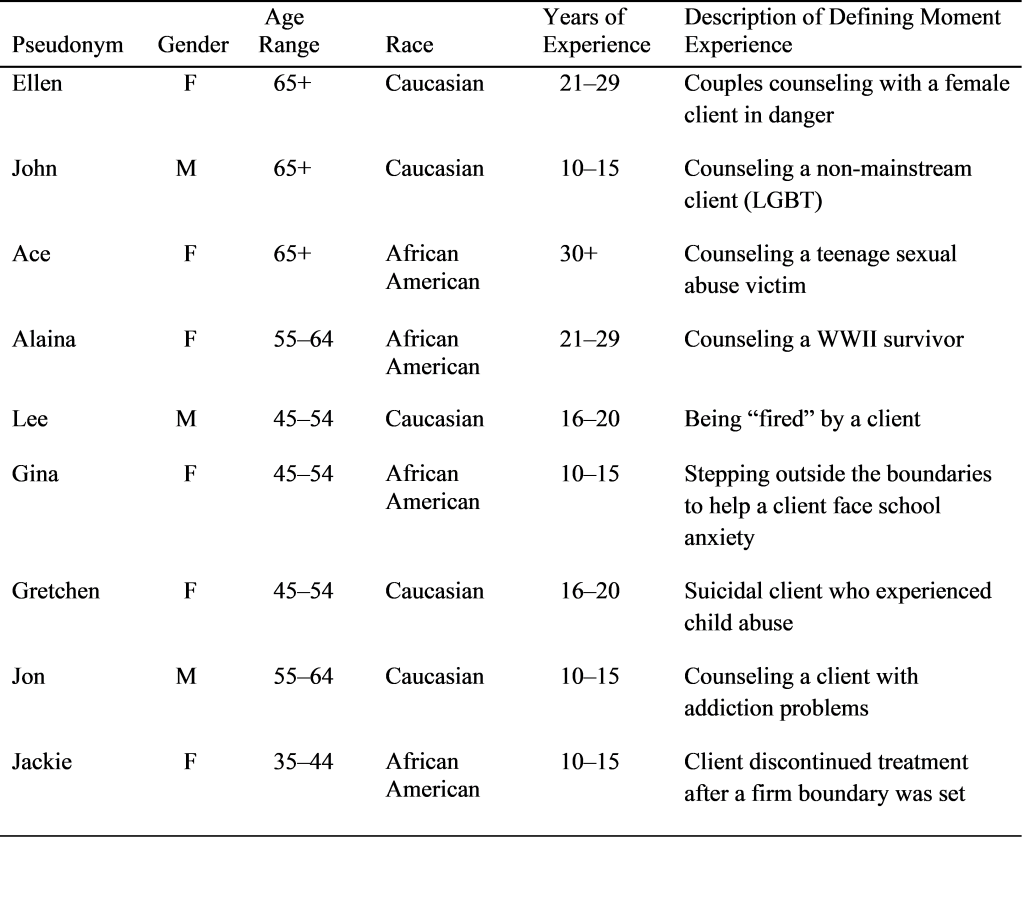
A range of procedural steps were taken to enhance the credibility, dependability, confirmability, and transferability of the data (Lincoln & Guba, 1985) and to counter any potential researcher biases (Morrow, 2005). To establish the credibility of the findings, descriptive field notes were taken during interviews to document observations and add context to the audio data. The field notes emphasized participant content, expressed meaning and PI observations (Creswell, 2007), and provided a means to confirm interpretations of interview data through data triangulation (Anney, 2014). Member checking was used to enhance the credibility of the findings (see Onwuegbuzie & Leech, 2005) by asking participants to check summaries of the interview content. Confirmability of findings entailed the use of analytic memos and a reflexivity journal to ensure objectivity in any interpretations made in the course of data analysis (Smith, Flowers, & Larkin, 2009). Analytic memos were written throughout data analysis to record thoughts about the meaning behind participants’ words (Saldaña, 2009). A reflexivity journal was employed to assist the PI with preparing to interview each participant and enter their subjective reality by writing about her own defining moment experiences as a counselor prior to interviews (Hays & Singh, 2012). Moreover, the PI maintained the reflexivity journal throughout the interviews and data analysis processes. The PI made a consistent effort to bracket assumptions and biases to not superimpose her own experiences or subjective interpretations as a professional counselor (Smith, 2004; Smith & Osborn, 2008). The transferability of research findings was met by purposive sampling of participants based on their capacity to provide relevant knowledge on defining moment experiences (Anney, 2014). The criteria of ensuring dependability was met by employing the Dedoose qualitative research software program (Moylan, Derr, & Lindhorst, 2015) to independently organize, archive, and code interview data and field notes, as well as validate codes and themes derived from interview data (Silver & Lewins, 2014). The dependability of the data was enhanced by having the external auditor confirm the accuracy of (1) interview transcripts, (2) descriptive field notes, (3) the reflexive journal, (4) the theme codebook, and (5) Dedoose summaries and output.
Table 2
Interview Questions for the Study
| Question No. |
Question content |
| 1 |
Tell me about a defining moment that occurred while working with a client(s). This moment could have occurred in the early stages of counselor training or at a later time in your work as a counselor. |
| 1a |
• What made it a defining moment? |
| 1b |
• Do you have a takeaway from this moment? |
| 1c |
• Is there anything else you would like to share about this experience? |
| 2 |
How did this experience shape how you saw yourself as a professional counselor? As a person? |
| 2a |
• What did this experience mean to you as a counselor? |
| 2b |
• What did this experience mean to you on a personal level? |
| 2c |
• What assisted you with making sense out of this experience? |
| 3 |
How did this experience shape your sense of clinical competency? |
| 3a |
• What strengths did you become aware of? |
| 3b |
• What weaknesses or limitations did you become aware of? |
| 4 |
How did you regard the therapeutic relationship between client and counselor prior to your defining moment experience? |
| 4a |
• How did your understanding of the therapeutic relationship change or not change after the
defining moment experience? |
| 4b |
• How would you describe the therapeutic relationship between client and counselor as if you
were describing this to a layperson/non-clinician? |
| 5 |
As you reflect on your defining moment experience, how has your perspective changed or not changed? |
| 5a |
• How did you make sense of the experience then? |
| 5b |
• How do you make sense of the experience now? |
Data Analysis
Data analysis followed a 3-stage process as outlined by Pietkiewicz and Smith (2012): immersion, transformation, and connection. The immersion process began with the PI listening to each interview after its conclusion in order to review the content and record any additional observations in the field notes (Smith & Osborn, 2008). Each interview was transcribed by an independent contractor and the PI reviewed each along with the digital recording to ensure accuracy and facilitate deeper immersion in the data (Pietkiewicz & Smith, 2012). The PI read the participant’s responses along with the recording during the review process to foster deeper immersion and understanding of the experience being shared (Bailey, 2008). The PI documented new observations and insights throughout the immersion process in field notes and via a reflexivity journal (Pietkiewicz & Smith, 2012). The RA also independently engaged in the immersion, transformation, and connection stages with the interview transcripts.
The PI and the RA worked together to review and interpret all their notes about the transcripts and transform them into emergent themes consistent with IPA methodology (Smith & Osborn, 2008). Emergent themes were then connected together according to conceptual similarities to develop a thematic hierarchy (Pietkiewicz & Smith, 2012). The final stage of analysis entailed a narrative account of each theme, including direct passages from the interviews. The PI and the RA also discussed and compared several levels of interpretation of interview content and of interpreted meanings to reach agreement on the final set of distinct themes. Moreover, the transcripts, notes, and themes were submitted to the external auditor, who conducted an independent cross-analysis to ensure their accuracy and clarity.
Results
Data analysis with IPA methods resulted in five themes being identified and labeled based on the meanings associated with professional counselors’ defining moment experiences (see Table 3). The first theme was labeled acceptance of reality and captures how defining moment experiences led professional counselors to the realization that counselors are not always a good match for a client and cannot fully resolve any clinical problem that comes their way. The second theme, finding a balance, addresses how defining moment experiences shaped perceptions of clinical boundaries and the balance between strengths and limitations and external and internal forces. The third theme to be derived from the analysis, enhanced self-reflection and awareness, captures professional counselors’ understanding that defining moment experiences facilitated their own reflection and questioning of their intrapersonal and interpersonal processes. The fourth theme, reciprocal transformation, illustrates how the experiences shaped professional counselors’ understanding of the therapeutic relationship and acted as a mutual change agent for both counselor and client. Lastly, the fifth theme, assimilation and integration, encapsulates how meanings attached to defining moment experiences changed and were incorporated over time.
Table 3
IPA Coding Scheme of the Meaning of Defining Moment Experiences of Professional Counselors
| Theme |
Description |
| Acceptance of reality |
Coming to terms with the realistic, sometimes limiting, aspects of the counselor role |
| Finding a balance |
Perceptions of clinical boundaries and the balance between strengths and limitations and external and internal forces |
| Enhanced self-reflection and awareness |
Facilitated reflection and questioning of intrapersonal and interpersonal processes |
| Reciprocal transformation |
Mutual change agent for both counselor and client |
| Assimilation and integration |
How meanings attached to defining moment experiences changed and were incorporated over time |
Theme 1: Acceptance of Reality
Experienced counselors made meaning of their defining moment experiences in the theme of acceptance of reality. This theme was derived to reflect participants’ thoughts about how their defining moment experience helped them come to terms with the realistic, sometimes limiting, aspects of the counselor role. Specifically, defining moment experiences were understood by counselors to help dispel the myth that counselors are a good match for any client and can “fix” and fully resolve any clinical problem that comes their way. According to Ellen, “some situations are beyond repair. If people wait too long to come to see us, we can’t help, and they can’t even make any changes for themselves.” For Jackie, the defining moment experience meant being comfortable with accepting the reality of the limiting aspects of the counselor role when a client didn’t want to change and wanted Jackie to do all the work. She reflected: “In that moment, I just remembered saying . . . you can’t help everybody. It just means I’m not a good fit (for everybody) and that’s okay.” Similarly, the defining moment experience of Alaina meant accepting the reality that “a client I cannot love is not right for me . . . I don’t agree celebrating [the fact of] working with someone you don’t have a connection with.” It also would appear from these defining moment reflections that the acceptance of reality was associated with deeper knowledge of counselor–client boundary conditions. Indeed, counselor–client boundary issues were a significant factor in the defining moments theme of finding a balance.
Theme 2: Finding a Balance
The theme of finding a balance was identified in participants’ understanding of their defining moment experiences as highlighting different therapeutic boundary conditions and balancing the fine line between internal or external limitations while gaining a sense of finesse and agility between opposing forces. Here, participants identified a dual connection between strengths and limitations, while expressing accountability for establishing a balance between the two factors for client benefit. By taking ownership of a specific personality trait as part of the defining moment experience, Lee came to understand the importance of balance and the potential for possible pitfalls if such a balance is not obtained: “It was my personal disposition to speak with conviction, which is both a strength and limitation. I am still this way of course, but I know when to scale it back—to strike that balance.”
Finding a balance through defining moment experiences was evident in participants sharing their experiences of entering uncharted or unfamiliar territories with some trepidation, only to find their own rhythm through setting boundaries. Alaina shared: “I understood I was really flying by the seat of my pants and the only thing I had that I really understood were my boundaries. It made my boundaries even stronger. They were very heart-wrenching limitations; it was very hard.” Moreover, Ellen conveyed how the defining moment experience highlighted the process of balancing between her own feelings of physical vulnerability and her inner strengths when she was working with a couple in an abusive relationship: “I needed to sit alone with him to keep her safe. It was like walking into the lion’s den; however, my use of self-intuition [and] wisdom was a strength. I was just going to tap dance with him when I saw him.”
Theme 3: Enhanced Self-Reflection and Awareness
Professional counselors understood their defining moment experiences as ones that especially facilitated self-reflection and awareness of intrapersonal and interpersonal processes. At the intrapersonal level, John highlighted how the defining moment experience “increased my awareness and clarity of my own internal processes.” At the interpersonal level, Lee shared: “I made a connection in my personal relationships where I’ve learned to create space for others.” The theme of self-reflection also was manifest in the level of self-questioning prompted by the defining moment experiences of professional counselors. Indeed, Jackie discussed how her defining moment experience led to “a lot of reflection; I started to question my passion and why I wanted to be a therapist.” Similarly, Gina reflected that “I was puzzled and confused; lots of self-doubt [and] reflection. I remember where I would question whether I was a good therapist.” Importantly, the self-reflection and awareness prompted by the defining moment experiences of professional counselors appeared to have confirmed their professional capacities, with Gretchen sharing: “I received affirmation of what I thought I knew—what my gut was telling me.”
Theme 4: Reciprocal Transformation
Professional counselors understood their defining moment experiences as entailing the theme of reciprocal transformation through shared vulnerability and trust. This theme was derived from counselors speaking to their awareness of the dynamic of change within the therapeutic relationship; defining moment experiences generated a broader understanding of the transformative power within the therapeutic bond. For example, Lee shared: “You know, it’s a two-way conversation. This guy came back, taught me a great lesson: just how sacred and fragile the bond can be. I think we both changed after that experience.” Reciprocal transformation was reflected in participants discussing how defining moment experiences were associated with shared feelings of vulnerability and healing. As stated by Ellen, “We work with vulnerable people and if we just pretend we’re not there’s no authentic connection. The relationship is the primary vehicle for healing. Vulnerability is a good thing as a therapist.”
Jackie discussed how her defining moment experience highlighted the importance of disclosure in transforming the therapeutic relationship into one of mutual trust: “You are both engaging in some sense of disclosure and that helps people to build trust. It’s ever-growing, it’s always changing. The relationship can change and grow as the two of you grow and change.” In a similar way, Jon’s understanding of his defining moment experience highlighted the importance of taking risks to transform the therapeutic relationship: “You are risking the possibility that something will happen so then emotionally they won’t go on with you. You need to be willing to clear the air and move forward. I think that’s the place where the relationship deepens.”
Theme 5: Assimilation and Integration
The final theme, assimilation and integration, represents the difference in meaning between how the defining moment experience was initially assimilated by professional counselors and how meanings gleaned from the experience continue to be integrated. Participants discussed the non-static nature of the meanings attached to their defining moment experiences. The meanings continue to be assimilated with time and experience and remain an integral part of their ongoing counselor development. For example, Jackie stated: “I needed to grow as a therapist. Now, I look at the experience differently. It really has evolved into knowing my limitations [and] my strengths.” For Alaina, “the meanings acquired more textures, they got better and continue with me today.” Similarly, Lee used the metaphor of winding a ball of yarn to explain the meaning associated with integrating her defining moment experience over time: “Then, it taught me more about the client. Now, it informs me more. It’s like a ball of yarn. As I acquired experience, there was more yarn to wind. It now informs me how to be with all clients.”
For John, processing the defining moment experience meant he went from a place of anxiety to becoming aware of the spiritual nature of counseling: “At first, the experience relieved some anxiety about whether I was able to do this work. What I appreciate now, that I was too anxious to be aware of at the time, is that this is spiritual work.” Finally, Ace integrated her defining experience of working with a victim of teenage sexual abuse by now conducting advocacy work: “What assisted me with making sense out of my experience was volunteering for child abuse agencies, serving on a board, [and] being an advocate.” Overall, each participant constructed meaningful interpretations of their defining moment experiences that continue to inform their work and passion as counseling professionals, whether as a source of inspiration or affirmation.
Discussion
From novice to seasoned professionals, challenges occur within the therapeutic relationship that can provide growth opportunities to counseling practitioners to develop their clinical attributes (Orlinsky & Rønnestad, 2005; Skovholt & Rønnestad, 2003). The findings from this study support and extend the idea that defining moment experiences represent one such challenge. Professional counselors in this study understood their defining moment experiences as growth opportunities associated with different meanings to their professional practice and clinical skills. The meanings of the defining moment experiences of professional counselors were interpreted to reflect five main themes relevant to counseling practice: acceptance of reality, finding a balance, enhanced self-reflection and awareness, reciprocal transformation, and assimilation and integration.
Professional counselors understood their defining moment experience as one that was a wake-up call to accept the reality that counselors are not ideal for all clients and all presenting problems. This finding supports theory and research that an idealistic and glamorized view of counseling is often a source of stress among developing counselors (Moss et al., 2014; Skovholt & Rønnestad, 2003), wherein supervisors play an important role in guiding novice counselors toward the realistic position that it is not always possible to have a positive impact with clients. Indeed, the findings of this study provide distinct evidence that defining moment experiences of professional counselors bring them to a point in their career when they come to accept that the counselor role may produce limited success with certain clients on different occasions. As suggested by Skovholt and Rønnestad (2003) and the findings of this study, acceptance of reality is paradoxical in a helping profession like counseling; growth as a counselor occurs with the realization that some people and problems cannot be helped. This change of view also meant that the acceptance of reality was associated with deeper knowledge of counselor–client boundary conditions.
The meanings of professional counselors’ defining moment experiences were reflected in the specific theme of finding a balance in terms of participants navigating the boundaries between their strengths and limitations. Previous counselor development research (e.g., Furr & Carroll, 2003; Moss et al., 2014; Trotter-Mathison et al., 2010) has shown that establishing client–counselor boundaries is an important challenge to novice counselors, usually meant in terms of establishing emotional boundaries. To the counselors in this study, establishing such boundaries was about finding the right balance. Nevertheless, the meanings associated with the defining moment experiences of professional counselors extended beyond client–counselor boundaries to include balance between one’s own strengths and weaknesses, internal and external limitations, and finding a rhythm in uncharted or unfamiliar territories. It also was apparent that the participants’ ability for self-reflection and awareness was important for facilitating balance.
Experienced counselors also understood their defining moment experiences to entail enhanced self-reflection and awareness. Indeed, their willingness to self-reflect and take ownership for finding an optimal balance between strengths and limitations that were revealed through defining moment experiences has been clarified elsewhere as an important developmental step toward increased counseling competency (e.g., Skovholt & Rønnestad, 2003; Thériault & Gazzola, 2010; Williams, Hayes, & Fauth, 2008). As identified by Moss et al. (2014), continuous reflection is required for optimal learning. Defining moment experiences for professional counselors meant self-reflection even to the point of questioning their suitability for the profession. Indeed, the best counselors are generally viewed as questioning what they do and why (Kottler, 2017). It would appear from the findings that defining moment experiences appear to bring that level of self-questioning into focus.
The findings also revealed the change-agent quality of defining moment experiences wherein the experiences of counselors led to the development of a broader understanding of the reciprocal and transformative power within the therapeutic bond. In line with previous research (e.g., Orlinsky, Botermans, & Rønnestad, 2001; Skovholt & Rønnestad, 2003), the findings clarified that learning within the counselor–client relationship was a significant influence on career development among experienced counselors. Moreover, reciprocal transformation was reflected in professional counselors acknowledging shared vulnerability within the counselor–client relationship. Other research (e.g., Trotter-Mathison et al., 2010) has similarly found the most powerful defining moments occurred when counselors took risks or a leap of faith and allowed themselves to be vulnerable. Indeed, the defining moment experiences of the professional counselors in this study were reported as opportunities to experience the transformative power of shared vulnerability to establish new learning and growth in both counselor and client alike.
Within the theme of assimilation and integration, professional counselors shared how meanings of their defining moments continue to be a solid foundation of inspiration for their purpose, passion, and advocacy work in the counseling profession. Siegel (2007) referred to this process as the power of recall and repetition, whereby as counselors self-reflect on definitive experiences, the repetition of each memory forges deeper, more meaningful connections in the brain. Whether counselors engage in self-reflection in present time or as retrospection, the repetition of recall begins to move newly acquired data from state to trait, thus furthering the integration of new information or insights (Siegel, 2007). This view is supported in Prengel and Somerstein’s (2013) study of defining moment experiences, which highlights the process of self-reflection as one that requires time and re-examination in order to deepen lessons learned. In kind, the findings of this study suggest it is beneficial for counselors to engage in self-reflective practices throughout their professional life; the practice of self-reflection appears to have facilitated deeper integration of originally assimilated meanings of defining moment experiences by professional counselors. Consistent with the view of Engels, Barrio Minton, and Ray (2009), assimilation and integration of significant meanings appeared to have a positive effect on the competencies of professional counselors in this study.
Altogether, interpretive analysis of the defining moment experiences of professional counselors suggested a set of interrelated meanings and themes that appear to facilitate the development of counselor capacities. Defining moment experiences appear to bring into sharp focus an important transition in counselor thinking—acceptance of the realistic nature of counseling in terms of the sometimes lack of counselor–client-problem fit. In a related way, defining moment experiences of professional counselors facilitated deeper thinking about finding balance in professional practice. Professional counselors reported deeper thinking in the form of heightened self-reflection and self-awareness as meanings they associated with defining moment experiences. One may posit that heightened self-reflection and awareness mediates the relationship between defining moment experiences and acceptance of reality and finding balance in professional counseling. Defining moment experiences of professional counselors also held significant meaning because they highlighted the reciprocal and transformative power within the therapeutic bond and because the meanings continue to be integrated. As shared by Jackie, “This was a great opportunity to reflect on where I was and who I’ve become . . . all with the same lesson from my first client . . . that thread continues to inform me.”
Implications for Counselor Practice
The significance of defining moment experiences to professional counselors raises implications for professional practice and the counselor development process. As suggested by themes identified in the findings of this study, experienced professional counselors appeared to find defining moment experiences helped them accept counseling realities, find balance within the counselor role, and understand the transformative power within the therapeutic bond. At the same time, defining moment experiences facilitated heightened self-awareness, providing professional counselors an opportunity to attune to their own internal processes. As such, the meanings associated with defining moment experiences tie in with standards set forth by the Council for Accreditation of Counseling and Related Educational Programs (2015), which aligns professional competence with counselor self-awareness via self-reflection. Facilitating conversations and reflecting on defining moment experiences may provide a focal point for continuing training of professional counselors consistent with the mission of ACA (2019). The findings of this study underline the potential benefits of practicing and modeling self-reflection throughout the careers of professional counselors, supervisors, and counselor mentors to enhance their ongoing development and clinical expertise.
At the same time, counselor training programs may incorporate the meanings of defining moment experiences into their courses. Indeed, some participants in this study reported on a defining moment experience that occurred as a counselor trainee, and previous research has revealed practicum and novice counselors find great benefit from reflecting on defining experiences when they worked with a challenging client or issue (e.g., Bischoff et al., 2002; Furr & Carroll, 2003; Howard et al., 2006). Providers of counselor education programs and supervisors could develop awareness of the potential for defining moment experiences to raise questions about the realities of counseling, finding a balance in the counselor role, and the transformative power of the therapeutic relationship. This may be facilitated by encouraging novice counselors to employ self-reflection techniques such as journaling, which has been shown in previous research to benefit counselor development (e.g., Burnett & Meacham, 2002). Novice counselors could be asked to self-reflect on a defining moment experience via journaling as a part of their practicum and internship programs and use supervision sessions to connect the meaning and significance of the experience to the development of clinical skills and attributes. The findings of this study provide some insights on what type of meanings may be discussed in such sessions, including how defining moment experiences may relate to acceptance of counseling realities, finding a balance within the counselor role, and understanding the transformative power within the therapeutic bond.
Limitations and Future Research
There are limitations inherent in this study that require acknowledgement. The sample of participants might have invoked a self-selection bias wherein participants who elected to take part in the study may have been more inclined to value and reflect on their defining moment experiences than those who did not elect to participate. The use of semi-structured interviews, whether conducted in person or by phone, could have increased the likelihood of response inhibition (Bischoff et al., 2002). The interview participants could have answered interview questions according to perceived socially desirable responses rather than provide a more accurate and honest account of thoughts and feelings associated with their defining moment experiences. Steps to ensure confidentiality, such as the use of pseudonyms for participants, may have minimized response bias; however, to what degree is uncertain. In addition, the sample of participants was limited to professional counselors who worked in private practice with an expertise in trauma. A final limitation of the study is the potential for researcher subjectivity to influence data collection (interviews) and interpretive analysis (thematic coding). Nevertheless, appropriate methodological steps were taken in this study, such as a reflexivity journal and independent coders, to enhance the objectivity and trustworthiness of the data collection and interpretation procedures and outcomes.
The research findings provide directions for future research on defining moment experiences of professional counselors. To date, there is very little empirical research on defining moment experiences and their significance to professional counselors. Whereas this study provides a unique contribution to the counselor literature, future research may broaden the sample criteria to include not only experienced professionals in other regions of the United States and in other countries, but also licensed clinical social workers, licensed marriage and family therapists, and clinical psychologists. Research with a range of professionals would broaden knowledge about the significance of defining moment experiences to their ongoing professional practice. Moreover, research that broadens the focus on counselors to include an investigation of the role of supervisors in defining moment experiences would be worthwhile. Finally, research may follow up on the revelation from two participants in this study that defining moment experiences led them to question their suitability for the counseling profession. Research on the defining moment experiences of individuals who chose to leave the field may shed light upon the goodness-of-counselor-fit within the counseling profession.
Conclusion
In conclusion, findings from this study support and contribute to the professional counseling literature by revealing the meanings associated with the defining moment experiences of professional counselors. Consistent with models of counselor development (e.g., Moss et al., 2014), experienced counselors showed a comparatively strong capacity to deeply reflect and process the latent meanings and implications of defining moment experiences for their ongoing professional growth and development. Defining moment experiences appear to help professional counselors accept the realities of counseling, find a balance within the counselor role, and understand the transformative power within the therapeutic bond. The findings contribute to existing literature by illustrating how meaningful interpretations of defining moment experiences continue to deepen over time and enhance counselor practice, especially when opportunities are taken for self-reflection. Application of knowledge on the significance, meaning, and implications of defining moment experiences in counselor training programs and supervision sessions provides an opportunity for enhancing the clinical attributes of professional counselors.
Conflict of Interest and Funding Disclosure
The authors reported no conflict of interest
or funding contributions for the development
of this manuscript.
References
American Counseling Association. (2014). Code of ethics. Alexandria, VA: Author.
American Counseling Association. (2019). Continuing education. Retrieved from https://www.counseling.org /continuing-education
Anney, V. N. (2014). Ensuring the quality of the findings of qualitative research: Looking at trustworthiness criteria. Journal of Emerging Trends in Educational Research and Policy Studies, 5, 272–281.
Bailey, J. (2008). First steps in qualitative data analysis: Transcribing. Family Practice, 25(2), 127–131. doi:10.1093/fampra/cmn003
Bischoff, R. J., Barton, M., Thober, J., & Hawley, R. (2002). Events and experiences impacting the development of clinical self confidence: A study of the first year of clinical contact. Journal of Marital and Family Therapy, 28, 371–382. doi:10.1111/j.1752-0606.2002.tb01193.x
Burnett, P. C., & Meacham, D. (2002). Learning journals as a counseling strategy. Journal of Counseling & Development, 80, 410–415. doi:10.1002/j.1556-6678.2002.tb00207.x
Council for Accreditation of Counseling and Related Educational Programs. (2015). 2016 CACREP standards. Retrieved from https://www.cacrep.org/for-programs/2016-cacrep-standards
Creswell, J. W. (2007). Qualitative inquiry and research design. London, UK: SAGE.
Engels, D. W., Barrio Minton, C. A., & Ray, D. C. (2009). The professional counselor: Portfolio, competencies, guidelines, and assessments. Alexandria, VA: American Counseling Association.
Furr, S. R., & Carroll, J. J. (2003). Critical incidents in student counselor development. Journal of Counseling & Development, 81, 483–489. Hays, D. G., & Singh, A. A. (2012). Qualitative inquiry in clinical and educational settings. New York, NY: Guilford Press.
Howard, E. E., Inman, A. G., & Altman, A. N. (2006). Critical incidents among novice counselors in training. Counselor Education and Supervision, 46(2), 88–102. doi:10.1002/j.1556-6978.2006.tb00015.x
Kottler, J. A. (2017). On being a therapist (5th ed). New York, NY: Oxford University Press.
Lee, R. E., Eppler, C., Kendal, N., & Latty, C. (2001). Critical incidents in the professional lives of first year MFT students. Contemporary Family Therapy, 23, 51–61. doi:10.1023/A:1007872132292
Lincoln, Y. S., & Guba, E. G. (1985). Naturalistic inquiry. Newbury Park, CA: SAGE.
Morrow, S. L. (2005). Quality and trustworthiness in qualitative research in counseling psychology. Journal of Counseling Psychology, 52, 250–260. doi:10.1037/0022-0167.52.2.250
Moss, J. M., Gibson, D. M., & Dollarhide, C. T. (2014). Professional identity development: A grounded theory of transformational tasks of counselors. Journal of Counseling & Development, 92, 3–12.
doi:10.1002/j.1556-6678.2003.tb00275.x
Moylan, C. A., Derr, A. S., & Lindhorst, T. (2015). Increasingly mobile: How new technologies can enhance qualitative research. Qualitative Social Work, 14, 36–47. doi:10.1177/1473325013516988
Onwuegbuzie, A. J., & Leech, N. L. (2005). On becoming a pragmatic researcher: The importance of combining quantitative and qualitative research methodologies. International Journal of Social Research Methodology, 8, 375–387. doi:10.1080/13645570500402447
Orlinsky, D. E., Botermans, J.-F., & Rønnestad, M. H. (2001). Towards an empirically grounded model of psychotherapy training: Four thousand therapists rate influences on their development. Australian Psychologist, 36(2), 139–148. doi:10.1080/00050060108259646
Orlinsky, D. E., & Rønnestad, M. H. (2005). How psychotherapists develop: A study of therapeutic work and professional growth. Washington, DC: American Psychological Association.
Patterson, C. A., & Levitt, D. H. (2011). Student counselor development during the first year: A qualitative study. The Journal of Counselor Preparation and Supervision, 3(2), 6–19.
Pietkiewicz, I., & Smith, J. A. (2012). A practical guide to using interpretative phenomenological analysis in qualitative research psychology. Czasopismo Psychologiczne Psychological Journal, 18, 361–369. doi:10.14691/CPPJ.20.1.7
Prengel, S., & Somerstein, L. (2013). Defining moments for therapists. New York, NY: LifeSherpa.
Rønnestad, M. H., & Skovholt, T. M. (2003). The journey of the counselor and therapist: Research findings and perspectives in professional development. Journal of Career Development, 30, 5–44. doi:10.1177/089484530303000102
Saldaña, J. (2009). The coding manual for qualitative researchers (1st ed.). London, UK: SAGE.
Siegel, D. J. (2007). Mindfulness training and neural integration: Differentiation of distinct streams of awareness and the cultivation of well-being. Social, Cognitive, and Affective Neuroscience, 2, 259–263. doi:10.1093/scan/nsm034
Silver, C., & Lewins, A. (2014). Using software in qualitative research (2nd ed.). Los Angeles, CA: SAGE.
Skovholt, T. M. (2012). Becoming a therapist: On the path to mastery. New York, NY: Wiley & Sons.
Skovholt, T. M., & McCarthy, P. R. (1988). Critical incidents: Catalysts for counselor development. Journal of Counseling & Development, 67(2), 69–72. doi:10.1002/j.1556-6676.1988.tb02016.x
Skovholt, T. M., & Rønnestad, M. H. (2003). Struggles of the novice counselor and therapist. Journal of Career Development, 30, 45–58. doi:10.1023/A:1025125624919
Smith, J. A. (2004). Reflecting on the development of interpretative phenomenological analysis and its contribution to qualitative research in psychology. Qualitative Research in Psychology, 1, 39–54. doi:10.1191/1478088704qp004oa
Smith, J. A., Flowers, P., & Larkin, M. (2009). Interpretative phenomenological analysis: Theory, method and research. London, UK: SAGE.
Smith, J. A., & Osborn, M. (2008). Interpretative phenomenological analysis. In J. A. Smith (Ed.), Qualitative psychology: A practical guide to research methods (pp. 53–80). London, UK: SAGE.
Thériault, A., & Gazzola, N. (2010). Therapist feelings of incompetence and suboptimal processes in psychotherapy. Journal of Contemporary Psychotherapy, 40, 233–243. doi:10.1007/s10879-010-9147-z
Trotter-Mathison, M., Koch, J. M., Sanger, S., & Skovholt, T. M. (2010). Voices from the field: Defining moments in therapist and counselor development. New York, NY: Routledge.
Veach, P. M., & LeRoy, B. S. (2012). Defining moments in genetic counselor professional development: One decade later. Journal of Genetic Counseling, 21, 162–166. doi:10.1007/s10897-011-9427-0
Williams, E. N., Hayes, J. A., & Fauth, J. (2008). Therapist self-awareness: Interdisciplinary connections and future directions. In S. D. Brown & B. Lent (Eds.), Handbook of counseling psychology (4th ed., pp. 303–319). Hoboken, NJ: Wiley.
Zahm, K. W., Veach, P. M., Martyr, M. A., & LeRoy, B. S. (2016). From novice to seasoned practitioner: A qualitative investigation of genetic counselor professional development. Journal of Genetic Counseling, 25, 818–834. doi:10.1007/s10897-015-9900-2
Diane M. Coll is a professional counselor at Argosy University. Chandra F. Johnson is an associate professor at Argosy University. Chinwé U. Williams is an associate professor at Argosy University. Michael J. Halloran is an honorary associate professor at La Trobe University. Correspondence can be addressed to Michael Halloran, School of Psychology and Public Health, La Trobe University, Kingsbury Dr., Bundoora, Australia, 3086, m.halloran@latrobe.edu.au.
Jun 3, 2019 | Volume 9 - Issue 2
Patrick R. Mullen, Nancy Chae, Adrienne Backer
The Recognized American School Counselor Association Model Program (RAMP) designation aims to acknowledge school counselors who deliver comprehensive data-driven programs. However, there is little research to date that examines RAMP schools and associated factors with this designation. Therefore, we compared the characteristics of schools that earned the RAMP designation with a random sample of schools without this designation to examine if differences exist. Data was accessed using the Elementary/Secondary Information System through the U.S. Department of Education. The results indicated that non-RAMP schools in this study were more likely to: (a) be eligible for Title I; (b) be located in city, rural, and township communities; and (c) have fewer students and full-time equivalent employees. Furthermore, non-RAMP schools had higher rates of students eligible for free or reduced lunch. The development of support mechanisms for the RAMP-seeking process for these schools may be beneficial along with further research on this topic.
Keywords: Recognized ASCA Model Program (RAMP), school counseling, school characteristics, U.S. Department of Education, data-driven
School counselors provide an array of services to students and families across elementary and secondary schools. The American School Counselor Association (ASCA) created the ASCA National Model (ASCA, 2012), a framework for school counselors to identify the appropriate roles and duties of a school counselor. Additionally, the ASCA National Model outlines the tenets of comprehensive school counseling programs. Currently, the ASCA National Model is the only structured framework promoted by ASCA that recommends job duties and different roles that will help to support the school community (ASCA, 2012). For example, ASCA recommends that school counselors spend 80% or more of their time in providing direct or indirect service with the students in their buildings and 20% or less in program planning or school support (ASCA, 2012). Thus, this model is taught in school counselor training programs and used for professional development of practicing school counselors across the United States. One initiative by ASCA to encourage and recognize rigorously implemented school counseling programs is to facilitate the Recognized ASCA Model Program (RAMP) designation program (ASCA, 2019). RAMP is earned by school counseling programs that consistently adhere to the ASCA National Model and demonstrate its implementation and outcomes through data-driven practices. Programs with the RAMP designation are highlighted at ASCA-related events and publications. The RAMP initiative has encouraged many school counseling programs to implement comprehensive services and requires evaluation of their effectiveness through data-driven practices.
While the RAMP recognition intends to highlight accomplished school counseling programs, the general development of the ASCA National Model helped to structure the efforts and experiences of school counselors and students. Researchers have previously asserted that the ASCA National Model can benefit student achievement and promote effective school counseling programs (Brigman & Campbell, 2003; Carey, Harrity, & Dimmitt, 2005; Sink & Stroh, 2003). In a study of secondary school counselors from Michigan, Pyne (2011) suggested that school counselors who implemented a comprehensive school counseling program, like the ASCA National Model, experienced greater job satisfaction compared to school counselors without such programs. Specifically, school counselors exhibited greater job satisfaction when school counseling programs had administrative support, included communication among school faculty members, possessed a clear program philosophy, identified clear roles of the school counselor, served all students in the school, and included time for planning and evaluation of the school counseling program and related activities (Pyne, 2011).
In studies of state-based school counseling programs, researchers have found positive features of student outcomes in schools with comprehensive school counseling programs. Carey, Harrington, Martin, and Hoffman (2012) assessed school counseling programs in suburban and rural Nebraska high schools, and found that well-implemented and differentiated programs with features of the ASCA National Model enhanced student outcomes, including lower suspension rates, lower discipline incident rates, higher attendance rates, and higher math proficiency. By contrast, high school counselors in Nebraska who spent more time providing responsive services were associated with schools with higher suspension and disciplinary incident rates and lower graduation rates. Moreover, Carey, Harrington, Martin, and Stevenson (2012) assessed school counseling programs in Utah high schools, and found that high schools that reflected components of the ASCA National Model improved student achievement, such as ACT scores, number of students taking the ACT, and percentage of students with proficient reading and math scores on the state assessments. The researchers suggested that programmatic focus and use of data were strongly associated with academic achievement and college aspirations in Utah high schools (Carey, Harrington, Martin, & Stevenson, 2012). Carey, Harrington, Martin, and Stevenson (2012) also found that more favorable or lower student-to-school counselor ratios were connected to decreased disciplinary issues and increased student attendance.
Lapan, Gysbers, and Petroski (2001) found that students who attended Missouri middle schools with fully implemented comprehensive school counseling programs reported feeling safer and having fewer conflicts with peers, having improved relationships with teachers, and believing their education was applicable to their future, as compared to students who attended schools with lower implementation fidelity. Additionally, Sink, Akos, Turnbull, and Mvududu (2008) compared student achievement in middle schools in Washington with and without fully implemented comprehensive school counseling programs and found student achievement was significantly higher in schools with fully implemented comprehensive school counseling programs for at least five years. Both studies indicated positive student outcomes associated with the implementation of comprehensive school counseling programs. However, despite a call for schools and school counselors to implement comprehensive school counseling programs for more than 30 years, Martin, Carey, and DeCoster (2009) found that 17 states have fully implemented these programs and 24 states have at least partially implemented these programs.
Although previous research addressed how components of the ASCA National Model offer benefits to school counseling programs and schools, there is little known about how schools that earn a RAMP designation uniquely aid students’ academic, social and emotional, and postsecondary outcomes. In other words, there is limited research about the differences between schools with a RAMP designation versus schools without a RAMP designation (henceforward non-RAMP). In one study, Wilkerson, Pérusse, and Hughes (2013) compared RAMP and non-RAMP designated schools on their Adequate Yearly Progress scores for Math and English/Language Arts and found that the elementary schools with RAMP performed better than non-RAMP schools. However, the researchers only collected data from a single state, had a limited sample size resulting in issues related to power, and did not control for school factors (e.g., funding, size, and student characteristics) that may have impacted the results. Outside of this single study, no other research has been done that provides empirical evidence for RAMP designated schools being more effective at addressing students’ educational outcomes over non-RAMP schools.
Other studies about RAMP schools connected the benefits of data-driven decision making, supervisory practices, and administrative support. In a study of school counselors from RAMP schools, Young and Kaffenberger (2011) found that participants who earned RAMP actively used data to drive and inform school counseling program development and impact student outcomes. In addition, school counselors reported that undergoing the RAMP application process transformed their beliefs in using data to address gaps and develop interventions (Young & Kaffenberger, 2011). In addition, Blakely, Underwood, and Rehfuss (2009) found that supervisors in a RAMP school provided significantly more supervisory activities related to the ASCA National Model for school counseling trainees in RAMP schools than trainees in traditional schools (i.e., non-RAMP schools), which may help to maintain consistency in school counseling training and support trainees to apply their university training in their professional practice. Moreover, in a study of administrators’ perceptions of school counselors in RAMP versus non-RAMP schools, Dodson (2009) found that participants from RAMP schools more often perceived school counselors to deliver classroom guidance lessons, counsel students with disciplinary concerns, consult with teachers, and interpret student records, compared to participants from non-RAMP schools. According to these studies, there are benefits of understanding the RAMP process in schools to inform training practices and elicit administrative support.
One topic related to becoming a RAMP-designated school is the ability of a counseling program to implement the components of the ASCA National Model with fidelity. To implement a comprehensive school counseling program, school counselors need the financial and time resources to implement the services. For example, the school or school counselor may need to put forth money to purchase various curricula for group or classroom interventions. Moreover, ASCA suggests that the recommended timeline of the RAMP process includes one to two years of planning (e.g., developing the foundational and management components, such as calendars, an advisory council, and advisory agreement) and approximately one year to collect and evaluate data (ASCA, 2019). A minimum 2-year commitment can be burdensome for school counseling programs with a single school counselor and even for a team of school counselors, which may require coordination. In addition, school counselors often have high student caseloads and do not always have the time to implement the various components of the ASCA National Model because they focus on responding to immediate student needs and non–counselor-related duties (McCarthy, van Horn Kerne, Calfa, Lambert, & Guzmán, 2010). Increased financial resources and counselors in a school (i.e., lower student-to-counselor ratio) impact the ability of school counselors to implement the ASCA National Model (Lapan, Whitcomb, & Aleman, 2012). As a result, schools with fewer staff allocations and fewer financial supports may be less likely to put forth time and resources to the RAMP designation.
In addition, the application for RAMP costs $250 for ASCA members and $500 for non-members, which adds to the financial burden of schools to pay to implement these services. There also is a perceived lack of benefit for earning RAMP designation. School districts and states have yet to incentivize the RAMP designation, making the use of time and financial effort toward this status resultant in only professional recognition (ASCA, 2019). Given the emphasis placed on the ASCA National Model and the RAMP designation, those schools with the fewest resources may likely have the least amount of opportunity to implement. However, there has been no research on the differences in school characteristics for those sites that have earned the RAMP designation in comparison to those schools who have not earned this recognition. Therefore, the purpose of this study was to compare the characteristics of RAMP-designated schools to a sample of non-RAMP schools to provide information about how these schools differ.
While earning the RAMP designation is an indicator of the comprehensive implementation of the ASCA National Model, little is known about characteristics of schools that have attained RAMP recognition in comparison to non-RAMP schools. The lack of research on RAMP schools is notable due to ASCA’s efforts to train and encourage practitioners to earn this recognition, which may take school counselors away from other responsibilities or burden them with more commitments. It is likely that school counseling programs that pursue RAMP have unique qualities as compared to non-RAMP schools, given the requirements of RAMP, which necessitate resources and organizational support. Some differences between RAMP and non-RAMP schools might lie in the school counselors’ individual qualities (e.g., professional identity, training, motivation); however, there could be characteristics of the school that differ (e.g., school size or location) and facilitate or hinder the achievement of RAMP designation. Therefore, we compared differences in school characteristics based on whether a school has achieved RAMP status. The following exploratory research questions guided our study: (1) Do schools whose school counseling programs have achieved RAMP differ in general school characteristics when compared to schools with school counseling programs that have not achieved RAMP status? (2) Do schools whose school counseling programs have achieved RAMP differ in student body characteristics when compared to schools with school counseling programs that have not achieved RAMP status?
Method
Data Sources
The analyses in this study utilized school-level data publicly available from the Common Core of Data’s (CCD) Elementary/Secondary Information System (ELSi; National Center for Education Statistics, 2018) to retrieve the school characteristics for a sample of RAMP schools and non-RAMP schools. The CCD is a census database that provides information on all public elementary and secondary schools along with school districts and additional administrative and operational entities in the United States. Education agencies submit data to the National Center for Education Statistics on an annual basis (National Center for Education Statistics, 2018). In the data set, three types of information are collected: (a) general descriptive data (e.g., school grade level and locale), (b) demographic data on staff and students, and (c) fiscal data.
We accessed the ELSi to retrieve information on general descriptive data and demographic data. In our first step, we downloaded a dataset of every U.S. public school from the most recent year available (2015–2016) that contained characteristics for each school. We captured information about free and reduced lunch rates (i.e., based on family size and income criteria, students eligible for free or reduced-price lunches at school under the National School Lunch Act), Title I status (i.e., per state and federal regulations, Title I schools are eligible for participation in programs authorized by Title I of Public Law 103-382), geographic region in which the school is located, grade level, number of students at the school, race and ethnicity demographics for each school, and school full-time–equivalent (FTE) teachers. Then, we removed schools (n = 133) that attained RAMP status in 2015 or 2016 and created a new dataset with these schools. We selected the RAMP schools from the 2015–2016 school year to match the years in which the CCD was represented. The list of RAMP schools was acquired through the ASCA website. After removing RAMP schools, we generated an equal-sized simple random sample of schools (n = 133) from the remaining schools in the CCD database. The resulting aggregated and de-identified sample included data for 266 schools across the United States. There were some cases in which data was missing (e.g., three schools didn’t report grade level served).
Participants
The sample (N = 266) in this study included RAMP (n = 133, 50%) and non-RAMP (n = 133, 50%) schools from across the United States. On average, the schools in this sample reported 940.96 (SD = 753.76, Mdn = 706.00, Range = 35 to 4,190) students, a mean teacher-to-pupil ratio of 16.80 (SD = 4.72, Mdn = 16.18, Range = 8.57 to 53.56), and a mean FTE of 55.43 (SD = 42.69, Mdn = 43.60, Range = 0 to 270.96). In addition, the average percentage of students eligible for free or reduced lunch was 48.33% (SD = 26.81, Mdn = 46.30, Range = 2.32 to 100), and the majority of schools were eligible for Title I funding (n = 159, 59.8%) as compared to not being eligible for Title I funding (n = 107, 40.2%). We used percentages of the student body that make up each race and ethnicity group by dividing the number of students for each group by the total number of students in the school and multiplying it by 100. Across all the schools that reported the race and ethnicity rates in this study (N = 261), White students had the highest mean percentage (M = 52.30%, Mdn = 55.38%, SD = 29.26%) followed by Hispanic (M = 19.94%, Mdn = 12.44%, SD = 21.82%), Black (M = 17.47%, Mdn = 8.28%, SD = 22.20%), Asian (M = 4.93%, Mdn = 2.04%, SD = 7.54%), Two or more races/ethnicities (M = 3.99%, Mdn = 3.33%, SD = 3.13%), Hawaiian or Pacific Islander (M = .74%, Mdn = .05%, SD = 5.81%), and American Indian (M =.69%, Mdn = .22%, SD = 2.78%).
Regarding location, the ELSi portal identifies locales, which measure schools’ locations relative to the populated areas in which they are situated, as city, suburban, town, and rural settings. There are 12 subdomains to indicate varied levels within the broad domains: City: Large, Midsize, and Small; Suburb: Large, Midsize, and Small; Town: Fringe, Distant, and Remote; and Rural: Fringe, Distant, and Remote (National Center for Education Statistics, 2018). For this study, we condensed these subcategories into four broad areas to simplify the analyses. Most schools were located in suburban communities (n = 120, 45.1%) followed by city (n = 71, 26.7%), rural (n = 53, 19.9%), and town (n = 22, 8.3%). The majority of the schools were primary level (n = 111, 41.7%) followed by secondary level (n = 79, 29.7%), middle (n = 65, 24.4%), and other levels (n = 8, 3.0%), with three (1.1%) cases of missing data.
ELSi denotes two school-choice programs: (a) charter schools—schools that offer elementary and secondary education for students who are eligible under a charter approved by the state legislature or some other applicable authority and (b) magnet schools—schools that offer programs to draw students of varied racial and ethnic backgrounds with the aim to decrease racial isolation and offer an academic and social focus. Two-hundred and forty-three (91.4%) of the schools were not charter schools, 11 (4.1%) schools identified as charter schools, and 12 schools did not have data for this category. Only 29 (10.9%) schools in the sample identified as magnet schools, 222 (83.5%) schools were not magnet schools, and 15 (5.6%) schools had missing data.
Study Variables
The two-level independent variable in this study was whether a school achieved RAMP status. The dependent variables included general descriptive data and demographic data on students. The general descriptive dependent variables of school characteristics (Research Question 1) included grade level served by the school (i.e., elementary, middle, high school), geographic location of the school (i.e., city, suburban, town, and rural), FTE, and total number of attending students. Furthermore, the student demographic data dependent variables (Research Question 2) included percentage of students eligible for free or reduced lunch, Title I status of the school, and percentage of race and ethnicity in the student body. For percentage of students eligible for free or reduced lunch and percentage of race/ethnicity in the student body, we calculated these variables using the frequency count data. All dependent variables were selected by using the filter option in ELSi.
Data Analysis
We employed the Mann-Whitney U Test and chi-square analyses for this study due to the data characteristics. Specifically, each analysis included RAMP status as a nominal and dichotomous independent variable. The dependent variables were nominal with four groups or continuous data. However, the distribution of the continuous dependent variables violated assumptions for normality; thus, we applied non-parametric approaches of data analysis to this data. The Mann-Whitney U Test was used with continuous dependent variables. For the Mann-Whitney U Tests, we interpreted the effect sizes by computing the approximate value of r (Pallant, 2011), which could be interpreted using 0.1, 0.3, and 0.5 for small, medium, and large effect sizes, respectively (Cohen, 1988). We also utilized chi-square tests for independence when the dependent variables were nominal. In the case of a two-by-two chi-square table, we used Yates’ continuity correction statistics for interpretation and the phi coefficient to evaluate the effect size. The phi coefficient can be interpreted in a similar fashion as the r statistic. For analyses with chi-square tables of two-by-four, we studied the Pearson chi-square statistic and the Cramer’s V effect size statistic. We interpreted the Cramer’s V based on criteria for four categories (0.06, 0.17, and 0.29 were small, medium, and large effect sizes, respectively; Pallant, 2011). An initial a priori power analysis for the Mann-Whitney U Test using G*Power with an alpha level of .05, power established at .95, and a moderate effect size of 0.5 (Cohen, 1988) identified a minimum sample size of 184. Similarly, we conducted an a priori power analysis for the chi-square tests for independence using G*Power with an alpha level of .05, power established at .95, and a moderate effect size of 0.3 (Cohen, 1988) and identified a minimum sample of 191. We used a Bonferroni corrected value of .003 as a means to reduce the likelihood of Type I errors.
Results
General School Characteristics
Our first research question examined whether schools whose school counseling programs have achieved RAMP (i.e., RAMP schools) differ in general school characteristics when compared to schools with school counseling programs that have not achieved RAMP status (i.e., non-RAMP schools). We facilitated a Mann-Whitney U Test to compare the total number of students per school for both RAMP and non-RAMP schools. The Mann-Whitney U Test revealed a statistically significant difference in RAMP schools (Mrank = 159.90, Mdn = 925, M = 1,201.81, SD = 853.67) versus non-RAMP schools (Mrank = 103.96, Mdn = 575, M = 687.96, SD = 534.56, U = 4,915.50, z = -5.97, p < .001, r = .37). Similarly, we completed the Mann-Whitney U Test to analyze FTEs for both RAMP and non-RAMP schools. The Mann-Whitney U Test revealed a statistically significant difference in FTE for schools that had RAMP (Mrank = 159.20, Mdn = 51.37, M = 69.38, SD = 48.49) and those schools that did not have RAMP (Mrank = 105.80, Mdn = 32.48, M = 41.49, SD = 30.27, U = 5,187.00, z = -5.68, p < .001, r = .35).
A chi-square test for independence indicated a statistically significant association between RAMP and geographic location among the schools in this study: χ2 (3, N = 266) = 22.94, p < .001, Cramer’s V = .29. Table 1 provides a breakdown of the frequency and percentage for each geographical location by RAMP status. Non-RAMP schools were more often located in city, town, and rural settings than RAMP schools, whereas RAMP schools were more often located in suburban locations. A chi-square test for independence indicated no statistically significant association between RAMP and school level among the schools in this study: χ2 (3, N = 263) = 22.94, p = .06, Cramer’s V = .17 (Bonferroni corrected p value of .003).
| Table 1
Chi-square Tests of Independence Comparing RAMP Versus Non-RAMP Schools |
| Independent Variable |
RAMP
(n = 133) |
Non-RAMP (n = 133) |
Pearson χ2 |
Cramer’s V |
| Geographic Location |
|
|
22.94** |
.29 |
| City (n = 71) |
28 (39.4%) |
43 (60.6%) |
|
|
| Suburban (n = 120) |
79 (65.8%) |
41 (34.3%) |
|
|
| Town (n = 22) |
6 (27.3%) |
16 (72.7%) |
|
|
| Rural (n = 53) |
30 (37.7%) |
33 (62.3%) |
|
|
| School Level |
|
|
7.61 |
.17 |
| Primary (n = 111) |
45 (40.5%) |
66 (59.5%) |
|
|
| Middle (n = 65) |
33 (50.8%) |
32 (49.2%) |
|
|
| Secondary (n = 79) |
48 (60.8%) |
31 (39.2%) |
|
|
| Other (n = 8) |
4 (50.0%) |
4 (50.0%) |
|
|
|
|
|
Cont. Correlation |
Phi
|
| Title I Eligible |
|
|
33.08** |
-.36 |
| Yes (n = 159) |
56 (35.2%) |
103 (64.8%) |
|
|
| No (n = 107) |
77 (71.0%) |
30 (28.0%) |
|
|
| Charter School |
|
|
5.33* |
-.16 |
| Yes (n = 11) |
1 (9.1%) |
10 (90.9%) |
|
|
| No (n = 243) |
120 (49.4%) |
123 (50.6%) |
|
|
| Magnet School |
|
|
6.17* |
.17 |
| Yes (n = 29) |
21 (72.4%) |
8 (27.6%) |
|
|
| No (n = 222) |
102 (45.9%) |
120 (54.1%) |
|
|
| Note. * = p < .05, ** = p < .001, Bonferroni correction of .003 for significant p value. |
A chi-square test for independence using Yates’ continuity correction indicated a non-statistically significant association between RAMP status and identity as a charter school among the schools in this study: χ2 (1, N = 254) = 5.33, p < .05, phi = -.16 (Bonferroni corrected p value of .003). Of the 11 schools that were charter schools, 10 (90.9%) were non-RAMP schools and one (9.1%) was a RAMP school. However, schools that were not charter schools were evenly split between RAMP schools (n = 120, 49.4%) and non-RAMP schools (n = 123, 50.6%). Similarly, another chi-square test for independence using Yates’ continuity correction indicated no statistically significant association between RAMP status and identification as a magnet school among the schools in this study: χ2 (1, N = 251) = 6.17, p < .05, phi = .17 (Bonferroni corrected p value of .003). Nonetheless, schools that identified as magnet schools (N = 29) were more often RAMP schools (n = 21, 72.4%) compared to non-RAMP schools (n = 8, 27.6%). Of the schools that did not identify as a magnet school (n = 222), 45.9% (n = 102) were RAMP and 54.1% (n = 120) were not RAMP.
Student Body Characteristics
The second research question examined whether schools whose school counseling programs have achieved RAMP differ in student body characteristics when compared to schools with school counseling programs that have not achieved RAMP status. A chi-square test for independence using Yates’ continuity correction indicated a significant association between RAMP status and Title I eligibility among the schools in this study: χ2 (1, N = 266) = 33.08, p < .001, phi = -.36. Of the schools eligible for Title I (n = 159), 56 (35.2%) were RAMP schools and 103 (64.8%) were non-RAMP schools. Conversely, 77 (71.0%) of the schools not eligible for Title I (n = 107) were RAMP schools, whereas 30 (28.0%) were non-RAMP schools. A Mann-Whitney U Test revealed a significant difference in the percentage of students eligible for free and reduced lunch based on RAMP (Mrank = 114.19, Mdn = 38.71, M = 42.23, SD = 26.16) and those schools that did not have RAMP (Mrank = 148.29, Mdn = 53.63, M = 54.24, SD = 26.18, U = 6,345.00, z = -3.64, p < .001, r = .23).
Table 2 provides a detailed breakdown of the percentages of students’ race and ethnicity for RAMP and non-RAMP schools. The percentages were calculated by dividing the total number of students identified for each race/ethnic category by the total number of students at each school. Percentages were utilized versus total frequency counts to help understand the rates of students for each race and ethnicity category in the contexts of their schools. Of the race and ethnicity categories, one produced significant differences based on RAMP status. The RAMP schools in this study had a greater percentage of Asian students when compared to non-RAMP schools.
| Table 2
Breakdown of Percentages of Students’ Race/Ethnicity for RAMP and Non-RAMP Schools |
|
Percentages for Each Race/Ethnicity Classification by RAMP Status |
|
|
|
|
RAMP |
Non-RAMP |
|
|
|
| Race/Ethnicity |
Mrank |
M |
SD |
Mrank |
M |
SD |
U |
z |
r |
| White |
128.90 |
57.96 |
26.92 |
133.50 |
52.64 |
31.47 |
8,243.00 |
-0.44 |
– |
| Black |
141.12 |
16.94 |
19.24 |
121.11 |
17.98 |
24.81 |
7,209.00 |
-2.14 |
– |
| Hispanic |
133.15 |
18.58 |
18.49 |
128.90 |
21.27 |
24.64 |
8,237.00 |
-0.45 |
– |
| Asian |
152.80 |
6.38 |
8.47 |
109.69 |
3.51 |
6.23 |
5,701.50 |
-4.62* |
.29 |
| Hawaiian Pacific Islander |
137.85 |
1.24 |
8.23 |
124.30 |
0.24 |
0.60 |
7,630.00 |
-1.54 |
– |
| American Indian |
126.31 |
0.50 |
1.74 |
135.59 |
0.88 |
3.51 |
7,908.50 |
-1.00 |
– |
| Two or more races |
146.31 |
4.33 |
3.12 |
119.79 |
3.56 |
3.13 |
7,021.50 |
-2.81* |
– |
| Note. * = p < .001 |
Discussion
The first research question compared school characteristics of RAMP and non-RAMP schools, and we found that RAMP schools were more likely to have a larger student enrollment and more full-time teachers compared to non-RAMP schools. In addition, RAMP schools were more likely to be located in suburban areas, whereas non-RAMP schools were more often in city, town, and rural settings. RAMP schools were more likely to be magnet schools and less likely to be charter schools; however, this was not found to be significant with the Bonferroni corrected p value. There were no differences in school level (i.e., elementary, middle, high) and pupil-to-teacher ratios as variables in either RAMP or non-RAMP schools. The second research question compared student body characteristics of RAMP and non-RAMP schools, and we found that non-RAMP schools were more likely to be Title I schools and serve low-income students compared to RAMP schools. Moreover, RAMP schools likely had more Asian students. There is little known about RAMP schools in relationship to students’ demographic breakdown, and this finding provides some insight into the topic for continued research. This finding has a medium effect size, which indicates moderate practical significance. More research on the racial/ethnic breakdown of RAMP compared to non-RAMP schools is needed to make significant claims about this difference.
Although RAMP schools tended to have larger student enrollments than non-RAMP schools, RAMP schools were also likely to have more full-time teachers. With larger student bodies, more full-time staff might be needed and budgeted to address the capacity of students served. However, the data showed that larger school enrollments were often located in suburban areas. This finding raises the question about how certain contextual factors of schools play a role in comprehensive school counseling program development. For instance, it is possible that largely populated urban, township, or rural schools may have fewer full-time teachers, making it difficult to implement comprehensive counseling programs (Gagnon & Mattingly, 2016). With more full-time staff, school counselors who are pursuing the RAMP application process may benefit from increased access to full- and part-time staff to support program development; however, a report by Scafidi (2013) found that an increase in staffing in U.S. public schools did not necessarily appear to have positive outcomes for student achievement, such as test scores and graduation rates. More research is needed to understand how numbers of school staff members can support school counselors and counseling program development, implementation, and recognition. More importantly, students and their families can benefit from having increased access to full-time personnel to address their academic, social and emotional, and postsecondary needs. For example, Sink (2008) suggested that when elementary school teachers work collaboratively with school counselors, student learning and academic outcomes have the potential to improve and narrow achievement gaps among students. On the other hand, fewer full-time staff might be budgeted in schools with lower enrollments, thus having to share and delegate the many daily roles and responsibilities among fewer staff. Furthermore, having fewer FTE teachers may increase staff members’ burdens, and the RAMP process could be perceived as additional tasks that take time away from their primary responsibilities.
Our results indicated the allocation of the RAMP designation differed based on location. The greater likelihood of RAMP schools being in suburban locations suggested that RAMP schools are often located in areas of increased access to school-based and community resources (Wright, 2012). With greater access to physical and financial resources, counselors can bridge and enhance their program planning and delivery for students. Since non-RAMP schools in this study were likely to be located in rural, township, and urban areas as well as serve more low-income students, these student populations might have less access to counseling services due to the challenges of funding and resource availability in their local communities. Also, these communities might serve higher populations of minority and low-income students (Gagnon & Mattingly, 2016; Lapan, Gysbers, & Sun, 1997; Lee, 2005; Sutton & Pearson, 2002).
Although magnet and charter schools offer attractive nontraditional school and program choices to students and families, Archbald (1996) suggested that magnet schools either appealed to parents of higher educational attainment, or parents of higher educational attainment were better able to gain access to magnet schools. Parents of higher educational attainment are likely to have greater financial resources, and in addition, because of specialized programming, some magnet schools have even received increased educational funding (Archbald, 1996). It is possible that families of higher educational attainment and greater funding can afford schools and their school counseling programs with more resources to implement comprehensive counseling programs. Moreover, in a case study of a college counseling program in a charter high school, researchers suggested that the innovative nature of the charter school framework and structure may support the work of college counseling; however, school counselors may experience difficulties in implementing a comprehensive college counseling model due to the organizational challenges of sustaining a new school (Farmer-Hinton & McCullough, 2008). Furthermore, charter schools may likely have smaller student enrollments and thus fewer full-time teachers budgeted for the programs, which connects to the present study’s findings about non-RAMP schools. Both magnet and charter programs attract students based on various program characteristics, and further studies about school counselors’ roles in school-choice programs is warranted. The ways in which schools are funded and managed can impact school counselors’ access to developing and implementing comprehensive school counseling programs. Further research is needed to explore the characteristics of these school-choice programs and their connections with comprehensive school counseling programs.
Teacher-to-student ratios were not different when comparing RAMP and non-RAMP schools in our study, which is consistent with the mixed evidence about the impact of teacher-to-student ratios on student achievement. For instance, one study found that lower teacher-to-student ratios did not necessarily equate to higher test achievement (Alspaugh, 1994), while another study showed that lower teacher-to-student ratios increased student achievement (Schwartz, Schmidt, & Lose, 2012). Further research is not only needed about the potential impact of teacher-to-student ratios on school counseling programming, but also student-to-school counselor ratios on program development and delivery. Researchers found that Connecticut, Missouri, Nebraska, and Utah high schools with comprehensive school counseling programs and lower student-to-school counselor ratios were connected to lower disciplinary rates and higher attendance rates (Carey, Harrington, Martin, & Hoffman, 2012; Carey, Harrington, Martin, and Stevenson, 2012; Lapan, Gysbers, Stanley, & Pierce, 2012; Lapan, Whitcomb, & Aleman, 2012). It also could be beneficial to further understand how student-to-school counselor ratios impact RAMP programming.
School counselors and the programs they develop play critical roles in closing the achievement gap (Holcomb-McCoy, 2007). RAMP schools submit closing-the-gap results reports as a component of the RAMP application to address an achievement or attainment gap within the context of their school and community, demonstrating that comprehensive school counseling programs work toward closing such gaps. It is possible that RAMP schools work toward closing the achievement and attainment gaps specific to their local settings; however, the findings of this study demonstrate that RAMP schools in totality might not be addressing the national educational gaps among students from low-income backgrounds. This study demonstrated that fewer low-income students and students who attended Title I schools are in RAMP schools, which highlights the issue of equity and access to comprehensive school counseling programs to support the academic, social and emotional, and postsecondary development of students. Dimmitt and Wilkerson (2012) found that schools in Rhode Island with higher percentages of minority students and those receiving free and reduced lunch were less likely to have implemented comprehensive school counseling programs, which supports the findings of the present study. In addition, researchers found that students who attended poorer, diverse, and city school districts had less access to school counselors (Gagnon & Mattingly, 2016). However, research has demonstrated that when schools reduce the student-to-school counselor ratio to 250:1, as recommended by ASCA, students receiving free and reduced lunch at high-poverty schools had better academic outcomes (Lapan, Gysbers, Stanley, & Pierce, 2012). Research should continue to explore and question how RAMP schools work toward more globally closing the achievement gap in addition to addressing the gaps within their own local contexts.
Implications for Practice and Research
The findings of this study indicate potential inequalities between RAMP-designated schools and non-RAMP schools. Specifically, the RAMP designation appears to be more often received in schools that: (a) have fewer students on free and reduced lunch, (b) have more students and FTEs, and (c) are less likely to be eligible for Title I. Thus, there are several implications for practice and research. School counselors whose principals are supportive and knowledgeable about school counselors’ roles and programming can better facilitate implementation of comprehensive school counseling programs (Dodson, 2009; Fye, Miller, & Rainey, 2018). When school counselors are burdened by non-counseling duties, such as administrative tasks, substitute teaching, and lunch duty, they are less likely to devote the time, energy, and resources required to effectively implement components of the ASCA National Model. Therefore, it is critical that school counselors and principals view the ASCA National Model not as an added task, but rather an inherent element that guides program development, enhances student achievement, and supports underrepresented student groups who would not otherwise have access. School counselors can work with school administrations to advocate for the time and financial resources needed to implement components of the ASCA National Model.
As a tool to advocate for the merit of the ASCA National Model and the RAMP designation, scholars can develop and implement research studies that test and evaluate the effectiveness of this approach. For instance, Martin and Carey (2014) developed a logic model to guide evaluation of ASCA National Model programs, which offered a step toward understanding the connection between comprehensive school counseling programs and addressing issues related to the student achievement gap and outcomes. Also, Villares and Dimmit (2017) identified the top research priorities in the school counseling field, indicating that determining best practices related to school counseling interventions persists as highly ranked, as does evaluating the impact of comprehensive school counseling programs on students’ academic development and achievement. Additional studies to test the effectiveness of the ASCA National Model are needed to attest to its merit as an evidence-based practice. For example, many evidence-based registries require interventions to have been researched using experimental or quasi-experimental designs, used an inactive control group, and been published in high quality journals (Brigman, Villares, & Webb, 2018; Mullen, Stevens, & Chae, 2019). Thus, researchers may want to develop rigorous study designs that provide merit for the ASCA National Model’s effectiveness—an endeavor that has yet to be fulfilled in the literature despite the vast implementation of this model. Similarly, ASCA as an organization would likely benefit from providing resources and support to researchers to take on such endeavors. The need for increased use of the ASCA National Model is predicated on its effectiveness at enhancing students’ educational, social and emotional, and career outcomes; consequently, research is vital to establish its credibility. Research on the effectiveness of the ASCA National Model will help develop its merit for stakeholders and enhance the ability to advocate for its implementation.
A key finding of our study is that schools that are lower staffed, smaller, and have students with lower SES are less likely to receive the RAMP designation. Based on the concept that higher implementation of the ASCA National Model will result in better student outcomes, it is imperative to increase access for schools with lower resources and higher needs. As the ASCA National Model asserts and ASCA as an organization believes school counselors to be agents of social justice, it is reasonable that measures are taken to increase the access to service implementation for smaller, lower staffed schools with a higher rate of students with lower SES. For example, ASCA could provide training materials or programs at a reduced rate for qualified schools or waive the application fee for schools that may not have access to such support locally. Similarly, ASCA could provide or facilitate mentor support for schools that may not have access to this type of support locally. Moreover, ASCA can support school counselors, especially those in Title I schools who serve larger populations of students and families who are from low SES backgrounds, by offering supervision or mentoring at no or limited cost to facilitate strengths-based partnerships with schools, families, and communities that have the potential to provide necessary resources and supports for students’ academic, social and emotional, and postsecondary development (Bryan & Henry, 2008). School counselors, school counseling trainees, and school counselor educators are encouraged to be self-reflective as well as to engage in professional development practices connected to supporting students and families from low SES backgrounds (Cole & Grothaus, 2014). School counselors can gain awareness of and advocate for the challenges experienced by these students and families and also highlight their strengths and assets. While it is unlikely that any one individual or organization can cause a school to increase the number of school counselors at that site, it is relevant to continue advocacy efforts related to decreasing student ratios.
Limitations and Future Research Directions
This study compares school and student characteristics of RAMP and non-RAMP schools; however, the results do not attribute causality. Based on the findings, we can only make predictions based on the given characteristics of RAMP and non-RAMP schools. Another limitation is that CCD ELSi data neither identifies if schools have a presence of school counselors nor clarifies if schools include school counselors in the FTE category. We can be assured that the RAMP schools in this study have at least one school counselor, but it is unclear if school counselors are represented in our simple random sample of non-RAMP schools. Moreover, since there were only 133 RAMP schools in the 2015–2016 school year, the 133 non-RAMP schools selected for this study might not necessarily be an accurate representation of all U.S. public schools. Also, this study cannot account for or consider the individual qualities of school counselors in RAMP schools and how individual school counselors’ professional identity, training, motivation, and other unique factors contribute to RAMP achievement.
Future research can explore the barriers and supports of pursuing and sustaining RAMP, like in Fye et al. (2018). Continued research is needed to understand how RAMP schools specifically address and work toward closing the achievement gap, which impacts students of color and students from low-income backgrounds. Furthermore, although there are existing state-level studies of school counseling programs and their connections to student outcomes within individual states (Burkard, Gillen, Martinez, & Skytte, 2012; Carey, Harrington, Martin, & Hoffman, 2012; Carey, Harrington, Martin, & Stevenson, 2012; Dimmitt & Wilkerson, 2012; Lapan, Gysbers, Stanley, & Pierce, 2012; Lapan, Whitcomb, & Aleman, 2012; Martin et al., 2009; Sink et al., 2008; Wilkerson et al., 2013), cross-comparison studies of state-by-state programs can be useful to see which states are highly represented among RAMP schools, and how these states’ RAMP schools effectively facilitate the RAMP process. Such state-based studies also can explore the extent to which state-level funding and supports impact school counseling program development.
Conclusion
This study explored whether schools whose school counseling programs have achieved RAMP designation differ in general school and student body characteristics when compared to schools with school counseling programs that have not achieved RAMP status. The study utilized publicly available data from the CCD’s ELSi to retrieve the school characteristics for RAMP schools and an equal-sized simple random sample of non-RAMP schools. The results showed that general school characteristics of RAMP schools differed from non-RAMP schools. Non-RAMP schools tended to be eligible for Title I, had more students eligible for free and reduced lunch, and were more likely to be in city, rural, and township communities. Non-RAMP schools also had fewer students and full-time teachers compared to RAMP schools. This study not only addressed issues of social justice as it pertains to socioeconomic status, geographic location, and race, but also explored the disparities in the types of schools and student populations that have or lack access to school counseling programs. School counselors, schools, and ASCA can collaborate and advocate on behalf of students to ensure that comprehensive school counseling programs serve and are equitably accessed by all students.
Conflict of Interest and Funding Disclosure
The authors reported no conflict of interest
or funding contributions for the development
of this manuscript.
References
Alspaugh, J. W. (1994). The relationship between school size, student teacher ratio and school efficiency. Education, 114, 593–602.
American School Counselor Association. (2012). The ASCA National Model: A framework for school counseling programs (3rd ed.). Alexandria, VA: Author.
American School Counselor Association. (2019). Recognized ASCA Model Program (RAMP). Retrieved from https://www.schoolcounselor.org/school-counselors/recognized-asca-model-program-(ramp)
Archbald, D. (1996). SES and demographic predictors of magnet school enrollment. Journal of Research and Development in Education, 29, 152–162.
Blakely, C., Underwood, L. A., & Rehfuss, M. (2009). Effectiveness of school counselor supervision with trainees utilizing the ASCA Model. Journal of School Counseling, 7.
Brigman, G., & Campbell, C. (2003). Helping students improve academic achievement and school success behavior. Professional School Counseling, 7, 91–98.
Brigman, G., Villares, E., & Webb, L. (2018). Evidence-based school counseling: A student success approach. New York, NY: Taylor & Francis.
Bryan, J., & Henry, L. (2008). Strengths-based partnerships: A school-family-community partnership approach to empowering students. Professional School Counseling, 12, 149–156. doi:10.1177/2156759X0801200202
Burkard, A. W., Gillen, M., Martinez, M. J., & Skytte, S. L. (2012). Implementation challenges and training needs for comprehensive school counseling programs in Wisconsin high schools. Professional School Counseling, 16, 136–145. doi:10.5330/PSC.n.2012-16.136
Carey, J., Harrington, K., Martin, I., & Hoffman, D. (2012). A statewide evaluation of the outcomes of the implementation of ASCA National Model school counseling programs in rural and suburban Nebraska high schools. Professional School Counseling, 16, 100–107. doi:10.1177/2156759X0001600202
Carey, J., Harrington, K., Martin, I., & Stevenson, D. (2012). A statewide evaluation of the outcomes of the implementation of ASCA National Model school counseling programs in Utah high schools. Professional School Counseling, 16, 89–99. doi:10.1177/2156759X0001600203
Carey, J., Harrity, J., & Dimmitt, C. (2005). The development of a self-assessment instrument to measure a school district’s readiness to implement the ASCA National Model. Professional School Counseling, 8, 305–312.
Cohen, J. (1988). Statistical power analysis for the behavioral sciences (2nd ed.). Hillsdale, NJ: Lawrence Earlbaum Associates.
Cole, R. F., & Grothaus, T. (2014). A phenomenological study of urban school counselors’ perceptions of low-income families. Journal of School Counseling, 12(5).
Dimmitt, C., & Wilkerson, B. (2012). Comprehensive school counseling in Rhode Island: Access to services and student outcomes. Professional School Counseling, 16, 125–135. doi:10.1177/2156759X0001600205
Dodson, T. (2009). Advocacy and impact: A comparison of administrators’ perceptions of the high school counselor role. Professional School Counseling, 12, 480–487. doi:10.1177/2156759X0901200606
Farmer-Hinton, R. L., & McCullough, R. G. (2008). College counseling in charter high schools: Examining the opportunities and challenges. The High School Journal, 91(4), 77–90. doi:10.1353/hsj.0.0006
Fye, H. J., Miller, L. G., & Rainey, J. S. (2018). Predicting school counselors’ supports and challenges when implementing the ASCA National Model. Professional School Counseling, 21, 1–11. doi:10.1177/2156759X18777671
Gagnon, D. J., & Mattingly, M. J. (2016). Most U.S. school districts have low access to school counselors: Poor, diverse, and city school districts exhibit particularly high student-to-counselor ratios. Retrieved from University of New Hampshire Carsey School of Public Policy, Carsey Research: https://scholars.unh.edu/cgi/viewcontent.cgi?article=1285&context=carsey
Holcomb-McCoy, C. (2007). School counseling to close the achievement gap: A social justice framework for success. Thousand Oaks, CA: Corwin Press.
Lapan, R. T., Gysbers, N. C., & Sun, Y. (1997). The impact of more fully implemented guidance programs on the school experiences of high school students: A statewide evaluation study. Journal of Counseling & Development, 75, 292–302. doi:10.1002/j.1556-6676.1997.tb02344.x
Lapan, R. T., Gysbers, N. C., & Petroski, G. F. (2001). Helping seventh graders be safe and successful: A statewide study of the impact of comprehensive guidance and counseling programs. Journal of Counseling & Development, 79, 320–330. doi:10.1002/j.1556-6676.2001.tb01977.x
Lapan, R. T., Gysbers, N. C., Stanley, B., & Pierce, M. E. (2012). Missouri professional school counselors: Ratios matter, especially in high-poverty schools. Professional School Counseling, 16, 108–116. doi:10.1177/2156759X0001600207
Lapan, R. T., Whitcomb, S. A., & Aleman, N. M. (2012). Connecticut professional school counselors: College and career counseling services and smaller ratios benefit students. Professional School Counseling, 16, 117–124. doi:10.1177/2156759X0001600206
Lee, C. C. (2005). Urban school counseling: Context, characteristics, and competencies. Professional School Counseling, 8, 184–188.
Martin, I., & Carey, J. (2014). Development of a logic model to guide evaluations of the ASCA National Model for school counseling programs. The Professional Counselor, 4, 455–466. doi:10.15241/im.4.5.455
Martin, I., Carey, J., & DeCoster, K. (2009). A national study of the current status of state school
counseling models. Professional School Counseling, 12, 378–386.
doi:10.1177/2156759X0901200506
McCarthy, C., van Horn Kerne, V., Calfa, N. A., Lambert, R. G., & Guzmán, M. (2010). An exploration of school counselors’ demands and resources: Relationship to stress, biographic, and caseload characteristics. Professional School Counseling, 13, 146–158. doi:10.1177/2156759X1001300302
Mullen, P. R., Stevens, H., & Chae, N. (2019). School counselors’ attitudes toward evidence-based practices. Professional School Counselor, 22, 1–11. doi:10.1177/2156759X18823690
National Center for Education Statistics. (2018). Elementary/secondary information system. Retrieved from https://nces.ed.gov/ccd/elsi
Pallant, J. (2011). SPSS survival manual: A step by step guide to data analysis using SPSS (4th ed.). Buckingham, UK: Open University Press.
Pyne, J. R. (2011). Comprehensive school counseling programs, job satisfaction, and the ASCA National Model. Professional School Counseling, 15, 88–97. doi:10.1177/2156759X1101500202
Scafidi, J. (2013). The school staffing surge: Decades of employment growth in America’s public schools (Part II). Retrieved from https://files.eric.ed.gov/fulltext/ED543118.pdf
Schwartz, R. M., Schmidt, M. C., & Lose, M. K. (2012). Effects of teacher-student ratio in response to intervention approaches. The Elementary School Journal, 112, 547–567. doi:10.1086/664490
Sink, C. A. (2008). Elementary school counselors and teachers: Collaborators for higher student achievement. The Elementary School Journal, 108, 445–458. doi:10.1086/589473
Sink, C. A., Akos, P., Turnbull, R. J., & Mvududu, N. (2008). An investigation of comprehensive school counseling programs and academic achievement in Washington state middle schools. Professional School Counseling, 12, 43–53. doi:10.1177/2156759X0801200105
Sink, C. A., & Stroh, H. R. (2003). Raising achievement test scores of early elementary school students through comprehensive school counseling programs. Professional School Counseling, 6, 350–364.
Sutton, J. M., Jr., & Pearson, R. (2002). The practice of school counseling in rural and small town schools. Professional School Counseling, 5, 266–276.
U.S. Department of Education, Common Core of Data. (2016). Elementary/secondary information system [ElSi], 2015-2016 [Data set]. Retrieved from https://nces.ed.gov/ccd/elsi/tableGenerator.aspx
Villares, E., & Dimmitt, C. (2017). Updating the school counseling research agenda: A Delphi study. Counselor Education and Supervision, 56, 177–192. doi:10.1002/ceas.12071
Wilkerson, K., Pérusse, R., & Hughes, A. (2013). Comprehensive school counseling programs and student achievement outcomes: A comparative analysis of RAMP versus non-RAMP schools. Professional School Counseling, 16, 172–184. doi:10.1177/2156759X1701600302
Wright, W. (2012). The disparities between urban and suburban American education systems: A comparative analysis using social closure theory. Proceedings of The National Conference on Undergraduate Research (NCUR). Ogden, UT: Webster State University.
Young, A., & Kaffenberger, C. (2011). The beliefs and practices of school counselors who use data to implement comprehensive school counseling programs. Professional School Counseling, 15, 67–76. doi:10.1177/2156759X1101500204
Patrick R. Mullen, NCC, is an assistant professor at the College of William & Mary. Nancy Chae, NCC, is a doctoral candidate at the College of William & Mary. Adrienne Backer is a doctoral student at the College of William & Mary. Correspondence can be addressed to Patrick Mullen, P.O. Box 8795, Williamsburg, VA 23187-8795, prmullen@wm.edu
May 14, 2019 | Article

TPC received entries for the sixth annual Dissertation Excellence Award from across the United States. After great deliberation, the TPC editorial board committee selected Stacey Diane A. Litam to receive the 2019 Dissertation Excellence Award for her dissertation, An Examination of Whether Scores of Attitudes Based on Labels and Counselor Attributes Predicted Scores of Human Relations and Beliefs About Rape in Counselors.
Stacey Diane A. Litam, PhD, NCC, LPCC (Ohio), earned a Bachelor of Science in psychology and a Master of Arts in clinical mental health counseling from John Carroll University. In 2018, she was awarded a Doctor of Philosophy in counselor education and supervision from Kent State University. Dr. Litam is an assistant professor in Cleveland State University’s counselor education program in Cleveland, Ohio. She is also a part-time instructor at the Northeast Ohio Medical University (NEOMED) where she teaches the Foundations of Clinical Medicine courses.
Dr. Litam has over five years of experience within agency, college, and community mental health settings. She currently works as an LPCC at a Northeast Ohio agency where she specializes in serving survivors of sex trafficking, persons with substance use disorders, and LGBTQ+ clients. She is a researcher, educator, and social justice advocate on topics related to human trafficking, human sexuality, and the phenomenological experiences of individuals with intersecting marginalized identities.
Dr. Litam has facilitated over 50 state, national, and international presentations on topics related to sex trafficking, human sexuality, decolonizing the minority myth stereotype, and the influence of internalized racism and intra-ethnic othering on Asian American identity development. She has three peer-reviewed publications, with two additional peer-reviewed articles and one book chapter in press.
In October 2018, Dr. Litam was contracted by the Cleveland Division of the Federal Bureau of Investigation (FBI) to provide a brief training program that outlined strategies to create a more affirming workplace for LGBTQ+ employees.
In addition to this award, Dr. Litam has won numerous awards for her academic and advocacy work, including a 2016 Doctoral Minority Fellowship from the NBCC Foundation, the 2016 Outstanding Doctoral Student of the Year award from the Ohio Association for Counselor Education and Supervision, the 2017 Humanistic Advocacy and Social Justice Award from the Association for Humanistic Counselors division of the American Counseling Association, the 2018 David K. Brooks Award from Chi Sigma Iota, and a 2019 Outstanding Service to Specialized Populations Award from NBCC.
TPC looks forward to recognizing outstanding dissertations like Dr. Litam’s for many years to come.
Read more about the TPC scholarship awards here.
May 2, 2019 | TPC Outstanding Scholar
Michael T. Kalkbrenner and Christopher A. Sink

Michael T. Kalkbrenner and Christopher A. Sink received the 2018 Outstanding Scholar Award for Quantitative or Qualitative Research for their article, “Development and Validation of the College Mental Health Perceived Competency Scale.”
Michael T. Kalkbrenner, PhD, NCC, is an assistant professor of counseling and educational psychology at New Mexico State University. His research interests include college student mental health, interprofessional approaches to physical and mental wellness, and reducing barriers to counseling. He conducts quantitative and qualitative research, with an emphasis on quantitative methodology in psychometrics. Dr. Kalkbrenner has clinical experience providing counseling to a variety of populations in an array of different settings, including medical residents, veterans, college students, and children.
Christopher A. Sink, PhD, NCC, is a professor and the Batten Chair of Counseling and Human Services at Old Dominion University. His current research interests involve the intersection of mental and school-based counseling, psychometrics, social and emotional learning, ecological and systemic approaches to prevention, positive psychotherapy, and spirituality as an important feature of adolescent resiliency. Dr. Sink serves as the editor of the Journal of School-based Counseling Policy and Evaluation (International Society for Policy Research and Evaluation in School-Based Counseling) and associate editor for Counseling and Values (American Counseling Association). He has also served on the editorial boards of multiple peer-refereed journals, including The Professional Counselor (National Board for Certified Counselors), Professional School Counseling (American School Counselor Association), and Counselling and Spirituality (Saint Paul University, Canada).
Read more about the TPC scholarship awards here.