Jul 20, 2016 | Article, Volume 6 - Issue 2
Marc A. Grimmett, Adria S. Dunbar, Teshanee Williams, Cory Clark, Brittany Prioleau, Jen S. Miller
Research studies indicate that the number of African Americans diagnosed with oppositional defiant disorder (ODD) is disproportionately higher than other demographic groups (Feisthamel & Schwartz, 2009; Schwartz & Feisthamel, 2009). One contributing factor for this disproportionality is that White American clients presenting with the same disruptive behavioral symptoms as African American clients tend to be diagnosed with adjustment disorder. Feisthamel and Schwartz (2009) concluded, “counselors perceive attention deficit, oppositional, and conduct-related problems as significantly more common among clients of color” (p. 51), and racial diagnostic bias may influence the assessment process. Racial biases in clinical decision making are explained in a conceptual pathway developed by Feisthamel and Schwartz (2007).
In the pathway, counselors who hold stereotypical beliefs about clients selectively attend to client information. The counselor’s judgment is influenced by personal bias, resulting in misdiagnosing the client. African American masculinity stereotypes of criminal mindedness, violent behavior, aggression and hostility (Spencer, 2013) held by counselors with low multicultural social justice counseling competence (Ratts, Singh, Nassar-McMillan, Butler, & McCullough, 2015; Sue, Arredondo, & McDavis, 1992) potentially foster misdiagnosis and overdiagnosis of African American males with ODD.
Studies on how African American males are diagnosed with ODD and specific implications for African American males are relatively nonexistent. McNeil, Capage, and Bennett (2002) indicated the majority of information on children diagnosed with ODD has been obtained from primarily White children and families. They recommended that counselors working with African American families consider the African American family’s unique stressors, worldviews and burdens; possible inclusion of the extended family; possible therapist biases that conflict with client’s worldview; and positive factors that lead to competency, self-reliance and health in African American culture (Lindsey & Cuellar, 2000). Thus, an appropriate ODD diagnosis in African American males requires assessment and treatment plan considerations that include other related factors.
Diagnosing Oppositional Defiant Disorder in African American Males
According to the Diagnostic and Statistical Manual of Mental Disorders, Fifth Edition (DSM-5; American Psychiatric Association [APA], 2013), ODD is characterized by a pattern of behavior that includes angry and irritable mood, argumentative and defiant behavior, and/or vindictiveness. Symptoms must cause significant problems at home, school or work; must occur with at least one individual who is not a sibling; and must persist for 6 months or more (APA, 2013). The diagnostic assessment also determines that (a) these behaviors are displayed more often than is typical for peers, and (b) symptoms are not associated with other mental health disorders such as anxiety, depression, antisocial behavior and substance abuse disorders.
High rates of ODD diagnosis among African American males may occur because of low cultural competency in diagnosis and counselor bias (Guindon & Sobhany, 2001; Hays, Prosek, & McLeod, 2010; Snowden, 2003). Spencer and Oatts (1999) and Clark (2007), for example, found that health professionals misinterpreted symptoms of disruptive behavior disorders like ODD at greater rates for African American children. Misdiagnosis was common among children assessed as having symptoms of (a) obsessive compulsive disorder and response to rigid classroom rules, (b) bipolar disorder or attention-deficit/hyperactivity disorder and engagement in destructive behavior, and (c) anxiety disorder (e.g., social anxiety) and dislike for school, and defiance toward teachers. These symptoms also may result from unfair treatment and discrimination (Smith & Harper, 2015). Misdiagnosis of ODD can reasonably be expected to have potentially adverse implications for healthy psychological, emotional and social development in family and education systems.
Family Systems
Primary caregivers of children diagnosed with ODD report mild to moderate levels of depression and anxiety and severe levels of stress (Oruche et al., 2015). Caregivers report having overwhelming difficulty managing the aggressive and defiant nature of their children’s behaviors and constantly watching over their children to prevent them from hurting themselves or others (Oruche et al., 2015). The well-being of family members who are not primary caregivers (i.e., in some cases fathers, siblings, grandparents) is rarely considered in disruptive behavior research, although these family members experience many of the same stressors outlined by primary caregivers (Kilmer, Cook, Taylor, Kane, & Clark, 2008). Siblings of diagnosed adolescents have demonstrated high rates of anxiety, poor school performance and adjustment problems (Kilmer et al., 2008; Oruche et al., 2015). Children with disruptive behavior disorders whose family members participated in their treatment showed improved grade point averages and attendance and reduced drop-out rates relative to students whose family members considered themselves uninvolved (Reinke, Herman, Petras, & Ialongo, 2008). While family interventions appear helpful, an accurate diagnosis remains the first step in creating an effective treatment plan and not causing further harm to clients (e.g., school suspension, expulsion, incarceration; Smith & Harper, 2015).
Educational Systems
Students with aggressive disruptive behaviors also have higher rates of mental health risk factors, including school maladjustment, antisocial activity, substance use and early sexual activity (Schofield, Bierman, Heinrichs, & Nix, 2008). Children diagnosed with ODD experience a range of academic problems, including in-school suspensions (Reinke et al., 2008), high school drop-out (Vitaro, Brendgen, Larose, & Trembaly, 2005), and lower academic grades and achievement scores (Bub, McCartney, & Willett, 2007). ODD was not cited as a contributing factor; however, a recent report by Smith and Harper (2015) revealed that in Southern states African American males comprised 47% of student suspensions and 44% of expulsions from K–12 public schools in the United States, which was highest among all racial and ethnic groups. School administrators also were more likely to rate African American children higher on symptoms related to behavioral disorders than White American children (Epstein et al., 2005).
Finally, 50–70% of juveniles detained in the United States have a diagnosable behavioral health disorder (e.g., ODD; Schubert & Mulvey, 2014). While African American youth make up only 16% of the total youth population in the United States, they account for 37% of the detained population (National Council on Crime and Delinquency, 2007). Given the potential negative trajectory of an ODD diagnosis for some African American males, the diagnostic process warrants further consideration.
Method
Design
The purpose of this qualitative research study was to (a) help understand and explain the contextual factors, diagnostic processes and counseling outcomes associated with the diagnosis of ODD in African American males, and (b) identify, describe, and make meaning of patterns and trends in mental health care systems that may be associated with the apparent overdiagnosis of African American boys with ODD. A consensual qualitative research (CQR) design was employed in this study to identify, describe and make meaning of the diagnostic processes and outcomes related to ODD. The following components of CQR identified by Hill et al. (2005) were used in this study: (a) open-ended questions in semistructured interviews “to allow for the collection of consistent data across individuals, as well as more in-depth examination of individual experiences,” (b) research team collaboration (i.e., two judges and one auditor) throughout the data analysis process for multiple perspectives, (c) “consensus to arrive at the meaning of the data,” (d) an auditor to check the work of the two judges; and (e) “domains, core ideas, and cross-analyses in the data analysis” (p. 196).
Research Team
The research team included a counselor educator and licensed psychologist (African American male, age 42), counselor educator and licensed professional counselor (White American female, age 36), three clinical mental health graduate students (African American female, age 23; White American female, age 28; White American male, age 29) and one public administration graduate student (African American female, 34). All research team members had clinical experience (i.e., as mental health counselors, research and counseling interns, or parents of clients receiving counseling) with African American males who have been diagnosed with ODD. Training to conduct the study involved reading and discussing [Hill, Knox, Thompson, Williams, Hess, & Ladany, 2005; Hill, Thompson, & Williams, 1997]; attending in-person research team meetings to discuss, design, plan and implement the research study; and electronic communication throughout the process. Feelings and reactions (i.e., biases) related to the study were openly discussed among the research team throughout the process to minimize influences on data analysis. Research team biases included: (a) awareness of apparent disproportionality of ODD diagnosis in African American males compared to other populations, based on clinical experience, (b) potential low multicultural competence of counselors making diagnoses, and (c) difficulties for African American males with an ODD diagnosis.
Participants
Six mental health professionals met the following criteria for participation in this study: (a) the ability to verbally describe and explain the diagnostic criteria for ODD (during the interview for data collection), (b) a minimum of 2 years’ clinical experience working with clients who have ODD as demonstrated by professional resume or curriculum vitae and explanation at the interview, and (c) a professional mental health license.
The sample consisted of diverse practitioners in identity, years of experience, professional position and places of employment. Racial/ethnic and gender identities of participants were: African American female, African American male, multiracial Arab American female, White American female (n = 2), and White American male. Participant ages ranged from: (a) 30–35 years (n = 2), (b) 35–40 years (n = 2) and (c) over 40 years (n = 2). Reported mental health licenses included: licensed professional counselor associate (n = 1), licensed professional counselor (n = 2), licensed professional counselor supervisor (n = 1), licensed clinical social worker (n = 1) and licensed psychological associate (n = 1). Years holding licensure ranged from less than one to greater than 15. The majority of participants described their professional position as a clinical supervisor and mental health counselor (n = 3), with others identifying as mental health counselors (n = 2) and multisystemic therapy program supervisor (n = 1). All participants reported working within a private organization, with two participants employed by a for-profit community mental health agency, three participants by a non-profit community mental health agency and one participant in private practice.
Procedure
The Institutional Review Board for the Use of Human Subjects in Research evaluated and approved the study. Participant recruitment involved purposeful sampling of mental health providers from local Critical Access Behavioral Health Agencies likely to meet participant criteria. Research team members contacted 10 potential participants by e-mail and follow-up phone calls to explain the study and ask for their participation. Once eligibility had been determined based on selection criteria, six mental health professionals were selected to create an intentionally diverse sample. Participants scheduled an in-person appointment to complete the informed consent process with a team member, signed the form indicating understanding and agreement to participate in the study, and engaged in an in-depth interview lasting 1 to 1.5 hours, at the office of the participants or the first author. Codes and pseudonyms protected confidential participant information and data was audio-recorded and transcribed for each interview.
Measures
Semi-structured interviews. Interview questions for the study were based on a literature review, an evaluation of the DSM-5 (APA, 2013) criteria for ODD, and pilot field interviews with mental health professionals, clients, and clinical directors experienced in providing or receiving services related to ODD. Participants were asked 12 initial questions about the process of making an ODD diagnosis for African American male clients that focused on: life circumstances that contributed to an ODD diagnosis; structural and cultural factors related to diagnosis (e.g., What are the social systems involved in the diagnosis?); post-diagnosis outcomes and implications (e.g., What happens after a client receives the diagnosis?); and treatment plan considerations (e.g., What are the benefits and/or problems of the treatment plan?).
Data Analysis
Data were analyzed using CQR beginning with a start domain list created from the initial interview questions and transcript of the first interview, where all research team members coded first interview data into domains, “topics used to group or cluster data” (Hill et al., 2005, p. 200). Next, core ideas, “summaries of the data that capture the essence of what was said in fewer words with greater clarity,” from each domain were recorded using direct quotes from participants (Hill et al., 2005, p. 200). Cross-analysis was then completed to characterize the frequency of the data: “general applies to all or all but one case; typical applies to more than half up to cutoff for general; and variant applies to two cases up to the cutoff for typical” (Hill et al., 2005, p. 203). Finally, one team member acted as the auditor and provided feedback throughout the analysis process, and most importantly, ensured “that all important material has been faithfully represented in the core ideas, that the wording of the core ideas succinctly captures the essence of the raw data, and that the cross-analysis elegantly and faithfully represents the data” (Hill et al., p. 201).
The consensus process commenced in the collaborative team design and implementation of the study and proceeded with the independent analysis of the data by the coders and auditor. Domains, core ideas and cross-analyses were then presented, discussed, debated and confirmed during in-person research team meetings, by e-mail and video conferencing. A multilayered consensus process over time contributed to the stability of the data for trustworthiness, along with: (a) consistency and documentation of data collection procedures, (b) research team description and positionality statement, (c) providing quotes that capture core ideas, and (d) using a research team of coders and an auditor to analyze data. No cases were withheld from the initial cross-analysis for the stability check of the data, as Hill et al. (2005) found it is not necessary. Rather, Hill et al. (2005) suggested presenting “evidence of trustworthiness in conducting data analysis,” as described (p. 202).
Findings
Four domains were identified related to diagnosing ODD. Categories further define each domain, supported by core ideas using direct quotes from the participants. Table 1 shows the frequency of categories within each of the domains. Hill et al. (1997) outlined the following categories: general if it applies to all (6), typical if it applies to half or more (3–5), and variant if it applies to less than half of the participants (2 up to typical; all categories applied to at least half of the participants; therefore, none were variant).
Insurance Influence
Most insurance companies require counselors to diagnose clients with a mental disorder in order to obtain payment for mental health services (Kautz, Mauch, & Smith, 2008). Many insurance companies require that a diagnosis be made during the first few counseling sessions, sometimes within the very first counseling session. All participants described the role and influence of insurance companies and managed care in the diagnostic process. One participant expressed, “the diagnosis is necessary to get paid, so you have to find something. You are not looking objectively. You are just giving them a diagnosis.” The participant continued:
We see this proportion of diagnoses [with African American males] because the insurance in managed care world drives agencies like this one and drives providers to say that an [African American] child is diagnosed a particular way . . . There is this incentive to diagnose and to diagnose in a short period of time.
| Table 1Summary of Domains From the Cross-Analysis of the Participants (N = 6) |
|
Domain and Category
|
Frequency |
|
|
| Insurance influence |
|
| Diagnosis required for payment of services |
General
|
| Reimbursement likelihood drives the type of diagnosis given |
General
|
| Insufficient assessment time allotted for proper diagnosis |
General
|
| Oppositional defiant disorder diagnostic criteria |
|
| Criteria are too general |
General
|
| Criteria provide a convenient catch-all for providers |
General
|
| Oppositional defiant disorder is stigmatized |
|
| African American males |
Typical
|
| Long-term negative implications |
Typical
|
| Assessment, diagnosis and treatment |
|
| Family, community and other contextual considerations |
General
|
| Mental health counselor bias |
Typical
|
| Cultural and contextual integration |
Typical
|
|
|
Findings suggested that the assessment time allotted by insurance companies to diagnose a mental disorder undermines the diagnostic process and invalidates the diagnosis. One participant emphasized, “the client is not going to open up to you within that time frame; this is the first time the child is ever seeing you. Those types of things progress over time.” Further structural and systemic assessment problems also were identified by another participant:
You’re allowed to do one assessment per year for the client . . . The assessor would take the previous assessment, use a majority of that information, and then just ask what has changed between then and now . . . there [are] a lot of questions that the previous assessment didn’t answer or didn’t really look into. So that piece gets missed.
Oppositional Defiant Disorder Diagnostic Criteria
The DSM-5 criteria for ODD are too general, providing a convenient catch-all for providers. Symptoms of ODD align with typical child and adolescent behavior as well as other childhood disorders (e.g., ADHD), adjustment disorder, depression and anxiety, depending on developmental context (APA, 2013). Every participant expressed the relative malleability of the ODD criteria. “It’s an easy diagnosis for most people to fit into that category, if they’re having trouble with the legal system and there’s nothing else going on,” noted one participant. Another added that ODD “serves as a holding cell for behaviors that are not understood.” Finally, one mental health counselor stated:
There are no differentials for ODD. It’s all under this blurry category of disruptive behaviors. On one hand it looks easy to diagnose, but on the other hand it’s very complicated when you are not ethically doing the right thing.
Oppositional Defiant Disorder Is Stigmatized
An ODD diagnosis carries negative social weight and judgment within and beyond the mental health fields. African American males are particularly vulnerable to diagnostic stigmatization due to multiple marginalizations that can occur when intersecting with other forms of oppression, such as racism (Arrendondo, 1999; Ratts et al., 2015). Most participants referenced long-term negative implications for these clients, including, “I think it leaves a permanent scar, with elementary kids all the way up.” One participant expressed further that:
I have had kids that have been diagnosed with [ODD] and they drop out. I have had young African American boys in my office and they say ‘You know this has been going on with me since I was a kid?’ And you know that they are telling the truth. They ask themselves, ‘Why am I still in school?’ So they drop out.
Another mental health counselor added:
I see it when we go to court even [with] an African American judge. African American boys would typically get a harsher sentence. It’s a systemic issue. We just start viewing through a lens and we automatically have an assumption to what the problem is. We have a negative interpretation of one kid’s actions versus another.
Assessment, Diagnosis and Treatment
Assessment, diagnosis and treatment do not account for family, community and other contextual problems affecting the client’s mood and behavior. One mental health counselor explained, “if the parent has been incarcerated, they are going to act out. If they are dealing with a domestic violence situation in their home, this is a way of relieving stress for them.” Another participant added:
We leave the whole family out of this process . . . That may be where the problems exist. It is person centered to a fault. To the neglect of it being family centered versus person centered or being both, because you would dare not want to intervene with a child and not involve family. Despite [that] the parents will come and say, 95% of the time, ‘I am okay—you need to fix my son or daughter.’ When treatment plans get tailored based on that premise, then everybody is in trouble.
Trauma also was identified as a contextual issue that warrants consideration in the diagnostic process.
Past trauma, living in very difficult situations, near or below poverty are not taken into account. What might be very adaptive behaviors for a kid, or might be situational dependent, are then just translated into the diagnosis.
Participants acknowledged mental health counselor bias plays a role in diagnosis as well. A mental health counselor may have a tendency to diagnose certain clients with ODD because it is a familiar and commonly used diagnosis. One mental health counselor stated, “a lot of times, particularly with new clinicians, [ODD] is a buzz word . . . like ADD was a buzz word years ago.” A different participant shared the diagnostic rationale, “it helps them, too, because it’s a relatively non-offensive diagnosis. It’s not as personal a diagnosis, so they don’t feel as bad being diagnosed oppositional defiant disorder as they would something else.”
The relative cultural competency of practitioners also was referenced by participants as potentially compromising the diagnostic process, with one indicating that:
When I think about oversight and training, it’s limited in terms of how much exposure they’ve had to diversity training or multiculturalism. What might present as disrespect or non-compliance might be very culturally appropriate . . . The assumption is made that these things are all dysfunctional for the individual as opposed to other contextual factors that are going on.
Discussion
The purpose of this study was to understand the diagnostic processes and implications associated with ODD. Findings suggest that a diagnosis of ODD can result from more factors than client symptoms fitting the diagnostic criteria. While none of the research or interview questions asked specifically about the role of insurance or managed care, every participant indicated that third party billing influenced the diagnostic process.
Specifically, the mental health counselors interviewed were keenly aware of the necessity of making a diagnosis for insurance reimbursement. It appeared that ODD is considered a reliable diagnosis for billing purposes; however, diagnostic necessity may also create an ethical dilemma for mental health counselors who want to provide quality care and need to earn a living. The possibility of racial diagnostic bias remains, even with insurance requirements, when African Americans are more likely to receive a diagnosis of ODD, while White Americans presenting with similar symptoms receive a diagnosis of adjustment disorder (Feisthamel & Schwartz, 2009; Schwartz & Feisthamel, 2009).
Professional ethical standards and best practices warrant full consideration of a diagnosis, including the purpose served and implications, as related to the health and well-being of clients (American Counseling Association [ACA], 2014). Even when a diagnosis is not warranted or conflicts with theoretical, philosophical or therapeutic approaches, mental health providers serving clients who do not pay cash for services are forced to accommodate diagnostic requirements. The use of a diagnosis as a therapeutic tool, designed to act in concert with others, has also come to serve as the gateway to mental health care services.
In the case of African American male clients, an ODD diagnosis can be particularly stigmatizing with immediate and long-term implications for marginalization and tracking (Cossu et al., 2015). Educational, judicial and incarceration data clearly demonstrate that African American males are disproportionately suspended and expelled from school compared to their peers (U.S. Department of Education Office for Civil Rights, 2014); receive harsher sentences in judicial systems for the same offenses as other defendants (Ghandnoosh, 2014; Rehavi & Starr, 2012); and are more likely to be stopped, searched, assaulted and killed by police officers than other community members (Gabrielson, Jones, & Sagara, 2014; Weatherspoon, 2004). Since ODD is categorized as a disruptive behavior disorder, it may be considered, intentionally or unintentionally, a justification, rationale or explanation for these disparate outcomes. When the diagnosis of a mental disorder is used for purposes other than helping the client, it opens the door to unintended and problematic consequences.
The assessment process is critical to making an accurate diagnosis and should not be limited to the most readily available, convenient or confirmatory information. With ODD, alternative, viable explanations for client symptoms have to be considered that may include family history and dynamics, personal trauma and social–cultural context. Guindon and Sobhany (2001) noted, “often there are discrepancies between the counselor’s perception of their clients’ mental health problems and those of the clients themselves” (p. 277). Again, there may be a tendency to diagnose African American males with perceived behavioral problems with ODD without full consideration of historical and contextual variables that may better explain mood and behavior and warrant a different diagnosis altogether (Hays et al., 2010).
Mental health counselors also have certain biases, within and beyond personal awareness, that create diagnostic tendencies, which may undermine the diagnostic process and invalidate the results of the assessment. Assessment practices and structures appear to accommodate intrinsic and individual information, more so than extrinsic and systemic variables (Hays et al., 2010). For these reasons, the gathering of client information for diagnostic purposes must be as comprehensive and inclusive as possible, notwithstanding measures to limit mental health counselor bias, such as supervision and consultation.
The ACA Code of Ethics outlines the need for even the most experienced counselors to seek supervision and consultation when necessary (ACA, 2014). One potential blind spot for many counselors experiencing bias toward African American male clients is not realizing the need for supervision and consultation when it arises. Understanding that ODD diagnoses within the African American male community have been shown to be inflated is a first step toward decreasing counselor bias. Second, recognizing the subjective nature of making an ODD diagnosis, especially since many of the behaviors and emotions listed as diagnostic criteria also “occur commonly in normally developing children and adolescents” (APA, 2013, p. 15) is another critical aspect of ensuring accurate diagnoses are made.
Counselors are trained from a multimodal approach to diagnosis based on Western medicine; therefore, diagnosing clients is a culturally-based practice (Sue & Sue, 2015). Furthermore, most research in the area of mental and behavioral health has, in large part, not included people of color (U.S. Department of Health and Human Services, 2001). Cultural discrepancies also are evident in the demographic characteristics represented within the counseling profession. Approximately 71% of counselors in the United States are women, and only 18.4% of counselors identify as Black or African American (U.S. Department of Labor, 2015); therefore, most African American male clients will likely have different cultural backgrounds from their counselors. These factors create a need for consultation and supervision to ensure that the personal and professional worldviews of counselors are not inhibiting accurate diagnosis and treatment planning for African American male clients.
In addition to supervision, another measure to limit counselor bias would be to practice reflective cultural auditing, a 13-step process for walking counselors through how culture may impact their work with clients from initial meeting through termination and follow-up. This process allows counselors to reflect on what may seem like client resistance, but may instead be a “disruption in the working alliance” (Collins, Arthur, & Wong-Wylie, 2010, p. 345) based on cultural differences. In addition to utilizing reflective audits of individual cases, it also can be helpful for counselors to review case files regularly, taking into account race and ethnic background, along with symptoms and reported diagnosis. Finding diagnostic patterns within one’s own practice can help counselors reflect on their clinical work and identify areas of bias that may exist.
Implications for Professional Counselors
Thinking through the diagnostic process and beyond the diagnosis requires the mental health counselor to consider and balance the needs of the client, provision of ethical and effective mental health services, expectations and requirements of employers, and earning a living. The following recommendations are offered to help mental health professionals balance these diagnostic considerations in light of current findings, particularly in the assessment and diagnosis of ODD.
In order to make an accurate diagnosis, billing considerations should not be a determining factor in the assessment process. We acknowledge that payment for services is a necessary component for earning a living as a mental health counselor; at the same time, there is an inherent conflict of interest between ethical diagnostic practices and billing when they are not considered as separate processes. Counselors can reference the ACA Code of Ethics (2014) regarding cultural sensitivity (Section E.5.b) as well as historical and social prejudices in the diagnosis of pathology (Section E.5.c). Additionally, counselors may reference the guidelines for informed consent in the counseling relationship (Section A.2.b), ensuring that clients are aware of how information in their client records will be used and how it may impact clients in the future. When appropriate, counselors may choose a less stigmatizing diagnosis initially (e.g., adjustment disorder), while continuing to learn more about a client’s context and cultural background before making a final diagnosis.
Consider extrinsic and external factors that may contribute to emotional and behavioral symptoms presented. It is important to keep in mind that a pattern of ODD behavior includes anger and irritability, argumentative and defiant behavior, and/or vindictiveness, which causes significant problems at work, school or home, and lasts at least 6 months. In order to qualify as ODD symptoms, these behaviors must occur with at least one person who is not a sibling, and must occur on their own (i.e., not as part of another mental health problem, such as depression, anxiety, antisocial behavior and substance abuse disorders). If family history and dynamics, personal trauma and community/contextual factors contribute to any of the above systems, a diagnosis of ODD may not be the most accurate, thereby leading to ineffective, if not harmful treatment plans and outcomes. A diagnosis of adjustment disorder may be more beneficial to ensure that the client receives adequate treatment, which would hopefully increase the client’s chances of having a positive counseling outcome.
African American males are diagnosed with ODD at a disproportionately higher rate than other social demographic groups (Feisthamel & Schwartz, 2009). Ethical and best practice standards require mental health professionals to understand personal biases that might inform their work as well as to develop strategies to reduce or eliminate negative impact (ACA, 2014; Ratts et al., 2015; Sue et al., 1992). In addition, mental health counselors need to use continuing education to remain aware of current trends in the field relevant to the populations they serve (ACA, 2014; Ratts et al., 2015). Health professionals should adhere to diagnostic criteria and integrate multicultural counseling competencies in order to avoid making decisions based on pre-defined misconceptions.
Implications for Counselor Educators and Supervisors
Included in the Council for Accreditation of Counseling and Related Educational Programs (CACREP) accreditation standards is the responsibility of counselor education programs to train students on “the effects of power and privilege for counselors and clients” (CACREP, 2016, p. 9). It is imperative that counselor educators provide specific training on racial bias among counselors, which often is automatic and hidden from conscious awareness (Abreu, 2001).
Creating a safe, comfortable, respectful classroom environment in which students are able to honestly self-reflect and ask questions is necessary to integrate and infuse multicultural and social justice counseling competence training within counselor education programs (Ratts et al., 2015). Counselors-in-training need the opportunity to think critically and experience cognitive dissonance in the classroom regarding ways African American males are portrayed and the erroneous assumptions often made by authority figures and institutions of power. In turn, counselors need to be aware of how these portrayals and assumptions potentially impact the mental health services African American males receive.
In addition to didactic teaching, experiential exercises also are critical for meaningful learning to take place (Sue & Sue, 2015). Assignments that illustrate personal and systemic prejudice can help students reflect on their own potential biases as well as build awareness of systemic influences that may impact clients of color in ways counselors-in-training previously had not considered. Reading assignments that illustrate common biases among counselors can normalize the phenomenon in ways that facilitate student openness to learning and self-reflection. In addition, using diverse theories when discussing diagnosis and treatment planning can ensure multiple perspectives are acknowledged, including the perspective that diagnoses can be both helpful and harmful to clients. Counselor educators have a responsibility to ensure students graduate with an awareness of the need to constantly monitor their own biases and prejudices toward African American males, as well as knowing when to seek supervision and consultation.
Finally, counselor educators can implement a multicultural competence approach to teaching clinical assessment and diagnosis. Guindon and Sobhany (2001) offered a conceptual framework that can be utilized in the classroom in order to achieve this goal: (a) obtain a specific and complete understanding of the client’s chief complaint, (b) be aware of discrepancies in counselor and client perceptions of clinical reality, (c) elicit clients’ clinical realities and explain counselor clinical models, (d) engage in active negotiation with the client as a therapeutic ally, (e) recognize the importance of renegotiation (of perception of presenting problem), and (f) use assessment instruments advisedly and with caution. The authors intended for this framework to be used by “counselors from any cultural background [to] assist those who are not like themselves” (Guindon & Sobhany, 2001, p. 279).
Limitations of the Study
The CQR model allowed the research team to independently and collaboratively analyze the data through a deliberate, thorough and comprehensive process over time to understand the meanings. Multiple perspectives and the relational dynamic within our team helped to check our own biases and to clearly grasp the view of our participants. The findings of this study represent an in-depth analysis of the perspectives of six licensed mental health professionals with experience diagnosing and working with clients who are diagnosed with ODD that may apply to some degree to working with similar populations and contexts. Life and professional experiences of the researchers and participants, however, naturally interact and influence our understandings of the meanings of the data. As such, different combinations of research team members, participants, or contexts could reveal similar, additional or different findings in a similar study. Finally, two graduate student members of the initial research team graduated before data analysis commenced; therefore, we had fewer coders than originally planned. Additional coders would have provided other perspectives on the data and may have further enhanced the meaning-making process.
Conclusion and Future Research
A mental health diagnosis such as ODD has destructive potential when not used properly. Professional counselors, then, have social power in their capacity to diagnose a client with a mental disorder (APA, 2013; Prilleltensky, 2008). Such power requires that counselors cultivate awareness of personal and professional biases that may influence the diagnostic process. Factors driving the diagnostic process extend beyond the mental health needs of the client and can play a critical role in assessment. Contextual explanations, including historic and systemic contexts, must be considered before a diagnosis is given. Attending to the role of counselor bias to prevent overdiagnosis is an ethical responsibility for which counselor educators and practicing counselors must hold themselves accountable.
Additional research is needed to consider whether the diagnosis–billing model is the most optimal and ethical for mental health care, particularly for preventive mental health and for African American male clients and other marginalized populations. Further study also is warranted to capture the long-term implications of an ODD diagnosis, including identifying ways in which a client‘s family can advocate for school and community resources (e.g., outpatient counseling, mentoring programs, support groups). Finally, possible relationships between an ODD diagnosis, school discipline practices and crime adjudication with marginalized groups (e.g., African American males) should be explored, given the drop-out-of-school-to-prison pipeline that is now widely recognized as a reality for many African American males (Barbarin, 2010).
Conflict of Interest and Funding Disclosure
The authors reported no conflict of interest
or funding contributions for the development
of this manuscript.
References
Abreu, J. M. (2001). Theory and research on stereotypes and perceptual bias: A didactic resource for multi-cultural counseling trainers. The Counseling Psychologist, 29, 487–512. doi:10.1177/0011000001294002
American Counseling Association (2014). ACA code of ethics. Alexandria, VA: Author
American Psychiatric Association. (2013). Diagnostic and statistical manual of mental disorders (5th ed.). Arlington, VA: Author.
Arrendondo, P. (1999). Multicultural counseling competencies as tools to address oppression and racism.
Journal of Counseling & Development, 77, 102–108.
Barbarin, O. A. (2010). Halting African American boys’ progression from pre-k to prison: What families, schools, and communities can do! American Journal of Orthopsychiatry, 80, 81–88.
Bub, K. L., McCartney, K., & Willett, J. B. (2007). Behavioral problem trajectories and first-grade cognitive
ability and achievement skills: A latent growth curve analysis. Journal of Educational Psychology, 99, 653–670. doi:10.1037/0022-0663.99.3.653
Clark, E. (2007). Conduct disorders in African American adolescent males: The perceptions that lead to
overdiagnosis and placement in special programs. Alabama Counseling Association Journal, 33(2), 1–7.
Collins, S., Arthur, N., & Wong-Wylie, G. (2010). Enhancing reflective practice in multicultural counseling through cultural auditing. Journal of Counseling & Development, 88, 340–347.
doi:10.1002/j.1556-6678.2010.tb00031.x
Cossu, G., Cantone, E., Pintus, M., Cadoni, M., Pisano, A., Otten, R., . . . Carta, M. G. (2015). Integrating
children with psychiatric disorders in the classroom: A systematic review . Clinical Practice and
Epidemiology in Mental Health : CP & EMH, 11, 41–57. doi:10.2174/1745017901511010041
Council for Accreditation of Counseling and Related Educational Programs. (2016). 2016 standards for
accreditation. Alexandria, VA: Author.
Epstein, J. N., Willoughby, M., Valencia, E. Y., Tonev, S. T., Abikoff, H. B., Arnold, L. E., & Hinshaw, S. P. (2005). The role of children’s ethnicity in the relationship between teacher ratings of attention-deficit/hyperactivity disorder and observed classroom behavior. Journal of Consulting and Clinical Psychology, 73, 424–434.
Feisthamel, K. P., & Schwartz, R. C. (2007, November). Enhancing cross-cultural assessment and diagnosis in counseling. Workshop presented at the 2007 All Ohio Counselors Conference, Columbus, OH.
Feisthamel, K. P., & Schwartz, R. C. (2009). Differences in mental health counselors’ diagnoses based on client race: An investigation of adjustment, childhood, and substance-related disorders. Journal of Mental Health Counseling, 31, 47.
Gabrielson, R., Jones, R. G., & Sagara, E. (2014). Deadly force in Black and White. Retrieved from http://www.propublica.org/article/deadly-force-in-black-and-white
Ghandnoosh, N. (2014). Race and punishment: Racial perceptions of crime and support for punitive policies.
Retrieved from http://www.sentencingproject.org/wp-content/uploads/2015/11/Race-and-Punishment.pdf
Guindon, M. H., & Sobhany, M. S. (2001). Toward cultural competency in diagnosis. International Journal for the Advancement of Counseling, 23, 269–282.
Hays, D. G., Prosek, E. A., & McLeod, A. L. (2010). A mixed methodological analysis of the role of culture in the clinical decision-making process. Journal of Counseling & Development, 88, 114–121.
doi:10.1002/j.1556-6678.2010.tb00158.x
Hill, C. E., Knox, S., Thompson, B. J., Williams, E. N., Hess, S. A., & Ladany, N. (2005). Consensual qualitative research: An update. Journal of Counseling Psychology, 52, 196–205.
Hill, C. E., Thompson, B. J., & Williams, E. N. (1997). A guide to conducting consensual qualitative research. The Counseling Psychologist, 25, 517–572.
Kautz, C., Mauch, D., & Smith, S. A. (2008). Reimbursement of mental health services in primary care settings (HHS Pub. No. SMA-08-4324). Rockville, MD: Center for Mental Health Services, Substance Abuse and Mental Health Services Administration.
Kilmer, R. P., Cook, J. R., Taylor, C., Kane, S. F., & Clark, L. Y. (2008). Siblings of children with severe emotional disturbances: Risks, resources, and adaptation. American Journal of Orthopsychiatry, 78, 1–10.
Lindsey, M. L., & Cuellar, I. (2000). Mental health assessment and treatment of African Americans: A multicultural perspective. In I. Cuellar & F. A. Paniagua (Eds.), Handbook of multicultural mental health (pp. 195–208). San Diego, CA: Academic Press.
McNeil, C. B., Capage, L. C., & Bennett, G. M. (2002). Cultural issues in the treatment of young African American children diagnosed with disruptive behavior disorders. Journal of Pediatric Psychology, 27, 339–350.
National Council on Crime and Delinquency. (2007). And justice for some: Differential treatment of youth of color in the justice system. Oakland, CA: Author.
Oruche, U. M., Draucker, C. B., Al-Khattab, H., Cravens, H. A., Lowry, B., & Lindsey, L. M. (2015). The challenges for primary caregivers of adolescents with disruptive behavior disorders. Journal of Family Nursing, 21, 149–167. doi:10.1177/1074840714562027
Prilleltensky, I. (2008). The role of power in wellness, oppression, and liberation: The promise of psychopolitical validity. Journal of Community Psychology, 36, 116–136.
Ratts, M. J., Singh, A. A., Nassar-McMillan, S., Butler, S. K., & McCullough, J. R. (2015). Multicultural and social justice counseling competencies. Retrieved from http://www.multiculturalcounseling.org/index.php?option=com_content&view=article&id=205:amcd-endorses-multicultural-and-social-justice-counseling-competencies&catid=1:latest&Itemid=123
Rehavi, M. M., & Starr, S. B. (2012). Racial disparity in federal criminal charging and its sentencing consequences (May 7, 2012). University of Michigan Law School, Program in Law & Economics Working Paper Series, Working Paper No. 12-002. doi:10.2139/ssrn.1985377
Reinke, W. M., Herman, K. C., Petras, H., & Ialongo, N. S. (2008). Empirically derived subtypes of child academic and behavior problems: Co-occurrence and distal outcomes. Journal of Abnormal Child Psychology, 36, 759–770.
Schofield, H. T., Bierman, K. L., Heinrichs, B., & Nix, R. L. (2008). Predicting early sexual activity with behavior problems exhibited at school entry and in early adolescence. Journal of Abnormal Child Psychology, 36, 1175–1188.
Schubert, C. A., & Mulvey, E. P. (2014, June). Behavioral health problems, treatment, and outcomes in serious youth offenders. Juvenile Justice Bulletin. U.S. Department of Justice, Office of Justice Programs, Office of Juvenile Justice Deliquency and Prevention. Retrieved from http://www.ojjdp.gov/pubs/242440.pdf
Schwartz, R. C., & Feisthamel, K. P. (2009). Disproportionate diagnosis of mental disorders among African American versus European American clients: Implications for counseling theory, research, and practice. Journal of Counseling & Development, 87, 295–301.
Smith, E. J., & Harper, S. R. (2015). Disproportionate impact of K-12 school suspension and expulsion on Black students in southern states. Philadelphia: University of Pennsylvania, Center for the Study of Race and Equity in Education. Retrieved from http://www.gse.upenn.edu/equity/sites/gse.upenn.edu.equity/files/publications/SOUTHADVANCEDDRAFT24AUG15.pdf
Snowden, L. R. (2003). Bias in mental health assessment and intervention: Theory and evidence. American Journal of Public Health, 93, 239–243. doi:10.2105/AJPH.93.2.239
Spencer, L. E., & Oatts, T. (1999). Conduct disorder vs. attention-deficit hyperactivity disorder: Diagnostic implications for African-American adolescent males. Education, 119, 514–518.
Spencer, S. Z. (2013). The sociopolitics of Black men and criminality in the media: Shaping perception, impression, and affect control. International Journal of Social Science Research and Practice, 1, 149–73. Retrieved from http://sola.vsu.edu/files/docs/sociology-criminal-justice/ijssrp.pdf
Sue, D. W., Arredondo, P., & McDavis, R. J. (1992). Multicultural counseling competencies and standards: A call to the profession. Journal of Counseling & Development, 70, 477–486.
Sue, D. W., & Sue, D. (2015). Counseling the culturally diverse: Theory and practice. Hoboken, NJ: Wiley.
U.S. Department of Education Office for Civil Rights. (2014). Civil rights data collection: Data snapshot (School discipline). Retrieved from http://www2.ed.gov/about/offices/list/ocr/docs/crdc-discipline-snapshot.pdf
U.S. Department of Health and Human Services. (2001). Mental health: Culture, race, and ethnicity- A supplement to mental health: A report of the Surgeon General. Rockville, MD: U.S. Department of Health and Human Services, Public Health Service, Office of the Surgeon General, Substance Abuse and Mental Health Services Administration.
U.S. Department of Labor. (2015). Bureau of Labor Statistics: Labor force statistics from the Current Population Survey. Retrieved from http://www.bls.gov/cps/cpsaat11.htm
Vitaro, F., Brendgen, M., Larose, S., & Trembaly, R. E. (2005). Kindergarten disruptive behaviors, productive factors, and educational achievement by early adulthood. Journal of Educational Psychology, 97, 617–629.
Weatherspoon, F. D. (2004). Racial profiling of African-American males: Stopped, searched, and stripped of constitutional protection. The John Marshall Law Review, 38, 439–468.
Marc A. Grimmett is an Associate Professor at North Carolina State University. Adria S. Dunbar is an Assistant Professor at North Carolina State University. Teshanee Williams and Cory Clark are doctoral students at North Carolina State University. Brittany Prioleau and Jen S. Miller are licensed professional counselors. Correspondence can be addressed to Marc. A. Grimmett, Campus Box 7801, Raleigh, NC 27695-7801, marc_grimmett@ncsu.edu.
Jul 14, 2016 | Article, Volume 6 - Issue 2
James Ikonomopoulos, Javier Cavazos Vela, Wayne D. Smith, Julia Dell’Aquila
Master’s level counseling programs accredited by the Council for Accreditation of Counseling and Related Education Programs (CACREP, 2016) require students to complete practicum and internship courses that involve group and individual or triadic supervision. Although clinical supervision provides students with effective skill development (Bernard & Goodyear, 2004), counseling students may begin practicum with low self-efficacy regarding their counseling abilities and skills. Given the importance of clinical supervision and counselor self-efficacy, it is surprising that there are limited studies that have examined the impact of supervision and practicum experience from the perspectives of supervisees. Almost all studies within this domain are qualitative and involve personal interviews with supervisees or supervisors (e.g., Hein & Lawson, 2008). In order to fill a gap in the literature and document the impact of the practicum experience, this study examined the effectiveness of the practicum experience encompassing direct counseling services, group supervision and triadic supervision to increase counseling students’ self-efficacy. First, we provide a literature review regarding group supervision, triadic supervision and counselor self-efficacy. Next, we present findings from a study with 11 counseling practicum students. Finally, we provide a discussion regarding the importance of these findings as well as implications for counseling practice and research.
Supervision in Counselor Education Coursework
CACREP requires an average of one and a half hours of weekly group supervision in practicum courses that involves an instructor with up to six counseling graduate students (Degges-White, Colon, & Borzumato-Gainey, 2012). Borders et al. (2012) identified that group supervisors use leadership skills, facilitate and monitor peer feedback, and encourage supervisees to take ownership of group process in group supervision. Borders and colleagues (2012) identified several benefits in group supervision, including exposure to multiple counselor styles and ability to learn about various educational issues. There also were challenges such as limited helpful feedback, brevity of case presentations, timing of group meetings and lack of educational opportunities. In another study, Conn, Roberts, and Powell (2009) compared hybrid and face-to-face supervision among school counseling interns. There were similarities in perceptions of quality of supervision, suggesting that distance learning can provide effective group supervision. CACREP counseling programs also require students to receive one hour of weekly supervision from a faculty member or doctoral student supervisor. Triadic is one form of supervision that involves a process whereby one supervisor meets and provides feedback with two supervisees (Hein & Lawson, 2008). Hein and Lawson (2008) explored supervisors’ perspectives on triadic supervision and found increased demands on the role of the supervisor. For example, supervisors felt additional pressure to support both supervisees in supervision. Additionally, Lawson, Hein, and Stuart (2009) investigated supervisees’ perspectives of triadic supervision. Noteworthy findings included: some students perceived less time and attention to their needs; importance of compatibility between supervisees; and careful attention must be given when communicating feedback, particularly if negative feedback must be given.
Finally, Borders et al. (2012) explored supervisors’ and supervisees’ perceptions of individual, triadic and group supervision. Benefits included vicarious learning experiences, peer-learning opportunities, and better supervisor feedback, while challenges included peer mismatch and difficulty keeping both supervisees involved.
Counselor Self-Efficacy
One of the most important outcome variables in counseling is self-efficacy. Bandura (1986) defined self-efficacy as individuals’ confidence in their ability to perform courses of action or achieve a desired outcome. Self-efficacy in counselor education settings might influence students’ thoughts, behaviors and feelings toward working with clients (Bandura, 1997). In the current study, counseling self-efficacy is defined as “one’s beliefs or judgments about his or her capabilities to effectively counsel a client in the near future” (Larson & Daniels, 1998, p. 1). Counselor self-efficacy also can refer to students’ confidence regarding handling the therapist role, managing counseling sessions and delivering helping skills (Lent et al., 2009). In higher education settings, researchers identified relationships between practicum students’ counseling self-efficacy and various client outcomes in counseling (Halverson, Miars, & Livneh, 2006). Self-efficacy also is positively related to performance attainment (Bandura, 1986), perseverance in counseling tasks, less anxiety (Larson & Daniels, 1998), positive client outcomes (Bakar, Zakaria, & Mohamed, 2011), and counseling skills development (Lent et al., 2009). Halverson et al. (2006) evaluated the impact of a CACREP program on counseling students’ conceptual level and self-efficacy. Longitudinal findings showed that counseling students’ perceptions of self-efficacy increased over the course of the program, primarily as a result of clinical experiences.
In another investigation, Greason and Cashwell (2009) examined mindfulness, empathy and self-efficacy among masters-level counseling interns and doctoral counseling students. Mindfulness, empathy and attention to meaning accounted for 34% of the variance in counseling students’ self-efficacy. Finally, Barbee, Scherer, and Combs (2003) investigated the relationship among prepracticum service learning, counselor self-efficacy and anxiety. Substantial counseling coursework and counseling-related work experiences were important influences on counseling students’ self-efficacy.
Purpose of Study
This study evaluated practicum experiences by using a single-case research design (SCRD) to measure the impact on students’ self-efficacy. In a recent special issue of the Journal of Counseling & Development, Lenz (2015) described how researchers and practitioners can use SCRDs to make inferences about the impact of treatment or experiences. SCRDs are appropriate for counselors or counselor educators for the following reasons: minimal sample size, self as control, flexibility and responsiveness, ease of data analysis, and type of data yielded from analyses. In the current study, the rationale for using an SCRD to examine the effectiveness of the practicum experience and triadic supervision was to provide counselor educators with insight regarding potential strategies that increase students’ self-efficacy. With this goal in mind, we implemented an SCRD (Lenz, Perepiczka, & Balkin, 2013; Lenz, Speciale, & Aguilar, 2012) to identify and explore trends of students’ changes in self-efficacy while completing their practicum experience. We addressed the following research question: to what extent does the practicum experience encompassing direct counseling services, group supervision and triadic supervision influence counseling graduate students’ self-efficacy?
Methodology
Instructors of record for three practicum courses formulated a plan to investigate the impact of the practicum experience on counseling students’ self-efficacy. We focused on providing students with a positive practicum experience with support, constructive feedback, wellness checks and learning experiences. With this goal in mind, we implemented a single case research design (Hinkle, 1992; Lenz et al., 2013; Lenz et al., 2012) to identify and explore trends of students’ changes in self-efficacy while completing their practicum experience. We selected this design to evaluate data that provides inferences regarding treatment effectiveness (Lenz et al., 2013). All practicum courses followed the same course requirements, and instructors shared the same level of teaching experience.
Participant Characteristics
We conducted this study with a sample of Mexican American counseling graduate students (N = 11) enrolled in a CACREP-accredited counseling program in the southwestern United States. This Hispanic Serving Institution had an enrollment of approximately 7,000 undergraduate and graduate students (approximately 93% of students at this institution are Latina/o) at the time of data collection. As a result, we were not surprised that all of the participants in the current study identified as Mexican American. Fifteen participants were solicited; four declined to participate. Participants (four men and seven women) ranged in age from 24 to 57 (M = 31; STD = 9.34). All participants were enrolled in practicum; we assigned participants with pseudonyms to protect their identity. Participants had diverse backgrounds in elementary education, secondary education, case management and behavioral intervention services. Participants also had aspirations of obtaining doctoral degrees or working in private practice, school settings, and community mental health agencies.
Instrumentation
Counselor Activity Self-Efficacy Scale. The Counselor Activity Self-Efficacy Scale (CASES) is a self-report measure of counseling self-efficacy (Lent, Hill, & Hoffman, 2003). This scale consists of 31 items with a 10-point Likert-type scale in which respondents rate their level of confidence from 0 (i.e., having no confidence at all) to 9 (i.e., having complete confidence). Participants respond to items on exploration skills, session management and client distress (Lent et al., 2003), with higher scores reflective of higher levels of self-efficacy. The total score across these domains represents counseling self-efficacy. Reliability estimates range from .96 to .97 (Greason & Cashwell, 2009; Lent et al., 2003). We used the total score as the outcome variable in our study.
Treatment
Over the course of a 14-week semester, participants received 12 hours of triadic supervision and approximately 25 hours of group supervision. We followed Lawson, Hein, and Getz’s (2009) model through pre-session planning, in-session strategies, administrative considerations and evaluations of supervisees. During triadic supervision meetings with two practicum students, the instructor of record conducted wellness checks assessing students’ well-being and level of stress, listened to concerns about clients, observed recorded sessions, provided support and feedback, and encouraged supervisees to provide feedback. The instructor of record also facilitated group supervision discussions on clients’ presenting problems, treatment planning, note-writing, and wellness and self-care strategies. All practicum instructors collaborated and communicated bi-weekly to monitor students’ progress as well as students’ work with clients. All students obtained a minimum of 40 direct hours while working at their university counseling and training clinic, where services are provided to individuals with emotional, developmental, and interpersonal issues. Treatment for depression, anxiety and family issues are the most common issues. The population receiving services at this counseling and training clinic are mostly Mexican American and Spanish-speaking clients who are randomly assigned to a practicum student after an initial phone screening.
Procedure
We evaluated treatment effect using an AB SCRD (in our case, we referred to this more precisely as BT for baseline and treatment), using scores on the CASES as an outcome measure. During an orientation before the semester, practicum students were informed that their instructors were interested in evaluating changes in self-efficacy. Students who agreed to participate in the current study completed baseline measure one at this time. Following this, we selected a pseudonym to identify each participant when completing counselor self-efficacy activity (CSEA) scales throughout the study. The baseline phase consisted of data collection for 3 weeks before the practicum experience. The treatment phase began after the third baseline measure, when the first triadic supervision session was integrated into the practicum experience. Individual cases under investigation were practicum students who agreed to document their changes in self-efficacy while completing the practicum experience. Given that participants serve as their own control group in a single case design, the number of participants in the current study was considered sufficient to explore the research question (Lenz et al., 2013).
Data Collection and Analysis
We implemented an AB, SCRD (Lundervold & Belwood, 2000; Sharpley, 2007) by gathering weekly scores of the CASES. We did not use an ABA design with a withdrawal phase given that almost all students enrolled in internship immediately after the semester. As a result, we did not want to collect data that would have tapped into students’ internship experiences. After three weeks of data collection, the baseline phase of data collection was completed. The treatment phase began after the third baseline measure where the first triadic supervision session occurred. After the 13th week of data collection, the treatment phase of data collection was completed due to nearing completion of the semester, for a total of three baseline and ten treatment phase collections. We did not collect additional treatment data points given that students were scheduled to begin internship at the conclusion of the semester. We only wanted to measure the impact of the practicum experience.
Percentage of data points exceeding the median (PEM) procedure was implemented to analyze the quantitative data from the AB single case design (Ma, 2006). A visual trend analysis was reported as data points from each phase were graphically represented to provide visual representations of change over time (Ikonomopoulos, Smith, & Schmidt, 2015; Sharpley, 2007). An interpretation of effect sizes was conducted to determine the effectiveness of triadic supervision integrated into the practicum experience when comparing each phase of data collection (Sharpley, 2007). Interpreting effect sizes for the PEM procedure yields a proportion of data overlap between a baseline and treatment condition expressed in a decimal format that ranges from zero and one. Higher scores represent greater treatment effects while lower scores represent less effective treatments. This procedure is conceptualized as the analysis of treatment phase data that is contingent on the overlap with the median data point within the baseline phase. Ma (2006) suggested that PEM is based on the assumption that if the intervention is effective, data will be predominately on the therapeutic side of the median. If an intervention is ineffective, data points in the treatment phase will vacillate above and below the baseline median (Lenz, 2013). To calculate the PEM statistic, data points in the treatment phase on the therapeutic side of the baseline are counted and then divided by the total number of points in the treatment phase. Scruggs and Mastropieri (1998) suggested the following criteria for evaluation: effect sizes of .90 and greater are indicative of very effective treatments; those ranging from .70 to .89 represent moderate effectiveness; those between .50 to .69 are debatably effective; and scores less than .50 are regarded as not effective
Results
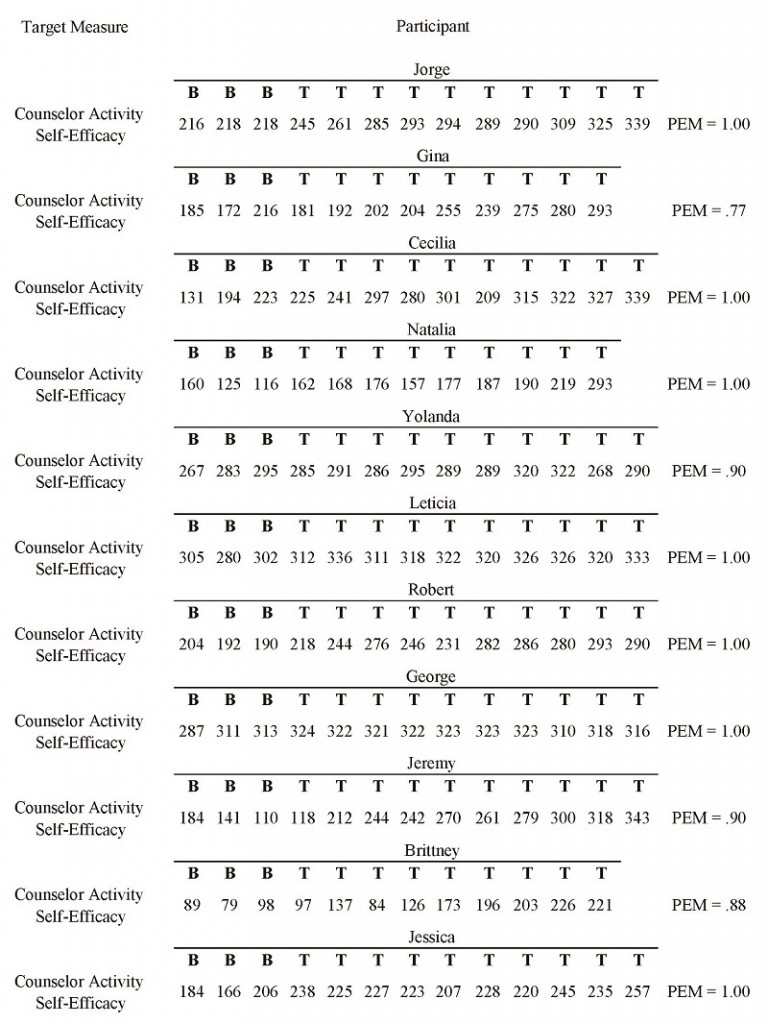
Figure 1 and Table 1 depict estimates of treatment effect using PEM across all participants. Detailed descriptions of participants’ experiences are provided below.
Participant 1
Jorge’s ratings on the CASES illustrate that the practicum experience involving triadic supervision and group supervision was very effective for improving counselor self-efficacy. Before the treatment phase began, three of Jorge’s baseline measurements were above the cut-score guideline on the CASES with a total scale score of 123, which considers an individual to have low counseling self-efficacy for the CASES. Evaluation of the PEM statistic for the CASES (1.00) indicated that 10 scores were on the therapeutic side above the baseline (total scale score of 217). Scores above the PEM line were within a 122-point range. Trend analysis depicted a consistent level of improvement following the first treatment measure. The majority of improvement in confidence was found on items measuring exploration skills.
Participant 2
Gina’s ratings on the CASES illustrate that the practicum experience involving triadic supervision and group supervision was moderately effective for improving counselor self-efficacy. Before the treatment phase began, three of Gina’s baseline measurements were above the cut-score guideline on the CASES with a total scale score of 123. Evaluation of the PEM statistic for the CASES (0.77) indicated that seven scores were on the therapeutic side above the baseline (total scale score of 194). Scores above the PEM line were within a 99-point range. Trend analysis depicted a consistent level of improvement following the second treatment measure. The majority of improvement in confidence was found on items measuring exploration skills, session management and client distress.
Participant 3
Cecilia’s ratings on the CASES illustrate that the practicum experience and triadic supervision were very effective for improving counselor self-efficacy. Before the treatment phase began, three of Cecilia’s baseline measurements were above the cut-score guideline on the CASES with a total scale score of 123. Evaluation of the PEM statistic for the CASES (1.00) indicated that 10 scores were on the therapeutic side above the baseline (total scale score of 177). Scores above the PEM line were within a 162-point range. Trend analysis depicted a consistent level of improvement following the first treatment measure. The majority of improvement in confidence was found on items measuring exploration skills and session management.
Figure 1.
Graphical Representation of Ratings for Counselor Activity Self-Efficacy by Participants
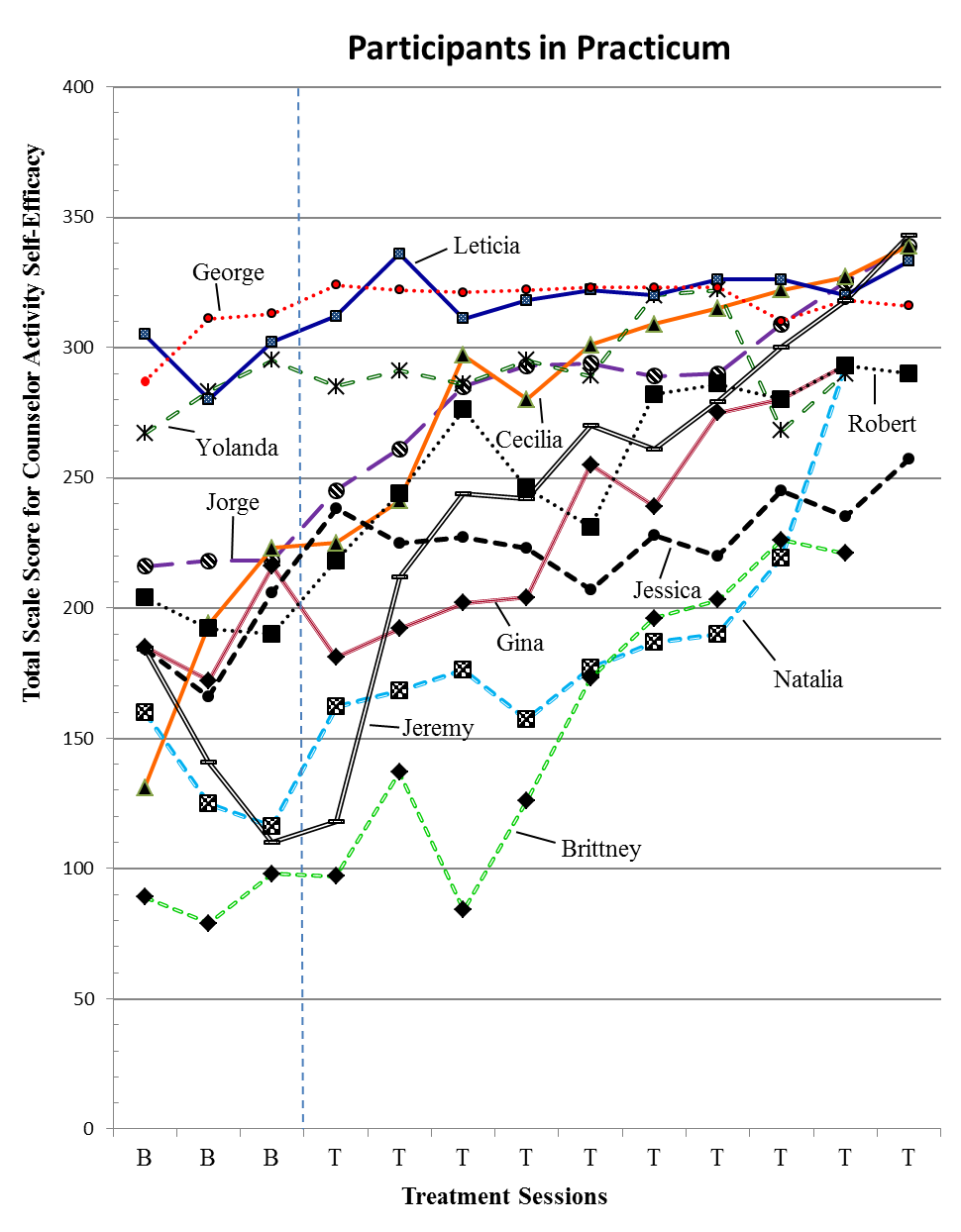
Table 1
Participants’ Sessions and Their CASES Total Scale Score for Counselor Activity Self-Efficacy
Participant 4
Natalia’s ratings on the CASES illustrate that the practicum experience and triadic supervision were very effective for improving her counselor self-efficacy. Before the treatment phase began, two of Natalia’s baseline measurements were above the cut-score guideline on the CASES with a total scale score of 123. Evaluation of the PEM statistic for the CASES (1.00) indicated that nine scores were on the therapeutic side above the baseline (total scale score of 138). Scores above the PEM line were within a 155-point range. Trend analysis depicted a consistent level of improvement following the first treatment measure. The majority of improvement in confidence was found on items measuring exploration skills.
Participant 5
Yolanda’s ratings on the CASES illustrate that the practicum experience and triadic supervision were very effective for improving counselor self-efficacy. Before the treatment phase began, three of Yolanda’s baseline measurements were above the cut-score guideline on the CASES with a total scale score of 123. Evaluation of the PEM statistic for the CASES (0.90) indicated that nine scores were on the therapeutic side above the baseline (total scale score of 295). Scores above the PEM line were within a 27-point range. Trend analysis depicted a minimal level of improvement following the first treatment measure. The majority of improvement in confidence was found on items measuring exploration skills.
Participant 6
Leticia’s ratings on the CASES illustrate that the practicum experience and triadic supervision were very effective for improving her counselor self-efficacy. Before the treatment phase began, three of Leticia’s baseline measurements were above the cut-score guideline on the CASES with a total scale score of 123. Evaluation of the PEM statistic for the CASES (1.00) indicated that 10 scores were on the therapeutic side above the baseline (total scale score of 293). Scores above the PEM line were within a 43-point range. Trend analysis depicted a consistent level of improvement following the first treatment measure. The majority of improvement in confidence was found on items measuring client distress.
Participant 7
Robert’s ratings on the CASES illustrate that the practicum experience and triadic supervision were very effective for improving counselor self-efficacy. Before the treatment phase began, three of Robert’s baseline measurements were above the cut-score guideline on the CASES with a total scale score of 123. Evaluation of the PEM statistic for the CASES (1.00) indicated that 10 scores were on the therapeutic side above the baseline (total scale score of 197). Scores above the PEM line were within a 96-point range. Trend analysis depicted a consistent level of improvement following the first treatment measure. The majority of improvement in confidence was found on items measuring client distress.
Participant 8
George’s ratings on the CASES illustrate that the practicum experience and triadic supervision were very effective for improving his counselor self-efficacy. Before the treatment phase began, three of George’s baseline measurements were above the cut-score guideline on the CASES with a total scale score of 123. Evaluation of the PEM statistic for the counselor activity self-efficacy measure (1.00) indicated that ten scores were on the therapeutic side above the baseline (total scale score of 300). Scores above the PEM line were within a 24-point range. Trend analysis depicted a consistent level of improvement following the first treatment measure. The majority of improvement in confidence was found on items measuring exploration skills.
Participant 9
Jeremy’s ratings on the CASES illustrate that the practicum experience and triadic supervision were very effective for improving his counselor self-efficacy. Before the treatment phase began, two of Jeremy’s baseline measurements were above the cut-score guideline on the CASES with a total scale score of 123. Evaluation of the PEM statistic for the CASES (0.90) indicated that nine scores were on the therapeutic side above the baseline (total scale score of 142). Scores above the PEM line were within a 201-point range. Trend analysis depicted a consistent level of improvement following the second treatment measure. The majority of improvement in confidence was found on items measuring session management and client distress.
Participant 10
Brittney’s ratings on the CASES illustrate that the practicum experience and triadic supervision were moderately effective for improving her counselor self-efficacy. Before the treatment phase began, three of Brittney’s baseline measurements were below the cut-score guideline on the CASES with a total scale score of 123. Evaluation of the PEM statistic for the CASES (0.88) indicated that eight scores were on the therapeutic side above the baseline (total scale score of 94). Scores above the PEM line were within a 132-point range. Trend analysis depicted a consistent level of improvement following the fourth treatment measure. The majority of improvement in confidence was found on items measuring session management.
Participant 11
Jessica’s ratings on the CASES illustrate that the practicum experience and triadic supervision were very effective for improving her counselor self-efficacy. Before the treatment phase began, three of Jessica’s baseline measurements were above the cut-score guideline on the CASES with a total scale score of 123. Evaluation of the PEM statistic for the CASES (1.00) indicated that 10 scores were on the therapeutic side above the baseline (total scale score of 186). Scores above the PEM line were within a 71-point range. Trend analysis depicted a consistent level of improvement following the first treatment measure. The majority of improvement in confidence was found on items measuring exploration skills.
Discussion
The results of this study found that in all 11 investigated cases, the practicum experience ranged from moderately effective (PEM = .77) to very effective (PEM = 1.00) for improving or maintaining counselor self-efficacy during practicum coursework. For most participants, counseling self-efficacy continued to improve throughout the practicum experience as evidenced by high scores on items such as “Helping your client understand his or her thoughts, feelings and actions,” “Work effectively with a client who shows signs of severely disturbed thinking,” and “Help your client set realistic counseling goals.” Participants shared that the most helpful experiences during practicum to improve their counselor self-efficacy came from direct experiences with clients. This finding is consistent with Bandura’s (1977) conceptualization of direct mastery experiences where participants gain confidence with successful experiences of a particular activity. Participants also shared how obtaining feedback from clients on their outcomes and seeing their clients’ progress was important for their development as counselors. Other helpful experiences included processing counseling sessions with a peer during triadic supervision, and case conceptualization and treatment planning during group supervision. Obtaining feedback during triadic supervision from peers and instructors after observing recorded counseling sessions also was beneficial.
Qualitative benefits of supervision included vicarious learning experiences, peer-learning opportunities and better supervisor feedback (Borders et al., 2012). Findings from this study extend qualitative findings regarding benefits of the practicum experience and triadic supervision. The results of this study yielded promising findings related to the integration of triadic supervision into counseling graduate students’ practicum experiences. First, the practicum experience appeared to be effective for increasing and maintaining participant scores on the CSEA scale. Inspection of participant scores within treatment targets revealed that the practicum experience was very effective for nine participants and within the moderately effective range for two participants.
Lastly, informal conversations with participants indicate that triadic supervision provided participants with an opportunity to receive peer feedback. Participants also commented that weekly wellness checks were important due to stress from the practicum experience. Trends were observed for the group as a majority of participants improved self-efficacy consistently after their fourth treatment measure. In summary, direct services with clients, triadic supervision with a peer and group supervision as part of the practicum experience may assist counseling graduate students to improve self-efficacy.
Implications for Counseling Practice
There are several implications for practice. First, triadic supervision has been helpful when there is compatibility between supervisor and supervisees (Hein & Lawson, 2008). Compatibility between supervisees is helpful, as participants shared how having similar knowledge and experience contributed to their development. While all participants in the current study selected their partner for supervision, Hein and Lawson (2008) commented that the responsibility to implement and maintain clear and achievable support to supervisees lies heavily on supervisors. As a result, additional trainings should be offered to supervisors regarding clear, concise and supportive feedback. Such trainings and discussions can focus on clarity of roles and expectations for both supervisor and supervisee before triadic supervision begins. More training in providing feedback to peers in group supervision also can be beneficial as students learn to provide feedback to promote awareness of different learning experiences. We suggest that additional trainings will help practicum instructors and students identify ways to provide clear, constructive and effective feedback.
Practicum instructors can administer weekly or bi-weekly wellness checks and discuss responses on individual items on the Mental Well-Being Scale to monitor progress (Tennant et al., 2007). Additionally, counselor education programs would benefit from bringing self-efficacy to the forefront in the practicum experience as well as prepracticum coursework. Findings from the current study could be presented to students in group counseling and practicum coursework to facilitate discussion regarding how the practicum experience can increase students’ self-efficacy. Part of this discussion should focus on assessing baseline self-efficacy in order to help students increase perceptions of self-efficacy. As such, counselor educators can administer and interpret the CSEA scale with practicum students. There are numerous scale items (e.g., silence, immediacy) that can be used to foster discussions on perceived confidence in dealing with counseling-related issues. Finally, CACREP-accredited programs require 1 hour of weekly supervision and allow triadic supervision to fulfill this requirement. We recommend that CACREP and non-CACREP-accredited programs consider incorporating triadic supervision into the practicum experience and suggest that triadic supervision as part of the practicum experience might help students’ increase self-efficacy.
Implications for Counseling Research
The practicum experience seemed helpful for improving counseling students’ self-efficacy. However, information regarding reasons for this effectiveness of the practicum experience and triadic supervision was not explored. Qualitative research regarding the impact of the practicum experience on counselors’ self-efficacy can provide incredible insight into specific aspects of group or triadic supervision that increase self-efficacy. Second, more outcome-based research with ethnic minority counseling students is necessary. There might be aspects of group or triadic supervision that are conducive when working with Mexican American students (Cavazos, Alvarado, Rodriguez, & Iruegas, 2009). Third, exploring different models of group or triadic supervision to increase counseling self-efficacy is important. As one example, researchers could explore the impact of the Wellness Model of Supervision (Lenz & Smith, 2010) on counseling graduate students’ self-efficacy. Finally, all participants in our study attended a CACREP counseling program with mandatory individual or triadic supervision. Comparing changes in self-efficacy between students in CACREP and non-CACREP programs where weekly individual or triadic supervision outside of class is not mandatory would be important.
Limitations
There are several limitations that must be taken into consideration. First, we did not use an ABA design with withdrawal measures that would have provided stronger internal validity to evaluate changes to counselor self-efficacy (Lenz et al., 2012). Most practicum students in our study began internship immediately after the conclusion of the semester. As a result, collecting withdrawal measures in an ABA design would have tapped into students’ internship experiences. Second, although three baseline measurements are considered sufficient in single-case research (Lenz et al., 2012), employing five baseline measures might have allowed self-efficacy scores to stabilize prior to their practicum experience (Ikonomopoulos et al., 2015).
Conclusion
Based on results from this study, the practicum experience shows promise as an effective strategy to increase counseling graduate students’ self-efficacy. Implementing triadic supervision as part of the practicum experience for counseling students is a strategy that counselor education programs might consider. Provided are guidelines for counselor educators to consider when integrating triadic supervision into the practicum experience. Researchers also can use different methodologies to address how different aspects of the practicum experience influence counseling students’ self-efficacy. In summary, we regard the practicum experience with triadic supervision as a promising approach for improving counseling graduate students’ self-efficacy.
Conflict of Interest and Funding Disclosure
The authors reported no conflict of interest
or funding contributions for the development
of this manuscript.
References
Bakar, A. R., Zakaria, N. S., & Mohamed, S. (2011). Malaysian counselors’ self-efficacy: Implication for career counseling. The International Journal of Business and Management, 6, 141–147. doi:10.5539/ijbm.v6n9p141
Bandura, A. (1977). Toward a unifying theory of behavioral change. Psychological Review, 84, 191–215.
Bandura, A. (1986). Social foundations of thought and action: A social cognitive theory. Englewood Cliffs, NJ: Prentice Hall.
Bandura, A. (1997). Self-efficacy: The exercise of control. New York, NY: Freeman.
Barbee, P. W., Scherer, D., & Combs, D. C. (2003). Prepracticum service-learning: Examining the relationship with counselor self-efficacy and anxiety. Counselor Education and Supervision, 43, 108–120.
Bernard, J. M., & Goodyear, R. K. (2004). Fundamentals of clinical supervision (3rd ed.). Needham Heights, MA: Allyn & Bacon.
Borders, L. D. (2014). Best practices in clinical supervision: Another step in delineating effective supervision practice. American Journal of Psychotherapy, 68, 151–162.
Borders, L. D., Welfare, L. E., Greason P. B., Paladino, D. A., Mobley, A. K., Villalba, J. A., & Wester, K. L. (2012). Individual and triadic and group: Supervisee and supervisor perceptions of each modality. Counselor Education and Supervision, 51, 281–295.
Cavazos, J., Alvarado, V., Rodriguez, I., & Iruegas, J. R. (2009). Examining Hispanic counseling students’ worries: A qualitative approach. Journal of School Counseling, 7, 1–22.
Conn, S. R., Roberts, R. L., & Powell, B. M. (2009). Attitudes and satisfaction with a hybrid model of counseling supervision. Educational Technology and Society, 12, 298–306.
Council for Accreditation of Counseling and Related Educational Programs. (2016). 2016 CACREP standards. Retrieved from http://www.cacrep.org/wp-content/uploads/2016/02/2016-Standards-with-Glossary-rev-2.2016.pdf
Degges-White, S., Colon, B. R., & Borzumato-Gainey, C. (2013). Counseling supervision within a feminist framework: Guidelines for intervention. Journal of Humanistic Counseling, 52, 92–105.
doi:10.1002/j.2161-1939.2013.00035.x
Greason, P. B., & Cashwell, C. S. (2009). Mindfulness and counseling self-efficacy: The mediating role of attention and empathy. Counselor Education and Supervision, 49, 2–19.
Halverson, S. E., Miars, R. D., & Livneh, H. (2006). An exploratory study of counselor education students’ moral reasoning, conceptual level, and counselor self-efficacy. Counseling and Clinical Psychology Journal, 3, 17–30.
Hein, S., & Lawson, G. (2008). Triadic supervision and its impact on the role of the supervisor: A qualitative examination of supervisors’ perspectives. Counselor Education and Supervision, 48, 16–31.
Hinkle, J. S. (1992). Computer-assisted career guidance and single-subject research: A scientist-practitioner approach to accountability. Journal of Counseling & Development, 70, 391–395.
Ikonomopoulos, J., Smith, R. L., & Schmidt, C. (2015). Integrating narrative therapy within rehabilitative programming for incarcerated adolescents. Journal of Counseling & Development, 93, 460–470. doi:10.1002/j.1556-6676.2014.00000.x
Larson, L. M., & Daniels, J. A. (1998). Review of the counseling self-efficacy literature. The Counseling Psychologist, 26, 179–218.
Lawson, G., Hein, S. F., & Getz, H. (2009). A model for using triadic supervision in counselor education preparation programs. Counselor Education and Supervision, 48, 257–270.
Lawson, G., Hein, S. F., & Stuart, C. L. (2009). A qualitative investigation of supervisees’ experiences of triadic supervision. Journal of Counseling & Development, 87, 449–457.
Lent, R. W., Cinamon, R. G., Bryan, N. A., Jezzi, M. M., Martin, H. M., & Lim, R. (2009). Perceived sources of changes in trainees’ self-efficacy beliefs. Psychotherapy: Theory, Research, Practice, Training, 46, 317–327. doi:10.1037/a0017029
Lent, R. W., Hill, E., & Hoffman, M. A. (2003). Development and validation of the counselor activity self-efficacy scales. Journal of Counseling Psychology, 50, 97–108.
Lenz, A. S. (2013). Calculating effect size in single-case research: A comparison of nonoverlap methods. Measurement and Evaluation in Counseling and Development, 46, 64–73.
Lenz, A. S. (2015). Special issue editor’s introduction: Using single-case research designs to demonstrate evidence for counseling practices. Journal of Counseling & Development, 93, 387–393.
doi:10.1002/jcad.12036
Lenz, A. S., Perepiczka, M., & Balkin, R. S. (2013). Evidence of the mitigating effects of a support group for attitude toward statistics. Counseling Outcome Research & Evaluation, 4, 26–40. doi:10.1177/2150137812474000
Lenz, A. S., & Smith, R. L. (2010). Integrating wellness concepts within a clinical supervision model. The Clinical Supervisor, 29, 228–245. doi:10.1080/07325223.2020.518511
Lenz, A. S., Speciale, M., & Aguilar, J. V. (2012). Relational-cultural therapy intervention with incarcerated adolescents: A single-case effectiveness design. Counseling Outcome Research & Evaluation, 3, 17–29. doi:10.1177/2150137811435233
Lundervold, D. A., & Belwood, M. F. (2000). The best kept secret in counseling: Single-case (N = 1) experimental designs. Journal of Counseling & Development, 78, 92–102.
Ma, H. H. (2006). An alternative method for quantitative synthesis of single-subject researches: Percentage of data points exceeding the median. Behavior Modification, 30, 598–617.
Scruggs, T. E., & Mastropieri, M. A. (1998). Summarizing single-subject research: Issues and applications. Behavior Modification, 22, 221–242.
Sharpley, C. F. (2007). So why aren’t counselors reporting n = 1 research designs? Journal of Counseling & Development, 85, 349–356.
Tennant, R., Hiller, L., Fishwick, R., Platt, S., Joseph, S., Weich, S., . . . Stewart-Brown, S. (2007). The Warwick-Edinburgh Mental Well-being Scale (WEMWBS): Development and UK validation. Health & Quality of Life
Outcomes, 5, 63. doi:10.1186/1477-7525-5-63
James Ikonomopoulos, NCC, is an Assistant Professor at the University of Texas Rio Grande Valley. Javier Cavazos Vela is an LPC-Intern at the University of Texas Rio Grande Valley. Wayne D. Smith is an Assistant Professor at the University of Houston–Victoria. Julia Dell’Aquila is a graduate student at the University of Texas Rio Grande Valley. Correspondence concerning this article can be addressed to James Ikonomopoulos, University of Texas Rio Grande Valley, Department of Counseling, Main 2.200F, One West Univ. Blvd., Brownsville, TX 78520, james.ikonomopoulos@utrgv.edu.
May 20, 2016 | Article, Volume 6 - Issue 2
Melissa J. Fickling
Advocacy with and on behalf of clients is a major way in which counselors fulfill their core professional value of promoting social justice. Career counselors have a unique vantage point regarding social justice due to the economic and social nature of work and can offer useful insights. Q methodology is a mixed methodology that was used to capture the perspectives of 19 career counselors regarding the relative importance of advocacy interventions. A two-factor solution was reached that accounted for 60% of the variance in perspectives on advocacy behaviors. One factor, labeled focus on clients, emphasized the importance of empowering individual clients and teaching self-advocacy. Another factor, labeled focus on multiple roles, highlighted the variety of skills and interventions career counselors use in their work. Interview data revealed that participants desired additional conversations and counselor training concerning advocacy.
Keywords: social justice, advocacy, career counselors, Q methodology, counselor training
The terms advocacy and social justice often are used without clear distinction. Advocacy is the active component of a social justice paradigm. It is a direct intervention or action and is the primary expression of social justice work (Fickling & Gonzalez, 2016; Ratts, Lewis, & Toporek, 2010; Toporek, Lewis, & Crethar, 2009). Despite the fact that counselors have more tools than ever to help them develop advocacy and social justice competence, such as the ACA Advocacy Competencies (Lewis, Arnold, House, & Toporek, 2002) and the Multicultural and Social Justice Counseling Competencies (Ratts, Singh, Nassar-McMillan, Butler, & McCullough, 2015), little is known about practitioners’ perspectives on the use of advocacy interventions.
One life domain in which social inequity can be vividly observed is that of work. The economic recession that began in 2007 has had a lasting impact on the labor market in the United States. Long-term unemployment is still worse than before the recession (Bureau of Labor Statistics, U.S. Department of Labor, 2016a). Further, in the United States, racial bias appears to impact workers and job seekers, as evidenced in part by the fact that the unemployment rate for Black workers is consistently about double that of White workers (e.g., 4.1% White unemployment and 8.2% Black unemployment as of May 2016; Bureau of Labor Statistics, U.S. Department of Labor, 2016b). Recent meta-analyses indicate that unemployment has a direct and causal negative impact on mental health, leading to greater rates of depression and suicide (Milner, Page, & LaMontagne, 2013; Paul & Moser, 2009). Clearly, the worker role is one that carries significant meaning and consequences for people who work or want to work (Blustein, 2006).
The rate at which the work world continues to change has led some to argue that worker adaptability is a key 21st century skill (Niles, Amundson, & Neault, 2010; Savickas, 1997), but encouraging clients to adapt to unjust conditions without also acknowledging the role of unequal social structures is inconsistent with a social justice paradigm (Stead & Perry, 2012). Career counselors, particularly those who work with the long-term unemployed and underemployed, witness the economic and psychological impact of unfair social arrangements on individuals, families and communities. In turn, they have a unique vantage point when it comes to social justice and a significant platform from which to advocate (Chope, 2010; Herr & Niles, 1998; Pope, Briddick, & Wilson, 2013; Pope & Pangelinan, 2010; Prilleltensky & Stead, 2012).
It appears that although career counselors value social justice and are aware of the effects of injustice on clients’ lives, they are acting primarily at the individual rather than the systemic level (Cook, Heppner, & O’Brien, 2005; McMahon, Arthur, & Collins, 2008b; Prilleltensky & Stead, 2012; Sampson, Dozier, & Colvin, 2011). Some research has emerged that focuses on practitioners’ use of advocacy in counseling practice (Arthur, Collins, Marshall, & McMahon, 2013; Arthur, Collins, McMahon, & Marshall, 2009; McMahon et al., 2008b; Singh, Urbano, Haston, & McMahan, 2010). Overall, this research indicates that advocacy is challenging and multifaceted and is viewed as a central component of good counseling work; however, more research is needed if we are to fully understand how valuing social justice translates to use of advocacy interventions in career counseling practice. This study aims to fill this theory–practice gap by illuminating the perceptions of advocacy behaviors from career counselors as they reflect upon their own counseling work.
Methodology
Through the use of Q methodology, insight into the decisions, motivations and thought processes of participants can be obtained by capturing their subjective points of view. When considering whether to undertake a Q study, Watts and Stenner (2012) encouraged researchers to consider whether revealing what a population thinks about an issue really matters and can make a real difference. Given the ongoing inequality in the labor market, increased attention and energy around matters of social justice in the counseling profession, the lack of knowledge regarding practitioners’ points of view on advocacy, and career counselors’ proximity to social and economic concerns of clients, the answer for the present study is most certainly yes.
Q methodology is fundamentally different from other quantitative research methodologies in the social sciences. It uses both quantitative and qualitative data to construct narratives of distinct perspectives. The term Q was coined to distinguish this methodology from R; Q measures correlations between persons, whereas R measures trait correlations (Brown, 1980). Rather than subjecting a sample of research participants to a collection of measures as in R methodology, Q methodology subjects a sample of items (i.e., the Q sample) to measurement by a collection of individuals through a ranking procedure known as the Q sort (see Figure 1; Watts & Stenner, 2012). Individuals are the variables in Q methodology, and factor analysis is used to reduce the number of points of view into a smaller number of shared perspectives. Then interviews are conducted to allow participants to provide additional data regarding their rankings of the Q sample items. In this study, career counselors were asked to sort a set of advocacy behaviors according to how important they were to their everyday practice of career counseling. Importance to practice was used as the measure of psychological significance since career counselors’ perspectives on advocacy interventions were of interest, rather than self-reported frequency or competence, for example.
Q Sample
The Q sample can be considered the instrumentation in Q methodology. The Q sample is a subset of statements drawn from the concourse of communication, which is defined as the entire population of statements about any given topic (McKeown & Thomas, 2013). The goal when creating the Q sample is to provide a comprehensive but manageable representation of the concourse from which it is taken. For this study, the concourse was that of counselor advocacy behaviors.
The Q sampling approach used for this study was indirect, naturalistic and structured-inductive. Researchers should draw their Q sample from a population of 100 to 300 statements (Webler, Danielson, & Tuler, 2009). For this study, I compiled a list of 180 counselor social justice and advocacy behaviors from a variety of sources including the ACA Advocacy Competencies (Lewis et al., 2002), the Social Justice Advocacy Scale (SJAS; Dean, 2009), the National Career Development Association (NCDA) Minimum Competencies (2009), the Council for Accreditation of Counseling and Related Educational Programs (CACREP) Standards (2009), and key articles in counseling scholarly and trade publications.
Consistent with a structured-inductive sampling strategy, these 180 statements were analyzed to identify categories representing different kinds of advocacy behaviors. By removing duplicates and those items that were more aligned with awareness, knowledge or skill rather than behavior, I was able to narrow the list from 180 to 43 statements. These statements were sorted into five domains that were aligned with the four scales of the SJAS (Dean, 2009) and a fifth added domain. The final domains were: Client Empowerment, Collaborative Action, Community Advocacy, Social/Political Advocacy, and Advocacy with Other Professionals. Aligning the Q sample with existing domains was appropriate since advocacy had been previously operationalized in the counseling literature.
Expert reviewers were used to check for researcher bias in the construction of the Q sample, including the addition of the fifth advocacy domain. Three expert reviewers who were faculty members and published on the topic of social justice in career counseling were asked to review the potential Q sample for breadth, coverage, omissions, clarity of phrasing and the appropriateness of the five domains of advocacy. Two agreed to participate and offered their feedback via a Qualtrics survey, leading to a refined Q sample of 25 counselor advocacy behaviors (see Table 1). Five statements were retained in each of the five domains. Finally, the Q sample and Q sorting procedure were piloted with two career counselors, leading to changes in instructions but not in the Q sample itself. Pilot data were not used in the final analysis.
Participants
In Q methodology, participant sampling should be theoretical and include the intentional selection of participants who are likely to have an opinion about the topic of interest (McKeown & Thomas, 2013; Watts & Stenner, 2012). It also is important to invite participants who represent a range of viewpoints and who are demographically diverse. For the current study, the following criteria were required for participant inclusion: (a) holds a master’s degree or higher in counseling and (b) has worked as a career counselor for at least one year full-time in the past two years. For this study, career counselor was defined as having career- or work-related issues as the primary focus of counseling in at least half of the counselor’s case load. Regarding the number of participants in a Q study, emphasis is placed on having enough participants to establish the existence of particular viewpoints, not simply having a large sample since generalizability is not a goal of Q methodology (Brown, 1980). In Q methodology, it also is important to have fewer participants than Q sample items (Watts & Stenner, 2012; Webler et al., 2009).
Participants were recruited by theoretical sampling of my professional network of practitioners, and one participant was recruited through snowball sampling. Nineteen career counselors participated in the present study from six states in the Southeast, West and Midwest regions of the United States. The participant sample was 68% female (n = 13) and 32% male (n = 6); the sample was 84% White and included two Black participants and one multi-racial participant. One participant was an immigrant to the United States and was a non-native English speaker. The participant sample was 95% heterosexual with one participant identifying as gay. Sixty-three percent of participants worked in four-year institutions of higher education and one worked in a community college. Thirty-two percent (n = 6) provided career counseling in non-profit agencies. The average age was 43 (SD = 12) and the average number of years of post-master’s counseling experience was eight (SD = 7); ages ranged from 28 to 66, and years of post-master’s experience ranged from one and a half to 31 years.
Q Sorting Procedure
The Q sort is a method of data collection in which participants rank the Q sample statements according to a condition of instruction along a forced quasi-normal distribution (see Figure 1). There is no time limit to the sorting task and participants are able to move the statements around the distribution until they are satisfied with their final configuration. The function of the forced distribution is to encourage active decision making and comparison of the Q sample items to one another (Brown, 1980).
Figure 1
Sample Q Sort Distribution

The condition of instruction for this study was, “Sort the following counselor advocacy behaviors according to how important or unimportant they are to your career counseling work.” The two poles of the distribution were most important and most unimportant. Poles range from most to most so that the ends of the distribution represent the areas that hold the greatest degree of psychological significance to the participant, and the middle of the distribution represents items that hold relatively little meaning or are more neutral in importance (Watts & Stenner, 2012).
The Q sorts for this study were conducted both in person and via phone or video chat (i.e., Google Hangouts, Skype). Once informed consent was obtained, I facilitated the Q sorting procedure by reading the condition of instruction, observing the sorting process, and conducting the post-sort interview. Once each participant felt satisfied with his or her sort, the distribution of statements was recorded onto a response sheet for later data entry.
Post-Sort Interview
Immediately following the Q sort, I conducted a semistructured interview with each participant in order to gain a greater understanding of the meaning of the items and their placement, as well as his or her broader understanding of the topic at hand (Watts & Stenner, 2012). The information gathered during the interview is used when interpreting the final emergent factors. Items in the middle of the distribution are not neglected and are specifically asked about during the post-sort interview so that the researcher can gain an understanding of the entire Q sort for each participant. Although the interview data are crucial to a complete and rigorous factor interpretation and should be conducted with every participant in every Q study, the data analysis process is guided by the quantitative criteria for factor analysis and factor extraction. The qualitative interview data, as well as the demographic data, are meant to help the researcher better understand the results of the quantitative analysis.
Data Analysis
Data were entered into the PQMethod program (Schmolck, 2014) and Pearson product moment correlations were calculated for each set of Q sorts. Inspection of the correlation matrix revealed that all sorts (i.e., all participants) were positively correlated with one another, some of them significantly so. This indicated a high degree of consensus among the participants regarding the role of advocacy in career counseling, which was further explored through factor analysis.
I used centroid factor analysis and Watts and Stenner’s (2012) recommendation of beginning by extracting one factor for every six Q sorts. Centroid factor analysis is the method of choice among Q methodologists because it allows for a fuller exploration of the data than a principal components analysis (McKeown & Thomas, 2013; Watts & Stenner, 2012). Next, I calculated the significance level at p < .01, which was .516 for this 25-item Q sample.
The unrotated factor matrix revealed two factors with Eigenvalues near or above the commonly accepted cutoff of 1 according to the Kaiser-Guttman rule (Kaiser, 1970). Brown (1978) argued that although Eigenvalues often indicate factor strength or importance, they should not solely guide factor extraction in Q methodology since “the significance of Q factors is not defined objectively (i.e., statistically), but theoretically in terms of the social-psychological situation to which the emergent factors are functionally related” (p. 118). Since there currently is little empirical evidence of differing perspectives on advocacy among career counselors, two factors were retained for rotation.
In order to gain another perspective on the data, I used the Varimax procedure. I flagged those sorts that loaded significantly (i.e., at or above 0.516) onto only one factor after rotation. Four participants (2, 8, 9 and 17) loaded significantly onto both rotated factors and were therefore dropped from the study and excluded from further analysis (Brown, 1980; Watts & Stenner, 2012). Two rotated factors were retained, which accounted for 60% of the variance in perspectives on advocacy behaviors. Fifteen of the original 19 participants were retained in this factor solution.
Q methodology uses only orthogonal rotation techniques, meaning that all factors are zero-correlated. Even so, it is possible for factors to be significantly correlated but still justify retaining separate factors (Watts & Stenner, 2012). The two factors in this study are correlated at 0.71. This correlation indicates that the perspectives expressed by the two factor arrays share a point of view but are still distinguishable and worthy of exploration as long as the general degree of consensus is kept in mind (Watts & Stenner, 2012).
Constructing Factor Arrays
After the two rotated factors were identified, factor arrays were constructed in PQMethod. A factor array is a composite Q sort and the best possible estimate of the factor’s viewpoint using the 25 Q sample items. First, a factor weight was calculated for each of the 15 Q sorts that loaded onto a factor. Next, normalized factor scores (z scores) were calculated for each statement on each factor, which were finally converted into factor arrays (see Table 1). In Q methodology, unlike traditional factor analysis, attention is focused more on factor scores than factor loadings. Since factor scores are based on weighted averages, Q sorts with higher factor loadings contribute proportionally more to the final factor score for each item in a factor than those with relatively low factor loadings. Finally, factors were named by examining the distinguishing statements and interview data of participants that loaded onto the respective factors. Factor one was labeled focus on clients and factor two was labeled focus on multiple roles.
Factor Characteristics
Factor one was labeled focus on clients and accounted for 32% of the variance in perspectives on advocacy behaviors. It included nine participants. The demographic breakdown on this factor was: six females, three males; eight White individuals and one person who identified as multi-racial. The average age on this factor was about 51 (SD = 10.33), ranging from 37 to 66. Persons on this factor had on average 11 years of post-master’s counseling experience (SD = 8.6), ranging from one and a half to 31 years. Fifty-six percent of participants on this factor worked in 4-year colleges or universities, 33% in non-profit agencies, and one person worked at a community college.
Factor two was labeled focus on multiple roles and accounted for 28% of the variance in career counselors’ perspectives on advocacy behaviors. It included six participants. Five participants on this factor identified as female and one identified as male. Five persons were White; one was Black. The average age of participants on this factor was almost 35 (SD = 6.79), ranging from 29 to 48, and they had an average of just over seven years of post-master’s experience (SD = 3.76), ranging from three and a half to 14 years. Four worked in higher education, and two worked in non-profit settings.
Factor Interpretation
In the factor interpretation phase of data analysis, the researcher constructs a narrative for each factor by incorporating post-sort interview data with the factor arrays to communicate the rich point of view of each factor (Watts & Stenner, 2012). Each participant’s interview was considered only in conjunction with the other participants on the factor on which they loaded. I read post-sort interview transcripts, looking for shared perspectives and meaning, in order to understand each factor array and enrich each factor beyond the statements of the Q sample. Thus, the results are reported below in narrative form, incorporating direct quotes and paraphrased summaries from interview data, but structured around the corresponding factor arrays.
Table 1
Q Sample Statements, Factor Scores and Q Sort Values
|
No
|
Statement
|
Factor 1
|
Factor 2
|
|
|
Factor Score
|
QSV
|
Factor Score
|
QSV
|
| 1 |
Question intervention practices that appear inappropriate. |
0.09
|
1
|
0.54
|
1
|
| 2 |
Seek feedback regarding others’ perceptions of my advocacy efforts. |
-0.85
|
-2
|
-0.75
|
-1
|
| 3 |
Serve as a mediator between clients and institutions. |
-0.47
|
-1
|
-1.05
|
-2
|
| 4 |
Express views on proposed bills that will impact clients. |
-0.97
|
-2
|
-1.96
|
-4
|
| 5 |
Maintain open dialogue to ensure that advocacy efforts are consistent with group goals. |
-0.19
|
0
|
-0.05
|
0
|
| 6 |
Encourage clients to research the laws and policies that apply to them. |
-0.31
|
0
|
0.15
|
0
|
| 7 |
Collect data to show the need for change in institutions. |
-0.67
|
-2
|
-0.75
|
-2
|
| 8 |
Educate other professionals about the unique needs of my clients. |
0.87
|
1
|
0.86
|
2
|
| 9 |
Help clients develop needed skills. |
1.67
|
3
|
0.42
|
1
|
| 10 |
Assist clients in carrying out action plans. |
-1.31
|
3
|
1.06
|
2
|
| 11 |
Help clients overcome internalized negative stereotypes. |
1.02
|
2
|
0.89
|
2
|
| 12 |
Conduct assessments that are inclusive of community members’ perspectives. |
-1.31
|
-3
|
0.5
|
1
|
| 13 |
With allies, prepare convincing rationales for social change. |
-0.35
|
-1
|
-1.36
|
-3
|
| 14 |
Identify strengths and resources of clients. |
2.17
|
4
|
1.62
|
3
|
| 15 |
Get out of the office to educate people about how and where to get help. |
0.58
|
1
|
-0.47
|
-1
|
| 16 |
Teach colleagues to recognize sources of bias within institutions and agencies. |
-0.37
|
-1
|
-0.37
|
-1
|
| 17 |
Deal with resistance to change at the community/system level. |
-0.43
|
-1
|
-0.21
|
0
|
| 18 |
Collaborate with other professionals who are involved in disseminating public information. |
-0.33
|
0
|
-0.4
|
-1
|
| 19 |
Help clients identify the external barriers that affect their development. |
1.08
|
2
|
1.46
|
3
|
| 20 |
Use multiple sources of intervention, such as individual counseling, social advocacy and case management. |
-0.32
|
0
|
1.73
|
4
|
| 21 |
Train other counselors to develop multicultural knowledge and skills. |
0.15
|
1
|
0.19
|
0
|
| 22 |
Work to ensure that clients have access to the resources necessary to meet their needs. |
1.03
|
2
|
0.85
|
1
|
| 23 |
Work to change legislation and policy that negatively affects clients. |
-1.78
|
-4
|
-1.39
|
-3
|
| 24 |
Ask other counselors to think about what social change is. |
-0.25
|
0
|
-0.22
|
0
|
| 25 |
Communicate with my legislators regarding social issues that impact my clients. |
-1.45
|
-3
|
-1.28
|
-2
|
Note. Q sort values are -4 to 4 to correspond with the Q distribution (Figure 1) where 4 is most important
and -4 is most unimportant; QSV = Q Sort Value.
Results
Factor 1: Focus on Clients
For participants on the focus on clients factor, the most important advocacy behavior was to “identify client strengths and resources” (see Table 1). When speaking about this item, participants often discussed teaching clients self-advocacy skills, stating that this is a key way in which career counselors promote social justice. Identifying client strengths and resources was referred to as “the starting point,” “the bottom line” and even the very “definition of career counseling.” One participant said that counseling is about “empowering our clients or jobseekers, whatever we call them, to do advocacy on their own behalf and to tell their story.” In general, persons on this factor were most concerned with empowering individual clients; for example, “I would say, even when we’re doing group counseling and family counseling, ultimately it’s about helping the person in the one-to-one.” Similarly, one participant said, “Instead of fighting for the group in legislation or out in the community, I’m working with each individual to help them better advocate for themselves.” Interview data indicated that social justice was a strongly held value for persons on this factor, but they typically emphasized the need for balancing their views on social injustice with their clients’ objectives; they wanted to take care not to prioritize their own agendas over those of their clients.
Several participants on this factor perceived items related to legislation or policy change as among the least client-centered behaviors and therefore as the more unimportant advocacy behaviors in their career counseling work. Persons on this factor stated that advocacy at the systems level was neither a strength of theirs nor a preference. A few reported that there are other people in their offices or campuses whose job is to focus on policy or legislative change. There also was a level of skepticism about counselors’ power to influence social change. In regard to influencing legislative change in support of clients, one participant said, “I don’t think in my lifetime that is going to happen. Maybe someday it will. I’m just thinking about market change right now instead of legislative change.”
Interview data revealed that career counselors on this factor thought about advocacy in terms of leadership, both positively and negatively. One person felt that a lack of leadership was a barrier to career counselors doing more advocacy work. Another person indicated that leaders were the ones who publicly called for social change and that this was neither his personality nor approach to making change, preferring instead to act at the micro level. Finally, persons on this factor expressed that conversations about social change or social justice were seen as potentially divisive in their work settings. One White participant said the following:
There is a reluctance to do social justice work because—and it’s mostly White people—people really don’t understand what it means, or feel like they don’t have a right to do that, or feel like they might be overstepping. Talking about race or anything else, people are really nervous and they don’t want to offend or say something that might be wrong, so as a result they just don’t engage on that level or on that topic.
Factor 2: Focus on Multiple Roles
One distinguishing feature of the focus on multiple roles factor was the relatively high importance placed on using multiple sources of intervention (see Table 1). Participants described this as being all-encompassing of what a career counselor does and reflective of the multiple roles a career counselor may hold. One participant said, “You never know what the client is going to come in with,” arguing that career counselors have to be open to multiple sources of intervention by necessity. Another participant indicated that she wished she could rely more on multiple sources of intervention but that the specialized nature of her office constricted her ability to do so.
Participants on this factor cited a lack of awareness or skills as a barrier to their implementing more advocacy behaviors. They were quick to identify social justice as a natural concern of career counselors and one that career counselors are well qualified to address due to their ability to remain aware of personal, mental health and career-related concerns simultaneously. One participant said:
I don’t know if the profession of career counseling is really seen as being as great as it is in that most of us have counseling backgrounds and can really tackle the issues of career on a number of different levels.
In talking about the nature of career counseling, another participant said, “Social justice impacts work in so many ways. It would make sense for those external barriers to come into our conversations.”
Regarding collaborating with other professionals to prepare convincing rationales for social change, one participant stated that there are already enough rationales for social change; therefore, this advocacy behavior was seen as less important to her. Persons on this factor placed relatively higher importance on valuing feedback on advocacy efforts than did participants on factor one. One participant said she would like to seek feedback more often but had not thought of doing so in a while: “I did this more when I was in graduate school because you are thinking about your thinking all the time. As a practitioner, as long as social justice and advocacy are on my radar, that’s good.”
Discussion
Neither setting nor gender appeared to differentiate the factors, but age and years of post-master’s experience may have been distinguishing variables. Younger individuals and those with fewer years of post-master’s experience tended to load onto factor two. Factor one had an average age of 51 compared to 35 for factor two, and the average age for all study participants was 43. It is interesting to note that the four participants who loaded onto both factors and were therefore dropped from analysis had an average of just over two years of post-master’s counseling experience versus 11 for factor one and seven for factor two. It is possible that their more recent training regarding advocacy may account for some differences in perspective from those of more experienced counselors.
Participants on factor one (focus on clients) who emphasized the importance of individual clients tended to perceive it as more difficult to have conversations about social justice with their peers or supervisors. In contrast, participants on factor two (focus on multiple roles) were more likely to cite a lack of knowledge or skills regarding their reasons for not engaging in more advocacy behaviors beyond the client level. Factor arrays indicated that factor one participants viewed engaging at the community level as more important, whereas participants on factor two viewed conversations with colleagues and clients about social justice as more important to their work.
The broader view of persons on factor two regarding the career counselor’s role and their openness to acknowledging their own lack of awareness or skills may reflect a different kind of socialization around advocacy compared to persons on factor one. Career counselors who graduated from counseling programs prior to the emphasis on multicultural competence in the early 1990s or before the inclusion of social justice in the literature and CACREP standards in the first decade of the 21st century may have had limited exposure to thinking about contextual or social factors that impact client wellness. Persons on both factors, however, expressed interest in social justice and felt that the vast majority of advocacy behaviors were important.
In post-sort interviews, participants from both factors described a gradual shift in emphasis from a focus on the individual on the right hand (most important) side of the Q sort distribution to an emphasis on legislation on the left hand (most unimportant) side. For example, the statement identify strengths and resources of clients was one of the most important behaviors for nearly every participant. Likewise, the statement work to change legislation and policy that negatively affects clients was ranked among the most unimportant advocacy behaviors for both factors. Interestingly, the statement encourage clients to research the laws and policies that apply to them was a consensus statement with a Q sort value of 0, or the very middle of the distribution. Since this advocacy behavior is both client focused and presumably would provide clients with important self-advocacy skills, it is interesting that it was ranked lower than other items related to client self-advocacy. Some participants indicated that they considered this item a “passive” counselor behavior in that they might encourage clients to research laws but could not or would not follow up with clients on this task. One participant said she would like to encourage clients to research laws that apply to them but shared that she would first need to learn more about the laws that impact her clients in order to feel effective in using this intervention.
Participants were asked directly about potential barriers to advocacy and potential strengths of career counselors in promoting social justice. Responses are discussed below. The questions about strengths and barriers in the post-sort interview did not reference Q sample items, so participant responses are reported together below.
Barriers to Promoting Social Justice
In the post-sort interviews, lack of time was mentioned by nearly every participant as a barrier to implementing more advocacy in career counseling, and it often came in the form of little institutional support for engaging in advocacy. For example, participants indicated that while their supervisors would not stop them from doing advocacy work, they would not provide material support (e.g., time off, reduced case load) to do so. This finding is consistent with other literature that suggests that career counselors report a lack of institutional support for engaging in advocacy (Arthur et al., 2009).
Another major barrier to advocacy was a lack of skill or confidence in one’s ability as an advocate. Advocacy at the social/political level requires a unique set of skills (M. A. Lee, Smith, & Henry, 2013), which practitioners in the present study may or may not have learned during their counseling training. Pieterse, Evans, Risner-Butner, Collins, and Mason (2009) reviewed 54 syllabi from required multicultural courses in American Psychological Association (APA)- and CACREP-accredited programs and found that awareness and knowledge tended to be emphasized more than skill building or application of social justice advocacy. This seems to have been reflected in the responses from many participants in the present study.
Participants on both factors indicated that they held some negative associations to advocacy work, calling it “flag waving” or “yelling and screaming” about inequality or social issues. They expressed some concern about how they might be perceived by their peers if they were to engage in advocacy; however, involvement in this study seemed to provide participants with a new understanding of advocacy as something that happens at the individual as well as at the social level. Participants appeared to finish the data collection sessions with a more positive understanding of what advocacy is and could be.
Strengths of Career Counselors in Promoting Social Justice
In addition to discussing barriers to advocacy, participants were asked directly about strengths of career counselors in promoting social justice and were able to identify many. First and foremost, participants saw the ability to develop one-on-one relationships with clients as a strength. One participant nicely captured the essence of all responses in this area by stating, “The key thing is our work one-on-one with an individual to say that even though you’re in a bad place, you have strengths, you have resources, and you have value.” Participants indicated that social change happens through a process of empowering clients, instilling hope and seeing diversity as a strength of a client’s career identity. The ability to develop strong counseling relationships was attributed partially to participants’ counseling training and identity, as well as to their exposure to a broad range of client concerns due to the inseparable nature of work from all other aspects of clients’ lives (Herr & Niles, 1998; Tang, 2003).
Career counselors in this study served diverse populations and highly valued doing so. These participants described multicultural counseling skills and experience as central to competent career counseling and to advocacy. They felt that they possessed and valued multicultural competence, which bodes well for their potential to engage in competent and ethical advocacy work with additional training, experience and supervision (Crook, Stenger, & Gesselman, 2015; Vespia, Fitzpatrick, Fouad, Kantamneni, & Chen, 2010).
Finally, participants felt that career counseling is seen as more accessible than mental health counseling to some clients, giving career counselors unique insight into clients’ social and personal worlds. Participants reported having a broad perspective on their clients’ lives and therefore unique opportunities to advocate for social justice. Relatedly, participants noted that the more concrete and tangible nature of career counseling and its outcomes (e.g., employment) may lead policymakers to be interested in hearing career counselors’ perspectives on social issues related to work. One participant noted that “there’s a huge conversation to be had around work and social justice” and that career counselors’ key strength “is empowering clients and the broader community to understand the role of work.”
Implications for Career Counselors, Counselor Educators, and Supervisors
Nearly all participants described the sorting process as thought provoking and indicated that social justice and advocacy were topics they appreciated the opportunity to think more about. There was a strong desire among some practitioners in this study to talk more openly with colleagues about social justice and its connection to career counseling, but a lingering hesitation as well. Therefore, one implication of the present study is that practitioners should begin to engage in discussions about this topic with colleagues and leaders in the profession. If there is a shared value for advocacy beyond the individual level, but time and skills are perceived as barriers, perhaps a larger conversation about the role of career counselors is timely. Career counselors may benefit from finding like-minded colleagues with whom to talk about social justice and advocacy. Support from peers may help practitioners strategize ways to question or challenge coworkers who may be practicing career counseling in ways that hinder social justice.
To move toward greater self-awareness and ethical advocacy, practitioners and career counseling leaders must ask themselves critical and self-reflexive questions about their roles and contributions in promoting social justice (McIlveen & Patton, 2006; Prilleltensky & Stead, 2012). Some authors have indicated there is an inherent tension in considering a social justice perspective and that starting such conversations can even lead to more questions than answers (Prilleltensky & Stead, 2012; Stead & Perry, 2012). Counselors should turn their communication skills and tolerance for ambiguity inward and toward one another in order to invite open and honest conversations about their role in promoting social justice for clients and communities. The participants in this study seem eager to do so, though leadership may be required to get the process started in a constructive and meaningful way.
Counselor educators and supervisors can provide counselors-in-training increased experience with systemic-level advocacy by integrating the ACA Advocacy Competencies and the Multicultural and Social Justice Counseling Competencies into all core coursework. Even though broaching issues of social justice has been reported as challenging and potentially risky, counselor educators should integrate such frameworks and competencies in active and experiential ways (Kiselica & Robinson, 2001; M. A. Lee et al., 2013; Lopez-Baez & Paylo, 2009; Manis, 2012). Singh and colleagues (2010) found that even self-identified social justice advocates struggled at times with initiating difficult conversations with colleagues; they argued that programs should do more to help counselors-in-training develop skills “to anticipate and address the inevitable interpersonal challenges inherent in advocacy work” (p. 141). Skills in leadership, teamwork and providing constructive feedback might be beneficial to prepare future counselors for addressing injustice. Furthermore, Crook and colleagues (2015) found that advocacy training via coursework or workshops is associated with higher levels of perceived advocacy competence among school counselors, lending more support in favor of multi-level training opportunities.
Limitations
The current study is one initial step in a much-needed body of research regarding advocacy practice in career counseling. It did not measure actual counselor engagement in advocacy, which is important to fully understand the current state of advocacy practice; rather, it measured perceived relative importance of advocacy behaviors. Researcher subjectivity may be considered a limitation of this study, as researcher decisions influenced the construction of the Q sample, the factor analysis and the interpretation of the emergent factors. By integrating feedback from two expert reviewers during construction of the Q sample, I minimized the potential for bias at the design stage. Factor interpretation is open to the researcher’s unique lens and also may be considered a limitation, but if it is done well, interpretation in Q methodology should be constrained by the factor array and interview data. Although generalizability is not a goal of Q methodology, the sample size in this study is small and therefore limits the scope of the findings.
Suggestions for Future Research and Conclusion
Advocacy is central to career counseling’s relevance in the 21st century (Arthur et al., 2009; Blustein, McWhirter, & Perry, 2005; McMahon, Arthur, & Collins, 2008a), yet due to the complexity and personal nature of this work, more research is required if we are to engage in advocacy competently, ethically and effectively. There appears to be interest among career counselors in gaining additional skills and knowledge regarding advocacy, so future research could include analyzing the effects of a training curriculum on perceptions of and engagement with advocacy. Outcome research could also be beneficial to understand whether career counselors who engage in high levels of advocacy report different client outcomes than those who do not. Finally, research with directors of career counseling departments could be helpful to understand what, if any, changes to career counselors’ roles are possible if career counselors are interested in doing more advocacy work. Understanding the perspectives of these leaders could help further the conversation regarding the ideals of social justice and the reality of expectations and demands faced by career counseling offices and agencies.
This research study is among the first to capture U.S. career counselors’ perspectives on a range of advocacy behaviors rather than attitudes about social justice in general. It adds empirical support to the notion that additional conversations and training around advocacy are wanted and needed among practicing career counselors. Stead (2013) wrote that knowledge becomes accepted through discourse; it is hoped that the knowledge this study produces will add to the social justice discourse in career counseling and move the profession toward a more integrated understanding of how career counselors view the advocate role and how they can work toward making social justice a reality.
Conflict of Interest and Funding Disclosure
The author conducted this research with the assistance of grants awarded by the National Career Development Association, the North Carolina Career Development Association, and the Southern Association for Counselor Education and Supervision.
References
American Counseling Association. (2014). 2014 ACA Code of Ethics. Alexandria, VA: Author. Retrieved from http://www.counseling.org/Resources/aca-code-of-ethics.pdf
Arthur, N., Collins, S., Marshall, C., & McMahon, M. (2013). Social justice competencies and career development practices. Canadian Journal of Counselling and Psychotherapy, 47, 136–154.
Arthur, N., Collins, S., McMahon, M., & Marshall, C. (2009). Career practitioners’ views of social justice and barriers for practice. Canadian Journal of Career Development, 8, 22–31.
Blustein, D. L. (2006). The psychology of working. Mahwah, NJ: Erlbaum.
Blustein, D. L., McWhirter, E. H., & Perry, J. C. (2005). An emancipatory communitarian approach to vocational development theory, research, and practice. The Counseling Psychologist, 33, 141–179. doi:10.1177/0011000004272268
Brown, S. R. (1978). The importance of factors in Q methodology: Statistical and theoretical considerations. Operant Subjectivity, 1, 117–124.
Brown, S. R. (1980). Political subjectivity: Applications of Q methodology in political science. New Haven, CT: Yale University Press.
Bureau of Labor Statistics, U.S. Department of Labor. (2016a). Charting the labor market: Data from the Current Population Survey (CPS). Retrieved from http://www.bls.gov/web/empsit/cps_charts.pdf
Bureau of Labor Statistics, U.S. Department of Labor. (2016b). The employment situation – May 2016. Retrieved from http://www.bls.gov/news.release/pdf/empsit.pdf
Chope, R. C. (2010). Applying the ACA advocacy competencies in employment counseling. In M. J. Ratts, R. L. Toporek, & J. A. Lewis (Eds.), ACA advocacy competencies: A social justice framework for counselors (pp. 225–236). Alexandria, VA: American Counseling Association.
Cook, E. P., Heppner, M. J., & O’Brien, K. M. (2005). Multicultural and gender influences in women’s career development: An ecological perspective. Journal of Multicultural Counseling and Development, 33, 165–179. doi:10.1002/j.2161-1912.2005.tb00014.x
Council for Accreditation of Counseling and Related Educational Programs. (2009). 2009 standards. Retrieved from http://www.cacrep.org/wp-content/uploads/2013/12/2009-Standards.pdf
Crook, T. M., Stenger, S., & Gesselman, A. (2015). Exploring perceptions of social justice advocacy competence among school counselors. Journal of Counselor Leadership and Advocacy, 2, 65–79.
Dean, J. K. (2009). Quantifying social justice advocacy competency: Development of the social justice advocacy scale
(Doctoral dissertation). Retrieved from http://scholarworks.gsu.edu/cgi/viewcontent.cgi?article=10
39&context=cps_diss
Fickling, M. J., & Gonzalez, L. M. (2016). Linking multicultural counseling and social justice through advocacy. Journal of Counselor Leadership and Advocacy. doi:10.1080/2326716X.2015.1124814
Herr, E. L., & Niles, S. G. (1998). Career: Social action on behalf of purpose, productivity, and hope. In C. C. Lee & G. R. Walz (Eds.), Social action: A mandate for counselors (pp. 117–136). Alexandria, VA: American Counseling Association.
Kaiser, H. F. (1970). A second generation little jiffy. Psychometrika, 35, 401–415. doi:10.1007/BF02291817
Kiselica, M. S., & Robinson, M. (2001). Bringing advocacy counseling to life: The history, issues, and human dramas of social justice work in counseling. Journal of Counseling & Development, 79, 387–397. doi:10.1002/j.1556-6676.2001.tb01985.x
Lee, C. C., & Hipolito-Delgado, C. P. (2007). Introduction: Counselors as agents of social justice. In C. C. Lee
(Ed.), Counseling for social justice (2nd ed., pp. xiii–xxviii). Alexandria, VA: American Counseling Association.
Lee, M. A., Smith, T. J., & Henry, R. G. (2013). Power politics: Advocacy to activism in social justice counseling. Journal for Social Action in Counseling and Psychology, 5, 70–94. Retrieved from http://www.psysr.org/jsacp/Lee-V5n3-13_70-94.pdf
Lewis, J. A., Arnold, M. S., House, R., & Toporek, R. L. (2002). ACA advocacy competencies. American Counseling Association. Retrieved from https://www.counseling.org/docs/default-source/competencies/advocacy_competencies.pdf?sfvrsn=9
Lopez-Baez, S. I., & Paylo, M. J. (2009). Social justice advocacy: Community collaboration and systems advocacy. Journal of Counseling & Development, 87, 276–283. doi:10.1002/j.1556-6678.2009.tb00107.x
Manis, A. A. (2012). A review of the literature on promoting cultural competence and social justice agency among students and counselor trainees: Piecing the evidence together to advance pedagogy and research. The Professional Counselor, 2, 48–57. doi:10.15241/aam.2.1.48
McIlveen, P., & Patton, W. (2006). A critical reflection on career development. International Journal for Educational and Vocational Guidance, 6, 15–27. doi:10.1007/s10775-006-0005-1
McKeown, B., & Thomas, D. B. (2013). Q methodology (2nd ed.). Thousand Oaks, CA: Sage.
McMahon, M., Arthur, N., & Collins, S. (2008a). Social justice and career development: Looking back, looking forward. Australian Journal of Career Development, 17, 21–29. doi:10.1177/103841620801700205
McMahon, M., Arthur, N., & Collins, S. (2008b). Social justice and career development: Views and experiences of Australian career development practitioners. Australian Journal of Career Development, 17(3), 15–25. doi:10.1177/103841620801700305
Milner, A., Page, A., & LaMontagne, A. D. (2013). Long-term unemployment and suicide: a systematic review and meta-analysis. PLoS ONE, 8, e51333. doi:10.1371/journal.pone.0051333
National Career Development Association. (2009). Minimum competencies for multicultural career counseling and development. Retrieved from http://ncda.org/aws/NCDA/pt/sp/guidelines
Niles, S. G., Amundson, N. E., & Neault, R. A. (2010). Career flow: A hope-centered approach to career development. Boston, MA: Pearson Education.
Paul, K. I., & Moser, K. (2009). Unemployment impairs mental health: Meta-analyses. Journal of Vocational Behavior, 74, 264–282. doi:10.1016/j.jvb.2009.01.001
Pieterse, A. L., Evans, S. A., Risner-Butner, A., Collins, N. M., & Mason, L. B. (2009). Multicultural competence and social justice training in counseling psychology and counselor education: A review and analysis of a sample of multicultural course syllabi. The Counseling Psychologist, 37, 93–115. doi:10.1177/0011000008319986
Pope, M., Briddick, W. C., & Wilson, F. (2013). The historical importance of social justice in the founding of the National Career Development Association. The Career Development Quarterly, 61, 368–373.
doi:10.1002/j.2161-0045.2013.00063.x
Pope, M., & Pangelinan, J. S. (2010). Using the ACA advocacy competencies in career counseling. In M. J. Ratts, R. L. Toporek, & J. A. Lewis (Eds.), ACA advocacy competencies: A social justice framework for counselors (pp. 209–223). Alexandria, VA: American Counseling Association.
Prilleltensky, I., & Stead, G. B. (2012). Critical psychology and career development: Unpacking the adjust–challenge dilemma. Journal of Career Development, 39, 321–340. doi:10.1177/0894845310384403
Ratts, M. J., Lewis, J. A., & Toporek, R. L. (2010). Advocacy and social justice: A helping paradigm for the 21st century. In M. J. Ratts, R. L. Toporek, & J. A. Lewis (Eds.), ACA advocacy competencies: A social justice framework for counselors (pp. 3–10). Alexandria, VA: American Counseling Association.
Ratts, M. J., Singh, A. A., Nassar-McMillan, S., Butler, S. K., & McCullough, J. R. (2015). Multicultural and social justice counseling competencies. Retrieved from http://www.counseling.org/knowledge-center/competencies
Sampson, J. P., Jr., Dozier, V. C., & Colvin, G. P. (2011). Translating career theory to practice: The risk of unintentional social injustice. Journal of Counseling & Development, 89, 326–337.
doi:10.1002/j.1556-6678.2011.tb00097.x
Savickas, M. L. (1997). Career adaptability: An integrative construct for life-span, life-space theory. The Career Development Quarterly, 45, 247–259. doi:10.1002/j.2161-0045.1997.tb00469.x
Schmolck, P. (2014). PQMethod 2.35 with PQROT 2.0 [Computer software and manual]. Retrieved from
http://schmolck.userweb.mwn.de/qmethod
Singh, A. A., Urbano, A., Haston, M., & McMahan, E. (2010). School counselors’ strategies for social justice change: A grounded theory of what works in the real world. Professional School Counseling, 13, 135–145. doi:10.5330/PSC.n.2010-13.135
Stead, G. S. (2013). Social constructionist thought and working. In D. L. Blustein (Ed.), The Oxford handbook of the psychology of working (pp. 37–48). New York, NY: Oxford University Press.
Stead, G. B., & Perry, J. C. (2012). Toward critical psychology perspectives of work-based transitions. Journal of Career Development, 39, 315–320. doi:10.1177/0894845311405661
Tang, M. (2003). Career counseling in the future: Constructing, collaborating, advocating. The Career Development Quarterly, 52, 61–69. doi:10.1002/j.2161-0045.2003.tb00628.x
Toporek, R. L., Lewis, J. A., & Crethar, H. C. (2009). Promoting systemic change through the ACA advocacy competencies. Journal of Counseling & Development, 87, 260–268. doi:10.1002/j.1556-6678.2009.tb00105.x
Vespia, K. M., Fitzpatrick, M. E., Fouad, N. A., Kantamneni, N., & Chen, Y.-L. (2010). Multicultural career counseling: A national survey of competencies and practices. The Career Development Quarterly, 59, 54–71. doi:10.1002/j.2161-0045.2010.tb00130.x
Watts, S., & Stenner, P. (2012). Doing q methodological research: Theory, method and interpretation. Thousand Oaks, CA: Sage.
Webler, T., Danielson, S., & Tuler, S. (2009). Using Q method to reveal social perspectives in environmental research.
Greenfield, MA: Social and Environmental Research Institute. Retrieved from
http://seri-us.org/sites/default/files/Qprimer.pdf
Melissa J. Fickling, NCC, is an Assistant Professor at the University of Memphis. Correspondence can be addressed to Melissa J. Fickling, University of Memphis, Ball Hall 100, Memphis, TN 38152, mfckling@memphis.edu.
May 19, 2016 | Article, Volume 6 - Issue 2
Daniel T. Sciarra, Holly J. Seirup, Elizabeth Sposato
Over the past few decades there has been a dramatic paradigm shift in both focus and attitude among postsecondary institutions regarding the importance of student persistence, retention and academic success (Hu, 2011; Kuh, Kinzie, Buckley, Bridges, & Hayek, 2007), in contrast to the past where an institution’s prestige was tied to its ability to exclude students (Coley & Coley, 2010). U.S. News and World Report solidified this sea change, as its report of college rankings now includes retention and graduation rates as a measure of institutional quality (Morse, 2015). In addition, colleges and universities are under increased pressure from public policymakers to improve retention and graduation rates (Hossler, Ziskin, & Gross, 2009). The matter of college graduation rates and persistence has in fact taken on national prominence. In a speech at the University of Texas at Austin, President Obama (2010) commented that over a third of America’s college students and over half of our minority students don’t earn a degree even after six years. So we don’t just need to open the doors of college to more Americans; we need to make sure they stick with it through graduation. (Obama, 2010, para. 34)
The importance of completing a college degree has been magnified because of the high correlation with economic self-sufficiency and responsible citizenship (Kuh, Cruce, Shoup, Kinzie, & Gonyea, 2008). In this regard, the college degree has come to replace the high school diploma.
Students, parents, high school counselors and college counselors expend much time and energy on the college admissions process with high expectations that the student will be successful and persist (Seirup & Rose, 2011). Yet, the statistics regarding college persistence are surprisingly low, while the cost of attrition to the student, the college and the community is quite high. Forty-one percent of students who begin their college careers at a four-year college will not graduate within six years (U.S. Department of Education, 2013), while 35% will drop out completely (Tinto, 2004). The costs associated with students dropping out of college are sobering and impact multiple stakeholders who would potentially benefit from individuals who persisted and graduated from college. The American Institutes for Research (2010) found that the cost of students dropping out of their first year of college is more than nine billion dollars in state and federal funds. For individual students, the average debt is currently $29,000. More problematic is that those who drop out do not have the requisite economic and employment opportunities needed to repay those loans and therefore are four times more likely to default (Casselman, 2012). There also are the additional costs associated to the colleges and universities that need to provide redundant and remedial courses. Amos (2006) found that it costs $1.4 billion to provide remedial education to students who have recently completed high school. Finally, there are the costs to individuals who leave college without achieving their goals and are thus robbed of important opportunities to learn and benefit from that education after college (Hossler et al., 2009).
Prior Research on College Persistence
Based on the seminal work of authors such as Tinto (1975, 1987, 1993), Astin (1984, 1993), Kuh (2007), and Hu (2011), colleges and universities have begun to study factors that impact college persistence and, consequently, to develop and initiate programs to support student success, transition and persistence/retention. Tinto (1975) is perhaps the most recognized for work regarding college persistence. His original model focused on the impact of students’ academic and social integration on the decision to persist but was later revised to focus more on the issues of separation from the home environment and culture, transition from high school to college, and incorporation into the campus community (Tinto, 1987). Tinto (1993) introduced a model of student departure where he addressed the fact that different groups of students (e.g., first generation, at-risk, adults) and different institutions (e.g., public, private, residential) required different retention programs and support services to support student persistence. For example, pre-entry attributes such as family background, skills and abilities, and prior schooling are included in this latest model, yet the main focus of the model is student integration and engagement at the postsecondary institution. Tinto (1993) found that students enter college with certain traits, experiences and intentions that are subsequently and continually modified and reformulated as a result of interactions between the individual and members of the institution’s academic and social systems.
Astin (1993) found that student persistence was positively linked to involvement in academic and social activities along with interaction with faculty and peers. Kuh et al. (2007) found that most persistence and retention models included the following variables: (a) student background characteristics including pre-college academic and other experiences; (b) structural characteristics of institutions such as mission, size and selectivity; (c) interactions with faculty, staff members, and peers; (d) student perceptions of the learning environment; and (e) the quality of effort students devote to educational activities. Pascarella and Terenzini (2005) found the main variables that impact college persistence were: (a) academic performance as measured by grades, particularly those in the first semester/year; (b) academic support programs (e.g., developmental studies, remedial programs, supplemental instruction, instruction in non-academic support skills such as study skills and time management, first-year seminars, academic advising, counseling, and undergraduate research programs); (c) financial aid (the impact and importance of grants, scholarships, and loans and how these things often impact a student’s decision and need to work by reducing the economic obstacles one may face when deciding to persist); (d) interaction with faculty (the perception that faculty are available outside of the classroom positively impacts student persistence); (e) interaction with peers; (f) residence (overall, living on campus positively impacts persistence); (g) learning communities that promote both academic and social interaction; (h) academic major; and (i) social interaction in the form of extracurricular and social involvement. Pascarella and Terenzini (2005) further noted that the degree of integration into campus social systems had positive net effects on persistence and ultimately degree attainment, while involvement in extracurricular activities and the extent and quality of students’ peer interactions were particularly influential.
Current literature on college persistence continues to be based upon the work and models of Tinto, Astin and Kuh but has also focused on the impact of race and ethnicity (Arbona & Nora, 2007; Lundberg & Schreiner, 2004), finding that key variables on persistence are consistent with prior research. Lundberg and Schreiner (2004) found that “satisfying relationships with faculty members and frequent interaction with faculty members, especially those that encouraged students to work harder were strong predictors of learning across every racial group” (p. 559). Arbona and Nora (2007) supported prior findings that academic integration and engagement are significant predictors of persistence for Hispanic students as well.
Currently, a public outcry exists for colleges and universities to be more accountable in supporting students’ persistence to graduation (Nelson, 2012; U.S. Department of Education, 2006). The response to this outcry and the research on college persistence and academic success has been the implementation of initiatives to support students’ transitions from high school to college. These initiatives appear to focus on pre-admission/pre-college attributes such as family background, socioeconomic status and academic performance measured by high school GPA, SAT and ACT scores. Examples of such initiatives include enhanced orientation programs, freshman seminars, living-learning communities and housing options. The resulting outcome data from the successful implementation of these types of support initiatives have yielded increases in retention rates (Barefoot, 2004). Higher education institutions have therefore come to realize the important role the first year, and even the first few weeks, of college may play in a student’s decision to persist.
The above review indicates a clear identification of factors on the college level that impact persistence. Little is known, however, about whether these factors on the high school level can impact college persistence. If such factors could be identified, then counselors who work with pre-college adolescents could increase a student’s chances of persisting in college by developing and strengthening these factors.
While in the academic realm it seems clear that the intensity of the high school curriculum and GPA are predictive of academic success in college (Adelman, 2006; Kuh, et.al., 2008; Sciarra, 2010; Sciarra & Whitson, 2007; Trusty & Niles, 2003), less is known about the predictive effect upon persistence of other high school experiences and skills such as engagement in extracurricular activities, interaction with faculty, amount of time spent studying and doing homework, time doing paid and volunteer work, and the amount of social and academic support. Research (e.g., Kuh, 2007) has shown these factors in college to have a relationship to persistence; yet little if any research has shown whether such factors in high school are predictive of college persistence. This study seeks to answer the following question: Do the same factors at the college level that have a relationship to persistence also have a predictive value for persistence when measured at the high school level?
Method
The study used data from the three waves of ELS (U.S. Department of Education, 2008). ELS included a base year of 10th graders in 2002 followed by two subsequent waves that took place in 2004 and 2006. The base year of ELS comprised a nationally representative probability sample of 15,362 10th graders. A second wave of data in 2004 came from the same base-year participants in their senior year, and a third wave in 2006 came 2 years after scheduled graduation (Sciarra & Ambrosino, 2011). The base year of ELS employed a two-stage sample selection process. Schools were chosen with probability proportional to school size, and size was a composite measure based on school enrollment by race and ethnicity. There were 1,221 eligible public, Catholic and other private schools. Of these, 752 agreed to participate and were asked to provide sophomore enrollment lists. To deal with non-response bias, ELS conducted analyses in conjunction with weighting adjustment to reduce but not completely eliminate all bias. In the second step of sample selection, 26 students were selected from these lists using a stratified systematic sampling of students selected on a flow basis (Ingels et al., 2007). To provide non-academic data, participants completed paper-and-pencil, self-administered questionnaires usually done in the school setting. The ELS Web site provides actual copies of the questionnaires.
Participants
Participants included students who participated in all three waves (2002, 2004 and 2006) of ELS (U.S. Department of Education, 2008) and who enrolled in either a two-year or four-year institution upon graduation from high school. The enrollment condition was necessary since the study is an investigation into those who persisted in college versus those who did not. This resulted in a final N of 7,271. Participants also included sophomore math and English teachers. The student participants were 54% female and 46% male. Their ethnic identification was 1% Native American, 5% Asian, 15% African American, 13% Latino, 62% White, and 4% Multiracial. Since not all of the originally selected schools participated in the study’s three waves, the data were weighted to adjust for this and for probabilities that were unequal in the selection of schools and students (Ingels, Pratt, Rogers, Siegel, & Stutts, 2005). There are two main steps in the weighting process. First is the calculation of unadjusted weights as the inverse of the probabilities of selection; second, these weights are adjusted to compensate for non-response (Curtin, Ingels, Wu, & Heuer, 2002) and result in a relative weight derived by dividing the panel weight of the data base by the average weight of the sample.
Variables
The study employed a total of nine predictor variables, seven categorical and two interval.
Categorical variables. Four of the categorical variables were yes/no questions, two of which were teacher-reported. Both the student’s math and English teachers were asked: “Does this student talk with you outside of class about school work, plans for after high school or personal matters?” ELS limits its survey to only the math and English teachers. Another yes/no question included asking the students if they had gone to the school counselor for college entrance information, and the fourth asked the students whether they had performed any unpaid, volunteer, community service work during the past two years. The remaining three variables were the result of categorizing the number of hours spent weekly working at a job, doing homework and performing extracurricular activities. As regards to hours worked at a job, the original 10-category variable was collapsed into four categories: “none,” “low” (1 to 10 hours per week), “moderate” (11 to 20 hours per week), and “high” (21 or more hours per week). Hours spent weekly doing homework in or out of school were categorized as “very low” (none to less than 1 hour), “low” (1 to 6 hours), “moderate” (7 to 15 hours), and “high” (16 or more hours). Time spent weekly in extracurricular activities was categorized as “none,” “low” (less than 1 hour to 4 hours), “moderate” (5 to 14 hours), and “high” (15 or more hours). The two teacher-reported variables were from sophomore year, while the rest were asked of students in their senior year.
Interval variables. Created from individual items in the database, the study employed two composite, interval variables: academic and social support. These variables were selected based upon the research of Pascarella and Terenzini (2005), Kuh (2007), and Hu (2011) who identified these constructs as being integral to a student’s success in higher education. The academic support variable was composed of three Likert-scaled items: (1) “Among your close friends, how important is it to them that they study?”; (2) “Among your close friends, how important is it that they finish high school?”; and (3) “Among your close friends, how important is it that they continue their education past high school?” Cronbach’s alpha for the academic support scale was .72. The social support variable was also composed of three Likert-scaled items: (1) “Among your close friends, how important is it that they get together with friends?”; (2) “Among your close friends, how important is it that they go to parties?”; and (3) “How important is it to you to have strong friendships in your life?” Cronbach’s alpha for the social support scale was .49. All questions were asked of students in their sophomore year of high school and had three choices for answers: (1) not important, (2) somewhat important and (3) very important. Higher scores represented greater socialization.
Criterion variable. The criterion variable measured student status 2 years after scheduled graduation and had three categories: (1) leaver (enrolled after high school but not enrolled in January of 2006), (2) still enrolled in a two-year institution, and (3) still enrolled in a four-year institution. This same criterion variable with four categories was used in a previous study (Sciarra & Ambrosino, 2011).
Data Analysis
Since the criterion variable has three categories (leaver, still enrolled in a two-year institution, still enrolled in a four-year institution), the appropriate method for analysis is a multinomial logistic regression (MLR; Norusis, 2004). The MLR models the relationship between a categorical criterion variable and predictor variables (Menard, 2010; Norusis, 2004; Pampel, 2000). In MLR, the effect size results from the odds ratios for each predictor. Odds ratios are ratios of the probability of being in a particular group compared to being in the baseline or reference group (Sciarra & Ambrosino, 2011). In the present analysis, the reference group was the first category (leaver), to which the other groups were compared along the predictor variables. Unlike linear regression, MLR employs categorical variables and cannot rely on traditional transformation methods to deal with missing data. The SPSS default position was employed, which excludes all cases with missing values on any of the independent variables. The analysis, more theory-testing than exploratory, utilized the forced entry method where all predictors are entered at the same time into the regression equation. In large data sets, there is a danger of overdispersion. To check for this, a dispersion parameter was calculated by dividing the Pearson chi square goodness of fit by the degrees of freedom, which equaled 1.23. While any parameter greater than 1 indicates the presence of overdispersion, only a parameter approaching or greater than 2 suggests a problem (Field, 2009).
Results
The original MLR model had nine predictor variables (academic support, social support, talks with math teacher outside of class, talks with English teacher outside of class, has gone to counselor for college entrance information, performed volunteer/community service work, number of hours spent weekly on working, homework and extracurricular activities). From the sample of 7,271 who participated in all three waves (2002, 2004 and 2006) of ELS (U.S. Department of Education, 2008) and who enrolled in either a two-year or four-year institution upon graduation from high school, academic support [χ2 (2, 3148) =.90, ρ=.64], social support [χ2 (2, 3148) =.59, ρ=.74], talks with English teacher outside of class [χ2 (2, 3148) =1.14, ρ=.57] , has gone to counselor for college entrance information [χ2 (2, 3148) =1.44, ρ=.49], performed community/volunteer service [χ2 (2, 3148) =.63, ρ=.73], and number of hours worked [χ2 (6, 3148) =4.64, ρ=.59] were not significant and therefore were excluded from subsequent analyses.
The revised model included the three remaining variables whose correlations were .066 (hours spent on homework and talks with math teacher outside of class), .00 (number of hours spent on extracurricular activities and talks with math teacher outside of class, and .01 (number of hours spent on homework and number of hours spent on extracurricular activities). Low correlations along with low standard errors (ranging from .06 to .18) among the independents suggest the absence of multicollinearity. Tests for multicollinearity revealed tolerances values and various inflations factors to hover around 1.0, and the highest condition index was 7.9. All observations reveal low risk of multicollinearity (Cohen, Cohen, West, & Aiken, 2013).
For the MLR examining the effects of the three predictor variables, the likelihood ratio test for the overall model revealed that the model was significantly better than the intercept-only model [χ2 (14, 7271) = 594.63, p < .000]. In other words, the null hypothesis (that the regression coefficients of the independent variables are zero) was rejected. Both the Hosmer-Lemeshow test (Hosmer & Lemeshow, 2000) for model deviance [χ2 (48)=59.87, p < .117] and the goodness of fit test [χ2 (48)=58.53, p < .142] failed to reject the null hypothesis, implying that the model’s estimates fit the data at an acceptable level. Furthermore, the likelihood ratio test for individual effects showed that all of the predictor variables were significantly related to the categories of the criterion variable: talks with math teacher, χ2 (2) = 14.94, p < .001; hours of homework, χ2 (6) = 13.50, p < .05; and hours of extracurricular activities, χ2 (6) = 533.65, p < .000. Regarding effect size, the Nagelkerke R2 (Norusis, 2004) in the overall model was .086, considered a medium effect size (Sink & Stroh, 2006). Therefore, the independent variables included in the model explained 8.6% of the variability in college persistence.
Table 1
MLR Parameter Estimates and the Effects of the Predictor Variables Upon Postsecondary Education Status.
|
Still Enrolled in Two-Year Institution
|
Still Enrolled in Four-Year Institution
|
| VARIABLE |
β
|
Odds
|
β
|
Odds
|
| Talks with Math Teacher Outside of ClassNoYes |
.04
|
1.04
|
.21*** |
1.24
|
| Hours Spent Weekly on HomeworkVery LowLowModerateHigh |
.13
.20
.16
|
.88
1.23
1.17
|
.08.24.18 |
1.08
1.27
1.20
|
| Hours Spent Weekly on Extracurricular ActivityNoneLowModerateHigh |
-.25*
-.12
-.01
|
.78
.86
.99
|
-1.6***-.58***-.15 |
.20
.56
.86
|
Note. Leaver is the reference category for the dependent variable. The comparison categories for the predictor variables were talking to the math teacher outside of class, high (16 or more) number of hours per week on homework, and high (15 or more) number of hours spent in extracurricular activities. AM software (American Institutes for Research, 2003) was used to calculate adjusted standard errors for sampling design effects. Nagelkerke R2 = .09. * p ≤ .05; ** p ≤ .01; *** p ≤ .001.
Table 1 gives the parameter estimates from the MLR that analyzed the effects of the predictor variables on postsecondary education status and presents two nonredundant logits since our criterion variable (postsecondary status) has three possible values: leaver, still enrolled in a two-year institution, and still enrolled in a four-year institution. When comparing those still enrolled in a two-year institution to those no longer enrolled, the only parameter estimate that was significantly different from zero was time spent in extracurricular activities. Those students with no extracurricular activities (β=-.25) compared to those with a high number extracurricular activities (15 or more hours per week) were less likely to still be enrolled in a two-year institution. When examining the second logit (those still enrolled in a four-year institution compared to those no longer enrolled in any postsecondary institution), two predictors were significant: talks to the math teacher outside of class and time spent in extracurricular activities. Those students who spoke with their math teacher outside of class increased their chances of still being enrolled in a four-year institution rather than being in the leaver group by a factor of 1.24. The parameters for homework were not significant. In regards to the number of weekly hours in extracurricular activities, the parameters for none and low (1–4) hours were significant. Those students who spent either no or a low number of hours in extracurricular activities compared to those with a high number of hours (15 or more) were less likely to still be enrolled in a four-year institution. The difference between a moderate number (5–14) and a high number (15+) of hours spent in extracurricular activities was not significant.
Discussion
Based on previous research about factors in college related to persistence, this study hypothesized nine criterion variables on the high school level to predict college persistence. The hypothetical question guiding this study was: Would the same variables on the college level known to influence persistence predict persistence when measured at the high school level? Three of these nine variables were significant in the overall model: talks with math teacher outside of class, number of hours spent weekly on homework, and number of hours spent weekly on extracurricular activities. Six of the nine variables were not significant: academic support, social support, talks with English teacher outside of class, has gone to counselor for college entrance information, performed community/volunteer service, and number of hours worked. As a result, our original model was replaced with a more parsimonious model of three predictor variables. Furthermore, number of hours spent weekly on homework, while significant in the overall model, was not a strong enough predictor to distinguish those who persisted in two-year colleges from those who left or to distinguish those who persisted in four-year colleges from those who left. In the end, the two predictors strong enough to differentiate among the three groups were: talks with math teacher outside of class and number of hours spent in extracurricular activities.
Some of the predictor variables, like academic support and social support, were composite variables of just three Likert-scaled student-reported items. Thus, the reliability of these is questionable and may explain their lack of predictive value. Previous research (Kuh et al., 2008; Pascarella & Terenzini, 2005) has shown that college students with both academic and social support have a greater chance of persisting. Related to academic support, however, is seeking out and talking with professors outside of class. College students who interact with professors outside of class have a greater chance of persisting. The results of the present study indicate that high school students who spoke with their math teacher (not the English teacher) outside of class had a greater chance of persisting in a four-year college, but not necessarily in a two-year college. This result is not surprising as it was hypothesized that high school students who speak with their teachers outside of class would have a greater likelihood of doing so on the college level and, in turn, a greater likelihood of persisting in college. What may be surprising is that the predictive value lies particularly with the math teacher. The predictive value of the math curriculum upon completion of the baccalaureate degree has been well established (Adelman, 1999, 2006; Trusty & Niles, 2003). Thus, based on previous research, one might argue that students taking math more seriously in high school will have a greater chance of persisting in a four-year college, and one indication of such seriousness is speaking with the teacher outside of class. This is not to say that speaking with other teachers is unimportant, but it may be that such communication has less of an effect upon college persistence and completion of a four-year degree. Many students find math difficult, especially the more advanced courses. Some students may have the self-confidence to approach math teachers, and these attributes contribute to their persistence in college. The average student, however, may not feel so comfortable. If students are able to overcome the intimidation of difficult and challenging subject matter by approaching their teacher either to seek help for material that is confusing and not understood or desiring further work, they will find fewer obstacles in approaching other teachers or professors. Without wishing to sound overly simplistic, it may be stated: If you can speak with a teacher whose subject matter you find difficult and challenging, you might be able to speak with anyone. It fosters a help-seeking quality that may very well contribute to persistence in college. A history of speaking with the high school math teacher outside of class may make it less intimidating to speak with university professors once the students arrive at a four-year institution.
The relationship between homework, extracurricular activities and college persistence merits some discussion. As mentioned previously, hours spent doing homework in high school were significant in the overall model of college persistence, but not strong enough to significantly differentiate those who persisted from those who did not. On the other hand, the number of hours spent in extracurricular activities was significant on both the four-year and two-year college levels. The relative lack of significance for homework is a surprising result, as studies show that college grades are related to hours spent doing homework and significantly impact persistence (Pascarella & Terenzini, 2005). Why then is homework not a significant predictor on the high school level? Kuh et al. (2007) found that 47% of high school students study 3 hours a week or less and receive predominantly A and B grades, and academic engagement declines in a linear fashion over the 4 years. This, taken into conjunction with extracurricular activities may explain why the latter is more important than the former. Research (Astin, 1993; Kuh et al., 2008; Pascarella & Terenzini, 2005) has shown that integration (i.e., a feeling of connectedness and belonging) is one of the strongest predictors of persistence on the college level. Participation in extracurricular activities is one of the many ways, if not the most effective way, students become integrated into the school environment. The present study shows that those involved in zero or low (1–4 hours weekly) number of hours of extracurricular activities were less likely to persist in a four-year institution. It can be suggested, then, that those who participated in a moderate (5–14 hours) and high (15+) number of hours in high school activities would more likely participate in clubs and activities on the college level, which may, in turn, foster their sense of belonging and integration in the college environment. This was somewhat less true for those who persisted in a two-year institution, where only those who had zero extracurricular activities were less likely to persist. It may be that since many two-year institutions are commuter schools, integration via participation in extracurricular activities may have a less important role in persistence. Among those who attend four-year colleges, the pathway to persistence initially may be through feeling part of something (e.g., a club, an activity, a sport), which fosters a sense of integration and consequential feelings of contentment. Rare are the students who like doing homework. More common, however, might be students who will do homework because they like the school environment, want to stay and do not want to be dismissed for academic reasons. In other words, the pathway to persistence may be through extracurricular activities.
Implications for Counseling Practice
Implications for School Counselors
School counselors are intricately involved in postsecondary planning and, in many schools, diligently work toward getting their students into the college of their choice (American School Counselor Association [ASCA], 2005b). One of the nine predictive variables in our initial model that was related to the school counselor, “gone to counselor for college entrance information,” was not significant. Getting information from a counselor regarding college entrance requirements is transactional, and although it may assist a student with getting into college, it would not necessarily impact their persistence. Furthermore, this variable focuses on one aspect of the school counselor’s complex role and not on the broader roles school counselors perform that can impact college persistence. The National Standards of ASCA (1997; Campbell & Dahir, 1997), the ASCA National Model (2003, 2005a), and the Transforming School Counseling Initiative (Education Trust, 1997) have contributed to determining the role of the school counselor as more proactive in maximizing the academic development of students. The results of our study imply that school counselors can influence factors related to persistence, namely extracurricular activities and talking with teachers outside of class. The ASCA National Model (ASCA, 2005a) focuses on the school counselor’s role and responsibility to promote the development of students in the academic, career, and personal and social domains. Specifically, the school counselor could support and encourage students to engage in extracurricular activities and to interact/talk with teachers outside of class, which would be proactive measures under the ASCA model and also increase the chances of college persistence. Those who develop a sense of belonging (Adler, 1964) through extracurricular activities in high school will be more equipped to replicate this effort on the college level. School counselors have always tried to promote school bonding by connecting students to clubs and organizations commensurate with their interests. This study shows that they can invigorate their efforts with the added knowledge that it may make a difference in whether a student persists or not on the college level.
A second implication for school counselors concerns the predictive value of talking to the math teacher outside of class. Speaking with a teacher outside of class, especially if it involves material not understood, can be challenging for many students. It requires assertiveness and self-confidence and, in spite of encouragement by counselors, many students may fail to make such efforts. This study implies that school counselors should develop and maintain efforts at facilitating student interactions with teachers outside of class. Most teachers are dedicated professionals and want to help students succeed. School counselors know both the teachers and the students and therefore are in a unique position to broker relationships between the two. Comprehensive school counseling programs emphasize collaboration between the professional school counselor and other educators in order to promote academic achievement (ASCA, 2005b). If students can develop facility during high school for talking with teachers outside of class and seeking help for material they do not understand, this study shows that doing so may make a difference in their ability to persist on the college level. The first year of college can be intimidating for many students, and their help-seeking capacities for academic challenges can make a big difference in their becoming comfortable and engaged in college life. Therefore, school counselors should not tire in their efforts to promote a healthy interaction between students and teachers, especially with a teacher whose subject matter students might find challenging. For many students, this may be the math teacher, which may explain why the present study found that talking to a high school math teacher outside of class positively predicted persistence in college.
Implications for Community and Mental Health Counselors
Often encouraged by the school, many parents whose children are struggling seek counseling services in the community. Poor academic performance can result in a variety of mental health problems, including learned helplessness, low self-esteem and poor self-efficacy (McLeod, Uemura, & Rohrman, 2012; Needham, Crosnoe, & Muller, 2004). A counselor’s advocacy with the school becomes a significant part of the treatment plan because these students often get lost in the system (Holcomb-McCoy & Bryan, 2010). With the parents’ permission, counselors can attend pupil personnel team meetings and talk with the school counselors and teachers. As mentioned several times, the interactions with teachers are an important predictor for college persistence. The first author works with many adolescents who attend large urban schools and struggle with math. He will often suggest talking to the teacher and getting extra help, a suggestion that is often unceremoniously dismissed. In some cases, through counseling and the use of role-plays, students can gain the necessary assertiveness and self-confidence to approach their teachers and discuss difficult subject matter. In other cases, students will continue to resist. After discussing the idea with the student, the counselor can call the school counselor and even the teacher to effectuate greater interactions with the students. More important than who initiates the interaction is the comfort level a student achieves from talking and meeting with teachers outside of class with the hope of receiving tutoring and mentoring (Bryan et al., 2012). With both the adolescent’s and parents’ permission, the senior author has often called teachers to discuss a struggling student’s performance and alert them to the student’s difficulty in asking for help. The phone call usually ends with an agreement that the teacher will reach out to the student. While it may be rare for the college professor to reach out, students who have had the experience of talking with teachers in high school about challenges in the classroom may be more likely to initiate such interactions on the college campus.
Implications for College Student Development Counselors
Recently, there have been calls for stronger links between secondary schools and institutions of higher education (Adams, 2013; Brock, 2010; Lautz, Hawkins, & Perez, 2005). In fact, President Obama’s 2014 budget included grants for high schools to partner with higher education, business and non-profit groups to develop programs to prepare students for college and the workplace (Adams, 2013.) While strides have been made in the development of programs to support early college, dual enrollment programs, various articulation agreements and the integration of offering college level courses in high schools (Adams, 2013; Allen & Murphy, 2008; Fowler & Luna, 2009; Lautz, Hawkins, & Perez, 2005), these programs are mostly academic and do not address the social, non-academic and engagement issues proven to impact persistence (Pascarella & Terenzini, 2005). Thus, it would seem that promoting increased communication and collaboration between school and college student development counselors might provide the needed link for those working directly with students outside of the classrooms at all grade levels. For example, the University of Buffalo has responded by developing a program that includes advisory boards made up of school counselors, hosting the local school counselor association meeting and trainings on campus, and connecting with school counselor education programs (Bernstein, 2003).
Our results suggest the need to promote the importance of students’ involvement in extracurricular activities as well as the interaction with faculty—particularly the math teachers. College student development counselors need to seek out opportunities to meet with high school students not only to recruit them to their respective schools, but to work with the school counselors and the students themselves to assist and encourage students in developing these important skills. Admissions counselors often have that very important initial contact with students and can build into their presentation a simple yet meaningful assessment to identify students who may not have the skills identified as positively impacting persistence. One implication from the present study would be to ask students about the number of hours spent in extracurricular activities and how well they know their teachers (particularly their math teacher). Such questions could give an indication as to how developed those skills are at the moment and identify those students who need additional assistance. Professional development for teachers might also assist in increasing their understanding of the important and future consequences of interaction with their students as it relates to college persistence. Again, if college counselors can promote the interaction between teachers and students on the high school level, it may pave the way for these same students to interact and seek out help more easily from their college professors.
Limitations and Future Research
First, data-based research limits the investigator to items in the data base. The academic and social support variables, known to have a significant effect at the college level upon persistence, were composed of items that made these variables equivocal to the kind of support experienced in college. More reliable measures of academic and social support are needed to properly assess their predictive value on the high school level in regards to persistence. Secondly, the study is longitudinal and relies on data collected over a period of 4 years. As is the case with many longitudinal studies, not all ELS base-year participants were available several years later for the second follow-up, a year and a half after scheduled graduation from high school. Studies using continuous variables can rely on transformation methods available in statistical programs to replace missing data. However, this was not an option for the present study because it employed mostly categorical variables and causes the study to have missing cases, which reduces its randomness and generalizability. Thirdly, in the Discussion section, reference was made to the path toward college persistence and the special significance extracurricular activities might play in that pathway. Logistic regression can measure the significance and strength of individual predictors but cannot determine whether there is a significant difference among the predictors. Future studies, using path analysis, can shed more light on our findings that were achieved through simple regression and determine more specifically the path toward college persistence and the strength of relationship among various predictors.
Conclusion
This study investigated variables at the high school level that predict college persistence. Persistence was the dependent variable and measured by those who were still enrolled in a postsecondary institution a year and a half after graduation from high school. From the variables on the college level known to have a relationship to persistence, this study measured those same variables on the high school level to see if they predicted persistence in either a two-year or four-year institution. Six of the nine variables from the original model were not significant: academic support, social support, talks with English teacher outside of class, has gone to counselor for college entrance information, performed community/volunteer service, and number of hours worked. Two variables were strong enough to distinguish those who persisted from those who left: hours of extracurricular activities and talking with math teachers outside of class. The study discussed the implications for school, college student development and community mental health counselors in regards to the significance of these two variables.
Persistence is a major concern today among colleges. Implications of this study reveal how counselors can contribute to enhancing persistence by examining the relationship between factors on the high school level and persistence. The results of this study indicate that much more research needs to be done on this topic. Only a small number of our originally hypothesized predictors were supported as having a relationship to college persistence. Homework, talking to the math teacher and extracurricular activities contributed to about 9% of the variance, indicating that high school persistence is explained by many more factors other than the ones found significant in this study. This study, however, is a first attempt at investigating how counselors working with high school youth might contribute to enhancing persistence on the college level. The authors hope that the findings that indicate the significance of some and the lack of significance of other variables will spur further interest in this topic. More so than attending college, graduating from college has become a major challenge today. If counselors can help construct a more solid foundation for persistence at the secondary school level, colleges will be in a better position to graduate qualified members for increasingly sophisticated and academically challenging work environments.
Conflict of Interest and Funding Disclosure
The authors reported no conflict of interest or funding contributions for the development of this manuscript.
References
Adams, C. (2013). Obama calls for innovation in high school and higher ed. Education Week. Retrieved from http://blogs.edweek.org/edweek/college_bound/2013/02/obama_calls_
for_innovation_in_high_school_and_higher_ed.html
Adelman, C. (1999). Answers in the tool box: Academic intensity, attendance patterns, and bachelor’s degree attainment. U.S. Department of Education, Office of Educational Research and Improvement. Washington, DC: Government Printing Office.
Adelman, C. (2006). The toolbox revisited: Paths to degree completion from high school through college. Washington, DC: U.S. Department of Education.
Adler, A. (1964). Social interest: A challenge to mankind. New York, NY: Capricorn.
Allen, L., & Murphy, L. (2008). Leveraging postsecondary partners to build a college-going culture: Tools for high school/postsecondary partnerships. Boston, MA: Jobs for the Future.
American Institutes for Research. (2003). AM statistical software. Retrieved May 3, 2014 from http://am.air.org
American Institutes for Research. (2010). College dropouts cost cash-strapped states billions. Retrieved from http://www.air.org/news/press-release/college-dropouts-cost-cash-strapped-states-billions
American School Counselor Association. (1997). Executive summary: The national standards for school counseling programs. Alexandria, VA: Author.
American School Counselor Association. (2003). American school counselor association national model: A framework for school counseling programs. Alexandria, VA: Author.
American School Counselor Association. (2005a). The ASCA national model: A framework for school counseling programs (2nd ed.). Alexandria, VA: Author.
American School Counselor Association. (2005b). The professional school counselor and comprehensive school counseling programs. Alexandria, VA: Author.
Amos, J. (2006). Paying double: United States spends over $1.4 billion annually on remedial education for recent high school graduates. Alliance for Excellent Education, 6, 16. Retrieved from http://all4ed.org/articles/paying-double-united-states-spends-over-1-4-billion-annually-on-remedial-education-for-recent-high-school-graduates/
Arbona, C., & Nora, A. (2007). The influence of academic and environmental factors on Hispanic college degree attainment. Review of Higher Education, 30, 247–269. doi:10.1353/rhe.2007.0001
Astin, A. W. (1984). Student involvement: A developmental theory for higher education. Journal of College Student Personnel, 25, 297–308.
Astin, A. W. (1993). What matters in college? Four critical years revisited. San Francisco, CA: Jossey Bass.
Barefoot, B. O. (2004). Higher education’s revolving door: Confronting the problem of student drop out in U.S. college and universities. Open Learning, 19, 9–18. doi:10.1080/0268051042000177818
Bernstein, F. (2003). Good neighbors: Tips for colleges to enhance school-counselor relations. Journal of College Admission, 181, 30–31.
Brock, T. (2010. Young adults and higher education: Barriers and breakthrough to success. The Future of Children, 20, 109–132.
Bryan, J., Moore-Thomas, C., Gaenzle, S., Kim, J., Lin, C.-H., & Na, G. (2012). The effects of school bonding on high school seniors’ academic achievement. Journal of Counseling & Development, 90, 467–480.
Campbell, C. A., & Dahir, C. A. (1997). Sharing the vision: The national standards for school counseling programs. Alexandria, VA: American School Counselor Association.
Casselman, B.(2012, November 22). The cost of dropping out. Millions struggling with high college debt and no degree. The Wall Street Journal. Retrieved from http://www.wsj.com/articles/SB10001424127887324595904578117400943472068
Cohen, J., Cohen, P., West, S. G., & Aiken, L. S. (2013). Applied multiple regression/correlation analysis for the behavioral sciences (3rd ed.). Mahwah, NJ: Erlbaum.
Coley, C., & Coley, T. (2010). Retention and student success: Staying on track with early intervention strategies. Malvern, PA: Sunguard Higher Education.
Curtin, T. R., Ingels, S. J., Wu, S., & Heuer, R. (2002). National Education Longitudinal Study of 1988: Base-year to fourth follow-up data file user’s manual (NCES 2002–323). Washington, DC: U.S. Department of Education, National Center for Education Statistics.
Education Trust. (1997). Working definition of school counseling. Washington, DC: Author.
Field, A. (2009). Discovering statistics using SPSS (3rd ed.). Thousand Oaks, CA: Sage.
Fowler, M., & Luna, G. (2009). High school and college partnerships: Credit-based transition
programs. American Secondary Education, 38, 62–76.
Holcomb-McCoy, C., & Bryan, J. (2010). Advocacy and empowerment in parent consultation: Implications for theory and practice. Journal of Counseling & Development, 88, 259–268.
doi:10.1002/j.1556-6678.2010.tb00021.x
Hosmer, D. W., & Lemeshow, S. (2000). Applied logistic regression. Hoboken, NJ: Wiley. doi:10.1002/0471722146.scard
Hossler, D., Ziskin, M., & Gross, J. (2009 January–February). Getting serious about institutional performance in student retention. Wiley InterScience, About Campus: Hoboken, NJ.
Hu, S. (2011). Reconsidering the relationship between student engagement and persistence in college. Innovative Higher Education, 36, 97–106. doi:10.1007/s10755-010-9158-4
Ingels, S. J., Pratt, D. J., Rogers, J. E., Siegel, P. H., & Stutts, E. S. (2005). Education Longitudinal Study of 2002: Base-year to first follow-up data file documentation (NCES 2006–344). U.S. Department of Education. Washington, DC: National Center for Education Statistics.
Ingels, S. J., Pratt, D. J., Wilson, D., Burns, L. J., Currivan, D., Rogers, J. E., & Hubbard-Bednasz, S. (2007). Education Longitudinal Study of 2002: Base-year to second follow-up data file documentation (NCES2008–347). U.S. Department of Education. Washington, DC: National Center for Education Statistics.
Kuh, G. D. (2007). What student engagement data tell us about college readiness. Peer Review, 9, 4–8.
Kuh, G. D., Cruce, T. M., Shoup, R., Kinzie, J., & Gonyea, R.M. (2008). Unmasking the effects of student engagement on first-year college grades and persistence. The Journal of Higher Education, 79, 540–563.
Kuh, G. D., Kinzie, J., Buckley, J. A., Bridges, B. K., & Hayek, J. C. (2007). Piecing together the student success puzzle: Research, propositions, and recommendations. ASHE Higher Education Report, 32. San Francisco, CA: Jossey Bass.
Lautz, J., Hawkins, D., & Perez, A.B. (2005). The high school visit: Providing college counseling and building crucial K–16 links among students, counselors and admission officers. Journal of College Admission, 188, 6–15.
Lundberg, C. A., & Schreiner, L. A. (2004). Quality and frequency of faculty-student interaction as predictors of learning: An analysis by student race/ethnicity. Journal of College Student Development, 45, 549–565. doi:10.1353/csd.2004.0061
McLeod, J. D., Uemura, R., & Rohrman, S. (2012). Adolescent mental health, behavior problems, and academic achievement. Journal of Health and Social Behavior, 53, 482–497.
Menard, S. (2010). Logistic regression. Thousand Oaks, CA: Sage.
Morse, R., & Brooks, E. (2015). Best colleges ranking criteria and weights. US News and World Report. Retrieved from http://www.usnews.com/education/best-colleges/articles/ranking-criteria-and-weights
Needham, B. L., Crosnoe, R., & Muller, C. (2004). Academic failure in secondary schools: The inter-related role of health problems and educational context. Social Problems, 51, 569–586.
Nelson, L. A. (2012, April 12). Last rites for graduation rate. Inside Higher Ed. Retrieved from http://www.insidehighered.com/news/2012/04/12/education-department-changing-graduation-rate-measurements.
Norusis, M. J. (2004). SPSS 13.0 Advanced statistical procedures companion. Upper Saddle River, NJ: Prentice Hall.
Obama, B. (2010). Remarks by the President on higher education and the economy at the University of Texas at Austin. Retrieved from https://www.whitehouse.gov/the-press-office/2010/08/09/remarks-president-higher-education-and-economy-university-texas-austin
Pampel, F. C. (2000). Logistic regression: A primer. Sage University Papers Series on Quantitative Applications in the Social Sciences, 07–132. Thousand Oaks, CA: Sage.
Pascarella, E. T., & Terenzini, P. T. (2005). How college affects students: A third decade of research (Vol. 2). San Francisco, CA: Jossey-Bass Higher & Adult Education.
Sciarra, D. T. (2010). Predictive factors in math course-taking in high school. Professional School Counseling, 13, 196–207.
Sciarra, D. T., & Ambrosino, K.E. (2011). Post-secondary expectations and educational attainment. Professional School Counseling, 14, 231–241.
Sciarra, D. T., & Whitson, M. L. (2007). Predictive factors in post-secondary education attainment among Latinos. Professional School Counseling, 10, 307–316.
Seirup, H., & Rose, S. (2011). Exploring the effects of hope on GPA and retention among college undergraduate students on academic probation. Education Research International, 2011, 1–7. doi:10.1155/2011/381429
Sink, C. A., & Stroh, H. R. (2006). Practical significance: The use of effect sizes in school counseling research. Professional School Counseling, 9, 401–411.
Tinto, V. (1975). Dropout from higher education: A theoretical synthesis of recent research. Review of Educational Research, 45, 89–125. doi:10.3102/00346543045001089
Tinto, V. (1987). Leaving college: Rethinking the causes and cures of student attrition. Chicago, IL: University of Chicago Press.
Tinto, V. (1994-. Leaving college: Rethinking the causes and cures of student attrition (2nd ed.). Chicago, IL: University of Chicago Press.
Tinto, V. (2004). Student retention and graduation: Facing the truth, living with the consequences. Washington, DC: The Pell Institute for the Study of Opportunity in Higher Education.
Trusty, J., & Niles, S. G. (2003). High-school math courses and completion of the Bachelor’s degree. Professional School Counseling, 7, 99–107.
U.S. Department of Education. (2006). A test of leadership: Charting the future of U.S. higher education, ED-06-C0-0013. Washington, DC: Author.
U.S. Department of Education. (2008). Educational longitudinal study: 2002/04/06 data files and electronic codebook system, base-year, first follow-up, second follow-up with high school transcripts. NCES 2008–346. Washington, DC: Author.
U.S. Department of Education. (2013). The condition of education 2013: Institutional retention and graduation rates for undergraduate students. NCES 2013–037. Washington, DC: Author.
Daniel T. Sciarra, NCC, is a Professor at Hofstra University. Holly J. Seirup is an Associate Professor at Hofstra University. Elizabeth Sposato is Assistant Director of Career Services at New York Institute of Technology. Correspondence can be addressed to Daniel Sciarra, 160 Hagedorn Hall, Hofstra University, Hempstead, NY 11549, daniel.t.sciarra@hofstra.edu.
Apr 3, 2016 | Volume 7 - Issue 2
Viki P. Kelchner, Kathy Evans, Kathrene Brendell, Danielle Allen, Cassandre Miller, Karen Cooper-Haber
This investigation examined the potential impact of a school-based youth intervention program on the attitudes and behavioral patterns of at-risk youth. The sample size used in this study was 52; 24 participants received the school-based intervention and 28 participants did not receive the intervention. A two-group pretest-posttest design approach was implemented. A two-phase behavioral intervention was used with at-risk youth who were returning from a remanded period at an alternative school in lieu of expulsion from school. After the conclusion of the intervention program, school attitudes, behavioral indicators and academic success indicators were evaluated. The results of this study revealed that there was a significant treatment effect on youth’s school attitudes.
Keywords: school-based youth intervention, at-risk youth, alternative school, transitional support, behavioral intervention
According to the National Center of Education Statistics (2016), in the United States, almost 7% of students drop out of high school. Evaluations of on-time graduation rates reveal that approximately 30% of students fail to graduate in the traditional 4-year time frame (Berger, 2011; Kelchner, 2015; Levin, 2009; Stout & Christenson, 2009). There are some common predictors of high school dropout. Suh, Suh, and Houston (2007) identified 16 predictors of school dropout. Of those 16 predictors, low socioeconomic status, academic failure and behavior problems were the primary risk factors. Academic failure was found to have the most significant impact. Suh, Suh, and Houston (2007) determined that (a) early intervention (prior to a student accumulating multiple risk factors) is more easily targeted and effective and (b) multiple interventions may be necessary to keep students with multiple risk factors in school. Youth who have been suspended from school are twice as likely to drop out (Smith & Harper, 2015). Often, youth who have been sent to alternative schools have incurred multiple suspensions, making the likelihood of dropping out of school even greater. Academic failure can lead to repeating courses, grade retention, and academic apathy, and ultimately may lead to dropping out altogether (Berger, 2011).
Frequently, students who are the most susceptible to dropping out are those who are in or have attended alternative schools (Kelchner, 2015). Alternative education proliferated in the 1960s and early 1970s as educational priorities shifted to the progressive education movement (Kim, 2006). Alternative schools were initially designed to provide a positive alternative to conventional learning environments for students who were unable to succeed in traditional learning environments, but the trend today is for alternative schools to function as separate retributory schools for undesirable children (Prior, 2010; Richardson, 2012). Originally, people who were dissatisfied with traditional curricula welcomed alternative public schools that subscribed to the ideas of progressive education, which called for a free, open policy that emphasized the development of self-concept, problem solving and humanistic approaches (Conley, 2002). Alternative schools tried to offer more freedom and prospects for success for students. However, most alternative schools from this era were short-lived.
In the mid-1990s, alternative learning environments started providing programs to schools (including public and private voucher programs, charter schools, and magnet programs) in an effort to solve issues of poor student achievement, ineffective pedagogical methods, and an increasing inability to meet the needs of diverse families (Kim, 2006). Two pieces of legislation were introduced that modified the number and types of students being served by alternative education settings. The first legislation was the Gun Free Schools Act of 1994, which mandated that students who brought weapons to school be expelled and/or sent to alternative educational settings for a period of 1 year (Prior, 2010; Stone, 2003). Zero tolerance policies were a product of this legislation and created the stage for a dramatic increase in student suspensions and expulsions from school. These referrals led to more placements in alternative education schools. The second piece of legislation introduced was the Individuals with Disabilities Act of 1997, which allowed individualized education program teams to place students with disabilities in appropriate interim alternative education settings for up to 45 days (Prior, 2010).
According to Prior (2010), Richardson (2012), and Stone (2003), there are three types of alternative schools: Type I alternative schools are schools of choice that mimic magnet schools; Type II alternative schools are last-chance programs; and Type III alternative schools are disciplinary programs that focus on remediation or rehabilitation. Typically, the goal of Type II and Type III schools is to return students to their home schools after successful treatment (Stone, 2003). Today, alternative schools are often viewed by the public as places for students who are disruptive, deviant and dysfunctional, rather than as positive alternative solutions for students whose needs are not being met by traditional schools. Many believe these schools exist to segregate troublemakers in one place to better protect the students in traditional schools (Conley, 2002; Kim, 2006).
Out-of-school suspension and expulsion are widely used practices in American school systems, which only further isolate students from education. As a result, more than 3.3 million students are suspended each year and these students are at greater risk of not remaining in school (T. Lee, Cornell, Gregory, & Fan, 2011; Smith & Harper, 2015). Students who have received disciplinary infractions for excessive absenteeism, disrespectful behavior, disrupting class, fighting, profanity, refusal to obey, tardiness, theft, truancy and verbal altercations may be recommended for expulsion from school. In lieu of expulsion, students may be allowed to attend an alternative academy within the school district. One of the goals of alternative schools is to provide students with a second chance (Kim, 2006). The alternative academy is a smaller, more supportive Type III environment that focuses on providing students with academic and behavioral skills. In some alternative schools, short-term placements are utilized for students who are suspended or expelled, offering the students opportunities to return to traditional school settings (Blythewood Academy, 2013; Richardson, 2012). The eligibility for the student to return to the traditional school setting is based on fulfillment of certain requirements or assessments (Richardson, 2012).
Students returning from alternative academies to their home schools may face an array of challenges. The transition back to the home school can be difficult for a number of reasons. Students returning from an alternative school setting to a traditional school setting have to readjust to the larger classroom sizes and less one-on-one assistance with their academic studies. The students are often behind in their studies because they are placed in classes at their home schools that are further along than the classes they were taking at the alternative academies. In addition, they tend to be labeled “at-risk” for school failure because of their attendance at an alternative school, no matter how much academic potential they may possess (Kim, 2006). Likewise, there is a sense of disconnectedness to the home school and its faculty and staff (Boutelle, 2010; Kelchner, 2015). Students’ performance tends to be greater when they bond with their school, are connected and feel someone at the school cares about them (Flower, McDaniel, & Jolivette, 2011). Many at-risk youth are not given compulsory support and are not nominated to receive remedial services (Kayler & Sherman, 2009). Because the transition back to their home schools can be very challenging, students who fail to make this transition either are sent back to the alternative academy, expelled from school or drop out. Rumberger and Lim (2008) classified the reasons students leave high school before completion into individual predictors and institutional predictors. There are four major categories of individual predictors: (a) academic failure, (b) expectations (e.g., future academic success), (c) behaviors, especially engagement, and (d) background and life experiences (Rumberger & Lim, 2008). Students who are sent to an alternative school are more than twice as likely to drop out of school as students who have not been sent to an alternative school setting, and support with this transition is needed for students returning to their home schools (Berger, 2011; Brownstein, 2010; Kelchner, 2015; Stone, 2003).
Alternative School Transition
The literature was reviewed to assess interventions for use in our study. The primary goal of alter-native programs is to transition students back to their traditional educational environment, the home school. There is little research about this transition and how to best meet the needs of transitioning youth. Coordinated planning can minimize the anxiety and negative elements experienced by students, families and teachers that can accompany the transition from one educational setting to another (Kelchner, 2015; Richardson, 2012; Wolf & Wolf, 2008). A lack of appropriate transition and support programming can negate the benefits received from the alternative school. Students have the potential to regress to prior negative behaviors and poor performance because of the loss of support, a return to the environment that already failed them, negative peer influences, and labeling and stigmatization by both peers and school personnel, which may lead to re-suspension (Stone, 2003; Valore, Cantrell, & Cantrell, 2006; Wolf & Wolf, 2008). As a result, students who attend an alternative school and have the fortitude to improve behavior, improve school relations and catch up academically often return to the prior negative conditions in their home school that caused them to fail in the first place. Because of an apparent lack of support and services throughout the transition, many students return to the alternative schools or end up in more restrictive placements, such as juvenile detention or jail (Berger, 2011; Richardson, 2012; Stone, 2003).
School-Based Transitional Support Intervention
Exiting an alternative school and re-entering a traditional school setting can present many stressors for youth. The purpose of this study is to provide an intervention to support youth returning to a traditional educational setting from alternative school to assist in preventing youth from dropping out of school. The intervention in this study, focused on the area of the individual and how the individual accesses systemic supports within the school community, local community and family. Empowerment, school engagement and academic success were the three major variables focused on in the development of this intervention. The final intervention was based on 10 systemic reviews of intervention programs, eight meta-analyses of various school interventions for at-risk youth, 25 various studies of design, six articles describing implementation of specific programs and six components articles relevant to one or more of the identified key variables. Interventions had to encompass the following criteria to be included in the development of the intervention: target at least one of the factors identified by the target population, be deliverable in a group format, not require direct teacher involvement, and not require unavailable resources.
The theoretical foundation for this research was an ecosystemic approach. This approach was chosen because it is important to look at all of the systems that support the youth, such as the school community, social community, family community and local community. The ecosystemic approach offers perspective on emotional and behavioral difficulties in schools by offering a particular analysis of the interactional patterns observable in social systems (Cooper & Upton, 1990; Wolf & Wolf, 2008). Ecosystemic theory takes into consideration all parts of the students’ systems and how these systems can assist students to have a successful transition to a traditional educational setting and high school experience. A smoother transition also may be promoted by empowering students.
Empowerment
Empowerment is a way people gain control over their lives through actively participating and focusing on their strengths and not their weaknesses, while embracing diversity and using the language that reflects empowerment ideals (Chinman & Linney, 1998). Empowerment is a cyclical process in which adolescents develop their identity variables, including self-efficacy, self-confidence, self-esteem and self-acceptance (Berger, 2011; Chinman & Linney, 1998). Students are given a sense of control through this process. Empowerment shapes how youth interact with their entire environment, including their school environment, while facilitating attitudes and motivation.
The empowerment component of our intervention was based on the intervention program Empowerment Groups for Academic Success (EGAS; Bemak, Chung, & Siroskey-Sabdo, 2005). The EGAS intervention was initially used with African American female students who were referred because of extremely poor academic performance, behavior issues and a lack of desire to finish high school (Bemak, Chung, & Siroskey-Sabdo, 2005). The authors only retrieved qualitative data through taped interviews with students 6 months post-intervention and follow-up surveys at 1 year (Bemak et al., 2005; Berger, 2011). Empirical evaluations of the study were planned and approved, but because of administrative changes, researchers were prohibited from collecting empirical data. EGAS was initially designed for use with African American females (Bemak et al., 2005) and later adapted for use with African American middle school females (Hilton-Pitre, 2007). Weekly group sessions provided support throughout the school year in a format in which group members chose the discussion agenda and facilitators guided the discussion, while the overarching goal was academic success. Bemak and colleagues (2005) proposed to empower group participants by acknowledging their ability to evaluate their own needs and implement topics for discussion. EGAS was designed to encourage empowerment through the group process and move away from the psychoeducational format, with the goal of facilitating self-efficacy and empowerment (Bemak et al., 2005; Berger, 2011). The group was also aimed at improving attendance and academic performance.
During the weekly EGAS group meetings, care was taken to make sure that the group session was not held within the same class period from the previous week. A university professor facilitated the group and the co-facilitator was a school counselor. The facilitator worked closely with the school counselor to implement the group process. The program used five graduate student interns to co-lead during the semester. Participants acknowledged improved school attendance, behavior and grades. They discussed that they were better able to communicate and had improved relationships at home. Prior to participating in EGAS, students believed they would not graduate from high school. Upon completion of the program, students expressed the desire to attend college.
The intervention was conducted with a population demographically similar to the target population in this study with the exception that there were no male students. The intervention’s primary objective was to enhance student empowerment with the expected antecedent that empowered youth would self-correct academic and behavioral barriers to high school graduation (Bemak et al., 2005; Berger, 2011). The intervention in this study was designed to support students for an entire year and embraced an ecosystemic approach. All systems of the students were involved in the process to encourage success. Students’ teachers, administration, families, counselors, community and peers worked collaboratively in the intervention. The descriptive evidence provided in support of the treatment is promising and is reinforced by similar findings in the Hilton-Pitre study (Berger, 2011; Hilton-Pitre, 2007). Additionally, successful utilization of empowerment strategies by other adolescent group intervention designs targeted for the treatment of various youth populations maintains the adaptability of EGAS to a diverse population group format (Berger, 2011).
Bemak and colleagues (2005) were only able to use self-reported improvements to illustrate the effectiveness of the EGAS approach, and they limited their research to females. These limitations weaken the ability to generalize to other populations. The intervention in our study used empirical data to examine effectiveness and a control group. Our study also used a sample that included both females and males from more diverse backgrounds, which promoted the generalizability of this study to other populations. Each of the interventions designed to facilitate empowerment in adolescents was evaluated for efficacy, feasibility and ecosystemic suitability. EGAS was recommended for inclusion in the transition intervention.
School Engagement
Many terms define school engagement: school connectedness, school bonding, school attachment and school belonging (Berger, 2011; Boutelle, 2010; Caraway, Tucker, Reinke, & Hall, 2003; Catalano, Haggerty, Oesterle, Fleming, & Hawkins, 2004; Christenson & Anderson, 2002; Flower et al., 2011; Frydenberg, Care, Freeman, & Chann, 2009; Reschly & Christenson, 2006; Stout & Christenson, 2009).
Stout and Christenson (2009) suggested utilizing interventions designed to help students develop analytical skills and develop serviceable goals to increase academic performance. Behavioral engagement is an external indicator of school engagement that makes it directly observable by an array of indicators: attendance, time on tasks, classroom behavior, interpersonal relationships and participation (Berger, 2011; Jimerson et al., 2003; Stout & Christenson, 2009).
The transition to high school is a challenge for many students and is one of many developmental tasks for adolescents (Kayler & Sherman, 2009). Positive intrinsic motivation and positive self-attributes help adolescents achieve developmental tasks, such as academic achievement, transition to secondary school, forming close friendships and forming a sense of self. Kayler and Sherman (2009) implemented a psychoeducational study skills intervention with ninth-grade students whose academic performance was in the bottom 50th percentile (N = 90). The American School Counselor Association (ASCA) National Model was used as a framework for development, delivery and evaluation.
Kayler and Sherman found that a small group counseling intervention strengthened study behaviors. Increasing school counselor visibility and increasing positive relationships with parents and other stakeholders was also important to students’ success. The study skills program focused on three main skill sets that research has indicated contribute to improved academic performance: (a) cognitive and metacognitive skills, such as goal setting, time management and study skills; (b) social skills, including listening and teamwork; and (c) self-management skills, including motivation (Berger, 2011; Kayler & Sherman, 2009). The small group format permitted students to meet standards for the ASCA National Model in the academic, career, personal and social domains. Each theme of the ASCA National Model was expressed: leadership, collaboration, systemic change and most notably, advocacy (Kayler & Sherman, 2009).
Groups consisted of 12 students of both mixed gender and race and two counselors. The authors used a pretest-posttest study designed to evaluate the program. Data was collected utilizing the “How do you study?” survey (J. L. Lee & Pulvino, 2002) at both the second session and final session to evaluate the program’s effect on seven areas: time usage, persistence, organization, concentration, note-taking skills, reading skills and test-taking skills. Additionally, participants were asked for their input regarding the program at the final session. This study was implemented from a systemic perspective. School counselors collaborated with invested parties in the students’ lives, such as administration, families, peers, teachers and university partners. All of the systems were interactional and reflective of the ecosystemic approach. Posttest scores for all subscales were significantly higher than pretest scores, except in the area of concentration, signifying that students were using significantly more study skills after the program than before. Students’ GPAs also were compared and showed a significant increase in a number of individual students’ grades, but improvement was not significant overall. The authors discussed the possibility that GPAs were taken too soon after completion of the group and noted that there was no control group to offer a true comparison. The results of this study demonstrate that the use of study skills improved dramatically after participation in the group. Opening communication between students and parents was a significant outcome of the program (Kayler & Sherman, 2009), and provides evidence that utilization of a cognitive-behavioral grounded psychoeducational group to teach study skills can be effective (Berger, 2011; Kayler & Sherman, 2009). The intervention fits the needs of our target population. The study was conducted with ninth graders in the bottom half of their class; most students returning from alternative schools are true ninth graders or repeat ninth graders. Therefore, this intervention was recommended for inclusion in our final intervention.
EGAS and Kayler and Sherman’s psychoeducational study skills intervention encourage cultivation of self-regulation skills. One effective strategy in developing self-regulatory processes is goal setting (Bandura, 1991; Berger, 2011; Zimmerman, 2000). Short-term goals can be used to help students receive feedback success in a shorter time frame, which enables students to learn to adjust to meet desired goals (Berger, 2011). Goal setting as a group topic helps students learn from one another and understand other experiences while recognizing commonalities. Goal setting is a feature of the psychoeducational study skills intervention (Berger, 2011; Kayler & Sherman, 2009). Students who are empowered through the EGAS experience may increase confidence in their ability to employ self-regulation techniques in other areas of their lives (Bemak et al., 2005; Berger, 2011). This increased confidence may aid students in academic success.
Academic Success
When students struggle to maintain positive academic self-perceptions, it can inhibit their abilities to succeed in academic environments. Inadequate academic competence has been shown to be the strongest predictor of high school dropout (Battin-Pearson et al., 2000; Berger, 2011; Newcomb et al., 2002). Goal setting, progress monitoring, memory skills, interpersonal skills, problem-solving skills, listening, teamwork, regulating attention, and regulating emotions and motivation are important skills that help facilitate students’ academic competence (Berger, 2011; Hattie, Biggs, & Purdie, 1996; Masten & Coatsworth, 1998). Berger (2011) reported that there are numerous variables that are attributed to academic success and related to students’ willingness and ability, including academic self-perception, cognitive ability, engagement, importance of education to the student, and academic self-identity. Longitudinal research has established correlations between early student behavioral patterns (i.e., absenteeism, lack of engagement, behavioral problems), academic performance and later dropping out of school (Alexander, Entwisle, & Kabbani, 2001; Archambault, Janosz, Morizot, & Pagani, 2009; Berger, 2011; Connell, Halpern-Felsher, Clifford, Crichlow, & Usinger, 1995; Fleming et al., 2005; Frydenberg et al., 2009).
Adult support is continuously present in research relating to dropout prevention interventions. Numerous studies have discussed the positive effect of adult support on academic achievement
(Berger, 2011; Blount, 2013; Croninger & Lee, 2001; Kayler & Sherman, 2009; Klem & Connell, 2004). Adult support may be given through teachers, administration, counselors, mentors and school staff. Students feel support when there is a caring relationship within the school context (Blount, 2012). Adult support is a key element of the interventions reviewed in either the form of group facilitators or one-on-one mentors or counselors (Bemak et al., 2005; Berger, 2011; Flower et al., 2011; Hilton-Pitre, 2007; Kayler & Sherman, 2009). The EGAS and the psychoeducational study skills intervention employ adult support through school counselors, facilitators, graduate interns and mentors. Therefore, our intervention included adult support in the form of group facilitators, mentors and a school advocate.
The three major variables of this study—youth empowerment, school engagement and academic success—were revealed in the literature and thus should be considered in the development of an intervention for transitioning at-risk youth. Youth empowerment helps youth explore positive self-variables. Empowerment enables youth to feel hopeful and confident in discovering roles during development. Empowerment shapes how youth interact with their entire environment, including their school environment, while facilitating attitudes and motivation. School engagement influences students’ attitudes, perceptions and feelings about school. School engagement also shapes youth behavior within the school context. Empowerment and school engagement are connected to academic success. The relationship of these variables is illustrated in Figure 1.
Figure 1. Variables connected to school success.
Based on the evaluation of research and the ability to fit in the parameters of this study, the decision was made to incorporate two interventions in our final treatment. Our final treatment was composed of a study skills intervention and an empowerment intervention. The intervention aimed to provide three foundational supports for the returning alternative academy students: group, mentor and advocate. The treatment was provided in a group format and students were supported by individual mentors and an advocate housed at their home school. Graduate student interns working toward their master’s, Ph.D. or Ed.S. degrees provided the mentoring. The advocate was a school counselor and designated point of contact in the home school system.
The group treatment consisted of two phases. The first phase was a psychoeducational study skills group consisting of six modules covered over 8 weeks: (a) goal setting, (b) self-regulation, (c) organizational strategies, (d) study strategies and directions, (e) note-taking strategies and (f) test-taking strategies/managing test anxiety. When Phase I was completed, students transitioned immediately into Phase II, the EGAS model developed by Bemak et al. (2005). Even though this model was originally implemented with African American students, it was chosen because often students with multiple risk factors can be marginalized and can benefit from empowerment (Berger, 2011), and a majority of students returning from the alternative academy were African American. During Phase II, students continued to meet weekly through the duration of the school year. The EGAS setting was student-driven in that students presented the topics while leaders facilitated the group discussion. Each week, the students chose as the group topic personal problems that impacted their academic success.
Ultimately, the four research questions guiding our investigation were: (1) What is the effect of a school-based youth intervention program on at-risk youth’s school attendance transitioning from an alternative educational setting to a traditional school setting as measured by number of periods absent? (2) What is the effect of a school-based youth intervention program on at-risk youth’s school disciplinary actions transitioning from an alternative educational setting to a traditional school setting as measured by number of discipline referrals? (3) What is the effect of a school-based youth intervention program on at-risk youth’s credit accrual transitioning from an alternative educational setting to a traditional school setting as measured by the percentage of classes passed? And (4) what is the effect of a school-based youth intervention program on at-risk youth’s school attitudes transitioning from an alternative educational setting to a traditional school setting as measured by the School Attitude Assessment Survey-Revised (SAAS-R)?
Methodology
Procedure and Participants
A two-group pretest-posttest design, which included collecting data at two time points over the course of the school year, was utilized to investigate the effectiveness of the school-based transitional support intervention program on the youth’s attitudes and behavior. Prior to the recruitment of participants, we received approval from our university’s Institutional Review Board and from the school district to conduct the study. The setting for the treatment and control groups were in high schools in the southeastern United States. The high school within one school district with the highest number of expulsions was selected as the treatment site. The other high schools in the school district’s alternative school returnees were used as a control group for the study. The at-risk youth targeted for this study were students returning from at least a 45-day remanded period at the school district’s alternative academy. There were a total of 100 participants (N = 100), including 50 treatment and 50 control participants. Because of missing data, the sample size was reduced to 52 participants (N = 52). There were 24 participants (N = 24) in the treatment group and 28 participants (N = 28) in the control group. Although the initial sample was 100, with statistical listwise deletion the sample was reduced to 52. This study utilized a multivariate analysis of variance, an analysis that is unable to use datasets with missing data points because a likewise deletion is utilized (Pallant, 2016). When using listwise deletion, a case is dropped from an analysis because it has a missing value in at least one of the specified variables (e.g., attendance, grades, discipline, SAAS-R). When conducting research with this population, there is always the risk of not being able to obtain all needed data because a participant is no longer in the same school or school district.
The ethnicity of participants was as follows: 85% Black, 5% Hispanic, 6% White, 2% Multiracial and 2% Asian. Seventy-two percent of the participants were male and 28% were female. The ethnicity of the sample was aligned with the ethnicity of the students who attended the alternative school. The majority of students who attended the alternative school were Black. Sixty-eight percent of participants were receiving free lunch, 12% were receiving reduced fee lunch, and 20% were paying full lunch fees. The participants’ ages ranged from 14 to 19 years old. The demographics of the sample were representative of the alternative school demographics.
Recruitment of participants was facilitated through the alternative school exit interviews. All students exiting the alternative school must partake in an exit interview to ensure they have met all requirements to return to their home school. Parents and students were informed about the intervention program. They also were informed about which group the student would qualify to be in, which was determined by the home school the student attended. Parents and students were informed that students’ grades, attendance and behavioral information would be collected as part of an ongoing evaluation to determine the effectiveness of the program. Parents and students were made aware of the attitude assessments students would complete two separate times during the school year. They were provided with an information packet with consent forms, an explanation of the program and contact information. If consent was obtained, the participants were given the SAAS-R.
Behavioral and School Attitude Outcomes
The data collection packet consisted of one measure, the SAAS-R (McCoach & Siegle, 2002). The SAAS-R was administered during the exit process at the alternative school and after participants completed the intervention. In addition, the school district provided the attendance records (measured by individual class periods missed), discipline records (measured by discipline infractions [e.g., warnings, school suspension, out-of-school suspension, Saturday school detention]) and credit accrual (measured by the percentage of courses passed the school year prior to exiting the alternative school and the exiting school year) for the students in both the treatment and control groups.
School Attitude Assessment Survey-Revised (SAAS-R). The SAAS-R (McCoach & Siegle, 2002) is a 35-question assessment with five subscales, including students’ academic self-perceptions, attitudes toward teachers, attitudes toward school, goal valuation and self-regulation. Students were assessed pre-treatment (pretest) and at the end of the school year and conclusion of the treatment group (posttest). Both groups were assessed pre-return to their home school during exit interviews (pretest), which served as the baseline pretest, and again at the end of the school year (posttest). Students answer the 35 questions on a 6-point Likert scale (1 = strongly disagree; 6 = strongly agree). Subscales were scored by totaling the response value of each question and then dividing that by the number of questions. The scores range from one to six. Scores of one to three suggest negative attitudes, and scores of four to six suggest positive attitudes (Berger, 2011; McCoach & Siegle, 2002; Suldo, Shaffer, & Shaunessy, 2008). McCoach and Siegle (2003) investigated the validity of the SAAS-R with 176 high school students while Suldo and colleagues (2008) investigated the validity of the SAAS-R with 321 high school students. Both found evidence of adequate construct validity, criterion-related validity and internal consistency reliability (McCoach & Siegle, 2002; Suldo et al., 2008).
Data Analysis
SAAS-R scores, attendance, discipline and credit accrual pre- and post-intervention data, and control data were entered into Statistical Package for the Social Sciences (SPSS Version 21) for analysis. Next, we screened for missing data. Then we conducted preliminary analyses to examine statistical assumptions (e.g., normality, outliers, linearity, homogeneity of regression, multicollinearity and singularity, and homogeneity of variance-covariance matrices). A repeated measures multivariate analysis of variance was performed to determine if there was a significant difference in participants’ school attitudes, credit accrual, discipline and attendance scores pre- and post- intervention intervals and control intervals (Pallant, 2016). Four dependent variables were used: SAAS-R (assessment), percentage of courses passed (credit and grade accrual), discipline referrals (incidents), and attendance. There were two forms of independent variables: treatment and control, and Time 1 and Time 2. Treatment and control were the between-subjects independent variables and Time 1 and Time 2 were the within-subjects independent variables. This study had four dependent variables (e.g., assessment, grades, incidents, attendance) and one grouping variable with two levels (time and control). The dataset should include more cases than dependent variables, which we satisfied (Pallant, 2016). The power analysis helped to decrease the probability of a Type II error (Balkin & Sheperis, 2011; Cohen, 1992; Faul, Erdfelder, Lang, & Buchner, 2007). For these reasons, a post hoc power analysis was conducted for the means of this study and established sufficient power for the overall model (.98).
Results
There was no significant main effect due to treatment (time by treatment/control): Wilks’ Lambda = .890, F(4, 47) = 1.451, p = .232. However, the multivariate test did reveal a significant main effect for time: Wilks’ Lambda = .654, F(4,47) = 6.219, p < .001 (see Table 1.1). Because of the significant main effect for time, each dependent variable was investigated further by reviewing the univariate results. Examination of the simple effects indicated a significant difference between pre- and post-values for grades: F(1,50) = 13.178, p < .001. Both treatment and control grades decreased between pre- and post-grades. The simple effects indicated a significant difference in pre- and post-values for discipline: F(1,50) = 6.206, p < .05. Both treatment and control had a decrease in discipline referrals between pre- and post-values. All univariate effects are reported in Table 1.2. Overall multivariate results revealed that time was significant and time by treatment and control was not significant. The test of between-subjects effects results show that there was a significant effect of treatment on SAAS-R: F(1,50) = 5.159, p < .027. All between-subjects univariate effects are reported in Table 1.3. The effect of treatment on SAAS-R revealed a significant result, which indicated that participants who received the intervention scored higher on the SAAS-R at the end of the school year. The participants in the treatment group had higher attitudes toward school than the participants who did not receive the intervention.
Table 1.1
Multivariate Effects
|
Wilks’ Lambda
|
F(4,47)
|
p
|
| Time |
.654
|
6.219
|
.001
|
| Time by Treatment/Control |
.890
|
1.451
|
.232
|
Table 1.2
Univariate Effects for Time 1 and Time 2
| Dependent Variables |
Mean Square
|
F(1,50)
|
p
|
| Assessment |
232.154
|
.311
|
.580
|
| Grades |
.514
|
13.178
|
.001*
|
| Discipline |
114.434
|
6.206
|
.016*
|
| Attendance |
Error 11698.959
747.339
2.840
.098
*Significant (p < .05)
Table 1.3
Between-Subjects Effects for Treatment and Control
| Dependent Variables |
Mean Square
|
F(1,50)
|
p
|
| Assessment |
5268.134 |
5.159
|
.027*
|
| Grades |
.007
|
.090
|
.765
|
| Discipline |
11.385 |
.474
|
.494
|
| Attendance |
1210.554 |
.235
|
.630
|
*Significant (p < .05)
Discussion
Implications for Practice
The aim of this study was to determine the effect of a school-based youth intervention program on the attitudes and behavioral patterns of at-risk youth. The intervention did not have an effect on the youth’s school attendance. There was no significant difference between the treatment and control groups. Overall there was an increase in the number of periods missed for both the treatment and control groups. One of the most important predictors of academic success is remaining engaged in academic instruction (Berger, 2011; Kelchner, 2015); thus, if students are missing classes, they also are missing instructional time. After transitioning back to the traditional school setting, the participants’ attendance decreased, resulting in less time in the classroom to receive academic instruction and ultimately lower grades. Results from other research support these findings. Students who are regularly absent from school have less than a 10% chance of graduating and are disengaged, creating academic and behavioral issues (Allensworth & Easton, 2007). Students who are suspended or expelled are at greater risk of not going to classes and dropping out of school (Brownstein, 2010; T. Lee et al., 2011; Smith & Harper, 2015). Even though the intervention was not found to have an effect on attendance, the percentage of students remaining in school who attended the alternative school was higher than the percentage of students remaining in school the year prior to implementing the intervention. In the school year prior to the intervention, 59% of students returning from the alternative school setting to the home school were no longer in school at the end of the year. At the end of the school year after the intervention took place, the number of students returning from the alternative school setting that were no longer in school was reduced to 14%.
Other researchers have found that students returning from alternative school placement may have the tendency to revert back to prior negative behaviors, resulting in reoccurring suspension (Richardson, 2012; Stone, 2003; Wolf & Wolf, 2008). Many students return to the alternative school or end up in more restrictive placements like juvenile detention or jail (Berger, 2011; Richardson, 2012; Stone, 2003). This intervention had no significant effect on discipline. However, there was a decrease in the number of discipline referrals from Time 1 to Time 2. Both the treatment and control groups experienced a decrease in the number of discipline referrals received. The researcher met the control group participants during exits and established a relationship with the participants. This could have contributed to gains the controls made simply because the participants may have felt someone cared about them. It is important to find ways to sustain positive gains when students leave an alternative school setting. This can be facilitated via support through the transition from alternative educational setting to the traditional school setting (Berger, 2011; Stone, 2003; Valore et al., 2006; Wolf & Wolf, 2008).
The participants in the treatment and control group did not exhibit gains in credit accrual. This finding is supported by other research. School transitions are associated with absenteeism, re-suspensions, disengagement to the school community and poor academic performance (Berger, 2011; Richardson, 2012; Stone, 2003; Wolf & Wolf, 2008). School transition also can affect social relationships that enhance academic accomplishments (Richardson, 2012; Stone, 2003). It is difficult for some students to re-integrate in a traditional school setting and do well academically. The decrease in credit accrual may be a reflection of this difficulty.
What our intervention did obtain was a positive effect on school attitudes as measured by the SAAS-R. There was a significant effect of treatment on assessments. The control group assessment scores remained almost exactly the same, whereas the treatment group assessments scores increased. This is an indication of more positive attitudes toward school. One component of the intervention was empowerment. Empowerment shapes how youth interact with their environment and facilitates improvement in attitudes and motivation (Berger, 2011). Interventions that promote empowerment promote positive self-perception and help develop self-esteem (Berger, 2011; Thomas, Townsend, & Belgrave, 2003). Another component of the intervention was engagement. Participants in the treatment group were taught strategies to facilitate engagement. School engagement influences students’ attitudes (Stout & Christenson, 2009). The increase in the assessment scores within the treatment group is reflective of this. The treatment group was given the assessment at the end of the year by facilitators and mentors the participants had developed a relationship with. This could be a reason the participants had higher scores. They may have better attitudes toward school because they have someone they know who cares about them and they interact with this mentor at least twice a week, if not more often (during group sessions and during individual counseling sessions). Supportive relationships can help promote students’ success in school (Berger, 2011; Richardson, 2012; Stone, 2003). Our findings lend support for the use of school-based transactional supports for youth returning to a traditional education environment from an alternative school to increase positive school attitudes.
Limitations of the Study
Although measures were taken to ensure the fidelity of the study, there were limitations because of the nature of the research. An important strength of the study was the fact that it was effectiveness research in a real-world, everyday setting (Singal, Higgins, & Waljee, 2014). The sample used in this research is a community sample and the intervention took place in an actual school setting. The nature of this setting creates limitations because a number of factors were out of the researchers’ control and created an inability to control for any independent variables. When conducting research with this population, there is always a risk of not being able to obtain all needed data because some participants are no longer in the same school or school district, reflecting a high attrition rate. This resulted in incomplete data sets and drastically reduced our sample size. Overall, this sample is not representative of the entire population because it was studied in one school district in the southeastern United States, which may have unique qualities as compared to other school districts and high schools. Lastly, fidelity can be a challenge in research. The intervention delivery involved several people. Even though every measure was taken to properly train facilitators and oversee all aspects of the research, fidelity in this area may have been an issue.
Recommendations for Future Research
Previous researchers have neglected to look at the most effective way to support youth transitioning from an alternative school setting back to a traditional education setting. There is research on youth who are involved in the juvenile justice system, but researchers have neglected to investigate youth who are transitioning to traditional educational settings and who are not engaged with the justice system. Often, students who have been placed up for expulsion or received out-of-school suspensions will inevitably become a part of the juvenile justice system (Berger, 2011; Blount, 2012; Kelchner, 2015). This research has demonstrated to some extent the importance of developing caring relationships with youth. The intervention employed in this study facilitated a change in the school attitudes of at-risk youth. The results provide evidence for the need for more research in the area of interventions to prevent school dropout or reduce justice system involvement, creating an environment in which fewer youth would end up incarcerated.
Our utilized intervention included empowerment strategies to encourage youth to feel connected with others in school and the community. Adult support through facilitators, mentors and advocates helps to change school attitudes with at-risk youth transitioning back to the traditional educational setting. Adult support creates positive effects on academic achievement for at-risk youth (Berger, 2011; Blount, 2012; Croninger & Lee, 2001; Kayler & Sherman, 2009; Klem & Connell, 2004).
In summary, this study of high school youth returning from an alternative school environment to a traditional school setting found that school-based transitional support intervention was effective in changing school attitudes of at-risk youth. There is a great need for additional research to investigate ways to support this vulnerable population, but this study is a step in the right direction.
Conflict of Interest and Funding Disclosure
Data collected in this study was part of a
dissertation study and was supported through
a partnership with Richland School District
Two and Family Intervention Services. The
dissertation was awarded the 2016 Dissertation
Excellence Award by the National Board
for Certified Counselors.
References
Alexander, K. L., Entwisle, D. R., & Kabbani, N. S. (2001). The dropout process in life course perspective: Early risk factors at home and school. Teachers College Record, 103, 760–822. doi:10.1111/0161-4681.00134
Allensworth, E., & Easton, J. Q. (2007). What matters for staying on-track and graduating in Chicago public high schools: A close look at course grades, failures and attendance in the freshman year. Chicago, IL: Consortium on Chicago School Research.Retrieved from https://consortium.uchicago.edu/sites/default/files/publications/07%20What%20Matters%20Final.pdf
Archambault, I., Janosz, M., Morizot, J., & Pagani, L. (2009). Adolescent behavioral, affective, and cognitive engagement in school: Relationship to dropout. Journal of School Health, 79, 408–415.
doi:10.1111/j.1746-1561.2009.00428.x
Axelrod, M. I., Zhe, E. J., Haugen, K. A., & Klein, J. A. (2009). Self-management of on-task homework behavior: A promising strategy for adolescents with attention and behavior problems. School Psychology Review, 38, 325–333.
Balkin, R. S., & Sheperis, C. J. (2011). Evaluating and reporting statistical power in counseling research. Journal of Counseling & Development, 89, 268–272. doi:10.1002/j.1556-6678.2011.tb00088.x
Bandura, A. (1991). Social cognitive theory of self-regulation. Organizational Behavior and Human Decision Processes, 50, 248–287. doi:10.1016/0749-5978(91)90022-L
Battin-Pearson, S., Newcomb, M. D., Abbott, R. D., Hill, K. G., Catalano, R. F., & Hawkins, J. D. (2000). Predictors of early high school dropout: A test of five theories. Journal of Educational Psychology, 92, 568–582.
Bemak, F., Chung, R. C.-Y., & Siroskey-Sabdo, L. A. (2005). Empowerment groups for academic success: An innovative approach to prevent high school failure for at-risk, urban African American girls. Professional School Counseling, 8, 377–389.
Berger, K. C. (2011). A research utilization project: Implementation of an evidence-based behavioral treatment for students at-risk of dropout at Richland Northeast High School (Doctoral dissertation). Retrieved from Proquest. (3454672)
Blount, T. (2012). Dropout prevention: Recommendations for school counselors. Journal of School Counseling, 10(16).
Blythewood Academy. (2013). Program requirements. Retrieved fromzhttps://www.richland2.org/ba/Pages/
barequirements.aspx
Boutelle, M. (2010). Pooling resources reduces number of dropouts. Education Digest: Essential Readings Condensed for Quick Review, 75(5), 50–55.
Brownstein, R. (2010). Pushed out. Education Digest: Essential Readings Condensed for Quick Review, 75(7), 23–27.
Caraway, K., Tucker, C. M., Reinke, W. M., & Hall, C. (2003). Self-efficacy, goal orientation, and fear of failure as predictors of school engagement in high school students. Psychology in the Schools, 40, 417–427. doi:10.1002/pits.10092
Catalano, R. F., Haggerty, K. P., Oesterle, S., Fleming, C. B., & Hawkins, J. D. (2004). The importance of bonding to school for healthy development: Findings from the Social Development Research Group. Journal of School Health, 74(7), 252–261. doi:10.1111/j.1746-1561.2004.tb08281.x
Chinman, M. J., & Linney, J. A. (1998). Toward a model of adolescent empowerment: Theoretical and empirical evidence. The Journal of Primary Prevention, 18, 393–413. doi:10.1023/A:1022691808354
Christenson, S. L., & Anderson, A. R. (2002). Commentary: The centrality of the learning context for students’ academic enabler skills. School Psychology Review, 31, 378–393.
Cohen, J. (1992). A power primer. Psychological Bulletin, 112, 155–159. doi:10.1037/0033-2909.112.1.155
Conley, B. (2002). Alternative schools: A reference handbook. Santa Barbara, CA: ABC-CLIO.
Connell, J. P., Halpern-Felsher, B. L., Clifford, E., Crichlow, W., & Usinger, P. (1995). Hanging in there: Behavioral, psychological, and contextual factors affecting whether African American adolescents stay in high school. Journal of Adolescent Research, 10, 41–63. doi:10.1177/0743554895101004
Cooper, P., & Upton, G. (1990). An ecosystemic approach to emotional and behavioural difficulties in schools. Educational Psychology, 10, 301–321. doi:10.12691/education-1-9-1
Croninger, R. G., & Lee, V. E. (2001). Social capital and dropping out of high school: Benefits to at-risk students of teachers’ support and guidance. Teachers College Record, 103, 548–581. doi:10.1111/0161-4681.00127
Diganth, C., Buettner, G., & Langfeldt, H.-P. (2008). How can primary school students learn self-regulated learning strategies most effectively? A meta-analysis on self-regulation training programmes. Educational Research Review, 3, 101–129. doi:10.1016/j.edurev.2008.02.003
Duckworth, A. L., & Seligman, M. E. P. (2005). Self-discipline outdoes IQ in predicting academic performance of adolescents. Psychological Science, 16, 939–944. doi:10.1111/j.1467-9280.2005.01641.x
DuPaul, G. J., & Eckert, T. L. (1997). The effects of school-based interventions for attention deficit hyperactivity disorder: A meta-analysis. School Psychology Review, 26, 5–27.
Fleming, C. B., Haggerty, K. P., Catalano, R. F., Harachi, T. W., Mazza, J. J., & Gruman, D. H. (2005). Do social and behavioral characteristics targeted by preventive interventions predict standardized test scores and grades? Journal of School Health, 75, 342–349. doi:10.1111/j.1746-1561.2005.00048.x
Faul, F., Erdfelder, E., Lang, A.-G., & Buchner, A. (2007). G*Power 3: A flexible statistical power analysis program for the social, behavioral, and biomedical sciences. Behavior Research Methods, 39, 175–191. doi:10.3758/BF03193146
Flower, A., McDaniel, S.C., & Jolivette, K. (2011). A literature review of research quality and effective practices in alternative education settings. Education and Treatment of Children, 34, 489–510. doi:10.1353/etc.2011.0038
Frydenberg, E., Care, E., Freeman, E., & Chan, E. (2009). Interrelationships between coping, school connectedness and wellbeing. Australian Journal of Education, 53, 261–276. doi:10.1177/000494410905300305
Hattie, J., Biggs, J., & Purdie, N. (1996). Effects of learning skills interventions on student learning: A meta-analysis. Review of Educational Research, 66, 99–136.
Hilton-Pitre, T. Y. (2007). Counseling minority adolescent girls in a predominately White middle school setting: Perceptions of Empowerment Group for Academic Success (EGAS) model (Doctoral dissertation). Retrieved from ProQuest. (304861985)
Jimerson, S. R., Campos, E., & Greif, J. L. (2003). Toward an understanding of definitions and measures of school engagement and related terms. The California School Psychologist, 8, 7–27. doi:10.1007/BF03340893
Kayler, H., & Sherman, J. (2009). At-risk ninth-grade students: A psychoeducational group approach to increase study skills and grade point averages. Professional School Counseling, 12, 434–439.
Kelchner, V. P. (2015). The effect of a school-based youth intervention program on at-risk youth’s school attitudes and behavior returning from an alternative school setting to a traditional school setting (Doctoral dissertation). Retrieved from ProQuest. (1690276858)
Kim, J.-H. (2006). For whom the bell tolls: Conflicting voices inside an alternative high school. International Journal of Education & the Arts, 7(6), 1–21.
Klem, A. M., & Connell, J. P. (2004). Relationships matter: Linking teacher support to student engagement and achievement. Journal of School Health, 74, 262–273. doi:10.1111/j.1746-1561.2004.tb08283.x
Lee, J. L., & Pulvino, C. J. (2002). Self-exploration inventories: 16 reproducible self-scoring instruments (3rd ed.). Minneapolis, MN: Education Media Corporation.
Lee, T., Cornell, D., Gregory, A., & Fan, X. (2011). High suspension schools and dropout rates for Black and White students. Education and Treatment of Children, 34, 167–192. doi:10.1353/etc.2011.0014
Levin, H. M. (2009). The economic payoff to investing in educational justice. Educational Researcher, 38, 5–20. doi:10.3102/0013189X08331192
Masten, A. S., & Coatsworth, J. D. (1998). The development of competence in favorable and unfavorable environments: Lessons from research on successful children. American Psychologist, 53, 205–220. doi:10.1037/0003-066X.53.2.205
McCoach, D. B., & Siegle, D. (2002). The School Attitude Assessment Survey-Revised: A new instrument to identify academically able students who underachieve. Educational and Psychological Measurement, 63, 414–429. doi:10.1177/0013164403063003005
National Center of Educational Statistics. (2016). The condition of education 2016. Retrieved from https://nces.ed.gov/pubs2016/2016144.pdf
Newcomb, M. D., Abbott, R. D., Catalano, R. F., Hawkins, J. D., Battin-Pearson, S., & Hill, K. (2002). Mediational and deviance theories of late high school failure: Process roles of structural strains, academic competence, and general versus specific problem behaviors. Journal of Counseling Psychology, 49, 172–186. doi:10.1037/0022-0167.49.2.172
Pallant, J. (2016). SPSS survival manual: A step by step guide to data analysis using SPSS (6th ed.). Maidenhead, UK: Open University Press/McGraw-Hill.
Prior, N. (2010). Alternative education and juvenile delinquency (Doctoral dissertation). Retrieved from ProQuest. (877950658)
Reschly, A. L., & Christenson, S. L. (2006). Prediction of dropout among students with mild disabilities: A case for the inclusion of student engagement variables. Remedial and Special Education, 27, 276–292.
doi:10.1177/07419325060270050301
Richardson, T. (2012). An examination of school re-enrollment procedures for juvenile offenders re-entering urban school districts in southern New England: Implications for school leaders delinquency (Doctoral dissertation). Retrieved from ProQuest. (961696398)
Rumberger, R., & Lim, S. (2008). Why students drop out of school: A review of 25 years of research. (Policy Brief No.15). Santa Barbara, CA: California Dropout Research Project, An Affiliated Project of the University of California Linguistic Minority Research Institute, UC Santa Barbara, Gevirtz Graduate School of Education.
Singal, A. G., Higgins, P. D. R., & Waljee, A. K. (2014). A primer on effectiveness and efficacy trials. Clinical and Translational Gastroenterology, 5(45), 1–4. doi:10.1038/ctg.2013.13
Smith, E., J., & Harper, S. R. (2015). Disproportionate impact of K–12 school suspension and expulsion on Black students in southern states. Philadelphia, PA: University of Pennsylvania, Center for the Study of Race and Equity in Education. Retrieved from http://www.gse.upenn.edu/equity/SouthernStates
Stone, P. J. (2003). At-risk youth: Making the transition from alternative high school settings to regular high schools (Doctoral dissertation). Retrieved from ProQuest. (3073573)
Stout, K. E., & Christenson, S. L. (2009). Staying on track for high school graduation: Promoting student engagement. The Prevention Researcher, 16(3), 17–20.
Suh, S., Suh., J., & Houston, I. (2007). Predictors of categorical at-risk high school dropouts. Journal of Counseling & Development, 85, 196–203. doi:10.1002/j.1556-6678.2007.tb00463.x
Suldo, S. M., Shaffer, E. J., & Shaunessy, E. (2008). An independent investigation of the validity of the School
Attitude Assessment Survey-Revised. Journal of Psychoeducational Assessment, 26, 69–82. doi:10.1177/0734282907303089
Thomas, D. E., Townsend, T. G., & Belgrave, F. Z. (2003). The influence of cultural and racial identification on the psychosocial adjustment of inner-city African American children in school. American Journal of Community Psychology, 32, 217–228. doi:10.1023/B:AJCP.0000004743.37592.26
Valore, T. G., Cantrell, M. L., & Cantrell, R. P. (2006). Preparing for passage. Preventing School Failure, 51, 49–54.
Wolf, E. M., & Wolf, D. A. (2008). Mixed results in a transitional planning program for alternative school students. Evaluation Review, 32, 187–215. doi:10.1177/0193841X07310600
Zimmerman, B. J. (2000). Self-efficacy: An essential motive to learn. Contemporary Educational Psychology, 25, 82–91. doi:10.1006/ceps.1999.1016
Viki Kelchner, NCC, is an Assistant Professor at the University of Central Florida. Kathy Evans is an Associate Professor at the University of South Carolina. Kathrene Brendell is Clinical Assistant Professor at the University of South Carolina. Danielle Allen is a Licensed Marriage and Family Therapist in Columbia, South Carolina. Cassandre Miller is a graduate student at Syracuse University. Karen Cooper-Haber is a Licensed Marriage and Family Therapist at Lexington Five School District in Columbia, South Carolina. Correspondence can be addressed to Viki Kelchner, Department of Child, Family and Community Sciences, College of Education, P.O. Box 161250, Orlando, FL 32816-1250, viki.kelchner@ucf.edu.