Jun 3, 2026 | Volume 16 - Issue 2
Shadin Atiyeh, Tahani Dari
Currently, 200,000 Afghans live in the United States, including the 76,000 Afghan nationals who arrived in 2021 under Operation Allies Welcome. Afghan refugees have often lived their entire lives under strife and occupation, presenting specific concerns unique to this population. To demonstrate how mental health and social and economic factors can manifest traumatic responses in children from migrant backgrounds, the article presents a case study involving a school-aged child and recommendations for how a counselor would work with this client in the school setting. The article also presents practical applications and interventions that could be beneficial in these cases while also considering the limitations that exist in the current case study regarding relevant issues for immigrants in counseling.
Keywords: counseling, Afghan refugees, case study, children, migrant
Afghan migration to the United States started to increase significantly in the late 20th century, growing from 4,000 in 1980 to 45,000 by 2000 (Saydee & Saydee, 2025). Currently, about 200,000 Afghans are living in the United States (Saydee & Saydee, 2025). The Afghan immigrant population in the United States has a lower median age than other immigrant and native-born groups in the United States, and 30% of Afghan immigrants are under 18 years old (Montalvo & Batalova, 2024). We present historical and contextual information related to the experiences of Afghan parolees in the United States and how counselors may work with a school-aged Afghan parolee and their family through a case study. Parole in this context refers to a temporary, discretionary immigration status allowing admission to the United States for humanitarian concerns or significant public benefit (Immigration and Nationality Act, 2025, 8 U.S.C 212(d)(5)).We demonstrate counseling using an integrative ecological approach with an Afghan child who arrived in the United States with humanitarian parole status through the case study. For this case study, we define children as school-aged (6–18). The case study is hypothetical, incorporating elements based on our experiences working with Afghan parolees in community and school settings in the United States post-evacuation in 2021. We illustrate through the case study of a school-aged child an integrative approach relevant for both school and mental health counselors.
Operation Allies Welcome
In August 2021, 76,000 Afghan nationals arrived in the United States under Operation Allies Welcome, an emergency evacuation effort after the American withdrawal from Afghanistan and subsequent takeover by the Taliban (U.S. Department of Homeland Security, 2022). Before arrival, these Afghans completed a rigorous health and security screening process and were granted humanitarian parole to enter the United States (U.S. Department of Homeland Security, 2022). This parole status allows individuals to enter the country without a visa in cases of humanitarian concern or benefit to the United States (National Immigration Forum [NIF], 2021), such as requiring protection from harm, seeking critical medical treatment within the United States, caring for a sick relative living in the United States, attending a funeral, or participating in a legal proceeding. Under this status, Afghan evacuees were allowed to remain in the country and to work legally for a period of 2 years. Similar past evacuation efforts occurred after the Hungarian Revolution in 1957, the withdrawal from Vietnam in 1975, the withdrawal from Iraq in 1996, and the evacuation of interpreters from Iraq in 2007 (NIF, 2021).
The recent exodus of displaced persons from Afghanistan after the U.S. withdrawal joined refugees fleeing the country in response to decades of conflict and hardship, including the Soviet invasion in the 1980s, civil war in the 1990s, the Taliban takeover in 1996, and the American invasion in 2001 (Montalvo & Batalova, 2024). Once in the United States, Afghan parolees were initially housed at Army base camps across the country (which closed by February 19, 2022), until referred to a refugee resettlement agency for permanent resettlement. Parolees had 2 years to apply for an immigration status that allows for a pathway to citizenship, such as asylum or a special immigrant visa (SIV; Bruno, 2023). This process differs from the typical refugee resettlement process, in which refugees must have fled their country because of persecution, been granted refugee status, and been referred to the U.S. resettlement screening process, which can take 5 to 8 years. Refugees who arrive under this process are eligible to work from the day of arrival in the United States and have a pathway toward citizenship.
Although Afghan parolees were deemed eligible for public benefits, resettlement, and other integration services benefits upon arrival to the United States, and were spared the long waiting process for refugee resettlement (Bruno, 2023), they were required to apply for work authorization as well as an immigration status that would allow them to stay in the country permanently (Bruno, 2023). The influx of Afghan migrants also overwhelmed resettlement agencies, many of whom were already operating under limited capacity because of COVID-19 and years of low arrivals (Office of the Inspector General, 2023). Because of the urgency of the evacuation, many of these migrants had little time to prepare or consider the implications of the decision to leave Afghanistan. Some had to leave behind family members, even spouses and children, with no pathway toward family reunification (until the family reunification initiative launched almost 2 years later; Rush, 2023).
Contextual Considerations for Counseling
It is important for counselors not to regard any country as a monolith and to assess the individual ethnic and cultural background of their clients. Afghanistan is diverse, made up of more than 19 different ethnic groups with distinct languages and cultures (Saydee & Saydee, 2025). The two primary languages are Dari and Pashto, and the primary ethnic groups include Pashtuns, Tajiks, Hazaras, and Uzbeks (Saydee & Saydee, 2025). Three-fourths of children in Afghanistan report experiencing violence at home, and children are at risk for child labor, early marriages, sexual violence, military recruitment, and honor killings (Saydee & Saydee, 2025). Although exposure to violence may be prevalent, counselors should never assume that a client is abusive or being abused solely because of ethnicity nor label the culture as inherently violent. Symptoms of trauma, such as hypervigilance and avoidance symptoms, can be exacerbated by honor values in Afghan culture (Missmahl, 2018). For example, an Afghan woman may lean heavily on cultural expectations that she serves as homemaker and caretaker to avoid uncomfortable experiences in a new country. A counselor may not question her behavior out of respect for her cultural beliefs, further enabling her isolation. Alternatively, a counselor may perceive culturally appropriate behavior, such as refusing to be in a room alone with a man, as indicative of paranoia, social phobia, or another pathological symptom.
Socioeconomic circumstances can contribute to psychological distress in children (Golberstein et al., 2019). Counselors may expect that a person who has experienced trauma such as war and sudden flight from their country must be traumatized. They might attribute symptoms of distress to traumatic experiences from overseas, and therefore miss that possible present unemployment, social isolation, homelessness, and/or food insecurity might be responsible for these symptoms (Im et al., 2021). In these cases, counselors should be prepared to investigate and address the socioeconomic circumstances that contribute to psychological distress (Missmahl, 2018).
Uncertain legal status complicates the daily life and integration of Afghan parolees resettled in 2021 and can contribute to symptoms of traumatic distress (Drožđek et al., 2013). The traditional refugee resettlement process includes coordination between several federal agencies, nonprofit organizations, and local communities that includes security and health screenings and clearance overseas, placement and travel, and reception and connection to services (Office of Refugee Resettlement, 2015). Although the initial parole status granted them legal presence for 2 years, they had to apply for employment authorization cards and wait for approval before starting work. Their only pathway toward permanent residency in the United States was to apply for asylum, which can also be an expensive and lengthy legal process, or to apply for an SIV, if they were eligible, by being able to prove that they worked with Americans in Afghanistan for at least 1 year. Asylum involves demonstrating evidence of persecution in the country of origin based on race, religion, nationality, membership in a particular social group, or political opinion (Bruno, 2023). Receiving an SIV involves demonstrating evidence that the Afghan individual assisted the U.S. government in the fight against the Taliban or eligible employment by or on behalf of the U.S government in Afghanistan (Bruno, 2023). Those who left behind immediate family members in Afghanistan had no pathway toward applying for them to join them in the United States.
Grief over separation from family and fear for their safety can be a major source of distress (Bryant et al., 2021), as can fear of discrimination in the United States (Yang et al., 2025). A young person coming to the United States from Afghanistan in 2021 is likely to have lived their whole life under American foreign occupation. Additionally, this person may feel a sense of betrayal for abandoning their country, and that sense of betrayal may color each decision, either to acculturate to American life or to cling to traditional Afghan ways. Afghan evacuees left behind their hometowns and the social structures inherent in them. Hence, practicing their cultural or religious beliefs may be difficult in a new country when these practices involve community, because this new community needs to be rebuilt.
In addressing the psychosocial needs of Afghan children resettled from the evacuation effort, counselors need to provide a comprehensive approach that considers the legal, physical, emotional, and social needs to begin the reconstruction of a new community structure for these children. Miller et al. (2006) conducted a study exploring Afghan conceptualizations of mental health and distress and found that well-being was made up of three areas: community (honor), family (respect, harmony), and the individual (hope, faith, calm). Young refugees, in general, benefit from a multidisciplinary approach (Stammel et al., 2017). Family can be a source of protection, belonging, and strength for immigrant children (Burgos et al., 2017). In Afghanistan, families are often tight-knit, and each contributes to the extended family unit. Although it can be a source of stress, children of immigrants often become involved in caring for parents as adults struggle to navigate new systems (Burgos et al., 2017). At the same time, contributing to the family can increase self-esteem for youth (Burgos et al., 2017). For Afghans, this can be a way of honoring culture, building social support, and promoting self-esteem.
Maintaining ethnic identity, religious practices, and family cohesion can lead to well-being among immigrant children (Burgos et al., 2017). Reimagining ethnic identity in the process of immigration can be a crucial step in integration and identity development. For example, an Afghan child can identify with other refugees from different countries who have experienced a similar process of flight from war and resettlement in a new country. This can be balanced against maintaining other important aspects, such as religious identity. Using religious practices and tenets to resolve family and internal distress can be useful, such as increasing tolerance and patience, practicing listening and respect, and using various relaxation techniques like prayer or aromatherapy (Faqiri, 2018). Children arriving from Afghanistan with humanitarian status are unique from other refugee groups because of the nature of their evacuation directly to the United States and the differences in their immigration status and its implications for long-term integration (Saydee & Saydee, 2025). We highlight these dynamics in the following case study.
Case Study: Aaisha
Ten-year-old Aaisha recalls the dangers of her home country, Afghanistan, and the limitations she experienced growing up in a war-torn country. These dangers forced her family to seek asylum in the United States. During her escape, her immediate family—her mother, father, and younger sister—were unable to stay with other close family members with whom she had grown up, such as her grandparents, aunts, uncles, and cousins. The separation from extended family and subsequent immigration to a new country disrupted her life and continues to affect the life her family is trying to build in the United States, where she now lives and attends elementary school.
While Aashia was still living in Afghanistan, the parents tell the school counselor, she was unable to play outside or attend school because of the danger of sniper and missile attacks. She reports that she even learned to identify what type of weapon was being used based only on the sound it made. Her mother tells the school counselor that they were able to get on a plane out of Afghanistan, during which her younger sister almost died because of the heat and crowded conditions. The family lived on an Army base in Texas for 2 months until they were assigned to a resettlement agency in another state. They have been staying at a local hotel for 2 months since then and are waiting for employment authorization and permanent housing.
Aaisha is struggling to adjust. She fears she is too far behind the other students in her grade at school, and the language barrier prevents her from connecting to classmates or fully expressing herself. She remembers the violence of her home country and, despite the new environment, thinks often about her past, in which she needed to hide. She still misses her extended family and her home in Afghanistan deeply. Leaving her family each day to go to school makes her feel nervous, and when at home, she suffers from restless sleep, further adding to her stress at school. She struggles to pay attention, and her teacher complains that she is distracted and often excuses herself to the restroom, which prevents her from engaging fully in the lessons. She does not want to complain and worry her parents, but the teacher assigned her to sit with two Afghan male students in class who have been in the country longer. They do not speak her language and ignore her when she tries to ask them for help. The girls in the class also seem to laugh at her and make fun of her clothes. At home after school, she procrastinates doing homework, often complaining that she has a headache. She also changes the subject when asked about her school day, frequently reporting that she does not feel well. The school counselor is concerned about Aaisha’s psychological well-being and has approached her and her parents about possible therapy options. The school counselor has suggested that her parents explore art therapy as a constructive way for their daughter to creatively express and process her emotions and trauma. Her parents like this idea but cannot afford therapy or even art classes. The school counselor refers the student to an on-site school-based clinic staffed by clinical mental health interns. The school counselor meets with the intern to discuss her concerns before the clinical mental health intern meets with the client. School-based mental health clinics can be effective and bridge gaps in accessibility for counseling services (Solomon et al., 2020).
An ecological approach can help school counselors promote equity for students like Aaisha (Savitz-Romer & Nicola, 2022). Children develop within and are influenced by multiple levels of society, including the immediate family, school environment, community, and wider sociological forces (Bronfenbrenner, 1979). The ecological approach can be useful in understanding the dynamic factors involved in refugee children’s development and potential areas of intervention (Yoon et al., 2023). Below, we show how an ecological approach can help us understand the case and provide a productive starting point for intervening to help Aaisha.
Ecological Approach
Case conceptualization and treatment planning with refugees should take an ecological approach that considers all relevant factors, highlighting areas of challenge and strength (Yoon et al., 2023). The ecological model attends to different spheres of the child’s life pre- and post-migration. The model includes any education, trauma, information, coping skills, and medical support the child would have received before immigration to a new country (Minhas et al., 2017). Assessing a child’s needs using an ecological approach can provide useful information to important individuals in the child’s life (Minhas et al., 2017), including caregivers, medical teams, pediatricians, physicians, and school staff who can help support successful acculturation. Minhas et al. (2017) developed an ecological approach to assessing risk factors among refugee children. This approach is represented by the acronym EMPOWER: Education, Migration, Parents and family, Outlook, Words, Experiences of trauma, and Resources (Minhas et al., 2017). Using this model, the school counselor and clinical mental health intern meet and discuss the possible ecological factors relevant to Aaisha’s case, applying the EMPOWER model, to coordinate her care. For her educational background, they know that she’s currently in an English as a Second Language (ESL) class and is perceived by her instructor as struggling with attention and focus. She is proficient in both spoken and written Dari and has some proficiency with English. She also experienced an interruption in her formal education because of her migration experience. Her migration experience included a forced migration from her home country to the United States, one that she did not have time to plan or prepare for. Her family was evacuated from Afghanistan and held in a temporary shelter in Texas at a military base for 2 months until they were referred to the local nonprofit agency for 3 months of resettlement services. Her family is now living on a temporary parole status and has to pay a lawyer to help with processing an application for asylum, leading to a more permanent pathway to staying in the United States. For her family, she lives with her mother, father, and sister who serve as a resource and source of strength for her. She is experiencing grief over the loss of her family and social network in Afghanistan. For her outlook, she is motivated to do well in school and to feel a sense of belonging and safety in a community. She worries about her extended family overseas and is troubled by loneliness. Related to words, she speaks Dari and some English. For resources, she can seek support from the local nonprofit that resettled the family and that offers additional social services such as a food pantry, after-school tutoring, and assistance navigating public benefits. She has limited support from the local Afghan community because they were also resettled recently and many of them came from a different ethnic group.
Evidence-Based Treatments
Counselors can help in a variety of ways by addressing grief related to the loss of friends and family, the effects of being a minority, perceived discrimination and acculturation, exposure to trauma and harassment, and the effects of social issues (Beehler et al., 2011; Beiser et al., 2015; Goh et al., 2007; Kopala et al., 1994). To meet the unique needs of children and families, practitioners must use evidence-based interventions, such as cognitive behavioral therapy (Sullivan & Simonson, 2016), while making appropriate adaptations to render them logistically and culturally accessible. Counselors using an integrative approach can utilize evidence-based interventions to address various aspects of the mental health challenges a child is facing. Counselors can focus on grieving the loss of family and friends (Goh et al., 2007), the effect of being a minority (Kopala et al., 1994), perceived discrimination (Beiser et al., 2015) and acculturation (Beehler et al., 2011; Beiser et al., 2015), exposure to trauma (Beehler et al., 2011), harassment, and social issues (Goh et al., 2007). With Aashia, these elements are all involved. She is experiencing migratory grief, which is often unnamed and unrecognized (Yoon et al., 2023), as well as the loss of family, friends, and the comfort of living in a familiar climate, environment, and surrounded by a familiar language. The experience of being perceived as a religious and racial minority in a different social system in the United States is also distressing. Aaisha was exposed to trauma overseas before migration, and the experience of migration and resettlement was further traumatizing. Evidence-based interventions are needed to assist with the processing of trauma associated with these experiences.
School-based mental health professionals can play an important role in offering mental health services for migrant children. Two-thirds of students surveyed said they preferred to seek counseling at school (Fazel et al., 2016; Sullivan & Simonson, 2016). Because of their ability to identify distress, address psychosocial functioning, and implement creative expression (Goh et al., 2007; McNeely et al., 2020), schools are well-situated to support student wellness, offering an opportunity to provide mental health services for migrant children in an acceptable and accessible manner (Sullivan & Simonson, 2016). For Aaisha, the school could be an accessible place to receive these services. The school counselors would not be able to provide the individual treatment themselves, but they can support the on-site clinics and coordinate with the individual practitioners. The school counselors would also be able to organize and offer group sessions to build peer psychosocial support. By providing referrals to individualized services, offering group sessions, and facilitating advocacy to build a welcoming and supportive school environment, the school counselor is meeting ethical responsibilities through a holistic approach (Harrichand et al., 2022).
Art Therapy
Creative expression through evidence-based art therapy provides an outlet for children, such as refugees struggling with traumatic past experiences, and can be an effective way for them to begin to process their complex emotions and trauma (Rowe et al., 2017; Sullivan & Simonson, 2016). In the absence of a shared common language, art provides a mechanism for communication and expression among peers (St. Thomas & Johnson, 2001). Rowe and colleagues (2017) reported that the use of assessment tools like the Diagnostic Drawing Series can be helpful as a baseline because art therapy can initially cause depressive symptoms as the trauma surfaces but ultimately leads to decreased anxiety and depression. If working with Aaisha, the school-based clinical mental health counselor could use art therapy to help reduce her anxiety and depression through either structured drawing or the Diagnostic Drawing Series. Art therapy could also offer Aashia a way to communicate her emotions in a safe environment.
Peer Support and Groups
It is up to counselors to develop an encouraging environment for students to address and process their present and past feelings (St. Thomas & Johnson, 2001). St. Thomas and Johnson (2001) investigated a 12-week program to help children process their feelings through puppetry in a supportive peer group setting. Panter-Brick et al. (2018) found that high levels of traumatic distress can be managed using psychosocial groups. They found that small peer groups help adolescents develop trusting relationships with individuals from different cultures. Groups also have the benefit of supporting acculturation for refugees and immigrants through rebuilding communities and offering opportunities to practice interpersonal skills (Atiyeh et al., 2020). As Aaisha is navigating life in a new country and rebuilding community, the school counselor can provide a group intervention that could assist her in learning new skills and reducing isolation. The school counselor would lead a peer support group for Aaisha and other new students to offer support in acclimating to the school environment, address social skills, and develop peer support. A group intervention can offer an opportunity for the school counselor to address Aaisha’s social needs, facilitating her connection with peers in a supportive environment. The school counselor would also be able to identify shared barriers or concerns new students face in the school and advocate more effectively for a welcoming environment among school faculty, staff, students, and families.
Cognitive Behavioral Therapy (CBT) and Trauma-Focused CBT
Interventions that focus on helping refugees and immigrants through trauma can be very therapeutic (Im et al., 2021). Cognitive behavioral therapy (CBT) interventions like narrative exposure therapy, creative exercises, cognitive restructuring, trauma-focused therapy, and psychoeducation are effective for children with post-traumatic stress disorder (PTSD), anxiety, and depression (Kangaslampi et al., 2015). The clinical mental health counselor working with Aaisha could implement these techniques to treat symptoms of trauma and facilitate adaptive coping techniques for acculturative stress. Trauma-focused cognitive behavioral therapy (TF-CBT) can be used to process and understand trauma (de Arellano et al., 2014). TF-CBT focuses on helping children with processing trauma and working through PTSD, depression, anxiety, and behavioral issues. TF-CBT has also helped counselors work with children who have struggled with depression, PTSD (de Arellano et al., 2014; Scheeringa et al., 2011), and behavioral issues (de Arellano et al., 2014). Scheeringa et al. (2011) completed a 12-session model for reducing PTSD and depression in children. TF-CBT could be productive with a client like Aaisha, who witnessed the danger of sniper and missile attacks. Addressing and focusing on her trauma could help reduce PTSD symptoms over time. The counseling intern working in the school-based clinic would offer TF-CBT to support with art therapy techniques to help Aaisha process grief and past trauma, and to strengthen coping skills to manage worries and anxiety. The counseling intern starts with a thorough informed consent process with both Aaisha and her parents, with an interpreter present to discuss the counseling process, the time limitation of her internship, and the plan for ongoing services after the end of the TF-CBT protocol. The intern develops a treatment plan that identifies manageable goals important to Aaisha for the timeframe they have to work together.
Integrative Approach
Using an integrative, school-based approach that addresses the logistical and cultural needs of the client in treating trauma and adjustment-based concerns, the school counselor working with Aaisha would need to hire a trained contractual interpreter to assist with co-facilitating an integrative group intervention. The school counselor could work with her teachers to identify other girls within her age bracket who might share similar concerns. The group sessions could follow the general protocol of TF-CBT, including psychoeducation, relaxation, affect regulation skills, integration of the trauma narrative, communication skills, and parenting skills. Art therapy techniques at each stage will make activities more accessible and meaningful. These techniques might include creating group murals or collages with coping techniques. While the clinical mental health counselor is working with the students, the school counselor could lead parenting skills and psychoeducation sessions with the parents so that they can be brought into the group sessions to support their children effectively.
Limitations/Considerations
While we offer an integrative approach in this case study, school counselors must account for their school contexts and resource limitations. Within those limitations, we advocate for an approach that honors the client’s cultural background, family and community involvement, and holistic needs for well-being. School and clinical mental health counselors must work in partnership with each other, students, interpreters, families, and wider school communities to meet these needs ethically. The ASCA National Model (2025a) and the ASCA School Counselor Professional Standards & Competencies (2025b) outline school counselors’ responsibility to build partnerships among schools, families, and communities. Seeking supervision and consultation can support creative advocacy efforts to address migration-related trauma and acculturation concerns within resource constraints.
Conclusion
Equipped with background knowledge of migration issues, cultural norms, and relevant social systems as well as skills in evidence-based interventions, advocacy, and cultural brokering, counselors can successfully support refugee and immigrant children in their pursuit of wellness. An ecological approach that includes consideration for poverty, trauma, and culture is best suited to facilitate understanding of both the pressing challenges and areas of strength and resilience among refugee and immigrant children. Counselors are well-positioned in the community and school settings to help facilitate psychosocial adjustment in collaboration with schools, service providers, health care providers, and families.
Conflict of Interest and Funding Disclosure
The authors reported no conflict of interest
or funding contributions for the development
of this manuscript.
References
American School Counselor Association. (2025a). The ASCA National Model: A framework for school counseling programs (5th ed.). https://bit.ly/ASCANationalModel5Ed
American School Counselor Association. (2025b). ASCA School Counselor Professional Standards & Competencies. https://bit.ly/ASCASchoolCounselorStandards
Atiyeh, S., Choudhuri, D. D., & Dari, T. (2020). Considerations for facilitating refugee acculturation through groups. The Journal for Specialists in Group Work, 45(4), 353–366. https://doi.org/10.1080/01933922.2020.1800879
Beehler, S., Birman, D., & Campbell, R. (2011). The effectiveness of cultural adjustment and trauma services (CATS): Generating practice-based evidence on a comprehensive, school-based mental health intervention for immigrant youth. American Journal of Community Psychology, 50(1–2), 155–168. https://doi.org/10.1007/s10464-011-9486-2
Beiser, M., Puente-Duran, S., & Hou, F. (2015). Cultural distance and emotional problems among immigrant and refugee youth in Canada: Findings from the New Canadian Child and Youth Study (NCCYS). International Journal of Intercultural Relations, 49, 33–45. https://doi.org/10.1016/j.ijintrel.2015.06.005
Bruno, A. (2023, August 17). Immigration options for immigration parolees. Congressional Research Service. https://crsreports.congress.gov/product/pdf/R/R47654
Bronfenbrenner, U. (1979). The ecology of human development: Experiments by nature and design. Harvard University Press. https://doi.org/10.2307/j.ctv26071r6
Bryant, R. A., Edwards, B., Creamer, M., O’Donnell, M., Forbes, D., Felmingham, K. L., Silove, D., Steel, Z., McFarlane, A. C., Van Hooff, M., Nickerson, A., & Hadzi-Pavlovic, D. (2021). Prolonged grief in refugees, parenting behaviour and children’s mental health. Australian & New Zealand Journal of Psychiatry, 55(9), 863–873. https://doi.org/10.1177/0004867420967420
Burgos, M., Al-Adeimi, M., & Brown, J. (2017). Protective factors of family life for immigrant youth. Child and Adolescent Social Work Journal, 34, 235–245. https://doi.org/10.1007/s10560-016-0462-4
de Arellano, M. A. R., Lyman, D. R., Jobe-Shields, L., George, P., Dougherty, R. H., Daniels, A. S., Ghose, S. S., Huang, L., & Delphin-Rittmon, M. E. (2014). Trauma-focused cognitive-behavioral therapy for children and adolescents: Assessing the evidence. Psychiatric Services, 65(5), 591–602. https://doi.org/10.1176/appi.ps.201300255
Drožđek, B., Kamperman, A. M., Tol, W. A., Knipscheer, J. W., & Kleber, R. J. (2013). Is legal status impacting outcomes of group therapy for posttraumatic stress disorder with male asylum seekers and refugees from Iran and Afghanistan? BMC Psychiatry, 13, Article 148. https://doi.org/10.1186/1471-244X-13-148
Faqiri, R. (2018). An Afghan woman’s story fighting for a better life. Intervention, 16(3), 273–275. https://doi.org/10.4103/INTV.INTV_34_18
Fazel, M., Garcia, J., & Stein, A. (2016). The right location? Experiences of refugee adolescents seen by school-based mental health services. Clinical Child Psychology and Psychiatry, 21(3), 368–380. https://doi.org/10.1177/1359104516631606
Firling, K. (1988). The Afghan refugee client. Journal of Counseling & Development, 67(1), 31– 34. https://doi.org/10.1002/j.1556-6676.1988.tb02006.x
Goh, M., Wahl, K. H., McDonald, J. K., Brissett, A. A., & Yoon, E. (2007). Working with immigrant students in schools: The role of school counselors in building cross-cultural bridges. Journal of Multicultural Counseling and Development, 35(2), 66–79. https://doi.org/10.1002/j.2161-1912.2007.tb00050.x
Golberstein, E., Gonzales, G., & Meara, E. (2019). How do economic downturns affect the mental health of children? Evidence from the National Health Interview Survey. Health Economics, 28(8), 955–970. https://doi.org/10.1002/hec.3885
Harrichand, J. J. S., Su, Y.-W., Hyun, J. H., & Anandavalli, S. (2022). School counselors and refugee students: Application of the Refugee Well-Being Project intervention to address the social determinants of health. Professional School Counseling, 26, 1–8. https://doi.org/10.1177/2156759×221106810
Im, H., Rodriguez, C., & Grumbine, J. M. (2021). A multitier model of refugee mental health and psychosocial support in resettlement: Toward trauma-informed and culture-informed systems of care. Psychological Services, 18(3), 345–364. https://doi.org/10.1037/ser0000412
Immigration and Nationality Act. (2025). Immigration and Nationality Act, 8 U.S.C. 212(d)(5). U.S. Code.
Kangaslampi, S., Garoff, F., & Peltonen, K. (2015). Narrative exposure therapy for immigrant children traumatized by war: Study protocol for a randomized controlled trial of effectiveness and mechanisms of change. BMC Psychiatry, 15, 127. https://doi.org/10.1186/s12888-015-0520-z
Kopala, M., Esquivel, G., & Baptiste, L. (1994). Counseling approaches for immigrant children: Facilitating the acculturative process. The School Counselor, 41(5), 352–359. http://www.jstor.org/stable/23909254
McNeely, C. A., Sprecher, K., Bates-Fredi, D., Price, O. A., & Allen, C. D. (2020). Identifying essential components of school-linked mental health services for refugee and immigrant children: A comparative case study. The Journal of School Health, 90(1), 3–14. https://doi.org/10.1111/josh.12845
Miller, K. E., Omidian, P., Quraishy, A. S., Quraishy, N., Nasiry, M. N., Nasiry, S., Karyar, N. M., & Yaqubi, A. A. (2006). The Afghan Symptom Checklist: A culturally grounded approach to mental health assessment in a conflict zone. American Journal of Orthopsychiatry, 76(4), 423–433. https://doi.org/10.1037/0002-9432.76.4.423
Missmahl, I. (2018). Value-based counselling: Reflections on fourteen years of psychosocial support in Afghanistan. Intervention, 16(3), 256–260. https://doi.org/10.4103/intv.intv_15_18
Minhas, R. S., Graham, H., Jegathesan, T., Huber, J., Young, E., & Barozzino, T. (2017). Supporting the developmental health of refugee children and youth. Pediatrics & Child Health, 22(2), 68–17. https://doi.org/10.1093/pch/pxx003
Montalvo, J., & Batalova, J. (2024, February 15). Afghan immigrants in the United States. Migration Information Source. https://www.migrationpolicy.org/article/afghan-immigrants-united-states-2022
National Immigration Forum. (2021). Explainer: Humanitarian parole and the Afghan evacuation. https://immigrationforum.org/article/explainer-humanitarian-parole-and-the-afghan-evacuation/
Office of the Inspector General. (2023, March). Review of challenges in the Afghan Placement and Assistance Program. https://www.stateoig.gov/uploads/report/report_pdf_file/esp-23-01.pdf
Office of Refugee Resettlement. (2015, September 14). The U.S. Refugee Resettlement Program: An overview. https://acf.gov/orr/programs/refugees
Panter-Brick, C., Dajani, R., Eggerman, M., Hermosilla, S., Sancilio, A., & Ager, A. (2018). Insecurity, distress and mental health: Experimental and randomized controlled trials of a psychosocial intervention for youth affected by the Syrian crisis. Journal of Child Psychology and Psychiatry, 59(5), 523–541. https://doi.org/10.1111/jcpp.12832
Rowe, C., Watson-Ormond, R., English, L., Rubesin, H., Marshall, A., Linton, K., Amolegbe, A., Agnew-Brune, C., & Eng, E. (2017). Evaluating art therapy to heal the effects of trauma among refugee youth: The Burma art therapy program evaluation. Health Promotion Practice, 18(1), 26–33. https://doi.org/10.1177/1524839915626413
Rush, N. (2013, January 13). Family reunification: A path to permanent residence for “temporary” Afghan parolees. Center for Immigration Studies.
https://cis.org/Rush/Family-Reunification-Path-Permanent-Residence-Temporary-Afghan-Parolees
Savitz-Romer, M., & Nicola, T. P. (2022). An ecological examination of school counseling equity. The Urban Review, 54, 207–232. https://doi.org/10.1007/s11256-021-00618-x
Saydee, F., & Saydee, D. (2025). Afghans: An introduction for service providers. Switchboard TA. www.switchboardta.org/wp-content/uploads/2025/07/AFGHANISTAN-Backgrounder-20250702.pdf
Scheeringa, M. S., Weems, C. F., Cohen, J. A., Amaya-Jackson, L., & Guthrie, D. (2011). Trauma-focused cognitive-behavioral therapy for posttraumatic stress disorder in three- through six-year-old children: A randomized clinical trial. Journal of Child Psychology and Psychiatry, 52(8), 853–860. https://doi.org/10.1111/j.1469-7610.2010.02354.x
Solomon, S., Ladegard, K., & Keniston, A. (2020). Bringing the treatment to the patients: The benefits of integrated school-based mental health clinics in an urban public school system. Journal of the American Academy of Child & Adolescent Psychiatry, 59(10), S216–S217. https://www.clinicalkey.com/#!/content/1-s2.0-S0890856720316968
Stammel, N., Knaevelsrud, C., Schock, K., Walther, L. C. S., Wenk-Ansohn, M., & Böttche, M. (2017). Multidisciplinary treatment for traumatized refugees in a naturalistic setting: Symptom courses and predictors. European Journal of Psychotraumatology, 8(Supp. 2), 1377552. https://doi.org/10.1080/200008198.2017.1377552
Sullivan, A. L., & Simonson, G. R. (2016). A systematic review of school-based social-emotional interventions for refugee and war-traumatized youth. Review of Educational Research, 86(2), 503–530. https://doi.org/10.3102/0034654315609419
St. Thomas, B., & Johnson, P. G. (2001). Child as healer. Migration World Magazine, 29(5), 33–40. https://link.gale.com/apps/doc/A83097698/AONE?u=anon~c7903554&sid=sitemap&xid=f037ddf6
U.S. Department of Homeland Security. (2022). Operation Allies Welcome. https://www.dhs.gov/allieswelcome
Yang, C.-Y., Urbaeva, J., & Koo, J. (2025). Perceived discrimination, deportation fear, and mental health of Muslim-majority Central Asian immigrants. Journal of the Society for Social Work & Research. https://doi.org/10.1086/722835
Yoon, E., Cabirou, L., Liu, H., Kim, D., Chung, H., & Chang, Y. J. (2023). A content analysis of immigrant and refugee research: A 31-year review. The Counseling Psychologist, 51(4), 470–499. https://doi.org/10.1177/00110000231158291
Shadin Atiyeh, PhD, NCC, ACS, LPC, CCC, CRC, is an assistant professor at Wayne State University. Tahani Dari, PhD, NCC, LPC, is an associate professor at the University of Detroit Mercy. Correspondence may be addressed to Shadin Atiyeh, 5424 Gullen Mall, Detroit, MI 48202, shadin.atiyeh@wayne.edu.
Feb 7, 2022 | Volume 12 - Issue 1
Clare Merlin-Knoblich, Jenna L. Taylor, Benjamin Newman
Social justice is a paramount concept in counseling and supervision, yet limited research exists examining this idea in practice. To fill this research gap, we conducted a qualitative case study exploring supervisee experiences in social justice supervision and identified three themes from the participants’ experiences: intersection of supervision experiences and external factors, feelings about social justice, and personal and professional growth. Two subthemes were also identified: increased understanding of privilege and increased understanding of clients. Given these findings, we present practical applications for supervisors to incorporate social justice into supervision.
Keywords: social justice, supervision, case study, personal growth, practical applications
Social justice is fundamental to the counseling profession, and, as such, scholars have called for an increase in social justice supervision (Ceballos et al., 2012; Chang et al., 2009; Collins et al., 2015; Dollarhide et al., 2018, 2021; Fickling et al., 2019; Glosoff & Durham, 2010). Although researchers have studied multicultural supervision in the counseling profession, to date, minimal research has been conducted on implementing social justice supervision in practice (Dollarhide et al., 2021; Fickling et al., 2019; Gentile et al., 2009; Glosoff & Durham, 2010). In this study, we sought to address this research gap with an exploration of master’s students’ experiences with social justice supervision.
Social Justice in Counseling
Counseling leaders have developed standards that reflect the profession’s commitment to social justice principles (Chang et al., 2009; Dollarhide et al., 2021; Fickling et al., 2019; Glosoff & Durham, 2010). For instance, the American Counseling Association’s ACA Code of Ethics (2014) highlights the need for multicultural and diversity competence in six of its nine sections, including Section F, Supervision, Training, and Teaching. Additionally, in 2015, the ACA Governing Council endorsed the Multicultural and Social Justice Counseling Competencies (MSJCC), which provide a framework for counselors to use to implement multicultural and social justice competencies in practice (Fickling et al., 2019; Ratts et al., 2015). All of these standards reflect the importance of social justice in the counseling profession (Greene & Flasch, 2019).
Social Justice Supervision
Although much of the counseling profession’s focus on social justice emphasizes counseling practice, social justice principles benefit supervisors, counselors, and clients when they are also incorporated into clinical supervision. In social justice supervision, supervisors address levels of change that can occur through one’s community using organized interventions, modeling social justice in action, and employing community collaboration (Chang et al., 2009; Dollarhide et al., 2021; Fickling et al., 2019). These strategies introduce an exploration of culture, power, and privilege to challenge oppressive and dehumanizing political, economic, and social systems (Dollarhide et al., 2021; Fickling et al., 2019; Garcia et al., 2009; Glosoff & Durham, 2010; Pester et al., 2020). Moreover, participating in social justice supervision can assist counselors in developing empathy for clients and conceptualizing them from a systemic perspective (Ceballos et al., 2012; Fickling et al., 2019; Kiselica & Robinson, 2001). When a supervisory alliance addresses cultural issues, oppression, and privilege, supervisees are better able to do the same with clients (Chang et al., 2009; Dollarhide et al., 2021; Fickling et al., 2019; Glosoff & Durham, 2010). Thus, counselors become advocates for clients and the profession (Chang et al., 2009; Dollarhide et al., 2021; Gentile et al., 2009; Glosoff & Durham, 2010).
Chang and colleagues (2009) defined social justice counseling as considering “the impact of oppression, privilege, and discrimination on the mental health of the individual with the goal of establishing equitable distribution of power and resources” (p. 22). In this way, social justice supervision considers the impact of oppression, privilege, and discrimination on the supervisee and supervisor. Dollarhide and colleagues (2021) further simplified the definition of social justice supervision, stating that it is “supervision in which social justice is practiced, modeled, coached, and used as a metric throughout supervision” (p. 104). Supervision that incorporates a focus on intersectionality can further support supervisees’ growth in developing social justice competencies (Greene & Flasch, 2019).
Literature about social justice supervision often includes an emphasis on two concepts: structural change and individual care (Gentile et al., 2009; Lewis et al., 2003; Toporek & Daniels, 2018). Structural change is the process of examining, understanding, and addressing systemic factors in clients’ and counselors’ lives, such as identity markers and systems within family, community, school, work, and elsewhere. Individual care acknowledges each person within the counseling setting independent of their environment (Gentile et al., 2009; Roffman, 2002). Scholars advise incorporating both concepts to address power, privilege, and systemic factors through social justice supervision (Chang et al., 2009; Gentile et al., 2009; Glosoff & Durham, 2010; Greene & Flasch, 2019; Pester et al., 2020).
It is necessary to distinguish social justice supervision from previous literature on multicultural supervision. Although similar, these concepts are different in that multicultural supervision emphasizes cultural awareness and competence, whereas social justice supervision brings attention to sociocultural and systemic factors and advocacy (Dollarhide et al., 2021; Fickling et al., 2019; E. Lee & Kealy, 2018; Peters, 2017; Ratts et al., 2015). For instance, a supervisor practicing multicultural supervision would be aware of a supervisee’s identity markers, such as race, ethnicity, and culture, and address those components throughout the supervisory experience, whereas a supervisor practicing social justice supervision would also consider systemic factors that impact a supervisee, in addition to being culturally competent. The supervisor would use that knowledge in the supervisory alliance and act as a change agent at individual and community levels (Chang et al., 2009; Dollarhide et al., 2021; Fickling et al., 2019; Gentile et al., 2009; Glosoff & Durham, 2010; E. Lee & Kealy, 2018; Lewis et al., 2003; Peters, 2017; Ratts et al., 2015; Toporek & Daniels, 2018).
Researchers have found that multicultural supervision contributes to more positive outcomes than supervision without consideration for multicultural factors (Chopra, 2013; Inman, 2006; Ladany et al., 2005). For example, supervisees who participated in multicultural supervision reported that supervisors were more likely to engage in multicultural dialogue, show genuine disclosure of personal culture, and demonstrate knowledge of multiculturalism than supervisors who did not consider multicultural concepts in supervision (Ancis & Ladany, 2001; Ancis & Marshall, 2010; Chopra, 2013). Supervisees also reported that multicultural considerations led them to feel more comfortable, increased their self-awareness, and spurred them on to discuss multiculturalism with clients (Ancis & Ladany, 2001; Ancis & Marshall, 2010). Although parallel research on social justice supervision is lacking, findings on multicultural supervision are a promising indicator of the potential of social justice supervision.
Models
In recent years, scholars have called for social justice supervision models to integrate social justice into supervision (Baggerly, 2006; Ceballos et al., 2012; Chang et al., 2009; Collins et al., 2015; Glosoff & Durham, 2010; O’Connor, 2005). However, to date, only three formal models of social justice supervision have been published. Most recently, Dollarhide and colleagues (2021) recommended a social justice supervision model that can be used with any supervisory theory, developmental model, and process model. In this model, the MSJCC are integrated using four components. First, the intersectionality of identity constructs (i.e., gender, race/ethnicity, socioeconomic status, sexual orientation, abilities, etc.) is identified as integral in the supervisory triad between supervisor, counselor, and client. Second, systemic perspectives of oppression and agency for each person in the supervisory triad are at the forefront. Third, supervision is transformed to facilitate the supervisee’s culturally informed counseling practices. Lastly, the supervisee and client experience validation and empowerment through the mutuality of influence and growth (Dollarhide et al., 2021).
Prior to Dollarhide and colleagues’ (2021) model for social justice supervision, Gentile and colleagues (2009) proposed a feminist ecological framework for social justice supervision. This model encouraged the understanding of a person at the individual level through interactions within the ecological system (Ballou et al., 2002; Gentile et al., 2009). The supervisor’s role is to model socially just thinking and behavior, create a climate of equality, and implement critical thinking about social justice (Gentile et al., 2009; Roffman, 2002).
Lastly, Chang and colleagues (2009) suggested a social constructivist framework to incorporate social justice issues in supervision via three delineated tiers (Chang et al., 2009; Lewis et al., 2003; Toporek & Daniels, 2018). In the first tier, self-awareness, supervisors assist supervisees to recognize privileges, understand oppression, and gain commitment to social justice action (Chang et al., 2009; C. C. Lee, 2007). In the second tier, client services, the supervisor understands the clients’ worldviews and recognizes the role of sociopolitical factors that can impact the developmental, emotional, and cognitive meaning-making system of the client (Chang et al., 2009). In the third tier, community collaboration, the supervisor guides the supervisee to advocate for changes on the group, organizational, and institutional levels. Supervisors can facilitate and model community collaboration interventions, such as providing clients easier access to resources, participating in lobbying efforts, and developing programs in communities (Chang et al., 2009; Dinsmore et al., 2002; Kiselica & Robinson, 2001).
Each of these supervision models serves as a relevant, accessible tool for counseling supervisors to use to incorporate social justice into supervision (Chang et al., 2009, Dollarhide et al., 2021; Gentile et al., 2009). However, researchers lack an empirical examination of any of the models. To address this research gap and begin understanding social justice supervision in practice, the present qualitative case study exploring master’s students’ experiences with social justice supervision was undertaken.
We selected Chang and colleagues’ (2009) three-tier social constructivist framework in supervision for several reasons. First, the social constructivist framework incorporates a tiered approach similar to the MSJCC (Ratts et al., 2015) and reflects social justice goals in the profession of counseling (Ceballos et al., 2012; Chang et al., 2009; Collins et al., 2015; Glosoff & Durham, 2010). Second, the model is comprehensive. In using three tiers to address social justice (self, client, and community), the model captures multiple layers of social justice influence for counselors. Finally, the model is simple and meets the developmental needs of novice counselors. By identifying three tiers of social justice work, Chang and colleagues (2009) crafted an accessible tool to help new and practicing school counselors infuse social justice into their practice. This high level of structure matches the initial developmental levels of new counselors, who typically benefit from high amounts of structure and low amounts of challenge in supervision (Foster & McAdams, 1998).
Method
The research question guiding this study was: What are the experiences of master’s counseling students in individual social justice supervision? We used a social constructivist theoretical framework and presumed that knowledge would be gained about the participants’ experiences based on their social constructs (Hays & Singh, 2012). The ontological perspective reflected realism, or the belief that constructs exist in the world even if they cannot be fully measured (Yin, 2017).
We selected a qualitative case study methodology because it was the most appropriate approach to explore the experiences of a single group of supervisees supervised by the same supervisor in the same semester. In this approach, researchers examine one identified unit bounded by space, time, and persons (Hancock et al., 2021; Hays & Singh, 2012; Yin, 2017). Qualitative case study research allows researchers to deeply explore a single case, such as a group, person, or experience, and gain an in-depth understanding of that identified situation, as well as meaning for the people involved in it (Hancock et al., 2021; Prosek & Gibson, 2021).
In this study, we selected a case study methodology because the study’s participants engaged in the same supervisory experience at the same counseling program in the same semester, thus forming a case to be studied (Hancock et al., 2021). Given the research question, we specifically used a descriptive case study design, which reflected the study goals to describe participants’ experiences in a specific social justice supervision experience. Case study scholars (Hancock et al., 2021; Yin, 2017) have noted that identifying the boundaries of a case is an essential step in the study process. Thus, the boundaries for this study were: master’s-level school counseling students receiving social justice supervision from the same supervisor (persons) at a medium-sized public university on the East Coast (place) over the course of a 14-week semester (time).
Research Team
Our research team for this study consisted of our first and third authors, Clare Merlin-Knoblich and Benjamin Newman, both of whom received training and had experience in qualitative research. Merlin-Knoblich and Newman both identify as White, heterosexual, cisgender, middle-class, and trained counselor educators/supervisors. Merlin-Knoblich is a woman (pronouns: she/her/hers) and former school counselor, who completed master’s and doctoral coursework on social justice counseling and studied social justice supervision in a doctoral program. Newman is a man (pronouns: he/him/his) and clinical mental health/addictions counselor, who completed social justice counseling coursework in a master’s counseling program before completing a doctorate in counselor education and supervision. Our second author, Jenna L. Taylor, was not a part of the research team, but rather was a counseling student unaffiliated with the research participants who assisted in the preparation of the manuscript. Taylor identifies as a White, heterosexual, cisgender, and middle-class woman (pronouns: she/her/hers) with prior experience in research courses and on qualitative research teams. Merlin-Knoblich was familiar with all three participants given her role as the practicum supervisor. Taylor and Newman did not know the study participants beyond Newman’s interactions while recruiting and interviewing them for this study.
Participants and Context
Although some scholars of some qualitative research methodologies call for requisite minimum numbers of participants, in case study research, there is no minimum number of participants sufficient to study (Hays & Singh, 2012). Rather, in case study research, researchers are expected to study the number of participants needed to reflect the phenomenon being studied (Hancock et al., 2021). There were three participants in this study because the supervisory experience that comprised the case studied included three supervisees. Adding additional participants outside of the case would have conflicted with the boundaries of the case and potentially interfered with an understanding of the single, designated case in this study.
All study participants identified as White, heterosexual, cisgender, middle-class, and English-speaking women (pronouns: she/her/hers). Participants were 23, 24, and 26 years old. All the participants were students in the same CACREP-accredited school counseling program at a public liberal arts university on the East Coast of the United States. Prior to the study, the participants completed courses in techniques, group counseling, school counseling, ethics, and theories. While being supervised, participants also completed a practicum experience and coursework in multicultural counseling and career development.
All participants completed practicum at high schools near their university. One high school was urban, one was suburban, and one was rural. During the practicum experience, participants met with Merlin-Knoblich, their supervisor, for face-to-face individual supervision for 1 hour each week. They also submitted weekly journals to Merlin-Knoblich, written either freely or in response to a prompt, depending on their preference. Merlin-Knoblich then provided weekly written feedback to each participant’s journal entry, and, if relevant, the journal content was discussed during face-to-face supervision. Simultaneously, a university faculty member provided weekly face-to-face supervision-of-supervision to Merlin-Knoblich to monitor supervision skills and ensure adherence to the identified supervision model. The faculty member possessed more than 15 years of experience in supervision and was familiar with social justice supervision models.
Merlin-Knoblich applied Chang and colleagues’ (2009) social constructivist social justice supervision model in deliberate ways throughout the supervisees’ 14-week practicum experience. For example, in the initial supervision sessions, Merlin-Knoblich introduced the supervision model and explained how they would collaboratively explore ideas of social justice in counseling related to their practicum experiences. This included defining social justice, discussing supervisees’ previous background knowledge, and exploring their openness to the idea.
Throughout the first 5 weeks of supervision, Merlin-Knoblich used exploratory questions to build participants’ self-awareness (the first tier), particularly around their experiences with privilege and oppression. During the next 5 weeks of supervision, Merlin-Knoblich focused on the second tier, understanding clients’ worldviews. They discussed sociopolitical factors and examined how a client’s worldview impacts their experiences. For example, Merlin-Knoblich discussed how a client’s age, race/ethnicity, socioeconomic status, family structure, language, immigrant status, gender identity, sexual orientation, and other factors can influence their experiences. Lastly, in the final 4 weeks of supervision, Merlin-Knoblich focused on the third tier of social justice implications at the institutional level. For instance, Merlin-Knoblich initiated discussions about policies at participants’ practicum sites that hindered equity. Merlin-Knoblich also explored the role that participants could take in making resources available to clients, advocating in the community, and using leadership to support social justice. Table 1 summarizes how Merlin-Knoblich implemented Chang and colleagues’ (2009) social justice model.
Table 1
Social Justice Supervision in Practice
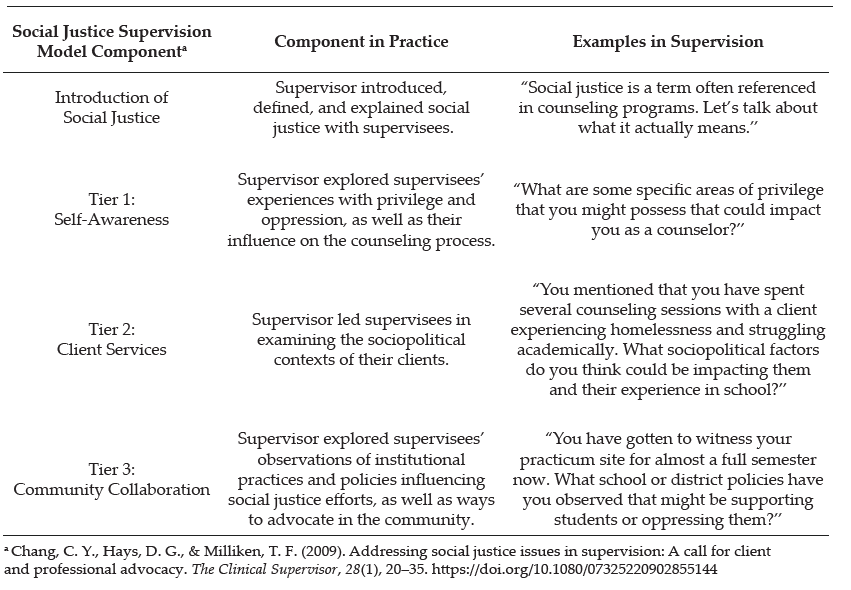
Merlin-Knoblich addressed fidelity to the supervision model in two ways. First, in weekly supervision-of-supervision meetings with the faculty advisor, they discussed the supervision model and its use in sessions with participants. The faculty advisor regularly asked about the supervision model and how it manifested in sessions in an attempt to ensure that the model was being implemented recurrently. Secondly, engagement with Newman occurred in regular peer debriefing discussions about the use of the supervision model. Through these discussions, Newman monitored Merlin-Knoblich’s use of the social justice model throughout the 14-week supervisory experience.
Data Collection
We obtained IRB approval prior to initiating data collection. One month after the end of the semester and practicum supervision, Newman approached Merlin-Knoblich’s three supervisees about participation in the study. He explained that participation was an exploration of the supervisees’ experiences in supervision and not an evaluation of the supervisees or the supervisor. Newman also emphasized that participation in the study was confidential, entirely voluntary, and would not affect participants’ evaluations or grades in the practicum course, which ended before the study took place. All supervisees agreed to participate.
Case study research is “grounded in deep and varied sources of information” (Hancock et al., 2021) and thus often incorporates multiple data sources (Prosek & Gibson, 2021). In the present study, we identified two data sources to reflect the need for varied information sources (Hancock et al., 2021). The first data source came from semistructured interviews with participants, a frequent data collection tool in case study research (Hancock et al., 2021). One month after the participants’ practicum experiences ended, Newman conducted and audio-recorded 45-minute individual in-person interviews with each participant using a prescribed interview protocol that explored participants’ experiences in social justice supervision. Newman exercised flexibility and asked follow-up questions as needed (Merriam, 1998).
The interview protocol contained 12 questions identified to gain insights into the case being studied (Hancock et al., 2021). Merlin-Knoblich and Newman designed the interview protocol by drafting questions and reflecting on three influences: (a) the overall research question guiding the study, (b) the social constructivist framework of the study, and (c) Chang and colleagues’ (2009) three-tier supervision model. Questions included “In what ways, if any, has the social justice emphasis in your supervision last semester influenced you as a counselor?” Questions also addressed whether or not the emphasis on social justice at each tier (i.e., self, client, institution) affected participants. Appendix A contains a list of all interview questions.
The second data source was participants’ practicum journals. In addition to interviewing the participants about experiences in supervision, we also asked participants if their practicum journals could be used for the study’s data analysis. The journals served as a valuable form of data to answer the research question, given their informative and non-prescriptive nature. That is to say, although participants knew during the study interviews that the interview data would be used for analysis for the present study, they wrote and submitted their journals before the study was conceptualized. Thus, the journals reflected in-the-moment ideas about participants’ practicum and social justice supervision. Furthermore, this emphasis on participant experiences during the supervisory experience aligned with the methodological emphasis on studying a case in its natural context (Hancock et al., 2021). All participants consented for their 14 practicum journal entries (each 1–2 pages in length) to be analyzed in the study, and they were added to the interview data to be analyzed together. Such convergent analysis of data is typical in case study research (Prosek & Gibson, 2021).
Data Analysis
We followed Yin’s (2017) case study research guidelines throughout the data analysis process. We transcribed all interviews, replaced participants’ names with pseudonyms, and sent participants the transcripts for member checking. Two participants approved their interview transcripts without objection. One participant approved the transcript but chose to share additional ideas about the supervisory experience via a brief email. This email was added to the data. The case study database was then formed with the compiled participants’ journal entries, the additional email, and the interview data (Yin, 2017).
Next, we read each interview transcript and journal entry twice in an attempt to become immersed in the data (Yin, 2017). We then independently open coded transcripts by identifying common words and phrases while maintaining a strong focus on the research question and codes that answered the question (Hancock et al., 2021). We compared initial codes and then collaboratively narrowed codes into cohesive categories representing participants’ experiences. This process generated a list of tentative categories across data sources (Yin, 2017). Throughout these initial processes, we attended to two of Yin’s (2017) four principles of high-quality data analysis: attend to all data and focus on the most significant elements of the case.
We then independently contrasted the tentative categories with the data to verify that they aligned accurately. We discussed the verifications until consensus was met on all categories. Lastly, we classified the categories into three themes and two subthemes found across all participants (Stake, 2005). During these later processes, we were mindful of Yin’s (2017) remaining two principles of high-quality data analysis: consider rival interpretations of data and use previous expertise when interpreting the case. Accordingly, we reflected on possible contrary explanations of the themes and considered the findings in light of previous literature on the topic.
Trustworthiness
We addressed trustworthiness in three ways in this study. First, before data collection, we engaged in reflexivity through acknowledging personal biases and assumptions with one another (Hays & Singh, 2012; Yin, 2017). For example, Merlin-Knoblich acknowledged that her lived experience supervising the participants might impact the interpretation of data during analysis and noted that these perceptions could potentially serve as biases during the study. Merlin-Knoblich perceived that the supervisees grew in their understanding of social justice, but also acknowledged doubt over whether the social justice supervision model impacted participants’ advocacy skills. She also noted her role as a supervisor evaluating the three participants prior to the study taking place. These power dynamics may have influenced her interpretations in the analysis process. Newman shared that his lack of familiarity with social justice supervision might impact perceptions and biases to question whether or not supervisees grew in their understanding of social justice. We agreed to challenge one another’s potential biases during data analysis in an attempt to prevent one another’s experiences from interfering with interpretations of the findings.
In addition, we acknowledged that our identities as White, English-speaking, educated, heterosexual, cisgender, middle-class researchers studying social justice inevitably was informing personal perceptions of the supervisees’ experiences. These privileged identities were likely blinding us to experiences with oppression that participants and their clients encountered and that we are not burdened with facing. Throughout the study, we discussed the complexity of studying social justice in light of such privileged identities. We spoke further about our identities and potential biases when interpreting the data.
Second, investigator triangulation was addressed by collaboratively analyzing the study’s data (Hays & Singh, 2012). Because data included both interview transcripts and journals, we confirmed that study findings were reflected in both data sources, rather than just one information source (Hancock et al., 2021). This process helped prevent real or potential biases from informing the analysis without constraint. We also were mindful of saturation of themes while comparing data across participants and sources during the analysis process. Lastly, an audit trail was created to further address credibility. The study recruitment, data collection, and data analysis were documented so that the research can be replicated (Hays & Singh, 2012; Roulston, 2010).
Findings
In case study research, researchers use key quotes and descriptions from participants to illuminate the case studied (Hancock et al., 2021). As such, we next describe the themes and subthemes identified in study data using participants’ journal and interview quotes to illustrate the findings. Three overarching themes were identified in the data: 1) intersection of supervision experiences and external factors, 2) feelings about social justice, and 3) personal and professional growth. Two subthemes, 3a) increased understanding of privilege and 3b) increased understanding of clients, further expand the third theme.
Intersection of Supervision Experiences and External Factors
One theme evident across the data was that participants’ experiences in social justice supervision did not occur in isolation from other experiences they encountered as counseling students. Coursework, overall program emphasis, and previous work experiences were external factors that created a compound influence on participants’ counselor development and intersected with their experiences of growth in supervision. Thus, external factors influenced participants’ understanding of and openness to a social justice framework. For example, concurrent with their practicum and supervision experiences, participants completed the course Theory and Practice of Multicultural Counseling. While discussing their experiences in supervision, all participants referenced this course. For example, Casey explained that exposure to social justice in the multicultural counseling course while discussing the topic in supervision made her more open and eager to learning about social justice overall.
Participants’ experiences prior to the counseling program also appeared to intersect with and influence their experiences in social justice supervision. Kallie, for instance, previously worked with African American and Latin American adolescents as a camp counselor at an urban Boys and Girls Club. She explained that social justice captured the essence of viewpoints formed in these experiences, saying, “I really like social justice because it kind of is like the title for the way I was looking at things already.” Casey grew up in California and reported that growing up on the West Coast also exposed her to a mindset parallel to social justice. Esther described that though she was not previously exposed to the term “social justice,” studying U.S., women’s, and African American history in college influenced her pursuit of a counseling career. This influence is evident in Esther’s third journal entry, in which she described noticing issues of power and oppression:
My own attention to an “arbitrarily awarded power” and personal questioning as to what to do with this consciousness has been at the forefront of my mind over the past two years. Ultimately this self-exploration led me to school counseling as a vehicle to advocate and raise consciousness in potentially disenfranchised groups.
This quote highlights how Esther’s previous studies in college may have primed her for the content she was exposed to in social justice supervision.
Feelings About Social Justice
The second theme was a change in participants’ feelings toward social justice over the course of the semester. Two of the participants expressed that their feelings toward social justice changed from intimidation and fear to comfort and enthusiasm. Initially, Casey explained that social justice supervision created feelings of intimidation. Casey felt fear that the supervisor would instruct her to be an advocate at the practicum site, and that in doing so, Casey would upset others. However, Casey reported that she realized during supervision that social justice advocacy does not necessarily look one specific way. Casey said, “I think a lot of that intimidation went away as I realized that I could have my own style integrated into social justice.” Kallie expressed a similar pattern of emotions, particularly regarding examining clients from a social justice perspective. When asked to explore clients through this lens in supervision, an initial uncomfortable feeling emerged, but over the course of practicum, Kallie reported an attitude change. In the sixth journal entry, Kallie explained that she was focusing on examining all clients through a social justice lens, and “found it to be significantly easier this week than last week.”
Esther also shared evidence of changed emotions during social justice supervision. Initially, Esther reported feeling excited, but later, she was confused as to how counselors could use social justice practically. Despite this confusion, Esther shared that she gained new awareness that social justice advocacy is not only found in individual situations with clients, but also in an overall mindset:
Something I will take from it [supervision] . . . is you incorporate that sort of thinking into your overall [approach]. You don’t necessarily wait for a specific event to happen, but once you know the culture of a place, you have lessons geared towards whatever the problem is there.
Despite these mixed feelings, Esther’s experience aligns with Casey’s and Kallie’s, as all reported experiencing a change in emotions toward social justice over the course of supervision.
Personal and Professional Growth
Participants also demonstrated changes in professional and personal growth throughout the supervision experiences, the third theme identified. In early journal entries, they reported nervousness, doubt, and insecurity regarding their counseling skills and knowledge. Over time, the tone shifted to increased comfort and confidence. This improvement appeared not only related to overall counseling abilities, but specifically to participants’ understanding of social justice in counseling. For example, in Esther’s second journal entry, she noted the influence that social justice supervision had on the ability to recognize oppression and bring awareness to it at practicum. Esther wrote, “Just having this concept be explicitly laid out in our plan has already caused me to be more attentive to such issues.”
Similarly, professional growth was evident in Kallie’s journal entries over time. In the fourth journal entry, Kallie described discomfort and nervousness when reflecting on clients’ sociopolitical contexts. However, in the ninth journal entry, Kallie described an experience in which she adapted her counseling to be more sensitive to the client’s multicultural background. Casey also highlighted growth with an anecdote about a small group she led. Casey explained that the group was for high-achieving, low-income juniors intending to go to college:
In the very beginning, I remember thinking—this sounds terrible now, but—“It’s kind of unfair to the other students that these kids get special privileges in that they get to meet with us and walk through the college planning process.” ’Cause I was thinking, “Wow, even kids who are high-achieving but are middle-class or upper-class, they could use this information, also. And it’s not really fair that just ’cause they’re lower class, they get their hand held during this.” But, throughout the semester, realizing that that’s not necessarily a bad thing for an institution to give another one a little extra help because they’re gonna have a deficit of help somewhere else in their life, and it really is fair. It’s more fair to give them more help ’cause they likely aren’t going to be getting it at home. . . . So, by having that group, it actually is making a greater degree of equity . . . through supervision and through processing all of that, [I learned] it was actually evening the board out more.
Participants also expressed that their professional growth in social justice competencies was intertwined with personal growth. Casey reported that supervision increased her comfort when talking about social justice issues and led to the reevaluation of personal opinions. Similarly, Kallie summarized:
I am very thankful that I had that social justice–infused model because it changed the way I think about people. . . . It kinda opened my eyes in a way I had not anticipated practicum opening my eyes. I didn’t expect that—social justice. I didn’t realize how big of an impact it would actually have.
Increased Understanding of Privilege
Participants reported that understanding their privilege was one area of growth. During practicum, participants considered their areas of privilege and how these aligned or contrasted with those of clients. For example, in Esther’s third journal entry, she noted that interactions with clients made her more aware of personal privileges, which led her to create a list regarding gender identity, socioeconomic background, and sexual orientation. Casey and Kallie further described initially feeling resistant to the idea of White privilege. Casey explained:
I was a little resistant to the idea of White privilege originally, which I’ve since learned is a normal reaction. ’Cause I’ve kind of had the thought of “No! It’s America! All of us pull ourselves up by our bootstraps and everyone has the same opportunity,” which just isn’t the case. And so that definitely had a huge influence on me—realizing that I have huge privileges and powers that I did not, maybe didn’t want to, recognize before.
After initial resistance, participants reported that they transitioned from feeling shame about White privilege to an increased understanding and excitement to use privilege to create change.
Increased Understanding of Clients
Lastly, participants also reported specific growth in their understanding of the clients whom they counseled. Participants believed they were better able to understand clients’ backgrounds and experiences because of social justice supervision. Kallie described how reflecting on clients’ sociopolitical contexts helped her better understand clients. She noted that the practice became a habit, saying, “It just kinda invaded the way I look at different people and see their backgrounds.” Casey also described an increased understanding of clients by sharing an example of a client who was highly intelligent, low-income, and Mexican American. Casey learned that the client intended to go to trade school to become a mechanic and was not previously exposed to other postsecondary education options like college. Casey described this realization as “a big moment” and said, “My interaction with him, for sure, was influenced by recognizing that there was social injustice there.”
Discussion
The purpose of this study was to explore counseling students’ experiences in social justice supervision. Findings indicated that participants had meaningful experiences in social justice supervision that impacted them as future counselors. Topics of privilege, oppression, clients’ sociopolitical contexts, and advocacy were reportedly prominent in the participants’ supervision and influenced their experiences.
Despite many calls for social justice supervision in the counseling profession (Baggerly, 2006; Ceballos et al., 2012; Chang et al., 2009; Collins et al., 2015; Glosoff & Durham, 2010; O’Connor, 2005), this is the first known study about supervisees’ experiences with social justice supervision. It represents a new line of inquiry to understand what social justice supervision may be like for supervisees. Findings indicate that participants wrestled with understanding social justice and viewed it as a complex topic. They also suggest that participants found value in making sense of social justice and using it as a tool to better support clients individually and systemically. Similar to research on multicultural supervision, participants indicated that receiving social justice supervision was a positive experience and impacted personal and professional growth (Ancis & Ladany, 2001; Ancis & Marshall, 2010; Chopra, 2013; Inman, 2006; Ladany et al., 2005).
Notably, findings align with some, though not all, of Chang and colleagues’ (2009) delineated tiers in the social justice supervision model. Some of the themes reflect the first tier, self-awareness. For example, participants’ feelings about social justice (Theme 2) and increased understanding of privilege (Theme 3a) highlight how the supervisory experience enhanced their self-awareness as counselors. As their feelings changed and knowledge of privilege grew, their self-awareness improved, a critical task in becoming a social justice–minded counselor (Chang et al., 2009; Dollarhide et al., 2021; Fickling et al., 2019; Glosoff & Durham, 2010). Participants’ increased understanding of clients (Theme 3b) reflects the second tier in Chang and colleagues’ (2009) model, client services. In demonstrating an enhanced understanding of clients and their world experiences, the participants reported thinking beyond themselves and into how power, privilege, and oppression affected those they counseled.
The final tier of the social justice supervision model, community collaboration, was not evident in participant data about their experiences. Despite the supervisor’s intent to address this tier through analyses of school and district policies, as well as community advocacy opportunities, themes about this topic did not manifest in the data. This theme’s absence may suggest that the supervisor’s efforts to address the third tier were not strong enough to impact participants. Alternatively, the absence may suggest that participants were not developmentally prepared to make sense of social justice at a systemic, community level. Instead, their development matched best with social justice ideas at the self and client levels.
Participant findings did align with previous research about supervision. For example, Collins and colleagues (2015) studied master’s-level counseling students and found that their lack of experience in social justice supervision led them to feel unprepared to meet the needs of diverse clients. In this study, the presence of social justice supervision helped participants feel more prepared to support clients, as evidenced in the subtheme of increased understanding of clients. Furthermore, this study reflects similar findings from multicultural supervision research. We found that multicultural supervision was associated with positive outcomes of being prepared to work with diverse clients and engaging in effective supervision (Chopra, 2013; Inman, 2006; Ladany et al., 2005). This pattern is reflected in the current study, as participants reported positive experiences in social justice supervision. Ancis and Ladany (2001) and Ancis and Marshall (2010) found that incorporating multicultural considerations into supervision increases supervisees’ self-awareness and encourages them to engage clients in multicultural discussions. These same results were evident in the present study, with participants reporting personal and professional growth, such as stronger awareness of White privilege and greater willingness to examine clients’ sociopolitical contexts. Findings also reflect general research on supervision, which indicates that supervisees typically experience personal and professional growth in the process (Association for Counselor Education and Supervision, 2011; Watkins et al., 2015; Young et al., 2011).
Furthermore, study findings also align with assertions from supervision scholars regarding the value of social justice supervision. They support Chang and colleagues’ (2009) claim that social justice supervision can increase counselor self-awareness and build an understanding of oppression. Additionally, the findings also reflect Glosoff and Durham’s (2010) assertion that social justice in supervision helps supervisees gain awareness of power differentials. Finally, Ceballos and colleagues (2012) posited that social justice supervision will help counselors develop empathy for clients as counselors conceptualize clients in a systemic perspective. The participants’ enhanced understanding of White privilege and their clients’ contexts supports each of these ideas. Though findings are not generalizable, they appear to confirm scholars’ ideas about social justice supervision and suggest that the approach can be a positive, beneficial experience for counselors-in-training.
Limitations
Study findings ought to be considered in light of the study’s limitations. First, although case study research focuses on a single identified case by definition and is not designed for generalization (Hays & Singh, 2012), the case in this study consisted of a demographically homogenous population of only three participants lacking racial, gender, and age diversity. This lack of diversity influenced participants’ experiences and study findings. Second, although the supervisor in this study did not conduct the semistructured interviews with participants in an attempt to prevent bias, participants were aware that Merlin-Knoblich was collaborating on the study, and this knowledge may have influenced their reported experiences. Merlin-Knoblich and Newman also began the study with acknowledged biases toward and against social justice supervision, and although they engaged in reflexivity and dialogue to prevent these biases from interfering with data analysis, there is no way to verify that this positionality did not influence the interpretation of findings. Lastly, our privileged identities served as a potential limitation while studying a topic like social justice supervision. Our racial, educational, class, language, and sexual identity privileges continually blind us to the experiences of oppression that others, including supervisees and clients, face. Seeking to know these perspectives better can increase our understanding of the implications of social injustices in society.
Implications for Counselor Educators and Supervisors
The positive participant experiences illuminated through this study suggest that supervision based on this model may yield positive experiences for counselors-in-training, such as supporting students in developing self-awareness, understanding of clients’ sociopolitical contexts, and advocacy skills (Chang et al., 2009). Although the supervisor in this study used social justice supervision in individual sessions with participants, counselor educators may choose to apply social justice supervision models to group or triadic supervision. Counseling supervisors in agency, private practice, and school settings may also want to consider using social justice supervision to support counselors and subsequently clients (Baggerly, 2006; Ceballos et al., 2012; O’Connor, 2005). Furthermore, counselor educators teaching doctoral students may want to incorporate social justice supervision models into introductory supervision courses. Including these models into course content may in itself increase student interest in social justice (Swartz et al., 2018).
Regardless of the setting in which supervisors implement social justice supervision, the findings suggest practical implications that supervisors can consider. First, supervisors appear to benefit from considering social justice supervision models in their work (Chang et al., 2009; Dollarhide et al., 2021; Gentile et al., 2009). The findings in this study, plus previous research indicating positive outcomes for multicultural supervision (Chopra, 2013; Inman, 2006; Ladany et al., 2005), suggest that social justice supervision may potentially benefit counseling. Second, supervisors using social justice supervision may encounter supervisee confusion, discomfort, and/or enthusiasm when introduced to social justice supervision. These feelings also may change over the course of the supervisory relationship when learning about social justice. Third, supervisors ought to be mindful of all three tiers of Chang and colleagues’ (2009) social justice supervision model and a supervisee’s developmental match with each tier. As seen in this study, supervisees may be best matched for the first and second tiers of the model (self-awareness and client services), but not the third tier (community collaboration). Supervisors would benefit from assessing a supervisee’s potential for understanding community collaboration before deciding to infuse its focus in supervision.
More research is needed to understand social justice supervision. A variety of future studies, including different models, methods, and settings, would benefit the counseling profession. For example, a study implementing the social justice supervision model proposed by Dollarhide and colleagues (2021) can add to the needed research in this field. Additional qualitative studies with diverse supervisees in different counseling settings would be helpful in understanding if the experiences participants reported encountering in this study are common in social justice supervision. Quantitative studies on social justice supervision interventions would also add to the profession’s knowledge on the value of social justice supervision. Lastly, studies on supervisees’ experiences in social justice supervision compared to other models would highlight benefits and drawbacks of multiple supervision models (Baggerly, 2006; Chang et al., 2009; Glosoff & Durham, 2010).
Conclusion
In this article, we explored master’s-level counseling students’ experiences in social justice supervision via a qualitative case study. Through this exploration, we identified three themes reflecting participants’ experiences in social justice supervision: intersection of supervision experiences and external factors, feelings about social justice, and personal and professional growth, as well as two subthemes: increased understanding of privilege and increased understanding of clients. Findings suggest that social justice supervision may be a beneficial practice for supervisors and counselor educators to consider integrating in their work (Chang et al., 2009; Dollarhide et al., 2021; Gentile et al., 2009; Pester et al., 2020). Further research across contexts and with a range of methodologies is needed to better understand social justice supervision in practice.
Conflict of Interest and Funding Disclosure
The authors reported no conflict of interest
or funding contributions for the development
of this manuscript.
References
American Counseling Association. (2014). ACA code of ethics. https://www.counseling.org/resources/aca-code-of-ethics.pdf
Ancis, J. R., & Ladany, N. (2001). A multicultural framework for counselor supervision. In L. J. Bradley & N. Ladany (Eds.), Counselor supervision: Principles, process, and practice (3rd ed., pp. 63–90). Brunner-Routledge.
Ancis, J. R., & Marshall, D. S. (2010). Using a multicultural framework to assess supervisees’ perceptions of culturally competent supervision. Journal of Counseling & Development, 88(3), 277–284.
https://doi.org/10.1002/j.1556-6678.2010.tb00023.x
Association for Counselor Education and Supervision. (2011). Best practices in clinical supervision. https://acesonline.net/wp-content/uploads/2018/11/ACES-Best-Practices-in-Clinical-Supervision-2011.pdf
Baggerly, J. (2006). Service learning with children affected by poverty: Facilitating multicultural competence in counseling education students. Journal of Multicultural Counseling and Development, 34(4), 244–255. https://doi.org/10.1002/j.2161-1912.2006.tb00043.x
Ballou, M., Matsumoto, A., & Wagner, M. (2002). Toward a feminist ecological theory of human nature: Theory building in response to real-world dynamics. In M. Ballou & L. S. Brown (Eds.), Rethinking mental health and disorder: Feminist perspectives (pp. 99–141). Guilford.
Ceballos, P. L., Parikh, S., & Post, P. B. (2012). Examining social justice attitudes among play therapists: Implications for multicultural supervision and training. International Journal of Play Therapy, 21(4), 232–243. https://doi.org/10.1037/a0028540
Chang, C. Y., Hays, D. G., & Milliken, T. F. (2009). Addressing social justice issues in supervision: A call for client and professional advocacy. The Clinical Supervisor, 28(1), 20–35. https://doi.org/10.1080/07325220902855144
Chopra, T. (2013). All supervision is multicultural: A review of literature on the need for multicultural supervision in counseling. Psychological Studies, 58, 335–338. https://doi.org/10.1007/s12646-013-0206-x
Collins, S., Arthur, N., Brown, C., & Kennedy, B. (2015). Student perspectives: Graduate education facilitation of multicultural counseling and social justice competency. Training and Education in Professional Psychology, 9(2), 153–160. https://doi.org/10.1037/tep0000070
Dinsmore, J. A., Chapman, A., & McCollum, V. J. C. (2002). Client advocacy and social justice: Strategies for developing trainee competence. Paper presented at the Annual Conference of the American Counseling Association, Washington, DC.
Dollarhide, C. T., Hale, S. C., & Stone-Sabali, S. (2021). A new model for social justice supervision. Journal of Counseling & Development, 99(1), 104–113. https://doi.org/10.1002/jcad.12358
Dollarhide, C. T., Mayes, R. D., Dogan, S., Aras, Y., Edwards, K., Oehrtman, J. P., & Clevenger, A. (2018). Social justice and resilience for African American male counselor educators: A phenomenological study. Counselor Education and Supervision, 57(1), 2–17. https://doi.org/10.1002/ceas.12090
Fickling, M. J., Tangen, J. L., Graden, M. W., & Grays, D. (2019). Multicultural and social justice competence in clinical supervision. Counselor Education and Supervision, 58(4), 309–316. https://doi.org/10.1002.ceas.12159
Foster, V. A., & McAdams, C. R., III. (1998). Supervising the child care counselor: A cognitive developmental model. Child and Youth Care Forum, 27(1), 5–19. https://doi.org/10.1007/BF02589525
Garcia, M., Kosutic, I., McDowell, T., & Anderson, S. A. (2009). Raising critical consciousness in family therapy supervision. Journal of Feminist Family Therapy, 21(1), 18–38. https://doi.org/10.1080/08952830802683673
Gentile, L., Ballou, M., Roffman, E., & Ritchie, J. (2009). Supervision for social change: A feminist ecological perspective. Women & Therapy, 33(1–2), 140–151. https://doi.org/10.1080/02703140903404929
Glosoff, H. L., & Durham, J. C. (2010). Using supervision to prepare social justice counseling advocates. Counselor Education and Supervision, 50(2), 116–129. https://doi.org/10.1002/j.1556-6978.2010.tb00113.x
Greene, J. H., & Flasch, P. S. (2019). Integrating intersectionality into clinical supervision: A developmental model addressing broader definitions of multicultural competence. The Journal of Counselor Preparation and Supervision, 12(4). https://digitalcommons.sacredheart.edu/jcps/vol12/iss4/14
Hancock, D. R., Algozzine, B., & Lim, J. H. (2021). Doing case study research: A practical guide for beginning researchers (4th ed.). Teachers College Press.
Hays, D. G., & Singh, A. A. (2012). Qualitative inquiry in clinical and educational settings. Guilford.
Inman, A. G. (2006). Supervisor multicultural competence and its relation to supervisory process and outcome. Journal of Marital and Family Therapy, 32(1), 73–85. https://doi.org/10.1111/j.1752-0606.2006.tb01589.x
Kiselica, M. S., & Robinson, M. (2001). Bringing advocacy counseling to life: The history, issues, and human dramas of social justice work in counseling. Journal of Counseling & Development, 79(4), 387–397.
https://doi.org/10.1002/j.1556-6676.2001.tb01985.x
Ladany, N., Friedlander, M. L., & Nelson, M. L. (2005). Critical events in psychotherapy supervision: An interpersonal approach. American Psychological Association.
Lee, C. C. (2007). Counseling for social justice (2nd ed.). American Counseling Association.
Lee, E., & Kealy, D. (2018). Developing a working model of cross-cultural supervision: A competence- and alliance-based framework. Clinical Social Work Journal, 46, 310–320. https://doi.org/10.1007/s10615-018-0683-4
Lewis, J. A., Arnold, M. S., House, R., & Toporek, R. L. (2003). Advocacy competencies. www.counseling.org/resources/competencies/advocacy_competencies.pdf
Merriam, S. B. (1998). Qualitative research and case study applications in education. Jossey-Bass.
O’Connor, K. (2005). Assessing diversity issues in play therapy. Professional Psychology: Research and Practice, 36(5), 566–573. https://doi.org/10.1037/0735-7028.36.5.566
Pester, D. A., Lenz, A. S., & Watson, J. C. (2020). The development and evaluation of the Intersectional Privilege Screening Inventory for use with counselors-in-training. Counselor Education and Supervision, 59(2), 112–128. https://doi.org/10.1002/ceas.12170
Peters, H. C. (2017). Multicultural complexity: An intersectional lens for clinical supervision. International Journal for the Advancement of Counselling, 39, 176–187. https://doi.org/10.1007/s10447-017-9290-2
Prosek, E. A., & Gibson, D. M. (2021). Promoting rigorous research by examining lived experiences: A review of four qualitative traditions. Journal of Counseling & Development, 99(2), 167–177. https://doi.org/10.1002/jcad.12364
Ratts, M. J., Singh, A. A., Nassar-McMillan, S., Butler, S. K., & McCullough, J. R. (2015). Multicultural and social justice counseling competencies. www.counseling.org/docs/default-source/competencies/multicultural-and-social-justice-counseling-competencies.pdf
Roffman, E. (2002). Just supervision. Multicultural Perspectives on Social Justice and Clinical Supervision Conference, Cambridge, MA, United States.
Roulston, K. (2010). Reflective interviewing: A guide to theory and practice. SAGE.
Stake, R. E. (2005). Qualitative case studies. In N. K. Denzin & Y. S. Lincoln (Eds.), The SAGE handbook of qualitative research (3rd ed., pp. 433–466). SAGE.
Swartz, M. R., Limberg, D., & Gold, J. (2018). How exemplar counselor advocates develop social justice interest: A qualitative investigation. Counselor Education and Supervision, 57(1), 18–33. https://doi.org/10.1002/ceas.12091
Toporek, R. L., & Daniels, J. (2018). ACA advocacy competencies. https://www.counseling.org/docs/default-source
/competencies/aca-advocacy-competencies-updated-may-2020.pdf?sfvrsn=f410212c_4
Watkins, C. E., Jr., Budge, S. L., & Callahan, J. L. (2015). Common and specific factors converging in psychotherapy supervision: A supervisory extrapolation of the Wampold/Budge Psychotherapy Relationship Model. Journal of Psychotherapy Integration, 25(3), 214–235. http://doi.org/10.1037/a0039561
Yin, R. K. (2017). Case study research and applications: Designs and methods (6th ed.). SAGE.
Young, T. L., Lambie, G. W., Hutchinson, T., & Thurston-Dyer, J. (2011). The integration of reflectivity in developmental supervision: Implications for clinical supervisors. The Clinical Supervisor, 30(1), 1–18. https://doi.org/10.1080/07325223.2011.532019
Appendix A
Semistructured Interview Questions
- What brought you to this counseling program?
- Overall, how would you describe your practicum experience last semester?
- Where did you complete your practicum?
- How would you describe the population you worked with at your practicum?
- What previous experience, if any, did you have with social justice prior to individual practicum supervision?
- During individual practicum supervision on campus last semester, what were some of your initial thoughts and feelings about a social justice–infused supervision model?
- In what ways, if any, did those thoughts and feelings about social justice change throughout your
supervision experience?
These next three questions address three areas of social justice that were incorporated into your individual practicum supervision model: self, students (clients), and institution (school or school districts).
6. Do you think that the emphasis on social justice related to self (i.e., your power, privileges, and experience with oppression) in individual practicum supervision on campus had any influence on you?
-
- If yes, what influence did this emphasis have on you?
- If no, why do you think that’s the case?
7. Do you think that the emphasis on social justice related to others (i.e., the sociopolitical context of students, staff, etc.) in individual practicum supervision on campus had any influence on you?
-
- If yes, what influence did this emphasis have on you?
- If no, why do you think that’s the case?
8. Do you think that the emphasis on social justice related to institution (i.e., your practicum site, school district) in individual practicum supervision on campus had any influence on you?
-
- If yes, what influence did this emphasis have on you?
- If no, why do you think that’s the case?
- In what ways, if any, has the social justice emphasis in your individual practicum supervision influenced you as a counselor?
- In what ways, if any, has the social justice emphasis in your individual practicum supervision influenced your development as a person?
- How would you define social justice?
- Is there anything else you would like to add regarding your experience in a social justice–infused model of supervision last semester?
- Is there anything else you’d like to share?
Clare Merlin-Knoblich, PhD, NCC, is an associate professor at the University of North Carolina at Charlotte. Jenna L. Taylor, MA, NCC, LPC-A, is a doctoral student at the University of North Texas. Benjamin Newman, PhD, MAC, ACS, LPC, CSAC, CSOTP, is a professional counselor at Artisan Counseling in Newport News, VA. Correspondence may be addressed to Clare Merlin-Knoblich, 9201 University City Blvd., Charlotte, NC 28211, cmerlin1@uncc.edu.