Jun 3, 2026 | Volume 16 - Issue 2
April D. Brown, LaShauna M. Dean, Matthew Lyons
This transcendental phenomenological study explored the lived experiences of Black women counselor educators mitigating experiences of racial trauma in the workplace. Bell’s critical race theory and Crenshaw’s intersectionality served as the frameworks for this study. Six participants were selected based on specific criteria: They held a PhD or EdD in counselor education and supervision, worked full-time in a CACREP-accredited program, were employed for at least 2 years, and self-reported that they experienced racial trauma in the workplace. Data collection involved semi-structured interviews, which were transcribed and analyzed for themes. Findings revealed the following textural themes: disrespect from colleagues and students, diminished well-being, lack of trust in competency, expressing concerns for safety/hypervigilance, a heightened awareness of intersectionality, awareness of social conditioning/exposure to sexualization, and the cognitive process. The final theme, surviving the environment, contributed to the structural description. Finally, the results provide implications for counselor educators, mental health professionals, and counselor education program administrators.
Keywords: racial trauma, Black women, counselor educators, workplace, transcendental phenomenological
The intersection of race and gender has long been a critical focal point in understanding the lived experiences of Black women, particularly in professional settings (Crenshaw, 1989). Black women occupy a unique space within the workforce, often navigating the compounded challenges of racism and sexism. These dual oppressions are pervasive and deeply ingrained in the structures of many workplaces, including counselor education. This study focuses on a central research question: What are the lived experiences of Black women counselor educators mitigating instances of racial trauma in the workplace? This article contributes to the body of literature that explores how Black women counselor educators experience oppression and racial trauma in the workplace.
Black women are disproportionately affected by workplace discrimination, and their experiences are often dismissed or minimized by colleagues and supervisors (Comas-Díaz et al., 2019; Williams, Printz, & DeLapp, 2018). Almost 92% of Black women reported racial discrimination in the workplace (Carter & Forsyth, 2010), which is compounded by a lack of representation of Black faculty within postsecondary institutions (National Center for Education Statistics [NCES], 2022). NCES (2022) found that among the 1.6 million faculty in degree-granting postsecondary institutions, Black women comprised 4% of full-time faculty. The 2024 Vital Statistics Survey of the Council for Accreditation of Counseling and Related Educational Programs (CACREP) revealed that 18.27% of full-time faculty in CACREP-accredited programs identified as Black, whereas 61.16% identified as White (CACREP, 2025). However, there is a lack of research explaining how Black women faculty in counselor education perceive racial trauma in the workplace.
Mental Health and Racial Trauma
Racism has detrimental effects on mental health and can cause psychological distress (Clark et al., 1999; Pieterse & Carter, 2007; Pieterse & Powell, 2016). Carter and Forsyth (2010) found that encounters with racism resulted in several harmful emotions, such as guilt, shame, anxiety, and hypervigilance. Other effects of racism include identity issues, internalization, isolation, aggression, substance abuse, domestic violence, race-related stressors, sexual promiscuity, and suicidal ideation, all of which can look different individually, institutionally/structurally, and culturally (Hemmings & Evans, 2018; Pieterse & Powell, 2016).
There is a pressing need to address the effects of racism in all settings, as Black women experience more mental health problems than other racial groups (Allen et al., 2019; Catabay et al., 2019). Black women experience not only individual racism, but also institutional or structural racism, which can lead to health disparities (Holder et al., 2015; Jones, 1997; Knighton et al., 2022; Pieterse & Powell, 2016; Sotero, 2006). Workplace hostility can cause severe traumatic stress, including increased anxiety, depression, hypervigilance, avoidant reactions, and other poor mental health outcomes (Carter & Forsyth, 2010; Dickens & Chavez, 2018; Loo, 2003; Shih et al., 2013; Triana et al., 2015; Williams, Printz, & DeLapp, 2018).
Racial trauma is “a form of race-based stress referring to people of color and Indigenous individuals’ reactions to real or perceived experiences of racial discrimination” (Comas-Díaz et al., 2019, p. 1). Racial trauma results from overt acts of racial hostility and subtle, insidious forms of racism, such as microaggressions or the pressure of having to conform to predominantly White workplaces. For Black women counselor educators, instances of racism include racialized marginalization, pressure to prove their competence, and invalidation of their experiences (Haskins et al., 2016; Pérez & Carney, 2018). The cumulative effect of these experiences can lead to chronic stress, anxiety, depression, and other mental health challenges, which are exacerbated by the intersectional nature of Black women’s identities (Arday, 2022; Bernard et al., 2017; Crenshaw, 1989; Pieterse & Powell, 2016; Pizarro & Kohli, 2020).
Due to racialized and gendered microaggressions, Black women faculty might feel racial battle fatigue (Behar-Horenstein et al., 2012; Chancellor, 2019), which is often made worse by the Strong Black Woman schema, a cultural expectation for Black women to exhibit resilience in the face of adversity (Castelin & White, 2022; Liao et al., 2019). Similar to the effects of racial trauma, the Strong Black Woman schema can cause adverse psychological effects (Castelin & White, 2022; Liao et al., 2019). While this stereotype may serve as a coping mechanism, it can also discourage Black women from seeking mental health support, leading to a reluctance to acknowledge or address the psychological harm they endure.
Racial Trauma in the Workplace
Because Black women are more susceptible to mental health concerns, exploring their lived racial trauma experiences in counselor education programs could provide insight into the associated mental health outcomes (Carter & Forsyth, 2010). Research supports that many Black women experience ongoing workplace discrimination (Dickens & Chavez, 2018; Holder et al., 2015; Shih et al., 2013; Velez et al., 2018). For Black faculty, racial trauma negatively impacts job satisfaction (DeCuir-Gunby & Gunby, 2016). Black women frequently feel the need to identity-shift or alter their cultural behavior, often through code-switching, causing psychological distress (Dickens & Chavez, 2018; Fields & Cunningham-Williams, 2021; Shih et al., 2013). Unfortunately, these changes do not always prevent adverse outcomes (O’Brien et al., 2016).
There is an unfulfilled need to discuss and address racial trauma in the workplace. While there are promising clinical approaches, such as race-based therapy (Bryant-Davis & Ocampo, 2006), racial trauma recovery (Comas-Díaz, 2016), feminist therapy (Brown, 2008), and trauma-focused cognitive behavioral therapy (TF-CBT; Phipps & Thorne, 2019), there are no empirically supported treatments for racial trauma (Comas-Díaz, 2016; Williams et al., 2018a). This research seeks to investigate how Black women faculty conceptualize and interpret the impact of racial trauma in academia, aiming to elucidate the nuanced meanings and implications.
Methods
The central research question guiding this study was: What are the lived experiences of Black women counselor educators mitigating instances of racial trauma in the workplace? This question was explored using Moustakas’s (1994) transcendental phenomenological design. Transcendental phenomenology allows the researcher to understand the natural essence of the phenomenon through intentionality and intuition (Descartes, 1977; Husserl, 1999). The researchers captured the essence of each participant’s experience by constructing textural descriptions of what the participants experienced and how they experienced it (Moustakas, 1994), which were constructed into composite textural and structural descriptions.
Research Positionality
Three authors are involved in this study, and before discussing our results, we want to acknowledge our positionality in relation to this research. The first author, April D. Brown, originally developed this study for her doctoral dissertation. She is an African American cisgender woman and a practicing counselor who acknowledges experiencing racial trauma. As a licensed professional counselor, Brown has worked closely with clients who experienced racism and discrimination in the workplace. She also encountered her own internalized racism and experienced vicarious trauma as she listened to participant stories. She attended therapy, engaged in reflective meditation repeatedly, and consulted a peer reviewer to ensure objectivity in this study.
The second author, LaShauna M. Dean, is an African American cisgender woman who has been a faculty member in counselor education for 12 years. She recognizes that her social position may influence her interpretation of participant narratives, given her experiences as a Black faculty member. Dean has a strong commitment to accurately conveying participants’ stories, as she recognizes the potential benefits of addressing racial trauma in counselor education and has reflected on her own biases through the research process by engaging in critical self-reflection.
The third author, Matthew Lyons, is a White cisgender male counselor educator and academic administrator. Diversity is a significant part of his personal and professional priorities. Lyons acknowledges the ever-present reality of racism and the importance of sharing stories of racial trauma. He was the chair of the dissertation committee for Brown and, therefore, involved in this research from the early stages.
Recruitment and Participants
All participants in this study were Black women counselor educators employed as full-time faculty in CACREP-accredited programs. Researchers recruited participants by first utilizing the CACREP directory to send emails to faculty, secondly by posting the recruitment flyer in the Facebook group for the Association for Multicultural Counseling and Development, and lastly by posting study details on the CESNET-L listserv. Each recruitment attempt included a description of the study, the interest and inclusion survey to verify eligibility and the contact information of the primary researcher. Eligible participants self-identified as a Black woman, held a terminal degree in counselor education and supervision, had at least 2 years of faculty experience, and self-reported experiencing racial trauma. Participants were provided with the Comas-Díaz et al. (2019) definition of racial trauma and responded “yes” or “no” to whether their experiences met the definition. Six participants met all recruitment criteria, including availability for the interview. One participant did not disclose gender pronouns and is referred to using gender-neutral pronouns (they/them) in this manuscript. Participants’ demographics and pseudonyms are presented in Table 1.
Table 1
Participants’ Demographic Characteristics
| Participants |
Amber |
August |
Hazel |
June |
May |
Summer |
| Age |
25–40 |
41–56 |
25–40 |
25–40 |
41–56 |
25–40 |
| Gender pronouns |
She/her/
hers |
She/her/ hers |
Prefer not
to say |
She/her/ hers |
She/her/ hers |
She/her/ hers |
| ACES region |
NCACES |
SACES |
SACES |
NCACES |
SACES |
SACES |
| State of residence |
MN |
AL |
MD |
WI |
LA |
TN |
| Years of experience |
6–10 |
11–14 |
2–5 |
2–5 |
2–5 |
6–10 |
Note. ACES = Association for Counselor Education and Supervision; NCACES = North Central Association for Counselor Education and Supervision; SACES = Southern Association for Counselor Education and Supervision. Regional classifications are based on the five ACES regions (ACES, 2021).
Data Collection
Semi-structured interviews, lasting approximately 60 minutes, served as the primary source of data. The interview protocol included questions about experiences of racial trauma as well as supports that mitigated those experiences (see Appendix). The interview protocol was developed to address identified gaps in the literature around workplace trauma explicitly experienced by Black women in counselor education and was aligned with the principles of transcendental phenomenology.
Data Analysis
Data analysis followed the eight-step process outlined by Moustakas (1994), which involves a systematic and reflective approach to understanding lived experiences. Our research team began by transcribing interviews and engaging in horizontalization, identifying all relevant statements with equal value. Through reduction and elimination, nonessential or overlapping data were removed, and significant expressions were distilled into invariant constituents, which were then clustered into core themes. We then verified the relevance of these themes in the final identification phase to ensure they authentically reflect participants’ experiences. Using these themes, we constructed individual textural descriptions (what was experienced) and structural descriptions (how it was experienced). These were then synthesized into textural–structural descriptions to capture the full essence of each participant’s experience. Finally, these insights were integrated into a composite description that represents the collective meaning and essence of the phenomenon across all participants, ensuring both depth and rigor in capturing the lived experience.
Interviews were conducted via Microsoft Teams video calls and transcribed using Rev, a transcription service. Following transcription via Rev (n.d.), the interview data were analyzed using Delve (n.d.), a cloud-based qualitative data analysis platform designed to support rigorous thematic analysis. Delve assisted the researchers in systematically coding, clustering, color-coding, and visually mapping qualitative data to identify patterns and themes across transcripts. This process facilitated an iterative and structured approach to data analysis consistent with phenomenological methodology. Delve and Rev comply with General Data Protection Regulation standards, ensuring participant confidentiality and the secure handling of sensitive data throughout transcription and analysis (Delve, 2022; Rev, n.d.). Upon completing the data analysis process, each participant received copies of the constructed descriptions from their interviews to provide feedback in alignment with member checking procedures.
Trustworthiness
Several methods were employed to ensure trustworthiness during the study’s interview and data analysis portions. First, Brown used a detailed field log and reflexive journal to record decisions and processes throughout the research, which facilitated self-reflection and enhanced self-awareness throughout the research process. The journal documented thought processes and supported data interpretation (Silver & Lewins, 2014; Tobin & Begley, 2004).
Member checking was also used to ensure trustworthiness by sending participants their textural–structural descriptions after the interview. Participants could confirm or modify their descriptions in writing to ensure that they accurately reflected their experiences (Humphrey, 1991; Moustakas, 1994), and this feedback was used to make adjustments. For unresponsive participants, Humphrey (1991) suggested that their descriptions should reflect the researchers’ interpretation of the data.
Finally, an independent peer reviewer participated in the data analysis to confirm the findings and served as a sounding board to ensure objectivity throughout the research. The peer reviewer had experience conducting phenomenological research. Brown met with the peer reviewer three times to discuss the data analysis process, during which they reviewed the initial list of themes, reviewed the reduction and elimination process, identified core themes, and incorporated the relevant information into the study. All participants were aware of the peer reviewer’s role from the informed consent form.
Results
This transcendental phenomenological study explored the lived experiences of Black women counselor educators and their experiences of racial trauma in the workplace to highlight ways in which they navigated those experiences. Our results indicated that the experiences of Black women counselor educators were unique to their individual contexts and settings. The following themes emerged from our data: 1) disrespect from colleagues and students, 2) diminished well-being, 3) lack of trust in competency, 4) expressing concerns for safety/hypervigilance, 5) heightened awareness of intersectionality, 6) awareness of social conditioning/exposure to sexualization, 7) the cognitive process (i.e., how racial trauma experiences impacted their thought process), and 8) surviving the environment.
Theme 1: Disrespect From Colleagues and Students
While discussing their experiences of racial trauma in the workplace, the participants described navigating disrespect from colleagues and students, such as name-calling, retaliation, microaggressions, and professional demotions (e.g., not being addressed by their professional titles or credentials). For Hazel, experiencing disrespect in predominantly White institutions was a “reality check.” They stated, “[In the] field of counseling and psychology . . . as a counselor educator, you will be called by your first name. You’ll be demoted by students, by faculty, by colleagues, by everyone.” They recalled, “I’ve gotten emails from students, ‘Hey, can you change [something]?’” August stated, “One student . . . didn’t get the A she thought she [would], and she stopped speaking to me.” She recalled another incident, stating, “I had another student [who] was like, ‘All you talk about is race.’” She also recalls being told, “I am the worst teacher.”
Theme 2: Diminished Well-being
Participants expressed diminished well-being while navigating racial trauma at work. May described experiencing significant physical and psychological distress as well as social–emotional concerns, noting an unintentional 77-pound weight loss, disrupted sleep, diminished appetite, and medical issues such as elevated blood pressure, along with cognitive distortions and heightened perfectionistic tendencies. She explained:
My presentation changed, and [there were] rumors. I’ve gained the weight back, but I had lost a lot of weight rapidly, and I had started to become more isolated and closed-off and cryptic. So, some folks were like, “Your personality went from bubbly to more withdrawn.”
August also expressed how racial trauma affected her well-being. She noted that she was diagnosed with pneumonia, an autoimmune disorder, and shingles while navigating racial trauma at work. She stated, “Long story, it’s not really short, but health. Health was the main thing that [racial trauma] really impacted. And mental health as well.”
Theme 3: Lack of Trust in Competency
Lack of trust in competency was a key theme that emerged from the participants’ experiences. While most participants described experiencing a lack of trust in competency in previous workplaces, one participant, June, was actively facing it in her current workplace. Her experience provides a critical perspective on how racial trauma manifests in real time. She recalled:
[The students would] ask me a question, and I’d respond. Then they’d look it up and be like, “Well, actually, dah, dah, dah.” Or I’d give them a response; they’d run to someone else and be just doing all this stuff. Or one group, they do an exit survey and stuff. They just ripped into every class that was specific to what I taught. No grace of, “Oh, it’s your first time teaching.”
June perceived a lack of trust in her competency as an ongoing issue in the workplace. She explained, “It was a reminder of, no matter what, it doesn’t matter if I’m super competent or know what I’m talking about, there’s always going to be people questioning every last thing I tell them.”
Theme 4: Expressing Concerns for Safety/Hypervigilance
June expressed concerns for safety while actively navigating experiences of racial trauma. Unlike other participants, who had processed their experiences after leaving harmful workplaces, June was currently navigating a series of traumatic incidents. She was “fearful of things,” displayed hypervigilance, and frequently assessed potential threats at work. The first incident occurred when a magazine published content criticizing her work. She stated, “That moment was just like, whoa. There’s a lot of fear with that.”
After the incident, June expressed concerns for her safety by not wanting to put her location on her institution’s website. She stated, “I don’t want to make it easier for people to find me. I know they can find me if they really want to.” Her fears extended to food delivery. She explained, “Oh, my gosh. You never know who’s going to deliver [the food]. What if they recognize my name and want to harm me in some way, or what if I come on campus and something happens?” June worried about her safety returning to work in person during the COVID-19 pandemic. She described attending the “first all-college meeting” at her predominantly White institution and how she felt being the only Black person in the room. She stated, “Actually, it was kind of overwhelming because I was like, ‘We’re all in this room. I don’t like it.’” June recalled walking to class when she saw a van approaching her slowly. She stated, “The windows rolled down, and they yelled, ‘“Trump 2020’ or something.” She explained:
It was jarring because I wasn’t expecting that to happen. Then they drove off. I remember feeling so disoriented that I’ve been walking to class this whole time, that I started to, in a way, get lost, not remember where my classroom was, just because I was still in disbelief. I’m like, “It’s broad daylight.”
After these incidents, June took measures to protect herself. She stated, “I ended up buying a key chain. I forgot what it’s called, but it’s a little metal thing that I guess, worst-case scenario, you just jab someone with it, right, but it’s not sharp or anything.”
Theme 5: Heightened Awareness of Intersectionality
Participants experienced a heightened awareness of intersectionality, recognizing that their intersections of race and gender impacted their workplace experiences. For participants, navigating these intersections in the workplace was the norm, something to be expected. August explained that in counselor education, “You’re the unicorn—you’re just unusual.” For Summer, navigating race and gender required a constant attunement to self-awareness. She stated, “It’s a constant knowing. It’s a constant double consciousness. I have to think about how other people are experiencing me [and] how I’m experiencing the situation. Also, [I’m] thinking about how I’m showing up in these particular environments.” Similarly, Amber shared, “I am very cognizant that I have a worldview and a perspective unique to being a Black woman.” She also said that navigating race and gender “takes a little bit of work,” including “learning how to do some compartmentalizing with my identity.”
Theme 6: Awareness of Social Conditioning/Exposure to Sexualization
Awareness of social conditioning/exposure to sexualization described participants’ awareness of society’s assumptions of Black women and of being sexualized at work. Our participants believed that preconceived notions such as societal assumptions, stereotypes, and expectations for Black women exacerbated their racial trauma experiences. Summer reflected on how societal stereotypes prevent Black women from being seen as whole individuals. She noted that Black women are often perceived as strong, emotionless, or lacking intellectual credibility, leaving little room for their full humanity to be acknowledged. Consequently, she believed that her identity contributed to colleagues dismissing her experiences of racial trauma in the workplace.
June said, “I think it’s interesting because, on one hand, I feel like Black women are always kind of seen as strong, right, and scary, and angry, and whatever.” August’s awareness of social conditioning meant managing work and caregiving responsibilities. She mentioned, “Sometimes, it gets very stressful being a woman and being that nurturing person because that’s what is expected of me.” August believed that Black women are socialized to do it all. She explained:
I have to, in a sense, be a liaison for adjunct professors and everything. I’m doing all of this, I’m teaching, and I was trying to publish so I wouldn’t perish, going to conferences, and taking care of my mom. I was juggling [everything].
Participants were sexualized at work by colleagues and students. Summer perceived being sexualized by her colleagues as a form of name-calling. She stated, “I’d gotten an award for something, and someone said [I received the award] because my boss had jungle fever, [not] because of my expertise or my knowledge. They thought it was a joke.” Summer found the joke inappropriate, stating it “sexualized” her. She also felt “ostracized” and “traumatized.” In contrast, May experienced sexual harassment from a student. She recalled feeling stunned and in disbelief, noting that she never expected a student to address her in such a sexualized manner or to encounter this kind of harassment in a professional setting.
May attributed her experience to her identity. She noted that Black women are oversexualized in the media. As a result of her experience, she adjusted her appearance and behavior to reclaim her sense of agency and reduce unwanted attention. She stated:
At one point, I thought I was becoming the asexual mammy archetype because I was becoming more coddling, more docile, and more, whatever you say, let’s go with the flow. I remember how my dress had changed. I started wearing [what] I call the deaconess buns, like the braided buns, after the situation. I wouldn’t put on nothing but chapstick, and I would dress down. But the outfits I was picking were like those floral-pattern, shapeless [dresses] so you couldn’t see a single curve.
Theme 7: The Cognitive Process
The participants described how their racial trauma experiences impacted their thought processes. May initially felt unsupported at her institution. She explained, “Being a Black woman in academia, in the beginning, it was very lonely, isolating, and tokenized for me for [the] years 2018, 2019, [and] 2020.” May’s perspective shifted when her department hired another Black woman. She stated, “I immediately felt the love; it was the missing component.”
June believed that her racial identity made her more susceptible to racial discrimination. She stated, “I know that it’s always going to be a thing because there’s always going to be students coming in who have never encountered a Black woman in a role like this.” She also viewed racial trauma as inevitable at a predominantly White institution. She explained:
I think, in some ways, I kind of expected to run into some stuff. In some ways, I maybe thought it might have been a little bit [worse], actually. I think that’s just having an awareness of, “Yeah, I’m entering a predominantly White environment.”
June perceived the incidents she experienced on campus as intense, which left her feeling threatened and intimidated.
Hazel expressed a mistrust of the institution. They refused to teach a course again after the administration withheld pertinent information about a student in their class. They stated, “I don’t trust the admin to be protective or to keep me safe. Yeah, the mistrust is definitely there.” Hazel became suspicious and questioned joining professional organizations and the integrity of the profession as a whole. They explained, “[Racial trauma] made me question my field, question my counterparts, and wonder, ‘How are we really helping?’”
Theme 8: Surviving the Environment
Participants employed various strategies to reduce the impact of racial trauma in the workplace and maintain well-being. Many relied on spiritual and therapeutic practices. Summer shared that her “church family” provided support, and her spirituality increased as she navigated racial trauma. May echoed, “My church, my God, [and] my higher power [helped me cope].” Participants also used therapeutic resources. Summer stated, “For my mental health and well-being, I went to counseling.” May found individual therapy and coaching helpful, August benefited from group therapy, and June engaged in the sandplay process. August and Summer also found journaling beneficial. Similarly, Amber relied on self-awareness and shared, “The more I understand about myself . . . the better I’m able to navigate.” August found that “using [her] senses to ground [her]” was highly beneficial.
Community support was another key strategy. Amber noted, “I think it’s really important to have support, to not try to address it alone.” Summer emphasized “a positive support group, an affinity group . . . committed to actionable steps to help you navigate a racist academy.” May similarly highlighted the importance of forming “a united front” with colleagues. June’s relationships with marginalized colleagues created spaces to process, “support each other,” and have “all kinds of conversations.” She also found connecting with students “exciting” and meaningful.
Some participants coped by giving back to the community. June felt responsible for Black students, drawing on the concept of “other mothering” and expressing a desire to nurture and look out for students facing racism. Hazel continued working at an institution where they experienced racial trauma because they were committed to supporting a Black student. They stated, “I’m on a student’s dissertation. . . . She’s an African American student, and I really want to support her. I’m trying to hang in there.”
Participants also found relief through intentional diversity, equity, and inclusion (DEI) efforts. June routinely incorporated multiculturalism, equity, and social justice into her courses. She shared, “I tell students about [racial battle fatigue]. I find any reason to bring it up at least once.” She noted, “It gives you hope so that it’s healing in that way.” Summer similarly infused Ratts et al.’s Multicultural and Social Justice Counseling Competencies (MSJCC; 2015) across her program, explaining that diversity was present “not [in] just one day of the schedule but [in] every conversation we’re having.” Amber, as program chair, remained committed to promoting DEI and relied on a “social justice lens” to review policies and ensure equity.
Several participants turned to counseling literature as a coping strategy. Hazel described using exercises from The Racial Healing Handbook by Anneliese Singh and referencing Jennifer Fraser’s work on workplace bullying. May accessed the MSJCC and the work of scholars such as Derald Wing Sue, David Sue, Cirecie West-Olatunji, Kent Butler, and writers like Gwendolyn Brooks, bell hooks, and Patricia Collins.
Overall, participants’ coping strategies reflected key relational dimensions: self, others, space, and time. August’s and Amber’s focus on self-advocacy, self-awareness, and self-care fostered resilience. June and Summer emphasized relationality through peer and student connections. Spatial awareness informed decisions to leave unsafe environments, as seen in Hazel’s and Summer’s stories. May’s experience highlighted time as a resource that required boundaries and intentional management. Together, these strategies demonstrate the multidimensional ways Black women in counselor education coped with and made meaning of their racial trauma experiences.
Discussion
This transcendental phenomenological study explored Black women counselor educators’ lived experiences of racial trauma in the workplace, and our results indicate that those experiences of racial trauma were unique to the participants’ contexts and settings. The participants perceived their experiences of racial trauma in the workplace as a larger systemic issue that was beyond their control, supporting the idea that racial inequality results from institutional and structural factors rather than individual prejudice (Reece, 2018). Previous research has explored racial microaggressions in the workplace, racism on college campuses, racial battle fatigue among educators, and microaggressions among female faculty (Avent Harris et al., 2019; Blackshear & Hollis, 2021; Pérez & Carney, 2018; Rollock, 2021). Past research also indicated that Black women faculty in predominantly White institutions frequently experience microaggressions from students, colleagues, and staff (Blackshear
& Hollis, 2021).
Our study provided new insight into Black women counselor educators’ perspectives on their racial trauma experiences in the workplace. Participants described disrespect from colleagues and students, including microaggressions, name-calling, retaliation, and professional demotions that indicated being devalued in their professional roles. Participants also described feeling several negative emotions, such as hurt, frustration, and outrage, while navigating racial trauma in the workplace (Carter & Forsyth, 2010). As outlined in previous research (Anderson, 2012; Bernard et al., 2017; Carter & Forsyth, 2010; Pieterse & Powell, 2016), our participants confirmed that race-related stress resulted in physical and mental health challenges, which aligns with previous studies that link the prevalence of racism to ailments among people of color (Allen et al., 2019; Alvarez et al., 2016; Catabay et al., 2019; Loo, 2003; Williams et al., 2018) and the detrimental impact of workplace discrimination on overall well-being (Dickens & Chavez, 2018; Knighton et al., 2022; Shih et al., 2013; Triana et al., 2015). Black women often feel compelled to prove their competence and credibility to colleagues and students, particularly White colleagues (Haskins et al., 2016; Kelly et al., 2017; Pérez & Carney, 2018). Our study revealed that a lack of trust in competency was an ongoing issue for a participant working in a predominantly White setting. Results suggest that students primarily questioned and challenged this participant’s competence.
Participants expressed concerns about their physical and psychological safety, with a participant describing the need to protect herself after experiencing a series of traumatic incidents on campus. Two participants left the institutions where they experienced racial trauma to find safer work environments. This finding suggests that emphasizing the “E” stage (enhancing safety) within the TF-CBT PRACTICE framework may help reduce the impact of racial trauma (Metzger et al., 2020). Therefore, counselor education program administrators might focus on prioritizing psychological safety in the workplace to reduce racial trauma experiences among Black women counselor educators.
Participants knew their social locations, societal stereotypes, and assumptions negatively impacted their roles in the workplace and believed preconceived notions influenced their experiences of racial trauma. They were aware of the intersectionality of racism and sexism (Crenshaw, 1989), which they believed increased their susceptibility to workplace racism (Avent Harris et al., 2019; Behar-Horenstein et al., 2012; Chancellor, 2019; Rollock, 2021).
Past research showed that Black women encounter racism and sexism in higher education (Behar-Horenstein et al., 2012). Our participants described experiences of sexual harassment by colleagues and students, indicating that their intersecting identities exacerbated their racial trauma experiences. Participants’ heightened awareness of intersectionality developed as they navigated the complexities of race and gender in their workplace (Bell, 1995; Delgado & Stefancic, 2017). Their deep understanding of intersectionality, shaped by lived experiences of oppression at the intersection of race and gender, underscores the need for deeper exploration of the unique perspectives and worldviews that emerge from navigating these systemic barriers.
In alignment with previous research finding that Black faculty experience daily microaggressions in the workplace and feelings of victimization (Arday, 2022), our participants described feeling excluded and isolated within their institutions as they navigated the workplace alone. These experiences are consistent with previous research highlighting the challenges that marginalized faculty face in counselor education (Haskins et al., 2016; Pérez & Carney, 2018). Another participant perceived her experiences of racial discrimination as inevitable, supporting past research that Black tenured faculty reported and expected racism in institutions (Blackshear & Hollis, 2021), while mistrusting the institution involved, feeling suspicious, and lacking confidence in the work environment. This finding supports previous literature that documents suspiciousness as a psychological effect of racial trauma (Bryant-Davis & Ocampo, 2006; Comas-Díaz et al., 2019). Our study’s results indicate that cognitively processing racial trauma experiences was an emotional release for participants.
Amidst their challenges, our participants navigated and processed racial trauma in distinct and deeply personal ways, reflecting varied coping strategies and resilience. Participants discussed how they employed several internal and external coping strategies to reduce the impact of racial trauma. The coping strategies described by participants parallel previous recommendations for addressing racial trauma, including Black women’s reliance on internal resources for coping (Stevens-Watkins et al., 2014), community support (Chioneso et al., 2020; Liu & Modir, 2020), and integrating relaxation techniques (Metzger et al., 2020).
Past research found that Black women and people of color are less likely to seek mental health services (Stevens-Watkins et al., 2014) and support for stress and racism (Carter & Forsyth, 2010); however, our study participants sought counseling to cope with their experiences. Two participants left their institutions when they felt unsafe, confirming that racism negatively impacts job retention and well-being (Pizarro & Kohli, 2020). Participants focused on DEI work as a strategy for coping, explicitly advocating for faculty diversity to reduce racial trauma experiences. Our study revealed that participants used counseling literature to cope and unknowingly applied Ratts et al.’s (2015) MSJCC advocacy domains. Despite this, study participants did not consciously consider using the MSJCC to address workplace issues such as racial trauma. This finding supports the recommendations of previous scholars to fully operationalize the MSJCC (Hays, 2020; Singh et al., 2020).
Implications for the Profession
This study has implications for Black women counselor educators experiencing racial trauma in the workplace, mental health professionals supporting clients facing racial trauma, and counselor education program administrators who supervise Black women faculty and implement policies affecting their work. Black women counselor educators must consider how systemic issues contribute to their workplace experiences and overall well-being. Mental health professionals working with clients who may be experiencing racial trauma should identify and screen for racial trauma, use culturally relevant interventions and racial models of recovery to treat racial trauma, utilize cognitive and behavioral strategies that promote relaxation, and help clients identify internal and external resources for coping.
Mental health professionals also have a responsibility to address issues related to oppression, privilege, and social inequities (Lee, 2007). When working with Black women counselor educators, mental health professionals should be aware of anti-DEI policies and legislation while empowering clients to engage in social justice and advocacy to reduce racial trauma at work. As DEI programs are no longer permitted within federal government agencies (The White House, 2025), implications for counselor education program administrators include recognizing the impact of anti-DEI mandates, policies, programs, and activities on counselor education programs. Administrators should inform counselor educators, staff, and students about how these changes impact employment, hiring practices, workplace policies and procedures, and curriculum. Although recent executive orders emphasize advancing a policy of equal dignity and respect (The White House, 2025), counselor education administrators should consider strategies to foster a workplace culture that upholds federal civil rights protections for all employees. They should also familiarize themselves with anti-discrimination laws and focus on enhancing psychological safety and support to reduce the impact of racial trauma in counselor education programs.
Limitations
Our recruitment strategy limited our sample size due to the criteria we set and the sensitive nature of the research topic, which consequently restricts the transferability of our findings. Our sample size also lacks racial and gender diversity, with all participants identifying as Black women. Black people experience racial trauma more than any other racial group (Comas-Díaz et al., 2019; Williams, Printz, & DeLapp, 2018). However, the exclusion of male participants is a limitation, and understanding Black men’s experiences as counselor educators is also worth exploring in depth.
Finally, bracketing personal experiences in phenomenological research is difficult because researchers always bring their own assumptions to the study (Moustakas, 1994; van Manen, 1990, 2014). Hence, our interpretation of the data could reflect our biases, beliefs, and values. Because all of us have counselor educator experience, our professional experiences may have shaped our interpretation of participants’ experiences. Therefore, we took intentional steps to minimize our biases and bracket our experiences, including journaling, member checking, and peer review throughout the research process.
Conclusion
This study aimed to explore Black women counselor educators’ lived experiences of racial trauma in the workplace. The findings showed that the participants had experiences unique to their contexts and settings. Participants experienced significant challenges, including disrespect from colleagues and students, diminished well-being, a lack of trust in their competency, expressing concerns for safety/hypervigilance, a heightened awareness of intersectionality, an awareness of social conditioning/exposure to sexualization, and the cognitive process. Despite these hardships, they employed various coping strategies to survive the environment, thus mitigating racial trauma in the workplace. This study contributes essential knowledge to counselor education by highlighting the systemic conditions that shape the experiences of Black women counselor educators and revealing a critical need for structural and institutional change to ensure safe, equitable, and culturally responsive environments that support the well-being and professional longevity of Black women faculty.
Conflict of Interest and Funding Disclosure
Data collected and content shared in this article
were part of a dissertation study, which was
awarded the 2024 Dissertation Excellence Award
in Qualitative Research by The Professional Counselor
and the National Board for Certified Counselors.
References
Allen, A. M., Wang, Y., Chae, D. H., Price, M. M., Powell, W., Steed, T. C., Rose Black, A., Dhabhar, F. S., Marquez-Magaña, L., & Woods-Giscombe, C. L. (2019). Racial discrimination, the superwoman schema, and allostatic load: Exploring an integrative stress-coping model among African American women. Annals of the New York Academy of Sciences, 1457(1), 104–127. https://doi.org/10.1111/nyas.14188
Alvarez, A., Milner, H. R., & Delale-O’connor, L. (2016). Race, trauma, and education: What educators need to know. In T. Husband (Ed.), But I don’t see color: The perils, practices, and possibilities of antiracist education (pp. 27–40). Sense Publishers. https://doi.org/10.1007/978-94-6300-585-2_3
Anderson, K. F. (2012). Diagnosing discrimination: Stress from perceived racism and the mental and physical health effects. Sociological Inquiry, 83(1), 55–81. https://doi.org/10.1111/j.1475-682x.2012.00433.x
Arday, J. (2022). No one can see me cry: Understanding mental health issues for Black and minority ethnic staff in higher education. Higher Education, 83(1), 79–102. https://doi.org/10.1007/s10734-020-00636-w
Association for Counselor Education and Supervision. (2021). Regions. https://acesonline.net/regions
Avent Harris, J. R., Trepal, H., Prado, A., & Robinson, J. (2019). Women counselor educators’ experiences of microaggressions. Journal of Counselor Preparation and Supervision, 12(2), 1–28.
Behar-Horenstein, L. S., West-Olatunji, C. A., Moore, T. E., Houchen, D. F., & Roberts, K. W. (2012). Resilience post tenure: The experience of an African American woman in a PWI. Florida Journal of Educational Administration & Policy, 5(2), 68–84. https://files.eric.ed.gov/fulltext/EJ983137.pdf
Bell, D. A. (1995). Who’s afraid of critical race theory? University of Illinois Law Review, 4, 893–910.
Bernard, D. L., Lige, Q. M., Willis, H. A., Sosoo, E. E., & Neblett, E. W. (2017). Impostor phenomenon and mental health: The influence of racial discrimination and gender. Journal of Counseling Psychology, 64(2), 155–166. https://doi.org/10.1037/cou0000197
Blackshear, T., & Hollis, L. P. (2021). Despite the place, can’t escape gender and race: Black women’s faculty experiences at PWIs and HBCUs. Taboo, 20(1), 28–50. https://digitalscholarship.unlv.edu/cgi/viewcontent.cgi?article=1097&context=taboo
Brown, L. S. (2008). Feminist therapy as a meaning-making practice: Where there is no power, where is the meaning? In K. J. Schneider (Ed.), Existential-integrative psychotherapy: Guideposts to the core of practice (pp. 130–140). Routledge.
Bryant-Davis, T., & Ocampo, C. (2006). A therapeutic approach to the treatment of racist-incident-based trauma. Journal of Emotional Abuse, 6(4), 1–22. https://doi.org/10.1300/j135v06n04_01
Carter, R. T., & Forsyth, J. (2010). Reactions to racial discrimination: Emotional stress and help-seeking behaviors. Psychological Trauma: Theory, Research, Practice, and Policy, 2(3), 183–191.
https://doi.org/10.1037/a0020102
Castelin, S., & White, G. (2022). “I’m a strong independent Black woman”: The Strong Black Woman schema and mental health in college-aged Black women. Psychology of Women Quarterly, 46(2), 196–208.
https://doi.org/10.1177/03616843211067501
Catabay, C. J., Stockman, J. K., Campbell, J. C., & Tsuyuki, K. (2019). Perceived stress and mental health: The mediating roles of social support and resilience among Black women exposed to sexual violence. Journal of Affective Disorders, 259, 143–149. https://doi.org/10.1016/j.jad.2019.08.037
Chancellor, R. L. (2019). Racial battle fatigue: The unspoken burden of Black women faculty in LIS. Journal of Education for Library and Information Science, 60(3), 182–189. https://doi.org/10.3138/jelis.2019-0007
Chioneso, N. A., Hunter, C. D., Gobin, R. L., McNeil Smith, S., Mendenhall, R., & Neville, H. A. (2020). Community healing and resistance through storytelling: A framework to address racial trauma in Africana communities. Journal of Black Psychology, 46(2–3), 95–121. https://doi.org/10.1177/0095798420929468
Clark, R., Anderson, N. B., Clark, V. R., & Williams, D. R. (1999). Racism as a stressor for African Americans: A biopsychosocial model. American Psychologist, 54(10), 805–816. https://doi.org/10.1037/0003-066x.54.10.805
Comas-Díaz, L. (2016). Racial trauma recovery: A race-informed therapeutic approach to racial wounds. In A. J. Nadal (Ed.), The cost of racism for people of color: Contextualizing experiences of discrimination (pp. 249–272). American Psychological Association. https://doi.org/10.1037/14852-012
Comas-Díaz, L., Hall, G. N., & Neville, H. A. (2019). Racial trauma: Theory, research, and healing: Introduction to the special issue. American Psychologist, 74(1), 1–5. https://doi.org/10.1037/amp0000442
Council for the Accreditation of Counseling and Related Educational Programs. (2025). CACREP vital statistics: Results from a national survey of accredited programs. https://www.cacrep.org/wp-content/uploads/2025
/05/CACREP-Vital-Statistics-2024-Report-5.2025.pdf
Crenshaw, K. (1989). Demarginalizing the intersection of race and sex: A Black feminist critique of antidiscrimination doctrine, feminist theory and antiracist politics. University of Chicago Legal Forum, 8(1), 139–167. https://chicagounbound.uchicago.edu/cgi/viewcontent.cgi?article=1052&context=uclf
DeCuir-Gunby, J. T., & Gunby, N. W., Jr. (2016). Racial microaggressions in the workplace: A critical race analysis of the experiences of African American educators. Urban Education, 51(4), 390–414. https://doi.org/10.1177/0042085916628610
Delgado, R., & Stefancic, J. (2017). Critical race theory: An introduction (3rd ed.). New York University Press.
Delve. (n.d.). The essential guide to coding qualitative data. https://delvetool.com/guide/#tools
Delve. (2022, February 8). User privacy policy. https://delvetool.com/privacy-policy
Descartes, R. (1977). The essential writings (J. J. Blom, Trans.). Harper & Row.
Dickens, D. D., & Chavez, E. L. (2018). Navigating the workplace: The costs and benefits of shifting identities at work among early career U.S. Black women. Sex Roles, 78, 760–774. https://doi.org/10.1007/s11199-017-0844-x
Fields, L. N., & Cunningham-Williams, R. M. (2021). Experiences with imposter syndrome and authenticity at research-intensive schools of social work: A case study on Black female faculty. Advances in Social Work, 21(2/3), 354–373. https://doi.org/10.18060/24124
Haskins, N. H., Ziomek-Daigle, J., Sewell, C., Crumb, L., Appling, B., & Trepal, H. (2016). The intersectionality of African American mothers in counselor education: A phenomenological examination. Counselor Education and Supervision, 55(1), 60–75. https://doi.org/10.1002/ceas.12033
Hays, D. G. (2020). Multicultural and social justice counseling competency research: Opportunities for innovation. Journal of Counseling & Development, 98(3), 331–344. https://doi.org/10.1002/jcad.12327
Hemmings, C., & Evans, A. M. (2018). Identifying and treating race-based trauma in counseling. Journal of Multicultural Counseling and Development, 46(1), 20–39. https://doi.org/10.1002/jmcd.12090
Holder, A. M. B., Jackson, M. A., & Ponterotto, J. G. (2015). Racial microaggression experiences and coping strategies of Black women in corporate leadership. Qualitative Psychology, 2(2), 164–180. https://doi.org/10.1037/qup0000024
Humphrey, E. (1991). Searching for life’s meaning: A phenomenological and heuristic exploration of experience of searching for meaning in life (Publication No. 9027787) [Doctoral dissertation, The Union Institute]. ProQuest Dissertations and Theses Global.
Husserl, E. (1999). Cartesian meditations: An introduction to phenomenology (D. Cairns, Trans.). Springer. https://doi.org/10.1007/978-94-009-9997-8
Jones, J. M. (1997). Prejudice and racism. McGraw-Hill.
Kelly, B. T., Gayles, J. G., & Williams, C. D. (2017). Recruitment without retention: A critical case of Black faculty unrest. The Journal of Negro Education, 86(3), 305–317. https://doi.org/10.7709/jnegroeducation.86.3.0305
Knighton, J.-S., Dogan, J., Hargons, C., & Stevens-Watkins, D. (2022). Superwoman schema: A context for understanding psychological distress among middle-class African American women who perceive racial microaggressions. Ethnicity & Health, 27(4), 946–962. https://doi.org/10.1080/13557858.2020.1818695
Lee, C. C. (2007). Social justice: A moral imperative for counselors. Professional Counseling Digest. American Counseling Association. https://www.yumpu.com/en/document/read/34860664/social-justice-a-moral-imperative-for-counselors/1
Liao, K. Y.-H., Wei, M., & Yin, M. (2019). The misunderstood schema of the Strong Black Woman: Exploring its mental health consequences and coping responses among African American women. Psychology of Women Quarterly, 44(1), 84–104. https://doi.org/10.1177/0361684319883198
Liu, S. R., & Modir, S. (2020). The outbreak that was always here: Racial trauma in the context of COVID-19 and implications for mental health providers. Psychological Trauma: Theory, Research, Practice, and Policy, 12(5), 439–442. https://doi.org/10.1037/tra0000784
Loo, C. M. (2003). PTSD among ethnic minority veterans. http://www.ncptsd.org/facts/veterans/fs_ethnic_vet.htm
Metzger, I. W., Anderson, R. E., Are, F., & Ritchwood, T. (2020). Healing interpersonal and racial trauma: Integrating racial socialization into trauma-focused cognitive behavioral therapy for African American youth. Child Maltreatment, 26(1), 17–27. https://doi.org/10.1177/1077559520921457
Moustakas, C. (1994). Phenomenological research methods. SAGE.
National Center for Education Statistics. (2022). Fast facts: Race/ethnicity of college faculty. https://nces.ed.gov/fastfacts/display.asp?id=61
O’Brien, K. R., McAbee, S. T., Hebl, M. R., & Rodgers, J. R. (2016). The impact of interpersonal discrimination and stress on health and performance for early career STEM academicians. Frontiers in Psychology, 7, Article 615. https://doi.org/10.3389/fpsyg.2016.00615
Pérez, J. F. C., & Carney, J. V. (2018). Telling of institutional oppression: Voices of minoritized counselor educators. Counselor Education and Supervision, 57(3), 162–177. https://doi.org/10.1002/ceas.12108
Phipps, R., & Thorne, S. (2019). Utilizing trauma-focused cognitive behavioral therapy as a framework for addressing cultural trauma in African American children and adolescents: A proposal. The Professional Counselor, 9(1), 35–50. https://doi.org/10.15241/rp.9.1.35
Pieterse, A. L., & Carter, R. T. (2007). An examination of the relationship between general life stress, racism-related stress, and psychological health among Black men. Journal of Counseling Psychology, 54(1), 101–109. https://doi.org/10.1037/0022-0167.54.1.101
Pieterse, A., & Powell, S. (2016). A theoretical overview of the impact of racism on people of color. In A. J. Nadal (Ed.), The cost of racism for people of color: Contextualizing experiences of discrimination (pp. 11–30). American Psychological Association. https://doi.org/10.1037/14852-002
Pizarro, M., & Kohli, R. (2020). “I stopped sleeping”: Teachers of color and the impact of racial battle fatigue. Urban Education, 55(7), 967–991. https://doi.org/10.1177/0042085918805788
Ratts, M. J., Singh, A. A., Nassar-McMillan, S., Butler, S. K., & McCullough, J. R. (2015). Multicultural and social justice counseling competencies. https://www.counseling.org/docs/default-source/competencies/multicultural-and-social-justice-counseling-competencies.pdf?sfvrsn=20
Reece, R. L. (2018). Color crit: Critical race theory and the history and future of colorism in the United States. Journal of Black Studies, 50(1), 3–25. https://doi.org/10.1177/0021934718803735
Rev. (n.d.). Security & privacy compliance for enterprise services. https://www.rev.com/enterprise/security
Rollock, N. (2021). “I would have become wallpaper had racism had its way”: Black female professors, racial battle fatigue, and strategies for surviving higher education. Peabody Journal of Education, 96(2), 206–217. https://doi.org/10.1080/0161956x.2021.1905361
Shih, M., Young, M. J., & Bucher, A. (2013). Working to reduce the effects of discrimination: Identity management strategies in organizations. American Psychologist, 68(3), 145–157.
https://doi.org/10.1037/a0032250
Silver, C., & Lewins, A. (2014). Using software in qualitative research: A step-by-step guide (2nd ed.). SAGE.
Singh, A. A., Nassar, S. C., Arredondo, P., & Toporek, R. (2020). The past guides the future: Implementing the multicultural and social justice counseling competencies. Journal of Counseling & Development, 98(3), 238–252. https://doi.org/10.1002/jcad.12319
Sotero, M. (2006). A conceptual model of historical trauma: Implications for public health practice and research. Journal of Health Disparities Research and Practice, 1(1), 93–108.
Speight, S. L. (2007). Internalized racism: One more piece of the puzzle. The Counseling Psychologist, 35(1), 126–134. https://doi.org/10.1177/0011000006295119
Stevens-Watkins, D., Sharma, S., Knighton, J. S., Oser, C. B., & Leukefeld, C. G. (2014). Examining cultural correlates of active coping among African American female trauma survivors. Psychological Trauma: Theory, Research, Practice, and Policy, 6(4), 328–336. https://doi.org/10.1037/a0034116
Tobin, G. A., & Begley, C. M. (2004). Methodological rigour within a qualitative framework. Journal of Advanced Nursing, 48(4), 388–396. https://doi.org/10.1111/j.1365-2648.2004.03207.x
Triana, M. d. C., Jayasinghe, M., & Pieper, J. R. (2015). Perceived workplace racial discrimination and its correlates: A meta-analysis. Journal of Organizational Behavior, 36(4), 491–513. https://doi.org/10.1002/job.1988
van Manen, M. (1990). Researching lived experience: Human science for an action sensitive pedagogy (2nd ed.). State University of New York Press.
van Manen, M. (2014). Phenomenology of practice: Meaning-giving methods in phenomenological research and writing (1st ed.). Left Coast Press.
Velez, B. L., Cox, R., Jr., Polihronakis, C. J., & Moradi, B. (2018). Discrimination, work outcomes, and mental health among women of color: The protective role of womanist attitudes. Journal of Counseling Psychology, 65(2), 178–193. https://doi.org/10.1037/cou0000274
The White House. (2025, January 20). Ending radical and wasteful government DEI programs and preferencing. https://www.whitehouse.gov/presidential-actions/2025/01/ending-radical-and-wasteful-government-dei-programs-and-preferencing/
Williams, M. T., Metzger, I. W., Leins, C., & DeLapp, C. (2018). Assessing racial trauma within a DSM–5 framework: The UConn Racial/Ethnic Stress & Trauma Survey. Practice Innovations, 3(4), 242–260. https://doi.org/10.1037/pri0000076
Williams, M. T., Printz, D. M. B., & DeLapp, R. C. T. (2018). Assessing racial trauma with the Trauma Symptoms of Discrimination Scale. Psychology of Violence, 8(6), 735–747.
https://doi.org/10.1037/vio0000212
April D. Brown, PhD, NCC, CPCS, LPC, is a licensed professional counselor at The Wellness Room LLC. LaShauna M. Dean, PhD, NCC, ACS, LPC, is an associate professor at University of the Cumberlands. Matthew Lyons, PhD, is a professor and dean at University of the Cumberlands. Correspondence may be addressed to April D. Brown, 2870 Peachtree Rd NW Suite 915-8596, Atlanta, GA 30305, info@trythewellnessroom.com.
Appendix
Interview Protocol
- What does it mean to be a Black woman counselor educator?
- Tell me about your experiences working as a Black woman counselor educator.
- Tell me about the racial trauma you have experienced in the workplace.
- What was it like for you? How did these experiences impact you?
- Tell me what areas in your life were most impacted due to these experiences.
- How would you describe the role that race and gender played in these experiences?
- Let’s talk about what you have done to mitigate experiences of racial trauma in the workplace.
- How would you describe the intentional choices you made to deal with these experiences?
- What specific actions did you take?
- What specific interventions helped you overcome these experiences?
- Tell me, was there anything from the counseling literature that helped you?
- What about the Multicultural Social Justice Counseling Competencies?
- Tell me who was a part of your work experience and helped you overcome racial trauma in the workplace.
- What external factors helped you overcome these experiences?
- As you reflect on your experiences, is there anything else you want me to know about your experiences mitigating racial trauma in the workplace?
Apr 1, 2026 | Volume 16 - Issue 1
Darius A. Green, Kade Stanzilis, Sierra Roach-Coye, Connor Sullivan
Online racism has increasingly become a mental health concern alongside rapid advancements in digital technology and social media use. This cross-sectional study investigated the associations between exposure to online racism, racial trauma, and social connectedness among a sample of 227 adult social media users in the United States. Using regression and mediation analyses, we found that both exposure to online racism and online social connectedness predicted increased racial trauma symptoms. Additionally, results indicated that the relationship between exposure to online racism was significantly mediated by online social connectedness. These results highlight the existence of online racism as a racially traumatic stressor and the importance of enhancing social connectedness among individuals who may be exposed to online racism.
Keywords: online racism, digital technology, social media, racial trauma, social connectedness
Digital technology use has skyrocketed with advancements in and accessibility of digital technology in the United States. According to Pew Research Center (2024), smartphone ownership has increased from 35% of adults in the United States in 2011 to 91% in 2024, with 41% of adults indicating that they are constantly using the internet (Gelles-Watnick, 2024). Additionally, social media platforms such as Facebook, Instagram, and TikTok have expanded their integration into everyday lives across the globe. It is estimated that there are 4.9 billion social media users worldwide with an anticipated growth to 5.85 billion by 2027 (Wong, 2023). Although use of social media among adults may vary across platforms, estimates highlight that 83% of adults in the United States have used YouTube, and 68% of U.S. adults have used Facebook (Gottfried, 2024). Given the rapid development and expanding use of digital technology, it is essential for counselors to develop awareness of these technologies and their impact on client wellness.
Social media platforms have been the center of scrutiny for several reasons, including online aggression. Online aggression involves various problematic online behaviors such as online hate speech, harassment, and cyberbullying (Rudnicki et al., 2023). Although not a new phenomenon, online racism has emerged in research as a pervasive issue for social media users and People of the Global Majority (PGM; Bliuc et al., 2018; Keum & Miller, 2017). We use PGM to acknowledge Black, Indigenous, Asian, Southwest Asian and North African, and Latine populations that are marginalized by white supremacy despite making up most of the world’s population. Online racism has existed as a concern and stressor for PGM since the inception of the internet. Moreover, the threat of online racism for PGM requires that critical attention be paid to its impact (Keum & Miller, 2017).
As a chronic stressor rooted in racism, it is essential to analyze the connections between exposure to online racism and traumatic stress in order to develop recommendations for clinical practice (Hemmings & Evans, 2018). Moreover, it is essential to examine factors that contribute to the traumatic impact of online racism in our digital era (Keum & Miller, 2017). Notably, social connectedness is of particular interest given the emergence of digital resistance via online counterspaces as tools to combat online racism and its deleterious impact (Gomez & Cabrera, 2025; Hill, 2018; Mosley et al., 2021). Our study seeks to expand upon this growing literature base by examining the connection between exposure to online racism and racial trauma. Moreover, we examine the role of sense of social connectedness in the relationship between online racism and racial trauma.
Online Racism
Online racism refers to the use of electronic and digital communication and media that denigrate and discriminate against PGM because of their racial and ethnic identity (Bliuc et al., 2017; Volpe et al., 2021). Like offline racism, online racism creates a hierarchy of white supremacy (Volpe et al., 2021). Although online and offline racism have common roots, there are notable ways in which online racism is unique. For example, Keum and Miller (2017) noted that online racism is pervasive, permanent, and constantly evolving. Additionally, although PGM may often be the explicit targets of racism, social media allows for a broader audience, including members of a dominant racial identity, to be vicariously impacted by racist content. Moreover, algorithms and artificial intelligence may play a role in disseminating racist content to social media users, which can lead to widespread exposure (Fulmer, 2024; Volpe et al., 2021). As a result of these unique characteristics, the prevalence and impact of online racism may be wide-ranging, particularly as it relates to mental health.
Regarding the impact of online racism on mental health, several studies have documented a connection to a range of mental health symptoms. Most research on the topic has centered on children and adolescents, highlighting associations with anxiety, depression, stress- and trauma-related symptoms, as well as psychological distress (Del Toro & Wang, 2023; Thomas et al., 2023; Tynes et al., 2012). Emerging research on the mental health impact of online racism among adults has demonstrated connections to psychological distress and well-being (Cavalhieri et al., 2024; Keum & Hearns, 2021), substance use (Keum & Ahn, 2021; Keum & Cano, 2021; Keum et al., 2023), suicidal ideation (Keum, 2022), anxiety and depression (Cano et al., 2021; Layug et al., 2022), and trauma (Evans et al., 2024) among adults who experience online racism.
Racial Trauma
Given that racism is a chronic stressor with mental health implications, it is essential to consider the relevance of racial trauma. Racial trauma refers to the psychologically, emotionally, and physically injurious impacts resulting from exposure to racism that may be both directly and vicariously experienced (Carter, 2007; Comas-Díaz et al., 2019; Wright et al., 2023). Following exposure to threatening events, injury, or violence that are racist in nature, individuals may experience symptoms of intrusion, avoidance, altered cognition and mood, as well as impacted arousal and reactivity (American Psychiatric Association, 2022; Williams et al., 2022). Symptoms of racial trauma can also expand beyond these symptoms traditionally associated with post-traumatic stress disorder (PTSD; Williams et al., 2022). For example, some psychological instruments identify depression, intrusion, anger, hypervigilance, physical symptoms, self-esteem, and avoidance as core symptoms to focus on when assessing racial trauma (Carter et al., 2013; Carter, Kirkinis, & Johnson, 2020). Additionally, racial trauma may diverge from this limited categorization of symptoms to encapsulate the cumulative impact of racial discrimination (Williams et al., 2018). Moreover, the impact of racial trauma is also conceptualized as transgenerational (Comas-Díaz et al., 2019; Williams et al., 2018). It must also be noted that emerging research has highlighted that White individuals may endorse symptoms of racial trauma following exposure to racism (Carter & Kirkinis, 2021; Carter, Roberson, & Johnson, 2020). Notably for White individuals, less mature White racial identity attitudes may contribute to how racism and subsequent racial trauma symptoms are experienced (Carter, Roberson, & Johnson, 2020). Additionally, Carter and Kirkinis (2021) found vicarious exposure to racism to be the most frequently reported exposure to racism among White participants. This framing of racial trauma is essential to consider when dissecting how exposure to online racism may produce it.
Technological advancements in social media and digital technology allow for traumatic stress to occur from various manifestations of online racism. Akin to offline racism, online racism may include interpersonal encounters such as microaggressions and cyberbullying (Evans et al., 2024; Green et al., 2023; Keum, 2017). Racially traumatizing stressors may also include exposure to audiovisual media that depicts racialized violence. For example, exposure to police brutality toward Black Americans or imagery from the genocide of Palestinian people in Gaza may result in racial trauma (Green et al., 2024; Keum, 2017; Nasereddin, 2023). To date, there is a paucity of research that connects exposure to online racism and traumatic stress. A study examining race-related online traumatic events in a sample of Black and Latinx adolescents found that online exposure was related to increased PTSD symptoms (Tynes et al., 2019). Emerging research in a sample of young Black adults has also demonstrated connections between exposure to online racism and symptoms of trauma (Maxie-Moreman & Tynes, 2022). Additionally, a study with a sample of Black American adults found evidence of anticipatory traumatic reaction across audiovisual exposure, news reports, and imagined exposure to police violence (Green et al., 2024). Lastly, a study on cyberbullying victimization among PGM adults found that participants experienced racial discrimination that resulted in traumatic stress in alignment with racial trauma (Evans et al., 2024). These studies highlight that traumatic responses to online racism may result in experiences such as traditional symptoms of PTSD, a heightened sense of anticipated vulnerability to racialized violence, and attempts at suppressing the traumatic impact of online racism (Evans et al., 2024; Green et al., 2024; Maxie-Moreman & Tynes, 2022; Tynes et al., 2019). While these studies document the relationship between online racism and traumatic stress, it is important to note that the relationship between racial trauma and online racism has not yet been investigated.
Social Connectedness
French et al. (2020) proposed the psychology of radical healing as a liberatory and multicultural counseling framework for supporting healing from the traumatic impact of racism. This framework emphasizes resisting oppression and envisioning collective liberation despite the pervasive nature of oppressive systems like white supremacy (Adames et al., 2023; French et al., 2020). Moreover, the psychology of the radical healing framework identifies critical consciousness, cultural authenticity and self-knowledge, radical hope, collectivism, and strength and resistance as the foundations of radical healing (Adames et al., 2023; French et al., 2020). Based on the salience of community and social relationships in this framework (French et al., 2020; Mosley et al., 2020), we identified social connectedness as a relevant construct for exploration. Social connectedness is an aspect of sense of belonging and refers to the perceived emotional distance between oneself and others (Lee & Robbins, 1995). Social and peer connectedness are essential resources for coping with and alleviating racial trauma (Holmes et al., 2024). Conversely, having limited social connectedness that fosters radical healing may increase the likelihood of internalizing racist messages communicated online (Adames et al., 2023).
Existing data on offline experiences have indicated that the harmful impact of discrimination may be buffered by social connectedness and related variables. For example, increased social connectedness significantly moderated the relationship between discrimination and post-traumatic cognition among forcibly displaced Muslims (Sheikh et al. 2022). Specifically, lower levels of social connectedness moderated this relationship (Sheikh et al., 2022). In the context of online racism, it is possible that experiencing or witnessing online racism may result in greater emotional distance and disconnection. For example, a study on online racism among professional counselors found that greater exposure to online racism predicted decreased perception of inclusion (Green et al., 2023). Alternatively, seeking counterspaces, such as online communities and interactions that are characterized by cultural affirmation, sense of community and belonging, knowledge sharing, empowerment, resistance, and critical consciousness are theorized to be facilitative of social connectedness and wellness (Case & Hunter, 2012; Gomez & Cabrera, 2025; Hill, 2018; Lopez-Leon & Casanova, 2023). For example, participating with others in counterspaces may provide a sense of connectedness despite the isolating impact of experiencing racial microaggressions (Ong et al., 2018). Relatedly, social connectedness in these counterspaces may enhance radical healing through deconstructing racist narratives and countering self-blame (Adames et al., 2023). Emerging literature on radical healing and its overlap with online counterspaces highlights the importance of investigating how online connectedness might mediate racial trauma associated with online racism.
Present Study
Our study seeks to expand the contemporary literature of racial trauma to online contexts. Specifically, our study seeks answers to the following research questions: 1) What is the relationship between online exposure to racism, social connectedness, and racial trauma symptoms? and 2) Does social connectedness mediate the relationship between exposure to online racism and racial trauma? We hypothesize that 1) exposure to online racism will significantly predict racial trauma symptoms, 2) social connectedness will significantly predict racial trauma symptoms, and 3) social connectedness will significantly mediate the relationship between online racism and racial trauma symptoms.
Methods
Procedures
After receiving IRB approval, participants were recruited to participate in our cross-sectional study using convenience sampling using the MTurk platform. Inclusion criteria included being a U.S. resident, being at least 18 years old, and self-identifying as using social media. A total of 518 participants accessed our online survey. We implemented a racial identity quota to ensure representation of PGM participants. The racial identity quota limited the number of White participants to 170 to prevent oversampling. We chose 170 as a target in an attempt to achieve a final sample comprising approximately 60% White participants to reflect the population of the United States in 2020 (Jones et al., 2021). As a result, a total of 292 participants completed the online survey. Participant responses were screened to remove participants who failed two validity check items, resulting in the removal of 18 participant responses. We took a conservative approach and removed an additional 47 responses from the dataset that were flagged by Qualtrics as potential duplicate responses, leaving a total of 227 participant responses. Participants who completed the online survey were compensated $8.
Participants
Participant age ranged from 19 to 70 years (M = 33.33; SD = 9.04). Regarding race, 19 (8.37%) were Asian, 26 (11.45%) were Black, one (0.44%) was Latinx, one (0.44%) was Middle Eastern and North African, five (2.20%) were Native or Indigenous American, 170 (74.89%) were White, three (1.32%) were multiracial, and two (0.88%) did not indicate their race. As for gender, 164 (72.57%) identified as cisgender men and 62 (27.43%) identified as cisgender women. One (0.44%) had less than a high school diploma or equivalent, seven (3.08%) were high school graduates, seven (3.08%) had some college experience with no degree, 13 (5.73%) had an associate degree, 160 (70.48%) had a bachelor’s degree, 36 (15.68%) had a master’s degree, and three (1.32%) had a doctoral degree. Regarding social media use, one (0.44%) reported never using social media, 13 (5.73%) reported using social media once a week, 44 (19.38%) used social media 2–3 times per week, 24 (10.57%) used social media 4–6 times per week, and 145 (63.88%) used social media daily. Of specific social media platforms, 30 (13.22%) used Discord, 197 (86.78%) used Facebook, 201 (88.55%) used Instagram, 67 (29.52%) used LinkedIn, 49 (21.59%) used Reddit, 41 (20.70%) used Threads, 107 (47.14%) used TikTok, nine (3.96%) used Tumblr, 128 (56.39%) used Twitter/X, and 193 (85.02%) used YouTube.
Measures
Perceived Online Racism
We used the 15-item Perceived Online Racism-Short Form (PORS-SF) to measure experiences of and exposure to online racist interactions and content (Keum, 2021; Keum & Miller, 2017). Participant scores ranged from 1 (not at all) to 4 (extremely). Sample items from the PORS-SF include items such as “received racist insults regarding my online profile (e.g., profile pictures, user ID)” and “seen online videos (e.g., YouTube) that portray my racial/ethnic group negatively” (Keum, 2021; Keum & Miller, 2017). Cronbach’s α for the PORS-SF ranged from .91 to .93 in its validation and was .93 in the current sample (Keum, 2021).
Social Connectedness
The 8-item Social Connectedness Scale (Lee & Robbins, 1995) was used to measure social connectedness in offline and online environments. Scores range from 1 (agree) to 6 (disagree) and were summed to compute a total score. Scores on the scale correspond to the sense of social disconnectedness and detachment experienced, with higher scores indicating greater disconnectedness and detachment (Lee & Robbins, 1995). Reliability for the Social Connectedness Scale was α = .91 in a sample of university students (Lee & Robbins, 1995). To distinguish between offline and online social connectedness, participants completed two versions of the Social Connectedness Scale, one with instructions to focus on offline relationships and another with instructions to focus on online relationships. Example items included, “I feel disconnected from the world around me” and “I catch myself losing all sense of connectedness with society.” Cronbach’s α on the Social Connectedness Scale for the current sample was .94 for both offline and online scores.
Racial Trauma
The 30-item Racial Trauma Scale (Williams et al., 2022) was used to measure participants’ experiences and symptoms of racial trauma. Specifically, the Racial Trauma Scale measures experiences related to impact on safety, negative cognition, and difficulty in coping. Participant responses ranged on each item from 1 (not at all) to 4 (extremely) and were summed for a total score. Sample items included, “thinking the world is unsafe,” “having difficulties connecting with other people,” and “having nightmares about discrimination.” White participants were included in the development of the Racial Trauma Scale and were found to report fewer symptoms of racial trauma compared to PGM (Williams et al., 2022). Internal consistency from three diverse samples of MTurk users for the Racial Trauma Scale ranged from α = .96 to .97. Cronbach’s α for the Racial Trauma Scale in the current sample was .97.
Analytic Plan
Preliminary and regression analyses were conducted using Stata (Version 18.5). We conducted a multiple regression analysis to examine the relationship between perceived online racism and social connectedness on racial trauma. Additionally, we conducted a mediation analysis to determine the mediating role of social connectedness on the relationship between perceived online racism and racial trauma. We used a significance level of α = .05 and pairwise exclusion for each of the analyses. Assumptions for normality, linearity, homoscedasticity, and multicollinearity were tested. Visual inspection of residuals demonstrated no evidence of violations of assumptions of normality, linearity, or homoscedasticity. Participant data showed no evidence of multicollinearity as evidenced by variation inflation factor values being below 10 and tolerance values being above .1; however, offline social connectedness was removed from multiple regression analyses because of the high correlation with online social connectedness (r = .91) as shown in Table 1 (Cohen et al., 2003; Tabachnick & Fidell, 2019).
Table 1
Correlations of Variables
| Variable |
M |
SD |
1 |
2 |
3 |
| 1. Online Social Connectedness |
32.48 |
9.20 |
|
|
|
| 2. Offline Social Connectedness |
32.32 |
9.67 |
.91*** |
|
|
| 3. Online Racism |
51.78 |
11.29 |
.61*** |
.60*** |
|
| 4. Racial Trauma |
77.96 |
20.65 |
.71*** |
.68*** |
.72*** |
Note. N = 186.
*p < .05; **p < .01; ***p < .001.
Results
Descriptive Analysis
Prior to our primary analyses, we conducted a descriptive analysis for participant responses on the PORS-SF, the Racial Trauma Scale, and the Social Connectedness Scale. For the PORS-SF, participants’ scores ranged from 15 to 69 with a mean of 51.88 and standard deviation of 10.94. Participant scores on the Racial Trauma Scale ranged from 30 to 120 with a mean of 78.40 and standard deviation of 20.63. Participant scores on the Social Connectedness Scale ranged from 8 to 47 with a mean of 32.55 and a standard deviation of 9.28.
Regression Analyses
We used regression analyses to answer our first research question: What is the relationship between online exposure to racism, social connectedness, and racial trauma symptoms? We hypothesized that 1) online racism exposure and 2) social connectedness would significantly predict racial trauma symptoms. Results from the hierarchical multiple regression model analyzing the impact of social connectedness and exposure to online racism on racial trauma symptoms while controlling for race, gender, education, age, and frequency of social media use are presented in Table 2. Among the control variables, age (β = −.19, p = .010) and frequency of social media use (β = −.35, p < .001) significantly predicted less racial trauma in the first step of the model. Race, gender, and education did not significantly predict racial trauma symptoms. There was a significant increase when adding social connectedness and online racism in the second step of the model for predicting racial trauma, F(7, 178) = 47.81, p < .001, ΔR2 = .44. Online social connectedness (β = .38, p < .001) and online racism (ꞵ = .45, p < .001) predicted greater racial trauma symptoms. Step 2 accounted for 66% of variance in racial trauma symptoms with the addition of perceived online racism and online social connectedness accounting for a 44% increase in explained variance. Results from the regression analyses demonstrated support for our first two hypotheses that online exposure to racism and social connectedness would significantly predict racial trauma symptoms.
Table 2
Regression Coefficients of Variables on Racial Trauma
| Variable |
Step 1 |
Step 2 |
| B (SE) |
β |
B (SE) |
β |
| Age |
−0.40 (0.15) |
−.19** |
−0.14 (0.10) |
−.07 |
| Race |
|
|
|
|
| White (ref) |
|
|
|
|
| PGM |
3.49 (3.22) |
.08 |
0.98 (2.15) |
.02 |
| Gender |
|
|
|
|
| Cisgender Man (ref) |
|
|
|
|
| Cisgender Woman |
−3.66 (3.24) |
−.08 |
1.28 (2.18) |
.03 |
| Education |
|
|
|
|
| > Bachelors (ref) |
|
|
|
|
| < Bachelors |
3.22 (4.47) |
.05 |
−2.62 (3.02) |
−.04 |
| Social Media Use |
|
|
|
|
| > Daily (ref) |
|
|
|
|
| Daily |
−15.20 (3.01) |
−.35*** |
−5.07 (2.11) |
−.12* |
| Online Social Connectedness |
|
|
0.86 (0.13) |
.38*** |
| Online Racism |
|
|
0.83 (0.11) |
.45*** |
|
|
|
|
|
| R2 |
.21*** |
|
.65*** |
|
| ΔR2 |
|
.44*** |
Note. N = 185.
*p < .05; **p < .01; ***p < .001.
Mediation Analysis
We conducted a simple mediation analysis using Hayes (2018) PROCESS macro (Version 5.0) in RStudio (Version 4.5) to answer our second research question: Does social connectedness mediate the relationship between exposure to online racism and racial trauma? Results from the mediation analysis are presented in Table 3 and depicted in Figure 1. The total effect of online racism exposure on racial trauma was significant, b = 1.32, β = .72, SE = .09, 95% CI [1.13, 1.50], R2 = .52. The indirect effect of exposure to online racism on racial trauma through online social connectedness was significant, b = .47, β = .26, SE = .13, bootstrapped 95% CI [0.24, 0.73]. Confirming our third hypothesis, these results indicate that online social connectedness significantly mediated the relationship between online racism and racial trauma among participants.
Table 3
Results of Mediation Analysis
| Path |
b |
SE |
β |
t |
R2 |
95% CI |
| LL |
UL |
| Online racism → Social connectedness (a) |
0.50 |
.05 |
.61*** |
10.44 |
.37 |
0.40 |
0.59 |
| Social connectedness → Racial trauma (b) |
0.95 |
.13 |
.70*** |
7.49 |
|
0.70 |
1.20 |
| Online racism → Racial trauma (c’) |
0.85 |
.10 |
.72*** |
8.25 |
|
0.65 |
1.05 |
| Total Effect |
1.32 |
.09 |
.72*** |
14.18 |
.52 |
1.14 |
1.50 |
| Indirect Effect |
0.47 |
.13 |
.26 |
|
|
0.13 |
0.40 |
Note. N = 185. The indirect effect was estimated using 10,000 bootstrap samples.
***p < .001.
Figure 1
Mediation Model of Relationships Between Online Racism, Online Social Connectedness, and Racial Trauma
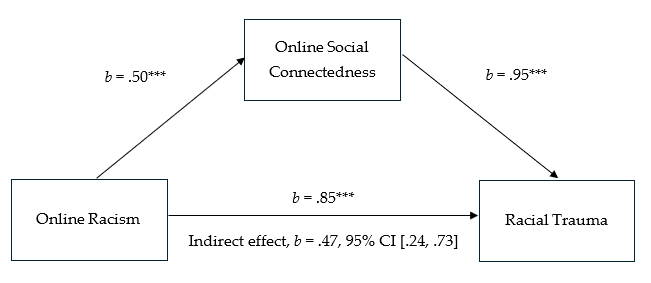
Note. Coefficients presented are unstandardized regression coefficients of direct effects. Confidence interval for the indirect effect is a bootstrapped confidence interval using 10,000 samples.
***p < .001.
Discussion
Prior and emerging literature has documented the significant impact of online racism on mental health and wellness, such as anxiety, depression, stress- and trauma-related symptoms, and psychological distress among children and adolescents (Del Toro & Wang, 2023; Thomas et al., 2023; Tynes et al., 2012) as well as emerging findings of psychological distress, substance use, suicidal ideation, anxiety, and depression among adults (Cano et al., 2021; Cavalhieri et al., 2024; Keum, 2022; Keum & Ahn, 2021; Keum & Cano, 2021; Keum et al., 2023; Keum & Hearns, 2021; Layug et al., 2022). This study sought to build upon these findings to determine if online racism exists as a racially traumatic stressor that may lead to the development of symptoms of racial trauma. Confirming our first hypothesis, the results of our study demonstrated that exposure to online racism was associated with increased racial trauma symptoms among participants. Thus, our findings indicate that such exposure contributes to emotional and psychological injury upon individuals’ racial identity. Our study aligns with emerging research on adults that has demonstrated exposure to racism via online communication and media as a traumatic stressor (Evans et al., 2024; Green et al., 2024; Maxie-Moreman & Tynes, 2022).
Our study builds upon existing research by highlighting that exposure to online racism may be experienced as racially traumatizing by PGM as well as by White individuals. Although not part of our primary research question and analysis, our regression analysis found no statistically significant difference in racial trauma between White and PGM participants. This finding should be interpreted with nuance given that White individuals do not experience racism as a function of white supremacy. Echoing findings from Carter, Roberson, and Johnson (2020) and Carter and Kirkinis (2021), White individuals’ quantitative endorsement of racial trauma from vicarious exposure to racism may be qualitatively different from experiences of PGM. Specifically, racial identity attitudes may play a role in how White individuals perceive racism and experience subsequent distress (Carter, Roberson, & Johnson, 2020). Prior research highlights that White individuals with greater racial awareness endorse fewer racial trauma symptoms despite reporting vicarious exposure to racism (Carter, Roberson, & Johnson, 2020). Moreover, White individuals with color-evasive racial attitudes may view White individuals as targets of online racism (Green et al., 2023). Thus, this finding may be best understood as being connected to racial attitudes that impact measurement of racial trauma symptoms rather than equating White and PGM participant experiences.
Our study also sought to examine the relationship and mediating role of social connectedness with online racism and racial trauma. Confirming our second hypothesis, we found that online social connectedness both significantly predicted racial trauma in our regression model and significantly mediated the relationship between online racism and racial trauma. These findings suggest that feeling disconnected in online contexts following exposure to online racism may relate to increased symptoms of racial trauma. Additionally, individuals who experience challenges in finding and maintaining connectedness and supportive communities with others may be at greater risk of developing racial trauma symptoms. This aligns with findings of suppression and social withdrawal following experiences of racialized cybervictimization (Evans et al., 2024). Conversely, our findings highlight that stronger social connectedness after exposure to online racism may relate to decreased racial trauma symptoms. These findings emphasize the value of resources like online counterspaces that may foster racial identity affirmation, sense of community, social support, and resistance to online racism (Case & Hunter, 2012; Gomez & Cabrera, 2025; Lopez-Leon & Casanova, 2023). In summary, this study highlights the important roles of online interactions, relationships, and communities as they relate to the racial trauma experienced following exposure to online racism.
Clinical Implications and Future Research
As discussed above, our study contributes to existing literature on online racism and symptoms of mental health and wellness. Findings from our study indicate that online racism may be experienced as a racially traumatic stressor. This is noted in participant scores for racial trauma (M = 78.40; SD = 20.63) being above the established clinical cut-off score of 48 (Williams et al., 2022). Thus, counselors should integrate experiences of online racism into assessment and interventions with adult clients, particularly at times when online racist content may be prevalent. This assessment and acknowledgement can incentivize counselors to focus on processing these traumatic experiences. For example, a counselor naming a client’s response as part of racial trauma can support validating their experiences following exposure. Moreover, this may also support client healing by attributing their intrapsychic racial trauma symptoms as responses to external racism while reducing the odds of internalizing racism (Adames et al., 2023). Likewise, counselors can focus on enhancing client social connectedness as a potential protective factor that may support reducing client experiences of self-blame and social withdrawal (Adames et al., 2023; Evans et al., 2024). Counselors may also consider supporting clients in developing digital hygiene to optimize self-care in their therapeutic work.
Considering the significance of social connectedness as a protective factor, counselors can advocate for clients experiencing racial trauma from online racism to actively participate in digital counterspaces that foster social connectedness (Gomez & Cabrera, 2025; Mosley et al., 2021). This may occur through traditional modalities of counseling such as group counseling via telehealth or other community-developed groups across social media platforms. Counselors may encourage client participation in such digital counterspaces during treatment to empower them to engage in community care as a compliment to self-care behaviors. Additionally, these client recommendations may aid in developing critical consciousness, a sense of belonging with others, and in developing resistance strategies despite experiences of online racism (Case & Hunter, 2012; Gomez & Cabrera, 2025; Lopez-Leon & Casanova, 2023). Beyond individual counseling, it is imperative that counselors engage in community-level advocacy in addressing online racism. For example, facilitating workshops, public education, and creating safe spaces in school or university settings may support vulnerable populations in building awareness around online racism and its impact. Such spaces can offer safety and validation of racial trauma experiences (Wright et al., 2023). Moreover, these spaces and events can provide critical insight toward preventing engagement in online racism and healing from its traumatic impact (Wright et al., 2023).
Lastly, counselors might consider ways to support the wellness of White clients who experience distress related to online racism. Counselors should emphasize development in White racial identity and coping practices to navigate vicarious exposure to racism online. This might include supporting White clients in reshaping their cognition of their adverse reactions toward a more critical understanding of white supremacy (Carter, Roberson, & Johnson, 2020). Counselors are encouraged to address color-evasive racial attitudes expressed by White clients during sessions to enhance critical consciousness in alignment with theory on radical healing (Adames et al., 2023; French et al., 2020; Green et al., 2023). Counselors should also encourage White clients who are struggling with their adverse reactions to online racism to build relationships with other White individuals to enhance social connectedness as it pertains to critical consciousness raising. Supporting White clients in appropriately attributing their adverse experiences may also aid in reducing online racism toward PGM. For example, a White client who experiences online backlash from engaging in online racism may attribute their adverse experience to reverse racism, resulting in further engagement in online racism (Green et al., 2023).
Future research may build upon our study by more specifically investigating the role of counterspaces as they relate to mental health, wellness, and exposure to online racism and other forms of online hate. Such research should consider the significance of qualitative methodologies to better understand the lived experiences of coping and resisting through social resources that may reduce the impact of online racism. Further quantitative research on the racial trauma of online racism might compare differences in coping between White and PGM populations to better understand ways for counselors to enhance support for those impacted by online racism. Additionally, it is important to examine online racism experienced by online racial justice activists who may be prone to such exposure. Such research might compare racial trauma symptoms experienced because of online and offline exposure to racism to identify ways in which counselors can support the wellness of those who engage in racial justice efforts via social media and other forms of digital technology. Lastly, future research might examine the impact of long-term exposure to racially traumatizing online content on mental health and wellness in order to better understand the transgenerational impact of online racism alongside advancements in digital technology. Such research might specifically study social, cognitive, and behavioral changes across the lifespan, particularly for parents of PGM children, adolescents, and emerging adults.
Limitations
One limitation of this study lies in its cross-sectional nature. Although the use of mediation analysis was used to better understand how exposure to online racism may result in decreased social connectedness that in turn increases racial trauma symptoms, the cross-sectional design does not allow for causal conclusions. As a result, it is unknown if lower or greater social connectedness reported by participants was preexisting or the result of exposure to online racism. Another limitation of the study lies in the sampling method. First, the use of MTurk as a platform to recruit participants likely introduced bias, particularly given the financial incentive for participants to complete the study. We attempted to mitigate some bias through use of two validity check items in the online survey; however, this may not have counteracted the potential for bias to influence participant data. In addition to the use of convenience sampling with monetary incentive, the use of a quota system introduced a bias in the results for White participants who completed the survey early on while PGM participants did not experience restrictions or any subsequent bias in participation. Although the quota was intended to limit the overrepresentation of White participants that may have occurred through sampling via MTurk, it also introduced uncontrolled bias into the results. Moreover, we did not include exposure to online racism or experiences of racial trauma as criteria in the recruitment process. Using a narrower sample would have been more consistent with the underlying theory of racial trauma and could produce different results. As a result, caution should be taken in generalizing this study’s findings. Future research might mitigate such bias by sampling from multiple sources, such as directly recruiting from social media platform users and groups, to better prevent issues of oversampling as it relates to racial identity.
Conclusion
Our study sought to expand emerging research on exposure to online racism by examining how it relates to racial trauma among adults. Moreover, our study contributed to this emerging research by highlighting the significance of online social connectedness as a mediating variable in the relationship between online racism and racial trauma. Our study indicates that online racism may exist as a racially traumatic stressor that is essential for counselors to attend to in clinical practice for clients who may be vulnerable to such exposure. Lastly, our findings suggest that enhancing sense of connectedness may be an avenue for supporting client wellness among those who experience racial trauma from online racism exposure.
Conflict of Interest and Funding Disclosure
The authors reported no conflict of interest
or funding contributions for the development
of this manuscript.
References
Adames, H. Y., Chavez-Dueñas, N. Y., Lewis, J. A., Neville, H. A., French, B. H., Chen, G. A., & Mosley, D. V. (2023). Radical healing in psychotherapy: Addressing the wounds of racism-related stress and trauma. Psychotherapy, 60(1), 39–50. https://doi.org/10.1037/pst0000435
American Psychiatric Association. (2022). Diagnostic and statistical manual of mental disorders (5th ed., text rev.).
Bliuc, A-M., Faulkner, N., Jakubowicz, A., & McGarty, C. (2018). Online networks of racial hate: A systematic review of 10 years of research on cyber-racism. Computers in Human Behavior, 87, 75–86.
https://doi.org/10.1016/j.chb.2018.05.026
Cano, M. Á., Schwartz, S. J., MacKinnon, D. P., Keum, B. T., Prado, G., Marsiglia, F. F., Salas-Wright, C. P., Cobb, C. L., Garcini, L. M., De La Rosa, M., Sánchez, M., Rahman, A., Acosta, L. M., Roncancio, A. M., & de Dios, M. A. (2021). Exposure to ethnic discrimination in social media and symptoms of anxiety and depression among Hispanic emerging adults: Examining the moderating role of gender. Journal of Clinical Psychology, 77(3), 571–586. https://doi.org/10.1002/jclp.23050
Carter, R. T. (2007). Racism and psychological and emotional injury: Recognizing and assessing race-based traumatic stress. The Counseling Psychologist, 35(1), 13–105. https://doi.org/10.1177/0011000006292033
Carter, R. T., & Kirkinis, K. (2021). Differences in emotional responses to race-based trauma among Black and White Americans. Journal of Aggression, Maltreatment, & Trauma, 30(7), 889–906.
https://doi.org/10.1080/10926771.2020.1759745
Carter, R. T., Kirkinis, K., & Johnson, V. E. (2020). Relationships between trauma symptoms and race-based traumatic stress. Traumatology, 26(1), 11–18. https://doi.org/10.1037/trm0000217
Carter, R. T., Mazzula, S., Victoria, R., Vazquez, R., Hall, S., Smith, S., Sant-Barket, S., Forsyth, J., Bazelais, K., & Williams, B. (2013). Initial development of the Race-Based Traumatic Stress Symptom Scale: Assessing the emotional impact of racism. Psychological Trauma: Theory, Research, Practice, and Policy, 5(1), 1–9. https://doi.org/10.1037/a0025911
Carter, R. T., Roberson, K., & Johnson, V. E. (2020). Race-based stress in White adults: Exploring the role of White racial identity status attitudes and type of racial events. Journal of Multicultural Counseling & Development, 48(2), 95–107. https://doi.org/10.1002/jmcd.12168
Case, A. D., & Hunter, C. D. (2012). Counterspaces: A unit of analysis for understanding the role of settings in marginalized individuals’ adaptive responses to oppression. American Journal of Community Psychology, 50(1–2), 257–270. https://doi.org/10.1007/s10464-012-9497-7
Cavalhieri, K. E., Greer, T. M., Hawkins, D., Choi, H., Hardy, C., & Heavner, E. (2024). The effects of online and institutional racism on the mental health of African Americans. Cultural Diversity & Ethnic Minority Psychology, 30(3), 476–486. https://doi.org/10.1037/cdp0000585
Cohen, J., Cohen, P., West, S. G., & Aiken, L. S. (2003). Applied multiple regression/correlation analysis for the behavioral sciences (3rd ed). Lawrence Erlbaum.
Comas-Díaz, L., Hall, G. N., & Neville, H. A. (2019). Racial trauma: Theory, research, and healing: Introduction to the special issue. American Psychologist, 74(1), 1–5. https://doi.org/10.1037/amp0000442
Del Toro, J., & Wang, M.-T. (2023). Online racism and mental health among Black American adolescents in 2020. Journal of the American Academy of Child & Adolescent Psychiatry, 62(1), 25–36. https://doi.org/10.1016/j.jaac.2022.07.004
Evans, A. M., Chalk, S., Green, D., Hornsby, T., Ramsay-Seaner, K., & Haskins, R. (2024). Cyberbullying as a method of discrimination among people of color: An interpretative phenomenological analysis. Wisconsin Counseling Journal, 37, 26–46.
French, B. H., Lewis, J. A., Mosley, D. V., Adames, H. Y., Chavez-Dueñas, N. Y., Chen, G. A., & Neville, H. A. (2020). Toward a psychological framework of radical healing in communities of color. The Counseling Psychologist, 48(1), 14–46. https://doi.org/10.1177/0011000019843506
Fulmer, R. (2024). A primer on how AI algorithms control you. Journal of Technology in Counselor Education and Supervision, 5(2), Article 1. https://doi.org/10.61888/2692-4129.1098
Gelles-Watnick, R. (2024). Americans’ use of mobile technology and home broadband. Pew Research Center. www.pewresearch.org/internet/2024/01/31/americans-use-of-mobile-technology-and-home-broadband
Gomez, V., & Cabrera, J. (2025). Theorizing virtual counterspaces: How Latina graduate students build community online. Race Ethnicity and Education, 28(7), 1105–1121. https://doi.org/10.1080/13613324.2023.2292509
Gottfried, J. (2024). Americans’ social media use. Pew Research Center. https://www.pewresearch.org/internet/2024/01/31/americans-social-media-use
Green, D. A., Dockery, G. N., & Williams, B. A. (2023). Cyber racism in counseling cyberspaces. Journal of Multicultural Counseling and Development, 51(3), 195–207. https://doi.org/10.1002/jmcd.12276
Green, D. A., Evans, A. M., Litam, S. D. A., Hornsby, T., Boulden, R., Shannon, J., Ford, D. J., & Landrum, D. (2024). Racial identity attitudes and vicarious traumatization from undue police violence on anticipatory traumatic reaction among Black Americans. Journal of Interpersonal Violence, 39(3–4), 848–868. https://doi.org/10.1177/08862605231198484
Hayes, A. F. (2018). Introduction to mediation, moderation, and conditional process analysis: A regression-based approach (2nd ed.). Guilford.
Hemmings, C., & Evans, A. M. (2018). Identifying and treating race-based trauma in counseling. Journal of Multicultural Counseling and Development, 46(1), 20–39. https://doi.org/10.1002/jmcd.12090
Hill, M. L. (2018). “Thank you, Black Twitter”: State violence, digital counterpublics, and pedagogies of resistance. Urban Education, 53(2), 286–302. https://doi.org/10.1177/0042085917747124
Holmes, S. C., Zare, M., Haeny, A. M., & Williams, M. T. (2024). Racial stress, racial trauma, and evidence-based strategies for coping and empowerment. Annual Review of Clinical Psychology, 20, 77–95.
https://doi.org/10.1146/annurev-clinpsy-081122-020235
Jones, N., Marks, R., Ramirez, R., & Ríos-Vargas, M. (2021, August 12). 2020 census illuminates racial and ethnic composition of the country. United States Census Bureau. https://www.census.gov/library/stories/2021/08/improved-race-ethnicity-measures-reveal-united-states-population-much-more-multiracial.html
Keum, B. T. (2017). Qualitative examination on the influences of the internet on racism and its online manifestation. International Journal of Cyber Behavior, Psychology and Learning, 7(3), 13–22.
https://doi.org/10.4018/IJCBPL.2017070102
Keum, B. T. (2021). Development and validation of the Perceived Online Racism Scale short form (15 items) and very brief (six items). Computers in Human Behavior Reports, 3, 100082. https://doi.org/10.1016/j.chbr.2021.100082
Keum, B. T. (2022). Impact of online racism on suicide ideation through interpersonal factors among racial minority emerging adults: The role of perceived burdensomeness and thwarted belongingness. Journal of Interpersonal Violence, 38(5–6), 4537–4561. https://doi.org/10.1177/08862605221117247
Keum, B. T., & Ahn, L. H. (2021). Impact of online racism on psychological distress and alcohol use severity: Testing ethnic-racial socialization and silence about race as moderators. Computers in Human Behaviors, 120, 106773. https://doi.org/10.1016/j.chb.2021.106773
Keum, B. T., & Cano, M. Á. (2021). Online racism, psychological distress, and alcohol use among racial minority women and men: A multi-group mediation analysis. American Journal of Orthopsychiatry, 91(4), 524–530. https://doi.org/10.1037/ort0000553
Keum, B. T., Cano, M. Á., Valdovinos, I. C., & Boland, D.-z. (2023). Impact of online and offline racism on cigarette smoking, marijuana use, and vaping via depressive/anxiety symptoms among racially minoritized emerging adults. American Journal of Orthopsychiatry, 93(5), 450–459. https://doi.org/10.1037/ort0000691
Keum, B. T., & Hearns, M. (2021). Online gaming and racism: Impact on psychological distress among Black, Asian, and Latinx emerging adults. Games and Culture, 17(3), 445–460. https://doi.org/10.1177/15554120211039082
Keum, B. T., & Miller, M. J. (2017). Racism in digital era: Development and initial validation of the Perceived Online Racism Scale (PORS v1.0). Journal of Counseling Psychology, 64(3), 310–324. http://doi.org/10.1037/cou0000205
Layug, A., Krishnamurthy, S., McKenzie, R., & Feng, B. (2022). The impacts of social media use and online racial discrimination on Asian American mental health: Cross-sectional survey in the United States during COVID-19. JMIR Formative Research, 6(9), e38589. https://doi.org/10.2196/38589
Lee, R. M., & Robbins, S. B. (1995). Measuring belongingness: The Social Connectedness and the Social Assurance scales. Journal of Counseling Psychology, 42(2), 232–241. https://doi.org/10.1037/0022-0167.42.2.232
Lopez-Leon, G., & Casanova, S. (2023). “Those are the spaces where I feel seen and fully understood”: Digital counterspaces fostering community, resistance, and intersectional identities among Latinx LGBTQ+ emerging adults. Journal of Adolescent Research, 40(2), 331–360. https://doi.org/10.1177/07435584231165993
Maxie-Moreman, A. D., & Tynes, B. M. (2022). Exposure to online racial discrimination and traumatic events online in Black adolescents and emerging adults. Journal of Research on Adolescence, 32(1), 254–269. https://doi.org/10.1111/jora.12732
Mosley, D. V., Hargons, C. N., Meiller, C., Angyal, B., Wheeler, P., Davis, C., & Stevens-Watkins, D. (2021). Critical consciousness of anti-Black racism: A practical model to prevent and resist racial trauma. Journal of Counseling Psychology, 68(1), 1–16. https://doi.org/10.1037/cou0000430
Mosley, D. V., Neville, H. A., Chavez-Dueñas, N. Y., Adames, H. Y., Lewis, J. A., & French, B. H. (2020). Radical hope in revolting times: Proposing a culturally relevant psychological framework. Social and Personality Psychology Compass, 14(1), Article e12512. https://doi.org/10.1111/spc3.12512
Nasereddin, S. (2023). Impact of social media platforms on international public opinion during the Israel war on Gaza. Global Change, Peace & Security, 35(1), 5–31. https://doi.org/10.1080/14781158.2024.2415908
Ong, M., Smith, J. M., & Ko, L. T. (2018). Counterspaces for women of color in STEM higher education: Marginal and central spaces for persistence and success. Journal of Research in Science Teaching, 55(2), 206–245. https://doi.org/10.1002/tea.21417
Pew Research Center. (2024). Mobile fact sheet. https://www.pewresearch.org/internet/fact-sheet/mobile
Rudnicki, K., Vandebosch, H., Voué, P., & Poels, K. (2023). Systematic review of determinants and consequences of bystander interventions in online hate and cyberbullying among adults. Behaviour & Information Technology, 42(5), 527–544. https://doi.org/10.1080/0144929X.2022.2027013
Sheikh, I. S., Alsubaie, M. K., Dolezal, M. L., Walker, R. S., Rosencrans, P. L., Peconga, E., Holloway, A., Bentley, J. A., & Zoellner, L. A. (2022). The role of social connectedness in buffering the effects of discrimination on post-trauma cognitions in forcibly displaced Muslims. Psychological Trauma: Theory, Research, Practice, & Policy, 14(1), 47–54. https://doi.org/10.1037/tra0001070
Tabachnick, B. G., & Fidell, L. S. (2019). Using multivariate statistics (7th ed). Pearson.
Thomas, A., Gale, A., & Golden, A. R. (2023). Online racial discrimination, critical consciousness, and psychosocial distress among Black and Latino adolescents: A moderated mediation model. Journal of Youth & Adolescence, 52(5), 967–979. https://doi.org/10.1007/s10964-022-01732-z
Tynes, B. M., Umaña-Taylor, A. J., Rose, C. A., Lin, J., & Anderson, C. J. (2012). Online racial discrimination and the protective function of ethnic identity and self-esteem for African American adolescents. Developmental Psychology, 48(2), 343–355. https://doi.org/10.1037/a0027032
Tynes, B. M., Willis, H. A., Stewart, A. M., & Hamilton, M. W. (2019). Race-related traumatic events online and mental health among adolescents of color. Journal of Adolescent Health, 65(3), 371–377.
https://doi.org/10.1016/j.jadohealth.2019.03.006
Volpe, V. V., Hoggard, L. S., Willis, H. A., & Tynes, B. M. (2021). Anti-Black structural racism goes online: A conceptual model for racial health disparities research. Ethnicity & Disease, 31(Suppl 1), 311–318.
https://ethndis.org/supplementarchive/files/ethndis-31-311.pdf
Williams, M. T., Metzger, I. W., Leins, C., & DeLapp, C. (2018). Assessing racial trauma within a DSM–5 framework: The UConn Racial/Ethnic Stress & Trauma Survey. Practice Innovations, 3(4), 242–260. https://doi.org/10.1037/pri0000076
Williams, M. T., Osman, M., Gallo, J., Pereira, D. P., Gran-Ruaz, S., Strauss, D., Lester, L., George, J. R., Edelman, J., & Litman, L. (2022). A clinical scale for the assessment of racial trauma. Practice Innovations, 7(3), 223–240. https://doi.org/10.1037/pri0000178
Wong, B. (2023). Top social media statistics and trends. Forbes Advisor. https://www.forbes.com/advisor/business/social-media-statistics
Wright, W., Hatchett Stover, J., & Brown-Rice, K. (2023). Understanding racial trauma: Implications for professional counselors. The Professional Counselor, 13(1), 17–26. https://doi.org/10.15241/ww.13.1.17
Darius A. Green, PhD, NCC, LPCC, is an assistant professor at Bowie State University. Kade Stanzilis, MA, LPCC, is a graduate researcher at the University of Colorado Colorado Springs. Sierra Roach-Coye, MSW, LSW, is a doctoral candidate at Denver University. Connor Sullivan, MA, LPCC, is a graduate researcher at the University of Colorado Colorado Springs. Correspondence may be addressed to Darius A. Green, Department of Counseling and Psychological Studies, Bowie State University, 14000 Jericho Park Road, Bowie, MD, 20715, dgreen2@bowiestate.edu.
May 10, 2023 | Volume 13 - Issue 1
Warren Wright, Jennifer Hatchett Stover, Kathleen Brown-Rice
Racial trauma has become a common topic of discussion in professional counseling. This concept is also known as race-based traumatic stress, and it addresses how racially motivated incidents impede emotional and mental health for Black, Indigenous, and people of color (BIPOC). Research about this topic and strategies to reduce its impact are substantial in the field of psychology. However, little research about racial trauma has been published in the counseling literature. The intent of this paper is to provide an in-depth perspective of racial trauma and its impact on BIPOC to enhance professional counselors’ understanding. Strategies for professional counselors to integrate into their clinical practice are provided. In addition, implications for counselor supervisors and educators are also provided.
Keywords: racial trauma, BIPOC, counseling, professional counselors, clinical practice
The impact of racism on the psychological, emotional, and physical well-being of those subjected to it is no secret. In fact, the Centers for Disease Control and Prevention (2021) has declared racism as a public health issue and threat to the health of minoritized individuals. Similarly, the Federal Bureau of Investigation (2019) reported that 5,155 people were targets of racially motivated hate crimes in 2018: 47.1% of the victims identified as Black/African American, 13% as Hispanic/Latino, 4.1% as American Indian/Alaskan Native, and 3.4% as Asian. Daily experiences of racism for Black, Indigenous, and people of color (BIPOC) can lead to an increase in health complications and mental health disparities (French et al., 2020; Williams et al., 2019). Hemmings and Evans (2018) noted that because of racism, BIPOC communities have limited access to resources, which impacts their quality of education and health care. Thus, racially marginalized communities are susceptible to chronic illnesses and mental health concerns such as diabetes, heart disease, depression, and suicide (Hemmings & Evans, 2018). Furthermore, researchers have found that exposure to racism and discrimination increases levels of stress in the body and can lead to chronic illnesses such as high blood pressure, diabetes, and gastrointestinal issues for people of color (Bernier et al., 2021; Chavez-Dueñas et al., 2019; Smith et al., 2011; Wagner et al., 2015), therefore adversely impacting the livelihood and overall well-being of BIPOC communities.
Racism-related stressors can lead to race-based traumatic stress, also known as racial trauma (Carter, 2007; Comas-Díaz et al., 2019). Racial trauma and race-based traumatic stress occur when there is an experience of direct or indirect racism that leads to psychological and emotional injury for BIPOC. Examples include experiencing microaggressions in the workplace (Sue et al., 2019), witnessing an unarmed Black person being killed by law enforcement (Williams et al., 2018), and being physically attacked because others believe a person’s racialized group is the cause of a global pandemic (e.g., Asian American and Pacific Islanders [AAPIs]; Litam, 2020). There is a substantial amount of literature in the field of psychology related to racism, race-based traumatic stress, and racial trauma (Adames et al., 2023; Bryant-Davis & Ocampo, 2006; Carter, 2007; Comas-Díaz et al., 2019; French et al., 2020; Helms et al., 2010; Mosley et al., 2021). However, there is little to no research in the counseling profession related to racial trauma. Therefore, this article provides an overview of racial trauma and implications for the counseling profession.
Race-Based Traumatic Stress and Racial Trauma
Racial trauma is the collective stress experienced by BIPOC directly or indirectly due to continuous racially motivated incidents of microaggressions, exclusion, discrimination, and sociopolitical events that create psychological and emotional harm (Anderson & Stevenson, 2019; Comas-Díaz et al., 2019). Race-based traumatic stress is one of the most common interchangeable terms for racial trauma and refers to the stress response and emotional injury that occur after experiencing a racist encounter (Carter, 2007; Williams et al., 2018). Carter (2007), along with other researchers (Chavez-Dueñas et al., 2019; Helms et al., 2010; Smith et al., 2007, 2016), examined the experiences of BIPOC and the accompanying psychological stress when they experience racism-related incidents. Constant exposure to racially motivated incidents can create and lead to an overwhelming emotional stress response for BIPOC. Bryant-Davis and Ocampo (2005), Hemmings and Evans (2018), and Litam (2020) discussed how racist incidents of physical assaults, verbal attacks, and threats to one’s safety impact a person’s sense of self and can cause a person to present with symptoms of trauma.
It is imperative to note that experiencing racism and presentation of trauma symptoms are not all life threatening. Therefore, racial trauma differs from the traditional diagnosable PTSD criteria as stated in the 5th edition of the Diagnostic and Statistical Manual of Mental Disorders (DSM-5; American Psychiatric Association [APA], 2013). Although it is not explicitly stated in the DSM-5, racial trauma encompasses racism-related stressors associated with one’s membership in a racialized social group, historical trauma, and continuous exposure to racism-related violence. Consequently, conceptualizing and diagnosing a client that presents to counseling with trauma symptomology that does not fit the criteria for the PTSD diagnosis can be confusing for mental health professionals. Therefore, it is important for professional mental health counselors to be prepared to assess and treat clients who present to counseling with trauma symptomology related to racist incidents.
Impact of Racism and Racial Trauma
Racial trauma could impact a person’s sense of self, pride in culture, and identity (Brown-Rice, 2013; Skewes & Blume, 2019). Skewes and Blume (2019) found that assimilation, exploitation, and forced relocation led to the loss of spiritual and cultural practices for American Indian and Alaska Native (AI/AN) communities. Additionally, Brown-Rice (2013) stated that loss of cultural traditions and native practices creates a sense of confusion and hopelessness for Native American adults. Thus, racialized trauma can lead to a separation of cultural identity and practices. Similarly, Chavez-Dueñas and colleagues (2019) found that racial trauma has increased psychological distress for Latinx immigrant communities because of anti-immigration policies, opposition to assimilation into the American culture, and fear of deportation. Furthermore, racial trauma can lead to psychological concerns such as anxiety, depression, emotional dysregulation, and suicidal ideation (American Foundation for Suicide Prevention, 2020; Bryant-Davis & Ocampo, 2005; Comas-Díaz et al., 2019; French et al., 2020; Hemmings & Evans, 2018). Additionally, the American Foundation for Suicide Prevention (2020) found suicide rates for minoritized communities have increased. Moreover, racial discrimination has been positively correlated with suicidal ideation among African American young adults (American Foundation for Suicide Prevention, 2020).
Racism is consistently prevalent within American schools and continues to be an issue of concern experienced by BIPOC students (Kohli et al., 2017; Merlin, 2017). The experience of trauma coupled with racism and discriminatory practices in education has shown to impart racial disparities among BIPOC students in the areas of academic achievement, employment, and participation in the criminal justice system (Lebron et al., 2015). Black students are underrepresented in advanced courses, are less likely to be college ready, and spend less time in the classroom because of disciplinary practices (United Negro College Fund, 2020). According to a report on school discipline by the U.S. Department of Education Office for Civil Rights (2018), Black students only account for 18% of preschool enrollment, yet they make up 42% of total suspensions and 3 times more expulsions than their White peers. In addition, Black students are more than twice as likely to be referred to law enforcement and subject to arrest for school-based incidents when compared to their peers (United Negro College Fund, 2020). Furthermore, not only are Black students underrepresented in advanced courses, but they are overrepresented in special education programs and more likely to be identified with a disability (Harper, 2017). Therefore, it is imperative for professional mental health counselors to understand how racial trauma could impact the mental health and well-being of individuals at distinct phases of life span development (e.g., children, college students, etc.).
Currently, racial trauma has been exacerbated by the recent COVID-19 pandemic plaguing the United States and other parts of the world. Liu and Modir (2020) and Fortuna et al. (2020) highlighted the lived experiences within BIPOC communities regarding living in low-income neighborhoods, denial of access to care, and being disproportionately affected by the COVID-19 virus. Black Americans accounted for 34% of confirmed cases in the United States, followed by Latinos at 20%–25% of cases (Fortuna et al., 2020). This demonstrates that health disparities coupled with racism could impact the physical well-being of BIPOC. Racism-related stress impacts the emotional and physical health of BIPOC communities. This includes sense of self (Chavez-Dueñas et al., 2019), culture identity (Skewes & Blume, 2019), and overall wellness (Litam, 2020). Healing racial trauma requires professional mental health counselors working with BIPOC individuals to consider sociocultural factors such as systemic racism, oppression of marginalized communities, and cultural trauma.
Implications for Professional Counselors
The counseling profession highlights the importance of assessment competency as stated in the American Counseling Association (ACA) Code of Ethics (ACA, 2014; e.g., Standard E.5.c: Historical and Social Prejudices in the Diagnosis of Pathology) and the 2016 Council for Accreditation of Counseling and Related Educational Programs (CACREP, 2015) Standards (e.g., Assessment and Testing). In addition, the 2016 CACREP standards emphasized the importance of social and cultural diversity, highlighting strategies and techniques to identify and eliminate barriers of oppression and discrimination (CACREP, 2015). Because racial trauma is invasive and harmful for BIPOC individuals and communities, understanding its impact on psychological and emotional well-being is imperative for all mental health professionals in their respective roles. Thus, counselors must be prepared to provide culturally responsive care to BIPOC individuals who have experienced racism-related trauma.
Licensed Professional Mental Health Counselors
Assessing for racial trauma is of utmost importance when conceptualizing and creating a treatment plan for BIPOC clients. It is imperative for counselors to become familiar with assessments and clinical interventions to inform their approach to treating racial trauma. Williams and colleagues (2018) proposed the UConn Racial/Ethnic Stress and Trauma Survey (UnRESTS) to assist mental health professionals in their case conceptualizations and treatment planning when racial trauma is present in BIPOC individuals. The UnRESTS is a clinician-administered semi-structured interview that is beneficial in case conceptualization to determine the multiple experiences of racism for the client. The interview comprises 6 sections: introduction of the interview, racial and ethnic identity development, experiences of direct overt racism, experiences of racism by loved ones, experiences of vicarious racism, and experiences of covert racism (Williams et al., 2018). Even though this survey is like the DSM-5 Cultural Formulations Interview (APA, 2013) and helps the counselor determine if the client’s symptomology fits criteria for PTSD, it should not be the only assessment tool used to determine a diagnosis of PTSD. Additionally, this interview tends to be lengthy in time; therefore, counselors should consider completing this interview within the first and second sessions. This assessment along with other clinical approaches could be beneficial to understanding the traumatic responses of clients impacted by racism.
Several BIPOC scholars have offered models, theories, and frameworks to heal racial trauma (Adames et al., 2023; Bryant-Davis & Ocampo, 2006; French et al., 2020; Mosley et al., 2021). Counselors must position themselves to consider approaches that go beyond Eurocentric theories and models when addressing and treating racial trauma. These include being critical of sociopolitical structures, awareness of one’s own racial identity, and comfort level when broaching the topic of racism and racial trauma (Adames et al., 2023; Thrower et al., 2020). For instance, Bryant-Davis and Ocampo (2006) provided a foundation for treating racial trauma in a safe environment. Their therapeutic approach included acknowledgment, grieving/mourning loss, analyzing internalized shame and racism, and centering coping and resistance strategies. Supporting clients to name oppressive systems, process their experiences of racist incidents, and deconstruct self-blame narratives because of racism fosters liberation and healing for BIPOC clients who have experienced racism-related stress and trauma (Adames et al., 2023). Thus, counselors must be empathetic and take initiative in helping BIPOC clients shift the focus on harm from self-blame to external oppressive factors. This promotes a strong sense of self and healthy living for BIPOC clients.
Similarly, models offered by Chavez-Dueñas et al. (2019), French et al. (2020), Mosley et al. (2021), and Adames et al. (2023) center the well-being and collective power of BIPOC communities. For example, critical consciousness, Black Psychology, Liberation Psychology, and trauma-informed care influenced these approaches to address racism-related stress and trauma. Subsequently, French and colleagues’ (2020) Radical Healing Framework centers justice and overall wellness for BIPOC communities. This is the intentional practice of going beyond just coping with racism to focus on healing wherein a client can thrive by connecting to community and engaging in resistance against racism-related stressors (French et al., 2020). Thus, helping clients to engage in activism and utilize microinterventions to disarm and address microaggressions can empower clients (Mosley et al., 2021; Sue et al., 2019). Microinterventions help equip clients with tools they can implement to assert boundaries and communicate disagreement with microaggressions (Litam, 2020; Sue et al., 2019). However, counselors must remember that safety is a priority when supporting clients in confronting perpetrators of racism-related trauma (Litam, 2020). Therefore, role-plays in counseling sessions could provide the space and time to strategize when it is and is not appropriate to confront perpetrators of microaggressions.
Utilizing these approaches with clients fosters validation and affirmation of their experiences. Failure to acknowledge and attend to the symptoms and experiences of racism-related stress and trauma can maintain psychological distress for BIPOC clients (Chavez-Dueñas et al., 2019). Furthermore, helping clients process the positive messages they received about their racial identity throughout their life can reinforce these approaches (Anderson & Stevenson, 2019). Thus, counselors should use a strength-based approach when supporting BIPOC clients in healing from racism-related stress and trauma. In addition, consultation with colleagues, supervisors, and counselor educators can provide support and a space to implement best practices to provide the most effective care for BIPOC individuals who have experienced racial trauma, rendering positive mental health outcomes.
Professional School Counselors
Professional school counselors should demonstrate cultural competence and serve as essential stakeholders in identifying and supporting clients impacted by trauma (ACA, 2014; American School Counselor Association [ASCA], 2016; Parikh-Foxx et al., 2020). ASCA specifies these responsibilities and obligations in their ASCA Ethical Standards for School Counselors (ASCA, 2022). These principles serve as a framework in which professional values, norms, and behaviors are referenced. Further, school counselors can help to identify, respond to, and prevent incidents of racism and bias, as well as become resources to help promote systemic change and advocate for social justice within the educational setting (ASCA, 2020). However, ASCA (2021) recognizes the lack of racial literacy and the inherent gaps between racial equity and equality within education, petitioning for school counselors to continually pursue cultural competency and work toward mitigating the negative effects of racism and bias. Subsequently, ASCA guidelines encourage school counselors to examine their own biases and consult with community professionals to engage in immersive experiences and provide support to students and families who have experienced racial trauma or have been negatively impacted by racism (ASCA, 2021; Atkins & Oglesby, 2019; Levy & Adjapong, 2020).
As facilitators of change, school counselors can help to create environments that are safe and inclusive for both students and educators. One approach is to discuss issues of racial trauma using trauma-informed and restorative practices (National Child Traumatic Stress Network [NCTSN], 2018). Trauma-informed practices take on a phenomenological approach, seeking to identify, understand, and address the meaning behind student behaviors and experiences (Steane, 2019). Additionally, restorative practices not only provide an alternative to harsh disciplinary practices, but also create spaces for individuals to share their own perspectives without fear of judgement or ridicule, while being open to listening and validating the values, experiences, and perspectives of others (NCTSN, 2018; United Negro College Fund, 2020). Moreover, Anderson and Stevenson (2019) posited the concept of racial socialization, which is the intentional communication about the system of racism, racial identity, and experiences between parents and their children and others within the family system with similar racial and ethnic identities. Racial socialization aids in the development of a positive sense of self and cultural identity as mitigating forces to racial trauma. Further, the Racial Encounter Coping Appraisal and Socialization Theory (RECAST) helps families and youth prepare for, discuss, and respond to racially stressful experiences appropriately (Anderson & Stevenson, 2019). Thus, this can also prepare students to strategize how to respond to incidents of racism in the school environment.
It is evident that incidents of school-based racism are perpetuated by several factors and continue to negatively impact student performance and affect the health and well-being of BIPOC students (Kohli et al., 2017). The implementation of culturally responsive pedagogy can be used to mitigate this impact, increase academic success, and help students maintain cultural integrity (Ladson-Billings, 1995; Lebron et al., 2015). Counseling professionals can support this effort by engaging in training and professional development to understand racism and its impact on culturally diverse students and by facilitating necessary discussions that help to equip stakeholders with tools to adequately address discrimination, racism, and race-based trauma (NCTSN, 2018; Pietrantoni, 2017).
Counselor Supervisors
The ACA Code of Ethics (2014; e.g., Section F: Supervision, Teaching, and Training) highlights the importance of counselor supervision for the development of counselors seeking licensure as independent mental health practitioners. Additionally, counselor supervision enhances a supervisee’s knowledge, skills, and ability to work with diverse clients (ACA, 2014). Therefore, counselor supervisors and their supervisees should be aware of racial trauma and the effects it could have on BIPOC clients. Pieterse (2018) posited guidelines and considerations for supervisors to follow when attending to racial trauma concerns in clinical supervision. Specifically, supervisors must be reflective of their own racial identity, understand how to assess for racial trauma, and implement effective clinical interventions for their supervisees’ clients impacted by racial trauma (Pieterse, 2018).
Additionally, understanding the concept of racial trauma in the larger context of historical trauma for BIPOC communities creates a learning environment for supervisees to deepen their knowledge of racial trauma (Comas-Díaz, 2000; French et al., 2020; Pieterse, 2018). For example, educating supervisees on historical depictions of racism-related stress and trauma for BIPOC communities, such as internment camps, chattel slavery, and colonization, provides the historical context of psychological wounds impacting BIPOC communities in present day by way of intergenerational trauma (Comas-Díaz et al., 2019; Nagata et al., 2019). Furthermore, clinical supervisors can role-play in supervision meetings with their supervisees to model helping clients process racist-related incidents, assessing for psychological distress, and empowering clients to practice effective coping and resistant strategies (Pieterse, 2018), thus ensuring supervisors’ awareness of multiculturalism and diversity in the supervisory relationship (ACA, 2014; e.g., Section F.2.b.: Multicultural Issues/Diversity in Supervision). It is critical for counselor supervisors to obtain the knowledge, skills, and abilities to best prepare counselor supervisees in addressing and treating racial trauma concerns.
Counselor Educators
Moh and Sperandio (2022) urged the counseling profession to integrate trauma-informed curricula to best prepare counselors-in-training (CITs) to respond effectively to trauma concerns caused by systemic racism in the United States. However, there is hesitancy for counselor educators to teach CITs about racial trauma (VanAusdale & Swank, 2020). Specifically, counselor educators have reported a lack of knowledge and limited ability to teach CITs about racial trauma (VanAusdale & Swank, 2020), futher highlighting the need for trauma-informed curricula to be adopted in the counselor profession to best prepare counselors and educators to address the needs of those impacted by racial trauma. In addition, counselor educators’ lack of knowledge in trauma-informed care and racial trauma does not help prepare future CITs to address this concern once they have graduated from their respective counselor education programs, consequently leading to racial trauma concerns going unaddressed and deepening the wounds of racial trauma for BIPOC (Bryant-Davis & Ocampo, 2005; Comas-Díaz, 2000; Helms, et al., 2010).
However, counselor educators can find creative ways to implement racial trauma education into the classroom. For example, counselor educators can include required readings from BIPOC scholars in their classes that contribute to the racial trauma literature (e.g., Anderson & Stevenson, 2019; French et al., 2020; Mosley et al., 2021). Additionally, counselor educators can demonstrate how to implement the UnRESTS (Williams et al., 2018) for CITs in practicum and internship courses who are practicing conducting clinical interviews. Furthermore, counselor educators can introduce CITs to theories that go beyond the Eurocentric tradition. For example, the first author of this article, Warren Wright, was introduced to queer theory, critical theory, and critical race theory in his master’s-level multicultural counseling (formerly cross-cultural counseling) course. As a student, Wright was assigned to write a social justice and advocacy paper, in which he utilized critical race theory to discuss how adolescents’ responses to experiencing racism in K–12 education could present as behavioral and emotional dysregulation. To mitigate this concern, Wright created an after-school program that utilized dance movement therapy (i.e., stepping) to help Black adolescent males with emotional regulation, personal development, and academic excellence. This approach is an example of a trauma-informed and responsive practice that could reduce harsh disciplinary referrals and increase Black students’ socioemotional development (Stover et al., 2022). If counselor educators feel inadequate to teach trauma counseling or trauma-informed practices, they should seek additional training and consultation to increase their awareness, knowledge, and skills about trauma-informed curricula and approaches (Moh & Sperandio, 2022).
Conclusion
The aim of this article is to provide an understanding of racial trauma and its impact on the psychological and emotional well-being of BIPOC communities and provide recommendations for the counseling profession. Intentional practices, strategies, and approaches are needed to help reduce the impact of racial trauma experienced by BIPOC individuals and communities. Therefore, it is imperative for CITs, licensed professional mental health counselors, school counselors, counselor educators, and supervisors to be well-equipped to address racial trauma concerns. Failure of the counseling profession to address racial trauma concerns deepens the psychological and emotional injuries of racial trauma. Therefore, curricula for CITs should be adapted to best prepare the next generation of counselors to aid with and mitigate the lasting impacts of racially motivated trauma inflicted on BIPOC individuals and communities.
Conflict of Interest and Funding Disclosure
The authors reported no conflict of interest
or funding contributions for the development
of this manuscript.
References
Adames, H. Y., Chavez-Dueñas, N. Y., Lewis, J. A., Neville, H. A., French, B. H., Chen, G. A., & Mosley, D. V. (2023). Radical healing in psychotherapy: Addressing the wounds of racism-related stress and trauma. Psychotherapy, 60(1), 39–50. https://doi.org/10.1037/pst0000435
American Counseling Association. (2014). ACA code of ethics. https://www.counseling.org/resources/aca-code-of-ethics.pdf
American Foundation for Suicide Prevention. (2020). Suicide statistics. https://afsp.org/suicide-statistics
American Psychiatric Association. (2013). Diagnostic and statistical manual of mental disorders (5th ed.).
American School Counselor Association. (2016). The school counselor and trauma-informed practice. ASCA Position Statements. https://www.schoolcounselor.org/Standards-Positions/Position-Statements/ASCA-Position-Statements/The-School-Counselor-and-Trauma-Informed-Practice
American School Counselor Association. (2020). Eliminating racism and bias in schools: The school counselor’s role. School Counseling Standards in Practice. https://www.schoolcounselor.org/getmedia/542b085a-7eda-48ba-906e-24cd3f08a03f/SIP-Racism-Bias.pdf
American School Counselor Association. (2021). The school counselor and anti-racist practices. ASCA Position Statements. https://www.schoolcounselor.org/Standards-Positions/Position-Statements/ASCA-Position-Statements/The-School-Counselor-and-Anti-Racist-Practices
American School Counselor Association. (2022). ASCA ethical standards for school counselors. https://www.schoolcounselor.org/getmedia/44f30280-ffe8-4b41-9ad8-f15909c3d164/EthicalStandards.pdf
Anderson, R. E., & Stevenson, H. C. (2019). RECASTing racial stress and trauma: Theorizing the healing potential of racial socialization in families. American Psychologist, 74(1), 63–75.
https://doi.org/10.1037/amp0000392
Atkins, R., & Oglesby, A. (2019). Interrupting racism: Equity and social justice in school counseling. Routledge.
Bernier, R. A., Venkatesan, U. M., Soto, J. A., Rabinowitz, A. R., Hong, J. S., & Hillary, F. G. (2021). Perceived discrimination and blood pressure in individuals aging with traumatic brain injury. Rehabilitation Psychology, 66(2), 148–159. https://doi.org/10.1037/rep0000379.supp (Supplemental).
Brown-Rice, K. (2013). Examining the theory of historical trauma among Native Americans. The Professional Counselor, 3(3), 117–130. https://doi.org/10.15241/kbr.3.3.117
Bryant-Davis, T., & Ocampo, C. (2005). Racist incident-based trauma. The Counseling Psychologist, 33(4), 479–500. https://doi.org/10.1177/0011000005276465
Bryant-Davis, T., & Ocampo, C. (2006). A therapeutic approach to the treatment of racist-incident-based trauma. Journal of Emotional Abuse, 6(4), 1–22. https://doi.org/10.1300/J135v06n04_01
Carter, R. T. (2007). Racism and psychological and emotional injury: Recognizing and assessing race-based traumatic stress. The Counseling Psychologist, 35(1), 13–105. https://doi.org/10.1177/0011000006292033
Centers for Disease Control and Prevention. (2021, April 8). Media statement from CDC Director Rochelle P. Walensky, MD, MPH, on racism and health. https://www.cdc.gov/media/releases/2021/s0408-racism-health.html
Chavez-Dueñas, N. Y., Adames, H. Y., Perez-Chavez, J. G., & Salas, S. P. (2019). Healing ethno-racial trauma in Latinx immigrant communities: Cultivating hope, resilience, and action. American Psychologist, 74(1), 49–62. https://doi.org/10.1037/amp0000289
Comas-Díaz, L. (2000). An ethnopolitical approach to working with people of color. American Psychologist, 55(11), 1319–1325. https://doi.org/10.1037/0003-066X.55.11.1319
Comas-Díaz, L., Hall, G. N., & Neville, H. A. (2019). Racial trauma: Theory, research, and healing: Introduction to the special issue. American Psychologist, 74(1), 1–5. https://doi.org/10.1037/amp0000442
Council for Accreditation of Counseling and Related Educational Programs. (2015). 2016 CACREP standards. http://www.cacrep.org/wp-content/uploads/2017/08/2016-Standards-with-citations.pdf
Federal Bureau of Investigation. (2019). 2018 hate crime statistics. https://ucr.fbi.gov/hate-crime/2018/topic-pages/victims.pdf
Fortuna, L. R., Tolou-Shams, M., Robles-Ramamurthy, B., & Porche, M. V. (2020). Inequity and the disproportionate impact of COVID-19 on communities of color in the United States: The need for a trauma-informed social justice response. Psychological Trauma: Theory, Research, Practice, and Policy, 12(5), 443–445. https://doi.org/10.1037/tra0000889
French, B. H., Lewis, J. A., Mosley, D. V., Adames, H. Y., Chavez-Dueñas, N. Y., Chen, G. A., & Neville, H. A. (2020). Toward a psychological framework of radical healing in communities of color. The Counseling Psychologist, 48(1), 14–46. https://doi.org/10.1177/0011000019834506
Harper, K. (2017). The school-to-prison pipeline: The intersections of students of color with disabilities. Child Trends. https://www.childtrends.org/publications/school-prison-pipeline-intersections-students-color-disabilities
Helms, J. E., Nicolas, G., & Green, C. E. (2010). Racism and ethnoviolence as trauma: Enhancing professional training. Traumatology, 16(4), 53–62. https://doi.org/10.1177/1534765610389595
Hemmings, C., & Evans, A. M. (2018). Identifying and treating race-based trauma in counseling. Journal of Multicultural Counseling and Development, 46(1), 20–39. https://doi.org/10.1002/jmcd.12090
Kohli, R., Pizarro, M., & Nevárez, A. (2017). The “new racism” of K-12 schools: Centering critical research on racism. Review of Research in Education, 41, 182–202. http://www.jstor.org/stable/44668692
Ladson-Billings, G. (1995). But that’s just good teaching! The case for culturally relevant pedagogy. Theory into Practice, 34(3), 159–165. https://www.jstor.org/stable/1476635
Lebron, D., Morrison, L., Ferris, D., Alcantara, A., Cummings, D., Parker, G., & McKay, M. (2015). Facts matter! Black lives matter! The trauma of racism. http://mcsilver.nyu.edu/sites/default/files/reports/Trauma-of-Racism-Report.pdf
Levy, I. P., & Adjapong, E. S. (2020). Toward culturally competent school counseling environments: Hip-hop studio construction. The Professional Counselor, 10(2), 266–284. https://doi.org/10.15241/ipl.10.2.266
Litam, S. D. A. (2020). “Take your kung-flu back to Wuhan”: Counseling Asians, Asian Americans, and Pacific Islanders with race-based trauma related to COVID-19. The Professional Counselor, 10(2), 144–156. https://doi.org/10.15241/sdal.10.2.144
Liu, S. R., & Modir, S. (2020). The outbreak that was always here: Racial trauma in the context of COVID-19 and implications for mental health providers. Psychological Trauma: Theory, Research, Practice, and Policy, 12(5), 439–442. https://doi.org/10.1037/tra0000784
Merlin, C. (2017). School counselors and multicultural education: Applying the five dimensions. Journal of School Counselors. https://files.eric.ed.gov/fulltext/EJ1144757.pdf
Moh, Y. S., & Sperandio, K. R. (2022). The need to consider requiring trauma training in entry-level academic training programs in clinical mental health counseling. Journal of Mental Health Counseling, 44(1), 18–31. https://doi.org/10.17744/mehc.44.1.03
Mosley, D. V., Hargons, C. N., Meiller, C., Angyal, B., Wheeler, P., Davis, C., & Stevens-Watkins, D. (2021). Critical consciousness of anti-Black racism: A practical model to prevent and resist racial trauma. Journal of Counseling Psychology, 68(1), 1–16. https://doi.org/10.1037/cou0000430
Nagata, D. K., Kim, J. H. J., & Wu, K. (2019). The Japanese American wartime incarceration: Examining the scope of racial trauma. American Psychologist, 74(1), 36–48. https://doi.org/10.1037/amp0000303
National Child Traumatic Stress Network. (2018). Addressing race and trauma in the classroom: A resource for educators. The National Child Traumatic Stress Network. https://www.nctsn.org/resources/addressing-race-and-trauma-classroom-resource-educators
Parikh-Foxx, S., Martinez, R., Baker, S. B., & Olsen, J. (2020). Self-efficacy for enhancing students’ career and college readiness: A survey of professional school counselors. Journal of Counseling & Development, 98(2), 183–192. https://doi.org/10.1002/jcad.12312
Pieterse, A. L. (2018). Attending to racial trauma in clinical supervision: Enhancing client and supervisee outcomes. The Clinical Supervisor, 37(1), 204–220. https://doi.org/10.1080/07325223.2018.1443304
Pietrantoni, Z. (2017). School counselor multicultural self-efficacy: Educational and training practices. In Ideas and Research You Can Use: VISTAS 2017. https://www.counseling.org/docs/default-source/vistas/school-counselor-multicultural-self-efficacy.pdf?sfvrsn=9e9f4a2c_4
Skewes, M. C., & Blume, A. W. (2019). Understanding the link between racial trauma and substance use among American Indians. American Psychologist, 74(1), 88–100. https://doi.org/10.1037/amp0000331
Smith, W. A., Allen, W. R., & Danley, L. L. (2007). “Assume the position…you fit the description”: Psychosocial experiences and racial battle fatigue among African American male college students. American Behavioral Scientist, 51(4), 551–578. https://doi.org/10.1177/0002764207307742
Smith, W. A., Hung, M., & Franklin, J. D. (2011). Racial battle fatigue and the miseducation of Black men: Racial microaggressions, societal problems, and environmental stress. Journal of Negro Education, 80(1), 63–82.
Smith, W. A, Mustaffa, J. B., Jones, C. M., Curry, T. J., & Allen, W. R. (2016). “You make me wanna holler and throw up both my hands!”: Campus culture, Black misandric microaggressions, and racial battle fatigue. International Journal of Qualitative Studies in Education, 29(9), 1189–1209. https://doi.org/10.1080/09518398.2016.1214296
Steane, B. R. (2019). Removing traumatic barriers to learning: The need for effective trauma-informed approach to learning legislation in Pennsylvania. Temple Law Review, 92(1), 299–330. https://www.templelawreview.org/lawreview/assets/uploads/2020/01/Steane_92-Temp.-L.-Rev.-299.pdf
Stover, J. H., Wright, W. B., & Brown-Rice, K. (2022). Trauma-informed and responsive practices. Counseling Today, 65(2), 20–23.
Sue, D. W., Alsaidi, S., Awad, M. N., Glaeser, E., Calle, C. Z., & Mendez, N. (2019). Disarming racial microaggressions: Microintervention strategies for targets, White allies, and bystanders. American Psychologist, 74(1), 128–142. https://doi.org/10.1037/amp0000296
Thrower, S. J., Helms, J. E., & Price, M. (2020). Racial dynamics in counselor training: The racial identity social interaction model. The Journal of Counselor Preparation and Supervision, 13(1).
United Negro College Fund. (2020). K-12 disparity facts and statistics. https://uncf.org/pages/k-12-disparity-facts-and-stats
U.S. Department of Education Office for Civil Rights. (2018). 2015–16 civil rights data collection: School climate and safety. https://www2.ed.gov/about/offices/list/ocr/docs/school-climate-and-safety.pdf
VanAusdale, S., & Swank, J. M. (2020). Integration of trauma based education in counselor education. The Journal of Counselor Preparation and Supervision, 13(2). https://digitalcommons.sacredheart.edu/cgi/viewcontent.cgi?article=1354&context=jcps
Wagner, J., Lampert, R., Tennen, H., & Feinn, R. (2015). Exposure to discrimination and heart rate variability reactivity to acute stress among women with diabetes. Stress & Health, 31(3), 255–262. https://doi.org/10.1002/smi.2542
Williams, M. T., Metzger, I. W., Leins, C., & DeLapp, C. (2018). Assessing racial trauma within a DSM-5 framework: The UConn Racial/Ethnic Stress and Trauma Survey. Practice Innovations, 3(4), 242–260. https://doi.org/10.1037/pri0000076
Williams, M. T., Rosen, D. C., & Kanter, J. W. (2019). Eliminating race-based mental health disparities: Promoting equity and culturally responsive care across settings. New Harbinger.
Warren Wright, MEd, NCC, LPC, CCTP, is a doctoral student at Sam Houston State University. Jennifer Hatchett Stover, MA, NCC, LPC, CCTP, CSC, is a doctoral student at Sam Houston State University. Kathleen Brown-Rice, PhD, NCC, ACS, LPC, LCMHC, LCAS, is a professor at Sam Houston State University. Correspondence may be addressed to Warren Wright 1932 Bobby K. Marks Drive, Huntsville, TX 77340, wbw007@shsu.edu.