Sep 6, 2014 | Article, Volume 1 - Issue 3
Genevieve Weber-Gilmore, Sage Rose, Rebecca Rubinstein
Internalized homophobia, or the acceptance of society’s homophobic and antigay attitudes, has been shown to impact the coming out process for LGB individuals. The current study examined the relationship between levels of outness to family, friends and colleagues and internalized homophobia for 291 lesbian, gay, and bisexual individuals. Results suggest internalized homophobia is a predictor of outness to friends, colleagues, and extended family, but not nuclear family. A discussion of these findings as well as implications for counselors are provided.
Keywords: internalized homophobia, “coming out,” lesbian, gay, bisexual
Lesbian, gay and bisexual individuals (LGB) have been shown to be one of the most stressed population groups in society (Iwasaki & Ristock, 2007). Beyond dealing with daily stressors common with their heterosexual counterparts, LGB individuals experience unique stressors such as homophobia, societal discrimination and limited social and institutional supports due to their same-gender sexual orientations. Homophobia is defined as the anxiety, aversion, and discomfort that some individuals experience in response to being around, or thinking about LGB behavior or people (Davies, 1996; Spencer, & Patrick, 2009).
Homophobia is endorsed through the perpetuation of negative stereotypes about LGB behavior and people on both societal and individual levels, and the discrimination and prejudice of LGB people across the lifespan (Bobbe, 2002; Davies, 1996; Spencer & Patrick, 2009). Subtle forms of homophobia and discrimination such as the exclusion of LGB couples in the media and blatant acts of alienation experienced when individuals refuse to rent to LGB people are far too common in the lives of LGB individuals (Neisen, 1990; Smiley, 1997). Other examples of homophobia include unfair treatment by family, friends, and peers; loss of employment or lack of promotions; and observing/hearing people making anti-gay jokes (King, Reilly, & Hebl, 2008; Rankin, Weber, Blumenfeld, & Frazer, 2010). These homophobic events greatly affect the lives of LGB individuals such that many LGB individuals hide their sexual orientation from others and feel shame and other negative feelings towards themselves (Center for Substance Abuse Treatment [CSAT], 2001).
Higher levels of stress are common among LGB individuals who feel they have to hide their sexual orientation from others (Iwasaki & Ristock, 2007) or have negative feelings towards themselves based on their same-gender sexual attractions (Weber, 2008). The acceptance of society’s homophobic and anti-gay attitudes about LGB sexual orientations is known as internalized homophobia. Low self-esteem and low self-acceptance; shame; guilt; depression and anxiety; feelings of inadequacy and rejection; verbal and physical abuse by family, partners, and/or peers; homelessness; prostitution; substance use and abuse; and suicide are some of the common feelings or behaviors that are associated with internalized homophobia (CSAT, 2001; Diamond & Wilsnack, 1978; Grossman, 1996; Lewis, Saghir, & Robins, 1982; Ross & Rosser, 1996; Saghir & Robins, 1973; Spencer, & Patrick, 2009; Stall & Wiley, 1988; Stein & Cabaj, 1996). According to Bobbe (2002), the negative feelings and behaviors associated with internalized homophobia can have a more painful and disruptive influence on the health of LGB individuals than external, overt forms of oppression such as prejudice and discrimination.
Homophobia and internalized homophobia have been shown to impact the coming out process for LGB individuals. “Coming out” is a shortened term for “coming out of the closet” (Hunter, 2007, p. 41). As LGB individuals begin to disclose their sexual orientation to others, or “come out,” they often experience a series of stages that include but are not limited to an initial awareness of being different, grieving, feelings of inner conflict, and an established sexual minority identity with long-term relationships. This is a developmental process that involves a person’s awareness and acknowledgement of same-gender oriented thoughts and feelings while accepting being LGB as a positive stage of being (Browning, Reynolds, & Dworkin, 1991; Kus, 1990; McGregor et al., 2001; Ridge, Plummer, & Peasley, 2006). The process of forming an LGB identity or “coming out” is a challenging process as it involves adopting a non-traditional sexual identity, restructuring one’s self-concept, and changing one’s relationship with society (Reynolds & Hanjorgiris, 2000; Ridge, Plummer, & Peasley, 2006).
Coming out for bisexual individuals is a “more ambiguous status” (Hunter, 2007, p. 53) as it is complicated by marginalization from both the straight and gay communities. This marginalization usually includes same-gender oriented friends urging bisexual individuals to adopt a gay lifestyle and heterosexually-oriented friends pressuring them to conform to heterosexual standards (Smiley, 1997). Although it is common for research on bisexual individuals to be lumped with lesbians and gay men (Hoang, Holloway, & Mendoza, 2011), Knous (2005) proposed a series of steps that individuals who identify as bisexual might take in disclosing and ultimately embracing their sexual identity. The first step is to be attracted or to participate in sexual activity with someone of either gender. The second step is to become labeled as bisexual either by themselves or by society. The third step is to be participatory in the bisexual community through personal or group pride. Bisexual individuals still experience stigma similar to their lesbian, gay, or heterosexual counterparts (Knous, 2005), and respond in similar ways: they might “pass” as either gay or straight, an act intended to hide one’s same-gender attractions (Herek, 1996); disclose their bisexual identity; or join support groups to fight the stigma (Knous, 2005).
Multiple researchers have described average chronological ages at which experiences related to coming out occur, which were summarized by Hunter (2007). Lesbians and bisexual women first experience awareness of same-gender attraction between the ages of ten and eleven years; gay and bisexual males between the ages of nine and thirteen years. Gay male youths on average experience their first sexual experiences a few years later between the ages of thirteen and sixteen years, while lesbian youths experiment around twenty years of age. First disclosures of sexual orientation happen between the ages of sixteen and nineteen for lesbian youths, and sixteen and twenty for gay male youths. Regardless of the age of disclosure, negative responses to being lesbian, gay, or bisexual still occur, and this “tempers the motivation of persons…in terms of making disclosures” (Hunter, 2007, p. 84). This may explain the three main patterns of sexual identity in individuals who are moving towards identifying as gay, lesbian, or bisexual (Rosario, Schrimshaw, Hunter, & Braun, 2006). These patterns include consistently identifying as gay or lesbian, transitioning from bisexual to gay or lesbian, and consistently identifying as bisexual. Youths who were engaged in transitional identities continued to change their behavior and orientation to match their new identity. The process of acceptance of one’s sexual identity, committing to that identity, and integrating that identity into one’s life is something that does not end after adolescence, but continues into adulthood (Rosario, Schrimshaw, Hunter, & Braun, 2006).
The process of coming out could be a major source of stress for LGB individuals (Iwasaki & Ristock, 2007). Some disclosures could cause harm in the lives of LGB individuals such as family crisis, dismissal from the household, loss of custody of children, loss of friends, or mistreatment in the workplace (Hunter, 2007; Rotheram-Borus & Langabeer, 2001; Savin-Williams & Ream, 2003). Yet, not coming out to others means LGB individuals must maintain personal, emotional, and social distance from those to whom they remain closeted in order to “protect the secrecy” of their “core identity” (Brown, 1988, p. 67).
A number of studies have explored the unique challenges associated with the coming out process for LGB individuals. A study by Flowers and Buston (2001) investigated “passing” as heterosexual, or assuming the identity of a heterosexual individual while hiding behaviors associated with an LGBT identity. In their study, Flowers and Buston examined the retrospective accounts of gay identity development for 20 gay men. Living a lie was identified as a common theme in their interviews such that many men continued to assume a heterosexual identity as a response to a non-accepting homophobic society. This lie was not something that was simply stated; rather, it had to be created and maintained “all the time” (p. 58, Flowers & Buston), and only temporarily eased the participants’ feelings of isolation and identity confusion (Flowers & Buston). Shapiro, Rios, & Stewart (2010) support the findings of Flowers and Buston. In this study that explored narrative accounts of sexual minority identity development among lesbians, cultural norms that failed to acknowledge the existence of non-normative sexual identities were identified and discussed. Such neglect of LGB identities required personal silence on the part of the respondents, which helped them avoid the negative consequences of coming out such as feelings of danger and discomfort as well as punishment.
Paul and Frieden (2008) examined the process of integration of gay identity and self-acceptance among gay men. Participants described societal homophobia and heterosexism as “powerful barriers” to self-acceptance, and validation and acceptance from others as helpful supports in the acceptance of themselves. Respondents indicated that they felt emotional pain or crisis when they began to develop a same-gender sexual identity and received negative messages about that identity. They feared that loved ones would not be accepting, and often denied that they were gay, both to themselves and to others.
A study by Rowen and Malcolm (2002) examined internalized homophobia and its relationship to sexual minority identity formation, self-esteem, and self-concept among 86 gay men. Results indicated that higher levels of internalized homophobia were associated in less developed gay male identities. In addition, gay men who felt more uncomfortable with their sexual orientations were more likely to experience guilt over their same-gender sexual behavior. Internalized homophobia also was found to be related to lower levels of self-esteem and self-concept in terms of physical appearance and emotional stability.
There are a diverse range of personal variables such as “personality characteristics, overall psychological health, religious beliefs, and negative or traumatic experiences regarding one’s sexual orientation” (Hunter, 2007, p. 94) that impact to whom LGB individuals disclose their same-gender sexual orientation. Some same-gender oriented individuals are closeted entirely and hide their sexual orientations from others for fear of their reactions (Iwasaki & Ristock, 2007). Others will only come out to selected people (e.g., friends, family, colleagues, teachers, medical providers) rather than everyone at once. Several will come out completely and become very involved in the LGB community by attending LGB events and venues.
In general, disclosures are most often first made to friends of LGB people who are considered to be somewhat affirming of one’s same-gender sexual orientation (Hunter, 2007). According to Cain (1991), coming out to friends can bring two friends closer together, confirm an already close relationship, or cause a strain between previously close friends. Results from a study by D’Augelli and Hershberger (2002) revealed that 73% of lesbian and gay youths first told a friend about their same-gender sexual attractions. Other research suggested that bisexual men and women are also more likely to disclose to their friends than to family members and work colleagues (Hunter, 2007). These friends are usually across sexual identities and often with individuals who are heterosexual, and less with other bisexuals (Galupo, 2006).
Regardless of the outcome, the notion that disclosure to friends differs from disclosure to family members allows for LGB individuals to “select friends who are supportive or drop those unlikely to accept the revelation, something they cannot do in their parental or sibling relationships” (Cain, 1991, p. 349). LGB individuals do not always disclose their LGB sexual orientations to family members for fear of consequences such as “…anything from a dismissal of their feelings to an actual dismissal from the household” (Rotheram-Borus & Langabeer, 2001, p. 104). Disclosures to parents elicit much anxiety for LGB individuals as there are limited ways to predict how parents will respond (Hunter, 2007). Many LGB individuals fear losing familial support after disclosing to family members (Carpineto et. al, 2008; D’Augelli, Grossman, & Starks, 2005). According to Shapiro, Rios, & Stewart (2010), when LGB individuals have identified the family as a source of conflict, these individuals considered their parental figures to be unsupportive of their sexual identity. This conflict leads to an increase in tension within the family. According to Savin-Williams and Ream (2003), 90% of college men reported that coming out to their parents was a “somewhat” to “extremely” challenging event for them (p. 429).
Siblings have been described as more accepting of their LGB sibling’s disclosure, and if there is rejection it is usually less stressful than rejection by the parents (Cain, 1991). Lesbian wives do not often disclose to their husbands for fear of consequences (i.e., violence, custody battles), but men who come out as bisexual following their marriage to a woman tell her soon after he accepts his bisexual identity (Hunter, 2007). No data on gay men and their disclosure to their wives could be located. It also is not uncommon for LGB parents to keep their same-gender sexual orientations from their children for fear of losing custody or inflicting harm on their children (Hunter, 2007).
There are positives and negatives to coming out at work and to work colleagues (Hunter, 2007), and therefore there are varying levels of disclosure among LGB individuals. Research suggests that LGB individuals who are more open at work experience higher levels of job satisfaction and commitment to the workplace (Day & Shoenrade, 1997; Griffith & Hebl, 2002; King, Reilly, & Hebl, 2008). Some LGB individuals may feel “honest, empowered and connected” after disclosure at work, and able to speak more freely about their personal lives and romantic relationships (Hunter, 2007, p. 127). Organizations that have written non-discrimination policies, are actively affirmative, and offer trainings that incorporate LGB issues usually impact whether lesbian and gay individuals come out in the workplace (Griffith & Hebl, 2002). It is unfortunate, however, that there is little legal protection for LGB individuals based on sexual orientation in most workplaces (Hunter, 2007). The possible harm (i.e., ridicule, ostracism, job loss) of disclosing at work without legal protection, and in some cases even with legal protection, causes many LGB individuals to stay closeted at work. Although keeping one’s LGB sexual orientation a secret might create fewer problems with regard to stigma, discrimination, and discreditability, living “a double life” can be personally and professionally “costly” (Hunter, 2007, p. 126). Hunter further summarized the limited professional literature on outness in the workplace and reported that more than two-thirds of lesbian and gay individuals think coming out in the workplace would create problems and challenges for them, while one-third believed disclosure would hurt their career progression (i.e., not being hired, not being promoted, not receiving personal or professional support). Fears of and personal experiences with harassment and heterosexism in the workplace also could negatively impact one’s psychological and physical well-being and thus one’s decision to disclose to work colleagues.
A major study based on the utilization of The National Lesbian Health Care Survey (NLHCS; Bradford, Ryan, & Rothblum, 1993) examined the degrees of outness and to whom disclosures were made for a national sample of 1,925 lesbians. The results of this study support the aforementioned identification of whom LGB individuals come out to more often as they move through the process of forming a sexual minority identity. Researchers found that although the majority of lesbians (88%) were out to all gay and lesbian individuals who they knew, much smaller numbers were out to all family members (27%), heterosexual friends (28%), and co-workers (17%). Furthermore, many participants reported not coming out to any family members (19%) or co-workers (29%). Correlations between degree of outness and fears as a lesbian were also analyzed and results showed a negative relationship such that lesbians who were less out to family, heterosexual friends, and co-workers had more fear of exposure as a lesbian. Correlations were strongest among outness to heterosexual friends and co-workers. No other studies that specifically examined the relationship between level of outness and internalized homophobia could be located. Therefore, this important relationship remains underexplored.
In summary, LGB individuals have been described as an at-risk group based on the high level of homophobia on both societal and individual levels. Such experiences with homophobia impact the way LGB individuals view themselves, particularly how they define their sexual minority identities which have been historically marginalized and stigmatized. Consequently, negative views of self result from the internalization of society’s negative attitudes towards LGB individuals. Internalized homophobia has been documented as a potential disruption to the coming out process as it impacts an LGB individual’s decision to be closeted completely, come out to selected individuals, or come out to all (Cabaj, 1997). Disclosure or non-disclosure to family, friends, and colleagues and how it is impacted by internalized homophobia warrants attention from researchers as it has significant implications in the lives of LGB individuals.
Purpose of the Study
The purpose of the present study was to gain a better understanding of the relationship between levels of outness to family, friends and colleagues and internalized homophobia. Conducting research on risk factors that negatively impact the coming out process, such as internalized homophobia, will generate knowledge that will help reduce the stress unique to LGB individuals. Such research also will increase the provision of quality and effective support to cope with stress for this historically underserved population group (Iwasaki & Ristock, 2007).
We hypothesized that internalized homophobia would predict whether one comes out to all family (nuclear and extended family), friends, and colleagues. Internalized homophobia and concerns about coming out contributes to an LGB individual’s reluctance to enter the ‘scene’ or culture which is related to their sexual identity (Ridge, Plummer, & Peasley, 2006). In fact, internalized homophobia has prevented some LGB individuals from never finding their true selves, creating a further disconnection from their true identities. Based on this finding as well as others, we propose that LGB individuals with high levels of internalized homophobia would be less likely to come out as LGB to all family (nuclear and extended family), friends and colleagues. If issues related to internalized homophobia, a well-documented risk factor for stress among LGB individuals, are addressed, improvement in the mental health and overall quality of life for LGB individuals can occur (Wagner et al., 1996).
Method
Participants
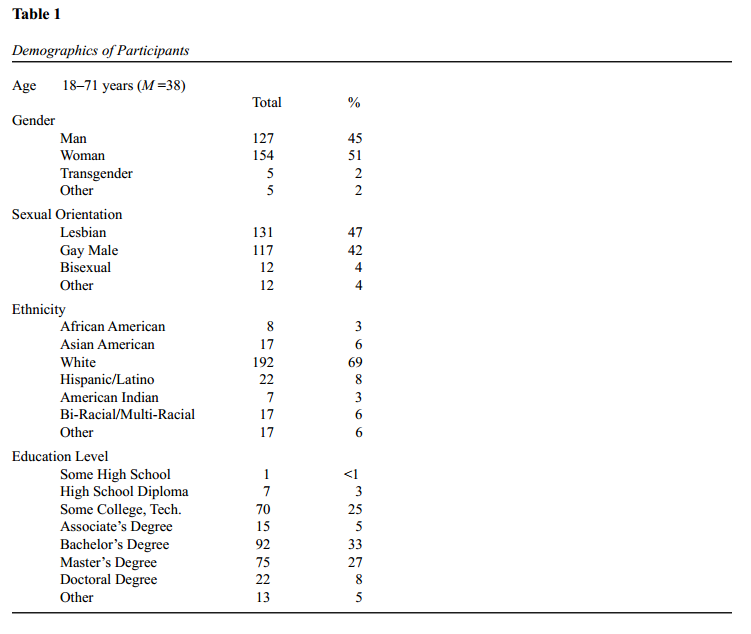
Two hundred ninety individuals between the ages of 18 and 71 responded to our study. Forty-seven percent (n = 131) of respondents identified as lesbian, 42% (n = 117) as gay, and 4% (n = 12) as bisexual. More than half of the respondents identified their gender identity as woman (51%, n = 154), 45% (n=127) as man, 2% (n = 5) as transgender, and 2% (n = 5) as “other.” Seventy-three percent (n = 204) had an associate’s degree or higher, and 69% (n=192) identified as White (see Table 1 for complete demographics). Due to the small number of transgender respondents, we did not examine their experiences by gender identity. We do recognize, however, the unique interaction between gender identity and sexual identity, and encourage future research in this area.
Materials
Levels of Outness. The questions used in this study that assessed level of outness of participants were adapted with permission from a survey developed by Rankin (2003). These questions are part of a larger campus climate survey that is used nationally to assess campus climate for community members. This set of questions showed high internal consistency (α = .80). Using a varimax rotation, items load as one factor and account for 65% of the variance.
Internalized Homophobia Scale (IHP; Martin & Dean, 1987). The Internalized Homophobia Scale is a 9-item measure adapted for self-report. Previous research has indicated that the self-administered version of the IHP scale has acceptable internal consistency and correlated as expected with relevant measures (Herek & Glunt, 1995). Items are administered with a 5-point response scale, ranging from disagree strongly to agree strongly. Reliability coefficients for this scale are typically higher for men (α = .83) then women (α = .71).
Procedure
An online survey was created through PsychData, a Web-based company that conducts Internet-based research in the social sciences. Participants were invited through email advertisements to general and multicultural LGBT list-servs. Personal networks also were utilized. Participants were made aware of the intentions of the survey and the topics they would encounter. Participation was anonymous and all respondents reviewed and gave informed consent before initiating the study. (Appropriate IRB approval was obtained).
Results
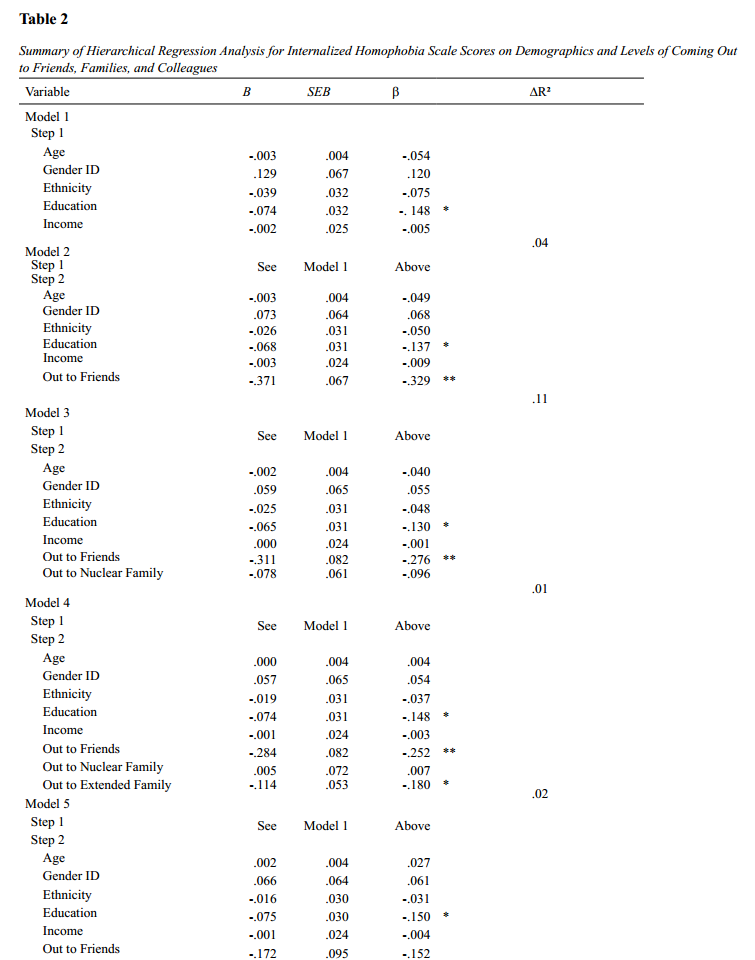
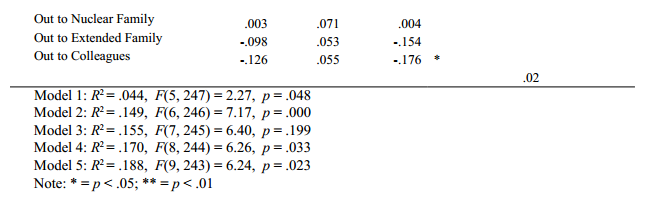
A set of regression procedures were conducted to examine how “coming out” to friends, family, and colleagues predicted scores on the Internalized Homophobia Scale (IHP). Table 2 shows the complete regression summaries. Model 1 regressed demographic variables: age, self-identified gender, ethnicity, education level and reported income. This model accounted for 4% of the overall variance with education level contributing most to the prediction of IHP scores (β = -.15, p < .05). This model was used in each of the following hierarchical models as a first step to control for demographics to examine the prediction value of each “coming out” variable.
Model 2 emerged as a significant model. Coming “out to friends” was added as a second step to the model and accounted for an additional 11% of the variance after controlling for demographics. According to the standardized regression coefficients, this variable provided a significant contribution to the prediction of IHP scores (see Table 2). Model 3 did not emerge as a significant model. By including coming “out to nuclear family” only an addition 1% of the total variance was accounted for. Within the third model, coming “out to friends” remained the largest contributor to the prediction of internalized homophobia (β = -.28, p < .05).
Model 4 and Model 5 emerged as significant models. In Model 4, the second step added coming “out to extended family” and contributed 2% to the total variance. Standardized regression coefficients indicated coming “out to friends” and “out to extended family members” were the strongest contributors to the model. By adding “out to colleagues” to the second step of the fifth model, an additional 2% of the variance was accounted for beyond demographics. “Out to colleagues” contributed the most to the predication of internalized homophobia beyond demographic differences, coming out to friends, coming out to nuclear family, and coming out to extended family (β = -.18, p < .05). Model 5 accounted for almost 19% of the total variance.
Discussion
The findings from our study suggest internalized homophobia impacts whether one is out to friends, colleagues, and extended family, but not to nuclear family. These findings are surprising as we hypothesized internalized homophobia would impact whether one is out to all family members (nuclear and extended), friends, and colleagues. Specifically, we hypothesized that higher internalized homophobia would lessen the likelihood that LGB individuals disclose as lesbian, gay, or bisexual to all family (nuclear and extended), friends, and colleagues. This assumption was based on the professional literature that underscored the fact that experiences in an anti-gay society can lead LGB individuals to internalize prejudicial messages and have negative views of self, and the potential consequences of coming out to family (family crisis), friends (disconnection and loss of friends), and work colleagues (dismissal and mistreatment; Hunter, 2007; Rotheram-Borus & Langabeer, 2001; Savin-Williams & Ream, 2003).
Education level also was a strong predictor of internalized homophobia for the sample in this study. Education level may be influential because individuals who are more “in the know” may accept that internalized homophobia is a barrier to self-acceptance and therefore an issue worth addressing and resolving. Further, coming out to friends and colleagues contributed strongly to internalized homophobia which may be a result of the experiences of LGB individuals in an anti-gay society and the possibility that friends and colleagues represent non-affirming members of our society. Therefore, the greater the discomfort with one’s same gender sexual identity, the less likely a LGB individual will come out to friends or co-workers for fear of negative consequences.
Although Hunter (2007) posited that LGB people most often come out to friends first, our study underscores a unique relationship between internalized homophobia and coming out to friends in that respondents with higher internalized homophobia were less out to friends. Findings from the National Lesbian Health Care Survey (NLHCS; Bradford, Ryan, & Rothblum, 1993) support this finding from our study. Correlations from the NLHCS suggest lesbians with higher internalized homophobia feared exposure as a lesbian to heterosexual friends. Furthermore, 88% of lesbians from the NLHCS were out to other LGB individuals, but only 28% were out to heterosexual friends. Perhaps respondents in our study who had higher internalized homophobia had similar fears regarding disclosure to heterosexual friends, particularly those who were non-affirming of LGB sexual identities. Furthermore, based on the results of our study and the professional literature, it is possible to assert that respondents from our study who had lower internalized homophobia were more comfortable coming out to friends who were affirming of LGB sexual identities.
Research suggests that LGB individuals who are more open at work experience higher levels of job satisfaction, commitment to the workplace, the fostering of a healthy identity, and the encouragement of employers to promote a diverse workplace (Day & Shoenrade, 1997; Griffith & Hebl, 2002; King, Reilly, & Hebl, 2008). While there are positive aspects of research surrounding coming out at work, research also suggests that more than two-thirds of LGB people think coming out to the workplace would create problems (i.e., not being hired, not being promoted, not receiving support and mentorship necessary for professional development, or loss of job; Hunter, 2007). The context in which an individual comes out at work is much more important than the situational factors which lead them to come out (King, Reilly, & Hebl, 2008). Consequently, many LGB individuals stay closeted at work in anticipation of rejection, which is often based on a lack of legal protection or personal experiences with an anti-gay organizational climate.
Our study uncovered a strong relationship between internalized homophobia and level of outness at work. In fact, outness to colleagues was the largest predictor of internalized homophobia above and beyond all other variables analyzed in this study. Based on this finding, we defend previously cited research that LGB individuals are more likely to be out and experience less internalized homophobia when they have had positive experiences with coming out in the past, or when their organizations are gay-friendly, include written non-discrimination policies and advocate on behalf of LGB people (i.e., offer trainings and workshops that incorporate LGB issues; Griffith & Hebl, 2002). Friskopp and Silverstein (1995) concur with our findings by suggesting those who disclosed at work were not only more comfortable with their sexual identity, but also had many previous disclosures with heterosexual friends and relatives. In the same respect, LGB individuals who enter and remain in a workplace where heterosexism and homophobia are pervasive may never come out to co-workers or may be very selective about to whom they come out (Hunter, 2007). They might decide to pass to divide their work life and personal life, and avoid discrimination at all costs (DeJordy, 2008). Passing, while helpful in the organizational environment, can be harmful to the individual because it reduces an individual’s authenticity of one’s behavior, lowers one’s self-esteem, and denies or suppresses an individual’s LGB identity.
Results from the NLHCS (Bradford, Ryan, & Rothblum, 1993) support Hunter (2007) and our research: lesbians who were less out to co-workers had more fear of exposure as lesbian. For some LGB individuals, “just the thought of disclosure at work typically creates considerable anxiety” (Hunter, 2007, p. 124). This might be true for the participants in our study.
Finally, our hypothesis that internalized homophobia will predict outness to all family members, including nuclear and extended, was partially supported by our results. In particular, internalized homophobia was not a predictor of outness to nuclear family, but was a predictor of outness to extended family.
The fact that internalized homophobia did not predict outness to nuclear family was surprising considering the high degree of difficulty and anxiety associated with coming out to parents, the anticipated rejection by the nuclear family, and the fact that many LGB individuals remain closeted to family members indefinitely or until later in life (Hunter, 2007). Paul and Frieden (2008) contend that negative social messages about LGB sexual identities, particularly those made by family, friends, and religious organizations, increases the challenge of self-acceptance as LGB. With a lack of self-acceptance coupled with “fears related to a potential loss of relationship with specific family members,” LGB individuals might refrain from disclosing their sexual minority identities (Paul & Frieden, 2008, p. 43). It could be assumed that internalized homophobia would affect the act of coming out to family, particularly nuclear family, since “there is no predicting” how parents will react, and disclosure could cause “great turmoil in the home” (Hunter, 2007, p. 95.). Based on the aforementioned assumption, our initial hypothesis would stand. This conception, however, was not supported by the results of our study as internalized homophobia predicted outness to extended family and not nuclear family. It appears that the disclosures or lack of disclosures to nuclear family by participants in our study were not influenced by internalized homophobia. Future research that explores factors that impact disclosure to nuclear family is warranted in order to more fully understand this relationship.
Implications for Counseling
This study presents many implications for counselors. First, experiences with internalized homophobia can impact the lives of LGB individuals, particularly the coming out process.
“If one has a high level of internalized homophobia, the [coming out] process can be fraught with turmoil; however, if the individual is able to connect with supportive people who can help him or her dispel the negative attitudes of society, that state is temporary. This is an area in which counselors can aid in the process” (Matthews, 2005, p. 212).
An affirmative counselor can model a positive reaction to an LGB client’s disclosure, provide a corrective emotional experience for that client, and instill hope that positive consequences can result from coming out. This can help the client externalize his or her experiences with homophobia, and move towards self-acceptance (Matthews, 2007). Ridge, Plummer, and Peasley (2006) found that positive self-talk, writing about problems, and making more positive choices were helpful when an individual is looking to defeat feelings of internalized homophobia. On the other hand, a counselor who perpetuates messages of homophobia or heterosexism can reinforce the negative experiences of the LGB client, and thus cause more distress and heartache.
It is essential that affirmative counselors avoid heterosexism in clinical practice (i.e., review clinical paperwork for heterosexist language; decorate office to be inclusive of diverse sexual identities; advocate for a non-discrimination policy that is inclusive of sexual and gender identity). A counselor also must overcome heterosexism through self-examination and self-education where biases and prejudices are identified and dispelled (Matthews, 2007). Additionally, it is necessary for affirmative counselors to develop the knowledge and skills necessary for working with LGB clients. Continuing education opportunities such as conference workshops and graduate classes that focus on LGB issues are excellent ways to enhance a counselor’s multicultural competency to work with LGB clients. Familiarizing oneself with the LGB community (local and national) by attending LGB venues (i.e., parades, community centers, LGB bookstores), and learning key LGB figures who contributed to LGB rights through movies and literature are all important steps in becoming an affirmative counselor.
“Personal contact is the most consistently influential factor in reducing prejudice” (Hunter, 2007, p. 168). Therefore, it is invaluable for affirmative counselors, particularly heterosexual counselors, to spend time with LGB people. This will help challenge misconceptions and messages that have been learned as members of a society that perpetuates anti-gay attitudes and beliefs in many domains. Counselors must help clients explore and discover how they wish to self-identify, whether it is lesbian, gay, bisexual, queer, or questioning another identity. It is important to use caution in assigning the client an identity before he or she is ready to self-identity. It is beneficial for counselors to utilize sexual minority identity development models (see, for example, Cass, 1979; D’Augelli, 1994; McCarn & Fassinger, 1996; Troiden, 1979). Although these models present stages or phases that are often experienced during the coming out process, it is important to use them as guides as each LGB client is unique and may experience coming out differently.
Coming out can be a risky process, but also an empowering experience for LGB individuals (Matthews, 2007). Consequently, as a counselor, it is important to consider the potential dangers and benefits of disclosing to various individuals in the LGB client’s life. A LGB client might decide not to disclose to a particular individual because the negative consequences outweigh the positives. Counselors should support the decisions made by clients, and always ensure their personal safety (Hunter, 2007). Although there might be consequences as a result of disclosure, there will likely be long-term gains in self-acceptance and overall psychological health for LGB individuals.
It also is very important for an LGB individual to establish a connection to the LGBT community (Matthews, 2007). As a counselor, it is vital to be able to promote exposure to and interaction with positive elements of the LGB community. There are a number of online options such as support groups, chat rooms, and list-servs. Community options include LGBT community centers, support groups at counseling centers, and LGBT-sponsored events. Counselors should be familiar with these resources and prepared ahead of the counseling session to share them with a LGB client. Caution should be used in identifying resources to ensure they are safe and healthy avenues for support.
Limitations and Areas for Future Research
A possible limitation of this research is that it represents a one-time measurement of self-reported data. Such complex perceptions of being closeted and the corresponding feelings of internalized homophobia may be viewed as a dynamic process subject to change over time and experiences. Moradi, Mohr, Worthington, and Fassinger (2009) suggest using experimental, repeated measures designs, and longitudinal designs to best determine causal and or developmental hypotheses regarding sexual minority research areas and would benefit research such as this one. Future research will look toward long-term methods of measuring levels of outness and corresponding feelings of internalized homophobia over time. Additional future research should focus on homophobia and heterosexism in the workplace which, according to a report by the Human Rights Campaign (2001) “occurred in every area of the country, happened in a range of workplaces, and affected employees at all levels” (Smith & Ingram, 2004, p. 59). Although anti-LGB discrimination in the workplace is pervasive in our society, this topic remains under-explored. Finally, best practices to reduce the negative effects of internalized homophobia should be examined. Although internalized homophobia is a strong influential factor to coming out, the exploration of additional risk factors is essential in gaining a stronger understanding of sexual minority identity development.
References
Bobbe, J. (2002). Treatment with lesbian alcoholics: Healing shame and internalized homophobia for ongoing sobriety. Health and Social Work, 27(3), 218–222.
Bradford, J., Ryan, C., & Rothblum, E. (1994). National Lesbian Health Care Survey: Implications for mental health care. Journal of Consulting and Clinical Psychology, 62(2), 228–242.
Brown, L. (1989). Lesbians, gay men, and their families: Common clinical issues. Journal of Gay and Lesbian Psychotherapy, 1(1), 65–77.
Browning, C., Reynolds, A. L., & Dworkin, S. H. (1991). Affirmative psychotherapy for lesbian women. The Counseling Psychologist, 19(2), 177–196.
Cabaj, R. P. (2000). Substance abuse, internalized homophobia, and gay men and lesbians: Psychodynamic issues and clinical implications. In J. R. Guss & J. Drescher (Eds.), Addictions in the gay and lesbian community (pp. 5–24). Binghamton, NY: Haworth.
Cain, R. (1991). Stigma management and gay identity development. Social Work, 36(1), 67–73.
Carpineto, J., Kubicek, K., Weiss, G., Iverson, E., & Kipke, M. D. (2008). Young men’s perspectives on family support and disclosures of same-sex attraction. Journal of LGBT Issues in Counseling, 2(1), 53–80.
Cass, V. (1979) Homosexual identity formation: A theoretical model. Journal of Homosexuality, 4(3), 219–235.
Center for Substance Abuse Treatment. (2001). A provider’s introduction to substance abuse treatment for lesbian, gay, bisexual, and transgender individuals. DHHS Publication No. (SMA) 01-3498. Rockville, MD: CSAT.
D’Augelli, A. R. (1994). Identity development and sexual orientation: Toward a model of lesbian, gay, and bisexual development. In E. W. Trickett, R. J. Watts & D. Birman (Eds.), Human diversity: Perspectives on people in context. San Francisco, CA: Jossey-Bass.
D’Augelli, A. R., Grossman, A, H., & Starks, M. T. (2005). Parents’ awareness of lesbian, gay, bisexual youths’ sexual orientation. Journal of Marriage and Family Therapy, 67, 474–482.
D’Augelli, D. & Hershberger, S. L. (2002). Incidence and mental health impact of sexual orientation victimization of lesbian, gay, and bisexual youths in high school. School Psychology Quarterly, 17, 148–167.
Davies, D. (1996). Homophobia and heterosexism. In D. Davies & C. Neal (Eds.), Pink therapy: A guide for counselors and therapists working with lesbian, gay, and bisexual clients (pp. 41–65). Buckingham, England: Open University Press.
Day, N., & Schoenrade, P. (1997). Staying in the closet versus coming out: Relationships between communication about sexual orientation and work attitudes. Personnel Psychology, 50(1), 147–163.
DeJordy, R. (2008). Just passing through – stigma, passing, and identity decoupling in the work place. Group and Organization Management, 33(5), 504–531.
Diamond, D. L., & Wilsnack, S. C. (1978) Alcohol abuse among lesbians: A descriptive study. Journal of Homosexuality, 4(2), 123–142.
Flowers P., & Buston K. (2001). “I was terrified of being different”: Exploring gay men’s accounts of growing-up in a heterosexist society. Journal of Adolescence, 24(1), 51–65.
Friskopp, A., & Silverstein S. (1995). Straight jobs, Ggay lives: Gay and lesbian professionals, the Harvard Business School, and the American workplace. New York, NY: Scribner.
Galupo, M.P. (2006). Sexism, heterosexism, and biphobia: The framing of bisexual women’s friendships. Journal of Bisexuality, 6(3), 35–45.
Griffith, K. H., & Hebl, M. R. (2002). The disclosure dilemma for gay men and lesbians: “Coming out” at work. Journal of Applied Psychology, 87(6), 1191–1199.
Herek, G. M. (1996). Heterosexism and homophobia. In R. P. Cabaj & T. S. Stein (Eds.), Textbook of homosexuality and mental health (pp. 101–113). Washington, DC: American Psychiatric Press.
Herek, G. M., & Glunt, E. K. (1995). Identity and community among gay and bisexual men in the AIDS era: Preliminary findings from the Sacramento Men’s Health Study. In G. M. Herek & B. Greene (Eds.) AIDS, identity, and community: The HIV epidemic and lesbians and gay men (pp. 55–84). Thousand Oaks, CA: Sage.
Hoang, M., Holloway, J., & Mendoza, R. H. (2011). An empirical study into the relationship between bisexual identity congruence, internalized biphobia and infidelity among bisexual women. Journal of Bisexuality, 11, 23–38.
Hunter, S. (2007). Coming out and disclosures: LGBT persons across the life span. Binghamton, New York, NY: Haworth.
Iwasaki, Y., & Ristock, J. (2007). The nature of stress experienced by lesbians and gay men. Anxiety, Stress and Coping: An International Journal, 20(20), 299–319.
King, E. B., Reilly, C., & Hebl, M. (2008). The best of times, the worst of times – exploring dual perspectives of “coming out” in the workplace. Group and Organization Management, 33(5), 566–601.
Knous, H. M. (2005). The coming out experience for bisexuals: Identity formation and stigma management. Journal of Bisexuality, 5(4), 37–59.
Kus, R. J. (1988). Alcoholism and non-acceptance of gay self: The critical link. Journal of Homosexuality, 15(1-2), 25–41.
Lewis, C. E., Saghir, M. T., & Robins, E. (1982). Drinking patterns in homosexual and heterosexual women. Journal of Clinical Psychiatry, 43(7), 277–279.
McCarn, S. R., & Fassinger, R. E. (1996). Re-visioning sexual minority identity formation: A new model of lesbian identity and its implications for counseling and research. The Counseling Psychologist, 24(3), 508–534.
McGregor, B., Carver, C., Antoni, M., Weiss, S., Yount, S., & Ironson, G. (2001). Distress and internalized homophobia among lesbian women treated for early stage breast cancer. Psychology of Women Quarterly, 25(1), 1–9.
Martin, J., & Dean, L. (1987). Ego-dystonic Homosexuality Scale. School of Public Health, Columbia University.
Matthews, C. R. (2007). Affirmative lesbian, gay, and bisexual counseling with all clients. In K. J. Bieschke, R. M. Perez, & K. A. DeBord (Eds.), Handbook of counseling and psychotherapy with lesbian, gay, bisexual, and transgender clients, (2nd ed., pp. 201–219). Washington, DC: American Psychological Association.
Moradi, B., Mohr, J., Worthington, R. L., & Fassinger, R. (Guest Eds.) (2009). Special Issue: Advances in research with sexual minority people. Journal of Counseling Psychology, 56(1), 23–43.
Neisen, J. H. (1990). Heterosexism: Redefining homophobia for the 1990’s. Journal of Gay and Lesbian Psychotherapy, 1(3), 21–35.
Paul, P., & Frieden, G. (2008). The lived experience of gay identity development: A phenomenological study. Journal of LGBT Issues in Counseling, 2(1), 25–52.
Rankin, S. (2003). Campus climate for sexual minorities: A national perspective. New York, NY: National Gay and Lesbian Task Force Policy Institute.
Rankin, S., Weber, G., Blumenfeld, W., & Frazer, S. (2010). 2010 State of Higher Education for LGBT People. Charlotte, NC: Campus Pride.
Reynolds, A. L., & Hanjorgiris, W. F. (2000). Coming out: Lesbian, gay, and bisexual identity development. In R. M. Perez, K. A. DeBord, & K. J. Bieschke (Eds.), Handbook of counseling and psychotherapy with lesbian, gay, and bisexual clients, (pp. 35–55). Washington, DC: American Psychological Association.
Ridge, D., Plummer, D., & Peasley, D,. (2006). Remaking the masculine self and coping in the liminal world of the gay ‘scene’. Culture, Health & Sexuality, 8(6), 501–514.
Rosario, M., Schrimshaw, E. W., Hunter, J., & Braun, L. (2006). Sexual identity development among lesbian, gay, and bisexual youths: consistency and change over time. Journal of Sex Research, 43(1), 46–58.
Ross, M. W., & Rosser, S. B. (1996). Measurement and correlates of internalized homophobia: A factor analytic study. Journal of Clinical Psychology, 52(1), 15–20.
Rotheram-Borus, M. J., & Langabeer, K. A. (2001). Developmental trajectories of gay, lesbian, and bisexual youth. In A. D’Augelli, & C. Patterson (Eds.), Lesbian, gay, and bisexual identities and youth: Psychological perspectives (pp. 97–128). Oxford: Oxford University Press.
Rowen, C., & Malcolm, J. (2002). Correlates of internalized homophobia and homosexual identity formation in a sample of gay men. Journal of Homosexuality, 43(2), 77–92.
Saghir, M. T., & Robins, E. (1973). Male and female homosexuality: A comprehensive investigation. Baltimore, MD: Williams and Wilkins.
Savin-Williams, R. C., & Ream, G. L. (2003). Sex variations in the disclosure to parents of same-sex attractions. Journal of Family Psychology, 17, 429–438.
Selvidge, M. (2000). The relationship of sexist events, heterosexist events, self-concealment and self-monitoring to psychological well-being in lesbian and bisexual women. Unpublished doctoral dissertation, University of Memphis, Memphis, Tennessee.
Shapiro, D.N., Rios, D., & Stewart, A.J. (2010). Conceptualizing lesbian sexual identity development: narrative accounts of socializing structures and individual decisions and actions. Feminism & Psychology, 20(4), 491–510.
Smiley, E. B. (1997). Counseling bisexual clients. Journal of Mental Health Counseling, 19, 373–382.
Smith, N. G., & Ingram, K. M. (2004). Workplace heterosexism and adjustment among lesbian, gay, and bisexual individuals: The role of unsupportive social interactions. Journal of Counseling Psychology, 51(1), 57–67.
Spencer, S. M., & Patrick, J. H. (2009). Social support and personal mastery as protective resources during emerging adulthood. Journal of Adult Development, 16, 191–198.
Stall, R., & Wiley, J. (1988). A comparison of alcohol and drug use patterns of homosexual and heterosexual men: The San Francisco Men’s Health Study. Drug and Alcohol Dependence, 22(1-2), 63–73.
Stein, T. S., & Cabaj, R. P. (1996). Psychotherapy and gay men. In R. P. Cabaj & T. S. Stein (Eds.), Textbook of homosexuality and mental health (pp. 413–432). Washington, DC: American Psychiatric Press.
Troiden, R. (1979) Becoming homosexual: A model of gay identity acquisition. Psychiatry, 42(4), 362–373.
Wagner, G., Brondolo, E., & Rabkin, J. (1996). Internalized homophobia in a sample of HIV+ gay men, and its relationship to psychological distress, coping, and illness progression. Journal of Homosexuality, 32(2), 91–106.
Weber, G. N. (2008). Using to numb the pain. Journal of Mental Health Counseling, 30(1), 31–48.
Genevieve Weber-Gilmore and Sage Rose are Assistant Professors at Hofstra University. Rebecca Rubinstein is a graduate student in Rehabilitation and Mental Health Counseling at Hofstra University. Correspondence can be addressed to Genevieve Weber-Gilmore, Hofstra University, Department of Counseling and Mental Health Professions, Hempstead, NY, 11549-1000, genevieve.weber@hofstra.edu.
Sep 6, 2014 | Article, Volume 1 - Issue 2
Michael Lee Powell, Rebecca A. Newgent
Aligning with a particular theoretical orientation or personal multi-theory integration is often a formidable task to entry-level counselors. A better understanding of how personal strengths and abilities fit with theoretical approaches may facilitate this process. To examine this connection, thirty-five mental health professionals completed a series of inventories to determine if passive counselors adhere to more nondirective, insight-oriented theories, while assertive counselors adhere to more directive, action-oriented approaches. Analyses revealed a significant difference between level of assertiveness and theoretical orientation, with action-oriented counselors demonstrating significantly higher levels of assertiveness than insight-oriented counselors. Implications for professional practice and counselor education are discussed.
Keywords: assertiveness, theoretical orientation, action-oriented, insight-oriented, professional practice, counselors
Murdock, Banta, Stromseth, Viene, and Brown (1998) assert that research into the predictors of theory construction benefits the profession, because the information aids educators and clinical supervisors in helping students and beginning counselors to adopt an appropriate theoretical orientation. If counselors knew what personal strengths and abilities fit best with potential therapeutic approaches (Johnson, Germer, Efran, & Overton, 1988), then adhering to a model of therapy might be less complex, more satisfying, and essentially advantageous for their clientele. To assist in the alleviation of this issue, this study intends to examine the difference between insight-oriented and action-oriented counselors on level of assertiveness.
One of the most exciting and typically daunting tasks for counselors is choosing a theoretical orientation (Halbur & Halbur, 2005). Particularly, choosing one that adequately explains human development and functioning while also attempting to purport interventions that can facilitate greater personal growth and behavioral change in clients. Doing so, however, requires more than simple investigation into the diverse multitude of therapeutic approaches available to counselors. According to Patterson (1985), extensive self-exploration into one’s own personality, values, abilities, and beliefs about human nature are equally salient, as is mandatory longstanding experience. Even then, counselors find that no one theory may suffice or help explain human complexity, which leads to personal theory construction, attempts at theoretical integration, and/or technical eclecticism (Corey, 2008).
Simplifying personal theory construction, or single/multi-theory integration, might assist counselors in choosing a theory that is a better fit for them. With over 400 available therapeutic models (Corsini & Wedding, 2008), counselors find themselves overwhelmed and indifferent to obtaining a sound theoretical foundation, and opt for more technique-oriented practices (Cheston, 2000; Freeman, 2003). Improvements in the manner in which counselors choose a theory would advance knowledge and understanding about the usefulness of adhering to a particular model of therapy. This would also increase treatment consistency and decrease the haphazard, inexperienced practice common with counselors who compile a therapeutic toolbox of empirically-supported interventions, but fail to grasp the rationale that supports their use (Corey, 2008). According to Corsini and Wedding (2008), good therapists follow a particular theory and use techniques associated with that theory and that “technique and method are always secondary to the clinician’s sense of what is the right thing to do with a given client at a given moment in time” (Corsini & Wedding, 2008, p. 10). Further, MacCluskie (2010) discusses the role of theory in counseling and states that, “Practitioners need theories because it is our theory that drives our understanding and conceptualization of the client, the client’s problem, and what strategies and techniques we might use to help the client grow and/or feel better” (p. 9).
Style and Theoretical Orientation
Researchers interested in how a counselor constructs or chooses a particular theory examine multiple predictive factors. For example, Scragg, Bor, and Watts (1999) examined graduate students’ scores on personality assessments as predictors of a chosen theoretical model. They categorized students into two groups derived from their interest in studying directive or nondirective approaches, and found that students interested in the nondirective theories tend to prefer dealing with the abstract and working in an unstructured manner, and that students interested in learning more directive approaches appear to have more charm and leadership ability than the nondirective group. Similarly, Erickson (1993) found differences between theoretical groups based on personality assessment. She measured counselors using the thinking/feeling typology of the Myers-Briggs Type Indicator and found that thinking types reported preferences toward cognitive approaches (e.g., REBT), and feeling types favored affective approaches (e.g., Person-Centered).
Murdock et al. (1998) investigated whether one’s philosophical assumptions, interpersonal style, and supervisor orientation were consistent with specific theoretical orientations. They found that existential/gestalt counselors favor holistic philosophies rather than behavioral ones, which is consistent with their orientation. The systems/interpersonal group preferred observable and contextual causes of behavior rather than mental explanations, and the cognitive/cognitive-behavioral counselors scored high on elementarism (mechanistic, as opposed to holistic) due to their tendency to attend to client’s thoughts and behaviors as the source of change. The psychoanalytics, however, were the only group to score significantly higher on all other measures, meaning they tend to be more dominant interpersonally and prefer supervision from same-orientation supervisors.
Walton (1978) examined counselor self-concept, or view of personal self, as a potential factor predicting theoretical orientation. Among the factors analyzed on a semantic differential instrument, differences between complexity and seriousness were found between the psychodynamic counselor and one who adheres to a rational-emotive approach. Psychodynamic counselors reported themselves as serious and intricate, contrasted to the rational-emotive group who viewed themselves as simple and humorous.
Cummings and Luchese (1978) postulated, “The emergence of an orientation is one given to the whims of fate” (p. 327), not choice, which Steiner (1978) identified as a direct result of one’s chosen graduate training and persuasive influence from professors and supervisors. Norcross and Prochaska (1983) disagree, arguing that it is foolish to think “clinicians select an orientation largely on inexplicable or accidental grounds” (p. 197). They questioned experienced psychologists, not graduate students, as to what factors fueled their theory selection. Among the various influences obtained via survey, clinical experience rated as the most influential. Other factors such as values, graduate training, postgraduate training, life experiences, internship, and the theory’s ability to help in self-discovery received strong ratings. Client type, orientations of colleagues, undergraduate training, and accidental circumstances received a weak or no influential rating.
Although client type was found less influential than other predictive factors (Norcross & Prochaska, 1983), researchers who support technical eclecticism argue otherwise, asserting that a client’s needs should determine a clinician’s orientation (Cheston, 2000; Erickson, 1993). Supporters of this approach encourage clinicians to consider adhering to methodologies that utilize specific empathic techniques that build greater rapport and subsequent growth in clients who conceptually do better with a particular interpersonal style (Bayne, 1995; Churchill & Bayne, 2001). Bayne (1995), for example, contends that if a client appears less innovative and more practical, then he or she should receive cognitive-behavioral counseling, rather than approaches that require creative expression. Extroverts, according to Bayne (1995), are more suitable for humanistic or insight-oriented approaches and group counseling, because they tend to be more sociable and talkative.
Assertiveness and Orientation
According to Gass and Seiter (2003), “Assertive people are not afraid to speak up, express their feelings, or take initiative” (p. 115). Assertive people are viewed as more socially influencing (Cialdini, 2001). In the clinical community, assertive people are sometimes defined by the amount of directiveness utilized in therapy. Kottler and Brown (2000) explain that directiveness involves one’s ability to influence an individual or family in such a way that they are motivated to make positive changes one goal at a time. They state that by taking initiative, setting limits, structuring sessions, and defending their suggestions, directive counselors are more likely to use their expert position for positive therapeutic gains. However, this does not mean that assertiveness equals directiveness, per se. No known research exists to validate that the two are parallel.
Although assertiveness on the part of the counselor is an influential factor in client growth and development, and essential for conflict resolution (Ramirez & Winer, 1983; Smaby & Tamminen, 1976), it has not been isolated or tested as an actual predictor for theoretical orientation. This study aims to add to the list of predictive factors that potentially contribute to the adoption of a theoretical orientation by examining whether an experienced counselor’s level of assertiveness relates to his or her chosen approach. Namely, whether passive counselors tend to adhere to more nondirective, insight-oriented theories, and if assertive counselors tend to adhere to more directive, action-oriented approaches.
Method
Participants
Thirty-five (N = 35) mental health professionals from two mid-south community mental health agencies participated in this study. Fifty packets containing each instrument were hand delivered to qualifying participants, resulting in a 70% response rate. Purposive sampling was used to ensure that respondents had at least two years of clinical experience, and to obtain enough participants from different experience levels. The reason experienced counselors were chosen is that they have had more time to practice different approaches and are more likely to have identified the orientation that best fits them, whereas “students are not capable of formulating a theory,” since “theories are developed by mature individuals on the basis of a thorough knowledge of existing theories and long experience” (Patterson, 1985, p. 349).
Participants had the following licenses: Clinical Psychologist (n = 1); Counseling Psychologist (n = 3); Psychological Examiner (n = 7); Social Worker (n = 12); and Professional Counselor (n = 13). There were 20 females and 15 males. Nineteen participants reported between 2–5 years of experience, while six reported having between 5–10 years of experience, and 10 reported having more than 10 years of experience. Sixteen participants reported adhering to an insight-oriented approach, and 19 were action-oriented. Each participant self-identified as Caucasian.
Instruments
Assertiveness Self-Report Inventory. The Assertiveness Self-Report Inventory (ASRI; Herzberger, Chan, & Katz, 1984) is a brief measure of behavioral assertiveness, developed intentionally with adequate validity data in mind. Other measures of assertiveness have been criticized for not reporting psychometric information (Corcoran, 2000). The instrument is a 25-item measurement with a forced-choice, true/false scale, with half of the items reverse scored to decrease the likelihood of a response set.
Herzberger et al. (1984) report high internal consistency with the ASRI (Cronbach’s Alpha = .78), strong test/retest reliability (r = .81, p < .001), and strong convergent validity with the Rathus Assertiveness Schedule (Rathus, 1973) during two testing sessions (r = .70, p < .001; r = .63, p < .001). For further validation, two criterion-related studies were conducted measuring participants’ ability to offer assertive-like solutions to social dilemmas and peer ratings of participants’ assertiveness. Both studies produced significant relationships to scores on the ASRI (r = .67, p < .001; r = .40, p < .005).
Bakker Assertiveness-Aggressiveness Inventory. The Bakker Assertiveness-Aggressiveness Inventory (AS-AG; Bakker, Bakker-Rabdau, & Breit, 1978) is a 36-item inventory that measures two dimensions of assertiveness necessary for social functioning: the ability to refuse unreasonable requests (Assertiveness) and the ability to take initiative, make requests, or ask for favors (Aggressiveness), with both scales available for use as separate 18-item instruments (Corcoran, 2000). Each item provides the reader with a specific conflict situation and a specific behavioral response, and asks examinees to rate the likelihood that they would respond in the same manner. Half the items contain an assertive response, whereas the other half contains more passive, submissive responses (Bakker et al., 1978). Each item is scored on a five-point likert scale ranging from almost always (AA = 1) to almost never (AN = 5).
Normative data were collected from seven groups, including health professionals, city employees, college students, and clients of an adult development program seeking assertiveness training. Test-retest reliability data are strong for both scales: .75 for the assertiveness scale and .88 for the aggressiveness scale, and split-half reliability of .58 and .67 for both scales, respectively (Bakker et al., 1978). Validity measures were obtained by comparing each group with the college sample, since it was the largest (n = 250). The only group to significantly differ in assertiveness/aggressiveness was the adult development program clients (p < .001), confirming “that the scales are sensitive to differences in functioning” (Bakker et al., p. 282).
The Simple Rathus Assertiveness Schedule. The Simple Rathus Assertiveness Schedule (SRAS; McCormick, 1985) is a revised measure of the Rathus Assertiveness Schedule (Rathus, 1973) designed to improve the original measure’s readability and usability (Corcoran, 2000). A 30-item instrument, the schedule measures social boldness by asking readers to rate themselves on various personal inclinations, such as I enjoy meeting and talking to people for the first time and I have sometimes not asked questions for fear of sounding stupid (McCormick, 1985). Items are scored on a six-point Likert scale, ranging from 6 (very much like me) to 1 (very unlike me).
Reliability for the SRAS is “very good” (Corcoran, 2000, p. 746) when compared with the original Rathus, with the correlation between odd and even items on both versions at .90, and overall total scores correlating at .94, suggesting that “a satisfactory degree of equivalence had been obtained between both measures” (McCormick, 1985, p. 97). The original Rathus reported test/retest reliabilities of .77 (p < .01) and strong convergent validity with other measures of assertiveness.
Procedure
Participants were placed in one of two groups based on their reported theoretical orientation, which Kottler and Brown (2000) categorized as insight-oriented and action-oriented. Insight-oriented approaches believe that self-discovery and revelation is the path to true growth and consists of humanistic, psychodynamic, interpersonal, and experiential theories. Action-oriented approaches are defined as theories that utilize direct interventions and action for symptom reduction. Theories within this category are behavioral, cognitive, strategic, and solution-focused in nature.
Both groups completed an assessment packet, consisting of an informed consent form, a demographic sheet, and the three measurements of assertiveness. Presentation of instruments was identical in both groups. Scores were totaled and compared between each group. Consent forms were kept separate to ensure confidentiality of the information.
Results
A Pearson product-moment correlation analyzed the relationship between all three assertiveness instruments to investigate convergent validity. This analysis revealed a significant positive correlation between the ASRI and SRAS (r = .78, p < .0001) between the ASAG and SRAS (r = .56, p = .0017) and between the ASRI and ASAG (r = .51, p = .0004). The nature of the correlation coefficients indicates a strong convergent validity between all three instruments.
Data were analyzed via a one-way analysis of variance (ANOVA) in order to find differences between insight-oriented and action-oriented counselors on three assertiveness instruments. Additionally, effect sizes are reported as small ≥ .02, medium ≥ .13, and large ≥ .26 (see Steyn & Ellis, 2010). Sample means and trial effects are presented in Table 1. The ANOVA on the ASRI revealed a significant difference between each group: F(1, 33) = 7.75, MSE = 7.66, p < .0088. The mean score for the insight-oriented group was 13.40 (SD = 2.92), and the mean for the action-oriented group was 16.05 (SD = 2.63). The multivariate effect size η2 = .19 indicates a moderate relationship between theoretical orientation and participant assertiveness.
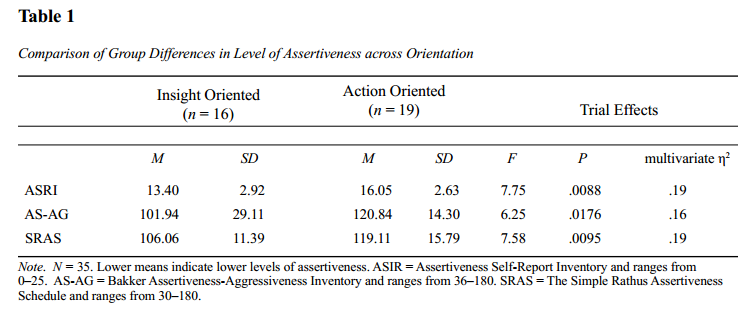
Next, the ANOVA on the AS-AG revealed a significant difference between each group: F(1, 33) = 6.25, MSE = 496.53, p < .0176. The mean score for the insight-oriented group was 101.94 (SD = 29.11), and the mean for the action-oriented group was 120.84 (SD = 14.30). The multivariate effect size η2 = .16 indicates a moderate relationship between theoretical orientation and participant assertiveness.
Finally, the results of the ANOVA on the SRAS revealed a significant difference between each group: F(1, 33) = 7.58, MSE = 195.05, p < .0095. The mean score for the insight-oriented group was 106.06 (SD = 11.39), and the mean for the action-oriented group was 119.11 (SD = 15.79). The multivariate effect size η2 = .19 indicates a moderate relationship between theoretical orientation and participant assertiveness.
Discussion
The purpose of this study was to determine if passive counselors tend to adhere to more nondirective, insight-oriented theories, and if assertive counselors tend to adhere to more directive, action-oriented approaches. Data from scores on the Assertiveness Self-Report Inventory, the Bakker Assertiveness-Aggressiveness Inventory, and the Simple Rathus Assertiveness Schedule suggest that a significant difference does exist between insight-oriented and action-oriented counselors on level of assertiveness, suggesting that level of assertiveness in mental health professionals is a viable factor in theoretical orientation development. In fact, action-oriented counselors had significantly higher levels of assertiveness than the insight-oriented counselors did across all three measures, with the variability of the scores on the AS-AG indicating substantial differences between the two orientations. Not surprisingly, the results on all three measures were in the same direction, consistent with the convergent validity of the measures.
Effect size analyses indicate that moderate relationships exist between theoretical orientation and participant assertiveness, which are clinically meaningful and of practical significance in addition to statistical significance (LeCroy & Krysik, 2007). This finding supports Kottler and Brown’s (2000) position on the nature and quality of directiveness in the therapeutic relationship. That is how assertiveness on the part of the counselor can be an influential factor in client growth and development. This suggests that possibly the two may in fact be parallel. Nonetheless, according to the results, counselors that choose directive approaches appear to be assertive themselves.
Previous research has investigated several predictive factors that contribute to the adoption of a theoretical orientation by counselors (Bayne, 1995; Erickson, 1993; Freeman, 2003; Johnson et al., 1988; Murdock et al., 1998; Norcross & Prochaska, 1983; Steiner, 1978; Walton, 1978). No one study, however, has been able to identify each factor interdependently, opting to isolate specific factors independently via multiple examinations. This study aimed to add to the established list of identified predictive factors by examining whether an experienced counselor’s level of assertiveness relates to his or her chosen approach. We believe that we can now add assertiveness to the list of predictive factors, which include personality type, therapist training, age of clients, and level of counselor development. A limitation in this study was the ability to generalize to different races. All mental health professionals that participated were Caucasian. Another possible limitation was that the participants self-reported on their theoretical orientation.
Implications and Conclusions
The counseling profession benefits from research designed to identify the predictive factors leading to one’s choice of a theoretical orientation. Graduate programs, for example, could use the current data to facilitate the process of theory formation and adoption, including theoretical integration and technical eclecticism, in addition to general instruction that covers the history of theory and the art of the therapeutic relationship. Supervisors of beginning clinicians might profit, not only in facilitating a supervisee’s development of professionalism, but by assisting them to re-examine their strengths and limitations, which may lead to an investigation into new theoretical possibilities that create a better “clinical fit.” Even agencies, conceivably, could utilize the predictors in an attempt to match a client to a particular counselor based on theory and personality. Although this may not seem practical, such an effort could be a positive ingredient for increasing community outcome measures and reducing counselor burnout. Further research supporting this idea would be beneficial. Conversely, further research is necessary to investigate whether matching a counselor’s personality to a theoretical orientation is actually empirically effective. This study is limited by the fact that it does not provide support for such a hypothesis, but does support its consideration.
Although the list of predictive factors leading to a counselor’s choice of orientation is extensive and complex, and no study has been able to identify them in their entirety, it does not mean that isolating the factors for clinical research is meaningless. On the contrary, identifying the predictive factors is advantageous. Doing so could make theory adoption more counselor-centered and satisfying to the adopting practitioner, who can choose an approach that “fits” best.
References
Bakker, C. B., Bakker-Rabdau, M. K., & Breit, S. (1978). The measurement of assertiveness and aggressiveness. Journal of Personality Assessment, 42(3), 277–284.
Bayne, R. (1995). Psychological type and counselling. British Journal of Guidance and Counselling, 23(1), 95–106.
Cheston, S. E. (2000). A new paradigm for teaching counseling theory and practice. Counselor Education and Supervision, 39(4), 254–270.
Churchill, S., & Bayne, R. (2001). Psychological type and conceptions of empathy in experienced counsellors: Qualitative results. Counselling Psychology Quarterly, 14(3), 203–217.
Cialdini, R. B. (2001). Influence: Science and practice (4th ed.). Needham Heights, MA: Allyn and Bacon.
Corcoran, K. J. (2000). Measures for clinical practice: A sourcebook. New York: Free Press.
Corey, G. (2008). Theory and practice of counseling and psychotherapy (8th ed.). Belmont, CA: Brooks/Cole.
Corsini, R. J., & Wedding, D. (2008). Current psychotherapies (8th ed.). Belmont, CA: Brooks/Cole.
Cummings, N. A., & Luchese, G. (1978). Adoption of a psychological orientation: The role of the inadvertent. Psychotherapy: Theory, Research, and Practice, 15, 375–381.
Erickson, D. B. (1993). The relationship between personality type and preferred counseling model. Journal of Psychological Type, 27, 39–41.
Freeman, M. S. (2003). Personality traits as predictors of a preferred theoretical orientation in beginning counselor education students. Dissertation Abstracts International, 64(02), 407B.
Gass, R. H., & Seiter, J. S. (2003). Persuasion, social influence, and compliance gaining (2nd ed.). Needham Heights, MA: Allyn & Bacon.
Halbur, D. A., & Halbur, K. V. (2005). Developing your theoretical orientation in counseling and psychotherapy. Needham Heights, MA: Allyn & Bacon.
Heppner, P. P., Kivlighan, Jr., D. M., & Wampold, B. E. (1999). Research design in counseling (2nd ed.). Belmont, CA: Brooks/Cole.
Herzberger, S. D., Chan, E., & Katz, J. (1984). The development of an assertiveness self-report inventory. Journal of Personality Assessment, 48(3), 317–323.
Johnson, J. A., Germer, C. K., Efran, J. S., & Overton, W. F. (1988). Personality as the basis for theoretical predilections. Journal of Personality and Social Psychology, 55(5), 824–835.
Kottler, J. A., & Brown, R. W. (2000). Introduction to therapeutic counseling: Voices from the field (4th ed.). Belmont, CA: Brooks/Cole.
LeCroy, C. W., & Krysik, J. (2007). Understanding and interpreting effect size measures. Social Work Research, 31(4), 223–248.
MacCluskie, K. (2010). Acquiring counseling skills: Integrating theory, multiculturalism, and self-awareness. Upper Saddle River, NJ: Pearson Education.
McCormick, I. A. (1985). A simple version of the Rathus assertiveness schedule. Behavioral Assessment, 7, 95–99.
Murdock, N. L., Banta, J., Stromseth, J., Viene, D., & Brown, T. M. (1998). Joining the club: Factors related to choice of theoretical orientation. Counselling Psychology Quarterly, 11(1), 63–78. doi:10.1080/09515079808254043
Norcross, J. C., & Prochaska, J. O. (1983). Clinicians’ theoretical orientations: Selection, utilization, and efficacy. Professional Psychology: Research and Practice, 14(2), 197– 207.
Patterson, C. H. (1985). New light for counseling theory. Journal of Counseling and Development, 63(6), 349–350.
Ramirez, J., & Winer, J. L. (1983). Counselor assertiveness and therapeutic effectiveness in treating depression. The Personnel and Guidance Journal, 62(3), 167–170.
Rathus, S. A. (1973). A 30-item schedule for assessing assertive behavior. Behavior Therapy, 4, 398–406.
Scragg, P., Bor, R., & Watts, M. (1999). The influence of personality and theoretical models on applicants to a counseling psychology course: A preliminary study. Counseling Psychology Quarterly, 12(3), 263–270.
Smaby, M. H., & Tamminen, A. W. (1976). Counselors can be assertive. Personnel and Guidance Journal, 54(8), 421–424.
Steiner, G. L. (1978). A survey to identify factors in therapists’ selection of a theoretical orientation. Psychotherapy: Theory, Research, and Practice, 15(4), 371–374.
Steyn, H. S., Jr., & Ellis, S. M. (2010). Estimating an effect size in one-way multivariate analysis of variance (MANOVA). Multivariate Behavioral Research, 44(1), 106–129. doi:10.1080/00273170802620238
Walton, D. E. (1978). An exploratory study: Personality factors and theoretical orientations of therapists. Psychotherapy: Theory, Research, and Practice, 15(4), 390–395.
Michael Lee Powell is a Licensed Professional Counselor and Licensed Alcoholism and Drug Abuse Counselor at Youth Bridge, Inc. in Fayetteville, AR, and Rebecca A. Newgent, NCC, is a Licensed Professional Clinical Counselor with Supervision Designation in Ohio, a Licensed Professional Counselor with Supervision Specialization in Arkansas, and Professor and Chairperson at Western Illinois University – Quad Cities. Correspondence can be addressed to Michael Lee Powell, 4257 Gabel Drive, Fayetteville, AR, 72703, dr.michael.powell@gmail.com.
Sep 6, 2014 | Article, Volume 1 - Issue 1
James P. Sampson, Jr., Robert C. Reardon
Fundamental changes occurring in the nature of work have led some authors to contest that established approaches to delivering career services may no longer be efficacious. This article challenges such notions and examines the idea of changing occupations and how these changes may influence the delivery of career services. While important changes have occurred, occupations remain a viable unit of analysis for the assessment and information resources used in delivering career services. The article concludes with clinical implications for career counselors and service providers.
Keywords: career services, occupations, assessment, career theory, technological innovations, clinical implications
While the efficacy of various educational and vocational guidance interventions has always been a matter of debate, concerns have been raised about the continued use of interventions developed in the past and based on possibly outdated concepts (e.g., occupation). An example of such a concern was raised most recently by Savickas et al. (2009).
We reviewed the literature on this topic and constructed a generalized assertion compiled from various sources:
The transition from the industrial age to the information age has been accompanied by
unprecedented change. Virtually every aspect of modern life has been impacted by
technology. Occupations have changed in fundamental ways as technology and globalization
have reshaped the workplace. Occupations have become fluid and organizations are evolving
rapidly, adapting their workforce to respond to a rapidly evolving marketplace.
Although the wording of this concern changes from one talk or publication to another, the essential elements are often repeated in the media and mentioned in presentations at professional meetings. This assertion has been repeated so often that it has attained the status of fact. The only problem is that it is not true. An analysis of current labor market information indicates that the extent of change in occupations, while real and important, is not as pervasive as common knowledge would have us believe.
A second assertion follows from the one above:
Much of the current practice in educational and vocational guidance is the product of the
industrial age. Old models of practice, based on ideas about occupations and work that have
changed dramatically, need to change to reflect the demands of the information age.
These assertions, although popular, are flawed for two reasons. First, the extent of change in occupations is not as great as commonly assumed. Second, even if substantive changes have occurred, we have no data showing that well designed and implemented career interventions created in the past are no longer effective (Brown et al., 2003).
This paper examines the idea of changing occupations and how these changes may have affected the delivery of career services. For the purposes of this paper, occupations are defined as “a group of similar positions found in different industries or professions” (Reardon, Lenz, Sampson, & Peterson, 2009, p. 7).
Misperceptions of the Extent of Change in Occupations
The perception that unprecedented change has occurred in occupations is the result of a variety of factors, including: (a) the idea that the magnitude of change between the agricultural and the industrial age was less than the change between the industrial age to the information age, (b) inaccurate information in the public media about change in occupations, and (c) the failure to use career theory in analyzing occupational change.
Change Across the Agricultural, Industrial, and Information Ages
Technology changes over time have profoundly influenced the lives of individuals, organizations and governments. For example, the steam engine and electricity changed the nature of work from the agricultural age to the industrial age, and the computer has led to the current information age. Some consider the extent of change between the agricultural age and the industrial age as less than or equivalent to the extent of change between the industrial age and the information age. In a discussion of the information age, Watts (1999, p.1) noted, “Robert Reich has called it the ‘second great crossing,’ comparable to the move from the land to the factory.”
While this assertion may be true in some respects, the magnitude of these changes is not equivalent in our opinion. First, there was a massive geographic displacement from rural to urban areas in the transition from the agricultural to the industrial age. While relocation of workers still occurs at the present time, it is not on the scale that it was a century ago. Individuals moving from manufacturing to service occupations are often able to obtain employment without physically relocating. Moreover, in many instances it is factories that are moving to locations where labor is cheap. Second, 100 years ago success as a farmer was dependent on having a wide variety of skills. For example, the farmer did the work because it was too expensive to hire someone else to repair machinery. When farmers moved to urban areas and began working in factories, the range of job skills needed declined substantially. Work was simplified and made routine in order to improve efficiency in the factory. While this was not true for all workers, it did create a clear demarcation in the nature of working between the agricultural age and the industrial age.
More recently, Friedman (2005) suggested that technology innovations and the global economy now make it possible for individuals to work more independently in a flattened world. The work is accomplished in real time without regard to distance or worker location. While new forms of business organizations and ways of working will lead to occupational changes in the information age, the most important difference today from the past may be simply the rate of change.
As aforementioned, we do not see the changes in occupations and work occurring between the industrial age and the information age as having been as dramatic as the changes between the agricultural age and the industrial age. While information technology has increased the speed of change and the increasing complexity of work tasks has required more collaboration among workers, we believe the amount of change in occupations in our contemporary world has been oversold.
In all three eras, there were and have been changes in gender roles and relationships, family life, lifestyles, financial income, the kinds of jobs available, ways of working, job training and the diverse characteristics of workers (e.g., ethnicity, disability, and the nature of occupational choices). But, there are still jobs in construction, business and social services, food production, manufacturing, transportation, education, and a host of other industries, and these jobs comprise the occupations that persist in the new age.
Public Media Information about Change in Occupations
The perception that occupations are undergoing substantive change has been exacerbated by inaccurate information about occupations presented in mass media. The fact that the demand for home health aids, accountants, receptionists and food service workers is growing at 5% is not particularly newsworthy. However, the fact that the demand for robotic technicians is increasing at 50% per year is newsworthy, especially when the story is accompanied by video of a robot performing simple household tasks while the homeowner watches from a corner of the room and comments on how nice it is to have a robot. A brief interview with the robotic technician, stating how exciting and rewarding their job is, reinforces the notion that robotics work is a good option for the future. However, reality presents a different picture.
The concept of big growth and fast growth occupations (Reardon et al., 2009) is relevant here. For example, projected employment growth for environmental engineers and accountants/auditors from 2002 to 2012 shows 18,000 for the former and 205,000 for the latter. But, when the percent of employment growth is examined for these two occupations, the rate for environmental engineers is 38% (fast growth) and accountants/auditors are 19% (big growth with 205,000 jobs projected). The distinction between big growth occupations and fast growth occupations is rarely mentioned in the media. The public, as well as educational and vocational guidance practitioners who have limited knowledge of labor market information, easily conclude that substantive changes in occupations are occurring when only percent change is examined. Indeed, occupations with the most openings are not new, different, or unique but familiar and common (Reardon et al., 2009).
Pikulinski (2004), an economist with the U.S. Department of Labor, reported that most new and emerging occupations are in firms with fewer than 100 employees. Even many of the fast growth occupations in the U.S. are in familiar areas of work. For example, 11 of the 20 fastest-growing occupations are in the fields of health services or the provision of social, personal, or mental health services (Reardon et al., 2009).
Using Career Theory to Understand Occupational Change
Occupational change can be examined from the standpoint of Holland’s (1997) career theory and provides a familiar schema for counselors in examining occupational change. U.S. census data from 1960 to 2000 provides evidence about the extent of change in occupations relative to Holland codes. First, occupational titles included in the census have remained quite constant over time, which is an indication of stability in occupational schema. Second, the pattern of employment for men and women by Holland code (realistic, investigative, artistic, social, enterprising and conventional) has been relatively stable (Reardon, Bullock, & Meyer, 2007). Third, realistic jobs have held constant from 1960 to 2000 and employed the most people; however, the percentage of people working in the realistic area has been declining. Very few people work in the Artistic area (about 1–2%) and this has remained constant over five decades, but occupational employment in the enterprising area has been increasing slightly over the same period.
The application of a career theory developed over the past 40-plus years adds to our understanding of occupations and occupational change, and it should be a basic tool for career counselors. However, this is not often noted in much contemporary career literature forecasting the demise of work as we have known and understood it. We believe that Holland’s (1997) matching model is supported by data and experience related to occupational employment and can inform career services.
Actual Changes in Occupations
It is obvious that some change has occurred in occupations. For example, we would suggest that most occupations have been impacted by information technology ranging from bar codes, cell phones, computers, the Internet, social media and more. However, other aspects of work have not changed. Essential work behaviors such as problem-solving, written and oral communication, interpersonal relationship skills, manual dexterity, and creativity have remained constant despite rapid changes in technology. Moreover, job vacancy notices are still posted announcing the availability of work, and job titles are used as a quick way to communicate information about the nature of the work. Internet job boards such as CareerBuilder and Monster list millions of positions daily, and these positions have job titles for specific employing organizations that can be generalized to occupational titles across fields of work.
Consider the following examples: In dentistry, technology has led to improved instruments, electronic databases are used to store patient records, and X-rays are now viewed and stored digitally. However, other aspects of work have not changed. Essential work behaviors such as assessment, diagnosis, treatment planning, communication with patients, manual dexterity, and selecting and managing staff remain essential to the success of a dentist. The essential work behaviors of a dentist have not changed in 100 years.
Carpenters are another example. Despite advances in materials and methods of home construction, carpenters are still employed in large numbers. Although the use of prefabricated building materials has reduced the need for some specialized craft skills, such as making crown molding, the essential work behaviors of problem-solving, eye-hand coordination, teamwork and planning have remained constant.
The number of individuals employed in various occupations increases and decreases with changes in the economy. This dynamic was as much a feature of the industrial age as it is in the information age. The loss of positions for the coopers who shaped wooden staves and assembled barrels occurred in the industrial age long before computers became commonplace. Web designers are often given as an example of the substantive change currently occurring in occupations. Forklift drivers were unknown in 1870, but were commonplace by 1950 during the industrial age. The pace of change in the information age is undoubtedly faster, but it is a mistake to confuse the rate of change in occupations with the extent of change. A relatively small number of occupations appear and disappear in the labor market each decade, but the characteristics of most occupations change only incrementally and these changes are often peripheral (as is the case with dentists).
Occupational credentialing provides additional evidence of the relative stability of occupations. Despite changes in work tasks, numerous occupations still require a license or certification to work independently. There is no evidence that the number of occupations requiring a credential has decreased. Certainly the knowledge and skills required for credentialed workers evolves over time. These changes are reflected in content modifications in licensure and certification exams, as well as changes in experience requirements required for credentialing. However, the core elements of credentialed occupations are stable enough to warrant continued certification.
The process of identifying and describing an occupation is the work of occupational analysts who use a variety of specialized tools and classification systems in their work. For example, analysts working with census data examine hundreds of thousands of jobs and employment situations reported by citizens in each census period. Researchers then categorize the detailed job information into occupational groups using the census occupational codes and more recently the Standard Occupation Code (SOC; U.S. Dept. of Labor, 2000) to classify occupations. SOC is the system now used with O*NET, the online, comprehensive listing of the most common occupations in the U.S. that employ the most persons.
Implications for Practice in Career Services
We believe the magnitude of change in occupations has been oversold in professional counseling literature and in the popular media. The transition to the information age has not had the substantive impact on occupations that is generally believed. Thomas Gutteridge and Raymond Palmer, a researcher and career counselor, respectively, suggested that it is jobs that are changing, not occupations (as cited in Patterson & Allen, 1996). They noted that it is a mistake to consider the occupational world as unstable or unpredictable because the vast majority of occupations change very little. The findings of Reardon, Bullock, and Meyer (2007) support their assertion. The career assessments and career information used in the provision of educational and vocational guidance services are based on occupations and not jobs, and practitioners should have confidence that this is a useful schema for career services.
While a few occupations will change more, most will change less. Labor market analysts have the expertise to maintain the validity of occupational data. We also have the technology required to maintain and quickly disseminate these data. However, without a public policy to provide adequate and stable funding for analysis and dissemination of occupational information, the opportunity to provide individuals with potentially helpful career information will be negatively impacted.
While important changes in work have occurred, occupations remain a viable unit of analysis for the assessment and information resources used in delivering career services. It is inappropriate to assume that current changes occurring in the nature of work are a sufficient justification for substantive change in the delivery of career services. Career interventions that are old are not out of date unless there is evidence that some other intervention is more effective. Changes in the delivery of career services should be based on evidence that changes are warranted and that other interventions are likely to be more effective. New ideas are not necessarily better and old ones are not necessarily worse. As Savickas et al. (2009, p. 240) stated, “…we must not lose sight of those valuable contributions of 20th century theories and techniques that remain relevant in this new era. As we go forward, we should manage the great inheritance of the last decades of the 20th century, while increasing its richness.”
References
Brown, S. D., Krane, N. E. R., Brecheisen, J. Castelino, P. Budisin, I., Miller, M., & Edens, L. (2003). Critical ingredients of career choice interventions: More analyses and new hypotheses. Journal of Vocational Behavior, 62, 411–428.
Friedman, T. L. (2005). The world is flat. New York, NY: Farrar, Straus, & Giroux.
Holland, J. L. (1997). Making vocational choices. Odessa, FL: Psychological Assessment Resources.
Patterson, V., & Allen, C. (1996). Occupational outlook overview: Where will the jobs be in 2005? Journal of Career Planning & Employment, 56(3), 32–35, 61–64.
Pikulinski, J. (2004). New and emerging occupations. Monthly Labor Review, 127(12), 39–42.
Reardon, R. C., Bullock, E. E., & Myer, K. E. (2007). A Holland perspective on the U.S. workforce from 1960 to 2000. The Career Development Quarterly, 55, 262–274.
Reardon, R., Lenz, J., Sampson, J., & Peterson, G. (2009). Career development and planning: A comprehensive approach (3rd. ed.). Mason, OH: Cengage Learning.
Savickas, M. L., Nota, L., Rossier, J., Dauwalder, J. P., Duarte, M. E., Guichard, J., Soresi, S., Van Esbroek, R., & van Vianin, A. M. E. (2009). Life designing: A paradigm for career construction in the 21st century. The Journal of Vocational Behavior, 75, 239–250.
U.S. Department of Labor. (2000). Standard occupational classification (SOC) system manual. Washington, DC: U.S. Government Printing Office.
Watts, A.G. (1999). Reshaping Career Development for the 21st Century. Inaugural Professorial Lecture. Derby: Centre for Guidance Studies, University of Derby.
James P. Sampson, Jr., NCC, is the Mode L. Stone Distinguished Professor of Counseling and Career Development, Associate Dean of the College of Education, and Co-Director of the Center for the Study of Technology in Counseling and Career Development, while Robert C. Reardon, NCC, is Professor Emeritus and Senior Research Associate in the Center for the Study of Technology in Counseling and Career Development, both at Florida State University. This article was originally presented at a symposium in Padova, Italy, sponsored by the International Association of Educational and Vocational Guidance, the Society for Vocational Psychology, and the National Career Development Association, September 3, 2007. Appreciation is expressed to Ashley Chason, Casey Dozier, and Stephanie Rodriguez for their assistance with the literature review. Correspondence should be directed to James P. Sampson, Jr., Florida State University, 307 Stone Building, Tallahassee, FL 32306-4453, jsampson@fsu.edu.
Sep 5, 2014 | Article, Volume 2 - Issue 1
Amie A. Manis
There is a call for research on how to effectively foster cultural competence and a social justice advocacy orientation among counselor trainees. A multidisciplinary review of the literature reveals a body of anecdotal and empirical evidence in support of the use of pedagogical strategies grounded in critical theory to this end. Critical pedagogy regarding the development of a social justice origination is emphasized. Privilege, oppression, and experiential classroom activities are presented.
Keywords: critical theory, pedagogy, cultural competence, social justice, advocacy
The promotion of multicultural competence is an established professional training standard in industry and higher education (Musil, 1996). As a fourth force phenomenon within the counseling profession, multicultural education is intimately tied to advancing social justice (Arredondo & Perez, 2003) for trainees in the context of their studies (Ratts & Wood, 2011), and through populating our profession with culturally competent counselors. Its value in training has been empirically validated, yet much is left to discover about how to most effectively deliver multicultural education and ensure that counselors are able to engage in ethical and competent counseling and advocacy with diverse populations (Coleman, 2006; Manese, Wu, & Nepomuceno, 2001; Seto, Young, Becker, & Kiselica, 2006; Smith, Constantine, Dunn, Dinehart, & Montoya, 2006).
More recently advocacy competence has been recognized as a distinct professional standard for counselors with the American Counseling Association’s (ACA) endorsement of the Advocacy Competencies (Lewis, Arnold, House, & Toporek, 2002), the recognition of Counselors for Social Justice (CSJ) as a division of ACA, the 2005 ACA Code of Ethics, and the 2009 Council for Accreditation of Counseling and Related Educational Programs (CACREP) standards. As such, there is a growing body of literature with respect to the promotion of advocacy competence among counselor trainees grounded largely in critical theories (Bemak, Chi-Ying Chung, Talleyrand, Jones, & Daquin, 2011; Brubaker, Puig, Reese, & Young, 2010; Constantine, Hage, Kindaichi, & Bryant, 2007; Goodman, Liang, Helms, Latta, Sparks, & Weintraub, 2004; Green, McCollum, & Hays, 2008; Hof, Dinsmore, Barber, Suhr, & Scofield, 2009; Lewis, Arnold, House, & Toporek, 2002; Ratts & Wood, 2011; Steele, 2008; Toporek & Reza, 2001). Naturally, counseling research on the relationship between multicultural counseling competence and advocacy competence (Manis, 2008) and effective training methods for promoting advocacy competence (Hays, Dean, & Chang, 2007; Lewis, Davis, Lenski, Mukhopadhyay, & Taylor Cartwright, 2010; Murray, Pope, & Rowell, 2010; Odegard & Vereen, 2010) is early in its development.
Thus, while echoing the synergistic relationship between multicultural counseling competencies and social justice advocacy, Odegard and Vereen (2010) recently concluded “how counselor educators teach these constructs to students is a mystery” (p. 145). Their conclusion resonated with earlier expressions of this conundrum within and beyond the mental health professions. Palmer (2004) spoke to this challenge, indicating that the question of how to teach the constructs had been pondered and studied across disciplines.
In fact, a multidisciplinary review of the literature on multicultural education, social justice advocacy and critical pedagogy revealed not only a paucity of research on effective training practices in counselor education and supervision (Odegard & Vereen, 2010; Toporek, Lewis, & Crethar, 2009), but also a lack of attention and investment in training for social justice advocacy within counselor education programs (Hays et al., 2007; Nilsson & Schmidt, 2005; Ratts, 2006; Ratts & Wood, 2011). It further provided a pragmatic rationale for infusing attention to culture and social justice throughout program curricula (Brubaker, Puig, Reese, & Young, 2010; Dinsmore & England, 1996; Goodman et al., 2004: Green et al., 2008; Hays et al., 2007; Hill, 2003; Paylo, 2007; Ratts & Wood, 2011; Stadler, Suh, Cobia, Middleton, & Carney, 2006; Sue, Bingham, Porché-Burke, & Vasquez, 1999; Watts, 2004), and empirical evidence that suggested theoretically grounded pedagogies could be twice as effective as ungrounded approaches in delivering multicultural education (Smith et al., 2006). The literature also offered anecdotal and empirical evidence that critical pedagogical strategies are effective in raising the social consciousness of students and fostering social justice advocacy.
An analysis of the existing evidence, along with more recent findings specific to the field of counselor education and supervision offered a compelling case for further exploration of critical pedagogical strategies in training counselors and research on its efficacy. A brief overview of critical theory and pedagogy is presented, followed by a summary of key research findings. This is followed by a discussion of implications for counselor education and supervision practice, as well as future research.
Critical Pedagogy
Critical pedagogy is rooted in the work of Paolo Freire, who developed this approach with the explicit goal of empowering Brazilian peasants to advocate on their own behalf for social justice. Freire (1974) theorized that becoming aware of one’s sociopolitical reality and position through reflection and dialogue, or attaining critical consciousness, would serve as a catalyst for social justice advocacy.
The application of critical pedagogy in multicultural education has been described as “a deep examination, through dialogue with others, of the legitimacy of the social order in terms of access to socioeconomic resources and opportunities” (Sleeter, Torres, & Laughlin, 2004, p. 82), or in other words, social justice (Chang, Crethar, & Ratts, 2010; Fouad, Gerstein, &Toporek, 2006). Decoding is the term designated by Freire (1974) for this process whereby sociopolitical realities become transparent and a sense of empowerment as change agents is possible.
Freire (1974) used the term praxis to refer to social justice advocacy. He was deliberate in specifying that praxis is a manifestation, rather an outcome of critical consciousness. Thus, he emphasized the undeniably catalytic nature of developing critical consciousness, and the inherent charge which accompanies it regardless of one’s social positions of privilege or oppression. Freire also was explicit in observing the inherently value-laden nature of praxis, or social justice advocacy. He explained: “praxis (which can never be limited to mere activity of the consciousness) is never neutral; in the same way, education can never be neutral. Those who talk of neutrality are precisely those who are afraid of losing their right to use neutrality to their own advantage” (p. 132).
Sue, Bingham, Porché-Burke and Vasquez (1999) echoed Freire and elucidated the relationship between multiculturalism and social justice relative to mental health training and practice. They made it plain that multiculturalism, “…is not value neutral [and actually] … stands against beliefs and behaviors that oppress other groups and deny them equal access and opportunity” (p. 1064). Recognizing this valence is critical not only to advancing the practice standards of our profession (Ratts & Wood, 2011), but also to how we understand and frame our role as counselor educators and supervisors. “Our task as teachers is to clarify the complexity of the many overlapping economies of power and to work with our students to build the critical skills necessary to examine their own location in such a system and to find strategies of resistance to it” (Chan & Treacy, 1996, p. 214).
Enns and Forrest (2005) underscored the connection between the emergence of critical pedagogy from human rights movements and its regular use in multicultural education. They described the scope of multicultural education grounded in these theories as extending beyond the classroom and entailing: (a) a critical examination of the construction of knowledge, (b) an exploration of the relationships among diverse people, and (c) the recognition that cultural identities are dynamic and complex. The intuitive fit of critical pedagogy for raising the social consciousness of counselor trainees, as well as its regular employment in multicultural education lends the theory for investigation as an effective theoretical grounding for training culturally and advocacy competent counselors.
Cultivating Critical Consciousness: A Developmental Process
Critical pedagogical approaches reflect an appreciation of the socializing role of seasoned professionals and educators (Cornelius, 1998; Prilleltensky, 1989), the non-traditional and relational nature of the instructor–student relationship, and the developmental nature of the process of consciousness raising and becoming advocates (Ford & Dillard, 1996; Kathleen May, personal communications, 2006; Sleeter et al., 2004). Indeed, Ford and Dillard (1996) described multiculturalism in these terms: “… it is more than just a learning process, it is a socialization process that involves qualitative degrees of self-development” (p. 5). Sleeter et al. (2004) emphasized the importance of scaffolding students in this process of reflection on their own and others’ identities relative to social positions and experiences of privilege and oppression. The theoretical (Bemak et al., 2011; Green et al., 2008; Hof et al., 2009; Rasheed Ali, Ming Liu, Mahmood, & Arguello, 2008; Sleeter et al., 2004) and research literature (Hays et al., 2007; Murray et al., 2010; Nilsson & Schmidt, 2005; Paylo, 2007) has been consistent in the valuing of experiential learning as a means of cultivating social consciousness among students, and affording opportunities to practice and engage in advocacy.
Developing a Social Justice Orientation
Broido (2000) explored how college students from privileged positions actively engaged in advocacy for social justice understood their own development as advocates. Her findings initially suggested students’ willingness and ability to act as social justice allies developed through having increased information on social justice issues. She reported: “participants gained an overwhelming share of their knowledge of social justice issues from their experiences in the classroom” (p. 9).
The second critical factor in students’ willingness and ability to act as social justice allies was engagement in a dialectical meaning-making process. Broido (2000) concluded that it was “through reflection, discussion, and perspective taking, [that] the participants developed clarity regarding—and confidence in—their own position on social justice issues” (p. 10). The third finding pointed to the impact of self-confidence on the participants’ willingness to reflect on the role of privilege in their success.
These findings pointed to the potential importance of introducing material on social justice in counseling instruction. They also demonstrated the value of specific critical pedagogical practices, namely reflection, dialogue and decoding in the participants’ development of critical consciousness and change agency. Finally, they underscored self-confidence as a student quality that supported a critical examination of their own privileged positions.
Exploring Dynamics of Privilege and Oppression
Exploring dynamics of privilege and oppression is at the heart of critical pedagogy. A critical examination of one’s own social positions, as well as those of others, is considered integral to developing critical consciousness and social change agency. The findings of Chizhik and Chizhik (2002) highlighted the need for faculty to attend to student meaning with respect to dynamics of privilege and oppression.
Chizhik and Chizhik (2002) investigated middle class college students’ conceptions of privilege and oppression. They emphasized the importance for instructors of understanding students’ meaning-making with respect to those dynamics as a means of preparing to effectively guide them. They stated: “Knowing students’ preconceived notions about these terms should help instructors ‘scaffold students’ learning to a more multicultural and social justice orientation (if one does not already exist)” (p. 794).
Chizhik and Chizhik (2002) observed that both privileged and oppressed students as defined in terms of racial identity failed to understand these phenomena in systemic terms. They found that, “White students were more likely to blame oppression on internal factors [and believed that] the oppressed are and should be responsible for helping themselves” (p. 805). They also found that students of color were more likely to attribute privilege to factors external to the individual, but not to systemic factors. Furthermore, they found that students of color viewed “social change as a collective act rather than an individual act” (p. 805).
Chizhik and Chizhik (2002) identified the “lack of connection between privilege and oppression…[as] perhaps, the greatest challenge in multicultural discourse” (p. 806). They further suggested: “Understanding the compensatory relationship between privilege and oppression may be an important first step leading to an obligatory call for action through understanding one’s responsibility to act for social justice” (p. 806). Their findings underscored the need for exploration and collective meaning-making of the dynamics of privilege and oppression with students. They also suggested the relevance of this process for all students (Hays, 2008; Lark & Paul, 1998; Rooney, Flores, & Mercier, 1998). And finally, the findings have implications for helping students to resolve resistance to multicultural education and social justice advocacy.
Scaffolding the Development of Critical Consciousness
The challenging and potentially painful nature of decoding raises the importance of scaffolding students as they engage in reflection and dialogue. Broido’s (2000) findings pointed to the significance of confidence to the willingness and success of students of privileged social positions in decoding their experiences. The findings presented by Chizhik and Chizhik (2002) suggested the importance of attending to students’ preconceived ideas about privilege and oppression, and pointed to possible sources of resistance to engaging in open and active exploration of dynamics of privilege and oppression.
Clearly decoding requires unusual vulnerability within the classroom for both students and instructors (Garcia & Van Soest, 1997; Lark & Paul, 1998; Locke & Kiselica, 1999). Chan and Treacy (1996) captured the heart of the challenge more fully. They observed:
Any serious examination of a system of domination that usually cloaks its relationships of power makes many people uncomfortable; these are topics that are often skirted around. Moreover, this approach asks participants in the inquiry (students and teachers alike) to acknowledge [their] lack of knowledge, to examine what [they] do not know about [their] histories, [their] political and legal systems, [their] education, and the contexts in which [they] seek to understand [their] experiences. As we teach and learn about these power relationships, the world looks different and we take a different place in it; we are at least temporarily decentered from our usual normative self (p. 214).
Garcia and Van Soest (1997) conducted an exploratory study of master’s-level social work students engaged in a required course on diversity, particularly how their understanding of privilege and oppression changed over the course. Course objectives centered on familiarizing students with dynamics of social power, oppression, privilege and empowerment. A key pedagogical strategy was paying “considerable attention…to helping students assimilate information that challenged their world views, self-image, and professional self-concepts” (p. 122).
Their findings indicated that the majority of students’ in the course experienced increased social consciousness at the end of the course (Garcia & Van Soest, 1997). Changes reported by the White/non-Jewish students included increased awareness of privilege, increased understanding of the dynamics of oppression, increased hope and the identification of an action plan. Changes reported by the multiethnic students in the class also fell into the three areas of change reported by the White/non-Jewish students. Their changes were reported in terms of increased understanding “of their own oppression” (p. 125). One African-American student reflected: “This course has opened my eyes… It is easy for me to see how different rules can be racist, whereas in the past, I believed they were fair…I have become increasingly aware of how I am treated” (pp.125–126). In addition, among the reports of the students of color were increases in self-confidence, reflection and awareness of the oppression of other groups, as well as positive plans for change. These findings further supported the value and importance of scaffolding students in decoding dynamics of privilege and oppression for all students, and in this case for students in the mental health field.
The relevance of attending to dynamics of privilege and oppression in counselor education and supervision is further underscored by research within the field on social justice advocacy. Hays et al. (2007) conducted a qualitative study of counselors’ perceptions regarding how privilege and oppression were addressed in their training, and how these phenomena impacted counseling relationships. Their findings pointed to inadequate training in multicultural and advocacy competence, and a lack of attention to social justice advocacy specifically around the phenomena of privilege and oppression.
Experiential Activities: Moving Beyond the Classroom
Based on their findings Hays et al. (2007) proposed strategies to address the training deficits identified by counselors in practice. These resonated with critical pedagogy, and included: (a) addressing social justice advocacy in instruction, (b) attending to counselor self-efficacy as related to cultural and advocacy competence, (c) exploring the systemic nature of oppression in the context of case conceptualization, and (d) building from strategies used to enhance cultural competence such as guest speakers and experiential activities.
Nilsson and Schmidt (2005), among others (Ratts, 2006), also observed a deficiency in counselor training. They pointed out that while social justice advocacy has been emphasized in the literature, “this value appears not to have filtered through graduate training programs to its trainees” (p. 277). They further reported “little evidence that educators encourage students to act individually or in groups to produce social change” (p. 277).
Their findings pointed to a desire to advocate and political interest as two factors that may lead to advocacy and indicated a need for further research on differences in this regard between students of oppressed or privileged social statuses (Nilsson & Schmidt, 2005, p. 275). Nilsson and Schmidt (2005) arrived at conclusions with respect to counselor training that were similar to those of Hays et al. (2007). Specifically they noted: “counselors’ concern for others needs to be guided beyond the individual level and extended to societal and political levels” (p. 276). They also proposed incorporation of pedagogical strategies resonating with critical theory. These included engaging students in dialogue around political and social issues, exposing students to culturally diverse peers and individuals, providing opportunities for campus or community outreach, and teaching advocacy skills.
Paylo’s (2007) study of the characteristics of counselors who advocate also led to similar conclusions and recommendations. Paylo found that counselors who consider advocacy important are more likely to act as advocates. He stressed: “… it is imperative for counselor educators to infuse the importance of advocacy throughout the curriculum. They may not be able to directly affect counselors-in-training’s actual advocacy behaviors but by instilling the importance of advocacy, they may increase advocacy behaviors indirectly” (p. 134). He went on to suggest hands-on, relationally-oriented strategies such as bringing in guest speakers, infusing advocacy concepts within field and coursework, and service projects.
The literature provided both anecdotal and empirical support for service learning across disciplines as a strategy for promoting critical consciousness and social justice agency among students. McAllister and Irvine (2000) offered empirical support that “providing opportunities for students to interact with individuals from other ethnic backgrounds in authentic cultural settings” (p. 20) enhances the multicultural learning process. Beilke (2005) proposed community service as an effective intervention in facilitating the development of critical consciousness in pre-service teachers. She asserted that the “first task of developing a critical multicultural perspective is to see oneself more objectively by ‘unpacking’ power, privilege, and racial identity” (p. 3).
Research within counselor education also supported the practice of service learning as effective (Arthur & Achenbach, 2002), particularly immersion experiences or those involving direct contact with diverse individuals and communities (Burnett, Hamel, & Long, 2004; Coleman, 2006; Díaz-Lázaro & Cohen, 2001; Dickson & Jepsen, 2007).
Piecing the Evidence Together: Implications for Counselor Training and Research
Theory and research across the humanities addressing multicultural education, advocacy and social justice supported the developmental and process oriented nature of developing critical consciousness. It also provided compelling evidence to guide the use and further investigation of critical pedagogical strategies within the field of counselor education and supervision as a means of training counselors who are culturally competent and prepared to act as advocates for social justice. Key themes among the findings were the value of: (a) introducing social justice material in coursework, (b) incorporating examination, dialogue and reflection with respect to dynamics of privilege and oppression in society, (c) scaffolding all students in their meaning-making of the dynamics of privilege and oppression in their own experiences regardless of their identities and relative social positions, and (d) providing opportunities for experiential activities beyond the individual client level and classroom.
Teaching
Consonant with the developmental nature of counselor training and the research findings discussed relative to critical pedagogy, the more recent literature in the fields of counseling and psychology promoted critical theoretical approaches (Brubaker et al., 2010), models (Green et al., 2008) and training strategies (Bemak et al., 2011; Hof et al., 2009; Rasheed Ali et al., 2008). These recommendations pointed to the value of pedagogies that: (a) incorporate a tone of equality, de-ideologize dominant paradigms and incorporate experiential training (Brubaker et al., 2010); (b) recognize the link between social justice advocacy and professional advocacy (Hof et al., 2009); and (c) address the domains of awareness, knowledge and skill in infusing social justice advocacy throughout curricula (Green et al., 2008). Green et al. (2008) proposed an advocacy counseling paradigm that builds from awareness of injustice, to knowledge to empowerment of self and others, up to skills to perform and teach to others. Their model is consistent with the guidance offered by Rasheed Ali, Ming Liu, Mahmood, and Arguello (2008), who advised: “Before the actual practical training of social justice begins, it is equally important for students to understand the meaning and implications of social justice as a theory as well as implementing theory to practice” (p. 3).
In their reflections on infusing social justice advocacy, Bemak et al. (2011) provided a number of suggestions. These included beginning with the faculty and engaging in collective meaning-making about social justice and how it applies across courses and content. They went on to address the relevance of personal experiences of students with respect to their worldview and their identities as counselors, and emphasized the need to explore the challenges of social justice work with students. They recommended utilizing real life situations and news in role plays and further suggested service learning as an important component of hands-on training.
Experiential learning, particularly in terms of service learning was a consistent recommendation in the most current literature. Murray et al. (2010) pointed out that experiential learning is already an essential component of counselor training through fieldwork. In addition to affording students the opportunity to apply gains in awareness, knowledge and skills, they asserted that service learning also encourages civic commitment. Rasheed Ali et al. (2008) described a homeless shelter practicum as an apt example of a practicum experience that reaches an underserved population and that could include attention to public policy initiatives. Ali emphasized the need for sensitivity and care in assessing community needs, placing students, and evaluating the impact of service learning projects when developing fieldwork opportunities for counselor trainees where they will have an opportunity to confront social injustices and engage in advocacy at the client, community and public policy levels.
Supervision
Falender and Shafranske (2004) offered a clear description of diversity competent supervision as a process that not only promotes social justice, but also is in essence a social justice intervention. They asserted that diversity-competent supervision:
includes incorporation of self-awareness by both supervisor and supervisee and is an interactive process of the client or family, supervisee-therapist, and supervisor, using all of their diversity factors. It entails awareness, knowledge, and appreciation of the interaction among the client’s, supervisee-therapist’s, and supervisor’s assumptions, values, biases, expectations, and worldviews; integration and practice of appropriate, relevant, and sensitive assessment and intervention strategies and skills; and consideration of the larger milieu of history, society, and sociopolitical variables (p. 125).
Their conceptualization of the infusion of diversity and social justice within the supervisory relationship and the supervision process is in alignment with the critical pedagogical recommendations of Brubaker et al. (2010) for the infusion of advocacy in counselor training, as well as the recommendations of Glosoff and Durham (2010) for incorporating social justice advocacy in supervision. In short, their recommendations centered on calling supervisee attention to the continuum along which advocacy may occur, encouraging supervisee examination of their own place on the continuum, and scaffolding supervisee development of critical consciousness through reflective questioning, supervisor self-disclosure, and the incorporation of self-assessment and explicit examination of the counseling process in terms of dynamics of privilege and oppression.
Research
Since research on social justice advocacy in counselor education and supervision is so young, the possibilities for investigation appear limitless. First, establishing a clear understanding of the state of social justice advocacy training in counselor education and supervision programs is needed. Surveying current practices would not only shed light on how the field has embraced the charge to train counselors who are competent advocates, but also would provide perspective on the range of practices currently in use. This would include investigation of (a) strategies for promoting advocacy competence currently employed in counselor education and supervision programs overall, (b) theoretical approaches to counselor training for social justice advocacy, (c) exploring the efficacy of standalone courses on cultural competence and/or advocacy as compared to infusion of training throughout a curriculum, and (d) the state and practice of social justice within counselor education and supervision programs.
Further qualitative inquiry into the training experiences of counselor trainees and counselors would lend an important perspective to the knowledge base. Immediate foci may include desires for training, reflections on the process of developing critical consciousness and committing to social justice advocacy, critical incidents in training, and social justice needs within counselor education. Similarly, qualitative investigation of the experiences of counselor educators and supervisors who are charged with implementing training initiatives would bring additional perspective to the challenges and opportunities inherent in this endeavor. In addition, qualitative investigations of the clients and communities with whom service-learning initiatives are planned or conducted could be useful in assessing not only needs but also the impact of such projects and advocacy initiatives (Murray et al., 2010; Rasheed Ali et al., 2008).
Examination of the relationship between multicultural counseling competence and advocacy competence also is indicated as an area in need of exploration. Understanding this relationship could lead to economies in programming and more effective facilitation of student development, as suggested by current practices and understanding of the synergistic relationship between the two competencies (Hays et al., 2007; Manis 2008). In addition, further investigation into how best to assess competence in both areas of practice would be useful (Smith et al., 2006).
Finally, experimental research that assesses the efficacy of critically grounded pedagogical strategies in short- and long-term approaches would be helpful in assessing its ongoing utility in counselor education and supervision curricula, and in considering the question of efficacy of stand alone versus infusion approaches (Manis, 2008). This could be limited to specific strategies such as examination of dynamics of privilege and oppression, or expanded to testing full models or approaches as presented in the literature. And while there is promising evidence of the efficacy of critically grounded approaches for counselor education and supervision, this does not rule out the potential utility of investigating the efficacy of approaches grounded in other theories (Smith et al., 2006).
Conclusion
A review of the literature pointed to an appreciation of critical theories in grounding training for competent social justice advocacy. These approaches call upon counselor educators to attend to social justice across the curriculum and remain alert to their role in socializing counselor trainees as advocates. They also emphasize the importance of attending to the individual meaning-making of counselor trainees with respect to culture and dynamics of privilege and oppression. Lastly, they underscore the developmental nature of developing critical consciousness and the need to incorporate strategies that both instruct counselor trainees, and allow them to apply concepts in the field.
Adopting a critical pedagogical approach demands a high degree of investment from faculty and trainees. Counselor education and supervision practices are inherently reflective and experiential, and thus consonant with critical pedagogies. Critical approaches offer tremendous potential for enhancing the process and content of existing counselor education and supervision curricula so as to better meet the training needs of diverse students and ultimately the clients and communities they will serve.
The time to delve more deeply into transformational practices in our field is now (Ratts & Wood, 2011). It has been five years since Smith et al. (2006) heralded the end of the debate on multicultural education, validated its value in training and called for research to examine the efficacy of theoretically grounded pedagogical interventions in multicultural education. A review of the literature points to the efficacy of critical theory in social justice pedagogy. This offers a sound basis for incorporating critical pedagogical strategies now, while collective efforts to fully investigate the effectiveness of critical pedagogy are undertaken to advance the most efficacious training within the field of counselor education and supervision.
References
American Counseling Association (2005). ACA code of ethics. Washington, DC: Author.
Arredondo, P., & Perez, P. (2003). Expanding multicultural competence through social justice leadership. The Counseling Psychologist, 31, 282–289.
Arthur, N., & Achenbach, K. (2002). Developing multicultural counseling competence through experiential learning. Counselor Education and Supervision, 42, 2–15.
Beilke, J. R. (Spring 2005). Whose world is this? Multicultural Education, 12, 2–7.
Bemak, F., Chi-Ying Chung, R., Talleyrand, R.M., Jones, H., & Daquin, J. (2011). Implementing multicultural social justice strategies in counselor education training programs. Journal for Social Action in Counseling and Psychology, 3, 29–43.
Broido, E. M. (2000). The development of social justice allies during college: A phenomenological investigation. Journal of College Student Development, 41, 3–18.
Brubaker, M. D., Puig, A., Reese, R. F., & Young, J. (2010). Integrating social justice into counseling theories pedagogy: A case example. Counselor Education and Supervision, 50, 88–102.
Burnett, J. A., Hamel, D., & Long, L. L. (2004). Service learning in graduate counselor education: Developing multicultural counseling competency. Journal of Multicultural Counseling and Development, 32, 180–191.
Chan, C. S., & Treacy, M. J. (1996). Resistance in multicultural courses: Student, faculty, and classroom dynamics. American Behavioral Scientist, 40, 212–221.
Chang, C. Y., Crethar, H. C., & Ratts, M. J. (2010). Social justice: A national imperative for counselor education and supervision [Special issue]. Counselor Education and Supervision, 50, 82–87.
Chizhik, E. W., & Chizhik, A. W. (2002). Decoding the language of social justice: What do “privilege” and “oppression” really mean? Journal of College Student Development, 43, 792–807.
Coleman, M. N. (2006). Critical incidents in multicultural training: An examination of student experiences. Journal of Multicultural Counseling and Development, 34, 168–182.
Constantine, M. G., Hage, S. M., Kindaichi, M. M., & Bryant, R. M. (2007). Social justice and multicultural issues: Implications for the practice and training of counselors and counseling psychologists. Journal of Counseling & Development, 85, 24–29.
Cornelius, D. (1998). Walking the walk: Socializing students to social activism. Teaching Sociology, 26, 190–197.
Council for Accreditation of Counseling and Related Educational Programs. (2009). 2009 CACREP standards. Alexandria, VA: Author.
Díaz-Lázaro, C. M., & Cohen, B. B. (2001). Cross-cultural contact in counseling training. Journal of Multicultural Counseling and Development, 29, 41–56.
Dickson, G. L., & Jepsen, D. A. (2007). Multicultural training experiences as predictors of multicultural competencies: Students’ perspectives. Counselor Education and Supervision, 47, 76–95.
Dinsmore, J. A., & England, J. T. (1996). A study of multicultural counseling training at CACREP-accredited counselor education programs. Counselor Education and Supervision, 36, 58–76.
Enns, C. Z., & Forrest, L. M. (2005). Toward defining and integrating multicultural and feminist pedagogies. In C. Z. Enns & A. L. Sinacore (Eds.), Teaching and social justice: Integrating multicultural and feminist theories in the classroom (pp. 3–23). Washington, DC: American Psychological Association.
Falendar, C. A., & Shafranske, E. P. (2004). Clinical supervision: A competency-based approach. Washington, DC: American Psychological Association.
Ford, T. L., & Dillard, C. B. (1996). Becoming multicultural: A recursive process of self- and social construction. Theory into Practice, 35, 232–238.
Fouad, N. A., Gerstein, L. H., & Toporek, R. L. (2006). Social justice and counseling psychology in context. In R. L. Toporek, L. H. Gerstein, N.A. Fouad, G. Roysircar, & T. Israel (Eds.), Handbook for social justice in counseling psychology (pp. 1–17). Thousand Oaks, CA: Sage.
Freire, P. (1974). Education for critical consciousness. New York: Continuum.
Garcia, B., & Van Soest, D. (1997). Changing perceptions of diversity and oppression: MSW students discuss the effects of a required course. Journal of Social Work Education, 33, 119–129.
Glosoff, H. L., & Durham, J. C. (2010). Using supervision to prepare social justice counseling advocates. Counselor Education and Supervision, 50, 116–129.
Goodman, L. A., Liang, B., Helms, J. E., Latta, R. E., Sparks, E., & Weintraub, S. R. (2004). Training counseling psychologists as social justice agents: Feminist and multicultural principles in action. The Counseling Psychologist, 32, 793–836.
Green, E. J., McCollum, V. C., & Hays, D. G. (2008). Teaching advocacy counseling within a social justice framework: Implications for school counselors and educators. Journal for Social Action in Counseling and Psychology, 1(2), 14–30.
Hays, D. G. (2008). Assessing multicultural competence in counselor trainees: A review of instrumentation and future directions. Journal of Counseling & Development, 86, 95–101.
Hays, D. G., Dean, J. K., & Chang, C.Y. (2007). Addressing privilege and oppression in counselor training and practice: A qualitative analysis. Journal of Counseling & Development, 85, 317–324.
Hill, N. (2003). Promoting and celebrating multicultural competence in counselor trainees. Counselor Education & Supervision, 43, 39–51.
Hof, D. D., Dinsmore, J. A., Barber, S., Suhr, R., & Scofield, T. R. (2009). Advocacy: The T.R.A.I.N.E.R. model. Journal for Social Action in Counseling and Psychology, 2, 15–28.
Lark, J. S., & Paul, B. D. (1998). Beyond multicultural training: Mentoring stories from two white American doctoral students. The Counseling Psychologist, 26, 33–42.
Lewis, J., Arnold, M. S., House, R., & Toporek, R. L. (2002). Advocacy competencies: Task Force on Advocacy Competencies. Alexandria, VA: American Counseling Association. Retrieved on February 10, 2007 from http://www.counseling.org/Files/FD.ashx?guid=24135fca-b378-4fe2-ae35-a467487858f7
Lewis, R., Davis Lenski, S., Mukhopadhyay, S., & Taylor Cartwright, C. (2010). Mindful wonderment: Using focus groups to frame social justice. Journal for Social Action in Counseling and Psychology, 2, 82–105.
Locke, D. C., & Kiselica, M. S. (1999). Pedagogy of possibilities: Teaching about racism in multicultural counseling courses. Journal of Counseling & Development, 77, 80–86.
Manese, J. E., Wu, J. T., & Nepomuceno, C. A. (2001). The effect of training on multicultural counseling competencies: An exploratory study over a ten-year period. Journal of Multicultural Counseling and Development, 29, 31–40.
Manis, A. A. (2008). Promoting multicultural and advocacy competence in counselor trainees: Testing a critical pedagogical intervention (Doctoral Dissertation, University of Virginia, Charlottesville, 2008). Retrieved from ProQuest Digital Dissertations (ATT 3302213).
McAllister, G., & Irvine, J. J. (2000). Cross cultural competency and multicultural teacher education. Review of Educational Research, 70, 3–24.
Murray, C. E., Pope, A. L., & Rowell, P. C. (2010). Promoting counseling students’ advocacy competencies through service-learning. Journal for Social Action in Counseling and Psychology, 2, 29–46.
Musil, C. M. (1996). The maturing of diversity initiatives on American campuses: Multiculturalism and diversity in higher education. American Behavioral Scientist, 40, 222–232.
Nilsson, J. E., & Schmidt, C. K. (2005). Social justice advocacy among graduate students in counseling: An initial exploration. Journal of College Student Development, 46, 267–279.
Odegard, M. A., & Vereen, L. G. (2010). A grounded theory of counselor educators integrating social justice into their pedagogy [Special issue]. Counselor Education and Supervision, 50, 130–149.
Palmer, L. K. (2004). The call to social justice: A multidiscipline agenda. The Counseling Psychologist, 32, 879–885.
Paylo, M. J. (2007). Characteristics of counselors that advocate for clients (Doctoral dissertation). Retrieved from Pro Quest Dissertations and Theses Database. (3260661).
Prilleltensky, I. (1989). Psychology and the status quo. American Psychologist, 44, 795–802.
Rasheed Ali, S., Ming Liu, W., Mahmood, A., & Arguello, J. (2008). Social justice and applied psychology: Practical ideas for training the next generation of psychologists. Journal for Social Action in Counseling and Psychology, 1, 1–13.
Ratts, M. J. (2006). Social justice counseling: A study of social justice counselor training in CACREP-accredited counselor preparation programs (Doctoral dissertation). Retrieved from Pro Quest Dissertations and Theses Database. (3214372).
Ratts, M. J., & Wood, C. (2011). The fierce urgency of now: Diffusion of innovation as a mechanism to integrate social justice in counselor education. Counselor Education and Supervision, 50, 207–223.
Rooney, S. C., Flores, L. Y., & Mercier, C. A. (1998). Making multicultural education effective for everyone. The Counseling Psychologist, 26, 22–32.
Seto, A., Young, S., Becker, K. W., & Kiselica, M. S. (2006). Application of the triad training model in a multicultural counseling course. Counselor Education and Supervision, 45, 304–318.
Sleeter, C., Torres, M. N., & Laughlin, P. (2004). Scaffolding conscientization through inquiry in teacher education. Teacher Education Quarterly, 81–96.
Smith, T. B., Constantine, M. G., Dunn, T. W., Dinehart, J. M., & Montoya, J. A. (2006). Multicultural education in the mental health professions: A meta-analytic review. Journal of Counseling Psychology, 53, 132–145.
Stadler, H. A., Suh, S., Cobia, D. C., Middleton, R. A., & Carney, J. S. (2006). Reimagining counselor education with diversity as a core value. Counselor Education & Supervision, 45, 193–206.
Steele, J. M. (2008). Preparing counselors to advocate for social justice: A liberation model. Counselor Education and Supervision, 48, 74–85.
Sue, D. W., Bingham, R. P., Porché-Burke, L., & Vasquez, M. (1999). The diversification of psychology: A multicultural revolution. American Psychologist, 54, 1061–1069.
Toporek, R. L., Lewis, J. A., & Crethar, H. C. (2009). Promoting systemic change through the ACA advocacy competencies. Journal of Counseling and Development, 87, 260–268.
Toporek, R. L., & Reza, J. V. (2001). Context as a critical dimension of multicultural counseling: Articulating professional and institutional competence. Journal of Multicultural Counseling and Development, 29, 13–30.
Watts, R. J. (2004). Integrating social justice and psychology. The Counseling Psychologist, 32, 855–865.
Amie A. Manis, NCC, is a Core Faculty member in Counselor Education and Supervision at Capella University. The author acknowledges the contributions of colleagues at the University of Virginia, including Dr. Kathleen May, Dr. Sandra Lopez-Baez and Dr. Matthew J. Paylo in the development of this paper. Correspondence can be addressed to Amie A. Manis, 255 Forge Road, Lexington, VA 24450, amie.manis@capella.edu.
Sep 5, 2014 | Article, Volume 1 - Issue 3
John McCarthy
Academic preparation is essential to the continued fidelity and growth of the counseling profession and clinical practice. The accreditation of academic programs is essential to ensuring the apposite education and preparation of future counselors. Although the process is well documented for counselors-in-training in the United States, there is a dearth of literature describing the academic preparation of counselors in the United Kingdom and Ireland. This article describes interview findings from six counseling programs at institutions in England and Ireland: Cork Institute of Technology; the University of East Anglia; the University of Cambridge; the University of Limerick; The University of Manchester; and West Suffolk College. It also discusses common and differentiating themes with counselor training in the U.S.
Keywords: accreditation, international, counselors-in-training, England, Ireland
Academic preparation lies at the heart of the counseling profession and is a vital ingredient to professional practice. Most people identifying themselves as professional counselors possess a minimum of a master’s degree in counseling, and as a result of the varied roles and settings in which they work, the academic training for such professionals is broad-based in common domains. Most counseling graduate programs typically offer coursework reflective of a core curriculum, field placement, and a specialty area (Neukrug, 2007).
Program accreditation also influences preparation. The Council for the Accreditation of Counseling and Related Educational Programs (CACREP) and the Council on Rehabilitation Education (CORE) represent two accrediting bodies in the counseling profession. The most recent CACREP Standards were developed “to ensure that students develop a professional counselor identity and master the knowledge and skills to practice effectively” (CACREP, 2009, p. 2). Eight core areas of curriculum are required of all CACREP-accredited programs: Professional Orientation and Ethical Practice; Social and Cultural Diversity; Human Growth and Development; Career Development; Helping Relationships; Group Work; Assessment; and Research and Program Evaluation. Furthermore, as Neukrug (2007) pointed out, many master’s-level counseling programs include a specialty area recognized by CACREP.
At the same time, international issues in counseling have drawn considerable interest in the past two decades. Pedersen and Leong (1997) outlined the global need for counseling as a result of urbanization and modernization throughout the world. The twelfth edition of Counselor Preparation was the first in the series to offer a chapter about counselor training outside of the U.S. (Schweiger, Henderson, & Clawson, 2008). More recent articles have examined counseling issues in such nations as Turkey (Stockton & Güneri, 2011), Mexico (Portal, Suck, & Hinkle, 2010), and Italy (Remley, Bacchini, & Krieg, 2010). The pace of the counseling profession internationally is rapid, prompting a need “to expand the knowledge basis of counseling as a profession internationally” (Stockton, Garbelman, Kaladow, & Terry, 2008, p. 78).
Despite the interest in international issues, the literature specific to the United Kingdom and Ireland—particularly related to counselor preparation—is somewhat limited. According to Syme (1994), counseling in Britain dates back to the 1940s. Initially such training was limited to priests, youth workers, and volunteers of the National Marriage Guidance Council. University counseling courses started in the 1950s. Growth among counselors working independently (i.e., counseling privately) was observed in the 1960s, and this trend in part resulted in the creation of the Standing Conference for the Advancement of Counselling in 1970.
In regard to the development of school counseling in England, Shertzer and Jackson (1969) noted that four counselor training facilities existed in the country at that time, producing about 100 counselors per year. In discussing various differential factors between the two countries, they pointed out that school counseling in the U.S. had benefited from federal government support, while in England the national government had taken a more neutral stance. Not long thereafter, Hague (1976) indicated that British professionals viewed the development of the profession as lagging behind that of the U.S. It also was during this decade that counselors from the U.S. had a “profound influence” on developments in the UK (Syme, 1994, p. 10). Awareness of counseling grew during the 1980s, a period in which counselors worked in the voluntary and private sectors as well as most universities and even larger companies (Syme).
Citing the 1993 edition of the Counselling and Psychotherapy Resources Directory that was published by the British Association of Counselling, Syme (1994) reported that approximately 600 counselors were listed in the London area, while far fewer were found in other areas of the UK. Around this period of time, counseling in independent practice had become “an attractive career,” though “an ever-present danger of standards being eroded in some areas of Britain where demand exceeds supply” existed (p. 15).
Dryden, Mearns, and Thorne (2000) also offered an extensive perspective of counseling in the UK dating to the World War II era. The British Association of Counselling (BAC), which emerged in 1976 and included members from the Association for Student Counselling and the Association for Pastoral Care and Counselling, played a pivotal role in the early development of the counseling profession. (The BAC has subsequently become the British Association of Counselling and Psychotherapy). Important contributions came from the educational system and voluntary sector. Dryden et al. summarized the historical foundations: “It is not perhaps altogether fanciful to see the history of counseling in Britain as the story of a collaborative response by widely differing people from different sectors of the community to human suffering engendered by social change and shifting value systems” (p. 471). In the early stages of development, counseling was not viewed as a profession, but rather as something that individuals performed with little or no training that was subsumed by another profession (Dryden et al.).
Dryden et al. (2000) noted that the BAC had begun to accredit counseling programs in 1988. Furthermore, it also had developed an expanded and detailed code of ethics that included supervision and training and had created guidelines for programs seeking accreditation. Altogether the profession had become “significant” in that it now was making noteworthy “demands on the budgets of the social and health services” (p. 476). They further speculated that the greatest inroads in counseling were made in the workplace, particularly regarding job-related stress. As counseling entered the 21st century in Britain, it had reached a “critical but dynamic point” in its development, as it was aiming to “maintain its humanity in its attitudes to both clients and practitioners” (p. 477).
Accreditation
Various accreditation bodies exist in this region. Among the UK programs, two foremost organizations are the British Association for Counselling and Psychotherapy (BACP), and the United Kingdom and European Association for Psychotherapeutic Counselling (UKEAPC).
The British Association of Counselling and Psychotherapy (BACP), formerly named the British Association for Counselling, was formed in 1977 and arose from the Standing Conference for the Advancement of Counselling (BACP, 2011). Its name was modified in September 2000 in acknowledgement of counselors’ and psychotherapists’ desire to belong to a unified profession that met the common interests of both groups (University of Cambridge Faculty of Education, 2010). BACP’s mission is to “enable access to ethical and effective psychological therapy by setting and monitoring of standards” (Welcome from BACP, 2011). BACP accredits individual practitioners, counseling services, and training courses. Nearly 9000 counselors and psychotherapists are accredited by BACP (Counsellor/Psychotherapist accreditation scheme, 2010).
To become accredited, individuals must meet eight criteria, which include the completion of a BACP-accredited training course and a minimum of three years of practice prior to the application. Candidates must have had 450 supervised hours within the past 3–6 years, 150 of which came after their academic training, along with a minimum of 1.5 hours of supervision/month during this period. (An alternative route is provided and included in the BACP Standard for Accreditation.) Other criteria address continuing professional development; self-awareness; and knowledge and understanding of theories along with practice and supervision (BACP, 2009).
BACP began the recognition of training course standards in 1988, and over 120 courses have been recognized or accredited. Courses must include a mix of elements that include knowledge-based learning; competencies in therapy; self-awareness; professional development; skills work; and placements regarding practice (BACP, 2009).
BACP’s most recent framework in ethics, the Ethical Framework for Good Practice in Counselling & Psychotherapy (BACP, 2010), replaced earlier ethical codes. Aimed at guiding practice in counseling and psychotherapy for BACP members, the Framework also was produced to “inform the practice of closely related roles that are delivered in association with counselling and psychotherapy or as part of the infrastructure to deliver these services” (p. 02). The Framework features sections on values and ethical principles in counseling and psychotherapy. It also is highlighted by a section related to the personal moral qualities of counselors, who are encouraged to possess such characteristics as resilience, humility, wisdom, empathy, and courage.
The United Kingdom and European Association for Psychotherapeutic Counselling (UKEAPC) is an organization that “regulates and monitors the standards of training and quality of delivery of its Member Training Organizations” (UKEAPC Home page, 2011). It was founded in 1996 and underwent a modification in its name in 2010 to include member organizations in Europe (UKEAPC Name Change, 2010). Member organizations can include universities and training programs in the private sector and it is designed for programs at the post-graduate level or the equivalent thereof (Home Page, 2011).
UKEAPC defines psychotherapeutic counseling as a “form of counselling in depth which adopts a relational-developmental focus with the goal of fostering the client’s personal growth and development, in the context of their life and current circumstances” (UKEAPC What is Therapeutic Counselling?, 2011). It also involves the counselor’s use of self; competence in interventions, assessment, and diagnosis; an understanding of efficacy within the psychotherapeutic relationship; competence in abilities to guide clients toward their existential potential; ability to work with other healthcare professionals; and a commitment to ongoing professional development (UKEAPC).
Trainees in psychotherapeutic counseling programs must meet certain criteria to be considered for acceptance into UKEAPC. In addition to possessing a personality that can maintain stability in a psychotherapeutic relationship, candidates also should be living a life consistent with personal ethics; possess experience in responsible roles in working with people; and have an educational background to enable her/him to cope with academic demands at the postgraduate/graduate level (UKEAPC Training Standards, 2011).
Graduate training programs meeting UKEAPC standards are a minimum of three years in duration along with 450 hours devoted to skills and theory and 300 hours dedicated to supervised work with clients. Four components are deemed to be necessary: personal therapy; clinical practice; supervised practice; and a comprehension of theories. A trainee must have at least 40 hours/year of personal therapy, equating to 120 hours by the conclusion of the program. A final evaluation that assesses theoretical comprehension and clinical competence must also be given. Training programs are responsible for publishing the code of ethics/professional practice to which it adheres; this code must be consistent with the corresponding codes of UKEAPC (UKEAPC Training Standards, 2011).
Programs also must include the following curricular items: theory, practice, and range of approaches of psychotherapeutic counseling; relevant studies in human development, sexuality, ethics, research, and human sciences; social and cultural influences in psychotherapeutic counseling; the provision of a placement in mental health; supervised psychotherapeutic counseling practice; identification/management of the trainee’s involvement in personal psychotherapeutic counseling; the ability to refer to other professionals when deemed necessary; legal issues; research skills; and a written product that displays a trainee’s ability to communicate professionally. Full member organizations also must have a professional development policy consistent with UKEAPC (UKEAPC Training Standards, 2011).
In regard to Ireland, guidance was made “a universal entitlement in post primary schools” in Ireland through the adoption of the Education Act (1998). Additional professionals are given to each school by the Department of Education and Skills for the purpose of guidance. They range from eight hours in smaller schools with an enrollment of less than 200 students to approximately two full-time posts in larger schools with an enrollment of 1,000 students or more (National Centre for Guidance in Education, 2011).
The National Centre for Guidance and Education (NCGE), an agency of the Irish Department of Education and Science, aims to “support and develop guidance practice in all areas of education and to inform the policy of the Department in the field of guidance” (National Centre for Guidance in Education, 2011). The Centre provides support for guidance professionals in the school setting, such as guidance counselors and practitioners in second and third level schools and in adult education. It fosters such support through an array of activities, including though not limited to the development of guidance resources, the dissemination of information on good guidance practice, and offering support for innovative projects in guidance (National Centre for Guidance in Education, 2011). Training in Whole School Guidance Planning also is administered through professional development workshops (NCGE, Whole School Guidance, 2011).
Established in 1968, the Institute of Guidance Counsellors (IGC) in Ireland represents over 1200 professionals in second-level schools as well as third level colleges, guidance services in adult settings, and private practice. IGC serves as a liaison and an advocate in its work with government, institutions of higher education, and other organizations (Welcome to the ICG, 2011). It also offers a Code of Ethics (Coras Eitice–Code of Ethics, 2011).
The purpose of this study was to examine counselor preparation at selected institutions of higher education in England and Ireland from a comparative standpoint to that in the United States. In my search of the literature, no recent journal article has addressed this topic. The rationale behind this study is not only to enlighten U.S. counselor educators in learning more about another system of preparation, but also to aid them in their own programmatic considerations regarding such areas as philosophy, training emphases, and student involvement. One of the critical fundamental questions in the interviews echoed Stockton et al.’s (2008) discussion of international counselor training: “What are the critical variables that shape these programs?” (p. 84).
Data Collection
This research project was approved by the University’s Institutional Review Board prior to the collection of data, which took place during the author’s sabbatical in the spring semester of 2011. Institutions offering graduate training in counseling were asked to participate based on, for the most part, a convenience factor. Three of them were in proximity to the base of my sabbatical, the University of Cambridge. The two programs in Ireland were also sought due to their propinquity. This sample was clearly not exhaustive and was not intended to be meant as comprehensive in any way. However, it is interesting to note that the institutions included in this study do vary in both size and type of institution.
Possible participation was initially sought in one of two ways: After identifying a faculty member or course director from a website search, I emailed the respective counselor educator, outlined my proposed study, and asked for participation. In other instances, I spoke to the course director directly. The informed consent was shared or sent for their review, and a copy of the completed consent was given to participants at the actual interview. All interviews were done in person and were informal in structure. Drafts of each course summary in the data section were sent to one of the interviewees at each institution for feedback on the clarity and accuracy of the content as well as overall approval.
Interviewees in the study were Dr. Judy Moore, Director of the Centre for Counselling Studies, University of East Anglia (England); Dr. Steve Shaw, Course Director (Access Course) (Counselling), West Suffolk College (England); Dr. Lucy Hearne, Programme Director, University of Limerick (Ireland); Mr. Tom Geary, Lecturer, Programme Director, University of Limerick (Ireland); Dr. Terry Hanley, Director of MA (January intake), University of Manchester (England); Dr. Colleen McLaughlin, Course Director (MEd), University of Cambridge (England); and Mr. Gus Murray, Lecturer in Counselling, Cork Institute of Technology (Ireland).
Terminology
In understanding the approach to counselor training in this region, I found some differing language that is reflected in parts of this article. First, for the most part, a “course” would not mean an individual class, as it might be used in the U.S., but rather a course of study or program. Second, instead of “faculty/faculty members” or “department,” I tended to hear “course team” or “members of staff” to describe the equivalent. Third, “course members” was often used in place of “students.” Fourth, instead of being headed by a “department chair,” a faculty member with the title of “course director” oversaw each individual program. Finally, “accreditation” was used to mean both course of study approval by an outside body as well as approval of an individual’s educational work (i.e., certification). In other words, a trainee in England could seek accreditation by, for instance, the BACP.
Data
This section offers an overview of the respective courses included in the study and represents data taken from the interviews as well as from course/university materials and/or websites. Each course summary is designed to reflect pertinent facets of the courses, including the curriculum and any unique elements. A background of the institution also is featured.
University of Limerick (UL)
Located five kilometers from Limerick City, the University of Limerick has an enrollment of approximately 11,600 students (University of Limerick, 2010). Designed around IGC guidelines, its Graduate Diploma in Guidance Counselling program is part-time in enrollment and two full years in duration. Its primary objective is to train practicing teachers and other related professionals to become Guidance Counsellors, and the program’s qualification is recognized by the Department of Education and Skills in Ireland for the aim of gaining an appointment as a Guidance Counsellor at a second-level school (i.e., high school). It is also recognized by the Institute of Guidance Counsellors, Ireland. To be considered for admission, an individual must have an undergraduate degree and/or an approved teaching qualification or an acceptable level of experience and interest in the area. Applicants also are interviewed prior to the admission decision (University of Limerick, n.d.-b).
Interviews and course materials. Started 12 years ago, the Graduate Diploma in Guidance Counselling at the University of Limerick is housed in the Department of Education and Professional Studies. Faculty members include other UL faculty who primarily teach in other academic areas as well as 6–8 part-time lecturers. The diploma program is offered in 2–3 “outreach centres” throughout Ireland, each of which has a link-in coordinator who liaises with the programme directors and students. Other key personnel include process educators, who aid in teaching theories and skills development; placement tutors, who are retired guidance counselors who serve as supervisors during students’ placements; and mentors, who share their expertise with students on a voluntary basis during the students’ placements. Approximately 18–20 trainees are accepted in a cohort in each of the centres. The diploma program has 325 graduates to date with another 80 trainees to be graduating in January, 2012 (T. Geary & L. Hearne, personal communication, April 4, 2011).
The program is comprised of 10 taught modules, a research project, and a placement in an educational setting. On average, students’ classroom time for the initial three semesters is six hours/week. A portion of the program is offered on two intensive residential weekend sessions. This portion is done in the first and third semesters and emphasizes experiential group work as a way to enhance trainees’ skills. In the third semester, the classtime is decreased to about three hours/week to enable students to complete their research projects (University of Limerick, n.d.-b; T. Geary & L. Hearne, personal communication, April 4, 2011).
Courses in “Counselling Theory and Practice” are taken in both the first and second years. Additional courses in the initial year include those in the areas of human development, career development, group processes, research methods, and assessment. The second year features placements in both educational and industrial settings, the latter of which is brief (five days) and intended to give exposure to alternative guidance counseling settings. Placements are marked on a pass/fail basis. The final year also includes a research project and coursework in guidance in adult/continuing education, educational issues, professional practice, and the psychology of work (University of Limerick, n.d.-b; T. Geary & L. Hearne, personal communication, April 4, 2011).
The University of Limerick program has been described as “a course with psychological emphasis….focusing on the psychological aspects of guidance counseling” and where “the standard and focus on the personal counselling dimension is emphasized” (Geary & Liston, 2009, p. 7). Consistent with this approach, students are required to pursue their own personal therapy. This experience occurs in each first academic year and must be at least 10 sessions in length. Trainees pay for their own therapy and have to submit a letter from the professional confirming the trainee’s attendance (T. Geary & L. Hearne, personal communication, April 4, 2011).
Trainees at UL pursue competency in the various modules through coursework, including a two-week summer school session at the end of the first academic year. Successful completion of a module, each of which has two units, is reflected in evaluative rubrics. They also have two tutorials per semester in which a programme director meets with a group of students to offer a brief presentation on a topic such as writing skills or to discuss trainees’ concerns in relation to their course work. The minor dissertation in the second year requires students to investigate a topic as a practitioner– researcher. Trainees develop the research proposal through the course on research methods taken in the summer school session in the first year. The topic must be related to guidance counseling, and the completed project is submitted at the end of September in their second year for a graduation the subsequent January (T. Geary & L. Hearne, personal communication, April 4, 2011). Finally, elements of the program have been presented at three recent conferences in Finland (Geary & Liston, 2009), the UK (Liston & Geary, 2009), and Canada (Liston & Geary, 2010), and a qualitative/quantitative assessment of UL graduates’ career paths, professional roles, and professional development needs has been planned (Geary & Liston, 2009).
Finally, a Master of Arts in Guidance Counselling was started Fall 2011 (L. Hearne, personal communication, 27 May 2011; University of Limerick, n.d.-c). Focusing on personal, social, educational, and vocational issues through contemporary perspectives, the post-graduate degree program is designed to “advance graduates of initial guidance counselling programmes” and to “build on their knowledge, skills and competencies in the field” (University of Limerick, n.d.-a). The 12-month, part-time programme will be offered only at the main campus for the time being. Five modules and a dissertation will be required and work-related experiences and supervision also will be integral parts of the course of study. Coursework will cover advanced research methods; advanced counseling theory and practice; two practica (the first of which is on critical perspectives in the field and the second of which is on a case study); and guidance planning.
Cork Institute of Technology (CIT)
CIT has approximately 12,000 students, about half of whom are enrolled full-time, across four separate campuses. The main campus is located in Bishopstown, west of Cork City (Facts and Figures, n.d.). It features a part-time Counselling and Psychotherapy program that leads to a BA (Honours) degree (Cork Institute of Technology, 2011). A part of this degree can include two certifications: Students completing the first year earn a Counselling Skills Certificate in Counselling Skills, herein referred to as the “initial Certificate.” Similarly, individuals earn a Higher Certificate in Arts in Counselling Skills upon finishing the second year. Both years involve part-time enrollment. The BA (Honours) degree is four years in length and is accomplished through successful completion of the third and fourth years (CIT, Counselling Skills Certificate, 2011).
Interview and course materials. The initial Certificate program is described as “an introductory training in Counselling for use in their existing work or life situations” (CIT, Counselling Skills Certificate, 2011). Individuals must be at least 25 years old and submit two written references and also are assessed through an interview. In addition, the importance of dual relationships is outlined on the website for the Certificate:
…Due to the personal and experiential nature of the course, it is generally not possible to have staff or students with significant existing personal or professional relationships in the same course group. Where possible, every effort is made to overcome this difficulty by placing them in separate groups. Oftentimes this solution is not possible and in these instances, the dual relationship may prevent the applicant from being offered a place on the course at that time (CIT, Counselling Skills Certificate, 2011).
Five courses are offered each semester. Students enroll in coursework on family systems theory and application, counseling skills, mindfulness, and experiential group process in their initial semester. Trainees in the final half of the certification program take courses on person-centered counseling theory and application; developmental theory; and a second course in both counseling skills and experiential group process. Successful completion is based on an evaluation of written, practical, and experiential assignments (CIT Program outcomes, 2011). By earning this Certificate, graduates should be enabled to practice counseling skills within their “existing roles.” Furthermore, the website clearly states that the Certificate is not a professional qualification within Counselling and “does not qualify the holder to practice as a professional counsellor” (CIT, Counselling Skills, 2011).
The Higher Certificate is predicated upon completion of the initial Certificate and has similar admissions requirements (CIT, Counselling Skills, 2011). The goal is to build upon the foundation in the initial Certificate so that individuals can use the skills in existing employment or volunteer work. It also serves as an entry into the BA Honours degree in the subsequent third and fourth years (CIT, Counselling Skills, 2011). Eight modules are outlined and described in detail in a rubric format and are based on various knowledge, skills and competencies (CIT, Higher Certificate, 2011). Content in the Higher Certificate is highlighted by continued work in group process and counseling skills. However, another feature that differentiates the Higher Certificate from the Certificate is an emphasis on theory and application of ego states and life scripts (CIT, Higher Certificate, 2011). Though completion does not permit individuals to practice as a professional counselor, it does enable them to practice a full range of counselling skills within an existing role (CIT, Counselling Skills, 2011).
The Certificate program was developed in 1991. At any given time, about 140 students are enrolled in the various segments of the CIT training: approximately 60 in the first year, 36 in the second year, and 24 in the third and fourth years. Trainees are not guaranteed admission among the various levels. In other words, completion of the initial Certificate does not translate into an automatic admission into the Higher Certificate (year 2). Though the minimum age of 25 is set as admissions criterion for both Certificate programs, the average age of admitted students is generally closer to 35, as life experience and maturity are valued in terms of the development of therapeutic relationships by the trainees. A written self-appraisal and two interviews (group and individual) are also a part of the admissions process. In addition, it was noted that many students enter the CIT program having first been in other professions (G. Murray, personal communication, April 5, 2011).
Years 3 and 4 of the BA (Honours) degree support the practice of counseling with the final year stressing the integration of modalities. Staff members coordinate and often identify the trainees’ placements, which often take place at universities, high schools, primary schools, community projects, and alternative centers. Students are supervised individually and accumulate a minimum of 100 placement hours over the four years (G. Murray, personal communication, April 5, 2011). By their graduation, students must have completed a minimum of 100 hours of personal counseling (G. Murray, personal communication, October 10, 2011). The CIT program also has about 15 instructors, most of whom are part-time, that assist with the training (G. Murray, personal communication, April 5, 2011). A Master’s degree was also instituted in Fall 2011 (G. Murray, personal communication, October 10, 2011).
Most graduates of the BA (Honours) degree progress in their work area as a result of their advanced training, as they may get a promotion or secure a more counseling-related position in their workplace. Private practice is another possible route for graduates. Additional hours are needed after graduation for individuals to meet accreditation standards (G. Murray, personal communication, April 5, 2011).
University of Cambridge
During the 2009–2010 academic year, the University of Cambridge had a full-time equivalent student load of approximately 17,600, of whom about 5,800 students are classified as full-time post-graduate status (Facts and Figures January 2011, 2011). The University’s Faculty of Education offers a full-time Master’s of Philosophy (MPhil) and a part-time Master’s in Education (MEd) in Child and Adolescent Psychotherapeutic Counselling. It is not possible for individuals to gain accreditation through the MPhil program (University of Cambridge Faculty of Education, n.d.). Counselor training at Cambridge started in 1985 in the Institute of Education now one of three organizations that make up the Faculty. The MEd program currently has 56 students and a team of five counselor educators. With its focus on working with youth, the MEd program stresses therapy through play and the arts, such as storytelling, drawing, and sand play (McLaughlin & Holliday, 2010).
Interview and course materials. The training route consists of three parts: a) a 60-hour introductory course; b) a 180-hour advanced diploma program; and c) a three-year master’s degree program. The introductory course requires one 4000-word assignment and can be taken through its Faculty of Education or another equivalent program. The advanced diploma program is one year in duration and requires three assignments, two of which are 4000 words in length and the last of which is 8000 words in length. Both the introductory course and advanced diploma are requirements for admission into the master’s degree program. Trainees in the advanced diploma attend classes one day/week for three terms, each of which is 10 weeks in length for the diploma and eight weeks for the master’s degree. The BACP accreditation route begins with the advanced diploma program and concludes with the completion of the MEd degree (University of Cambridge Faculty of Education, 2010).
Frequent interviews are integral to the courses. Admissions to both the diploma and MEd courses require, in part, a personal interview with members of the course team. It serves as an assessment of such qualities as their commitment to personal development, their commitment to the course, personal motivation and robustness, demonstration of self-reflection, and how their prior experiences relate to the course. Course members also undergo feedback interviews with tutors. These events occur three times during the diploma course and six times during the MEd course (C. McLaughlin, personal communication, April 20, 2011).
The MEd course of study is grounded in four themes: the therapeutic relationship and therapeutic processes; professional issues in therapy with children; understanding child and adolescent development; and the development of the social and emotional well-being of children (Child and Adolescent Psychotherapeutic Counselling, n.d.). The first two years of the MEd degree course are 238 hours in length, and three required assignments are due each year, two of which are 6000 words in length. Trainees attend classes for five hours on one day/week for three terms for the first two years. Two mornings of classes are also required each term where the focus is solely on practical work. All trainees are mandated to complete a thesis of 18,000–20,000 words in length, and this project takes place in their final year of study (University of Cambridge Faculty of Education, 2010).
Supervised counseling practice can begin after January of the MEd degree course. Supervision sessions must occur at least once every two weeks and should take place when no more than six counseling sessions have been completed by the student. Approved supervisors must be used, and they submit a report about the trainee’s counseling abilities each July. Trainees must keep logs of their work and have them signed by their supervisors. Altogether 450 hours of supervised practice are required (University of Cambridge Faculty of Education, 2010).
In addition, trainees must undergo their own personal therapy during the course of study. Students are expected to find their own counselor, who must be accredited by a professional association such as BACP or UKEAPC, and be approved by the course director. They also must pay for the therapy themselves. It is mandatory for the duration of the training, including periods when classes are not in session. A minimum of 35 sessions is anticipated. Trainees are expected to be in long-term counseling involving “in-depth work concerning childhood” and “where the practitioner uses the transference, or actively works with the psychotherapeutic relationship dialogically” (University of Cambridge Faculty of Education, 2010, p. 5).
Students must submit a report from their counselor, indicating that they have attended and participated in the therapeutic process and whether any serious concerns about their well-being as a future therapist are apparent. Termination in the personal therapy must be documented along with the starting and ending dates and the number of sessions attended. Course members also are required to participate in weekly personal development groups, which are facilitated by someone external to the University. These groups are 24 sessions in total length, which comprises three eight-week terms. In a similar vein, course directors also seek the input of a training supervisor, an external consultant per se who is not associated with the University, regarding course issues (University of Cambridge Faculty of Education, 2010; C. McLaughlin, personal communication, April 20, 2011).
Graduates of the course of study have found employment in schools, the NHS, and in the voluntary sector (McLaughlin & Holliday, 2010). Alumni must conduct an annual audit of their professional development to maintain their registration with UKEAPC. The Faculty also operates the Cambridge Forum for Children’s Emotional Well-Being, a continuing professional development program and professional network for graduates and other area psychotherapeutic professionals (University of Cambridge Faculty of Education, 2010; C. McLaughlin, personal communication, April 20, 2011).
University of East Anglia
The University of East Anglia (UEA) was started in 1963, admitting 87 students (History, 2011). It has an enrollment of over 14,000 students (Our Campus, 2011) and is located in Norwich, a city located about 115 miles northeast of London (Getting to UEA, 2011). It offers a one-year, full-time Postgraduate Diploma in counseling that is accredited by BACP and “is designed to equip successful students to practise professionally as counsellors” (PG Diploma Counselling, 2011, para. 1). Intensive five-day trainings are conducted during the first and final week of the program, and counseling placements and supervision are involved in the program. Students who complete the Postgraduate Diploma may continue to the master’s program (MA) in Counseling (UEA Post Graduate Prospectus, n.d.). Both the Postgraduate Diploma and MA courses of study are housed in the School of Education and Lifelong Learning. Students can complete the Master’s degree in six months, if attending full-time, and in one year, if enrolled part-time. UEA also offers a Post-Graduate Certificate in Focusing-Oriented Psychotherapy, the only such program in the UK (University of East Anglia School of Education and Lifelong Learning).
Interview and course handbook. The UEA course of study is person-centered in its orientation and the topics of spirituality and focusing are important elements of the training. Primary admission criteria for the Postgraduate Diploma are previous significant counseling experience or the possession of a counseling certificate, which is a 60-credit course emphasizing basic helping skills. Most applicants from the UK possess the latter item. If meeting initial criteria, applicants are interviewed by tutors of the program. Nineteen students were admitted into this program for the 2011–2012 academic year (J. Moore, personal communication, 25 March 2011).
A University policy prohibits graduate student employment for more than 12 hours per week, and tutors strongly recommend that trainees do not engage in work outside of the program. Given the intensive nature of the diploma program, personal therapy is no longer required, though an estimated half of the students do pursue counseling on their own (J. Moore, personal communication, 25 March 2011).
Extensive group participation is integrated into the UEA diploma course. First, self-selected study groups are formed at the outset of the academic year; these groups meet weekly (University of East Anglia, 2010). Second, trainees must participate in “community meetings” twice per week where, along with two tutors who serve solely as facilitators, they are allowed to freely explore their lives or themselves in a supportive environment. Meetings range from 75–120 minutes in length (J. Moore, personal communication, 25 March 2011).
Third, trainees also are required to attend personal development groups composed of 9–10 trainees and held at the end of the teaching week (J. Moore, personal communication, 25 March 2011). The goal of this group is to aid trainees in becoming aware of their vulnerabilities as well as their strengths. The co-facilitator, a person-centered counselor, has no other relationship with the course of study. Fourth, a supervision group is offered in addition to individual supervision. This group is described as “often a very creative place to explore and develop counselling practice” that gives trainees an opportunity to link theory with practice (University of East Anglia, 2010, p. 31). Fifth, they also are obligated to participate in a focusing group and a focusing partnership. This segment of the course enables trainees to work on their core conditions related to their own personal experiences. The partnerships allow trainees to practice focusing and listening skills with other cohort members in a structured approach. The listener in the partnership allows the trainee “a space in the week simply to be and express yourself, and to experience the value of being deeply listened to, without interruption” (p. 32). Participation in these groups meets the BACP requirements for personal development (University of East Anglia).
Six written assignments are a core part of the postgraduate Diploma program (University of East Anglia, 2010), which is often referred to as “Unit I.” They are composed of in-depth analyses of videotapes with peers, essays on and comparison of person-centered therapy with another approach, and a case study (University of East Anglia). Two significant assignments involve in-depth analyses of trainees’ audiotaped work with clients as an assessment of their own self-reflection on their practice and their approach and competence in person-centered counseling. These assignments do not include the 100 placement hours accompanied by weekly supervision and are graded on a pass/fail basis (J. Moore, personal communication, March 25, 2011 and April 21, 2011).
The process of self-assessment is described as “one of the most testing aspects” of the course where, from a person-centered approach, “it is a time when tensions between congruence and acceptance can be felt” (University of East Anglia, 2010, p. 20). This process is the foundation of the culminating project, the trainee’s 8000-word, self-assessment project that comes at the conclusion of the diploma course. Evaluation of this capstone project and the earlier assignments is done via a “mixed assessment process” that combines the person-centered approach and an atmosphere of “constant exploration and examination” along with University and BACP requirements (University of East Anglia, p. 4). The University’s Exam Board also does a thorough review of trainees’ assignments in determining whether a passing grade is issued at the trainee’s completion of course requirements, and this finally determines the pass/fail grade (J. Moore, personal communication, 25 March 2011).
All trainees in the diploma course are offered a core placement in the University Counselling Service and may also have one at a site outside of the University. At the conclusion of the MA trainees must also complete a 20,000-word dissertation (University of East Anglia, 2010). Guided by an academic supervisor, trainees may choose the type of project to be pursued. Many of them select a qualitative exploration related to their interests. Upon graduation, many people may do volunteer counseling work before securing employment, which is often part-time and subsequently found in a drug/alcohol agency, a youth counseling agency, voluntary or statutory agencies, in an educational context or private practice (J. Moore, personal communication, 25 March 2011).
West Suffolk College
West Suffolk College (WSC) is a rural further education college with a main campus in Out Risbygate, adjacent to Bury St. Edmunds in Suffolk. In 2009–2010, WSC boasted an enrollment of approximately 17,900 students, about 2,500 of whom were enrolled full-time. Courses are offered at over 100 sites throughout the county at its Local Learning Centres (West Suffolk College, 2010).
The two degree (Foundation and BA Honors) courses of study offer coursework reflective of mostly Humanistic, Psychodynamic, and Cognitive-Behavioral orientations and allow students to work toward BACP accreditation. As pointed out in the course website, “Students are encouraged to respect the frame and ethos of their core integrative training approach, but also to develop their own individual style and philosophy of counselling” (University Campus Suffolk, 2010).Coursework covers both works with children and young adults (University Campus Suffolk, 2010).
Interview and course handbook. The “team” (instructors) consists of course directors for both the Access course and the Foundation and BA Honors courses along with four tutors that are not full-time WSC employees. Students progress toward completion of the BA Honors degree by first completing the Access course and the Foundation (FdA Counselling) degree course. As described in the Course Handbook, the Foundation Degrees are “vocational in nature” and “differ from the traditional BA (Honours) degree by placing a much greater emphasis on work-based learning and the acquisition of transferable, vocational and intellectual skills” (p. 3).
Open to everyone, an Access course is generally designed for those individuals who have not been enrolled in an educational program and enables them to raise their academic skills and abilities. The full-time Access course in Counselling requires 450 hours of student contact time with tutors and is done over 45 weeks with class time averaging 1.5 days per week. Students also attend one weekend of residential work. The application process consists of a writing sample, a screen test assessing literacy and numeracy skills, and a group interview. In the admissions workshop, commitment to the course is heavily emphasized, a point reinforced by past students offering a presentation to applicants. Approximately 20 students are accepted annually (S. Shaw, personal communication, 30 March 2011). Course time is consumed mostly by theoretical work presented by tutors in the morning segments. Afternoon sessions include skills practice and required participation in an experiential, here-and-now group facilitated by two tutors. During one weekend in the year, the one-hour group meets for an extended weekend session from a Friday night through a Sunday morning (S. Shaw, personal communication, 30 March 2011).
Ten modules highlight the Access course: Study Skills; Basic Counseling Skills; Emotional Intelligence 1 and 2; Emotional Development; Metaphor, Images, and Dreams; The Professional Relationship; Theories and Concepts; Supervision; and Advanced Counseling Skills. Each module has a corresponding rubric and assignments to assess trainees’ competencies (University Campus Suffolk, 2008/09a). A grade is given for each module as well as for the overall course of study (S. Shaw, personal communication, 30 March 2011).
Completion of the Access course does not qualify a trainee for BACP accreditation, as the course hours do not meet BACP standards in terms of course hours. However, completion does allow for admission to the Foundation degree, the next step in the progression which began two years ago. About 75% of those finishing the Access course choose to continue to the Foundation degree, which involves an examination of theory in greater depth and includes work by Jung, Klein, and Freud. Trainees are responsible for finding their placements and organizing the corresponding supervision. Given the difficulty encountered by students, the team is considering the creation of a counseling agency at the College (S. Shaw, personal communication, 30 March 2011).
Both the Foundation (FdA) and BA Honors degrees are administered through the School of Healthcare & Early Years (University Campus Suffolk, 2008/09b) and are of two semesters in duration with each semester being 12 weeks in length (S. Shaw, personal communication, 30 March 2011). The FdA program is designed to be vocational and includes work experience (placements). It differs from the BA Honors degree in that the FdA program places its emphasis on “work-based learning and the acquisition of transferable, vocational, and intellectual skills” (University Campus Suffolk, p. 5). Upon completion, trainees can apply for BACP accreditation.
In the Foundation program, personal tutors are assigned to each student at the outset of the program. Whenever possible, the student has the same tutor throughout the duration of enrollment. The tutor is designed to be a source of support and a person to offer “advice where needed” (University Campus Suffolk, 2008/09b, p. 3). Students are expected to meet with their tutors once or twice per semester. In addition, the delivery of the modules is done by the Course Committee, which meets four times per academic year. The Committee also views students’ comments as vital feedback in their deliberations.
In the BA Honors program, trainees study five new modules, including the philosophy of counselling; mental health (study of personality disorders); group counseling; counseling children; and a dissertation on their integrative approach to counseling. Upon graduation, people tend to enter private practice; find a position at such places as a drug/alcohol or women’s center, or a community counseling service; or a general practitioner’s office. Some students completing the BA Honors degree have also gained subsequent employment in a school setting (S. Shaw, personal communication, 30 March 2011).
University of Manchester
The University of Manchester has an enrollment of nearly 39,500 students, of which approximately 11,000 are graduate students (Facts and Figures, 2011). It offers a 180-credit MA degree in Counselling, a course of study housed in the University’s School of Education in Educational Support & Inclusion (The University of Manchester, 2010). The degree can be earned through part-time enrollment over a period of 36 months (The University of Manchester, 2011). Individuals of many different career backgrounds often enroll in the course:
The course is intended for people for whom counselling is a legitimate and generally recognized part of their work role, either paid or voluntary [sic]. Normally course members come from a range of professional backgrounds, e.g. teaching; social work; the medical professions, the pastoral ministry and from community voluntary organizations. (Counselling MA Selection criteria, n.d.)
Interview and other course materials. Evaluated on their personal and intellectual fit for counseling training, applicants are required to have a first (i.e., undergraduate) degree or a certificate in counseling, often gained through 90–120 hours of study done at a further education college over a year. However, in some instances professional counseling experience, relevant life experience, and/or suitable training may be considered in place of the degree requirement (The University of Manchester, 2011). In addition to the application forms, individuals must submit references and be interviewed in both a group and individual format as part of the admissions process (Counselling MA Entry requirements, n.d.; T. Hanley, personal communication, April 11, 2011). About 30 individuals are admitted annually. They begin the course of study in September of each year with placement hours commonly beginning in their second semester (T. Hanley, professional communication, April 11, 2011).
The initial two years of the course of study have been BACP-accredited since 1993 and require attendance at 60 weekly sessions, a summer school component, and four weekend segments. In the first two years of study, students attend classes from 12pm–8pm one day per week. In the third year, class time decreases to 4–8pm, also one day per week. An introductory weekend is featured at the outset of the course of study to help students in the formation of relationships and to provide a further orientation to the course. All classes are offered in an in-person format. The course is comprised of six teaching modules, which include counseling theories, reflective practice, lifespan/social context, and a supervised project in research. Students also must have 150 practice sessions in their placements as well as monthly supervision and personal therapy. The program is integrative in nature and utilizes Egan’s three-stage model as a foundation for integrating theory and practice (T. Hanley, personal communication, April 11, 2011; The University of Manchester, School of Education, 2009–2012; The University of Manchester, School of Education, 2011).
Personal therapy is not required of students during the MA course of study, though it is deemed to be potentially highly beneficial prior to beginning their studies and often recommended throughout. Personal reflection also is encouraged throughout the course of study. To this end, students are required to attend a personal development group once a week over the initial two years in the program. These groups are assigned for the first two years. In the final year, students self-select their groups. They are facilitated by a professional external to the course of study or by one of the core staff on the counseling team not involved in leading input for that year group (T. Hanley, personal communication, April 11, 2011).
Most students in the cohort continue to the third year and earn the MA degree, thereby heightening their professional credibility. This final year of studies enables students to complete the research project in an area related to students’ interests. It is not designed to provide additional training in counseling, though students are permitted to attain their placement hours in a period of three years (T. Hanley, personal communication, April 11, 2011).
Rather this component of the course seeks to aid students in their academic development in four ways: by providing an introduction to research methods; by helping them to realize the connection between research and practice; by aiding them in the creation of a base of knowledge in current developments in the profession; and by assisting them in building links among theory, research, and practice. Students also are encouraged to attend the annual research conference held each July. The capstone project of the third year is a 15,000-word project in which students implement practitioner-based research on a topic reflective of their professional interest. The proposal for the project is required as part of the third-year coursework. Students then have about nine months to collect data and write the thesis. If successful, they graduate in the following December (The University of Manchester, 2010; T. Hanley, personal communication, April 11, 2011).
Graduates of the MA course often take various directions. They may earn a promotion in their present position as a result of their graduate training, as most students in the MA course are employed during their part-time studies. Some individuals find employment as a result of their practice placement. Still others may volunteer at a counseling setting post-graduation and eventually be hired by that same agency (T. Hanley, personal communication, April 11, 2011).
The University also features a professional doctorate degree and a Ph.D. degree in Counselling Studies. Very few graduates of the MA degree immediately pursue either doctoral program, as it is not viewed as a linear progression in their education. The Ph.D. program emphasizes such areas as training evaluation; supervision; counseling and culture; and professional, legal, and ethical issues. The professional doctorate is geared toward qualified (accredited), experienced practitioners who desire to study issues in additional depth (The University of Manchester, 2010; T. Hanley, personal communication, April 11, 2011).
Discussion
Four points emerged from the interviews and examinations of the courses of counseling study. Each point is set in comparison to the structure and academic delivery of counseling programs in the U.S. They are not intended to be framed as comparison points of superiority or inferiority in any way. Rather they are meant to be communicated as merely contrasts in approach and in design.
The master’s degree wasn’t the focal point. To become a professional counselor in the U.S., one must initially obtain both a baccalaureate degree and a graduate degree, the latter of which is in counseling (Schweiger, Henderson, & Clawson, 2008). However, the degree system is different in these programs in that the master’s degree was generally not a critical prerequisite for entry into the profession. Rather the course of study had a different name and came prior to the master’s degree. As seen in both programs in Ireland, the creation of the master’s degree studies in regard to counseling is a more recent development.
Research is required. A significant research project was a capstone requirement in some of the courses studied in this project, as course members were required to design and implement a lengthy research project in the final year of their studies. Students themselves often decided the topic of the study within certain parameters. Given the depth of the project, it appeared to be the equivalent of a master’s degree thesis.
A similar, though perhaps not as extensive, learning experience is expected of trainees of CACREP-accredited programs in the U.S. In the CACREP framework, accredited programs must offer a component on “Research and Program Evaluation.” In this core curriculum area, trainees are to be offered “studies that provide an understanding of research methods, statistical analysis, needs assessment, and program evaluation” (CACREP, 2009, p. 15). Elements of this curricular area include the importance of research in the counseling profession; various research methods; statistical methods; principles of needs assessment and program evaluation; using research in regard to practice; and strategies regarding cultures and ethics in interpretation and reports of research and program evaluation (CACREP, 2009).
Personal therapy is strongly encouraged and sometimes required. In his discussion of factors of an effective helper, Neukrug (2007) cited seven studies, summarizing that a majority of therapists have sought their own personal therapy. They added, “It is heartening to see that therapists seem to want to work on their own issues” (p. 20).
Several textbooks by U.S. authors espouse the same message to trainees: Personal counseling aids the training process and the development, personal and professional, of the student. Kottler and Shepard (2008) addressed one possible benefit of the process: working though conflicts and problems that can impede one’s ability to be therapeutic. They maintained, “In the process of challenging yourself, there is no vehicle more appropriate than experiencing counseling as a client” (p. 473).
The degree to which personal counseling is encouraged for trainees varies in graduate counseling programs in the U.S. However, among some of the six courses of studies, it was clear that personal counseling was viewed as paramount in the training process. In requiring personal counseling, the respective courses of study were making a strong statement in the importance of knowing oneself and of self-reflection. Furthermore, trainees were sometimes expected to participate in what would be considered to be longer-term therapy at their own expense. The two critical factors—the duration of the counseling and the cost involved—are noteworthy, as they reflect the deep level of commitment and benefits seen in the mandate. A possible future study on this realm could investigate the perceived impact of the counseling on the trainees’ development.
A previous career prior to the pursuit of a counseling degree is often the norm. In other words, the possession of professional experience was valued with the inference that entering students possessed more maturity. A theme that appeared throughout the courses of study was the notion of counseling representing a second career for many course members, a topic receiving relatively little attention in the U.S. literature. The BACP echoes the notion of second careers:
Counselling is often taken up as a second career. As a result people are frequently working and training at the same time. For this reason, most courses are part-time, usually in the evening or day release.
The desire to become a counsellor develops frequently from some aspect of a person’s original career. These careers have the welfare of others at heart; for example, nursing, teaching, social and support work. This work naturally benefits from training in counselling skills but may lead to a change to a career as a counsellor. (Careers in Counseling, 2010, para. 1–2)
The notion of entering the counseling profession as a second career is not a foreign concept in the U.S., though literature on this specific topic is extremely limited. Anecdotally, Randy McPhearson, the School Counselor of the Year as chosen by the American School Counselor Association in 2011, entered the field after being a higher education administrator and an executive recruiter (O’Grady, 2011).
Conclusion
The identified themes are not meant to be conclusive, particularly given the relatively small number of courses of study involved in this article. If more courses of study were included, it is conceivable that different observations would have emerged. Nonetheless, the observations are noteworthy and present both similarities and contrasts to the general approaches of counselor education programs in the U.S. In some respects, the themes are not surprising, given the strong foundation of the counseling profession in Ireland and England. Stockton et al. (2008) offered a consistent point: “In nations where counseling is perceived as an independent profession, it is not surprising to see a strong emphasis on graduate-level training that often emphasizes skills, theory, and the identity of the profession” (p. 85).
References
British Association for Counselling and Psychotherapy. (2010). Careers in counselling. Retrieved from http://www.bacp.co.uk/information/education/careersincounselling.php
British Association for Counselling and Psychotherapy. (2011). Our mission. Retrieved from http://www.bacp.co.uk/
British Association for Counselling and Psychotherapy Accreditation. (2010). Counsellor /psychotherapist accreditation scheme. Retrieved from http://www.bacp.co.uk/accreditation/Accreditation%20%28Counsellor%20&%20Psychotherapist%29/index.php
British Association for Counselling and Psychotherapy. (2009). Accreditation of training courses. Lutterworth, England: Author.
British Association for Counselling and Psychotherapy Accreditation. (2010). Careers in counselling. Retrieved from http://www.bacp.co.uk/information/education/careersincounselling.php
British Association for Counselling and Psychotherapy. (2010). Ethical framework for good practice in counselling & psychotherapy. Lutterworth, England: Author.
British Association for Counselling and Psychotherapy. (2011). Welcome from BACP. http://www.bacp.co.uk/
Cork Institute of Technology. (2011). Counselling skills (certificate). Retrieved from http://www.cit.ie/course/CRHCOUI_6
Cork Institute of Technology. (2011). Find a course. Retrieved from http://www.cit.ie/findacourse?doSearch=1&p=counselling&departmentEntryId=Any&fieldofstudyEntryId=Any&qualificationEntryId=Any&modeofstudyEntryId=Any
Cork Istitute of Technology. (2011). Higher certificate in arts in counseling skills: programme outcomes. Retrieved from http://courses.cit.ie/index.cfm/page/course/code/CR_HCOUN_6
Cork Institute of Technology. (2011). Counselling skills (certificate). Retrieved from http://courses.cit.ie/index.cfm/page/course/code/CR_HCOUI_6
Council for Accreditation of Counseling and Related Educational Programs (CACREP). 2009 Standards. Retrieved from http://www.cacrep.org/doc/2009%20Standards%20with%20cover.pdf
Dryden, W., Mearns, D., & Thome, B. (2000). Counselling in the United Kingdom: Past, present, and future. British Journal of Guidance & Counselling, 28(4), 467–483.
Facts and Figures. (n.d.). Retrieved from http://www.cit.ie/factsandfigures1
Geary, T., & Liston, J. (2009). The complexity of implementing a guidance counsellor education programme. Full Papers and Presentations. IAEVG Conference 2009 Finland. Retrieved from http://ktl.jyu.fi/ktl/iaevg2009fin/full_papers
Hague, W. (1976). Counselling in England today. Canadian Counsellor, 10(4), 169–176.
Home Page. (2011). United Kingdom and European Association for Therapeutic Counselling. Retrieved from http://www.ukapc.org.uk/index.asp
Institute of Guidance Counselors. (2011). Welcome to the IGC. Retrieved from http://www.igc.ie/
Institute of Guidance Counselors. (2011). Coras Eitice–Code of Ethics. Retrieved from http://www.igc.ie/About-Us/Code-Of-Ethics.
Kottler, J.A., & Shepard, D.S. (2008). Introduction to counseling: Voices from the field (6th ed.). Belmont, CA: Thomson Higher Education.
Liston, J., & Geary, T. (2009). An exploration of the efficacy of the University of Limerick Graduate Diploma in Guidance and Counselling. Paper presentation for the British Educational Research Association Conference, University of Manchester, United Kingdom.
Liston, J., & Geary, T. (2010). An exploration into the effectiveness of a guidance counsellor education programme: Using past experience to inform future practice. Paper presentation for the Canada International Conference on Education, Toronto, Canada.
McLaughlin, C., & Holliday, C. (2010, December). Child and Adolescent Counselling at the Faculty. Education Cambridge, pp. 8–9.
National Centre for Guidance in Education. (2011). What is NCGE? Retrieved from http://www.ncge.ie/
National Centre for Guidance in Education. (2011). NCGE offers continuing professional development for guidance counsellors in whole school guidance planning: What is whole school guidance planning? Retrieved from http://www.ncge.ie/post_guidance.htm
Neukrug, E. (2007). The world of the counselor (3rd ed.). Belmont, CA: Thomson Higher Education.
O’Grady, K. (2011, March/April). Leading the way. ASCA School Counselor, 48(4), 10–17.
Pedersen, P., & Leong, F. (1997). Counseling in an international context. Counseling Psychologist, 25 (1), 117–122.
Portal, E. L., Suck, A. T., & Hinkle, J. S. (2010). Counseling in Mexico: History, current identity, and future trends. Journal of Counseling & Development, 88 (1), 33–37.
Remley, T. P., Bacchini, E., & Krieg, P. (2010). Counseling in Italy. Journal of Counseling & Development, 88 (1), 28–32.
Schweiger, W. K., Henderson, D. A., & Clawson, T. W. (2008). Counselor preparation: Programs, faculty, trends (12th ed.). New York, NY: Routledge.
Shertzter, B., & Jackson, R. (1969). School counselling in America and England. Comparative Education, 5(2), 143–148.
Stockton, R., Garbelman, Kaladow, J. K., & Terry, L. J. (2008). The international development of counseling as a profession. In W. K. Schweiger, D. A. Henderson, & T. W. Clawson, Programs of counselor training outside of the United States. Counselor preparation (pp. 77–97). New York: Routledge.
Stockton, R., & Güneri, O. Y. (2011). Counseling in Turkey: An evolving field. Journal of Counseling & Development, 89 (1), 98–104.
Syme, G. (1994). Counselling in independent practice. Counselling in context. Buckingham: Open University Press.
The University of Manchester. (n.d.). Counselling MA selection criteria. Retrieved from http://www.manchester.ac.uk/postgraduate/taughtdegrees/courses/atoz/course/?code=07993&pg=4
The University of Manchester (n.d.). Counselling MA entry requirements. Retrieved from http://www.manchester.ac.uk/postgraduate/taughtdegrees/courses/atoz/course/?code=07993&pg=3
The University of Manchester. (2011). Facts and figures 2011. Retrieved from http://documents.manchester.ac.uk/display.aspx?DocID=6178
The University of Manchester. (2011). School of education: Counselling MA selection criteria. Retrieved from http://www.manchester.ac.uk/postgraduate/taughtdegrees/courses/atoz/course/?code=07993&pg=4
The University of Manchester. (2010). MA in counselling studies handbook. Manchester: Author.
The University of Manchester School of Education. (2009-2012). The Post-Graduate Diploma/MA in Counselling part-time pathway. Manchester: Author.
United Kingdom and European Association for Therapeutic Counselling. (2011). Training standards requirements for full member organisations. Retrieved from http://www.ukapc.org.uk/main.asp?ID=12
United Kingdom and European Association for Therapeutic Counselling. (2011). What is psychotherapeutic counselling? Retrieved from http://www.ukapc.org.uk/main.asp?ID=8
United Kingdom and European Association for Therapeutic Counselling Name Change. (2010). Retrieved from http://www.ukapc.org.uk/newsreader.asp?ID=28
University of Cambridge. (2011). Facts and figures January 2011. Retrieved from http://www.admin.cam.ac.uk/offices/planning/information/statistics/facts/2011poster.pdf
University of Cambridge Faculty of Education (2010). The Child & Adolescent Psychotherapeutic Counselling Trainee Handbook 2010. Cambridge: Author.
University of Cambridge Faculty of Education (n.d.). Child and adolescent psychotherapeutic counselling. Retrieved from http://www.educ.cam.ac.uk/graduate/masters/courses/routes/tac.html
University Campus Suffolk (2008/09a). Access course handbook. Author: Bury St Edmunds.
University Campus Suffolk (2008/09b). FdA counselling course handbook. Author: Bury St Edmunds.
University Campus Suffolk (2010). FdA Counselling BA (hons) Counselling (progression route). Retrieved from http://ucs.ac.uk/Courses/UG/Counselling/Counselling-FdA.aspxUniversity of East Anglia. (2011). Getting to UEA. Retrieved from http://www.uea.ac.uk/about/gettinghere
University of East Anglia. (2011). History. Retrieved from http://www.uea.ac.uk/about/History
University of East Anglia. (2011). Our campus. Retrieved from http://www.uea.ac.uk/about/ourcampus
University of East Anglia. (2011). PG Diploma Counselling. Retrieved from http://www.uea.ac.uk/edu/courses/pg+diploma-counselling
University of East Anglia. (2010). Post-Graduate Diploma in Counselling 2010/2011 Course Handbook. Norwich: Author.
University of East Anglia School of Education and Lifelong Learning. (n.d.). Postgraduate Prospectus. Retrieved from http://www.uea.ac.uk/polopoly_fs/1.166608!PG%20Education%20Prospectus.pdf
University of Limerick. (n.d.-a). Education and health sciences: Career guidance and counselling (PT) grad dip. Retrieved from http://www2.ul.ie/web/WWW/Services/Research/Graduate_School/Prospective_Students/Graduate_Programmes/Taught_Programmes/Education_&_Health_Sciences/Career_Guidance_and_Counselling
University of Limerick. (n.d.-b). Education & Health Sciences: Guidance and Counselling (PT) Grad Dip. Retrieved from http://www2.ul.ie/web/WWW/Services/Research/Graduate_School/Prospective_Students/Graduate_Programmes/Taught_Programmes/Education_&_Health_Sciences/Career_Guidance_and_Counselling
University of Limerick. (n.d.-c). MA in Guidance Counselling (PT). Retrieved from http://www2.ul.ie/web/WWW/Services/Research/Graduate_School/Prospective_Students/Graduate_Programmes/Taught_Programmes/Education_%26_Health_Sciences/Guidance_Counselling_MA_pt
University of Limerick. (2010). A profile 2010. Retrieved from http://www2.ul.ie/pdf/740912057.pdf
West Suffolk College. (2010). About us. Retrieved from http://www.westsuffolk-ac.co.uk/general/about_us.php
John McCarthy, NCC, is a Professor in the Department of Counseling at Indiana University of Pennsylvania. Correspondence can be addressed to John McCarthy, Indiana University of Pennsylvania, 206 Stouffer Hall, Indiana, PA, 15705, john.mccarthy@iup.edu.