Sep 8, 2014 | Article, Volume 1 - Issue 1
James M. Benshoff, Melinda M. Gibbons
Recently, many counselor education programs have considered whether and how to offer courses online. Although online counselor education courses are becoming increasingly common, the use of synchronous (real-time) teaching approaches appears to be limited at best. In this article, we provide a context and rationale for incorporating online synchronous learning experiences, discuss the use of simple technologies to create meaningful educational experiences, and present one model for combining synchronous and asynchronous instructional approaches online. We also share our perspectives on the contributions of synchronous learning components, reflect on student and instructor experiences, and discuss issues to be considered in developing online counselor education courses.
Keywords: online teaching, counselor education, synchronous learning, implementation, technology
Use of technology in counselor education is commonplace today. Email, PowerPoint presentations, and online grading are accepted and utilized on a daily basis. In addition, many counselor educators use online teaching platforms such as Blackboard as a way of incorporating asynchronous communication, discussion, and resources to enhance face-to-face (F2F) courses. In this hybrid model of instruction, the asynchronous component is utilized but a significant part of the course is taught in a traditional (F2F) classroom. What is less prevalent, however, is the use of computer-mediated communication (CMC) in place of F2F classroom meetings. Online synchronous discussion (OSD) is one approach to CMC that includes a range of activities which occur online in real time, including chat and instant messaging. These technologies allow participants to have conversations much as they would if they were physically in the same space. The purpose of this article is to review the literature on the effectiveness of CMC, to provide an example of how online synchronous discussion (OSD) (combined with asynchronous use of Blackboard) has been used effectively in counselor education, and to discuss the possibilities and limitations of this approach. This article is intended for those with little or no experience in online teaching as well as for those who have primarily used asynchronous teaching approaches online.
Technology in Counselor Education
Although technology is not the primary focus of this paper, some introductory definitions of terms are necessary to approach this topic. Distance education is an overarching term used to describe teaching that includes the use of various technologies in order to serve students who are not physically present in the classroom. Often, this involves using audio- or videoconferencing tools to allow people from various locations to participate in a course. In video- or teleconferencing, students may report to various satellite classrooms in order to access the technology. Students in each classroom can then view both the instructor and other students (Woodford, Rokutani, Gressard, & Berg, 2001). Computer-mediated communication (CMC), which involves the use of computers and web-based technology as teaching tools, can be divided into two types. Online asynchronous discussion (OAD) involves learning that is not restricted to classroom time and that can be accessed at any time; often, this includes discussion boards, email, and postings of course materials on an Internet-accessible site (e.g., webpage or Blackboard course pages) (Jones & Karper, 2000). Alternatively, online synchronous discussion (OSD) involves audio, text, and/or video connections through the Internet for real-time communication (Slack, Beer, Armitt, & Green, 2003). Because the advantages of distance education often include the opportunity for students to attend class completely on their own schedule, many distance education courses depend on asynchronous approaches to instruction since these do not require that all students and the instructor be in the same space (physical or virtual) at the same time.
Two studies have examined the use of technology in counselor education programs. Wantz et al. (2003) surveyed CACREP-accredited counselor education programs on their use of distance learning and found that the majority of programs reported not using distance learning and that these programs had no current plans to implement these types of courses into their curriculum. A second group (Quinn, Hohenshil, & Fortune, 2002) examined the use of technology in general by CACREP-accredited programs. Although technology frequently was utilized within a traditional classroom setting, few respondents reported offering online courses in their programs. It appears that advancement in the use of CMC has been slow within the counselor education community.
A Conceptual Framework for Online Teaching
Garrison, Anderson, and Archer (2000) created a conceptual framework that includes the required components of what they considered to be a powerful online educational experience. Their model, termed a community of inquiry, included three aspects of the educational experience: Social Presence, Cognitive Presence, and Teaching Presence. Social Presence refers to the ability to bring student and instructor personalities into the learning community. Included in this social component are expression of emotion, open communication, and development of group cohesion. Cognitive Presence is the ability to construe meaning from the educational experience, with critical thinking or inquiry being the major focus. Finally, Teaching Presence refers to the design, delivery, and facilitation of the course content. This component includes three aspects: instructional management, creating understanding, and direct instruction. Garrison et al. suggested that all three components are necessary for a successful online course.
Research on OSD
Studies of online learning communities have been conducted in various realms. Shea (2006) surveyed students participating in various online courses and found that the stronger the Teaching Presence, the stronger the overall learning community. Students rated the classroom community higher when their instructors were more active facilitators, including keeping students on task, creating an open and accepting learning climate, and acknowledging student input and contributions. Results of another study (Perry & Edwards, 2004) revealed that effective online instructors both challenged and affirmed their students, and that high levels of Cognitive Presence and positive Social Presence directly added to students’ positive reactions to online learning. Clearly, research to date supports the potential for successfully creating a community of inquiry online.
Other researchers have conducted studies examining the effectiveness of synchronous learning experiences online (OSD). Wang (2005) found that the use of open-ended and comparison questions in a real-time online classroom was effective in engaging students and fostering cognitive development. Another study (Walker, 2004) helped identify those teaching strategies that could help develop critical thinking and debate in an OSD-based course. Participants in one debate course indicated that Socratic strategies such as open-ended responses, including challenges and probes, were most likely to elicit student response, and that encouragement and countering also were helpful. Slack et al. (2003) found that online discussions where group cohesion had occurred promoted cognitive development in students better than in classes that lacked cohesion. This suggests that instructors must give attention to rapport building in their OSD classes in order to increase levels of critical thinking and involvement. Finally, Levin, He, and Robbins (2006) surveyed preservice teachers before and after their participation in a series of OSDs. Prior to the online discussions, the majority of participants believed they would prefer asynchronous discussion; afterwards, however, the majority indicated that they actually preferred synchronous discussions online. Reasons given for this change in preference included the opportunity to receive immediate feedback, the real-time pace of the discussions, the convenience of having the entire chat completed in one sitting, and the challenge of having to think critically and learn from peers. In addition, participants in OSD demonstrated higher levels of critical reflection than did OAD participants. These studies demonstrate the potential effectiveness of OSD and point to the importance of appropriate facilitation in order to promote student growth.
Although Garrison et al. (2000) stated that “all three elements [Social Presence, Cognitive Presence, and Teaching Presence] are essential to a critical community of inquiry for educational purposes” (p. 92), they also noted challenges involved in developing such an online community of inquiry. These authors proposed that “… the elements of a community of inquiry can enhance or inhibit the quality of the educational experience and learning outcomes” (p. 92). In addition, they clarified that the kind of OAD they addressed, although collaborative, was quite different from F2F environments. It is this difference from traditional F2F learning that makes the obstacles in using online courses to train counselors unacceptable and virtually insurmountable. Because counseling is a person-to-person experience, it can be particularly difficult for counselor educators to envision how counseling students could be trained and evaluated effectively through a text-based, online experience where course participants cannot see and interact with each other in real time.
The online group course described in the following section was designed to address all three of Garrison et al.’s (2000) elements of a community of inquiry by combining synchronous and asynchronous experiences that much more closely simulate an F2F educational experience. Moreover, our experience has been that use of readily-available technology has allowed us not only to more closely simulate face-to-face classroom experiences, but also to take advantage of features unique to the online experience.
The Online Course: Group Counseling in Schools
To meet the needs of practicing school counselors for additional post-master’s degree training in school counseling, the counselor education program at one southeastern university created an online-only Post-Master’s Certificate (PMC) in Advanced School Counseling. This program was designed to provide working school counselors with 12 hours of additional training that also would qualify them for a significant salary increase in the state system. Over a two-year period, four graduate-level courses were developed for this program. The first of these courses, Group Counseling in Schools, was created and used to pilot test an instructional model for the remaining courses. To do this, the first author worked closely with university instructional technology consultants to create an online learning environment that could be process-based and provide a student-focused learning environment in which student participation was critical to the quality and success of the course itself. The result was an online course that incorporated both OAD and OSD components.
The Asynchronous Component (OAD)
Blackboard is well known and widely used as an educational platform “for delivering learning content, engaging learners, and measuring their performance” (http://www.Blackboard.com/Teaching-Learning/Learn-Platform.aspx) in higher education. Blackboard is primarily an asynchronous learning platform which offers a format that provides for easy posting of course information and a wide variety of course resources. Features include a discussion board with forums that provide opportunities for students to respond to prompts, discuss issues, and share ideas in an OAD where postings can be made and responded to at any time. Blackboard currently is used widely to supplement F2F instruction. In our online group course, Blackboard’s discussion board is used to allow students to take more time to reflect on their learning and encourages them to think more critically about online experiences and course material. Because instructors typically do not participate in these discussions, both responsibility and control are shifted to students for the quality and content of their postings. We have been very interested to see how learning conversations develop as students learn to respond not just to instructor-generated prompts, but also to each other, sharing support, differing perspectives, and experiences. Instructors’ review of the weekly postings is then used to help guide course content and discussion in the OSD component of the course.
The Synchronous Component (OSD)
LinguaMOO (MOO) is an interactive, synchronous learning platform that is available in its basic form for free (see http://www.ericdigests.org/1997-4/moo.htm), with technical support provided by each individual institution. MOO was developed as a community that is designed to simulate F2F environments in many ways using technology that is affordable and easily implemented. MOO is text-based and utilizes a very basic chat environment. More capable, commercial software packages that are now becoming widely used include Elluminate (a free, virtual, collaborative web-conferencing system; http://www.Elluminate.com) and Saba Centra Classroom (which offers a complete set of features for recreating interactive classroom learning experiences online; http://www.saba.com/products/centra/details.htm). Both of these packages add greatly enhanced capabilities for using audio, video, whiteboards, and graphics as part of online class meetings, providing a wide variety of tools to use in creating a virtual environment for learning.
In the online MOO class, when students come to class, they enter the instructor’s room, which is the virtual classroom. Each person who enters the online classroom is visible to everyone else already in the room. As with F2F classes, MOO meetings often begin and end with informal chatting among students and instructors. The visual format of MOO is simple and would be familiar to anyone who has participated in online chats. The computer screen is divided into three sections: two sections on the left display the ongoing discussion and provide a place for students and instructors to compose their comments. In addition to text, MOO also provides an emote feature that can be used to add nonverbals and emotions (similar to text-based emoticons) to the discussion, giving participants a different way to express themselves or add expression to their comments. The right half of the screen is used to present PowerPoint slides that support, guide, and facilitate online discussion, as well as provide structure and content for the class meetings. In addition, MOO allows for recording the transcription (complete with links to PowerPoint slides) for each class, permitting students to review what occurred in class if they missed a class or wanted to revisit a discussion topic. This feature also frees students from having to take notes during class.
Class meets for two hours per week during the regular semester. Like F2F courses, class is scheduled for a particular day and time. Thus, students must commit to being able to attend the online class meetings at the same designated time each week; just like F2F, everyone has to attend class at the same time. Unlike F2F classes, however, students do not have to travel, search for parking, and arrive at a physical classroom on time. Both instructors and students have the flexibility to log into class from any location with an Internet connection. Although the same faculty member has taught this course from its inception, different advanced doctoral students, typically with strong background and expertise in school counseling, have been assigned to co-teach each time the course was offered.
Implementation of the Course
A required F2F meeting is scheduled on campus prior to the beginning of the group counseling course. Although the primary purpose of this meeting is to train students in use of the technology to be used in the course, additional benefits include: making social connections with students and instructors; developing a basis for social presence; and getting a feel for the instructors’ teaching style. Starting in a familiar F2F format and using a standard classroom environment to acquaint students with new technology, a new learning format, and each other seems to work well. In addition, students frequently comment on the importance of this first F2F session for having a successful experience in the course; their F2F experiences help reduce anxiety and create a basis for group cohesion and support throughout the PMC program.
Combining Synchronous and Asynchronous Modes of Learning
In this online course, OAD and OSD approaches are combined to create the total learning environment. Blackboard tends to elicit more formal, traditionally academic, and reflective responses as students reply to instructor prompts (and each other) on the Blackboard discussion board. Prompts typically come from readings and OSD discussions. By contrast, MOO has the vitality more characteristic of a F2F class meeting, with more social and informal discussions and responses. Use of PowerPoint slides online helps structure class and provides content to supplement required reading. Like F2F, synchronous online class meetings have immediacy and are fast-paced. The chat aspect of class means that comments, responses, and interactions can move very quickly, challenging students (and instructors) to pay attention. The quick back-and-forth in the chat format requires that traditional academic expectations about such details as spelling and grammar be suspended, helping to create a more relaxed climate online. Also, active participation online requires much shorter comments and responses than in F2F classes because the faster pace requires faster posting of responses and shorter amounts of text for others to read. Thus, online class sessions are reading- and writing-intensive.
Cognitive Presence
In discussing the cognitive presence component, Garrison et al. (2000) emphasized the “potential for facilitating deep and meaningful learning in a [virtual learning] environment” (p. 93). We use MOO to provide opportunities for high levels of in-depth interaction during class. The nature of the OSD component is that it requires verbal participation online in order to be actively engaged in class. Students who are not actively posting in the discussion are invisible in class. This is unlike F2F experiences where students can contribute minimally or choose to be passive learners. In MOO, all students contribute very actively to discussions. In interactions with instructors online, students are encouraged to take responsibility for their own learning, share their knowledge with others in the class, and combine what they know from practice with new or revisited concepts in class. Thus, instructors strive to address the teaching elements proposed by Newman et al. (1996), including actively encouraging and inviting new ideas and perspectives as well as helping link together theories, facts, applications, and professional experiences.
With this expectation of active verbal participation online, many students are challenged to modify their usual classroom style. For example, introverts who might be hesitant to share comments in an F2F class often shine online. Conversely, strong extraverts can feel constrained online by having to compose their comments and keep them shorter and more focused. Students quickly adapt to this change and most tend to be active in every class meeting.
Throughout the course, we utilize various techniques to promote critical thinking. Similar to F2F classes, open-ended questions are frequently posed to students. Often, probes are used to stimulate further discussion on a topic. In addition, we frequently make encouraging comments such as “interesting idea” or “well put” to let students know that their ideas are important to the discussion and highlight these contributions for other students. These encouragers reinforce student contributions to class, help promote additional conversation, and help highlight important points in the transcript. Even more than in an F2F class, it is vital that instructors plan for how to use their teaching skills to promote cognitive presence online. In the synchronous online learning environment, critical thinking results from instructors’ intentional encouragement, supportive comments, and challenging questions.
Social Presence
Garrison et al. (2000) hypothesized that “high levels of Social Presence with accompanying high degrees of commitment and participation are necessary for the development of higher order thinking skills and collaborative work” (p. 93). To create a community of inquiry, students must feel they can be “real” people in the virtual classroom. As noted earlier, we use the on-campus training to help students feel comfortable and competent with the technology. Then, in the first class online, instructors ask students to reflect on their own professional experiences, modeling use of humor, restatement, encouragement, and positive reinforcement along the way. These techniques help build a level of social presence in the online classroom.
As students have successful experiences in the online environment, they find ways to contribute their personalities, ideas, and expertise in the virtual classroom. As that happens, the technology becomes just another tool for learning and sharing information, ideas, and resources with each other. The shared experience of doing something new and the commonalities students have as school counselors also help to foster social connections and relationships online. One strong indicator of success in developing the social component online is that students frequently share both professional and personal issues with each other, at the beginning and end of class as well as (appropriately) throughout discussions. Students typically develop strong connections with the group and its members that provide a working foundation for their ongoing development as a group during the PMC program. As Garrison et al. (2000) have observed, “Social Presence marks a qualitative difference between a collaborative community of inquiry and a simple process of downloading information” (p. 96).
Teaching Presence
Clearly, there is a critical need to establish a strong teaching presence online, since this has been described as “the binding element in creating a community of inquiry for educational purposes” (Garrison et al., 2000, p. 96). One challenge for counselor educators is to provide familiar kinds of structure, leadership, and facilitation online. We have found that the synchronous learning environment lends itself very well to using group facilitation and process skills to stimulate and involve students in very active ways. We present prompts, share selected information, encourage students to think critically about material, and help students relate course material to their own experiences and work settings. For teaching that is more instructor-centered and more lecture-based, MOO is limited and somewhat lacking. As a platform for process-based learning experiences, however, MOO provides the basic elements to create an online experience that can offer a viable alternative to F2F instruction. In fact, what actually takes place in an online class is largely the same as what would happen in an F2F version of the class; the primary adaptations have to do with effectively using technology to do these things online.
Garrison et al. (2000) noted the importance of students having time to reflect on information as a critical part of the learning process. In our course, students have built-in time to reflect and discuss during online meetings. This reflection time, however, is limited, and must be intentionally included in the class structure by the instructors. Enhanced reflection can occur through Blackboard discussion board postings (OAD) and by requiring students to review and comment on transcripts from online class meetings following online class sessions. With co-instructors for this course, there typically are two instructor/facilitators online in the class. As with co-leading groups, this allows one instructor to serve as lead facilitator to guide the process and cover content while the other instructor keeps a closer eye on student responses and responds to their questions and comments, often playing a major role in supporting and reinforcing student contributions. Because the lead instructor role often shifts midway through a class, each instructor has the chance to be more upfront and facilitative in one part of the class and more of the active listener and supporter in another.
Some examples can illustrate how we create a strong teaching presence. First, class size is limited to 12 students. This small number helps the instructors keep track of the students in the class; since students cannot be seen, it is important to watch users’ screen names to ensure that everyone participates. In addition, the smaller class size allows activities to be completed without consuming the entire class time. Activities also are used to engage students and model facilitation skills. For example, in one class students are asked to design a tattoo for themselves and discuss its meaning. The instructors use this activity to demonstrate group processing skills by modeling reflections, open-ended questions, and facilitative comments. This type of activity helps lead to cognitive presence through strong teaching presence. Finally, everything done in the class is purposeful, just as in an F2F classroom. This attention to goals and purpose helps maintain students’ interest, keeps students focused and involved during the class, and helps us maintain a strong teaching presence.
Reflections on Course Format and Learning Experiences
Benefits to Students and Instructors
Surprisingly, one of the benefits for students is a much higher level of consistent, ongoing participation than would be possible in an F2F classroom. One reason is that in a chat (MOO) format, everyone can essentially be talking at the same time, something that can be managed in an online environment, but would create total chaos F2F. In addition, the chat format allows students to address instructors and each other directly to ask questions, share observations, or make suggestions. In many ways, students can have much more contact and interaction with instructors and their peers in the virtual classroom, and we see this as a major benefit of this online learning environment.
Because of the ongoing dialogue in class, students can more readily affect the pacing and depth of material covered in class by having ongoing input into the educational process. We also encourage students to bring their real-life experiences to bear on the material (and vice-versa). This is particularly appropriate for working adult students who consistently have been found to value opportunities to blend experience with new information in the classroom. Many other benefits to students have been mentioned previously, including the opportunity for everyone to participate, availability of class transcriptions, easy access to the class on the Internet, and the ability to use PowerPoint slides to both guide discussion and inject instructors’ personalities into the class (e.g., through selective use of photos, images, or quotes).
Instructors share many of the benefits noted above for students. The most obvious instructor benefit may be the flexibility of being able to teach from any location with reliable Internet connections (e.g., the lead author has taught this class from New Zealand and Italy). Also, guest presenters can easily participate in the class no matter where they are located geographically. One class featured a guest presenter from India who shared information about her culture and responded to students’ lively questions. Additionally, the simple format of MOO allows instructors the opportunity to exercise their creativity by adding color, graphics, photos, and design elements to visually enhance and enliven the online experience. These creative elements also can help to stimulate and harness the live energy and the excitement of collaborative learning experiences. Graduate student co-instructors have found that teaching online has given them additional teaching skills they can market as new counselor educators, in addition to influencing how they view both online and F2F teaching. Even for the experienced faculty member, the online teaching experiences have positively affected how he plans for and conducts F2F classes.
Student Feedback on Online Experiences
As we reviewed student evaluations from several semesters of this online course, the most striking thing was how similar ratings and feedback were to student evaluations of F2F classes taught by the counselor educators. In addition, very little mention was made about the technology used for class; the few comments that were made were positive. The vast majority of student comments focused on instructor effectiveness, skills, and knowledge. Related to teaching presence, students commented positively on organization of the course, group leadership/facilitation, clear communication, and instructors’ knowledge. In the area of cognitive presence, key themes were instructors’ ability to stimulate interest in course content and stimulation of critical inquiry. Finally, students addressed social presence in the course with comments about instructors’ approachability and helpfulness, respectfulness, and ability to foster group cohesion.
Precautions and Practical Considerations
We believe there are three keys to success with online learning: (1) incorporate an energetic and well-planned interactive component; (2) keep things as technically uncomplicated as possible; and, (3) provide necessary training and tech support (e.g., backup) upfront. Students regularly cite the importance of the initial F2F technology training and the comfort of knowing they can contact university tech support if they experience difficulties. As noted above, the MOO platform provides basic tools for creating live classes online without many of the frills that can make things unnecessarily complicated and intimidating to students. Classes really come alive with the interactive component that MOO offers, due in no small part to instructors’ establishing a norm for active and enthusiastic participation in online sessions. Instructors also act as if these classes are F2F, using familiar language (e.g., “see you next week,” “see you in class”) and familiar structures (agendas for class, balance of information-giving and discussion, even having a break midway through class) that subtly replicate familiar F2F instruction experiences.
To be able to accomplish all three areas of presence (teaching, cognitive, and social) identified by Garrison et al. (2000), instructors must be very intentional in designing and conducting the OSD component. For example, to teach effectively in this environment, instructors need to closely monitor student participation so that they can see those who are sitting quietly in the online classroom and encourage or call on them to bring their voices to class discussions. We have found it very helpful to have co-instructors to help keep up with the flow of discussion, maintain energy in the online classroom, and reach out to quieter or less involved students. To create and maintain cognitive presence, instructors need to be very intentional in cultivating an environment of critical inquiry, including asking good, critical questions and encouraging constructive dialogue among students and instructors. Social presence primarily involves encouraging students to connect with their peers and with instructors in class, and can include appropriate use of humor, liberal use of names, and attention to time for socializing at different points in class (beginning, end, break).
Conclusion
Numerous approaches exist for offering and teaching online graduate courses. If the primary goal is communication of large amounts of information, the approach described in this article likely will not be the most effective or efficient option. Counselors and counseling students, however, like to be able to interact with each other—whether F2F or online—and the MOO/Blackboard (OSD/OAD) approach to teaching and learning online allows for much discussion and processing of course material. Over the past several years, we have found that student responses to this online format have been overwhelmingly positive. Even students fearful or skeptical at the beginning, readily become active and engaged class members. This approach has worked particularly well with more advanced students where their F2F coursework prepared them with fundamental counseling knowledge and skills. It is our belief that a community of inquiry can be established effectively in an OSD format and that the elements of teaching that counselor educators hold dear—social contact and interaction—can be created successfully in an online environment. The increasing availability of more sophisticated platforms for synchronous online class meetings (e.g., Elluminate and Saba Centra Classroom) should make it even easier for counselor educators to use OSD for online only or hybrid courses in their programs. For us, the ability to interact with students online in real time has been a key to making online instruction come alive in ways that rival what we do in our F2F classes.
References
Garrison, D. R., Anderson, T., & Archer, W. (2000). Critical inquiry in a text-based environment: Computer conferencing in higher education. The Internet and Higher Education, 2, 87–105.
Jones, K. D., & Karper, C. (2000). How to develop an online course in counseling techniques. Journal of Technology in Counseling, 1(2).
Kanuka, H. (2005). An exploration into facilitating higher levels of learning in a text-based Internet learning environment using diverse instructional strategies. Journal of Computer-Mediated Communication, 10(3), article 8.
Levin, B. B., He, Y., & Robbins, H. H. (2006). Comparative analysis of preservice teachers’ reflective thinking in
synchronous versus asynchronous online case discussions. Journal of Technology and Teacher Education, 14, 439–460.
Perry, B., & Edwards, M. (2005). Exemplary online educators: Creating a community of inquiry. Turkish Online Journal of Distance Education, 6(2).
Quinn, A. C., Hohenshil, T., & Fortune, J. (2002). Utilization of technology in CACREP approved counselor education programs. Journal of Technology in Counseling, 2(2).
Shea, P. (2006). A study of students’ sense of learning community in online environments. Journal of Asynchronous Learning Networks, 10(1).
Slack, F., Beer, M., Armitt, G., & Green, S. (2003). Assessment and learning outcomes: The evaluation of deep learning in an on-line course. Journal of Information Technology Education, 2, 305–317.
Walker, S. A. (2004). Socratic strategies and devil’s advocacy in synchronous CMC debate. Journal of Computer Assisted Learning, 20, 172–182.
Wang, C. H. (2005). Questioning skills facilitate online synchronous discussions. Journal of Computer Assisted Learning, 21, 303–313.
Wantz, R. A., Tromski, D. M., Mortsolf, C. J., Yoxtheimer, G., Brill, S., & Cole, A. (2003). Incorporating distance learning into counselor education programs: A research study. In J. Bloom & G. Walz (Eds.), Cybercounseling and cyberlearning: An encore, ERIC Counseling and Student Services Clearinghouse, Greensboro, NC (pp. 327–344). (ED481146).
Woodford, M. S., Rokutani, L., Gressard, C., & Berg, L. B. (2001). Sharing the course: An experience with collaborative distance learning. Journal of Technology in Counseling, 2(1).
James M. Benshoff, NCC, and Melinda M. Gibbons, NCC, are professors at the University of North Carolina at Greensboro and the University of Tennessee, Knoxville, respectively. Correspondence should be addressed to James M. Benshoff, University of North Carolina at Greensboro. Department of Counseling and Educational Development, P.O. Box 26170, Greensboro, NC 27402-6170, benshoff@uncg.edu.
Sep 7, 2014 | Article, Volume 1 - Issue 3
E. Heather Thompson, Melodie H. Frick, Shannon Trice-Black
Counselors-in-training face the challenges of balancing academic, professional, and personal obligations. Many counselors-in-training, however, report a lack of instruction regarding personal wellness and prevention of personal counselor burnout. The present study used CQR methodology with 14 counseling graduate students to investigate counselor-in-training perceptions of self-care, burnout, and supervision practices related to promoting counselor resilience. The majority of participants in this study perceived that they experienced some degree of burnout in their experiences as counselors-in-training. Findings from this study highlight the importance of the role of supervision in promoting resilience as a protective factor against burnout among counselors-in-training and provide information for counselor supervisors about wellness and burnout prevention within supervision practice
Keywords: counselors-in-training, wellness, burnout, supervision, resilience
Professional counselors, due to often overwhelming needs of clients and heavy caseloads, are at high risk for burnout. Research indicates that burnout among mental health practitioners is a common phenomenon (Jenaro, Flores, & Arias, 2007). Burnout is often experienced as “a state of physical, mental, and emotional exhaustion caused by long-term involvement in emotionally demanding situations” (Gilliland & James, 2001, p. 610). Self-care and recognition of burnout symptoms are necessary for counselors to effectively care for their clients as well as themselves. Counselors struggling with burnout can experience diminished morale, job dissatisfaction (Koeske & Kelly, 1995), negative self-concept, and loss of concern for clients (Rosenberg & Pace, 2006). Clients working with counselors experiencing burnout are at serious risk, as they may not receive proper care and attention to often severe and complicated problems.
The potential hazards for counselor distress in practicum and internship are many. Counselors-in-training often begin their professional journeys with a certain degree of idealism and unrealistic expectations about their roles. Many assume that hard work and efforts will translate to meaningful work with clients who are eager to change and who are appreciative of the counselor’s efforts (Leiter, 1991). However, clients often have complex problems that are not always easily rectified and which contribute to diminished job-related self-efficacy for beginning counselors (Jenaro et al., 2007). In addition, counselor trainees often experience difficulties as they balance their own personal growth as counselors while working with clients with immense struggles and needs (Skovholt, 2001). Furthermore, elusive measures for success in counseling can undermine a new counselor’s sense of professional competence (Kestnbaum, 1984; Skovholt, Grier, & Hanson, 2001). Client progress is often difficult to concretely monitor and define. The “readiness gap,” or the lack of reciprocity of attentiveness, giving, and responsibility between the counselor-in-training and the client, are an additional job-related stressor that may increase the likelihood of burnout (Kestnbaum, 1984; Skovholt et al., 2001; Truchot, Keirsebilck, & Meyer, 2000).
Counselors-in-training are exposed to emotionally demanding stories (Canfield, 2005) and situations which may come as a surprise to them and challenge their ideas about humanity. The emotional demands of counseling entail “constant empathy and one-way caring” (Skovholt et al., 2001, p. 170) which may further drain a counselor’s reservoir of resilience. Yet, mental health practitioners have a tendency to present themselves as caregivers who are less vulnerable to emotional distress, thereby hindering their ability to focus on their own needs and concerns (Barnett, Baker, Elman, & Schoener, 2007; Sherman, 1996). Counselors who do not recognize and address their diminished capacity when stressed are likely to be operating with impaired professional competence, which violates ethical responsibilities to do no harm.
Counselor supervision is designed to facilitate the ethical, academic, personal, and professional development of counselors-in-training (CACREP, 2009). Bolstering counselor resilience in an effort to prevent burnout is one aspect of facilitating ethical, personal, and professional development. Supervisors who work closely with counselors-in-training during their practicum and internship can promote the hardiness and sustainability of counselors-in-training by helping them learn to self-assess in order to recognize personal needs and assert themselves accordingly. This may include learning to say “no” to the demands that exceed their capacity or learning to actively create and maintain rejuvenating relationships and interests outside of counseling (Skovholt et al., 2001). Supervisors also can teach and model self-care and positive coping strategies for stress, which may influence supervisees’ practice of self-care (Aten, Madson, Rice, & Chamberlain, 2008). In an effort to bolster counselor resilience, supervisors can facilitate counselor self-understanding about overextending oneself to prove professional competency to achieve a sense of self-worth (Rosenburg & Pace, 2006). Supervisors can help counselors-in-training come to terms with the need for immediate positive reinforcement related to work or employment, which is limited in the counseling profession as change rarely occurs quickly (Skovholt et al., 2001). Counselor resiliency also may be bolstered by helping counselors-in-training establish realistic measures of success and focus on the aspects of counseling that they can control such as their knowledge and ability to create strong therapeutic alliances rather than client outcomes. In sum, distressing issues in counseling, warning signs of burnout, and coping strategies for dealing with stress should be discussed and the seeds of self-care should be planted so they may grow and hopefully sustain counselors-in-training over the course of their careers.
Method
The purpose of this exploratory study was to investigate counselor-in-training perceptions of self-care, burnout, and supervision practices related to promoting counselor resilience. The primary research questions that guided this qualitative study included: (a) What are master’s-level counselors-in-training’s perceptions of counselor burnout? (b) What are the perceptions of self-care among master’s-level counselors-in-training? (c) What, if anything, have master’s-level counselors-in-training learned about counselor burnout in their supervision experiences? And (d) what, if anything, have master’s level counselors-in-training learned about self-care in their supervision experiences?
The consensual qualitative research method (CQR) was used to explore the supervision experiences of master’s-level counselors-in-training. CQR works from a constructivist-post-positivist paradigm that uses open-ended semi-structured interviews to collect data from individuals, and reaches consensus on domains, core ideas, and cross-analyses by using a research team and an external auditor (Hill, Knox, Thompson, Williams, Hess, & Ladany, 2005; Ponterotto, 2005). Using the CQR method, the research team examined commonalities and arrived at a consensus of themes within and across participants’ descriptions of the promotion of self-care and burnout prevention within their supervision experiences (Hill et al., 2005; Hill, Thompson, & Nutt Williams, 1997).
Participants
Interviewees. CQR methodologists recommend a sample size of 8–15 participants (Hill et al., 2005). The participants in this sample included 14 individuals; 13 females and 1 male, who were graduate students in master’s-level counseling programs and enrolled in practicum or internship courses. The participants attended one of three universities in the United States (one in the Midwest and two in the Southeast). The sample consisted of 10 participants in school counseling programs and 4 participants in clinical mental health counseling programs. Thirteen participants identified as Caucasian, and one participant identified as Hispanic. The ages of participants ranged from 24 to 52 years of age (mean = 28).
Researchers. An informed understanding of the researchers’ attempt to make meaning of participant narratives about supervision, counselor burnout, and self-care necessitates a discussion of potential biases. This research team consisted of three Caucasian female faculty members from three different graduate-level counseling programs. All three researchers are proficient in supervision practices and passionate about facilitating counselor growth and development through supervision. All members of the research team facilitate individual and group supervision for counselors-in-training in graduate programs. The three researchers adhere to varying degrees of humanistic, feminist, and constructivist theoretical leanings. All members of the research team believe that supervision is an appropriate venue for bolstering both personal and professional protective factors that may serve as buffers against counselor burnout. It also is worth noting that the three members of the research team believed they had experienced varying degrees of burnout over the course of their careers. The researchers acknowledge these shared biases and attempted to maintain objectivity with an awareness of their personal experiences with burnout, approaches to supervision, and beliefs regarding the importance of addressing protective factors, wellness and burnout prevention in supervision. This study also was influenced by an external auditor who is a former counselor educator with more than 20 years of experience in qualitative research methods and supervision practice. As colleagues in the field of counselor education and supervision, the research team and the auditor were able to openly and respectfully discuss their differing perspectives throughout the data analysis process, which permitted them to arrive at consensus without being stifled by power struggles.
Procedures for Data Collection
Criterion sampling was used to select participants in an intentional manner to understand specified counseling students’ experiences in supervision. Criteria for participation in this study included enrollment as a graduate student in a master’s-level counseling program and completion of a practicum experience or participation in a counseling internship in a school or mental health counseling agency. Researchers disseminated information about this study by email to master’s-level students in counseling programs at three different universities. Interested students were instructed to contact, by email or phone, a designated member of the research team, who was not a faculty member at their university. All participants were provided with an oral explanation of informed consent and all participants signed the informed consent documents. All procedures followed those established by the Institutional Review Board of the three universities associated with this study.
Within the research team, researchers were designated to conduct all communication, contact, and interviews with participants not affiliated with their respective universities, in order to foster a confidential and non-coercive environment for the participants. Interviews were conducted on one occasion, in person or via telephone, in a semi-structured format. Participants in both face-to-face and telephone interviews were invited to respond to questions from the standard interview protocol (see Appendix A) about their experiences and perceptions of supervision practices that addressed counselor self-care and burnout prevention. Participants were encouraged to elaborate on their perceptions and experiences in order to foster the emergence of a rich and thorough understanding. The transferability of this study was promoted by the rich, thick descriptions provided by an in-depth look at the experiences and perceptions of this sample of counselors-in-training. Interviews lasted approximately 50–70 minutes. The interview protocol was generated after a thorough review of the literature and lengthy discussions about researcher experiences as a supervisee and a supervisor. Follow-up surveys (see Appendix B) were administered electronically to participants six weeks after the interview to capture additional thoughts and experiences of the participants.
Data Analysis
All interviews were audio-taped and transcribed verbatim for data analysis. Transcripts were checked for accuracy by comparing them to the audio-recordings after the transcription process. Participant names were changed to pseudonyms to protect participant anonymity. Participants’ real names and contact information were only used for scheduling purposes. Information linking participants to their pseudonyms was not kept.
Coding of domains. Prior to beginning the data analysis process, researchers generated a general list of broad domain codes based on the interview protocol, a thorough understanding of the extant literature, and a review of the transcripts. Once consensus was achieved, each researcher independently coded blocks of data into each domain code for seven of the 14 cases. Next, as a team, the researchers worked together to generate consensus on the domain codes for the seven cases. The remaining cases were analyzed by pairs of the researchers. The third team member reviewed the work of the pair who generated the domain coding for the remaining seven cases. Throughout the coding process, domains were modified to best capture the data.
Abstracting the core ideas within each domain. Each researcher worked independently to capture the core idea for each domain by re-examining each transcript. Core ideas consisted of concise statements of the data that illuminated the essence of the participant’s expressed perspectives and experiences. As a group, the researchers discussed the wording of core ideas for each case until consensus was achieved.
Cross analysis. The researchers worked independently to identify commonalities of core ideas within domains across cases. Next, as a group, the research team worked to find consensus on the identified categories across cases. Aggregated core ideas were placed into categories and frequency labels were applied to indicate how general, typical, or variant the results were across cases. General frequencies refer to findings that are true for all but one of the cases (Hill et al., 2005). Typical frequencies refer to findings that are present in more than half of the cases. Variant frequencies refer to finding in at least two cases, but less than half.
Audit. An external auditor was invited to question the data analysis process and conclusions. She was not actively engaged in the conceptualization and implementation of this study, which gave the research team the benefit of having an objective perspective. The external auditor reviewed and offered suggestions about the generation of domains and core ideas, and the cross-case categories. Most feedback was given in writing. At times, feedback was discussed via telephone. The research team reviewed all auditor comments, looked for evidence supporting the suggested change, and made adjustments based on team member consensus.
Stability check. For the purpose of determining consistency, two of the 14 transcripts were randomly selected and set aside for cross-case analysis until after the remaining 12 transcripts were analyzed. This process indicated no significant changes in core domains and categories, which suggested consistency among the findings.
Results
A final consensus identified five domains: counselor burnout, counselor self-care, faculty supervision, site supervision, and improvements (see Table 1). Cross-case categories and subcategories were developed to capture the core ideas. Following CQR procedures (Hill et al., 1997, 2005), a general category represented all or all but one of the cases (n = 13–14); a typical category represented at least half of the cases (n = 7–12); and a variant category represented less than half but more than two of the cases (n = 3 – 6). Categories with fewer than three cases were excluded from further analysis. General categories were not identified from the data.
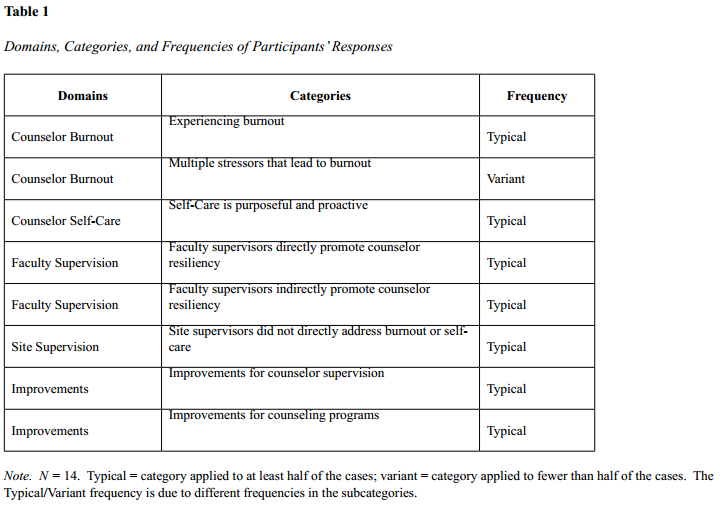
Counselor Burnout
Experiencing burnout. Most participants reported knowledge of or having experiences with burnout. Participants identified stressors leading to burnout as a loss of enthusiasm and compassion, the struggle to balance school, work, and personal responsibilities and relationships, and difficulty delineating and separating personal and professional boundaries.
Participants described counselor burnout as no longer having compassion or enthusiasm for counseling clients. One participant defined counselor burnout as, “it seems routine or [counselors] feel like they’ve dealt with so many situations over time that they’re just kind of losing some compassion for the field or the profession.” Another participant described counselor burnout as no longer seeing the unique qualities of individuals seen in counseling:
I wouldn’t see [clients] as individuals anymore…and that’s where I get so much of it coming at me, or so many clients coming at me, that they’re no longer an individual they’re just someone that’s sitting in front of me, and when they leave they write me a check….they are not people anymore, they’re clients.
Participants often discussed a continual struggle to balance personal and professional responsibilities. One participant described burnout as foregoing pleasurable activities to focus on work-related tasks:
I can tell when I am starting to get burned out when I am focusing so much on those things that I forgo all of those things that are fun for me. So I am not working out anymore, I am not reading for fun, and I am putting off hanging out with my friends because of my school work. There’s school work that maybe doesn’t have to get done at that moment, but if I don’t work on it I’m going to be thinking about it and not having fun.
Another participant described burnout as having a hard time balancing professional and personal responsibilities stating, “I think I don’t look forward to…working with…people. I’m just kind of glad when they don’t show up. And this kind of sense that I’m losing the battle to keep things in balance.”
Boundary issues were commonly cited by participants. Several participants reported that they struggled to be assertive, set limits, maintain realistic expectations, and not assume personal responsibility for client outcomes. One participant described taking ownership of a client’s outcome and wanting to meet all the needs of her clients:
I believe part of it is internalizing the problem on myself, feeling responsible. Maybe loosing sight of my counseling skills and feeling responsible for the situation. Or feeling helpless. Also, in school counseling there tends to be a larger load of students. And this is frustrating to not meet all the needs that are out there.
Participants reported experiences with burnout and multiple stressors that lead to burnout. Participants defined counselor burnout as a loss of compassion for clients, diminished enthusiasm, difficulty maintaining a life-work balance, and struggles to maintain boundaries.
Counselor Self-Care
Self-care is purposeful and proactive. Participants were asked to describe self-care for counselors and reported that self-care requires purposeful efforts to set time aside to engage in activities outside of work that replenish energy and confidence. Most participants identified having and relying on supportive people, such as family, friends, and significant others to help them cope with stressors. Participants also identified healthy eating and individualized activities such as exercise, reading, meditation, and watching movies as important aspects of their self-care. One participant described self-care as:
Anything that can help you reenergize and refill that bucket that’s being dipped into every day. If that’s going for a walk in the park…so be it. If that’s going to Starbucks…go do it….Or something that makes you feel good about yourself, something that makes you feel confident, or making someone else feel confident….Whatever it is, something that makes you feel good about yourself and knowing that you’re doing what you need to be doing.
Participants reported that self-care requires proactive efforts to consult with supervisors and colleagues; one of the first steps is recognizing when one needs consultation. One participant explained:
I think in our program, [the faculty] were very good about letting us know that if you can’t handle something, refer out, consult. Consult was the theme. And then if you feel you really can’t handle it before you get in over your head, make sure you refer out to someone you feel is qualified.
Participants described self-care as individualized and intentional, and included activities and supportive people outside of school or work settings that replenished their energy levels. Participants also discussed the importance of identifying when counselor self-care is necessary and seeking consultation for difficult client situations.
Faculty Supervision
Faculty supervisors directly promote counselor resiliency. More than half of the participants reported that faculty supervisors directly initiated conversations about self-care. A participant explained, “Every week when we meet for practicum, [the faculty supervisor] is very adamant, ‘is everyone taking care of themselves, is anyone having trouble?’ She is very open to listening to any kind of self-care situation we might have.” Similarly, another participant stated, “Our professors have told us about the importance of self-care and they have tried to help us understand which situations are likely to cause us the most stress and fatigue.” One participant identified preventive measures discussed in supervision:
In supervision, counselor burnout is addressed from the perspective of prevention. We develop personal wellness plans, and discuss how well we live by them during supervision….Self-care is addressed in the same conversation as counselor burnout. In supervision, the mantra is good self-care is vital to avoiding burnout.
Faculty supervisors indirectly promote counselor resiliency. Participants also reported that faculty supervisors indirectly addressed counselor self-care by being flexible and supportive of participants’ efforts with clients. Participants repeatedly expressed appreciation for supervisors who processed cases and provided positive feedback and practical suggestions. One participant explained, “I know that [my supervisor] is advocating for me, on my side, and allowing me to vent, and listening and offering advice if I need it….giving me positive feedback in a very uncomfortable time.”
Further, participants stated they appreciated supervisors who actively created a safe space for personal exploration. One participant explained:
[Supervision] was really a place for us to explore all of ourselves, holistically. The forum existed for us for that purpose. [The supervisors] hold the space for us to explore whatever needs to be explored. That was the great part about internship with the professor I had. He sort of created the space, and we took it. It took him allowing it, and us stepping into the space.
Modeling self-care also is an indirect means of addressing counselor burnout and self-care. Half of the participants reported that their faculty supervisors modeled self-care. For example, faculty supervisors demonstrated boundaries with personal and professional obligations, practiced meditation, performed musically, and exercised. Conversely, participants reported that a few supervisors demonstrated a lack of personal self-care by working overtime, sacrificing time with their families for job obligations, and/or having poor diet and exercise habits.
Participants reported that faculty supervisors directly and indirectly addressed counselor burnout and self-care in supervision. Supervisors who intentionally checked in with the supervisees and used specific techniques such as wellness plans were seen as directly affecting the participants’ perspective on counselor self-care. Supervisors who were present and available, created safe environments for supervision, provided positive feedback and suggestions, and modeled self-care were seen as indirectly addressing counselor self-care. Both direct and indirect means of addressing counselor burnout and self-care were seen as influential by participants.
Site Supervision
Site supervisors did not directly address burnout or self-care. Participants reported that site supervisors rarely initiated conversations about counselor burnout or self-care. One participant reported that counselor burnout was not addressed and as a result she felt a lack of support from the supervisor:
[Site Supervisors] don’t ask about burnout though. Every time I’m bringing it up, the answers I’m getting are ‘well, when you’re in grad school you don’t get a life.’ You know, yeah, I get that, but that’s not really true, so I get a lot of those responses, ‘well, you know, welcome to the club.’
One participant stated that her site supervisor did not specifically address counselor burnout or self-care, stating “I think that is less addressed in a school setting than it is in the mental health field….I think that because we see such a small picture of our students, I think it is not as predominantly addressed.” Some participants, however, reported that their site supervisors indirectly addressed self-care by modeling positive behaviors. One participant stated:
[My site supervisor] has either structured her day or her life in such a way that no one cuts into that time unless she allows it. In that sense, she’s great at modeling what’s important…She just made a choice….She was protective. She made her priorities. Her family was a priority. Her walk was a priority, getting a little activity. Other things, house chores, may have fallen by the wayside. She had a good sense of priorities, I thought. That was good to watch.
In summary, participants reported that counselor burnout and self-care were not directly addressed in site supervision. Indeed, some participants felt a lack of support when feeling overwhelmed by counseling duties, and that school sites may address burnout and self-care less than at mental health sites. At best, self-care was indirectly modeled by site supervisors with positive coping mechanisms.
Improvements for Counselor Supervision and Training
Improvements for counselor supervision. More than half of the participants reported wanting more understanding and empathy from their supervisors. One participant complained:
A lot of my class mates have a lot on their plates, like I do, and our supervisors don’t have as much on their plate as we do. And it seems like they don’t quite get where we are coming from. They are not balancing all the things that we are balancing….a lot of the responses you get demonstrate their lack of understanding.
Another participant suggested:
I think just hearing what the person is saying. If the person is saying, I need a break, just the flexibility. Not to expect miracles, and just remember how it felt when you were in training. Just be relatable to the supervisees and try to understand what they are going through, and their point of view. You don’t have to lower your expectations to understand where we’re at…and to be honest about your expectations…flexible, honest, and understanding. If [supervisors] are those three things, it’ll be great.
Participants also suggested having counselor burnout and self-care more thoroughly addressed in supervision, including more discussions on balancing personal and professional responsibilities, roles, and stressors. One participant explained:
What would be really helpful when the semester first begins is one-on-one time that is direct about ‘how are you approaching this internship in balance with the rest of your life?’ ‘What are any issues that it would be worthwhile for me to know about?’ How sweet for the supervisor to see you as a whole person. And then to put out the invitation: the door’s always open.
Improvements for counselor training programs. More than half of the participants wanted a comprehensive and developmentally appropriate approach to self-care interwoven throughout their counselor training, with actual practice of self-care skills rather than “face talk.” One participant commented:
Acknowledge the reality that a graduate-level program is going to be a challenge, talking about that on the front end….[faculty] can’t just say you need to have self-care and expect [students] to be able to take that to the next level if we don’t learn it in a graduate program….how much better would it be for us to have learned how to manage that while we were in our program and gotten practice and feedback about that, and then that is so important of a skill to transfer and teach to our clients.
Most of the participants suggested the inclusion of concrete approaches to counselor self-care. Participants provided examples such as preparing students for their work as counselors-in-training by giving them an overview of program expectations at the beginning of their programs, and providing students with self-care strategies to deal with the added stressors of graduate school such as handling administrative duties during internship, searching for employment prior to graduation, and preparing for comprehensive exams.
Discussion
Findings from this study highlight the importance of the role of supervision in promoting resilience as a protective factor against burnout among counselors-in-training. The majority of participants in this study perceived that they experienced some degree of burnout in their experiences as counselors-in-training. Participants’ perceptions of experiencing burnout are a particularly meaningful finding because it indicates that these counselors-in-training see themselves as over-taxed during their education and training. If, during their master’s programs, counselors-in-training are creating professional identities based on cognitive schemas for being a counselor, then perhaps these counselors-in-training have developed schemas for counseling that include a loss of compassion for clients, diminished enthusiasm for counseling, a lopsided balance of personal and professional responsibilities, and struggles to maintain boundaries. Counselors-in-training should be aware of these potential pitfalls as these counselors-in-training reported experiencing symptoms of burnout which were rarely addressed in supervision.
In contrast to recent literature, which suggests that counselor burnout is related to overcommitment to client outcomes (Kestnbaum, 1984; Leiter, 1991; Shovholt et al., 2001), many counselor trainees in this study did not perceive that their supervisors directly addressed their degree of personal commitment to their clients’ success in counseling. Similarly, emotional exhaustion is commonly identified as a potential hazard for burnout (Barnett et al., 2007); yet, few participants believed that their supervisors directly inquired about the degree of emotional investment in their clients. Finally, elusive measures of success in counseling are often indicated as a potential factor for burnout (Kestnbaum, 1984; Skovholt, et al., 2001). The vast majority of participants interviewed for this study did not perceive that these elusive measures of success were addressed in their supervision experiences. Supervisors who are interested in thwarting counselor burnout early in the training experiences of counselors may want to consider incorporating conversations about overcommitment to client outcomes, emotional exhaustion, degree of emotional investment, and elusive measures of success into their supervision with counselors-in-training. In an effort to promote more resilient schemas and expectations for counseling work, supervisors can take an active role in helping counselors-in-training understand the importance of awareness and protective factors to protect against a lack of compassion, enthusiasm, life-work balance, and professional boundaries, similar to the way a pilot is aware that a plane crash is possible and therefore employs purposeful and effective methods of prevention and protection.
Participants in this study conceptualized self-care as purposeful behavioral efforts. Proactive behavioral choices such as reaching out to support others are ways that many counselors engage in self-care. However, self-care cannot be solely limited to engagement in specific behaviors. Self-care also should include discussions about cognitive, emotional, and spiritual coping skills. Supervisors can help counselors-in-training create a personal framework for finding meaning in their work in order to promote hardiness, resilience, and the potential for transformation (Carswell, 2011). Because of the nature of counseling, it is necessary for counselors to be open and have the courage to be transformed. Growth and transformation are often perceived as scary and something to be avoided. Yet, growth and transformation can be embraced and understood as part of each counselor’s unique professional and personal process. Supervisors can normalize and validate these experiences and help counselors-in-training narrate their inspirations and incorporate their personal, spiritual, and philosophical frameworks in their counseling. In addition, supervisors can directly address misperceptions about counseling, which often include: “I can fix the problem,” “I am responsible for client outcomes,” “Caring more will make it better,” and “My clients will always appreciate me” (Carswell, 2011). While these approaches to supervision are personal in nature, counselors-in-training in this study reported an appreciation for time spent discussing how the personal informs the professional. This finding is consistent with Bernard & Goodyear’s (1998) model of supervision which emphasizes personal development as an essential part of supervision. Models for personal development in counselor education programs have been proposed by many professionals in the field of counseling (Myers, 1991; Myers & Williard, 2003; Witmer & Granello, 2005).
Counselors-in-training in this study reported an appreciation for supervision experiences in which their supervisors provided direct feedback and positive reinforcement. Counselors-in-training often experience performance anxiety and self-doubt (Aten et al., 2008). In an effort to diminish counselor-in-training anxiety, supervisors may provide additional structure and feedback in the early stages of supervision. Once the counselor-in-training becomes more secure, the supervisor may facilitate a supervisory relationship that promotes supervisee autonomy and higher-level thinking.
The majority of participants interviewed reported a desire for supervisors to place a greater emphasis on life-work balance and learning to cope with stress. These findings suggest the importance of counselor supervisors examining their level of expressed empathy and emphasis on preventive, as well as remedial, measures to ameliorate symptoms and stressors that lead to counselor burnout. Participants expressed a need to be more informed about additional stressors in graduate school such as administrative tasks in internship, preparing for comprehensive exams, and how to search for employment. These findings suggest the need for counselor educators and supervisors to examine how they indoctrinate counselors-in-training into training programs in order to help provide realistic expectations of work and personal sacrifice during graduate school and in the counseling field. Moreover, counselor educators and supervisors should strive to provide ongoing discussions on self-care throughout the program, specifically when students in internship are experiencing expanding roles between school, site placement, and searching for future employment. As mental health professionals, counselor educators and supervisors may also struggle with their own issues of burnout; thus, attentiveness to self-care also is recommended for those who teach and supervise counselors in training.
Limitations
Findings from this study will benefit counselor educators, supervisors, and counselors-in-training; however, some limitations exist. One limitation is the lack of diversity in the sample of participants. The majority of the participants identified as Caucasian females, which is representative of the high number of enrolled females in the counseling programs approached for this study. The purpose for this study, however, was not to generalize to all counselor trainees’ experiences, but rather to shed light on how counselor perceptions of burnout and self-care are being addressed, or not, in counselor supervision.
Participant bias and recall is a second limitation of this study. Recall is affected by a participant’s ability to describe events and may be influenced by emotions or misinterpretations. This limitation was addressed by triangulating sources, including a follow-up questionnaire, reinforcing internal stability with researcher consensus on domains, core ideas, and categories, and by using an auditor to evaluate analysis and prevent researcher biases.
Conclusion
Counselors should be holders of hope for their clients, but one cannot give away what one does not possess (Corey, 2000). Counselors who lack enthusiasm for their work and compassion for their clients are not only missing a critical element of their therapeutic work, but also may cause harm to their clients. Counseling is challenging and can tax even the most “well” counselors. A lack of life-work balance and boundaries can add to the already stressful nature of being a counselor. Discussions in supervision about the potential for emotional exhaustion, the counselor-in-training’s degree of emotional investment in client outcomes, elusive measures of success in counseling, coping skills for managing stress, meaning-making and sources of inspiration, and personalized self-care activities are several ways supervisors can promote counselor resilience and sustainability. Supervisors should discuss the definitions of burnout, how burnout is different from stress, how to identify early signs of burnout, and how to address burnout symptoms in order to promote wellness and prevent burnout in counselors-in-training. Counselor educators and supervisors have the privilege and responsibility of teaching counselors-in-training how to take care of themselves in addition to their clients.
References
Aten, J. D., Madson, M. B., Rice, A., & Chamberlain, A. K. (2008). Postdisaster supervision strategies for promoting supervisee self-care: Lessons learned from hurricane Katrina. Training and Education in Professional Psychology, 2(2), 75–82. doi:10.1037/1931-3918.2.2.75
Barnett, J. E., Baker, E. K., Elman, N. S., & Schoener, G. R. (2007). In pursuit of wellness: The self-care imperative. Professional Psychology: Research and Practice, 38(6), 603–612. doi:10.1037/0735-7028.38.6.603
Bernard, J. M., & Goodyear, R. K. (1998). Fundamentals of clinical supervision (2nd ed.). Needham Heights, MA: Allyn & Bacon.
Council for Accreditation of Counseling and Related Educational Programs (CACREP) (2009). 2009 Standards. Retrieved from http://www.cacrep.org/ doc/2009%20standards %20with20cover.pdf
Canfield, J. (2005). Secondary traumatization, burnout, and vicarious traumatization: A review of the literature as it relates to therapists who treat trauma. Smith College Studies in Social Work, 75(2), 81–102. doi:10.1300 J497v75n02_06
Carswell, K. (2011, March). Lecture on combating compassion fatigue: Strategies for the long haul. Counseling Department, Western Carolina University, Cullowhee, NC.
Corey, G. (2000). Theory and practice of group counseling (5th ed.). Belmont, CA: Wadsworth/Thompson Learning.
Hill, C. E., Knox, S., Thompson, S. J., Williams, E. N, Hess, S. A., & Ladany, N. (2005). Consensual qualitative research: An update. Journal of Counseling Psychology, 23(2), 196–205. doi:10.1037/0022-0167.52.2.196
Hill, C. E., Thompson, B. J., & Nutt Williams, E. (1997). A guide to conducting consensual qualitative research. The Counseling Psychologist, 25, 517–572. doi:10.1177/ 0011000097254001
Gilliland, B. E., & James, R. K. (2001). Crisis intervention strategies. Pacific Grove, CA: Brooks/Cole-Thomson Learning.
Jenaro, C., Flores, N., & Arias, B. (2007). Burnout and coping in human service practitioners. Professional Psychology: Research and Practice, 38, 80–87. doi:10.1037/0735-7028.38.1.80
Koeske, G. F., & Kelly, T. (1995). The impact of overinvolvement on burnout and job satisfaction. American Journal of Orthopsychiatry, 65, 282–292. doi:10.1037/h0079622
Kestnbaum, J. D. (1984). Expectations for therapeutic growth: One factor in burnout. Social Casework: The Journal of Contemporary Social Work, 65, 374–377.
Leiter, M. (1991). The dream denied: Professional burnout and the constraints of human service organizations. Canadian Psychology, 32(4), 547–558. doi:10.1037/h0079040
Myers, J. E. (1991). Wellness as the paradigm for counseling and development. The possible future. Counselor Education and Supervision, 30, 183–193.
Myers, J. E., & Williard, K. (2003). Integrating spirituality into counselor preparation: A developmental, wellness approach. Counseling and Values, 47, 142–155.
Ponterotto, J. G. (2005). Qualitative research in counseling psychology: A primer on research paradigms and philosophy of science. Journal of Counseling Psychology, 52(2), 126–136. doi:10.1037/0022-0167.52.2.196
Rosenberg, T., & Pace, M. (2006). Burnout among mental health professionals: Special considerations for the marriage and family therapist. Journal of Marital and Family Therapy, 32(1), 87–99. doi:10.1111/j.1752- 0606.2006.tb01590
Sherman, M. D. (1996). Distress and professional impairment due to mental health problems among psychotherapists. Clinical Psychology Review, 16, 299–315. doi:10.1016/0272- 7358(96)00016-5
Skovholt, T. M. (2001). The resilient practitioner: Burnout prevention and self-care strategies for counselors, therapists, teachers, and health professionals. Needham Heights, MA: Allyn & Bacon.
Skovolt, T. M., Grier, T. L., & Hanson, M. R. (2001). Career counseling for longevity: Self-care and burnout prevention strategies for counselor resilience. Journal of Career Development, 27(3), 167–176. doi:10.1177/089484530102700303
Truchot, D., Keirsebilck, L., & Meyer, S. (2000). Communal orientation may not buffer burnout. Psychological Reports, 86, 872–878. doi:10.2466/PR0.86.3.872-878
Witmer, J. M., & Granello, P. F. (2005). Wellness in counselor education and supervision. In J. E. Myers & T. J. Sweeney (Eds.), Counseling for wellness: Theory, research, and practice (pp. 342–361). Alexandria, VA: American Counseling Association.
E. Heather Thompson is an Assistant Professor in the Department of Counseling Western Carolina University. Melodie H. Frick is an Assistant Professor in the Department of Counseling at West Texas A & M University. Shannon Trice-Black is an Assistant Professor at the College of William and Mary. Correspondence can be addressed to Shannon Trice-Black, College of William and Mary, School of Education, PO Box 8795, Williamsburg, VA, 23187-8795, stblack@wm.edu.
Appendix A
Interview Protocol
1. What do you know about counselor burnout or how would you define counselor burnout?
2. What do you think are possible causes of counselor burnout?
3. As counselors we often are overloaded with administrative duties which may include treatment planning, session notes, and working on treatment teams. What has this experience been like for you?
4. Counseling requires a tremendous amount of empathy which can be emotionally exhausting. What are your experiences with empathy and emotional exhaustion? Can you give a specific example?
5. How do you distinguish between feeling tired and the early signs of burnout?
6. As counselors, we sometimes become overcommitted to clients who are not as ready, motivated, or willing to engage in the counseling process. Not all of our clients will succeed in the way that we want them to. How do you feel when your clients don’t grow in the way you want them to? How has this issue been addressed in supervision?
7. What is your perception of how your supervisors have dealt with stress?
8. How has counselor burnout been addressed in supervision?
prompt: asked about, evaluated, provided reading materials, and how often
9. How have specific issues related to burnout been addressed in supervision such as: (a) over-commitment to clients who seem less motivated to change, (b) emotional exhaustion, and (c) elusive measures of success?
10. How could supervision be improved in addressing counselor burnout?
prompt: asked about, evaluated, provided reading materials, modeled by supervisor
11. What do you know about self-care or how would you define self-care for counselors?
12. What are examples of self-care, specifically ones that you use as counselors-in-training?
13. How has counselor self-care been addressed in supervision?
14. Sometimes we have to say “no.” How would you characterize your ability to say “no?” What have you learned in supervision about setting personal and professional boundaries?
15. What, if any, discussions have you had in supervision about your social, emotional, spiritual, and/or physical wellbeing? What is a specific example?
16. How could supervision be improved in addressing counselor self-care?
prompt: asked about, provided reading materials, modeled by supervisor
17. How could your overall counselor training be improved in addressing counselor burnout and counselor self-care?
Appendix B
Follow-Up Questionnaire
How would you describe counselor burnout?
How has counselor burnout been addressed in supervision?
How could supervision be improved in addressing counselor burnout?
How would you describe self-care for counselors?
How has counselor self-care been addressed in supervision?
How could supervision be improved in addressing counselor self-care?
How could your overall counselor training be improved in addressing counselor burnout and counselor self-care?
Sep 7, 2014 | Article, Volume 2 - Issue 1
Michael W. Firmin, Richard A. Wantz, Ruth L. Firmin, Courtney B. Johnson
Using qualitative research methods, interviews were conducted with college students regarding the sources they
used in generating perceptions of professional counselors. Respondents believed that information sources such as word of mouth, media sources and personal experiences were responsible for their understandings of professional counselors. The findings have applications for leaders in professional counseling organizations. Common knowledge characteristics, public perceptions, counselor identity and advocacy are discussed.
Keywords: perceptions, professional counselors, information sources, counselor identity, advocacy
Perceptions do not equal reality. However, perceptions eventually can lead to what reality becomes in time. All professions possess public perception. When someone refers to doctors, lawyers, dentists, and other specialized occupational groups, images are created in our minds. These percepts possess varying degrees of reality, of course, but the effects of such images are cogent nonetheless. Of particular interest to the present study is the perception of human service personnel, including professional counselors.
As a whole, the human service profession has landed itself on the positive side of the public’s opinion spectrum (Nunnally & Kittross, 1958). McGuire and Borowy’s (1979) research showed a continuum of perceptions held by the lay public regarding a wide range of professionals who worked with mental illness. Those occupying the fields of nursing, physicians, counseling psychologists, social workers, psychiatric nurses, psychiatrists, and clinical psychologists received the highest rankings.
Undergraduate students’ opinions regarding effectiveness of various human service providers for helping mental health consumers were reported by Tse, Wantz, and Firmin (2010) and Wantz and Firmin (2011). Participants in these studies rated human service providers’ effectiveness more positive than negative. Professional counselors and psychologists were rated more effective with providing mental health services than other human service providers.
Richardson and Handal (1995) found the general public viewed psychotherapy as a reasonably effective means of treatment for between 25 and 50% of all cases. Most people also recognized that services of less traditional human service providers, such as marriage and family therapists, also could be used effectively in relation to particular disorders. Psychiatrists and psychologists, however, were perceived as having higher levels of competence when addressing mental health issues (Schindler, Berren, Hannah, Beigel, & Santiago, 1987). Educational attainment (Dotson-Blake, Know, & Holman, 2010), chronological maturity (Erikson, 1963; Oliver, Reed, & Smith, 1998), and psychosocial development (Tinsley, Hinson, Holt, & Tinsley, 1990) have been reported to be positively correlated with perceived benefits of counseling.
Murstein and Fontaine (1993) found familiarity of the general public to be greater concerning physicians, clergypersons, and psychiatrists than it was in their knowledge of psychotherapists and psychologists. Consequently, of the two, psychologists were the source the general public was most likely to use when recommending a human service provider. Also reported, the most common reasons for which clients sought mental health professionals were mild depression, marital problems, and child-rearing issues. A generation ago, Gelso, Brooks, and Karl (1975) reported mental health consumers’ overall preferences to be for counseling psychologists and psychiatrists.
Sharpley (1986) purported a tendency for mental health consumers to separate human service professionals into two categories, each entailing distinct perspectives. First, private practice and fee-for-service providers, psychologists and psychiatrists being the most prominent, were viewed as those who were most competent in treating mental illnesses. Second, public-utility and non-fee-demanding professionals, of which social workers and counselors prominently emerged, were perceived as being more practical and apt in providing service to the average person when addressing emotional problems.
Among the various human service professionals, counselors are of particular interest to the present study. Sharpley, Bond, and Agnew (2004) indicated that the public views counselors’ roles to be primarily listening, supporting, and helping to solve problems. While 79% said counselors were needed, and the same number indicated a willingness to pay for services provided, survey respondents personally were likely to consult a counselor concerning only 13–20% of the problems they faced. Participants also reported benefits of counseling to include having an impartial person to listen and help clarify, as well as having a facilitator for problem-solving, and meeting in a safe, confidential environment.
Fall, Levitov, Jennings, and Eberts (2000) described the public’s expressed general confidence in professional counselors’ abilities to treat “less serious” cases, but less confidence when treating cases which were perceived to be at higher levels of seriousness (e.g., psychopathology). These findings are congruent with those found by Fall, Levitov, Anderson, and Clay (2005) specifically studying the perceptions of the African-American population. In both studies, the participants expressed significantly greater levels of confidence in the abilities of psychiatrists when addressing severe issues, such as psychotic depression or post-traumatic stress disorder. Findings further showed that doctoral-level counselors were perceived similarly to clinical psychologists, while both studies showed that in every case professional counselors with doctorates were preferred over those with only master’s-level education. Wantz, Firmin, Johnson, and Firmin (2006) reported on university student perceptions of high school counselors. This qualitative study found college students reported high school counselors as having similar empathic and desire to help skills as licensed professional counselors.
Dixon, Vrochopoulos, and Burton (1997) reported the underrepresentation of counseling psychologists in introductory psychology textbooks, showing counseling to have significantly fewer references than clinical, school, and industrial psychologists. Likewise, Firmin, Johnson, and Winkler’s (2005) research showed almost no references to professional counselors in general psychology texts. Consequently, we conclude that while the public generally possesses positive perceptions of professional counselors, their presence is kept somewhat cryptic by the gatekeepers. College-educated students depend on introductory psychology texts to frame for them professional domains and functions among human service professionals.
As counselors have achieved professional status through licensure over the last two decades, identity confusion has been demonstrated by the practitioners within the field (King, 2006). Inevitably, this perplexity has trickled down to the minds of mental health practice consumers regarding distinctions and roles of professional counselors. Consequently, while the public generally likes the construct of who they think of as counselors, they also are unsure of these professionals’ roles (Butterfield, 1989).
Decades ago, Dahlem (1969) called for the vital need to research the general publics’ perception of counselors’ images and role perceptions, compared to counselors’ self-perceptions. He stressed the importance of clarifying consumers’ understandings and perceptions in relation to the success of the providers. Gelso and McKenzie (1973) followed up, studying ways in which students were informed of counselors’ available assistance. Students receiving only written information about hypothetical problems appropriate for counseling were less likely to experience changes of perceptions. This suggested that the most effective way to impact students’ impressions concerning counselors would be the presentation of written and oral information.
Narrowing the scope, the present study updates this important research inquiry. Specifically, our interests were to explore how college students, as potential consumers of mental health services, came to their understandings of counselors’ professional competence. That is, how effective do students perceive professional counselors to be? Obviously, since such perceptions are tied to students’ ultimate use of counselors’ services, the answers to the research question have significant implications for personnel working in college counseling settings.
Method
In accomplishing the study’s aim of assessing how college students generate their perceptions of professional counselors, we considered a number of potential research designs. While quantitative methods such as surveys would provide us with a relative breadth of understanding in this area (Patten, 1998) and this would be valuable, we believed such an approach would not be as apt as a qualitative design. Generally, quantitative approaches answer “what” or “how many” types of questions (Sarafino, 2005). However, we were more interested in knowing answers to “how” and “why” types of questions. These, by and large, are best answered via qualitative designs (Atkinson, Coffey, & Delamont, 2003).
At the outset, we are explicit regarding our decision in using an atheoretical approach to the qualitative method. Significant and heated debate presently exists in qualitative circles regarding whether one should or should not use theory—and if so, what that role should be. Originally Glaser and Strauss (1967) advocated that atheoretic, inductive approaches were the only means of generating a grounded theory. Later, Strauss and Corbin (2008) purported that theory was legitimate and useable for some qualitative research designs. Glaser (1992), however, vehemently opposed this departure from the classical approach indicating that researchers must exercise disciplined restraint in holding back theory when generating or interpreting results.
Obviously, we are not going to abate the controversy in this article, but we do wish to be explicit in reporting our commitment to classical grounded theory. That is, philosophically we believe that phenomenological studies such as the present one should be conducted inductively—holding theory at bay. While we understand the implications and even potential limitations of this approach, we believe it to be most apt, nonetheless.
A sample of 26 students was drawn from a general psychology course (16 females and 10 males). The institution was a selective, private comprehensive university located in the Midwest. Departing from traditional criterion or purposeful sampling most often used with qualitative research (Seidman, 2006), we used random sampling for this study because we wished to enhance the external validity of our findings as much as feasible. That is, the trade-off of expanded generalizability was believed to be worth the expense of potentially less rich descriptions through specifically selected students. Since the general psychology course was part of the liberal arts core curriculum at the institution, our sample reflected a relatively wide cross-section of majors, included students who were freshmen through seniors, and participants’ ages ranged from 18 to 22 years of age. Interviews were tape recorded and later transcribed for analysis. In writing the present article, we used respondent pseudonyms for reading clarity.
We utilized a semi-structure method in conducting the in-depth interviews. We used staple constructs for generating questions, but also allowed students to deviate in their replies, enabling them to tell their own stories and share perceptions inductively. Following Firmin (2006a), two waves of interviews were conducted. That is, all participants were interviewed twice—with transcription and coding occurring in between the interviews. This allowed for constant comparison of the data and dialogue among the researchers for generating potential codes.
When analyzing the interviews, we used an open (Maxwell, 2005) coding, inductive process (Marshall, 1999). Since we located no studies published on this topic, axial coding was not practical and open coding was more consistent with the study’s exploratory aim. Frequent meetings among the article’s authors occurred and this process facilitated coding, providing verifications for consistency of analysis. When generating potential codes, we read through the transcripts, utilizing constant comparison methods (Bogdan & Biklen, 2007). This involved continuously comparing the transcripts to one another, looking for any repeating words, phrases, or constructs that were common among the participants. In order to keep the data manageable, some similar categories were collapsed into major categories. NVIVO qualitative research software also was used to help analyze data. This program helps to manage relatively large amounts of transcript documentation as well as aid in the generation of reliable themes across multiple participant data sets. This technology enhanced human capability, and it did not replace the role of subjective judgments required to conduct intuitive work (Lewins & Siver, 2007). Following Gay, Mills, and Airasian (2009), the process of transitioning from codes to themes involved asking key questions, conducting organizational review, visually displaying the findings, and concept mapping.
The research team’s dialogue regarding potential thematic outcomes enhanced the study’s internal validity. Naturally, one researcher can appropriately analyze data and provide apt findings. Nonetheless, the assurance of valid findings often is enhanced when multiple qualitative researchers participate in the analysis process (Ryan & Bernard, 2003). We included in this article only those themes on which the entire research team concurred. The study’s internal validity also was strengthened through generating a data trail (Daytner, 2006). This involved generating direct connections between each reported theme in our transcripts through identifying specific paragraphs within the interview conversations. Data trails can be useful to those who wish to check the validity of our reported findings or who hope to someday replicate or advance our present study (Firmin, 2006b).
Third, member checks (Merriam, 2002) were applied with various research participants. This is a qualitative research technique whereby we shared our findings with research subjects, garnering their feedback regarding how reported results aptly reflected their reported perceptions during the interview process. Each of the individuals with whom we checked commonly agreed with our reported results. Fourth, we strengthened the study’s internal validity by including participation from an independent researcher with renowned expertise in qualitative methodology (Flick, 2006). This expert appraised the steps at each stage of the study, the legitimacy of our process, assessed our data audit, and provided analysis regarding linking the transcripts data with the results. Fifth, saturation (Silverman, 2006) occurred when analyzing the transcript data. Specifically, after approximately 24 interviews, our participants generally shared similar sentiments, with few fresh insights added as subsequent interviews were added to the sample. In the qualitative tradition of experts such as Guest, Bunce, and Johnson (2006) and Neuman (2006), we believe our sample size was both ample and appropriate for the context of this specific study.
In summary, internal validity is a critical component in delineating appropriate qualitative research (Cope, 2004). Weightier confidence may be placed in the reported themes, that they adequately represent the general sentiments of the research participants when particular, deliberate steps are taken. Both in the study’s design and its implementation, we believe this project demonstrates rigor by established qualitative research standards (DeWet & Erasmus, 2005) and an apt grounded theory of the data collected (Lundberg & Young, 2005).
Results
Upon examination of the interviews, several themes emerged from the coded transcripts. Primarily, respondents discussed their awareness of sources such as the media, word of mouth, and personal experience in the development of opinions regarding professional counselors. Further, respondents discussed characteristics of a “common knowledge” upon which consumers draw in their utilization or hesitancy of seeking counseling services. Finally, responses delineated the perceived effects of this common knowledge on the reputation of counseling.
Three Sources
Repeatedly, respondents spoke of three main sources on which they depended in generating their opinions of professional counselors’ effectiveness. Respondents particularly mentioned the contribution of media sources such as radio, newspapers, television, and movies, along with the more personal and implicative sources of word of mouth and personal experience. Considered holistically, this amalgamated into a nebulous resource of common knowledge. One respondent defined common knowledge as “general sources,” implying the prevalent accessibility of this information.
Consistent with the sample’s generational factors, responses repeatedly indicated the role of the media in their concept formation of who professional counselors are and what they do. Janet explained that “common knowledge would probably be just things they’ve heard on TV or seen on TV,” revealing the expectation of what a professional counseling session should theoretically cover and how a session should appear. Media also sharply influenced perceptions of what a counselor and client should look like (i.e., personal dress and hygiene) and even where these services are located (e.g., in a swanky hospital wing or in urban city slums). Pete specifically mentioned the impact Hollywood had on the formation of his own perceptions, indicating no coincidence in the congruity of college students’ expectations with media depictions.
Fortunately, respondents spoke with a voice of relative discernment, aware of the possible slants injected into information relayed by the media. Injecting a sense of humor, Jason admitted: “I know I was watching TV the other day, I think it was Growing Pains, or something like that, and they were talking about it [counseling] so that’s how I know.” Not credulous to the media portrayal, he continued: “Like they have no problems in life, everything’s going smooth for them . . . people that have no problems and are like happy all the time . . . that’s not true.” While not all respondents explicitly expressed this intuition, they generally did note the connotations associated with counseling by the media. For example, Coleen noticed the subliminal messages as she watched movies or television shows: “It’s usually like TV and movies just have different characters in them and it usually seems like a negative type thing. . . I think that they make it seem like it’s [counseling] a weird place to go and it’s not a fun thing.” Clearly, the media is not a bias-free information source, but requires active examination on the part of the viewer.
Numerous respondents mentioned the place that word of mouth had in the formation of their perceptions about counselors. Where personal experience waned and media fell short of credibility, respondents turned to testimonies of people they know who were counseled first-hand and held credence. When asked to describe sources of common knowledge regarding her perceptions of counselors, Barb offered: “I think a lot of people would be, maybe from people they know, who have been to one, who are one [professional counselor].” Respondents feel that no matter the strength of the connection, be it from a friend-of-a-friend or from the mouth of a professional counselor, hearing of others’ encounters considerably influences perception formation. Making judgments on topics with which respondents are personally unfamiliar (i.e., no personal experience in counseling) is alleviated when backed by the testimony of personal references.
Dan mentioned the input of “the whole movies and TV and media” in passing, but pointed to word of mouth as the primary information hub about how he developed his percepts regarding counselors. His assertion that word of mouth is the primary means rests on another assumption, “I’m sure probably the majority of the people don’t go to counseling,” highlighting that where personal experience lacks, the information network through word of mouth becomes prominent in concept formations. Dan concluded: “I think that in general it’s the word of mouth because you always know someone who’s been through something or doing something and has had to go to counseling.” Respondents believed that personal encounters with counselors by their friends were a rarity, and in a sense a commodity, taking what they heard at face value. As such, their collections of personal testimonies were typically sparse. Johanna considered word of mouth to be the prominent common knowledge source when thinking about counselors, as she stated: “I haven’t really read up on them or anything, but just based on what people have said, that’s where I’ve gotten my perspective from.” Even more, Johanna looked to her immediate context: “For me it would be more of adults, like parents, parents’ friends, stuff like that.” Speaking from the periphery, students gain perspective based on other’s comments.
When accessible, respondents relied on personal experience and interactions of acquaintances as their main contributors to their knowledge base about professional counselors. No matter how insignificant the interaction, respondents preferred personal encounters or those of close friends, more so than media or other sources, in their concept formations. For example, Emma drew on memories from elementary school: “Just like experiences in elementary school where counselors came around and talked like ‘don’t do drugs and things like that.” Respondents readily admitted their recollections may be somewhat “fuzzy,” but nonetheless preferred these to more broad sources.
The context of “home” was imperative for perception formation about counselors among respondents in our sample. Specifically, respondents heavily relied on past experiences to formulate opinions about new concepts or in discussing unfamiliar territory. Carla offered this insight: “I suppose it could be something that has come from their background or their family life.” Familial beliefs are known to possess cogent influences in multiple life domains such as politics, religion, prejudice, etc. In the present context, our students suggested that generational influences play a moderating role in perceptions of professional counseling.
As the majority of respondents could not draw from personal experience, the testimony of friends often was their closest connection to professional counselors. Stephanie mentioned that common knowledge was a salient influence in how she came to think of counselors. Later, she elaborated this could be from talking with “friends that went to go see a counselor” and who could fill in the gaps of her understanding. Randy affirmed the power generated when he will “hear other people’s experiences.” Obviously, respondents in our sample could not judge the relative quality of their friends’ experiences or the degree of truth represented by their friends’ accounts. But hearing what their friends told them left indelible impressions, nonetheless.
Common Knowledge Characteristics
Upon examination of their information sources, respondents reflected on the characteristics of their sources. Specifically, respondents mentioned that their knowledge about unfamiliar topics such as professional counselors may have little-to-no factual basis or may be unreliable. Mandy shared that respondents evaluate counselors by “just what they think they know. It might not necessarily come off of anything.” Respondents often were aware of this vulnerable reasoning, but when asked to offer their opinions, they drew on the ambiguous common knowledge anyhow. Linda stated her perception that this concept was “possibly general statistics or people’s assumptions about professional counselors, not necessarily what’s true.” In consideration of the often inaccurate portrayal of counselors through movies, magazines, and additional sources of media, these assumptions may differ widely from reality. Kevin offered this reasoning about how common knowledge affects perceptions about counselors: “People . . . think they know stuff about stuff, and really don’t. . . . So that’s why the majority of people don’t even know much about counselors and stuff like that. They hear one thing, and generalize it about everybody.” The tendency to generalize can be potently beneficial, depending on the accuracy of the source, of course. This principle has important ramifications for the development of counseling as a potential profession.
A second characteristic of common knowledge in our study is an inability of participants to recall the sources from which the information comes. Clearly, when making decisions such as choosing counseling services, knowing potential sources behind the motivation for utilizing them are important. Lori mentioned that students often rely on “things from a long time ago that they may not remember specifically” in order to evaluate the positive or negative effects of seeking professional counseling services. Similar to Rob’s tendency to generalize, our subjects’ distant recollections were said to be formative in their perceptions, however accurate they may or may not be. Steve elucidated that this source of common knowledge may be far removed from the true source: “Like second and third hand information about people who have gone to counselors, again television and movies, the joke from the Sunday newspaper, you know.” Perceptions for these students are formulated from a conglomeration of sources, credible or not, evidently even from the comics section of the Sunday newspaper.
While respondents relied heavily on word of mouth, Jordan did speak of the possible flaws in this resource: “I guess from other people talking to them about it. You can’t just know, obviously, but obviously they don’t remember where they’ve heard it from.” While acquaintances and peers may be eager to share their opinions, our subjects evidently often were unable to support their opinions with factual sources. Cathy concurred in stating that common knowledge of counselors is generated by “probably a little bit of what they fill in, what they assume.” Not only are their potential sources emitting their own assumptions, but the respondents fall prey to the same tendency in order to compensate for lack of information. Sandy further clarified, “it may just be, I assume they’re this way, but they really didn’t base that off of anything,” again revealing the flaws in their apt perception formation.
Effects of Common Knowledge
Without doubt, the lack of verifiable validity found in common knowledge about counselors creates powerful effects for the advancement of counseling as a profession. Namely, not only is the reputation of services potentially marred, but respondents also may be less likely to seek out counseling when needed due to their incorrect assumptions and faulty sources. Respondents reported feeling that the media, through movies, magazines or books, too often generates negative connotations with professional counseling images. Rachel noted: “I think that it [media] negatively affects their perception of professional counselors.” When prodded to share more, she continued: “A lot of times in TV and in movies they’re portrayed as odd people so I guess that’s the image that a lot of people have, because going back to their philosophy in the way they conduct their counseling.” Most definitely, “odd” is not a positive connotation to associate with professional counseling. In times of need, respondents likely will not seek out a source they consider to be odd. Larry offered a similar insight in his comment: “Probably that they’re just people who sit there and they try and make you talk to them even though you don’t want to and, I don’t know, probably the same thing that they would be with a psychologist.” This statement is loaded with several faulty assumptions, ubiquitous in other students’ comments. First, respondents tend to believe counselors force their clients to talk about issues when they do not wish to receive counsel, or that their sessions consist more of passive listening, where clients ramble as the counselor nods occasionally and interjects the expected empathetic reflection. Second, this respondent offhandedly equated counselors with psychologists, illuminating the lack of public awareness in deciphering services offered by counselors compared to psychologists.
Students indicated that the connotations afforded by common knowledge sources of professional counselors sometimes are positive and sometimes negative, depending on the source. Molly used media news as a concrete example: “Well, usually if they hear it in the news it will be negative, if the counselor screws up, they’ll hear that, and it might give them a bad image.” She continued that one negative news report could be potent enough to prevent her or others from ever seeking a professional counselor, regardless of the intensity of the personal need. Similarly, Kim thinks that movies could “go either way” and the audience “can either think of a positive image of counselors that they really do help someone, or they can portray them as people who are out of touch with reality and don’t really help the person necessarily.” This phenomenon follows the similar vein relative to the equivocal nature of these sources. Clearly, the common knowledge phenomenon affects the realm of professional counseling by impacting not only expectations of a session on the part of the counselor or the client, but also regarding the tendency to seek professional counseling services.
Discussion
We believe that due deliberation of our findings are warranted on two levels: macro and micro. On the macro level, professional organizations must become more aggressive in advocating for the profession in media and other “common knowledge sources.” Specifically, we interpret our results as a clarion call to the American Counseling Association (ACA), the American Mental Health Counselors Association (AMHCA), and the National Board for Certified Counselors (NBCC).
In the past decade, how many times has a major motion picture made central references to a Licensed Professional Counselor (LPC)? A systematic assessment in answering this important question is warranted elsewhere. However, the authors of the present article are unaware of a single time when this has occurred. We do recall, of course, main characters visiting psychiatrists, psychologists, social workers, and even marriage & family therapists. But, it is completely unacceptable for Hollywood to ignore licensed professional counselors.
Our findings suggest that movies are powerful sources by which the public come to generate their perceptions of professional counselors. When movies ignore the profession, then it follows that counselors become vulnerable to unhealthy stereotypes, negative perceptions, or simply empty perceptions. The role of professional counseling organizations is to advance the profession—and our data suggests that much more needs to be done in this domain.
To be more specific, every time a major motion picture is released where main characters interact with human service professionals that are not counselors—advocacy must occur. That is, leaders of ACA, AMHCA, NBCC, state counseling organizations, and others need to issue united statements of protest. Media such as the Associated Press need to pick up on these protests, carrying complaints of professional counselors’ lack of Hollywood notice.
To proactively accomplish this, the professional organizations must make permanent connections with producers, directors, writers, and other influential individuals in Hollywood as scripts are generated. Hollywood needs to be aware that if they ignore professional counselors as potential sources of human service provision, then the professional counseling organizations will become active. It should be worth their while to ensure that an apt, positive representation of counselors occurs.
On the micro level, individual counselors must be more active when advertising their services to the public. Specifically, the local media should be utilized to portray positive messages about professional counselors and benefits of service utilization. Local news media frequently look for short stories or opinions from human service professionals on various topics. This particularly is true around holidays or other special occasions—or even traumatic events—when media generate special interest stories. Local television specials can be powerful mediums for perception formation among families and potential clients. Universities with communication arts programs can budget monies for student and/or professionally generated DVDs that highlight and promote professional counselors as quality options during times of personal need.
The same advocacy can occur with school newspapers, web sites, circulars, and other sources of “common knowledge.” Respondents from the present study indicated that media is a powerful source and influences their perceptions. Professional counselors, therefore, should seize this medium—using it to generate reoccurring positive messages.
Respondents also told us that parental opinions, former clients, information from friends, and other word of mouth sources were important in how they came to think of professional counselors. There is little that counselors can do to encourage positive word of mouth advertising for professional counselors. However, they can utilize the media to its fullest.
On both macro and micro levels, we are concerned about professional counselors’ general tendencies towards passivity. That is, counselors presently are at the mercy of how happenstance may occur in clients’ lives to formulate perceptions of counselors. Rather, counselors should architect how they want potential clients to think about them. Draft the message and then market it through public service announcements, movies, the media, and other sources that consumers say are important to their concept formations. In short, be proactive rather than laissez-faire on this important matter.
Limitations and Future Research
We believe the present research study provided an apt representation of the students interviewed. However, as with all qualitative research, external validity is a limitation. That is, while replication is important for quantitative research (Cumming, 2005), qualitative research is particularly context dependent, relying on replication ultimately to prove its generalizability (Firmin, 2006b). In this light, we are limited in our ability to apply the present findings to all students at all universities in the United States or the public in general. Further research should replicate this study, assessing students and potential clients in varying parts of the country. Further, national survey data should be collected—providing more breadth to our present findings—although, of course, breadth and depth acquisitions tend to be methodological tradeoffs.
No minority representation was included in the present sample. Of course they were not deliberately excluded; rather, the general psychology class from which the sample was drawn contained only a few minority students. By random sample chance they were not included. As previously indicated, we used random sampling of the students in the study in order to enhance external validity as much as possible. The university from which the sample was taken contains only a 6% total minority population. Consequently, further research should be conducted in this area, possessing greater numbers of minority students in those samples. Also, replicating the present qualitative study with all minority students would provide an interesting comparison to the present findings from a Caucasian sample.
In sum, we believe that the present study has powerful heuristic value. Researchers should take this concept and develop it much further than what we were able to do in the present design. Assuming that professional counseling is going to develop and flourish in the upcoming decades, then the call we make for proactive advocacy must be heard. Students and the public have perceptions of professional counselors. That simply is a fact of human nature. It behooves the professional counselor leaders as well as individual counselors to craft what they wish those perceptions to be.
References
Atkinson, P., Coffey, A., & Delamont, S. (2003). Key themes in qualitative research. New York, NY: Rowman & Littlefield.
Bogdan, R. C., & Biklen, S. K. (2007). Qualitative research for education (5th ed.). Boston, MA: Allyn & Bacon.
Butterfield, P. J. (1989). The assessment of mental health professionals’ public image by means of multidimensional scaling. Digital Dissertations. (No. AAT 9019467)
Cope, C. (2004). Ensuring validity and reliability in phenomenological research using the analytical framework of a structure of analysis. Qualitative Research Journal, 4, 5–18.
Cumming, G. (2005). Understanding the average probability of replication: Comment on Killeen. Psychological Science, 16, 1002–1004.
Dahlem. G. G. (1969). Counselor image: Crucial target for research. Counselor Education and Supervision, 8, 130–135.
Daytner, K. (2006, June). Validity in qualitative research: Applications of safeguards. Paper presented at the 18th Annual Ethnographic & Qualitative Research in Education Conference, Cedarville, OH.
De Wet, J., & Erasmus, Z. (2005). Toward rigor in qualitative research. Qualitative Research Journal, 5, 27–40.
Dixon, N. D., Vrochopoulos, S., & Burton, J. (1997). Public image of counseling psychology: What introductory psychology textbooks say. The Counseling Psychologist, 25, 674–682.
Dotson-Blake, K., Know, D., & Holman, A. R. (2010). Reaching out: College student perceptions of counseling. Professional Issues in Counseling. Permanent on-line access http://www.shsu.edu/~piic/Fall2010.html
Erikson, E. (1963). Childhood and society (2nd ed.). New York, NY: Norton.
Fall, K. A., Levitov, J. E., Anderson, L., & Clay, H. (2005). African Americans’ Perception of Mental Health Professions. International Journal for the Advancement of Counseling, 27, 47–56.
Fall, K. A., Levitov, J. E., Jennings, M., & Eberts, S. (2000). The public perception of mental health professions: An empirical examination. Journal of Mental Health Counseling, 22, 123–134.
Firmin, M. (2006a). Using interview waves in qualitative research. In P. Brewer & M. Firmin (Eds.) Ethnographic and qualitative research in education (pp. 175–181). Newcastle, UK: Cambridge Scholars Press.
Firmin, M. (2006b, June). External validity in qualitative research. Paper presented at the 18th Annual Ethnographic and Qualitative Research in Education Conference, Cedarville, OH.
Firmin, M., Johnson, E., & Wikler, J. (2005, February). Professional human service occupation biases in general psychology textbooks. Paper presented at the 8th Annual Conference of the American Association of Behavioral and Social Sciences, Las Vegas, NV.
Flick, U. (2006). An introduction to qualitative research (3rd ed.). Thousand Oaks, CA: Sage.
Gay, L. R., Mills, G. E., & Airasian, P. (2009). Educational research (9th ed.). Upper Saddle River, NJ: Pearson.
Gelso, C. J., Brooks, L., & Karl, N. J. (1975). Perceptions of “counselors” and other helpers: A consumer analysis. Journal of College Student Personnel, 16, 287–292.
Gelso, C. J., & McKenzie, J. D. (1973). Effect of information on students’ perceptions of counseling and their willingness to seek help. Journal of Counseling Psychology, 20, 406–411.
Glaser, B. G. (1992). Basics of grounded theory analysis. Mill Valley, CA: Sociology Press.
Glaser, B. G., & Strauss, A. L. (1967). The discovery of grounded theory. Chicago, IL: Aldine.
Guest, G., Bunce, A., & Johnson, L. (2006). How many interviews are enough? An experiment with data saturation and variability. Field Methods, 18, 59–82.
King, J. H. (2006, July). Identity crisis and a uniform counseling title. Counseling Today, 17.
Lewins, A., & Silver, C. (2007). Using software in qualitative research: A step by step guide. Thousand Oaks, CA: Sage.
Lundberg, C. C., & Young, C. A. (2005). Modified grounded theory: How defensible is it? American Association of Behavioral and Social Sciences Journal, 8, 90–98.
Marshall, M. N. (1999). Improving quality in general practice: qualitative case study of barriers faced by health authorities. British Medical Journal, 219, 164–167.
Maxwell, J. A. (2005). Qualitative research design (2nd ed.). Thousand Oaks, CA: Sage.
McGuire, J. M., & Borowy, T. D. (1979). Attitudes toward mental health professionals. Professional Psychology, 10, 74–79.
Merriam, S. B. (2002). Assessing and evaluating qualitative research. In S. Merriam (Ed.).Qualitative research in practice (pp. 18–33). San Francisco, CA: Jossey-Bass.
Murstein, B. I., & Fontaine, P. A. (1993). The public’s knowledge about psychologist and other mental health professionals. American Psychologist, 48, 839–845.
Nunnally, J., & Kittross, J. M. (1958). Public attitudes toward mental health professions. American Psychologist, 13, 589–594.
Oliver, J. M., Reed, K. S., & Smith, B. W. (1998). Patterns of psychological problems in university undergraduates: Factor structure of symptoms of anxiety and depressions, physical symptoms, alcohol use, and eating problems. Social Behavior and Personality, 26, 211–232.
Patten, M. L. (1998). Questionnaire research: A practical guide. Los Angeles, CA: Pyrczak.
Ryan, G. W., & Bernard, H. R. (2003). Techniques to identify themes. Field Methods, 15, 85–109.
Richardson, P., & Handal, P. (1995). The public’s perception of psychotherapy and counseling: Differential views on the effectiveness of psychologists, psychiatrist, and other providers. Journal of Contemporary Psychotherapy, 25, 367–385.
Sarafino, E. P. (2005). Research methods: Using processes & procedures of science to understand behavior. Upper River Saddle, NJ: Prentice Hall.
Schindler, F., Berren, M. R., Hannah, T. M., Beigel, A., & Santiago, J. M. (1987). How the public perceives psychiatrists, psychologists, nonpsychiatric physicians, and members of the clergy. Professional Psychology: Research and Practice, 18, 371–376.
Seidman, I. (2006). Interviewing as qualitative research: A guide for researchers in education and the social sciences (3rd ed.). New York, NY: Teachers College, Columbia University.
Sharpley, C. F. (1986). Public perceptions of four mental health professions: A survey of knowledge and attitudes to psychologist, psychiatrists, social workers, and counselors. Australian Psychologist, 21, 57–67.
Sharpley, C. F., Bond, J. E., & Agnew, C. J. (2004). Why go to a counselor? Attitudes to, and knowledge of counseling in Australia, 2002. International Journal for the Advancement of Counseling, 26, 95–108.
Silverman, D. (2006). Interpreting qualitative data (3rd ed.). Thousand Oaks, CA: Sage.
Strauss, A. L., & Corbin, J. (2008). Basics of qualitative research: Grounded theory procedures and techniques (3rd ed.). Newbury Park, CA: Sage.
Tinsley, D. J., Hinson, J. A., Holt, M. S., & Tinsley, H. E. A. (1990). Level of psychosocial development, perceived level of psychological difficulty, counseling readiness, and expectations about counseling: Examination of group differences. Journal of Counseling Psychology, 37, 143–148.
Tse, L. M., Wantz, R. A., & Firmin, M. (2010). Perceptions of effectiveness among college students towards marriage and family counseling and therapy. The Family Journal. 18, 269–274. doi: 10.1177/1066480710371799.
Wantz, R. A., & Firmin, M. (2011). Perceptions of Professional Counselors: Survey of College Student Views. The Professional Counselor, 1, 71–81.
Wantz, R., Firmin, M., Johnson, C., & Firmin, R. (2006). University student perceptions of high school counselors. In M. Firmin and P. Brewer (Eds.), Ethnographic and qualitative research in education: Vol. 2. (pp. 171–184). New Castle, UK: Cambridge Scholars Press.
Michael W. Firmin is a Professor at Cedarville University. Richard A. Wantz is a Professor at Wright State University. Ruth L. Firmin and Courtney B. Johnson are doctoral students at Indiana University-Purdue University, Indianapolis. Correspondence can be addressed to Richard A. Wantz, Wright State University, Human Services, 3640 Colonel Glenn Highway, Dayton, OH 45435-0001, rick.wantz@right.edu.
Sep 7, 2014 | Article, Volume 1 - Issue 1
Becky Weller Meyer, Sachin Jain, Kathy Canfield-Davis
Adolescents defined as at-risk typically lack healthy models of parenting and receive no parenthood education prior to assuming the parenting role. Unless a proactive approach is implemented, the cyclic pattern of dysfunctional parenting— including higher rates of teen pregnancy, increased childhood abuse, low educational attainment, intergenerational poverty, and lack of steady employment—will continue. Parenthood education seeks to remediate this recurring cycle with at-risk youth before they become parents. Eighty-two alternative school students, grades 7 through 12, were randomly assigned to either an experimental or control group. After the experimental group completed a 16-session parenthood education program, differences between the two groups were tested using two measures: the Self-Efficacy Scale and the Parent Effectiveness Measure. Two-way ANOVA analyses showed statistical significance between the primary caregivers in the experimental and control group on the social self-efficacy and parent effectiveness measures. Implications and suggestions for further research are discussed.
Keywords: parenthood education, pre-pregnancy prevention, at-risk youth, social self-efficacy, parental effectiveness
At-risk adolescents typically lack the resources and background to build a strong foundation for parenthood. Often these adolescents do not have appropriate models of parenting, which potentially account for higher rates of teen pregnancies, higher incidences of childhood abuse or neglect, lack of self-efficacy, and low socio-economic status (Bifulco et al., 2002; Coleman & Karraker, 1997; Donenberg, Wilson, Emerson, & Bryant, 2002; Herrenkohl, Herrenkohl, & Egolf, 2003; Griffin, 1998; Helge, 1991, 1990; Herrenkohl, Herrenkohl, Rupert, Egolf, & Lutz, 1995; Massey, 1998; National Campaign to Prevent Teen Pregnancy [NCPTP], 2002; Shumow & Lomax, 2002). Without some type of intervention, at-risk adolescents may be prone to developing the same unhealthy patterns they experienced in their own upbringing and continue the cycle of poor parenting. Minet (1985) suggests parental patterns are reproduced across generations. For example, studies have found that 40% of mothers who were abused or neglected as children maltreated their own children, another 30% provided borderline care (Cowen, 2001), and over 22% of adolescent females that were born to a teenage mother will become teen parents themselves (Terry & Manlove, 2000). In the absence of more effective options, cyclic dysfunction may ensue. Education programs may provide a catalyst to learn positive parenting techniques and skills from sources outside one’s own upbringing (Reppucci, Britner, & Woolard, 1997) and to increase one’s sense of self-efficacy (Bandura, Adams, Hardy, & Howells, 1980; Griffith, 2002; Leerkes & Crockenberg, 2002). A program that enhances student self-efficacy may lead to increased motivation and a transfer of efficacious beliefs to other domains in participants’ lives (Bandura, 1982). This study examined the effect of a parenthood education program with at-risk alternative school adolescents on a measure of self-efficacy, parent effectiveness, and the parent-child relationship.
Cost to Society
Continuing the cycle of poor parenting comes with a great price tag to society. A host of societal problems—school failure, child abuse and neglect, substance abuse, assaultive behavior, intergenerational poverty, single mother births, welfare dependency, workforce underdevelopment, absent fathers and low self-efficacy—have all been shown to be closely associated with teen pregnancy (Herrenkohl et al., 2003; Massey, 1998; NCPTP, 2002). Financially, teen parenthood results in a considerable cost to local, state and national governments. The welfare costs for families started by a teen birth have been estimated at $25 billion in one year nationally (Herrenkohl, Herrenkohl, Egolf, & Russo, 1998), while almost 60% of the expenditures for another federal program, Aid to Families with Dependent Children (AFDC) go to single mothers who had their first child while a teenager (Dorrell, 1994). One cost benefit analysis suggests the government could increase spending on teen pregnancy prevention to eight times the current amount and still break even (Sawhill, 2001, 2007).
Although these figures are significant, the social-emotional burden is even more alarming. Without proper preparation to learn the skills needed for the challenges of childrearing, parents are highly likely to default to inappropriate coping mechanisms, such as violent behaviors. In the United States, 8,042 children are reported abused or neglected every day, more than 3.25 million annually; nearly four children die each day as a result of child abuse or neglect (Hopper, 2005; Massey, 1998). Education is an essential part of the foundation of our society; a violent or abusive environment undermines a student’s ability to learn and the damage is not easily repaired (Prothrow-Stith & Quaday, 1995; Swick & Williams, 2006). Clearly, the ongoing, multifaceted cost to society is difficult to calculate.
Although decline in teen pregnancy and birth rates recently exists (Flanigan, 2001), the United States still has the highest rates of teen pregnancy, teen births, and teen abortion in the fully industrialized world. There are nearly half a million teen births annually; each hour nearly 100 teen girls become pregnant and 55 give birth (U.S. Department of Health & Human Services, 2002; Ventura, Mathews, & Hamilton, 2002). Four in ten young women become pregnant at least once before age 20 and nearly 40% of these are age 17 or younger (NCPTP, 2002). The NCPTP (2005) reports 35% of teen girls become pregnant at least once as a teen—850,000 annually. Moreover, more teens are sexually active earlier. In a recent study (see Pearson, Muller, & Frisco, 2006; Terry & Manlove, 2000), 8.3% of students report having sex before age 13, a 15% increase since 1997. There was a 3% increase in teen pregnancy rates between 2005 and 2006 (NCPTP, 2011). If current fertility rates remain constant, the number of pregnancies and births among teenagers will increase 26% by 2010 (NCPTP, 2002). Collectively, the effects of teenage parenting have become a national crisis. Research, as well as politicians and national, state, and local initiatives and campaigns have embraced some aspect of the teen pregnancy agenda. In his 1995 State of the Union address, former President Bill Clinton declared teen pregnancy the most serious social problem facing the country.
Adolescent pregnancy continues to be a cycle of dependency and poverty. According to the U.S. Department of Commerce children of unmarried teenage mothers experience long-term abject poverty four times as often as children from other families (U.S. Department of Commerce, 1990) and two-thirds of families begun by young unmarried mothers are poor (NCPTP, 2002). Recent research found that unmarried teen mothers had a 43% lower income-to-need ratio, were 2.8 times more likely to be poor and 1.4 times more likely to receive government welfare benefits than were non-teen mothers or married teen mothers (Bissell, 2000). The NCPTP (2005) reports that 52% of all mothers on welfare had their first child as a teenager, and teen mothers are twice as likely to become dependent on welfare than their counterparts—nearly 80% of unmarried teen mothers are on welfare (Dorrell,1994).
Unremitting poverty is not the only issue of teenage parenthood; education and employment are affected as well. Less than 4 of 10 teen mothers who have a child before age 18 ever complete high school (Hotz, McElroy, & Sanders, 1997, 2005), with school dropouts six times more likely to become unmarried parents than their graduated counterparts (Dorrell, 1994). Moreover, about one-fourth of teenage mothers have a second child within 24 months of the first birth, which can further impede their ability to finish school, obtain or maintain a job, or escape poverty (Kalmuss & Namerow, 1994; Raneri & Wiemann, 2007). Without a high school diploma, the economic outlook is bleak: according to the 2003 U.S. Census Bureau, the median income for college graduates increased 13% in the past 25 years, while median income for high school dropouts decreased 30%. Teen mothers are more likely to work at low-paying jobs, experience longer periods of unemployment, receive welfare benefits, experience single parenthood, and live in high poverty compared to mothers who do not have a child in their teen years (Bissell, 2000). Even if a teen parent finishes high school, earnings are nearly 20% less annually than that of those completing some college courses, and at least 75% less annually than those who complete a bachelor’s degree—almost $1 million less in lifetime earnings (U.S. Census Bureau, 2003).
The Cycle Continues
If more children were born to parents who are ready and able to care for them, there would be a significant reduction in the social problems afflicting children—from school failure and crime to child abuse, neglect and poverty (NCPTP, 2002). The outcome for many children of teen parents is grim: children of teen mothers are 50% more likely to repeat a grade, less likely to complete high school, and perform lower on standardized tests than children born to older parents (NCPTP, 2002). One in five children in the U.S. lives with a mother who has not completed high school; the chances of that child dropping out of school are two to three times higher than those of a child whose mother has graduated (Dorrell, 1994). The sons of teen mothers are 13% more likely to end up in prison and the daughters of teen mothers are 22% more likely to become teen mothers themselves (Terry & Manlove, 2000). An adolescent single parent is the best single predictor that a child will live in poverty (Griffin, 1998).
A 2002 study by Johnson, Cohen, Kasen, Smailes, and Brook found maladaptive or adverse parental behavior (classified as hostile, abusive, or neglectful) significantly associated with subsequent disorders experienced by offspring, including anxiety, depression, substance abuse, and disruptive disorders. Abused or neglected children tend to perform poorly in school, lack the social skills that lead to inclusion in conventional peer groups, exhibit low self-esteem and experience increased levels of depression (Smith, 1996). According to a study sponsored by the National Institute of Justice (NIJ), abuse or neglect in childhood increases the likelihood of arrest as a juvenile by 53% (by 77% for females) and violent crime by 38% (“April is Child Abuse Prevention Month,” 2005). Another study found that disruptive behavior disorders in children are linked to negative parenting (Frick, Christian, & Wootton, 1999). As Prevatt (2003) concludes, these studies have consistently confirmed a direct correlation between parenting practices and developmental outcomes. The cycle is relentlessly repetitive.
When examining the childhood of teen parents, Herrenkohl et al. (1998) found that 96% of teen mothers and 97% of teen fathers had been abused or neglected as children, and a statistically significant number of teen parents were rated as lacking in self-confidence by their elementary school teacher. These adolescents exhibit a passive acceptance of their future and seem to believe nothing will change, despite their best efforts to the contrary (Griffin, 1998). This recurring cycle creates an overwhelming sense of hopelessness that can appear insurmountable to at-risk adolescents lacking in healthy supports and skills. Instead of reacting to the interminable products of this complex social problem, a proactive, preventive approach to intervention, which is both logical and cost-effective, may provide an enduring solution.
Parenthood Education Programs
Program rationale. In order to decrease the likelihood of teen pregnancy, increase self-efficacy, stop the cycle of childhood abuse, increase high school retention, improve the outlook of long-term employment, and increase parent effectiveness, a creative prevention program is necessary. One such approach is to integrate a proactive parenthood education program into the school curriculum to provide adolescents with focused educational intervention before they become parents. The public school systems are natural catchment areas, bringing together the majority of children and adolescents residing in a given community in a learning environment where didactic teaching is expected (Herz, Goldberg, & Reis, 1984). There is support for integrating programs that prepare “the next generation of parents” and recommendations from prior research have included adapting programs for inclusion in the school curriculum (Bissell, 2000; Cutting & Tammi, 1999; Dorrell, 1994; Griffith, 2002; Helge, 1989, 1991; Herz, Goldberg, & Reis, 1984; Jacobson, 2001; Rutgers, The State University, 1979; Stanberry & Stanberry, 1994; Stirtzinger et al., 2002).
Program description. A parenthood education program is comprised of a pre-service intervention through which adolescents are provided fundamental information regarding the role of “parent”—the skills, responsibilities, and time commitment required of a healthy functioning parent, appropriate parenting models, and positive, strength-focused parenting strategies. An effective parenthood education program repairs and reconstructs the lens through which at-risk adolescents see the parenting role, one that has typically been adversely impacted by their dysfunctional models. The adolescent is enabled to prepare more realistically for eventual parenting responsibilities and build a more effective relationship with their current parent/caregiver (Cutting & Tammi, 1999). Parenthood education aims to equip students with the skills necessary to make informed choices and a greater awareness of the responsibilities and implications of becoming a parent.
Prior programs. Relatively scant empirical literature exists on proactive parenthood education programs. A thorough review of the literature produced studies with three different types of programs. One study involving 7th and 8th grade students (ages 11–15) in two inner-city Chicago schools observed positive changes from pretest to posttest in the experimental group. The study measured the impact of a family life education program, for which the goals were twofold: reducing the risk of pregnancy by helping young teens develop a positive self-image, and promoting responsible sexual and contraceptive decision making. Program participants exhibited “(a) improved knowledge about contraception, reproductive physiology, and adolescent pregnancy outcomes; (b) increased awareness of the existence of specific birth control methods; (c) among seventh graders, more conservative attitudes toward circumstances under which sexual intercourse was viewed as personally acceptable, and among eighth graders, a shift toward more liberal attitudes; and (d) a greater tendency to acknowledge mutual responsibility for contraception” (Herz, Goldberg, & Reis, 1984, p. 309).
A second parenthood education program was developed as part of Save the Children, Scotland’s 3-year Positive Parenting Project in Angus, a rural school in North East Scotland. The participants were ages 13–14, labeled Year 2 level in Scotland. Goals were: increase the quality of life for the next generation of families; improve the way young people handle life within their own families; help develop young people’s communication skills in all their relationships; and establish good parenting as the foundation for other aspects of personal and social education (i.e., drug awareness, environmental education, and community involvement). Although not an experimental study, the conclusion was that the program had a positive impact on students by helping them think more objectively about the parenting role and concurrent responsibilities of parenthood (Cutting & Tammi, 1999).
A third study examined the longitudinal effects of an Adolescent Development Program on participants in Trinidad, Spain, 10 years after participation. The 3-month program was designed to develop the social and academic skills of adolescents ages 16 to 19, and focused on self-understanding, parenting skills, overcoming everyday problems, and increasing motivation to better equip themselves with marketable skills. Qualitative findings, gathered through follow-up surveys, indicated participants benefited from the program in several ways: they became better parents, improved communication with their own parents, developed higher levels of self-esteem, and female participants postponed childbearing (Griffith, 2002). While these studies have been important in showing that parenthood education programs can be influential with adolescents, there is a gap in experimental research with the at-risk high school population in the U.S.
An alternative school population. This study was designed to expand the body of knowledge and address the identified gap in current literature by quantifying the results of a parenthood education program with one of the more needy populations—pre-pregnancy, pre-parenting alternative school students. Research is plentiful on parenting education programs geared toward teen parents, a necessary, albeit reactionary course of action. Alternately, this study implemented a parenthood education program with alternative school students prior to parenthood. Alternative school adolescents are plagued with countless obstacles—low self-efficacy, substance abuse, poverty, child abuse, school failure, employment barriers, teen pregnancy—as a result of recurring intergenerational cycles (Barr & Parrett, 2003; Payne, 2003). Without proactive intervention, the cycle is bound to continue indefinitely and outlook for improvement is dim. These challenges were addressed in this study by exploring the following research questions: Would a parenthood education program integrated into an alternative school curriculum produce student participants who (a) demonstrate higher self-efficacy, (b) believe they are more prepared to be effective parents, and (c) evidence increased empathy for their current parent/caregiver, thereby improving the student’s appreciation for the parent-child relationship?
Methodology
Participants
The participants for this study were 82 students, grades 7th through 12th (M = 9.93, SD = 1.44), from an alternative school located in a rural community of a northwest state. Participants included 37 females and 45 males ranging from 13 to 20 years of age (M = 15.73, SD = 1.66). Sixty-five of the participants (79%) came from a home with a female primary caregiver, while 17 (21%) were from a family with a male primary caregiver. Additionally, 50 (61%) had a one-parent family, 27 (33%) had a two-parent family, and five (6%) were not living with a parent. The breakdown of the demographic characteristics by experimental and control group are displayed below.
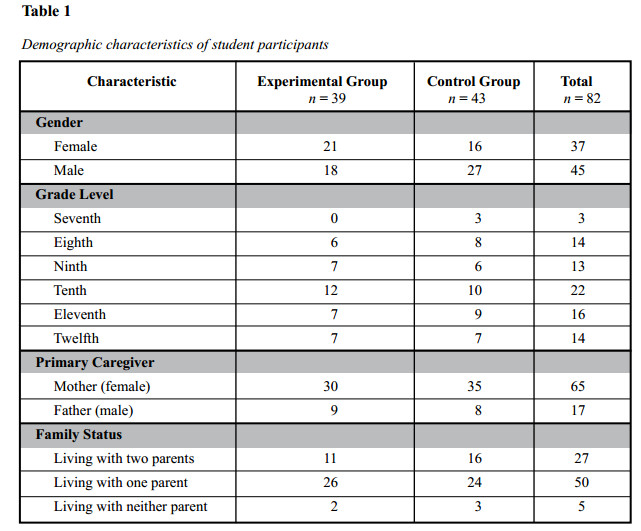
Because the school is small (currently 100 students), the entire student population, except for pregnant or parenting teens, was utilized as a census sample. Therefore, no sampling procedures were enacted through the process. Four participants from the experimental group dropped out of the study. One male, grade 9, age 17, dropped out of school to get his GED; another male, grade 12, age 18, and the two female participants, both grade 12 and age 18, dropped out of school to seek full-time employment.
Instruments/Materials
Self-Efficacy Scale. The instrument used to measure self-efficacy was the Self-Efficacy Scale (Sherer et al., 1982). According to Bandura (1997), expectations of self-efficacy are the most powerful determinants of behavioral change because self-efficacy expectancies determine the initial decision to perform a behavior, the effort expended, and persistence in the face of adversity. According to Sherer, the primary author of the instrument, the goal in developing this instrument was to create a measure of self-efficacy that would not be tied to a specific situation or behavior. The purpose of this study was discussed with Sherer (personal communication, August 10, 2004), who agreed this instrument would be appropriate to measure a growth factor in the self-efficacy domain for this student population. The Self-Efficacy Scale is a 30-item measure assessing two self-efficacy constructs: general self-efficacy and social self-efficacy. The total scores for each subscale were utilized.
Parent Effectiveness Measure. Parent effectiveness, the second variable, was assessed with an adapted version of the Parenting Self-Agency Measure (Dumka et al., 1996). The 10-item instrument was measured on the same scale, but the items were modified to account for the fact that the student participants are not yet parents. The wording of items was changed to future tense to validate the change of context (e.g., “I feel sure of myself as a mother/father” was modified to “I will feel sure of myself as a mother/father”). Dumka (personal communication, October 6, 2004), the primary author of this measure, agreed that the instrument would be equally valid when adapted as a prospective parenting assessment, even though it was originally developed for use with parents of young teens. Dumka et al. noted that hypothetically, increased parenting self-agency should be one outcome of any preventive or therapeutic parenting intervention.
Procedure
Student participants were randomly assigned to either the experimental or the control group, initially 43 in each group. In order to study the effect of parenthood education with only non-pregnant, non-parenting alternative school students, this study was delimited to participants who fit this criteria—students who were either pregnant or already a parent were not included in the initial randomization of students to experimental or control groups. The experimental group attended the parenthood education program two mornings each week, for eight weeks. The control group was offered the opportunity to attend the same parenthood education course after the post data collection. A survey of parent education research revealed a range in curricula length, with the mean program at 10.5 weeks of instruction (Bamba, 2001; Cline & Fay, 1990; Cutting & Tammi, 1999; Doetsch, 1990; Fay, Cline, & Fay, 2000; Herz, 1984; Stirtzinger et al., 2002).
The parenthood education program was designed as a pre-pregnancy prevention strategy to teach pro-social parenting skills, a realistic picture of child raising (including financial, time, and emotional demands), child development, goal setting, proactive family planning strategies, and included learning opportunities for the development of self-efficacy and empathy (with current parent/caregiver roles and responsibilities). The program is partially a derivative of an established parenting program, which was read and approved by Dr. Foster Cline, a renowned child psychiatrist and parenting educator/author (personal communication, November 2004). Based upon extensive experience and certification, the first author was selected as the instructor for the program. The teaching method consisted of lectures, small and large group discussions, daily journaling, instructional videos, role-playing, practical and relevant information dissemination, and question and answer periods.
Results
The program impact for the results of the two instruments described above was assessed using a between-subjects posttest design. The experimental group concluded the last program session by completing the four instruments while the control group participants simultaneously finished the instruments in their advisory classes. The classroom teachers adhered to the posttest protocol discussed by the first author prior to testing (test environment, order of instruments, student question guidelines, timeline, data collection). It should be noted that the experimental group was much larger (n=39) and the testing environment was considerably louder and less focused than control group settings, where the participants in each room ranged from only two to six students and the rooms were observed to be quiet and composed. The experimental group was reported to be “in a hurry to finish” and “distracted,” with “excessive talking and chitchat” present in the room. It was expected that these factors might negatively influence the validity of the instrument results.
Table 2 summarizes the descriptive data—means and standard deviations of the scores—for each dependent variable with both the experimental and control group. The alpha level was set at .05 throughout the study, unless otherwise indicated.
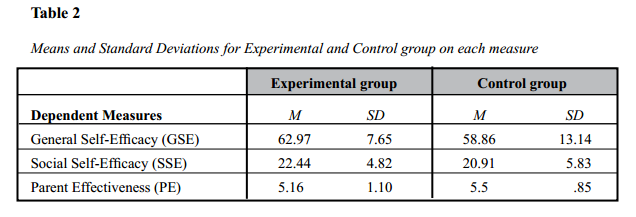
General Self-Efficacy (GSE). Two-way ANOVA analyses were conducted to evaluate the effects of a participant’s group (experimental or control) and identified attributes (grade, age, gender, gender of primary caregiver and number of parents in the household) on general self-efficacy. Statistical significance was shown in the difference between the experimental and control group when averaged across the primary caregiver levels (male or female), F (1, 78) = 5.51, p < .05, partial η² = .07. No other main effect or any interaction effects were found to be significant on the GSE measure (see Table 3).
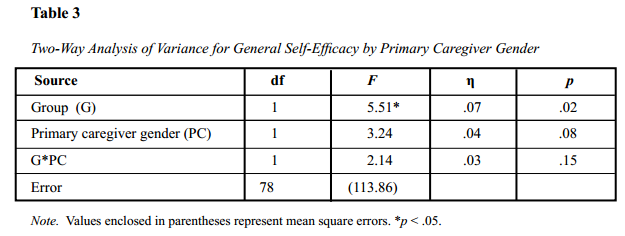
Social Self-Efficacy (SSE). The results for the two-way ANOVA on social self-efficacy indicated two statistically significant main effects. The primary caregiver factor, averaged across the grouping factor (experimental or control) was found to be significant at the alpha level .001, F (1, 78) = 11.24, p < .001, partial η² = .13 (see Table 4). The second main effect showing significance was the number of parents in the household (1, 2, or none), F (2, 76) = 3.51, p < .05, partial
η² = .08 (see Table 5).

Parent Effectiveness (PE). The two-way ANOVA analyses were again conducted to evaluate the effects of a participant’s group and attributes (grade, age, gender, gender of primary caregiver, and number of parents in the household) on a dependent measure, parent effectiveness. Statistically significant results were indicated in the grouping main effect (experimental or control), F (1, 78) = 5.03, p < .05, partial η² = .06, although in the opposite direction than originally hypothesized. The other main effect, parent effectiveness, and the interaction effect did not produce statistically significant results (see Table 6).
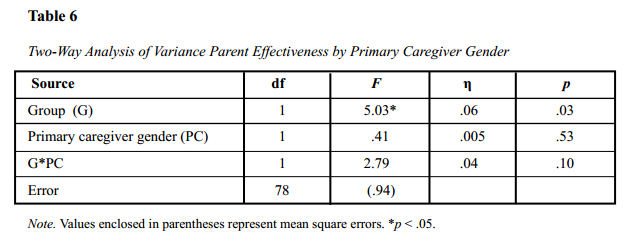
Discussion and Implications
The purpose of this study was to examine the effect of parenthood education on self-efficacy and parent effectiveness. Review of research studies corroborates that at-risk students are confronted with discouraging cyclic patterns including school failure, child abuse and neglect, substance abuse, poverty, out-of-wedlock births, welfare dependency, workforce underdevelopment, fatherless children and low self-efficacy (Herrenkohl et al., 2003; Massey, 1998; NCPTP, 2002). These intergenerational cycles of unconstructive parenting patterns will continue, absent new knowledge and more effective options. The current inquiry offered a proactive approach to teaching fundamental information through an integrated parenthood education program.
Using a two-way ANOVA, statistically significant results were obtained from four main effect analyses: (1) General Self-Efficacy measure (group by gender of primary caregiver); (2) Social Self-Efficacy measure (gender of primary caregiver); (3) Social Self-efficacy measure (group by number of parents in the household); and (4) Parent Effectiveness (group). Interestingly, the Parent Effectiveness measure actually produced results counter to the purported outcome.
The seemingly contradictory results from a comparison of overall means obtained on the Parent Effectiveness measure (the control group mean calculated higher than the experimental group) are a logical outcome when considering one of the goals of the parenthood education program—to increase student awareness of the financial, social-emotional and time demands of actual parenting. Once the experimental group became cognizant of the realistic depiction of parenting, it is probable they were evaluating themselves more accurately in the parental role, unlike the control group who idealistically, albeit erroneously, rated themselves as more “effective” parents based upon a limited, narrow definition of parenthood. These naïvely confident students, as Hess, Teti, and Hussey-Gardner (2004) contend, may feel highly secure at parenting tasks and believe they are a competent parent, but when they are working from a faulty knowledge base of what is developmentally appropriate, the self-analysis of parenting skills will not be a genuine reflection of ability. Hence, the experimental group’s authentic assessment was lower because it was filtered through the newfound knowledge of what it actually takes to be a healthy functioning parent. Cutting and Tammi (1999) documented a significant impact on participants’ perceptions of parenting after the parenthood education program in their Scotland study; students rated “Made me a lot more aware about what being a parent involves” higher than other survey choices. Similar to Griffith’s 2002 study, which found that the intervention enhanced the participants’ future parenting skills, these study results suggest a new awareness level of participants. Although contrary to the intention of this research, the outcome may be considered positive because there is a possibility students are now more prepared for parenthood and may be more cautious and introspective about pregnancy and family planning. Consistent with the Trinidad Spain study’s long-term follow up (Griffith), future studies should include subsequent analysis of pregnancy rates at various time intervals after program intervention to determine the program’s childbearing effects and capacity to deter teen pregnancy.
These findings are consistent with Bandura’s 1982 theory that a program which aims to enhance self-efficacy will lead to increased motivation and a transfer of efficacious beliefs to other domains in participants’ lives. The intervention program provided a mechanism for student participants to gain new knowledge and attitudes from a source outside their own family construct and to increase their own sense of self-efficacy (Hess et al., 2004; Leerkes & Crockenberg, 2002; Reppucci, Britner, & Woolard, 1997). A supposition can be made that knowledge and new insight from the intervention program led to an increase of general self-efficacy for student participants, which subsequently translated into enhanced scores on the post-test measures. This would support Bandura’s theory of efficacy transference. Integrating parenthood education into an alternative school curriculum affords at-risk students the opportunity for exposure to healthy parenting and family planning information that they would not otherwise receive. By participating in a parenthood education program designed as a pre-pregnancy prevention strategy, alternative school students receive instruction and guidance in prosocial parenting skills, realistic child raising (including financial, time, and emotional demands), child development, proactive family planning, goal setting, and the development of self-efficacy and empathy (with parent/caregiver’s roles and responsibilities).
Limitations
The major limitation of this study was using the program with the entire experimental group (39 students) placed in one large instructional setting. Although logistically necessary for the school’s academic and scheduling requirements, this arrangement was not theoretically sound from an alternative school educational pedagogy (Barr & Parrett, 2003). A group of 39 students is too many to monitor, focus toward lesson goals and objectives, and authentically involve in discussions and activities. It is likely that sustainability of program content for student participants was weak or even lost due to the size of the group. A smaller group would naturally prompt an increase in instructor-student interaction, group discussion participation, and greater retention of the information by student participants. Future programs or follow-up studies are recommended to be not more than 8–12 students per class session, which is consistent with group theory and at-risk curriculum recommendations (Corey, 1990; Becvar, Canfield, & Becvar, 1997).
The duration of the program—eight weeks, two times per week—can be a limitation. Although the length of the parenthood education program is consistent with best practices and the average for parent education programs (Bamba, 2001; Cline & Fay, 1990; Cutting & Tammi, 1999; Doetsch, 1990; Fay, Cline, & Fay, 2000; Herz, 1984; Stirtzinger et al., 2002), extending the program would allow for reiteration of material, increased process and reflection time, and retention of curriculum. Because the program content is unfamiliar to this population, a longer time span for program intervention would assist in assimilation and application for the students.
Generalizability of the study findings beyond this population is limited. Because the population consisted of only one alternative school in Northern Idaho, caution is advised in generalizing the results to other settings. In order to extend generalizability, future research should replicate the current study parameters in similar populations.
Recommendations for future studies include: (1) increased integration of the program across a full semester scheduled to meet at least one hour per week; (2) implementation of the program with group sizes which are theoretically sound for the at-risk adolescent population (between 8–12 students per group); (3) administration of posttests in at least two sessions versus all assessments completed in only one session; (4) the addition of a qualitative component to the posttest measures which would enhance understanding of the at-risk adolescent; and, (5) inclusion of a follow-up measure that would help analyze pregnancy rates at various time intervals after program intervention to determine the effect of the program in deterring teen pregnancy over time. These recommendations would serve to alleviate the current study’s limitations, expound on its strengths, and produce a robust, credible parenthood education program effective with our at-risk alternative school adolescents.
References
April is Child Abuse Prevention Month. (2005, March). Bonner County Daily Bee, 4, 13.
Bamba, M. L. (2001). Evaluating the impact of parent education for parents of young children (Doctoral dissertation, University of Oregon, 2001). Dissertation Abstracts International, 61 (7-A), 2586.
Bandura, A. (1982). Self-efficacy mechanism in human agency. American Psychologist, 37, 122–147.
Bandura, A. (1997). Self-efficacy: The exercise of control. New York, NY: W. H. Freeman.
Bandura, A., Adams, N., Hardy, A., & Howells, G. (1980). Tests of the generality of self- efficacy theory. Cognitive Therapy and Research, 3, 39–66.
Barr, R. D., & Parrett, W. H. (2003). Saving our students, saving our schools: 50 proven strategies for revitalizing at-risk students and low-performing schools. Glenview, IL: Pearson Skylight.
Becvar, R. J., Canfield, B. S., & Becvar, D. S. (1997). Group work: Cybernetic, constructivist, and social constructionist perspectives. Denver, CO: Love Publishing.
Bifulco, A., Moran, P. M., Ball, C., Jacobs, C., Baines, R., & Bunn, A., & Cavagin J (2002). Childhood adversity, parental vulnerability and disorder: Examining inter-generational transmission of risk. Journal of Child Psychology and Psychiatry, 43, 1075–1086.
Bissell, M. (2000). Socio-economic outcomes of teen pregnancy and parenthood: A review of the literature. Canadian Journal of Human Sexuality, 9, 191–204.
Cline, F., & Fay, J. (1990). Parenting with love and logic: Teaching children responsibility. Colorado Springs: Pinon Press.
Coleman, P. K., & Karraker, K. H. (1997). Self-efficacy and parenting quality: Findings and future applications. Developmental Review, 18, 47–85.
Cowen, P. S. (2001). Effectiveness of a parent education intervention for at-risk families. Journal of the Society of Pediatric Nurses, 6, 73–82.
Cutting, E., & Tammi, L. (1999). Understanding parents, understanding parenthood: An education for parenthood course piloted at Monifeith High School, Angus (Report No. PS028153). United Kingdom, Scotland: Save the Children Scotland, Edinburgh. (ERIC Document Reproduction Service No. ED 437 181).
Doetsch, P. (1990). Reducing the risk for child abuse by developing and implementing a parenting program for teenage mothers (Report No. CG-022-668). Nova University, FL: Counseling and Student Services Clearinghouse. (ERIC Document Reproduction Service No. ED321218).
Donenberg, G. R., Wilson, H. W., Emerson, E., & Bryant, F. B. (2002). Holding the line with a watchful eye: The impact of perceived parental permissiveness and parental monitoring on risky sexual behavior among adolescents in psychiatric care. AIDS Education and Prevention, 14, 138–157.
Dorrell, L. D. (1994). A future at risk: Children having children. Clearing House, 67, 224–227.
Dumka, L. E., Stoerzinger, H. D., Jackson, K. M., & Roosaa, M. W. (1996). Examination of the cross-cultural and cross-language equivalence of the Parenting Self-Agency Measure. Family Relations, 45, 216–222.
Fay, J., Cline, F. W., & Fay, C. (2000). Becoming a love and logic parent: Parent handbook. Golden, CO: The Love and Logic Press.
Flanigan, C. (2001). What’s behind the good news: The decline of teen pregnancy rates during the 1990s. Washington, DC: National Campaign to Prevent Teen Pregnancy.
Frick, P. J., Christian, R. E., & Wootton, J. M. (1999). Age trends in the association between parenting practices and conduct problems. Behavior Modification, 23, 106–128.
Griffin, N. C. (1998). Cultivating self-efficacy in adolescent mothers: A collaborative approach. Professional School Counseling, 1, 53–59.
Griffith, J. (2002). To handle life’s challenges: A tracer study of Servol’s adolescent development programme in Trinidad. Early childhood development: Practice and reflections. Following footsteps (Report No. 16). The Hague, Netherlands: Bernard van Leer Foundation. (ERIC Document Reproduction Service No. ED 463 857).
Helge, D. (1989a). Preventing teenage pregnancies in rural America (Report No. CG-022-212). Bellingham, WA: National Rural and Small Schools Consortium. (ERIC Document Reproduction Service No. ED314677).
Helge, D. (1989b). Report of pilot project regarding strategies for enhancing self-esteem of at- risk students (Report No. CG-022-213). Bellingham, WA: Counseling and Student Services Clearinghouse. (ERIC Document Reproduction Service No. ED 314678).
Helge, D. (1989c). Rural “at-risk” students: Directions for policy and intervention (Report No. RC-017-663). Bellingham, WA: Rural Education and Small Schools Clearinghouse. (ERIC Document Reproduction Service No. ED 323046).
Helge, D. (1990). A national study regarding at-risk students (Report No. RC-017-778). Bellingham, WA: Rural Education and Small Schools Clearinghouse. (ERIC Document Reproduction Service No. ED 324178).
Helge, D. (1991). At-risk students—a national view of problems and service delivery strategies. Rural Special Education Quarterly, 10, 42–52.
Herrenkohl, E. C., Herrenkohl, R. C., & Egolf, B. P. (2003). The psychosocial consequences of living environment instability on maltreated children. American Journal of Orthopsychiatry, 73, 367–380.
Herrenkohl, E. C., Herrenkohl, R. C., Egolf, B. P., & Russo, M. J. (1998). The relationship between early maltreatment and teenage parenthood. Journal of Adolescence, 21, 291–303.
Herrenkohl, E. C., Herrenkohl, R. C., Rupert, L. J., Egolf, B. P., & Lutz, J. G. (1995). Risk factors for behavioral dysfunction: The relative impact of maltreatment, SES, physical health problems, cognitive ability, and quality of parent-child interaction. Child Abuse and Neglect, 19, 191–203.
Herz, E. J., Goldberg, W. A., & Reis, J. S. (1984). Family life education for young adolescents: A quasi-experiment. Journal of Youth and Adolescence, 13, 309–327.
Hess, C. R., Teti, D. M., & Hussey-Gardner, B. (2004). Self-efficacy and parenting of high-risk infants: The moderating role of parent knowledge of infant development. Applied Developmental Psychology, 25, 423–437.
Hopper, J. (2005). Child abuse: Statistics, research, and resources. Retrieved April 1, 2005, from http://www.jimhopper.com
Hotz,V. J., McElroy, S.W., & Sanders, S. G. (1997). The impacts of teenage childbearing on the mothers and the consequences of those impacts for government. In R. A. Maynard (Ed.). Kids having kids (pp. 55–94). Washington, DC: Urban Institute.
Hotz,V. J., McElroy, S. W., & Sanders, S. G. (2005). Teenage childbearing and its life cycle consequences: Exploiting a natural experiment. The Journal of Human Resources, 40(3), 683–715.
Jacobson, L. (2001). Program builds young students’ parenting skills. Education Week, 20 (39), 1–3.
Johnson, J. G., Cohen, P., Smailes, E. M., Kasen, S., & Brook, J. S. (2002). Television viewing and aggressive behavior during adolescence and adulthood [Electronic version]. Science, 295, 2468–2471.
Kalmuss, D. S., & Namerow, P. B. (1994). Subsequent childbearing among teenage mothers: The determinants of a closely spaced second birth. Family Planning Perspectives, 26, 149–159.
Leerkes, E. M., & Crockenberg, S. C. (2002). The development of maternal self-efficacy and its impact on maternal behavior. Infancy, 3, 227–247.
Massey, M. S. (1998). Early childhood violence prevention (Report No. EDO-PS-98-9). Champaign, IL: ERIC Clearinghouse on Elementary and Early Childhood Education. (ERIC Document Reproduction Service No. D424032).
Minet, S. B. (1985). An infant/toddler program for high risk parents and their children (Report No. PS-015-403). CA: Elementary and Early Childhood Education Clearinghouse. (ERIC Document Reproduction Service No. ED 261806).
National Campaign to Prevent Teen Pregnancy [NCPTP]. (2011). Teen birth rate increase 2006 Retrieved January 12, 2011, from http://www.thenationalcampaign.org/resources/pdf/TBRincrease_2006.pdf
National Campaign to Prevent Teen Pregnancy [NCPTP]. (2002). Not just another single issue: Teen pregnancy prevention’s link to other critical social issues (Report No. UD-034-831). Washington, DC: Author. (ERIC Document Reproduction Service No. ED462522).
National Campaign to Prevent Teen Pregnancy [NCPTP]. (2005). Retrieved March 12, 2005, from
http://www.teenpregnancy.org/Default.asp?bhcp=1
National Clearinghouse on Child Abuse and Neglect Information. (2004). What is child abuse and neglect? Retrieved March 12, 2005, from http://nccanch.acf.hhs.gov/pubs/factsheets/whatiscan.cfm
National Institute of Justice (NIJ). (2005). Retrieved April 4, 2005, from http://www.ojp.usdoj.gov/nij/
Payne, R. K. (2003). A Framework for understanding poverty (3rd Rev. ed.). Highlands, TX: aha! Process, Inc.
Pearson, J., Muller, C., & Frisco, M. L. (2006). Parental involvement, family structure, and adolescent sexual decision making. Sociological Perspectives, 49, 67–90.
Prevatt, F. F. (2003). The contribution of parenting practices in a risk and resiliency model of children’s adjustment [Electronic version]. British Journal of Developmental Psychology, 21, 469–480.
Prothrow-Stith, D., & Quaday, S. (1995). Hidden casualties: The relationship between violence and learning. Washington, DC: National Health & Education Consortium and National Consortium for African American Children, Inc. ED 390 552.
Raneri, L.G., & Wiemann, C.M. (2007). Social ecological predictors of repeat adolescent pregnancy. Perspectives on Sexual and Reproductive Health, 39(1) 39–47.
Reppucci, N. D., Britner, P. A., & Woolard, J. L. (1997). Preventing child abuse and neglect through parent education. Baltimore: Paul H. Brooks.
Rutgers, The State University. (1979). Education for Parenthood (Vocational-Technical Curriculum Lab Report No. CE047008). Abstract retrieved August 2, 2004, from Adult, Career, and Vocational Education Clearinghouse. (ERIC Document Reproduction Service No. ED 281048).
Sawhill, I.V. (2001). What can be done to reduce teen pregnancy and out-of-wedlock births? Center on Children and Families Briefs. Retrieved online on December 14, 2009 from http://www.brookings.edu/papers/2001/10childrenfamilies_sawhill.aspx
Sawhill, I.V. (2007) Attacking poverty and inequality: Reinvigorate the fight for greater opportunity. Center on Children and Families Briefs. Retrieved online on December 14, 2009 from http://www.brookings.edu/papers/2007/0228poverty_haskins_Opp08.aspx
Sherer, M., Maddux, J. E., Mercandante, B., Prentice-Dunn, S., Jacobs, B., & Rogers, R. W. (1982). The self-efficacy scale: Construction and validation. Psychological Reports, 51, 663–671.
Shumow, L., & Lomax, R. (2002). Parental efficacy: Predictor of parenting behavior and adolescent outcomes. Parenting: Science and Practice, 2, 127–150.
Smith, C. (1996). The link between childhood maltreatment and teenage pregnancy. Social Work Research, 20, 131–141.
Stanberry, J. P., & Stanberry, A. M. (1994). Confidence in parenting: Is parent education working? (Report No. PS-023-082). Mississippi: Elementary and Early Childhood Education Clearinghouse. (ERIC Document Reproduction Service No. ED382324).
Stirtzinger, R., McDermid, S., Grusec, J., Bernardini, S., Quinlan, K., & Marshall, M. (2002). Interrupting the inter-generational cycle in high-risk adolescent pregnancy. The Journal of Primary Prevention, 23, 7–22.
Swick, K. J., & Williams, R. D. (2006). An analysis of Bronfenbrenner’s bio-ecological perspective for early childhood educators: Implications for working with families experiencing stress. Early Childhood Education Journal, 33(5) 371–378.
Terry, E., & Manlove, J. (2000). Trends in sexual activity and contraceptive use among Teens. Washington, DC: National Campaign to Prevent Teen Pregnancy.
United States Census Bureau. (2003). Current population survey, 2003 annual social and economic supplement. Retrieved March 31, 2005, from http://www.census.gov/hhes/www/income.html
U.S. Department of Commerce, Bureau of Census. 1990. Current population reports: Money income and poverty status in the United States. Washington, D.C.: U.S. Government Printing Office.
United States Department of Health & Human Services. (2002). Teen births. Retrieved from http://www.cdc.gov/nchs/fastats/teenbrth.htm
Ventura, S. J, Mathews, T. J., & Hamilton, B. E. (2002). Teenage births in the United States: State trends, 1991–2000, an update. National vital statistics reports: From the Centers for Disease Control and Prevention, National Center for Health Statistics, National Vital Statistics System, 50(9), 1–4.
Becky Weller Meyer is Principal of Sandpoint High School in Sandpoint, Idaho. Sachin Jain, NCC is Assistant Professor of Counseling and School Psychology at the University of Idaho. Kathy Canfield-Davis is Assistant Professor of Educational Leadership at the University of Idaho. Correspondence can be addressed to Sachin Jain, University of Idaho, 1031 N. Academic Way, Coeur d’Alene, ID 83814 -2277, sjain@uidho.edu.
Sep 6, 2014 | Article, Volume 2 - Issue 1
Martha Nodar
The primary goal of this paper is two-fold: to challenge the belief that adult children of alcoholics tend to abuse alcohol as the result of genetic composition, and to show instead evidence that the unpredictable and chaotic home environment in which alcoholics grow up may be responsible. Adult children of alcoholics syndrome, mood alteration, and family history of alcoholism are explored. Addiction models and treatment plan implications are presented.
Keywords: abuse, addiction, chaos, home environments, alcoholics
According to the National Association for Children of Alcoholics (n.d.), out of the approximately 30 million children of alcoholics in the United States, 11 million are believed to be minors (younger than 18 years old) and the remainder (almost 20 million) are adult children. The term Adult Children of Alcoholics (ACoA) attempts to capture the shared characteristics typically found among those adults who grew up with either one or two alcoholic parents (Jones, Perera-Diltz, Sayers, Laux, & Cochrane, 2007). Alcoholic families are driven by a system of rigidity (arbitrary rules, lack of flexibility) where children develop a sense of chronic shock (Kritsberg, 1985). Kritsberg (1985) refers to chronic shock as an overwhelming fear that is never expressed or resolved, which commonly leads to shutting down. Prevented from expressing their emotions and from learning healthy coping skills in an alcoholic environment, coupled with poor family interaction patterns tend to place ACoAs at a higher risk for alcohol abuse (Woititz, 1984). In a move to augment Woititz’s (1984) findings, this essay reviews the risk for alcohol abuse among ACoAs from a complimentary paradigm: growing up in a chaotic family environment rather than having alcoholic parents may account for the tendency of alcohol abuse among ACoAs.
The ACoA Syndrome
A chaotic environment is fertile ground for the shared characteristics of ACoAs, known as the ACoA syndrome (Kritsberg, 1985). The ACoA syndrome is a developmental phenomenon shared by most if not all ACoAs, which describes “common symptoms and behaviors as the result of their common experience” (Kritsberg, 1985, p. 3). A kaleidoscope of characteristics engulf the syndrome, which is mostly grounded in fear: fear of abandonment, fear of intimacy, fear of change, chronic shock (a persistent state of apprehension), fear of making mistakes, feelings of inadequacy (fear of not being good enough) and poor coping skills (Kritsberg, 1985). Ratey and Johnson (1997) explain that syndromes are a constellation of traits that manifest themselves in a continuum depending on the individual’s psychological development. In other words, not all ACoAs may present all of the traits, but most ACoAs fall somewhere in the spectrum (Kritsberg, 1985; Woititz, 1984). Kritsberg (1985) insists the ACoA syndrome typically develops in response to a very rigid and chaotic family system that may be centered on the alcoholic.
Alcohol: A Mood-Altering Substance
An alcoholic is a person who abuses alcohol despite the consequences to self, finances, and interpersonal relationships. Alcohol is a depressant whose job is to suppress the central nervous system (CNS) while hijacking the brain’s mesolimbic reward system (Dodes, 2002). Encompassing a complex pleasure circuit, the mesolimbic reward system activates the limbic system (the seat of emotion), and at the same time deactivates the prefrontal cortex (the seat of reason) (Dodes, 2002). The dynamics involved in the nerve fibers of the reward pathway are believed to be responsible for the “sensation” or the feelings of euphoria sought by alcoholics (Heitzeg, Nigg, Yau, Zucker, & Zubieta, 2010, p. 287).
Although there may be different models to explain the etiology of substance abuse and addiction, there is a consensus among scholars that alcoholics attempt to alter their moods, such as depression, anxiety, anger, and feelings of inadequacy, through alcohol consumption (Dodes, 2002). Consequences of alcohol abuse are not only evident in the United States, but also are seen in families around the world. European studies focusing on adolescents from Austria, Germany, Czechoslovakia, Russia, Turkey, and Denmark show that “one family member’s substance abuse is often influenced by substance-using behaviors of others in the family” (Grüber, Celan, Golik-Grüber, Agius, & Murphy, 2007, p. 27). While ethnicity does not seem to play a significant role in the propensity toward alcohol abuse, other variables have been found to have an impact (Braitman et al., 2009). For instance, either having two alcoholic parents or having “an alcoholic father” increases the odds of alcohol abuse in both their male and female offspring (Braitman et al., 2009, p. 71).
Family History as a Variable
A longitudinal study that followed participants from 12 years of age to 31 by Warner, White, and Johnson (2007) showed that a combination of both early experimentation with alcohol and a family history of alcoholism are predictors of a “problem-drinking trajectory” (p. 56). Warner et al. reached their arguments based on a number of analyses including the application of Rutgers Alcohol Problem Index (RAPI). The RAPI is a psychometric instrument used to discern how problematic alcohol consumption may be perceived by a population and has received support among scholars. Neal, Fromme, and Corbin (2006) found RAPI to have acceptable validity and reliability and “test-retest correlations between 89 and 92” (p. 402). Warner et al. concluded that age at drinking onset alone is not sufficient to predict a problematic drinking trajectory. Instead, Warner et al. predict those who start drinking at an early age (adolescence) who also have a family history of alcoholism (ACoAs) are at higher risk to abuse alcohol as adults than those who do not have an alcoholic family history (non-ACoAs).
ACoAs vs. Non-ACoAs
Intrigued by the presence of alcohol in the family as a probable variable in the offspring’s alcohol abuse, Jones et al. (2007) led a research study to investigate the differences in alcohol consumption between ACoAs and non-ACoAs. With that in mind, the researchers divided the participants in two groups: those who identified themselves as having grown up with a substance-abuse parent and those who did not. Jones et al. applied the Self-Administered, Stand-Alone Screening Instrument (SASSI-3) to the participants. The SASSI-3 is a questionnaire unrelated to substance abuse. The rationale for asking substance-unrelated questions is an attempt to bypass the tendency of denial often found among those abusing a substance. After analyzing the results, Jones et al. noted no difference in the consumption of alcohol between the ACoA and non-ACoA groups. Jones et al. concluded that the culprit in an alcoholic home may not be so much the substance per se, but “the chaos associated with the substance use that may lead to the ACoA traits” (p. 24). In other words, the chaos and unpredictability experienced in alcoholic families may explain the ACoA syndrome, and the high risk of alcohol abuse among ACoAs (Kritsberg, 1985; Woititz, 1984).
Chaos and Unpredictability
In concert with Jones et al.’s (2007) theory of unpredictability, Ross and Hill (2001) conducted a study where participants from different ethnic and socioeconomic backgrounds were recruited from ongoing studies at the University of Michigan Alcohol Research Center. One group of adult children of alcoholics and one group of adults who had parents who drank moderately during social events were investigated. The researchers’ mission was to isolate unpredictability (lack of consistency) and chaos in the family as variables in developing alcohol abuse in adulthood. In agreement with Jones et al. (2007), Ross and Hill (2001) propose that “the chaotic nature” and the “unpredictability” in the home may be the precursors to alcohol abuse in adulthood (p. 610). Factors such as parental rejection or uninvolvement, abusive discipline and punishment, and systematic broken promises were the underpinnings measured in the unpredictability index (Ross & Hill, 2001).
Ross and Hill (2001) argued that their study revealed “parental unpredictability, rather than parental alcoholism per se, was associated with alcohol misuse . . . and [shows] why all children from alcoholic homes do not have problems with alcohol themselves” (p. 630). These researchers point out that the significance of unpredictability, which they found in homes of adult children of divorce, adult children of economic adversity, and among ACoAs is the factor linking these adult children, which cannot be over-emphasized (Ross & Hill, 2001).
Basing their premise on Bowlby’s (1969) theory of attachment and loss, Ross and McDuff (2008) contend that unpredictability is a derivative of insecure attachment between caregivers and their children. Attachment describes the bond children form with their caregivers. Attachments range in a continuum from secure to insecure (avoidant) depending on the caregiver’s availability and willingness to meet children’s needs (Bowlby, 1969). Insecure attachments are damaging to children because they tend to send implicit and explicit messages that they are not important enough to receive care (Bowlby, 1969). This mindset is unconsciously carried into adulthood, becoming the underpinning of the ACoA syndrome (Kritsberg, 1985).
In an effort to support their argument on unpredictability, Ross and McDuff (2008) administered both Ross and Hill’s (2001) Family Unpredictability Scale (FUS) and Ross and McDuff’s (2008) Retrospective Family Unpredictability Scale (Retro-FUS) to the participants in their study. Retro-FUS is specifically designed for ACoAs, and both FUS and Retro-FUS evaluate the degree of inconsistencies in discipline, nurturance, meals, and general family dysfunction. As a corollary, Hodgins, Maticka-Tyndale, El-Guebaly, and West’s (1993) Children of Alcoholics Screening Test (CAST) also was used to specifically distinguish ACoAs from non-ACoAs in the study. It is worth mentioning that the CAST has received support among the academic community for its accuracy in measuring specific family dynamics in the alcoholic home (Lease & Yanico, 1995). Ross and McDuff (2008) conclude that growing up in an unpredictable environment is an important factor placing the ACoAs at higher risk for abusing alcohol compared with non-ACoAs.
Addiction Models
Among some clinicians the genetic model has gained clamor because of the frequency of alcoholism observed in certain families (Wang et al., 2011). To identify the contributing gene or genes to alcohol dependence, Wang et al. (2011) conducted a study of a small sample of Australian twins and concluded there is no gene or group of genes responsible for the main effect of alcohol dependence, but rather the possibility that an individual with a certain genotype such as monamine oxidase A (MAOA) may have an increased risk for alcohol dependence. However, this increased risk would most likely only occur when those “subjects are exposed to environmental stressors” (Wang et al., 2011, p.1295). Examples of environmental factors may include the individual’s personality, coping strategies, or family system. These researchers conclude by stating that it is unclear how the genetic influence may or may not interfere in alcohol dependence and to what degree.
Also interested in exploring the genetic influence in alcohol abuse, Clarke et al. (2010) analyzed twin studies while conducting their own study. These researchers argue that stress activates certain responses in the brain, such as the locus coeruleus (LC), a structure located in one of the ventricles and sensitive to the activation (by a gene) to produce cortisol during times of stress. Clarke et al.’s argument is based on the notion that this dynamic between the stress and the production of cortisol may drive an individual to alcohol abuse to decrease the activity in LC, supposedly bringing a sense of calm during stressful situations. In other words, the gene activating the LC may be responsible for mediating the effect of alcohol which has been detected in twin studies.
As expected, the genetic model has its critics because they argue it has not yet established a definite or persuasive relationship between genes and alcoholism (Dodes, 2002). In his 1986 article, Peele unveils his concern for the popularity of the genetic model to explain the etiology of alcohol abuse. Peele (1986) argues the data obtained to form the basis of the genetic model for alcoholism do not take into account important variables. These variables may include the unique differences among alcoholics as well as within ACoAs; how the alcohol abuse may unfold in many individuals and how any of these variables may be affected by a family environment that may or may not include a history of alcoholism (Peele, 1986).
Peele (1986) insists there is no evidence that ACoAs inherit a “genetic liability for alcoholism” (p. 63). Peele explains the phenomenon observed in twins from biological alcoholic parents only shows a correlation between having alcoholic parents and abusing alcohol. Additional information about family dynamics where twins grew up, such as divorce, financial instability, or chaos in the family was not included in the research with twins (Clarke et al., 2010; Wang et al., 2011). Peele (1986) emphasized that the genetic model has “dangerous consequences” because it appears to deny the human complexity involved in substance abuse, and because it may prevent counselors from digging deep into the core issues of addiction with their clients (p. 63). Peele is supported by other scholars who believe ACoAs are modeling substance abuse behavior rather than having a genetic composition for alcoholism (Braitman, 2009).
Moreover, Dodes (2002) concedes that although some genes may “influence the susceptibility to developing alcoholism” (p. 81), it is not realistic to believe that one single gene or even a group of genes would have the power to produce one single specific behavior such as alcohol addiction or dependence. Dodes explains that genes are a sequence of DNA (molecules), but DNA not only contains additional information that is non-genetic, but DNA also controls whether genes are activated or not. The non-genetic factors in the DNA may include variables such as individual experiences, coping strategies, family environment and emotions. Even if a genetic predisposition is in place, that predisposition is not likely to materialize without the significant influence of the environment (Dodes, 2002).
In agreement with Peele (1986), Ross and Hill (2001, 2004) and Ross and McDuff (2008) divert from the genetic model, and instead lean toward the psychological models which focus on the learned maladaptive patterns of behavior. Other approaches include neurobiological models which attribute alcohol abuse as the result of the person’s brain functions (Heitzeg et al., 2010). Once the memory circuit makes an association between a substance and pleasure, addicts quickly learn to repeat the process to obtain a relief from their negative feelings such as loss, depression, anxiety and anger (Heitzeg et al., 2010). Some models overlap with each other, but all of them attempt to explain the substance abuse phenomenon.
Conclusion
The evidence presented herewith may carry some important implications for how addiction counselors may want to approach their treatment plan with those suffering from alcohol addiction or dependence. This paper argues that many addiction programs have failed to meet the needs of those suffering from substance abuse because the problem may not be the substance per se, but the consequences of growing up with maladaptive coping strategies that might have served to survive in a chaotic environment, but are no longer efficient. This paper claims that those suffering from addiction are able to continue their addiction likely because they have enablers in their household who are either consciously or unconsciously supporting the addiction. Addiction counselors may wish to consider involving those in the family who may be deriving a secondary gain from the addict’s addictive behavior. Both the person with addictions and the person supporting the addictions may be getting a payoff—a possible distraction to a traumatic childhood experience based on a chaotic environment.
References
Bowlby, J. (1969). Attachment and loss: Vol.1, Attachment. New York, NY: Basic Books.
Braitman, A., Kelley, M., Ladage, J., Schroeder, V., Gumienny, L., Morrow, J., & Klostermann, K. (2009). Alcohol and drug use among college student adult children of alcoholics. Journal of Alcohol and Drug Education, 53(10),
69–88.
Clarke, T., Dempster, E., Docherty, S., Desrivieres, S., Lourdsamy, A., Wodarz, N., Ridinger, M., Maier, W., Rietschel, M., & Schumann, G. (2010). Multiple polymorphisms in genes of the adrenergic stress system confer vulnerability to alcohol abuse. Addiction Biology, 17, 202–208.
Dodes, L. (2002). The heart of addiction. New York, NY: Harper-Collins.
Grüber, E., Celan, J., Golik- Grüber, V., Agius, M., & Murphy, S. (2007). The relationship between having smoking or drinking parents and the occurrence of smoking or drinking in their adolescent children. Alcoholism, 43(1),
25–35.
Heitzeg, M., Nigg, J., Yau, W., Zucker, R., & Zubieta, J. (2010). Striatal dysfunction marks preexisting risk and medial prefrontal dysfunction is related to problem drinking in children of alcoholics. Biological Psychiatry, 68(3),
287–295.
Hodgins, D., Maticka-Tyndale, E., El-Guebaly, N., & West, M. (1993). The CAST-6: Development of a short-form of the Children of Alcoholics Screening Test. Addictive Behaviors, 18, 337–345.
Jones, A., Perera-Diltz, D., Salyers, M., Laux, J., & Cochrane, W. (2007). Testing hypothesized differences between adult children of alcoholics (ACOAs) and non-ACOAs in a college student sample. Journal of College Counseling, 10, 19–26.
Kritsberg, W. (1985). The adult children of alcoholics syndrome. Pompano Beach, FL: Bantam Books.
Lease, S., & Yanico, B. (1995). Evidence of validity for the children of alcoholics screening test. Measurement and Evaluation in Counseling and Development, 27(4), 200–210.
National Association for Children of Alcoholics. (n.d.). Children of addicted parents: Important facts. Retrieved from http://www.nacoa.net/pdfs/addicted.pdf., pp. 1–4.
Neal, D., Corbin, W., & Fromme, K. (2006). Measurement of alcohol-related consequences among high school and college students: Application of item response models to the Rutgers alcohol problem index. Psychological Assessment, 18(4), 402–414.
Peele, S. (1986). The implications and limitations of genetic models of alcoholism and other addictions. Journal of Studies on Alcohol, 47(1), 63–73.
Ratey, J., & Johnson, C. (1997). Shadow syndromes. New York, NY: Pantheon Books.
Ross, L. T., & Hill, E. M. (2001). Drinking and parental unpredictability among adult children of alcoholics: A pilot study. Substance Use & Misuse, 36(5), 609–638.
Ross, L. T., & Hill, E. M. (2004). Comparing alcoholic and nonalcoholic parents on the family unpredictability scale. Psychological Reports, 94(3), 1385–1391.
Ross, L. T., & McDuff, J. (2008). The retrospective family unpredictability scale: Reliability and validity. Journal of Child and Family Studies, 17, 13–27.
Wang, K., Liu, X., Aragam, N., Jian, X., Mullersman, J., Liu, Y., & Pan, Y. (2011). Family-Based association analysis of alcohol dependence in the COGA sample and replication in the Australian twin-family study. Journal of Neural Transmission, 118(9), 1293–1299.
Warner, L., White, H., & Johnson, V. (2007). Alcohol initiation experiences and family history of alcoholism as predictors of problem-drinking trajectories. Journal of Studies on Alcohol and Drugs, 68(1), 56–65.
Woititz, J. (1984). Adult children of alcoholics. Alcoholism Treatment Quarterly, 1, 71–99.
Martha Nodar is a graduate counseling student at Mercer University in Atlanta, Georgia. Correspondence can be addressed to Martha Nodar, Mercer University, 3056 Anderson Place, Decatur, GA 30033, martha.a.nodar@live.mercer.edu.