Sep 10, 2014 | Article, Volume 1 - Issue 1
George Davy Vera
A personal description of the international counselor education program at the University of Zulia in Venezuela is presented including educational objectives of the counseling degree, various services counselors are trained to provide, and a sample curriculum. This description serves as an example of one international counselor education program that can be used as a model for burgeoning programs in other countries.
Keywords: Venezuela, University of Zulia, international counseling, counselor education, counseling services, curriculum
Venezuela’s early counseling pioneers at the University of Zulia, some of whom were trained in the United States (e.g., Dr. E. Acquaviva, Dr. C. Guanipa, A. Busot, M. Ed.; A. Quintero, M.Ed., M. Socorro, M.Ed., D. Campo, M.Ed.), were pioneers responsible for influencing and crafting the counseling and guidance culture at the University of Zulia. Accordingly, I would like to describe one of the oldest and most well known counseling training programs in Venezuela. This program is chosen because many past and present counseling leaders in Venezuela were educated at the University of Zulia.
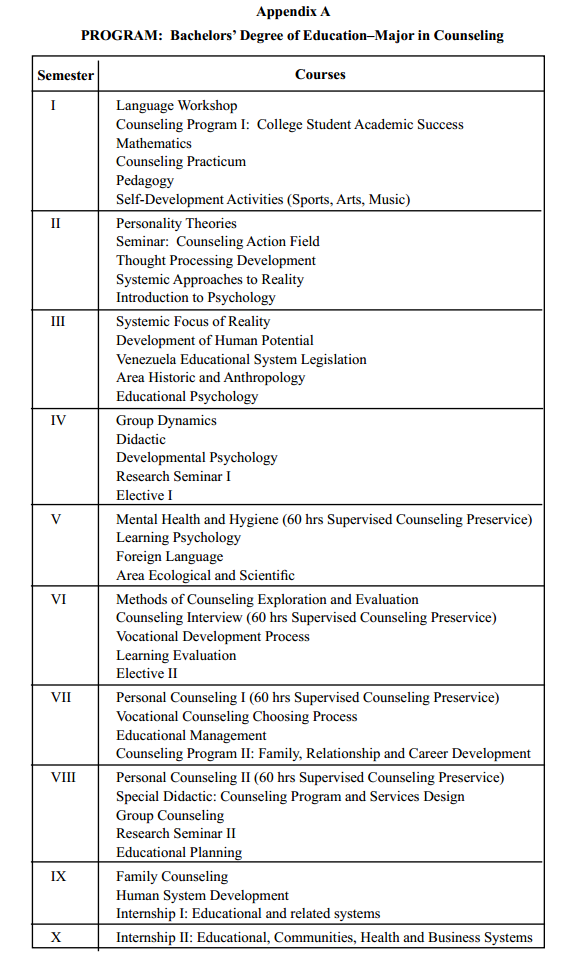
Initially in the early 1970s, this bachelor’s level counseling program was conceived as educational counseling (asesoramiento) and vocational guidance (orientación vocacional) as a specialization track within the major of Pedagogical Science. Graduates from this program received a Licentiate in Education, Major in Pedagogical Sciences in the area of counseling (Licenciatura en Educación, Mención Ciencias Pedagógicas, Area de Orientación). According to the University of Zulia’s official archive (1970-2010) on counseling academic and curriculum development, professional services related to individual, vocational or educational counseling and guidance were understood as orientación. Therefore, the Spanish word was implemented to better communicate the meaning of professional counseling and guidance. Historically, the academic choice of using this term at the time was congruent with the Ministry of Education’s decision in 1962, when the terms orientación and orientador were officially adopted to describe guidance professionals and counseling practitioners, respectively. The current bachelors’ degree is five years long (10 academic semesters, for details see Appendix A).
According to the Academic Updated Curriculum Design (Curriculum Commission of Psychology Department, 1995), the education of professional counselors is conceived upon several key concepts:
• Professional identity reflects that graduates are trained to perform counseling and guidance tasks within the educational system and other professional and organizational agencies.
• Counseling professionals help people develop within the social environment, assist with the processes of psychosocial functioning, and effectively deal with developmental changes and stressful life events.
• Professional counselors trained at the University of Zulia are competent in performing counseling tasks such as:
o designing, implementing, and evaluating counseling services.
o developing prevention or remediation programs emphasizing personal, social, academic, vocational, work, recreational, and community needs at any developmental phase using individual or group strategies.
The main educational objectives of the counseling major are:
1. Diagnosing human system characteristics within the educational, organizational, assistance, judicial, and community contexts.
2. Performing counseling and consultation.
3. Designing, implementing, and evaluating services.
4. Generating research in counseling.
Graduates provide counseling services in different areas of human services:
A. Personal-social counselors help clients deal with issues related to social roles and gain more understanding of themselves within their sociocultural context. The main purpose of the personal-social intervention area is to help clients deal with mental health and personal growth issues and to reach psychological stability. In this area, some helping processes are related to:
• psychological development: self-esteem, decision-making, emotional stability, psychosexual maturity, and intellectual potential.
• social development: interpersonal relationships, work and academic motivation, social adjustment, and ethical values.
• family development: prevention, couples relationships, parents and children, family crisis intervention including divorce, terminal and lifelong sickness, bereavement, and human sexuality.
B. Academic counselors help clients deal with issues related to learning and the role of the learner. Helping processes are related to educational adjustment, academic attitudes, cognitive development, academic performance, and consultation with school teachers, families, and communities.
C. Vocational counselors focus on individual talents, vocational potential and tendencies, as well as roles within the workplace. Vocational counselors’ tasks are mainly focused on several facets, including assessment, decision-making, work development, academic needs, workplace readiness, and positive work attitudes.
D. Work counselors provide counseling services to help individuals and organizations with shared objectives to reach mutual satisfaction and development. This area includes process management, career planning and development, work motivation and communication, work-related decision-making, evaluation, conflict resolution, work-service quality, leadership, performance, and teamwork.
E. Community and recreational counselors provide counseling services for community life enhancement. Counseling processes in this area include community resources and needs, civic practices, positive utilization of recreation and free time, community creativity, organization and planning, cultural and artistic manifestations, and social transformation.
Graduates are trained in three core counseling professional competencies:
• Human system diagnostics: use of diverse tools for diagnosing human systems and individual psychological, educational, social and developmental characteristics.
• Program and service design: conceptualize and evaluate human processes in order to design and administer counseling services for individuals, groups, communities, and organizations.
• Counseling and consultation: provide professional services concerning human potential development and to meet psychological, emotional, behavioral, educational, social, organizational, and community needs.
References
Curriculum Commission of Psychology Department. (1995). Counseling education program. Maracaibo, VZ: University of Zulia.
George Davy Vera teaches in the Counselor Education Program, Universidad de Zulia, Maracaibo, Venezuela. Dr. Vera expresses appreciation to Dr. J. Scott Hinkle for editorial comments on an earlier draft of this manuscript. Correspondence should be directed to George Davy Vera, avenida 16 (Guajira). Ciudad Universitaria, Núcleo Humanístico, Facultad de Humanidades y Educación. Edificio de Investigación y Postgrado. Maracaibo, Venezuela, gdavyvera@gmail.com.
Sep 10, 2014 | Article, Volume 2 - Issue 1
Kylie P. Dotson-Blake, David Knox, Marty E. Zusman
Despite growing attention to the subject, a dearth of information exists regarding college students’ perceptions and process of meaning-making related to the act of oral sex. Such perspectives and allied social sexual scripts can have considerable consequences on the sexuality and sexual health of older teens and college-aged populations. The present research serves to elucidate such perspectives and presents a profile of college students’ degree of agreeing that oral sex is not sex. Over half (62.1%) of a sample of college students (N = 781) at a large southeastern university agreed that oral sex is not sex. Response rates across demographic groups are presented and factors that influence such perspectives are examined. Sexual script theory serves as the theoretical framework. Implications and limitations are explored.
Keywords: oral sex, social sexual scripts, college students, script theory, sexuality, sex counseling
Television talk show hosts, The Washington Post (Stepp, 2005) and Science Daily (University of California, San Francisco, 2005) have all had recent headlines related to oral sex in the older teen and college-aged populations. Because of these and other popular media sources, sex educators, parents and others have become more aware of oral sex engagement among college students and more concerned about the impacts of this engagement. Although society members are becoming concerned about this topic, limited information regarding college students’ perceptions and process of meaning-making related to the act of oral sex is available in the literature. To develop sexuality education curriculum and resources targeted at young people engaging in oral sex, professionals must first identify those most likely to engage in oral sex, their process of meaning-making around this engagement and risks young people are exposed to as a function of their engagement in oral sex.
In an effort to provide insight into this population’s process of meaning-making related to engagement in oral sex and initial information about characteristics of college students likely to engage in oral sex, this article presents the findings of a survey conducted at a large southeastern university. An initial profile of undergraduates who agreed with the statement “Oral Sex is Not Sex” is offered and findings are analyzed through the lens of social sexual script theory to explore the process of meaning-making related to the perceptions of participants regarding oral sex. We hope this information will assist sex educators, counselors, health professionals and parents in efforts to target individuals likely to engage in oral sex to minimize risks related to oral sex in the college student population. Thus, the purpose of this study was to provide a profile of undergraduates who agreed with the assertion that oral sex is not sex and to explore the links between participant responses and sexual scripts to illuminate fully how these participants perceived oral sex engagement. This profile is important because recent research suggests that young people perceive oral sex as safe, with few potential health risks (Halpern-Felsher, Cornell, Kropp, & Tschann, 2005). However, engaging in oral sex may expose individuals to the risk of viral and bacterial infections, including chlamydia, gonorrhea and herpes (Edwards & Carne, 1998a, 1998b). Consequently, it is critical that counselors fully understand the context and perceptions of college students in order to provide information to assist with healthy decision-making in developmentally-appropriate ways for these clients.
Theoretical Foundation
Sexual script theory situates perceptions of sexual interactions within the social context to explain how sexual identity and sexuality are shaped by social cultural messages (Frith & Kitzinger, 2001). Consequently, what is perceived to be “real” sex is defined by the society within which one exists, individual identity and socio-cultural normative sexual scripts. Sexual scripts vary across individuals, but often common elements exist within sexual scripts associated with particular cultural groups (Wiederman, 2005). As a social constructionist approach to exploring the development of sexuality, sexual script theory has been primarily used as a qualitative method of research (Simon & Gagnon, 2003). However, recent research has applied sexual script theory in quantitative research exploring the impact of exposure to sexually explicit material on young people (Stulhofer, Busko, & Landripet, 2010). For the study presented in this article, results were found using quantitative methods and then a qualitative exploration of themes that emerged from the quantitative data yielded links to sexual scripts postulated by sexual script theory.
Sexual Scripts and Heterocentric Standards
One sexual script prevalent in Western cultures, the traditional sexual script (Rostosky & Travis, 2000), serves to situate sexual intercourse between heterosexuals as real sex. This sexual script serves to disenfranchise sexual minorities by failing to recognize the full spectrum of sexual acts occurring between persons of any gender and the meanings attributed to these acts. Furthermore, not only is sex limited to heterosexual intercourse, but the concept fundamentally depends on male ejaculation since it is the male orgasm that denotes both the number of times a couple has sex and is the culmination (the climax) of sex (Frye, 1990). This phallocentric approach with regard to the concept of sex limits the power of women to be equal partners in a heterosexual relationship (Bhattacharyya, 2002). Consequently, these heterocentric standards for what qualifies as sex means that lesbians do not have real sex since lesbian sex does not involve penile penetration.
Within this sexual value system, vaginal-penile penetration/intercourse is at the apex of what constitutes sex, such that all other non-coital sexual practices/behaviors—such as oral sex—are considered foreplay and as a result have not been researched as fully and comprehensively as vaginal-penile penetration/intercourse. Much of sexual research has been situated within Western culture, resulting in the firm entrenchment of the traditional sexual script (Rostosky & Travis, 2000) within research methods and processes. This social entrenchment of heteronormative standards impacts the social sexual scripts college-aged individuals hold and apply in their sexual engagement (Bhattacharyya, 2002).
Peer groups have a strong influence on sexual behaviors, particularly among young adults. Peer group shifts in perceptions and values, when it comes to sex and sexual activity, will in turn impact sexual trends and patterns within peer groups. For college students, peer group perceptions powerfully impact individual perceptions and behaviors (Carter & McGoldrick, 1999). Prinstein, Meade, and Cohen (2003) discerned a positive relationship between young people’s reports of oral sex engagement and peer popularity. This suggests that peer culture for college students supports oral sex practice.
Peer group perceptions are formed within the context of the larger society and events, media and social issues within the society. One such societal event relevant to this discussion is the Clinton-Lewinsky scandal. At the heart of the scandal is Clinton’s famous utterance, “I did not have sexual relations with that woman, Miss Lewinsky” (Clinton, 1998). Whether his perception of oral sex as not real sex is due more to his personal perception based upon the traditional sexual script (Rostosky & Travis, 2000) or Clinton’s cunning sense of self-preservation will never be known. What is known, however, is that his statement and the subsequent maelstrom of controversy that ensued solidly asserted the question: “Is oral sex really sex?” into the public domain for debate.
Prevalence of Oral Sex Engagement in Young Adult and College-Age Population
In 2002, as part of the National Survey of Family Growth, 10,208 people ages 15–19 were included in the overall sample, and, of these respondents, more than half of males (55%) and females (54%) reported engaging in oral sex (Mosher, Chandra, & Jones, 2005). Richters, de Visser, Rissel, & Smith (2006) analyzed data from the Australian Study of Health and Relationships from a representative sample of 19,307 Australians aged 16 to 59 and found that almost a third (32%) of the respondents reported that oral sex was included in their last sexual encounter. Similarly, in a study of 212 participants ranging in age from 15 to 17, Prinstein, Meade, and Cohen (2003) reported that a third of the males and half of the females had engaged in oral sex in the past year. These studies reveal that many of the college-aged population are engaging in oral sex.
Oral Sex Scripts and Pop Culture
As dialogue about oral sex entered contemporary popular culture, it also became mainstreamed into the young adult vernacular and embedded into the tapestry of social mores and norms. Sexual script theory (Gagnon & Simon, 1973) emphasizes that social norms play a significant role in governing college students’ processes of meaning-making regarding health information and subsequent health and sexual behaviors. This theory holds at its foundation the understanding that sexuality is borne from cultural norms and messages that define what is deemed sex and socially-appropriate responses in sexual situations and encounters (Frith & Kitzinger, 2001).
In considering the impact of culturally-laden sexual norms and social sexual messages, one may infer that as oral sex has entered contemporary discourse, the social norms emerging from this discourse have impacted college students’ perceptions of and participation in oral sex. Understanding this process of social norm-belief-behavior interaction and possible consequences, including sexually transmitted infections (STIs), is critically important for sex educators, counselors and therapists working with the college-aged population, as these clients have intense levels of interactions with peers attuned to contemporary popular culture.
Young Adults and Sexually Transmitted Infections
Researchers also have found that young people are increasingly experiencing high rates of sexually transmitted infections (STIs) (Prinstein, Meade, & Cohen, 2003). According to the Centers for Disease Control and Prevention (2006), females who are 15–19 years of age reported the highest rates of all other demographic groups for chlamydia and gonorrhea. Of the 19 million STIs reported each year in the U.S., Weinstock, Berman, and Cates (2004) estimated that almost 50% occur in individuals who are 15–24 years of age. From these high rates of STIs in the young adult population, it can be inferred that more education around protection and safe sex engagement is necessary. Recent research has shown that young people also are concerned about the need for safety in sexual engagement and as such have turned to oral sex because they feel it presents fewer health risks (Halpern-Felsher, Cornell, Kropp, & Tschann, 2005). However, oral sex also presents risks of STIs. In a summary of research over more than 35 years regarding oral sex as a possible means of transmitting STIs, Edwards and Carne (1998a, 1998b) noted that oral sex may transmit viral and bacterial infections, including gonorrhea, chlamydia and herpes. Consequently, college students need to be educated about the risks of STI transmission through oral sex to minimize the harmful consequences.
The Need to Explore Perceptions of Oral Sex
In view of the various studies reporting the frequency and consequences of oral sex among young adults and college students, we emphasize the importance of educating this population about safe practices related to oral sex. A first step in this process is to assess the perceptions of this population in regard to oral sex. In short, though the research suggests that this population is engaging in oral sex (Prinstein, Meade, & Cohen, 2003), little is known about how they perceive the act and what meaning they attribute to the behavior in terms of their sense of self and sexual identity development. How do college students perceive oral sex? Do they perceive it to be real (i.e., intercourse) sex? How does it shape a young adult’s sense of self? Do college students feel that by engaging in oral sex and other non-coital behaviors that they are practicing a form of abstinence, that they are maintaining their virginity? Finding the answers to these questions may assist sex educators, counselors and therapists in developing comprehensive sexuality education programs incorporating resource awareness, prevention and health-focused knowledge for this population (Bay-Cheng, 2003).
In an effort to begin to address these questions and process, this article presents the findings of a study exploring the perceptions and behaviors of college students regarding oral sex. The purpose of the research was to identify a profile of undergraduates who agree with the assertion oral sex is not sex. This profile can be used to identify college students who may be more likely to engage in oral sex, allowing clinicians and educators to plan and implement developmentally-appropriate measures in contexts most likely to reach this population. An exploration of the intersection of social norms, utilizing sexual script theory, with characteristics prevalent in the profile that emerged will be discussed, as well as the implications and limitations of the study.
Sexual Script Theory and Perceptions of Oral Sex
By exploring research focused on oral sex engagement, the college-aged population and prevalent social sexual scripts, one may make significant inferences regarding this population’s perceptions of oral sex and process of meaning-making related to this sexual act. Again, it is important that the authors note that sexual scripts are based upon individual experience and social engagement and as such are impacted by the intersecting identity characteristics of individuals. Sexual scripts are reflective of culture and thus some elements will be common to members of the identified cultural group to which the script refers (Geer & Broussard, 1990). However, personal identity is multi-faceted and individuals belong to many different cultural groups by the nature of their race, ethnicity, religion, social class, sexual identity, education status, etc. Consequently, there may be wide variation in sexual scripts across individuals, even within a specific cultural group or sub-group (Wiederman, 2005).
Remaining cognizant of the diversity of sexual scripts across cultural groups, the authors will lead an exploration of selected dominant sexual scripts that may impact college-aged individual’s perceptions of and engagement in oral sex in the U.S. This exploration is not intended to be exhaustive; it is simply meant to serve as a foundation for understanding the potential of sexual scripts to impact these individuals’ processes of meaning-making related to oral sex. Finally, the authors recognize that sex extends far beyond penile penetration of a vagina. Unfortunately, the majority of research findings gleaned from a comprehensive review of the professional literature promote heteronormative standards by focusing solely on sex as the act of sexual intercourse between individuals of different genders. Consequently, the discussion of current professional research is limited in scope, indicating the need for additional research exploring the full range of sexual activities and sexual scripts impacting young adults and the college student population of any gender and sexuality.
Perception One: Oral Sex is Safe
The current professional literature suggests that young adults and college students articulate diverse reasons for engagement in oral sex. A reason that emerges dominantly from multiple studies is the perception that oral sex is safe with minimal risk and consequence (Halpern-Felsher et al., 2005; Remez, 2000). In a study of ninth-graders in California, participants were unlikely to use barrier protection when engaging in oral sex (Halpern-Felsher et al., 2005), indicating that they felt the practice of oral sex carried minimal risk for STIs. Possibly contributing to adolescent and teen perceptions of oral sex as safe are the sex education programs to which this population is exposed. Data suggest that abstinence-only and faith-based sex education programs do little to educate young adults on the very real and possible dangers associated with oral sex—i.e., the spread of STIs (Lindau, Tetteh, Kasza, & Gilliam, 2008). This lack of information may lead to the perception that because risks related to oral sex are not talked about, it must be safe. Surveys find that most young adults are misinformed, in that they are taught that STI risks are only associated with vaginal-penile intercourse. In sum, we surmise that these sex education programs, shifts in societal perceptions of and sexual scripts related to oral sex, and the use of oral sex as a substitute for intercourse may have a strong effect on the perceptions of the college age population reflecting that oral sex is safe sex.
Perception Two: Oral Sex Mitigates Religiosity and Sex Guilt Tension
Studies have shown strong correlations between degree of religiosity and patterns of sexual behavior. Kinsey, Pomeroy and Martin (1948, 1953) were some of the first to show empirically that religious identification limits sexual behaviors among the unmarried. Schulz, Bohrnstedt, Borgatta, and Evans (1977) also found that religiosity had a significant inhibiting effect on sexual behavior for both men and women. A study conducted by Wulf, Prentice, Hansum, Ferrar, and Spilka (1984) examined the sexual attitudes and behaviors among evangelical Christian singles, and found overall a more conservative outlook in sexual beliefs compared to the cultural norms. Of this group, those that were intrinsically faithful—that is, the more intensely religious who had a strong identification with traditional Christian values—and were not involved in a relationship, displayed the most conservative sexual attitudes. Among the more devout and single, the strongest correlations were found with respect to premarital intercourse and oral sex, in that these individuals were least likely to have engaged in these two activities.
Numerous studies have shown strong relationships between religiosity and sex guilt (Langston, 1973; Mosher & Cross, 1971). Those with conventional religious beliefs are more likely to have sex guilt, which in turn inhibits sexual behavior (Sack, Keller & Hinkle, 1984). Individuals with sex guilt are more absolutist in their orientations to sex and are less sexually active, since transgressing these strict sexual parameters might elicit intense displeasure and an antagonistic relationship with their religious community. By perceiving oral sex as not real sex, young adults and college students may be able to mitigate the tension between religious beliefs and sex guilt. For instance, a meta-analysis of studies looking at sexual attitudes and practices among young adults found that a majority believe oral sex to be less intimate compared to intercourse and that oral sex does not spoil virgin status (Remez, 2000). Many abstinence-only and faith based sex education programs now include a new push for virginity pledges, reinforcing the notion that vaginal intercourse is what is most at stake when it comes to preserving one’s virgin status.
Perception Three: Oral Sex Requires Less Commitment
Studies examining sexual attitudes and practices have found that sexual experience seems to be associated with a more liberal orientation to sex. This more liberal orientation to sex has been linked with “hooking up,” defined as having sex with someone one has just met (Richey, Knox, & Zusman, 2009). Paul, McManus, and Hayes (2000) examined the hookup culture within a college setting. They found that students high on impulsivity had a more noncommittal orientation with regard to relationships, displayed a high level of autonomy, and were much more likely to engage in both coital and non-coital hookups.
Social scripts are shared interpretations and have three functions: to define situations, name actors, and plot behaviors. For example, the social sexual script operative between two college students who are hooking up is to define the situation (a hookup, not a relationship where they will see each other tomorrow), name the actors (male and female college students out to meet someone for an evening of fun), and plot behaviors (go back to one’s dorm room or apartment, fool around, and not see each other again.). This hookup process leads to lessened intimacy and expectations for commitment in sexual encounters. Related to oral sex, findings (Halpern-Felsher et al., 2005) show that among teens and the college-aged population, oral sex is used as a substitute for vaginal-penile intercourse and as such may take the place of vaginal-penile intercourse in heterosexual hookup events. This perception of oral sex as less intimate by the college-aged population stands in contrast to perceptions of older adults, particularly older women, who view oral sex as equally intimate (or more so) to vaginal sex (Remez, 2000).
Perception Four: Oral Sex is Not Sex
The authors posit that each of the preceding sexual scripts is subsumed by an over-arching sexual script prevalent within the college-aged population: oral sex is not sex. By positioning oral sex as a less risky, less intimate sex practice that allows one to maintain his/her virginity with minimal religion-based sex guilt, the college-aged population may not identify oral sex as real sex. According to Remez (2000), peer culture socializes young adults to perceive oral sex as abstinence, allowing one to maintain and protect one’s virginity. Many factors related to contemporary social sexual scripts for oral sex support the assertion that the college-aged population does not identify oral sex as sex, including beliefs that oral sex does not impact their virgin status, is thought to be less dangerous, is less likely to lead to deterioration in the student’s reputation, and leads to less guilt than vaginal-penile penetration (Hollander, 2005).
All of the aforementioned sexual scripts contribute to the perceptions of college-aged individuals regarding oral sex. By raising awareness of the social sexual scripts, we hope to illuminate the process of meaning-making college-aged individuals attach to the act of oral sex. Further illumination of specific characteristics aligned with the over-arching social sexual script of oral sex is not sex will allow sex educators, counselors and others to target initiatives aimed at reducing risks related to oral sex in a more intentional, focused effort on individuals within the college-aged population who are most vulnerable to those risks.
Method
Sample
The data for this study were taken from a larger nonrandom sample of 781 undergraduates at a large southeastern university who answered a 100-item questionnaire (approved by the Institutional Review Board of the university) on “Sexual Attitudes and Behaviors of College Students.” Respondents completed the questionnaire anonymously (the researcher was not in the room when the questionnaire was completed and no identifying information or codes allowed the researcher to know the identity of the respondents). Listwise deletion was used to address issues of missing data and two participants were excluded from statistical calculations due to missing data.
Measures
The measure used to collect data was a 100-item survey developed by Knox and Zussman (2007): Sexual Attitudes and Behaviors of College Students. The survey was developed based on a review of the professional literature related to sexuality among undergraduates. For the purpose of this research, demographic characteristics including gender, race, age and class level and the survey domains of sexual practices, religious identification and sexual values were included in the analysis. Within the domain of sexual practices were items asking participants to respond to whether they have given or received oral sex. Items surveying participants’ perceptions of themselves as religious and their beliefs about the importance of marrying someone of their same religion were included in the domain of religious identification. The domain of sexual values included items asking participants to choose the sexual value of absolutism, relativism, or hedonism, that best described their sexual values, and items asking participants to indicate their willingness to have sex without love.
Data Analysis
Data analysis was conducted using SPSS 17.0. Pearson product moment correlations and non-parametric statistics including cross-classification and Chi Squares were calculated to assess relationships among demographic characteristics and the selected domains. Following the quantitative analysis, themes within the results were explored through the lens of sexual script theory.
Results
Analysis of the data revealed several relationships that may be related to the dominant social sexual scripts affecting teen and college-aged individual’s engagement in oral sex. The majority of participants (62%) indicated their agreement with the statement that oral sex is not sex. In comparing the characteristics of those who agreed and disagreed, five statistically significant relationships emerged. Through statistical analysis of the responses, a profile of participants who asserted that oral sex is not sex emerged. Of the respondents, 76.4% were females and 25.4% were males. Racial background included 79.5% European American, 15.7% Blacks (respondent self-identified as African-American Black, African Black, or Caribbean Black), 1.9% Biracial, 1.7% Asian, and 1.3% Hispanic. The majority, (95%) of the sample identified as heterosexual, 2.9% identified as bisexual and 2% identified as homosexual. The mean age of the sample was 19 years-old.
Underclassmen-Freshmen & Sophomores
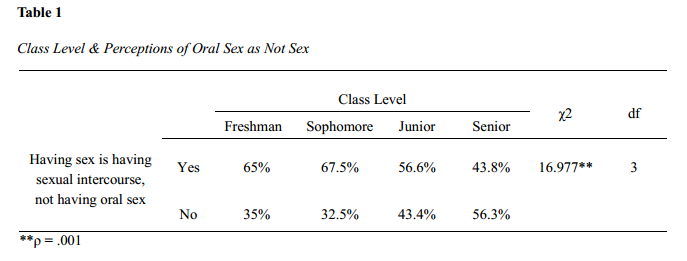
Freshmen and sophomores were the most likely to agree that oral sex does not take away one’s virginity, with the majority of freshmen and sophomores indicating their agreement that engaging in oral sex does not constitute having sex (see Table 1). Juniors and seniors were less likely than underclassmen to agree that oral sex is not having sex. Hence, there was a general pattern that the lower the class rank of the student, the more likely the student to hold the belief that he or she could have oral sex and remain a virgin.
European American
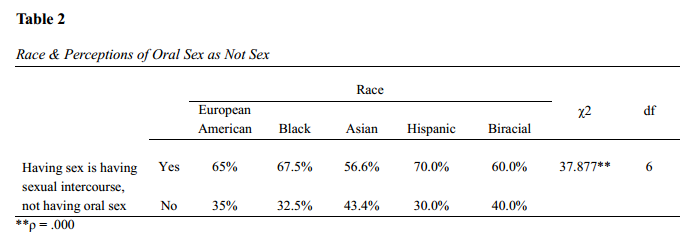
Race was significantly related to perceptions of oral sex as not being sex (see Table 2). European American undergraduates were more likely than Blacks (respondent self-identified as African-American Black, African Black, or Caribbean Black) to agree that oral sex is not sex. In this study, the limited number of Asian and Latino participants renders the data of minimal use, however 61.5% of Asian participants (N=13) and 70% of Hispanic participants (N=10) indicated that they agreed that oral sex is not sex.
Self-Identified as Religious
Students who noted that they considered themselves to be religious by indicating that they agreed or strongly agreed with the statement, “I am a religious person,” were more likely to agree that oral sex is not sex than students who reported that they were not religious at all (61.3% vs. 14.3%). Participant responses revealed an inverse relationship between self-identification as “a religious person” and having never “given oral sex to a partner,” r(4) = -.121, p = .001, and having “never received oral sex,” r(4) = -.099, p = .006. An inverse relationship between perceptions of the importance of marrying someone with the same religious identification as oneself and giving and receiving oral sex respectively also was noted, r(4) = -.114, p = .001 and r(4) = -.129, p = .000. Participants who identified as religious were thus more likely to agree that oral sex is not sex and also indicated that they have engaged in oral sex.
Sexual Value
Given the alternative sexual values of relativism (“the appropriateness of intercourse depends on the nature of the relationship”), absolutism (“no intercourse before marriage”) and hedonism (“if it feels good, do it”), students who self-identified as hedonistic were more likely than those who viewed themselves as relativists and absolutists to agree that oral sex is not sex (65.8% vs. 62.9%, and 48.0%) (p < .05). Expressed another way, over 50% of absolutists compared to 34% of hedonists say the idea that one is still a virgin after having oral sex is not true. This 16% difference is striking. Participants who reported having engaged in sex without love also indicated they had engaged in both giving and receiving oral sex r(2) = -.229, p = .000, and r(2) = -.206, p =.000. These findings reflect that students who express more hedonistic perspectives are more likely to agree that oral sex is not sex and does not impact one’s status as a virgin.
Safe Sex Practices
A significant inverse relationship existed between participants who reported requiring the use of a condom before intercourse and never having given oral sex (r(4) = -.120, p = .001), and never having received oral sex (r(4) = -.092, p = .010). These findings indicate that the participants from this study who engaged in oral sex also used protective methods when engaging in intercourse outside of oral sex.
Gender
Gender was not significantly related to participant perceptions of oral sex as not being real sex and sex only referring to sexual intercourse. Gender was, however, significantly related to having never given oral sex χ2 (1, N = 781) = 3.843, ρ = .05) and having never received oral sex χ2 (1, N = 781) = 4.016, =.045), with males indicating in greater levels than females that they have received oral sex, and also that they have never given oral sex. These findings indicate that the gendered experiences of giving and/or receiving oral sex are important to explore, because it appears from the participant responses in this study that there may be gender differences in the likelihood of an individual giving or receiving oral sex.
Discussion
This research sought to gain information about college-aged individuals most likely to agree that oral sex is not sex and to share information about individuals within this population’s perceptions about engagement in oral sex. The results allowed for the development of a demographic profile of participants who agreed that oral sex is not sex. In considering the results and demographic profile of participants who agreed that oral sex is not sex, relationships between sexual scripts and participant responses emerged.
The demographic profile which emerged indicated that participants most likely to agree that oral sex is not sex were underclassmen (freshmen and sophomores), European American and self-identified as religious. Inferences from the results were made through a parallel exploration of sexual scripts and the quantitative data from the studied domains and the demographic profile.
Oral Sex is Safe
The negative relationship that emerged between requiring the use of contraception before intercourse and engagement in oral sex may have many meanings. From the limited information provided through this analysis concerning safe sex practices and perceptions of oral sex, few inferences regarding the relationship between these issues can be made. Although the literature would suggest that college-aged students believe oral sex to be safe, this study did not provide enough information to definitively make this inference. However, the negative relationship between participants who required the use of contraception and previous experience with oral sex indicated that participants with previous experience giving and receiving oral sex were more likely to require the use of a condom before intercourse than were participants with no prior experience giving and receiving oral sex. From this finding, it could be inferred that participants who engage in oral sex are more likely to engage in safe sex practices, aligning congruently with the social sexual script posited in the professional literature of the perceptions that oral sex is safe. However, there could be many contributing factors to this relationship and further study is necessary to make clear inferences.
Oral Sex Potentially Mitigates Religiosity and Sex Guilt Tension
Supporting the sexual script that oral sex mitigates sex guilt because it is not real sex, the findings of this study discerned a strong relationship between religious identification and engagement in oral sex. Participants who reported strong self-identification as religious also reported having engaged in giving and receiving oral sex. Additionally, a significant relationship existed between participant responses to “I am a religious person” and “oral sex is not sex” χ2 (4, N = 781) = 10.310, p = .036). Other studies have shown that teens and young adults engage in oral sex because they view it as something that they do before they are ready to have sex (Remez, 2000). This of course implies that the only thing that counts as sex is vaginal-penile intercourse, and that this type of sexual activity breaks the threshold of virgin status.
These findings are not enough to conclude fully that oral sex is used to mitigate sex guilt-religiosity tension. However, the findings do suggest that college students who view themselves as religious also engage in oral sex, indicating that oral sex may be viewed as less likely to violate religious mores related to sexual engagement, since it is not viewed as real sex.
Oral Sex Requires Less Commitment
Perceptions of oral sex as less intimate and requiring less commitment may be better understood by exploring the class level, racial and sexual value components of the profile that emerged. Students at the beginning of their college careers, freshman and sophomores, were more likely to agree that oral sex is not sex. Developmentally, individuals at more advanced stages of one’s college career, such as juniors and seniors, may be more likely to be searching for a life-partner for a more committed, intimate relationship than students at the beginning of the college experience. By engaging in sexual acts perceived by this population as not real sex, these participants are able to avoid more deeply committed relationships.
In terms of racial background and the perception of oral sex as requiring less commitment, previous researchers have revealed that European Americans are more likely to engage in oral sex. In a national sample, 81% of European American men, 66% of African American men, and 65% of Latino men reported ever having received fellatio (Mahay, Laumann, & Michaels, 2001). Of European American, Latino and African Americans receiving fellatio, 82%, 68%, and 55%, respectively, reported the experience as “appealing” (Mahay et al., 2001). In the same study, 75% of European American women, 56% of Latina women, and 34% of African American women reported ever having provided fellatio for a male partner. Of European American, Latina and African American women providing fellatio, 55%, 46% and 25%, respectively, regarded the experience as “appealing” (Mahay et al., 2001). Mahay’s findings suggest that European Americans are more willing to engage in oral sex because they view it as less intimate, involved, or serious (Mahay et al., 2001). Like deep kissing or manual stimulation, they may perceive it as not sex. In contrast, African Americans may view oral sex as more “intimate, involved, and serious” and hence would be more likely to agree that oral sex is sex. The findings of this study support Mahay’s findings with European Americans being statistically more likely than African Americans to agree that oral sex is not sex.
Indicated sexual values also were related to the sexual script of oral sex as requiring less commitment. Participants who self-identified as hedonists (65.8%), with an if it feels good do it approach to sex, also agreed with the assertion that oral sex is not sex and will allow one to maintain virgin status. Since persons who “hookup” and had sex without love are more likely to be hedonists, it also is not surprising that students who reported that they had experienced having sex without love were more likely to report having engaged in giving and receiving oral sex. These findings support Young’s (1980) analysis of college students’ behaviors and attitudes relative to oral-genital sexuality, which revealed that college students who engaged in oral sex, had experienced sexual intercourse and were sexually active, possessed more favorable attitudes toward oral-genital sexual engagement.
In conclusion, Chambers (2007) studied college students and found agreement with oral sex is not sex, that oral sex is less intimate than sexual intercourse, and that the interpersonal context for being most comfortable about engaging in oral sex is a committed relationship, not a married relationship. Similarly, in the current study, we found that more than 60 percent of the respondents (62.1%) agreed that oral sex is not sex. Specifically, 62.1% responded “yes” to the statement “Having sex is having sexual intercourse, not having oral sex.” In contrast, 37.9% responded “no” to the statement.
Implications
Recognizing undergraduates who are more likely to agree with the assertion that oral sex is not sex will enable counselors and sex educators to provide targeted, specific education experiences to this population. This study revealed that undergraduates who were European American, religious, and underclassmen were more likely to agree that oral sex is not sex. However, although certain statistical differences existed among participants who believed that oral sex is not sex, over 60% of the total participant group in this study agreed that oral sex allows one to maintain one’s virgin status because it is not sex. This indicates that we do need specific targeted sex education opportunities for those most likely to agree that oral sex is not sex, but we also need broad, far-reaching education opportunities for the rest of the college-age population. Furthermore, this study explored the impact of dominant social sexual scripts on college-aged students’ perceptions of oral sex. By understanding the potential of social sexual scripts to ascribe meaning to an act of sexual engagement, sex educators and counselors will be better prepared to engage in discourse with young adults and college-aged individuals in a timely, developmentally-appropriate manner.
Limitations
The data for this study should be interpreted with caution. The data used in this study were pulled from a convenience sample of 781 undergraduates at one southeastern university. This sample cannot be considered representative of the total college-aged population in the U.S. However, it may provide some information from which larger, more representative studies can be developed.
A major limitation of this study is the lack of diversity within the sample. With small numbers of gay, lesbian and bisexual participants, it was impossible to discern the perceptions and likelihood for engagement in oral sex by this demographic segment of the college-aged population. The literature would suggest that college students identifying as gay, lesbian or bisexual may have unique perceptions of oral sex and processes for making meaning of this experience (Feldmann & Middleman, 2002). Unfortunately, this study had limited participants identifying as gay, lesbian or bisexual and did not fully explore this population’s experiences and perceptions. This is a major limitation of this research and should be addressed by additional research specifically exploring the perceptions and engagement of college-aged individuals who identify as gay, lesbian or bisexual in giving and receiving oral sex. Additionally, there were few individuals of Latino or Asian descent included in the sample, limiting the utility of the findings with these individuals.
Another significant limitation of the study was the lack of in-depth exploration about the gendered experience of giving and receiving oral sex. From the initial results, it was determined that a significant relationship existed between gender and giving and/or receiving oral sex. This is an important consideration to explore, particularly when considering the impact of social sexual scripts on the sexual engagement of young people. It is quite possible that males and females in the young adult and college-aged population have very different experiences with and perceptions of the process of engaging in oral sex. This is an area that needs further research and not including a thorough investigation of the impact of gender on the responses of participants was a limitation of this study.
References
Bay-Cheng, L. Y. (2003). The trouble of teen sex: The construction of adolescent sexuality through school-based sexuality education. Sex Education, 3, 61–74. doi:10.1080/1468181032000052162
Bhattacharyya, G. (2002). Sexuality and society. New York, NY: Routledge.
Carter, B., & McGoldrick, M. (Eds.). (1999). The expanded family life cycle: Individual, family, and social perspectives (3rd ed). Boston, MA: Allyn & Bacon.
Centers for Disease Control and Prevention, Division of Sexually Transmitted Diseases. (2006). Trends in reportable sexually transmitted diseases in the United States, 2005. Retrieved from http://www.cdc.gov/STD/STATS/trends2006.htm.
Chambers, W. C. (2007). Oral sex: Varied behaviors and perceptions in a college population. Journal of Sex Research, 44, 28–42. doi:10.1207/s15598519jsr4401_4
Clinton, W. J. (1998). Response to the Lewinsky allegations. Miller Center of Public Affairs, University of Virginia. Retrieved March 9, 2009 from http://millercenter.org/scripps/archive/speeches/detail/3930.
Edwards, S., & Carne, C. (1998a). Oral sex and the transmission of non-viral STIs. Sexually Transmitted Infections, 74, 95–100. doi:10.1136/sti.74.2.95
Edwards, S., & Carne, C. (1998b). Oral sex and the transmission of viral STIs. Sexually Transmitted Infections, 74, 6–10. doi:10.1136/sti.74.1.6
Feldmann, J., & Middleman, A. B. (2002, October). Adolescent sexuality and sexual behavior. Current Opinion in Obstetrics & Gynecology, 14(5), 489–493.
Frith, H., & Kitzinger, C. (2001). Reformulating sexual script theory: Developing a discursive psychology of sexual negotiation. Theory and Psychology, 11, 209–232. doi:10.1177/0959354301112004
Frye, M. (1990). Lesbian sex. In J. Allen (Ed.), Lesbian philosophies and cultures (pp. 305–315). New York, NY: State University of New York Press.
Gagnon, J. H., & Simon, W. (1973). Sexual conduct: The social sources of human sexuality. Chicago, IL: Aldine.
Geer, J. H., & Broussard, D. B. (1990). Scaling heterosexual behavior and arousal: Consistency and sex differences. Journal of Personality and Social Psychology, 58, 664–671. doi:10.1037/0022-3514.58.4.664
Halpern-Felsher, B. L., Cornell, J. L, Kropp, R. Y., & Tschann, J. M. (2005). Oral versus vaginal sex among adolescents: Perceptions, attitudes and behavior. Pediatrics, 115, 845–851. doi:10.1542/peds.2004-2108
Hollander, D. (2005). Many young teenagers consider oral sex more acceptable and less risky than vaginal intercourse. Perspectives on Sexual and Reproductive Health, 37(3), 155–157. doi:10.1111/j.1931-2393.2005.tb00051.x
Kinsey, A. C., Pomeroy, W. B., & Martin, C. E. (1953). Sexual behavior in the human female. Philadelphia, PA: Saunders.
Kinsey, A. C., Pomeroy, W. B., & Martin, C. E. (1948). Sexual behavior in the human male. Philadelphia, PA: Saunders.
Langston, R. D. (1973). Sex guilt and sex behavior in college students. Journal of Personality Assessment, 37, 467–472.
Lindau, S. T., Tetteh, A. S., Kasza, K., & Gilliam, M. (2008). What schools teach our patients about sex: Content, quality and influences on sex education. Obstetrics & Gynecology, 111(2) Part 1, 256–266.
Mahay, J., Laumann, E. O., & Michaels, S. (2001). Race, gender, and class in sexual scripts. In E. O. Laumann & R. T. Michael (Eds.), Sex, love, and health in America: Private choices and public policies (pp. 197–238). Chicago, IL: University of Chicago Press.
Mosher W. D., Chandra A., & Jones J. (2005). Sexual behavior and selected health measures: Men and women 15–44 years of age, United States, 2002. Advance data from vital and health statistics; no 362. Hyattsville, MD: National Center for Health Statistics.
Mosher, D. L., & Cross, H. J. (1971). Sex guilt and premarital sexual experiences of college students. Journal of Consulting and Clinical Psychology, 36, 22–32. doi:10.1037/h0030454
Paul, E., McManus, B., & Hayes, A. (2000). “Hookups”: Characteristics and correlates of college students’ spontaneous and anonymous sexual experiences. The Journal of Sex Research, 37, 76–88. doi:10.1080/00224490009552023
Prinstein, M. J., Meade, C. S., & Cohen, G. L. (2003). Adolescent oral sex, peer popularity, and perceptions of best friends’ sexual behavior. Journal of Pediatric Psychology, 28, 243–249. doi:10.1093/jpepsy/jsg012
Remez, L. (2000). Oral sex among adolescents: Is it sex or is it abstinence? Family Planning Perspectives, 32, 298–304. doi:10.2307/2648199
Richey, E., Knox, D., & Zusman, M. (2009). Sexual values of 783 undergraduates. College Student Journal, 43, 175–180.
Richters, J., de Visser, R., Rissel, C., & Smith, A. (2006). Sexual practices at last heterosexual encounter and occurrence of orgasm in a national survey. Journal of Sex Research, 43, 217–226. doi:10.1080/00224490609552320
Rostosky, S. S., & Travis, C. B. (2000). Menopause and sexuality: Ageism and sexism unite. In C. B. Travis & J. W. White (Eds.), Sexuality, society, and feminism (pp. 181–209). Washington, DC: American Psychological Association. doi:10.1037/10345-008
Sack, A., Keller, J., & Hinkle, D. E. (1984). Premarital sexual intercourse: A test of the effects of peer group, religiosity, and sexual guilt. The Journal of Sex Research, 20, 168–185. doi:10.1080/00224498409551215
Schulz, B., Bohrnstedt, G. W., Borgatta, E. R., & Evans, R. R. (1977). Explaining premarital sexual intercourse among college students: A causal model. Social Forces, 56, 148–165. doi:10.2307/2577418
Simon, W., & Gagnon, J. H. (2003). Sexual scripts: Origins, influences and changes. Qualitative Sociology, 26, 491–497. doi:10.1023/B:QUAS.0000005053.99846.e5
Stepp, L. S. (2005, September 16). Study: Half of all teens have had oral sex. The Washington Post, p. A07.
Stulhofer, A., Busko, V., & Landripet, I. (2010). Pornography, sexual socialization, and satisfaction among young men. Archives of Sexual Behavior, 39, 168–178. doi:10.1007/s10508-008-9387-0
University Of California, San Francisco (2005, April). Teens believe oral sex is safer, more acceptable to peers. ScienceDaily. Retrieved May 10, 2009, from http://www.sciencedaily.com/releases/2005/04/050411135016.htm.
Weinstock H., Berman S., & Cates W. (2004). Sexually transmitted diseases among American youth: Incidence and prevalence estimates, 2000. Perspectives on Sexual and Reproductive Health, 36, 6–10. doi:10.1363/3600604
Wiederman, M. W. (2005). The gendered nature of sexual scripts. The Family Journal, 13, 496–502. doi: 10.1177/1066480705278729
Wulf, J., D., Prentice, D., Hansum, D., Ferrar, A., & Spilka. B. (1984). Religiosity and sexual attitudes and behaviors among evangelical Christian singles. Review of Religious Research, 26(2), 119–131. doi:10.2307/3511697
Young, M. (1980). Attitudes and behavior of college students relative to oral-genital sexuality. Archives of Sexual Behavior, 9, 61–67. doi:10.1007/BF01541401
Kylie P. Dotson-Blake, NCC, is an Assistant Professor and David Knox is a Professor at East Carolina University. Marty E. Zusman is Professor Emeritus at Indiana University Northwest. Correspondence can be addressed to Kylie P. Dotson-Blake, East Carolina University, 706 River Hill Drive, Greenville, NC 27858, blakek@ecu.edu.
Sep 9, 2014 | Article, Volume 2 - Issue 1
Stefanie Rodriguez
The career decision-making process can be a daunting task during the college years for both athletes and non-athletes alike. Understanding factors that influence this process and ways to best support students as they are making career decisions is integral to counselors working with college students. Social support and career thoughts were examined in 118 college student-athletes and 154 non-athletes from a large public university in the southeastern United States. Social support was found to have a significant relationship with career thoughts. In addition, several significant differences were found between the study’s subpopulations. Implications for practice and future directions for research are further explored.
Keywords: career decisions, college athletes, social support, career counseling, sociocultural context
Career planning is a process in a college student’s life that can cause a considerable amount of stress, and social support can have a positive effect on this stress. In the sport psychology research, social support has been found to be an important factor in reducing the effects of stress in athletes’ lives (Bianco & Eklund, 2001; Taylor & Ogilvie, 2001). Athletes not only experience stress related to academics and athletics, but also related to what they will do after college. Some are talented enough to play professionally, but many must face the reality of having a career outside of the realm of sports. As a result, career planning is an important process for college athletes because it prepares them for life after sports. Social support can be an important factor during this process by alleviating the stress associated with career planning.
In research examining the general college student population, career thoughts have been found to have an important effect on the career planning process (Peterson, Sampson, & Reardon, 1991; Peterson, Sampson, Reardon, & Lenz, 1996; Sampson, Peterson, Lenz, Reardon, & Saunders, 1996b; Sampson, Reardon, Peterson, & Lenz, 2009). If career thoughts are negative, the individual is unable to clearly evaluate self and occupational knowledge that is necessary to make a career decision. Decreasing negative thoughts is the first and most important step in the career decision-making process. In conclusion, it is important for those who are influential in college students’ lives to know what types of social support have the strongest relationship with the thoughts related to a career after college.
Social Support
Social support refers to the “social interaction aimed at inducing positive outcomes” (Bianco & Eklund, 2001, p.85). The terms “provider” and “recipient” are often used when discussing social support. A provider is an individual who gives the social support, and a recipient is an individual who receives the social support. A theory that targets social support and recipient satisfaction is the person-environment fit theory (Brown, 2002). This theory posits that the interaction between the person and environment is both active and reactive. The person-environment fit model of satisfaction is a part of person-environment theory. It defines satisfaction as “a pleasant affective state that is produced by the degree of fit between a person’s needs, personality characteristics, abilities, and the commensurate supplies provided by, and abilities requirements of, the environment” (Brown, Brady, Lent, Wolfert, & Hall, 1987, p. 338). Conversely, dissatisfaction is defined as “an unpleasant affective state resulting from a misfit between relevant person and environment characteristics” (Brown et al., 1987, p. 338).
In many cases, person-environment fit is considered subjective because it focuses on the perceptions of the person. Within the context of subjective person-environment fit, satisfaction with social support is defined as “a positive affective state resulting from one’s appraisal or his or her social environment in terms of its success in meeting his or her interpersonal needs” (Brown et al., 1987, p. 338). Conversely, dissatisfaction with social support is defined as “an unpleasant affective state resulting from a perception that the interpersonal environment is failing to satisfy important interpersonal needs” (Brown et al., 1987, p. 338).
Using person-environment fit as a theoretical basis, Brown, Alpert, Lent, Hunt, and Brady (1988) defined five broad factors of social support: (a) acceptance and belonging, (b) appraisal and coping assistance, (c) behavioral and cognitive guidance, (d) tangible assistance and material aid, and (e) modeling. The first factor, acceptance and belonging, measures the degree to which the individual’s needs for affiliation and esteem are met through the provision of love, acceptance, respect, belonging, and shared communication. The second factor, appraisal and coping assistance, relates to the degree to which the social environment provides the individual with emotional support, hope, and coping assistance through assurances that feelings are normal, positive reinterpretations of the situation and future, and information on coping skills during times of stress.
The third factor, behavioral and cognitive guidance, relates to the degree to which the social environment meets the individual’s needs for direct and modeled feedback about appropriate behaviors and thoughts. The fourth factor, tangible assistance and material aid, pertains to the degree to which instrumental needs for money, goods, and services are met by the social environment. The fifth and final factor, modeling, refers to the information on how others feel, handle situations and think (Brown et al., 1988). It also measures the satisfaction with a model or example to follow. In conclusion, the person-environment fit theory provides a basis for the description of five types of social support. In order to fully understand the role of social support on the career planning process, it also is essential to understand the role of career thoughts in the process.
Career Thoughts
Career thoughts are defined as “outcomes of one’s thinking about assumptions, attitudes, behaviors, beliefs, feelings, plans, and/or strategies related to career problem-solving and decision-making” (Sampson et al., 2009, p. 91). Cognitive therapy theoretical concepts specify that dysfunctional cognitions have a detrimental impact on behavior and emotions (Beck, 1976; Beck, Emery, & Greenberg, 1985; Beck, Rush, Shaw, & Emery, 1979). Cognitive information process (CIP) theory explains the role of cognitions in career decision-making. This theory is meant to enhance the link between theory and practice in the delivery of cost-effective career services for adolescents, college students and adults (Peterson et al., 1991; 1996; Sampson et al., 2009). Its goal is to help individuals make appropriate career choices and learn improved problem-solving and decision-making skills needed for future choices (Sampson et al., 2009).
There are a few definitions that need to be understood in order to fully comprehend and utilize CIP. Problem is synonymous with career problem and is defined as a “gap between an existing and a desired state of affairs” (Sampson et al., 2009, p. 4). The gap may be between an existing state (e.g., knowing I need to make a choice) and an ideal state (e.g., knowing I made a good choice). Problem-solving is a “series of thought processes in which information about a problem is used to arrive at a plan of action necessary to remove the gap between an existing and a desired state of affairs” (Sampson et al., 2009, p. 5). Decision-making includes “problem-solving, along with the cognitive and affective processes needed to develop a plan for implementing the solution and taking risks involved in following through to complete the plan” (Sampson et al., 2009, p. 6).
CIP theory assumes that effective career problem-solving and decision-making requires the effective processing of information in four domains: (1) self-knowledge, (2) occupational knowledge, (3) decision-making skills, and (4) executive processing (Sampson et al., 2009). Self-knowledge includes individuals’ perceptions of their values, interests, skills, and employment preferences. Occupational knowledge includes knowledge of individual occupations and having a schema for how the world of work is organized. Decision-making skills are the generic information processing skills that individuals use to solve problems and make decisions. Executive processing includes meta-cognitions, which control the selection and sequencing of cognitive strategies used to solve a career problem through self-talk, self-awareness, and control and monitoring.
Social Support and Career Planning
There is limited research examining social support and career planning. Career planning is related to career thoughts by the appraisal or cognitive processing that occurs during career decision-making. Based on limited scientific findings, social support has been found to have a positive and important effect on career planning. In a study on unemployed individuals, Blustein (1992) found that instrumental support in the form of constructive advice and resources help to better appraise career-related information and adapt to the novel circumstances. It also was found that social support can positively affect the recipient’s experience and is an important determinant of career activities such as researching career options or seeking assistance from a career advisor.
Similar findings indicate that along with instrumental support, emotional social support which is characterized by empathy, caring, love, and trust from families is especially important during stressful transitions such as job loss (DeFrank & Ivancevich, 1986). Regarding students and career planning, Quimby and O’Brien (2004) found that perceptions of robust social support resulted in feelings of confidence both in managing the responsibilities associated with being a student and pursuing tasks related to advancing vocational development. Though it is evident that social support is an important factor in the career planning process, additional research examining this construct and its place in career development is needed.
Given the reviewed literature and current gap, the purpose of this study was to examine the relationships among satisfaction with five types of social support and negative career thoughts in collegiate athletes and non-athletes.
Method
Participants
Non-student-athletes and National Collegiate Athletic Association (NCAA) Division I student-athletes from the same university were recruited for this study. Complete data were obtained from 272 participants (154 non-athletes and 118 athletes). One hundred forty-six (53.7%) of the participants were male and 126 (46.3%) were female. The race/ethnicity breakdown was as follows: Caucasian (n = 162, 59.6%), African American (n = 74, 27.2%), Hispanic (n = 15, 5.5%), Asian American (n = 1, 0.4%), other (n = 12, 4.4%), and more than one apply (n = 8, 2.9%). Forty-three (15.8%) of the participants were freshman, 65 (23.9%) sophomores, 94 (34.6%) juniors and 70 (25.7%) seniors. Of the athletes, the varsity sport breakdown was as follows: baseball (n = 13, 11.0%), basketball (n = 14, 11.9%), football (n = 37, 31.4%), golf (n = 5, 4.2%), soccer (n = 7, 5.9%), softball (n = 8, 6.8%), swimming & diving (n = 8, 6.8%), tennis (n = 3, 2.5%), track & field (n = 18, 15.3%), and volleyball (n = 4, 3.4%). One (0.8%) athlete did not indicate involvement in a particular sport.
All participants were recruited from a single large university located in the southeastern region of the United States. They were above 18 years of age, and participants comprised of a volunteer, convenient sample obtained by contacting athletic administrators and professors.
Instrumentation
Demographic Information Survey. The survey contained information about participants’ college major, age, gender, race/ethnicity, and academic year.
Social Support Inventory-Subjective Satisfaction (SSI-SS). The SSI-SS (Brown et al., 1987) consisted of 39 self-report items assessing one’s satisfaction with five types of social support: (a) acceptance and belonging, (b) appraisal and coping assistance, (c) behavioral and cognitive guidance, (d) tangible assistance and material aid, and (e) modeling. Participants responded to these items on a 7-point Likert-type scale ranging from 1 (not at all satisfied) to 7 (very satisfied) to indicate their satisfaction with the support they have received. A total score is obtained by summing all of the items. The overall score of the SSI-SS ranges from 39 to 273. The acceptance-belonging subscale score ranges from 9 to 63, and the appraisal-coping assistance subscale score ranges from 9 to 63. The behavioral-cognitive guidance subscale score ranges from 6 to 42. The tangible assistance-material aid subscale score ranges from 5 to 35, and the modeling subscale score ranges from 4 to 28. The total score and the scores of each of the five factors will be assessed in this study.
Alpha coefficients for the five factors are .93 for acceptance-belonging, .88 for appraisal-coping assistance, .81 for behavioral-cognitive guidance, .78 for tangible assistance-material aid, and .83 for modeling (Brown et al., 1987). The overall alpha coefficient is .96. The SSI-SS has been normed on college-age and adult populations.
Career Thoughts Inventory (CTI). The CTI (Sampson, Peterson, Lenz, Reardon, & Saunders, 1996a) is a 48-item self-administered, objectively scored measure of dysfunctional thinking in career problem-solving and decision-making. Participants respond to items on a 4-point Likert-type scale ranging from 0 (strongly disagree) to 3 (strongly agree) to indicate how much they agree with the negative career statement given. The CTI scores consist of one total score as well as scores on three subscales. The CTI is a CIP-based assessment and intervention resource intended to assess the quality of career decisions made by adults and college and high school students. It measures the eight content dimensions of CIP theory that include: (1) self-knowledge, (2) occupational knowledge, (3) communication, (4) analysis, (5) synthesis, (6) valuing, (7) execution, and (8) executive processing (Peterson et al., 1991; 1996).
The CTI has been normed on high school, college, and adult populations (Sampson et al., 1996b). Reliability evidence for the CTI total score includes internal consistency alpha coefficients ranging from .93 to .97 and a test-retest coefficient of .77. The readability of the CTI was calculated to be at a 6.4 grade level.
Decision-making confusion (DMC) is one subscale on the CTI and it refers to the inability to initiate or sustain the decision-making process as a result of disabling emotions and/or a lack of understanding about the decision-making process itself. Commitment anxiety (CA) is another subscale on the CTI and it reflects the inability to make a commitment to a specific career choice, accompanied by generalized anxiety about the outcome of the decision-making process. This anxiety perpetuates indecision. External conflict (EC) is the final subscale and it reflects the inability to balance the importance of one’s own self-perceptions with the importance of input from significant others, resulting in a reluctance to assume responsibility for decision-making.
Procedure
Athletic academic advisers and professors at a large southeastern university were contacted via e-mail using a script. The principal investigator met with the participants whenever they were available to be administered the battery of tests, during their tutoring sessions in the athletic academic support office or in their classes. During the meeting, the participants were oriented to the purpose of the study. They were asked to sign an informed consent form, and told that their participation in the study was completely voluntary and that they may drop out at any time. The researcher administered the questionnaires beginning with the Demographic Information Survey, then the Social Support Inventory, and finally the Career Thoughts Inventory. Tests were then collected and a randomly assigned number identified each battery of tests.
Results
Preliminary analyses were performed to obtain internal consistency coefficients of the measures and descriptive statistics. The alpha coefficients observed in this study for each Social Support Inventory-Subjective Satisfaction (SSI-SS) subscale and total score were: acceptance-belonging (α = .79), appraisal-coping assistance (α = .83), behavioral-cognitive guidance (α = .81), tangible assistance-material aid (α = .70), modeling (α = .74), and total score (α = .90). For the Career Thoughts Inventory (CTI) subscales and total score, the alpha coefficients observed were as follows: decision-making confusion (α = .86), commitment anxiety (α = .85), external conflict (α = .82), and total score (α = .89). The alpha coefficient values indicated adequate internal consistency.
Descriptive Statistics and Bivariate Correlations
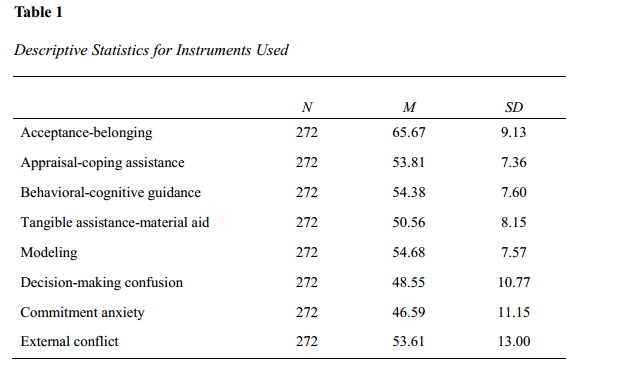
Descriptive statistics for the SSI-SS subscales: acceptance-belonging, appraisal-coping assistance, behavioral-cognitive guidance, tangible assistance-material aid, and modeling; and CTI subscales: decision-making confusion, commitment anxiety, and external conflict are presented in Table 1. Overall, participants averaged a T-score within the average range for the majority of the subscales with the social support subscale of acceptance-belonging having the highest mean (M = 65.67, SD = 9.13).
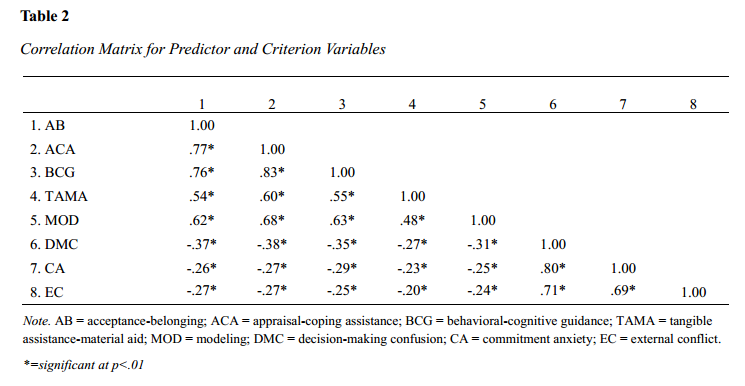
The bivariate correlations among study variables are presented in Table 2. Without controlling for any variables, the social support types of acceptance-belonging and appraisal-coping assistance had the strongest relationships with decision-making confusion (r = -.37 and -.38, respectively). The bivariate correlations also indicated that all social support types had significant relationships with decision-making confusion, commitment anxiety, and external conflict. When all variables were controlled, there were no significant relationships between any of the five types of social support and career thoughts.
Regression
Three hierarchical regression analyses were performed with the five predictor variables and three criterion variables. All regression models were significant. It is suggested that the variance shared among the predictors is what accounts for the significant models. None of the social support types were found to have significant unique relationships with any of the career thoughts variables.
Structural Equation Modeling
Conceptual models of the posited relationship between social support and career thoughts, as seen in Figure 1, were tested using SEM procedures. The model shows that the five social support types were used as indicators for a social support latent factor and the three subscales of the CTI were used as indicators for a negative career thoughts latent factor.
The distributional properties of the study variables in the model were examined to select the appropriate model estimator. No substantial problems were evident in either univariate skewness (M = -.39; range from -.83 to .29) or kurtosis (M = .23; range from -.36 to .90) in the eight variables used in the SEM analysis. Mild multivariate kurtosis was indicated with a Mardia’s normalized estimate equating to 10.15. For the model, the model-reproduced and observed covariance matrices did not differ, χ² = 18.79, df = 19, p = .47. Desirable CFI and IFI indexes (1.00 for both) were observed. The satisfactory distribution of the residuals was substantiated by the observed standardized RMSR (.02). Figure 1 presents the standardized path coefficients and residuals for the SEM.
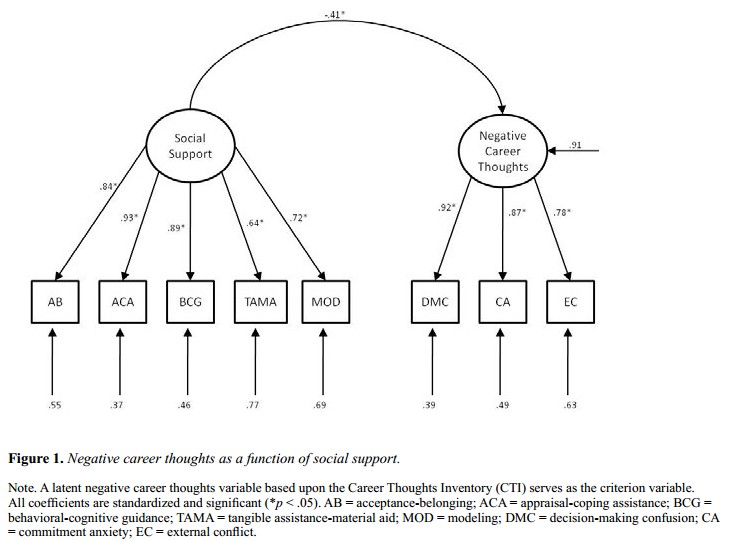
In the model, the social support latent variable accounted for 17% of the variance in the negative career thoughts latent variable. The social support latent variable accounted for the majority of the variance in the subscales of acceptance-belonging (R² = .70), appraisal-coping assistance (R² = .87), behavioral-cognitive guidance (R² = .79), tangible assistance-material aid (R² = .41), and modeling (R² = .52). The negative career thoughts latent variable accounted for the majority of the variance in the subscales of decision-making confusion (R² = .85), commitment anxiety (R² = .76), and external conflict (R² = .61). In summary, these analyses make it apparent that social support is associated with career thoughts as observed by the significant correlation between the latent variable of social support as measured by the SSI-SS and the latent variable of negative career thoughts as measured by the CTI.
Z-Score Analyses
Z-score analyses were performed to determine any significant differences between sample populations based on athletic status, gender, and academic class status in the relationship between social support and career thoughts. Regarding athletic status, a significant difference (p < .01) was found between athletes and non-athletes in the relationship between the social support type of appraisal-coping assistance and the career thoughts variable of commitment anxiety (z = 1.95), with that relationship being stronger in the non-athlete population. Also regarding athletic status, a significant difference (p < .01) was found between athletes and non-athletes in the relationship between the social support type of modeling and the career thoughts’ variable commitment anxiety (z = 2.02), with that relationship also being stronger in the non-athlete population.
No significant differences were found between the male and female genders in the relationship between social support and career thoughts. Regarding academic class status, upperclassmen had a significantly stronger relationship (p < .01) between total social support and the social support types of appraisal-coping assistance and behavioral-cognitive guidance and the career thoughts’ variable commitment anxiety (z = 2.08; 2.30; 2.15; respectively). In summary, several significant differences were found between sample populations.
Discussion
Results revealed that social support accounts for about 17% of the variance in career thoughts. This suggests that social support has a moderate relationship with career thoughts. These results also support the literature on the positive effect of social support on the career planning process (Blustein, 1992; DeFrank & Ivancevich, 1986; Quimby & O’Brien, 2004).
The person environment fit model (Dawis, 2002) provided an important framework in the present study as satisfaction with social support was found to have a moderate relationship with career thoughts. However, the strong relationships between the five types of social support made it difficult to examine the unique relationship of each to career thoughts. The results infer that the five types of social support identified by Brown et al. (1988) may not be independent.
The bivariate correlations indicated that all social support types had significant relationships with the career thoughts variables. When all variables were controlled, there were no significant relationships between any of the five types of social support and career thoughts. Instrumental support, as defined by Blustein (1992) and DeFrank and Ivancevich (1986), relates to Brown et al.’s (1988) social support types of behavioral-cognitive guidance and tangible assistance-material aid. The results of the present study show that both social support types had moderate relationships with career thoughts. Emotional support, as defined by DeFrank and Ivancevich (1986), relates to Brown et al.’s (1988) social support type of acceptance-belonging. This type of social support also was found to have a negative, moderate relationship with career thoughts. These results reinforce those found in Blustein (1992) and DeFrank and Ivancevich (1986) in that social support is an important component in the career planning process.
It was found that the sociocultural context in which the social support is provided has an effect on the perception of the social support by the recipient. The significant difference between the athlete and non-athlete and upperclassmen and underclassmen populations in the present study may be due to their different sociocultural contexts. The results of this study suggest that the appraisal-coping assistance and modeling social support types may be better provided to the non-student-athlete population who are experiencing anxiety related to the career decision-making process. In addition, the appraisal-coping assistance and behavioral-cognitive guidance social support types may be more influential in reducing career decision-making anxiety if provided to upperclassmen.
The present study adds to the literature by studying the different types of social support that make up the social support construct. The study also adds to the literature by examining the relationship between social support and career thoughts, which has not been studied previously. In addition, the examination of the differences in the social support/career thoughts relationship between groups in the sample population (i.e., athlete/non-athlete, male/female, upperclassmen/underclassmen) adds an important dimension to the available literature.
Limitations
The main limitation of this study is with the convenience sampling because the extent to which the students were representative of the overall population of college students is unknown. The participants were not obtained by random sampling, but rather obtained because of availability. Therefore, it is difficult to know the extent to which the results of this study are generalizable beyond this sample.
Implications
The present study investigated the relationship between the five types of social support and the three constructs that comprise career thoughts. Although none of the types of social support were found to have a uniquely significant relationship with career thoughts, there was in fact a moderate relationship between the overall construct of social support and career thoughts.
This study has important implications for practice. Coaches, athletic administrators, career counselors, mental health counselors, professors and other post-secondary administrators now have a better idea of what types of social support are deemed as having the greatest impact on how college students view their post-collegiate careers. Current literature only focuses on the overall social support construct and its positive effects, but the present study allows for the differentiation of the social support types, which provides additional information for practical purposes (Bianco & Eklund, 2001; Taylor & Ogilvie, 2001). Hopefully, this will increase the likelihood of college students actually receiving these types of social support based on their subgroup (i.e., athlete/non-athlete and upperclassmen/underclassmen). Also, college students now have the opportunity to be aware of what types of social support will lead to less negative career thinking.
Regarding implications for research, it is evident that additional research needs to be done to gain a better understanding of the relationship between social support and career thoughts in college students. This is the first study that has examined these two constructs and more research is necessary. More and better social support measures need to be introduced into the field that better examine social support and its different types. Also, this study supports the literature on the importance of career thoughts during the career planning process (Peterson et al., 1991, 1996; Sampson et al., 1996b, 2009). An improved foundation is now available for additional research on the cognitive aspects of career planning and how it relates to social entities.
Future Directions
The present study provides an important foundation for future research. Since it is the first study to examine social support and career thoughts directly, additional examinations of these constructs are necessary per the practical and research implications previously stated. Other variables such as career maturity, self-efficacy, motivation, and personality characteristics should be included in future research to try and account for the remaining variance in career thoughts. Also, the negative aspects of social support, such as peer or parental pressures, should be examined.
Since the present study only examines college students, other populations should be included in future research. In addition, it may be interesting to examine the differences between college students at private and public institutions. Other populations also can be researched, including adults on the verge of retirement or high school seniors trying to decide what to do after graduation.
It may be important to study the phases of the career development process and if different types of social support affect the various phases differently. For example, participating in volunteer activities to boost one’s resume is unlike job searching. In addition, performing qualitative research may add to the information provided from quantitative research.
It is important to note that the strong correlations between each type of social support may infer a poor measure of the different types of social support. A confirmatory factor analysis would be useful in determining if the Social Support Inventory is in fact an adequate measure of social support and its subtypes. There may be better inventories available that measure the different types of social support, and they should be used to determine any differences between social support measures. It is important to note the complexity of the social support construct and that other instruments should be identified that better measure the complex aspects of the construct. Overall, the current study provides an adequate foundation for future practice and research. The relationship between social support and career thoughts is important to understand in order to better help college students and possibly other populations prepare for whatever career transition they may face.
References
Beck, A. (1976). Cognitive therapy and the emotional disorders. New York, NY: International Universities Press.
Beck, A., Emery, G., & Greenberg, R. (1985). Anxiety disorders and phobias: A cognitive perspective. New York, NY: Guilford Press.
Beck, A., Rush, A., Shaw, B., & Emery, G. (1979). Cognitive therapy of depression. New York, NY: Guilford Press.
Bianco, T. (2001). Social support and the recovery from sport injury: Elite skiers share their experiences. Research Quarterly for Exercise and Sport, 72, 376–388.
Bianco, T., & Eklund, R.C. (2001). Conceptual considerations for social support research in sport and exercise settings: The case of sport injury. Journal of Sport & Exercise Psychology, 23, 85–107.
Blustein, D. (1992). Applying current theory and research in career exploration to practice. The Career Development Quarterly, 41, 174–184.
Brown, S., Brady, T., Lent, R., Wolfert, J., & Hall, S. (1987). Perceived social support among college students: Three studies of the psychometric characteristics and counseling uses of the social support inventory. Journal of Counseling Psychology, 34, 337–354.
Brown, S., Alpert, D., Lent, R., Hunt, G., & Brady, T. (1988). Perceived social support among college students: Factor structure of the social support inventory. Journal of Counseling Psychology, 35, 472–478.
Dawis, R. (2002). Person-environment-correspondence theory. In D. Brown & Associates (Eds.). Career choice and development (pp. 427–464). San Francisco, CA: Jossey-Bass.
DeFrank, R., & Ivancevich, J. (1986). Job loss: An individual level review and model. Journal of Vocational Behavior, 28, 1–20.
Peterson, G., Sampson, J., Jr., & Reardon, R. (1991). Career development and services: A cognitive approach. Pacific Grove, CA: Brooks/Cole.
Peterson, G., Sampson, J., Jr., Reardon, R., & Lenz, J. (1996). Becoming career problem solvers and decision makers: A cognitive information processing approach. In D. Brown & L. Brooks (Eds.), Career choice and development (3rd. Ed.) (pp. 423–475). San Francisco, CA: Jossey-Bass.
Quimby, J., & O’Brien, K. (2004). Predictors of student and career decision-making self-efficacy among nontraditional college women. The Career Development Quarterly, 52, 323–339.
Sampson, J., Jr., Peterson, G., Lenz, J., Reardon, R., & Saunders, D. (1996a). Career thoughts inventory. Odessa, FL: Psychological Assessment Resources.
Sampson, J., Jr., Peterson, G., Lenz, J., Reardon, R., & Saunders, D. (1996b). Negative thinking and career choice. In R. Feller & G. Walz (Eds.). Optimizing life transitions in turbulent times: Exploring work, learning and careers (pp. 323–330). Greensboro, NC: University of North Carolina at Greensboro, ERIC Clearinghouse on Counseling and Student Services.
Sampson, J., Jr., Reardon, R., Peterson, G., & Lenz, J. (2009). Career counseling and services: A cognitive information processing approach. Pacific Grove, CA: Brooks/Cole.
Taylor, J., & Ogilvie, B. (2001). Career termination among athletes. In R. N. Singer, H. A. Hausenblas, & C. M. Janelle (Eds.), Handbook of sport psychology (2nd ed., pp. 672–691). New York, NY: Wiley.
Stefanie Rodriguez is an Adjunct Professor at the University of South Florida. Correspondence can be addressed to Stefanie Rodriguez, University of South Florida, 4202 E Fowler Ave, Tampa, FL 33620, stefanie.rodriguez@live.com.
Sep 9, 2014 | Article, Volume 1 - Issue 1
Allison L. Smith, Craig S. Cashwell
Social distance towards adults with mental illness was explored among mental health and non-mental health trainees and professionals. Results suggested mental health trainees and professionals desired less social distance than non-mental health trainees and professionals, and that women desired less social distance than men, with male non-professionals demonstrating the greatest desire for social distance to individuals diagnosed with mental illness. Social distance also is related to attitudes towards adults with mental illness. Implications of such findings are presented.
Keywords: social distance, adult mental illness, mental health professionals, stigma, discriminatory behavior
Stigma has been defined as a product of disgrace that sets a person apart from others (Byrne, 2000). Stigma towards adults with mental illness, defined here as a serious medical condition such as schizophrenia, bipolar disorder, or major depression that disrupts a person’s thinking, feeling, mood, ability to relate to others, and daily functioning (National Alliance on Mental Illness [NAMI], 2009), is both a longstanding and widespread phenomenon (Byrne, 2000; Crisp, Gelder, Rix, Meltzer, & Rowlands, 2000). Researchers seem clear that stigma still exists as a detrimental occurrence in the lives of those diagnosed with a mental illness (Link, Struening, Neese-Todd, Asmussen, & Phelan, 2001; Link, Yang, Phelan, & Collins, 2004; Perlick et al., 2001). In fact, some have argued that the impact of mental illness stigma is so immense that the stigma can be as damaging as the symptoms (Feldman & Crandall, 2007). In the last decade, there have been attempts to highlight to the general population the topic of stigma towards adults with mental illness. For instance, Surgeon General David Satcher spoke in a recent report of the need to recognize stigma as a barrier within the field of mental health. He suggested that mental health care could not be improved without the eradication of mental health stigma (U.S. Department of Health and Human Services, 1999).
In the mental illness stigma literature, authors have used the construct of social distance (the proximity one desires between oneself and another person in a social situation) to assess expected discriminatory behavior towards adults with mental illness (Baumann, 2007; Link & Phelan, 2001; Marie & Miles, 2008). Scholars have described low social distance as characterized by a feeling of commonality, or belonging to a group, based on the idea of shared experiences. In contrast, high social distance implies that the person is separate, a stranger, or an outsider (Baumann, 2007). It has been suggested that social distance research can provide valuable insight into factors that influence mental illness stigma (Marie & Miles, 2008).
Social Distance and Non-Mental Health Professionals
Factors that are associated with social distance in the general population towards adults with mental illness have been discussed in the literature (Corrigan, Backs, Edwards, Green, Diwan, & Penn, 2001; Feldmann & Crandall, 2007; Hinkelman & Haag, 2003; Marie & Miles, 2008; Penn, Kohlmaier, & Corrigan, 2000; Phelan & Basow, 2007; Shumaker, Corrigan, & Dejong, 2003). One such factor that has been studied as it relates to social distance is gender, both of the target (person with the mental illness) (Phelan & Basow, 2007) and perceiver (person who desires social distance) (Hinkelman & Haag, 2003; Marie & Miles, 2008; Phelan & Basow, 2007).
Researchers (Marie & Miles, 2008; Phelan & Basow, 2007) have found that women tend to be more willing than men to engage in a relationship with someone diagnosed with depression. Marie and Miles (2008) investigated familiarity of the perceiver with various mental illnesses. A significant main effect was found for gender, with women perceivers rating the characters in vignettes as more dangerous than men participants (Marie & Miles, 2008). Phelan and Basow (2007) found that gender of the target character was a significant predictor of social distance, with female targets being more socially tolerated than male targets. This may be due to the fact that participants perceive male characters in vignettes as more dangerous than female characters. Hinkelman and Haag (2003) also have assessed how gender and adherence to strict gender roles impact attitudes toward mental illness. Interestingly, adherence to strict gender roles rather than gender was related to attitudes about mental illness. Those with strict gender roles were less likely to have positive attitudes. Thus, gender alone did not account for differences in attitudes; instead it was gender roles that related to attitudes towards mental illness.
Social Distance and Mental Health Professionals
Researchers have suggested that stigma also exists among mental health professionals (Lauber, Anthony, Ajdacic-Gross, & Rossler, 2004; Nordt, Rossler, & Lauber, 2006). Lauber et al. (2004) found no significant differences between psychiatrists and the general population on their preferred social distance from people with a mental illness. Both psychiatrists and the general population indicated that the closer the psychological proximity (e.g., allowing the person with mental illness to marry into their family compared to working with someone with a mental illness), the more social distance they desired. Similar results were found when comparing mental health professionals (i.e., psychiatrists, psychologists, nurses, social workers, and vocational workers) and the general population regarding social distance attitudes (Nordt et al., 2006). Both professionals and the general public reported many stereotypes about mental illness, and wanted an equal amount of social distance towards a mentally ill character in a vignette. Professionals, however, endorsed to a much lesser degree that adults with mental illness should have restrictions to rights such as voting or marriage. The public significantly accepted the restriction of the right to vote more than each professional group.
Professional Counselors and Social Distance
Although professional counselors might work in the same settings as other mental health professionals, the training background of this subgroup includes some noteworthy differences. Relative to other mental health disciplines, counselor training programs are largely, but not exclusively, grounded in developmental perspectives and strength-based orientations (Ivey & Ivey, 1998; Ivey, Ivey, Myers, & Sweeney, 2005; Ivey & Van Hesteren, 1990) as well as humanistic values and assumptions (Hansen 1999, 2000b, 2003), with a primary focus on the counseling relationship. Given these substantial differences as well as authors’ (Lauber et al. 2004; Nordt et al., 2006) suggestions that it is idealistic to assume that stigma does not exist among mental health professionals, it is important to consider counselors in comparison to other mental health professions and the general public. Further, particular types of counseling programs (clinical mental health counseling or school counseling) might differ when compared to each other on stigma towards adults with mental illness, given the variations of curriculum and clinical training associated with each.
Previous researchers have examined psychiatrists, psychologists, and social workers, but not professional counselors. Professional counselors should be included in this type of empirical examination, as professional counselors have reported that they are seeing more clients in severe distress (Ivey et al., 2005). Additionally, although attitudes towards mental illness and social distance have been examined in the literature, the relationship between these constructs has not been examined using the current study’s instruments. Further, researchers have not examined simultaneously the attitudes and desired social distance of students. Thus, the purpose of this study was to gain a more comprehensive understanding of social distance by including counselors and counseling students in addition to other mental health professionals and students, non-mental health professionals, and students outside of a mental health discipline.
The following research questions (RQ) were developed to organize this study:
(RQ1) What differences exist in social distance toward adults with mental illness between mental health professionals in-training, non-mental health professionals in-training, mental health professionals, and non- mental health professionals?
(RQ2) What differences exist in social distance toward adults with mental illness between mental health trainees and professionals based on professional orientation (i.e., counseling, social work, or psychology)?
(RQ3) What differences exist in social distance towards adults with mental illness between mental health trainees and professionals based on gender?
(RQ4) What is the relationship between social distance and other attitudes toward adults with mental illness?
Method
Participants: The total sample included 188 participants. Of these, 62.8% (n = 118) were female and 37.2% (n = 70) were male. The majority of respondents described themselves as Caucasian (89.4%, n = 168) with other participants identifying as African American (4.2%, n = 8), Asian Pacific Islander (2.1%, n = 4), Hispanic (2.1%, n = 4), Multiracial (1.1%, n = 2), and other (1.1%, n = 2). Age of participants ranged from 21 years to 65 years (M = 39.63, SD = 13.23). Response rate of the participants could not be determined, since participants responded to the survey online via a link provided in an email.
The total sample was divided into four subgroups. The first group, the non-mental health student group, included a sample of students (n = 20) who were enrolled in graduate programs in business administration at a mid-sized university in the southeast United States. Business students ranged from 21 to 53 years of age (M = 36.05, SD = 9.19).
A second subgroup included counseling students (n = 17), social work students (n = 20), and psychology students (n = 21). These students were enrolled in master’s level graduate training programs and were in at least their second year of graduate study. Counseling students ranged in age from 21 to 48 (M = 27.94, SD = 5.97). Social work students ranged in age from 22 to 31 (M = 30.45, SD = 8.56). Psychology students ranged in age from 21 to 32 (M = 24.29, SD = 2.72). Three programs of each discipline (counseling, social work, and psychology) at midsized universities in the Southeast United States were used to recruit volunteers. These students comprised the mental health student group.
The third subgroup included 76 mental health professionals who self-identified as counselors (n = 24), social workers (n = 20), or psychologists (n = 32) who were working in the mental health field and had been employed as such for a minimum of one year. Professional counselors ranged in age from 27 to 61 (M = 45.42, SD = 10.79), professional social workers ranged in age from 28 to 64 (M = 53.30, SD = 9.45), and professional psychologists ranged in age from 28 to 65 (M = 47.16, SD = 12.25). Mental health professionals ranged in years of mental health experience from one to 20 years (M = 14.32, SD = 6.25).
The fourth subgroup of interest included 34 non-mental health professionals. These were professionals who were working in a non-mental health field (business) in the southeast United States. Only professional level participants were included in this group to provide some control for education level as a potential confounding influence. Non-mental health professionals ranged in age from 25 to 64 (M = 43.76, SD = 10.62).
Instrumentation
Social Distance Scale. Social distance was measured by a modified version of a Social Distance Scale developed from the World Psychiatric Association Programme to Reduce Stigma and Discrimination Because of Schizophrenia (2001). Gureje, Lasebikan, Ephraim-Oluwanuga, Olley, and Kola (2005) modified this scale to assess social distance regarding attitudes toward mental illness, as the original scale was designed to measure social distance specifically towards adults with schizophrenia. Gureje et al.’s modified version was used in the current study. Six statements assess various levels of intimacy. For example, the first question asks, “Would you feel afraid to have a conversation with someone who has a mental illness?” Answers are given on a 4-point likert-type scale ranging from definitely (1) to definitely not (4). Item scores are added together to get a total social distance score, with high scores indicating less social distance and lower scores indicating more social distance. The Social Distance Scale had sufficient evidence of internal consistency (α= .81) with the current sample.
Community Attitudes Toward the Mentally Ill. The Community Attitudes Toward the Mentally Ill (CAMI; Taylor & Dear, 1981) was used to assess attitudes towards adults with mental illness. The CAMI was developed from the Opinions of Mental Illness Scale (OMI; Cohen & Struening, 1962) and is a 40-item self-report survey that uses a 5-point likert-type scale (5 = “Strongly agree” to 1 = “Strongly disagree”). Four scales are included on the CAMI: Authoritarianism, Benevolence, Social Restrictiveness, and Community Mental Health Ideology. Authoritarianism is defined by the belief that obedience to authority is necessary and people with mental illness are inferior and demand coercive handling by others. Benevolence is defined as being kind and sympathetic, supported by humanism rather than science. Social Restrictiveness involves beliefs about limiting activities and behaviors such as marriage, having children, and voting among people with a mental illness. Community Mental Health Ideology is defined as a “not in my backyard” attitude toward adults with mental illness, or the belief that adults with mental illness should get treatment, but not in close proximity to me (Taylor & Dear, 1981).
Evidence for internal consistency of the CAMI was clear for three of the four scales with the current sample: Community Mental Health Ideology (α= .86), Social Restrictiveness (α= .80), and Benevolence (α= .81). Only the Authoritarianism subscale (α= .62) was problematic in this research.
Marlowe-Crowne Social Desirability Scale. The Marlowe-Crowne Social Desirability Scale (MCSDS; Crowne & Marlowe, 1960) was included in order to assess the extent to which participants were answering in a socially desirable manner to further validate the attitudes captured by the CAMI and the Social Distance Scale. The MCSDS is the most commonly used social desirability assessment (Leite & Beretvas, 2005) and has demonstrated strong reliability. The original authors obtained a Kuder-Richardson reliability coefficient estimate of .88 (Crowne & Marlowe, 1960). A Cronbach’s alpha of .85 with the current sample provides evidence of reliability with this sample.
Procedure
Potential participants were invited to respond to the survey via electronic email. Email addresses of potential mental health professional participants were obtained from comprehensive statewide lists of the various subgroups of interest. To collect the sample of students, graduate students were contacted via various departmental listservs. Non-mental health professionals were reached through an alumni listserv obtained from a non-mental health training program. Participants were told that the following survey was designed to investigate attitudes towards adults with mental illness. Included in the email was a link to the survey, which was housed at a commercial online site for electronic survey research.
Results
As a preliminary analysis, scores on the Social Distance Scale and the CAMI were correlated with scores on the MCSDS to investigate whether participants were answering in a socially desirable manner. It has been suggested by authors (Leite & Beretvas, 2005) that a low correlation between the Marlowe-Crowne Desirability scale and the scale of interest indicates honest responses. No scores of interest correlated significantly at a .05 level with scores on the MCSDS. This provides evidence that social desirability did not have a substantive role in participant responses and that participants answered questions on the Social Distance Scale and the CAMI with a reasonable level of honesty.
To answer RQ1 and RQ3, a 2 X 2 X 2 ANOVA (professional level [trainee vs. professional] X status [mental health vs. non-mental health] X gender [female vs. male] X Social Distance) was used to investigate the desired social distance toward people with a mental illness. This analysis assessed for main effects based on professional level (trainee vs. professional), main effects based on status (mental health vs. non-mental health), main effects based on gender (female vs. male), and possible interaction effects between professional level, status, and gender. There was a significant main effect found for status F (1, 184) = 16.44, p < .05, η² = .08. Mental health trainees and professionals had higher mean scores on the Social Distance Scale (M = 3.4, SD = .38) than non-mental health trainees and professionals (M = 3.0, SD = .54). Results indicated a main effect for gender F (1, 184) = 6.63, p < .05, η²=.04. Women desired less social distance than men (M = 3.38, SD = .39 vs. M = 3.13, SD = .54) and an interaction effect for gender X mental health status F (1, 184) = 12.17, p < .05, η²=.07. Marginal means revealed that the non-mental health male sub-group was most important in separating the groups. There were no other significant main or interactive effects.
A 2 X 3 ANOVA (professional level [trainee or professional] X professional orientation [counseling, social work, psychology] X Social Distance) was used to investigate the differences in desired social distance. Results indicated that there was a main effect for professional orientation F (2, 184) = 17.67, p < .05, η² =.16. Univariate follow-up analyses indicated that participants with the professional orientation of counselor and psychologist desired significantly less social distance (M = 3.40, SD = .34; M = 3.40, SD = .4, respectively), than those who identified as social worker and non-mental health professional (M = 2.89, SD = .62; M = 3.06, SD = .49).
Finally, although attitudes towards mental illness and social distance have been discussed in the literature (Gureje et al., 2005; Taylor & Dear, 1981), the relationship between attitudes towards mental illness and social distance towards mental illness had not been explored using the CAMI and the Social Distance Scale. Therefore, bivariate correlations were calculated. Because multiple bivariate correlations were being conducted, a more stringent alpha level of .01 was used. There was a significant negative relationship between social distance and Authoritarianism (r (186) = -.52, p < .01) and social distance and Social Restrictiveness (r (186) = -.64, p < .01). There was a significant positive relationship between social distance and Benevolence (r (186) = .51, p < .01) and social distance and Community Mental Health Ideology (r (186) = .60, p < .01).
Discussion
Previous researchers have examined social distance attitudes of mental health professionals and trainees with samples of psychiatrists, psychologists, and social workers, but not professional counselors. In addition, researchers had not examined simultaneously the attitudes and desired social distance of students. Both the mental health professional group and the mental health trainee group included professional counselors, a group previously excluded from this research.
Authors had suggested that those associated with the mental health field hold the same social distance attitudes towards adults with mental illness as the general population (Lauber et al., 2004; Nordt et al., 2006). Results of the present study suggested that non-mental health trainees and professionals desired more social distance than those associated with the mental health field. This implies that members of the general population hold more negative attitudes toward those with mental illness than mental health professionals and trainees. These results are encouraging and imply that training programs and experience might have a positive effect on reducing social distance towards adults with mental illness. Regarding gender and social distance, a consistent finding in previous research (Marie & Miles, 2008; Phelan & Basow, 2007) suggested that women desired less social distance than men from those diagnosed with mental illness. Results from this study are consistent with those findings.
Since mental illness stigma can be as damaging as the symptoms (Feldman & Crandall, 2007), professional counselors can advocate for adults with mental illness in order to lessen stigma. These messages can be shared with the general population through national groups such as the National Alliance for the Mentally IlI and the National Mental Health Association, as well as through international programs such as the World Health Organization and NBCC International’s Mental Health Facilitator Program. Further, professional counselors might broach the topic of social distance with their clients, as sharing thoughts and feelings related to discrimination as a result of stigma might be therapeutic for those who are dealing with the phenomenon.
Professional orientation was of particular interest in this study. As counselors come from distinct training programs that largely, but not exclusively emphasize developmental perspectives and strength-based orientations (Ivey & Ivey, 1998; Ivey et al., 2005; Ivey & Van Hesteren, 1990), how this subgroup compared to other disciplines was of interest. If there were noteworthy differences in the ways in which professional counselors viewed adults with mental illness, for example, results could serve as an indication that counselor training is indeed unique in the way that professional counselors view clients, as the aforementioned literature has suggested.
Findings suggested that professional counselors and psychologists desired less social distance than both social workers and non-mental health professionals. Despite distinguishing aspects of counselor training (i.e., developmental, strength-based orientation), however, there were no significant differences in attitudes of professional counselors and counselor trainees when compared to those in the psychology field. The lack of difference between counselors and psychologists may be attributed to similarities in training. Alternatively, though, it may be that the types of people drawn to counseling and psychology programs are more similar than different, and that the similarities might not be based on training.
Social work trainees and professionals and non-mental health professionals desired significantly more social distance. This might imply that there are some fundamental differences in the training and coursework of social workers as compared to other professional orientations. For example, it is possible that the focus on macrosystems, more uniquely the purview of social work, leads to an external orientation to change relative to an individual or microsystem approach more common to counseling and psychology. Thus, this focus on larger systems might be a differentiating factor related to proximity to persons with mental illness. Conversely, training and coursework might not be differentiating factors related to social distance. Perhaps students already possess social distance preferences when they enter into mental health training programs.
Of particular interest was how the gender of mental health professionals impacted desired social distance towards adults with mental illness. There was a significant main effect found for status as well as for gender. This finding is consistent with previous literature (Marie & Miles, 2008; Phelan & Basow, 2007) that suggested that women desired less social distance than men from those diagnosed with mental illness. In addition, there was an interaction between the two variables. The social distance scores of women were highly similar between mental health professionals and non-mental health professionals. For men, however, there was a substantive gap based on status. Men who were not mental health professionals desired the highest level of social distance. Although there is a within-group difference, this suggests that targeted advocacy efforts might be tailored to men in the general population who seem to desire a greater social distance from people diagnosed with mental illness.
This study looked at social distance attitudes of participants as one group in order to explore the relationship social distance had with other attitudes towards mental illness. It seems that social distance and other attitudes towards mental illness are related. All correlations were in the hypothesized direction. There was a significant negative relationship between social distance and both Authoritarianism and Social Restrictiveness. There was a significant positive relationship between social distance and both Benevolence and Community Mental Health Ideology. This is because higher social distance scores indicate less social distance while higher mean scores on the CAMI indicate more of each attitude. Scores on the more negative attitude subscale of the CAMI, such as Authoritarianism and Social Restrictiveness were related to more social distance, while more positive attitudes on the CAMI such as Benevolence and Community Mental Health Ideology were related to less social distance.
This implies that social distance, or proximity to adults with mental illness, can be related to attitudes. People who hold more negative attitudes towards mental illness, such as Authoritarianism (belief that people with mental illness are inferior) and Social Restrictiveness (limiting the rights for people with mental illness) might manifest this in behavior such as the desire for more social distance. More positive attitudes towards mental illness such as Benevolence (a kindly or sympathetic attitude towards mental illness) and Mental Health Ideology (the belief that mental illness deserves treatment but “not in my back yard”) are related to the desire for less social distance. Those who hold a more positive attitude towards adults with mental illness will tend to be more comfortable with situations such as working at the same place of employment or maintaining a friendship with someone with a mental illness. Since the two constructs are related, perhaps advocacy efforts need to be geared towards both attitudes and social distance in order to combat mental illness stigma. For example, only focusing on attitudes might miss the proximity associated with stigma toward an adult with mental illness. These efforts might especially be geared towards those in the general population, since this study suggested that non-mental health professionals and students desired the most social distance.
Mental health professionals of any type can begin to consider social distance as it relates to attitudes towards adults with mental illness, since the construct of social distance can be used to assess expected discriminatory behavior towards adults with mental illness (Baumann, 2007; Link & Phelan, 2001; Marie & Miles, 2008). As well, professional counselors might begin to explore their own comfort level with proximity and closeness to adults with mental illness, since it relates to attitudes. Counselor educators might consider including people with mental illness as a marginalized group in multicultural training and challenging students to examine their knowledge and self-awareness related to mental illness. Although results of this study suggested that mental health professionals desired less social distance than those in the general population, other recent research has suggested that it would be too simplistic to assume that mental health professionals do not indeed hold stigmatizing attitudes (Nordt et al., 2006).
Limitations and Future Directions
As with all research, the current study has limitations that both contextualize the findings and provide direction for future research efforts. First, replication with larger and more diverse samples is warranted. It is unknown the extent to which respondents in this study differ from non-respondents. In particular, it is possible that there is a systematic bias (either positive or negative) among those who chose to respond to the study request. Future researchers should include a more racially diverse sample, as these findings are based on the responses of participants who largely identified as Caucasian.
Additionally, replication and extension efforts are warranted that use alternative methods of measuring social distance, which is important for at least two reasons. First, the current study relied solely on self-report and, although responses were not overly influenced by social desirability, it is unknown to what extent a mono-method bias exists. Future researchers could use other methods of assessing social distance to account for this potential bias. Furthermore, the present study is limited because of the cross-section scope of the data. Scholars interested in social distance might longitudinally examine mental health trainees before and after training to better understand the developmental nature of social distance and stigma towards adults with mental illness. Specifically, it would be useful to know what types of experiences impact one’s desired social distance and stigma. Such a longitudinal study also would provide information about whether mental health trainees enter their training program already desiring less social distance than the general population. While previous researchers explored attitudes towards mental illness before and after a single course during mental health training, thus assuming attitude changes were a result of the course, future research might survey students at the beginning of the training program, before starting any coursework, and at the end of training in order to investigate social distance over time. If desired proximity remains the same, this might imply that mental health students naturally possess less stigmatizing attitudes and are drawn to helping professions rather than assuming that low levels of desired social distance are an artifact of training. Further, future research could examine different types of counseling students, so that any differences related to particular types of counseling programs (i.e., clinical mental health counseling or school counseling) would be revealed. Given the variations of curriculum and clinical training associated with each, differences in attitudes might suggest attitude changes as a result of curriculum and training.
The topic of gender and social distance may be an area for continued study. Qualitative designs might assist researchers in gaining a deeper understanding of desired social distance of men and women, and whether gender is most important in understanding desired social distance with adults with mental illness. Depending on themes that might arise related to social distance, counselors can aim advocacy efforts and anti-stigma campaigns to assist with this.
Conclusion
Many people have attempted to highlight to the public that stigma towards adults with mental illness is as damaging to those diagnosed as the illness itself. Missing, however, is a comprehensive understanding of the stigma process. In this study, the focus was on social distance as it relates to stigma towards adults with mental illness. Factors such as mental health training, professional orientation, and gender seem to result in differences related to social distance. Individuals not associated with the mental health field continue to have mental illness stigma, as previous research suggested. Results of the current research can assist in a deeper understanding of the factors involved in the phenomenon. With a deeper understanding of social distance and stigma, practitioners can create advocacy efforts and targeted interventions with the overall goal of eradicating mental illness stigma.
References
Baumann, A. E. (2007). Stigmatization, social distance and exclusion because of mental illness: The individual with mental illness as a ‘stranger.’ International Review of Psychiatry, 19, 131–135.
Byrne, P. (2000). Stigma of mental illness and ways of diminishing it. Advances in Psychiatric Treatment, 6, 65–72.
Cohen, J., & Struening, E. L. (1962). Opinions about mental illness in the personnel of two large mental hospitals. Journal of Abnormal Social Psychology, 64, 349–360.
Corrigan, P. W., Backs Edwards, A., Green, A., Lickey Diwan, S., & Penn, D. L. (2001). Prejudice, social distance, and familiarity with mental illness. Schizophrenia Bulletin, 27, 219–225.
Crisp, A., Gelder, M., Rix, S., Meltzer, H., & Rowlands, O. (2000). Stigmatisation of people with mental illness. British Journal of Psychiatry, 177, 4–7.
Crowne, D. P., & Marlowe, D. (1960). A new scale of social desirability independent of psychopathology. Journal of Consulting Psychology, 24, 349–354.
Feldman, D. B., & Crandall, C. S. (2007). Dimensions of mental illness stigma: What about mental illness causes social rejection? Journal of Social and Clinical Psychology, 26, 137–154.
Gureje, O., Lasebikan, V., Ephraim-Oluwanuga, O., Olley, B., & Kola, L. (2005). Community study of knowledge of and attitude to mental illness in Nigeria. British Journal of Psychiatry, 186, 436–441.
Hansen, J. (1999). A review and critical analysis of humanistic approaches to treating disturbed clients. Journal of Humanistic Counseling, Education, and Development, 38, 29–38.
Hansen, J. (2000a). Mental health counseling: Comments on the emerging identity of an adolescent profession. Journal for the Professional Counselor, 15, 39–51.
Hansen, J. (2000b). Psychoanalysis and humanism: A review and critical examination of integrationist with some proposed resolutions. Journal of Counseling & Development, 78, 21–28.
Hansen, J. (2003). Including diagnostic training in counseling curricula: Implications for professional identity development. Counselor Education & Supervision, 43, 96–107.
Hinkelman, L., & Haag, D. (2003). Biological sex, adherence to traditional gender roles, and attitudes toward persons with mental illness: An exploratory investigation. Journal of Mental Health Counseling, 25, 259–270.
Ivey, A., & Ivey, M. (1998). Reframing DSM-IV: Positive strategies from developmental counseling and therapy. Journal of Counseling and Development, 76, 334–350.
Ivey, A., Ivey, M., Myers, J., & Sweeney, T. (2005). Developmental counseling and therapy: Promoting wellness over the lifespan. New York: Lahaska Press.
Ivey, A., & Van Hesteren, F. (1990). Counseling and development: “No one can do it all, but it all needs to be done.” Journal of Counseling and Development, 68, 534–536.
Lauber, C., Anthony, M., Ajdacic-Gross, V., & Rossler, W. (2004). What about psychiatrists’ attitudes to mentally ill people? European Psychiatry, 19, 423–427.
Leite, W. & Beretvas, S. N. (2005). Validation of scores on the Marlowe-Crowne Social Desirability Scale and the Balanced Inventory of Desirable Responding. Educational and Psychological Measurement, 65, 140–154.
Link, B. G., & Phelan, J. C. (2001). Conceptualizing stigma. Annual Review of Sociology, 27, 363–385.
Link, B., Yang, L., Phelan, J., & Collins, P. (2004). Measuring mental illness stigma. Schizophrenia Bulletin, 30, 511–541.
Marie, D., & Miles, B. (2008). Social distance and perceived dangerousness across four diagnostic categories of mental disorder. Australian and New Zealand Journal of Psychiatry, 42,126–133.
National Alliance on Mental Illness. (2009). About Mental Illness. Retrieved on April 5, 2009 from http://www.nami.org/Content/NavigationMenu/Inform_Yourself/About_Mental Illness/About_Mental_Illness.htm
National Board for Certified Counselors – International. (2011). Mental Health Facilitator Program. Retrieved on January 14, 2011 from http://www.nbccinternational.org/mhf
Nordt, C., Rossler, W., & Lauber, C. (2006). Attitudes of mental health professionals toward people with schizophrenia and major depression. Schizophrenia Bulletin, 32, 709–714.
Penn, D. L., Kohlmaier, J. R., & Corrigan, P. W. (2000). Interpersonal factors contributing to the stigma of schizophrenia: Social skills, perceived attractiveness, and symptoms. Schizophrenia Research, 45, 37–45.
Phelan, J. E., & Basow, S. A. (2007). College students’ attitudes toward mental illness: An examination of the stigma process. Journal of Applied Social Psychology, 37, 2877–2902.
Perlick, D., Rosenheck, R., Clarkin, J., Sirey, J., Salahi, J., Struening, E., & Link, B. (2001). Adverse effects of perceived stigma on social adaptation of persons diagnosed with bipolar affective disorder. Psychiatric Services, 52, 1627–1632.
Shumaker, M., Corrigan, P. W., & Dejong T. (2003). Examining cues that signal mental illness stigma. Journal of Social and Clinical Psychology, 22, 467–476.
Smith, A. L., & Cashwell, C. S. (2010). Stigma and mental illness: Investigating attitudes of mental health and non-mental health professionals and trainees. Journal of Humanistic Counseling, Education, and Development, 49, 189–202.
Taylor, S. M., & Dear, M. (1981). Scaling community attitudes toward the mentally ill. Schizophrenia Bulletin, 7, 225–240.
U.S. Department of Health and Human Services (1999). Executive Summary. Retrieved September 30, 2007 from www.surgeongeneral.gov-mental health: A report of the surgeon general.
World Psychiatric Association (2001). The WPA global programme to reduce the stigma and discrimination because of schizophrenia—an interim report 2001. Geneva, Switzerland: World Psychiatric Association.
Allison L. Smith is an Assistant Professor of Clinical Mental Health Counseling at Antioch University New England. Craig S. Cashwell, NCC, is a Professor of Counseling and Educational Development at the University of North Carolina at Greensboro. Correspondence can be addressed to Allison L. Smith, Antioch University New England, 40 Avon Street, Keene, New Hampshire 03431, asmith3@antioch.edu.
Sep 8, 2014 | Article, Volume 2 - Issue 1
Keith A. Cates, Christopher Gunderson, Michael A. Keim
Counselors working in frontier communities may encounter unique challenges and experiences not regularly found in larger contexts. This paper explores the aspects of counseling significant to rural and frontier settings. It discusses the traditional attitudes of rural and frontier populations, the counselor’s place in these communities, boundaries of competence, and ethical concerns that are significant to these areas of counseling, such as confidentiality. It also offers potential ways to address related ethical issues. The cultural milieu in small communities, subcultural self-identification, frontier attitudes and beliefs, and multiple relationships are explored.
Keywords: rural, ethics, frontier, multiple relationships, confidentiality, boundaries of competence
Working in small and rural communities presents counselors with challenges and experiences not necessarily or often encountered in larger population centers. The geographic constraints of the area itself, the culture and behavior of the client population, as well as the attitudes and skills of the counselor, can combine to create significant difficulties in providing ethically competent mental health care. Even the term rural is difficult to define when attempting to describe the 16% (Nusca, 2011) of the total U.S. population and the 20% (Trading Economics, 2011) of the Canadian population that live in “rural” settings. Rural in this usage is generally defined in regards to low population density, population size and distance from larger population centers. Although governmental agencies vary in their exact definition and identification of rural locations and populations in the United States, urban is generally defined as an area having more than 100 people per square mile, rural areas generally comprise open country and settlements with fewer than 2,500 residents and are defined as having between 99 and 6 people per square mile, and frontier is an area having less than 6 people per square mile (Bushy & Carty, 1994; Helbok, 2003). Much of Alaska, the central United States, and central Canada are primarily designated as frontier areas.
“Rural” and “frontier” become increasingly difficult to define when viewed through the perceptions of those living in these areas. Individual life experiences and interpretations blend with considerations of distance between families and communities, self-sufficiency, access to resources, and support to and from the community to create a style of living centered on individual capacity and self-reliance, as well as increased community interdependence (Brownlee, 1996; Erickson, 2001). Small and rural community living, however, does tend to have some similarities across geographic areas including scarce resources, higher poverty rates, lack of access to employment opportunities, lack of higher formal education, higher illiteracy rates, limited health services, limited insurance coverage, higher rates of disability, greater environmental hazards, increased overall age-adjusted mortality, and fewer mental health resources (Helbok, 2003; Murray & Keller, 1991; Roberts, Battaglia, & Epstein, 1999; Wagenfeld, 1988; Wilcoxon, 1989). In addition to the concerns associated with rural living, frontier areas have to contend with even fewer mental health care resources due to populations spread over a large geographic area, reduced numbers of mental health care providers, limited access to crisis services, mental health services and general medical care, inaccessibility to remote geographic areas, and the increased hardship of living in isolated locations (Bushy & Carty, 1994; Roberts et al., 1999).
Alaska is illustrative of the difficulties of providing for mental health care needs and access to experienced practitioners in rural and frontier communities. Alaska is the largest state (656,424 square miles) with the lowest population density in the United States with 1.2 persons per square mile. Much of that population is concentrated in two metropolitan statistical areas that account for approximately 66% of the state’s total estimated population (U.S. Census Bureau, 2012). In 2007, it had the highest suicide rate in the nation, with 21.8 suicides per 100,000 residents as compared to 11.5 suicides per 100,000 for the rest of the U.S. For Alaska Natives, the suicide rate jumps to 35.1 per 100,000 people (State of Alaska Bureau of Vital Statistics, n.d.).
In 2006, a report on the prevalence of mental health concerns estimated that 4.6 percent (21,754) of Alaskan adults in households had a serious mental illness and that 7.2% (12,725) of Alaskan youth had a serious emotional disturbance. The estimates for adults only include those with a diagnosable disorder that had persisted for over one year and was associated with a significant impairment (State of Alaska, Health & Social Services, n.d.). In 2007, approximately 11.3% of the population (about 53,000) of Alaskan adults (age 18 years or older) experienced serious psychological distress and 7.6% (about 36,000) had at least one major depressive episode (SAMHSA, 2009).
Community hospitals are important healthcare contact locations in rural and frontier areas. In 2011, Alaska community hospitals had only one community hospital bed for every 433 people. Outside the primary population areas of the state, this number increased to one bed for every 792 people. Only two psychiatric hospitals exist in Alaska and both of these are located in the municipality of Anchorage; outside of this area the state has no public psychiatric treatment options (U.S. Census Bureau, Health & Nutrition, 2012: U.S. Hospital Finder, 2011).
Small Communities
Small communities can be seen as each possessing their own cultural milieu with a shared context, set of perceptions and understandings and a view of “how we do things around here” (Alegria, Atkins, Farmer, Slaton, & Stelk, 2010, p. 50). When rural and frontier issues are part of a small community, the communities’ concerns magnify through the restrictions of geography and scarcity of resources and all of the previously noted ways that distinguish rural and frontier populations. Even so, rural and frontier communities have common threads with other small communities in their methods of subcultural self-identification. Each of them can be defined as much by external forces (such as geographic setting, population density, available natural and economic resources) as internal motivators (desire for small community interactions, dislike of big cities, desire for support from those with similar values and outlooks), but each also has a shared context that encourages successful adaptation in that setting, including an appreciation and support for the cultural norms and values endemic to each setting (Alegria et al., 2010). Therefore, the life context of the people who live in these communities, whether they are in a geographically isolated village in Alaska, a group of military families living in and around a military base, or an alternative lifestyle community living in a larger city, have much in common. Each of them is a part of a culture that shapes attitudes, behaviors and values as well as perceptions of what is accepted as “normal” in their community (Schank, Helbok, Haldeman, & Gallardo, 2010). This perception is frequently in contrast, or opposition, to the majority culture and is continually evolving through member interactions, reaction to the environment and perceived self-identity.
Rural and Frontier Attitudes and Behaviors
Self-reliance, which includes self-care behaviors, is a characteristic traditionally associated with rural residents. Historically, this reliance on self and kinship ties helped people to survive in remote, isolated, and difficult environments (Bushy & Carty, 1994) and created a hesitancy to seek services. Current potential mental health clients still tend to turn to familiar people, friends and family as a first level of support (Bushy & Carty, 1994; Helbok, 2003). These services are informal, heavily steeped in a shared history or culture, and frequently follow a tacit understanding of reciprocity among participants. This informal level of healthcare can be very beneficial in its promotion of healthy living and self-care behaviors, for example, in a family’s care of a mentally ill family member or a community’s support of a person with a disability or developmental issue. It also can be highly detrimental as it can hide that person’s issue within the family or community and enable a person to take on or maintain a sick role or prevent a person from seeking or receiving mental health care that may improve their overall functioning (Bushy & Carty, 1994).
The second level of assistance includes community groups, church and religious groups, school services, community educational and outreach programs, and civic organizations. Group members (usually extended community members) often combine and/or contribute resources to provide assistance to individuals and families in need, particularly in times of emergency or crisis. This generally takes the form of volunteering time and services, and donating food, clothing, other non-monetary items, and financial contributions. It also can include taking in an individual or family who is lacking housing or needs more comprehensive support (Bushy & Carty, 1994; Murray & Keller, 1991). The third level of support covers formal services such as community mental health and hospital/clinic services, medical doctors, governmental programs and services, and for-profit commercial service providers (Bushy & Carty, 1994). Financial remuneration is expected for the services provided and may potentially be based on a sliding scale or reduced fee schedule (Bushy & Carty, 1994; Murray & Keller, 1991).
That residents of rural and frontier areas tend to initially rely on the two informal levels of social support may in part be due to their self-reliant tendencies aggravated by geographic location and/or isolation, inability to access or qualify for services, inability to pay for services and lack of service providers. This also may be due to cultural traditions regarding the accepted traditional method of handling mental health issues (or if the concern is even acknowledged as a significant issue), a shared belief that outsiders are not to be trusted, resentment of outsiders coming to “rescue” them, and/or negative perceptions of the value of formal services in addressing the issue (Bushy & Carty, 1994; Erickson, 2001).
Acceptability of services by rural and frontier residents also is influenced by the behavior and approach of mental health professionals. A provider’s attitude and training in relation to rural and frontier practice can be fundamental in relating to a specific environment and the people living there. If a service is offered with an understanding of the particular characteristics and needs of a population, and the provider has been accepted into the community, then the services may be viewed as a treatment option in the community structure. If, however, the provider has not been accepted as a trustable member of the community or exhibits attitudes and behaviors that are incongruent with local values, then locals needing assistance may not seek services, or may not accept services that are readily available and accessible (Bushy & Carty, 1994).
Rural and Frontier Mental Health Services
The U.S. Department of Health and Human Services’ Health Professional Shortage Areas, which are determined by the availability of mental health service providers in relation to population numbers for a defined area (HRSA, 2011), illustrates the lack of qualified mental health services and providers for rural and frontier populations. This lack of qualified mental health professionals translates directly to reduced services for a given area as well as professional practice concerns for those that provide services.
In the face of such scarcity, frontier mental health providers frequently assume multiple roles in order to function in a variety of situations. Counselors may take on many duties past their primary role as clinician including case manager, crisis intervention specialist, advocate for client services, and community outreach worker, just to name a few. This multiplicity of duties provides better generalized coverage for client care, but can place the counselor in the ethically dangerous position of potentially breaching client confidentiality, operating outside professional training and competence, managing multiple dual relationships and conflicting professional roles, limited or no professional support, and increased potential for professional burnout (Roberts et al., 1999; Schank, 1998; Werth, Hastings, & Riding-Malon, 2010).
Ethical Issues in Rural and Frontier Mental Health Services
Counselors frequently face serious ethical dilemmas as service delivery in rural and frontier communities presents them with ethical challenges distinctive to those environments (McDermott, 2007). These ethical dilemmas and potential violations are no less common in rural and frontier areas than in urban locations but according to studies are more difficult to resolve (Bolin, Mechler, Holcomb, & Williams, 2008) due to geographic and social isolation, scarce resources, limited population numbers, and the cultural expectations that characterize those communities (Roberts et al., 1999; Scopelliti et al., 2004).
These ethical issues are not limited to populations that are primarily defined or identified by geographic restrictions or population density. They also are particularly relevant to small communities that are identified by demographic variables such as age, race, culture, sexual orientation, disability, or spiritual orientation. Although there are some needs that are specific to certain populations, the determination of appropriate ethical practice guidelines also should include the needs and cultural values of other small community groups (Schank et al., 2010; Schank & Skovholt, 1997).
The needs and considerations of rural and frontier communities frequently cause professional codes and guidelines to be in opposition to prevailing small community standards and expectations (Schank, 1998). To address these concerns, rural and frontier clinicians may find it necessary to adopt a view of professional boundaries and ethical guidelines that places more importance on community values and professional roles in the community than on rules of behavior as defined by professional organizations.
Urban ethical orientation in mental health services. This necessity on the part of mental health providers is intensified by the fact that mental health training and much of the ethics literature and professional ethics codes appear to favor urban-based mental health practices. This could potentially lead to erroneous assumptions when it comes to distinguishing between ethical and unethical practices in small community environments (Helbok, 2003; Roberts et al., 1999; Werth et al., 2010).
Most mental health clinicians are trained at universities and colleges located in urban and suburban areas. Their practical experience takes place in urban and suburban clinical training sites that have adequate resources and readily available personnel. Later in their practice, clinicians tend to work within areas that have relatively easy access to referral resources at multiple levels of intervention (hospitals, psychiatric treatment centers, partial treatment and day treatment centers), public transportation, various community support and centers, self-help groups, and peer support including ongoing supervision and professional mentoring (Helbok, 2003; Schank et al., 2010). This exposure to training in an urban/suburban environment may not adequately prepare those clinicians that go forward to work with small community and rural populations and creates the general consensus in the literature that an urban model of mental health training and service delivery is inadequate to meet the needs of rural and frontier communities. With this in mind, mental health service providers often feel that ethics codes and other literature are so urban-biased that they are not helpful in a rural or frontier context (Helbok, 2003; Murray & Keller, 1991; Roberts et al., 1999; Schank, 1998; Werth et al., 2010).
Current ethical codes do not adequately address ethical concerns in rural settings. It is important to understand that while there may be significant differences between the ethical considerations of urban, rural and frontier mental health practices, this does not mean that ethical codes have no applicability in rural and frontier clinical settings; to the contrary, potential ethical concerns should be closely monitored precisely because of the inherent ethical dangers that come with working as a clinician in such areas (Helbok, 2003). The fact that such situations will occur in rural and frontier clinical settings and will influence mental health services encourages the need to develop and expand the ethical codes and ethical decision-making processes (Schank et al., 2010) to include an understanding that rural and frontier mental healthcare decision-making is “colored and shaded by values, beliefs, emotions, competencies, and resources” (Cook & Hoas, 2008, p. 52). It is only by understanding and working with this coloring and shading that mental health providers can develop awareness and skills needed to work effectively in rural and frontier communities. To do this, rural and frontier clinicians must do more than simply adhere to standards or rote application of rules—they must understand why those rules exist, at what point those rules may be a detriment to the development of clinical relationships, and what may constitute a severe enough ethical issue in regards to both ethical codes and community values to warrant concern. Rural and frontier clinicians need to understand that “ethics should not be static but rather constantly examined and evolving in order to be the most beneficial to clients and counselors” (Schank, 1998, p. 272).
Confidentiality
The limitations in both human and material resources in frontier areas can cause many seemingly obvious and standard professional practices to take on significant ethical aspects and primary among these is confidentiality. With fewer mental health professionals in a given area, fewer support mechanisms and services, and geographically large and sparsely populated areas, confidentiality can be more difficult to ensure in rural and frontier practice; while on the other hand a strict adherence to confidentiality can negatively impact important collaborative relationships in smaller communities (Scopelliti et al., 2004).
The close confines and small populations of many frontier areas and towns lend themselves to personal business being known by many people in the community and each person potentially being aware of many others’ behaviors (Helbok, 2003; Roberts et al., 1999). It is in this regard that confidentiality is difficult to control as the size of the community lends itself to many people knowing who is seeking and/or getting treatment at any time. The members of the community tend to collectively know those who are having difficulties with mental health, personal or addiction concerns. The stigma of receiving mental health services, particularly when the potential client knows that the community is aware of their actions, can cause many to avoid needed professional assistance. This is only compounded when the office or support staffs of a mental health service are longtime members of the community and are familiar with the client, or may even be related to the client. Potential clients may be reluctant to engage in services where they may personally know others, such as group counseling or outpatient addictions settings (Helbok, 2003; Solomon, Hiesbergr, & Winer, 1981). Office and support staffs, themselves not having to meet the ethical requirements of professional licensure, may be more apt to share confidential client information between themselves, friends and family members. This sharing of information between community members is a concern on a professional level as the lack of professional referral sources may mean involving people, groups and organizations that may not share a counselor’s view of confidentiality. These referral sources may include community, church, and volunteer organizations, and these organizations and their associated paraprofessionals may create confidentiality concerns for clients through the informal sharing of information which is common in small communities.
This sharing of confidential information across professional lines also is significant in the relations of the counselor to the broader array of professional services and agencies that may interact with their clientele. Law enforcement, medical, educational and social service professionals may expect the rural and frontier counselor to freely share information the counselor considers confidential to the client. Without an appropriate informed consent or release of information the counselor is obligated to not share any personal or treatment information, or to even tell if the client is receiving services. This ethical stance can be damaging to a counselor’s professional practice as it can distance them from the local professional community, reduce future client referrals and strain relations with other health and service professionals (Helbok, 2003; Solomon et al., 1981; Stockman, 1990). Hargrove (1986) maintained that confidentiality must be preserved unless there is consent to release information, or if there is a clear and present danger. At the same time, the counselor needs to be responsive to community standards and attempt to work in the best interests of their client even when most rural clients assume that information will be shared without their consent (Elkin & Boyer, 1987; Helbok, 2003). In frontier settings, it may be difficult to balance ethical obligations with community expectations, but the counselor can be the best agent of change in these situations by taking steps to educate referral sources and local professional organizations on the importance of confidentiality in counseling services and how confidentiality can reduce the client’s fear of being stigmatized. Counselors also should take steps beyond the development of a comprehensive informed consent to discuss with clients the professional requirements of confidentiality and promote clarity regarding what information will be shared and in what circumstances (Helbok, 2003).
Boundaries of Competence
A counselor’s boundaries of competence are defined as the “education, training, supervised experience, state and national professional credentials, and appropriate professional experience” (ACA Code of Ethics, C.2.a, 2005) that qualifies a counselor to work with a particular client, population, or mental health area. In rural or frontier areas the determination of professional boundaries of competence can be difficult to achieve (Helbok, 2003). As rural and frontier clinicians are called upon to serve a diverse range of client issues, they tend to work as generalists rather than specialists in order to provide the highest quality of service to the most clients within a given area (Werth et al., 2010). Within a small community they may be asked to address many issues including adjustment concerns, addictions, mental illness, trauma, crisis, marital issues, career development, developmental and learning issues, life-changing circumstances and/or end-of-life concerns. These concerns can surface in any of the situations that a frontier counselor may find themselves in including community outreach, educational training, professional consultation and individual or group counseling settings (Werth et al., 2010).
When such a situation arises it is the duty of the counselor to determine if the concerns of the potential client fall within or without their professional competence while also considering the availability of appropriate referrals and professional services that may be better suited to address this issue, the geographic availability of such referrals, if such exists, and the ability, resources and inclination of the client to access such services. The counselor may choose to deny a client services on the grounds of non-maleficence; namely, that by working outside their areas of experience they risk more potential harm to the client than they would by violating their boundaries of competence. On the other hand, the counselor may choose to uphold the principle of beneficence in regards to client care with the opinion that a potentially inappropriate treatment would be less harmful than no treatment, or when there are no reasonably available referral options (Remley & Herlihy, 2009). Both of these options can be untenable when judging the value of a person’s mental stability and ability to function against an ethical code that does not take into account the realities of small community life. In that regard, each of these options serves to highlight the position that determinations of boundaries of competence in frontier areas need to include an awareness of the needs of the community.
In areas where members of close-knit communities traditionally depend on each other in the face of adverse living conditions, and the problematic behavior of even a single person can disrupt a family and through that a community, it is imperative to be aware of the interdependence and needs of small communities. With this in mind, when a frontier counselor is faced with a client concern that they do not feel wholly qualified to treat, they may choose to work with the client knowing that referral services are too far removed or inaccessible and that professional action may be construed as a violation of competence on the part of the counselor, but also that working with the client may serve to maintain the client’s best functioning in the community, thus supporting the continued well-being of the community itself (Werth et al., 2010). In contrast, a counselor could deny services to a client based on the counselor’s perception of their own professional abilities in regards to a particular client concern. The counselor could then seek to augment the boundaries of competence through supervision, mentoring and continuing education, expanding understanding until more comfort working with a particular concern or population was achieved. This assumes, of course, that adequate supervision and continuing education opportunities are available and that the counselor is able to access these services. In this manner, the frontier counselor is in the same predicament as their clients with geographic location and distance determining availability of resources. While technologies (Internet, audio/visual conferencing, telephone) do create greater potential access to necessary resources, the reality of frontier life is that many areas do not have Internet or phone access, or have very limited access heavily dependent on weather conditions and other factors relating to location and available technical resources. While most licensing boards allow some continuing education units (CEU’s) to be obtained through distance means (Zur, 2006) and some allow distance supervision for licensure (McAdams & Wyatt, 2010), the actuality of frontier counseling frequently makes it difficult to readily obtain licensure CEU’s, timely mentoring, and collaborative resources when needed.
Multiple Relationships and Conflicting Professional Roles
“A dual relationship would be considered to exist when, in addition to the professional role and relationship, there exists a further meaningful relationship with clear role expectations and obligations, such as employer, friend, family member, or business partner” (Brownlee, 1996, p. 498). These dual and multiple relationships are the most pervasive ethical concern facing rural and frontier counselors and are the most complicated of all the ethical dilemmas encountered in daily professional practice (Helbok, 2003; McDermott, 2007; Scopelliti et al., 2004; Werth et al., 2010; Zur, 2006).
Perceived problems with multiple relationships in counseling. The relationships themselves are, of course, not the problem. The ethical concerns begin to arise when the boundaries of a therapeutic relationship become unclear through multiple relationships to the extent that the potential of client dependency, feelings of entitlement to special favors, and financial, emotional, or sexual exploitation can more readily occur (Nickel, 2004). That is why the traditional view of managing multiple relationships has been to avoid them (Ebert, 1997; Faulkner & Faulkner, 1997; Stockman, 1990) and in general, the ethical codes of mental health professional organizations have discouraged multiple relationships in an effort to avoid exploiting the trust and dependency of clients (Erickson, 2001).
In the American Counseling Association’s (ACA, 2005) ethics code, for example, counselors are encouraged to avoid all non-professional interactions or relationships with “clients, former clients, their romantic partners, or their family members…except when the interaction is potentially beneficial to the client” (A.5.c). If there is a potential benefit for a current or former client the counselor:
must document in case records, prior to the interaction (when feasible), the rationale for such an interaction, the potential benefit, and anticipated consequences for the client or former client and other individuals significantly involved with the client or former client. (A.5.d.)
This may be a reasonable course of action when the counselor has the justifiable belief that he or she can move around in an environment without the immediate concern of interacting with a current or former client (Schank & Skovholt, 1997). But when the constraints of geography, availability of mental health services, population density, and the distinct characteristics and expectations of frontier communities and their inhabitants are taken into account it is a much more sensible assumption on the part of the frontier counselor that non-professional contact with a client, former client, their romantic partners, or their family members is not only inevitable but imminent (Faulkner & Faulkner, 1997; Schank et al., 2010). It is this inevitable imminence that lies at the heart of the disparity between current ethical guidelines and practical mental health provision to rural and frontier populations.
While there are some clearly delineated ethical violations that apply across professions and work environments, such as sexual or romantic counselor-client relationships, the complexity of social values and human relationships makes it impossible to define clear directives for engaging in nonsexual multiple relationships, particularly for those who practice in rural and frontier communities (Faulkner & Faulkner, 1997; Nickel, 2004; Pope & Vetter, 1992). With these considerations in mind, the idea that all dual relationships are unethical “would seem to be unnecessarily restrictive and unrealistic in a rural context” (Brownlee, 1996, p. 500).
Place of multiple relationships in frontier counseling. Unfortunately for the frontier counselor, the very social structure of frontier life fosters multiple interdependent relationships between people as a way of adapting to the realities of living in remote and sometimes harsh and dangerous environments. The smaller and more remote a community is, the greater the interdependence between its members in regards to life necessities such as food, water and shelter, as well as other needs including health issues, education and companionship (Roberts et al., 1999). In frontier areas, the likelihood of multiple relationships between community members is even greater due to scant resources and professional services, reduced population density, and the fact that many of the community members will have family relations between them as well. As Roberts et al. (1999) stated, “in these naturally ‘enmeshed’ communities, there are few options for relationships other than overlapping ones” (p. 499). Multiple relationships between members are seen as normal and reflect expected and traditional cultural and social norms (Campbell & Gordon, 2003). They expect to interact with each other in significant social and personal endeavors so their social norms have more flexible and permeable boundaries (Nickel, 2004) than might be encountered in less interdependent and socially interwoven populations.
Utility of multiple relationships in frontier counseling. It is into this world of highly interconnected social and familial relationships that the frontier counselor strives to be accepted and trusted. Faced on the one side with the idea of the ethical slippery slope, where relatively minor ethical infractions tend to lead to more severe violations (Faulkner & Faulkner, 1997), and on the other with a populace that expects and in many cases demands social and interpersonal interactions, the frontier counselor must find ways to be embraced by the people that make up their communities (Schank & Skovholt, 2006). The most secure route to this acceptance is through involvement with the community as this promotes familiarity which may lessen suspicion and increase approachability (Campbell & Gordon, 2003), thereby fostering community approval and trust (Horst, 1989; Schank et al., 2010).
This approval may directly establish the counselor as a trusted resource regarding mental health concerns and allow the counselor to act as an advocate for the value of formal therapeutic services. It also may indirectly influence clinical effectiveness (Erickson, 2001; Scopelliti et al., 2004) as clients may mistrust a counselor who lives and operates outside of the community structure and isn’t available on social or personal levels. As Nickel (2004) stated, “No matter how warm and caring they may be during therapy, rural mental health care providers cannot be effective if they hold themselves distant and aloof in other situations” (p. 19). On a personal level, this aloofness may not be advisable as the frontier counselor, and potentially his or her family, is living in the community and as such, personal survival may depend on interactions and relationships with community members. This inherent dual relationship works against the potential of avoiding multiple relationships as it is acceptance into the community that helps ensure communal and personal survival in many frontier and remote areas. However, the deeper a counselor is accepted into a community the greater the probability of developing non-sexual multiple relationships with clients and their families (Werth et al., 2010). This, consequently, could lead to professional ethical concerns for all of the reasons mentioned previously and potentially lead to gross ethical violations and/or impairment on the part of the counselor (Faulkner & Faulkner, 1997; Stockman, 1990). It should be noted, however, that not all multiple relationships must lead to ethical violations. While some rural clinicians establish and maintain strict professional boundaries, discouraging multiple relationships due to a belief that clinicians who work in rural environments must make personal sacrifices (Faulkner & Faulkner, 1997), others believe that multiple relationships may enhance a clinician’s standing in the community (Schank et al., 2010) to the extent that chance meetings outside of therapy and routine social interactions are protected by the counselor’s investment in the community and the community’s trust in the counselor (Faulkner & Faulkner, 1997).
This emotional investment of the counselor in the community can become a positive ethical force as “dual relationships and familiarity with patients…tend to decrease the probability of exploitation—not increase it—as the power differential in a more egalitarian relationship is reduced” (Scopelliti et al., 2004, p. 955). Due to the counselor’s involvement in the community, the local clientele may choose the services of the frontier counselor because they may be seen as someone who would understand and have awareness of the client’s concerns (Schank et al., 2010). Thus the regard the counselor has for the community’s overall welfare can act as a monitor “warning that distancing through anonymity and neutrality is not only likely to be counter-therapeutic, but also to increase the likelihood of exploitation” (Scopelliti et al., 2004, p. 955). This of course assumes that the counselor is diligently aware of their relations with clients and community members because, as Reamer (2003) states, such relations “can be ethically appropriate and, in fact, therapeutically helpful as long as the clinical dynamics are handled skillfully” (p. 128). Conversely, lack of awareness can lead rural clinicians to consider that because multiple relationships can be expected they are free to engage in any type of relationship and excuse it as a natural result (Werth et al., 2010).
Considerations for Frontier Counselors
Certainly there are no easy answers to the ethical dilemmas that working in frontier areas presents. Limited by resources, bound by geography and distance, and confronted with issues that might seem tractable in more urbane environments, the awareness of a frontier counselor needs to be focused on many professional and ethical levels at any one time.
Define Clear Boundaries
Informed consent is paramount. Considering the potential for ethical violations in a frontier setting the counselor must clearly communicate to his or her clientele the parameters within which the counseling relationship can exist. This should include how the client wishes chance or social encounters with the counselor to be handled as well as how multiple relationships, to the extent that they can be pre-determined, should be addressed when they occur. In an environment where overlapping relationships are best viewed as a certainty the need for transparency in the client/counselor relationship is fundamental for a clinical relationship that can weather the ethical realities of frontier life.
The counselor also needs to consider his or her own professional boundaries and determine a level of comfort in regards to the potential ethical issues that shape frontier clinical practice. Clarifying one’s own understanding of where boundaries of competence are can help the counselor determine when he or she is entering an area of uncertainty regarding providing services in which the counselor may not be fully conversant. In this regard the counselor also needs to come to terms with his or her own acceptable level of multiple relationships with clients. Understanding one’s self-determined boundaries, be they ethical or personal, can help alert the counselor to behaviors that could lead to ethical violations.
Confidentiality. The counselor must communicate to the client the confidentiality issues that are common in frontier environments and establish an understanding of the counselor’s ethical and legal obligations. Even when the client expects the counselor to share information about the client with other services or professionals in the area, it is the responsibility of the counselor to foster an understanding on the part of the client as to the extent and obligation of counselor/client confidentiality. As with other aspects of counseling, the frontier counselor should also be prepared to define their professional boundary of confidentiality when dealing with other professional services or agencies in the area. To the extent that they are able, it is a counselor’s duty to protect their client’s confidentiality, even in the face of a cultural value that shares information as part of communal survival.
Professional Awareness
The journey from analyzing ethical case studies in training situations to personal involvement in potential ethical violations can be very short for the new frontier counselor (Schank & Skovholt, 2006). Counselors new to the frontier perspective need to find qualified supervision to help them establish their understanding of ethical decision-making in ethically challenging environments. This may include investigating state licensure regulations on distance supervision (via phone, Internet, etc.) to expand the supervision and mentorship possibilities. The counselor, new or experienced, should also strive to find supervision and peer-consultation that has experience in rural and frontier communities to better support an informed awareness of the necessities and realities of frontier life.
“Acts of everyday living are self-disclosures” (Schank et al., 2010, p. 503) and the frontier counselor needs to be aware of their behavior on professional, social, and personal levels. As so much of frontier counseling is inter-relational, this self-attention is significant as it can help foster an awareness of the ethical aspects of many facets of frontier counseling practices and alert the counselor to potential ethical concerns in the making. When concerns are identified it is then incumbent on the counselor to determine the nature and extent of the issue and take action when necessary. The nature of that action is dependent on the role the counselor has created for themselves in the community, the needs of the client and the community and the potential actions that can be taken within cultural and ethical guidelines.
Cultural Awareness
With their own traditions and attitudes, frontier communities are very much their own small community cultures with self-determined ways of behaving and interrelating. For the frontier counselor to be accepted into the community it is necessary for the counselor to understand the values the community is built upon and work to honor and foster those values through professional practices. While many of the cultural behaviors of a frontier community may seem at odds with professional counseling ethical practices, a merging of the two is possible with vigilance and understanding. It is not for the counselor to enter a frontier community and require that they follow a professional ethic designed on a divergent cultural model by a dissimilar people; rather, it is for the counselor to appreciate that an ethical code is based on accepted cultural and behavior ideals and that it is the counselor’s obligation to serve those ideals within the boundaries of accepted professional codes of ethics. Understanding the community needs and values in terms of desired ideals and expected behaviors will help the counselor to better become a part of and serve the community as an involved and invested member.
Future Investigation Directions for Frontier Ethics
As the work of rural and frontier counselors impacts a significant percentage of the U.S. population and that population experiences a higher lack of mental health provisions than urban clients, it is in our best interest to better understand the needs and practices of rural and frontier counselors so that we can then provide better services to rural and frontier communities. Primarily, research needs to explore the practices of small community, rural, and frontier counselors, which should include case studies of how clinicians approach and handle clinical issues. This investigation into counselor practices needs to focus on the ethical decision-making processes that counselors employ when managing the ethical concerns that are prevalent in these communities. It also needs to analyze the products of these processes in light of the professional counseling code of ethics to better determine at what level, if at all, rural and frontier counselors are experiencing ethical crossings or violations in their professional practices. Next, we need to gain an understanding of the extent to which counselor educators recognize and understand small community settings and their effect on counseling in such areas. This would include the training that may exist in counselor education regarding the preparation of counselors to work with small community, rural, and frontier populations and should include counseling program curriculum, professional development courses and continuing education opportunities. Understanding what counselors are being taught in relation to these populations will help to determine if their training is adequate and appropriate to the needs of these communities.
Conclusion
This paper seeks to illustrate the point that the ambiguity that makes a code of ethics a flexible set of guidelines of professional behavior also creates difficulties when the situations they caution against are an inherent part of the social fabric of the world that the counselor works within, particularly that of a rural or frontier community. It is clear that many ethical issues cannot be avoided when working with frontier communities and must be integrated into professional practice with due consideration. Counselors in these areas need to be conscientious in examining their relationships with clients and community members. This examination should lead to clear communication with clients on potential ethical issues and help define the roles and boundaries of the client and the counselor. It also requires the counselor to remain vigilant against potential boundary violations and to take action whenever an issue arises (Helbok, 2003; Kitchner, 1988; Remley & Herlihy, 2009).
References
Alegria, M., Atkins, M., Farmer, E., Slaton, E., & Stelk, W. (2010). One size does not fit all: Taking diversity, culture and context seriously. Administration & Policy in Mental Health & Mental Health Services Research, 37, 48–60. doi:10.1007/s10488-010-0283-2
American Counseling Association. (2005). Code of ethics. Alexandria, VA: Author.
Bolin, J. N., Mechler, K., Holcomb, J., & Williams, J. (2008). An alternative strategy for resolving ethical dilemmas in rural healthcare. American Journal of Bioethics, 8(4), 63–65. doi:10.1080/15265160802147231
Brownlee, K. (1996). Ethics in community mental health care: The ethics of non-sexual dual relationships: A dilemma for the rural mental health profession. Community Mental Health Journal, 32, 497–503.
Bushy, A., & Carty, L. (1994). Rural practice? Considerations for counsellors with clients who live there. Guidance & Counseling, 9, 16–24.
Campbell, C. D., & Gordon, M. C. (2003). Acknowledge the inevitable: Understanding multiple relationships in rural practice. Professional Psychology: Research & Practice, 34, 430–434.
Cook, A. F., & Hoas, H. (2008). Ethics and rural healthcare: What really happens? What might help? American Journal of Bioethics, 8, 52–56. doi:10.1080/15265160802166009
Ebert, B. W. (1997). Dual-relationship prohibitions: A concept whose time never should have come. Applied & Preventive Psychology, 6, 137–156.
Elkin, B., & Boyer, P. A. (1987). Practice skills and personal characteristics that facilitate practitioner retention in rural mental health settings. Journal of Rural Community Psychology, 8, 30–39.
Erickson, S. H. (2001). Multiple relationships in rural counseling. Family Journal, 9, 302–304.
Faulkner, K. K., & Faulkner, T. A. (1997). Managing multiple relationships in rural communities: Neutrality and boundary violations. Clinical Psychology: Science and Practice, 4, 225–234.
Hargrove, D. S. (1986). Ethical issues in rural mental health practice. Professional Psychology: Research and Practice, 17, 20–23. doi:10.1037/0735-7028.17.1.20
Helbok, C. M. (2003). The practice of psychology in rural communities: Potential ethical dilemmas. Ethics & Behavior, 13, 367–384.
Horst, E. A. (1989). Dual relationships between psychologists and clients in rural and urban areas. Journal of Rural Community Psychology, 10, 15–24.
Kitchner, K. S. (1988). Dual role relationships: What makes them so problematic? Journal of Counseling & Development, 67, 217–221.
McAdams, C. R., III, & Wyatt, K. L. (2010). The regulation of technology-assisted distance counseling and supervision in the United States: An analysis of current extent, trends, and implications. Counselor Education & Supervision, 49, 179–192.
McDermott, D. (2007). Rural psychologists’ responses to multiple-role relationship ethical dilemmas and their perceptions of job burnout (Doctoral dissertation). Available from ProQuest Psychology Journals database. (Publication No. AAT 3274819)
Murray, J. D., & Keller, P. A. (1991). Psychology and rural America: Current status and future directions. American Psychologist, 46, 220–231.
Nickel, M. (2004). Professional boundaries: The dilemma of dual & multiple relationships in rural clinical practice. Counseling & Clinical Psychology Journal, 1, 17–22.
Nusca, A., (July, 2011). Rural U.S. population lowest in history, demographers say. Retrieved from http://www.smartplanet.com/blog/smart-takes/rural-us-population-lowest-in-history-demographers-say/17982
Pope, K. S., & Vetter, V. A. (1992). Ethical dilemmas encountered by members of the American Psychological Association. American Psychologist, 47, 397–411.
Reamer, F. G. (2003). Boundary issues in social work: Managing dual relationships. Social Work, 48, 121–133.
Remley, T., & Herlihy, B. (2009). Ethical, legal, and professional issues in counseling (3rd ed.). Upper Saddle River, NJ: Prentice Hall.
Roberts, L. W., Battaglia, J., & Epstein, R. S. (1999). Frontier ethics: Mental health care needs and ethical dilemmas in rural communities. Psychiatric Services, 50, 497–503.
Schank, J. A. (1998). Ethical issues in rural counselling practice. Canadian Journal of Counselling, 32, 270–283.
Schank, J. A., Helbok, C. M., Haldeman, D. C., & Gallardo, M. E. (2010). Challenges and benefits of ethical small-community practice. Professional Psychology, Research & Practice, 41, 502–510. doi:10.1037/a0021689
Schank, J. A., & Skovholt, T. M. (1997). Dual-relationship dilemmas of rural and small-community psychologists. Professional Psychology: Research & Practice, 28, 44–49.
Schank, J. A., & Skovholt, T. M. (2006). Ethical practice in small communities. Washington, DC: American Psychological Association.
Scopelliti, J., Judd, F., Grigg, M., Hodgins, G., Fraser, C., Hulbert, C., . . . Wood, A. (2004). Dual relationships in mental health practice: issues for clinicians in rural settings. Australian & New Zealand Journal of Psychiatry, 38, 953–959. doi:10.1111/j.1440-1614.2004.01486.x
Solomon, G., Hiesbergr, J., & Winer, J. L. (1981). Confidentiality issues in rural community mental health. Journal of Rural Community Psychology, 2, 17–37.
State of Alaska, Bureau of Vital Statistics. (n.d.). Retrieved from http://hss.state.ak.us/dph/bvs/
State of Alaska, Health & Social Services. (n.d.). Retrieved from http://hss.state.ak.us/dph/healthplanning/movingforward/intro.htm
Stockman, A. F. (1990). Dual relationships in rural mental health practice: An ethical dilemma. Journal of Rural Community Psychology, 2, 31–45.
Trading Economics. (2011). Rural population (% of total population) in Canada. Retrieved from
http://www.tradingeconomics.com/canada/rural-population-percent-of-total-population-wb-data.html
U.S. Census Bureau. (2012). The 2012 statistical abstract. Retrieved from www.census.gov/compendia/statab/cats/population.html
U.S. Census Bureau, Health & Nutrition: Health Care Resources. (2012). Retrieved from http://www.census.gov/compendia/statab/cats/health_nutrition/health_care_resources.html
U.S. Department of Health and Human Services, Health Resources and Services Administration. (2011). Retrieved from http://bhpr.hrsa.gov/shortage/
U.S. Department of Health and Human Services, Substance Abuse and Mental Health Services Administration, Office of Applied Studies. (2009). Retrieved from http://www.oas.samhsa.gov/2k7State/Alaska.htm
U.S. Hospital Finder. (2011). Retrieved from http://www.ushospitalfinder.com/hospitals-in/Alaska
Wagenfeld, M. O. (1988). Rural mental health and community psychology in the post community mental health era: An overview and introduction to the special issue. Journal of Rural Community Psychology, 9, 5–11.
Werth, J. L., Jr., Hastings, S. L., & Riding-Malon, R. (2010). Ethical challenges of practicing in rural areas. Journal of Clinical Psychology, 66, 537–548.
Wilcoxon, S. A. (1989). Leadership behavior and therapist burnout: A study of rural agency settings. Journal of Rural Community Psychology, 10, 3–14.
Zur, O. (2006). Therapeutic boundaries and dual relationships in rural practice: Ethical, clinical and standard of care considerations. Journal of Rural Community Psychology, E9(1).
Keith A. Cates, NCC, is an Assistant Professor in the Department of Counseling and Special Education at the University of Alaska-Anchorage. Christopher Gunderson is the Director of Training and Development at Denali Family Services, Anchorage, Alaska. Michael A. Keim is an Assistant Professor in the College of Education at the University of West Georgia, Carrollton, GA, USA. Correspondence can be addressed to Keith A. Cates, University of Alaska–Anchorage, 3211 Providence Dr., UAA-COE-CASE, PSB 206K, Anchorage, AK 99508-4614, kcates@uaa.alaska.edu.