Oct 8, 2014 | Article, Volume 2 - Issue 3
Alfonso Barreto
Counseling is the instrument that empowers training and forges the development of leaders in their essential drive to inspire and guide others. As much a discipline and praxis as a professional practice, counseling increases consciousness and optimizes the management and synergy of human energy. This article addresses methods for sustaining leadership development via the leader as manager, educator and motivator.
Keywords: leadership, human energy, counseling, sustained development, discipline and praxis, synergy
Discipline and Praxis in Counseling
Human enhancement is the pure essence of counseling both as a discipline and a profession. As a discipline, counseling is based on education, philosophy, psychology, anthropology, sociology and other human sciences. As a proactive professional practice, counseling works with the processes inherent to the development of personal potential with a view of strengthening and making its integral evolution more effective (Barreto,
2009; Vera, 2003).
Counselors are multidisciplinary professionals who offer their support in the development of individuals and groups regarding a constellation of subjects relative to their circumstances and commonalities (e.g.,
anxiety, depression, mental-emotional disorders, addictions, family issues, sexual abuse and domestic violence, absenteeism, vocational choice and career development, social maladjustment, grief, transitions in stages of
life) that usually cause stress in the development of the personality (Navare, 2008; Vera, 2003; Vera & Jiménez,
2005).
Vera (2006) reported that a fundamental goal of counseling services is the assistance to the individual in the task of becoming a person with optimal emotional and intellectual function, and with autonomy sufficient to take care of personal and community affairs in a suitable and effective form.
For Vera (2006), counseling is essentially a service for the enhancement of the individual based on a set of basic assumptions, including the following:
• The development of the individual is cumulative and dynamic, and changes over time, although it is
considered that the early influences in life echo the experiences of the subsequent years.
• The psychological representation of life events influences behavior more than the events themselves.
• Personal development is generated when one maintains a consistent identity (internal limits and external clarity about self) and when responsibility is assumed to choose one’s own personal growth.
• One has the freedom to choose the future from a wide range of possibilities.
• Social behaviors are learned and can change with the learning process.
• Personal development is a product in which interest is manifested in the cooperation with others in order to a common goal.
In consideration of these points, counseling is derived from a set of sub-disciplines and practices that allow one to address the different facets of life from various angles (e.g., social environment, stage of life, experiences) and is focused on an uplifting vision and a holistic understanding of the self (Barreto, 2009; Vera,
2004), as noted by the following:
• Career counseling pertains to knowledge and methodologies that address the needs and challenges of individuals in the work/organizational environment. Career counseling specializes in work education, organizational and group dynamics, organizational philosophy, sociology and anthropology. Similarly, vocational counseling is the branch of counseling that addresses the needs and challenges in the processes of vocational choice, career planning, and development during the life cycle.
• Academic counseling focuses on the academic environment and challenges in the personal-social development of students, teachers and the academic community.
• Family counseling addresses the needs and challenges of the contemporary family, taking into account the sociocultural environment and the interests and expectations of family members.
• Community mental health counseling engages in the design of programs and projects, addressing the diversities of the community environment for the sake of addressing and facilitating the progress of the communities in a harmonic and sustainable manner.
• Gerontological counseling centers its activities on the needs and challenges of life in late adulthood, retirement and old age.
• Addiction counseling is focused on support for individuals and groups regarding drugs and addictive substances, with the purpose of serving as an educator in the process of personal development.
Counseling works based on different scientific-humanistic frameworks without imposing models and patterns of understanding or assistance that restrict freedom, but cooperating and supporting the development of the potentialities of the person in order to stimulate autonomy and functionality throughout the life cycle, and in the sociocultural environment to which individuals belong (Barreto, 2009; Vera, 2004).
It also is important to mention that the counselors are able to cooperate with the development of the human ideal thanks to the development of certain basic therapeutic conditions and some fundamental capacities to obtain the convergence and harmonization of human energy. In Venezuela, and according to relevant literature, such capacities and conditions are denominated professional competencies for counseling including empathy, active communication, paraphrasing, verbal follow-up, comprehensive synthesis, feedback, reflection of contents, feelings and meanings, and confrontation. In this sense—and in agreement with Chang, Barrio Minton, Dixon, Myers, and Sweeney (2012)—counseling professionals have an advantage in identifying population indicators, selecting support methods, and improving the daily mode of life. In the same vein, leaders trained in counseling skills are in a better condition to understand, interact and respond to diverse situations of personal dynamics in the goals for which a leadership relationship has been established.
In effect, the attitudes, skills, and abilities with which the counseling professional is educated conform to a practical theory that can help train and develop responsible professionals and others who wish to facilitate the well-being of humankind: diplomats, police officers, professors, doctors, social workers, journalists, firefighters, and evidently, all types of leaders.
In this way, as demonstrated by the work that was developed by the Counselor Student’s Association at
Regis University (Colorado, U.S.) and stipulated by Osterlund and Mack (2011), diverse students who have
been able to participate in the programs of this association have harnessed their own style of leadership from the knowledge they have gained about themselves, and were able to better organize work teams, handle conflicts, recognize their weaknesses, and take advantage of their strengths. At the same time that these students improved their leadership skills, they also were able to forge closer relations with each other to mutually support their academic and professional development, even after the completion of their university studies.
In parallel, when the leader accepts a set of principles and exerts a praxis based on some attitudes that are
key to all counseling interventions, the leadership would be much less autocracy and more counseling. If leaders exert the praxis of leadership similar to how certain processes of consultation occur, in which the consultant
and consultee share responsibility during the support process in order to promote interpersonal relations, human development, socialization and mental health (Hansen, Himes, and Meier 1990), then the exercise of leadership would become sufficiently sensible and effective in order to reach its maximum potential. This potential harnesses the individual in its processes of improvement, development and search for well-being. In any case, leaders and counselors share a focus and professional interest in their daily activities including the effective management of human energy.
Leadership: An Interaction of Human Energy
The human phenomenon of “leadership” is one of the most studied, discussed and controversial, thus its
complexity, prospects for understanding, and variability of definitions. Barreto (2010) stipulates the following:
In academic circles, leadership is usually associated with status, certain skills, and power that some person has to influence others, innovate, and achieve objectives. Research is carried out constantly in order to clear up confusion and to diminish the lack of knowledge facing the needs and expectations generated around the topic. Also, a great number of books and writings are dedicated to offering prescriptions and formulas for people to exert effective leadership in their areas of expertise and social spaces.
In political, economic and community contexts, leadership is observed as a type of authority— one tied to power and related to the qualities of somebody that excels within a group, which addresses the leader as a set of subordinates, a mass, or lower-ranked followers. In the military field, it is that voice and presence of the leader that keeps alive the “fire” and the “mystical” in the troops when they are deployed to undertake the battles that will guarantee freedom, independence and sovereignty.
In the organizational area, it is presumed that the leadership is in management positions, and that the leader is the highest authority or president of the company. It is for this reason that the leader should shape and grow a set of general and technical skills in others who have management responsibilities, so they can assemble various work teams and reach objectives in an effective and efficient manner.
Additionally, for Baretto (2009), it is evident that leadership is a phenomenon of great attention as much for professionals as nonprofessionals, the young and not so young, experts and the not-so-expert. A social discipline even exists that exclusively approaches leadership as a phenomenon of change and transformation, referred
to as leaderology (Barreto, 2009). The term leadership comes from the indo-European word leit, meaning “to advance or to go forward.” Nowadays the concept of leadership is usually connected with terms like process, skill, influence, ability, quality and power. (Barreto, 2009).
It is important to note that most of these attributions of leadership emerge from the perspective of the leader. However, in making a new judgment on what can be considered to be leadership, it is necessary to understand that it also involves people who are non-leaders—that is, those who are led. A leader is not leader if he does not have the led; this means that leaders and the led are interdependent (Barreto, 2009. The term led is preferred, instead of followers or subordinates, since led serves the intent to increase participation, autonomy, achievement, equality, responsibility and fairness, whereas the other terms imply fascination, oppression, disability, domination, submission and inferiority.
In this sense, and according to Barreto (2009), Freire (2005), Heider (2004) and Ingenieros (2002), the led are at the other end of leadership; they complement the leader, and articulate and execute transformation and
re-engineering. While the leader can serve as a guide and helmsman, the led have the force of the propeller. The led are the reason for the leader. Therefore, leadership is an interaction between the leader and the led, conditioned by the skills, qualities, processes, abilities, characteristics and interests of both parties; where reciprocal influences exist, leaders seek to open and develop the processes of growth and improvement for themselves based on a clear vision and concrete objectives.
As noted by Barreto (2009), each person is a source of energy; adding together all the energies present in a group (family, society, organizations, and work teams) will produce a whole set of emotions, abilities, talents, skills, potentialities, wishes, psyches, bodies, souls and spirits that must be inexorably well-managed to ensure maximum well-being.
Consequently, one should consider leadership as an interaction of human energy that wishes to be
developed and prosper. Human energy is the intelligent and rational force that promotes the transformations and re-engineering. Not only is it a physical energy, it is also a mental, emotional and spiritual energy. Before this redefinition of leadership as an interaction of human energy with the intention to prosper and to perfect, and thanks to the principles assumed in counseling, the leader must be construed as a Manager (M), Educator (E) and Motivator (M) able to manage knowledge, clarify objectives, establish effective communications, evaluate various scenarios and risks, make decisions, and manage changes (Barreto, 2009).
The MEM Leader: Manager, Educator and Motivator
First, it is imperative to clarify that the leader is neither the head nor the patron, nor is the leader necessarily one that is being followed by a group or somebody who holds a managerial or executive position. Leadership is arguably more than that. A leader is a stimulator, guide and protector of human energy (Barreto, 2009).
Ontologically, the leader is a person with an unquestionable ecological sense of the human being, and perhaps for that reason the leader is somebody who revives and renews the concepts of “hope” and “prosperity” that are necessary for the human being to transform with enthusiasm and willingness. For that reason, each leader must be somebody with a set of characteristics, skills, abilities, qualities and talents that allow the leader to initiate and pursue the complex network of processes that comprise the interaction of human energy.
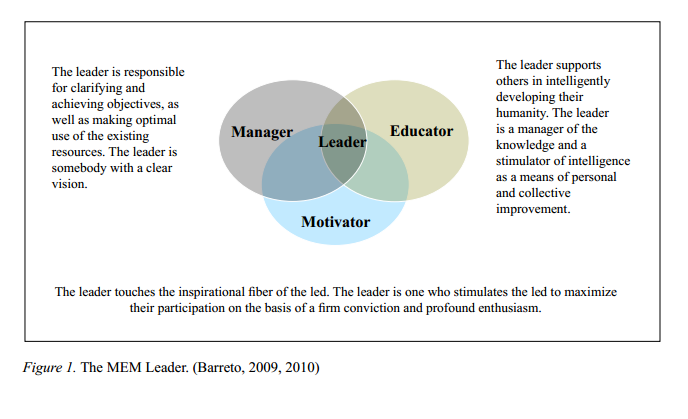
For Barreto (2009, 2010), a leader does not have to be a dichotomous person, nor is a leader simple product of a juxtaposition of characteristics, skills or behaviors. The leader is a triune: a holistic combination of a manager, an educator and a motivator.
A manager has the distinction of converging action toward an objective where energies are put in active tension to obtain an expected end. A manager-leader is responsible for the achievement of goals and objectives
that have a pattern of criteria and a clear philosophy of management and human development (Barreto, 2009; Sennewald, 1985).
An educator is an artist who can enable others to function in social life (Ingenieros, 2002), enhances intelligence, increases the power of the thought, and promotes the intrinsic skills of others to confront the challenges of life.
The true educator-leader assumes a pedagogical and liberating psychology, instead of allowing the dislocated epidemiological processes in which the only thing that happens is the adaptation of the person to the surroundings. On the contrary, the leader stimulates the germination of the critical-reflective competencies that allow both the led and the leader not only adapt to the reality of the surroundings but also to reinterpret it, to re- engineer it, and to transform it (Barreto, 2009, 2012a, 2012b; Freire, 2005).
The motivator mobilizes, encourages, dissuades and makes human energy flow. The leader as a motivator keeps the positive tension active in the group. This motivator-leader creates an energetic climate so that the led enrich it with their activity and enthusiastic participation. The leader is a positive energizer in the group, who does not assail the group, expend its energy, or impose his motivation per se; rather, a leader resonates
in the led and allows their intrinsic motivational energies to increase and articulate themselves (Barreto, 2009; Goleman, 2006; Heider, 2004).
The MEM leader, as illustrated in Figure 1, drives a practice of participatory, enthusiastic, critical and sustainable leadership. The leader has the conditions to understand and to magnetize the led, and they in response are integrated, and complement and execute the transformations with conscience synergy (Barreto,
2009, 2010).
Consciousness is associated with mental and emotional clarity, capacity to be empathic, ability to handle knowledge with intuitive clarity, and—over and above this—a superior understanding of the connection between all beings and elements (Chatterjee, 2007; Freire, 2005; Goleman, 2006; Heider, 2004). Synergy is the pace of sustained development; it is the cohesive integration of the parts of a system; it is the understanding and connection between the parts of a whole, making the final result of the system superior to the simple sum of the individual efforts that comprise it (Barreto, 2009, 2010). Synergy is the antithesis of entropy.
In thermodynamics, entropy is the property that marks the loss of interrelation between the parts of a system (existing disorder), which eventually leads to decay and obsolescence. A leader avoids entropy for the sake of maintaining harmonic, efficient and effective growth (Barreto 2009, 2010). While synergy is the union of energies, entropy is the dissipation of energy. Synergy makes efficient and effective use of energy; entropy wastes and exhausts energy.
Counseling for the Training of Leaders and the Development of Leadership
At the present time, university programs in counseling are becoming more focused in developing the skills of leadership in the students (Wolf, 2011). This indicates that the competencies and abilities of leaders and counselors are becoming more similar. Therefore, leaders learn more about harnessing particular realities (e.g., culture, gender, political position, spirituality, social sphere), and counselors direct their skills toward the management of human energy.
The training of counselors is not a simple task inasmuch as the professional work of counselors is
based on the human processes of the person. Hence, the aspiring counselor requires a deliberate and intense personal effort in the intellectual and emotional areas, and in the performance in the task of acquiring the competencies for the ideal practice of counseling (Vera, 2003). Similarly, for the training of leaders, a coordinated and deliberate effort is indispensable in order to provoke the awakening of one’s talents and to be able to develop a versatile and heuristic leader: a MEM leader.
Patterson (1999, cited in Vera, 2003) notes, for example, that empathic understanding, unconditional acceptance, and congruence must be promoted and encouraged throughout the training program because such conditions are not techniques or strategies, but attitudes that must harnessed in the person during training and not from the outside. Therefore, the training of leaders as managers, educators and motivators of human energy, can be based on the principles of constructive pedagogy of counseling that according to Vera (2003), allow counseling students to do the following:
• Become a professional of excellence (independent, flexible, reflective and critical).
• Assume a notion of life full of possibilities, not restricted to a single path or single way to be.
• Develop attitudes of understanding, deconstruction and transformation of the status quo.
• Recognize and to promote the integrated development of individual personalities framed in a sociocultural context.
Thus, it could be argued that counseling can provide knowledge that increases versatility in the training of a MEM leader (manager, educator and motivator) and in the development of leadership in communities, organizations, associations, and families, as well as circumstances in the life cycle of people including childhood, adolescence, early adulthood, middle age and old age, providing the conditions for
• raising and promoting the construction of paradigms that allow for the establishment of spaces for reflective understanding and fraternal human encounter;
• facilitating the establishment of effective mechanisms and processes of communication and management of knowledge;
• increasing the critical, independent and sovereign sense of the led with the purpose of stimulating responsibility to make decisions, evaluate actions, and increase participation as builders of a collective vision;
• harnessing the skills of the leader and the led to reinterpret and surpass daily challenges; and
• promoting the development of individual virtues that serve to optimize and enrich collective skills in an integrated way.
Final Comments
Leadership is an interaction of human energy that it has as its main attribute the development of the processes of growth and improvement for those who conform to it: the leader and the led. Human energy is an intelligent and rational force that promotes and realizes transformations and re-engineering. The leader, consequently, is the focal point of the energies that characterize the group, and must be seen as the manager who clarifies objectives and articulates the resources; as the educator who empowers
and intelligently nourishes human energy; as the motivator that maintains enthusiasm and vigor in the activities of growth and progress: the MEM leader (Barreto, 2009, 2010).
Counseling is a discipline and professional practice defined fundamentally by its uplifting nature of human energy, and by an understanding that people must harness their skills and form their attitudes. The counselor becomes a formidable ally for MEM leader both in its training as well as in its exercise, in providing a thorough understanding of the diverse facets of human life in its different angles with
an enhanced vision and a holistic understanding of people, and in forging a set of key attitudes such as empathy and unconditional acceptance (Barreto, 2009; Vera, 2004).
It is worth reflecting on how many hidden talented leaders might exist in society, who by not considering the systems of counseling lose their methods to make humanity more human; it is worth reflecting on how many leaders in the world are—without knowing it—damaging a human being because they do not use the concepts of the basic principles of human relationships used by counselors, or also how many leaders are not able to manage intelligently, to educate humanely, or to motivate the led in a sustainable manner.
Counselors’ unique training contributes to their being effective leaders in a wide variety of contexts (Paradise, Ceballos, and Hall, 2010).Counseling skills maximize the power of the leader to manage, to educate, and to motivate with synergy and consciousness, rendering human well-being more viable in the life cycle, consequently making the counselor-leader the engineer of sustained human development.
References
Barreto, A. (2009). Transformational leadership for enterprise management based on the management of knowledge and innovation (Unpublished master’s thesis). University of Zulia, Maracaibo, Venezuela.
Barreto, A. (2010). The leader of the human organizational energy: An innovating manager, educator and motivator. Paper presented at the First Congress of Organizational Management and Leadership, Barquisimeto, Venezuela.
Barreto, A. (2012a). Human energy and the manager, educator and motivational leader. Manuscript in preparation, Maracaibo, Venezuela.
Barreto, A. (2012b). Leadership: an interaction of human energy. Manuscript in preparation, Maracaibo, Venezuela.
Chang, C., Minton, C., Dixon, A., Myers, J., & Sweeney, T. (2012). Professional counseling excellence through leadership and advocacy. New York, NY: Routledge Taylor & Francis Group.
Chatterjee, D. (2007). The conscious leadership. Buenos Aires, Argentina: Ediciones Granica S.A. Freire, P. (2005). Pedagogy of the oppressed. Coyoacán, México: Siglo XXI Editores, S.A.
Goleman, D. (2006). The resonant leader creates more: The power of emotional intelligence. Buenos Aires, Argentina: Editorial Sudamericana S.A.
Hansen, J., Himes, B., & Meier, S. (1990). Consultation: Concepts and practices. New Jersey: Prentice Hall. Heider, J. (2004). Tao of the leaders. 1era. Edición. Buenos Aires, Argentina: Editorial del Nuevo Extremo
S.A.
Ingenieros, J. (2002). Moral forces. Bogota, Colombia: Ediciones Universales.
Navare, S. (2008). Counseling at work place: A proactive human resource initiative. Indian Journal of
Occupational and Environmental Medicine, 12(1), 1–2. Retrieved from http://www.ijoem.com. Osterlund, L. C., & Mack, M. (2011). Promoting advocacy and leadership in counselor education through
an innovative student and alumni association. Retrieved from http://counselingoutfitters.com/vistas/
vistas11/Article_29.pdf
Paradise, L. V., Ceballos, P. T., & Hall, S. (2010). Leadership and leader behavior in counseling: Neglected skills. International Journal for the Advancement of Counseling, 32, 46–55.
Sennewald, C. (1985). Effective security management. Newton, United States: Butterworth-Heinemann. Vera, G. (2003a). Pedagogy and training of counselors: A constructivist perspective. Revista de Pedagogía,
24, 137–166.
Vera, G. (2003b). Perspectives in the training of counselors: A qualitative study according to the Fundamental
Theory (Unpublished doctoral thesis). University of New Orleans, Louisiana.
Vera, G. (2004). Counseling as a profession: Definitions, intentions and scope. Encuentro Educacional, 11(2),
169–180.
Vera, G. (2006). Módulo de Personal. Unidad Curricular: Orientación Personal I. Universidad del Zulia, Maracaibo, Venezuela: Mimeo.
Vera, G., & Jiménez, D. (2005). Education of counselors in postmodern times: Challenges and possibilities.
Maracaibo, Venezuela: Revista Omnia.
Wolf, A. (2011). The knowledge, skills, practices and attributes that necessary for leadership roles in counseling (Doctoral dissertation). The University of North Carolina at Greensboro, Greensboro, NC.
Alfonso Barreto is a Development Analyst in Talents and Specialists (PDVSA – Management AIT). Correspondence can be addressed to Alfonso Barreto, Av. 33A, Calle 100, Terrazas de Sabaneta, Maracaibo-Venezuela, Sur América,
alfarreto@yahoo.es.
Oct 6, 2014 | Article, Volume 2 - Issue 2
Emily Bullock-Yowell, Sheba P. Katz, Robert C. Reardon, Gary W. Peterson
The respective roles of social cognitive career theory and cognitive information processing in career exploratory behavior were analyzed. A verified path model shows cognitive information processing theory’s negative career thoughts inversely predict social cognitive career theory’s career problem-solving self-efficacy, which predicts career exploratory behavior. The model suggests an intervention sequence to facilitate college student career development and exploration. A hypothetical case is provided as well as a depiction of the cycle of information processing in career decision making.
Keywords: career exploratory behavior, self-efficacy, negative career thoughts, college student career development, career problem-solving
Case of Sue
Sue, a young woman about to graduate from college with a degree in finance came to the university career center seeking career assistance in finding employment. Given some uncertainty about her interests and goals, she completed an interest inventory that produced a summary code (Holland, 1997) of IAS indicating interests in the investigative, artistic, and social areas. However, when occupational alternatives were identified for exploration following the assessment, she slumped in her chair and indicated that she was unable to concentrate on careers or the future and was unsure about the benefits of career counseling. At this point, the counselor invited her to complete the Career Thoughts Inventory (Sampson, Peterson, Lenz, Reardon, & Saunders, 1996) and the results revealed considerable negative career thinking across several domains. Further exploration in counseling revealed that a music teacher in high school had advised her to abandon her dreams of a music career because of a poor audition performance. She immediately decided to major in business finance without resolving the apparent loss of her future in music, or undertaking careful contemplation regarding viable career options.
This hypothetical case (although not an uncommon one) suggests that Sue was not ready to engage in a job campaign because she was mired in an emotional state that precluded her focusing on herself (goals, interests) or potential career options. In terms of cognitive information processing theory (CIP; Sampson, Reardon, Peterson, & Lenz, 2004), she lacked readiness (Sampson, Peterson, Reardon, & Lenz, 2000) to engage in career decision-making. She was unable to pursue the process of analyzing alternatives related to self and option knowledge because of longstanding emotional aftereffects associated with grieving the loss of an anticipated career in music performance. In effect, she was not emotionally available to engage effectively in the career problem-solving and decision-making process. This study examines how a negative emotional state, coupled with a lack of career decision self-efficacy, interferes with environmental and self-exploration precursors to the formulation of viable career options.
The CIP approach differentiates between career-related problem-solving and decision-making. Sampson, Reardon, Peterson, and Lenz (2004) defined problem-solving as “a series of thought processes in which information about a problem is used to arrive at a plan of action necessary to remove the gap between an existing and a desired state of affairs” (p. 5). Sampson et al. state that decision-making “includes problems solving, along with the cognitive and affective processes needed to develop a plan for implementing the solution and taking the risks involved in following through to the complete the plan” (p. 5). Difficulties in career decision making (as in Sue’s case) may stem from a variety of factors, including emotional distress, a lack of confidence in ability to perform certain tasks, lack of experience in varied life roles, lack of self-insight, negative expectations associated with a particular pursuit, fear of failure and conflicts with important people. Some career decision-making theories emphasize the use of self-knowledge (e.g., values, interests, and skills) and options knowledge (e.g., what jobs or majors of study are available), but they have less to offer regarding how beliefs, stress and affect associated with these two areas can impede progress in career decision-making. CIP (Sampson et al., 2004) and SCCT (Lent, 2005; Lent, Brown, & Hackett, 1994) address these issues.
Cognitive Career Theories
CIP (Peterson, Sampson, & Reardon, 1991; Sampson et al., 2004) and SCCT (Lent et al., 1994) have focused on the role of thinking in career decision-making. Independent of each other, these theories have defined types of dysfunctional cognitions, speculated about the role of these cognitions on academic and career decidedness, and developed self-report measures pertaining to these cognitions.
Within the career field, some career theorists have expressed the value of incorporating multiple career theories to provide the field with a more integrative framework for understanding career decision-making (Borgen, 1991; Hackett & Lent, 1992; Osipow, 1990). Specifically, such theorists have suggested that theories should integrate conceptually related constructs, further examine the relationship between dissimilar constructs and clarify commonly theorized outcome objectives within career decision-making. There are multiple cognitive constructs presented in CIP and SCCT career theories, but few studies have explored the interrelationships between them (Bullock-Yowell, Andrews, & Buzzetta, 2011).
Cognitive Information Processing Theory
CIP theory can be applied to understand the link between deficits in psychological functioning and career indecision (Peterson et al., 1991; Peterson, Sampson, Lenz, & Reardon, 2002). CIP theory utilizes the information-processing pyramid to explain the components involved in a career decision (Peterson et al., 1991). Four domains comprise the pyramid (Figure 1).
Figure 1. Information processing pyramid. Reprinted from Career development and services: A cognitive approach by G. W. Peterson, J. P. Sampson, and R. C. Reardon. Copyright ©1991 Brooks/Cole Publishing Company, Pacific Grove, CA 93950, a division of International Thomson Publishing, Inc.
At the base of the pyramid are two knowledge domains, self-knowledge and occupational knowledge. Self-knowledge is knowledge about one’s values, interests and abilities, while occupational knowledge is knowledge about the world of work and specific occupations (e.g., work setting, income and occupational tasks). These two areas provide the basic information that needs to be acquired in order to formulate appropriate occupational alternatives.
The decision-making skills domain is at the second level of the pyramid and involves individuals moving through the five phases of the cycle to process information for career decisions. The five-cycle phases include communication, analysis, synthesis, valuing and execution (Figure 2). These phases are referred to as the CASVE cycle. During the communication phase, individuals realize that they need to make a decision based on internal (e.g., anxiety) and external (e.g., notice from the university a major must be declared) cues they receive from themselves and their environment.
Figure 2. Cycle of information processing skills used in career decision-making. Reprinted from Career development and services: A cognitive approach by G. W. Peterson, J. P. Sampson, and R. C. Reardon. Copyright ©1991 Brooks/Cole Publishing Company, Pacific Grove, CA 93950, a division of International Thomson Publishing, Inc.
In the analysis phase, individuals seek to fully assess their career problem or the gap between their existing state of indecision and a desired state of decidedness. This phase involves determining the cause of the career problem and understanding the problem’s relationships themselves, their options and the factors that influence both themselves and their options (Sampson et al., 2004). This phase typically entails understanding assessments of interests, skills, values and engaging in occupational exploration. (Sue was unable to move from the communication phase to the analysis phase in the case example.)
In the third phase of the CASVE cycle, synthesis, individuals seek to determine a possible course of action which may involve developing alternatives for making a decision, including brainstorming an exhaustive list of options (synthesis elaboration) and narrowing this list to obtainable options (synthesis crystallization). (Sue was unable to successfully engage this phase of the CASVE cycle.) Throughout the fourth phase, valuing, individuals make judgments about these options based on their personal beliefs and preferences and arrive at a first choice. Finally, individuals put their thoughts into action in the execution phase of the CASVE cycle (e.g., completing a major field of study, applying for a job; Sampson et al., 2004).
The apex of the information processing pyramid consists of the executive processing domain. In this domain, people examine cognitions regarding the career decision process itself. There are three skills that need to be developed in order to engage in executive processing: self-talk, self-awareness, and control and monitoring. Self-talk is the internal conversation that individuals have about their decision-making abilities, e.g., “I can make good decisions for myself.” Self-awareness is the perception of one’s self as the performer of a task (Peterson et al., 1991), e.g., “I am nervous about meeting the timeline of my plans.” Control and monitoring is using self-awareness and understanding of the problem to guide and evaluate decision-making. For example, individuals are aware of anxious feelings about meeting a deadline and they decide they need more time. The executive function failed to operate in Sue’s case by allowing her to go prematurely from communication to synthesis without thoroughly becoming aware of her thoughts and feelings in the communication phase, and by not clarifying and acquiring adequate self and occupational knowledge in the analysis phase.
The strength of the CIP theory of career development is that it offers a framework of the cognitive and behavioral factors that guide career decidedness. Specifically, it provides a structure and sequence for gathering, transforming and utilizing information, while acknowledging the importance of thoughts and feelings.
Social Cognitive Career Theory
The framework for SCCT was derived primarily from general social cognitive theory (Bandura, 1986), and focuses on three variables: self-efficacy beliefs, outcome expectations, and personal goals. Self-efficacy is defined as beliefs about one’s ability to successfully perform given tasks or behaviors required to produce specific goal attainments (Bandura, 1977). It is hypothesized to be composed of beliefs linked to specific tasks or performance domains that vary across situations. Self-efficacy can be attained through four primary sources: (a) personal performance accomplishments, (b) vicarious learning (e.g., modeling), (c) social persuasion, and (d) the individual’s physiological and affective states (Bandura, 1977; Lent, 2005). According to SCCT, self-efficacy is a mediating factor for proactive behavior and behavioral change, regardless of ability level (Bandura, 1986).
Outcome expectations are defined as “beliefs about consequences or outcomes of performing particular behaviors” (Lent & Brown, 2006, p. 17). More specifically, outcome expectations influence behavior—when individuals expect that a behavior will lead to positive results, they are more likely to engage in the behavior. For example, if students expect that career options exploration will be helpful in their career decision-making, then they are more likely to engage in seeking and acquiring information (e.g., theory of reasoned behavior).
Personal goals refer to the individual’s intention to engage in a particular activity or produce an outcome (Bandura, 1986). The two types of goals identified by SCCT are choice-content goals and performance goals. Choice-content goals are goals related to activities or interest areas the individual wishes to pursue (e.g., choosing an academic major). Performance goals are goals regarding the individual’s level of performance needed to obtain the choice-content goal (e.g., maintaining a certain GPA to get into a particular field of study).
Choice and performance goals are theorized to be related to one’s self-efficacy and outcome expectation (Lent, 2005). Figure 3 provides a graphic depiction of the interrelationship among these constructs and an SCCT explanation of how interests develop over time. Additionally, SCCT outlines three related, yet distinct choice models related to the development of career-related interests, formation of career-related choices, and career/work-related performance. Strengths of SCCT theory include the acknowledgment of one’s confidence or self-efficacy associated with the development of interests and willingness to pursue and maintain work-related tasks. SCCT also acknowledges the many barriers to career development that exist in the environment, while promoting a sense of self-agency in clients.
Figure 3. Social Cognitive Career Theory (SCCT). Reprinted from Lent, R. W., Brown, S. D., & Hackett, G. (1994).Toward a unifying social cognitive theory of career and academic interest, choice, and performance. Journal of Vocational Behavior, 45, 79–122.
Exploratory Behavior in Career Decision-Making
In the case of Sue, she was unable to engage in exploratory behavior associated with career problem-solving and decision-making, specifically identifying an appropriate job opening. In this section, career exploratory behavior is examined from the standpoint of CIP and SCCT theories. Only one study was found examining exploratory behavior in relation to CTI scores (McHugh, Lenz, Reardon, & Peterson, 2012) which indicated that viewing a 10-minute model-reinforced video led to increased information-seeking behavior.
SCCT (Lent et al., 1994) suggests that self-efficacy beliefs influence behavioral intentions (e.g., planned career exploration) because it affects an individual’s perceived outcome expectation. Blustein (1989) found that self-efficacy and goal-directedness were related to environmental and self-exploration, but domain-specific self-efficacy proved to be a stronger predictor of exploratory behavior than goal stability. This finding provided evidence that self-efficacy does influence behavioral intentions and performance of an action so that a desired outcome is achieved (i.e., exploratory behavior).
Several studies provided empirical support for the application of SCCT in the examination of exploratory behavior (Bartley & Robitscheck, 2000; Betz & Voyten, 1997; Blustein, 1989; Fouad & Spreda, 1996; Ochs & Roessler, 2001, 2004). These studies examined how career decision-making self-efficacy and related variables (e.g., behavioral intention and outcome expectation) can contribute to the completion of career decision-making activities (e.g., career exploration). In one study, self-efficacy was found to aid students in developing and maintaining a commitment to career goals (i.e., behavioral intention; Blustein, 1989). As previously noted, behavioral intention is theorized to be the best predictor of actual behavior (Ajzen, 1988; Ajzen & Fishbein, 1980). Career exploratory behavior in undergraduate students was examined by Betz and Voyten (1997), and the results indicated that career outcome expectation was the best predictor for behavioral intentions (r =.50) in both males and females with academic outcome expectation and career decision-making self-efficacy accounting for some of the variance. The overall model for behavioral intention accounted for 25–29% of the variance. Taken together, research indicates that self-exploration and options exploration are related to career decision-making self-efficacy and other related SCCT constructs (Bartley & Robitscheck, 2000; Betz & Voyten, 1997; Blustein, 1989).
The Present Study
Both CIP and SCCT theories hypothesize that career beliefs influence goal development and ultimately behavioral outcomes. In CIP theory, the influences of meta-cognitions that regulate the career decision-making process are components of the executive processing domain of the information-processing pyramid (Peterson et al., 1991). As noted earlier, CIP theory suggests there are three key skills that need to be developed in order to examine and alter one’s thoughts: self-talk, self-awareness, and control and monitoring. CIP theory identifies three aspects of dysfunctional career thinking using the Career Thoughts Inventory (CTI): (a) decision-making confusion, (b) commitment anxiety, and (c) external conflict (Sampson et al., 1996), which can function to improve self-awareness. These thoughts can lead to avoidance in career problem-solving, insufficient processing of information during the phases of the CASVE cycle, and failure to complete the career problem-solving process. These difficulties can affect individuals’ abilities to progress through the CASVE cycle, thus increasing career indecision. The current study utilizes the CTI subscale scores to determine the extent to which the cognitive constructs presented in CIP theory predict for successful engagement of exploratory behavior in the analysis phase of the CASVE Cycle.
SCCT identifies three types of beliefs including self-efficacy, outcome expectations, and behavioral intention. One instrument, the Career Decision Self-efficacy Scale (CDSE; Betz & Luzzo, 1996) further defines these beliefs related to career decision-making self-efficacy into the subtypes of self-appraisal, occupational exploration, goal selection, planning, and problem-solving. These beliefs reciprocally interact to influence behavior. For example, past experience influences individuals’ current thoughts about themselves and their environment (e.g., self-efficacy beliefs and outcome expectations). These beliefs then influence goal setting (e.g., behavioral intention) and ultimately behavioral outcomes (e.g., self-exploration, environmental exploration and career decidedness).
Although the basic definitions of these cognitive variables are different across the two theories, the item content on the respective measurement scales appears to be very similar. CTI items to which test-takers are asked to rate their level of agreement (e.g., “My interests are always changing.” “Even though I’ve taken career tests, I still don’t know what field of study or occupations I like”) are similar to items on the self-appraisal subscale of the CDSE in which test-takers are asked to rate their confidence that they could accomplish the task (e.g., “Determine what your ideal job would be.” “Accurately assess your abilities”). In addition, items from the CDSE problem-solving subscale (e.g., “Persistently work at your major or career goal even when you get frustrated.” “Change occupations if you are not satisfied with the one you enter.”) are similar to “If I change my field of study or occupation, I will feel like a failure” and “I’ll never find a field of study or occupation I really like” on the CTI.
In the only study found to explore relationships among CIP and SCCT constructs, Bullock-Yowell, Andrews, and Buzzetta’s (2011) research demonstrated that negative career thoughts as measured by the CTI, along with three of the big five personality factors, explained 45.8% of the variance in career decision-making self-efficacy. This study provides a basis for better understanding the overlap and distinctness of these theories’ constructs. The five self-efficacy dimensions have some similarity to the CIP executive processing domain as they bear on the higher order regulation of the lower order decision-making process. In the case of Sue, she failed to engage in sufficient problem-solving and self-appraisal. As stated earlier, the CIP approach differentiates the career problem-solving process from the more comprehensive career decision-making process (Sampson et al., 2004). As Sue’s issues seem to be more directly related to the problem-solving process and her self-concept, the current study also examined the relationship between self-efficacy and the problem-solving process.
Within the context of CIP theory, the relationships between career indecision, exploratory behavior and negative career thoughts have theoretical support, but still need further empirical support. Research has consistently found moderate to strong correlations between career indecision and negative career thoughts (Saunders, Peterson, Sampson, & Reardon, 2000). Correlations between career decidedness and exploratory behavior are significant, but weak (Barak, Carney, & Archibald, 1975). In addition, no published articles have focused on the relationship between negative career thoughts and career exploration. Many career theorists have suggested that information processing is influenced by attitudes, values and cognitions (Kinnier & Krumboltz, 1986; Osipow, 1973; Sampson et al., 2004), and that the relationship between exploratory behavior and career decidedness may be mediated by career thoughts. Further research is needed to examine the theorized relationship between these variables. Thus, this study sought to address this gap by exploring the relationship between negative career thoughts and career exploration.
In order to better inform practitioners about effective ways to assist their clients using cognitive career theories, the following research question was posed: When are clients ready to move from the communication phase to the analysis phase of the CASVE cycle? More specifically, do negative career thoughts and career problem-solving self-efficacy predict successful engagement of self-exploration and environmental exploration in pursuit of self-knowledge and occupational knowledge? Three constructs of negative career thoughts from CIP theory (i.e., decision-making confusion (DMC), commitment anxiety (CA), and external conflict (EC) and two domains of career decision-making self-efficacy from SCCT (i.e., self-appraisal and problem-solving) were selected as predictors of career exploratory behavior (i.e., self-exploration and environmental exploration). These were framed in terms of a causal model amenable to analysis through structural equation modeling (SEM). Therefore, a model was proposed (See Figure 4) with a bi-directional relationship between the career thinking and career problem-solving self-efficacy latent variables, as well as career thinking and career problem-solving self-efficacy predicting career exploratory behavior.
This theorized model can be illustrated by returning to the case of Sue. Her level of negative thought together with the lack of perceived competency in self-appraisal and problem-solving severely impeded her ability to engage in self-exploration and environmental exploration. The model graphically portrays Sue’s circumstance and the hypothetical relationships among these theoretical constructs.
Method
Participants
Participants were 145 undergraduate students (51% female and 49% male, age range 18–36, mean age 21.8) enrolled in multiple sections of an introductory career development course at a research university. The common reason for enrolling in this elective course was to receive assistance in making a career decision or to solve a problem related to career issues. Ethnicity and classification demographics of the sample include: European American 71%, African American 21.4%, Hispanic American 5.5%, American Indian 0.7%, Other 1.4%, seniors 62.1%, sophomores 16.6%, juniors 15.9%, freshmen 4.8% and graduate students 0.7%.
Procedures
College students enrolled in an introductory level career development course were recruited to participate in this study. During a regularly scheduled class period, students in the course were read consent information by a research assistant. It was explained that the purpose of the study was to learn more about college students’ experiences. Participants were then administered a demographics questionnaire, the Career Thoughts Inventory, the Career Decision-Making Self-Efficacy Scale, and the Career Exploratory Survey: Environmental Exploration and Self-Exploration. The order in which the instruments were administered was randomly alternated to control for possible order effects. Students who agreed to participate received extra credit in the course. All measures were simultaneously collected on the first or second day of class to help control for missing data and environmental factors.
Instruments
Demographic Questionnaire. The demographic questionnaire included information such as age, gender, year in school, major, previous work experience, extracurricular activities and ethnicity. This measure was used to describe the study sample.
Career Thoughts Inventory (CTI; Sampson, Peterson, Lenz, Reardon, & Saunders, 1998). The CTI is a 48-item self-report inventory designed to measure career thoughts. The CTI measures negative thoughts that impede career decision-making using a four-point Likert scale. The CTI yields three subscale scores: Decision-Making Confusion (DMC), Commitment Anxiety (CA), and External Conflict (EC). Higher scores indicate negative career thinking. In the present study, the CTI subscales were the observed variables’ measures that defined the latent variable, Career Thinking. The CTI’s content validity is based on its consistency with the cognitive information processing (CIP) approach of career decision-making. The internal consistency for this measure is high with a coefficient alpha of r = .96 (Sampson et al., 1998) and .95 for the current sample. Subscale internal consistency for the current sample was Decision-Making Confusion (.92), Commitment Anxiety (.84) and External Conflict (.75). Test-retest reliability was measured in college and high students across 4 weeks and ranged from .74–.82 (Sampson et al., 1998). CTI total score converged with Indecision Scale of the Career Decision Scale at .70.
Career Decision Self-Efficacy Scale-Short Form (CDSES-SF; Betz & Luzzo, 1996). The CDSES-SF is a 25-item self-report inventory designed to measure career decision-making self-efficacy. Using a five-point Likert scale, the CDSES-SF measures confidence to perform decision-making tasks in five competency areas: performing accurate self-appraisals, gathering occupational information, selecting goals, making plans to implement career decisions and problem-solving. These five competency areas that make up the factor structure of the CDSES-SF are based on Crites’ (1969) theory of career maturity. The latent variable, career problem-solving self-efficacy, was comprised of two observed variables measured by the self-appraisal and problem-solving subscales of the CDSES-SF. Coefficient alphas for the self-appraisal and problem-solving subscales have been reported as .73 and .75, respectively (Betz & Luzzo, 1996). The coefficient alphas for the current sample were .79 for self-appraisal and .77 for problem-solving. The test-retest reliability for the total scale across a 6-month period was reported to be .83 (Betz & Luzzo, 1996). Concurrent validity has been established with the Career Decision Scale indecision and certainty scales (Osipow, 1980) and the My Vocational Situation: Identity scale (Holland, Daiger, & Power, 1980). Convergent validity has been established with a generalized measure of self-efficacy (Betz & Klein, 1996).
Career Exploratory Survey: Environmental Exploration and Self-Exploration (CES-EE & CES-SE; Blustein & Phillips, 1988; Stumpf, Colarelli, & Hartman, 1983). In the present study, the 6-item Environmental Exploration and the 9-item Self-Exploration scales from the Career Exploration Survey (CES) were used to measure the observed variables that defined the present study’s latent variable, Career Exploratory Behavior. The CES-SE measures “the extent of career exploration involving self-assessment and retrospection within the last 3 months” and the CES-EE measures “the extent of career exploration regarding occupations, jobs, and organizations within the last 3 months” (Stumpf et al., 1983, p.196). Internal consistency for the two scales has been adequately demonstrated in the literature (CES-SE alpha = .82 to .88 and CES-EE alpha = .88 to .89) (Blustein & Phillips, 1988; Stumpf et al., 1983) and in the current sample (CES-SE alpha = .85 and CES-EE alpha .87). In addition, Blustein and Phillips (1988) reported two-week test-retest reliabilities of .85 and .83 for the CES-SE and CES-EE, respectively. Content validity for the scales has been confirmed with a theoretically consistent factor structure (Stumpf et al.). Convergent validity for both scales has been established with a variety of constructs (Blustein, 1989; Blustein & Phillips, 1988; Hamer & Bruch, 1997; Luzzo, James, & I.una, 1996; Stumpf et al., 1983).
Results
The relationships among career exploratory behavior, career thinking and career problem-solving self-efficacy were analyzed. All analyses were conducted using AMOS 7.0 (Arbuckle, 2006) and SPSS 16.0. Structural equation modeling (SEM) served as the framework for the analysis. The majority of the correlations among the present study’s observed variables were statistically significant (See Table 1) with a few exceptions. Self-exploration, a defining variable for the career exploratory behavior latent variable, was not significantly correlated with any of the career thinking observed variables. Environmental exploration, another defining variable for the career exploratory behavior latent variable, was not significantly correlated with external conflict, one of the defining variables of the career thinking latent variable.
Table 1
Correlations, Means, and Standard Deviation of Study’s Observed Variables (N=145)
Measurement Model
The measurement model was evaluated to determine how well the observed variables combined to represent the underlying latent constructs of the model (Anderson & Gerbing, 1988). The initial measurement model was constructed with three latent constructs: career exploratory behavior, career thinking and career problem-solving self-efficacy (See figure 4). For this step, all latent variables were allowed to co-vary, and observed indicators were restricted to load only on their respective factor. Career problem-solving self-efficacy’s observed variables, problem-solving and self-appraisal, were significantly correlated (r =.71; p < .01). Career thinking’s observed variables—decision-making confusion (DMC), commitment anxiety (CA) and external conflict—were significantly intercorrelated (r =.53-.71; p < .01). Exploratory behavior’s observed variables, self-exploration and environmental exploration, were significantly correlated (r =.34; p < .01). The loadings of the measured variables on the latent variables were all statistically significant (p < .001) and ranged from .55 to .95, providing evidence that each of the latent variables was adequately measured by their respective observed variables.
Structural Models
The initial model tested (See Figure 4) proposed a bi-directional relationship between the career thinking and career problem-solving self-efficacy latent variables, along with variables explaining direct variance in career exploratory behavior. During the analysis process in AMOS 16.0, the model was deemed inadmissible. Therefore, a second path model (see Figure 5) was proposed in which the relationship between the career thinking and career problem-solving self-efficacy latent variables was modified to indicate that career thinking captured direct variance in career problem-solving self-efficacy, which in turn had a direct effect on career exploratory behavior. This path model had an adequate to low fit with the data, χ2 (11, N = 145) = 31.14, p < .001, χ2/df = 2.831, CFI = .946, TLI = .897, RMSEA = .113 (90% CI: .67, .160). Models with CFI and TLI between .90 and .94, and RMSEA values between .06 and .10, indicate an adequate fit to the data when models are not complex and samples sizes are smaller than 500 (Hu & Bentler, 1999; Weston & Gore, 2006). This path model met most of these specifications of adequate fit. The TLI and RMSEA coefficients fell slightly outside the recommended parameters.
Figure 4. Initially proposed model.
Figure 5. Final model.
Discussion
The model initially hypothesized and proposed (Figure 4) was not admissible. According to most indicators the final path model (Figure 5) was moderately verified. The model suggests that there is an important sequence of interventions when working to facilitate environmental and self-exploratory behavior in career counseling clients. The model indicates that negative career thinking explains some portion of career problem-solving self-efficacy. Also, career problem-solving self-efficacy in turn directly explains a portion of exploratory behavior, while negative career thinking does not. Self-efficacy appears to affect the relationship between negative thoughts and exploratory behavior. Thus, the presence of negative thinking appears to support a person’s level of self-efficacy. Perhaps the key for practitioners is to intervene on negative career thoughts initially to free clients for more successful building later upon problem-solving self-efficacy. Problem-solving self-efficacy can then be addressed once negative thinking is resolved through attending to the sources of self-efficacy (Bandura, 1977; Lent, 2005).
How do this model and these indicated interventions address the research question and hypotheses? It appears to be important to address negative career thinking prior to working with clients on building self-confidence in career decision-making. In terms of the CIP pyramid (Peterson et al., 1991) that would mean addressing issues in the decision-skills domain before engaging the apex or executive processing domain. Thus, the successful progression from the communication to analysis phase of the CIP CASVE cycle would first involve resolution of negative career thoughts followed by building career problem-solving self-efficacy. Upon increasing self-efficacy, the probably of engaging in career exploratory behavior to clarify self-knowledge and to acquire occupational knowledge at the base of the pyramid is enhanced.
This potentially generalizable model has direct implications for the specific case of Sue described at the beginning of this article, which will be used to demonstrate how the findings from this study could be utilized in specific counseling situations. Sue presented with low readiness (Sampson et al., 2004) to engage the career development process. She seemed frustrated and unwilling to explore her interest inventory results. This may be linked back to the disappointment, regret and perhaps even grief associated with the “loss” of her music aspirations. It is very likely she developed some negative career thoughts in that process.
The verified path model indicates the importance of identifying, challenging and altering these negative thoughts to allow Sue to act upon a new, more accurate version of these thoughts. The use of the Career Thoughts Inventory (CTI) assessment and workbook (Sampson et al., 1996) could aid Sue’s counselor in this process by identifying and challenging negative career thoughts.
When Sue’s negative thinking is transformed and becomes more realistic and positive, career-related self-efficacy should be ready for enhancement. In fact, Lent (2005) mentions that self-efficacy building attempts may be enhanced from some preliminary cognitive restructuring procedures. Bandura (1977) and Lent (2005) suggest targeting the four sources of self-efficacy to accomplish this positive change. One possible career counseling goal could target the personal performance accomplishments source of self-efficacy. Sue’s counselor could work with Sue to break down her present goal of finding employment into more discrete, attainable steps and milestones to build Sue’s confidence (or self-efficacy) in such tasks. For instance, during the next week Sue could look at the career center’s job listings and indicate three she likes and three for which she would never apply. This would allow for discussion of jobs of interest and areas to avoid in the next session as well as supporting Sue’s efforts to engage in the tasks necessary to explore career information and make an eventual choice. Sue and the counselor could work at Sue’s pace to accomplish a list of associated, small goals to build self-efficacy while simultaneously working toward Sue’s initial goal of finding employment.
This case and model indicate that even when a client presents with a need to explore career information it may not be the most prudent move for a counselor to initially engage in career exploration with the client. There may be steps that are necessary, or at least allow for the attainment of readiness in order to successfully engage in career exploration. These steps seem to include addressing negative career thinking followed by adequately addressing career problem-solving self-efficacy, indicating that both CIP and SCCT theories function in complementary ways.
Limitations and Implications
Given all of this discussion of counseling with Sue, it is important to note limitations of this research. Most SEM indicators verify the adequacy of the final model provided in this study. However, because it is not fully verified by all relevant indicators and not all possible related variables are taken into account, there may be a better fitting model that explains career exploratory behavior. Future research could focus on finding a better fitting model with a larger sample size to explain career exploratory behavior. Additionally, the sample was made up of college students, the majority of which were European American, and this may limit the generalizability of these findings to dissimilar groups. Additionally, research outside of the career realm may benefit from the consideration of such a model as it relates to other important life choices and exploration in which career counseling clients typically engage (e.g., choice of spouse, major purchases). Perhaps negative thinking resulting from regrets, disappointments, and grief have similar effects on client’s life-choice self-efficacy and exploratory behavior. There are many areas of life where clients prematurely make choices and there are ways for counselors to better prepare them for this decision-making process.
The suggested counselor interventions also are limited in several ways. The verified path model does not inform us as to whether intervention on career thinking followed by self-efficacy is necessary or if intervention on career thinking alone would be adequate. Additionally, the effects of the four sources of self-efficacy are not fully empirically supported (e.g., Alliman-Brissett, Turner, & Skovholt, 2004) and should be implemented with that in mind.
The case of Sue demonstrated some of the specific practice implications suggested by the model. It is important to consider whether a measure of negative career thinking, such as the Career Thoughts Inventory (Sampson et al., 1996), and of career-related self-efficacy, such as the Career Decision Self-Efficacy scale (Betz & Luzzo, 1996), should be integrated into the career counseling assessments as a standard procedure to help monitor and inform treatment.
References
Ajzen, I. (1988). Attitudes, personality and behaviors. Milton Keynes, England: Open University Press.
Ajzen, I., & Fishbein, M. (1980).Understanding attitudes and predicting social behavior. Englewood Cliffs, NJ: Prentice-Hall.
Alliman-Brissett, A. E., Turner, S. L., & Skovholt, T. M. (2004). Parent support and African American adolescents’ career self-efficacy. Professional School Counseling, 7, 124–132.
Anderson, J. C., & Gerbing, D. W. (1988). Structural equation modeling in practice: A review and recommended two-step approach. Psychological Bulletin, 103, 411–423.
Arbuckle J. (2006). Amos 7.0 User’s Guide. Spring House, PA: Amos Development Corporation.
Bandura, A. (1977). Self-efficacy: Toward a unifying theory of behavioral change. Psychology Review, 84, 629–644.
Bandura, A. (1986). Social foundations of thought and action: A social cognitive theory. Englewood Cliffs, NJ: Prentice Hall.
Barak, A., Carney, C. G., & Archibald, R. D. (1975). The relationship between vocational information seeking and educational and vocational decidedness. Journal of Vocational Behavior, 7, 149–159.
Bartley, D. F., & Robitschek, C. (2000). Career exploration: A multivariate analysis of predictors. Journal of Vocational Behavior, 56, 63–81.
Betz, N. E., & Luzzo, D. A. (1996). Career assessment and the Career Decision-Making Self-Efficacy Scale. Journal of Career Assessment, 4, 413–428.
Betz, N., & Klein, K. (1996). Relationships among measures of career self-efficacy, generalized self-efficacy and global self-esteem. Journal of Career Assessment, 4, 285–298.
Betz, N., & Voyten, K. (1997). Efficacy and outcome expectations influence career exploration and decidedness. The Career Development Quarterly, 46, 179–189.
Blustein, D. L. (1989). The role of goal instability and career self-efficacy in the career exploration process. Journal of Vocational Behavior, 35, 194–203.
Blustein, D. L., & Phillips, S. D. (1988). Individual and contextual factors in career exploration. Journal of Vocational Behavior, 33, 203–216.
Borgen, F. H. (1991). Megatrends and milestones in vocational behavior: A 20-year counseling psychology perspective. Journal of Vocational Behavior, 39, 263–290.
Bullock-Yowell, E., Andrews, L., & Buzzetta, M. (2011). Explaining career decision making self-efficacy: Personality, cognitions, and cultural mistrust. The Career Development Quarterly, 59, 400–411.
Crites, J. O., (1969). Vocational psychology: The study of vocational behavior and development. New York, NY: McGraw-Hill.
Fouad, N. A., & Spreda, S. L. (1996). Translation and use of career decision-making self-efficacy assessment for Hispanic middle school students. Journal of Vocational Education Research, 21, 67–85.
Hackett, G., & Lent, R.W. (1992).Theoretical advances and current inquiry in career psychology. In S. D. Brown & R. W. Lent (Eds.), Handbook of counseling psychology (2nd ed.) (pp. 419–452). New York, NY: Wiley.
Hamer, R. J., & Bruch, M. A. (1997). Personality factors and inhibited career development: testing the unique contribution of shyness. Journal of Vocational Behavior, 50, 382–400.
Holland, J. L. (1997). Making vocational choices: A theory of vocational personalities and work environments. Odessa, FL: Psychological Assessment Resources.
Holland, J. L., Daiger, D. C., & Power, P. G. (1980). My vocational situation. Palo Alto, CA: Consulting Psychologists Press.
Hu, L., & Bentler, P. M. (1999). Cutoff criteria for fit indexes in covariance structure analysis: Conventional criteria versus new alternatives. Structural Equation Modeling, 6, 1–55.
Kinnier R. T., & Krumboltz, J. D. (1986). Procedures for successful career counseling. In N. C. Gysbers (Ed.), Designing careers (pp. 307-335). San Francisco, CA: Jossey-Bass.
Lent, R.W. (2005). A social cognitive view of career development and counseling. In S.D. Brown, & R.W. Lent (Eds.), Career development and counseling: Putting theory and research to work (pp. 101–127). New York, NY: Wiley.
Lent, R. W., & Brown, S. D. (2006). On conceptualizing and assessing social cognitive constructs in career research: A measurement guide. Journal of Career Assessment, 14, 12–35.
Lent, R. W., Brown, S. D., & Hackett, G. (1994). Toward a unifying social cognitive theory of career and academic interest, choice, and performance. Journal of Vocational Behavior, 45, 79–122.
Luzzo, D. A., & James, T., (1996). Effects of attributional retraining on the career beliefs and career exploration behavior of college students. Journal of Counseling Psychology, 43, 415–422.
McHugh, E. R., Lenz, J. A., Reardon, R. C., & Peterson, G. W. (2012). The effects of using a model-reinforced video on information-seeking behaviour. Australian Journal of Career Development, 21(1), 16–23.
Ochs, L. A., & Roessler, R. T. (2004). Predictors of career exploration intentions: A social cognitive theory perspective. Rehabilitation Counseling Bulletin, 47, 224–233.
Ochs, L. A., & Roessler, R. T. (2001). Student with disabilities: How ready are they for the 21st century? Rehabilitation Counseling Bulletin, 44, 170–176.
Osipow, S. H. (1990). Convergence in theories of career choice and development: Review and prospect. Journal of Vocational Behavior, 36, 122–131.
Osipow, S. H. (1980). Manual for the Career Decision Scale. Columbus, OH: Marathon Consulting and Press.
Osipow, S. H. (1973). Theories of career development (2nd ed.) Englewood Cliffs, NJ: Wiley.
Peterson, G., Sampson, J., Lenz, J., & Reardon, R. (2002). A cognitive information processing approach to career problem solving and decision making. In D. Brown and Associates (Eds.), Career choice and development (4th ed.) (pp. 312–369). San Francisco, CA: Jossey-Bass.
Peterson, G., Sampson, J., & Reardon, R. (1991). Career development and services: A cognitive approach. Pacific Grove, CA: Brooks/Cole.
Sampson, J., Jr., Peterson, G., Reardon, R., & Lenz, J. (2000). Using readiness assessment to improve career services: A cognitive information processing approach. Career Development Quarterly, 49, 146–174.
Sampson, J., Jr., Reardon, R., Peterson, G., & Lenz, J. (2004). Career counseling and services: A cognitive information processing approach. Pacific Grove, CA: Brooks/Cole.
Sampson, J., Jr., Peterson, G., Lenz, J., Reardon, R., & Saunders, D. (1996). Career Thoughts Inventory: Professional manual. Odessa, FL: PAR, Inc.
Sampson, J., Jr., Peterson, G., Lenz, J., Reardon, R., & Saunders, D. (1998). The design and use of a measure of dysfunctional career thoughts among adults, college students, and high school students: The Career Thoughts Inventory. Journal of Career Assessment, 6, 115–134.
Saunders, D. E., Peterson, G. W., Sampson, J. P., & Reardon, R. C. (2000). Relation of depression and dysfunctional career thinking to career indecision. Journal of Vocational Behavior, 56, 288–298.
Stumpf, S. A., Colarelli, S. M., & Hartman, K. (1983). Development of the career exploration survey (CES). Journal of Vocational Behavior, 22, 191–226.
Weston, R., & Gore, P. A. (2006). A brief guide to structural equation modeling. The Counseling Psychologist, 34, 719–751.
Emily Bullock-Yowell, NCC, is an Assistant Professor at the University of Southern Mississippi. Sheba P. Katz is in private practice, Fort Myers, FL. Robert C. Reardon, NCC, is Professor Emeritus at Florida State University. Gary W. Peterson is Professor Emeritus at Florida State University. Correspondence can be addressed to Emily Bullock-Yowell, University of Southern Mississippi, Department of Psychology, 118 College Drive #5025, Hattiesburg, MS 39406-0001, emily.yowell@usm.edu.
Oct 6, 2014 | Article, Volume 2 - Issue 2
Sonya Lorelle, Rebekah Byrd, Stephanie Crockett
Scholars have examined globalization for many years in terms of its impact on individuals, but it remains a concept not often discussed in the counseling literature. As counseling transforms from a Western-based practice to a global phenomenon, it is important to understand professional counseling within an international and multicultural context. In this article, the ways in which the process of globalization are currently impacting the field of counseling, implications and future research directions are examined. Global mental health and wellness, culture, and access and structural limitations are also presented.
Keywords: globalization, international, multicultural, counselor education, professional counseling
As our world becomes increasingly connected economically, politically, technologically, and culturally, counseling is transforming from a Western-based practice to a global phenomenon. The globalization of counseling has placed the field on the cusp of growth and innovation. Such changes involve not only a willingness to adapt and perhaps redefine current counseling theories, but to hold our most basic assumptions regarding the nature of human change so loosely that we are willing to let counseling develop and evolve indigenously in international communities. Accordingly, this article highlights the impact of globalization on the field of counseling, with particular attention given to the spread of Western-based counseling practices to the international community. In order to do so, we begin by defining globalization and considering the progression of multicultural counseling toward a more global vision. We then examine the ways in which the process of globalization is currently impacting the field of counseling. Lastly, the implications for counseling as an increasingly global phenomenon and future research directions are considered.
Globalization
Globalization can be referred to the “McDonaldization” or “Westernization” of the world. These terms imply that globalism entails an invasion of Western capitalism into undeveloped nations and suggests the idea that the world is becoming homogeneous. Modern scholars of globalization (Featherstone, 1996; Tomlinson, 1999), however, point out that such oversimplifications only describe one aspect of globalism, and note that globalization is better defined by a series of interactions between nations than by a unidirectional Western conquest. Accordingly, we define globalization in this article as a continual process of interaction and integration among national economies, societies and cultures (Rothenberg, 2003).
There is a dynamic interplay between both global and local economies, politics, technologies and cultures in which local communities do not passively give way to outside influences, but rather actively react to the process by absorbing, assimilating, and/or resisting the worldviews, products and politics introduced by the West (Featherstone, 1996). This global-local relationship transforms the local lived experiences of the individuals and has increasing global consequences (Tomlinson, 1999).
Scholars in the counseling field have already increased their understanding of the process by which individuals in minority groups adapt to dominate cultural norms. Traditionally, it was assumed that acculturation was a one-dimensional process in which individuals demonstrated increasing adherence to the dominant culture and a lessening of adherence to the minority orientation. More recently, scholars understand this process to be multidimensional, involving both acculturation and enculturation (Kim & Abreu, 2001).
Similar to modern theories of globalization, counselors are increasingly aware of the dynamic interplay that exists between dominant and individual culture. In this manner, as the counseling profession is introduced and developed in international communities, not only will local communities and individuals living in those communities be transformed, but the practice of traditional, Western counseling may be fundamentally redefined as locals actively react and adapt to the practice. Individual views and experiences of globalization are contingent upon social location and personal experiences (Featherstone 1996; Tomlinson, 1999). In considering the globalization of counseling, the application of this assumption implies that each local community and individual assigns personal meaning and reacts differently to the experience of counseling. As a result, counseling and the implementation of counseling services in non-U.S. cultures differs significantly from country to country and community to community, with each model being a valid and effective method of helping individuals within a given social context.
Cultural Diversity and Counseling Beyond U.S. Borders
For nearly half a century, the field of counseling has gained improved awareness and understanding of the cultural differences that exist within the U.S. Counselors have specifically focused on understanding the cultural dynamics that occur on a micro level, between the counselor and an individual client or small group of clients, in order to improve the provision of services in the U.S. As counselors became increasingly alert to and accepting of the cultural similarities and differences between racial/ethnic groups, Pedersen (1991) heralded multiculturalism as counseling’s “fourth force” (p. 93), as it became a “hot” topic in the profession.
In recent years the field has begun to expand counseling beyond U.S. borders to a world that is increasingly interconnected and interdependent. This “fifth force” in counseling has been gaining speed over the past decade as many countries throughout the world express an interest in promoting the mental health of their citizens (Hohenshil, 2010). Efforts to assist the development of counseling internationally have been facilitated through the work and leadership of the U.S. counseling profession. One such effort includes the creation of NBCC International (NBCC-I), a division of the National Board for Certified Counselors (NBCC). NBCC-I was created in 2003 to promote the counseling profession on a global scale (NBCC-I, 2012). According to the NBCC website, the organization looks to “spread the availability of competent, reliable professional services to any part of the world that indicates an interest in acquiring them, . . .with utmost care and respect for the social, cultural, political, and economic realities of the various areas where [they] are invited” (Clawson, 2011, para. 2).
The winter 2010 issue of The Journal of Counseling and Development (JCD) highlighted the globalization of counseling in a special section devoted to describing development and future of counseling in eight countries (China, Botswana, Lebanon, Malaysia, Romania, Italy, Mexico, and Denmark). For the majority of countries detailed in the special section, counseling began through the need for career guidance in public school systems. Some countries had witnessed the expansion of counseling services into local communities (See & Ng, 2010; Stockton, Nitza, & Bhusumane, 2010), while others indicated the need to extend affordable counseling services beyond educational settings (Ayyash-Abdo, Alamuddin, & Mukallid, 2010). Most countries experienced a shortage of quality counselor training programs as the need for practicing counselors grew more quickly than the development of training programs. Regarding the future of counseling in these countries, most expressed that the need for counseling services would continue to grow, but expressed the need for systematic, quality counselor training programs as well as the development of national counseling associations, counselor training standards, and a credentialing mechanism (Ayyash-Abdo, Alamuddin, Mukallid, Remley, Bacchini, & Krieg, 2010; See & Ng, 2010; Stockton, Nitza, & Bhusumane, 2010).
The efforts of the counseling profession regarding multicultural competence provides the field with a solid foundation for the implementation of counseling on a global scale; however, counselors must remain alert to the broader implications that stem from promoting counseling to diverse individuals on a macro level. While the current literature acknowledges what countries need in order to incorporate counseling, it remains important to consider the impact of globalization and how the counseling profession may need to adapt to meet the needs of the local communities. The application of U.S. counseling theories and techniques, multicultural counseling included, is doubtfully sufficient to ensure the efficacy of international counseling. Instead, counselors will have to move beyond a national multicultural perspective toward a global vision for the field.
Impact of Globalization on Counseling
Heppner (1997) suggested that counseling “can play an important role in building a global village that helps people improve their well-being, alleviate distress and maladjustment, resolve crises, modify maladaptive environments, and increase their ability to live more highly functioning lives” (p.7). While we recognized the importance of considering cross-cultural understanding as counselors take on an international role, we must continuously ask who will define more highly functioning. Leung (2003) acknowledged the ethnocentric bias of Euro-American assumptions inherent in traditional counseling theories. For example, regarding attachment theory, You and Malley-Morrison (2000) confirmed the traditional definition of healthy attachment did not transfer to Asian cultures. The researchers found Korean students to score higher on the preoccupied attachment compared to American students. With an ethnocentric view, counselors might mistakenly believe they should promote the “higher functioning” secure attachment style; however, in Asian collectivistic cultures where there is greater value placed on others than the self, attachment styles present differently due to different interpretations and meanings associated with parent-child interactions (Rothbaum, Rosen, Ujie, & Uchida, 2002; You & Malley-Morrison, 2000).
It also is important to understand how globalization can impact the counseling field at the macro level as well as at the micro level where individuals are affected in ways that are relevant to counselors. In the following section, we examine three ways in which globalization may have an impact on the counseling field and on the people living in international communities. First, we will explore how globalization impacts the transfer of Western values transnationally; which in turn influences the local cultures’ ideas and experiences of mental health and wellness. Second, we will consider the commoditization of the helping relationship and how it translates internationally. Finally, through the globalization lens, we consider the issues with access and the structural limitations of international counseling.
Global Mental Health and Wellness
Early studies suggested that mental health services which were rooted in White middle-class value systems led to the misdiagnosis of racial/ethnic minorities (Adebimpe, 1981; Mukherjee, Shukla, & Woodle, 1983), decreased quality of care for racial/ethnic minorities (Ridley, 1989; Sattler, 1977; Sue 1977), and higher rates of premature termination among racial/ethnic minority clients (Ridley, 1989; Romero, 1985; Sue 1977; Yamamoto, James, Bloombaum, & Hattem, 1976). Given these documented dangers of ethnocentrism within U.S. borders, and because the local is transformed by the global in the process of globalization (Tomlinson, 1999), it is important to examine how the Western ideas of mental health and illness impact local-international communities.
There are several ways in which the local is transformed by the global regarding the mental health and wellness of individuals in international communities. First, the spread of Western notions of mental health can change how symptoms are conceptualized and manifested in local-international communities. Watters (2010) examined how the U.S.’s influence over the rest of the world does not simply impact the economic realms of individuals’ lives, but he also explored how the mental illness landscape of the world is changing as well to reflect Western ideas. For example, he interviewed Dr. Sing Lee, a Chinese eating disorder researcher, who explained that prior to the early 1990’s the local version of anorexia nervosa in Hong Kong presented differently in clients than those from the Western version. He called the local version nonfat phobic anorexia because the girls who exhibited the symptom of restricted eating did not also express the symptom of fear of being overweight, like the Western version of the disorder required. However, between 1998 and 2007 there was a significant increase in the number of cases that conformed to the traditionally Western fat phobic version of the disorder compared to the previous decade (Lee, Ng, Kwok, & Fung, 2010). The authors stated that their findings indicated “that the clinical presentation of eating disorders in Hong Kong has gradually conformed to the frequency of occurrence of eating disorders as found in Western communities” (p. 313).
Scholars have attributed this trend to the influence of the West. Watters (2010) suggested media coverage of Western mental health clinicians’ perspectives of the diagnostic symptoms of anorexia, which included the fear of gaining weight may have contributed to the shift in the presentation of symptoms. Watters suggested interviews with experts could have introduced an idea of a mental illness that was not present before, providing a new culturally acceptable symptom for psychological disturbances to be expressed by young women and girls in China. Pike and Borovoy (2004) similarly noted the correlation between the rise in eating disorders in Japan with the growing social changes brought on by industrialization in post-World War II times. While the authors questioned the impact of the Western ideals of beauty on women in Japan, they also considered the explanation to be more complex than Japanese women wholly internalizing Western ideals. The authors assumed Japanese women have their own internal conflicts and tensions, which are only complicated by the West’s influence.
Laungani (2004) noted that through globalization, the West’s value systems spread to diverse cultures, creating a more homogenized world. Not only do these Western ideas of diagnosis have the potential to create altered expression of symptoms in a local community, the very presence of the Western values in the economic and social spheres can create new tensions for individuals to resolve. For example, several scholars have noted how the value of individualism has been introduced into some aspects of the Japanese and Chinese, creating dual roles of individuality and community for people in those cultures and internal conflict in how to resolve the dual roles (Duan & Wang, 2000; Iwasaki, 2005). Iwasaki stated: “Today’s Japanese mental health problems reflect the confusion among Japanese individuals who live in an unstable period between enduring interdependent cultural values and emerging Western values of independence” (p. 129). Chen (2009) developed a counseling theory to address these interpersonal and psychological disturbances that occur in individuals in Taiwan. As individuals struggle to resolve the traditional versus the modern, Chen suggested that counselors could help clients to adjust how they resolve the conflict based on the type of situation they are in at the moment. He also suggested that incorporating the culture’s value on family can be helpful to resolve marital conflict by asking the most authoritative member in the family to serve the role of mediator to resolve the discord.
Finally, there are certain aspects involved in the globalization process itself, such as increased mobility, which also can affect the types of problems individuals in the local community may present in counseling. As economic forces shift the demand of labor to different global environments, the rate of adult migration continues to grow in countries with limited local employment options (Pottinger, Stair, & Brown, 2008). This migration of one or both parents can affect both those members who migrate and those family members who are left behind, creating special needs. Pottinger et al. (2008) noted that this migratory separation is common in the Caribbean, and children often need attention from counselors to help adjust to the loss of their parents. They also recommended counselors take a psycho-educational role when helping Caribbean families affected by this situation.
The global transmission of Western ideas of mental health can change the way international communities conceptualize and experience their own mental health, and the transmission of Western values into a culture can create internal psychological conflict. The economic forces of globalization can require families to be separated across continents, creating shifts in roles and adjustment issues for children. Understanding how the specific ways in which globalization impacts mental health conceptualizations and those individuals and families receiving these services is vitally important in order to better create international models of mental health counseling services.
Commoditization of a Relationship
The value of individualism is not the only Western concept spreading throughout the globe that will have an impact on the counseling field. Capitalism also is the driving economic force of globalization, which creates an inherent dichotomy of public and private spheres (Acker, 2004). Feminist scholars have criticized how the global economy devalues this private and informal sector and overvalues production and profit (Acker, 2004; Mies, 1994). It is important to consider how this factor influences the counseling field and individuals receiving counseling internationally.
Counseling at its very nature is an intimate exchange—sharing “secrets” behind closed doors, helping with problems of life’s most private topics of love, sex, loss and death. It is a core philosophical counseling value that the “relationship” is the vital aspect of the process. Through this relationship counselors hope to help clients grow, heal, fulfill potential, learn to cope or make other positive changes. For many cultures the idea of discussing these topics outside of the family is counterintuitive since these intimate exchanges are traditionally addressed in the relationships of the family and the private sphere of their lives. However, counselors do not only suggest people should bring these problems out of the bedroom and other private spaces, they also ask that clients pay to do so. In the U.S. this inherently private connection has been transformed into a public commodity. Sue and Sue (2003) noted that “mental health practice has been described as a White middle-class activity that often fails to recognize the economic implications in the delivery of mental health services” (p. 97).
While the counseling relationship can be very powerful and a catalyst for change, the authors are aware of and respect the counterintuitive aspects of the commoditization of this relationship. In line with the Western capitalistic framework it makes sense to charge for the services and time provided, and seems natural to translate these intimate exchanges into intimate economies. However, as the authors re-examine this phenomenon under the lens of globalization, they believe counselors should be wary of this aspect as the counseling profession develops in communities where capitalism is not the dominant world view and where the private sector of the home and family are more valued. Not only could these economic exchanges affect how the counseling relationship is viewed and experienced, but also how counseling is accessed. In the following section we will further address the access and structural limitations of counseling.
Access and Structural Limitations
Scholars have reported the fact that individuals from culturally diverse backgrounds are not as likely to seek counseling and that when counseling is used, these clients tend to terminate more rapidly (Atkinson, 2004; Sue & Sue, 2003). Atkinson outlined many reasons for the under-utilization of services and discussed cultural mistrust, social stigma associated with mental illness or counseling seeking behavior, the counseling process all together, and limited access (Atkinson, 2004). Counselors are increasingly aware of how inequity, discrimination and oppression adversely affect the lives of clients, and how these injustices can be systemically perpetuated by well-meaning individuals in privileged groups (Arredondo & Perez, 2003; Crethar, Torres-Rivera, & Nash, 2008). Many social justice and advocacy efforts continue to fight on the local, state, and federal level for services to be more accessible for all. Atkinson (2004) reported that many low-income ethnic minorities must rely on public and nonprofit mental health services since they often do not have insurance that covers these types of services.
Structural barriers such as transportation, hours of operation, and child care, as well as emotional barriers such as fears about being judged, also can create limitations for people with fewer resources to access counseling (Anderson et al., 2006). Toporek (2009) noted that there is a history of inadequate service for marginalized populations and “oppression, discrimination, inequitable policies, and lack of access and resources create environmental barriers that permeate mental health and well-being” (p.12). By ignoring these structural barriers and avoiding advocating for change in these greater systemic arenas, counselors end up colluding with the oppressive system (Toporek).
Given that these limitations are present in the U.S., the concepts of access and affordability are extremely important when discussing counseling in international spaces as well. We caution that services offered without issues of access taken into account may leave those people with the greatest need without services. If counseling is structurally established internationally with a similar economic model, and if there is limited structural support for public sponsored programs, then we risk providing services only to those with the most means. As advocacy efforts are attended to in the U.S., counselors will need to attend to similar systemic barriers internationally as well, by addressing social and socio-economic factors that may create limitations.
While considering these structural limitations for clients, it also will be important to consider how counselors are paid for their services if counseling is to grow as a profession in international communities. While the U.S. relies on private pay, insurance, governmental and private nonprofit agencies, and sliding scales, for countries that do not have a managed care system, counselors may need to advocate for their role to be added as an official job position in their vocational system.
Implications for the Counseling Field
Given the potential impact globalization can have on the counseling field and the international communities counselors will serve, an expansion of the multicultural competencies that include an international or more global perspective of counseling is needed (Chung, 2005). Sue and Sue (2003) encouraged counselors to broaden their understanding of multicultural counseling methods of treatment to include informal or natural systems of support, alternative healing methods, and culturally specific systems of helping. Sue and Sue suggested “we should actively try to find out why they may work better than Western forms of counseling and psychotherapy” (p. 44). In order for counselors to understand natural forms of helping in countries where formal “counseling” may not be available, speaking to and gathering information from individuals from other countries is imperative.
Chung (2005) addressed a more global perspective of counseling and stated that being multiculturally competent is an essential starting point for being an effective counselor on a global or international scale. Chung (2005) discussed that counselors need to keep current of cultural issues that are not Western-based and acknowledged that counselors need to be more aware of the impacts of globalization.
Training Counselors
Paredes et al. (2008) suggested that counselor education programs admit more international students in order to train them as counselors who will in turn take their information back to their countries of origin and provide services to individuals, start programs and service initiatives and educate others. However, the way in which we train counselors, whether international or not, should include global perspectives and the ways in which globalization impacts individuals and communities. Courses that examine the role of privilege and oppression should not only examine how these issues impact people within U.S. borders, but the interconnection of global systems as well. The social justice lens should be widened to include perspectives on global advocacy, including awareness of how choices people make in the U.S. impacts other individuals across the world.
International counselor education programs also need to be addressed. The need for adequate graduate training programs in counseling is great. The number of schools around the world that formally teach counseling is quickly growing (Low, 2009). One potential way to meet the need for trained service providers would be to create a tiered system of training. Hinkle and Henderson (2007) have developed a curriculum through NBCC-I for a Mental Health Facilitator program that sends trainers to international communities where there are little to no mental health services to train local people on the basic helping skills and how to recognize mental health issues (McGrath, 2009; NBCC, n.d.).
For formal counseling programs throughout the world, regulation is important to implement to ensure adequate training. Stair (2010), who presented at the American Counselor Association’s (ACA) national conference on the topic of counseling in Jamaica, discussed how there were no regulations or accreditation requirements for counselor training programs in her home country. She outlined that this void of a regulating body left clients unprotected from pseudo-professionals claiming to be counselors without holding credentials. The leaders of the Jamaica Association for Guidance Counsellors and Education (JAGCE) asked NBCC-I to partner with the counseling organization in order to work toward developing such credentials and ethical standards (W. Schweiger, personal communication, May 4, 2012). Their collaboration is especially geared toward the school counselors in Jamaica. Stair indicated that as counselor education programs develop internationally, it is vital to meet the mental health needs of a more globally connected population while considering the culture and space in which they will be educating and serving. For example, she specifically addressed how the issue of boundaries and dual relationships should be considered differently in Jamaica considering the collectivistic culture and the small spaces of the country. Schweiger stated that in order to be sensitive to cultural differences, U.S. counselors who collaborate with JAGCE leaders should ask questions about what they need so that decisions can be made as to what the standards will be specifically for Jamaica, rather than Western counselors telling Jamaica what they should be.
Future Research Directions
A meta-analysis of a top counseling journal revealed a dearth of article submissions on international or global topics (Crockett, Byrd, Erford, & Hays, 2010). Given how the process of globalization can impact the incorporation of counseling into a new cultural community, the need to add international voices in the field is clear. Paredes et al. (2008) suggested that international students may be a valuable resource to gain these perspectives for counselor education programs. Research is needed that assesses current helping methods of the country and structural barriers, as well as specific models or theories that may be best adapted to the values of the culture. International perspectives also could reveal potential stigmas, misunderstandings, or reservations that individuals in any culture may have about counseling. It would be important to highlight any discrepancies between the counseling philosophy and the culture that may prevent individuals from utilizing the services.
Conclusion
As the process of globalization has impacted the world economically, politically, culturally, and socially, it is important to maintain the global perspective when examining the counseling field as well. Ng and Noonan (2012) suggested several areas to which counselors should attend when considering the internationalization of counseling. They noted that international collaborations across fields, agencies, and countries regarding training and services should be equal partnerships. Given this guideline, when countries seek consultation from outside counselors, these foreign counselors should learn what systems are currently in place in that country as far as national counseling organizations or other non-governmental organizations (NGOs) that are currently providing services for the country’s citizens. These organizations can provide insight into the mental health issues of most concern in their country as well as be potential places for counseling service delivery. Another example of this type of collaboration would be international internships or training opportunities. As a specific example, one of the authors participated in an institute for which 12 counselors were invited to Bhutan through NBCC-I in order to collaborate with schools, a psychiatric hospital, a women’s center, university counseling centers, and substance abuse service providers. During this collaboration, the U.S. counselors shared information on mental health issues such as substance abuse and domestic violence, counseling skills, and counseling programs, yet the decisions on how specifically to implement programs in their culture remains in the hands of the Bhutanese counseling leaders. The counselors also spent time learning the government’s mental health provider system and other NGO’s that were interested in collaborating on how to provide counseling services. Starting Fall 2012, counselors from the U.S. will return for a semester at a time to continue this partnership.
Ng and Noonan (2012) also recommended the theoretical foundation of counseling should have a global framework that accounts for culture and is broadened to avoid implementing “culture-specific mental health intervention models” (p. 11). As scholars have become more mindful of our Western-based practices and how they have a potential global impact, the authors believe counselors have the responsibility to not only be flexible enough to challenge personal assumptions, but maintain a willingness to learn and adapt from their international neighbors. As counselors also become more aware of the structural impact of marginalized populations and call out for a social justice and advocacy perspective, they have the obligation to widen their lens to include not only the systems of our community, but the connected world as a whole.
References
Adebimpe, V. R. (1981). Overview: White norms and psychiatric diagnosis of Black patients. American Journal of Psychiatry, 138, 279–285.
Acker, J. (2004). Gender, capitalism, and globalization. Critical Sociology, 30, 17–42.
Anderson, C. M., Robins, C. S., Greeno, C. G., Cahalane, H., Copeland, V. C., & Andrews, R. M. (2006). Why lower income mothers do not engage with the formal mental health care system: Perceived barriers to care. Qualitative Health Research, 16, 926–943. doi: 10.1177/1049732306289224
Arredondo, P., & Perez, P. (2003). Expanding multicultural competence through social justice leadership. The Counseling Psychologist, 31, 282–289. doi:10.1177/0011000003031003003
Atkinson, D. R. (2004). Counseling American minorities (6th ed.). New York, NY: McGraw-Hill.
Ayyash-Abdo, H., Alamuddin, R., & Mukallid, S. (2010). School counseling in Lebanon: Past, present, and future. Journal of Counseling & Development, 88, 13–17.
Chen, P. (2009). A counseling model for self-relation coordination for Chinese clients with interpersonal conflicts. Counseling Psychologist, 37, 987–1009.
Chung, R. C. (2005). Women, human rights, and counseling: Crossing international boundaries. Journal of Counseling & Development, 83, 262–268.
Clawson, T. W. (2011). Welcome to NBCC International. Retrieved from http://www.nbccinternational.org/home/welcome
Crethar, H. C., Torres-Rivera, E., & Nash, S. (2008). In search of common threads: Linking multicultural, feminist, and social justice counseling programs. Journal of Counseling & Development, 86, 269–278.
Crockett, S. A., Byrd, R., Erford, B. T., & Hays, D. G. (2010). Golden anniversary publication pattern review: Author and article characteristics from 1985-2009. Counselor Education & Supervision, 50, 5–20.
Duan, C., & Wang, L. (2000). Counseling in the Chinese cultural context: Accommodating both individualistic and collectivistic values. Asian Journal of Counseling, 7, 1–21.
Featherstone, M. (1996). Localism, globalism, and cultural identity. Durham, NC: Duke University Press.
Heppner, P. P. (1997). Building on strengths as we move into the next millennium. The Counseling Psychologist, 25, 5–14.
Hinkle, J. S., & Henderson, D. (2007). Mental health facilitator. National Board for Certified Counselors International. Greensboro, NC.
Hohenshil, T. H. (2010). International counseling: Introduction. Journal of Counseling & Development, 88, 3.
Iwasaki, M. (2005). Mental health and counseling in Japan: A path toward societal transformation. Journal of Mental Health Counseling, 27, 129–141.
Kim, B. S. K., & Abreu, J. M. (2001) Acculturation measurement: Theory, current instruments, and future directions. In J. G. Ponterotta, J. M. Casas, L. A. Suzuki, & C. M. Alexander (Eds.), Handbook of multicultural counseling (2nd ed., pp.394–424). Thousand Oaks, CA: Sage.
Laungani, P. (2004). Counselling and therapy in a multi-cultural setting. Counselling Psychology Quarterly, 17, 195–207.
Lee S., Ng, K. L., Kwok, K., & Fung C. (2010). The changing profile of eating disorders at a tertiary psychiatric clinic in Hong Kong (1987–2007). International Journal of Eating Disorders, 43, 307–14.
Leung, S. A. (2003). A journal worth traveling: Globalization of counseling psychology. The Counseling Psychologist, 31, 412–419.
Low, P. K. (2009). Considering the challenges of counselling practice in schools. International Journal for the Advancement of Counselling, 31, 71–79.
McGrath, K. (2009). Addressing mental-health issues around the world. Retrieved from http://www.wfu.edu/wowf/2009/20091130.henderson.php
Mies, M. (1994) ‘”Gender” and global capitalism’ in L. Sklair (Ed.) Capitalism and development (pp. 107–122). London, England: Routledge.
Mukherjee, S., Shukla, S., & Woodle, J. (1983). Misdiagnosis of schizophrenia in bipolar patients: A multiethnic comparison. American Journal of Psychiatry, 140, 1571–1574.
NBCC (n.d.). Mental health facilitator. Retrieved from http://www.nbccinternational.org/mhf
Ng, K. & Noonan, B. M. (2012). Internationalization of the counseling profession: Meaning, scope and concerns. International Journal for the Advancement of Counselling, 34, 5–18. doi: 10.1007/s10447-011-9144-2
Paredes, D. M., Choi, K. M., Dipal, M., Edwards-Joseph, A. R. A. C., Ermakov, N., & Gouveia, A. T. (2008). Globalization: A brief primer for counselors. International Journal for the Advancement of Counselling, 30, 155–166.
Pedersen, P. B. (1991). Introduction to the special issue on multiculturalism as a fourth force in counseling. Journal of Counseling and Development, 70, 4.
Pike, K. M., & Borovoy, A. (2004). The rise of eating disorders in Japan: Issues of culture and limitations of the model of “westernization.” Culture, Medicine & Psychiatry, 28, 493–531.
Pottinger, A. M., Stair, A. G., & Brown, S. W. (2008). A counselling framework for Caribbean children and families who have experienced migratory separation and reunion. International Journal for the Advancement of Counselling, 30, 15–24.
Remley, T. P., Bacchini, E., & Krieg, P. (2010). Counseling in Italy. Journal of Counseling & Development, 88, 28–32.
Ridley, C.R., (1989). Racism in counseling as an aversive behavioral process. In P. B. Pedersen, J. G. Draguns, W. J. Lonner, & J. E. Trimble (Eds.), Counseling across cultures (3rd ed., pp. 55–77). Honolulu, HI: University of Hawaii Press.
Romero, D. (1985). Cross-cultural counseling: Brief reactions for the practitioner. The Counseling Psychologist, 13, 665–671. doi:10.1177/0011000085134010
Rothbaum, F., Rosen, K., Ujie, T., & Uchida, N. (2002). Family systems theory, attachment theory, and culture. Family Process, 41, 328–350.
Rothenberg, L. E. (2003). Globalization 101: The three tensions of globalization. Retrieved from http://www.globaled.org/issues/176.pdf
Sattler, J. M. (1977). The effects of therapist-client racial similarity. In A. S. Gurman & A. M. Razin (Eds.). Effective psychotherapy: A handbook of research (pp. 252–290). New York, NY: Pergamon.
See, C. M., & Ng, K. (2010). Counseling in Malaysia: History, current status, and future trends. Journal of Counseling & Development, 88, 18–22.
Stair, A. G. (2010, March). Counselling in small spaces: Perspectives from Jamaica. Presentation at the American Counseling Association World Conference, Charlotte, NC.
Stockton, R., Nitza, A., & Bhusumane, D. (2010). The development of professional counseling in Botswana. Journal of Counseling & Development, 88, 9–12.
Sue, S. (1977). Community mental health services to minority groups: Some optimism, some pessimism, American Psychologist, 32, 616–624. doi:10.1037/0003-066X.32.8.616
Sue, D. W., & Sue, D. (2003). Counseling the culturally diverse: Theory and practice (4th ed.). New York, NY: Wiley.
Tomlinson, J. (1999). Globalization and culture. Chicago, IL: University of Chicago Press.
Toporek, R. L. (2009). Counseling from a cross-cultural and social justice posture. In C. M. Ellis & J. Carlson (Eds.) Cross cultural awareness and social justice in counseling (pp. 1–22). New York, NY: Routledge.
Watters, E. (2010). Crazy like us: The globalization of the American psyche. New York, NY: Free Press.
Yamamoto, J., James, Q. C., Bloombaum, M., & Hattem, J. (1967). Racial factors in patient selection. American Journal of Psychiatry, 124, 630–636.
You, H. S., & Malley-Morrison K. (2000). Young adult attachment styles and intimate relationships with close friends: A cross-cultural study of Koreans and Caucasian Americans. Journal of Cross-Cultural Psychology, 31(4), 528–534.
Sonya Lorelle, NCC, is an Adjunct Professor at the University of North Carolina at Charlotte. Rebekah Byrd is an Assistant Professor at East Tennessee State University. Stephanie Crockett is an Assistant Professor at Oakland University. Correspondence can be addressed to Sonya Lorelle, Department of Counseling, University of North Carolina at Charlotte, 9201 University City Blvd., Charlotte, NC 28223, sonyalorelle@hotmail.com.
Oct 6, 2014 | Article, Volume 2 - Issue 2
W. Bryce Hagedorn, Jack R. Culbreth, Craig S. Cashwell
In this article, the authors discuss the Council for Accreditation of Counseling and Related Educational Programs’ (CACREP) role in furthering the specialty of addiction counseling. After sharing a brief history and the role of counselor certification and licensure, the authors share the process whereby CACREP developed the first set of accreditation and educational standards specific to addiction counseling. The impact of CACREP on the practice of addiction counseling, quality control, and implications for the future are provided.
Keywords: addiction counseling, educational standards, CACREP accreditation, certification
Whereas counseling as a profession is relatively new (compared with the other helping professions of psychology, psychiatry, and social work), it has made great strides in a relatively short time. With the adoption of the 2009 Council for Accreditation of Counseling and Related Educational Programs (CACREP) Standards, changes in professional identity, specialty areas of practice, core curricular standards, clinical field experiences and measures of student learning outcomes likely will have long-reaching impacts on promoting the development of the counseling profession. One significant change in the 2009 CACREP Standards was the creation and inclusion of a set of specialty standards related to addiction counseling. Whereas individual standards related to the practice of addiction counseling have been around for many years (e.g., those of the National Board for Certified Counselors’ [NBCC] Master Addictions Counselor [MAC] certification), this is the first time that an accrediting body of the helping professions has both legitimized and standardized the preparation of counselors to work with clients struggling with addictive disorders. In this article, we explore the history of addiction counseling, as well as the development of the credentialing and certification processes related to addiction counseling. Next, we examine the need for educational standards related to addiction counseling and CACREP’s role in the development of these standards. Finally, we will conclude with potential implications and directions for future research.
A Brief History of Addiction Counseling
The prevalence and impacts of addictive disorders are well documented and provide a context for the rationale for the creation of an addiction counseling specialty. In terms of those affected by addiction, 22.6 million individuals struggle with chemical abuse or dependency (Substance Abuse and Mental Health Services Administration [SAMHSA], 2007), 14 to 26 million individuals suffer from an eating disorder (also known as food addiction) (APA, 2000; Hudson, Hiripi, & Pope, 2007), 6 to 9 million struggle with compulsive gambling (also known as gambling addiction) (APA, 2000), 17 to 37 million Americans meet criteria for sexual addiction (Carnes, 2001; Cooper, Delmonico, & Burg, 2000), and 17 to 41 million people are addicted to the Internet (Kaltiala-Heino, Lintonen, & Rimpelä, 2004). In considering the lower end of each range of these disorders, it becomes apparent that approximately one in four Americans struggle with some kind of addictive disorder; this number fails to account for those impacted vicariously (i.e., through the addiction of a family member or close friend). Given the noted prevalence figures, it should come as no surprise that research has shown that addictive disorders, and complications related to these disorders, have devastating impacts on individuals, families, and society (French, Roebuck, McLellan, & Sindelar, 2000; Goodman, 2001; National Institute on Drug Abuse [NIDA], 2004; National Opinion Research Council [NORC], 1999; Young, 1999). In fact, when one tallies the estimated costs and losses attributed to addictive disorders in the form of health care costs, job productivity losses, crime and punishment, mental health care, impacts on the children and partners of addicts, and monies spent on the pursuit of drugs, alcohol, and other behaviors, one conservative estimate puts the annual total at $1.1 trillion dollars (Juhnke & Hagedorn, 2006). Without a group of specially trained counselors, untreated addictive disorders will continue to perpetuate costs that many are unable to pay.
Those individuals who emerged to address the aforementioned concerns did not initially matriculate from graduate programs in the helping professions. In fact, no other counseling specialty has been more closely associated with its “recovering” clients than has the addiction field. The origins of addiction treatment come straight from what is referred to as the “lay therapy” movement of the early 1900s (White, 1999). Courtenay Baylor is considered by many to be the first lay therapist to be hired at the treatment clinic in which he was originally a client. His approach to developing a cadre of addiction treatment providers from individuals who had participated in the treatment process became the norm well into the 20th century and laid the groundwork for the concept of wounded healers (Jung, 1993; White 2000b). The wounded healer approach became a much stronger influence with the development of Alcoholics Anonymous in the 1930s. Many members of AA began developing clubhouses, “retreats” (known as halfway houses today), and treatment centers (White & Kurtz, 2008). Much of the motivation of AA members providing such services for alcoholics resulted from a general negligence toward these individuals by the medical and mental health communities (AA, 1976).
By 1950, paraprofessional helpers/lay therapists were firmly entrenched in the community of addiction treatment, with the pre-eminent model of treatment, the Minnesota Model, drawing heavily on professionals with no formal training in the helping professions (Fisher & Harrison, 2009; Libretto, Weil, Nemes, Copland-Linger, & Johansson, 2004). Following the adoption of the American Medical Association’s disease concept of addiction in 1967 (Merta, 2001), the latter half of the 20th century produced several additional steps in the treatment process for addicted clients. Formalized training programs were created by both the National Institute for Alcoholism and Alcohol Abuse (NIAAA) and the National Institute for Drug Abuse (NIDA) in the 1970s to create a group of professionals to work with addicted clients using the disease concept, in conjunction with the Minnesota Model, as the primary treatment approach (White, 2000a). Then, during the 1980s, a shift occurred where formally educated and trained professionals began entering the treatment realm, especially from the field of counseling. These individuals stood by their education and training, rather than their recovery status, as the basis for legitimately providing treatment (Hosie, West, & Mackey, 1988). What emerged was a blending of three distinct groups: minimally-educated paraprofessional helpers (with recovery as their entry point into the treatment community), master’s level counselors (without recovery status as their entry point), and a hybrid of the two: master’s level recovering counselors (Culbreth, 2000). The intersection of helpers entering the treatment arena from these three different perspectives, each with varying levels of experiences related to addiction, led to debates regarding what type of helper was best suited to work effectively with addicted clients—lay or professional helpers.
More recently, important developments in addiction treatment have evolved. For example, new treatment paradigms such as harm reduction and relapse prevention examine addiction from perspectives different from those perpetuated by earlier models (e.g., reducing negative impacts rather than solely focusing on abstinence) (Fisher & Harrison, 2009). Similarly, considering the challenges involved with the change process, Prochaska, DiClemente, and Norcross (1992) developed a stage model (the transtheoretical model of change) to examine the processes that occur in clients’ behaviors as they enter recovery while offering suggested strategies aimed at counseling them within and through each stage. Then, motivational interviewing was developed to help explore and resolve the ambivalence and resistance experienced by those entering recovery (Miller & Rollnick, 2002). Another major development, that of viewing addiction through the lens of dual diagnosis (or co-occurring disorders) has been a significant step in addressing clients with multiple mental health issues and needs. More recently, the recognition of a variety of process addictions (addictions to such things as sex, gambling, the Internet and gaming) has taken the concept of addiction to a different level, beyond the traditional scope of chemicals. Finally, there have been significant advances in psychopharmacological approaches to addiction, along with manualized treatment approaches from specific theoretical perspectives, such as Project MATCH (Merta, 2001).
All of the aforementioned developments have led to the need for a much higher level of training and education for professionals intent on working with addicted individuals. Relying solely on one’s recovery status can no longer adequately prepare a counselor to address the myriad of complex issues brought forward by today’s clients. More sophisticated and in-depth education and clinical training is needed to insure that addicted clients receive the most efficacious treatment possible—hence the purpose for the creation of addiction counseling accreditation standards. On the road toward the creation of such educational standards, the helping professions began seeking standardization through the establishment of formal credentials and licensing.
History of Addictions Credentialing
As noted earlier, addiction counselors traditionally entered the field from a great diversity of backgrounds. As a result, debates ensued as to what best qualified one to be an addiction counselor. White (1999) stated: “Because so many of the grass roots treatment models utilized people in recovery who often had more prior contact with penal institutions than educational institutions, the challenge was how to prepare and professionalize this indigenous workforce while blending it with a growing array of other professionals entering the field…” (p. 25). At that point in time, many addiction counselors had only their own sobriety as a qualification to provide treatment. Unfortunately, the term “counselor” often was used to refer to these paraprofessionals to distinguish them from trained and licensed mental health professionals (i.e., psychiatrists, psychologists, and social workers).
It was in this historical context that a small group founded the National Association of Alcoholism Counselors and Trainers (NAACT) in 1972. This group later evolved into the National Association of Alcoholism and Drug Abuse Counselors (NAADAC) (White, 2005). NAADAC enhanced the professionalism of addiction counselors by establishing ethical standards for addiction counselors, disseminating information via professional publications, and providing ongoing training and credentialing activities (White, 1999). At about the same time that NAADAC was moving forward, two events were unfolding that would further shape credentialing and training efforts. First, the Association for Counselor Education and Supervision introduced the first set of counselor preparation standards (Association for Counselor Education and Supervision, 1973). Ultimately, this led to the establishment of CACREP in 1981 to promote quality counselor preparation at the graduate level. Second, privatized certification boards began emerging at the state level (Mustaine, West, & Wyrick, 2003). A dynamic tension manifested within these state certification boards in regards to reluctance among some within the field to require formal graduate training. Into this mix, the National Board for Certified Counselors (NBCC), NAADAC, and the Commission for Rehabilitation Counselor Certification (CRCC) worked together to establish the Master Addictions Counselor (MAC) credential, a credential that provided addiction counselors with a uniform credential regardless of their original discipline (Juhnke, 2000).
Several rationales exist for the continued shift toward credentialing graduate-level clinicians. First, and most pointedly, researchers have found that effective counseling with addicted clients requires specialized training and that professional counselors trained in academic graduate programs are more effective than their less educated counterparts (Carroll, 2000). Whereas many clinicians have sought to fulfill state certification requirements through workshops or seminars, the certification requirements offered therein are typically based on the number of attendance hours and have little to no assessment of content knowledge or mastery (Mustaine, West, & Myrick, 2003). Another reason for credentialing master’s-level clinicians is that they are better prepared than their lay counterparts to meet the multiple needs of addicted clients (Sias, 2002). Lay practitioners are often solely trained to address issues of chemical abuse and dependence (Banken & McGovern, 1992; Taleff & Martin, 1996), and thus lack the fundamental knowledge and skills required of professional counselors to address concomitant needs beyond chemical abuse. With the growing recognition of the prevalence of co-occurring disorders among clients with addictive disorders, as well as the familial impacts of addiction, the need for trained mental health professionals to treat these concerns has become increasingly important (Merta, 2001; Schulte, Meier, Sterling, & Berry, 2010).
Third-party reimbursement requirements add a third reason for the lean toward graduate-level addiction counselors. Whereas state-based addiction counseling certification boards do not require a graduate degree, insurance companies have moved to such a requirement in order to receive reimbursement (Mustaine et al., 2003). A final reason for graduate-level counselors is provided by Mustaine et al., who noted that state-based addiction counseling certification boards have traditionally required no direct observation of addiction counselors by their supervisors (e.g,, through audiotape, videotape, transcript, or live observation). Accordingly, it is possible that all supervision can, in theory, be based upon supervisee self-report, a process known to be particularly problematic with novice supervisees (Campbell, 1994; Holloway, 1988; Muslin, Thurnblad, & Meschel, 1981). Given the potential for problems evolving from inadequately trained and supervised addiction paraprofessionals, the rationale for graduate training is clear.
Given the call by national certifying bodies (e.g., NBCC, NAADAC, CRCC) for more adequately prepared clinicians, individuals were faced with the choice between seeking such training through educational institutions or continuing to rely upon the seminar or self-education model. Unfortunately, many who sought such initial training through a graduate program in the helping professions found that the majority of such programs were woefully unprepared to deliver the necessary addiction-related content they required (Whittinghill, Carroll, & Morgan, 2004).
Establishing a Need for Educational Standards Related to Addiction Counseling
The need for a set of standardized educational requirements for addiction counseling is evident in light of the societal impacts of addictive disorders, the treatment complications engendered by co-occurring disorders, and the lack of standardized preparation standards for addiction counselors. There has been ongoing recognition within the counseling field of just such a need. For example, Morgan and Toloczko (1997) noted more than 14 years ago that trained and educated addiction professionals were needed to help combat the problems created by untreated addictions. Other studies have investigated the perceived need for training standards in addiction counseling among counselor educators (Whittinghill, Carroll, & Morgan, 2004), have identified curriculum components for graduate-level training of addiction counselors (Whittinghill, 2006), have examined the relationship between addiction training in counselor education programs and state licensure requirements (Mustaine, West, & Wyrick, 2003; Salyers, Ritchie, Cochrane, & Roseman, 2006), and have directly called for the inclusion of addiction counseling standards to meet the multiple needs of addicted clients (Hagedorn, 2006; 2007). Many authors have followed suit (Hagedorn & Young, 2011; Hagedorn, 2007; Horvatich & Wergin, 1998; Merta, 2001; Miller, Scarborough, Clark, Leonard, & Keziah, 2010; Robertson, 2006; Whittinghill, Carroll, & Morgan, 2004), noting the need for specialized educational standards not only for those who counsel addicted clients, but for all counselors regardless of their area of specialization.
Given the aforementioned needs, it is somewhat surprising how the helping professions have answered the call. In reviewing the professional preparation standards of the various accrediting bodies, it becomes apparent that standards specific to training students to work with addictive disorders have not been a focus. For example, the Council for Social Work Education (CSWE) does not have any specific accreditation standards for training social workers to address problems related to addiction (CSWE, 2010). Similarly, the standards of the American Psychological Association’s Commission on Accreditation (CoA) for professional psychology specifically states that program objectives for professional psychology should be “broad and general” (CoA, 2007, p. 2) in nature. To wit, practice areas described for professional psychologists include clinical psychology, counseling psychology, school psychology, and other areas of professional psychology, with no mention of an addiction practice area, nor any standards specified to psychological work with addicted clients (CoA, 2007). Whereas the Accreditation Council for Graduate Medical Education (ACGME) does have specific training standards for psychiatrists working with addicted patients, (a) all of those standards are specific to those programs that train addiction specialists (i.e., they are not for the general training of psychiatrists who see addicted clients in a variety of treatment settings) and (b) no standards include any reference to process addictions (ACGME, 2003).
Given the lack of other professions’ preparation standards specific to working with addicted clients, how has counseling faired? CACREP has made efforts at establishing minimal educational standards related to addiction counseling (such as those found in the 2001 CACREP Standards), yet these were traditionally relegated to those graduate programs with a more clinical focus (e.g., mental health counselors). Thus, students matriculating from other specialties (e.g., school counseling, marriage and family counseling, etc.) have continued to be unprepared. Even when research and clinical practice have indicated the treatment complications produced by the co-morbidity and coincidence of addiction with just about every other presenting concern (e.g., relational difficulties, depression and anxiety, unemployment, school truancy and behavioral problems, impacts of abuse/neglect, domestic violence, low self-esteem, career indecision, legal concerns) (Burrow-Sanchez, Lopez, & Slagle, 2008; Davis, Flett, & Besser, 2002; Fergusson & Boden, 2008; Florida Council on Compulsive Gambling, 2004; Hussong, Galloway, & Feagans, 2005; Ohlmeier, et al., 2008), there has continued to be a lack of training across the helping disciplines (e.g., social work and psychology) and across specialty areas within counseling itself (e.g., school counseling, marriage and family counseling, student affairs and college counseling, career counseling).
There may be several reasons why those entities that set the educational standards for their professions have been reluctant to create a set of specialty standards and/or to mandate the inclusion of core curricular experiences related to addictions. Whereas a full discussion of these reasons is beyond the scope of this article (for a detailed description, see Hagedorn, 2009c), some reasons may include (a) the lack of established diagnostic criteria for disorders related to behaviors or processes (e.g., sex, the Internet, gaming); (b) the lack of consensus as to the interconnectedness of addiction and other presenting concerns; and/or (c) the belief that addictions, and the problems they cause, are the treatment responsibility of those who have traditionally been prepared to address them. In response to these areas of potential “push back” from some in the field, there is evidence in the professional literature that (a) diagnostic criteria for process addictions are on their way into the treatment community, (b) the research shows a clear connection between addiction and other concerns, and (c) addiction, and its associated problems, will impact all clinicians regardless of their scope of practice (Hagedorn, 2009c; Kafka, 2010; Robertson, 2006).
Potentially, an additional reason why accrediting bodies may have steered clear of establishing addiction-related standards across the curriculum may be the belief that those who work with addicted clients (and/or those affected by addicted individuals) will obtain the necessary competencies through on-the-job training or through training seminars, workshops, and professional conferences. As noted earlier, the problem with such expectations is that (a) this necessitates that counselors be proactive and motivated to seek out such opportunities, (b) credit for such endeavors is granted by simple attendance at such events (rather than as a result of a formal evaluation of knowledge and/or skills as would be found in an educational institution), (c) there is no way to determine the accuracy, timeliness, or quality of the content presented by such delivery methods, and (d) not all counselors will attend the same seminar, resulting in a variety of competency levels (Hagedorn, 2009b; Mustaine, West, & Wyrick, 2003). Clearly, a more standardized delivery method will result in more comparably trained counselors to work with those people impacted by addictive disorders.
Having set the stage for the historical need for educational standards related to counseling those impacted by addictive disorders, we now turn to the direct impact that CACREP has had on the emergence of such standards. Beginning with an introduction to the atmosphere that precipitated the creation of these standards, we will follow with a description of the procedures undertaken by CACREP to ensure the integrity and quality of the creation and revision processes. We then conclude with a brief review of the implications of these standards for the counseling profession and a call for empirical research to substantiate the impacts of a trained and prepared cadre of professional counselors on the lives of addicted clients and their families.
The Impact of CACREP on the Practice of Addiction Counseling
In moving forward with the development of the 2009 CACREP Standards, the CACREP Board (“the Board”) and the CACREP Standards Revision Committee (SRC; a committee external to the Board, charged with overseeing the revision process and presenting standards for consideration and adoption by the Board) were very intentional about maintaining those procedures dedicated to the highest quality of output while remaining open to its constituents. Preserving a transparent agenda, the SRC and the Board began the revision process with a scan of the counselor education horizon as it related specifically to the addiction counseling standards.
Watching the Horizon
Four factors helped trigger the decision to proceed with the drafting of a specific set of addiction counseling standards. First, as noted earlier, there had been a consistent call from the counseling literature for CACREP to establish a set of standards related to addiction counseling (Diaz, 2008; Hagedorn, 2009c; Morgan & Toloczko, 1997; Salyers, Ritchie, Cochrane, & Roseman, 2006; Whittinghill, 2006; Whittinghill, Carroll, & Morgan, 2004). Second, on a national scope, two events were occurring: (a) states continued to move toward the mandate of a master’s degree for addiction counselors and (b) there were a number of non-accredited addiction counseling programs that existed alongside CACREP-accredited programs in community or mental health counseling (Hagedorn, 2006; Salyers, et al., 2006). Third, the International Association of Addiction and Offender Counselors (IAAOC) had commissioned an Addiction Standards Committee (ASC) with the task of drafting a set of addiction counseling standards. Members of the ARC included David Whittinghill, Gerald Juhnke, and Kenneth Coll, the three of whom drafted the initial set of addiction counseling standards. These were later reviewed and modified by ARC members Rick Gressard and W. Bryce Hagedorn. Finally, the CACREP standards themselves were poised for their regular seven-year revision process. Given the confluence of these events, the time seemed ripe to determine if the Standards accurately reflected the current type of work done by counselors in all realms of practice, as well as for the inclusion of content specifically related to addiction counseling.
Quality Control
Since an exploration of all aspects related to the development of the 2009 CACREP Standards is beyond the scope of this article, our focus will be on a quick review of the processes that occurred related to the addiction counseling standards. Activities to solicit feedback, including solicitations via the Internet (cacrep.org, acesonline.net), in print (e.g., the CACREP Connection, Counseling Today), and in person (e.g., the American Counseling Association [ACA] National Conference, the Association for Counselor Education and Supervision [ACES] National Conference, and the regional ACES conferences, among others) occurred following the national distribution of each of the three drafts of the proposed 2009 Standards. The initial call for input from the field, particularly as it related to the area of addiction counseling, was answered by the IAAOC Board in January of 2006, who presented the work of the Addiction Standards Committee to the CACREP Board and the SRC for consideration.
Formal work by the SRC began earlier the preceding year, with focus given to the writing of addiction counseling standards beginning in 2006 (after receiving the suggested IAAOC standards). Based upon the CACREP Board’s review of the counseling literature and the initial input of constituents, the Board charged the SRC with two related responsibilities: create a set of addiction counseling specialty standards and infuse content related to addiction into the core curricular standards (thus introducing such content into the preparation of all counseling students). Pending feedback received from the various drafts disseminated to the public, the SRC adjusted this charge as it deemed necessary.
In the drafting of the CACREP standards related to addiction counseling, the SRC gathered the timeliest, most relevant, and most well-documented sources available. These sources included (a) the IAAOC Addiction Standards; (b) the 1998/2005 Technical Assistance Publication (TAP) Series #21 titled Addiction counseling competencies: The knowledge, skills, and attitudes of professional practice (Center for Substance Abuse Treatment, 2006); (c) standards related to NAADAC’s National Certified Addictions Counselor credential; and, (d) standards related to NBCC’s Master Addictions Counselor credential. In the first disseminated revision of the 2009 Standards, the SRC initially integrated addiction content into the CACREP standards for the new and soon-to-be designated Clinical Mental Health Counseling specialty. In receiving feedback from the counseling field, the SRC returned to work and redesigned a specialty area dedicated specifically to addiction counseling. During the gathering of feedback based upon the second and final drafts of the Standards, CACREP’s constituents provided only favorable comments about the new specialty area. Then, as a response both to the literature (e.g., Armstrong, Phillips, & Saling, 2000; Hagedorn, 2009c; Goodman, 2001; Merta, 2001; Potenza, Fiellin, Heninger, Rounsaville, & Mazure, 2002; Young, 1999) and the field calling for more inclusive terminology to describe the complex nature of addiction counseling, language found in the Standards related to substance use disorders (SUDs) and/or chemical abuse/dependence was broadened and substituted with the term “addictive disorder,” as this was determined to be the most encompassing designation.
The final set of events germane to the current discussion involved the infusion of content related to addiction counseling into the core curricular standards. The SRC (and the resulting feedback from constituents) agreed that the most obvious fit would be in the curricular standards related to human growth and development (Standard II.G.3.g.). This resulted in required curricular experiences related to the “theories and etiology of addictions and addictive behaviors, including strategies for prevention, intervention, and treatment” (CACREP, 2008, p. 11). Whereas this may seem like a minor adjustment to the core curriculum, the fact that all future CACREP-educated counselors would be exposed to information regarding the impacts of addictions and addictive behaviors, as well as the necessary prevention, intervention, and treatment methods, may well have long standing and positive impacts on the counseling profession. We explore additional potential implications below.
Implications and Directions for Future Research
Whereas it may be too early to measure the direct implications of the aforementioned processes on the delivery of counselor education (and the resulting influence on those affected by addictive disorders), it is important to note here that three important and interrelated elements occurred in the adoption of the 2009 CACREP Standards. First, among the helping professions, CACREP became the first accrediting body to formally establish a set of national educational standards related to addiction counseling. Whereas psychiatry may have a specialty in addiction medicine, the fact that social work and psychology have no such specialty puts counseling at the forefront of providing direct care to the millions impacted by addictive disorders. Future research that investigates such things as the impact of the counseling profession itself (e.g., in comparison with other professions) on the provision of therapeutic services for addicted clients would thus be in order.
Second, in noting the interconnectedness of addictions with other client concerns, CACREP became the first accrediting organization that strongly advocated for the inclusion of addiction-related content knowledge for all students, regardless of their scope of practice. The importance of this change cannot be understated: the fact that all future counselors will be at least minimally prepared to recognize the origins of addictive disorders (i.e. etiology) as well as be able to implement prevention, intervention, and treatment strategies is significant. The counseling profession is poised to deliver the crucial front-line interventions to struggling clients in all arenas.
CACREP took a bold professional stance by recognizing that addictions occur outside the context of chemical dependency: this is the final paradigm shift ushered in by the 2009 standards. By (a) broadening the terminology used in the 2001 Standards (which was specific to substance abuse) and including language related to addictive disorders, addictive behaviors, and process addictions, as well as (b) providing glossary definitions for process addictions (those related to addictions like gambling, shopping, eating, and sex), the counseling profession is potentially the forerunner of a new form of treatment delivery. This truly represents a monumental step toward preparing competent clinicians to work with those impacted by disorders that other accrediting bodies and even the medical community have been slow (some may say “careful”) to officially recognize. As future clients make decisions about from whom they will seek treatment, they will choose the most qualified clinicians; changes such as those mentioned here only solidify their choice of a counselor.
In noting the aforementioned decisions induced by the adoption of the 2009 Standards, several implications for future research become evident. First, it will be important to investigate the various impacts of the creation of specialty standards related to addiction counseling on students, graduates, clients, client families, addiction counseling delivery systems, third party reimbursement strategies, and even policy development. Second, similar systems could be evaluated (e.g., students, clients, policy development) following the establishment of a counseling workforce that has been adequately prepared to prevent, intervene and treat addiction-related problems wherever they arise, be it in schools, hospitals, clinics, vocational settings, families or universities.
A final implication of the 2009 standards is best framed as a question: What might occur as a result of a profession officially recognizing and advocating for clients whose struggles and concerns have traditionally been left outside of the treatment realm (e.g., sexual addiction, gaming addiction, etc.)? The potential implications on a societal level could be quite remarkable. For example, studies could compare the effectiveness of those clinical mental health counselors trained to recognize the impacts of sexual addiction with those without such training; this may have the potential of lowering sex-related offenses if clients are identified and treated earlier in their addictive cycle before they offend. Marriage and family counselors also could be investigated related to how well they identify family dysfunction and debt-related concerns as a result of addressing a member’s spending addiction. Finally, studies might pursue the impact of school counselors prepared to identify and address gaming addiction on their students’ academic achievement and lowered behavioral referrals.
To conclude, the authors contend that the shared focus, determination and alliance among the CACREP Board, the SRC members, and the involved constituents will help strengthen the counseling profession and help it to forge ahead into the 21st century. More specifically, we believe that the work accomplished by the standard revision process related specifically to addiction counseling will help place counseling at the pinnacle of the helping professions and look forward to witnessing its impacts on future students and the clients they serve.
References
Accreditation Council for Graduate Medical Education. (2003). ACGME program requirements for graduate medical education in addiction psychiatry. Retrieved from http://www. acgme.org/acWebsite/downloads/RRC_progReq/401pr703_u105.pdf.
Alcoholics Anonymous. (1976). The big book. New York, NY: Author.
American Psychiatric Association. (2000). Diagnostic and statistical manual of mental disorders (4th ed., Text Revision). Washington, DC: Author.
Armstrong L., Phillips, J. G., & Saling, L. L. (2000). Potential determinants of heavier Internet usage [Electronic version]. International Journal of Human-Computer Studies, 53, 537–550.
Association for Counselor Education and Supervision (1973). Standards for the preparation of counselors and other personnel services specialists. Washington, DC: American Personnel and Guidance Association (now American Counseling Association).
Banken, J. A., & McGovern, T. F. (1992). Alcoholism and drug abuse counseling: State of the art consideration. Alcoholism Treatment Quarterly, 9, 25–53.
Baylor, C. (1919). Remaking a man. New York, NY: Moffat, Yard, & Company.
Barker, R. L. (1998). Milestones in the development of social work and social welfare. Washington, DC: NASW Press.
Burrow-Sanchez, J. J., Lopez, A. L., & Slagle, C. P. (2008). Perceived competence in addressing student substance abuse: A national survey of middle school counselors. Journal of School Health, 78, 280–286.
Campbell, T. W. (1994). Psychotherapy and malpractice exposure. American Journal of Forensic Psychology, 12, 5–41.
Carnes, P. (2001). Out of the shadows: Understanding sexual addiction (3rd ed.). Center City, MN: Hazelden.
Carroll, J. J. (2000). Counselor students’ conceptions of substance-dependence and related initial interventions. Journal of Addictions & Offender Counseling, 20, 84–92.
Center for Substance Abuse Treatment (2006). Addiction counseling competencies: The knowledge, skills, and attitudes of professional practice. Technical Assistance Publication (TAP) Series 21. DHHS Publication No. (SMA 06-4171). Rockville, MD: Substance Abuse and Mental Health Services Administration.
Cooper, A., Delmonico, D. L., & Burg, R. (2000). Cybersex users, abusers, and compulsives: New findings and implications. Sexual Addiction & Compulsivity, 7, 5–29.
Council for Accreditation of Counseling and Related Educational Programs (2008). CACREP 2009 standards. Retrieved from: http://www.cacrep.org/ 2009standards.html
Council for Social Work Education. (2010). Educational policy and accreditation standards (revised). Retrieved from http://www.cswe.org/File.aspx?id=13780.
Council on Accreditation. (2007). Guidelines and principles for accreditation of programs in professional psychology. Retrieved from http://www.apa.org/ed/accreditation/about/ policies/guiding-principles.pdf.
Culbreth, J. R. (2000). Substance abuse counselors with and without a personal history of chemical dependency: A review of the literature. Alcoholism Treatment Quarterly, 18, 3–14.
Davis, R. A., Flett, G. L., & Besser, A. (2002). Validation of a new scale for measuring problematic internet use: Implications for pre-employment screening. Cyberpsychology and Behavior, 5, 331–345.
Diaz, M. (2008). Education and training in substance abuse: Counselor perceptions and recommendations. Dissertation Abstracts International Section A, 68.
Fergusson, D., & Boden, J. (2008). Cannabis use and later life outcomes. Addiction, 103, 969–976.
Fisher, G. L., & Harrison, T. C. (2009). Substance abuse: Information for school counselors, social workers, therapists, and counselors. Boston, MA: Pearson.
Florida Council on Compulsive Gambling. (2004). Social effects. Retrieved from http://www.gamblinghelp.org/sections/effects/social.html
French, M. T., Roebuck, M. C., McLellan, A. T., & Sindelar, J. L. (2000). Can the Treatment Services Review be used to estimate the costs of addiction and ancillary services? Journal of Substance Abuse, 12, 341–361.
Goodman, A. (2001). What’s in a name? Terminology for designating a syndrome of driven sexual behavior. Sexual Addiction & Compulsivity, 8, 191–213.
Hagedorn, W. B. (2007). Accredited addiction counseling programs: The future is upon us. Journal of Addictions & Offender Counseling, 28, 2–3.
Hagedorn, W. B. (2006). Editor’s note. Journal of Addictions & Offender Counseling, 27, 46.
Hagedorn, W. B. (2009a). Sexual addiction counseling competencies: Empirically-based tools for preparing clinicians to recognize, assess, and treat sexual addiction. Sexual Addiction and Compulsivity: The Journal of Treatment and Prevention, 16, 190–209.
Hagedorn, W. B. (2009b). Preparing competent clinicians: Curricular applications based on the sexual addiction counseling competencies. Sexual Addiction and Compulsivity: The Journal of Treatment and Prevention, 16, 341–360.
Hagedorn, W. B. (2009c). The call for a new Diagnostic and Statistical Manual of Mental Disorders diagnosis: Addictive disorders. Journal of Addictions & Offender Counseling, 29, 110–127.
Hagedorn, W. B., & Young, T. (2011). Identifying and intervening with students exhibiting signs of gaming addiction and other addictive behaviors: Implications for professional school counselors. Professional School Counseling, 14, 250–260.
Holloway, E. L. (1988). Instruction beyond the facilitative conditions: A response to Biggs. Counselor Education and Supervision, 27, 252–258.
Horvatich, P., & Wergin, J. (1998). Building a new profession: Defining and measuring the competence of addiction counselors. (ERIC Document Reproduction Service No. ED422545).
Hosie, T. W., West, J. D., & Mackey, J. A. (1988). Employment and roles of mental health counselors in substance-abuse centers. Journal of Mental Health Counseling, 10, 188–198.
Hudson, J. I., Hiripi, E., & Pope, H. G. Jr. (2007). The prevalence and correlates of eating disorders in the national comorbidity survey replication. Biological Psychiatry, 61, 348–358.
Hussong, A. M., Galloway, C. A., & Feagans, L. A. (2005). Coping motives as a moderator of daily mood-drinking covariation. Journal of Studies on Alcohol, 66, 344–353.
Juhnke, G. (2000). An interview with Thomas W. Clawson. Journal of Addictions and Offender Counseling, 20, 50–55.
Juhnke, G. A., & Hagedorn, W. B. (2006). Counseling addicted families: A sequential assessment & treatment model. New York, NY: Brunner-Routledge.
Jung, C. G. (1993). The practice of psychotherapy (collected works) (2nd ed.). New York, NY: Routledge.
Kafka, M. (2010). Hypersexual disorder: A proposed diagnosis for DSM-V. Archives of Sexual Behavior, 39, 377–400.
Kaltiala-Heino, R., Lintonen, T., & Rimpelä, A. (2004). Internet addiction? Potentially problematic use of the Internet in a population of 12-18 year-old adolescents. Addiction Research & Theory, 12, 89–96.
Libretto, S. V., Weil, J., Nemes, S., Copland-Linder, N., & Johansson, A. (2004). Snapshot of the substance abuse treatment workforce 2002: A synthesis of the current literature. Journal of Psychoactive Drugs, 36, 489–498.
Merta, R. J. (2001). Addictions counseling. Counseling and Human Development, 33, 1–15.
Miller, G., Scarborough, J., Clark, C., Leonard, J., & Keziah, T. (2010). The need for national credentialing standards for addiction counselors. Journal of Addictions & Offender Counseling, 30, 50–57.
Miller, W. R., & Rollnick, S. (2002). Motivational interviewing: Preparing people for change (2nd ed.). New York, NY: Guilford.
Morgan, O., & Toloczko, A. (1997). Graduate training of counselors in the addictions: A study of CACREP-approved programs. Journal of Addictions & Offender Counseling, 17, 66–76.
Muslin, H. L., Thurnblad, R. J., & Meschel, G. (1981). The fate of the clinical interview: An observational study. American Journal of Psychiatry, 138, 823–825.
Mustaine, B., West, P., & Wyrick, B. (2003). Substance abuse counselor certification requirements: Is it time for a change? Journal of Addictions & Offender Counseling, 23, 99–107.
National Institute on Drug Abuse. (2004). NIDA InfoFacts: Costs to society. Retrieved from http://www.drugabuse.gov/Infofax/costs.html
National Opinion Research Council. (1999). The national gambling impact study commission report. Retrieved from http://www.gamblinghelp.org/docs/12.pdf
Ohlmeier, M., Peters, K., Te Wildt, B., Zedler, M., Ziegenbein, M., Wiese, B., et al. (2008). Comorbidity of alcohol and substance dependence with attention-deficit/hyperactivity disorder (ADHD). Alcohol & Alcoholism, 43, 300–304.
Peabody, R. (1936). The common sense of drinking. Boston, MA: Little, Brown, and Company.
Potenza, M. N., Fiellin, D. A., Heninger, G. R., Rounsaville, B. J., & Mazure, C. M. (2002). Gambling: An addictive behavior with health and primary care implications. Journal of General Internal Medicine, 17, 721–732.
Prochaska, J. O., DiClemente, C. C., & Norcross J. C. (1992). In search of how people change: Applications to addictive behaviors. The American Psychologist, 47, 1102–1115.
Robertson, S. (2006). A million little lessons: The evaluation and use of mass media in counselor addiction education. Journal of Teaching in the Addictions, 5, 45–63.
Sias, S. (2002). Conceptual and moral development of substance abuse counselors: The relationship to counselor level of education, experience and recovery status. Dissertation Abstracts International Section A, 63
Salyers, K., Ritchie, M., Cochrane, W., & Roseman, C. (2006). Inclusion of substance abuse training in CACREP-accredited programs. Journal of Addictions & Offender Counseling, 27, 47–58.
Schulte, S. J., Meier, P. S., Sterling, J., & Berry, M (2010). Unrecognized dual diagnosis—a risk factor for dropout of addiction treatment. Mental health and Substance Use: Dual Diagnosis, 3, 94–109.
Substance Abuse and Mental Health Services Administration, Office of Applied Studies. (2007). Results from the 2006 national survey on drug use and health: National findings (DHHS Publication No. SMA 07-4293). Rockville, MD: Author.
Taleff, M. J., & Martin, M. (1996). The Pennsylvania State University’s chemical dependency training program: Addressing the needs of educators and addiction specialists. Journal of Addictions and Offender Counseling, 17, 12–20.
White, W. L. (1999). From calling to career: The birth of addiction counseling as a specialized Role. Counselor, 17, 9–12.
White, W. L. (2000a). Addiction counseling: The birth and maturation of a new profession. Counselor, 18, 9–12.
White, W. L. (2000b). The history of recovered people as wounded healers: I. From native America to the rise of the modern alcoholism movement. Alcoholism Treatment Quarterly, 18, 1–23.
White, W. L. (2005). History of drug policy, treatment, and recovery. In R. H. Coombs (ed.), Addiction counseling review: Preparing for comprehensive, certification and licensing examinations (pp. 81–102). Mahway, NJ: Lawrence Erlbaum.
White, W. L., & Kurtz, E. (2008). Twelve defining moments in the history of Alcoholics Anonymous. In M. Galanter & L. A. Kaskutas (eds.), Research on Alcoholics Anonymous and spirituality in addiction recovery (pp. 37–57). New York, NY: Springer.
Whittinghill, D. (2006). A preliminary investigation of the components of a curriculum for the preparation of master’s-level addiction counselors. Journal of Drug Education, 36, 357–371.
Whittinghill, D., Carroll, J., & Morgan, O. (2004). Curriculum standards for the education of professional substance abuse counselors. Journal of Teaching in the Addictions, 3, 63–76.
Young, K. (1999). Evaluation and treatment of Internet addiction. Innovations in clinical practice: A source book, Vol. 17 (pp. 19–31). Sarasota, FL: Professional Resource Press/ Professional Resource Exchange.
W. Bryce Hagedorn, NCC, is an Associate Professor at the University of Central Florida. Jack R. Culbreth, NCC, is an Associate Professor at the University of North Carolina at Charlotte. Craig S. Cashwell, NCC, is a Professor at the University of North Carolina at Greensboro. Correspondence can be addressed to W. Bryce Hagedorn, University of Central Florida, College of Education ED 322C, Orlando, FL 32816-1250, Bryce.Hagedorn@ucf.edu.
Oct 6, 2014 | Article, Volume 2 - Issue 2
Mashone Parker, Malik S. Henfield
The purpose of this qualitative study was to examine school counselors’ perceptions of vicarious trauma. Consensual qualitative research (CQR) methodology was used. Six school counselors were interviewed. Three primary domains emerged from the data: (a) ambiguous vicarious trauma, (b) support system significance, and (c) importance of level of experience. Supervision, discrepancies with burnout, and implications for counselor educations and school counselors are discussed.
Keywords: vicarious trauma, consensual qualitative research (CQR), school counselors, support system, counseling experience
Trauma occurs after a person experiences an event that involves or threatens death or serious injury, or a threat to self or other’s well-being (Trippany, White Kress, & Wilcoxin, 2004). Exposure to traumatic events and psychological stress has been found to be associated with significant physical and mental health concerns (Briggs-Gowan et al., 2010). Children and adolescents, particularly those growing up in poverty-stricken areas, are increasingly susceptible to traumatic events such as bullying (Lawrence & Adams, 2006; Newman, Holden, & Delville, 2005), community violence (Fowler, Tompsett, Braciszewski, Jacques-Tiura, & Baltes, 2009), and abuse (Reilly & D’Amico, 2011). For example, children ages 12–17 have been found to be more than twice as likely as adults to be victims of serious violent crimes (Snyder & Sickmund, 2006). Furthermore, every year millions of children and adolescents in the U.S. are exposed to violence in their homes, schools and communities (Finkelhor, Turner, Ormrod, Hamby, & Kracke, 2009). In addition, according to recent reports, homicide and suicide were found to be the second and third leading causes of death for persons ages 15–24 (U.S. Department of Health and Human Services, 2008–09).
Whether working in a school or mental health setting, there is a chance that a professional counselor will work with an individual who has experienced trauma (Trippany et al., 2004). School counselors, however, by virtue of working in schools, have even more direct contact with youth who may have been exposed to traumatic events. As a result, they are likely to be the first counseling professionals with whom traumatized students come into contact. Functioning as the first line of intervention for students in crisis makes the school counseling position one of vital importance to students’ positive development (Chambers, Zyromski, Asner-Self, & Kimemia, 2010). Exposure to students who have experienced trauma puts school counselors at particular risk for internalizing students’ emotions associated with traumatic events. This process of internalization is otherwise known as vicarious trauma (VT), which is associated with professionals developing harmful changes in their view of themselves, others and the world (Baird & Kracen, 2006).
If a counselor begins to over-identify with a client’s issues they can experience the client’s pain, sadness or distress (Skovholt, 2001). McCann and Pearlman (1990) found that some counselors experienced symptoms similar to those associated with Post-Traumatic Stress Disorder (PTSD) such as nightmares, anger and sadness related to their clients’ traumatic experiences. Clinicians working with sexual abuse victims, for example, may experience feelings of stigmatization and isolation which may be closely aligned with clients, the actual victims of the abuse (Canfield, 2005). Little is known about counselors’ ability to manage VT (Harrison & Westwood, 2009), but some extant literature can be reviewed.
For example, factors such as level of experience (Way, VanDeusen, Martin, Applegate, & Jandle, 2004) and educational training (Adams & Riggs, 2008) impact the prevalence of VT. Seminal articles examining VT concluded that counselors with more clinical experience have a buffer in preventing VT (Pearlman & Mac Ian, 1995). Adams and Riggs (2008) conducted a study with 129 therapist trainees. The purpose of their study was to explore the relationship between vicarious traumatization among trainees and variables recognized as potentially influential in this process among practicing therapists (i.e., history of trauma, clinical experience, trauma-specific training), and to explore the relationship between defense style and vicarious traumatization symptoms, as well as its possible interaction with the previous three factors in relation to reported symptoms. Consistent with previous research, the researchers found that novice therapists/counselors may be more vulnerable to experiencing VT (Adams & Riggs, 2008).
Level of peer support and supervision also play a role in buffering symptoms of VT (McCann & Pearlman, 1990). Supervision practices that address VT have been encouraged (Woodard, Meyers, & Cornille, 2002). Specifically, trauma-sensitive supervision is seen as helpful in minimizing the effects of vicarious exposure to trauma (Sommer & Cox, 2005). As Sommer and Cox (2005) conclude, multiple perspectives, collaboration, a calming presence and attention to self-care are most helpful when examining the supervisee’s perspective of adequate supervision. Clinicians must work through painful experiences in a supportive environment. McCann and Pearlman (1990) have suggested that weekly case conferences can be helpful for clinicians that use two-hour weekly support groups aimed at conceptualizing difficult victim cases (with client consent) and exploring personal meaning for themselves related to how they respond to the painful experiences of their clients. Other studies have identified coherence and organizational support as being linked to positive responses to stress (Linley & Joseph, 2007).
There is some overlap between conceptualizations of VT and burnout (McCann & Pearlman, 1990). Burnout is described as the result of the stress that working with difficult clients can produce, and is seen as having three content domains: emotional exhaustion, depersonalization and reduced personal accomplishments (Jenkins & Baird, 2002). There lies a feeling of complete overload which in turn may affect the counselor’s work performance. Burnout also can be described as a general reaction to feeling overwhelmed, where vicarious trauma is related to specific traumatic events. Moreover, Trippany et al. (2004) shared that many counselors who work with trauma patients may experience burnout and vicarious trauma simultaneously.
Most research related to VT focuses on mental health counselors and social workers. Little, if any, published research literature has examined this phenomenon among school counseling professionals. Exposure to a child’s trauma is usually described as more challenging for professionals when compared to adult trauma (Figley, 1995). Therefore, school counselors, by virtue of their work setting, may be at great risk for experiencing VT.
The primary purpose of this study was to investigate counselors’ knowledge and perceptions of VT. The information gathered in this project will increase the level of understanding and awareness of vicarious trauma on school counseling professionals, allowing school counselors to implement strategies to ameliorate the effects of vicarious trauma.
Method
Participants
Participants were individuals who met either one of two criteria: (a) persons licensed or certified as a school counselor, and/or (b) individuals endorsed as a school counselor and currently working in a school. Six school counselors ranging in age from 27 to 54 were recruited from schools located in a midwestern state (3 females and 3 males). Participants worked at least part-time with 3 to 14 years of counseling experience. Four of the six participants graduated from a master’s degree program accredited by the Council for Accreditation of Counseling and Related Educational Programs. All participants were European-American. In addition to school counseling experiences, participants had a range of other work experiences including mental health and social work.
Procedures
Due to the exploratory nature of the study, convenience sampling procedures were used to recruit participants (Marshall, 1996). A recruitment e-mail was sent to individuals on listservs serving school counselors in a midwestern state. Those interested in participating in the study replied to the e-mail indicating their desire. Once the e-mail was received by the primary researcher, participants were e-mailed a consent form and asked to sign and return it to the primary researcher. A verbal consent was then given at the beginning of each interview.
One phone or Skype interview was conducted with each participant. Each participant was emailed a copy of their transcriptions verbatim (member checking) to ensure participants’ voices were being heard and interpretations were accurate. Through member checking, participants were able to identify areas that may have been neglected or misconstrued (Lietz, Langer, & Furman, 2006); all participants verified the interviews were accurate. Asking for participant feedback helps build rapport between the researcher and participants and establishes trustworthiness (Williams & Morrow, 2009).
Researchers
As Patton (2002) writes, qualitative researchers are the major instrument of data collection, and their credibility is critical. The research team consisted of two individuals: a counselor education doctoral student (primary researcher) and an assistant professor in counselor education. An advanced counselor education doctoral candidate served as an auditor, whose role was to verify findings developed by the research team (Patton, 2002). One researcher had prior experience performing CQR investigations.
Trustworthiness refers to the quality or validity in qualitative research (Morrow, 2005). Staying aware of biases related to being a human instrument (Patton, 2002), as well as avoiding getting enmeshed in the data are important for qualitative researchers. Biases may arise from demographic characteristics of the researchers or values and beliefs about the topic. One potential bias for the study was one team member being familiar with the research on VT and possibly having preconceived expectations before analyzing data. The use of a research team of two researchers helped foster multiple perspectives (Hill et al., 2005). An external auditor and member checking strategies also were employed to ensure trustworthiness of the data (Patton, 2002).
The purpose of the external auditor in CQR is to ensure that the research team did not overlook important facts in the data (Hill, Knox, Thompson, & Nutt-Williams, 1997). During the data analysis process, the researcher engaged in an audit trail that described the specific research steps. An audit trail is an important part of establishing rigor in qualitative work as it describes the research procedures (Johnson & Waterfield, 2004). This audit trail was given to the external auditor who verified domains and core ideas.
Interview Protocol
Based on a review of current literature on vicarious trauma, a semi-structured interview guide was constructed. The interview guide included demographic questions as well as open-ended topics related to participants’ perceptions and understanding of trauma in relation to its impact on school counselors. Some examples of interview questions used are as follows: How do you define Vicarious Trauma (VT) of counselors? To what degree is VT a problem in the counseling profession? And, who do you believe to be at greater risk for experiencing VT? Specifically, the study was concerned with gaining an understanding of how participants perceived the importance of VT as an issue in the school counseling profession. Interviews were conducted by either Skype or telephone as a cost-effective means of collecting data (Hill et al., 1997). Each interview lasted 30 to 60 minutes. All interviews were taped and transcribed verbatim.
Data Analysis
The data were analyzed according to CQR methodology (Hill et al., 1997). In CQR, the goal is to arrive at a consensus along with other research team members regarding data classification and meaning. Grounded theory was the most influential theory in developing CQR. Although CQR combines aspects of various qualitative approaches, there are some factors that differ and provide its uniqueness. For example, unlike grounded theory, CQR emphasizes the use of research teams rather than one judge (Hill et al., 1997). CQR researchers also code data in domains (i.e., themes), then abstract the core ideas of each participant. Coding of the data was completed individually by the research team. Each researcher read all transcribed interviews and wrote what he or she thought to be the core ideas that captured each interview. Categories were developed from core ideas across all participants within each domain (Hill et al., 2005). These core ideas were identified as pertinent in the lives of these school counselors and were verified by the external auditor. Categories mentioned by all participants (i.e., all six counselors) were thought to be “general.” Those categories with more than half, but not all of the respondents were considered “typical” (i.e., 4–5 out of 6 counselors); those with half or fewer respondents were considered “variant” (i.e., 2–3 out of 6 counselors). Next, a consensus was reached regarding the core ideas captured from the data, followed by the auditor examining the resulting consensus and assessing the accuracy of the coding and core ideas. Finally, the research team reviewed the auditor’s comments to verify all findings (Hill et al., 1997).
Results
This section outlines three domains that emerged from the data: (a) ambiguous VT, (b) support system significance and, (c) importance of level of experience. These findings shed light on participants’ perceptions of the meaning of VT, as well as ways to avoid it and effectively respond to it should it occur.
Vicarious Trauma Ambiguity
In general, participants had an idea of what VT entailed, but for the most part it was ambiguously defined. One participant referred to it as taking on the issues that students or clients have and “carrying those things home.” Also, the counselor explained it was about living the experiences clients are living. Another counselor reported that VT occurs without realization.
Participants’ past experience was indicative of their understanding of trauma and VT. Specifically, those individuals who had previous social work careers (two participants) or a mental health background (one participant) had a greater knowledge of VT and its effects. They reported having more trauma training in their previous graduate programs when compared to their school counseling programs.
Typically, participants stated that they did not know much about VT, with three counselors reporting it to be synonymous with burnout. One counselor shared that VT was learned after participating in a research study exploring the topic. Another counselor shared that he did not have a clear understanding of VT, but assumes it refers to how he reacts to students with serious issues. Burnout was mentioned sporadically, but for some the concept served as a key feature of their understanding of VT. For example, one participant stated not knowing a ton about the topic, but understanding it as burnout, as did another participant. One counselor shared that VT was viewed as transference and that transference was something often discussed in graduate school.
Support System Significance
In general, school counselors reported that support systems are significant and needed to help alleviate vicarious trauma symptoms, or prevent it from occurring. Typical reports suggested they viewed peer supervision as quite useful for dealing effectively with VT. For example, one participant stated the importance of having others around who are willing to tell you when you are too close to a case. Another participant responded that counselors also have to be willing to accept an evaluation from staff members and others with similar career experience. Similarly, one participant discussed obtaining ongoing support from various avenues within the school environment to prevent her from experiencing VT. This counselor noted providing time for counselors to be with one other in a group setting or one-on-one consulting as a particularly good way to garner support for school counselors. This participant thought supervision would be helpful, but was not sure how to go about seeking it. Essentially, finding time to talk through issues was the most helpful thing to do according to this participant.
Someone or something to help unwind was viewed as a significant means of support. Participants explained that support also can come in the form of family or those not involved with the mental health profession at all. Furthermore, one participant noted that having an outlet such as an athletic or creative activity could be viewed as a form of support as well.
In addition, another participant shared the importance of a supportive work environment. According to this individual, without a healthy work environment VT can easily occur. Other participants also spoke of experiences with administrators and other staff at their workplace. For example, one participant addressed this support, sharing the fortune of having an administrative team to watch one another. They discussed keeping an eye out on issues and problems that colleagues may be experiencing, including VT.
Interestingly, participants also suggested that separation between work and home also has the potential to help alleviate these symptoms. According to one participant, “you must leave your hat at the door,” while another stated that once home, it was necessary to decompress and separate from work. Another school counselor felt as though technology created a hindrance in the separation of school and work. This participant felt that counselors should give themselves permission to separate themselves from work if they so desire. It was recommended that school counselors be given permission to separate themselves from work by not being forced to respond to e-mails and other forms of communication once arriving at home. As this school counselor noted, people have the ability to make contact at any time of day if they are allowed. This participant felt it is important not to give out phone numbers, or only give a personal number to those you trust will not abuse it.
Level of Experience
Generally, participants agreed that level of experience determined counselors’ risks of experiencing VT. Experience was perceived in a number of different ways ranging from formal training to work/life experience, with all participants mentioning how either life or work experiences helped them avoid or overcome VT.
Relatedly, many participants also discussed how either a lack of training or the need for more training could be related to how school counselors experience VT. Five out of six participants discussed the importance of receiving more training, or having an open discussion about their negative reactions to other colleagues or supervisors. Three out of six counselors shared that they had no classes related to trauma from their school counseling training. As one participant stated, not much training was offered and they wished more classes could have been taken on VT. A lack of life experience also was said to place a novice counselor at great risk for VT. One participant voiced concern about a student going straight into a master’s program with little life experience. Concern was voiced about students that go straight from a baccalaureate to a master’s program without taking time to live and work. According to this participant, inexperienced school counselors are unaware of the challenges they will face upon entering the counseling profession and may be more susceptible to VT. Similarly, another participant talked about how her relationship to the profession changed after four years as a school counselor. This school counselor discussed going home really frustrated or angry, feeling like more should have been done for students when starting out as a school counselor. Eventually, this counselor noted that work as a school counselor started to come together and that patience was important when working with children. This school counselor discussed frustration and anger as being signs of VT. This individual also felt that after more experience in the counseling field, symptoms such as these begin to vanish.
One participant mentioned a desire to save the world after graduation, which is typical of most new school counselors, but did not always work in the counselor’s favor. This individual felt that it only made the job more difficult when he realized he could not save every child he encountered. Another participant shared that new school counselors are often shocked because they haven’t seen as many issues as more seasoned counselors. However, this participant also shared that working with the issues kids face became easier each year, and the shock associated with hearing students’ issues decreased.
Discussion
The purpose of this study was to explore school counselors’ knowledge and perceptions of VT. Consistent with the literature regarding preventive and protective measures of VT (Adams & Riggs, 2008), these counselors named newer helping professionals as particularly susceptible to VT. They also discussed factors such as types of support systems and amount of experience with VT as playing a role in preventing VT. This finding is consistent with the research as well, which concludes that as level of support and work experience increase, the counselor is less likely to suffer from VT (Chrestman, 1999; Skovholt & Ronnestad, 2003; Sommer & Cox, 2005). All participants mentioned collaboration with other counselors as a primary means of averting VT. This finding suggests that counselors look to one another for assistance. Forming peer groups and having consultations with other staff within the school environment appeared to be vital in the lives of these participants. McCann and Pearlman (1990) support this notion and have stated the importance of counselors seeking potential sources of support in their professional networks, and that activities such as case conferences can be beneficial to counselors.
Participants proposed that lack of training on the topic made them more susceptible to experiencing VT, which is supported by literature on VT (Pearlman & Saakvitne, 1995). Studies have indicated that as level of experience, education and post-graduate training increases, trauma symptoms in counselors decrease (Adams & Riggs, 2008; Sommers, 2008).
School counselors discussed the difficulty associated with being a beginner counselor and how, with experience, one learns to set boundaries as a method of protecting oneself from VT. They also shared the strong relationship between life experience and being an effective counselor, which is vital to warding off VT symptomology. This finding is consistent with the literature that concludes that newer, more novice therapists may be more vulnerable to experiencing VT (Adams & Riggs, 2008). Many participants discussed how their level of confidence in their work increased over time. Previous literature and findings from the current study suggest that newer professionals may need more support for VT when starting their careers. Scholars have referred to helpful practices such as conferences (McCann & Pearlman, 1990), support groups or supervision (Sommers & Cox, 2005) as useful.
Supervision, although discussed in the literature as an alleviating factor in preventing VT (Sommers & Cox, 2005), was not salient in the current study. Only one participant discussed supervision as playing a role in preventing VT. The other school counselors did discuss that support from peers and administrators were helpful, but not supervision practices. This is worth mentioning, as supervision is one of the key methods counselor educators use to train counselors. It is not known if these counselors viewed support as part of supervision or if they do not see this as being available to them. For example, one participant spoke about an interest in forming peer supervision groups, but did not feel knowledgeable enough to do so.
Some participants stated they did not know much about VT, while others assumed it was similar to burnout. Vicarious trauma and burnout, although sometimes used simultaneously throughout the literature, have some differences in how each is displayed. Burnout may progress gradually, whereas vicarious traumatization can sometimes seem abrupt in onset with little or no knowledge of early recognition (Jenkins & Baird, 2002). Participants who compared VT to burnout did not distinguish any differences in the two constructs. Although not the focus on this study, one participant mentioned personally experienced symptoms related to VT (which this participant described as burnout). This finding suggests that counselors are aware of both VT and burnout. Burnout is a term documented throughout the literature, making it more accessible to counselors’ understanding of occupational stress and hazards.
The findings suggest that counselors feel unprepared to work with trauma cases due to lack of training in their master’s programs. Although the counselors in this study were able to form a working definition of what VT entailed, they wished they possessed more knowledge on the topic. What is important is that these counselors reported that with adequate support from one another they can help prevent or alleviate symptoms of VT. These school counselors also felt that as they become more settled in their profession, they are more apt in dealing with difficult case loads. This suggests that novice counselors should receive more support from colleagues, administrators and others in their professional network. The changes that occur when a counselor experiences VT may have a direct impact on the students they serve, therefore making it salient to address in both the school counseling profession as well training programs.
Implications for Counselor Educators and School Counselors
School counselors make an outstanding contribution to our society through serving our children. An awareness of VT may allow school counselors to implement strategies to ameliorate its effects. The information gathered in this project will increase the level of understanding and awareness of VT on school counseling professionals. VT is a phenomenon that has gained increasing attention in the counseling literature (Hafkenscheid, 2005; Harrison & Westwood, 2009; Sommer, 2008; Way et al., 2004). The findings seem to suggest school counselors feel they lack adequate knowledge and training regarding VT.
Findings from this study also suggest that it would be useful for counselors, especially those working with trauma survivors, to gain more knowledge and awareness on the topic. Counselor educators should offer more training in their counseling programs to increase awareness of VT and other trauma-related topics. For instance, school counselors in the current study expressed a need for more specific training related to VT or trauma in general. Courses related to trauma may be useful for fostering counselor growth (Sommer, 2008). Supervision also can be a reliable source for providing awareness of VT (Sommer & Cox, 2005) since supervision is used to monitor supervisees’ level of functioning and growth (McCann & Pearlman, 1990; Woodard Meyers, & Cornille, 2002).
The counselors in this study expressed the need for support in their work environments. School counselors should maintain collegial relationships as well as offer support to peers within their work environments. Peer groups, weekly case conferences and consultation may be useful for counselors to maintain their wellness and avoid experiencing VT (McCann & Pearlman, 1990). School counselors are in a good position to initiate support for students in their learning environments because they have direct access to children. Therefore, adequate training of school counselors is essential.
Limitations and Future Research
As with all research, there were limitations associated with the current study. First, Skype interviews may have generated pertinent information; however, such interviews were not feasible or accessible to all participants. Subtleties in body language cannot be accounted for during phone interviews. Future studies could include all Skype or face-to-face interviews. Second, given the limited understanding most participants in this study had on the topic, it may have been difficult for them to understand the prevalence of VT in the counseling field. It is possible that what they described as being VT in other school counselors can actually be symptoms of burnout, which the research concludes is different (Jenkins & Baird, 2002).
Conclusion
The current study provided an overview of the phenomenon and also some implications for both school counselors and counselor educators. There has not been much research supporting specific forms of treatment for VT and it should be examined further in the future. Research examining how individuals overcome symptoms of VT may be helpful for counseling professionals. Such research would provide others in the counseling field with a knowledge base that may be helpful in preventing the phenomenon. Since research on VT tended to focus on mental health professionals, social workers or trauma workers, future studies could specifically focus on preventative strategies for school counselors. Such information may elicit responses that capture how school counselors understand and experience VT, which could offer a clearer picture of what training programs can do to recognize and prepare for combating VT prior to entering the profession.
References
Adams, K. B., & Riggs, S. A. (2008). An exploratory study of vicarious trauma among therapist trainees. Training and Education in Professional Psychology, 2, 26–34.
Briggs-Gowan, M., Carter, A., Clark, R., Augustyn, M., McCarthy, K., & Ford, J. (2010). Exposure to potentially traumatic events in early childhood: differential links to emergent psychopathology. Journal of Children Psychology & Psychiatry, 51, 1132–1140.
Baird, K., & Kracen, A. (2006). Vicarious traumatization and secondary traumatic stress: A research synthesis. Journal of Counseling Psychology Quarterly, 19, 181–188.
Canfield, J. (2005). Secondary traumatization, burnout, and vicarious traumatization. Smith College Studies in Social Work, 75, 81–101.
Chambers, R. A., Zyromski, B., Asner-Self, K. K., & Kimemia, M. (2010). Prepared for school violence: School counselors’ perceptions of preparedness for responding to acts of school violence. Journal of School Counseling, 8, 1–35.
Chrestman, K. (1999). Secondary exposure to trauma and self-reported distress among therapists. In B. H. Stamm (Ed.), Secondary traumatic stress: Self-care issues for clinicians, researchers, and educators (2nd ed., pp. 29–36). Lutherville, MD: Sidran Press.
Figley, C. R. (1995) Compassion fatigue as secondary traumatic stress disorder: An overview. In: Figley, C.R. (Ed.), Compassion fatigue: Coping with secondary traumatic stress disorder in those who treat the traumatized (pp. 1–20). Philadelphia, PA: Brunner/Mazel.
Finkelhor, D. Turner, H. Ormrod, R., Hamby, S., & Kracke, K. (2009). Children’s exposure to violence: A comprehensive national survey. Juvenile Justice Bulletin, 1–11.
Fowler, P., Tompsett, C., Braciszewski, J., Jacques-Tiura, A., & Baltes, B. (2009). Community violence: A meta-analysis on the effect of exposure and mental health outcomes of children and adolescents. Development and Psychopathology, 21, 227–259.
Hafkenscheid, A. (2005). Event countertransference and vicarious traumatization: Theoretically valid and clinically useful concepts. European Journal of Psychotherapy, Counseling and Health, 7, 159–168.
Harrison, R., & Westwood, M. (2009). Preventing vicarious traumatization of mental health therapists: Identifying protective practices. Psychotherapy: Theory, Research, Practice, Training, 46, 203–219. doi: 10.1037/a0016081.
Hill, C. E., Knox, S., Thompson, B. J., & Nutt-Williams, E. (1997). A guide to conducting consensual qualitative research. The Counseling Psychologist, 25, 517–572.
Hill, C. E., Knox, S., Thompson, B. J. Nutt-Williams, E., Hess, S., & Ladany , N. (2005). Consensual qualitative research: An update. Journal of Counseling Psychology, 52, 196–205.
Jenkins, S., & Baird, S. (2002). Secondary traumatic stress and vicarious trauma: A validation study. Journal of Traumatic Stress, 15, 423–432.
Johnson, R., & Waterfield, J. (2004) Making words count: The value of qualitative research. Physiotherapy Research International 9, 121–131.
Lawrence, G., & Adams, F. D. (2006). For every bully there is a victim. American Secondary Education, 35, 66–71.
Lietz, C., Langer, C. L., & Furman, R. (2006). Establishing trustworthiness in qualitative research in social work: Implications from a study on spirituality. Qualitative Social Work, 5, 441–458.
Linley, P., & Joseph, S. (2007). Therapy work and therapists’ positive and negative well-being. Journal of Social and Clinical Psychology, 26, 385–403.
Marshall, M. (1996). Sampling for qualitative research. Family Practice, 13, 522–526. doi: 10.1093/fampra/13.6.522.
McCann, L., & Pearlman, A. (1990). Vicarious traumatization: A framework for understanding the psychological effects of working with victims. Journal of Traumatic Stress, 3, 131–149.
Morrow, S. L. (2005). Quality and trustworthiness in qualitative research in counseling psychology. Journal of Counseling Psychology, 52, 250–260.
Newman, M. L., Holden, G. W., & Delville, Y. (2005). Isolation and the stress of being bullied. Journal of Adolescence, 28, 343–357. doi:10.1016/j.adolescence.2004.08.002.
Patton, M. (2002). Qualitative research & evaluation methods. Thousand Oaks, CA: Sage.
Pearlman, L. A., & Mac Ian, P. S. (1995). Vicarious traumatization: An empirical study of the effects of trauma work on trauma therapists. Professional Psychology: Research and Practice, 26, 558–565.
Pearlman, L. A., & Saakvitne, K. W. (1995). Trauma and the therapist: Countertransference and vicarious traumatization in psychotherapy with incest survivors. New York, NY: W.W. Norton.
Reilly, R., &D’Amico, M. (2011). Mentoring undergraduate women survivors of childhood abuse and intimate partner violence. The Journal of College Student Development, 52, 409–424.
Skovholt, T. M. (2001). The resilient practitioner: Burnout prevention and self-care strategies for counselors, therapists, teachers, and health professionals. Boston, MA: Allyn & Bacon
Skovholt, T., & Rønnestad, M. (2003). Struggles of the novice counselor and therapist. Journal of Career Development, 30, 45–58, doi: 10.1023/A:1025125624919.
Sommer, C. (2008). Vicarious traumatization, trauma sensitive supervision, and counselor preparation. Journal of Counselor Education & Supervision, 48, 61–71.
Sommer, C., & Cox, J. (2005). Elements of supervision in sexual violence counselors’ narratives: A qualitative analysis. Counselor Education and Supervision, 45, 119–134.
Snyder, H. N., & Sickmund, M. (2006). Juvenile offenders and victims: 2006 national report. Washington, DC: Office of Juvenile Justice and Delinquency Prevention.
Trippany, R., White Kress, V., & Wilcoxin, A. (2004). Preventing vicarious trauma: What counselors should know when working with trauma survivors. Journal of Counseling & Development, 82, 31–37
U.S. Department of Health and Human Services (2008-2009). Child health USA. Rockville, MD: U.S. Department of Health and Human Services.
Way, I., VanDeusen, K. M., Martin, G., Applegate, B., & Jandle, D. (2004). Vicarious trauma: A comparison of clinicians who treat survivors of sexual abuse and sexual offenders. Journal of Interpersonal Violence, 19, 49–71.
Williams, E., & Morrow, S. (2009). Achieving trustworthiness in qualitative research: A pan-paradigmatic perspective. Psychotherapy Research, 19, 576–582.
Woodard Meyers, T., & Cornille, T, (2002). The trauma of working with traumatized children. In C. R. Figley (Ed.), Treating compassion fatigue (pp. 39–55). New York, NY: Brunner-Routledge.
Mashone Parker, NCC, is a doctoral candidate in the counselor education program at the University of Iowa. Malik S. Henfield is an Associate Professor in the counselor education program at the University of Iowa. Correspondence can be addressed to Mashone Parker, University of Iowa, RCE N338 Lindquist Center, Iowa City, IA 52242, mashone-parker@uiowa.edu.